Transforming Microbiological Diagnostics in Nosocomial Lower Respiratory Tract Infections: Innovations Shaping the Future


 and
and 
Abstract
1. Introduction
2. Relevant Sections
2.1. Overview of nLRTI Definitions
2.2. Etiological Pathogens in nLRTIs
2.3. Microbiological Diagnosis: From Conventional to Advanced Methods
2.3.1. Clinical Samples for Microbiological Diagnosis
2.3.2. Conventional Microbiological Diagnosis Methods
2.3.3. Advances in Molecular and Metagenomic Diagnostics
2.3.4. Biomarkers and Proteomics in the Diagnosis of nLTRIs
2.3.5. Integration of Gene Expression Profiles in the Diagnosis of nLTRI
2.3.6. Other Innovative Microbiological Diagnostic Methods for nLRTIs
3. Expert Opinion
4. Future Directions
Author Contributions
Funding
Institutional Review Board Statement
Informed Consent Statement
Data Availability Statement
Conflicts of Interest
References
- Kalil, A.C.; Metersky, M.L.; Klompas, M.; Muscedere, J.; Sweeney, D.A.; Palmer, L.B.; Napolitano, L.M.; O’Grady, N.P.; Bartlett, J.G.; Carratala, J.; et al. Management of Adults With Hospital-acquired and Ventilator-associated Pneumonia: 2016 Clinical Practice Guidelines by the Infectious Diseases Society of America and the American Thoracic Society. Clin. Infect. Dis. 2016, 63, e61–e111. [Google Scholar] [CrossRef] [Scilit]
- Chen, C.Y.; Lin, W.C.; Yang, H.Y. Diagnosis of ventilator-associated pneumonia using electronic nose sensor array signals: Solutions to improve the application of machine learning in respiratory research. Respir. Res. 2020, 21, 45. [Google Scholar] [CrossRef] [Scilit]
- Melsen, W.G.; Rovers, M.M.; Groenwold, R.H.; Bergmans, D.C.; Camus, C.; Bauer, T.T.; Hanisch, E.W.; Klarin, B.; Koeman, M.; Krueger, W.A.; et al. Attributable mortality of ventilator-associated pneumonia: A meta-analysis of individual patient data from randomised prevention studies. Lancet Infect. Dis. 2013, 13, 665–671. [Google Scholar] [CrossRef] [Scilit]
- Nguile-Makao, M.; Zahar, J.R.; Francais, A.; Tabah, A.; Garrouste-Orgeas, M.; Allaouchiche, B.; Goldgran-Toledano, D.; Azoulay, E.; Adrie, C.; Jamali, S.; et al. Attributable mortality of ventilator-associated pneumonia: Respective impact of main characteristics at ICU admission and VAP onset using conditional logistic regression and multi-state models. Intensive Care Med. 2010, 36, 781–789. [Google Scholar] [CrossRef] [Scilit]
- Torres, A.; Niederman, M.S.; Chastre, J.; Ewig, S.; Fernandez-Vandellos, P.; Hanberger, H.; Kollef, M.; Li Bassi, G.; Luna, C.M.; Martin-Loeches, I.; et al. International ERS/ESICM/ESCMID/ALAT guidelines for the management of hospital-acquired pneumonia and ventilator-associated pneumonia: Guidelines for the management of hospital-acquired pneumonia (HAP)/ventilator-associated pneumonia (VAP) of the European Respiratory Society (ERS), European Society of Intensive Care Medicine (ESICM), European Society of Clinical Microbiology and Infectious Diseases (ESCMID) and Asociacion Latinoamericana del Torax (ALAT). Eur. Respir. J. 2017, 50, 1700582. [Google Scholar] [CrossRef] [Scilit]
- Sopena, N.; Sabria, M.; Neunos Study, G. Multicenter study of hospital-acquired pneumonia in non-ICU patients. Chest 2005, 127, 213–219. [Google Scholar] [CrossRef] [Scilit]
- Muscedere, J.G.; Day, A.; Heyland, D.K. Mortality, attributable mortality, and clinical events as end points for clinical trials of ventilator-associated pneumonia and hospital-acquired pneumonia. Clin. Infect. Dis. 2010, 51 (Suppl. S1), S120–S125. [Google Scholar] [CrossRef] [Scilit]
- Kollef, M.H.; Hamilton, C.W.; Ernst, F.R. Economic impact of ventilator-associated pneumonia in a large matched cohort. Infect. Control Hosp. Epidemiol. 2012, 33, 250–256. [Google Scholar] [CrossRef] [Scilit]
- Heitz, M.; Levrat, A.; Lazarevic, V.; Barraud, O.; Bland, S.; Santiago-Allexant, E.; Louis, K.; Schrenzel, J.; Hauser, S. Metagenomics for the microbiological diagnosis of hospital-acquired pneumonia and ventilator-associated pneumonia (HAP/VAP) in intensive care unit (ICU): A proof-of-concept study. Respir. Res. 2023, 24, 285. [Google Scholar] [CrossRef] [Scilit]
- Martin-Loeches, I.; Torres, A.; Collaboration, E.N.C.R. The European Network for ICU-Related Respiratory Infections (ENIRRIs) ERS Clinical Research Collaboration. Eur. Respir. J. 2019, 53, 1801972. [Google Scholar] [CrossRef] [Scilit]
- Martin-Loeches, I.; Reyes, L.F.; Nseir, S.; Ranzani, O.; Povoa, P.; Diaz, E.; Schultz, M.J.; Rodriguez, A.H.; Serrano-Mayorga, C.C.; De Pascale, G.; et al. European Network for ICU-Related Respiratory Infections (ENIRRIs): A multinational, prospective, cohort study of nosocomial LRTI. Intensive Care Med. 2023, 49, 1212–1222. [Google Scholar] [CrossRef] [Scilit]
- Martin-Loeches, I.; Nseir, S.; Vallés, J.; Artigas, A. From ventilator-associated tracheobronchitis to ventilator-associated pneumonia. Réanimation 2013, 22, 231–237. [Google Scholar] [CrossRef] [Scilit]
- Miller, J.M.; Binnicker, M.J.; Campbell, S.; Carroll, K.C.; Chapin, K.C.; Gilligan, P.H.; Gonzalez, M.D.; Jerris, R.C.; Kehl, S.C.; Patel, R.; et al. A Guide to Utilization of the Microbiology Laboratory for Diagnosis of Infectious Diseases: 2018 Update by the Infectious Diseases Society of America and the American Society for Microbiology. Clin. Infect. Dis. 2018, 67, e1–e94. [Google Scholar] [CrossRef] [Scilit]
- Papazian, L.; Klompas, M.; Luyt, C.E. Ventilator-associated pneumonia in adults: A narrative review. Intensive Care Med. 2020, 46, 888–906. [Google Scholar] [CrossRef] [Scilit]
- Bussini, L.; Pascale, R.; Rinaldi, M.; Bartoletti, M. Diagnosis, management and treatment of nosocomial pneumonia in ICU: A narrative review. J. Emerg. Crit. Care Med. 2022, 6, 25. [Google Scholar] [CrossRef] [Scilit]
- Luyt, C.E.; Hekimian, G.; Koulenti, D.; Chastre, J. Microbial cause of ICU-acquired pneumonia: Hospital-acquired pneumonia versus ventilator-associated pneumonia. Curr. Opin. Crit. Care 2018, 24, 332–338. [Google Scholar] [CrossRef] [Scilit]
- Lyons, P.G.; Kollef, M.H. Prevention of hospital-acquired pneumonia. Curr. Opin. Crit. Care 2018, 24, 370–378. [Google Scholar] [CrossRef] [Scilit]
- Jones, R.N. Microbial etiologies of hospital-acquired bacterial pneumonia and ventilator-associated bacterial pneumonia. Clin. Infect. Dis. 2010, 51 (Suppl. S1), S81–S87. [Google Scholar] [CrossRef] [Scilit]
- Sfeir, M.M. Diagnosis of Multidrug-Resistant Pathogens of Pneumonia. Diagnostics 2021, 11, 2287. [Google Scholar] [CrossRef] [Scilit]
- Delisle, M.S.; Williamson, D.R.; Perreault, M.M.; Albert, M.; Jiang, X.; Heyland, D.K. The clinical significance of Candida colonization of respiratory tract secretions in critically ill patients. J. Crit. Care 2008, 23, 11–17. [Google Scholar] [CrossRef] [Scilit]
- Schauwvlieghe, A.; Rijnders, B.J.A.; Philips, N.; Verwijs, R.; Vanderbeke, L.; Van Tienen, C.; Lagrou, K.; Verweij, P.E.; Van de Veerdonk, F.L.; Gommers, D.; et al. Invasive aspergillosis in patients admitted to the intensive care unit with severe influenza: A retrospective cohort study. Lancet Respir. Med. 2018, 6, 782–792. [Google Scholar] [CrossRef] [Scilit]
- Luyt, C.E.; Combes, A.; Deback, C.; Aubriot-Lorton, M.H.; Nieszkowska, A.; Trouillet, J.L.; Capron, F.; Agut, H.; Gibert, C.; Chastre, J. Herpes simplex virus lung infection in patients undergoing prolonged mechanical ventilation. Am. J. Respir. Crit. Care Med. 2007, 175, 935–942. [Google Scholar] [CrossRef] [Scilit] [PubMed]
- Browne, E.; Hellyer, T.P.; Baudouin, S.V.; Conway Morris, A.; Linnett, V.; McAuley, D.F.; Perkins, G.D.; Simpson, A.J. A national survey of the diagnosis and management of suspected ventilator-associated pneumonia. BMJ Open Respir. Res. 2014, 1, e000066. [Google Scholar] [CrossRef] [Scilit]
- Cilloniz, C.; Liapikou, A.; Torres, A. Advances in molecular diagnostic tests for pneumonia. Curr. Opin. Pulm Med. 2020, 26, 241–248. [Google Scholar] [CrossRef] [Scilit]
- Cremet, L.; Gaborit, B.; Bouras, M.; Drumel, T.; Guillotin, F.; Poulain, C.; Persyn, E.; Lakhal, K.; Rozec, B.; Vibet, M.A.; et al. Evaluation of the FilmArray((R)) Pneumonia Plus Panel for Rapid Diagnosis of Hospital-Acquired Pneumonia in Intensive Care Unit Patients. Front. Microbiol. 2020, 11, 2080. [Google Scholar] [CrossRef] [Scilit]
- Agarwal, A.; Malviya, D.; Harjai, M.; Tripathi, S.S.; Das, A.; Parashar, S. Comparative Evaluation of the Role of Nonbronchoscopic and Bronchoscopic Techniques of Distal Airway Sampling for the Diagnosis of Ventilator-Associated Pneumonia. Anesth. Essays Res. 2020, 14, 434–440. [Google Scholar]
- Bouza, E.; Torres, M.V.; Burillo, A. The contribution of the microbiology laboratory to the diagnosis of ventilator-associated pneumonia. Enferm. Infecc. Microbiol. Clin. 2005, 23 (Suppl. S3), 2–9. [Google Scholar] [CrossRef] [Scilit]
- Chastre, J.; Combes, A.; Luyt, C.E. The invasive (quantitative) diagnosis of ventilator-associated pneumonia. Respir. Care 2005, 50, 797–807; discussion 807–712. [Google Scholar]
- Bello, G.; Pennisi, M.A.; Di Muzio, F.; De Pascale, G.; Montini, L.; Maviglia, R.; Mercurio, G.; Spanu, T.; Antonelli, M. Clinical impact of pulmonary sampling site in the diagnosis of ventilator-associated pneumonia: A prospective study using bronchoscopic bronchoalveolar lavage. J. Crit. Care 2016, 33, 151–157. [Google Scholar] [CrossRef] [Scilit]
- Reyes, L.F.; Serrano-Mayorga, C.C.; Zhang, Z.; Tsuji, I.; De Pascale, G.; Prieto, V.E.; Mer, M.; Sheehan, E.; Nasa, P.; Zangana, G.; et al. D-PRISM: A global survey-based study to assess diagnostic and treatment approaches in pneumonia managed in intensive care. Crit. Care 2024, 28, 381. [Google Scholar] [CrossRef] [Scilit]
- Baughman, R.P. Diagnosis of ventilator-associated pneumonia. Microbes. Infect. 2005, 7, 262–267. [Google Scholar] [CrossRef] [Scilit] [PubMed]
- Craven, D.E.; Hjalmarson, K.I. Ventilator-associated tracheobronchitis and pneumonia: Thinking outside the box. Clin. Infect. Dis. 2010, 51 (Suppl. S1), S59–S66. [Google Scholar] [CrossRef] [Scilit]
- Baughman, R.P. Diagnosis of ventilator-associated pneumonia. Curr. Opin. Crit. Care 2003, 9, 397–402. [Google Scholar] [CrossRef] [Scilit]
- Alnimr, A. Antimicrobial Resistance in Ventilator-Associated Pneumonia: Predictive Microbiology and Evidence-Based Therapy. Infect. Dis. Ther. 2023, 12, 1527–1552. [Google Scholar] [CrossRef] [Scilit]
- Arora, S.C.; Mudaliar, Y.M.; Lee, C.; Mitchell, D.; Iredell, J.; Lazarus, R. Non-bronchoscopic bronchoalveolar lavage in the microbiological diagnosis of pneumonia in mechanically ventilated patients. Anaesth. Intensive Care 2002, 30, 11–20. [Google Scholar] [CrossRef] [Scilit]
- Ioanas, M.; Ferrer, R.; Angrill, J.; Ferrer, M.; Torres, A. Microbial investigation in ventilator-associated pneumonia. Eur. Respir. J. 2001, 17, 791–801. [Google Scholar] [CrossRef] [Scilit]
- Ranzani, O.T.; Motos, A.; Chiurazzi, C.; Ceccato, A.; Rinaudo, M.; Li Bassi, G.; Ferrer, M.; Torres, A. Diagnostic accuracy of Gram staining when predicting staphylococcal hospital-acquired pneumonia and ventilator-associated pneumonia: A systematic review and meta-analysis. Clin. Microbiol. Infect. 2020, 26, 1456–1463. [Google Scholar] [CrossRef] [Scilit]
- O’Horo, J.C.; Thompson, D.; Safdar, N. Is the gram stain useful in the microbiologic diagnosis of VAP? A meta-analysis. Clin. Infect. Dis. 2012, 55, 551–561. [Google Scholar] [CrossRef] [Scilit]
- Camargo, L.F.; De Marco, F.V.; Barbas, C.S.; Hoelz, C.; Bueno, M.A.; Rodrigues, M., Jr.; Amado, V.M.; Caserta, R.; Martino, M.D.; Pasternak, J.; et al. Ventilator associated pneumonia: Comparison between quantitative and qualitative cultures of tracheal aspirates. Crit. Care 2004, 8, R422–R430. [Google Scholar] [CrossRef] [Scilit]
- Riaz, O.J.; Malhotra, A.K.; Aboutanos, M.B.; Duane, T.M.; Goldberg, A.E.; Borchers, C.T.; Martin, N.R.; Ivatury, R.R. Bronchoalveolar lavage in the diagnosis of ventilator-associated pneumonia: To quantitate or not, that is the question. Am. Surg. 2011, 77, 297–303. [Google Scholar] [CrossRef] [Scilit]
- Fujitani, S.; Cohen-Melamed, M.H.; Tuttle, R.P.; Delgado, E.; Taira, Y.; Darby, J.M. Comparison of semi-quantitative endotracheal aspirates to quantitative non-bronchoscopic bronchoalveolar lavage in diagnosing ventilator-associated pneumonia. Respir. Care 2009, 54, 1453–1461. [Google Scholar] [PubMed]
- Rattani, S.; Farooqi, J.; Jabeen, G.; Chandio, S.; Kash, Q.; Khan, A.; Jabeen, K. Evaluation of semi-quantitative compared to quantitative cultures of tracheal aspirates for the yield of culturable respiratory pathogens—A cross-sectional study. BMC Pulm. Med. 2020, 20, 284. [Google Scholar] [CrossRef] [Scilit] [PubMed]
- Ranzani, O.T.; Senussi, T.; Idone, F.; Ceccato, A.; Li Bassi, G.; Ferrer, M.; Torres, A. Invasive and non-invasive diagnostic approaches for microbiological diagnosis of hospital-acquired pneumonia. Crit. Care 2019, 23, 51. [Google Scholar] [CrossRef] [Scilit]
- Fernando, S.M.; Tran, A.; Cheng, W.; Klompas, M.; Kyeremanteng, K.; Mehta, S.; English, S.W.; Muscedere, J.; Cook, D.J.; Torres, A.; et al. Diagnosis of ventilator-associated pneumonia in critically ill adult patients-a systematic review and meta-analysis. Intensive Care Med. 2020, 46, 1170–1179. [Google Scholar] [CrossRef] [Scilit] [PubMed]
- Brun-Buisson, C.; Fartoukh, M.; Lechapt, E.; Honore, S.; Zahar, J.R.; Cerf, C.; Maitre, B. Contribution of blinded, protected quantitative specimens to the diagnostic and therapeutic management of ventilator-associated pneumonia. Chest 2005, 128, 533–544. [Google Scholar] [CrossRef] [Scilit]
- Mentec, H.; May-Michelangeli, L.; Rabbat, A.; Varon, E.; Le Turdu, F.; Bleichner, G. Blind and bronchoscopic sampling methods in suspected ventilator-associated pneumonia. A multicentre prospective study. Intensive Care Med. 2004, 30, 1319–1326. [Google Scholar] [CrossRef] [Scilit]
- Buchan, B.W.; Windham, S.; Balada-Llasat, J.M.; Leber, A.; Harrington, A.; Relich, R.; Murphy, C.; Dien Bard, J.; Naccache, S.; Ronen, S.; et al. Practical Comparison of the BioFire FilmArray Pneumonia Panel to Routine Diagnostic Methods and Potential Impact on Antimicrobial Stewardship in Adult Hospitalized Patients with Lower Respiratory Tract Infections. J. Clin. Microbiol. 2020, 58. [Google Scholar] [CrossRef] [Scilit]
- Torres, A.; Cilloniz, C.; Niederman, M.S.; Menendez, R.; Chalmers, J.D.; Wunderink, R.G.; van der Poll, T. Pneumonia. Nat. Rev. Dis. Primers 2021, 7, 25. [Google Scholar] [CrossRef] [Scilit]
- Luna, C.M.; Videla, A.; Mattera, J.; Vay, C.; Famiglietti, A.; Vujacich, P.; Niederman, M.S. Blood cultures have limited value in predicting severity of illness and as a diagnostic tool in ventilator-associated pneumonia. Chest 1999, 116, 1075–1084. [Google Scholar] [CrossRef] [Scilit]
- Estella, A.; Martin-Loeches, I.; Nunez, M.R.; Garcia, C.G.; Pesaresi, L.M.; Escors, A.A.; Prieto, M.D.L.; Calvo, J.M.S. Microbiological diagnosis of pulmonary invasive aspergillosis in critically ill patients with severe SARS-CoV-2 pneumonia: A bronchoalveolar study. Ann. Clin. Microbiol. Antimicrob. 2023, 22, 90. [Google Scholar] [CrossRef] [Scilit]
- Chen, T.; Zhang, L.; Huang, W.; Zong, H.; Li, Q.; Zheng, Y.; Lv, Q.; Kong, D.; Ren, Y.; Jiang, Y.; et al. Detection of Pathogens and Antimicrobial Resistance Genes in Ventilator-Associated Pneumonia by Metagenomic Next-Generation Sequencing Approach. Infect. Drug Resist. 2023, 16, 923–936. [Google Scholar] [CrossRef] [Scilit] [PubMed]
- Wilson, M.R.; Naccache, S.N.; Samayoa, E.; Biagtan, M.; Bashir, H.; Yu, G.; Salamat, S.M.; Somasekar, S.; Federman, S.; Miller, S.; et al. Actionable diagnosis of neuroleptospirosis by next-generation sequencing. N. Engl. J. Med. 2014, 370, 2408–2417. [Google Scholar] [CrossRef] [Scilit] [PubMed]
- Petersen, L.M.; Martin, I.W.; Moschetti, W.E.; Kershaw, C.M.; Tsongalis, G.J. Third-Generation Sequencing in the Clinical Laboratory: Exploring the Advantages and Challenges of Nanopore Sequencing. J. Clin. Microbiol. 2019, 58, e01315-19. [Google Scholar] [CrossRef] [Scilit] [PubMed]
- Gu, W.; Miller, S.; Chiu, C.Y. Clinical Metagenomic Next-Generation Sequencing for Pathogen Detection. Annu. Rev. Pathol. 2019, 14, 319–338. [Google Scholar] [CrossRef] [Scilit]
- Ruppe, E.; Schrenzel, J. Messages from the second International Conference on Clinical Metagenomics (ICCMg2). Microbes Infect. 2018, 20, 222–227. [Google Scholar] [CrossRef] [Scilit]
- Jacob, J.J.; Veeraraghavan, B.; Vasudevan, K. Metagenomic next-generation sequencing in clinical microbiology. Indian J. Med. Microbiol. 2019, 37, 133–140. [Google Scholar] [CrossRef] [Scilit]
- Beam, A.L.; Kohane, I.S. Big Data and Machine Learning in Health Care. JAMA 2018, 319, 1317–1318. [Google Scholar] [CrossRef] [Scilit]
- Antcliffe, D.B.; Wolfer, A.M.; O’Dea, K.P.; Takata, M.; Holmes, E.; Gordon, A.C. Profiling inflammatory markers in patients with pneumonia on intensive care. Sci. Rep. 2018, 8, 14736. [Google Scholar] [CrossRef] [Scilit]
- Povoa, P.; Coelho, L.; Cidade, J.P.; Ceccato, A.; Morris, A.C.; Salluh, J.; Nobre, V.; Nseir, S.; Martin-Loeches, I.; Lisboa, T.; et al. Biomarkers in pulmonary infections: A clinical approach. Ann. Intensive Care 2024, 14, 113. [Google Scholar] [CrossRef] [Scilit]
- Salluh, J.I.F.; Souza-Dantas, V.C.; Povoa, P. The current status of biomarkers for the diagnosis of nosocomial pneumonias. Curr. Opin. Crit. Care 2017, 23, 391–397. [Google Scholar] [CrossRef] [Scilit]
- Pepys, M.B.; Hirschfield, G.M. C-reactive protein: A critical update. J. Clin. Investig. 2003, 111, 1805–1812. [Google Scholar] [CrossRef] [Scilit] [PubMed]
- Simon, L.; Gauvin, F.; Amre, D.K.; Saint-Louis, P.; Lacroix, J. Serum procalcitonin and C-reactive protein levels as markers of bacterial infection: A systematic review and meta-analysis. Clin. Infect. Dis. 2004, 39, 206–217. [Google Scholar] [CrossRef] [Scilit] [PubMed]
- Castelli, G.P.; Pognani, C.; Meisner, M.; Stuani, A.; Bellomi, D.; Sgarbi, L. Procalcitonin and C-reactive protein during systemic inflammatory response syndrome, sepsis and organ dysfunction. Crit. Care 2004, 8, R234–R242. [Google Scholar] [CrossRef] [Scilit]
- Bouadma, L.; Luyt, C.E.; Tubach, F.; Cracco, C.; Alvarez, A.; Schwebel, C.; Schortgen, F.; Lasocki, S.; Veber, B.; Dehoux, M.; et al. Use of procalcitonin to reduce patients’ exposure to antibiotics in intensive care units (PRORATA trial): A multicentre randomised controlled trial. Lancet 2010, 375, 463–474. [Google Scholar] [CrossRef] [Scilit]
- Andreeva, E.; Melbye, H. Usefulness of C-reactive protein testing in acute cough/respiratory tract infection: An open cluster-randomized clinical trial with C-reactive protein testing in the intervention group. BMC Fam. Pract. 2014, 15, 80. [Google Scholar] [CrossRef] [Scilit]
- Schuetz, P.; Chiappa, V.; Briel, M.; Greenwald, J.L. Procalcitonin algorithms for antibiotic therapy decisions: A systematic review of randomized controlled trials and recommendations for clinical algorithms. Arch. Intern. Med. 2011, 171, 1322–1331. [Google Scholar] [CrossRef] [Scilit]
- Hellyer, T.P.; Morris, A.C.; McAuley, D.F.; Walsh, T.S.; Anderson, N.H.; Singh, S.; Dark, P.; Roy, A.I.; Baudouin, S.V.; Wright, S.E.; et al. Diagnostic accuracy of pulmonary host inflammatory mediators in the exclusion of ventilator-acquired pneumonia. Thorax 2015, 70, 41–47. [Google Scholar] [CrossRef] [Scilit]
- Nguyen, E.V.; Gharib, S.A.; Palazzo, S.J.; Chow, Y.H.; Goodlett, D.R.; Schnapp, L.M. Proteomic profiling of bronchoalveolar lavage fluid in critically ill patients with ventilator-associated pneumonia. PLoS ONE 2013, 8, e58782. [Google Scholar] [CrossRef] [Scilit]
- Swanson, J.M.; Wood, G.C.; Xu, L.; Tang, L.E.; Meibohm, B.; Homayouni, R.; Croce, M.A.; Fabian, T.C. Developing a gene expression model for predicting ventilator-associated pneumonia in trauma patients: A pilot study. PLoS ONE 2012, 7, e42065. [Google Scholar] [CrossRef] [Scilit]
- Cobb, J.P.; Moore, E.E.; Hayden, D.L.; Minei, J.P.; Cuschieri, J.; Yang, J.; Li, Q.; Lin, N.; Brownstein, B.H.; Hennessy, L.; et al. Validation of the riboleukogram to detect ventilator-associated pneumonia after severe injury. Ann. Surg. 2009, 250, 531–539. [Google Scholar] [CrossRef] [Scilit]
- Textoris, J.; Loriod, B.; Benayoun, L.; Gourraud, P.A.; Puthier, D.; Albanese, J.; Mantz, J.; Martin, C.; Nguyen, C.; Leone, M. An evaluation of the role of gene expression in the prediction and diagnosis of ventilator-associated pneumonia. Anesthesiology 2011, 115, 344–352. [Google Scholar] [CrossRef] [Scilit] [PubMed]
- Xu, X.; Yuan, B.; Liang, Q.; Huang, H.; Yin, X.; Sheng, X.; Nie, N.; Fang, H. Gene expression profile analysis of ventilator-associated pneumonia. Mol. Med. Rep. 2015, 12, 7455–7462. [Google Scholar] [CrossRef] [Scilit] [PubMed]
- van Vught, L.A.; Scicluna, B.P.; Wiewel, M.A.; Hoogendijk, A.J.; Klein Klouwenberg, P.M.; Franitza, M.; Toliat, M.R.; Nurnberg, P.; Cremer, O.L.; Horn, J.; et al. Comparative Analysis of the Host Response to Community-acquired and Hospital-acquired Pneumonia in Critically Ill Patients. Am. J. Respir. Crit. Care Med. 2016, 194, 1366–1374. [Google Scholar] [CrossRef] [Scilit]
- Martin-Loeches, I.; Sganzerla Martinez, G.; Garduno, A.; Cusack, R.; Andaluz-Ojeda, D.; Lopez-Campos, G.; Kelvin, D.; Ramirez, P.; Lomas Lorenzo, L.T.; Socias Crespi, L.; et al. Transcriptomics reveals shared immunosuppressive landscapes in ventilator-associated lower respiratory tract infections (VA-LRTI) patients. Expert. Rev. Anti. Infect. Ther. 2023, 21, 1135–1141. [Google Scholar] [CrossRef] [Scilit]
- Schnabel, R.M.; Boumans, M.L.; Smolinska, A.; Stobberingh, E.E.; Kaufmann, R.; Roekaerts, P.M.; Bergmans, D.C. Electronic nose analysis of exhaled breath to diagnose ventilator-associated pneumonia. Respir. Med. 2015, 109, 1454–1459. [Google Scholar] [CrossRef] [Scilit]
- van Geffen, W.H.; Bruins, M.; Kerstjens, H.A. Diagnosing viral and bacterial respiratory infections in acute COPD exacerbations by an electronic nose: A pilot study. J. Breath Res. 2016, 10, 036001. [Google Scholar] [CrossRef] [Scilit]
- Bouza, E.; Torres, M.V.; Radice, C.; Cercenado, E.; de Diego, R.; Sanchez-Carrillo, C.; Munoz, P. Direct E-test (AB Biodisk) of respiratory samples improves antimicrobial use in ventilator-associated pneumonia. Clin. Infect. Dis. 2007, 44, 382–387. [Google Scholar] [CrossRef] [Scilit]



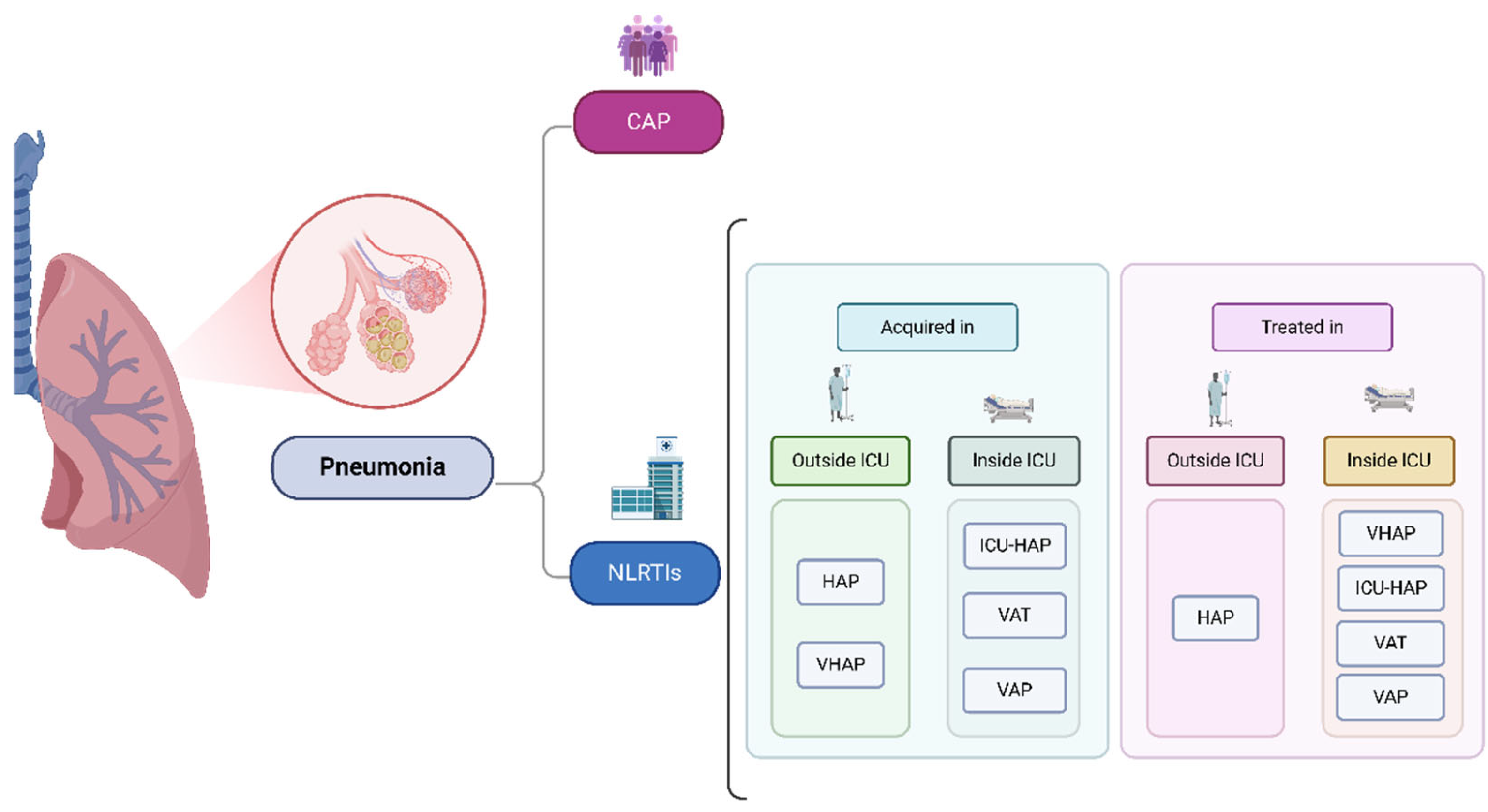
| nLTRI Classifications | Definition |
|---|---|
| HAP | LTRIs acquired outside the ICU at least ≥ 48 h after admission that do not require invasive mechanical ventilation |
| VHAP | LRTIs acquired outside the ICU at least ≥ 48 h after admission that require invasive mechanical ventilation |
| ICU-HAP | LRTI acquired at least ≥ 48 h after ICU admission that do not require invasive mechanical ventilation |
| VAP | A condition in which a patient who is admitted to the ICU requiring mechanical ventilation for reasons different from LRTI and, after ≥ 48 h of tracheal intubation/tracheostomy, develops an LRTI |
| VAT | A condition in which a patient who is admitted to the ICU requiring mechanical ventilation for reasons different from LRTI develops an LRTI at least ≥ 48 h after tracheal intubation/tracheostomy without a new or progressive radiological pulmonary infiltrate being detected |
| European Guidelines (ERS/ESICM/ESCMID/ALAT) [5] | American Guidelines (IDSA/ATS) [1] |
|---|---|
High-Risk HAP/VAP
| Risk factors for MDR HAP
|
| Sampling Method | Advantages | Disadvantages | References |
|---|---|---|---|
| Non-Invasive Sampling Methods | |||
| Spontaneous Expectoration | Easy to perform | Lower diagnostic accuracy due to contamination with oral and nasopharyngeal flora | [13] |
| Sputum Induction | Useful for non-intubated patients, can improve diagnostic yield | Requires patient cooperation, poses risk of inducing bronchospasm, potential for contamination with upper respiratory flora | [13,43] |
| Nasotracheal Suction | Useful for uncooperative patients | Risk of contamination with upper-respiratory flora, lower diagnostic accuracy | [13] |
| Endotracheal Aspirate (ETA) | Rapid, less costly, less invasive, easy to perform, high sensitivity (75.7%) | Lower specificity (67.9%), risk of contamination with upper-respiratory flora | [13,44] |
| Invasive Sampling Methods | |||
| Bronchoalveolar Lavage (BAL) | Higher specificity (79.6%) and sensitivity (71.1%), better for differentiating colonization from infection | More costly, requires trained personnel and specialized equipment, poses risk of complications like hypoxemia and bleeding | [1,36,44] |
| Protected Specimen Brush (PSB) | High specificity (76.5%), minimizes contamination from upper respiratory tract | Lower sensitivity (61.4%), more invasive and costly, requires bronchoscopy | [1,36,44] |
| Blind Bronchial Sampling | Can be performed without bronchoscopy, useful in settings in which bronchoscopy cannot be conducted, good diagnostic yield | Poses risk of contamination, lower specificity compared to bronchoscopic methods, requires skill to perform correctly | [1,45,46] |
| Commercial Name | Technique Used | Year of Launch |
|---|---|---|
| CLART ® PneumoVir | Multiplex Real-Time and Microarrays | 2008 |
| Prodesse ProFLu+ Assay | Multiplex Real-Time PCR | 2008 |
| xMAP ® Respiratory VIral Panel | Bead-Based Arrays | 2008 |
| Luminex xTAG® Respiratory Viral Panel | Multiplex PCR and Bead-Based Array | 2008 |
| GenoSensor ® Respiratory Virus Panel | Microarrays | 2009 |
| RespiFinder ® 22 | Multiplex Real-Time PCR | 2010 |
| RespiFInder ® 2Smart | Multiplex Real-Time PCR | 2010 |
| FilmArray ® Respiratory Panel | Multiplex Real-Time PCR | 2011 |
| FTD Respiratory Pathogens 21 | Multiplex Real-Time PCR | 2011 |
| SimplexaTM Respiratory Panel | Multiplex Real-Time PCR | 2012 |
| AdvanSureTM RV Real-Time RT-PCR Kit | Multiplex Real-Time PCR | 2013 |
| AnyplexTM II RV16 Detection | Multiplex Real-Time PCR | 2013 |
| PowerChekTM Respiratory Viral Real-Time PCR Kit | Multiplex Real-Time PCR | 2014 |
| Verigene ® Respiratory Pathogens Flex Test | Multiplex Real-Time PCR | 2014 |
| NxTAG ® Respiratory Pathogen Panel | Multiplex Real-Time PCR | 2015 |
| RIDA ® GENE Respiratory Panel | Multiplex Real-Time PCR | 2015 |
| 15Allplex TM Respiratory Panel | Multiplex Real-Time PCR | 2016 |
| ePlex ® Respiratory Pathogen Panel | Multiplex Real-Time PCR | 2017 |
| QIAstat-Dx ® Respiratory Panel | Multiplex Real-Time PCR | 2018 |
| BioCode ® Respiratory Pathogen Panel | Multiplex Real-Time PCR | 2019 |
Disclaimer/Publisher’s Note: The statements, opinions and data contained in all publications are solely those of the individual author(s) and contributor(s) and not of MDPI and/or the editor(s). MDPI and/or the editor(s) disclaim responsibility for any injury to people or property resulting from any ideas, methods, instructions or products referred to in the content. |
© 2025 by the authors. Licensee MDPI, Basel, Switzerland. This article is an open access article distributed under the terms and conditions of the Creative Commons Attribution (CC BY) license (https://creativecommons.org/licenses/by/4.0/).
Share and Cite
Bustos, I.G.; Martinez-Lemus, L.F.; Reyes, L.F.; Martin-Loeches, I. Transforming Microbiological Diagnostics in Nosocomial Lower Respiratory Tract Infections: Innovations Shaping the Future. Diagnostics 2025, 15, 265. https://doi.org/10.3390/diagnostics15030265
Bustos IG, Martinez-Lemus LF, Reyes LF, Martin-Loeches I. Transforming Microbiological Diagnostics in Nosocomial Lower Respiratory Tract Infections: Innovations Shaping the Future. Diagnostics. 2025; 15(3):265. https://doi.org/10.3390/diagnostics15030265
Chicago/Turabian StyleBustos, Ingrid G., Lina F. Martinez-Lemus, Luis Felipe Reyes, and Ignacio Martin-Loeches. 2025. "Transforming Microbiological Diagnostics in Nosocomial Lower Respiratory Tract Infections: Innovations Shaping the Future" Diagnostics 15, no. 3: 265. https://doi.org/10.3390/diagnostics15030265
APA StyleBustos, I. G., Martinez-Lemus, L. F., Reyes, L. F., & Martin-Loeches, I. (2025). Transforming Microbiological Diagnostics in Nosocomial Lower Respiratory Tract Infections: Innovations Shaping the Future. Diagnostics, 15(3), 265. https://doi.org/10.3390/diagnostics15030265