APACHE II and NUTRIC Scores for Mortality Prediction in Chronic Critical Illness: A “Right-Side” Prognostic Modeling Approach

 , , , , , and
Abstract
1. Introduction
2. Materials and Methods
2.1. Data Sources
2.2. Selection Criteria and Study Population
2.3. Data Extraction
2.4. Outcomes
2.5. Statistical Analysis
3. Results
3.1. Patient Characteristics
3.2. Effectiveness of Scales
4. Discussion
4.1. Key Findings
4.2. Relationship with Previous Studies
4.3. Significance of the Study Findings
4.4. Strengths and Limitations
4.5. Further Investigations
5. Conclusions
Supplementary Materials
Author Contributions
Funding
Institutional Review Board Statement
Informed Consent Statement
Data Availability Statement
Conflicts of Interest
Abbreviations
| CCI | chronic critical illness |
| APACHE II | Acute Physiology and Chronic Health Evaluation II |
| NUTRIC | Nutrition Risk in the Critically Ill |
| AUROC | area under the receiver operating characteristic curve |
| ICU | intensive care unit |
| EHR | electronic health record |
| RICD | Russian Intensive Care Dataset |
| BMI | body mass index |
| SOFA | Sequential Organ Failure Assessment |
| FOUR | Full Outline of UnResponsiveness |
| GCS | Glasgow Coma Scale |
| CRS-R | Coma Recovery Scale—Revised |
| DRS | Disability Rating Scale |
| MV | mechanical ventilation |
| IQR | interquartile range |
| ROC | receiver operating characteristic |
| COPD | chronic obstructive pulmonary disease |
| CI | confidence interval |
References
- Voiriot, G.; Oualha, M.; Pierre, A.; Salmon-Gandonnière, C.; Gaudet, A.; Jouan, Y.; Kallel, H.; Radermacher, P.; Vodovar, D.; Sarton, B.; et al. Chronic critical illness and post-intensive care syndrome: From pathophysiology to clinical challenges. Ann. Intensive Care 2022, 12, 58. [Google Scholar] [CrossRef] [Scilit] [PubMed]
- Ohbe, H.; Satoh, K.; Totoki, T.; Tanikawa, A.; Shirasaki, K.; Kuribayashi, Y.; Tamura, M.; Takatani, Y.; Ishikura, H.; Nakamura, K.; et al. Definitions, epidemiology, and outcomes of persistent/chronic critical illness: A scoping review for translation to clinical practice. Crit. Care 2024, 28, 435. [Google Scholar] [CrossRef] [Scilit] [PubMed]
- Brakenridge, S.; Kornblith, L.; Cuschieri, J. Multiple organ failure: What you need to know. J. Trauma Acute Care Surg. 2024, 97, 831–838. [Google Scholar] [CrossRef] [Scilit] [PubMed]
- Rosenthal, M.D.; Vanzant, E.L.; Moore, F.A. Chronic critical illness and pics nutritional strategies. J. Clin. Med. 2021, 10, 2294. [Google Scholar] [CrossRef] [Scilit]
- Hawkins, R.B.; Raymond, S.L.; Stortz, J.A.; Horiguchi, H.; Brakenridge, S.C.; Gardner, A.; Efron, P.A.; Bihorac, A.; Segal, M.; Moore, F.A.; et al. Chronic Critical Illness and the Persistent Inflammation, Immunosuppression, and Catabolism Syndrome. Front. Immunol. 2018, 9, 1511. [Google Scholar] [CrossRef] [Scilit]
- Madrid, R.A.; McGee, W. Value, Chronic Critical Illness, and Choosing Wisely. J. Intensive Care Med. 2019, 34, 609–614. [Google Scholar] [CrossRef] [Scilit]
- Rousseau, A.-F.; Prescott, H.C.; Brett, S.J.; Weiss, B.; Azoulay, E.; Creteur, J.; Latronico, N.; Hough, C.L.; Weber-Carstens, S.; Vincent, J.-L.; et al. Long-term outcomes after critical illness: Recent insights. Crit. Care 2021, 25, 108. [Google Scholar] [CrossRef] [Scilit]
- Marchioni, A.; Fantini, R.; Antenora, F.; Clini, E.; Fabbri, L. Chronic critical illness: The price of survival. Eur. J. Clin. Investig. 2015, 45, 1341–1349. [Google Scholar] [CrossRef] [Scilit]
- Kahn, J.M.; Le, T.; Angus, D.C.; Cox, C.E.; Hough, C.L.; White, D.B.; Yende, S.; Carson, S.S. The epidemiology of chronic critical Illness in the United States. Crit. Care Med. 2015, 43, 282–287. [Google Scholar] [CrossRef] [Scilit]
- Nelson, J.E.; Cox, C.E.; Hope, A.A.; Carson, S.S. Chronic critical illness. Am. J. Respir. Crit. Care Med. 2010, 182, 446–454. [Google Scholar] [CrossRef] [Scilit]
- Iwashyna, T.J.; Hodgson, C.L.; Pilcher, D.; Bailey, M.; van Lint, A.; Chavan, S.; Bellomo, R. Timing of onset and burden of persistent critical illness in Australia and New Zealand: A retrospective, population-based, observational study. Lancet Respir. Med. 2016, 4, 566–573. [Google Scholar] [CrossRef] [Scilit] [PubMed]
- Knaus, W.A.; Draper, E.A.; Wagner, D.P.; Zimmerman, J.E. APACHE II: A severity of disease classification system. Crit. Care Med. 1985, 13, 818–829. [Google Scholar] [CrossRef] [Scilit] [PubMed]
- Zimmerman, J.E.; Kramer, A.A. Outcome prediction in critical care: The Acute Physiology and Chronic Health Evaluation models. Curr. Opin. Crit. Care 2008, 14, 491–497. [Google Scholar] [CrossRef] [Scilit] [PubMed]
- Salluh, J.I.F.; Soares, M. ICU severity of illness scores: APACHE, SAPS and MPM. Curr. Opin. Crit. Care 2014, 20, 557–565. [Google Scholar] [CrossRef] [Scilit]
- Lew, C.C.H.; Yandell, R.; Fraser, R.J.L.; Chua, A.P.; Chong, M.F.F.; Miller, M. Association between Malnutrition and Clinical Outcomes in the Intensive Care Unit: A Systematic Review. J. Parenter. Enter. Nutr. 2017, 41, 744–758. [Google Scholar] [CrossRef] [Scilit]
- Koekkoek, K.W.A.C.; Van Zanten, A.R.H. Nutrition in the critically ill patient. Curr. Opin. Anaesthesiol. 2017, 30, 178–185. [Google Scholar] [CrossRef] [Scilit]
- Heyland, D.K.; Dhaliwal, R.; Jiang, X.; Day, A.G. Identifying critically ill patients who benefit the most from nutrition therapy: The development and initial validation of a novel risk assessment tool. Crit. Care 2011, 15, R268. [Google Scholar] [CrossRef] [Scilit]
- Rahman, A.; Hasan, R.M.; Agarwala, R.; Martin, C.; Day, A.G.; Heyland, D.K. Identifying critically-ill patients who will benefit most from nutritional therapy: Further validation of the “modified NUTRIC” nutritional risk assessment tool. Clin. Nutr. 2016, 35, 158–162. [Google Scholar] [CrossRef] [Scilit]
- Mukhopadhyay, A.; Henry, J.; Ong, V.; Leong, C.S.-F.; Teh, A.L.; van Dam, R.M.; Kowitlawakul, Y. Association of modified NUTRIC score with 28-day mortality in critically ill patients. Clin. Nutr. 2017, 36, 1143–1148. [Google Scholar] [CrossRef] [Scilit]
- Compher, C.; Chittams, J.; Sammarco, T.; Nicolo, M.; Heyland, D.K. Greater protein and energy intake may be associated with improved mortality in higher risk critically ill patients: A multicenter, multinational observational study. Crit. Care Med. 2017, 45, 156–163. [Google Scholar] [CrossRef] [Scilit]
- Azoulay, E.; Vincent, J.-L.; Angus, D.C.; Arabi, Y.M.; Brochard, L.; Brett, S.J.; Citerio, G.; Cook, D.J.; Curtis, J.R.; dos Santos, C.C.; et al. Recovery after critical illness: Putting the puzzle together—A consensus of 29. Crit. Care 2017, 21, 296. [Google Scholar] [CrossRef] [Scilit] [PubMed]
- Grechko, A.V.; Yadgarov, M.Y.; Yakovlev, A.A.; Berikashvili, L.B.; Kuzovlev, A.N.; Polyakov, P.A.; Kuznetsov, I.V.; Likhvantsev, V.V. Russian Intensive Care Dataset—RICD. Gen. Reanimatol. 2024, 20, 22–31. [Google Scholar] [CrossRef] [Scilit]
- von Elm, E.; Altman, D.G.; Egger, M.; Pocock, S.J.; Gøtzsche, P.C.; Vandenbroucke, J.P. The Strengthening the Reporting of Observational Studies in Epidemiology (STROBE) statement: Guidelines for reporting observational studies. Ann. Intern. Med. 2007, 147, 573–577. [Google Scholar] [CrossRef] [Scilit] [PubMed]
- DeLong, E.R.; DeLong, D.M.; Clarke-Pearson, D.L. Comparing the Areas under Two or More Correlated Receiver Operating Characteristic Curves: A Nonparametric Approach. Biometrics 1988, 44, 837. [Google Scholar] [CrossRef] [Scilit]
- Hosokawa, K.; Shime, N. Predictive Values of Initial Severity Scores at Intensive Care Unit Admission for Patients with Overnight or Prolonged Stay. Res. Sq. 2021. preprint. [Google Scholar] [CrossRef] [Scilit]
- Lefering, R.; Waydhas, C. Prediction of prolonged length of stay on the intensive care unit in severely injured patients—A registry-based multivariable analysis. Front. Med. 2024, 11, 1358205. [Google Scholar] [CrossRef] [Scilit]
- Likhvantsev, V.V.; Berikashvili, L.B.; Yadgarov, M.Y.; Yakovlev, A.A.; Kuzovlev, A.N. The Tri-Steps Model of Critical Conditions in Intensive Care: Introducing a New Paradigm for Chronic Critical Illness. J. Clin. Med. 2024, 13, 3683. [Google Scholar] [CrossRef] [Scilit]
- Liu, X.; Shen, M.; Lie, M.; Zhang, Z.; Liu, C.; Li, D.; Mark, R.G.; Zhang, Z.; Celi, L.A. Evaluating Prognostic Bias of Critical Illness Severity Scores Based on Age, Sex, and Primary Language in the United States: A Retrospective Multicenter Study. Crit. Care Explor. 2024, 6, E1033. [Google Scholar] [CrossRef] [Scilit]
- Liu, X.; Hu, P.; Yeung, W.; Zhang, Z.; Ho, V.; Liu, C.; Dumontier, C.; Thoral, P.J.; Mao, Z.; Cao, D.; et al. Illness severity assessment of older adults in critical illness using machine learning (ELDER-ICU): An international multicentre study with subgroup bias evaluation. Lancet Digit. Health 2023, 5, e657–e667. [Google Scholar] [CrossRef] [Scilit]
- Hatakeyama, J.; Nakamura, K.; Inoue, S.; Liu, K.; Yamakawa, K.; Nishida, T.; Ohshimo, S.; Hashimoto, S.; Kanda, N.; Aso, S.; et al. Two-year trajectory of functional recovery and quality of life in post-intensive care syndrome: A multicenter prospective observational study on mechanically ventilated patients with coronavirus disease-19. J. Intensive Care 2025, 13, 7. [Google Scholar] [CrossRef] [Scilit]
- Herridge, M.S.; Azoulay, É. Outcomes after Critical Illness. N. Engl. J. Med. 2023, 388, 913–924. [Google Scholar] [CrossRef] [Scilit]
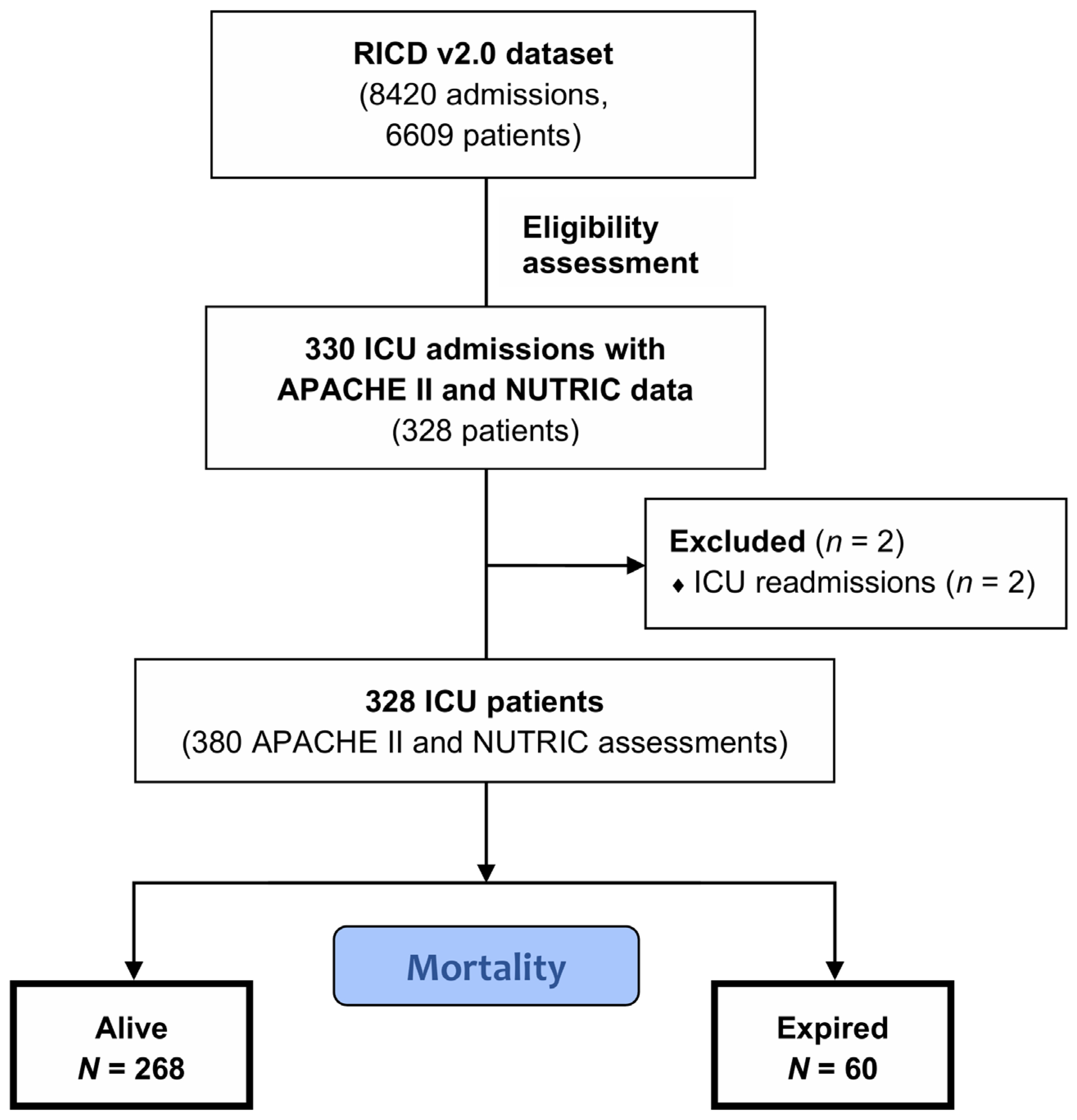


| Parameters | Alive N = 268 | Expired N = 60 | p-Value | |
|---|---|---|---|---|
| Sex | male | 140, 52.2% | 27, 45.0% | 0.3 1 |
| female | 128, 47.8% | 33, 55.0% | ||
| Age, years | 62 (IQR 48–74) | 73 (IQR 56–82) | <0.001 2 | |
| BMI, kg/m2 | N = 241, 25 (IQR 23–29) | N = 56, 26 (IQR 23–30) | 0.8 2 | |
| Scales at admission | ||||
| APACHE II at admission, score | N = 225, 15 (IQR 11–18) | N = 54, 21 (IQR 16–27) | <0.001 2 | |
| NUTRIC at admission, score | N = 225, 4 (IQR 3–5) | N = 54, 5 (IQR 4–7) | <0.001 2 | |
| SOFA at admission, score | N = 265, 4 (IQR 3–5) | N = 58, 5 (IQR 3–7) | <0.001 2 | |
| FOUR at admission, score | N = 257, 13 (IQR 11–16) | N = 55, 12 (IQR 8–14) | 0.016 2 | |
| GCS at admission, score | N = 263, 11 (IQR 9–13) | N = 58, 10 (IQR 7–12) | 0.029 2 | |
| CRS-R at admission, score | N = 128, 13 (IQR 6–20) | N = 22, 8 (IQR 5–13) | 0.067 2 | |
| DRS at admission, score | N = 253, 21 (IQR 18–23) | N = 55, 23 (IQR 19–25) | 0.027 2 | |
| Comorbidity | ||||
| Ischemic stroke | 130, 48.5% | 36, 60.0% | 0.1 1 | |
| Hemorrhagic stroke | 55, 20.5% | 10, 16.7% | 0.6 1 | |
| Traumatic brain injury | 43, 16.0% | 9, 15.0% | 0.9 1 | |
| Anemia | 62, 23.1% | 14, 23.3% | 0.9 1 | |
| Type 2 diabetes mellitus | 40, 14.9% | 17, 28.3% | 0.016 1 | |
| Cerebrovascular disease | 19, 7.1% | 7, 11.7% | 0.3 1 | |
| Chronic kidney disease | 31, 11.6% | 17, 28.3% | 0.002 1 | |
| COPD | 159, 59.3% | 43, 71.7% | 0.08 1 | |
| Myocardial infarction | 2, 0.7% | 1, 1.7% | 0.5 3 | |
| Coronary artery disease | 159, 59.3% | 43, 71.7% | 0.08 1 | |
| Atrial fibrillation | 30, 11.2% | 12, 20.0% | 0.09 1 | |
| Arterial hypertension | 223, 83.2% | 50, 83.3% | 0.9 1 | |
| Coagulopathy | 4, 1.5% | 2, 3.3% | 0.3 3 | |
| Heart failure | 56, 20.9% | 12, 20.0% | 0.9 1 | |
| Polytrauma | 12, 4.5% | 1, 1.7% | 0.5 3 | |
| Malignant tumor | 4, 1.5% | 0, 0.0% | 0.9 3 | |
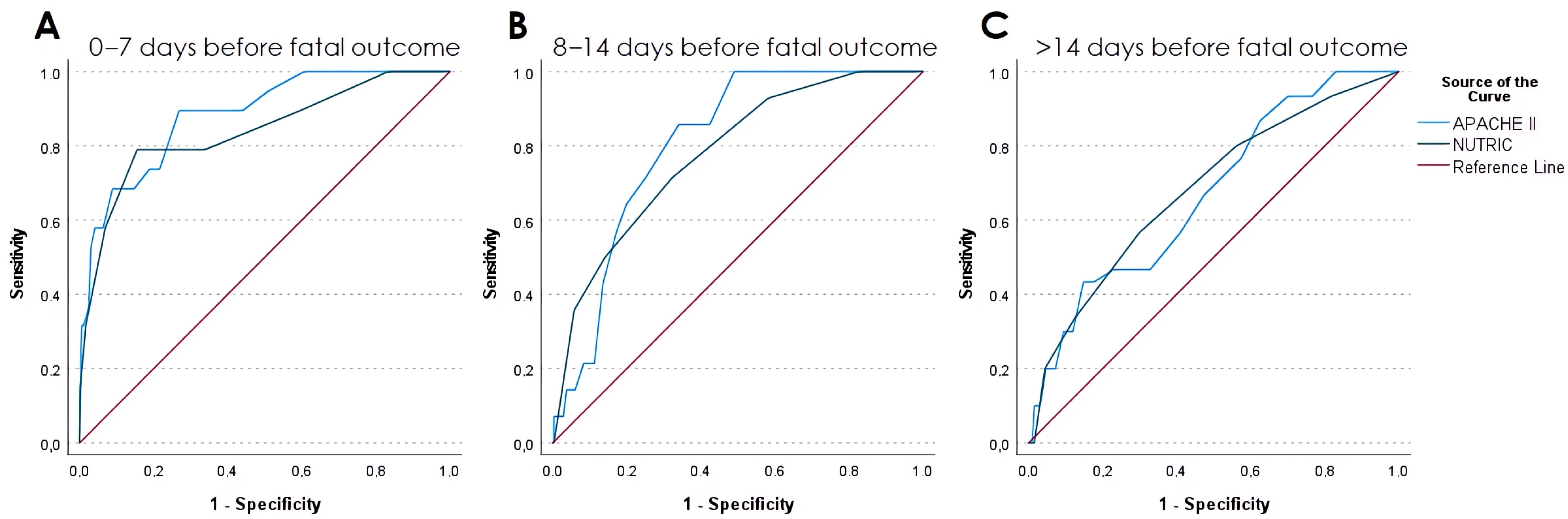
| Predictive Variables | AUROC | 95% CI | p-Value | Best Cutoff Value | Sensitivity | Specificity |
|---|---|---|---|---|---|---|
| 0–7 days before fatal outcome | ||||||
| APACHE II (19 pos. 361 neg.) | 0.883 | 0.808–0.958 | <0.001 | 19 | 89.5 | 73.1 |
| NUTRIC (19 pos. 361 neg.) | 0.839 | 0.732–0.946 | <0.001 | 6 | 78.9 | 84.5 |
| p-value * | 0.245 | |||||
| 8–14 days before fatal outcome | ||||||
| APACHE II (14 pos. 347 neg.) | 0.807 | 0.730–0.884 | <0.001 | 18 | 85.7 | 66.0 |
| NUTRIC (14 pos. 347 neg.) | 0.778 | 0.663–0.893 | <0.001 | 5 | 71.4 | 67.7 |
| p-value * | 0.559 | |||||
| ≥15 days before fatal outcome | ||||||
| APACHE II (30 pos. 317 neg.) | 0.671 | 0.575–0.767 | <0.001 | 21 | 43.3 | 85.2 |
| NUTRIC (30 pos. 317 neg.) | 0.681 | 0.579–0.782 | <0.001 | 5 | 56.7 | 70.0 |
| p-value * | 0.748 | |||||
Disclaimer/Publisher’s Note: The statements, opinions and data contained in all publications are solely those of the individual author(s) and contributor(s) and not of MDPI and/or the editor(s). MDPI and/or the editor(s) disclaim responsibility for any injury to people or property resulting from any ideas, methods, instructions or products referred to in the content. |
© 2025 by the authors. Licensee MDPI, Basel, Switzerland. This article is an open access article distributed under the terms and conditions of the Creative Commons Attribution (CC BY) license (https://creativecommons.org/licenses/by/4.0/).
Share and Cite
Zhidilyaev, D.V.; Berikashvili, L.B.; Yadgarov, M.Y.; Polyakov, P.A.; Yakovlev, A.A.; Kuzovlev, A.N.; Likhvantsev, V.V. APACHE II and NUTRIC Scores for Mortality Prediction in Chronic Critical Illness: A “Right-Side” Prognostic Modeling Approach. Diagnostics 2025, 15, 3218. https://doi.org/10.3390/diagnostics15243218
Zhidilyaev DV, Berikashvili LB, Yadgarov MY, Polyakov PA, Yakovlev AA, Kuzovlev AN, Likhvantsev VV. APACHE II and NUTRIC Scores for Mortality Prediction in Chronic Critical Illness: A “Right-Side” Prognostic Modeling Approach. Diagnostics. 2025; 15(24):3218. https://doi.org/10.3390/diagnostics15243218
Chicago/Turabian StyleZhidilyaev, Dmitrij V., Levan B. Berikashvili, Mikhail Ya. Yadgarov, Petr A. Polyakov, Alexey A. Yakovlev, Artem N. Kuzovlev, and Valery V. Likhvantsev. 2025. "APACHE II and NUTRIC Scores for Mortality Prediction in Chronic Critical Illness: A “Right-Side” Prognostic Modeling Approach" Diagnostics 15, no. 24: 3218. https://doi.org/10.3390/diagnostics15243218
APA StyleZhidilyaev, D. V., Berikashvili, L. B., Yadgarov, M. Y., Polyakov, P. A., Yakovlev, A. A., Kuzovlev, A. N., & Likhvantsev, V. V. (2025). APACHE II and NUTRIC Scores for Mortality Prediction in Chronic Critical Illness: A “Right-Side” Prognostic Modeling Approach. Diagnostics, 15(24), 3218. https://doi.org/10.3390/diagnostics15243218