
Diagnostic Accuracy of Wearable ECG Devices for Atrial Fibrillation and ST-Segment Changes: A Systematic Review
 , , , and
Abstract
1. Introduction
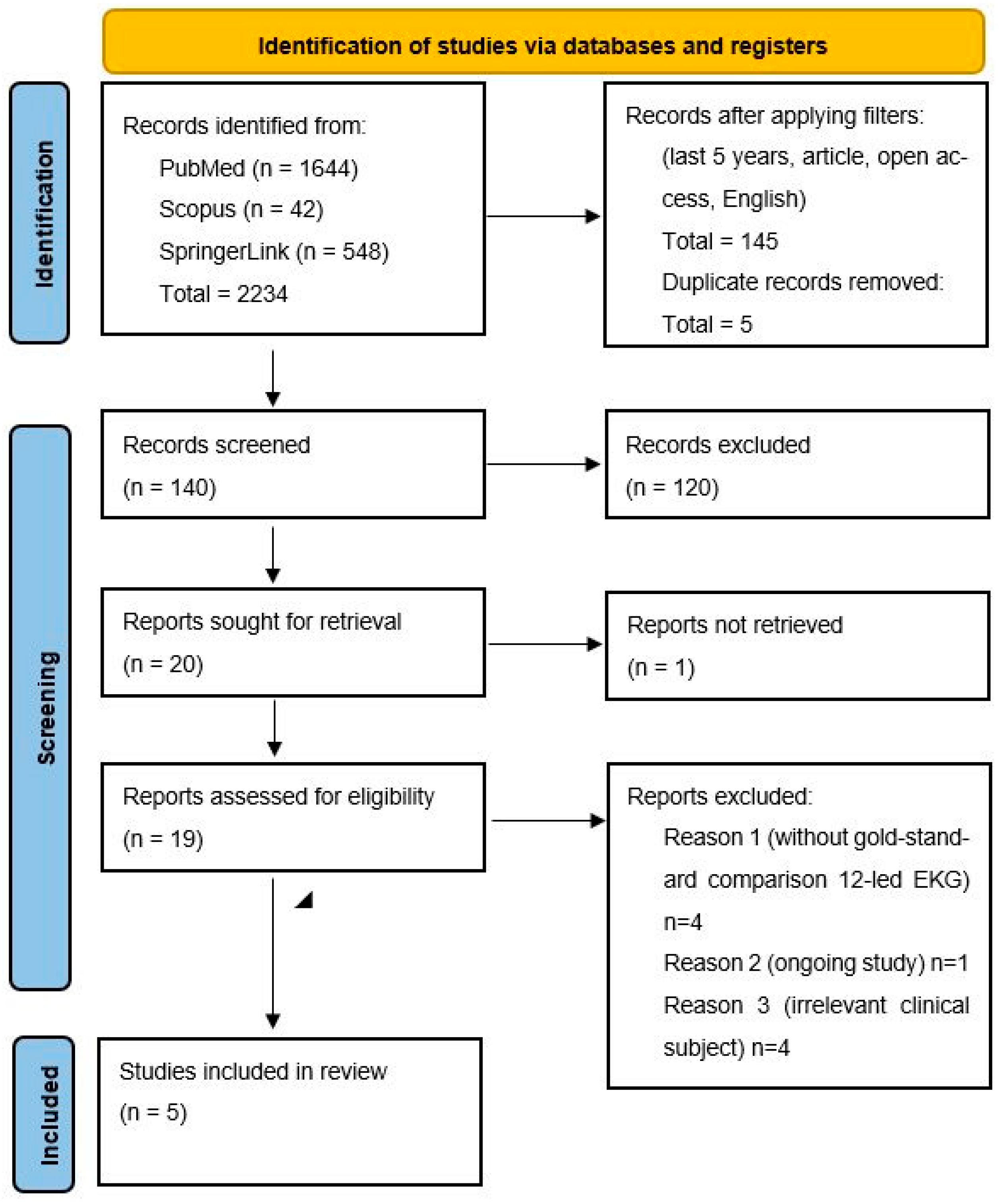
2. Materials and Methods
3. Results
3.1. Diagnostic Accuracy of the Apple Watch
3.2. Algorithmic Enhancements
3.3. Comparative Evaluation of Multiple Devices
3.4. Multichannel ECG Recording and ST-Segment Detection
3.5. Diagnostic Performance of a Dynamic ECG Wristband
3.6. Cross-Study Observations and Limitations
3.7. Summary of Diagnostic Performance
4. Discussion
4.1. Principal Findings
4.2. Strengths and Limitations
4.3. Clinical Implications
5. Conclusions
6. Future Research Directions
Author Contributions
Funding
Institutional Review Board Statement
Informed Consent Statement
Data Availability Statement
Conflicts of Interest
Abbreviations
| ECG | Electrocardiography |
| AF | Atrial fibrillation |
| SR | Sinus rhythm |
| M-TECH | Medical technology |
| PPG | Photoplethysmography |
| AUC | Area under the curve |
| TP | True positives |
| FP | False positives |
| TN | True negatives |
| FN | False negatives |
Appendix A
Appendix B

| Author | Study Design | Risk of Bias Tool Used | Overall Risk of Bias | Justification |
|---|---|---|---|---|
| Pepplinkhuizen et al. (2022) [2] | Prospective diagnostic validation study | ROBINS I | Moderate | This study confirms the high accuracy of the Apple Watch ECG for detecting AF in a clinical setting. While unclassified results slightly complicate interpretation, the study is generally well-conducted with only a low to moderate risk of bias. The findings are relevant for validating the device’s utility in AF detection among patients undergoing cardioversion. |
| Fu and Li (2021) [3] | Cross-sectional observational study | ROBINS I | Low | The study shows promising diagnostic performance of a wearable ECG device for AF screening, but suffers from a low-to-moderate risk of bias due to non-random participant selection. |
| Wouters et al. (2025) [4] | Comparative validation study | ROBINS I | Low | This validation study offers a robust comparison across several consumer wearable devices for AF detection, showing high diagnostic accuracy overall. However, the low risk of bias is primarily due to participant selection. |
| Spaccarotella et al. (2020) [5] | Feasibility and diagnostic concordance study | ROBINS I | Moderate | The study effectively demonstrates the technical feasibility of recording multichannel ECG with a smartwatch and detecting ST-segment changes. However, it carries a moderate risk of bias due to the selective inclusion of confirmed myocardial infarction patients and the absence of confounder control. |
| Velraeds et al. (2023) [6] | Algorithm development and validation study | ROBINS I | Moderate | This study proposes a meaningful algorithmic improvement in AF detection using Apple Watch ECG data. While the design included both development and validation cohorts, a moderate risk of bias remains due to possible selection bias and unadjusted confounding factors. Nonetheless, the study provides useful evidence to enhance smartwatch-based AF diagnosis. |
References
- Wyse, D.G.; Waldo, A.L.; DiMarco, J.P.; Domanski, M.J.; Rosenberg, Y.; Schron, E.B.; Kellen, J.C.; Greene, H.L.; Mickel, M.C.; Dalquist, J.E. A Comparison of Rate Control and Rhythm Control in Patients with Atrial Fibrillation. N. Engl. J. Med. 2002, 347, 1825–1833. [Google Scholar] [CrossRef]
- Pepplinkhuizen, S.; Hoeksema, W.F.; van der Stuijt, W.; van Steijn, N.J.; Winter, M.M.; Wilde, A.A.M.; Smeding, L.; Knops, R.E. Accuracy and Clinical Relevance of the Single-Lead Apple Watch Electrocardiogram to Identify Atrial Fibrillation. Cardiovasc. Digit. Health J. 2022, 3, S17–S22. [Google Scholar] [CrossRef] [PubMed]
- Fu, W.; Li, R. Diagnostic Performance of a Wearing Dynamic ECG Recorder for Atrial Fibrillation Screening: The HUAMI Heart Study. BMC Cardiovasc. Disord. 2021, 21, 558. [Google Scholar] [CrossRef]
- Wouters, F.; Gruwez, H.; Smeets, C.; Pijalovic, A.; Wilms, W.; Vranken, J.; Pieters, Z.; Van Herendael, H.; Nuyens, D.; Rivero-Ayerza, M. Comparative Evaluation of Consumer Wearable Devices for Atrial Fibrillation Detection: Validation Study. JMIR Form. Res. 2025, 9, e65139. [Google Scholar] [CrossRef]
- Spaccarotella, C.A.M.; Polimeni, A.; Migliarino, S.; Principe, E.; Curcio, A.; Mongiardo, A.; Sorrentino, S.; De Rosa, S.; Indolfi, C. Multichannel Electrocardiograms Obtained by a Smartwatch for the Diagnosis of ST-Segment Changes. JAMA Cardiol. 2020, 5, 1176. [Google Scholar] [CrossRef]
- Velraeds, A.; Strik, M.; Fontagne, L.; Haissaguerre, M.; Ploux, S.; Wang, Y.; Bordachar, P. Improving Automatic Smartwatch Electrocardiogram Diagnosis of Atrial Fibrillation by Identifying Regularity Within Irregularity. Sensors 2023, 23, 9283. [Google Scholar] [CrossRef] [PubMed]
- Shao, M.; Zhou, Z.; Bin, G.; Bai, Y.; Wu, S. A Wearable Electrocardiogram Telemonitoring System for Atrial Fibrillation Detection. Sensors 2020, 20, 606. [Google Scholar] [CrossRef]
- Torres-Soto, J.; Ashley, E.A. Multi-Task Deep Learning for Cardiac Rhythm Detection in Wearable Devices. NPJ Digit. Med. 2020, 3, 116. [Google Scholar] [CrossRef] [PubMed]
- Shahid, S.; Iqbal, M.; Saeed, H.; Hira, S.; Batool, A.; Khalid, S.; Tahirkheli, N.K. Diagnostic Accuracy of Apple Watch Electrocardiogram for Atrial Fibrillation: A Systematic Review and Meta-Analysis. JACC Adv. 2025, 4, 101538. [Google Scholar] [CrossRef]
- Tison, G.H.; Sanchez, J.M.; Ballinger, B.; Singh, A.; Olgin, J.E.; Pletcher, M.J.; Vittinghoff, E.; Lee, E.S.; Fan, S.M.; Gladstone, R.A. Passive Detection of Atrial Fibrillation Using a Commercially Available Smartwatch. JAMA Cardiol. 2018, 3, 409. [Google Scholar] [CrossRef]
- Gotlibovych, I.; Crawford, S.; Goyal, D.; Liu, J.; Kerem, Y.; Benaron, D.; Yilmaz, D.; Marcus, G.; Li, Y. End-To-End Deep Learning from Raw Sensor Data: Atrial Fibrillation Detection Using Wearables. arXiv 2018, arXiv:1807.10707. [Google Scholar] [CrossRef]
- Xintarakou, A.; Sousonis, V.; Asvestas, D.; Vardas, P.E.; Tzeis, S. Remote Cardiac Rhythm Monitoring in the Era of Smart Wearables: Present Assets and Future Perspectives. Front. Cardiovasc. Med. 2022, 9, 853614. [Google Scholar] [CrossRef]
- Duncker, D.; Ding, W.Y.; Etheridge, S.; Noseworthy, P.A.; Veltmann, C.; Yao, X.; Bunch, T.J.; Gupta, D. Smart Wearables for Cardiac Monitoring—Real-World Use beyond Atrial Fibrillation. Sensors 2021, 21, 2539. [Google Scholar] [CrossRef]
- Francisco, A.; Pascoal, C.; Lamborne, P.; Morais, H.; Gonçalves, M. Wearables and Atrial Fibrillation: Advances in Detection, Clinical Impact, Ethical Concerns, and Future Perspectives. Cureus 2025, 17, e77404. [Google Scholar] [CrossRef] [PubMed]
- Cheung, C.C.; Krahn, A.D.; Andrade, J.G. The Emerging Role of Wearable Technologies in Detection of Arrhythmia. Can. J. Cardiol. 2018, 34, 1083–1087. [Google Scholar] [CrossRef]
- Lubitz, S.A.; Faranesh, A.Z.; Selvaggi, C.; Atlas, S.J.; McManus, D.D.; Singer, D.E.; Pagoto, S.; McConnell, M.V.; Pantelopoulos, A.; Foulkes, A.S. Detection of Atrial Fibrillation in a Large Population Using Wearable Devices: The Fitbit Heart Study. Circulation 2022, 146, 1415–1424. [Google Scholar] [CrossRef]
- Abdelrazik, A.; Eldesouky, M.; Antoun, I.; Koya, A.; Vali, Z.; Suleman, S.A.; Donaldson, J.; Ng, G.A. Wearable Devices for Arrhythmia Detection: Advancements and Clinical Implications. Sensors 2025, 25, 2848. [Google Scholar] [CrossRef]
- McIntyre, W.F.; Connolly, S.J.; Healey, J.S. Atrial Fibrillation Occurring Transiently with Stress. Curr. Opin. Cardiol. 2018, 33, 58–65. [Google Scholar] [CrossRef]
- Wang, Y.-C.; Xu, X.; Hajra, A.; Apple, S.; Kharawala, A.; Duarte, G.; Liaqat, W.; Fu, Y.; Li, W.; Chen, Y. Current Advancement in Diagnosing Atrial Fibrillation by Utilizing Wearable Devices and Artificial Intelligence: A Review Study. Diagnostics 2022, 12, 689. [Google Scholar] [CrossRef] [PubMed]
- Lopez Perales, C.R.; Van Spall, H.G.C.; Maeda, S.; Jimenez, A.; Laţcu, D.G.; Milman, A.; Kirakoya-Samadoulougou, F.; Mamas, M.A.; Muser, D.; Casado Arroyo, R. Mobile Health Applications for the Detection of Atrial Fibrillation: A Systematic Review. EP Eur. 2020, 23, 11–28. [Google Scholar] [CrossRef] [PubMed]
- Raja, J.M.; Elsakr, C.; Roman, S.; Cave, B.; Pour-Ghaz, I.; Nanda, A.; Maturana, M.; Khouzam, R.N. Apple Watch, Wearables, and Heart Rhythm: Where Do We Stand? Ann. Transl. Med. 2019, 7, 417. [Google Scholar] [CrossRef]
- Papalamprakopoulou, Z.; Stavropoulos, D.; Moustakidis, S.; Avgerinos, D.; Efremidis, M.; Kampaktsis, P.N. Artificial Intelligence-Enabled Atrial Fibrillation Detection Using Smartwatches: Current Status and Future Perspectives. Front. Cardiovasc. Med. 2024, 11, 1432876. [Google Scholar] [CrossRef]
- Hamad, A.K. New Technologies for Detection and Management of Atrial Fibrillation. J. Saudi Heart Assoc. 2021, 33, 169–176. [Google Scholar] [CrossRef] [PubMed]
- Sibomana, O.; Hakayuwa, C.M.; Obianke, A.; Gahire, H.; Munyantore, J.; Molly Chilala, M. Diagnostic Accuracy of ECG Smart Chest Patches versus PPG Smartwatches for Atrial Fibrillation Detection: A Systematic Review and Meta-Analysis. BMC Cardiovasc. Disord. 2025, 25, 132. [Google Scholar] [CrossRef] [PubMed]
- Ding, E.Y.; Marcus, G.M.; McManus, D.D. Emerging Technologies for Identifying Atrial Fibrillation. Circ. Res. 2020, 127, 128–142. [Google Scholar] [CrossRef] [PubMed]
- Bumgarner, J.M.; Lambert, C.T.; Hussein, A.A.; Cantillon, D.J.; Baranowski, B.; Wolski, K.; Lindsay, B.D.; Wazni, O.M.; Tarakji, K.G. Smartwatch Algorithm for Automated Detection of Atrial Fibrillation. J. Am. Coll. Cardiol. 2018, 71, 2381–2388. [Google Scholar] [CrossRef]
- Piwek, L.; Ellis, D.A.; Andrews, S.; Joinson, A. The Rise of Consumer Health Wearables: Promises and Barriers. PLoS Med. 2016, 13, e1001953. [Google Scholar] [CrossRef]
- Perez, M.V.; Mahaffey, K.W.; Hedlin, H.; Rumsfeld, J.S.; Garcia, A.; Ferris, T.; Balasubramanian, V.; Russo, A.M.; Rajmane, A.; Cheung, L. Large-Scale Assessment of a Smartwatch to Identify Atrial Fibrillation. N. Engl. J. Med. 2019, 381, 1909–1917. [Google Scholar] [CrossRef]
- Goldstein, B.A.; Navar, A.M.; Pencina, M.J.; Ioannidis, J.P.A. Opportunities and Challenges in Developing Risk Prediction Models with Electronic Health Records Data: A Systematic Review. J. Am. Med. Inform. Assoc. 2016, 24, 198–208. [Google Scholar] [CrossRef]
- Attia, Z.I.; Noseworthy, P.A.; Lopez-Jimenez, F.; Asirvatham, S.J.; Deshmukh, A.J.; Gersh, B.J.; Carter, R.E.; Yao, X.; Rabinstein, A.A.; Erickson, B.J. An Artificial Intelligence-Enabled ECG Algorithm for the Identification of Patients with Atrial Fibrillation during Sinus Rhythm: A Retrospective Analysis of Outcome Prediction. Lancet 2019, 394, 861–867. [Google Scholar] [CrossRef]
- Hannun, A.Y.; Rajpurkar, P.; Haghpanahi, M.; Tison, G.H.; Bourn, C.; Turakhia, M.P.; Ng, A.Y. Publisher Correction: Cardiologist-Level Arrhythmia Detection and Classification in Ambulatory Electrocardiograms Using a Deep Neural Network. Nat. Med. 2019, 25, 530. [Google Scholar] [CrossRef]
- Kwon, J.; Lee, S.Y.; Jeon, K.; Lee, Y.; Kim, K.; Park, J.; Oh, B.; Lee, M. Deep Learning–Based Algorithm for Detecting Aortic Stenosis Using Electrocardiography. J. Am. Heart Assoc. 2020, 9, e014717. [Google Scholar] [CrossRef] [PubMed]
- Shcherbina, A.; Mattsson, C.; Waggott, D.; Salisbury, H.; Christle, J.; Hastie, T.; Wheeler, M.; Ashley, E. Accuracy in Wrist-Worn, Sensor-Based Measurements of Heart Rate and Energy Expenditure in a Diverse Cohort. J. Pers. Med. 2017, 7, 3. [Google Scholar] [CrossRef] [PubMed]
- Bent, B.; Goldstein, B.A.; Kibbe, W.A.; Dunn, J.P. Investigating Sources of Inaccuracy in Wearable Optical Heart Rate Sensors. NPJ Digit. Med. 2020, 3, 18. [Google Scholar] [CrossRef]
- Shimbo, D.; Artinian, N.T.; Basile, J.N.; Krakoff, L.R.; Margolis, K.L.; Rakotz, M.K.; Wozniak, G. Self-Measured Blood Pressure Monitoring at Home: A Joint Policy Statement from the American Heart Association and American Medical Association. Circulation 2020, 142, e42–e63. [Google Scholar] [CrossRef]
- Topol, E.J. High-Performance Medicine: The Convergence of Human and Artificial Intelligence. Nat. Med. 2019, 25, 44–56. [Google Scholar] [CrossRef]
- Esteva, A.; Chou, K.; Yeung, S.; Naik, N.; Madani, A.; Mottaghi, A.; Liu, Y.; Topol, E.; Dean, J.; Socher, R. Deep Learning-Enabled Medical Computer Vision. NPJ Digit. Med. 2021, 4, 5. [Google Scholar] [CrossRef]
- Kass-Hout, T.A.; Alhinnawi, H. Social Media in Public Health. Br. Med. Bull. 2013, 108, 5–24. [Google Scholar] [CrossRef] [PubMed]

| Study | Study Design | Device | Population | Reference Standard | TP (True Positives) | FP (False Positives) | TN (True Negatives) | FN (False Negatives) | Clinical Setting | Sensitivity | Specificity | Accuracy | Comments |
|---|---|---|---|---|---|---|---|---|---|---|---|---|---|
| Pepplinkhuizen et al. (2022) [2] | Prospective diagnostic validation study | Apple Watch (Single-lead ECG) | 74 patients with AF (mean age 67.1) | 12-lead ECG | 43 | 0 | 47 | 3 | Inpatient cardiology ward; simultaneous smartwatch + 12-lead ECG recordings in hospitalized patients | 93–94.6% | 96.5–100% | Not specified but inferred from sensitivity/specificity | High accuracy for AF detection, limited by unclassifiable readings. |
| Fu and Li (2021) [3] | Cross-sectional observational study | Wearable dynamic ECG recorder (Huami) | 114 outpatients (53 with AF) | 12-lead ECG | 47 | 0 | 61 | 6 | Community/outpatient screening; AF vs. SR recordings under rest and mild activity | 88.68–94.34% | 100% | 94.74–97.37% | Excellent sensitivity/specificity across body positions; feasible for remote use. |
| Wouters et al. (2025) [4] | Comparative validation study | Apple Watch, KardiaMobile 6L, FibriCheck, Preventicus | 122 participants (30 with AF) | 12-lead ECG | 25 | 2 | 95 | 0 | Outpatient cardiology clinic; resting ECG comparison in patients undergoing routine rhythm evaluation | 100% for all devices | 96.4–98.9% | High (97.4–99.2%) | All devices performed well; the Apple Watch was favored for usability. |
| Spaccarotella et al. (2020) [5] | Feasibility and diagnostic concordance study | Apple Watch (Multichannel ECG) | 100 participants (MI patients and controls) | 12-lead ECG | 50 | 3 | 43 | 4 | Emergency department/cath-lab setting; patients presenting with chest pain and suspected myocardial ischemia | 84–94% | 92–100% | High (Cohen’s k: 0.85–0.90) | Accurate for ST-segment changes with high agreement; requires physician guidance. |
| Velraeds et al. (2023) [6] | Algorithm development and validation study | Apple Watch (Enhanced AF detection algorithm) | 723 patients (21% with AF) | 12-lead ECG | 26 | 9 | 106 | 3 | Hospital inpatient cohort (cardiology department); mixed ECG abnormalities including AF, PACs, PVCs | 90% | 92% | Improved (91.67%) vs. original Apple algorithm (79.86%) | Improved diagnostic performance with an enhanced algorithm; eliminated inconclusive results. |
Disclaimer/Publisher’s Note: The statements, opinions and data contained in all publications are solely those of the individual author(s) and contributor(s) and not of MDPI and/or the editor(s). MDPI and/or the editor(s) disclaim responsibility for any injury to people or property resulting from any ideas, methods, instructions or products referred to in the content. |
© 2025 by the authors. Licensee MDPI, Basel, Switzerland. This article is an open access article distributed under the terms and conditions of the Creative Commons Attribution (CC BY) license (https://creativecommons.org/licenses/by/4.0/).
Share and Cite
Sîngeap, M.S.; Corneanu, L.E.; Prodaniuc, A.; Șova, I.A.; Coșovanu, E.O.; Petriș, O.R. Diagnostic Accuracy of Wearable ECG Devices for Atrial Fibrillation and ST-Segment Changes: A Systematic Review. Diagnostics 2025, 15, 3162. https://doi.org/10.3390/diagnostics15243162
Sîngeap MS, Corneanu LE, Prodaniuc A, Șova IA, Coșovanu EO, Petriș OR. Diagnostic Accuracy of Wearable ECG Devices for Atrial Fibrillation and ST-Segment Changes: A Systematic Review. Diagnostics. 2025; 15(24):3162. https://doi.org/10.3390/diagnostics15243162
Chicago/Turabian StyleSîngeap, Mara Sînziana, Luiza Elena Corneanu, Andrei Prodaniuc, Ivona Andreea Șova, Eric Oliviu Coșovanu, and Ovidiu Rusalim Petriș. 2025. "Diagnostic Accuracy of Wearable ECG Devices for Atrial Fibrillation and ST-Segment Changes: A Systematic Review" Diagnostics 15, no. 24: 3162. https://doi.org/10.3390/diagnostics15243162
APA StyleSîngeap, M. S., Corneanu, L. E., Prodaniuc, A., Șova, I. A., Coșovanu, E. O., & Petriș, O. R. (2025). Diagnostic Accuracy of Wearable ECG Devices for Atrial Fibrillation and ST-Segment Changes: A Systematic Review. Diagnostics, 15(24), 3162. https://doi.org/10.3390/diagnostics15243162