
Article

Clinical Significance of Incidentally Detected Parotid Masses on Brain MRI and PET-CT

1
Department of Otorhinolaryngology-Head and Neck Surgery, Hallym University Sacred Heart Hospital, College of Medicine, Hallym University, Anyang 14068, Republic of Korea
2
Division of Gastroenterology, Department of Internal Medicine, Hallym University Sacred Heart Hospital, College of Medicine, Hallym University, Anyang 14068, Republic of Korea
3
Department of Pathology, Hallym University Sacred Heart Hospital, College of Medicine, Hallym University, Anyang 14068, Republic of Korea
*
Author to whom correspondence should be addressed.
Diagnostics 2025, 15(22), 2895; https://doi.org/10.3390/diagnostics15222895
Submission received: 24 September 2025 / Revised: 29 October 2025 / Accepted: 11 November 2025 / Published: 14 November 2025
(This article belongs to the Special Issue Advances in the Diagnosis and Management of Head and Neck Disease)

Abstract

Background/Objectives: Parotid incidentalomas are increasingly detected during brain MRI and PET-CT, particularly in patients with serious diseases such as cancer. This study aimed to evaluate the clinical significance of incidentally identified parotid lesions. Methods: We retrospectively reviewed the records of 44,952 patients (≥19 years) who underwent brain MRI and 10,957 who underwent PET-CT between January 2014 and December 2023. The incidence, imaging findings, and pathological results of parotid incidentalomas were analyzed. Results: Among 44,952 brain MRIs, 100 incidental parotid lesions (0.22%) were detected, compared with 92 lesions (0.84%) among 10,957 PET-CT scans. The mean patient age was slightly higher in the PET-CT group. Of the MRI-detected lesions, 35 patients underwent further evaluation and 14 underwent surgery, with final pathology confirming only benign tumors, including pleomorphic adenomas, Warthin tumors, and basal cell adenomas. In contrast, among 23 PET-CT patients who underwent additional evaluation, 7 had surgery, and final pathology revealed both benign and malignant tumors. Malignant cases included mucoepidermoid carcinoma, metastatic Merkel cell carcinoma, metastatic sebaceous carcinoma, and adenoid cystic carcinoma. Notably, two patients with initially benign cytology and negative PET-CT findings were later confirmed to have malignancies after surgery, Primary sites of metastatic disease included the thyroid, cervix, head and neck, and skin. Conclusions: Most parotid incidentalomas detected on brain MRI are benign and may be managed conservatively. However, incidentalomas identified on PET-CT require thorough evaluation, as they may indicate metastatic disease or a second primary malignancy, particularly in patients with head and neck or skin cancers.

1. Introduction

Most parotid neoplasms can be readily detected through palpation or visual inspection. However, some are incidentally discovered during unrelated imaging studies, such as brain magnetic resonance imaging (MRI) or 18-F fluorodeoxyglucose (FDG) positron emission tomography-computed tomography (PET-CT)—particularly in patients with short necks or deeply located parotid lesions. Although parotid gland tumors are relatively uncommon, approximately 75% are benign [1,2,3]. Among these, pleomorphic adenoma is the most frequent benign tumor, with a reported risk of malignant transformation ranging from 1.8 to 6.2% [4,5].
For preoperative biopsy, fine-needle aspiration cytology (FNAC) is commonly performed as an initial diagnostic tool for salivary gland masses because it is relatively safe and easy to perform. However, due to the histologic heterogeneity of salivary gland tumors, the reported sensitivity of FNAC has been inconsistent, ranging from 48% to 94% for subclassifying neoplasms [6,7,8,9]. Owing to this variability and the relatively low diagnostic accuracy of preoperative biopsy, complete surgical excision is generally recommended to establish a definite diagnosis.
18 F-FDG PET-CT is a widely used imaging modality for cancer staging, particularly for detecting distant metastases and identifying occult primary malignancies. Parotid incidentalomas are frequently reported on PET-CT, with a prevalence ranging from 0.3% to 0.4% [10,11]. In one series, 558 incidentalomas were identified, of which 256 were benign and 112 were malignant [12]. Because small deep-lobe parotid tumors may not be palpable, they are often detected incidentally. A meta-analysis further demonstrated that deep-lobe parotid tumors have a malignancy rate of 26.6%, which is higher than that of tumors located in the superficial lobe [13].
Brain MRI is another commonly used imaging modality, often performed to evaluate conditions such as brain tumors, stroke, chronic headache, or facial nerve palsy. Many patients undergoing brain MRI or PET-CT as part of cancer or stroke evaluations are in poor general condition and are already receiving treatment for their primary disease. Consequently, determining whether to pursue further evaluation or treatment for an incidentally discovered parotid lesion can be clinically challenging.
In this study, we reviewed the clinical courses of patients with parotid incidentalomas detected on brain MRI or PET-CT performed during evaluations for their primary conditions and assessed the clinical relevance of these findings.

2. Materials and Methods

2.1. Patients

This retrospective study included 10,957 adult patients (aged ≥ 19 years) who underwent PET-CT and 44,952 patients who underwent brain MRI at our hospital between January 2014 and December 2023. The study was approved by the Institutional Review Board (IRB) of our hospital (IRB No. 2023-12-015-001) on 5 March 2024.
To identify potential parotid incidentalomas, PET-CT and brain MRI reports were screened for the keywords parotid, parotid gland, or PG. This search yielded 231 cases from PET-CT reports and 140 from MRI reports. Patient images and clinical histories were reviewed using the electronic medical record (EMR) system and the picture archiving and communication system (PACS).
Patients with lymphoproliferative diseases or radiologic findings suggestive of multiple lymph node metastases—where a parotid lesion could represent lymphoproliferative involvement or intra-parotid lymph node metastasis without further diagnostic work-up—were excluded. Additionally, patients with a prior diagnosis or treatment of parotid malignancy were also excluded.
After applying these exclusion criteria, 92 PET-CT cases and 100 brain MRI cases with parotid incidentalomas were included in the analysis, as illustrated in the flowchart (Figure 1).
Lesion size was measured, and radiologic interpretations were reviewed. From the EMR, we also extracted data on the primary indication for imaging (brain MRI or PET-CT), biopsy results—including FNAC and core needle biopsy (CNB)—and each patient’s Eastern Cooperative Oncology Group (ECOG) performance status [14] and American Society of Anesthesiologists (ASA) physical status classification [15].
The final study population comprised 192 patients: 115 men (59.9%) and 77 women (40.1%), with ages ranging from 19 to 92 years (mean age, 68.7 ± 12.6 years). Of these, 100 patients underwent brain MRI (47 men and 53 women; mean age, 68.90 ± 12.61 years) and 92 underwent PET-CT (68 men and 24 women; mean age, 69.49 ± 11.64 years) (Table 1). Detailed clinical characteristics are summarized in Table 1.

2.2. Statistical Analysis

Statistical analyses were performed using IBM SPSS Statistics software (version 27.0; IBM Corp., Armonk, NY, USA). The prevalence of incidental parotid masses and individual disease entities was evaluated. Continuous variables were expressed as mean ± standard deviation (SD). Student’s t-test and the chi-square test were used to analyze patient demographic data. A p-value < 0.05 was considered statistically significant for all analyses.

3. Results

3.1. Incidence of Parotid Incidentalomas on Brain MRI and PET-CT

Among the 44,952 brain MRI scans, 100 parotid lesions (0.22%) were incidentally detected. In comparison, 92 parotid lesions (0.84%) were identified among 10,957 PET-CT scans. The mean age was slightly higher in the PET-CT group than in the MRI group (69.49 ± 11.64 vs. 68.90 ± 12.61 years, respectively). Among the MRI-detected lesions, 35 patients (35.0%) underwent further evaluation, such as FNAC or CNB (Table 1). In the PET-CT group, 23 patients underwent additional evaluation for parotid incidentalomas. Of these, 14 patients in the MRI group and 7 in the PET-CT group underwent surgical excision for their parotid lesions.
Table 2 summarizes the indications for PET-CT scans in patients with parotid incidentalomas and the stages of their primary cancers. Lung cancer was the most common primary malignancy associated with parotid incidentalomas. Head and neck cancers and skin cancers were also relatively frequent, despite their lower overall incidence. Advanced-stage primary cancers were identified in approximately half of the patients with parotid incidentalomas.

3.2. Characteristics of Patients with Parotid Incidentalomas Who Underwent Further Evaluation

In the MRI group, the mean age did not differ significantly between patients who underwent further evaluation and those who did not (69.32 ± 9.96 years vs. 68.65 ± 14.01 years, p = 0.182) (Table 3). The mean size of the parotid mass was slightly larger in patients who underwent additional evaluation (1.87 ± 0.61 vs. 1.83 ± 0.99 cm, p = 0.067), although the difference was not statistically significant. General patient conditions, including ECOG performance status and ASA physical status classification, were also comparable between the two groups. The clinical indications for MRI among patients who underwent further evaluation were diverse, ranging from mild to severe conditions such as stroke, cancer work-up, neuropathy, and dizziness.
In contrast, a smaller proportion of patients (23 patients, 25.0%) in the PET-CT group underwent further evaluation for parotid lesions (Table 4). Similar to the MRI group, there were no significant differences in sex or mean age between those who did and did not undergo additional evaluation. The mean SUV was slightly higher in patients who underwent further evaluation, but the difference was not statistically significant (7.02 ± 2.97 vs. 6.77 ± 2.73, p = 0.859). Interestingly, the stages of primary cancer were relatively lower in patients who underwent additional evaluation, and many had primary head and neck (laryngeal, tonsillar, and nasopharyngeal) or thyroid cancers.

3.3. Comparison Between Initial Work-Up and Final Pathologic Results

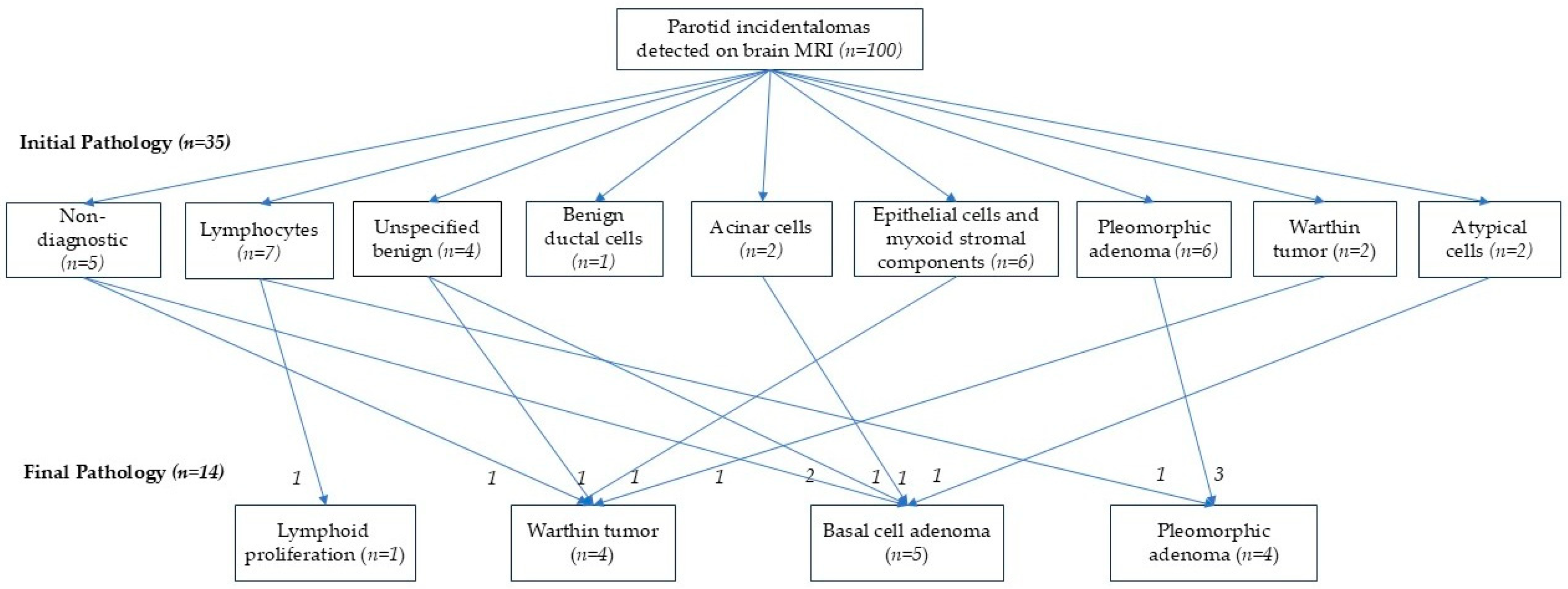
Figure 2 presents the histologic results of parotid incidentalomas detected on brain MRI. Initial cytologic diagnoses obtained through FNAC or CNB included 4 cases of unspecified benign lesions, 6 with epithelial cells and myxoid stromal components, 1 with benign ductal cells, 7 with lymphocytes, 2 with acinar cells, 5 with cystic or fibrotic exudate or scanty cellularity (non-diagnostic), 2 with atypical cells, 6 pleomorphic adenomas, and 2 Warthin tumors. Among these, 14 patients underwent surgical resection of their incidentally detected parotid lesions. Final pathology confirmed 4 pleomorphic adenomas, 4 Warthin tumors, 5 basal cell adenomas, and 1 case of lymphoid proliferation—all classified as benign tumors (Figure 2). All MRI interpretations in surgically treated patients were also reported as benign.
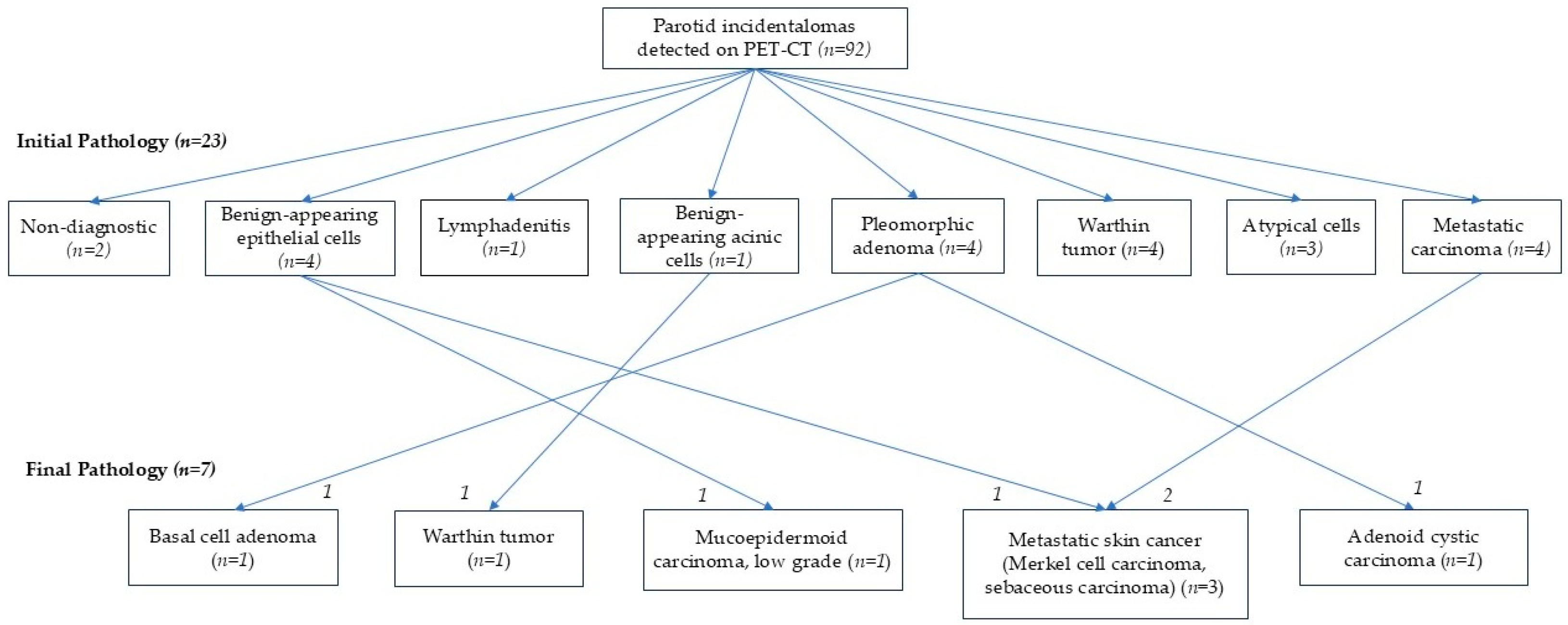
In the PET-CT group, the initial diagnoses were as follows: 4 cases of benign-appearing epithelial cells, 1 of benign-appearing acinic cells, 1 lymphadenitis, 4 metastatic carcinomas, 2 with cystic changes or scant cellularity (non-diagnostic), 3 with atypical cells, 4 pleomorphic adenomas, and 4 Warthin tumors (Figure 3). Among these patients, 7 underwent surgery. Final pathological diagnoses included 1 mucoepidermoid carcinoma (low grade), 1 metastatic Merkel cell carcinoma, 1 metastatic carcinoma, 1 metastatic sebaceous carcinoma, 1 adenoid cystic carcinoma, and 1 basal cell adenoma. Notably, in two cases, the initial pathology showed benign-appearing epithelial cells, and the PET-CT report did not suggest malignancy; however, malignancy was confirmed after surgical excision. Additionally, one case initially diagnosed as pleomorphic adenoma was later confirmed as adenoid cystic carcinoma. In the case initially diagnosed as metastatic carcinoma, metastasis was also confirmed in the final pathology. The primary sites in patients with initially benign but ultimately malignant parotid lesions were the thyroid and cervix, while four other metastatic cases originated from primary cancers of the skin and head and neck region.

3.4. Clinical Outcomes During Follow-Up of Parotid Incidentalomas

The median follow-up period was 14.5 month (range, 1–148 months) in the PET-CT group, with 35% of patients followed for less than 6 months. In the MRI group, the median follow-up period was 16 months (range, 1–120 months). Twenty patients in the PET-CT group died from their primary diseases during follow-up. In the MRI group, 14 patients died from their primary disease, and 19 underwent follow-up imaging without surgery. Of these, 17 showed stable lesion size, one lesion increased, and one resolved spontaneously. Among the PET-CT group, 19 patients underwent follow-up imaging without surgery; 15 showed no change in size, 4 showed increased size, and 1 showed decreased size. No patients in either group died of parotid disease.

4. Discussion

With advances in radiological imaging, PET-CT and MRI have been increasingly utilized in diverse clinical settings. PET-CT offers whole-body coverage, and many parotid tumors demonstrate high SUV uptake regardless of whether they are malignant or benign [16]. Consequently, parotid incidentalomas are frequently detected and have been increasingly reported. A recent systematic review of 558 parotid incidentalomas found a mean incidence of 0.74% on PET-CT, which is comparable to our finding (0.84%) [12]. Another large study reported a higher incidence (1.73%), likely due to the inclusion of non-focal ultrasonographic findings and metastatic lesions from lymphoma [17]. In contrast, our study excluded patients with lymphoproliferative disease, parotid gland metastases in interpretation, or a history of parotid malignancy to better define true parotid incidentalomas, which may explain the lower incidence observed.
The most common indication for PET-CT in both previous studies [12,17] and in our series was lung cancer. Among parotid incidentalomas, Warthin tumor is one of the most frequent findings on PET-CT because of its high glucose avidity [18,19]. A recent meta-analysis of PET-CT–detected parotid incidentalomas involving Warthin tumor also demonstrated a low referral rate for further evaluation and a similar median SUV uptake (7.21) [20]. However, that study was limited by a lack of detailed histopathologic data, as a surgical confirmation was performed in only three cases. Consistent with prior reports, our series also showed a predominance of benign lesions among parotid incidentalomas, although malignant lesions were observed in PET-CT–detected group [12,17].
Regarding MRI, a previous study of 7262 patients reported a 1.2% incidence of parotid incidentalomas (86/7292), which was higher than that in our study (0.22%) [21]. Pathologic evaluation was performed in 49 of those 86 cases (57.0%), with most lesions (46/49, 93.9%) being benign—consistent with our findings. In contrast, while no malignant cases were identified in our MRI group, their study reported three malignant parotid incidentalomas (one mucoepidermoid carcinoma and two metastatic lymph nodes), likely reflecting inclusion of metastatic lymph node lesions within the parotid region.
Benign parotid tumors typically present as slowly growing, painless masses and may warrant long-term surveillance or limited partial parotidectomy depending on the pathology [22]. Conversely, parotid malignancies require a more aggressive and timely surgical approach [23]. Distinguishing malignant from benign tumors remains challenging because of substantial histologic overlap [24]. Previous studies have reported variable diagnostic accuracy, with the sensitivity of FNAC for detecting parotid malignancy ranging from 59% to 93.5%, compared with 81.1% to 96.7% for CNB [25]. To standardize the reporting of salivary gland cytology, the Milan System for Reporting Salivary Gland Cytopathology (MSRSGC) was introduced in 2018 [26,27]. This system assigns each diagnostic category a specific risk of malignancy, thereby improving communication between pathologists and clinicians, reducing unnecessary surgeries, and guiding management strategies [28]. Subsequent studies have validated the MSRSGC for effectively stratifying malignancy risk in salivary gland FNAC samples, with refinements in recent editions [29]. Our cohort included patients from 2014 to 2023, encompassing the period before the adoption of the MSRSGC; thus, cytologic results in our study could not be classified according to this system.
Among the patients who underwent pathologic evaluation, the proportion of head and neck cancers was relatively high, likely because head and neck surgeons are more vigilant in assessing parotid lesions in patients with primary malignancies in this region. A recent review of metastatic parotid tumors identified squamous cell carcinoma as the most common primary source, followed by malignant melanoma and Merkel cell carcinoma [30]. Notably, three cases in our study were initially diagnosed as benign on FNAC or CNB but were subsequently confirmed as malignant on final pathology. Therefore, parotidectomy should be considered when the clinical condition allows, to establish a definite diagnosis.
Most patients in our cohort had a short follow-up period after detection of incidental parotid lesions, primarily due to severe underlying conditions or loss to follow-up. Among those who were observed without parotid surgery, none developed parotid-related complications. As is well known, when general condition permits, parotidectomy serves as both a diagnostic and therapeutic procedure. However, in patients with poor overall health, additional evaluation should be prioritized when the primary malignancy is located in the head and neck region, particularly in cases of skin cancer, to rule out possible parotid metastasis.
Our study has several limitations. First, the number of patients who underwent further evaluation for parotid incidentalomas was limited, resulting in a small subset with pathologic confirmation. This likely reflects the characteristics of our cohort—approximately half of the PET-CT group had advanced-stage cancers, while many MRI patients presented with acute conditions such as stroke or trauma that required immediate management, precluding further evaluation. In such cases, the decision to pursue surgery requires careful clinical judgement. Second, the retrospective, single-center design introduces potential selection bias. Nevertheless, given the relatively large number of PET-CT and MRI examinations analyzed, the impact of such bias may be minimized. Despite these limitations, our study provides valuable data on clinical outcomes and patients’ general conditions, thereby reflecting real-world clinical practice.

5. Conclusions

Many parotid incidentalomas are benign, and treatment decisions should be individualized according to the patient’s overall condition. However, parotid incidentalomas detected on PET-CT often occur in patients with primary malignancies, necessitating careful evaluation to determine whether these lesions represent metastases or a second primary tumor. In particular, in patients with skin cancer or head and neck primary tumors, the possibility of parotid metastasis should be thoroughly investigated.

Author Contributions

Conceptualization, J.I.J. and H.K.; methodology, J.W.K.; validation, J.H.W., H.S.K. and M.J.K.; formal analysis, J.S.L.; investigation, J.I.J.; resources, J.W.K.; data curation, H.K.; writing—original draft preparation, J.S.L.; writing—review and editing, H.K.; supervision, H.K.; funding acquisition, H.K. All authors have read and agreed to the published version of the manuscript.

Funding

This research was supported by Hallym University Research Fund 2023 (HURF-2023-30).

Institutional Review Board Statement

The study was conducted in accordance with the Declaration of Helsinki, and approved by the Institutional Review Board of Hallym Sacred Heart Hospital (IRB No. 2023-12-015-001) on 5 March 2024.

Informed Consent Statement

Patient consent was waived due to the retrospective nature of the study.

Data Availability Statement

The original contributions presented in this study are included in the article. Further inquiries can be directed to the corresponding author.

Conflicts of Interest

The authors declare no conflicts of interest.

References

  1. Mashrah, M.A.; Al-Sharani, H.M.; Al-Aroomi, M.A.; Abdelrehem, A.; Aldhohrah, T.; Wang, L. Surgical interventions for management of benign parotid tumors: Systematic review and network meta-analysis. Head Neck 2021, 43, 3631–3645. [Google Scholar] [CrossRef]
  2. Maahs, G.S.; Oppermann Pde, O.; Maahs, L.G.; Machado Filho, G.; Ronchi, A.D. Parotid gland tumors: A retrospective study of 154 patients. Braz. J. Otorhinolaryngol. 2015, 81, 301–306. [Google Scholar] [CrossRef] [PubMed]
  3. Reinheimer, A.; Vieira, D.S.; Cordeiro, M.M.; Rivero, E.R. Retrospective study of 124 cases of salivary gland tumors and literature review. J. Clin. Exp. Dent. 2019, 11, e1025–e1032. [Google Scholar] [CrossRef] [PubMed]
  4. Andreasen, S.; Therkildsen, M.H.; Bjørndal, K.; Homøe, P. Pleomorphic adenoma of the parotid gland 1985–2010: A Danish nationwide study of incidence, recurrence rate, and malignant transformation. Head Neck 2016, 38 (Suppl. S1), E1364–E1369. [Google Scholar] [CrossRef]
  5. Gnepp, D.R. Malignant mixed tumors of the salivary glands: A review. Pathol. Ann. 1993, 28, 279–328. [Google Scholar]
  6. Colella, G.; Cannavale, R.; Flamminio, F.; Foschini, M.P. Fine-needle aspiration cytology of salivary gland lesions: A systematic review. J. Oral Maxillofac. Surg. 2010, 68, 2146–2153. [Google Scholar] [CrossRef]
  7. Liu, C.C.; Jethwa, A.R.; Khariwala, S.S.; Johnson, J.; Shin, J.J. Sensitivity, specificity, and posttest probability of parotid fine-needle aspiration: A systematic review and meta-analysis. Otolaryngol. Head Neck Surg. 2016, 154, 9–23. [Google Scholar] [CrossRef]
  8. Hughes, J.H.; Volk, E.E.; Wilbur, D.C.; Cytopathology Resource Committee; College of American Pathologists. Pitfalls in salivary gland fine-needle aspiration cytology: Lessons from the College of American Pathologists Interlaboratory Comparison Program in Nongynecologic Cytology. Arch. Pathol. Lab. Med. 2005, 129, 26–31. [Google Scholar] [CrossRef]
  9. Griffith, C.C.; Pai, R.K.; Schneider, F.; Duvvuri, U.; Ferris, R.L.; Johnson, J.T.; Seethala, R.R. Salivary gland tumor fine needle aspiration cytology: A proposal for a risk stratification classification. Am. J. Clin. Pathol. 2015, 143, 839–853. [Google Scholar] [CrossRef]
  10. Makis, W.; Ciarallo, A.; Gotra, A. Clinical significance of parotid gland incidentalomas on (18)F-FDG PET/CT. Clin. Imaging 2015, 39, 667–671. [Google Scholar] [CrossRef] [PubMed]
  11. Wang, H.C.; Zuo, C.T.; Hua, F.C.; Huang, Z.M.; Tan, H.B.; Zhao, J.; Guan, Y.H. Efficacy of conventional whole-body 18F-FDG PET/CT in the incidental findings of parotid masses. Ann. Nucl. Med. 2010, 24, 571–577. [Google Scholar] [CrossRef]
  12. Thompson, C.; Nolli, T.; Bannister, M. Parotid incidentalomas: A systematic review. J. Laryngol. Otol. 2021, 135, 765–769. [Google Scholar] [CrossRef] [PubMed]
  13. Aasen, M.H.; Hutz, M.J.; Yuhan, B.T.; Britt, C.J. Deep Lobe Parotid Tumors: A Systematic Review and Meta-analysis. Otolaryngol. Head Neck Surg. 2022, 166, 60–67. [Google Scholar] [CrossRef]
  14. Azam, F.; Latif, M.F.; Farooq, A.; Tirmazy, S.H.; AlShahrani, S.; Bashir, S.; Bukhari, N. Performance Status Assessment by Using ECOG (Eastern Cooperative Oncology Group) Score for Cancer Patients by Oncology Healthcare Professionals. Case Rep. Oncol. 2019, 12, 728–736. [Google Scholar] [CrossRef]
  15. Mak, P.H.; Campbell, R.C.; Irwin, M.G.; American Society of Anesthesiologists. The ASA Physical Status Classification: Inter-observer consistency. American Society of Anesthesiologists. Anaesth. Intensive Care 2002, 30, 633–640. [Google Scholar] [PubMed]
  16. Seo, Y.L.; Yoon, D.Y.; Baek, S.; Lim, K.J.; Yun, E.J.; Cho, Y.K.; Bae, W.J.; Chung, E.J.; Kwon, K.H. Incidental focal FDG uptake in the parotid glands on PET/CT in patients with head and neck malignancy. Eur. Radiol. 2015, 25, 171–177. [Google Scholar] [CrossRef]
  17. Barbara, R.R.; Pawaroo, D.; Beadsmoore, C.; Hujairi, N.; Newman, D. Parotid incidentalomas on positron emission tomography: What is their clinical significance? Nucl. Med. Commun. 2019, 40, 264–269. [Google Scholar] [CrossRef]
  18. Okamura, T.; Kawabe, J.; Koyama, K.; Ochi, H.; Yamada, R.; Sakamoto, H.; Matsuda, M.; Ohashi, Y.; Nakai, Y. Fluorine-18 fluorodeoxyglucose positron emission tomography imaging of parotid mass lesions. Acta Otolaryngol. 1998, 118, 209–213. [Google Scholar]
  19. Rassekh, C.H.; Cost, J.L.; Hogg, J.P.; Hurst, M.K.; Marano, G.D.; Ducatman, B.S. Positron emission tomography in Warthin’s tumor mimicking malignancy impacts the evaluation of head and neck patients. Am. J. Otolaryngol.-Head Neck Med. Surg. 2015, 36, 259–263. [Google Scholar] [CrossRef]
  20. Holgado, A.; León, X.; Llansana, A.; Valero, C.; Casasayas, M.; Fernandez-León, A.; Quer, M. Warthin’s tumour as a parotid gland incidentaloma identified by PET-CT scan in a large series of cases. Indian J. Otolaryngol. Head Neck Surg. 2024, 76, 3046–3050. [Google Scholar] [CrossRef] [PubMed]
  21. Nam, I.C.; Baek, H.J.; Ryu, K.H.; Moon, J.I.; Cho, E.; An, H.J.; Yoon, S.; Baik, J. Prevalence and Clinical Implications of Incidentally Detected Parotid Lesions as Blind Spot on Brain MRI: A Single-Center Experience. Medicina 2021, 57, 836. [Google Scholar] [CrossRef]
  22. Thielker, J.; Grosheva, M.; Ihrler, S.; Wittig, A.; Guntinas-Lichius, O. Contemporary Management of Benign and Malignant Parotid Tumors. Front. Surg. 2018, 5, 39. [Google Scholar] [CrossRef]
  23. Geiger, J.L.; Ismaila, N.; Beadle, B.; Caudell, J.J.; Chau, N.; Deschler, D.; Glastonbury, C.; Kaufman, M.; Lamarre, E.; Lau, H.Y.; et al. Management of Salivary Gland Malignancy: ASCO Guideline. J. Clin. Oncol. 2021, 39, 1909–1941. [Google Scholar] [CrossRef] [PubMed]
  24. Seethala, R.R.; Stenman, G. Update from the 4th Edition of the World Health Organization Classification of Head and Neck Tumours: Tumors of the Salivary Gland. Head Neck Pathol. 2017, 11, 55–67. [Google Scholar] [CrossRef] [PubMed]
  25. Faquin, W.C.; Rossi, E.D.; Baloch, Z.; Barkan, G.A.; Foschini, M.P.; Kurtycz, D.F.I.; Pusztaszeri, M.P.; Vielh, P. The Milan System for Reporting Salivary Gland Cytopathology. In The Milan System for Reporting Salivary Gland Cytopathology; Springer International Publishing: Cham, Switzerland, 2018; pp. 1–9. [Google Scholar]
  26. Rossi, E.D.; Faquin, W.C. The Milan System for Reporting Salivary Gland Cytopathology (MSRSGC): An international effort toward improved patient care—When the roots might be inspired by Leonardo Da Vinci. Cancer Cytopathol. 2018, 126, 756–766. [Google Scholar] [CrossRef] [PubMed]
  27. Hurry, K.J.; Karunaratne, D.; Westley, S.; Booth, A.; Ramesar, K.C.R.B.; Zhang, T.T.; Williams, M.; Howlett, D.C. Ultrasound-guided core biopsy in the diagnosis of parotid neoplasia: An overview and update with a review of the literature. Br. J. Radiol. 2022, 95, 20210972. [Google Scholar] [CrossRef]
  28. Jinnin, T.; Kawata, R.; Higashino, M.; Nishikawa, S.; Terada, T.; Haginomori, S.-I. Patterns of lymph node metastasis and the management of neck dissection for parotid carcinomas: A single-institute experience. Int. J. Clin. Oncol. 2019, 24, 624–631. [Google Scholar] [CrossRef]
  29. Kowalewski, A.; Borowczak, J.; Choussy, O.; Lesnik, M.; Badois, N.; Klijanienko, J. Comparative analysis of the World Health Organization Reporting System for head and neck cytopathology and the Milan System for Reporting Salivary Gland Cytopathology. Cancer Cytopathol. 2025, 133, e70041. [Google Scholar] [CrossRef]
  30. Tsang, P.P.M.; Gupta, G.; Mukhopadhyay, S. Metastatic tumours to the parotid: A 20-year single institutional experience with an emphasis on 14 unusual presentations. Ann. Diagn. Pathol. 2024, 73, 152386. [Google Scholar] [CrossRef]
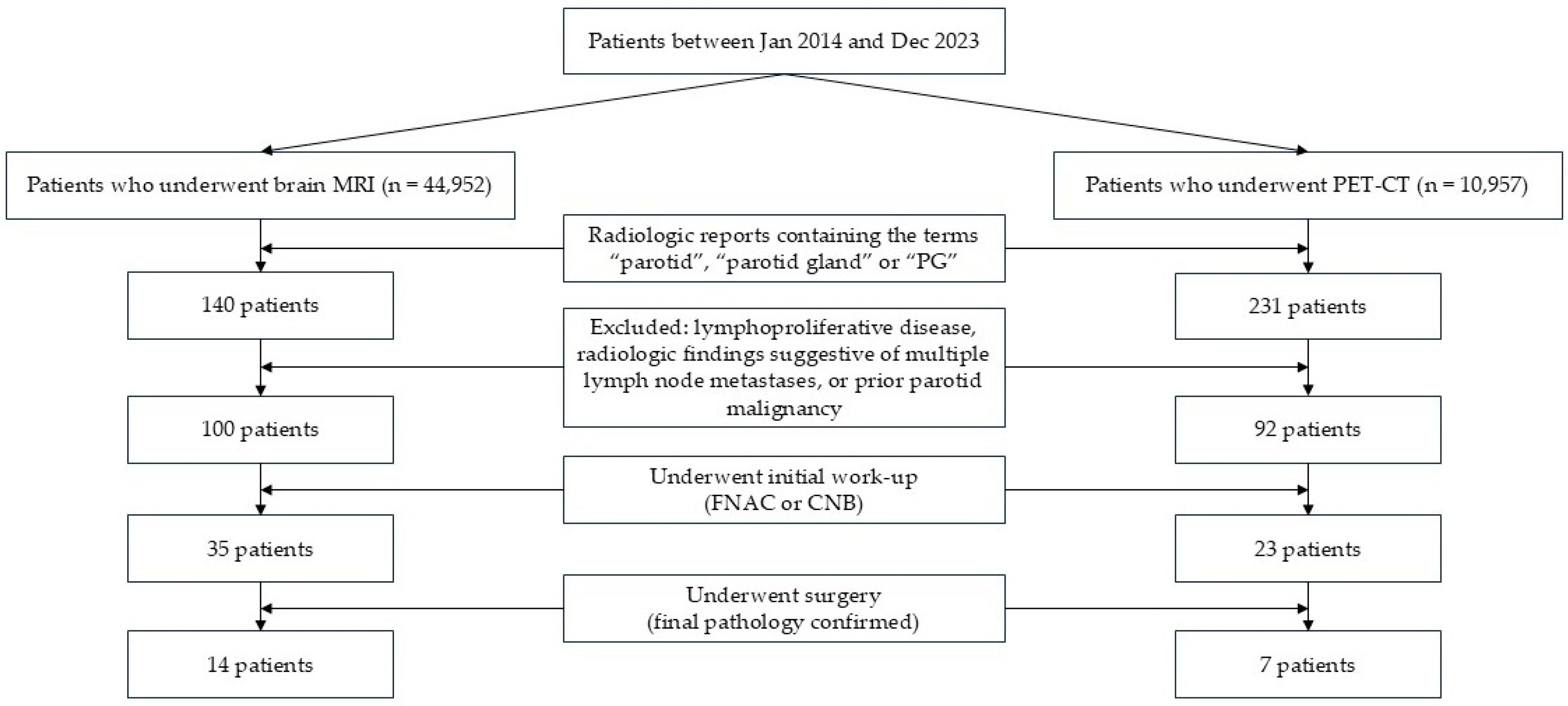
Figure 1. Flowchart of patients with parotid incidentalomas who underwent brain magnetic resonance imaging (MRI) and positron emission-computed tomography (PET-CT).
Diagnostics 15 02895 g001
Figure 2. Pathologic results of patients with parotid incidentalomas detected on brain MRI, comparing initial pathology from fine-needle aspiration cytology or core needle biopsy with final pathology from surgical resection.
Diagnostics 15 02895 g002
Figure 3. Pathologic results of patients with parotid incidentalomas detected on PET-CT, comparing initial fine-needle aspiration cytology (FNAC) or core needle biopsy (CNB) with final pathology from surgical resection.
Diagnostics 15 02895 g003
Table 1. General characteristics of patients with incidentally detected parotid abnormalities based on brain MRI and PET-CT interpretations.
CharacteristicsBrain MRIPET-CT
Incidence100/44,952 (0.22%)92/10,957 (0.84%)
Sex (Male:Female)47:5368:24
Age (years)68.90 ± 12.6169.49 ± 11.64
Initial pathologic evaluation (FNAC 1 or CNB 2)35/100 (35.0%)23/92 (25.0%)
1 FNAC; fine-needle aspiration cytology. 2 CNB; core-needle biopsy.
Table 2. Indications for PET-CT imaging of parotid incidentalomas.
IndicationCases (n)Stage I−IIStage III−IV
Gastric cancer523
Lung cancer28820
Sarcoma101
Hepato-biliary cancer633
Breast cancer110
Colorectal cancer1192
Primary malignancy of unknown origin301
Esophageal cancer312
Head and Neck cancer1192
Ovary/Cervix cancer523
Skin cancer633
Pancreas cancer101
Prostate cancer422
Thyroid cancer660
Neuroblastoma1  
Screening of health1  
Total924745
Table 3. Patient characteristics according to whether further evaluation (e.g., fine needle aspiration cytology or core needle biopsy) was performed among patients with incidentally detected parotid lesions on brain MRI.
CharacteristicsFurther Evaluationp-Value
Performed (n = 35)Not Performed (n = 65)
Sex (Male:Female)15:2032:330.675
Age (years)69.20 ± 10.2368.74 ± 13.800.182
Size (cm)1.87 ± 0.611.83 ± 0.990.067
ECOG (0–1:2–4)27:848:170.811
ASA (1–2:3–4)12:2327:380.312
IndicationCancer work-up
Brain tumor
Dementia
Stroke
Trauma/Hemorrhage
Aneurysm
Neuropathy
Dizziness
Infection/inflammation
Seizure
Headache
2
2
4
14
2
2
7
2
0
0
0
Cancer work-up
Brain tumor
Dementia
Stroke
Trauma/Hemorrhage
Aneurysm
Neuropathy
Dizziness
Infection/inflammation
Seizure
Headache
9
2
4
23
2
1
4
8
3
5
4
Table 4. Patient characteristics according to whether further evaluation (e.g., fine needle aspiration cytology or core needle biopsy) was performed among patients with incidentally detected parotid lesions on PET-CT.
CharacteristicsFurther Evaluationp-Value
Performed (n = 23)Not Performed (n = 69)
Sex (Male:Female)16:751:180.331
Age (years)68.70 ± 13.2969.52 ± 11.310.772
SUV7.02 ± 2.976.77 ± 2.730.859
Stage (I–II:III–IV)17:630:390.016
Primary siteColorectal
Esophageal
Hepatobiliary
Head and Neck
Lung
Ovary/Cervix
Sarcoma
Skin
Thyroid
3
2
1
8
3
1
1
3
2
Breast
Colorectal
MUO
Esophageal
Gastric
Hepatobiliary
Head and Neck
Lung
Ovary/Cervix
Pancreas
Prostate
Skin
Thyroid
1
8
3
1
5
5
3
25
4
1
4
3
4
MUO; malignancy of unknown origin.
Disclaimer/Publisher’s Note: The statements, opinions and data contained in all publications are solely those of the individual author(s) and contributor(s) and not of MDPI and/or the editor(s). MDPI and/or the editor(s) disclaim responsibility for any injury to people or property resulting from any ideas, methods, instructions or products referred to in the content.