Interesting Images

Plastic Bronchitis: Extensive Cast Expectoration in a 6-Year-Old Boy with Fontan Circulation

1
Department of Pediatric Cardiology, Saarland University Medical Center, 66421 Homburg, Germany
2
Clinic for Diagnostic and Interventional Radiology, Saarland University Medical Center, 66421 Homburg, Germany
*
Author to whom correspondence should be addressed.
Diagnostics 2025, 15(22), 2864; https://doi.org/10.3390/diagnostics15222864

Submission received: 27 October 2025 / Revised: 11 November 2025 / Accepted: 11 November 2025 / Published: 12 November 2025
(This article belongs to the Special Issue Advances in the Diagnosis and Management of Pediatric Diseases)

Abstract

We report on a 6-year-old boy with underlying hypoplastic left heart syndrome and a total cavopulmonary connection (Fontan circulation) with a diagnosis of plastic bronchitis. After an initial good response to therapy, his productive cough became significantly stronger again. Four months later, the patient’s mother brought a preserving jar containing an extensive bronchial cast to the clinic, the size of which is rarely seen in small children. Plastic bronchitis is a rare but dreaded complication in patients with Fontan circulation as well as in infectious or inflammatory diseases; its treatment is challenging.

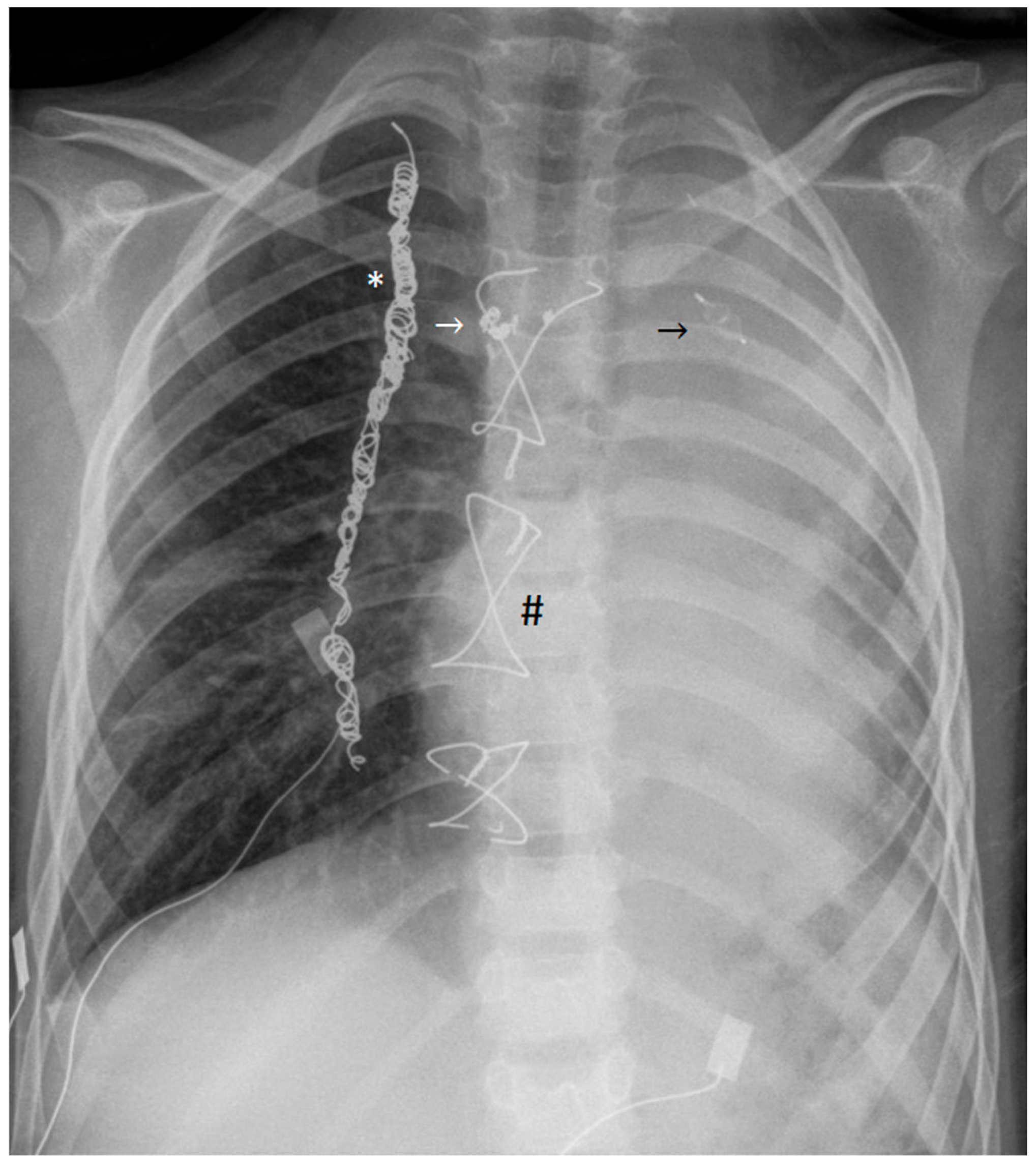
Figure 1. We present a case of a 6-year-old boy with hypoplastic left heart syndrome including mitral and aortic valve atresia, hypoplasia of ascending aorta, left ventricle, and atrium, as well as mild tricuspid regurgitation. At four days of age, a Norwood procedure with modified Blalock–Taussig shunt was performed. Chylothorax, wound infection, and mediastinitis complicated the postoperative course but were successfully treated. At the age of 5 months, a partial cavopulmonary connection (in the form of a bidirectional Glenn anastomosis) was established, and at the age of 4.5 years, a complete cavopulmonary connection (18 mm extracardiac Fontan conduit, 4 mm fenestration) was established. Due to the occurrence of multiple diffuse systemic-to-pulmonary collaterals originating from the right internal thoracic artery, this vessel was completely embolized with coils. Two more collaterals were selectively embolized using microcoils and a vascular plug. Other diffuse and branched arterial collaterals could not be closed due to their small size and tortuous course. He was treated with sildenafil, propranolol, lisinopril, and diuretics. The invasively measured Fontan circuit pressure was mean 10 mmHg three months earlier. First, the patient showed a good physical performance with a transcutaneous oxygen saturation of approximately 90% throughout. There were no symptoms of hypalbuminemia or protein loss, and serum albumin, immunoglobulin, and protein levels were within the normal range. Finally, the boy was admitted to the clinic with a cough that had been getting worse for several days, severe dyspnea, and reduced oxygen saturation of 55%. Chest X-ray showed extensive dystelectatic and atelectatic areas of the left lung (chest X-ray, anterior–posterior projection, showing extensive dystelectasis and atelectasis of the left lung; previously implanted wire cerclages (#), coils in the right internal thoracic artery (*), as well as microcoils and a vascular plug for embolization of systemic-to-pulmonary collaterals (arrows) are also visible). The echocardiographic examination revealed unchanged, fairly good function of the systemic ventricle with moderate tricuspid valve regurgitation and mild congestion of the inferior vena cava. The laboratory results did not reveal any significant abnormalities. Microbiological tests were negative for both viral and bacterial infections. He underwent bronchoscopy with lavage and removal of several fractions of rubber-like fibrous casts from the left bronchi, which histologically contained mucin, fibrin, lymphocytes, and macrophages, leading to the diagnosis of plastic bronchitis. Subsequent treatment in the pediatric intensive care unit included mechanical ventilation for 10 days, and inhaled mucolytic, fibrinolytic, and bronchodilator therapy, namely dornase alpha, hypertonic saline, recombinant tissue-type plasminogen activator, salbutamol, and ipratropium bromide. In addition, positioning therapy and repeated suctioning of the airways were performed. The boy’s condition improved significantly. He was discharged after three weeks and continued with inhaled mucolytic and steroid therapy (saline, aerosolized heparin, budesonide, and dornase intermittently), anticongestive medication, and physiotherapy at home. In addition, treatment for pulmonary arterial hypertension (sildenafil) was continued.
Diagnostics 15 02864 g001
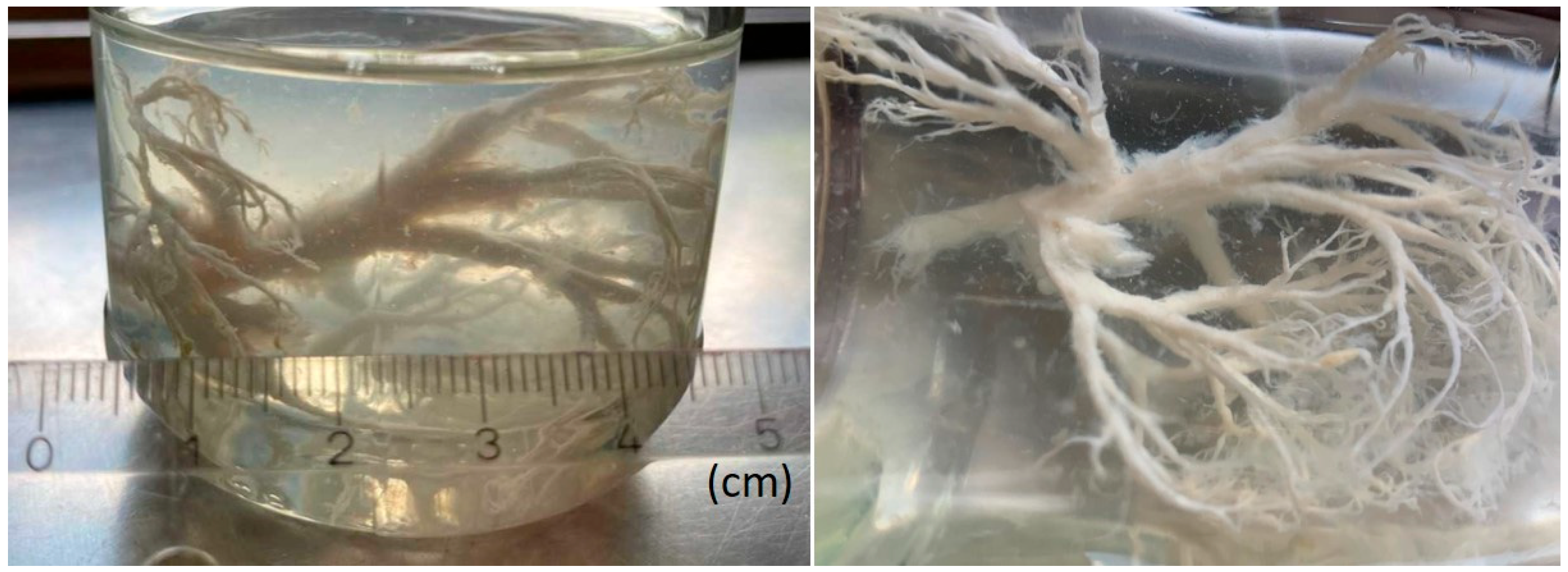
Figure 2. Four months later, the boy’s mother presented a preserving jar containing a highly ramified, whitish cast that the boy had expectorated due to persistent plastic bronchitis (photographs (two views) of the jar containing the cast in aqueous solution). The expectoration represented a coherent three-dimensional cast of the bronchial system of almost an entire lung side with a maximum length of approximately 8 cm. Also referred to as cast bronchitis, plastic bronchitis is a rare but severe complication of various diseases with an incidence of about 4% in Fontan patients [1]. Its symptoms are chronic cough, hypoxemia, and expectoration of proteinaceous casts, which mainly consist of fibrin and leucocytes. Cases involving expectoration of extensive bronchial casts have previously been described [2,3,4,5,6,7,8], but they are very rare to this extent in young children. In complex congenital heart diseases, failing Fontan circulation and systemic-to-pulmonary collaterals typically promote the disease. Further risk factors include chylothorax, ascites, and prolonged chest drainage after surgery [9]. Male patients are more frequently affected [10]. The exact etiology of plastic bronchitis is still unknown. The most probable pathophysiological causes are increased systemic venous pressure, lymphostasis, and retrograde intrathoracic lymph flow; increased capillary permeability due to chronic inflammation promotes the leakage of protein-containing fluid into the bronchi and the formation of casts. The loss of intravascular proteins and hypoalbuminemia lead to a vicious circle with a further reduction in oncotic pressure and resulting lymphatic leakage [9,11,12]. Plastic bronchitis in Fontan patients has serious prognostic implications, as the 5-year mortality rate is reportedly up to 50% [13]. Treatment is challenging and not standardized. A combination of anti-obstructive and anti-inflammatory treatment, as well as optimization of the Fontan physiology, appears to be the most promising strategy [14]. In addition to the above-mentioned fibrinolytic and mucolytic medication, which were used in our case, N-acetylcysteine, urokinase, or alpha-chymotrypsin as well as pulmonary vasodilators, octreotide, and low-fat diet are therapeutic options. Surgical and interventional procedures may include the creation of a Fontan fenestration (if missing) or Fontan takedown as well as embolization of systemic-to-pulmonary collateral arteries [14,15,16,17,18]. Selective percutaneous lymphatic embolization, for example, using n-butyl-2-cyanoacrylate, vascular plugs, or microcoils [9,19,20,21], or surgical ligation of the thoracic duct [22], may be considered in the absence of a therapeutic response. Although precise data are lacking, the risk of refractory or recurrent plastic bronchitis appears to be high. Compared to previously reported pediatric cases, ours is a typical case of plastic bronchitis, as it involves a male Fontan patient who expectorated characteristic casts. Nevertheless, the huge casts described, which the patient’s mother presented in a jar, are rarely seen in young children. The altered lymphatic drainage following chylothorax after the first operation, the multiple collaterals, as well as the tricuspid insufficiency may have contributed to the development of plastic bronchitis in our patient. Rigorous embolization of arterial systemic-to-pulmonary collaterals and percutaneous lymph embolization must be considered. However, recurrence despite extensive therapy can occur frequently. Other possible diseases associated with plastic bronchitis are asthma, Mycoplasma pneumoniae pneumonia, chronic inflammatory or infectious diseases, previous surgical procedures, and other chronic or severe systemic diseases [15,23,24]. The case presented shows that plastic bronchitis is a very difficult complication to treat in patients with Fontan physiology. Even in young children and during treatment, severe cast expectoration may occur. Combined therapy with inhalation, respiratory therapy, and the optimization of Fontan circulation is the most effective approach.
Diagnostics 15 02864 g002

Author Contributions

Conceptualization, J.P. and H.A.-K.; methodology, J.P. and H.A.-K.; validation, J.P., M.P., P.F. and H.A.-K.; formal analysis, J.P., M.P., P.F. and H.A.-K.; investigation, J.P.; resources, H.A.-K.; data curation, J.P.; writing—original draft preparation, J.P.; writing—review and editing, M.P., P.F. and H.A.-K.; visualization, J.P.; supervision, H.A.-K.; project administration, H.A.-K. All authors have read and agreed to the published version of the manuscript.

Funding

This research received no external funding.

Institutional Review Board Statement

The study was conducted in accordance with the Declaration of Helsinki, and approved by the Institutional Ethics Committee (ethics committee of the medical association of the Saarland, Saarbrücken, Germany; protocol code 151/25. Date: 27 August 2025).

Informed Consent Statement

Written informed consent has been obtained from the patient’s parents to publish this paper.

Data Availability Statement

Data are contained within the article.

Conflicts of Interest

The authors declare no conflicts of interest.

References

  1. Caruthers, R.L.; Kempa, M.; Loo, A.; Gulbransen, E.; Kelly, E.; Erickson, S.R.; Hirsch, J.C.; Schumacher, K.R.; Stringer, K.A. Demographic characteristics and estimated prevalence of Fontan-associated plastic bronchitis. Pediatr. Cardiol. 2013, 34, 256–261. [Google Scholar] [CrossRef] [PubMed] [PubMed Central]
  2. Maqsood, A.; Imel, L.R. Plastic Bronchitis. N. Engl. J. Med. 2022, 386, 780. [Google Scholar] [CrossRef] [PubMed]
  3. Mehta, I.; Patel, K. Lymphatic Plastic Bronchitis. N. Engl. J. Med. 2022, 386, e19. [Google Scholar] [CrossRef] [PubMed]
  4. Wei, P.; Song, H.; Li, J.; Ren, Y. Plastic Bronchitis in a Child. Indian J. Pediatr. 2023, 90, 829–830. [Google Scholar] [CrossRef] [PubMed]
  5. Chaudhari, M.; Stumper, O. Plastic bronchitis after Fontan operation: Treatment with stent fenestration of the Fontan circuit. Heart 2004, 90, 801. [Google Scholar] [CrossRef] [PubMed] [PubMed Central]
  6. Singhi, A.K.; Vinoth, B.; Kuruvilla, S.; Sivakumar, K. Plastic bronchitis. Ann. Pediatr. Cardiol. 2015, 8, 246–248. [Google Scholar] [CrossRef] [PubMed]
  7. Verghese, S.; Jackson, M.; Vaughns, J.; Preciado, D. Plastic bronchitis in a child with Fontan’s physiology presenting for urgent rigid bronchoscopy. Anesth. Analg. 2008, 107, 1446–1447. [Google Scholar] [CrossRef] [PubMed]
  8. Tzifa, A.; Robards, M.; Simpson, J.M. Plastic bronchitis; a serious complication of the Fontan operation. Int. J. Cardiol. 2005, 101, 513–514. [Google Scholar] [CrossRef] [PubMed]
  9. Mackie, A.S.; Veldtman, G.R.; Thorup, L.; Hjortdal, V.E.; Dori, Y. Plastic Bronchitis and Protein-Losing Enteropathy in the Fontan Patient: Evolving Understanding and Emerging Therapies. Can. J. Cardiol. 2022, 38, 988–1001. [Google Scholar] [CrossRef] [PubMed]
  10. Nayır Büyükşahin, H.; Emiralioglu, N.; Sekerel, B.E.; Soyer, T.; Oguz, B.; Güzelkaş, I.; Sunman, B.; Alboğa, D.; Akgül Erdal, M.; Yalcın, E.; et al. Plastic bronchitis during childhood: Diversity of presentation, etiology, treatment, and outcomes. Pediatr. Pulmonol. 2023, 58, 2559–2567. [Google Scholar] [CrossRef] [PubMed]
  11. Mazza, G.A.; Gribaudo, E.; Agnoletti, G. The pathophysiology and complications of Fontan circulation. Acta Biomed. 2021, 92, e2021260. [Google Scholar] [CrossRef] [PubMed] [PubMed Central]
  12. RochéRodríguez, M.; DiNardo, J.A. The Lymphatic System in the Fontan Patient-Pathophysiology, Imaging, and Interventions: What the Anesthesiologist Should Know. J. Cardiothorac. Vasc. Anesth. 2022, 36 Pt A, 2669–2678. [Google Scholar] [CrossRef] [PubMed]
  13. Schumacher, K.R.; Singh, T.P.; Kuebler, J.; Aprile, K.; O’Brien, M.; Blume, E.D. Risk factors and outcome of Fontan-associated plastic bronchitis: A case-control study. J. Am. Heart Assoc. 2014, 3, e000865. [Google Scholar] [CrossRef] [PubMed] [PubMed Central]
  14. Harteveld, L.M.; Blom, N.A.; Hazekamp, M.G.; Ten Harkel, A.D.J. Treatment and outcome of plastic bronchitis in single ventricle patients: A systematic review. Interact. Cardiovasc. Thorac. Surg. 2020, 30, 846–853. [Google Scholar] [CrossRef] [PubMed]
  15. Patel, N.; Patel, M.; Inja, R.; Krvavac, A.; Lechner, A.J. Plastic Bronchitis in Adult and Pediatric Patients: A Review of its Presentation, Diagnosis, and Treatment. Mo. Med. 2021, 118, 363–373. [Google Scholar] [PubMed] [PubMed Central]
  16. Xiong, L.; Rao, X.; Peng, X.; Zhang, G.; Liu, H. Management of Plastic Bronchitis Using α-Chymotrypsin: A Novel Treatment Modality. Cureus 2021, 13, e13551. [Google Scholar] [CrossRef] [PubMed] [PubMed Central]
  17. Pfeifer, J.; Poryo, M.; Gheibeh, A.; Rentzsch, A.; Abdul-Khaliq, H. Transcatheter Embolization of Systemic-to-Pulmonary Collaterals: A New Approach Using Concerto™ Helix Nylon-Fibered Microcoils. J. Clin. Med. 2024, 14, 113. [Google Scholar] [CrossRef] [PubMed] [PubMed Central]
  18. Pfeifer, J.; Gheibeh, A.; Fries, P.; Poryo, M.; Rentzsch, A.; Abdul-Khaliq, H. Transcatheter Embolization in Congenital Cardiovascular Malformations-Variable Use of Vascular Plugs. Cardiovasc. Ther. 2024, 2024, 4778469. [Google Scholar] [CrossRef] [PubMed] [PubMed Central]
  19. Maleux, G.; Storme, E.; Cools, B.; Heying, R.; Boshoff, D.; Louw, J.J.; Frerich, S.; Malekzadeh-Milanii, S.; Hubrechts, J.; Brown, S.C.; et al. Percutaneous embolization of lymphatic fistulae as treatment for protein-losing enteropathy and plastic bronchitis in patients with failing Fontan circulation. Catheter. Cardiovasc. Interv. 2019, 94, 996–1002. [Google Scholar] [CrossRef] [PubMed]
  20. Dori, Y.; Keller, M.S.; Rome, J.J.; Gillespie, M.J.; Glatz, A.C.; Dodds, K.; Goldberg, D.J.; Goldfarb, S.; Rychik, J.; Itkin, M. Percutaneous Lymphatic Embolization of Abnormal Pulmonary Lymphatic Flow as Treatment of Plastic Bronchitis in Patients with Congenital Heart Disease. Circulation 2016, 133, 1160–1170. [Google Scholar] [CrossRef] [PubMed]
  21. Haddad, R.N.; Dautry, R.; Bonnet, D.; Malekzadeh-Milani, S. Transvenous retrograde thoracic duct embolization for effective treatment of recurrent plastic bronchitis after fontan palliation. Catheter. Cardiovasc. Interv. 2023, 101, 863–869. [Google Scholar] [CrossRef] [PubMed]
  22. Shah, S.S.; Drinkwater, D.C.; Christian, K.G. Plastic bronchitis: Is thoracic duct ligation a real surgical option? Ann. Thorac. Surg. 2006, 81, 2281–2283. [Google Scholar] [CrossRef] [PubMed]
  23. Sharifi, A.; Rahbar, R.; Fynn-Thompson, F.; Farasat, E.; Pugi, J.; Samadizadeh, S.; Mohammadi-Brenjegani, A.; Ghaedsharaf, S.; Zojaji, M. Plastic bronchitis in pediatrics: A systematic review of etiologies, clinical presentations, treatments, and prognosis. Int. J. Pediatr. Otorhinolaryngol. 2025, 195, 112422. [Google Scholar] [CrossRef] [PubMed]
  24. Yang, L.; Zhang, Y.; Shen, C.; Lu, Z.; Hou, T.; Niu, F.; Wang, Y.; Ning, J.; Liu, R. Clinical features and risk factors of plastic bronchitis caused by Mycoplasma pneumoniae pneumonia in children. BMC Pulm. Med. 2023, 23, 468, Erratum in BMC Pulm. Med. 2023, 23, 499. [Google Scholar] [CrossRef] [PubMed] [PubMed Central]
Disclaimer/Publisher’s Note: The statements, opinions and data contained in all publications are solely those of the individual author(s) and contributor(s) and not of MDPI and/or the editor(s). MDPI and/or the editor(s) disclaim responsibility for any injury to people or property resulting from any ideas, methods, instructions or products referred to in the content.