Radiographic Imaging for the Diagnosis and Treatment of Patients with Skeletal Class III Malocclusion




Abstract
1. Introduction
2. Radiographic Features for Inter-Maxillary Relationship in the Diagnosis and Treatment of Skeletal Class III Malocclusion
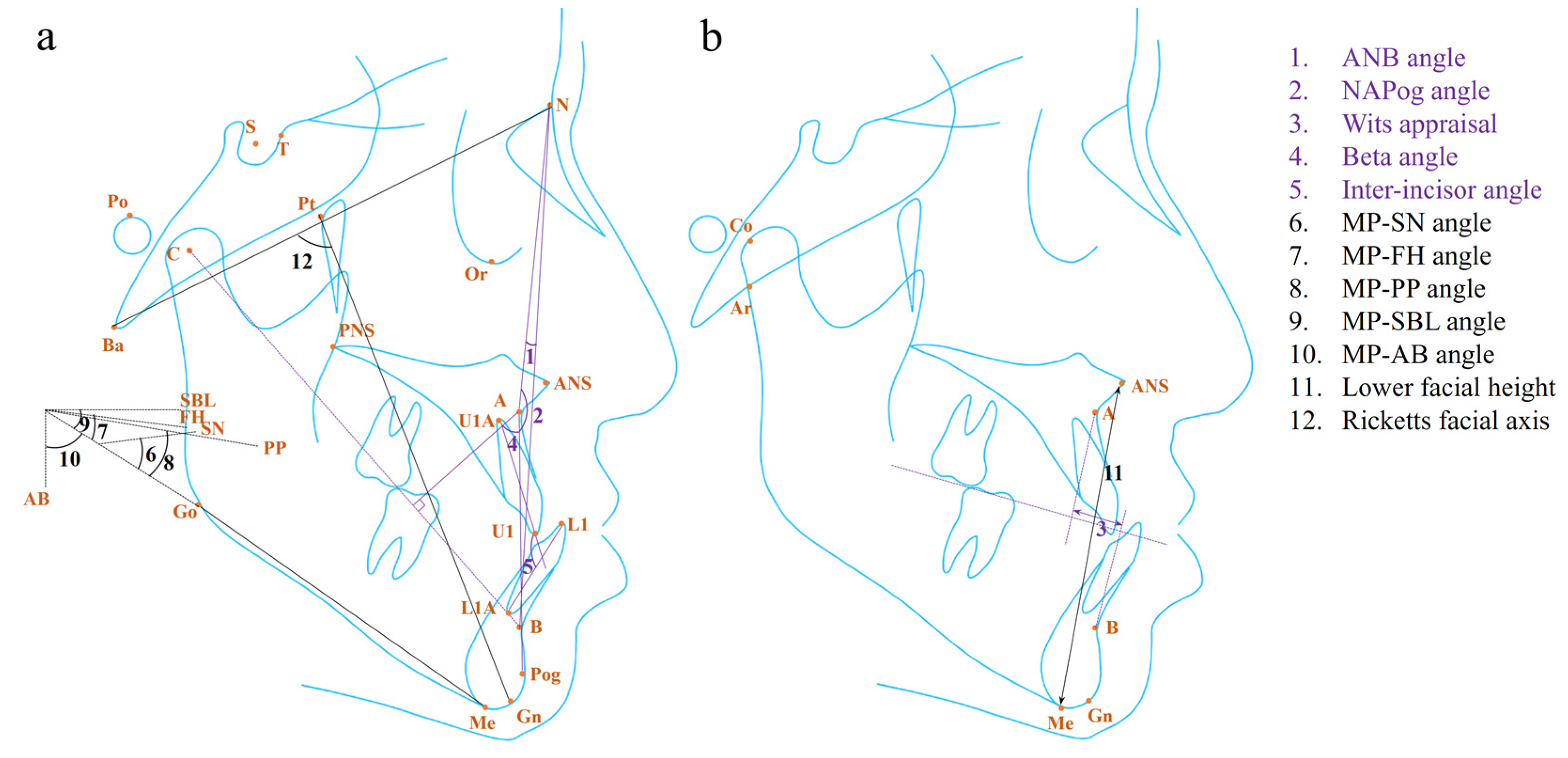
2.1. Radiographic Features for Sagittal Inter-Maxillary Relationship
2.2. Radiographic Features for Vertical Inter-Maxillary Relationship
3. Radiographic Features of Different Anatomical Structures in the Diagnosis and Treatment of Skeletal Class III Malocclusion
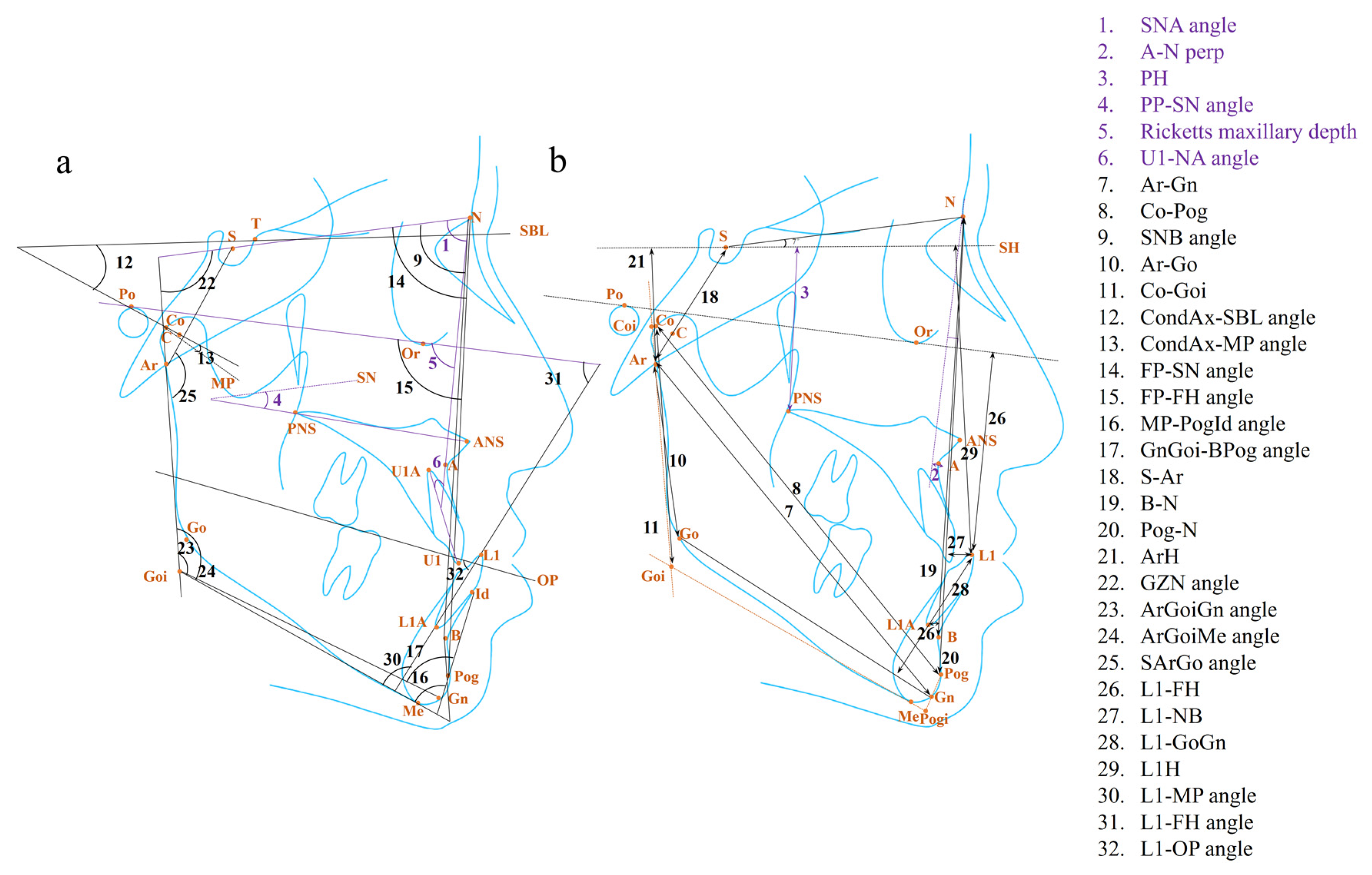
3.1. Radiographic Features in the Maxilla
3.2. Radiographic Features in the Mandible
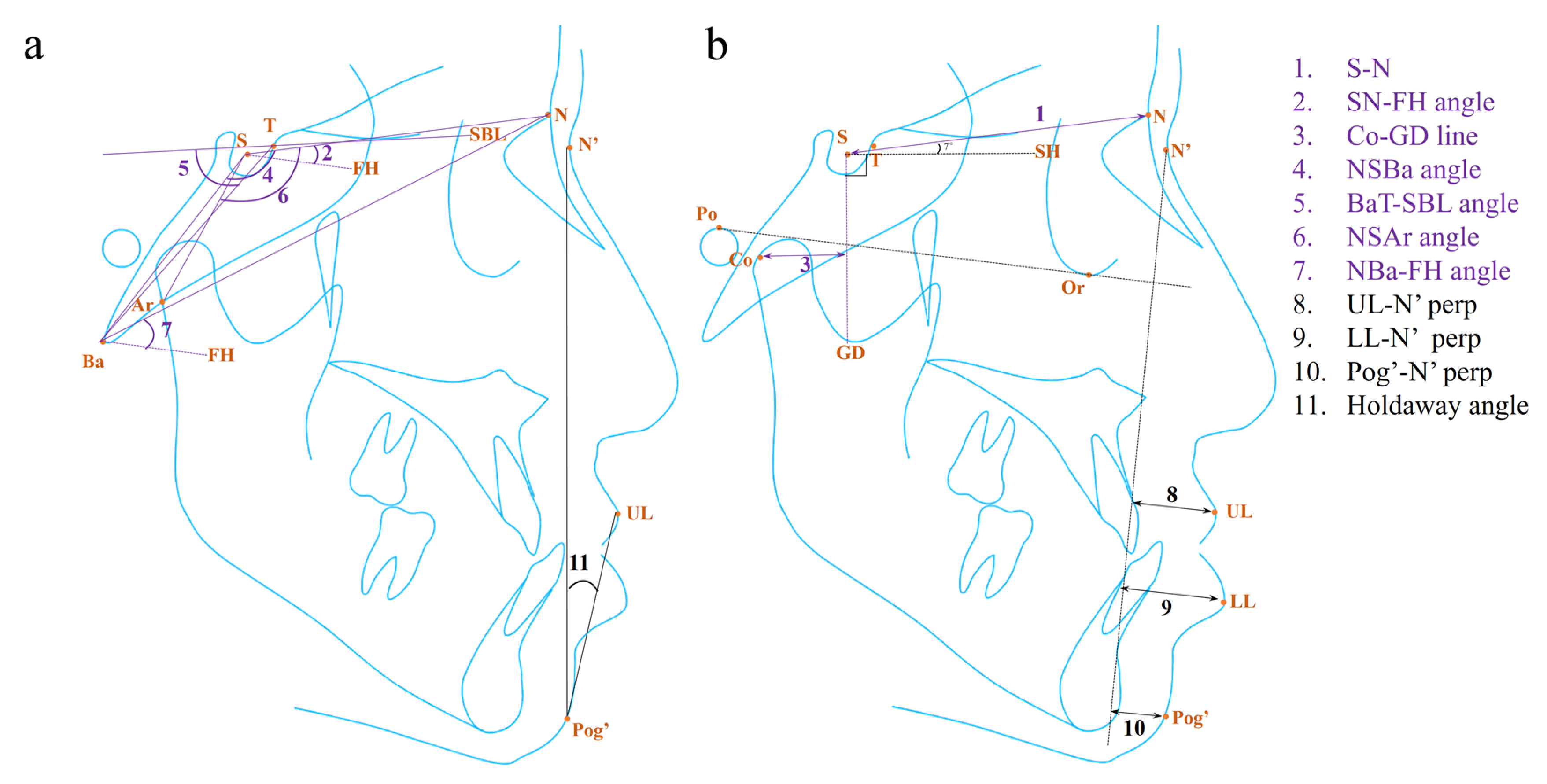
3.3. Radiographic Features in the Cranial Base
3.4. Radiographic Features in the Soft Tissue
4. Radiographic Features in 3D Images of Skeletal Class III Malocclusion
4.1. Radiographic Features in CBCT
4.2. Radiographic Features in MRI
5. Current States and Future Prospects
6. Conclusions
Supplementary Materials
Author Contributions
Funding
Institutional Review Board Statement
Informed Consent Statement
Data Availability Statement
Conflicts of Interest
References
- Angle, E.H. Classification of malocclusion. Dent. Cosmos 1899, 41, 350–357. [Google Scholar]
- Hardy, D.K.; Cubas, Y.P.; Orellana, M.F. Prevalence of angle class III malocclusion: A systematic review and meta-analysis. Open J. Epidemiol. 2012, 2, 75–82. [Google Scholar] [CrossRef]
- Ribeiro, L.G.; Antunes, L.S.; Küchler, E.C.; Baratto-Filho, F.; Kirschneck, C.; Guimarães, L.S.; Antunes, L.A.A. Impact of malocclusion treatments on Oral Health-Related Quality of Life: An overview of systematic reviews. Clin. Oral Investig. 2023, 27, 907–932. [Google Scholar] [CrossRef] [PubMed]
- Rezaei, F.; Masalehi, H.; Golshah, A.; Imani, M.M. Oral health related quality of life of patients with class III skeletal malocclusion before and after orthognathic surgery. BMC Oral Health 2019, 19, 289. [Google Scholar] [CrossRef] [PubMed]
- Nardoni, D.N.; Siqueira, D.F.; Cardoso Mde, A.; Capelozza Filho, L. Cephalometric variables used to predict the success of interceptive treatment with rapid maxillary expansion and face mask. A longitudinal study. Dent. Press J. Orthod. 2015, 20, 85–96. [Google Scholar] [CrossRef] [PubMed]
- Woon, S.C.; Thiruvenkatachari, B. Early orthodontic treatment for Class III malocclusion: A systematic review and meta-analysis. Am. J. Orthod. Dentofac. Orthop. 2017, 151, 28–52. [Google Scholar] [CrossRef] [PubMed]
- Alhammadi, M.S.; Almashraqi, A.A.; Khadhi, A.H.; Arishi, K.A.; Alamir, A.A.; Beleges, E.M.; Halboub, E. Orthodontic camouflage versus orthodontic-orthognathic surgical treatment in borderline class III malocclusion: A systematic review. Clin. Oral Investig. 2022, 26, 6443–6455. [Google Scholar] [CrossRef]
- Taraji, S.; Atici, S.F.; Viana, G.; Kusnoto, B.; Allareddy, V.S.; Miloro, M.; Elnagar, M.H. Novel Machine Learning Algorithms for Prediction of Treatment Decisions in Adult Patients with Class III Malocclusion. J. Oral Maxillofac. Surg. 2023, 81, 1391–1402. [Google Scholar] [CrossRef]
- Schulhof, R.J.; Nakamura, S.; Williamson, W.V. Prediction of abnormal growth in class III malocclusions. Am. J. Orthod. 1977, 71, 421–430. [Google Scholar] [CrossRef]
- Zentner, A.; Doll, G.M. Size discrepancy of apical bases and treatment success in angle Class III malocclusion. J. Orofac. Orthop. 2001, 62, 97–106. [Google Scholar] [CrossRef]
- Stensland, A.; Wisth, P.J.; Böe, O.E. Dentofacial changes in children with negative overjet treated by a combined orthodontic and orthopaedic approach. Eur. J. Orthod. 1988, 10, 39–51. [Google Scholar] [CrossRef] [PubMed]
- Bui, C.; King, T.; Proffit, W.; Frazier-Bowers, S. Phenotypic characterization of Class III patients. Angle Orthod. 2006, 76, 564–569. [Google Scholar] [CrossRef] [PubMed]
- Kim, B.M.; Kang, B.Y.; Kim, H.G.; Baek, S.H. Prognosis prediction for Class III malocclusion treatment by feature wrapping method. Angle Orthod. 2009, 79, 683–691. [Google Scholar] [CrossRef] [PubMed]
- Liu, J.; Zhang, C.; Shan, Z. Application of Artificial Intelligence in Orthodontics: Current State and Future Perspectives. Healthcare 2023, 11, 2760. [Google Scholar] [CrossRef] [PubMed]
- Lambin, P.; Rios-Velazquez, E.; Leijenaar, R.; Carvalho, S.; van Stiphout, R.G.; Granton, P.; Zegers, C.M.L.; Gillies, R.; Boellard, R.; Dekker, A.; et al. Radiomics: Extracting more information from medical images using advanced feature analysis. Eur. J. Cancer 2012, 48, 441–446. [Google Scholar] [CrossRef] [PubMed]
- Tortora, M.; Gemini, L.; Scaravilli, A.; Ugga, L.; Ponsiglione, A.; Stanzione, A.; D’arco, F.; D’anna, G.; Cuocolo, R. Radiomics Applications in Head and Neck Tumor Imaging: A Narrative Review. Cancers 2023, 15, 1174. [Google Scholar] [CrossRef] [PubMed]
- Hung, K.F.; Ai, Q.Y.H.; Wong, L.M.; Yeung, A.W.K.; Li, D.T.S.; Leung, Y.Y. Current Applications of Deep Learning and Radiomics on CT and CBCT for Maxillofacial Diseases. Diagnostics 2022, 13, 110. [Google Scholar] [CrossRef]
- Fudalej, P.; Dragan, M.; Wedrychowska-Szulc, B. Prediction of the outcome of orthodontic treatment of Class III malocclusions—A systematic review. Eur. J. Orthod. 2011, 33, 190–197. [Google Scholar] [CrossRef]
- Manlove, A.E.; Romeo, G.; Venugopalan, S.R. Craniofacial Growth: Current Theories and Influence on Management. Oral Maxillofac. Surg. Clin. N. Am. 2020, 32, 167–175. [Google Scholar] [CrossRef]
- Kim, C.; Ishikawa, H. Multivariate analysis of the effects of chin cap therapy. Hokkaido J. Dent. Sci. 1995, 16, 149–165. Available online: https://jglobal.jst.go.jp/en/detail?JGLOBAL_ID=200902180218977103 (accessed on 10 January 2024).
- Ueda, A.; Tussie, C.; Kim, S.; Kuwajima, Y.; Matsumoto, S.; Kim, G.; Satoh, K.; Nagai, S. Classification of Maxillofacial Morphology by Artificial Intelligence Using Cephalometric Analysis Measurements. Diagnostics 2023, 13, 2134. [Google Scholar] [CrossRef] [PubMed]
- Tahmina, K.; Tanaka, E.; Tanne, K. Craniofacial morphology in orthodontically treated patients of class III malocclusion with stable and unstable treatment outcomes. Am. J. Orthod. Dentofac. Orthop. 2000, 117, 681–690. [Google Scholar] [CrossRef]
- Zentner, A.; Doll, G.M.; Peylo, S.M. Morphological parameters as predictors of successful correction of Class III malocclusion. Eur. J. Orthod. 2001, 23, 383–392. [Google Scholar] [CrossRef] [PubMed]
- Ferro, A.; Nucci, L.P.; Ferro, F.; Gallo, C. Long-term stability of skeletal Class III patients treated with splints, Class III elastics, and chincup. Am. J. Orthod. Dentofac. Orthop. 2003, 123, 423–434. [Google Scholar] [CrossRef] [PubMed]
- Schuster, G.; Lux, C.J.; Stellzig-Eisenhauer, A. Children with class III malocclusion: Development of multivariate statistical models to predict future need for orthognathic surgery. Angle Orthod. 2003, 73, 136–145. [Google Scholar] [CrossRef] [PubMed]
- Ngan, P.; Wei, S.H.-Y. Early treatment of Class III patients to improve facial aesthetics and predict future growth. Hong Kong Dent. J. 2004, 1, 24–30. [Google Scholar]
- Choi, Y.J.; Chang, J.E.; Chung, C.J.; Tahk, J.H.; Kim, K.H. Prediction of long-term success of orthopedic treatment in skeletal Class III malocclusions. Am. J. Orthod. Dentofac. Orthop. 2017, 152, 193–203. [Google Scholar] [CrossRef]
- Auconi, P.; Ottaviani, E.; Barelli, E.; Giuntini, V.; McNamara, J.A.; Franchi, L. Prognostic approach to Class III malocclusion through case-based reasoning. Orthod. Craniofac. Res. 2021, 24 (Suppl. 2), 163–171. [Google Scholar] [CrossRef]
- Real, A.D.; Real, O.D.; Sardina, S.; Oyonarte, R. Use of automated artificial intelligence to predict the need for orthodontic extractions. Korean J. Orthod. 2022, 52, 102–111. [Google Scholar] [CrossRef]
- Stellzig-Eisenhauer, A.; Lux, C.J.; Schuster, G. Treatment decision in adult patients with Class III malocclusion: Orthodontic therapy or orthognathic surgery? Am. J. Orthod. Dentofac. Orthop. 2002, 122, 27–37, discussion 37–38. [Google Scholar] [CrossRef]
- Kochel, J.; Emmerich, S.; Meyer-Marcotty, P.; Stellzig-Eisenhauer, A. New model for surgical and nonsurgical therapy in adults with Class III malocclusion. Am. J. Orthod. Dentofac. Orthop. 2011, 139, e165–e174. [Google Scholar] [CrossRef] [PubMed]
- Martinez, P.; Bellot-Arcís, C.; Llamas, J.M.; Cibrian, R.; Gandia, J.L.; Paredes-Gallardo, V. Orthodontic camouflage versus orthognathic surgery for class III deformity: Comparative cephalometric analysis. Int. J. Oral Maxillofac. Surg. 2017, 46, 490–495. [Google Scholar] [CrossRef]
- Eslami, S.; Faber, J.; Fateh, A.; Sheikholaemmeh, F.; Grassia, V.; Jamilian, A. Treatment decision in adult patients with class III malocclusion: Surgery versus orthodontics. Prog. Orthod. 2018, 19, 28. [Google Scholar] [CrossRef] [PubMed]
- Prasad, J.; Mallikarjunaiah, D.R.; Shetty, A.; Gandedkar, N.; Chikkamuniswamy, A.B.; Shivashankar, P.C. Machine Learning Predictive Model as Clinical Decision Support System in Orthodontic Treatment Planning. Dent. J. 2022, 11, 1. [Google Scholar] [CrossRef] [PubMed]
- Lee, H.; Ahmad, S.; Frazier, M.; Dundar, M.M.; Turkkahraman, H. A novel machine learning model for class III surgery decision. J. Orofac. Orthop. 2022. [Google Scholar] [CrossRef] [PubMed]
- Franchi, L.; Baccetti, T.; Tollaro, I. Predictive variables for the outcome of early functional treatment of Class III malocclusion. Am. J. Orthod. Dentofac. Orthop. 1997, 112, 80–86. [Google Scholar] [CrossRef] [PubMed]
- Baccetti, T.; Franchi, L.; McNamara, J.A., Jr. Cephalometric variables predicting the long-term success or failure of combined rapid maxillary expansion and facial mask therapy. Am. J. Orthod. Dentofac. Orthop. 2004, 126, 16–22. [Google Scholar] [CrossRef]
- Moon, Y.M.; Ahn, S.J.; Chang, Y.I. Cephalometric predictors of long-term stability in the early treatment of Class III malocclusion. Angle Orthod. 2005, 75, 747–753. [Google Scholar] [CrossRef]
- Yoshida, I.; Yamaguchi, N.; Mizoguchi, I. Prediction of post-treatment outcome after combined treatment with maxillary protraction and chincap appliances. Eur. J. Orthod. 2006, 28, 89–96. [Google Scholar] [CrossRef]
- Jacobson, A. Update on the Wits appraisal. Angle Orthod. 1988, 58, 205–219. [Google Scholar] [CrossRef]
- Baik, C.Y.; Ververidou, M. A new approach of assessing sagittal discrepancies: The Beta angle. Am. J. Orthod. Dentofac. Orthop. 2004, 126, 100–105. [Google Scholar] [CrossRef] [PubMed]
- Kikuchi, M.; Higurashi, N.; Miyazaki, S.; Itasaka, Y.; Chiba, S.; Nezu, H. Facial pattern categories of sleep breathing-disordered children using Ricketts analysis. Psychiatry Clin. Neurosci. 2002, 56, 329–330. [Google Scholar] [CrossRef] [PubMed]
- Abu Alhaija, E.S.; Richardson, A. Growth prediction in Class III patients using cluster and discriminant function analysis. Eur. J. Orthod. 2003, 25, 599–608. [Google Scholar] [CrossRef] [PubMed]
- Wells, A.P.; Sarver, D.M.; Proffit, W.R. Long-term efficacy of reverse pull headgear therapy. Angle Orthod. 2006, 76, 915–922. [Google Scholar] [CrossRef] [PubMed]
- Auconi, P.; Scazzocchio, M.; Caldarelli, G.; Nieri, M.; McNamara, J.A.; Franchi, L. Understanding interactions among cephalometrics variables during growth in untreated Class III subjects. Eur. J. Orthod. 2017, 39, 395–401. [Google Scholar] [CrossRef] [PubMed][Green Version]
- Blagitz, M.N.; Almeida, G.A.; Normando, D. Factors associated with the stability of compensatory orthodontic treatment of Class III malocclusion in the permanent dentition. Am. J. Orthod. Dentofac. Orthop. 2020, 158, e63–e72. [Google Scholar] [CrossRef] [PubMed]
- Lee, K.-S.; Ryu, J.-J.; Jang, H.S.; Lee, D.-Y.; Jung, S.-K. Deep convolutional neural networks based analysis of cephalometric radiographs for differential diagnosis of orthognathic surgery indications. Appl. Sci. 2020, 10, 2124. [Google Scholar] [CrossRef]
- Ghiz, M.A.; Ngan, P.; Gunel, E. Cephalometric variables to predict future success of early orthopedic Class III treatment. Am. J. Orthod. Dentofac. Orthop. 2005, 127, 301–306. [Google Scholar] [CrossRef]
- Ko, Y.I.; Baek, S.H.; Mah, J.; Yang, W.S. Determinants of successful chincup therapy in skeletal class III malocclusion. Am. J. Orthod. Dentofac. Orthop. 2004, 126, 33–41. [Google Scholar] [CrossRef]
- Souki, B.Q.; Nieri, M.; Pavoni, C.; Pavan Barros, H.M.; Junqueira Pereira, T.; Giuntini, V.; Cozza, P.; Franchi, L. Development and validation of a prediction model for long-term unsuccess of early treatment of Class III malocclusion. Eur. J. Orthod. 2020, 42, 200–205. [Google Scholar] [CrossRef]
- Inoue, Y.; Deguchi, T.; Hartsfield, J.K., Jr.; Tome, W.; Kitai, N. Analysis of pretreatment factors associated with stability in early class III treatment. Prog. Orthod. 2021, 22, 23. [Google Scholar] [CrossRef] [PubMed]
- Etemad, L.; Wu, T.H.; Heiner, P.; Liu, J.; Lee, S.; Chao, W.L.; Zaytoun, M.L.; Guez, C.; Lin, F.; Jackson, C.B.; et al. Machine learning from clinical data sets of a contemporary decision for orthodontic tooth extraction. Orthod. Craniofac. Res. 2021, 24 (Suppl. 2), 193–200. [Google Scholar] [CrossRef] [PubMed]
- Khosravi-Kamrani, P.; Qiao, X.; Zanardi, G.; Wiesen, C.A.; Slade, G.; Frazier-Bowers, S.A. A machine learning approach to determine the prognosis of patients with Class III malocclusion. Am. J. Orthod. Dentofac. Orthop. 2022, 161, e1–e11. [Google Scholar] [CrossRef] [PubMed]
- Chen, Y.C.; Chen, C.Y.; Chen, M.C.; Ko, E.W.; Lin, C.H. Dental Occlusion Characteristics for Treatment Decision-Making Regarding Surgery-First Approach in Orthodontics. J. Clin. Med. 2023, 12, 6029. [Google Scholar] [CrossRef] [PubMed]
- Zhang, J.; Liang, Y.; Chen, R.; Chen, S.; Lin, J.; Han, B.; Liu, X. Inclination of mandibular incisors and symphysis in severe skeletal class III malocclusion. Head Face Med. 2023, 19, 16. [Google Scholar] [CrossRef] [PubMed]
- Rabie, A.B.; Wong, R.W.; Min, G.U. Treatment in Borderline Class III Malocclusion: Orthodontic Camouflage (Extraction) Versus Orthognathic Surgery. Open Dent. J. 2008, 2, 38–48. [Google Scholar] [CrossRef] [PubMed]
- Benyahia, H.; Azaroual, M.F.; Garcia, C.; Hamou, E.; Abouqal, R.; Zaoui, F. Treatment of skeletal Class III malocclusions: Orthognathic surgery or orthodontic camouflage? How to decide. Int. Orthod. 2011, 9, 196–209. [Google Scholar] [CrossRef] [PubMed]
- Mosca, G.; Grippaudo, C.; Marchionni, P.; Deli, R. Class III dento-skeletal anomalies: Rotational growth and treatment timing. Eur. J. Paediatr. Dent. 2006, 7, 23–28. [Google Scholar]
- Kim, J.H.; Kim, Y.H.; Kim, S.J.; Sung, J.; Song, Y.M.; Shin, J.W.; Park, J.H.; Chae, H.S. Twin study-genetic comparison of matrix versus intramatrix rotation in the mandible and three different occlusal planes. Prog. Orthod. 2020, 21, 44. [Google Scholar] [CrossRef]
- Sugawara, J.; Mitani, H. Facial growth of skeletal Class III malocclusion and the effects, limitations, and long-term dentofacial adaptations to chincap therapy. Semin. Orthod. 1997, 3, 244–254. [Google Scholar] [CrossRef]
- Baccetti, T.; Reyes, B.C.; McNamara, J.A., Jr. Craniofacial changes in Class III malocclusion as related to skeletal and dental maturation. Am. J. Orthod. Dentofac. Orthop. 2007, 132, 171.e1–171.e12. [Google Scholar] [CrossRef] [PubMed]
- Lemes, C.R.; Tozzi, C.F.; Gribel, S.; Gribel, B.F.; Venezian, G.C.; do Carmo Menezes, C.; Custodio, W. Mandibular ramus height and condyle distance asymmetries in individuals with different facial growth patterns: A cone-beam computed tomography study. Surg. Radiol. Anat. 2021, 43, 267–274. [Google Scholar] [CrossRef] [PubMed]
- Santander, P.; Quast, A.; Olbrisch, C.; Rose, M.; Moser, N.; Schliephake, H.; Meyer-Marcotty, P. Comprehensive 3D analysis of condylar morphology in adults with different skeletal patterns—A cross-sectional study. Head Face Med. 2020, 16, 33. [Google Scholar] [CrossRef] [PubMed]
- Vora, S.R. Mouse models for the study of cranial base growth and anomalies. Orthod. Craniofac. Res. 2017, 20 (Suppl. 1), 18–25. [Google Scholar] [CrossRef] [PubMed]
- Ishii, N.; Deguchi, T.; Hunt, N.P. Craniofacial differences between Japanese and British Caucasian females with a skeletal Class III malocclusion. Eur. J. Orthod. 2002, 24, 493–499. [Google Scholar] [CrossRef] [PubMed]
- Proff, P.; Will, F.; Bokan, I.; Fanghänel, J.; Gedrange, T. Cranial base features in skeletal Class III patients. Angle Orthod. 2008, 78, 433–439. [Google Scholar] [CrossRef] [PubMed]
- Sanggarnjanavanich, S.; Sekiya, T.; Nomura, Y.; Nakayama, T.; Hanada, N.; Nakamura, Y. Cranial-base morphology in adults with skeletal Class III malocclusion. Am. J. Orthod. Dentofac. Orthop. 2014, 146, 82–91. [Google Scholar] [CrossRef]
- Buvinic, S.; Balanta-Melo, J.; Kupczik, K.; Vásquez, W.; Beato, C.; Toro-Ibacache, V. Muscle-Bone Crosstalk in the Masticatory System: From Biomechanical to Molecular Interactions. Front. Endocrinol. 2020, 11, 606947. [Google Scholar] [CrossRef]
- Nanda, R.S.; Ghosh, J. Facial soft tissue harmony and growth in orthodontic treatment. Semin. Orthod. 1995, 1, 67–81. [Google Scholar] [CrossRef]
- Holdaway, R.A. A soft-tissue cephalometric analysis and its use in orthodontic treatment planning. Part I. Am. J. Orthod. 1983, 84, 1–28. [Google Scholar] [CrossRef]
- Huang, C.Y.; Liao, Y.F. Anatomical position of the mandibular canal in relation to the buccal cortical bone in Chinese patients with different dentofacial relationships. J. Formos. Med. Assoc. 2016, 115, 981–990. [Google Scholar] [CrossRef] [PubMed]
- Kim, K.J.; Park, J.H.; Bay, R.C.; Lee, M.Y.; Chang, N.Y.; Chae, J.M. Mandibular condyle bone density in adolescents with varying skeletal patterns evaluated using cone-beam computed tomography: A potential predictive tool. Am. J. Orthod. Dentofac. Orthop. 2018, 154, 382–389. [Google Scholar] [CrossRef] [PubMed]
- Kalabalik, F.; Akçay, H.; Tatar, B. Morphometric analysis of mandibular corpus relevance to sagittal split osteotomy: Comparison of dentoskeletal Class I and Class III patients. J. Stomatol. Oral Maxillofac. Surg. 2020, 121, 615–620. [Google Scholar] [CrossRef] [PubMed]
- Görgülü, S.; Sağdıç, D.; Akin, E.; Karaçay, S.; Bulakbası, N. Tongue movements in patients with skeletal Class III malocclusions evaluated with real-time balanced turbo field echo cine magnetic resonance imaging. Am. J. Orthod. Dentofac. Orthop. 2011, 139, e405–e414. [Google Scholar] [CrossRef] [PubMed]
- Jung, W.S.; Kim, H.; Jeon, D.M.; Mah, S.J.; Ahn, S.J. Magnetic resonance imaging-verified temporomandibular joint disk displacement in relation to sagittal and vertical jaw deformities. Int. J. Oral Maxillofac. Surg. 2013, 42, 1108–1115. [Google Scholar] [CrossRef] [PubMed]
- Gökalp, H. Disc position in clinically asymptomatic, pretreatment adolescents with Class I, II, or III malocclusion: A retrospective magnetic resonance imaging study. J. Orofac. Orthop. 2016, 77, 194–202. [Google Scholar] [CrossRef] [PubMed]
- Tagawa, D.T.; Franco, A.A.; Puchnick, A.; Wolosker, A.M.B.; Florez, B.M.; Dominguez, G.C.; Yamashita, H.K.; Cevidanes, L.H.S.; Aidar, L.A.d.A.; Junior, H.C. Temporomandibular joint articular disc position and shape in skeletal Class III. Orthod. Craniofac. Res. 2023, 26, 185–196. [Google Scholar] [CrossRef]
- Signorelli, L.; Patcas, R.; Peltomäki, T.; Schätzle, M. Radiation dose of cone-beam computed tomography compared to conventional radiographs in orthodontics. J. Orofac. Orthop. 2016, 77, 9–15. [Google Scholar] [CrossRef]
- Staderini, E.; Guglielmi, F.; Cornelis, M.A.; Cattaneo, P.M. Three-dimensional prediction of roots position through cone-beam computed tomography scans-digital model superimposition: A novel method. Orthod. Craniofac. Res. 2019, 22, 16–23. [Google Scholar] [CrossRef]
- Hung, K.F.; Yeung, A.W.K.; Bornstein, M.M.; Schwendicke, F. Personalized dental medicine, artificial intelligence, and their relevance for dentomaxillofacial imaging. Dentomaxillofac. Radiol. 2023, 52, 20220335. [Google Scholar] [CrossRef]
- Hung, K.F.; Ai, Q.Y.H.; Leung, Y.Y.; Yeung, A.W.K. Potential and impact of artificial intelligence algorithms in dento-maxillofacial radiology. Clin. Oral Investig. 2022, 26, 5535–5555. [Google Scholar] [CrossRef] [PubMed]
- Hung, K.; Montalvao, C.; Tanaka, R.; Kawai, T.; Bornstein, M.M. The use and performance of artificial intelligence applications in dental and maxillofacial radiology: A systematic review. Dentomaxillofac. Radiol. 2020, 49, 20190107. [Google Scholar] [CrossRef]
- Shin, W.; Yeom, H.G.; Lee, G.H.; Yun, J.P.; Jeong, S.H.; Lee, J.H.; Kim, H.K.; Kim, B.C. Deep learning based prediction of necessity for orthognathic surgery of skeletal malocclusion using cephalogram in Korean individuals. BMC Oral Health 2021, 21, 130. [Google Scholar] [CrossRef] [PubMed]
- Caloro, E.; Cè, M.; Gibelli, D.; Palamenghi, A.; Martinenghi, C.; Oliva, G.; Cellina, M. Artificial Intelligence (AI)-Based Systems for Automatic Skeletal Maturity Assessment through Bone and Teeth Analysis: A Revolution in the Radiological Workflow? Appl. Sci. 2023, 13, 3860. [Google Scholar] [CrossRef]
- Nardone, V.; Reginelli, A.; Grassi, R.; Boldrini, L.; Vacca, G.; D’Ippolito, E.; Annunziata, S.; Farchione, A.; Belfiore, M.P.; Desideri, I.; et al. Delta radiomics: A systematic review. Radiol. Med. 2021, 126, 1571–1583. [Google Scholar] [CrossRef]



| Author (Year) | Application | Sample Size | Inclusion | Treatment | Judgment Criteria | Type of Outcome | Period | Architecture | Input | Significant Output | Trend for Poorer Result/Extraction/Surgery Need (Cut-Off Point) |
|---|---|---|---|---|---|---|---|---|---|---|---|
| Sagittal dimension | |||||||||||
| Kim C (1995) [20] | Facial type | 46 | Around 8-year-old children with skeletal Class Ⅲ malocclusion | CC | Cluster analysis | 5 groups with different effect of chin-cup therapy | Around 6 years | Discriminant analysis | 17 cephalometric variables | ANB angle | None |
| Chi Bui (2006) [12] | Facial type | 309 | Patients with skeletal Class Ⅲ malocclusion | None | Cluster analysis | 5 clusters representing distinct subphenotypes | Not mentioned | Cluster and principal component analyses | 67 cephalometric variables | ANB angle, unit length difference, interincisal angle, Wits appraisal | None |
| Akane Ueda (2023) [21] | Facial type | 220 | Adults with skeletal Class Ⅰ or Ⅱ or Ⅲ malocclusion | Orthodontic treatment | Dentist | 9 maxillofacial morphology classifications | Not mentioned | Machine learning (random forest) (top 3 features with the highest importance) | 9 cephalometric variables and nonradiographic variables | ANB angle | None |
| A. Stensland (1988) [11] | Growth prediction | 91 | 4 to 9-year-old children with normal jaw relationship or skeletal Class Ⅲ malocclusion | Retractor + CC | Positive overjet | Success, relapse | 5 to 18 months | Discriminant analysis | 35 cephalometric variables | U1-L1 angle | Larger |
| Khatoon Tahmina (2000) [22] | Growth prediction | 56 | Children with skeletal Class Ⅲ malocclusion | CC + FIX | Treatment outcome or the occlusal status at the end of treatment after pubertal growth | Success, relapse | 9 years on average | Discriminant analysis | 20 cephalometric variables | NAPog angle | Larger |
| Andrej Zentner (2001) [23] | Growth prediction | 80 | Children with Class Ⅲ base relationship | FUN + FIX | Change of the peer assessment rating index | Greatly improved, improved, worse/no difference | 5 years on average | Regression analysis | 23 cephalometric variables | Co-A/Co-Gn, net sum of maxillary difference and mandibular difference | Smaller (0.74), None |
| Adolfo Ferro (2003) [24] | Growth prediction | 52 | Children with skeletal Class Ⅲ malocclusion | Splints + Class III elastics + CC | Positive overjet and overbite | Success, relapse | 9 years on average | T-test | 20 cephalometric variables | Wits appraisal, ANB angle | Smaller, smaller |
| Gabriele Schuster (2003) [25] | Growth prediction | 88 | Children with skeletal Class Ⅲ malocclusion | CC + HG + FIX | A surgery need based on 3 experienced orthodontists | Success, relapse | At least 4 years | Discriminant analysis and regression analysis | 20 cephalometric variables | Wits appraisal | Smaller |
| Peter Ngan (2004) [26] | Growth prediction | 40 | Children with skeletal Class Ⅲ malocclusion | RME + HG | A positive overjet of greater than 1 mm at the follow-up visit | Success, relapse | A minimum of 3 years | T-test | None | Growth Treatment Response Vector (GTRV) | Smaller (0.38) |
| Yoon Jeong Choi (2017) [27] | Growth prediction | 59 | Around 9-year-old children with skeletal Class Ⅲ malocclusion | FM | Overjet, overbite, and the acceptable facial profile agreed by three orthodontists | Success, relapse | Until the growth completion | Logistic regression analysis | 34 cephalometric variables | Wits appraisal | Smaller |
| Pietro Auconi (2021) [28] | Growth prediction | 104 | Children with skeletal Class Ⅲ malocclusion | None | The ANB angle, the Wits appraisal, and the ratio of Co-Gn/Co-A | Very serious growing subjects, mild subjects | At least one year and 6 months. About 3 years on average | Logistic regression analysis on case-based reasoning | 15 cephalometric variables | Wits appraisal | Smaller |
| Alberto Del Real (2022) [29] | Extraction-decision | 214 | Patients with skeletal Class Ⅰ or Ⅱ or Ⅲ malocclusion | Comprehensive orthodontic treatment in permanent dentition | Dentist | With or without orthodontic extraction | Not mentioned | Machine learning (sequential minimal optimization algorithm) | 42 cephalometric variables and nonradiographic inputs | Wits appraisal | Larger |
| Angelika Stellzig-Eisenhauer (2002) [30] | Surgery-decision | 175 | Adults with skeletal Class Ⅲ malocclusion | Surgery or none-surgery treatment | Dentist | Nonsurgery group and surgery group | Not mentioned | The discriminant function model | 20 cephalometric variables | Wits appraisal, ratio of anteroposterior length of maxilla to anteroposterior length of mandible | Smaller, smaller |
| Janka Kochel (2011) [31] | Surgery-decision | 69 | Adults with skeletal Class Ⅲ malocclusion | Surgery or nonsurgery treatment | Dentist | Nonsurgery group and surgery group | Not mentioned | A discriminant analysis | 19 cephalometric variables | Wits appraisal, ratio of anteroposterior length of maxilla to anteroposterior length of mandible | Smaller, smaller |
| P Martinez (2017) [32] | Surgery-decision | 156 | Adults with skeletal Class Ⅲ malocclusion | Surgery or nonsurgery treatment | Dentist | Nonsurgery group and surgery group | Not mentioned | The Student t-testand ANOVA | 9 cephalometric variables | Wits appraisal, U1-L1 angle | Smaller, larger |
| Sara Eslami (2018) [33] | Surgery-decision | 65 | Adults with moderate skeletal Class Ⅲ malocclusion | Surgery or nonsurgery treatment | Dentist | Orthodontic treatment with or without orthognathic surgery | Not mentioned | Stepwise discriminant analysis | 24 cephalometric variables | Wits appraisal | Smaller (−5.8 mm) |
| Jahnavi Prasad (2022) [34] | Surgery-decision | 700 | 10 to 30-year-old patients with skeletal Class Ⅰ or Ⅱ or Ⅲ malocclusion | Growth modulation, camouflage, or jaw surgery | Dentist | Extractions options in Class Ⅰ malocclusion; Growth modulation, camouflage and jaw surgery in Class Ⅱ and Ⅲ malocclusion | Not mentioned | Machine learning (7 kinds of algorithm) (top 10 parameters with the highest contribution) | 33 cephalometric variables and nonradiographic inputs | Wits appraisal, beta angle | None |
| Hunter Lee (2022) [35] | Surgery-decision | 196 | Skeletal Class III patients | Surgery or nonsurgery treatment | Dentist | Nonsurgery group and surgery group | Not mentioned | Machine learning (random forest and logistic regression) (top 3 features with the highest importance scores in the specific algorithm) | 60 cephalometric variables and nonradiographic inputs | Wits appraisal | Smaller |
| Samim Taraji (2023) [8] | Surgery-decision | 182 | Adults with skeletal Class Ⅲ malocclusion | Surgery or nonsurgery treatment | Dentist | Nonsurgery group and surgery group | 11 to 70 months | Machine learning (XG boost analysis) (with top 3 weights in XGBoost analysis) | 40 cephalographic variables and nonradiographic inputs | Wits appraisal, A-Ar/Gn-Ar | Smaller, smaller |
| Vertical dimension | |||||||||||
| Chi Bui (2006) [12] | Facial type | 309 | Patients with skeletal Class Ⅲ malocclusion | None | Cluster analysis | 5 clusters representing distinct subphenotypes | Not mentioned | Cluster and principal component analyses | 67 cephalometric variables | SN-GoGn, total facial height, LFH, upper facial height, posterior facial height, upper first molar-mandibular plane height | None |
| Akane Ueda (2023) [21] | Facial type | 220 | Adults with skeletal Class Ⅰ or Ⅱ or Ⅲ malocclusion | Orthodontic treatment | Dentist | 9 maxillofacial morphology classifications | Not mentioned | Machine learning (random forest) (top 3 features with the highest importance) | 9 cephalometric variables and nonradiographic inputs | MP-FH angle, MP-SN angle | None |
| Lorenzo Franchi (1997) [36] | Growth prediction | 45 | Around 5-year-old children with skeletal Class Ⅲ malocclusion due to mandibular protrusion | Removable mandibular retractor treatment | The concomitant presence of Class III permanent molar relationship, Class Ill permanent canine relationship and anterior crossbite of at least one incisor was defined as failure of treatment. | Success, relapse | 9 years on average | Discriminant analysis | 20 cephalographic variables, and nonradiographic inputs | PP-MP angle | Larger |
| Tiziano Baccetti (2004) [37] | Growth prediction | 42 | Children with skeletal Class Ⅲ malocclusion | RME + FM | The presence of Class III permanent molar relationship and negative overjet were defined as unsuccessful. | Success, relapse | 6.5 years on average | Discriminant analysis | 19 cephalometric variables and nonradiographic inputs | MP-SBL angle | Larger |
| Young-Min Moon (2005) [38] | Growth prediction | 45 | Children with Class Ⅲ malocclusion | CC + FIX | Overjet, overbite, and the orthognathic surgery need | Success, uncertain, relapse | At least 2 years after the end of treatment | Discriminant analysis | 20 cephalometric variables | AB-MP angle | Smaller |
| Ikue Yoshida (2006) [39] | Growth prediction | 32 | Children with skeletal Class Ⅲ malocclusion | FM + CC + FIX | Status of the anterior bite and molar and canine relationships | Success, relapse | About 7 years on average | Discriminant analysis and regression analysis | 20 cephalometric variables | ANS-Me | Larger |
| Bo-Mi Kim (2009) [13] | Growth prediction | 38 | Children with skeletal Class Ⅲ malocclusion | CC/FM + FIX | The favorable occlusal status with a normal overbite and overjet | Success, relapse | 9 years on average | Feature wrapping method and discriminant analysis | 46 cephalometric variables | AB-MP angle | Smaller |
| Yoon Jeong Choi (2017) [27] | Growth prediction | 59 | 9-year-old children with skeletal Class Ⅲ malocclusion | FM | Overjet, overbite and the acceptable facial profile agreed by three orthodontists | Success, relapse | Until the growth completion | Logistic regression analysis | 34 cephalometric variables | AB-MP angle | Smaller |
| Alberto Del Real (2022) [29] | Extraction-decision | 214 | Patients with skeletal Class Ⅰ or Ⅱ or Ⅲ malocclusion | Comprehensive orthodontic treatment in permanent dentition | Dentist | With or without orthodontic extraction | Not mentioned | Machine learning (a multilayer perceptron algorithm and sequential minimal optimization algorithm) | 42 cephalometric variables and nonradiographic inputs | Ricketts facial axis | Larger |
| Samim Taraji (2023) [8] | Surgery-decision | 182 | Adults with skeletal Class Ⅲ malocclusion | Surgery or nonsurgery treatment | Dentist | Nonsurgery group and surgery group | 11 to 70 months | Machine learning (XG boost analysis) (with top 3 weights in XGBoost analysis) | 40 cephalographic variables and nonradiographic inputs | PP-MP angle and MP angle | Larger, larger |
| Author (Year) | Application | Sample Size | Inclusion | Treatment | Judgment Criteria | Type of Outcome | Period | Architecture | Input | Significant Output | Trend for Poorer result/Extraction/Surgery Need (Cut-Off Point) |
|---|---|---|---|---|---|---|---|---|---|---|---|
| Maxilla dimension | |||||||||||
| Chi Bui (2006) [12] | Facial type | 309 | Patients with skeletal Class Ⅲ malocclusion | None | Cluster analysis | 5 clusters representing distinct subphenotypes | Not mentioned | Cluster and principal component analyses | 67 cephalometric variables | Maxillary unit length, A-N perp | None |
| Elham S. J. Abu Alhaija (2003) [43] | Growth prediction | 115 | Adolescents with skeletal Class Ⅲ malocclusion | None | Patients whose changes in Wits measurements were over 2.5 mm are defined poor growers. | Good and bad growers | 3.7 years on average. At least one year. | Hierarchical cluster analysis and discriminant function analysis (top 5 highest discriminant function coefficients) | 60 cephalometric variables | PH | Larger |
| Gabriele Schuster (2003) [25] | Growth prediction | 88 | Children with skeletal Class Ⅲ malocclusion | CC + HG + FIX | A surgery need based on 3 experienced orthodontists | Success, relapse | At least 4 years | Discriminant analysis and regression analysis | 20 cephalometric variables | PP-SN angle | Smaller |
| Young-Min Moon (2005) [38] | Growth prediction | 45 | Children with Class Ⅲ malocclusion | CC + FIX | Overjet, overbite, and the orthognathic surgery need | Success, uncertain, relapse | At least 2 years after the end of treatment | Discriminant analysis | 20 cephalometric variables | A-N perp | Larger |
| Andrew P. Wells (2006) [44] | Growth prediction | 41 | Children with skeletal Class Ⅲ malocclusion | RME + FM | The negative overjet was defined as failure | Success, relapse | At least 5 years after treatment | Discriminant analysis | 24 cephalometric variables | Vertical coordinate of PNS | Smaller |
| Bo-Mi Kim (2009) [13] | Growth prediction | 38 | Children with skeletal Class Ⅲ malocclusion | CC/FM + FIX | The favorableocclusal status with a normal overbite and overjet | Success, relapse | 9 years on average | Feature wrapping method and discriminant analysis | 46 cephalometric variables | A-N perp | Larger |
| Pietro Auconi (2017) [45] | Growth prediction | 91 | Untreated Class III children | None | Based on the difference betweenCo–Gn and Co–A | Unfavorable growers and favorable growers | 5 years on average | Classification trees | 11 cephalometric variables | SNA angle | Smaller (79.1 degrees) |
| Marco Nassar Blagitz (2020) [46] | Growth prediction | 36 | Patients with unilateral or bilateral canine Class III malocclusion or with skeletal deformities | FIX | Patients with relapse were defined with edge-to-edge or incisor crossbite and/or Class III canine relationship after treatment | Success, relapse | At least 3 years after treatment | Multivariate Poisson regression analysis | 7 cephalometric variables and other nonradiographic inputs | U1-NA angle | Larger |
| Pietro Auconi (2021) [28] | Growth prediction | 104 | Children with skeletal Class Ⅲ malocclusion | None | The worsening of ANB angle and the Wits appraisal, as well as the ratio of Co-Gn/Co-A | Very serious growing subjects, mild subjects | At least one year and 6 months. About 3 years on average | Logistic regression analysis on case-based reasoning | 15 cephalometric variables | PP-SN angle | Smaller |
| Alberto Del Real (2022) [29] | Extraction-decision | 214 | Patients with skeletal Class Ⅰ or Ⅱ or Ⅲ malocclusion | Comprehensive orthodontic treatment in permanent dentition | Dentist | With or without orthodontic extraction | Not mentioned | Machine learning (a multilayer perceptron algorithm and sequential minimal optimization algorithm) | 42 cephalometric variables and nonradiographic inputs | Ricketts maxillary depth | Smaller |
| Ki-Sun Lee (2020) [47] | Surgery-decision | 333 | Patients with Class Ⅰ or Ⅱ or Ⅲ malocclusion with or without skeletal discrepancies | Surgery or nonsurgery treatment | Dentist | Nonsurgery group and surgery group | Not mentioned | Machine learning (Modified-Alexnet, MobileNet and Resnet50) | 50 cephalometric variables | Maxillary teeth | None |
| Jahnavi Prasad (2022) [34] | Surgery-decision | 700 | 10 to 30-year-old patients with skeletal Class Ⅰ or Ⅱ or Ⅲ malocclusion | Growth modulation, camouflage, or jaw surgery | Dentist | Extractions options in Class Ⅰ malocclusion; Growth modulation, camouflage and jaw surgery in Class Ⅱ and Ⅲ malocclusion | Not mentioned | Machine learning (7 kinds of algorithm) (top 10 parameters with the highest contribution) | 33 cephalometric variables and nonradiographic inputs | Maxillary dimension | None |
| Mandibular dimension | |||||||||||
| Kim C (1995) [20] | Facial type | 46 | Around 8-year-old children with skeletal Class Ⅲ malocclusion | CC | Cluster analysis | 5 groups with different effect of chin-cup therapy | Around 6 years | Discriminant analysis | 17 cephalometric variables | SNB angle, SNP angle, MP-PogId angle, Ar-Me/AFH, Go-Pog/AFH, Ar-Go, GZN angle | None |
| Chi Bui (2006) [12] | Facial type | 309 | Patients with skeletal Class Ⅲ malocclusion | None | Cluster analysis | 5 clusters representing distinct subphenotypes | Not mentioned | Cluster and principal component analyses | 67 cephalometric variables | S-Ar, FP-SN angle, FP-FH angle, B-N, Pog-N, L1-NB, L1 protrusion, L1-GoGn, L1-FH, mandibular unit length, ramus height | None |
| A. Stensland (1988) [11] | Growth prediction | 91 | 4 to 9-year-old children with normal jaw relationship or skeletal Class Ⅲ malocclusion | Retractor + CC | Positive overjet | Success, relapse | 5 to 18 months | Discriminant analysis | 35 cephalometric variables | Pronounced mandibular prognathism, gonial angle, BPog-GnGoi angle | More apparent, larger, smaller |
| Lorenzo Franchi (1997) [36] | Growth prediction | 45 | Around 5-year-old children with skeletal Class Ⅲ malocclusion due to mandibular protrusion | Removable mandibular retractor treatment | The concomitant presence of Class III permanent molar relationship, Class Ill permanent canine relationship and anterior crossbite of at least one incisor was defined as failure of treatment. | Success, relapse | 9 years on average | Discriminant analysis | 20 cephalographic variables, and nonradiographic inputs | CondAx-SBL angle | Smaller |
| Khatoon Tahmina (2000) [22] | Growth prediction | 56 | Children with skeletal Class Ⅲ malocclusion | CC + FIX | Treatment outcome or the occlusal status at the end of treatment after pubertal growth | Success, relapse | 9 years on average | Discriminant analysis | 20 cephalometric variables | Gonial angle, ramus plane-SN plane angle | Larger, smaller |
| Andrej Zentner (2001) [23] | Growth prediction | 80 | Children with Class Ⅲ base relationship | FUN + FIX | Change of the peer assessment rating index | Greatly improved, improved, worse/no difference | 5 years on average | Regression analysis | 23 cephalometric variables | Go-Coi/Go-Pogi, gonial angle | Larger (0.72), larger |
| Elham S. J. Abu Alhaija (2003) [43] | Growth prediction | 115 | Adolescents with skeletal Class Ⅲ malocclusion | None | Patients whose changes in Wits measurements were over 2.5 mm are defined poor growers. | Good and bad growers | 3.7 years on average At least one year | Hierarchical cluster analysis and discriminant function analysis (top 5 highest discriminant function coefficients) | 60 cephalometric variables | Ar-Gn, ArH, ArP (projected Ar on SH) –GnP (projected Gn on SH), LiH | Larger, larger; larger, larger |
| Gabriele Schuster (2003) [25] | Growth prediction | 88 | Children with skeletal Class Ⅲ malocclusion | CC + HG + FIX | A surgery need based on 3 experienced orthodontists | Success, relapse | At least 4 years | Discriminant analysis and regression analysis | 20 cephalometric variables | L1-MP angle | Smaller |
| Adolfo Ferro (2003) [24] | Growth prediction | 52 | Children with skeletal Class Ⅲ malocclusion | Splints + Class III elastics + CC | Positive overjet and overbite | Success, relapse | 9 years on average | T-test | 20 cephalometric variables | SNB angle | Larger |
| Tiziano Baccetti (2004) [37] | Growth prediction | 42 | Children with skeletal Class Ⅲ malocclusion | RME + FM | The presence of Class III permanent molar relationship and negative overjet were defined as unsuccessful. | Success, relapse | 6.5 years on average. | Discriminant analysis | 19 cephalometric variables and nonradiographic inputs | Co–Goi | Larger |
| Matthew A. Ghiz (2005) [48] | Growth prediction | 64 | Children with skeletal Class Ⅲ malocclusion | RME + FM | A positive overjet and a Class Ⅰ molar relationship | Success, relapse | At least 3 years after treatment | Regression analysis | 18 cephalometric variables | Co–Goi, Co–Pog, gonial angle | Smaller, larger, larger |
| Young-Il Ko (2004) [49] | Growth prediction | 40 | Children with skeletal Class III malocclusion solely due to mandibular overgrowth | CC + FIX | A good facial profile, positive overbite and overjet, and Class I canine and molar occlusal relationship without severe facial and dental asymmetry were the criteria for good retention. | Success, relapse | 9 years on average. | T-test (the most significant features (p < 0.001) scores in the specific algorithm) | 55 cephalometric variables | L1-OP angle | Larger |
| Andrew P. Wells (2006) [44] | Growth prediction | 41 | Children with skeletal Class Ⅲ malocclusion | RME + FM | The negative overjet was defined as failure | Success, relapse | At least 5 years after treatment | Discriminant analysis | 24 cephalometric variables | Vertical position of Go, mandibular unit length | Smaller, larger |
| Ikue Yoshida (2006) [39] | Growth prediction | 32 | Children with skeletal Class Ⅲ malocclusion | FM + CC + FIX | Status of the anterior bite and molar and canine relationships | Success, relapse | About 7 years on average | Discriminant analysis and regression analysis | 20 cephalometric variables | Gonial angle | Larger |
| Daniele Nóbrega Nardoni (2015) [5] | Growth prediction | 26 | Children who had maxillary deficiency and/or mandibular prognathism with Class I or Class III malocclusion in mixed dentition | RME + FM | Subjective facial analysis by the evaluators and the self-perception from patients | Success, relapse | 6 years and 10 months on average | Discriminant analysis | 18 cephalometric variables | LAFH combined with the CondAx-MP angle | Larger, smaller |
| Yoon Jeong Choi (2017) [27] | Growth prediction | 59 | 9-year-old children with skeletal Class Ⅲ malocclusion | FM | Overjet, overbite, and the acceptable facial profile agreed by three orthodontists | Success, relapse | Until the growth completion | Logistic regression analysis | 34 cephalometric variables | SArGo angle | Smaller |
| Bernardo Quiroga Souki (2020) [50] | Growth prediction | 101 | 7 to 9-year-old children with skeletal Class Ⅲ malocclusion | RME + FM | The combination of occlusion and lateral cephalograms | Success, relapse | At least 5 years | Bivariate logistic regression analysis | 24 cephalometric variables and nonradiographic inputs | CondAx-MP angle | Larger (147.8 degrees) |
| Yasuko Inoue (2021) [51] | Growth prediction | 75 | Children with skeletal Class Ⅲ malocclusion | RME + FM | Positive overjet | Success, relapse | About 6 years on average | Logistic regression analysis | 13 cephalometric variables and nonradiographic inputs | SN-ramus plane angle, gonial angle, FH-L1 angle | Smaller, larger, larger |
| Lily Etemad (2021) [52] | Extraction-decision | 838 | Patients with Class Ⅰ or Ⅱ or Ⅲ malocclusion | FIX | Dentist | With or without orthodontic extraction | Not mentioned | Machine learning (random forest) | 22 cephalometric parameters and nonradiographic inputs | L1-NB | None |
| Angelika Stellzig-Eisenhauer(2002) [30] | Surgery-decision | 175 | Adults with skeletal Class Ⅲ malocclusion | Surgery or nonsurgery treatment | Dentist | Nonsurgery group and surgery group | Not mentioned | The discriminant function model | 20 cephalometric variables | Lower gonial angle | Larger |
| P Martinez (2017) [32] | Surgery-decision | 156 | Adults with skeletal Class Ⅲ malocclusion | Surgery or nonsurgery treatment | Dentist | Nonsurgery group and surgery group | Not mentioned | The Student t-testand ANOVA | 9 cephalometric variables | L1-MP angle | Smaller |
| Ki-Sun Lee (2020) [47] | Surgery-decision | 333 | Patients with Class Ⅰ or Ⅱ or Ⅲ malocclusion with or without skeletal discrepancies | Surgery or nonsurgery treatment | Dentist | Nonsurgery group and surgery group | Not mentioned | Machine learning (Modified-Alexnet, MobileNet and Resnet50) | 50 cephalometric variables | Mandibular teeth, mandibular symphysis and mandible | None |
| Pegah Khosravi-Kamrani (2022) [53] | Surgery-decision | 148 | 7 to 25 –year-old patients with skeletal Class Ⅲ malocclusion | Surgery or nonsurgery treatment | Straight profile, overjet, overbite, absence of anterior or posterior crossbite | Success, relapse | Not mentioned | Machine learning analysis | 67 cephalometric variables | Patients with mandibular prognathic and long face experienced higher likelihood of treatment failure. | None |
| Jahnavi Prasad (2022) [34] | Surgery-decision | 700 | 10 to 30-year-old patients with skeletal Class Ⅰ or Ⅱ or Ⅲ malocclusion | Growth modulation, camouflage, or jaw surgery | Dentist | Extractions options in Class Ⅰ malocclusion; Growth modulation, camouflage and jaw surgery in Class Ⅱ and Ⅲ malocclusion | Not mentioned | Machine learning (7 kinds of algorithm) (top 10 parameters with the highest contribution) | 33 cephalometric variables and nonradiographic inputs | Mandible body dimension | None |
| Hunter Lee (2022) [35] | Surgery-decision | 196 | Skeletal Class III patients | Surgery or nonsurgery treatment | Dentist | Nonsurgery group and surgery group | Not mentioned | Machine learning (random forest and logistic regression) (top 3 features with the highest importance scores in the specific algorithm) | 60 cephalometric variables and nonradiographic inputs | L1-MP angle | Smaller |
| Ying-Chen Chen (2023) [54] | Surgery-decision | 200 | Adult aged over 20 years old with skeletal Class III malocclusion | Two-jaw surgery with the surgery-first approach (SFA) or orthodontic-first approach (OFA) | Based on the initial model manipulation and surgical occlusion management | The surgery-first approach group and orthodontic-first approach group | Not mentioned | Logistic regression analyses | 2 cephalometric variables and noncephalometric inputs | L1-MP angle | Patients with a larger angle tend to be treated by OFA. |
| Jieni Zhang (2023) [55] | Practice guidance | 198 | Severe skeletal Class III patients (ANB ≤ −4°) | Surgery treatment | None | None | Not mentioned | ANOVA | 13 cephalometric variables | The angle between the long axis of the mandibular symphysis and L1 | None |
| Author (Year) | Application | Sample Size | Inclusion | Treatment | Judgment Criteria | Type of Outcome | Period | Architecture | Input | Significant Output | Trend for Poorer Result/Extraction/Surgery Need (Cut-Off Point) |
|---|---|---|---|---|---|---|---|---|---|---|---|
| Cranial base | |||||||||||
| Chi Bui (2006) [12] | Facial type | 309 | Patients with skeletal Class Ⅲ malocclusion | None | Cluster analysis | 5 clusters representing distinct subphenotypes | Not mentioned | Cluster and principal component analyses | 67 cephalometric variables | S-N, FH-SN angle | None |
| A. Stensland (1988) [11] | Growth prediction | 91 | 4 to 9-year-old children with normal jaw relationship or skeletal Class Ⅲ malocclusion | Retractor + CC | Positive overjet | Success, relapse | 5 to 18 months | Discriminant analysis | 35 cephalometric variables | NSBa angle | Smaller |
| Matthew A. Ghiz (2005) [48] | Growth prediction | 64 | Children with skeletal Class Ⅲ malocclusion | RME + FM | A positive overjet and a Class Ⅰ molar relationship | Success, relapse | At least 3 years after treatment | Regression analysis | 18 cephalometric variables | Co- GD line | Smaller |
| Angelika Stellzig-Eisenhauer (2002) [30] | Surgery-decision | 175 | Adults with skeletal Class Ⅲ malocclusion | Surgery or nonsurgery treatment | Dentist | Nonsurgery group and surgery group | Not mentioned | The discriminant function model | 20 cephalometric variables | S-N | Smaller |
| Tiziano Baccetti (2004) [37] | Growth prediction | 42 | Children with skeletal Class Ⅲ malocclusion | RME + FM | The presence of Class III permanent molar relationship and negative overjet were defined as unsuccessful. | Success, relapse | 6.5 years on average | Discriminant analysis | 19 cephalometric variables and nonradiographic inputs | BaT–SBL angle | Larger |
| Janka Kochel (2011) [31] | Surgery-decision | 69 | Adults with skeletal Class Ⅲ malocclusion | Surgery or nonsurgery treatment | Dentist | Nonsurgery group and surgery group | Not mentioned | A discriminant analysis | 19 cephalometric variables | NSAr angle | Smaller |
| Samim Taraji (2023) [8] | Surgery-decision | 182 | Adults with skeletal Class Ⅲ malocclusion | Surgery or nonsurgery treatment | Dentist | Nonsurgery group and surgery group | 11 to 70 months | Machine learning (XG boost analysis) (with top 3 weights in XGBoost analysis | 40 cephalographic variables and nonradiographic inputs | NBa-FH angle | Larger |
| Soft tissue | |||||||||||
| Chi Bui (2006) [12] | Facial type | 309 | Patients with skeletal Class Ⅲ malocclusion | None | Dentist | 5 clusters representing distinct subphenotypes | Not mentioned | Cluster and principal component analyses | 67 cephalometric variables | N’perp-UL; N’perp-LL, N’perp–Pog’ | None |
| A-Bakr M. Rabie (2008) [56] | Surgery-decision | 25 | Around 17-year-old patients with skeletal Class Ⅲ malocclusion | Surgery or nonsurgery treatment | Dentist | Nonsurgery group and surgery group | Not mentioned | Discriminant analysis | 28 cephalometric variables | Holdaway angle | Smaller (12 degrees) |
| Hicham Benyahia (2011) [57] | Surgery-decision | 47 | Adults with skeletal Class Ⅲ malocclusion | Surgery or nonsurgery treatment | Dentist | Nonsurgery group and surgery group | Not mentioned | Stepwise discriminant analysis | 27 cephalometric variables | Holdaway angle | Smaller (7.2 degrees) |
| Sara Eslami (2018) [33] | Surgery-decision | 65 | Adults with moderate skeletal Class Ⅲ malocclusion | Surgery or nonsurgery treatment | Dentist | Nonsurgery group and surgery group | Not mentioned | Stepwise discriminant analysis | 24 cephalometric variables | Holdaway angle | Smaller (10.3 degrees) |
| Hunter Lee (2022) [35] | Surgery-decision | 196 | Skeletal Class III patients | Surgery or nonsurgery treatment | Dentist | Nonsurgery group and surgery group | Not mentioned | Machine learning (random forest and logistic regression) (top 3 features with the highest importance scores in the specific algorithm) | 60 cephalometric variables and nonradiographic inputs | Holdaway angle | Smaller |
| Author (Year) | Sample Size | Inclusion | Architecture | Radiographic Feature |
|---|---|---|---|---|
| CBCT | ||||
| Chun-Yuan Huang (2016) [71] | 96 | 18 to 45-year-old patients with normal dentation, retrognathism, and prognathism | ANOVA | The distance from the outer/buccal edge of the mandibular canal to the inner surface of the buccal cortex, and the distance from the lingula of the ramus to the dorsal root of the first molar |
| Ki-Jun Kim (2018) [72] | 120 | 10 to 20-year-old patients with skeletal Class Ⅰ or Ⅱ or Ⅲ malocclusion | ANOVA | Cortical, cancellous, and total bone densities |
| F. Kalabalik (2020) [73] | 30 | Adult patients with Class Ⅰ or Class Ⅲ dentoskeletal patterns | T-test or Mann–Whitney U test | Thickness of the buccal cancellous bone, the distance from buccal aspect of mandibular canal (MC) to outer buccal cortical margin of mandible, the distance between superior aspect of MC and alveolar crest and the distances between first molar and the distal margin of mental foramen |
| Petra Santander (2020) [63] | 111 | Adult patients with skeletal Class Ⅰ or Ⅱ or Ⅲ malocclusion | MANOVA | Condylar dimension, antero–posterior, and medio–lateral inclination angles |
| MRI | ||||
| Serkan Görgülü (2011) [74] | 66 | Around 17-year-old patients with skeletal Class Ⅰ or Class Ⅲ malocclusion | ANOVA | Tongue posture and movement |
| W-S Jung (2013) [75] | 460 | Adult patients with skeletal Class Ⅰ or Ⅱ or Ⅲ malocclusion | ANOVA | TMJ disk position |
| Hatice Gökalp (2016) [76] | 76 | Around 10-year-old children with skeletal Class Ⅰ or Ⅱ or Ⅲ malocclusion | ANOVA | TMJ disk and condylar position |
| Daniella Torres Tagawa1 (2023) [77] | 105 | Children in CVS1&2 period with normal occlusion or skeletal Class Ⅲ malocclusion | ANOVA model or Kruskal–Wallis test or Cochran–Mantel–Haenszel test | TMJ articular disc position and shape |
Disclaimer/Publisher’s Note: The statements, opinions and data contained in all publications are solely those of the individual author(s) and contributor(s) and not of MDPI and/or the editor(s). MDPI and/or the editor(s) disclaim responsibility for any injury to people or property resulting from any ideas, methods, instructions or products referred to in the content. |
© 2024 by the authors. Licensee MDPI, Basel, Switzerland. This article is an open access article distributed under the terms and conditions of the Creative Commons Attribution (CC BY) license (https://creativecommons.org/licenses/by/4.0/).
Share and Cite
Li, Z.; Hung, K.F.; Ai, Q.Y.H.; Gu, M.; Su, Y.-x.; Shan, Z. Radiographic Imaging for the Diagnosis and Treatment of Patients with Skeletal Class III Malocclusion. Diagnostics 2024, 14, 544. https://doi.org/10.3390/diagnostics14050544
Li Z, Hung KF, Ai QYH, Gu M, Su Y-x, Shan Z. Radiographic Imaging for the Diagnosis and Treatment of Patients with Skeletal Class III Malocclusion. Diagnostics. 2024; 14(5):544. https://doi.org/10.3390/diagnostics14050544
Chicago/Turabian StyleLi, Zhuoying, Kuo Feng Hung, Qi Yong H. Ai, Min Gu, Yu-xiong Su, and Zhiyi Shan. 2024. "Radiographic Imaging for the Diagnosis and Treatment of Patients with Skeletal Class III Malocclusion" Diagnostics 14, no. 5: 544. https://doi.org/10.3390/diagnostics14050544
APA StyleLi, Z., Hung, K. F., Ai, Q. Y. H., Gu, M., Su, Y.-x., & Shan, Z. (2024). Radiographic Imaging for the Diagnosis and Treatment of Patients with Skeletal Class III Malocclusion. Diagnostics, 14(5), 544. https://doi.org/10.3390/diagnostics14050544