Article

CoSev: Data-Driven Optimizations for COVID-19 Severity Assessment in Low-Sample Regimes

1
Computer Science Department, Stanford University, Stanford, CA 94305, USA
2
Laboratory of Neuro Imaging, USC Stevens Neuroimaging and Informatics Institute, University of Southern California, Los Angeles, CA 90033, USA
*
Author to whom correspondence should be addressed.
Diagnostics 2024, 14(3), 337; https://doi.org/10.3390/diagnostics14030337

Submission received: 1 November 2023 / Revised: 6 January 2024 / Accepted: 19 January 2024 / Published: 4 February 2024

Abstract

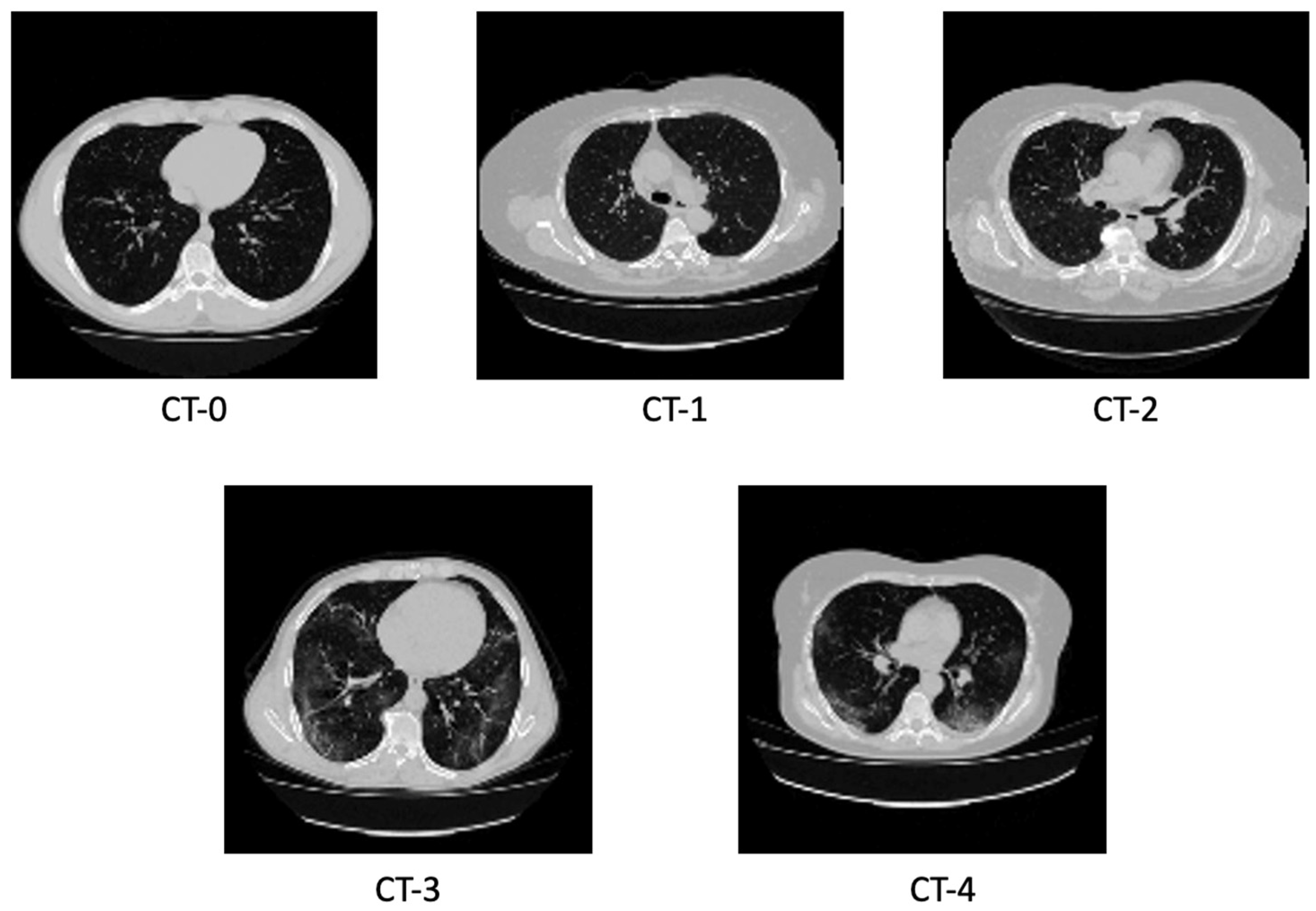
Given the pronounced impact COVID-19 continues to have on society—infecting 700 million reported individuals and causing 6.96 million deaths—many deep learning works have recently focused on the virus’s diagnosis. However, assessing severity has remained an open and challenging problem due to a lack of large datasets, the large dimensionality of images for which to find weights, and the compute limitations of modern graphics processing units (GPUs). In this paper, a new, iterative application of transfer learning is demonstrated on the understudied field of 3D CT scans for COVID-19 severity analysis. This methodology allows for enhanced performance on the MosMed Dataset, which is a small and challenging dataset containing 1130 images of patients for five levels of COVID-19 severity (Zero, Mild, Moderate, Severe, and Critical). Specifically, given the large dimensionality of the input images, we create several custom shallow convolutional neural network (CNN) architectures and iteratively refine and optimize them, paying attention to learning rates, layer types, normalization types, filter sizes, dropout values, and more. After a preliminary architecture design, the models are systematically trained on a simplified version of the dataset-building models for two-class, then three-class, then four-class, and finally five-class classification. The simplified problem structure allows the model to start learning preliminary features, which can then be further modified for more difficult classification tasks. Our final model CoSev boosts classification accuracies from below 60% at first to 81.57% with the optimizations, reaching similar performance to the state-of-the-art on the dataset, with much simpler setup procedures. In addition to COVID-19 severity diagnosis, the explored methodology can be applied to general image-based disease detection. Overall, this work highlights innovative methodologies that advance current computer vision practices for high-dimension, low-sample data as well as the practicality of data-driven machine learning and the importance of feature design for training, which can then be implemented for improvements in clinical practices.
Keywords: severity assessment; COVID-19; computer vision; high dimension low sample learning; data-driven severity assessment; COVID-19; computer vision; high dimension low sample learning; data-driven