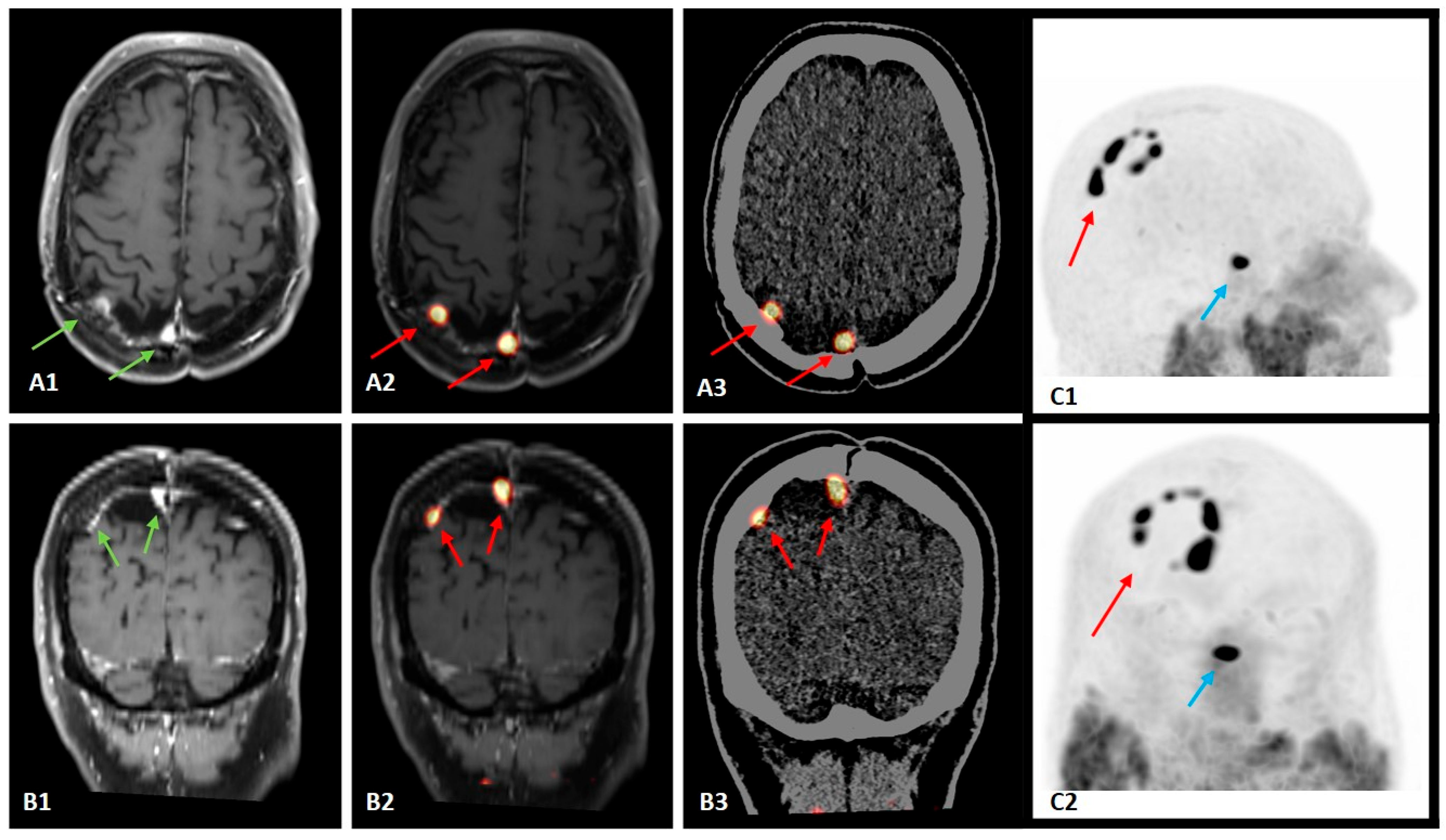
“Rosary Sign” at Somatostatin Receptor PET in a Case of Recurrent Meningioma

 , ,
, ,  and
and 
Abstract

Author Contributions
Funding
Institutional Review Board Statement
Informed Consent Statement
Data Availability Statement
Conflicts of Interest
References
- Albert, N.L.; Preusser, M.; Traub-Weidinger, T.; Tolboom, N.; Law, I.; Palmer, J.D.; Guedj, E.; Furtner, J.; Fraioli, F.; Huang, R.Y.; et al. Joint EANM/EANO/RANO/SNMMI practice guideline/procedure standards for diagnostics and therapy (theranostics) of meningiomas using radiolabeled somatostatin receptor ligands: Version 1.0. Eur. J. Nucl. Med. Mol. Imaging 2024, 51, 3662–3679. [Google Scholar] [CrossRef] [PubMed]
- Filippi, L.; Palumbo, I.; Bagni, O.; Schillaci, O.; Aristei, C.; Palumbo, B. Somatostatin Receptor Targeted PET-Imaging for Diagnosis, Radiotherapy Planning and Theranostics of Meningiomas: A Systematic Review of the Literature. Diagnostics 2022, 12, 1666. [Google Scholar] [CrossRef] [PubMed]
- Mirian, C.; Duun-Henriksen, A.K.; Maier, A.; Pedersen, M.M.; Jensen, L.R.; Bashir, A.; Graillon, T.; Hrachova, M.; Bota, D.; van Essen, M.; et al. Somatostatin Receptor-Targeted Radiopeptide Therapy in Treatment-Refractory Meningioma: Individual Patient Data Meta-analysis. J. Nucl. Med. 2021, 62, 507–513. [Google Scholar] [CrossRef] [PubMed]
- Palmisciano, P.; Watanabe, G.; Conching, A.; Ogasawara, C.; Ferini, G.; Bin-Alamer, O.; Haider, A.S.; Sabini, M.G.; Cuttone, G.; Cosentino, S.; et al. The Role of [⁶⁸Ga]Ga-DOTA-SSTR PET Radiotracers in Brain Tumors: A Systematic Review of the Literature and Ongoing Clinical Trials. Cancers 2022, 14, 2925. [Google Scholar] [CrossRef] [PubMed]
- Treglia, G.; Raditchkova, M.; Giovanella, L.; Stelmes, J.J.; Bosetti, D.G.; Martucci, F. Two Birds with One Stone: Skull Base Meningioma and Jugulotympanic Paragangliomas with Somatostatin Receptor Positron Emission Tomography. Diagnostics 2021, 11, 1669. [Google Scholar] [CrossRef] [PubMed]
- Helgebostad, R.; Revheim, M.E.; Johnsrud, K.; Amlie, K.; Alavi, A.; Connelly, J.P. Clinical Applications of Somatostatin Receptor (Agonist) PET Tracers beyond Neuroendocrine Tumors. Diagnostics 2022, 12, 528. [Google Scholar] [CrossRef] [PubMed]
- Muoio, B.; Espeli, V.; Treglia, G. Neuro-Oncology and Positron Emission Tomography: “Just Can’t Get Enough”. Cancers 2023, 15, 4739. [Google Scholar] [CrossRef] [PubMed]
- Albano, D.; Treglia, G.; Dondi, F.; Bertagna, F. Prevalence of Brain Incidental Lesions Detected by 68Ga-DOTA Peptides PET/CT. Medicina 2022, 58, 916. [Google Scholar] [CrossRef] [PubMed]
- Treglia, G.; Muoio, B.; Trevisi, G.; Mattoli, M.V.; Albano, D.; Bertagna, F.; Giovanella, L. Diagnostic Performance and Prognostic Value of PET/CT with Different Tracers for Brain Tumors: A Systematic Review of Published Meta-Analyses. Int. J. Mol. Sci. 2019, 20, 4669. [Google Scholar] [CrossRef] [PubMed]
Disclaimer/Publisher’s Note: The statements, opinions and data contained in all publications are solely those of the individual author(s) and contributor(s) and not of MDPI and/or the editor(s). MDPI and/or the editor(s) disclaim responsibility for any injury to people or property resulting from any ideas, methods, instructions or products referred to in the content. |
© 2024 by the authors. Licensee MDPI, Basel, Switzerland. This article is an open access article distributed under the terms and conditions of the Creative Commons Attribution (CC BY) license (https://creativecommons.org/licenses/by/4.0/).
Share and Cite
Iacovitti, C.M.; Bosetti, D.G.; Muoio, B.; Cuzzocrea, M.; Paone, G.; Treglia, G. “Rosary Sign” at Somatostatin Receptor PET in a Case of Recurrent Meningioma. Diagnostics 2024, 14, 2608. https://doi.org/10.3390/diagnostics14222608
Iacovitti CM, Bosetti DG, Muoio B, Cuzzocrea M, Paone G, Treglia G. “Rosary Sign” at Somatostatin Receptor PET in a Case of Recurrent Meningioma. Diagnostics. 2024; 14(22):2608. https://doi.org/10.3390/diagnostics14222608
Chicago/Turabian StyleIacovitti, Cesare Michele, Davide Giovanni Bosetti, Barbara Muoio, Marco Cuzzocrea, Gaetano Paone, and Giorgio Treglia. 2024. "“Rosary Sign” at Somatostatin Receptor PET in a Case of Recurrent Meningioma" Diagnostics 14, no. 22: 2608. https://doi.org/10.3390/diagnostics14222608
APA StyleIacovitti, C. M., Bosetti, D. G., Muoio, B., Cuzzocrea, M., Paone, G., & Treglia, G. (2024). “Rosary Sign” at Somatostatin Receptor PET in a Case of Recurrent Meningioma. Diagnostics, 14(22), 2608. https://doi.org/10.3390/diagnostics14222608