Review

Free-Running Cardiac and Respiratory Motion-Resolved Imaging: A Paradigm Shift for Managing Motion in Cardiac MRI?

by
Robert J. Holtackers
1,2,3,* and
Matthias Stuber
1,4
1
Department of Diagnostic and Interventional Radiology, Lausanne University Hospital (CHUV) and University of Lausanne (UNIL), Rue de Bugnon 46, 1011 Lausanne, Switzerland
2
Department of Radiology & Nuclear Medicine, Maastricht University Medical Center, P. Debyelaan 25, 6229 HX Maastricht, The Netherlands
3
Cardiovascular Research Institute Maastricht (CARIM), Maastricht University, Universiteitssingel 50, 6200 MD Maastricht, The Netherlands
4
Center for Biomedical Imaging (CIBM), EPFL AVP CP CIBM Station 6, 1015 Lausanne, Switzerland
*
Author to whom correspondence should be addressed.
Diagnostics 2024, 14(17), 1946; https://doi.org/10.3390/diagnostics14171946

Submission received: 16 August 2024 / Revised: 30 August 2024 / Accepted: 30 August 2024 / Published: 3 September 2024
(This article belongs to the Special Issue New Trends and Advances in Cardiac Imaging)

Abstract

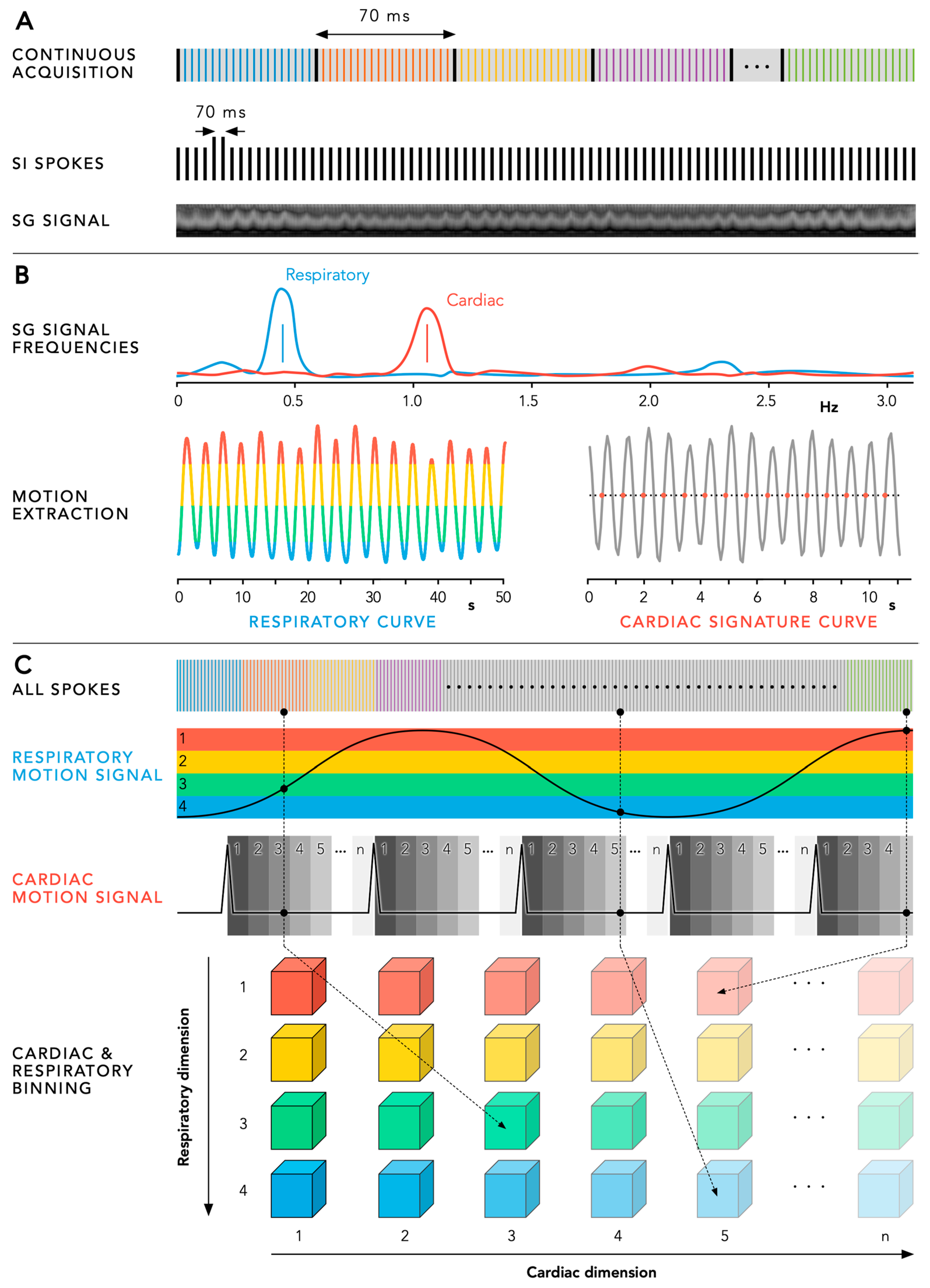
Cardiac magnetic resonance imaging (MRI) is widely used for non-invasive assessment of cardiac morphology, function, and tissue characteristics due to its exquisite soft-tissue contrast. However, it remains time-consuming and requires proficiency, making it costly and limiting its widespread use. Traditional cardiac MRI is inefficient as signal acquisition is often limited to specific cardiac phases and requires complex view planning, parameter adjustments, and management of both respiratory and cardiac motion. Recent efforts have aimed to make cardiac MRI more efficient and accessible. Among these innovations, the free-running framework enables 5D whole-heart imaging without the need for an electrocardiogram signal, respiratory breath-holding, or complex planning. It uses a fully self-gated approach to extract cardiac and respiratory signals directly from the acquired image data, allowing for more efficient coverage in time and space without the need for electrocardiogram gating, triggering, navigators, or breath-holds. This review provides a comprehensive overview of the free-running framework, detailing its history, concepts, recent improvements, and clinical applications.
Keywords: free-running; cardiac MRI; CMR; 5D; motion-resolved; self-gating; free-breathing free-running; cardiac MRI; CMR; 5D; motion-resolved; self-gating; free-breathing