Article

Intracranial Hemorrhage Detection Using Parallel Deep Convolutional Models and Boosting Mechanism


1
Department of Computer Science, COMSATS University Islamabad, Islamabad 44000, Pakistan
2
School of Electrical Engineering and Computer Science (SEECS), National University of Sciences and Technology (NUST), Islamabad 44500, Pakistan
3
Institute of Computing, Kohat University of Science & Technology, Kohat 26000, Pakistan
4
Computer Science Department, National University of Computer and Emerging Sciences (NUCES-FAST), Islamabad 44000, Pakistan
5
Industrial Engineering Department, College of Engineering, King Saud University, Riyadh 11421, Saudi Arabia
6
Centre for Smart Systems, AI and Cybersecurity, Staffordshire University, Stoke-on-Trent ST4 2DE, UK
*
Authors to whom correspondence should be addressed.
Diagnostics 2023, 13(4), 652; https://doi.org/10.3390/diagnostics13040652

Submission received: 21 December 2022 / Revised: 31 January 2023 / Accepted: 2 February 2023 / Published: 9 February 2023

Abstract

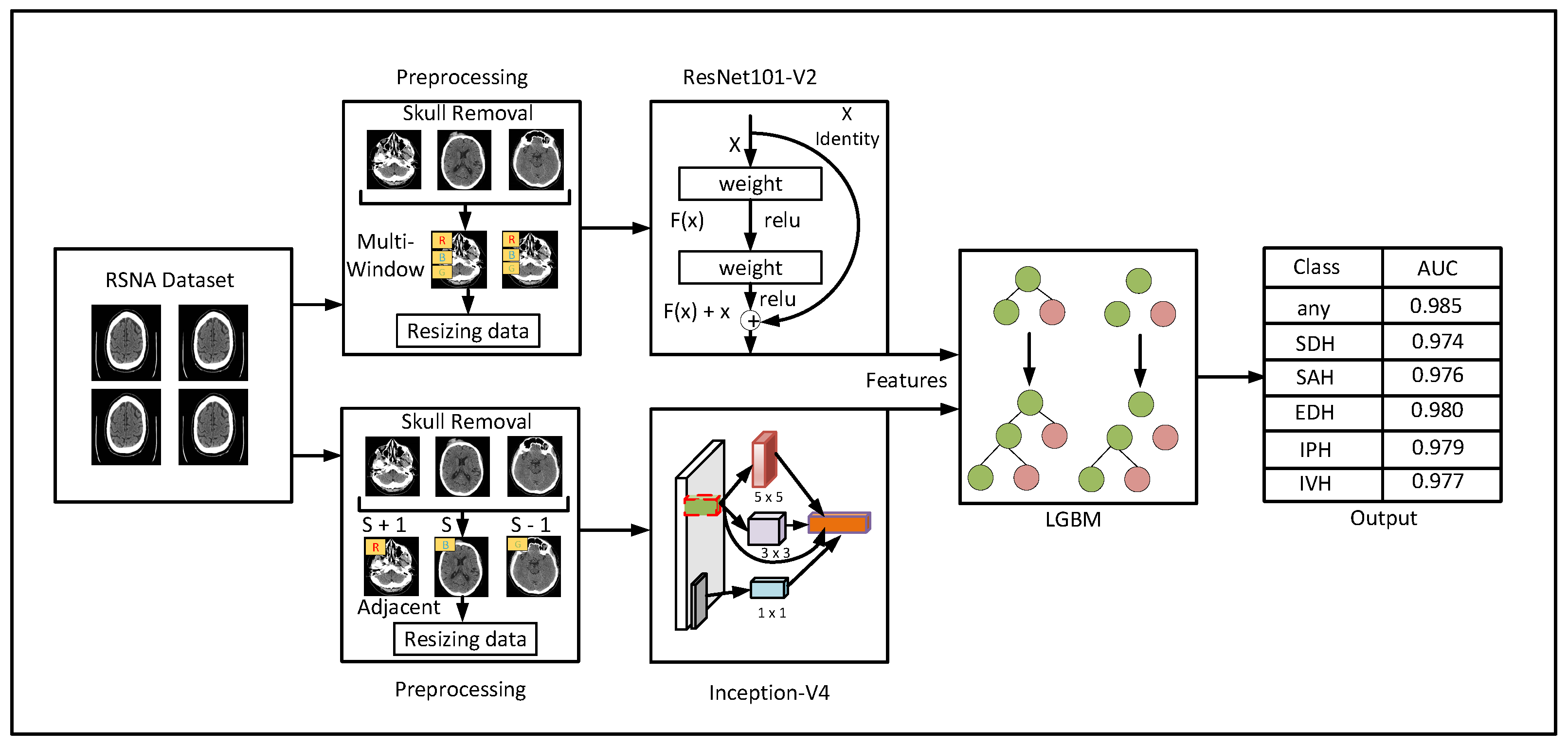
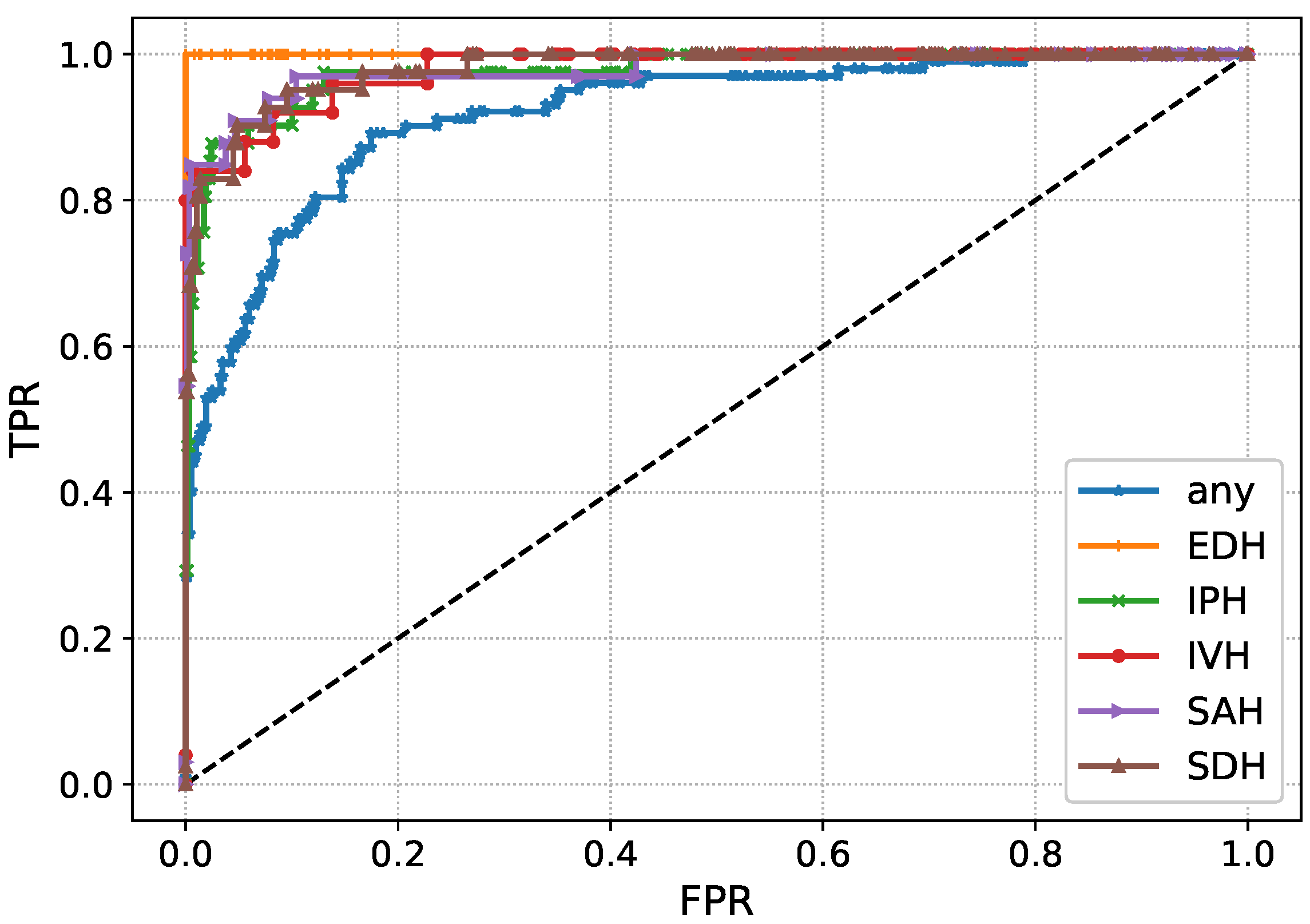
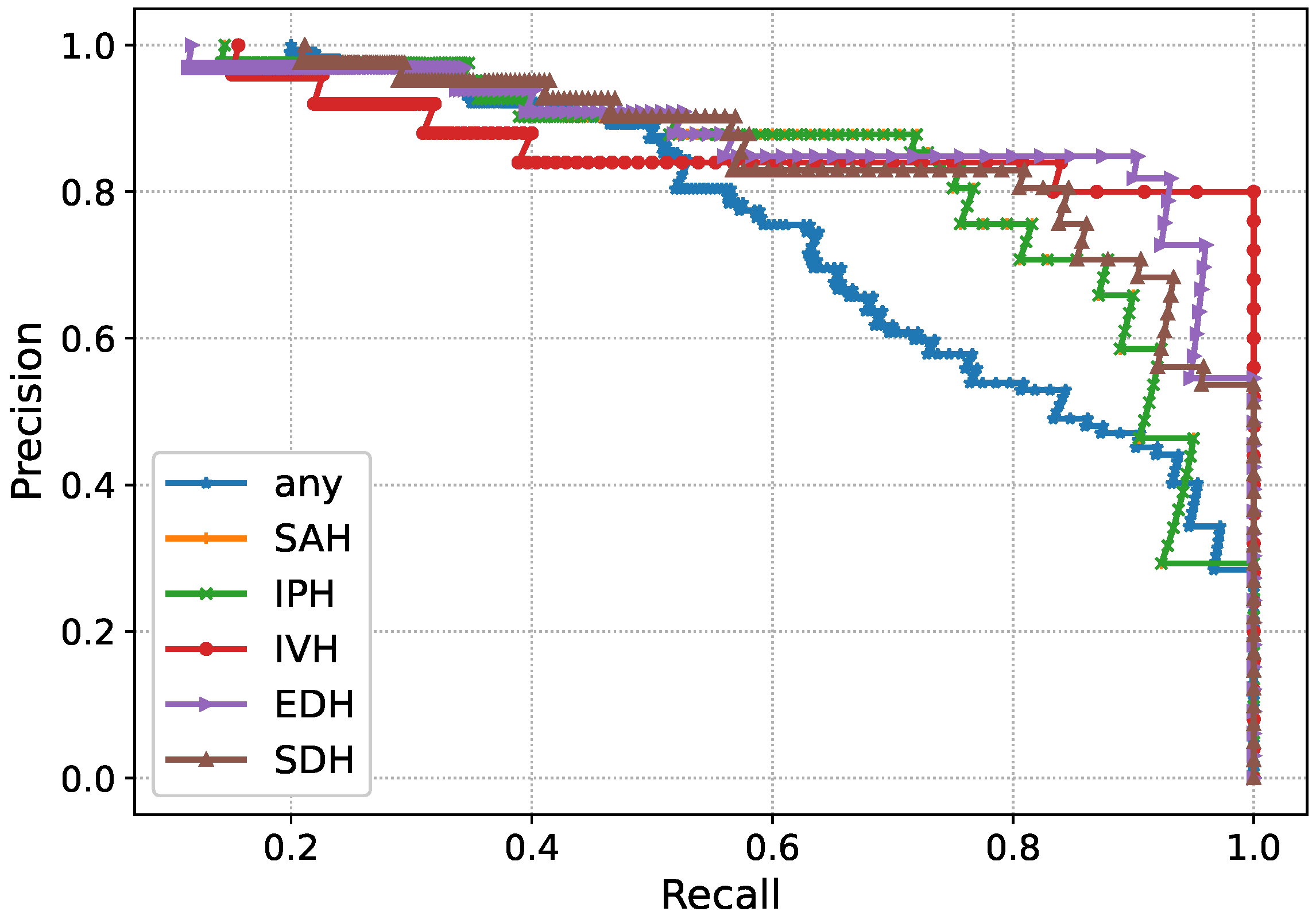
Intracranial hemorrhage (ICH) can lead to death or disability, which requires immediate action from radiologists. Due to the heavy workload, less experienced staff, and the complexity of subtle hemorrhages, a more intelligent and automated system is necessary to detect ICH. In literature, many artificial-intelligence-based methods are proposed. However, they are less accurate for ICH detection and subtype classification. Therefore, in this paper, we present a new methodology to improve the detection and subtype classification of ICH based on two parallel paths and a boosting technique. The first path employs the architecture of ResNet101-V2 to extract potential features from windowed slices, whereas Inception-V4 captures significant spatial information in the second path. Afterwards, the detection and subtype classification of ICH is performed by the light gradient boosting machine (LGBM) using the outputs of ResNet101-V2 and Inception-V4. Thus, the combined solution, known as ResNet101-V2, Inception-V4, and LGBM (Res-Inc-LGBM), is trained and tested over the brain computed tomography (CT) scans of CQ500 and Radiological Society of North America (RSNA) datasets. The experimental results state that the proposed solution efficiently obtains 97.7% accuracy, 96.5% sensitivity, and 97.4% F1 score using the RSNA dataset. Moreover, the proposed Res-Inc-LGBM outperforms the standard benchmarks for the detection and subtype classification of ICH regarding the accuracy, sensitivity, and F1 score. The results prove the significance of the proposed solution for its real-time application.
Keywords: intracranial hemorrhage; computed tomography; light gradient boosting machine; support vector machine; convolutional neural networks intracranial hemorrhage; computed tomography; light gradient boosting machine; support vector machine; convolutional neural networks