Review

Deep Learning Applications in Computed Tomography Images for Pulmonary Nodule Detection and Diagnosis: A Review

1
College of Big Data and Internet, Shenzhen Technology University, Shenzhen 518118, China
2
Guangdong Key Laboratory for Biomedical Measurements and Ultrasound Imaging, School of Biomedical Engineering, Shenzhen University Health Science Center, Shenzhen 518060, China
3
College of Applied Sciences, Shenzhen University, Shenzhen 518060, China
*
Author to whom correspondence should be addressed.
Diagnostics 2022, 12(2), 298; https://doi.org/10.3390/diagnostics12020298

Submission received: 15 November 2021 / Revised: 21 January 2022 / Accepted: 22 January 2022 / Published: 25 January 2022
(This article belongs to the Special Issue Machine Learning for Computer-Aided Diagnosis in Biomedical Imaging)

Abstract

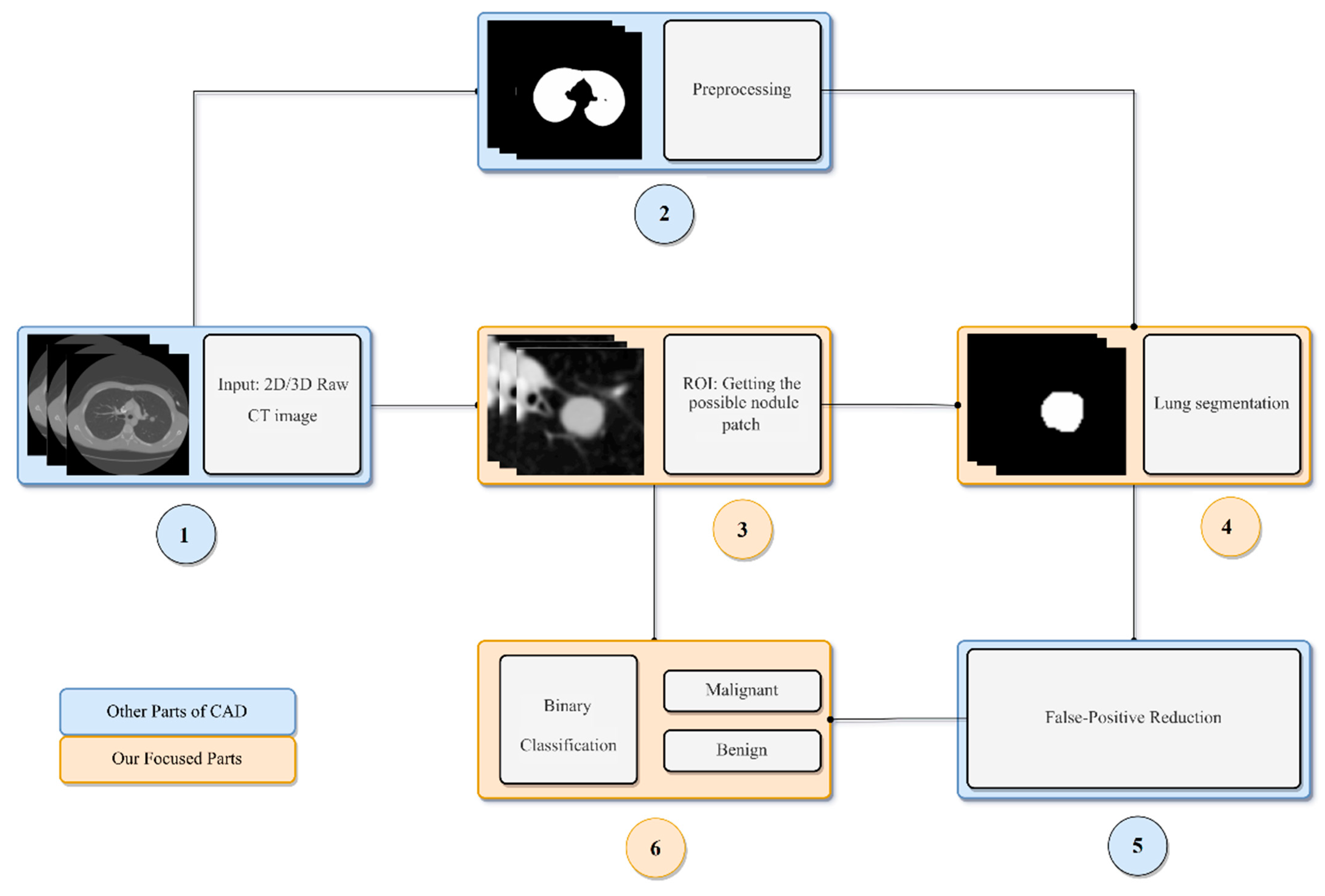
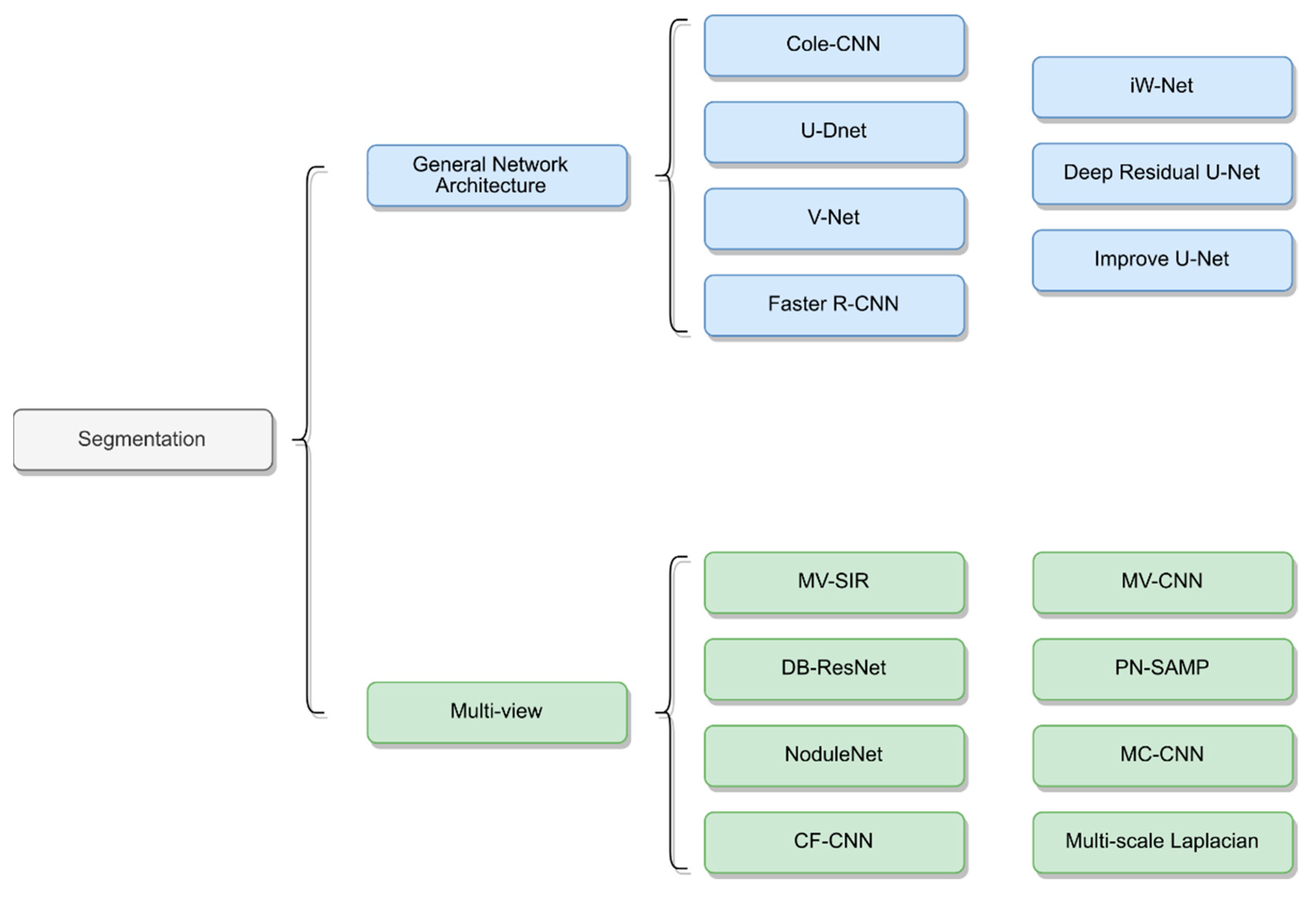
Lung cancer has one of the highest mortality rates of all cancers and poses a severe threat to people’s health. Therefore, diagnosing lung nodules at an early stage is crucial to improving patient survival rates. Numerous computer-aided diagnosis (CAD) systems have been developed to detect and classify such nodules in their early stages. Currently, CAD systems for pulmonary nodules comprise data acquisition, pre-processing, lung segmentation, nodule detection, false-positive reduction, segmentation, and classification. A number of review articles have considered various components of such systems, but this review focuses on segmentation and classification parts. Specifically, categorizing segmentation parts based on lung nodule type and network architectures, i.e., general neural network and multiview convolution neural network (CNN) architecture. Moreover, this work organizes related literature for classification of parts based on nodule or non-nodule and benign or malignant. The essential CT lung datasets and evaluation metrics used in the detection and diagnosis of lung nodules have been systematically summarized as well. Thus, this review provides a baseline understanding of the topic for interested readers.
Keywords: lung cancer; deep learning; lung nodule segmentation and classification; lung nodule computer-aided diagnosis lung cancer; deep learning; lung nodule segmentation and classification; lung nodule computer-aided diagnosis