Case Report

Quantitative, Dynamic 18F-FDG PET/CT in Monitoring of Smoldering Myeloma: A Case Report
by
Christos Sachpekidis
*,
Matthias Türk
and
Antonia Dimitrakopoulou-Strauss
Clinical Cooperation Unit Nuclear Medicine, German Cancer Research Center, Heidelberg 69120, Germany
*
Author to whom correspondence should be addressed.
Diagnostics 2021, 11(4), 649; https://doi.org/10.3390/diagnostics11040649

Submission received: 2 March 2021 / Revised: 25 March 2021 / Accepted: 2 April 2021 / Published: 3 April 2021
(This article belongs to the Special Issue Quantitative PET and SPECT)

Abstract

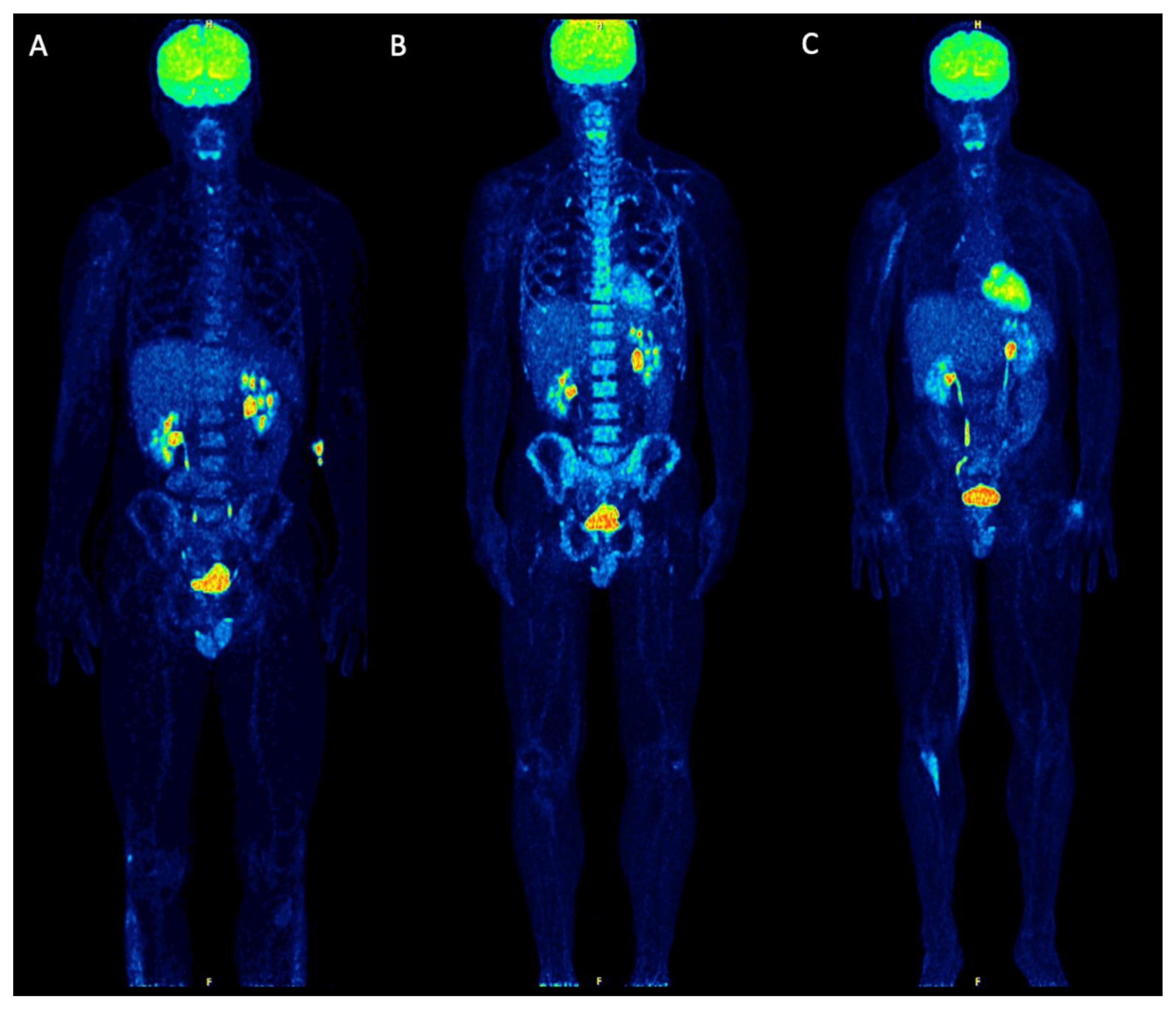
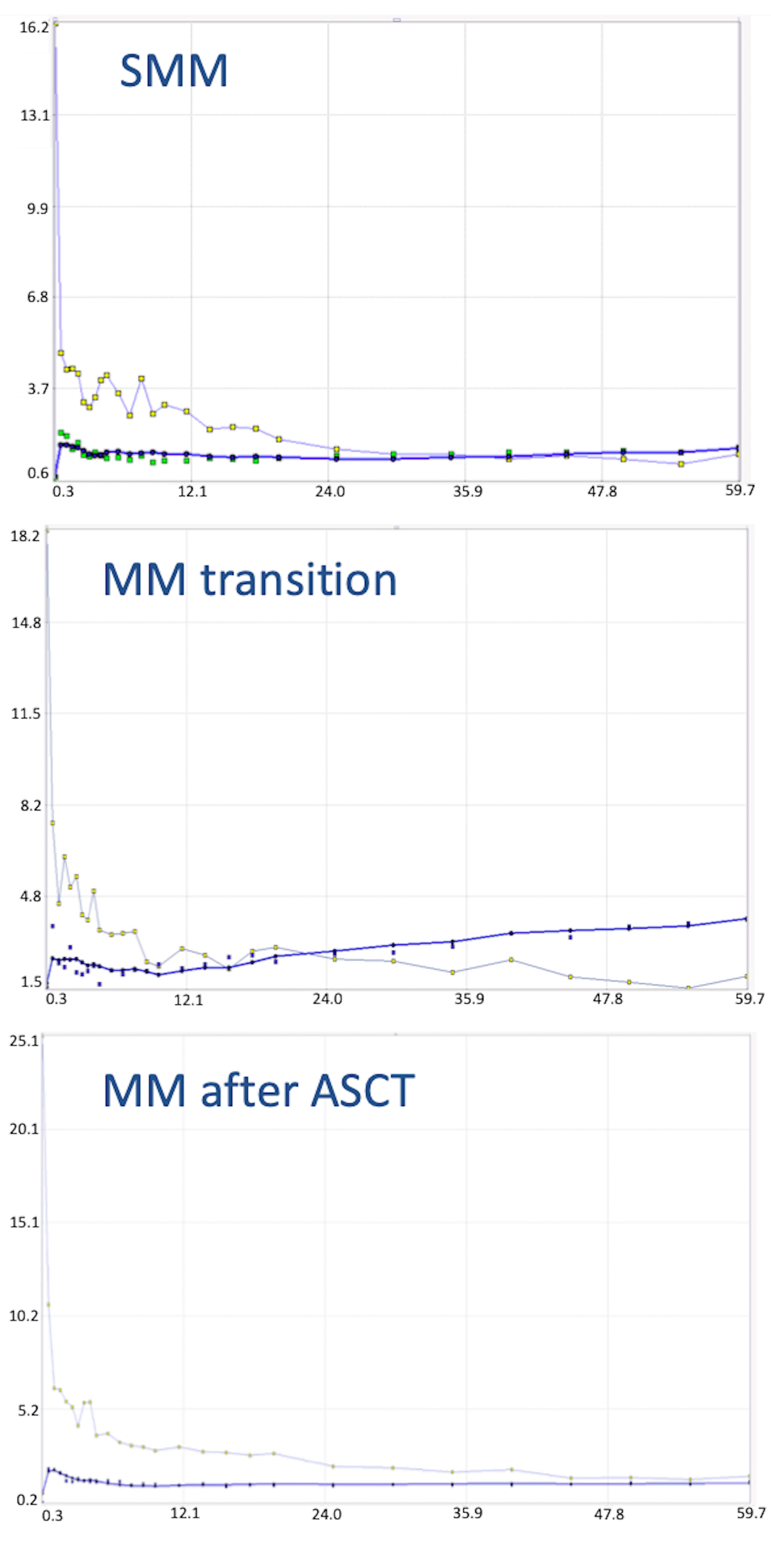
We report on a 52-year-old patient with an initial diagnosis of smoldering myeloma (SMM), who was monitored by means of dynamic and static positron emission tomography/computed tomography (PET/CT) with the radiotracer 1⁸F-fluorodeoxyglucose (18F-FDG). Baseline PET/CT revealed no pathological signs. Six months later, a transition to symptomatic, multiple myeloma (MM) was diagnosed. The transition was not accompanied by focal, hypermetabolic lesions on PET/CT. However, a diffusely increased 18F-FDG uptake in the bone marrow, accompanied by a marked increase of semi-quantitative (standardized uptake value, SUV) and quantitative, pharmacokinetic 18F-FDG parameters, was demonstrated. After successful treatment, including tandem autologous transplantation, the diffuse uptake in the bone marrow as well as the semi-quantitative and quantitative parameters showed a marked remission. This response was also confirmed by the clinical follow-up of the patient. These findings suggest that in MM a diffuse 18F-FDG uptake in the bone marrow may indeed reflect an actual bone marrow infiltration by plasma cells. Moreover, SUV values and kinetic parameters, not only from myeloma lesions but also from random bone marrow samples, may be used for MM monitoring. This could be particularly helpful in the follow-up of myeloma patients negative for 18F-FDG-avid focal lesions.
Keywords: smoldering myeloma; multiple myeloma; quantitative; dynamic 18F-FDG PET/CT; autologous stem cell transplantation smoldering myeloma; multiple myeloma; quantitative; dynamic 18F-FDG PET/CT; autologous stem cell transplantation