Article

Ventilator Parameters in the Diagnosis and Prognosis of Acute Respiratory Distress Syndrome in Postoperative Patients: A Preliminary Study

1
Internal Medicine Research Center, Department of Research, Changhua Christian Hospital, Changhua 500, Taiwan
2
Graduate Institute of Statistics and Information Science, National Changhua University of Education, Changhua 500, Taiwan
3
Division of Critical Care Medicine, Department of Internal Medicine, Changhua Christian Hospital, Changhua 500, Taiwan
4
Medical Intensive Care Unit, Division of Cardiology, Department of Internal Medicine, Cathay General Hospital, Taipei 106, Taiwan
5
Division of Neurosurgery, Department of Surgery, Mackay Memorial Hospital, Taipei 104, Taiwan
6
Institute of Traditional Medicine, National Yang-Ming Chiao-Tung University School of Medicine, Taipei 112, Taiwan
7
Department of Medical Research, Taipei Veterans General Hospital, Taipei 112, Taiwan
8
Department of Medicine, Taian Hospital, Taipei 104, Taiwan
9
Tanyu Research Laboratory, Taipei 112, Taiwan
*
Author to whom correspondence should be addressed.
These authors contributed equally to this work.
Diagnostics 2021, 11(4), 648; https://doi.org/10.3390/diagnostics11040648

Submission received: 20 March 2021 / Revised: 31 March 2021 / Accepted: 1 April 2021 / Published: 3 April 2021

Abstract

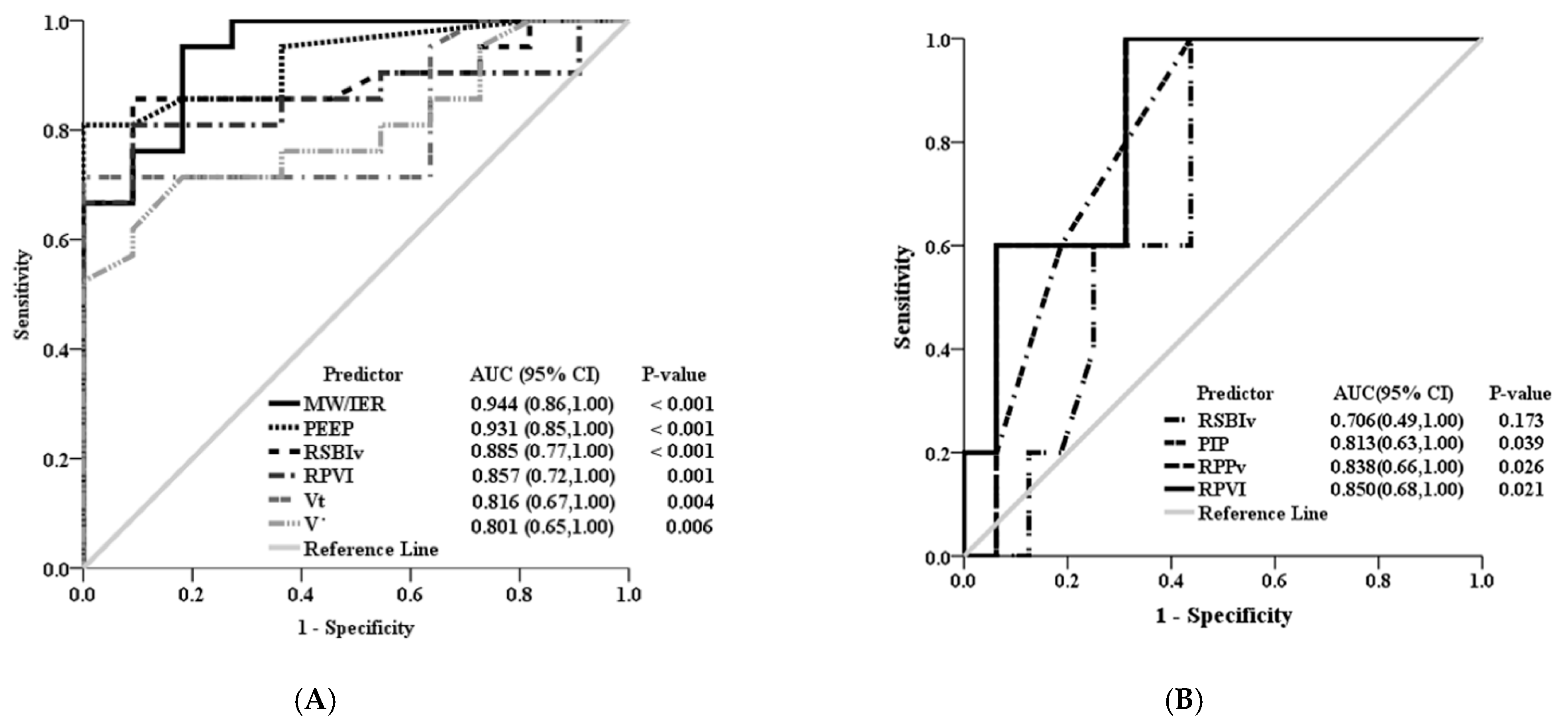
This study investigated the usefulness of ventilator parameters in the prediction of development and outcome of acute respiratory distress syndrome (ARDS) in postoperative patients with esophageal or lung cancer on admission to the surgical intensive care unit (SICU). A total of 32 post-operative patients with lung or esophageal cancer from SICU in a tertiary medical center were retrospectively analyzed. The study patients were divided into an ARDS group (n = 21) and a non-ARDS group (n = 11). The ARDS group contained the postoperative patients who developed ARDS after lung or esophageal cancer surgery. The ventilator variables were analyzed in this study. Principal component analysis (PCA) was performed to reduce the correlated ventilator variables to a small set of variables. The top three ventilator variables with large coefficients, as determined by PCA, were considered as sensitive variables and included in the analysis model based on the rule of 10 events per variable. Firth logistic regression with selective stepwise elimination procedure was performed to identify the most important predictors of morbidity and mortality in patients with ARDS. Ventilator parameters, including rapid shallow breath index during mechanical ventilation (RSBIv), rate pressure product of ventilation (RPPv), rate pressure volume index (RPVI), mechanical work (MW), and inspiration to expiration time ratio (IER), were analyzed in this study. It was found that the ARDS patients had significantly greater respiratory rate (RR), airway resistance (Raw), RSBIv, RPPv, RPVI, positive end-expiratory pressure (PEEP), and IER and significantly lower respiratory interval (RI), expiration time (Te), flow rate (V˙), tidal volume (VT), dynamic compliance (Cdyn), mechanical work of ventilation (MW), and MW/IER ratio than the non-ARDS patients. The non-survivors of ARDS had significantly greater peak inspiratory pressure above PEEP (PIP), RSBIv, RPPv, and RPVI than the survivors of ARDS. By using PCA, the MW/IER was found to be the most important predictor of the development of ARDS, and both RPPv and RPVI were significant predictors of mortality in patients with ARDS. In conclusion, some ventilator parameters, such as RPPv, RPVI, and MW/IER defined in this study, can be derived from ventilator readings and used to predict the development and outcome of ARDS in mechanically ventilated patients on admission to the SICU.
Keywords: acute respiratory distress syndrome; rapid shallow breath index; work of ventilation; rate pressure product of ventilation; inspiration to expiration time ratio acute respiratory distress syndrome; rapid shallow breath index; work of ventilation; rate pressure product of ventilation; inspiration to expiration time ratio