Systematic Review

Patient-Derived Functional Models for Prediction of Radiotherapy Response in Rectal Cancer: A Systematic Review and Exploratory HSROC Meta-Analysis


by
Stefan Morarasu
1,2,
Sorinel Lunca
1,2,*,
Andrei-Nicolae Ceobanu
1,3,
Alexandru-Florin Braniste
1,2 and
Gabriel Mihail Dimofte
1,2
1
Grigore T Popa University of Medicine and Pharmacy, 700115 Iasi, Romania
2
2nd Department of Surgical Oncology, Regional Institute of Oncology, 700483 Iasi, Romania
3
Department of Medical Oncology, Regional Institute of Oncology, 700483 Iasi, Romania
*
Author to whom correspondence should be addressed.
Life 2026, 16(7), 1205; https://doi.org/10.3390/life16071205
Submission received: 3 June 2026 / Revised: 7 July 2026 / Accepted: 14 July 2026 / Published: 21 July 2026
(This article belongs to the Section Radiobiology and Nuclear Medicine)

Abstract

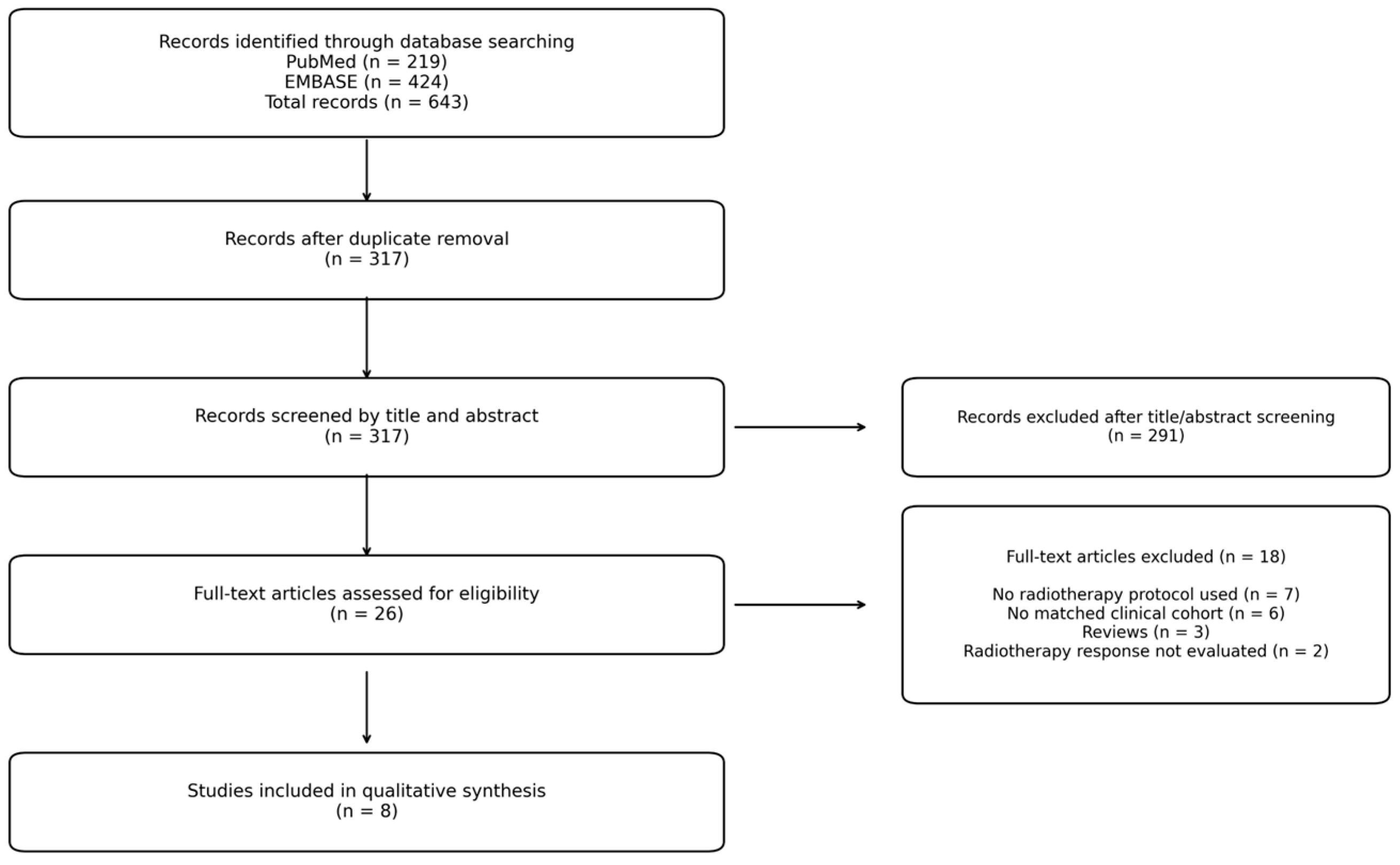
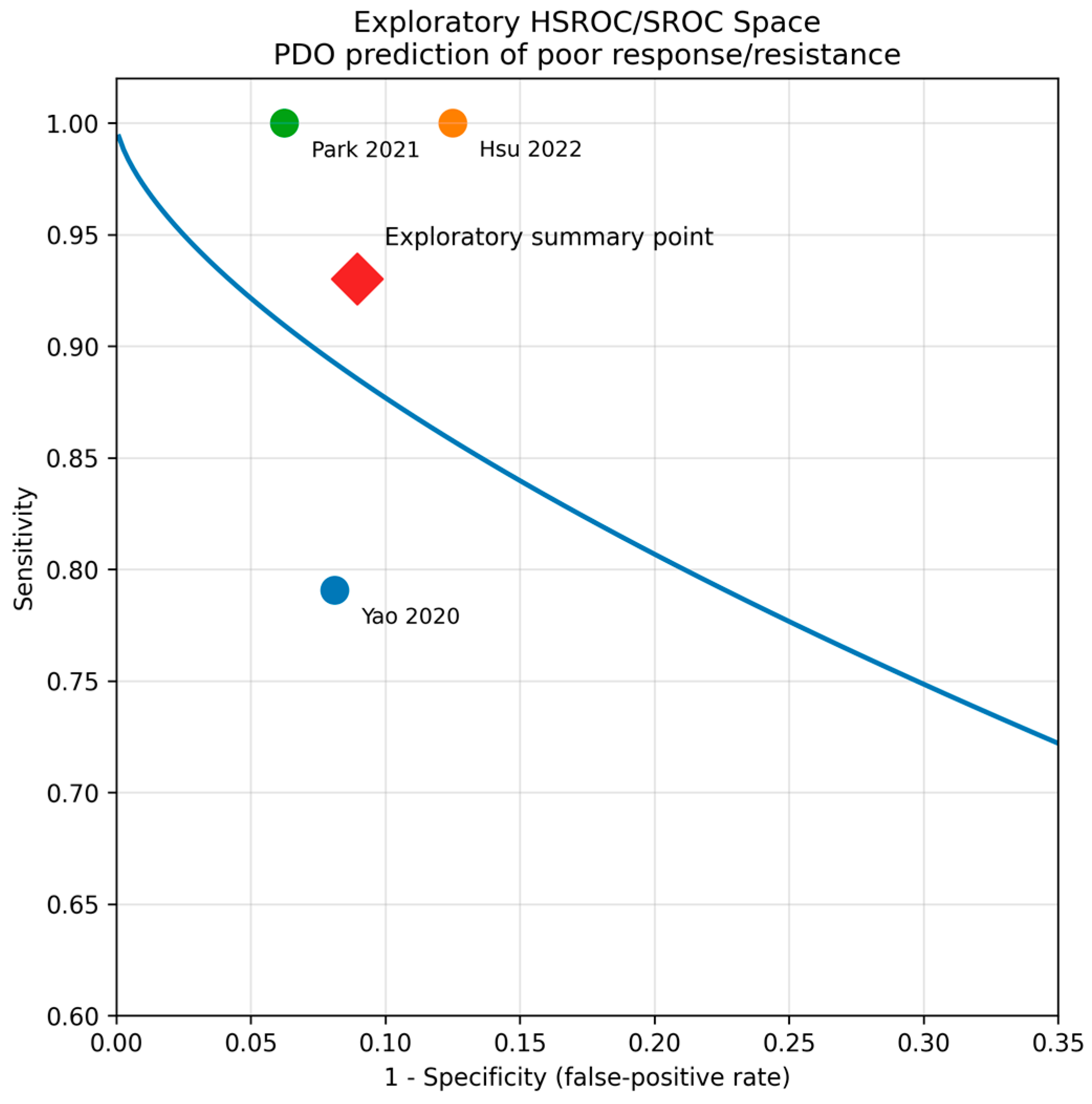
Background: Patient-derived functional models have emerged as promising translational platforms capable of reproducing tumour-specific treatment sensitivity patterns, which could be used to personalise neoadjuvant treatment for patients with rectal cancer. Herein, we aimed to summarise the current comparative evidence in a meta-analytical framework on radiotherapy response between preclinical platforms and matched patient data. Methods: A systematic review was performed according to PRISMA principles to identify studies evaluating patient-derived functional models for the prediction of radiotherapy or chemoradiotherapy response in rectal cancer. Study characteristics, experimental protocols, predictive performance and clinical correlations were extracted. An exploratory hierarchical summary receiver operating characteristic (HSROC) meta-analysis was performed using studies providing sufficient data. Results: Eight studies involving patient-derived organoids and zebrafish patient-derived xenograft models were included. Most studies evaluated locally advanced rectal cancer treated with neoadjuvant chemoradiotherapy. The included studies demonstrated concordance rates ranging from 78% to 100% between ex vivo functional responses and matched clinical treatment outcomes. Reported predictive performance was favourable, with Yao et al. demonstrating 85.0% concordance, 78.0% sensitivity and 92.0% specificity, while Hsu et al. reported 87.5% sensitivity and 100% specificity using radiobiological modelling. Exploratory HSROC analysis demonstrated overall favourable discriminatory performance for prediction of treatment resistance and poor response. Conclusions: Patient-derived functional models, particularly PDOs, demonstrate promising potential as predictive biomarkers for radiotherapy and chemoradiotherapy response in rectal cancer. Although the current evidence remains exploratory and is limited by methodological heterogeneity and small cohorts, these platforms represent a promising translational strategy in precision radiation oncology, warranting prospective multicentre validation.
Keywords: rectal cancer; radiotherapy; xenograft; organoids; precision oncology; personalised medicine rectal cancer; radiotherapy; xenograft; organoids; precision oncology; personalised medicine