Patient-Derived Functional Models for Prediction of Radiotherapy Response in Rectal Cancer: A Systematic Review and Exploratory HSROC Meta-Analysis

 , , , and
Abstract
1. Introduction
2. Materials and Methods
2.1. Literature Search
2.2. Eligibility Criteria
2.3. Data Extraction and Outcomes
2.4. Statistical Analysis
3. Results
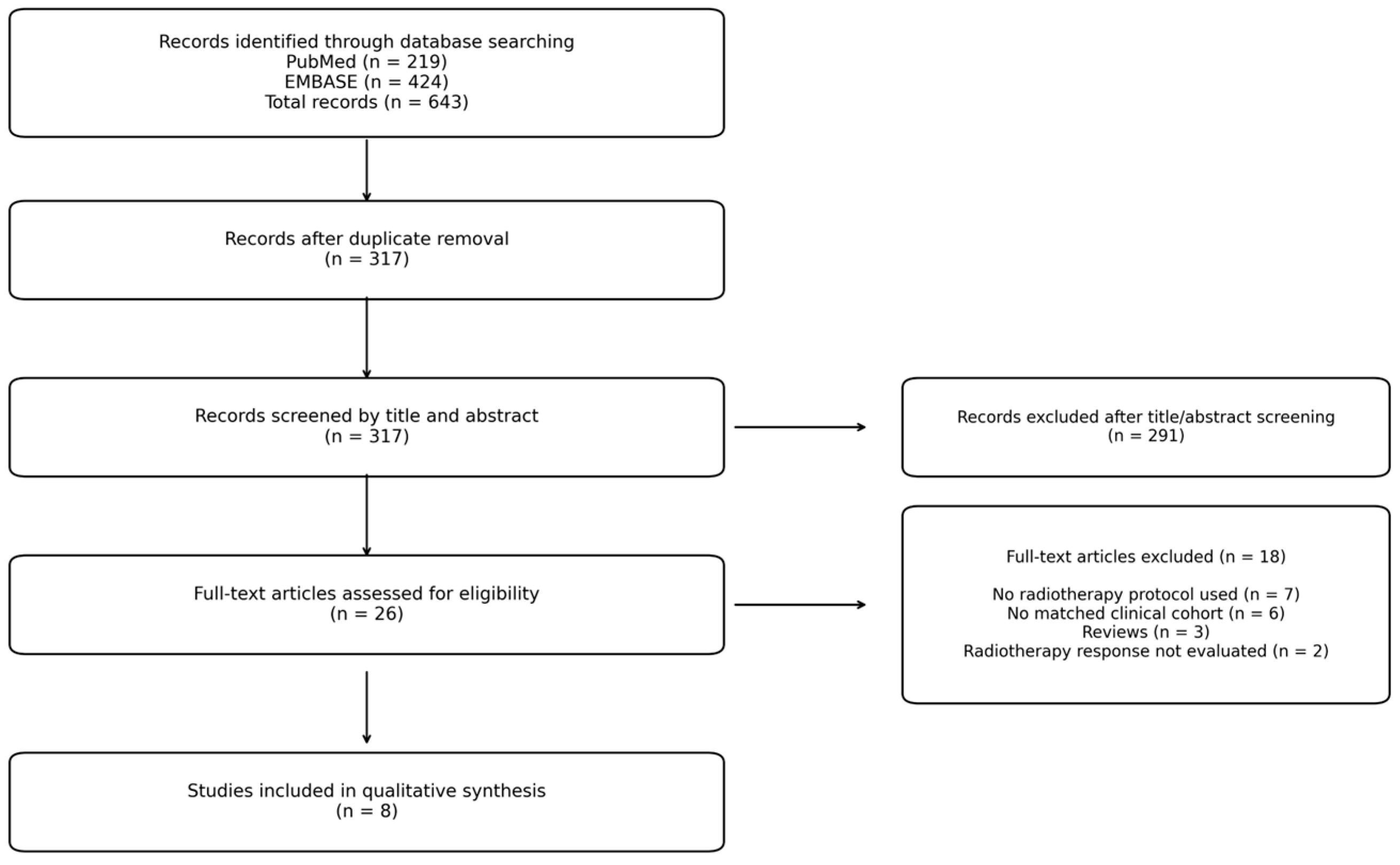
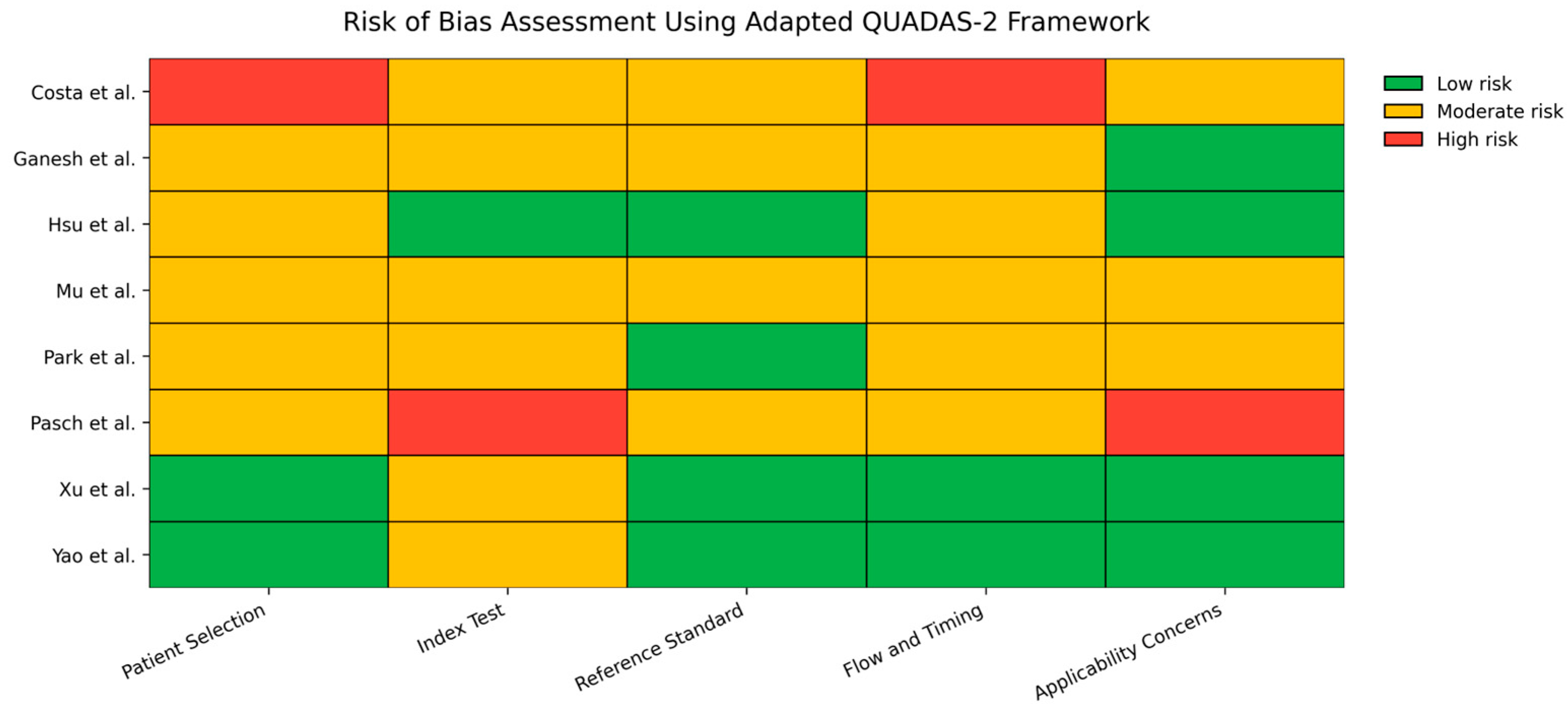
3.1. Eligible Studies
3.2. Design of Patient-Derived Functional Models
3.3. Radiotherapy Protocols
3.4. Predictive Performance
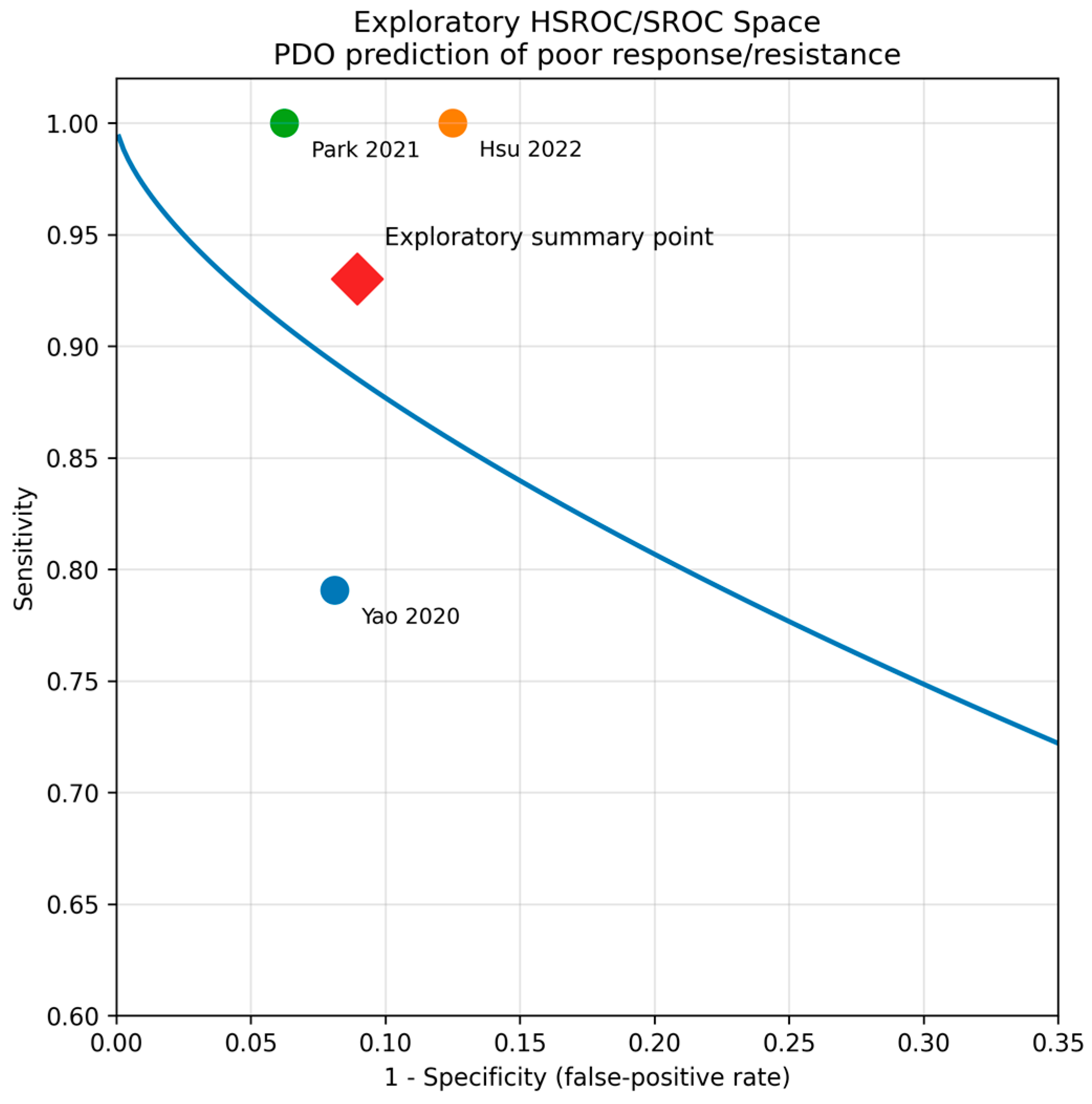
3.5. Diagnostic Accuracy Meta-Analysis
4. Discussion
5. Conclusions
Supplementary Materials
Author Contributions
Funding
Institutional Review Board Statement
Informed Consent Statement
Data Availability Statement
Conflicts of Interest
Abbreviations
| AUC | Area Under the Curve |
| cCR | Clinical Complete Response |
| CRT | Chemoradiotherapy |
| EMBASE | Excerpta Medica Database |
| FN | False Negative |
| FP | False Positive |
| HSROC | Hierarchical Summary Receiver Operating Characteristic |
| MRI | Magnetic Resonance Imaging |
| pCR | Pathological Complete Response |
| PDO | Patient-Derived Organoid |
| PDOX | Patient-Derived Organoid Xenograft |
| PDX | Patient-Derived Xenograft |
| PRISMA | Preferred Reporting Items for Systematic Reviews and Meta-Analyses |
| QUADAS-2 | Quality Assessment of Diagnostic Accuracy Studies-2 |
| ROC | Receiver Operating Characteristic |
| TNT | Total Neoadjuvant Therapy |
| TN | True Negative |
| TP | True Positive |
| TRG | Tumour Regression Grade |
References
- Sauer, R.; Becker, H.; Hohenberger, W.; Rödel, C.; Wittekind, C.; Fietkau, R.; Martus, P.; Tschmelitsch, J.; Hager, E.; Hess, C.F.; et al. Preoperative versus postoperative chemoradiotherapy for rectal cancer. N. Engl. J. Med. 2004, 351, 1731–1740. [Google Scholar] [CrossRef] [Scilit] [PubMed]
- Bahadoer, R.R.; Dijkstra, E.A.; van Etten, B.; Marijnen, C.A.M.; Putter, H.; Kranenbarg, E.M.; Roodvoets, A.G.; Nagtegaal, I.D.; Beets-Tan, R.G.; Blomqvist, L.K.; et al. Short-course radiotherapy followed by chemotherapy before total mesorectal excision (RAPIDO): A randomised, open-label, phase 3 trial. Lancet Oncol. 2021, 22, 29–42. [Google Scholar] [CrossRef] [Scilit] [PubMed]
- Conroy, T.; Bosset, J.F.; Etienne, P.L.; Rio, E.; François, E.; Mesgouez-Nebout, N.; Vendrely, V.; Artignan, X.; Bouché, O.; Gargot, D.; et al. Neoadjuvant chemotherapy with FOLFIRINOX and preoperative chemoradiotherapy for patients with locally advanced rectal cancer (PRODIGE 23): Results of a multicentre, randomised, open-label, phase 3 trial. Lancet Oncol. 2021, 22, 702–715. [Google Scholar] [CrossRef] [Scilit] [PubMed]
- van der Valk, M.J.M.; Hilling, D.E.; Bastiaannet, E.; Meershoek-Klein Kranenbarg, E.; Beets, G.L.; Figueiredo, N.L.; Habr-Gama, A.; OPerez, R.; Renehan, A.G.; van de Velde, C.J.H.; et al. Long-term outcomes of clinical complete responders after neoadjuvant treatment for rectal cancer in the International Watch & Wait Database (IWWD). Lancet 2018, 391, 2537–2545. [Google Scholar] [CrossRef] [Scilit] [PubMed]
- Geubels, B.M.; van den Esschert, A.J.; Temmink, S.J.D.; Nilsson, P.J.; Martling, A.; Roodvoets, A.G.H.; Peeters, K.C.M.J.; Sonneveld, D.J.A.; van Westreenen, H.L.; Bujko, K.; et al. Outcomes of watch and wait after short-course radiotherapy in an international multicentre watch-and-wait cohort. Br. J. Surg. 2024, 111, znae242. [Google Scholar] [CrossRef] [Scilit] [PubMed]
- Li, M.; Xiao, Q.; Venkatachalam, N.; Hofheinz, R.-D.; Veldwijk, M.R.; Herskind, C.; Ebert, M.P.; Zhan, T. Predicting response to neoadjuvant chemoradiotherapy in rectal cancer: From biomarkers to tumor models. Ther. Adv. Med. Oncol. 2022, 14. [Google Scholar] [CrossRef] [Scilit] [PubMed]
- Jain, S.M.; Ravichandran, S.N.; Kumar, M.M.; Banerjee, A.; Sun-Zhang, A.; Zhang, H.; Pathak, R.; Sun, X.-F.; Pathak, S. Understanding the molecular mechanism responsible for developing therapeutic radiation-induced radioresistance of rectal cancer and improving the clinical outcomes of radiotherapy—A review. Cancer Biol. Ther. 2024, 25, 2317999. [Google Scholar] [CrossRef] [Scilit] [PubMed]
- Mare, M.; Colarossi, L.; Veschi, V.; Turdo, A.; Giuffrida, D.; Memeo, L.; Stassi, G.; Colarossi, C. Cancer Stem Cell Biomarkers Predictive of Radiotherapy Response in Rectal Cancer: A Systematic Review. Genes 2021, 12, 1502. [Google Scholar] [CrossRef] [Scilit] [PubMed]
- Chatila, W.K.; Kim, J.K.; Walch, H.; Marco, M.R.; Chen, C.T.; Wu, F.; Omer, D.M.; Khalil, D.N.; Ganesh, K.; Qu, X.; et al. Genomic and transcriptomic determinants of response to neoadjuvant therapy in rectal cancer. Nat. Med. 2022, 28, 1646–1655. [Google Scholar] [CrossRef] [Scilit] [PubMed]
- Domingo, E.; Rathee, S.; Blake, A.; Samuel, L.; Murray, G.; Montefiore-Sebag, D.; Gollins, S.; West, N.; Begum, R.; Richman, S.; et al. Identification and validation of a machine learning model of complete response to radiation in rectal cancer reveals immune infiltrate and TGFβ as key predictors. EBioMedicine 2024, 106, 105228. [Google Scholar] [CrossRef] [Scilit] [PubMed]
- Akiyoshi, T.; Wang, Z.; Kaneyasu, T.; Gotoh, O.; Tanaka, N.; Amino, S.; Yamamoto, N.; Kawachi, H.; Mukai, T.; Hiyoshi, Y.; et al. Transcriptomic Analyses of Pretreatment Tumor Biopsy Samples, Response to Neoadjuvant Chemoradiotherapy, and Survival in Patients With Advanced Rectal Cancer. JAMA Netw. Open. 2023, 6, e2252140. [Google Scholar] [CrossRef] [Scilit] [PubMed]
- Tong, L.; Cui, W.; Zhang, B.; Fonseca, P.; Zhao, Q.; Zhang, P.; Xu, B.; Zhang, Q.; Li, Z.; Seashore-Ludlow, B.; et al. Patient-derived organoids in precision cancer medicine. Med 2024, 5, 1347–1371. [Google Scholar] [CrossRef] [Scilit] [PubMed]
- Zhou, Z.; Cong, L.; Cong, X. Patient-derived organoids in precision medicine: Drug screening, organoid-on-a-chip and living organoid biobank. Front. Oncol. 2021, 11, 762184. [Google Scholar] [CrossRef] [Scilit] [PubMed]
- Vlachogiannis, G.; Hedayat, S.; Vatsiou, A.; Jamin, Y.; Fernández-Mateos, J.; Khan, K.; Lampis, A.; Eason, K.; Huntingford, I.; Burke, R.; et al. Patient-derived organoids model treatment response of metastatic gastrointestinal cancers. Science 2018, 359, 920–926. [Google Scholar] [CrossRef] [Scilit] [PubMed]
- Ooft, S.N.; Weeber, F.; Dijkstra, K.K.; McLean, C.M.; Kaing, S.; van Werkhoven, E.; Schipper, L.; Hoes, L.; Vis, D.J.; van de Haar, J.; et al. Patient-derived organoids can predict response to chemotherapy in metastatic colorectal cancer patients. Sci. Transl. Med. 2019, 11, eaay2574. [Google Scholar] [CrossRef] [Scilit] [PubMed]
- Costa, B.; Ferreira, S.; Póvoa, V.; Cardoso, M.J.; Vieira, S.; Stroom, J.; Fidalgo, P.; Rio-Tinto, R.; Figueiredo, N.; Parés, O.; et al. Developments in zebrafish avatars as radiotherapy sensitivity reporters—Towards personalized medicine. EBioMedicine 2020, 51, 102578. [Google Scholar] [CrossRef] [Scilit] [PubMed]
- Ganesh, K.; Wu, C.; O’Rourke, K.P.; Szeglin, B.C.; Zheng, Y.; Sauvé, C.G.; Adileh, M.; Wasserman, I.; Marco, M.R.; Kim, A.S.; et al. A rectal cancer organoid platform to study individual responses to chemoradiation. Nat. Med. 2019, 25, 1607–1614. [Google Scholar] [CrossRef] [Scilit] [PubMed]
- Hsu, K.-S.; Adileh, M.; Martin, M.L.; Makarov, V.; Chen, J.; Wu, C.; Bodo, S.; Klingler, S.; Sauvé, C.-E.G.; Szeglin, B.C.; et al. Colorectal Cancer Develops Inherent Radiosensitivity That Can Be Predicted Using Patient-Derived Organoids. Cancer Res. 2022, 82, 2298–2312. [Google Scholar] [CrossRef] [Scilit] [PubMed]
- Mu, P.; Mo, S.; He, X.; Zhang, H.; Lv, T.; Xu, R.; He, L.; Xia, F.; Zhou, S.; Chen, Y.; et al. Unveiling radiobiological traits and therapeutic responses of BRAFV600E-mutant colorectal cancer via patient-derived organoids. J. Exp. Clin. Cancer Res. 2025, 44, 92. [Google Scholar] [CrossRef] [Scilit] [PubMed]
- Park, M.; Kwon, J.; Kong, J.; Moon, S.M.; Cho, S.; Yang, K.Y.; Jang, W.I.; Kim, M.S.; Kim, Y.; Shin, U.S. A patient-derived organoid-based radiosensitivity model for the prediction of radiation responses in patients with rectal cancer. Cancers 2021, 13, 3760. [Google Scholar] [CrossRef] [Scilit] [PubMed]
- Pasch, C.A.; Favreau, P.F.; Yueh, A.E.; Babiarz, C.P.; Gillette, A.A.; Sharick, J.T.; Karim, M.R.; Nickel, K.P.; DeZeeuw, A.K.; Sprackling, C.M.; et al. Patient-derived cancer organoid cultures to predict sensitivity to chemotherapy and radiation. Clin. Cancer Res. 2019, 25, 5376–5387. [Google Scholar] [CrossRef] [Scilit] [PubMed]
- Xu, X.; Lv, T.; Yao, Y.; Wan, J.; Shen, L.; Xia, F.; Gao, X.; Li, Y.; Fu, G.; Deng, Y.; et al. Comprehensive dissection of rectal cancer organoids in responses to chemoradiation. Cell Rep. Med. 2025, 6, 102397. [Google Scholar] [CrossRef] [Scilit] [PubMed]
- Yao, Y.; Xu, X.; Yang, L.; Zhu, J.; Wan, J.; Shen, L.; Xia, F.; Fu, G.; Deng, Y.; Pan, M.; et al. Patient-derived organoids predict chemoradiation responses of locally advanced rectal cancer. Cell Stem Cell 2020, 26, 17–26.e6. [Google Scholar] [CrossRef] [Scilit] [PubMed]
- Fazio, M.; Ablain, J.; Chuan, Y.; Langenau, D.M.; Zon, L.I. Zebrafish patient avatars in cancer biology and precision cancer therapy. Nat. Rev. Cancer 2020, 20, 263–273. [Google Scholar] [CrossRef] [Scilit] [PubMed]
- Xiao, J.; Glasgow, E.; Agarwal, S. Zebrafish xenografts for drug discovery and personalized medicine. Trends Cancer 2020, 6, 569–579. [Google Scholar] [CrossRef] [Scilit] [PubMed]
- Di Franco, G.; Usai, A.; Piccardi, M.; Cateni, P.; Palmeri, M.; Pollina, L.E.; Gaeta, R.; Marmorino, F.; Cremolini, C.; Dente, L.; et al. Zebrafish Patient-Derived Xenograft Model to Predict Treatment Outcomes of Colorectal Cancer Patients. Biomedicines 2022, 10, 1474. [Google Scholar] [CrossRef] [Scilit] [PubMed]
- Booth, A.; Clarke, M.; Dooley, G.; Ghersi, D.; Moher, D.; Petticrew, M.; Stewart, L. The nuts and bolts of PROSPERO: An international prospective register of systematic reviews. Syst. Rev. 2012, 1, 2. [Google Scholar] [CrossRef] [Scilit] [PubMed]
- Page, M.J.; McKenzie, J.E.; Bossuyt, P.M.; Boutron, I.; Hoffmann, T.C.; Mulrow, C.D.; Shamseer, L.; Tetzlaff, J.M.; Akl, E.A.; Brennan, S.E.; et al. The PRISMA 2020 statement: An updated guideline for reporting systematic reviews. BMJ 2021, 372, n71. [Google Scholar] [CrossRef] [Scilit] [PubMed]
- Whiting, P.F.; Rutjes, A.W.S.; Westwood, M.E.; Mallett, S.; Deeks, J.J.; Reitsma, J.B.; Leeflang, M.M.G.; Sterne, J.A.C.; Bossuyt, P.M.M. QUADAS-2: A revised tool for the quality assessment of diagnostic accuracy studies. Ann. Intern. Med. 2011, 155, 529–536. [Google Scholar] [CrossRef] [Scilit] [PubMed]
- Bourbonne, V.; Schick, U.; Pradier, O.; Visvikis, D.; Metges, J.-P.; Badic, B. Radiomics Approaches for the Prediction of Pathological Complete Response after Neoadjuvant Treatment in Locally Advanced Rectal Cancer: Ready for Prime Time? Cancers 2023, 15, 432. [Google Scholar] [CrossRef] [Scilit] [PubMed]
- Morais, M.; Fonseca, T.; Melo-Pinto, D.; Prieto, I.; Vilares, A.T.; Duarte, A.L.; Leitão, P.; Cirnes, L.; Machado, J.C.; Carneiro, S. Evaluation of ctDNA in the Prediction of Response to Neoadjuvant Therapy and Prognosis in Locally Advanced Rectal Cancer Patients: A Prospective Study. Pharmaceuticals 2023, 16, 427. [Google Scholar] [CrossRef] [Scilit] [PubMed]
- Alden, S.L.; Lee, V.; Narang, A.K.; Meyer, J.; Gearhart, S.L.; Christenson, E.S. Circulating Tumor DNA to Predict Radiographic and Pathologic Response to Total Neoadjuvant Therapy in Locally Advanced Rectal Cancer. Oncologist 2024, 29, e414–e418. [Google Scholar] [CrossRef] [Scilit] [PubMed]
- He, J.; Wang, S.X.; Liu, P. Machine learning in predicting pathological complete response to neoadjuvant chemoradiotherapy in rectal cancer using MRI: A systematic review and meta-analysis. Br. J. Radiol. 2024, 97, 1243–1254. [Google Scholar] [CrossRef] [Scilit] [PubMed] [PubMed Central]
- Tie, J.; Cohen, J.D.; Wang, Y.; Ginestet, P.G.; Wong, R.; Shapiro, J.D.; Campbell, R.; Day, F.; Hayes, T.M.; Aghmesheh, M.; et al. Circulating tumor DNA analysis informing adjuvant chemotherapy in locally advanced rectal cancer: The randomized AGITG DYNAMIC-Rectal study. J. Clin. Oncol. 2024, 42, 12. [Google Scholar] [CrossRef] [Scilit]



| Study | Model Type | Patient Cohort | Treatment Evaluated |
|---|---|---|---|
| Costa 2020 [16] | PDX | 2 patients | CRT |
| Ganesh 2019 [17] | PDO | Translational cohort | CRT |
| Hsu 2022 [18] | PDO | 13 patients | CRT |
| Mu 2025 [19] | PDO ± PDX | 19 patients | CRT |
| Park 2021 [20] | PDO | 33 patients | CRT |
| Pasch 2019 [21] | PDO | Translational cohort | Radiotherapy |
| Xu 2025 [22] | PDO | Translational cohort | CRT |
| Yao 2020 [23] | PDO | 80 patients | CRT |
| Study | Tissue Source | PDO Establishment Method | Culture Matrix/Medium |
|---|---|---|---|
| Costa 2020 [16] | Rectal tumour tissue | Mechanical and enzymatic dissociation followed by zebrafish xenografting | Not applicable |
| Ganesh 2019 [17] | Primary and metastatic rectal cancer tissue | Tumour dissociation and embedding into 3D extracellular matrix cultures | Basement membrane extract/matrigel with organoid-supportive medium |
| Hsu 2022 [18] | Rectal cancer endoscopic biopsies | Enzymatic digestion and organoid propagation under stem cell conditions | Matrigel-based colorectal organoid medium |
| Mu 2025 [19] | Rectal tumour tissue | Standardised 3D PDO establishment after tissue dissociation | Extracellular matrix-supported stem cell medium |
| Park 2021 [20] | Rectal cancer biopsy specimens | Tumour fragmentation and enzymatic dissociation into PDO cultures | Matrigel-based organoid medium |
| Pasch 2019 [21] | Rectal cancer surgical specimens | PDO establishment from patient tumours using 3D culture conditions | Basement membrane matrix with colorectal organoid medium |
| Xu 2025 [22] | Locally advanced rectal cancer biopsies | Large-scale PDO biobank generation and propagation | Matrigel-based organoid expansion medium |
| Yao 2020 [23] | Rectal cancer endoscopic biopsies | Mechanical and enzymatic tissue dissociation followed by PDO establishment | Matrigel and colorectal organoid stem cell medium |
| Study | Model | Experimental Treatment Protocol | Main Outcome Assessed |
|---|---|---|---|
| Costa 2020 [16] | PDX | Single-dose irradiation (25 Gy) | Tumour apoptosis and concordance with patient response |
| Ganesh 2019 [17] | PDOs | Chemoradiotherapy exposure assays | Functional treatment sensitivity and response phenotypes |
| Hsu 2022 [18] | PDOs | Clonogenic radiation survival assays; D0 modelling | Radiosensitivity and clinical response correlation |
| Mu 2025 [19] | PDOs/PDOX | 5-FU, irinotecan, and oxaliplatin ± 8 Gy irradiation | PDO response, apoptosis and pathologic response |
| Park 2021 [20] | PDOs | Experimental irradiation with a machine learning prediction model | Prediction of responder versus non-responder status |
| Pasch 2019 [21] | PDOs | Radiation and chemotherapy sensitivity assays | Metabolic and growth-based treatment response |
| Xu 2025 [22] | PDOs | 8 Gy irradiation combined with 5-FU ± irinotecan | Organoid response kinetics and pTRG/cCR prediction |
| Yao 2020 [23] | PDOs | Irradiation (0–16 Gy) combined with 5-FU and/or CPT-11 | TRG/cCR prediction and treatment response concordance |
| Study | Predictive Performance | Clinical Correlation |
|---|---|---|
| Costa 2020 [16] | Concordant radiosensitivity phenotypes observed in zebrafish PDX models | Experimental response correlated with matched patient CRT response |
| Ganesh 2019 [17] | PDOs identified heterogeneous treatment sensitivity patterns | Organoid response reflected patient-specific CRT response |
| Hsu 2022 [18] | Sensitivity 87.5%; specificity 100% | PDO radiosensitivity strongly correlated with clinical response |
| Mu 2025 [19] | PDO/PDOX models reproduced sensitive and resistant phenotypes | Experimental response paralleled pathological outcomes |
| Park 2021 [20] | Exploratory sensitivity 100%; specificity 93.8% | PDO radiosensitivity correlated with pathological response |
| Pasch 2019 [21] | Heterogeneous treatment susceptibility identified by metabolic imaging | Functional response signatures reflected treatment sensitivity |
| Xu 2025 [22] | High concordance between PDO response and patient outcome | Organoid kinetics correlated with CRT response |
| Yao 2020 [23] | Concordance 85.0%; AUC 88.2%; sensitivity 78.0%; specificity 92.0% | PDO profiles closely matched TRG and cCR outcomes |
Disclaimer/Publisher’s Note: The statements, opinions and data contained in all publications are solely those of the individual author(s) and contributor(s) and not of MDPI and/or the editor(s). MDPI and/or the editor(s) disclaim responsibility for any injury to people or property resulting from any ideas, methods, instructions or products referred to in the content. |
© 2026 by the authors. Licensee MDPI, Basel, Switzerland. This article is an open access article distributed under the terms and conditions of the Creative Commons Attribution (CC BY) license.
Share and Cite
Morarasu, S.; Lunca, S.; Ceobanu, A.-N.; Braniste, A.-F.; Dimofte, G.M. Patient-Derived Functional Models for Prediction of Radiotherapy Response in Rectal Cancer: A Systematic Review and Exploratory HSROC Meta-Analysis. Life 2026, 16, 1205. https://doi.org/10.3390/life16071205
Morarasu S, Lunca S, Ceobanu A-N, Braniste A-F, Dimofte GM. Patient-Derived Functional Models for Prediction of Radiotherapy Response in Rectal Cancer: A Systematic Review and Exploratory HSROC Meta-Analysis. Life. 2026; 16(7):1205. https://doi.org/10.3390/life16071205
Chicago/Turabian StyleMorarasu, Stefan, Sorinel Lunca, Andrei-Nicolae Ceobanu, Alexandru-Florin Braniste, and Gabriel Mihail Dimofte. 2026. "Patient-Derived Functional Models for Prediction of Radiotherapy Response in Rectal Cancer: A Systematic Review and Exploratory HSROC Meta-Analysis" Life 16, no. 7: 1205. https://doi.org/10.3390/life16071205
APA StyleMorarasu, S., Lunca, S., Ceobanu, A.-N., Braniste, A.-F., & Dimofte, G. M. (2026). Patient-Derived Functional Models for Prediction of Radiotherapy Response in Rectal Cancer: A Systematic Review and Exploratory HSROC Meta-Analysis. Life, 16(7), 1205. https://doi.org/10.3390/life16071205