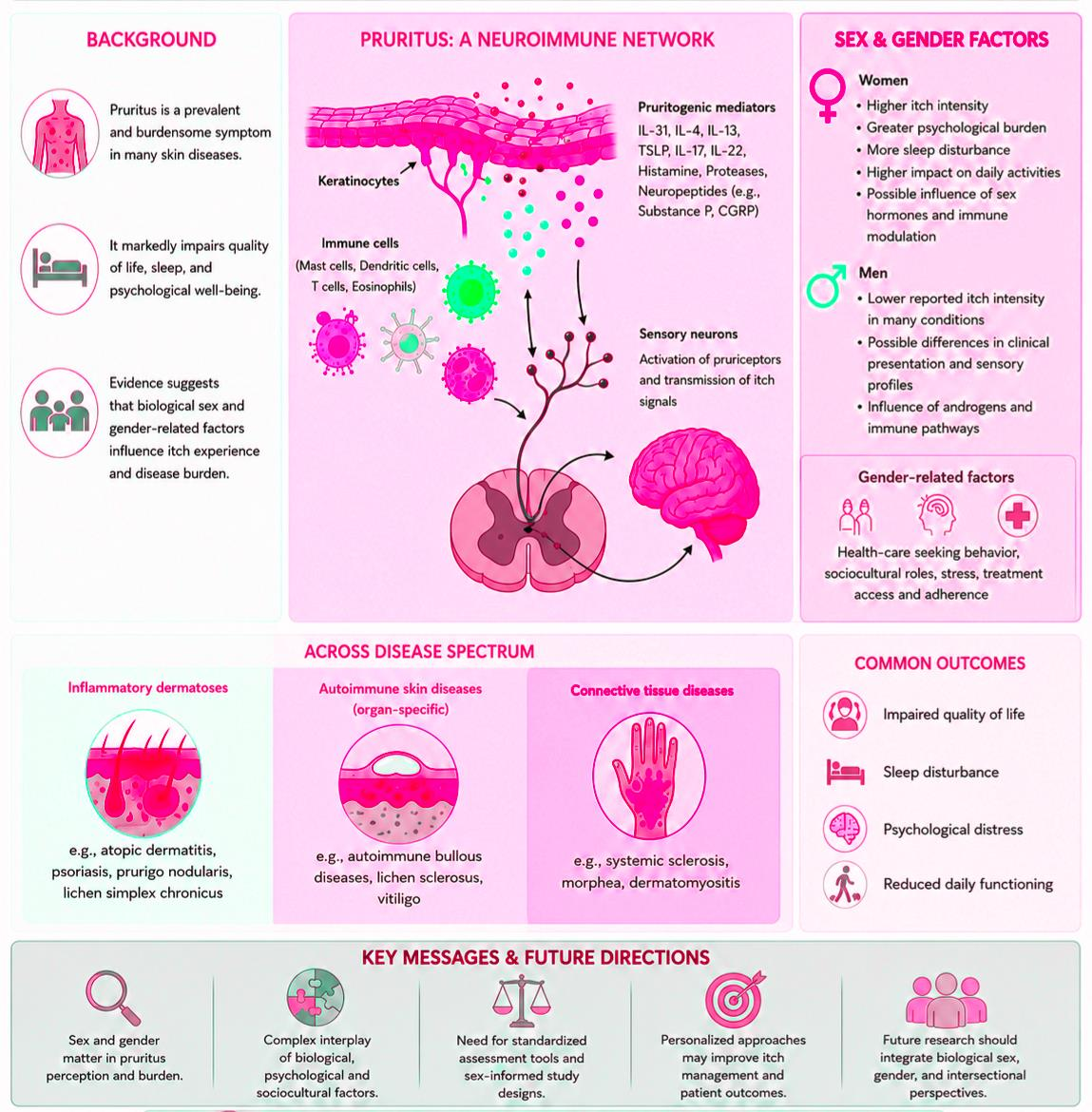
Sex- and Gender-Related Differences in Pruritus in Dermatological Diseases: Insights into Inflammatory, Autoimmune, and Connective Tissue Disorders

 , , , , , , , , ,
Abstract
1. Introduction
2. Literature Search Strategy
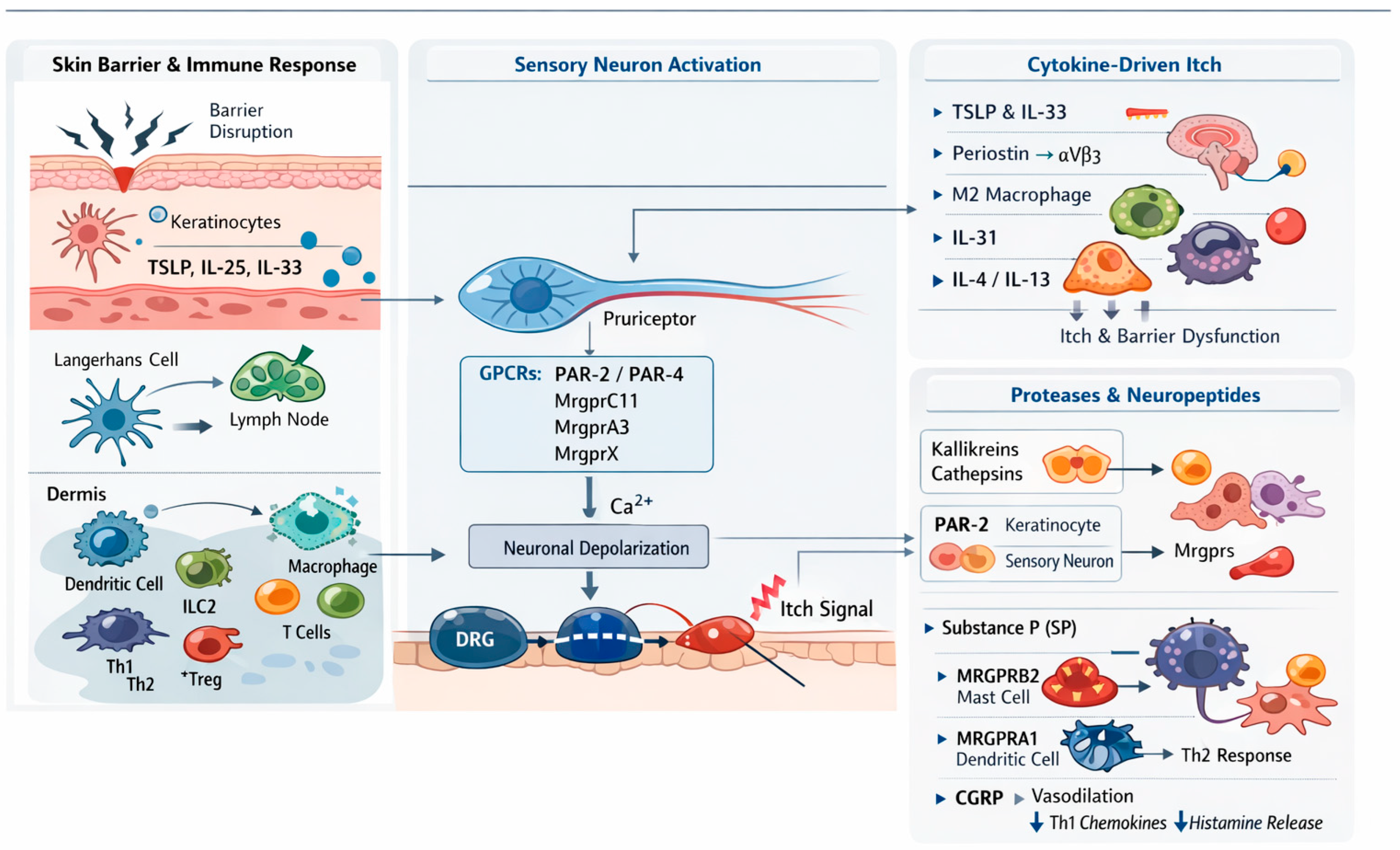
3. Pruritus: An Overview
4. Inflammatory Skin Diseases
4.1. Atopic Dermatitis
4.2. Psoriasis
4.3. Prurigo Nodularis
4.4. Lichen

| Disease | Key Evidence on Pruritus |
Reported Sex-Related
Differences |
Inconsistent Findings—
Critical Issues | Knowledge Gaps | References |
|---|---|---|---|---|---|
| Atopic dermatitis | Pruritus of moderate-to-severe-intensity in approximately 97–98% of patients; impacting QoL, quality of sleep, and daily activities | German and Brazilian studies: significantly higher itch intensity among females. Italian study: no sex differences in itch intensity | Conflicting results across studies due to heterogenous populations, differences in itch scales (NRS, ItchyQoL), undertreatment of women with moderate disease severity, pregnancy-related treatment avoidance | Lack of longitudinal studies; insufficient data on sex-related differences in treatment responses | [11,46,47,48,55] |
| Psoriasis | Pruritus affecting 70–90% of patients; comparable to AD among subjects requiring systemic treatment; detrimental effects on QoL; linked to stress, depression, and sleep impairment | Studies conducted in Sweden, Italy, Turkey, and Romania: higher proportion of women reporting higher itch intensity and abnormal, often painful or unpleasant skin sensations: Polish and Chines studies: no sex differences | Studies with small or monocentric cohorts; inconsistent assessment tools (NRS, VAS, Skindex 29 symptom scores, 4 -Item Itch Questionnaire, W AZS I index; limited adjustment for psychological conditions | Lack of longitudinal studies; limited multivariate analyses; poor characterization of sex-specific neuroimmune mechanisms. | [6,57,58,60,62,63,64,65,68,71,72,73,74] |
| Prurigo nodularis | Severe, chronic, often intractable itch manifesting in more than 90% of patients; involves both lesional and non-lesional skin; strong neuroimmune dysregulation | German study: women present with more scratch lesions and unpleasant skin sensations. U.S. study: women less likely to receive PN diagnosis despite more psychiatric comorbidities | Retrospective design; frequent misdiagnosis in PN; overlap with AD, scabies, psychiatric conditions; age imbalance; | Lack of longitudinal studies; limited data on differential therapeutic response; poor understanding of sex-related sensory profiles. | [13,66,80,81,82,83,84] |
| Lichen simplex chronicus | Chronic, often severe pruritus driven by a persistent itch–scratch cycle; substantial impact on QoL and sleep; high “scratch pleasurability” reported | Women more frequently exhibit psychological comorbidities and multiple-lesion disease, associated with higher itch severity | Limited number of studies; mostly cross-sectional or retrospective; lack of standardized itch assessment; difficulty disentangling psychological vs. biological drivers | Need for longitudinal studies; limited understanding of sex-specific neuroimmune and psychodermatological mechanisms; unclear causal relationship between psychological factors and scratching behavior | [89,91,96,97,98,99,102] |
5. Autoimmune Bullous Diseases
5.1. Bullous Pemphigoid
5.2. Pemphigus
5.3. Dermatitis Herpetiformis
| Disease | Key Evidence on Pruritus | Reported Sex-Related Differences | Inconsistent Findings— Critical Issues | Knowledge Gaps | References |
|---|---|---|---|---|---|
| Bullous pemphigoid | Severe pruritus is a hallmark; may be the only symptom in ~20% of patients; | Across four studies (conducted in Poland, France, and United States) no significant sex-related differences in itch intensity, NRS scores, 4-Item Itch Questionnaire, or itch-related QoL. A Polish study showed higher pruritus frequency in women (73.3% vs. 55.6%), but not statistically significant. | Higher global incidence in females but no sex differences in itch severity; small cohorts; retrospective design; possible inaccuracies in symptom reporting; heterogeneous itch scales (NRS, 4-Item Itch Questionnaire, 5-D Itch Scale) | Lack of prospective studies; no studies on sex-related differences in response to antipruritic treatments. | [107,108,109,113,114,115] |
| Pemphigus | Pruritus is understudied; ~50% of PV patients report itch; PF consistently associated with greater itch intensity than PV | Two U.S. studies found no significant association between sex and itch severity or itch-related QoL | Very limited number of studies; small sample sizes; itch not included in standard PV scoring system; BPDAI pruritus component for pemphigus. | No exploration of sex-specific sensory or inflammatory pathways; insufficient data on sex-related differences in itch burden or treatment response. | [114,124,125] |
| Dermatitis herpetiformis | Pruritus is the leading symptom and may precede lesions by months | No significant sex-related differences in itch intensity (NRS, 4-Item Itch Questionnaire) or frequency of skin symptoms. Women show better adherence to gluten-free diet but use dapsone less frequently (4% vs. 13%). | Lack of standardized itch assessment; potential confounding from dietary adherence; unclear whether sex influences cytokine profiles or pruritus pathways. | No data on sex differences in response to gluten-free diet or dapsone regarding itch; poor understanding of sensory phenotypes by sex. | [113,128,132,134] |
6. Organ-Specific Autoimmune Skin Diseases
6.1. Lichen Sclerosus
6.2. Vitiligo
| Disease | Key Evidence on Pruritus | Reported Sex-Related Differences | Inconsistent Findings— Critical Issues | Knowledge Gaps | References |
|---|---|---|---|---|---|
| Lichen sclerosus | Pruritus is a common and often prominent symptom (up to ~60% of patients); associated with burning and dyspareunia; may be associated with impairment of daily activities, sleep disturbance, and sexual dysfunction | Higher symptom severity and burden in women; more frequent and severe itch-related impairment, including sexual dysfunction | Limited number of studies; cross-sectional data; overlap with pain and burning sensations | Limited data on pathophysiological mechanisms of pruritus; lack of longitudinal studies; unclear relationship between immune-mediated damage, fibrosis, and itch | [140,148] |
| Vitiligo | Pruritus reported in approximately 20% of patients and may precede lesion onset; associated with impaired QoL | Higher psychological burden and QoL impairment in females; no consistent sex differences in pruritus prevalence or intensity across studies | Limited number of studies specifically evaluating pruritus; heterogeneous methodologies; variability in itch assessment tools; some findings do not reach statistical significance | Limited understanding of mechanisms underlying pruritus; insufficient data on sex- and gender-related differences in itch | [149,152,153] |
7. Connective Tissue Diseases
7.1. Systemic Sclerosis
7.2. Morphea
7.3. Dermatomyositis
| Disease | Key Evidence on Pruritus | Reported Sex-Related Differences | Inconsistent Findings— Critical Issues | Knowledge Gaps | References |
|---|---|---|---|---|---|
| Systemic sclerosis | Pruritus affects ~40–65% of patients; often occurs early and may involve both affected and unaffected skin; associated with significant QoL impairment | Most studies (Canada, France): no significant sex differences in pruritus prevalence or severity, despite higher proportion of affected women | Use of self-reported measures; dichotomous itch assessment (yes/no); inability to capture fluctuations in severity; heterogeneous cohorts | Lack of validated multidimensional itch assessment; limited data on sex-related differences in pruritus severity and mechanisms | [108,159,162,163,164,171] |
| Morphea | Pruritus is frequently reported and associated with impaired HRQoL; often coexists with pain; itch is one of the most common symptoms reported by patients | No direct studies on sex differences; however, female sex is associated with worse QoL and higher symptom burden, including itch | Scarcity of epidemiological data; indirect evidence (QoL studies rather than itch-specific analyses); small cross-sectional cohorts | No studies specifically assessing sex differences in pruritus prevalence, severity, or mechanisms | [176,177,178,179] |
| Dermatomyositis | Pruritus reported in <50% to >90% of patients; often moderate-to-severe; correlates with cutaneous disease severity and reduced QoL | Single study: trend toward higher itch severity in females, but not statistically significant | Very limited number of studies; small sample size; lack of adjusted analyses; variability in itch measurement tools | Need for larger studies on sex differences; poor characterization of pathophysiological mechanisms and sensory profiles | [184,185,186,187,188,189] |
8. Conclusions
Author Contributions
Funding
Institutional Review Board Statement
Informed Consent Statement
Data Availability Statement
Acknowledgments
Conflicts of Interest
Abbreviations
| AD | Atopic dermatitis |
| APC | Antigen presenting cell |
| BP | Bullous pemphigoid |
| CGRP | Calcitonin gene–related peptide |
| CP | Chronic pruritus |
| DH | Dermatitis herpetiformis |
| DM | Dermatomyositis |
| DRG | Dorsal root ganglia |
| GPCR | G protein coupled receptor |
| IFN-γ | Interferon gamma |
| IL | Interleukin |
| ILC | Innate lymphoid cell |
| LC | Langerhans cell |
| LS | Lichen sclerosus |
| LSC | Lichen simplex chronicus |
| Mrgpr | Mas related G-coupled protein receptor |
| NGF | Nerve growth factor |
| NRS | Numerical rating scale |
| PAR | Protease-activated receptor |
| PF | Pemphigus foliaceous |
| PSO | Psoriasis |
| PV | Pemphigus vulgaris |
| QoL | Quality of life |
| SP | Substance P |
| SSc | Systemic sclerosis |
| Th | Helper T cell |
| TRPA1 | Transient receptor potential ankyrin 1 |
| TRPV1 | Transient receptor potential vanilloid 1 |
| TSLP | Thymic stromal lymphopoietin |
| VAS | Visual analogue scale |
References
- Ring, J. Itch—The major symptom of skin disease and yet still enigmatic. J. Eur. Acad. Dermatol. Venereol. 2021, 35, 780. [Google Scholar] [CrossRef] [Scilit] [PubMed]
- Song, J.; Xian, D.; Yang, L.; Xiong, X.; Lai, R.; Zhong, J. Pruritus: Progress toward Pathogenesis and Treatment. BioMed Res. Int. 2018, 2018, 9625936. [Google Scholar] [CrossRef] [Scilit] [PubMed]
- Yosipovitch, G.; Skayem, C.; Aroman, M.S.; Taieb, C.; Inane, M.; Hayoun, Y.B.; Cullel, N.P.; Baissac, C.; Halioua, B.; Richard, M.A.; et al. International study on prevalence of itch: Examining the role of itch as a major global public health problem. Br. J. Dermatol. 2024, 191, 713–718. [Google Scholar] [CrossRef] [Scilit] [PubMed]
- BMJ Best Practices. Assessment of Pruritus. Available online: https://bestpractice.bmj.com/topics/en-gb/612 (accessed on 25 March 2026).
- Butler, D.C.; Berger, T.; Elmariah, S.; Kim, B.; Chisolm, S.; Kwatra, S.G.; Mollanazar, N.; Yosipovitch, G. Chronic Pruritus: A Review. JAMA 2024, 331, 2114–2124. [Google Scholar] [CrossRef] [Scilit] [PubMed]
- Zeidler, C.; Raap, U.; Witte, F.; Ständer, S. Clinical aspects and management of chronic itch. J. Allergy Clin. Immunol. 2023, 152, 1–10. [Google Scholar] [CrossRef] [Scilit] [PubMed]
- Tivoli, Y.A.; Rubenstein, R.M. Pruritus: An updated look at an old problem. J. Clin. Aesthet. Dermatol. 2009, 2, 30–36. [Google Scholar] [PubMed]
- Cianciulli, A.; Calvello, R.; Porro, C.; Lofrumento, D.D.; Panaro, M.A. Inflammatory Skin Diseases: Focus on the Role of Suppressors of Cytokine Signaling (SOCS) Proteins. Cells 2024, 13, 505. [Google Scholar] [CrossRef] [Scilit] [PubMed]
- Pathania, Y.S. An overview of pruritus in autoimmune connective tissue diseases. Int. J. Dermatol. 2022, 61, 515–518. [Google Scholar] [PubMed]
- Lagacé, F.; D’Aguanno, K.; Prosty, C.; Laverde-Saad, A.; Cattelan, L.; Ouchene, L.; Oliel, S.; Genest, G.; Doiron, P.; Richer, V.; et al. The Role of Sex and Gender in Dermatology—From Pathogenesis to Clinical Implications. J. Cutan. Med. Surg. 2023, 27, NP1–NP36. [Google Scholar] [CrossRef] [Scilit] [PubMed]
- Marani, A.; Bianchelli, T.; Gesuita, R.; Faragalli, A.; Foti, C.; Malara, G.; Micali, G.; Amerio, P.; Rongioletti, F.; Corazza, M.; et al. Gender differences in adult atopic dermatitis and clinical implication: Results from a nationwide multicentre study. J. Eur. Acad. Dermatol. Venereol. 2024, 38, 375–383. [Google Scholar] [PubMed]
- Kaufman, M.R.; Eschliman, E.L.; Karver, T.S. Differentiating sex and gender in health research to achieve gender equity. Bull. World Health Organ. 2023, 101, 666–671. [Google Scholar] [CrossRef] [Scilit] [PubMed]
- Ständer, S.; Stumpf, A.; Osada, N.; Wilp, S.; Chatzigeorgakidis, E.; Pfleiderer, B. Gender differences in chronic pruritus: Women present different morbidity, more scratch lesions and higher burden. Br. J. Dermatol. 2013, 168, 1273–1280. [Google Scholar] [CrossRef] [Scilit] [PubMed]
- Wu, Y.; Fu, J.; Ozbolat, I.T. Bioprinting of skin. In 3D Bioprinting in Tissue and Organ Regeneration; Wu, Y., Fu, J., Ozbolat, I.T., Eds.; Academic Press: Cambridge, MA, USA, 2023; pp. 119–172. [Google Scholar]
- Quaresma, J.A.S. Organization of the Skin Immune System and Compartmentalized Immune Responses in Infectious Diseases. Clin. Microbiol. Rev. 2019, 32, e00034-18. [Google Scholar] [CrossRef] [Scilit] [PubMed]
- Garcovich, S.; Maurelli, M.; Gisondi, P.; Peris, K.; Yosipovitch, G.; Girolomoni, G. Pruritus as a Distinctive Feature of Type 2 Inflammation. Vaccines 2021, 9, 303. [Google Scholar] [CrossRef] [Scilit] [PubMed]
- Hasegawa, T.; Oka, T.; Demehri, S. Alarmin Cytokines as Central Regulators of Cutaneous Immunity. Front. Immunol. 2022, 13, 876515. [Google Scholar] [CrossRef] [Scilit] [PubMed]
- Rastogi, I.; Jeon, D.; Moseman, J.E.; Muralidhar, A.; Potluri, H.K.; McNeel, D.G. Role of B cells as antigen presenting cells. Front. Immunol. 2022, 13, 954936. [Google Scholar] [CrossRef] [Scilit] [PubMed]
- Schlapbach, C.; Gehad, A.; Yang, C.; Watanabe, R.; Guenova, E.; Teague, J.E.; Campbell, L.; Yawalkar, N.; Kupper, T.S.; Clark, R.A. Human TH9 cells are skin-tropic and have autocrine and paracrine proinflammatory capacity. Sci. Transl. Med. 2014, 6, 219ra8. [Google Scholar] [CrossRef] [Scilit] [PubMed]
- Pan, Y.; Du, D.; Wang, L.; Wang, X.; He, G.; Jiang, X. The Role of T Helper 22 Cells in Dermatological Disorders. Front. Immunol. 2022, 13, 911546. [Google Scholar] [CrossRef] [Scilit] [PubMed]
- Bielecki, P.; Riesenfeld, S.J.; Hütter, J.C.; Torlai Triglia, E.; Kowalczyk, M.S.; Ricardo-Gonzalez, R.R.; Lian, M.; Amezcua Vesely, M.C.; Kroehling, L.; Xu, H.; et al. Skin-resident innate lymphoid cells converge on a pathogenic effector state. Nature 2021, 592, 128–132. [Google Scholar] [CrossRef] [Scilit] [PubMed]
- Khalil, N.; Kagan, T.; Yosipovitch, G. Cross-Talk between Neurons and Immune Cells in Pruritus: From Mechanisms To Medicines. Curr. Allergy Asthma Rep. 2026, 26, 12. [Google Scholar] [CrossRef] [Scilit] [PubMed]
- Dong, X.; Dong, X. Peripheral and Central Mechanisms of Itch. Neuron 2018, 98, 482–494. [Google Scholar] [CrossRef] [Scilit] [PubMed]
- Choi, J.E.; Di Nardo, A. Skin neurogenic inflammation. Semin. Immunopathol. 2018, 40, 249–259. [Google Scholar] [CrossRef] [Scilit] [PubMed]
- Szöllősi, A.G.; Oláh, A.; Lisztes, E.; Griger, Z.; Tóth, B.I. Pruritus: A Sensory Symptom Generated in Cutaneous Immuno-Neuronal Crosstalk. Front. Pharmacol. 2022, 13, 745658. [Google Scholar] [CrossRef] [Scilit] [PubMed]
- Oetjen, L.K.; Mack, M.R.; Feng, J.; Whelan, T.M.; Niu, H.; Guo, C.J.; Chen, S.; Trier, A.M.; Xu, A.Z.; Tripathi, S.V.; et al. Sensory Neurons Co-opt Classical Immune Signaling Pathways to Mediate Chronic Itch. Cell 2017, 171, 217–228.E13. [Google Scholar] [CrossRef] [Scilit] [PubMed]
- Liu, B.; Tai, Y.; Achanta, S.; Kaelberer, M.M.; Caceres, A.I.; Shao, X.; Fang, J.; Jordt, S.E. IL-33/ST2 signaling excites sensory neurons and mediates itch response in a mouse model of poison ivy contact allergy. Proc. Natl. Acad. Sci. USA 2016, 113, E7572–E7579. [Google Scholar] [CrossRef] [Scilit] [PubMed]
- Wilson, S.R.; Thé, L.; Batia, L.M.; Beattie, K.; Katibah, G.E.; McClain, S.P.; Pellegrino, M.; Estandian, D.M.; Bautista, D.M. The epithelial cell-derived atopic dermatitis cytokine TSLP activates neurons to induce itch. Cell 2013, 155, 285–295. [Google Scholar] [CrossRef] [Scilit] [PubMed]
- Mishra, S.K.; Wheeler, J.J.; Pitake, S.; Ding, H.; Jiang, C.; Fukuyama, T.; Paps, J.S.; Ralph, P.; Coyne, J.; Parkington, M.; et al. Periostin Activation of Integrin Receptors on Sensory Neurons Induces Allergic Itch. Cell Rep. 2020, 31, 107472. [Google Scholar] [CrossRef] [Scilit] [PubMed]
- Hashimoto, T.; Kursewicz, C.D.; Fayne, R.A.; Nanda, S.; Shah, S.M.; Nattkemper, L.; Yokozeki, H.; Yosipovitch, G. Mechanisms of Itch in Stasis Dermatitis: Significant Role of IL-31 from Macrophages. J. Investig. Dermatol. 2020, 140, 850–859.E3. [Google Scholar] [CrossRef] [Scilit] [PubMed]
- Cevikbas, F.; Wang, X.; Akiyama, T.; Kempkes, C.; Savinko, T.; Antal, A.; Kukova, G.; Buhl, T.; Ikoma, A.; Buddenkotte, J.; et al. A sensory neuron-expressed IL-31 receptor mediates T helper cell-dependent itch: Involvement of TRPV1 and TRPA1. J. Allergy Clin. Immunol. 2014, 133, 448–460. [Google Scholar] [CrossRef] [Scilit] [PubMed]
- Nakashima, C.; Otsuka, A.; Kabashima, K. Interleukin-31 and interleukin-31 receptor: New therapeutic targets for atopic dermatitis. Exp. Dermatol. 2018, 27, 327–331. [Google Scholar] [CrossRef] [Scilit] [PubMed]
- Campion, M.; Smith, L.; Gatault, S.; Métais, C.; Buddenkotte, J.; Steinhoff, M. Interleukin-4 and interleukin-13 evoke scratching behaviour in mice. Exp. Dermatol. 2019, 28, 1501–1504. [Google Scholar] [CrossRef] [Scilit] [PubMed]
- Furue, M.; Ulzii, D.; Vu, Y.H.; Tsuji, G.; Kido-Nakahara, M.; Nakahara, T. Pathogenesis of Atopic Dermatitis: Current Paradigm. Iran. J. Immunol. 2019, 16, 97–107. [Google Scholar] [CrossRef] [Scilit] [PubMed]
- Andoh, T.; Tsujii, K.; Kuraishi, Y. Increase in pruritogenic kallikrein 5 in the skin of NC mice with chronic dermatitis. Exp. Dermatol. 2015, 24, 978–980. [Google Scholar] [CrossRef] [Scilit] [PubMed]
- Guo, C.J.; Mack, M.R.; Oetjen, L.K.; Trier, A.M.; Council, M.L.; Pavel, A.B.; Guttman-Yassky, E.; Kim, B.S.; Liu, Q. Kallikrein 7 Promotes Atopic Dermatitis-Associated Itch Independently of Skin Inflammation. J. Investig. Dermatol. 2020, 140, 1244–1252.E4. [Google Scholar] [CrossRef] [Scilit] [PubMed]
- Reddy, V.B.; Sun, S.; Azimi, E.; Elmariah, S.B.; Dong, X.; Lerner, E.A. Redefining the concept of protease-activated receptors: Cathepsin S evokes itch via activation of Mrgprs. Nat. Commun. 2015, 6, 7864. [Google Scholar] [CrossRef] [Scilit] [PubMed]
- Chung, K.; Pitcher, T.; Grant, A.D.; Hewitt, E.; Lindstrom, E.; Malcangio, M. Cathepsin S acts via protease-activated receptor 2 to activate sensory neurons and induce itch-like behaviour. Neurobiol. Pain 2019, 6, 100032. [Google Scholar] [CrossRef] [Scilit] [PubMed]
- Shouman, K.; Benarroch, E.E. Peripheral neuroimmune interactions: Selected review and some clinical implications. Clin. Auton. Res. 2021, 31, 477–489. [Google Scholar] [CrossRef] [Scilit] [PubMed]
- Serhan, N.; Basso, L.; Sibilano, R.; Petitfils, C.; Meixiong, J.; Bonnart, C.; Reber, L.L.; Marichal, T.; Starkl, P.; Cenac, N.; et al. House dust mites activate nociceptor-mast cell clusters to drive type 2 skin inflammation. Nat. Immunol. 2019, 20, 1435–1443. [Google Scholar] [CrossRef] [Scilit] [PubMed]
- Perner, C.; Flayer, C.H.; Zhu, X.; Aderhold, P.A.; Dewan, Z.N.A.; Voisin, T.; Camire, R.B.; Chow, O.A.; Chiu, I.M.; Sokol, C.L. Substance P Release by Sensory Neurons Triggers Dendritic Cell Migration and Initiates the Type-2 Immune Response to Allergens. Immunity 2020, 53, 1063–1077.E7. [Google Scholar] [CrossRef] [Scilit] [PubMed]
- Ding, W.; Stohl, L.L.; Wagner, J.A.; Granstein, R.D. Calcitonin gene-related peptide biases Langerhans cells toward Th2-type immunity. J. Immunol. 2008, 181, 6020–6026. [Google Scholar] [CrossRef] [Scilit] [PubMed]
- Granstein, R.D.; Wagner, J.A.; Stohl, L.L.; Ding, W. Calcitonin gene-related peptide: Key regulator of cutaneous immunity. Acta Physiol. 2015, 213, 586–594. [Google Scholar] [CrossRef] [Scilit]
- Tian, J.; Zhang, D.; Yang, Y.; Huang, Y.; Wang, L.; Yao, X.; Lu, Q. Global epidemiology of atopic dermatitis: A comprehensive systematic analysis and modelling study. Br. J. Dermatol. 2023, 190, 55–61. [Google Scholar] [CrossRef] [Scilit] [PubMed]
- Fougerousse, A.C.; Alexandre, M.; Darrigade, A.S.; Merhand, S.; Marquié, A.; Hamza, M.; Le Fur, G.; Jachiet, M.; Bursztejn, A.C.; Taieb, C. Impact of Atopic Dermatitis on Adult Women’s Lives: A Survey of 1009 French Women. Acta Derm. Venereol. 2024, 104, 10321. [Google Scholar] [CrossRef] [Scilit] [PubMed]
- Mohino-Farré, N.; Silvestre-Salvador, J.F. Practical Approach to Pruritus in Patients with Atopic Dermatitis. Dermatitis 2026. Online ahead of print. [Google Scholar]
- Soares, G.B.; Orfali, R.L.; Averbach, B.L.; Yap, Q.V.; Yosipovitch, G.; Aoki, V. Pruritus in atopic dermatitis: A cross-sectional study of adult patients from a tertiary university hospital in São Paulo, Brazil. An. Bras. Dermatol. 2025, 100, 101093. [Google Scholar] [CrossRef] [Scilit] [PubMed]
- Huet, F.; Faffa, M.S.; Poizeau, F.; Merhand, S.; Misery, L.; Brenaut, E. Characteristics of Pruritus in Relation to Self-assessed Severity of Atopic Dermatitis. Acta Derm. Venereol. 2019, 99, 279–283. [Google Scholar] [CrossRef] [Scilit] [PubMed]
- Chovatiya, R.; Lei, D.; Ahmed, A.; Chavda, R.; Gabriel, S.; Silverberg, J.I. Clinical phenotyping of atopic dermatitis using combined itch and lesional severity: A prospective observational study. Ann. Allergy Asthma Immunol. 2021, 127, 83–90.E2. [Google Scholar] [CrossRef] [Scilit] [PubMed]
- Lee, C.H.; Chuang, H.Y.; Shih, C.C.; Jong, S.B.; Chang, C.H.; Yu, H.S. Transepidermal water loss, serum IgE and beta-endorphin as important and independent biological markers for development of itch intensity in atopic dermatitis. Br. J. Dermatol. 2006, 154, 1100–1107. [Google Scholar] [CrossRef] [Scilit] [PubMed]
- Napolitano, M.; di Vico, F.; Ruggiero, A.; Fabbrocini, G.; Patruno, C. The hidden sentinel of the skin: An overview on the role of interleukin-13 in atopic dermatitis. Front. Med. 2023, 10, 1165098. [Google Scholar] [CrossRef] [Scilit]
- Kim, J.; Kim, B.E.; Ahn, K.; Leung, D.Y.M. Interactions Between Atopic Dermatitis and Staphylococcus aureus Infection: Clinical Implications. Allergy Asthma Immunol. Res. 2019, 11, 593–603. [Google Scholar] [CrossRef] [Scilit] [PubMed]
- Zhang, Q.; Putheti, P.; Zhou, Q.; Liu, Q.; Gao, W. Structures and biological functions of IL-31 and IL-31 receptors. Cytokine Growth Factor Rev. 2008, 19, 347–356. [Google Scholar] [CrossRef] [Scilit] [PubMed]
- Bonnekoh, H.; Butze, M.; Metz, M. Characterization of the effects on pruritus by novel treatments for atopic dermatitis. J. Dtsch. Dermatol. Ges. 2022, 20, 150–156. [Google Scholar] [CrossRef] [Scilit] [PubMed]
- Weisshaar, E.; Bentz, P.; Apfelbacher, C.; Haufe, E.; Heinrich, L.; Heratizadeh, A.; Abraham, S.; Harder, I.; Kleinheinz, A.; Wollenberg, A.; et al. Itching in Atopic Dermatitis: Patient- and Physician-reported Outcomes in the German Atopic Dermatitis Registry TREATgermany. Acta Derm. Venereol. 2023, 103, 4426. [Google Scholar] [CrossRef] [Scilit] [PubMed]
- Napolitano, M.; Ruggiero, A.; Fontanella, G.; Fabbrocini, G.; Patruno, C. New emergent therapies for atopic dermatitis: A review of safety profile with respect to female fertility, pregnancy, and breastfeeding. Dermatol. Ther. 2021, 34, e14475. [Google Scholar] [CrossRef] [Scilit] [PubMed]
- Kaczmarska, A.; Kwiatkowska, D.; Skrzypek, K.K.; Kowalewski, Z.T.; Jaworecka, K.; Reich, A. Pathomechanism of Pruritus in Psoriasis and Atopic Dermatitis: Novel Approaches, Similarities and Differences. Int. J. Mol. Sci. 2023, 24, 14734. [Google Scholar] [CrossRef] [Scilit] [PubMed]
- Bahali, A.G.; Onsun, N.; Su, O.; Ozkaya, D.B.; Dizman, D.; Topukcu, B.; Uysal, O. The relationship between pruritus and clinical variables in patients with psoriasis. An. Bras. Dermatol. 2017, 92, 470–473. [Google Scholar] [CrossRef] [Scilit] [PubMed]
- Bu, J.; Ding, R.; Zhou, L.; Chen, X.; Shen, E. Epidemiology of Psoriasis and Comorbid Diseases: A Narrative Review. Front. Immunol. 2022, 13, 880201. [Google Scholar] [CrossRef] [Scilit] [PubMed]
- Shahwan, K.T.; Kimball, A.B. Itch intensity in moderate-to-severe plaque psoriasis versus atopic dermatitis: A meta-analysis. J. Am. Acad. Dermatol. 2017, 76, 1198–1200.e1. [Google Scholar] [CrossRef] [Scilit] [PubMed]
- Jaworecka, K.; Kwiatkowska, D.; Marek, L.; Tamer, F.; Stefaniak, A.; Szczegielniak, M.; Chojnacka-Purpurowicz, J.; Matławska, M.; Gulekon, A.; Szepietowski, J.C.; et al. Characteristics of Pruritus in Various Clinical Variants of Psoriasis: Results of the Multinational, Multicenter, Cross-Sectional Study. Life 2021, 11, 623. [Google Scholar] [CrossRef] [Scilit] [PubMed]
- Narbutt, J.; Olejniczak, I.; Sobolewska-Sztychny, D.; Sysa-Jedrzejowska, A.; Słowik-Kwiatkowska, I.; Hawro, T.; Lesiak, A. Narrow band ultraviolet B irradiations cause alteration in interleukin-31 serum level in psoriatic patients. Arch. Dermatol. Res. 2013, 305, 191–195. [Google Scholar] [PubMed]
- Reich, A.; Orda, A.; Wiśnicka, B.; Szepietowski, J.C. Plasma neuropeptides and perception of pruritus in psoriasis. Acta Derm. Venereol. 2007, 87, 299–304. [Google Scholar] [CrossRef] [Scilit] [PubMed]
- Morariu, S.-H.; Cotoi, O.S.; Tiucă, O.M.; Ambros, M.; Ilcuș, R.-I.; Garaga, L.; Raluca, A.; Horea, D.; Bălan, A.-B.; Husariu, M.; et al. Predicting Factors and Clinical Characteristics of Pruritus in Psoriasis: A Cross-Sectional Survey. Life 2024, 14, 827. [Google Scholar] [CrossRef] [Scilit] [PubMed]
- Park, S.M.; Kim, G.W.; Kim, H.S.; Ko, H.C.; Kim, M.B.; Kim, B.S. Characteristics of Pruritus according to Morphological Phenotype of Psoriasis and Association with Neuropeptides and Interleukin-31. Ann. Dermatol. 2020, 32, 1–7. [Google Scholar] [CrossRef] [Scilit] [PubMed]
- Whang, K.A.; Khanna, R.; Thomas, J.; Aguh, C.; Kwatra, S.G. Racial and Gender Differences in the Presentation of Pruritus. Medicines 2019, 6, 98. [Google Scholar] [CrossRef] [Scilit] [PubMed]
- Purzycka-Bohdan, D.; Nedoszytko, B.; Zabłotna, M.; Gleń, J.; Szczerkowska-Dobosz, A.; Nowicki, R.J. Chemokine Profile in Psoriasis Patients in Correlation with Disease Severity and Pruritus. Int. J. Mol. Sci. 2022, 23, 13330. [Google Scholar] [CrossRef] [Scilit] [PubMed]
- Czarnecka-Operacz, M.; Polańska, A.; Klimańska, M.; Teresiak-Mikołajczak, E.; Molińska-Glura, M.; Adamski, Z.; Jenerowicz, D. Itching sensation in psoriatic patients and its relation to body mass index and IL-17 and IL-31 concentrations. Postep. Dermatol. Alergol. 2015, 32, 426–430. [Google Scholar] [CrossRef] [Scilit]
- Chaowattanapanit, S.; Choonhakarn, C.; Salao, K.; Winaikosol, K.; Julanon, N.; Wongjirattikarn, R.; Foocharoen, C.; Sompornrattanaphan, M. Increased serum IL-31 levels in chronic spontaneous urticaria and psoriasis with pruritic symptoms. Heliyon 2020, 6, e05621. [Google Scholar] [CrossRef] [Scilit] [PubMed]
- Wongjirattikarn, R.; Chaisuriya, N.; Chaowattanapanit, S.; Ungarreevittaya, P.; Poosekeaw, P.; Winaikosol, K.; Choonhakarn, C.; Julanon, N.; Utchariyaprasit, E.; Sawanyawisuth, K. Increased tissue expression of IL-31 in patients with psoriasis. Cytokine 2024, 176, 156531. [Google Scholar] [CrossRef] [Scilit] [PubMed]
- Amatya, B.; Wennersten, G.; Nordlind, K. Patients’ perspective of pruritus in chronic plaque psoriasis: A questionnaire-based study. J. Eur. Acad. Dermatol. Venereol. 2008, 22, 822–826. [Google Scholar] [CrossRef] [Scilit] [PubMed]
- Sampogna, F.; Gisondi, P.; Melchi, C.F.; Amerio, P.; Girolomoni, G.; Abeni, D. IDI Multipurpose Psoriasis Research on Vital Experiences Investigators. Prevalence of symptoms experienced by patients with different clinical types of psoriasis. Br. J. Dermatol. 2004, 151, 594–599. [Google Scholar] [PubMed]
- Szepietowski, J.C.; Reich, A.; Wiśnicka, B. Itching in patients suffering from psoriasis. Acta Dermatovenerol. Croat. 2002, 10, 221–226. [Google Scholar] [PubMed]
- Reich, A.; Hrehorów, E.; Szepietowski, J.C. Pruritus is an important factor negatively influencing the well-being of psoriatic patients. Acta Derm. Venereol. 2010, 90, 257–263. [Google Scholar] [CrossRef] [Scilit] [PubMed]
- Kwatra, S.G.; Pereira, M.P.; Misery, L.; Mollanazar, N.K.; Shah, P.; Wiggins, S. Prurigo nodularis: Disease burden, clinical features and approach to management. Br. J. Dermatol. 2025, 193, 642–652. [Google Scholar] [CrossRef] [Scilit] [PubMed]
- Alinaghi, F.; Jensen, M.B.; Elberling, J.; Skov, L.; Loft, N. Worldwide prevalence of prurigo nodularis: A systematic review and meta-analysis. J. Eur. Acad. Dermatol. Venereol. 2025, 39, e767–e771. [Google Scholar] [CrossRef] [Scilit] [PubMed]
- Han, J.; Palomino, A.; Estupinan, B.; Wozniak, A.; Swan, J. Psychiatric Comorbidity in Prurigo Nodularis and the Impact of Socioeconomic Status. J. Clin. Aesthet. Dermatol. 2022, 15, 53–58. [Google Scholar] [PubMed]
- Joel, M.Z.; Hydol-Smith, J.; Kambala, A.; Cornman, H.L.; Kwatra, S.G. Prevalence and comorbidity burden of prurigo nodularis in United States adults enrolled in the All of Us research program. J. Am. Acad. Dermatol. 2023, 89, 1056–1058. [Google Scholar] [CrossRef] [Scilit] [PubMed]
- Yook, H.J.; Lee, J.H. Prurigo Nodularis: Pathogenesis and the Horizon of Potential Therapeutics. Int. J. Mol. Sci. 2024, 25, 5164. [Google Scholar] [CrossRef] [Scilit] [PubMed]
- Shao, Y.; Wang, D.; Zhu, Y.; Xiao, Z.; Jin, T.; Peng, L.; Shen, Y.; Tang, H. Molecular mechanisms of pruritus in prurigo nodularis. Front. Immunol. 2023, 14, 1301817. [Google Scholar] [CrossRef] [Scilit] [PubMed]
- Liao, V.; Cornman, H.L.; Ma, E.; Kwatra, S.G. Prurigo nodularis: New insights into pathogenesis and novel therapeutics. Br. J. Dermatol. 2024, 190, 798–810. [Google Scholar] [CrossRef] [Scilit] [PubMed]
- Zeidler, C.; Pereira, M.P.; Ständer, S. Chronic Prurigo: Similar Clinical Profile and Burden Across Clinical Phenotypes. Front. Med. 2021, 8, 649332. [Google Scholar] [CrossRef] [Scilit]
- Huang, A.H.; Williams, K.A.; Kwatra, S.G. Prurigo nodularis: Epidemiology and clinical features. J. Am. Acad. Dermatol. 2020, 83, 1559–1565. [Google Scholar] [CrossRef] [Scilit] [PubMed]
- Aggarwal, P.; Choi, J.; Sutaria, N.; Roh, Y.S.; Wongvibulsin, S.; Williams, K.A.; Huang, A.H.; Boozalis, E.; Le, T.; Chavda, R.; et al. Clinical characteristics and disease burden in prurigo nodularis. Clin. Exp. Dermatol. 2021, 46, 1277–1284. [Google Scholar] [CrossRef] [Scilit] [PubMed]
- Wong, L.S.; Yen, Y.T.; Lin, S.H.; Lee, C.H. IL-17A Induces Endothelin-1 Expression through p38 Pathway in Prurigo Nodularis. J. Investig. Dermatol. 2020, 140, 702–706.E2. [Google Scholar] [CrossRef] [Scilit] [PubMed]
- Wong, L.S.; Yang, J.L.; Yen, Y.T.; Lee, C.H.; Yang, J.H. Endothelin-1 Participates in the Pathogenesis of Prurigo Nodularis by Promoting NGF Expression via Endothelial Receptor B in Epidermal Keratinocytes and Dorsal Root Ganglion Cells. Allergy 2025, 80, 1530–1533. [Google Scholar] [CrossRef] [Scilit] [PubMed]
- Moshkovich, M.; Andrade, L.F.; Anderson, M.; Yosipovitch, G. Lichen Simplex Chronicus: Clinical Perspectives and Emerging Therapeutic Strategies. Am. J. Clin. Dermatol. 2025, 26, 895–903. [Google Scholar] [CrossRef] [Scilit] [PubMed]
- Ju, T.; Vander Does, A.; Mohsin, N.; Yosipovitch, G. Lichen Simplex Chronicus Itch: An Update. Acta Derm. Venereol. 2022, 102, 4367. [Google Scholar] [CrossRef] [Scilit] [PubMed]
- Lotti, T.; Buggiani, G.; Prignano, F. Prurigo nodularis and lichen simplex chronicus. Dermatol. Ther. 2008, 21, 42–46. [Google Scholar] [CrossRef] [Scilit] [PubMed]
- Thorstensen, K.A.; Birenbaum, D.L. Recognition and management of vulvar dermatologic conditions: Lichen sclerosus, lichen planus, and lichen simplex chronicus. J. Midwifery Women’s Health 2012, 57, 260–275. [Google Scholar] [CrossRef] [Scilit]
- Martín-Brufau, R.; Suso-Ribera, C.; Brufau Redondo, C.; Corbalán Berná, J. Differences Between Men and Women in Chronic Scratching: A Psychodermatologic Study in Lichen Simplex Chronicus. Actas Dermo-Sifiliogr. 2017, 108, 354–360. [Google Scholar] [CrossRef] [Scilit]
- Altunay, İ.K.; Özkur, E.; Uğurer, E.; Baltan, E.; Aydın, Ç.; Serin, E. More than a skin disease: Stress, depression, anxiety levels, and serum neurotrophins in lichen simplex chronicus. An. Bras. Dermatol. 2021, 96, 700–705. [Google Scholar] [CrossRef] [Scilit] [PubMed]
- Yalçın, M.; Baş, A.; Ergelen, M.; Gökçe, E.; Usta Sağlam, N.G.; Öcek Baş, T.; Gıynaş, F.F. Psychiatric comorbidity and temperament-character traits of the patients with lichen simplex chronicus: The relation with the symptom severity of the disease. Dermatol. Ther. 2020, 33, e14389. [Google Scholar] [CrossRef] [Scilit] [PubMed]
- Liao, Y.H.; Lin, C.C.; Tsai, P.P.; Shen, W.C.; Sung, F.C.; Kao, C.H. Increased risk of lichen simplex chronicus in people with anxiety disorder: A nationwide population-based retrospective cohort study. Br. J. Dermatol. 2014, 170, 890–894. [Google Scholar] [CrossRef] [Scilit] [PubMed]
- Kirtak, N.; Inaloz, H.S.; Akçali, C.; Erdal, E.; Herken, H.; Yildirim, M.; Erguven, H.G. Association of serotonin transporter gene-linked polymorphic region and variable number of tandem repeat polymorphism of the serotonin transporter gene in lichen simplex chronicus patients with psychiatric status. Int. J. Dermatol. 2008, 47, 1069–1072. [Google Scholar] [CrossRef] [Scilit] [PubMed]
- An, J.G.; Liu, Y.T.; Xiao, S.X.; Wang, J.M.; Geng, S.M.; Dong, Y.Y. Quality of life of patients with neurodermatitis. Int. J. Med. Sci. 2013, 10, 593–598. [Google Scholar] [CrossRef] [Scilit] [PubMed]
- Kouris, A.; Katoulis, A.; Christodoulou, C.; Rigopoulos, D.; Tsatovidou, R.; Petridis, A.; Kontochristopoulos, G. Quality of life and obsessive-compulsive behavior in patients with lichen simplex chronicus. J. Dtsch. Dermatol. Ges. 2015, 13, 62–63. [Google Scholar] [CrossRef] [Scilit]
- Koca, R.; Altin, R.; Konuk, N.; Altinyazar, H.C.; Kart, L. Sleep disturbance in patients with lichen simplex chronicus and its relationship to nocturnal scratching: A case control study. South. Med. J. 2006, 99, 482–485. [Google Scholar] [CrossRef] [Scilit] [PubMed]
- Golpanian, R.S.; Fourzali, K.; Fowler, E.; Kursewicz, C.D.; Lipman, Z.; Chan, Y.H.; Yosipovitch, G. The Pleasurability of Scratching an Itch Amongst Different Pruritic Conditions. Acta Derm. Venereol. 2020, 100, 5854. [Google Scholar] [CrossRef] [Scilit] [PubMed]
- de Miranda, A.S.; de Barros, J.L.V.M.; Teixeira, A.L. Is neurotrophin-3 (NT-3): A potential therapeutic target for depression and anxiety? Expert. Opin. Ther. Targets 2020, 24, 1225–1238. [Google Scholar] [CrossRef] [Scilit] [PubMed]
- He, H.Y.; Tian, J.L.; Deng, Y.Q.; Xiong, X.; Xu, Y.; Liao, Y.M.; Fang, J.; Feng, X.; Ye, X.; Li, C.Q. Association of brain-derived neurotrophic factor levels and depressive symptoms in young adults with acne vulgaris. BMC Psychiatry 2019, 19, 193. [Google Scholar] [CrossRef] [Scilit] [PubMed]
- Mashoudy, K.D.; Ye-Tay, J.; Kim, S.; Khalil, N.; Yosipovitch, G. A Retrospective Analysis of Itch Intensity and Comorbidities in Lichen Simplex Chronicus. Acta Derm. Venereol. 2025, 105, 43776. [Google Scholar] [CrossRef] [Scilit] [PubMed]
- Bahloul, D.; Dubucq, H.; Thomas, R.B.; Ajith, A.; Boss, J.; Fotheringham, I.; Kumichel, A. Burden of Disease of Bullous Pemphigoid: A Targeted Literature Review. Dermatology 2024, 240, 823–832. [Google Scholar] [CrossRef] [Scilit] [PubMed]
- Gorini, F.; Coi, A.; Santoro, M.; Tonacci, A.; Sansone, F.; Mariotti, E.B.; Donati, M.; Verdelli, A.; Nasca, M.R.; Amerio, P.; et al. The Role of Microbiota in the Pathogenesis of Bullous Pemphigoid and Pemphigus Vulgaris: Evidence, Controversies, and Perspectives. Int. J. Mol. Sci. 2025, 26, 6076. [Google Scholar] [CrossRef] [Scilit] [PubMed]
- Persson, M.S.M.; Begum, N.; Grainge, M.J.; Harman, K.E.; Grindlay, D.; Gran, S. The global incidence of bullous pemphigoid: A systematic review and meta-analysis. Br. J. Dermatol. 2022, 186, 414–425. [Google Scholar] [PubMed]
- Kridin, K.; Ludwig, R.J. The Growing Incidence of Bullous Pemphigoid: Overview and Potential Explanations. Front. Med. 2018, 5, 220. [Google Scholar] [CrossRef] [Scilit]
- Briand, C.; Gourier, G.; Poizeau, F.; Jelti, L.; Bachelerie, M.; Quéreux, G.; Jeudy, G.; Acquitter, M.; Ingen-Housz-Oro, S.; Caux, F.; et al. Characteristics of Pruritus in Bullous Pemphigoid and Impact on Quality of Life: A Prospective Cohort Study. Acta Derm. Venereol. 2020, 100, 5930. [Google Scholar] [CrossRef] [Scilit] [PubMed]
- Zeidler, C.; Pereira, M.P.; Huet, F.; Misery, L.; Steinbrink, K.; Ständer, S. Pruritus in Autoimmune and Inflammatory Dermatoses. Front. Immunol. 2019, 10, 1303. [Google Scholar] [CrossRef] [Scilit] [PubMed]
- Sun, C.; Feng, S. Recent developments in the pathogenesis of pruritus in bullous pemphigoid. Int. J. Dermatol. 2021, 60, 1441–1448. [Google Scholar] [CrossRef] [Scilit] [PubMed]
- Rüdrich, U.; Gehring, M.; Papakonstantinou, E.; Illerhaus, A.; Engmann, J.; Kapp, A.; Hartmann, K.; Meyer, N.H.; Gibbs, B.F.; Raap, U. Eosinophils are a Major Source of Interleukin-31 in Bullous Pemphigoid. Acta Derm. Venereol. 2018, 98, 766–771. [Google Scholar] [CrossRef] [Scilit] [PubMed]
- Hiroyasu, S.; Barit, J.J.G.; Hiroyasu, A.; Tsuruta, D. Pruritogens in pemphigoid diseases: Possible therapeutic targets for a burdensome symptom. J. Dermatol. 2023, 50, 150–161. [Google Scholar] [PubMed]
- Dimson, O.G.; Giudice, G.J.; Fu, C.L.; Van den Bergh, F.; Warren, S.J.; Janson, M.M.; Fairley, J.A. Identification of a potential effector function for IgE autoantibodies in the organ-specific autoimmune disease bullous pemphigoid. J. Investig. Dermatol. 2003, 120, 784–788. [Google Scholar] [CrossRef] [Scilit] [PubMed]
- Kulczycka-Siennicka, L.; Cynkier, A.; Waszczykowska, E.; Woźniacka, A.; Żebrowska, A. The Role of Intereukin-31 in Pathogenesis of Itch and Its Intensity in a Course of Bullous Pemphigoid and Dermatitis Herpetiformis. Biomed. Res. Int. 2017, 2017, 5965492. [Google Scholar] [CrossRef] [Scilit] [PubMed]
- Cole, E.F.; DeGrazia, T.; AlShamekh, S.; Feldman, R. Itch-related quality of life impact across 3 autoimmune blistering diseases: A retrospective cohort study. Itch 2020, 5, e39. [Google Scholar] [CrossRef] [Scilit]
- Mazan, P.; Lesiak, A.; Bednarski, I.; Sobolewska-Sztychny, D.; Noweta, M.; Narbutt, J. Factors Influencing the Clinical Course of Bullous Pemphigoid among Geriatric Patients: A Pilot Study. Medicina 2024, 60, 1701. [Google Scholar] [CrossRef] [Scilit] [PubMed]
- Lu, L.; Chen, L.; Xu, Y.; Liu, A. Global incidence and prevalence of bullous pemphigoid: A systematic review and meta-analysis. J. Cosmet. Dermatol. 2022, 21, 4818–4835. [Google Scholar] [CrossRef] [Scilit] [PubMed]
- Kridin, K.; Schmidt, E. Epidemiology of Pemphigus. JID Innov. 2021, 1, 100004. [Google Scholar] [CrossRef] [Scilit] [PubMed]
- Quintarelli, L.; Coi, A.; Maglie, R.; Corrà, A.; Mariotti, E.B.; Aimo, C.; Ruffo di Calabria, V.; Verdelli, A.; Bianchi, B.; Del Bianco, E.; et al. Clinical Patterns, Survival, Comorbidities, and Treatment Regimens in 149 Patients with Pemphigus in Tuscany (Italy): A 12-Year Hospital-Based Study. Front. Immunol. 2022, 13, 895490. [Google Scholar] [CrossRef] [Scilit] [PubMed]
- Rosi-Schumacher, M.; Baker, J.; Waris, J.; Seiffert-Sinha, K.; Sinha, A.A. Worldwide epidemiologic factors in pemphigus vulgaris and bullous pemphigoid. Front. Immunol. 2023, 14, 1159351. [Google Scholar] [CrossRef] [Scilit] [PubMed]
- Porro, A.M.; Seque, C.A.; Ferreira, M.C.C.; Enokihara, M.M.S.E.S. Pemphigus vulgaris. An. Bras. Dermatol. 2019, 94, 264–278. [Google Scholar] [CrossRef] [Scilit] [PubMed]
- Lim, Y.L.; Bohelay, G.; Hanakawa, S.; Musette, P.; Janela, B. Autoimmune Pemphigus: Latest Advances and Emerging Therapies. Front. Mol. Biosci. 2022, 8, 808536. [Google Scholar] [CrossRef] [Scilit] [PubMed]
- Caproni, M.; Giomi, B.; Cardinali, C.; Salvatore, E.; Pestelli, E.; D’Agata, A.; Bianchi, B.; Toto, P.; Feliciani, C.; Fabbri, P. Further support for a role for Th2-like cytokines in blister formation of pemphigus. Clin. Immunol. 2001, 98, 264–271. [Google Scholar] [CrossRef] [Scilit] [PubMed]
- Schwartz, R.R.; Seiffert-Sinha, K.; Sinha, A.A. Cytokine profiling reveals HLA-linked Th2 and Th17 driven immune activation in pemphigus vulgaris patients and genetically susceptible healthy controls. Front. Immunol. 2024, 15, 1500231. [Google Scholar] [CrossRef] [Scilit] [PubMed]
- Ghodsi, S.Z.; Chams-Davatchi, C.; Daneshpazhooh, M.; Valikhani, M.; Esmaili, N. Quality of life and psychological status of patients with pemphigus vulgaris using Dermatology Life Quality Index and General Health Questionnaires. J. Dermatol. 2012, 39, 141–144. [Google Scholar] [PubMed]
- Rolader, R.; Daugherty, L.N.; Liu, Y.; Feldman, R.J. Prevalence and predictors of pruritus in pemphigus compared with bullous pemphigoid: A cross-sectional study. J. Am. Acad. Dermatol. 2020, 83, 251–254. [Google Scholar] [CrossRef] [Scilit] [PubMed]
- Mansikka, E.; Salmi, T.; Kaukinen, K.; Collin, P.; Huhtala, H.; Reunala, T.; Hervonen, K. Diagnostic Delay in Dermatitis Herpetiformis in a High-prevalence Area. Acta Derm. Venereol. 2018, 98, 195–199. [Google Scholar] [CrossRef] [Scilit] [PubMed]
- Nguyen, C.N.; Kim, S.J. Dermatitis Herpetiformis: An Update on Diagnosis, Disease Monitoring, and Management. Medicina 2021, 57, 843. [Google Scholar] [CrossRef] [Scilit] [PubMed]
- Antiga, E.; Maglie, R.; Quintarelli, L.; Verdelli, A.; Bonciani, D.; Bonciolini, V.; Caproni, M. Dermatitis Herpetiformis: Novel Perspectives. Front. Immunol. 2019, 10, 1290. [Google Scholar] [CrossRef] [Scilit] [PubMed]
- Salmi, T.T.; Hervonen, K.; Kautiainen, H.; Collin, P.; Reunala, T. Prevalence and incidence of dermatitis herpetiformis: A 40-year prospective study from Finland. Br. J. Dermatol. 2011, 165, 354–359. [Google Scholar] [CrossRef] [Scilit] [PubMed]
- Siddiqui, K.; Uqaili, A.A.; Rafiq, M.; Bhutto, M.A. Human leukocyte antigen (HLA)-DQ2 and -DQ8 haplotypes in celiac, celiac with type 1 diabetic, and celiac suspected pediatric cases. Medicine 2021, 100, e24954. [Google Scholar] [CrossRef] [Scilit] [PubMed]
- Reunala, T.; Hervonen, K.; Salmi, T. Dermatitis Herpetiformis: An Update on Diagnosis and Management. Am. J. Clin. Dermatol. 2021, 22, 329–338. [Google Scholar] [CrossRef] [Scilit] [PubMed]
- Olson, M.A.; Wieland, C.N.; Newman, C.C. Diffuse vesicular rash with intractable pruritus. JAMA 2015, 313, 1158–1159. [Google Scholar] [CrossRef] [Scilit] [PubMed]
- Bonciani, D.; Quintarelli, L.; Del Bianco, E.; Bianchi, B.; Caproni, M. Serum levels and tissue expression of interleukin-31 in dermatitis herpetiformis and bullous pemphigoid. J. Dermatol. Sci. 2017, 87, 210–212. [Google Scholar] [CrossRef] [Scilit] [PubMed]
- Pasternack, C.; Hervonen, K.; Mansikka, E.; Reunala, T.; Kaukinen, K.; Salmi, T. Sex-differences in Gluten-free Dietary Adherence and Clinical Symptoms in Patients with Long-term Treated Dermatitis Herpetiformis. Acta Derm. Venereol. 2022, 102, 1072. [Google Scholar] [CrossRef] [Scilit] [PubMed]
- Ciacci, C.; Ciclitira, P.; Hadjivassiliou, M.; Kaukinen, K.; Ludvigsson, J.F.; McGough, N.; Sanders, D.S.; Woodward, J.; Leonard, J.N.; Swift, G.L. The gluten-free diet and its current application in coeliac disease and dermatitis herpetiformis. United Eur. Gastroenterol. J. 2015, 3, 121–135. [Google Scholar] [CrossRef] [Scilit]
- Shahid, M.A.; Mariotti, E.B.; Drenovska, K.; Vassileva, S.; Aimo, C.; Ruffo DI Calabria, V.; Quintarelli, L.; Magnatta, A.; Landini, S.; Donati, M.; et al. Dermatitis herpetiformis, celiac disease and their impact on women and their families. Ital. J. Dermatol. Venerol. 2025, 160, 501–507. [Google Scholar] [PubMed]
- Jerkovic Gulin, S.; Lundin, F.; Eriksson, O.; Seifert, O. Lichen Sclerosus-Incidence and Comorbidity: A Nationwide Swedish Register Study. J. Clin. Med. 2024, 13, 2761. [Google Scholar] [CrossRef] [Scilit] [PubMed]
- De Luca, D.A.; Papara, C.; Vorobyev, A.; Staiger, H.; Bieber, K.; Thaçi, D.; Ludwig, R.J. Lichen sclerosus: The 2023 update. Front. Med. 2023, 10, 1106318. [Google Scholar] [CrossRef] [Scilit]
- Latini, A.; Cota, C.; Orsini, D.; Cristaudo, A.; Tedesco, M. Male and female genital lichen sclerosus. Clinical and functional classification criteria. Postep. Dermatol. Alergol. 2018, 35, 447–453. [Google Scholar] [CrossRef] [Scilit]
- Kirtschig, G.; Kinberger, M.; Kreuter, A.; Simpson, R.; Günthert, A.; van Hees, C.; Becker, K.; Ramakers, M.J.; Corazza, M.; Müller, S. EuroGuiderm guideline on lichen sclerosus-introduction into lichen sclerosus. J. Eur. Acad. Dermatol. Venereol. 2024, 38, 1850–1873. [Google Scholar] [CrossRef] [Scilit] [PubMed]
- Tran, D.A.; Tan, X.; Macri, C.J.; Goldstein, A.T.; Fu, S.W. Lichen Sclerosus: An autoimmunopathogenic and genomic enigma with emerging genetic and immune targets. Int. J. Biol. Sci. 2019, 15, 1429–1439. [Google Scholar] [CrossRef] [Scilit] [PubMed]
- Wang, J.; Fan, H.; Bao, Z.; Li, G.; Wang, L.; Zhang, D. Immune Dysregulation and Cellular Composition in Lichen Sclerosus Revealed by Integrative Epigenetic Analysis with Cell Type Deconvolution. J. Inflamm. Res. 2025, 18, 283–299. [Google Scholar] [CrossRef] [Scilit] [PubMed]
- Chan, I.; Oyama, N.; Neill, S.M.; Wojnarowska, F.; Black, M.M.; McGrath, J.A. Characterization of IgG autoantibodies to extracellular matrix protein 1 in lichen sclerosus. Clin. Exp. Dermatol. 2004, 29, 499–504. [Google Scholar] [CrossRef] [Scilit] [PubMed]
- Fujimoto, N.; Terlizzi, J.; Aho, S.; Brittingham, R.; Fertala, A.; Oyama, N.; McGrath, J.A.; Uitto, J. Extracellular matrix protein 1 inhibits the activity of matrix metalloproteinase 9 through high-affinity protein/protein interactions. Exp. Dermatol. 2006, 15, 300–307. [Google Scholar] [CrossRef] [Scilit] [PubMed]
- Sherman, V.; McPherson, T.; Baldo, M.; Salim, A.; Gao, X.H.; Wojnarowska, F. The high rate of familial lichen sclerosus suggests a genetic contribution: An observational cohort study. J. Eur. Acad. Dermatol. Venereol. 2010, 24, 1031–1034. [Google Scholar] [CrossRef] [Scilit] [PubMed]
- Kumar, K.S.; Morrel, B.; van Hees, C.L.M.; van der Toorn, F.; van Dorp, W.; Mendels, E.J. Comparison of lichen sclerosus in boys and girls: A systematic literature review of epidemiology, symptoms, genetic background, risk factors, treatment, and prognosis. Pediatr. Dermatol. 2022, 39, 400–408. [Google Scholar] [CrossRef] [Scilit] [PubMed]
- Chamli, A.; Souissi, A. Lichen Sclerosus. [Updated 2023 Jul 31]. In StatPearls [Internet]; StatPearls Publishing: Treasure Island, FL, USA, 2026. Available online: https://www.ncbi.nlm.nih.gov/books/NBK538246/ (accessed on 28 May 2026).
- Virgili, A.; Borghi, A.; Cazzaniga, S.; Di Landro, A.; Naldi, L.; Minghetti, S.; Fierro, M.T.; Verrone, A.; Caproni, M.; Micali, G.; et al. Gender differences in genital lichen sclerosus: Data from a multicenter Italian study on 729 consecutive cases. G. Ital. Dermatol. Venereol. 2020, 155, 155–160. [Google Scholar] [CrossRef] [Scilit] [PubMed]
- El Sayed, H.; El Wakeel, H.; Nour, Z.; Mohyeeldeen, R.; Hafez, V. Sensory Symptoms as an Early Manifestation of Active Vitiligo: A Case-Control Clinical and Molecular Study. Pigment Cell Melanoma Res. 2025, 38, e13223. [Google Scholar] [CrossRef] [Scilit] [PubMed]
- Hu, Z.; Wang, T. Beyond skin white spots: Vitiligo and associated comorbidities. Front. Med. 2023, 10, 1072837. [Google Scholar] [CrossRef] [Scilit]
- The, Y.L.; Jamil, A. Epidermal Biophysical Characteristics in Patients with Vitiligo and the Association with Thyroid Auto-immunity and Itch. Indian J. Dermatol. 2024, 69, 201. [Google Scholar] [CrossRef] [Scilit]
- Lashin, S.E.; Shaker, O.G.; El-Tahlawi, S.M.; Yousef, E.H.; Yaseen, S.M. Interleukin 31 in vitiligo patients with and without pruritus. Acta Dermatovenerol. Alp. Pannonica Adriat. 2024, 33, 111–116. [Google Scholar] [CrossRef] [Scilit] [PubMed]
- Vachiramon, V.; Onprasert, W.; Harnchoowong, S.; Chanprapaph, K. Prevalence and Clinical Characteristics of Itch in Vitiligo and Its Clinical Significance. Biomed. Res. Int. 2017, 2017, 5617838. [Google Scholar] [CrossRef] [Scilit] [PubMed]
- Sarma, N.; Chakraborty, S.; Poojary, S.; Shashi Kumar, B.M.; Gupta, L.K.; Budamakuntla, L.; Kumrah, L.; Das, S.; Ovhal, A.G.; Mandal, N.K.; et al. A Nationwide, Multicentric Case-Control Study on Vitiligo (MEDEC-V) to Elicit the Magnitude and Correlates. Indian J. Dermatol. 2020, 65, 473–482. [Google Scholar] [CrossRef] [Scilit] [PubMed]
- Kumar, S.; Kesari, P.K.; Dixit, V.; Kumar, R.; Chaudhury, S. Gender differences in quality of life of vitiligo patients attending a tertiary care center. Ind. Psychiatry J. 2024, 33, 147–153. [Google Scholar] [PubMed]
- Wang, G.; Qiu, D.; Yang, H.; Liu, W. The prevalence and odds of depression in patients with vitiligo: A meta-analysis. J. Eur. Acad. Dermatol. Venereol. 2018, 32, 1343–1351. [Google Scholar] [CrossRef] [Scilit] [PubMed]
- Kussainova, A.; Kassym, L.; Akhmetova, A.; Glushkova, N.; Sabirov, U.; Adilgozhina, S.; Tuleutayeva, R.; Semenova, Y. Vitiligo and anxiety: A systematic review and meta-analysis. PLoS ONE 2020, 15, e0241445. [Google Scholar] [CrossRef] [Scilit] [PubMed]
- Bairkdar, M.; Rossides, M.; Westerlind, H.; Hesselstrand, R.; Arkema, E.V.; Holmqvist, M. Incidence and prevalence of systemic sclerosis globally: A comprehensive systematic review and meta-analysis. Rheumatology 2021, 60, 3121–3133. [Google Scholar] [CrossRef] [Scilit] [PubMed]
- Tian, J.; Kang, S.; Zhang, D.; Huang, Y.; Zhao, M.; Gui, X.; Yao, X.; Lu, Q. Global, regional, and national incidence and prevalence of systemic sclerosis. Clin. Immunol. 2023, 248, 109267. [Google Scholar] [CrossRef] [Scilit] [PubMed]
- Herrick, A.L.; Samaranayaka, M. Systemic sclerosis: Clinical features and management. Medicine 2024, 52, 791–800. [Google Scholar] [CrossRef] [Scilit]
- Volkmann, E.R.; Andréasson, K.; Smith, V. Systemic sclerosis. Lancet 2023, 401, 304–318. [Google Scholar] [PubMed]
- Gourier, G.; Théréné, C.; Mazeas, M.; Abasq-Thomas, C.; Brenaut, E.; Huet, F.; Sonbol, H.; Campillo, E.; Lemerle, J.; Pasquier, E.; et al. Clinical Characteristics of Pruritus in Systemic Sclerosis Vary According to the Autoimmune Subtype. Acta Derm. Venereol. 2018, 98, 735–741. [Google Scholar] [CrossRef] [Scilit] [PubMed]
- Razykov, I.; Thombs, B.D.; Hudson, M.; Bassel, M.; Baron, M.; Canadian Scleroderma Research Group. Prevalence and clinical correlates of pruritus in patients with systemic sclerosis. Arthritis Rheum. 2009, 61, 1765–1770. [Google Scholar] [CrossRef] [Scilit] [PubMed]
- Théréné, C.; Brenaut, E.; Sonbol, H.; Pasquier, E.; Saraux, A.; Devauchelle, V.; Le Moigne, E.; Misery, L.; Abasq-Thomas, C. Itch and systemic sclerosis: Frequency, clinical characteristics and consequences. Br. J. Dermatol. 2017, 176, 1392–1393. [Google Scholar] [CrossRef] [Scilit] [PubMed]
- Allanore, Y.; Distler, O.; Jagerschmidt, A.; Illiano, S.; Ledein, L.; Boitier, E.; Agueusop, I.; Denton, C.P.; Khanna, D. Lysophosphatidic Acid Receptor 1 Antagonist SAR100842 for Patients with Diffuse Cutaneous Systemic Sclerosis: A Double-Blind, Randomized, Eight-Week Placebo-Controlled Study Followed by a Sixteen-Week Open-Label Extension Study. Arthritis Rheumatol. 2018, 70, 1634–1643. [Google Scholar] [PubMed]
- Castelino, F.V.; Bain, G.; Pace, V.A.; Black, K.E.; George, L.; Probst, C.K.; Goulet, L.; Lafyatis, R.; Tager, A.M. An Autotaxin/Lysophosphatidic Acid/Interleukin-6 Amplification Loop Drives Scleroderma Fibrosis. Arthritis Rheumatol. 2016, 68, 2964–2974. [Google Scholar] [CrossRef] [Scilit] [PubMed]
- Hussain, N.; Motta, R.V.; Gungabissoon, U.; Casillas, L.; Mukherjee, S.; Ribeiro, A.; Mclaughlin, M.M.; Hagan, K.; Bhandal, K.; Rogers, P.; et al. Pruritus is common in primary sclerosing cholangitis, persists over time, and its intensity is associated with disease severity: A multicentre, prospective observational study. Hepatology 2025. Publish ahead of print. [Google Scholar] [CrossRef] [Scilit] [PubMed]
- Frasca, L.; Lande, R. Toll-like receptors in mediating pathogenesis in systemic sclerosis. Clin. Exp. Immunol. 2020, 201, 14–24. [Google Scholar] [CrossRef] [Scilit] [PubMed]
- Liu, T.; Gao, Y.J.; Ji, R.R. Emerging role of Toll-like receptors in the control of pain and itch. Neurosci. Bull. 2012, 28, 131–144. [Google Scholar] [CrossRef] [Scilit] [PubMed]
- Fujita, H. The role of IL-22 and Th22 cells in human skin diseases. J. Dermatol. Sci. 2013, 72, 3–8. [Google Scholar] [CrossRef] [Scilit] [PubMed]
- Razykov, I.; Levis, B.; Hudson, M.; Baron, M.; Thombs, B.D.; Canadian Scleroderma Research Group. Prevalence and clinical correlates of pruritus in patients with systemic sclerosis: An updated analysis of 959 patients. Rheumatology 2013, 52, 2056–2061. [Google Scholar] [CrossRef] [Scilit] [PubMed]
- Stein, T.; Cieplewicz-Guźla, P.; Iżykowska, K.; Pieniawska, M.; Żaba, R.; Dańczak-Pazdrowska, A.; Polańska, A. What Is New in Morphea-Narrative Review on Molecular Aspects and New Targeted Therapies. J. Clin. Med. 2024, 13, 7134. [Google Scholar] [CrossRef] [Scilit] [PubMed]
- Papara, C.; De Luca, D.A.; Bieber, K.; Vorobyev, A.; Ludwig, R.J. Morphea: The 2023 update. Front. Med. 2023, 10, 1108623. [Google Scholar] [CrossRef] [Scilit]
- Ferreli, C.; Gasparini, G.; Parodi, A.; Cozzani, E.; Rongioletti, F.; Atzori, L. Cutaneous Manifestations of Scleroderma and Scleroderma-Like Disorders: A Comprehensive Review. Clin. Rev. Allergy Immunol. 2017, 53, 306–336. [Google Scholar] [CrossRef] [Scilit] [PubMed]
- Wong, L.S.; Yen, Y.T. Autoimmune Connective Tissue Diseases-Related Pruritus: Proper Diagnosis and Possible Mechanisms. Diagnostics 2022, 12, 1772. [Google Scholar] [CrossRef] [Scilit] [PubMed]
- Klimas, N.K.; Shedd, A.D.; Bernstein, I.H.; Jacobe, H. Health-related quality of life in morphoea. Br. J. Dermatol. 2015, 172, 1329–1337. [Google Scholar] [CrossRef] [Scilit] [PubMed]
- Das, S.; Bernstein, I.; Jacobe, H. Correlates of self-reported quality of life in adults and children with morphea. J. Am. Acad. Dermatol. 2014, 70, 904–910. [Google Scholar] [CrossRef] [Scilit] [PubMed]
- Bali, G.; Kárpáti, S.; Sárdy, M.; Brodszky, V.; Hidvégi, B.; Rencz, F. Association between quality of life and clinical characteristics in patients with morphea. Qual. Life Res. 2018, 27, 2525–2532. [Google Scholar] [CrossRef] [Scilit] [PubMed]
- Lis-Święty, A.; Skrzypek-Salamon, A.; Ranosz-Janicka, I.; Brzezińska-Wcisło, L. Health-related quality of life and its influencing factors in adult patients with localized scleroderma—A cross-sectional study. Health Qual. Life Outcomes 2020, 18, 133. [Google Scholar] [CrossRef] [Scilit] [PubMed]
- Grunsted, P.; Xu, C. Epidemiology and mortality of dermatomyositis and polymyositis in Oklahoma 2010–2023. EULAR Rheumatol. Open 2026, 2, 100187. [Google Scholar] [CrossRef] [Scilit]
- Marvi, U.; Chung, L.; Fiorentino, D.F. Clinical presentation and evaluation of dermatomyositis. Indian J. Dermatol. 2012, 57, 375–381. [Google Scholar] [CrossRef] [Scilit] [PubMed]
- Kronzer, V.L.; Kimbrough, B.A.; Crowson, C.S.; Davis, J.M., 3rd; Holmqvist, M.; Ernste, F.C. Incidence, Prevalence, and Mortality of Dermatomyositis: A Population-Based Cohort Study. Arthritis Care Res. 2023, 75, 348–355. [Google Scholar]
- Parga, A.; Ratra, D.; Luu, D. An Update on Dermatomyositis and Related Inflammatory Myopathies: Cutaneous Clues, Skeletal Muscle Involvement, and Advances in Pathogenesis and Treatment. Muscles 2025, 4, 58. [Google Scholar] [CrossRef] [Scilit] [PubMed]
- Goreshi, R.; Chock, M.; Foering, K.; Feng, R.; Okawa, J.; Rose, M.; Fiorentino, D.; Werth, V. Quality of life in dermatomyositis. J. Am. Acad. Dermatol. 2011, 65, 1107–1116. [Google Scholar] [CrossRef] [Scilit] [PubMed]
- Yosipovitch, G.; Tan, A.; LoSicco, K.; Manabat, C.G.; Kannagra, A.; Carroll, C.; Chan, Y.H.; Ng, P.; Jorizzo, J. A comparative study of clinical characteristics, work-up, treatment, and association to malignancy in dermatomyositis between two tertiary skin centers in the USA and Singapore. Int. J. Dermatol. 2013, 52, 813–819. [Google Scholar] [PubMed]
- Kim, H.J.; Zeidi, M.; Bonciani, D.; Pena, S.M.; Tiao, J.; Sahu, S.; Werth, V.P. Itch in dermatomyositis: The role of increased skin interleukin-31. Br. J. Dermatol. 2018, 79, 669–678. [Google Scholar] [CrossRef] [Scilit]
- Shirani, Z.; Kucenic, M.J.; Carroll, C.L.; Fleischer, A.B., Jr.; Feldman, S.R.; Yosipovitch, G.; Jorizzo, J.L. Pruritus in adult dermatomyositis. Clin. Exp. Dermatol. 2004, 29, 273–276. [Google Scholar] [CrossRef] [Scilit] [PubMed]
- Takamori, A.; Nambu, A.; Sato, K.; Yamaguchi, S.; Matsuda, K.; Numata, T.; Sugawara, T.; Yoshizaki, T.; Arae, K.; Morita, H.; et al. IL-31 is crucial for induction of pruritus, but not inflammation, in contact hypersensitivity. Sci. Rep. 2018, 8, 6639. [Google Scholar] [CrossRef] [Scilit] [PubMed]
- Hurliman, E.; Groth, D.; Wendelschafer-Crabb, G.; Kennedy, W.; Kavand, S.; Ericson, M.; Hordinsky, M. Small-fibre neuropathy in a patient with dermatomyositis and severe scalp pruritus. Br. J. Dermatol. 2017, 176, 209–211. [Google Scholar] [PubMed]

Disclaimer/Publisher’s Note: The statements, opinions and data contained in all publications are solely those of the individual author(s) and contributor(s) and not of MDPI and/or the editor(s). MDPI and/or the editor(s) disclaim responsibility for any injury to people or property resulting from any ideas, methods, instructions or products referred to in the content. |
© 2026 by the authors. Licensee MDPI, Basel, Switzerland. This article is an open access article distributed under the terms and conditions of the Creative Commons Attribution (CC BY) license.
Share and Cite
Gorini, F.; Verdelli, A.; Magnatta, A.; Landini, S.; Sanna, L.; Daher, R.; Corti, V.; Bonanni, I.; Donati, M.; Mariotti, E.B.; et al. Sex- and Gender-Related Differences in Pruritus in Dermatological Diseases: Insights into Inflammatory, Autoimmune, and Connective Tissue Disorders. Life 2026, 16, 1182. https://doi.org/10.3390/life16071182
Gorini F, Verdelli A, Magnatta A, Landini S, Sanna L, Daher R, Corti V, Bonanni I, Donati M, Mariotti EB, et al. Sex- and Gender-Related Differences in Pruritus in Dermatological Diseases: Insights into Inflammatory, Autoimmune, and Connective Tissue Disorders. Life. 2026; 16(7):1182. https://doi.org/10.3390/life16071182
Chicago/Turabian StyleGorini, Francesca, Alice Verdelli, Alessandro Magnatta, Simone Landini, Luca Sanna, Rachel Daher, Virginia Corti, Irene Bonanni, Marta Donati, Elena Biancamaria Mariotti, and et al. 2026. "Sex- and Gender-Related Differences in Pruritus in Dermatological Diseases: Insights into Inflammatory, Autoimmune, and Connective Tissue Disorders" Life 16, no. 7: 1182. https://doi.org/10.3390/life16071182
APA StyleGorini, F., Verdelli, A., Magnatta, A., Landini, S., Sanna, L., Daher, R., Corti, V., Bonanni, I., Donati, M., Mariotti, E. B., Ruffo di Calabria, V., Corrà, A., & Caproni, M. (2026). Sex- and Gender-Related Differences in Pruritus in Dermatological Diseases: Insights into Inflammatory, Autoimmune, and Connective Tissue Disorders. Life, 16(7), 1182. https://doi.org/10.3390/life16071182