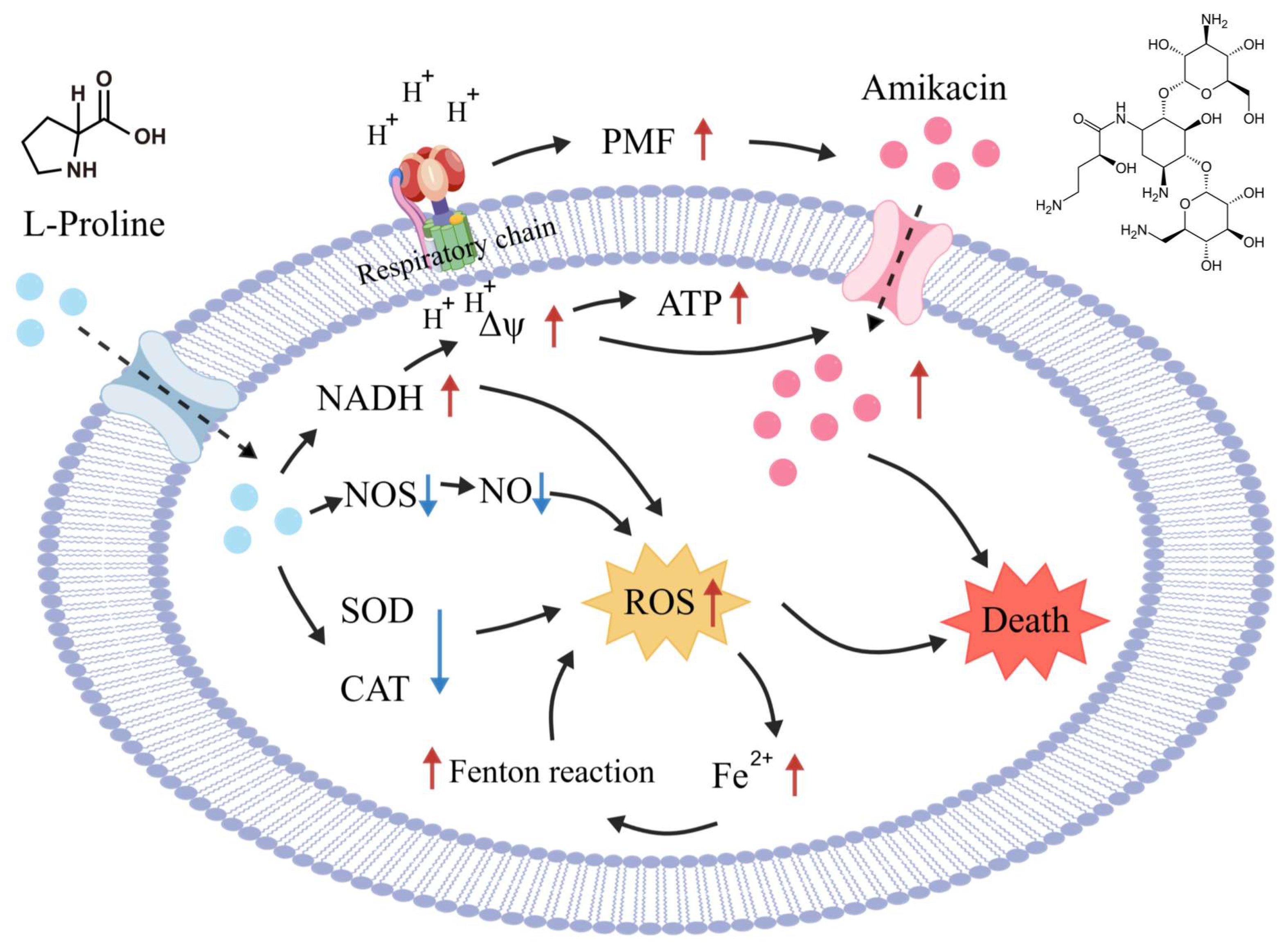
Proline Potentiates Aminoglycoside Bactericidal Efficacy Against Staphylococcus aureus


Abstract
1. Introduction
2. Materials and Methods
2.1. Instruments
2.2. Reagents
2.2.1. Culture Media
2.2.2. Metabolites and Inhibitors
2.2.3. Antibiotics
2.3. Bacterial Strains and Culture Conditions
2.4. Antibiotic Killing Assay
2.5. Isolation of Bacterial Persisters
2.6. Biofilm Formation Inhibition Assay
2.7. In Vitro Biofilm Model
2.8. Measurement of NADH Levels
2.9. Detection of ATP
2.10. Measurement of Membrane Potential
2.11. Intracellular Amikacin Uptake Assay
2.12. Measurement of Intracellular ROS
2.13. SOD Activity Assay
2.14. CAT Activity Assay
2.15. Quantification of Intracellular Ferrous Iron (Fe2+)
2.16. Measurement of Intracellular Nitric Oxide (NO)
2.17. Determination of MIC
2.18. Instrument Measurement Accuracy and Uncertainty
3. Results
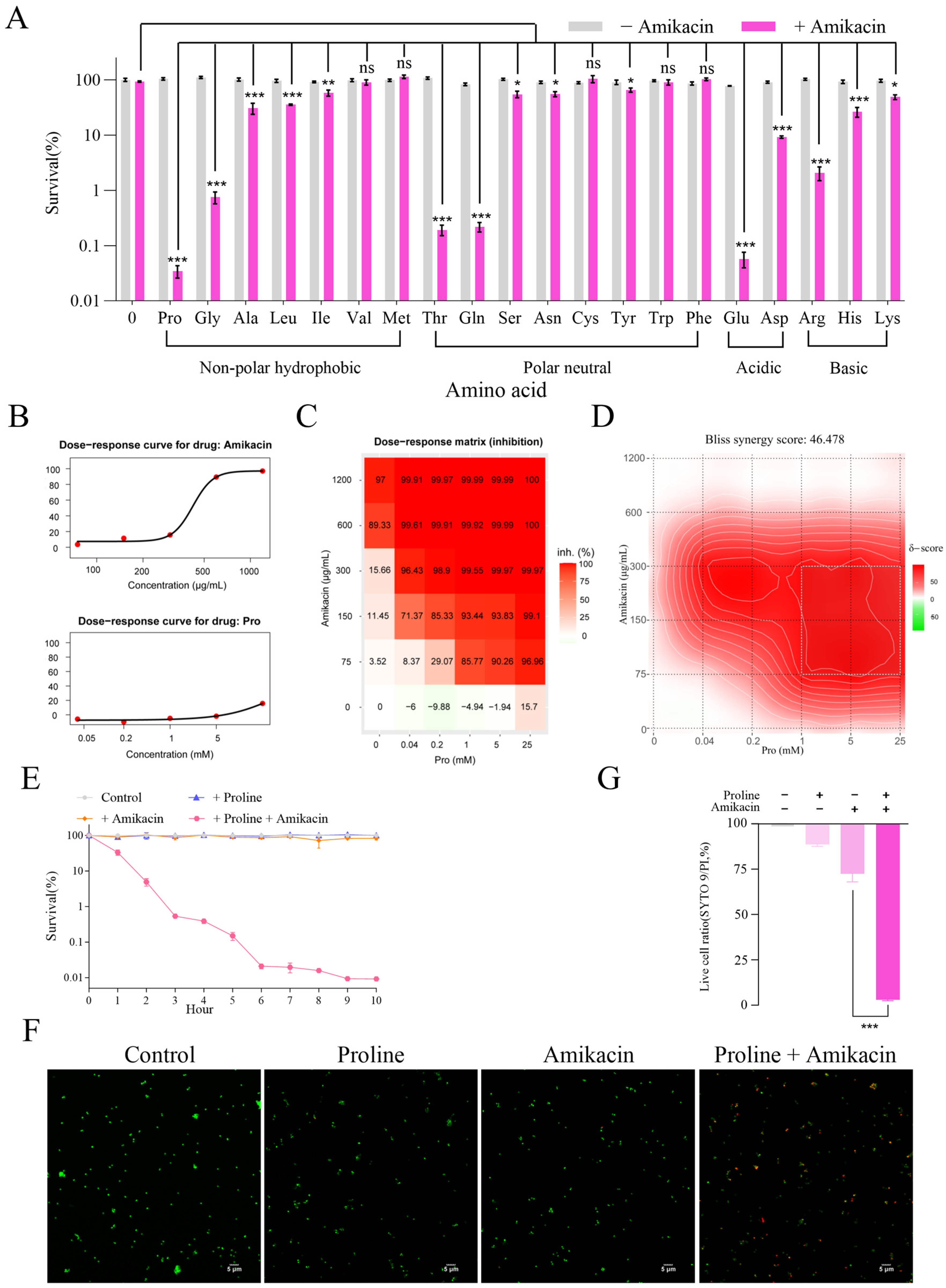
3.1. Exogenous Proline Potentiates the Killing of S. aureus by Amikacin
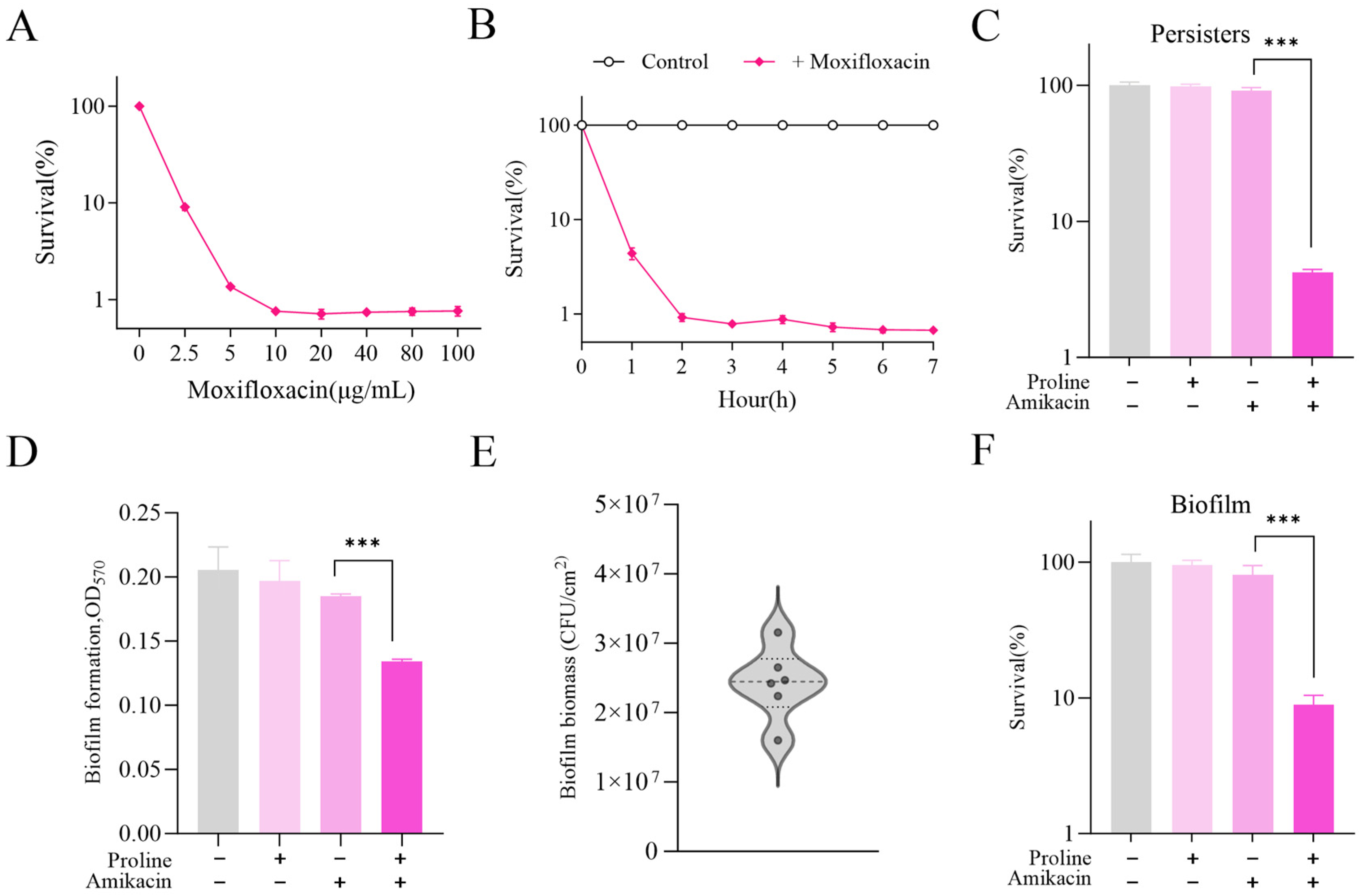
3.2. Exogenous Proline Eliminates Persisters and Biofilms of S. aureus with Amikacin
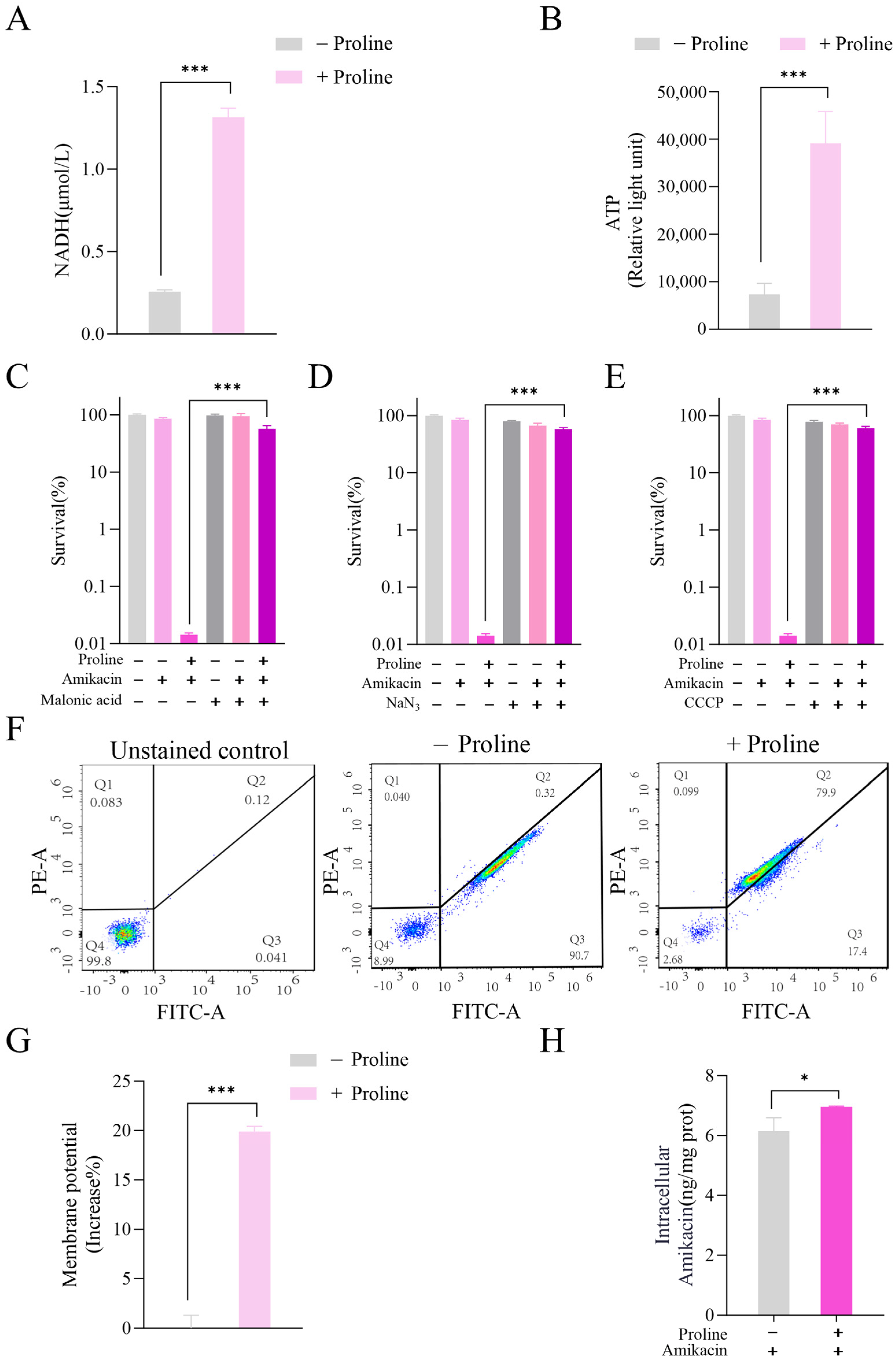
3.3. Exogenous Proline Increases Amikacin Uptake by Enhancing Proton Motive Force
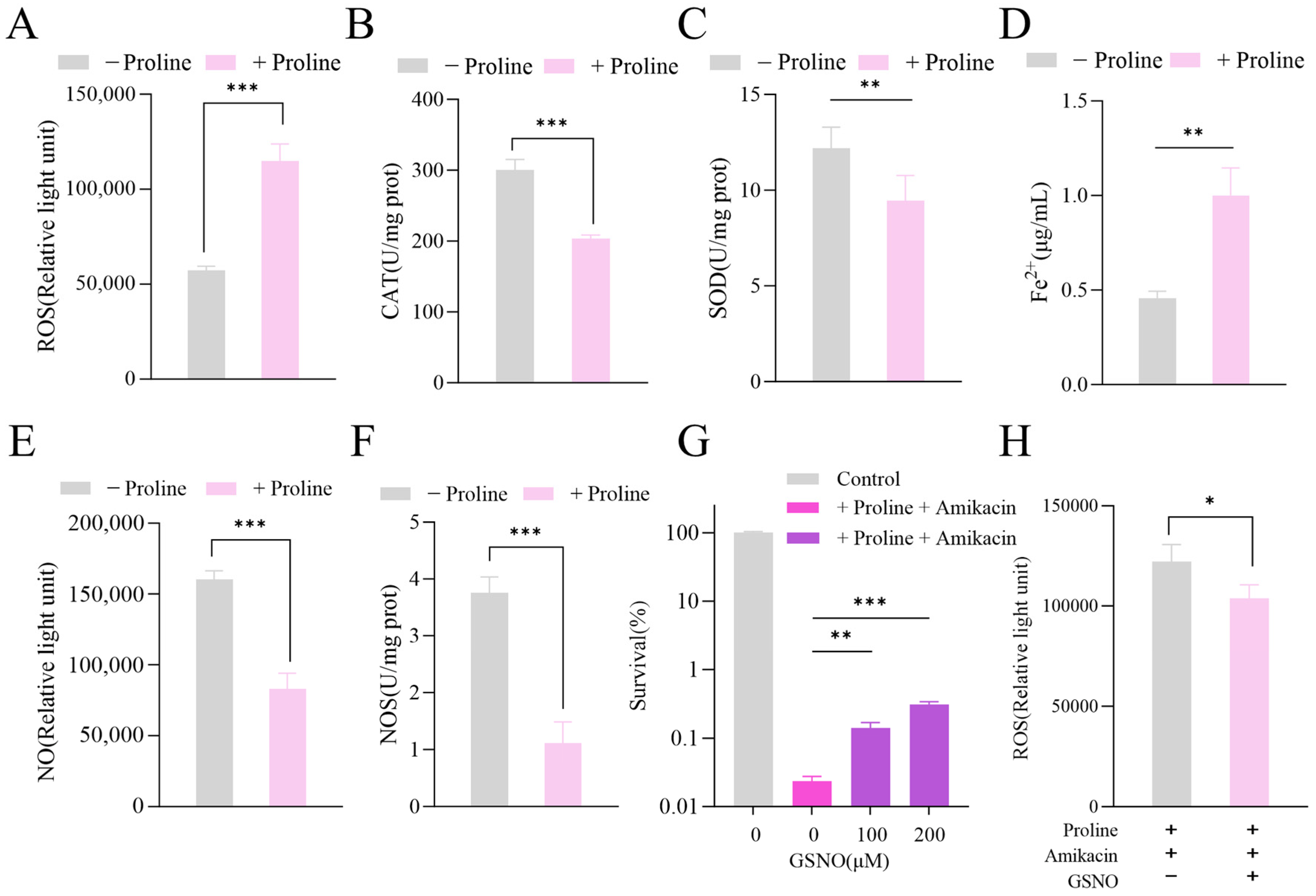
3.4. The Increase in Reactive Oxygen Species Levels Triggered by Proline Contributes to Its Synergistic Bactericidal Effect
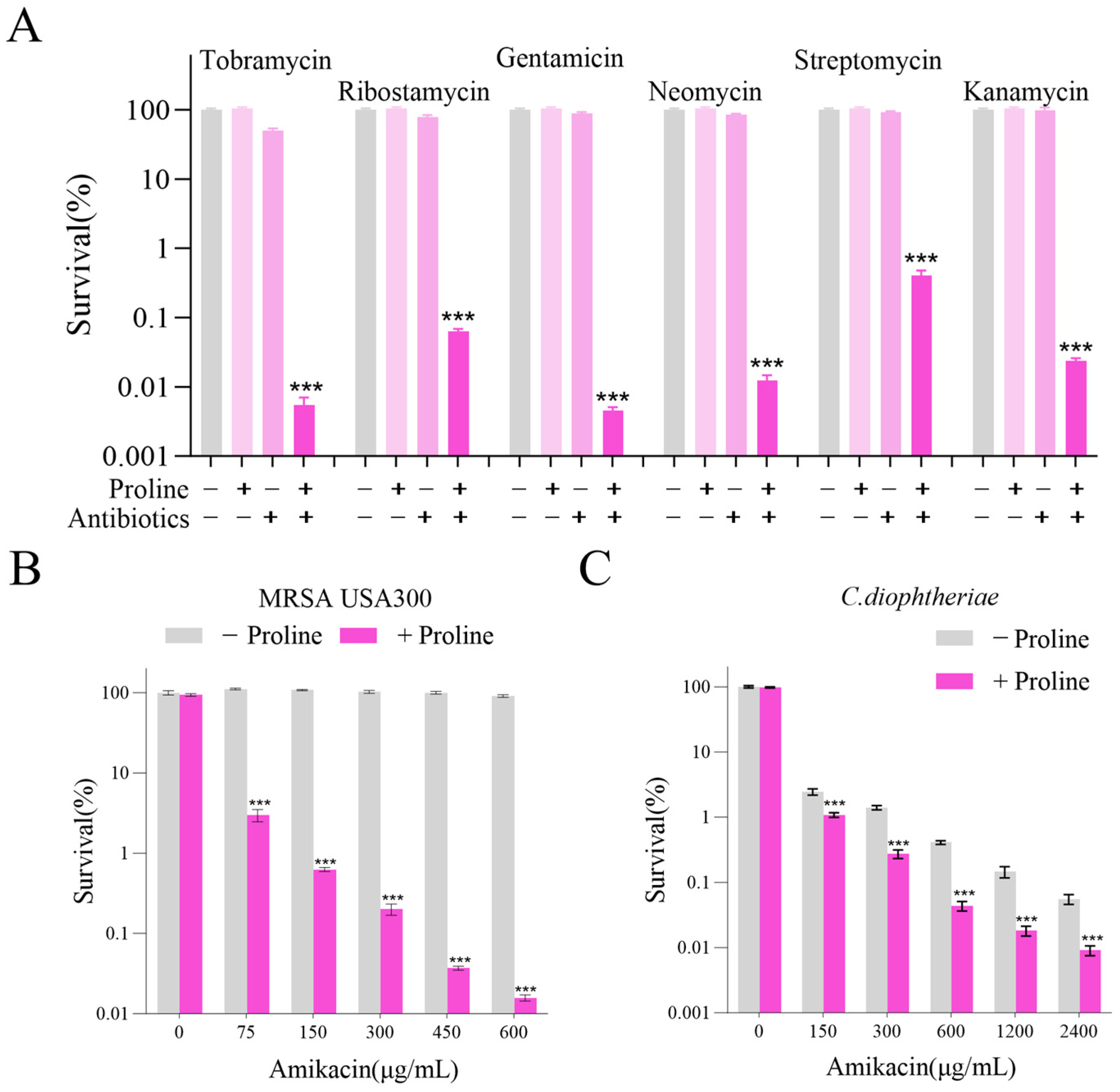
3.5. Broad-Spectrum Synergy of Proline as an Aminoglycoside Potentiator and Its Mechanism
4. Discussion
5. Conclusions
Supplementary Materials
Author Contributions
Funding
Institutional Review Board Statement
Informed Consent Statement
Data Availability Statement
Conflicts of Interest
References
- Boretti, A.; Banik, B. Antibiotic Resistance: Revisiting Older Antibiotics for Modern Bacterial Challenges. Chem. Biodivers. 2025, 22, e00813. [Google Scholar] [CrossRef] [PubMed]
- Nardulli, P.; Ballini, A.; Zamparella, M.; De Vito, D. The Role of Stakeholders’ Understandings in Emerging Antimicrobial Resistance: A One Health Approach. Microorganisms 2023, 11, 2797. [Google Scholar] [CrossRef] [PubMed]
- Nass, N.M.; Zaher, K.A. Beyond the Resistome: Molecular Insights, Emerging Therapies, and Environmental Drivers of Antibiotic Resistance. Antibiotics 2025, 14, 995. [Google Scholar] [CrossRef] [PubMed]
- FAO. The State of World Fisheries and Aquaculture 2024: Blue Transformation in Action; FAO: Rome, Italy, 2024. [Google Scholar] [CrossRef]
- Cabello, F.C.; Godfrey, H.P.; Tomova, A.; Ivanova, L.; Dölz, H.; Millanao, A.; Buschmann, A.H. Antimicrobial Use in Aquaculture Re-Examined: Its Relevance to Antimicrobial Resistance and to Animal and Human Health. Environ. Microbiol. 2013, 15, 1917–1942. [Google Scholar] [CrossRef] [PubMed]
- El-Ashker, M.; Monecke, S.; Gwida, M.; Rezk, M.; Müller, E.; Saad, T.; Akinduti, P.; Ehricht, R. Prevalence and Genetic Characterization of Methicillin-Resistant Staphylococcus aureus in Commercial Aquaculture Farms in Egypt. Sci. Rep. 2026, 16, 12026. [Google Scholar] [CrossRef] [PubMed]
- Fri, J.; Njom, H.A.; Ateba, C.N.; Ndip, R.N. Antibiotic Resistance and Virulence Gene Characteristics of Methicillin-Resistant Staphylococcus aureus (MRSA) Isolated from Healthy Edible Marine Fish. Int. J. Microbiol. 2020, 2020, 9803903. [Google Scholar] [CrossRef] [PubMed]
- Harakeh, S.; Yassine, H.; Hajjar, S.; El-Fadel, M. Isolates of Staphylococcus aureus and Saprophyticus Resistant to Antimicrobials Isolated from the Lebanese Aquatic Environment. Mar. Pollut. Bull. 2006, 52, 912–919. [Google Scholar] [CrossRef] [PubMed]
- Tong, S.Y.C.; Fowler, V.G.; Skalla, L.; Holland, T.L. Management of Staphylococcus aureus Bacteremia: A Review. JAMA 2025, 334, 798–808. [Google Scholar] [CrossRef] [PubMed]
- Nazli, A.; Tao, W.; You, H.; He, X.; He, Y. Treatment of MRSA Infection: Where Are We? Curr. Med. Chem. 2024, 31, 4425–4460. [Google Scholar] [CrossRef] [PubMed]
- Li, J.-J.; Cheng, F.-S.; Wei, X.-J.; Bai, Y.-B.; Wang, Q.; Li, B.; Zhou, Y.-X.; Zhai, B.-T.; Zhou, X.-Z.; Wang, W.-W.; et al. Methicillin-Resistant Staphylococcus aureus (MRSA): Resistance, Prevalence, and Coping Strategies. Antibiotics 2025, 14, 771. [Google Scholar] [CrossRef] [PubMed]
- Cai, W.; Arias, C.R. Biofilm Formation on Aquaculture Substrates by Selected Bacterial Fish Pathogens. J. Aquat. Anim. Health 2017, 29, 95–104. [Google Scholar] [CrossRef] [PubMed]
- Okafor, U.C.; Okorie-Kanu, O.J.; Ogugua, A.J.; Ikeogu, C.F.; Okafor, S.C.; Anyanwu, M.U.; Nwobi, O.C.; Anyaoha, C.O.; Mgbeahuruike, A.C.; Majesty-Alukagberie, L.O.; et al. Molecular Epidemiology, Antimicrobial Resistance, and Virulence Profiles of Staphylococcus aureus from Fish, Aquatic Environments, and Fish Handlers in Southeast Nigeria. Microorganisms 2025, 13, 2059. [Google Scholar] [CrossRef] [PubMed]
- Liu, C.; Bayer, A.; Cosgrove, S.E.; Daum, R.S.; Fridkin, S.K.; Gorwitz, R.J.; Kaplan, S.L.; Karchmer, A.W.; Levine, D.P.; Murray, B.E.; et al. Clinical Practice Guidelines by the Infectious Diseases Society of America for the Treatment of Methicillin-Resistant Staphylococcus aureus Infections in Adults and Children. Clin. Infect. Dis. 2011, 52, e18–e55. [Google Scholar] [CrossRef] [PubMed]
- Bassetti, M.; Labate, L.; Melchio, M.; Robba, C.; Battaglini, D.; Ball, L.; Pelosi, P.; Giacobbe, D.R. Current Pharmacotherapy for Methicillin-Resistant Staphylococcus aureus (MRSA) Pneumonia. Expert. Opin. Pharmacother. 2022, 23, 361–375. [Google Scholar] [CrossRef] [PubMed]
- Cui, K.; Yang, W.; Liu, Z.; Liu, G.; Li, D.; Sun, Y.; He, G.; Ma, S.; Cao, Y.; Jiang, X.; et al. Chenodeoxycholic Acid-Amikacin Combination Enhances Eradication of Staphylococcus aureus. Microbiol. Spectr. 2023, 11, e02430-22. [Google Scholar] [CrossRef] [PubMed]
- Park, S.; Lee, J.-H.; Kim, Y.-G.; Hu, L.; Lee, J. Fatty Acids as Aminoglycoside Antibiotic Adjuvants Against Staphylococcus aureus. Front. Microbiol. 2022, 13, 876932. [Google Scholar] [CrossRef] [PubMed]
- Pavani, K.; Shivshetty, N.; Poosarla, V.G.; Oli, A.K. Synergistic Effects of Antibiotic Combinations against Staphylococcus aureus in Clinical Samples from Inpatients at a Tertiary Care Facility in Hyderabad, India. Open Microbiol. J. 2025, 19, e18742858376149. [Google Scholar] [CrossRef]
- Busari, A.A.; Efejene, I.O.; Olayemi, S.O.; Orororo, O.C.; Egbune, E.O. Evaluation of Antibiotic Use and Analysis of Ciprofloxacin and Gentamicin Residue in Fish Samples from Farms in Lagos, Nigeria. Environ. Monit. Assess. 2024, 196, 127. [Google Scholar] [CrossRef] [PubMed]
- Ramirez, M.S.; Tolmasky, M.E. Amikacin: Uses, Resistance, and Prospects for Inhibition. Molecules 2017, 22, 2267. [Google Scholar] [CrossRef] [PubMed]
- Zhang, Z.-Y.; Cao, Z.-Y.; Fei, J.; Yan, B.-B.; Zhang, T.; Fan, L.-Y.; Zhang, W.-T.; Wang, C.; Wang, H.; Su, Y.-B. Fumaric Acid Restores Neomycin Efficacy against Carbapenem-Resistant Vibrio parahaemolyticus through Metabolic Reprogramming. J. Hazard. Mater. 2026, 504, 141430. [Google Scholar] [CrossRef] [PubMed]
- Zheng, Y.; Fu, L.-H.; Cao, Z.-Y.; Zhang, T.; Fei, J.; Jiang, M.; Zhou, Y.-L.; Shi, Z.; Su, Y.-B. Exogenous Indole Promotes Florfenicol Tolerance in Edwardsiella tarda. Virulence 2026, 17, 2620188. [Google Scholar] [CrossRef] [PubMed]
- Peng, B.; Li, H.; Peng, X.-X. Metabolic State-Driven Nutrient-Based Approach to Combat Bacterial Antibiotic Resistance. npj Antimicrob. Resist. 2025, 3, 24. [Google Scholar] [CrossRef] [PubMed]
- Li, X.; Wu, J.-Q.; Long, X.-R.; Hu, S.-B.; Jiang, M. Functional Proteomic Analysis Reveals mglB-Mediated Meropenem Resistance and Its Reversal by Galactose. Virulence 2026, 17, 2620246. [Google Scholar] [CrossRef] [PubMed]
- Kuang, S.-F.; Xiang, J.; Chen, Y.-T.; Peng, X.-X.; Li, H.; Peng, B. Exogenous Pyruvate Promotes Gentamicin Uptake to Kill Antibiotic-Resistant Vibrio alginolyticus. Int. J. Antimicrob. Agents 2024, 63, 107036. [Google Scholar] [CrossRef] [PubMed]
- Wu, J.-H.; Chen, X.-W.; Liu, Y.-L.; Wu, J.-Y.; Chen, Z.-G.; Peng, B. Metabolism-Dependent Succinylation Governs Resource Allocation for Antibiotic Resistance. Sci. Adv. 2025, 11, eadu2856. [Google Scholar] [CrossRef] [PubMed]
- Lian, L.-L.; Zhang, L.-S.; Shen, C.-G.; Zhang, B.-H.; Zhang, H.-Y.; Xie, Y.-Y.; Lin, X.-M. The Impact of Lysine Succinylation Modification of Host Factor for RNA Phage Qβ Replicase at K56 Site on the Biological Functions of Aeromonas hydrophila. Int. J. Biol. Macromol. 2025, 310, 143156. [Google Scholar] [CrossRef] [PubMed]
- Yi, L.-K.; Cao, M.-Z.; Chen, X.; Bai, Y.-B.; Wang, W.-W.; Wei, X.-J.; Shi, Y.-X.; Zhang, Y.-Y.; Ma, T.-H.; Zhu, Z.; et al. In Vitro Antimicrobial Synergistic Activity and the Mechanism of the Combination of Naringenin and Amikacin Against Antibiotic-Resistant Escherichia coli. Microorganisms 2024, 12, 1871. [Google Scholar] [CrossRef] [PubMed]
- Christgen, S.L.; Becker, D.F. Role of Proline in Pathogen and Host Interactions. Antioxid. Redox Signal. 2019, 30, 683–709. [Google Scholar] [CrossRef] [PubMed]
- Wadhawan, S.; Gautam, S.; Sharma, A. Involvement of Proline Oxidase (PutA) in Programmed Cell Death of Xanthomonas. PLoS ONE 2014, 9, e96423. [Google Scholar] [CrossRef] [PubMed]
- Zhang, P.-F.; Liu, Z. Structural Insights into the Transporting and Catalyzing Mechanism of DltB in LTA D-Alanylation. Nat. Commun. 2024, 15, 3404. [Google Scholar] [CrossRef] [PubMed]
- Morawska, L.P.; Detert Oude Weme, R.G.J.; Frenzel, E.; Dirkzwager, M.; Hoffmann, T.; Bremer, E.; Kuipers, O.P. Stress-Induced Activation of the Proline Biosynthetic Pathway in Bacillus subtilis: A Population-Wide and Single-Cell Study of the Osmotically Controlled proHJ Promoter. Microb. Biotechnol. 2022, 15, 2411–2425. [Google Scholar] [CrossRef] [PubMed]
- Chuphal, N.; Malik, M.A.; Kishore, P.S.; Mohanta, K.N. Amino Acids as Functional Nutrients in Stress Mitigation of Aquatic Species: Mechanisms and Applications in Aquaculture. Blue Biotechnol. 2025, 2, 20. [Google Scholar] [CrossRef]
- Yan, B.-B.; Li, N.; Zhou, Y.; Kang, L.-L.; Dong, X.-S.; Xu, X.; An, L.; Meng, Q.-L.; Wang, X.-R.; Yang, L.; et al. Metabolic Potentiation of Antibiotic Killing by L-Arginine in Drug-Resistant Edwardsiella tarda. mSystems 2026, 11, e0150925. [Google Scholar] [CrossRef] [PubMed]
- Peng, B.; Su, Y.-B.; Li, H.; Han, Y.; Guo, C.; Tian, Y.-M.; Peng, X.-X. Exogenous Alanine and/or Glucose plus Kanamycin Kills Antibiotic-Resistant Bacteria. Cell Metab. 2015, 21, 249–262. [Google Scholar] [CrossRef] [PubMed]
- Xiang, J.; Zhou, Y.-Q.; Yuan, S.-C.; Zhang, X.-L.; Wang, S.-W.; Chen, Z.-G.; Lin, L.-R.; Liu, Z.-Q.; Li, H.; Peng, B. Compound Amino Acid Synergizes Ceftazidime-Avibactam to Eradicate Extracellular and Facultative Intracellular MDR Pathogens. Cell Rep. 2026, 45, 117008. [Google Scholar] [CrossRef] [PubMed]
- Xiang, J.; Tian, S.-Q.; Wang, S.-W.; Liu, Y.-L.; Li, H.; Peng, B. Pyruvate Abundance Confounds Aminoglycoside Killing of Multidrug-Resistant Bacteria via Glutathione Metabolism. Research 2024, 7, 0554. [Google Scholar] [CrossRef] [PubMed]
- Yan, B.-B.; Dong, X.-S.; Wang, J.-P.; Li, X.-Y.; An, L.; Wang, X.-R.; Zhang, L.-G.; Meng, Q.-L.; Wang, C. Glutamate-Pantothenate Pathway Promotes Antibiotic Resistance of Edwardsiella tarda. Front. Microbiol. 2023, 14, 1264602. [Google Scholar] [CrossRef] [PubMed]
- Qureshi, K.A.; Fahmy, N.A.; Parvez, A.; Almahasheer, H.; Permatasari, D.; Jaremko, M.; Abdallah, E.M. Biofilms and Antimicrobial Resistance: Mechanisms, Clinical Implications, and Emerging Interventions. Chem. Biodivers. 2026, 23, e01351. [Google Scholar] [CrossRef] [PubMed]
- Niu, H.-X.; Gu, J.-Y.; Zhang, Y. Bacterial Persisters: Molecular Mechanisms and Therapeutic Development. Signal Transduct. Target. Ther. 2024, 9, 174. [Google Scholar] [CrossRef] [PubMed]
- Lu, C.; Zhang, N.; Kou, S.; Gao, L.; Peng, B.; Dai, Y.; Zheng, J. Sanguinarine Synergistically Potentiates Aminoglycoside-Mediated Bacterial Killing. Microb. Biotechnol. 2022, 15, 2055–2070. [Google Scholar] [CrossRef] [PubMed]
- Yang, J.; Zeng, Z.-H.; Yang, M.-J.; Cheng, Z.-X.; Peng, X.-X.; Li, H. NaCl Promotes Antibiotic Resistance by Reducing Redox States in Vibrio alginolyticus. Env. Microbiol. 2018, 20, 4022–4036. [Google Scholar] [CrossRef] [PubMed]
- Lu, W.-J.; Lu, H.; Wang, C.-C.; Wang, G.-Y.; Dong, W.-Q.; Tan, C. Effectors of the Type VI Secretion System Have the Potential to Be Modified into Antimicrobial Peptides. Microbiol. Spectr. 2023, 11, e0030823. [Google Scholar] [CrossRef] [PubMed]
- Kou, T.-S.; Wu, J.-H.; Chen, X.-W.; Chen, Z.-G.; Zheng, J.; Peng, B. Exogenous Glycine Promotes Oxidation of Glutathione and Restores Sensitivity of Bacterial Pathogens to Serum-Induced Cell Death. Redox Biol. 2022, 58, 102512. [Google Scholar] [CrossRef] [PubMed]
- She, P.-F.; Li, Z.-H.; Li, Y.-M.; Liu, S.-S.; Li, L.-H.; Yang, Y.-F.; Zhou, L.-Y.; Wu, Y. Pixantrone Sensitizes Gram-Negative Pathogens to Rifampin. Microbiol. Spectr. 2022, 10, e0211422. [Google Scholar] [CrossRef] [PubMed]
- Keren, I.; Kaldalu, N.; Spoering, A.; Wang, Y.; Lewis, K. Persister Cells and Tolerance to Antimicrobials. FEMS Microbiol. Lett. 2004, 230, 13–18. [Google Scholar] [CrossRef] [PubMed]
- Allison, K.R.; Brynildsen, M.P.; Collins, J.J. Heterogeneous Bacterial Persisters and Engineering Approaches to Eliminate Them. Curr. Opin. Microbiol. 2011, 14, 593–598. [Google Scholar] [CrossRef] [PubMed]
- Webster, C.M.; Woody, A.M.; Fusseini, S.; Holmes, L.G.; Robinson, G.K.; Shepherd, M. Proton Motive Force Underpins Respiration-Mediated Potentiation of Aminoglycoside Lethality in Pathogenic Escherichia coli. Arch. Microbiol. 2022, 204, 120. [Google Scholar] [CrossRef] [PubMed]
- Webster, C.M.; Shepherd, M. A Mini-Review: Environmental and Metabolic Factors Affecting Aminoglycoside Efficacy. World J. Microbiol. Biotechnol. 2022, 39, 7. [Google Scholar] [CrossRef] [PubMed]
- Batchelder, J.I.; Taylor, A.J.; Mok, W.W.K. Metabolites Augment Oxidative Stress to Sensitize Antibiotic-Tolerant Staphylococcus aureus to Fluoroquinolones. mBio 2024, 15, e0271424. [Google Scholar] [CrossRef] [PubMed]
- Kuang, S.-F.; Chen, Y.-T.; Chen, J.-J.; Peng, X.-X.; Chen, Z.-G.; Li, H. Synergy of Alanine and Gentamicin to Reduce Nitric Oxide for Elevating Killing Efficacy to Antibiotic-Resistant Vibrio alginolyticus. Virulence 2021, 12, 1737–1753. [Google Scholar] [CrossRef] [PubMed]
- Gusarov, I.; Nudler, E. NO-Mediated Cytoprotection: Instant Adaptation to Oxidative Stress in Bacteria. Proc. Natl. Acad. Sci. USA 2005, 102, 13855–13860. [Google Scholar] [CrossRef] [PubMed]
- Chaudhari, S.S.; Kim, M.; Lei, S.; Razvi, F.; Alqarzaee, A.A.; Hutfless, E.H.; Powers, R.; Zimmerman, M.C.; Fey, P.D.; Thomas, V.C. Nitrite Derived from Endogenous Bacterial Nitric Oxide Synthase Activity Promotes Aerobic Respiration. mBio 2017, 8, e00887-17. [Google Scholar] [CrossRef] [PubMed]
- Barraud, N.; Schleheck, D.; Klebensberger, J.; Webb, J.S.; Hassett, D.J.; Rice, S.A.; Kjelleberg, S. Nitric Oxide Signaling in Pseudomonas Aeruginosa Biofilms Mediates Phosphodiesterase Activity, Decreased Cyclic Di-GMP Levels, and Enhanced Dispersal. J. Bacteriol. 2009, 191, 7333–7342. [Google Scholar] [CrossRef] [PubMed]
- Dong, Y.; Liu, X.-N.; Xiong, S.-S.; Cao, M.-Y.; Wu, H.-J.; Chen, L.; Zhao, M.-M.; Zheng, Y.-D.; Zhang, Z.-Y.; Liu, Y.-Y.; et al. Guanosine Enhances the Bactericidal Effect of Ceftiofur Sodium on Streptococcus suis by Activating Bacterial Metabolism. Virulence 2025, 16, 2453525. [Google Scholar] [CrossRef] [PubMed]
- Guo, J.; Pan, Z.-Y.; Fan, L.-Y.; Zhong, Y.-L.; Pang, R.; Su, Y.-B. Effect of Three Different Amino Acids Plus Gentamicin Against Methicillin-Resistant Staphylococcus aureus. Infect. Drug Resist. 2023, 16, 4741–4754. [Google Scholar] [CrossRef] [PubMed]
- Wang, H.-P.; Wu, X.-J.; Xu, J.; Lu, Z.-M.; Hu, B.-L.; Zhu, L.-Z.; Lu, H.-J. Proline Mitigates Antibiotic Resistance Evolution Induced by Ciprofloxacin at Environmental Concentrations. J. Hazard. Mater. 2025, 489, 137561. [Google Scholar] [CrossRef] [PubMed]
- Pinheiro, F.; Warsi, O.; Andersson, D.I.; Lässig, M. Metabolic Fitness Landscapes Predict the Evolution of Antibiotic Resistance. Nat. Ecol. Evol. 2021, 5, 677–687. [Google Scholar] [CrossRef] [PubMed]
- Li, X.; Feng, D.-Y.; Zhou, J.-X.; Wu, W.-B.; Zheng, W.-Z.; Gan, W.-L.; Jiang, M.; Li, H.; Peng, X.-X.; Zhang, T.-T. Metabolomics Method in Understanding and Sensitizing Carbapenem-Resistant Acinetobacter baumannii to Meropenem. ACS Infect. Dis. 2024, 10, 184–195. [Google Scholar] [CrossRef] [PubMed]
- Mouammine, A.; Eich, K.; Frandi, A.; Collier, J. Control of Proline Utilization by the Lrp-like Regulator PutR in Caulobacter crescentus. Sci. Rep. 2018, 8, 14677. [Google Scholar] [CrossRef] [PubMed]
- Roos, G.; Garcia-Pino, A.; Van Belle, K.; Brosens, E.; Wahni, K.; Vandenbussche, G.; Wyns, L.; Loris, R.; Messens, J. The Conserved Active Site Proline Determines the Reducing Power of Staphylococcus aureus Thioredoxin. J. Mol. Biol. 2007, 368, 800–811. [Google Scholar] [CrossRef] [PubMed]
- Lehman, M.K.; Sturd, N.A.; Razvi, F.; Wellems, D.L.; Carson, S.D.; Fey, P.D. Proline Transporters ProT and PutP Are Required for Staphylococcus aureus Infection. PLoS Pathog. 2023, 19, e1011098. [Google Scholar] [CrossRef] [PubMed]
- Urso, A.; Monk, I.R.; Cheng, Y.-T.; Predella, C.; Wong Fok Lung, T.; Theiller, E.M.; Boylan, J.; Perelman, S.; Baskota, S.U.; Moustafa, A.M.; et al. Staphylococcus aureus Adapts to Exploit Collagen-Derived Proline during Chronic Infection. Nat. Microbiol. 2024, 9, 2506–2521. [Google Scholar] [CrossRef] [PubMed]
- Zou, D.; Yang, M.; Chen, Z.; Lin, P.; Li, Y.; Liu, X.; Tan, B.; Ye, C. Effects of Proline on Growth Performance, Protein Synthesis and Cold Resistance in White Shrimp (Litopenaeus Vannamei). Anim. Nutr. 2025, 23, 220–234. [Google Scholar] [CrossRef] [PubMed]
- Kou, T.-S.; Shang, Y.-Y.; Zhang, Q.-C.; Tian, S.-Q.; Li, J.; Yang, L.-N.; Min, L.; Peng, B. Exogenous Proline Promotes Serum Killing of Klebsiella pneumoniae. Virulence 2025, 16, 2545558. [Google Scholar] [CrossRef] [PubMed]
- Wei, X.-Y.; Gao, J.-C.; Zhou, D.-D.; Xu, C.-J.; Chen, P.; Chen, S.-P.; Zhang, Y.-H.; Liu, X.-H.; Li, G.-X.; Zhu, G.-B.; et al. Murepavadin Promotes the Killing Efficacies of Aminoglycoside Antibiotics against Pseudomonas aeruginosa by Enhancing Membrane Potential. Antimicrob. Agents Chemother. 2024, 68, e0153923. [Google Scholar] [CrossRef] [PubMed]
- Van Acker, H.; Coenye, T. The Role of Reactive Oxygen Species in Antibiotic-Mediated Killing of Bacteria. Trends Microbiol. 2017, 25, 456–466. [Google Scholar] [CrossRef] [PubMed]
- Jomova, K.; Alomar, S.Y.; Alwasel, S.H.; Nepovimova, E.; Kuca, K.; Valko, M. Several Lines of Antioxidant Defense against Oxidative Stress: Antioxidant Enzymes, Nanomaterials with Multiple Enzyme-Mimicking Activities, and Low-Molecular-Weight Antioxidants. Arch. Toxicol. 2024, 98, 1323–1367. [Google Scholar] [CrossRef] [PubMed]
- Huang, Y.-F.; Li, Y.; Chen, J.-Y.; Lin, J.-H.; Liu, L.; Ye, J.-Z.; Su, Y.-B. Promoting Effect of Fe3+ on Gentamicin Resistance in Escherichia coli. Biochem. Biophys. Res. Commun. 2022, 625, 134–139. [Google Scholar] [CrossRef] [PubMed]
- Sui, X.-Y.; Wang, J.-C.; Zhao, Z.-Q.; Liu, B.; Liu, M.-M.; Liu, M.; Shi, C.; Feng, X.-J.; Fu, Y.-X.; Shi, D.-Y.; et al. Phenolic Compounds Induce Ferroptosis-like Death by Promoting Hydroxyl Radical Generation in the Fenton Reaction. Commun. Biol. 2024, 7, 199. [Google Scholar] [CrossRef] [PubMed]
- Roberts, J.M.; Milo, S.; Metcalf, D.G. Harnessing the Power of Our Immune System: The Antimicrobial and Antibiofilm Properties of Nitric Oxide. Microorganisms 2024, 12, 2543. [Google Scholar] [CrossRef] [PubMed]
- Okda, M.; Spina, S.; Safaee Fakhr, B.; Carroll, R.W. The Antimicrobial Effects of Nitric Oxide: A Narrative Review. Nitric Oxide 2025, 155, 20–40. [Google Scholar] [CrossRef] [PubMed]
- Gusarov, I.; Shatalin, K.; Starodubtseva, M.; Nudler, E. Endogenous Nitric Oxide Protects Bacteria against a Wide Spectrum of Antibiotics. Science 2009, 325, 1380–1384. [Google Scholar] [CrossRef] [PubMed]
- McCollister, B.D.; Hoffman, M.; Husain, M.; Vázquez-Torres, A. Nitric Oxide Protects Bacteria from Aminoglycosides by Blocking the Energy-Dependent Phases of Drug Uptake. Antimicrob. Agents Chemother. 2011, 55, 2189–2196. [Google Scholar] [CrossRef] [PubMed]
- LSizar, O.; Rahman, S.; Sundareshan, V. Amikacin. In StatPearls [Internet]; StatPearls Publishing: Treasure Island, FL, USA, 2023. [Google Scholar]


Disclaimer/Publisher’s Note: The statements, opinions and data contained in all publications are solely those of the individual author(s) and contributor(s) and not of MDPI and/or the editor(s). MDPI and/or the editor(s) disclaim responsibility for any injury to people or property resulting from any ideas, methods, instructions or products referred to in the content. |
© 2026 by the authors. Licensee MDPI, Basel, Switzerland. This article is an open access article distributed under the terms and conditions of the Creative Commons Attribution (CC BY) license.
Share and Cite
Li, B.-H.; Xu, R.-H.; Maituersong, Z.; Lai, C.-F.; Wang, T.; Su, Y.-B. Proline Potentiates Aminoglycoside Bactericidal Efficacy Against Staphylococcus aureus. Life 2026, 16, 1070. https://doi.org/10.3390/life16071070
Li B-H, Xu R-H, Maituersong Z, Lai C-F, Wang T, Su Y-B. Proline Potentiates Aminoglycoside Bactericidal Efficacy Against Staphylococcus aureus. Life. 2026; 16(7):1070. https://doi.org/10.3390/life16071070
Chicago/Turabian StyleLi, Bo-Hao, Rui-Hua Xu, Zulifukeer Maituersong, Chao-Feng Lai, Ting Wang, and Yu-Bin Su. 2026. "Proline Potentiates Aminoglycoside Bactericidal Efficacy Against Staphylococcus aureus" Life 16, no. 7: 1070. https://doi.org/10.3390/life16071070
APA StyleLi, B.-H., Xu, R.-H., Maituersong, Z., Lai, C.-F., Wang, T., & Su, Y.-B. (2026). Proline Potentiates Aminoglycoside Bactericidal Efficacy Against Staphylococcus aureus. Life, 16(7), 1070. https://doi.org/10.3390/life16071070