Systematic Review

Surgical Intervention for Filariasis-Induced Lymphedema: A Systematic Review of Ablative and Physiological Approaches


by
Rani Septrina
1,*,
Irra Rubianti Widarda
1,
Putie Hapsari
2 and
Valeska Siulinda Candrawinata
3
1
Division of Plastic and Reconstructive Surgery, Department of Surgery, Faculty of Medicine, Universitas Padjadjaran/Dr. Hasan Sadikin General Hospital, Bandung 40161, Indonesia
2
Division of Vascular and Endovascular Surgery, Department of Surgery, Faculty of Medicine, Universitas Padjadjaran/Dr. Hasan Sadikin General Hospital, Bandung 40161, Indonesia
3
Department of Surgery, Universitas Padjadjaran/Dr. Hasan Sadikin General Hospital, Bandung 40161, Indonesia
*
Author to whom correspondence should be addressed.
Life 2026, 16(6), 942; https://doi.org/10.3390/life16060942
Submission received: 25 March 2026 / Revised: 19 May 2026 / Accepted: 26 May 2026 / Published: 2 June 2026

Abstract

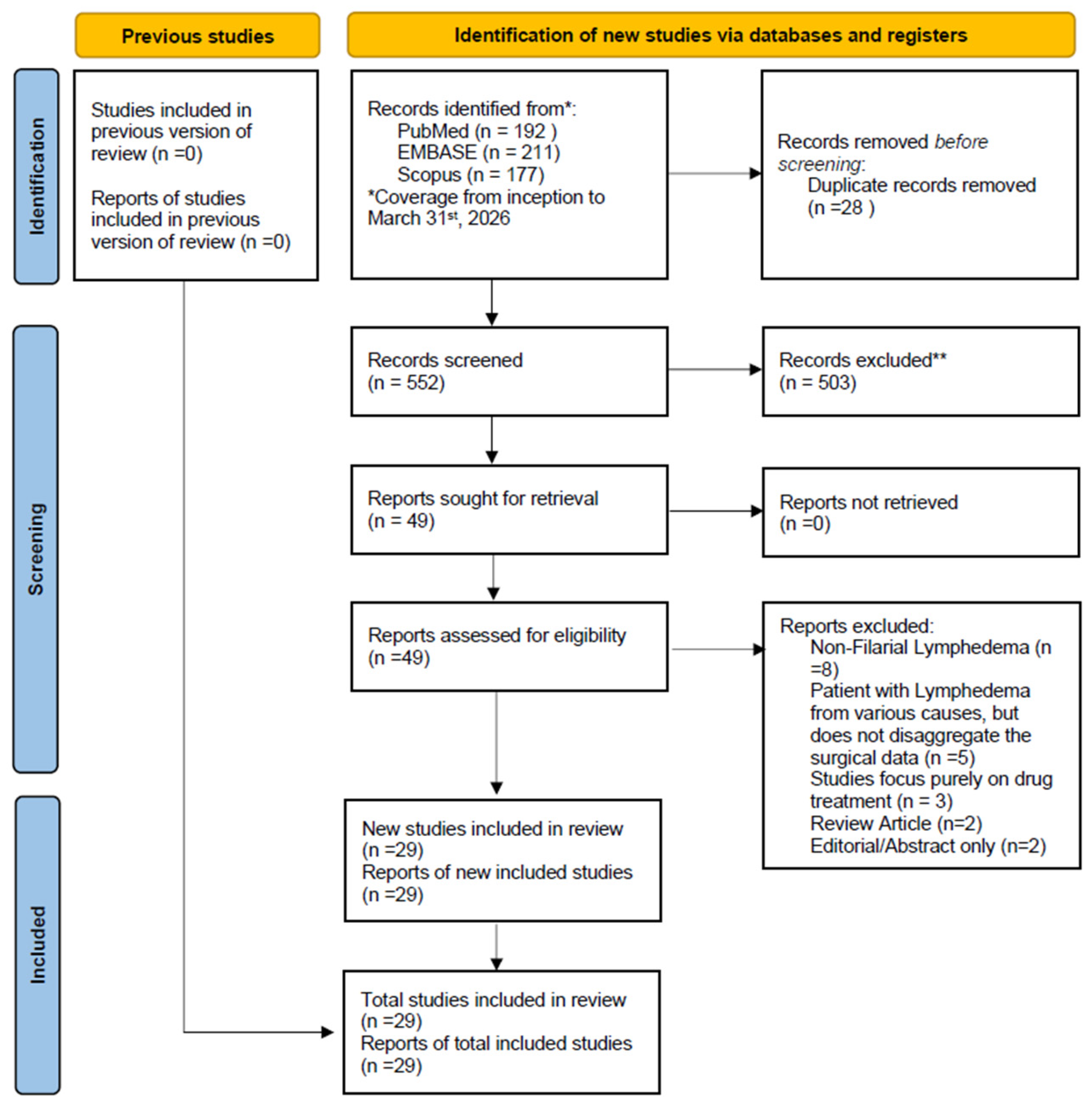
Advanced filariasis-induced lymphedema causes irreversible fibrosis, severe disability, recurrent infections, and major psychosocial burden, often with poor response to conservative therapy. Surgical management in this type of lymphedema is rarely addressed. We conducted a PRISMA 2020-guided systematic review evaluating surgical interventions versus conservative management or no intervention in adults with filarial lymphedema, involving various anatomical locations. Of 580 records identified, 29 studies were included for qualitative synthesis. The evidence base predominantly consisted of case reports, with surgical indications frequently involving disabling elephantiasis or diagnostic excision of filarial masses. While ablative procedures (excisional debulking) remained the primary salvage strategy, specific studies documented physiological techniques, including nodovenous shunts and vascularized lymph node transfer (VLNT). Quantitative limb-volume reduction was sparsely reported; however, qualitative assessments demonstrated significant improvements in ambulation, cosmesis, and patient-reported quality of life. Postoperative complications, primarily superficial surgical site infections, were generally low and manageable. Ablative surgical procedures appear to be the most common salvage strategy for advanced filarial lymphedema, but the evidence base remains limited to low-level, heterogeneous observational data. However, with the emergence of physiological lymphatic surgery, a combination of ablative procedures and physiological procedures should be considered. Prospective controlled studies with standardized outcomes are urgently needed.
Keywords: elephantiasis; filariasis; lymphedema; surgery elephantiasis; filariasis; lymphedema; surgery