Distant Landmarks Used for Navigation by Homing Pigeons
 , , and
Abstract
1. Introduction
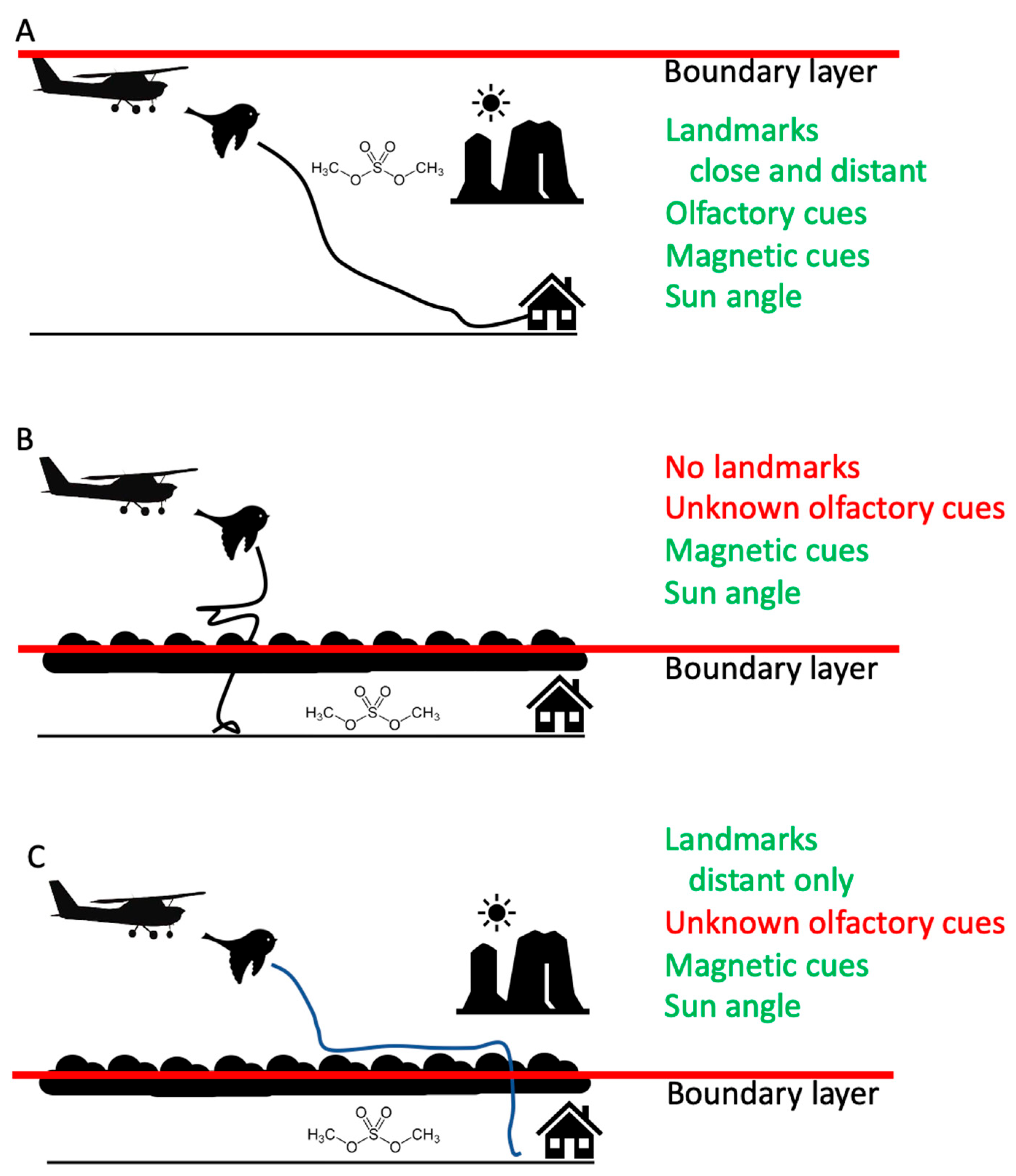
Hypotheses and Predictions
2. Materials and Methods
2.1. General Setup and Experimental Background
2.2. Birds and Experimental Procedures
2.3. GPS Data Loggers
Quantitative Analyses and Statistical Procedures
3. Results
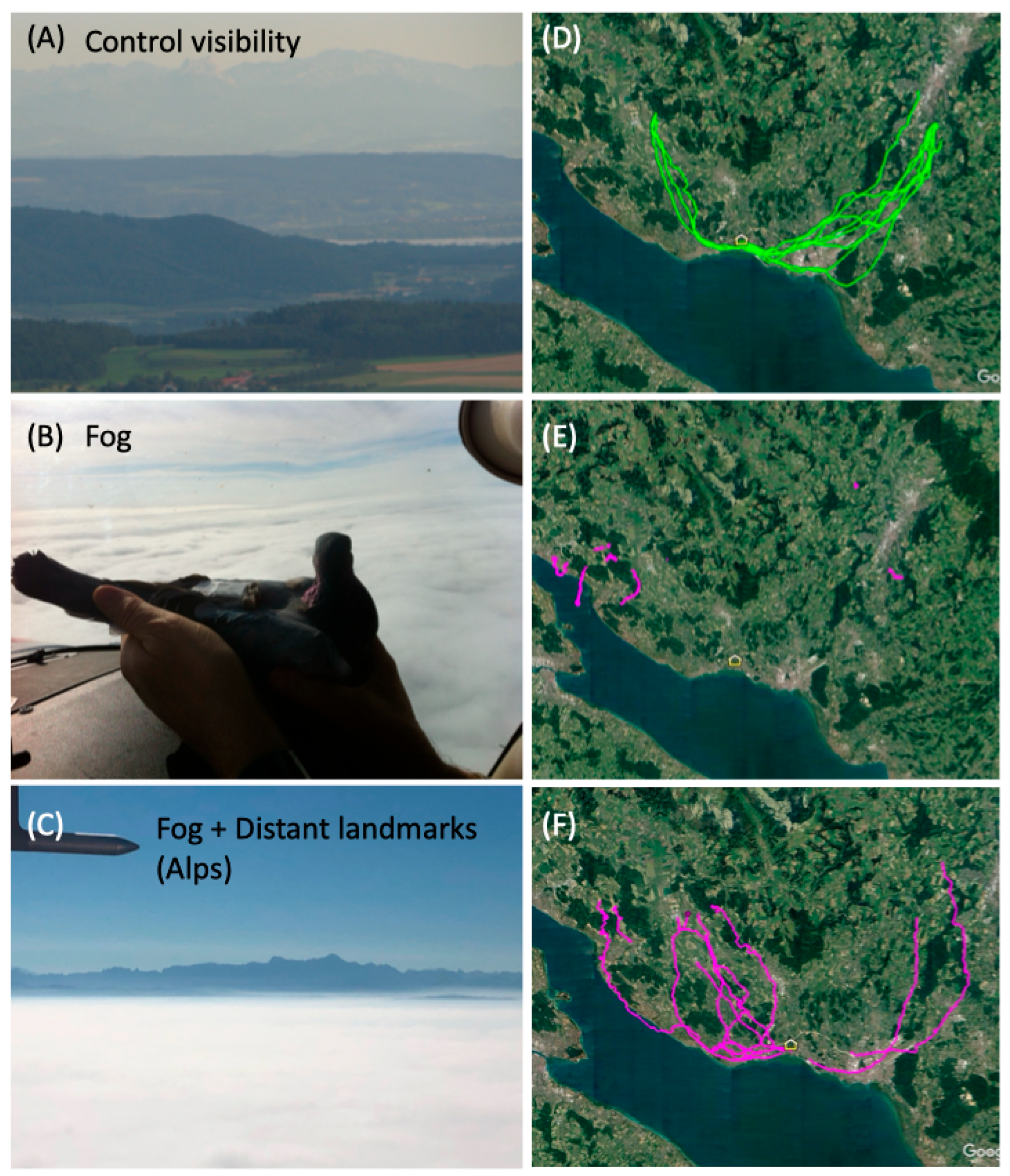
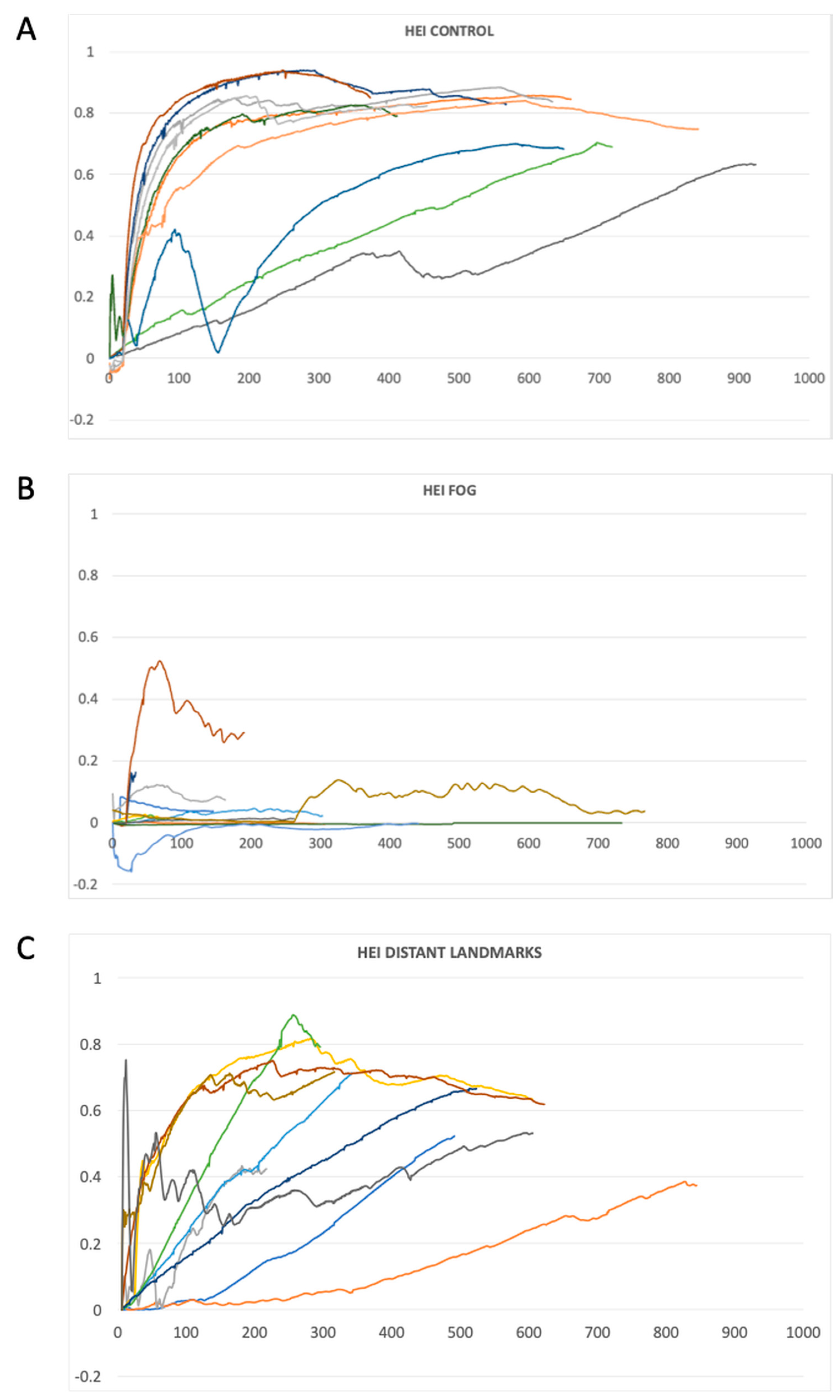
3.1. General Observations
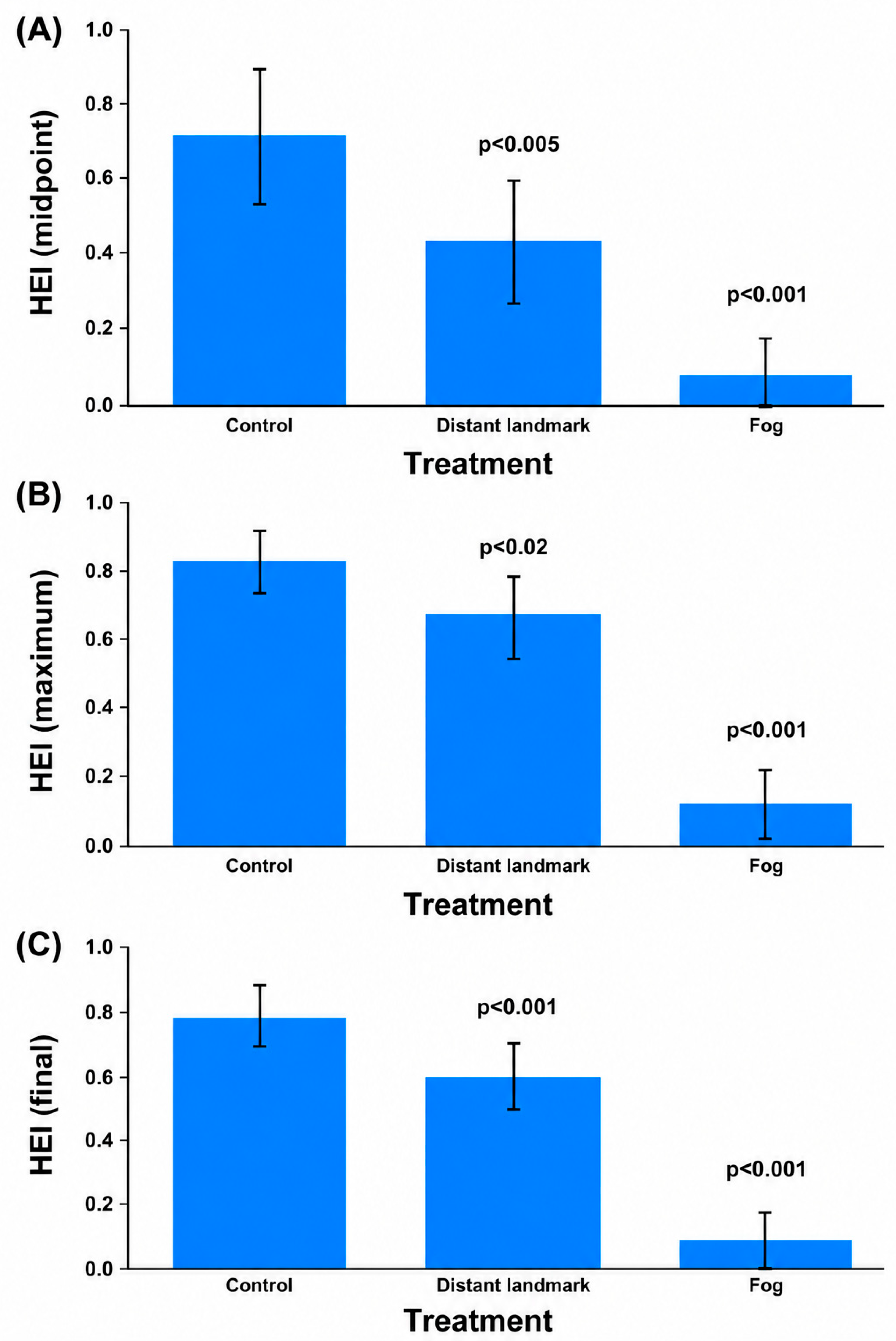
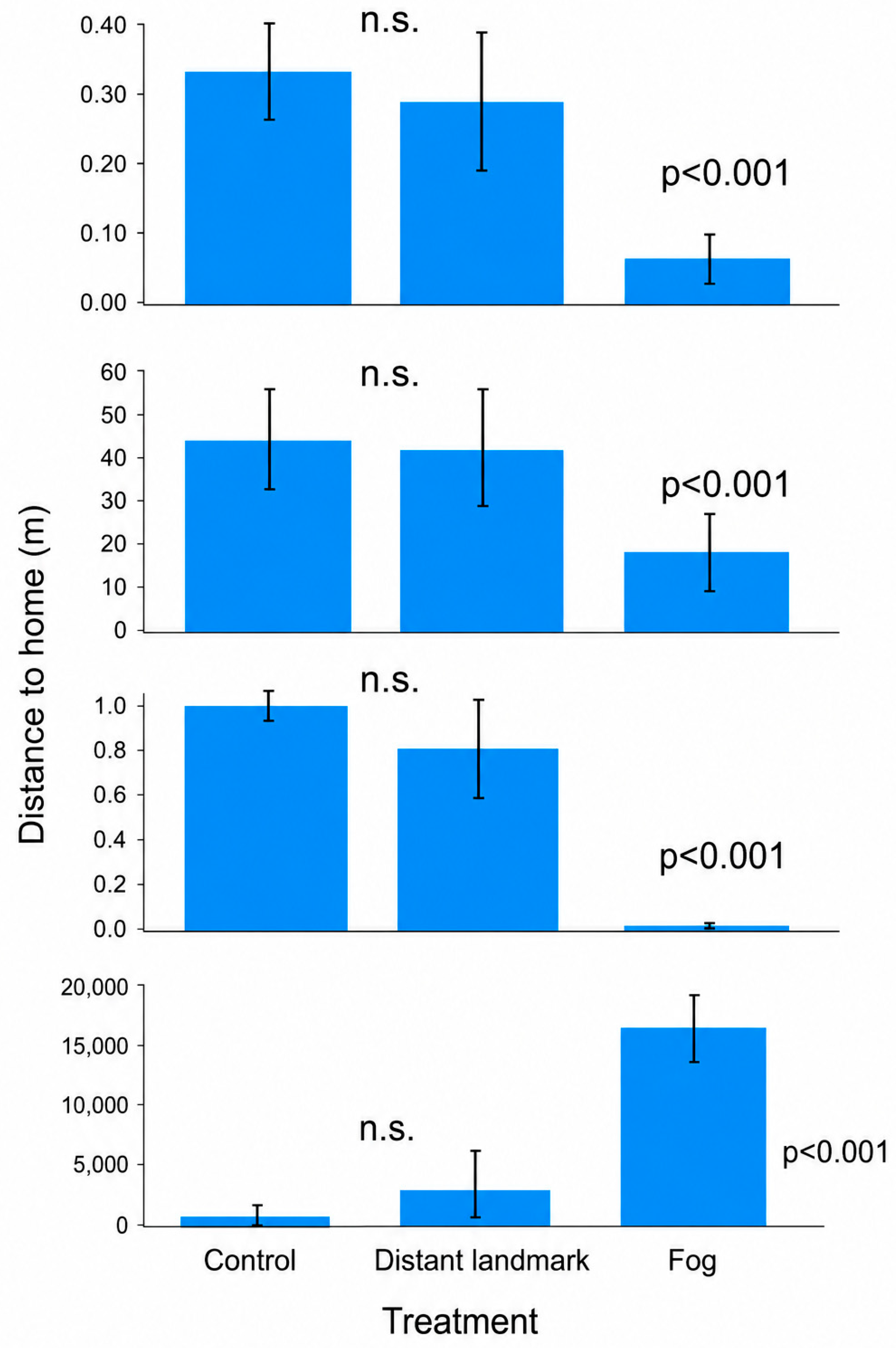
3.2. Quantifying the Homing Efficiency Index (HEI)
3.3. Statistical Comparison Between Experimental Situations
4. Discussion
4.1. Use of Distant Landmarks Above the Fog
4.2. Absence of Olfactory Information Above the Boundary Layer
4.3. Implications for Magnetic Navigation and the “Map” Problem
Descent Behavior and Decision-Making Under Uncertainty
4.4. Precision of Navigation Using Far-Distance Visual Projections
4.5. Ethical Considerations and Animal Welfare
4.6. Limitations of the Study
4.7. Avenues for Future Research
4.8. Broader Implications for Navigation Research
4.9. Distant Landmarks as a General Navigational or Orientational Guide
5. Conclusions
Supplementary Materials
Author Contributions
Funding
Institutional Review Board Statement
Informed Consent Statement
Data Availability Statement
Acknowledgments
Conflicts of Interest
Abbreviations
| GPS | Global positioning system |
References
- Lynch, K. The Image of the City; MIT Press: Cambridge, MA, USA, 1960; Volume 19, p. 50. [Google Scholar]
- Tolman, E.C. Cognitive maps in rats and men. Psychol. Rev. 1948, 55, 189. [Google Scholar] [CrossRef] [Scilit]
- Montello, D.R. A new framework for understanding the acquisition of spatial knowledge in large-scale environments. Spat. Temporal Reason. Geogr. Inf. Syst. 1998, 1, 143–154. [Google Scholar]
- Wiener, J.; Shettleworth, S.; Bingman, V.P.; Cheng, K.; Healy, S.; Jacobs, L.F.; Jeffery, K.; Mallot, H.A.; Menzel, R.; Newcombe, N.S. Animal Navigation—A Synthesis; The MIT Press: Cambridge, MA, USA, 2011. [Google Scholar]
- Wiener, J.M.; Büchner, S.J.; Hölscher, C. Taxonomy of human wayfinding tasks: A knowledge-based approach. Spat. Cogn. Comput. 2009, 9, 152–165. [Google Scholar] [CrossRef] [Scilit]
- Chen, X.; McNamara, T.P.; Kelly, J.W.; Wolbers, T. Cue combination in human spatial navigation. Cogn. Psychol. 2017, 95, 105–144. [Google Scholar] [CrossRef] [Scilit]
- Millonig, A.; Schechtner, K. Developing landmark-based pedestrian-navigation systems. IEEE Trans. Intell. Transp. Syst. 2007, 8, 43–49. [Google Scholar] [CrossRef] [Scilit]
- Zhao, M.; Warren, W.H. How you get there from here: Interaction of visual landmarks and path integration in human navigation. Psychol. Sci. 2015, 26, 915–924. [Google Scholar] [CrossRef] [Scilit]
- O’keefe, J.; Nadel, L. The Hippocampus as a Cognitive Map; Oxford University Press: Oxford, UK, 1978. [Google Scholar]
- Ishikawa, T.; Montello, D.R. Spatial knowledge acquisition from direct experience in the environment: Individual differences in the development of metric knowledge and the integration of separately learned places. Cogn. Psychol. 2006, 52, 93–129. [Google Scholar] [CrossRef] [Scilit]
- Guilford, T.; Biro, D. Route following and the pigeon’s familiar area map. J. Exp. Biol. 2014, 217, 169–179. [Google Scholar] [CrossRef] [Scilit] [PubMed]
- Filannino, C.; Armstrong, C.; Guilford, T.; Gagliardo, A. Individual strategies and release site features determine the extent of deviation in clock-shifted pigeons at familiar sites. Anim. Cogn. 2014, 17, 33–43. [Google Scholar] [CrossRef] [Scilit] [PubMed]
- Biro, D.; Freeman, R.; Meade, J.; Roberts, S.; Guilford, T. Pigeons combine compass and landmark guidance in familiar route navigation. Proc. Natl. Acad. Sci. USA 2007, 104, 7471–7476. [Google Scholar] [CrossRef] [Scilit] [PubMed]
- Lipp, H.-P.; Vyssotski, A.L.; Wolfer, D.P.; Renaudineau, S.; Savini, M.; Tröster, G.; Dell’Omo, G. Pigeon homing along highways and exits. Curr. Biol. 2004, 14, 1239–1249. [Google Scholar] [CrossRef] [Scilit]
- Vyssotski, A.L.; Dell’Omo, G.; Dell’Ariccia, G.; Abramchuk, A.N.; Serkov, A.N.; Latanov, A.V.; Loizzo, A.; Wolfer, D.P.; Lipp, H.-P. EEG responses to visual landmarks in flying pigeons. Curr. Biol. 2009, 19, 1159–1166. [Google Scholar] [CrossRef] [Scilit] [PubMed]
- Meade, J.; Biro, D.; Guilford, T. Route recognition in the homing pigeon, Columba livia. Anim. Behav. 2006, 72, 975–980. [Google Scholar] [CrossRef] [Scilit]
- Gagliardo, A.; Odetti, F.; Ioale, P. Relevance of visual cues for orientation at familiar sites by homing pigeons: An experiment in a circular arena. Proc. R. Soc. Lond. Ser. B Biol. Sci. 2001, 268, 2065–2070. [Google Scholar] [CrossRef] [Scilit]
- Biro, D.; Meade, J.; Guilford, T. Familiar route loyalty implies visual pilotage in the homing pigeon. Proc. Natl. Acad. Sci. USA 2004, 101, 17440–17443. [Google Scholar] [CrossRef] [Scilit]
- Pollonara, E.; Guilford, T.; Rossi, M.; Bingman, V.P.; Gagliardo, A. Right hemisphere advantage in the development of route fidelity in homing pigeons. Anim. Behav. 2017, 123, 395–409. [Google Scholar] [CrossRef] [Scilit]
- Wehner, R. Astronavigation in insects. Annu. Rev. Entomol. 1984, 29, 277–298. [Google Scholar] [CrossRef]
- Collett, T.S.; Graham, P.; Durier, V. Route learning by insects. Curr. Opin. Neurobiol. 2003, 13, 718–725. [Google Scholar] [CrossRef] [Scilit] [PubMed]
- Graham, P.; Fauria, K.; Collett, T.S. The influence of beacon-aiming on the routes of wood ants. J. Exp. Biol. 2003, 206, 535–541. [Google Scholar] [CrossRef] [Scilit] [PubMed]
- Graham, P.; Cheng, K. Ants use the panoramic skyline as a visual cue during navigation. Curr. Biol. 2009, 19, R935–R937. [Google Scholar] [CrossRef] [Scilit]
- Able, K.P.; Bingman, V.P. The development of orientation and navigation behavior in birds. Q. Rev. Biol. 1987, 62, 1–29. [Google Scholar] [CrossRef] [Scilit]
- Wiltschko, W.; Wiltschko, R. Homing pigeons as a model for avian navigation? J. Avian Biol. 2017, 48, 66–74. [Google Scholar] [CrossRef] [Scilit]
- Wallraff, H.G. Avian Navigation: Pigeon Homing as a Paradigm; Springer: Berlin/Heidelberg, Germany, 2005. [Google Scholar]
- Walker, M.M. On a wing and a vector: A model for magnetic navigation by homing pigeons. J. Theor. Biol. 1998, 192, 341–349. [Google Scholar] [CrossRef] [Scilit]
- Gagliardo, A.; Filannino, C.; Ioale, P.; Pecchia, T.; Wikelski, M.; Vallortigara, G. Olfactory lateralization in homing pigeons: A GPS study on birds released with unilateral olfactory inputs. J. Exp. Biol. 2011, 214, 593–598. [Google Scholar] [CrossRef] [Scilit] [PubMed]
- Gagliardo, A.; Ioale, P.; Filannino, C.; Wikelski, M. Homing Pigeons Only Navigate in Air with Intact Environmental Odours: A Test of the Olfactory Activation Hypothesis with GPS Data Loggers. PLoS ONE 2011, 6, e22385. [Google Scholar] [CrossRef] [Scilit] [PubMed]
- Gagliardo, A.; Pollonara, E.; Wikelski, M. Pigeon navigation: Exposure to environmental odours prior to release is sufficient for homeward orientation, but not for homing. J. Exp. Biol. 2016, 219, 2475–2480. [Google Scholar] [CrossRef] [Scilit] [PubMed]
- Bonadonna, F.; Gagliardo, A. Not only pigeons: Avian olfactory navigation studied by satellite telemetry. Ethol. Ecol. Evol. 2021, 33, 273–289. [Google Scholar] [CrossRef] [Scilit]
- Gagliardo, A.; Bingman, V.P. The avian olfactory system and hippocampus: Complementary roles in the olfactory and visual guidance of homing pigeon navigation. Curr. Opin. Neurobiol. 2024, 86, 102870. [Google Scholar] [CrossRef] [Scilit]
- Papi, F. Olfactory navigation in birds. Experientia 1990, 46, 352–363. [Google Scholar] [CrossRef] [Scilit]
- Gagliardo, A. Forty years of olfactory navigation in birds. J. Exp. Biol. 2013, 216, 2165–2171. [Google Scholar] [CrossRef] [Scilit]
- Gagliardo, A.; Pollonara, E.; Wikelski, M. Only natural local odours allow homeward orientation in homing pigeons released at unfamiliar sites. J. Comp. Physiol. A 2018, 204, 761–771. [Google Scholar] [CrossRef] [Scilit]
- Wallraff, H.G.; Neumann, M.F. Contribution of olfactory navigation and non-olfactory pilotage to pigeon homing. Behav. Ecol. Sociobiol. 1989, 25, 293–302. [Google Scholar] [CrossRef] [Scilit]
- Benvenuti, S.; Fiaschi, V.; Fiore, L.; Papi, F. Homing performances of inexperienced and directionally trained pigeons subjected to olfactory nerve section. J. Comp. Physiol. 1973, 83, 81–92. [Google Scholar] [CrossRef] [Scilit]
- Gagliardo, A.; Pollonara, E.; Wikelski, M. Pigeons remember visual landmarks after one release and rely upon them more if they are anosmic. Anim. Behav. 2020, 166, 85–94. [Google Scholar] [CrossRef] [Scilit]
- Wiltschko, W.; Wiltschko, R. Migratory orientation of European robins is affected by the wavelength of light as well as by a magnetic pulse. J. Comp. Physiol. A 1995, 177, 363–369. [Google Scholar] [CrossRef] [Scilit]
- Braithwaite, V.; Guilford, T. Recognition of familiar visual landmarks in homing pigeons. J. Navig. 1993, 46, 371–375. [Google Scholar] [CrossRef] [Scilit]
- Collett, T.S.; Graham, P. Animal navigation: Path integration, visual landmarks and cognitive maps. Curr. Biol. 2004, 14, R475–R477. [Google Scholar] [CrossRef] [Scilit]
- Hunt, E.R.; Kendall, C.; Stanbury, E.; Sendova-Franks, A.B.; Franks, N.R. Complementary landmarks facilitate ant navigation. Behav. Process. 2018, 157, 702–710. [Google Scholar] [CrossRef] [Scilit] [PubMed]
- Mather, J.A. Navigation by spatial memory and use of visual landmarks in octopuses. J. Comp. Physiol. A Neuroethol. Sens. Neural Behav. Physiol. 1991, 168, 491–497. [Google Scholar] [CrossRef] [Scilit]
- Baader, A. The significance of visual landmarks for navigation of the giant tropical ant, Paraponera clavata (Formicidae, Ponerinae). Insectes Sociaux 1996, 43, 435–450. [Google Scholar] [CrossRef] [Scilit]
- Trahanias, P.E.; Velissaris, S.; Garavelos, T. Visual landmark extraction and recognition for autonomous robot navigation. In Proceedings of the 1997 IEEE/RSJ International Conference on Intelligent Robot and Systems. Innovative Robotics for Real-World Applications. IROS’97, Grenoble, France, 11 September 1997; pp. 1036–1043. [Google Scholar]
- Wagner, G. Homing pigeons’ flight over and under low stratus. In Animal Migration, Navigation, and Homing; Springer: Berlin/Heidelberg, Germany, 1978; pp. 162–170. [Google Scholar]
- Wagner, G. Topography and Pigeon Orientation; NASA, Washington Animal Orientation and Navigation: Washington, DC, USA, 1972. Available online: https://ntrs.nasa.gov/citations/19720017427 (accessed on 19 May 2026).
- Guilford, T.; Taylor, G.K. The sun compass revisited. Anim. Behav. 2014, 97, 135–143. [Google Scholar] [CrossRef] [Scilit] [PubMed]
- Kunz, T.H.; Gauthreaux, S.A., Jr.; Hristov, N.I.; Horn, J.W.; Jones, G.; Kalko, E.K.V.; Larkin, R.P.; McCracken, G.F.; Swartz, S.M.; Srygley, R.B.; et al. Aeroecology: Probing and modeling the aerosphere. Integr. Comp. Biol. 2008, 48, 1–11. [Google Scholar] [CrossRef] [Scilit]
- Shamoun-Baranes, J.; Liechti, F.; Vansteelant, W.M. Atmospheric conditions create freeways, detours and tailbacks for migrating birds. J. Comp. Physiol. A 2017, 203, 509–529. [Google Scholar] [CrossRef] [Scilit]
- De Arellano, J.V.-G.; van Heerwaarden, C.C.; van Stratum, B.J.; van den Dries, K. Atmospheric Boundary Layer: Integrating Air Chemistry and Land Interactions; Cambridge University Press: Cambridge, UK, 2015. [Google Scholar]
- Mandel, J.T.; Bohrer, G.; Winkler, D.W.; Barber, D.R.; Houston, C.S.; Bildstein, K.L. Migration path annotation: Cross-continental study of migration-flight response to environmental conditions. Ecol. Appl. 2011, 21, 2258–2268. [Google Scholar] [CrossRef] [Scilit]
- Gagliardo, A.; Pollonara, E.; Wikelski, M. The homing pigeons’ olfactory map is affected by geographical barriers. Ethol. Ecol. Evol. 2021, 33, 321–337. [Google Scholar] [CrossRef] [Scilit]
- Safi, K.; Gagliardo, A.; Wikelski, M.; Kranstauber, B. How Displaced Migratory Birds Could Use Volatile Atmospheric Compounds to Find Their Migratory Corridor: A Test Using a Particle Dispersion Model. Front. Behav. Neurosci. 2016, 10, 175. [Google Scholar] [CrossRef] [Scilit]
- Wikelski, M.; Arriero, E.; Gagliardo, A.; Holland, R.A.; Huttunen, M.J.; Juvaste, R.; Mueller, I.; Tertitski, G.; Thorup, K.; Wild, M.; et al. True navigation in migrating gulls requires intact olfactory nerves. Sci. Rep. 2015, 5, 17061. [Google Scholar] [CrossRef] [Scilit]
- Zannoni, N.; Wikelski, M.; Gagliardo, A.; Raza, A.; Kramer, S.; Seghetti, C.; Wang, N.J.; Edtbauer, A.; Williams, J. Identifying volatile organic compounds used for olfactory navigation by homing pigeons. Sci. Rep. 2020, 10, 15879. [Google Scholar] [CrossRef] [Scilit] [PubMed]
- Wiltschko, R.; Stapput, K.; Thalau, P.; Wiltschko, W. Directional orientation of birds by the magnetic field under different light conditions. J. R. Soc. Interface 2010, 7, S163–S177. [Google Scholar] [CrossRef] [Scilit] [PubMed]
- Phillips, J.B. Magnetic navigation. J. Theor. Biol. 1996, 180, 309–319. [Google Scholar] [CrossRef] [Scilit]
- Freake, M.J.; Muheim, R.; Phillips, J.B. Magnetic maps in animals: A theory comes of age? Q. Rev. Biol. 2006, 81, 327–347. [Google Scholar] [CrossRef] [Scilit]
- Lohmann, K.J.; Lohmann, C.M.; Putman, N.F. Magnetic maps in animals: Nature’s GPS. J. Exp. Biol. 2007, 210, 3697–3705. [Google Scholar] [CrossRef] [Scilit] [PubMed]
- Fischer, J.; Freake, M.; Borland, S.; Phillips, J. Evidence for the use of magnetic map information by an amphibian. Anim. Behav. 2001, 62, 1–10. [Google Scholar] [CrossRef] [Scilit]
- Scanlan, M.M.; Putman, N.F.; Pollock, A.M.; Noakes, D.L. Magnetic map in nonanadromous Atlantic salmon. Proc. Natl. Acad. Sci. USA 2018, 115, 10995–10999. [Google Scholar] [CrossRef] [Scilit] [PubMed]
- Naisbett-Jones, L.C.; Putman, N.F.; Stephenson, J.F.; Ladak, S.; Young, K.A. A magnetic map leads juvenile European eels to the Gulf Stream. Curr. Biol. 2017, 27, 1236–1240. [Google Scholar] [CrossRef] [Scilit]
- Walcott, C. Magnetic maps in pigeons. In Orientation in Birds; Birkhäuser: Basel, Switzerland, 1991; pp. 38–51. [Google Scholar]
- Beason, R.C.; Wiltschko, W. Cues indicating location in pigeon navigation. J. Comp. Physiol. A 2015, 201, 961–967. [Google Scholar] [CrossRef] [Scilit]
- Zein, B.; Long, J.A.; Safi, K.; Kolzsch, A.; Wikelski, M.; Kruckenberg, H.; Demsar, U. Simulation experiment to test strategies of geomagnetic navigation during long-distance bird migration. Mov. Ecol. 2021, 9, 46. [Google Scholar] [CrossRef] [Scilit] [PubMed]
- Wallraff, H.G. Olfaction and homing in pigeons: A problem of navigation or of motivation? Naturwissenschaften 1979, 66, 269–270. [Google Scholar] [CrossRef] [Scilit]
- Cochran, W.W.; Mouritsen, H.; Wikelski, M. Migrating songbirds recalibrate their magnetic compass daily from twilight cues. Science 2004, 304, 405–408. [Google Scholar] [CrossRef] [Scilit]
- Brunyé, T.T.; Haga, Z.D.; Houck, L.A.; Taylor, H.A. You look lost: Understanding uncertainty and representational flexibility in navigation. In Representations in Mind and World; Routledge: Oxfordshire, UK, 2017; pp. 42–56. [Google Scholar]
- Schwarz, S.; Clement, L.; Gkanias, E.; Wystrach, A. How do backward-walking ants (Cataglyphis velox) cope with navigational uncertainty? Anim. Behav. 2020, 164, 133–142. [Google Scholar] [CrossRef] [Scilit]
- Guilford, T.; Åkesson, S.; Gagliardo, A.; Holland, R.A.; Mouritsen, H.; Muheim, R.; Wiltschko, R.; Wiltschko, W.; Bingman, V.P. Migratory navigation in birds: New opportunities in an era of fast-developing tracking technology. J. Exp. Biol. 2011, 214, 3705–3712. [Google Scholar] [CrossRef] [Scilit]
- Becker, C.; Salas, J.; Tokusei, K.; Latombe, J.-C. Reliable navigation using landmarks. In Proceedings of the 1995 IEEE International Conference on Robotics and Automation, Nagoya, Japan, 21–27 May 1995; pp. 401–406. [Google Scholar]
- Beinhofer, M.; Müller, J.; Burgard, W. Effective landmark placement for accurate and reliable mobile robot navigation. Robot. Auton. Syst. 2013, 61, 1060–1069. [Google Scholar] [CrossRef] [Scilit]
- Cesetti, A.; Frontoni, E.; Mancini, A.; Zingaretti, P.; Longhi, S. A vision-based guidance system for UAV navigation and safe landing using natural landmarks. J. Intell. Robot. Syst. 2010, 57, 233–257. [Google Scholar] [CrossRef] [Scilit]
- Kano, F.; Walker, J.; Sasaki, T.; Biro, D. Head-mounted sensors reveal visual attention of free-flying homing pigeons. J. Exp. Biol. 2018, 221, jeb183475. [Google Scholar] [CrossRef] [Scilit]
- Meade, J.; Biro, D.; Guilford, T. Homing pigeons develop local route stereotypy. Proc. R. Soc. B Biol. Sci. 2005, 272, 17–23. [Google Scholar] [CrossRef] [Scilit]
- Wiltschko, R.; Schiffner, I.; Siegmund, B. Homing flights of pigeons over familiar terrain. Anim. Behav. 2007, 74, 1229–1240. [Google Scholar] [CrossRef] [Scilit]
- Papadopoulou, M.; Hildenbrandt, H.; Sankey, D.W.; Portugal, S.J.; Hemelrijk, C.K. Emergence of splits and collective turns in pigeon flocks under predation. R. Soc. Open Sci. 2022, 9, 211898. [Google Scholar] [CrossRef] [Scilit]
- Garde, B.; Wilson, R.P.; Lempidakis, E.; Börger, L.; Portugal, S.J.; Hedenström, A.; Dell’Omo, G.; Quetting, M.; Wikelski, M.; Shepard, E.L. Fine-scale changes in speed and altitude suggest protean movements in homing pigeon flights. R. Soc. Open Sci. 2021, 8, 210130. [Google Scholar] [CrossRef] [Scilit]
- Lempidakis, E.; Ross, A.N.; Quetting, M.; Garde, B.; Wikelski, M.; Shepard, E.L. Estimating fine-scale changes in turbulence using the movements of a flapping flier. J. R. Soc. Interface 2022, 19, 20220577. [Google Scholar] [CrossRef] [Scilit]
- Lempidakis, E.; Wilson, R.P.; Luckman, A.; Metcalfe, R.S. What can knowledge of the energy landscape tell us about animal movement trajectories and space use? A case study with humans. J. Theor. Biol. 2018, 457, 101–111. [Google Scholar] [CrossRef] [Scilit]
- Wiltschko, R.; Wiltschko, W. Animal navigation: How animals use environmental factors to find their way. Eur. Phys. J. Spec. Top. 2023, 232, 237–252. [Google Scholar] [CrossRef] [Scilit]
- Gould, J.L. Animal navigation. Curr. Biol. 2004, 14, R221–R224. [Google Scholar] [CrossRef] [Scilit]
- Calisi, R.M.; Bentley, G.E. Lab and field experiments: Are they the same animal? Horm. Behav. 2009, 56, 1–10. [Google Scholar] [CrossRef] [Scilit]
- Mora, C.V.; Bingman, V.P. Detection of magnetic field intensity gradient by homing pigeons (Columba livia) in a novel “virtual magnetic map” conditioning paradigm. PLoS ONE 2013, 8, e72869. [Google Scholar] [CrossRef] [Scilit]
- Cheng, K.; Collett, T.; Pickhard, A.; Wehner, R. The use of visual landmarks by honeybees: Bees weight landmarks according to their distance from the goal. J. Comp. Physiol. A 1987, 161, 469–475. [Google Scholar] [CrossRef] [Scilit]
- Michon, P.-E.; Denis, M. When and why are visual landmarks used in giving directions? In Proceedings of the International Conference on Spatial Information Theory; Springer: Berlin/Heidelberg, Germany, 2001; pp. 292–305. [Google Scholar]
- Emlen, S.T.; Farner, D.; King, J. Migration: Orientation and navigation. Avian Biol. 1975, 5, 129–219. [Google Scholar]
- Dacke, M.; Baird, E.; Byrne, M.; Scholtz, C.H.; Warrant, E.J. Dung beetles use the Milky Way for orientation. Curr. Biol. 2013, 23, 298–300. [Google Scholar] [CrossRef] [Scilit]
- Enright, J.T. When the Beachhopper Looks at the Moon: The Moon Compass Hypothesis; NASA, Washington Animal Orientation and Navigation: Washington, DC, USA, 1972. [Google Scholar]
- Kramer, G. CHAPTER XXII—Long-Distance Orientation. Biol. Comp. Physiol. Birds 1961, 2, 341–371. [Google Scholar] [CrossRef] [Scilit]
- Wehner, R. Celestial and terrestrial navigation: Human strategies—Insect strategies. In Neuroethology and Behavioral Physiology: Roots and Growing Points; Springer: Berlin/Heidelberg, Germany, 1983; pp. 366–381. [Google Scholar] [CrossRef] [Scilit]
- Maaswinkel, H.; Whishaw, I.Q. Homing with locale, taxon, and dead reckoning strategies by foraging rats: Sensory hierarchy in spatial navigation. Behav. Brain Res. 1999, 99, 143–152. [Google Scholar] [CrossRef] [Scilit]


Disclaimer/Publisher’s Note: The statements, opinions and data contained in all publications are solely those of the individual author(s) and contributor(s) and not of MDPI and/or the editor(s). MDPI and/or the editor(s) disclaim responsibility for any injury to people or property resulting from any ideas, methods, instructions or products referred to in the content. |
© 2026 by the authors. Licensee MDPI, Basel, Switzerland. This article is an open access article distributed under the terms and conditions of the Creative Commons Attribution (CC BY) license.
Share and Cite
Wikelski, M.; Dechmann, D.K.N.; Quetting, M.; Heine, G.; Fiedler, W.; Schmid, H.; Bohrer, G.; Gagliardo, A. Distant Landmarks Used for Navigation by Homing Pigeons. Life 2026, 16, 933. https://doi.org/10.3390/life16060933
Wikelski M, Dechmann DKN, Quetting M, Heine G, Fiedler W, Schmid H, Bohrer G, Gagliardo A. Distant Landmarks Used for Navigation by Homing Pigeons. Life. 2026; 16(6):933. https://doi.org/10.3390/life16060933
Chicago/Turabian StyleWikelski, Martin, Dina K. N. Dechmann, Michael Quetting, Georg Heine, Wolfgang Fiedler, Heidi Schmid, Gil Bohrer, and Anna Gagliardo. 2026. "Distant Landmarks Used for Navigation by Homing Pigeons" Life 16, no. 6: 933. https://doi.org/10.3390/life16060933
APA StyleWikelski, M., Dechmann, D. K. N., Quetting, M., Heine, G., Fiedler, W., Schmid, H., Bohrer, G., & Gagliardo, A. (2026). Distant Landmarks Used for Navigation by Homing Pigeons. Life, 16(6), 933. https://doi.org/10.3390/life16060933