Airway Morphometric Changes Following Prefabricated Myofunctional Appliance in Class II Division 1 Patients: A Clinical Evaluation


Abstract
1. Introduction
2. Materials and Methods
2.1. Patient Selection
2.1.1. Selection Criteria for Children with Angle Class II Division 1 Malocclusion
- Diagnosis of Angle Class II division 1 malocclusion.
- Overjet ≥ 6 mm.
- Cervical vertebral maturation (CVM) stage III or earlier.
- A treatment period of more than one year with the EF appliance.
- Availability of cephalometric radiographic records before treatment and one year after treatment.
- Completed total nasal symptom score (TNSS) at the beginning and the end of the observation.
- Previous orthodontic interventions.
- Poor appliance compliance, defined as daily wear of <7 h or <5 days per week.
- Incomplete cephalometric radiographs at baseline or one-year follow-up.
- Incomplete TNSS score data.
- Presence of congenital craniofacial abnormalities or systemic diseases.
2.1.2. Selection Criteria of Observation-Only Group: The Data Were Retrieved from Departmental Records Data (2017–2019) with the Following Criteria
- Angle Class II division 1 malocclusion.
- Overjet ≥ 6 mm.
- No history of interceptive orthodontic treatment.
- Availability of initial and one-year follow-up cephalometric radiographs.
- CVM stage III or earlier.
- No congenital craniofacial anomalies or systemic diseases
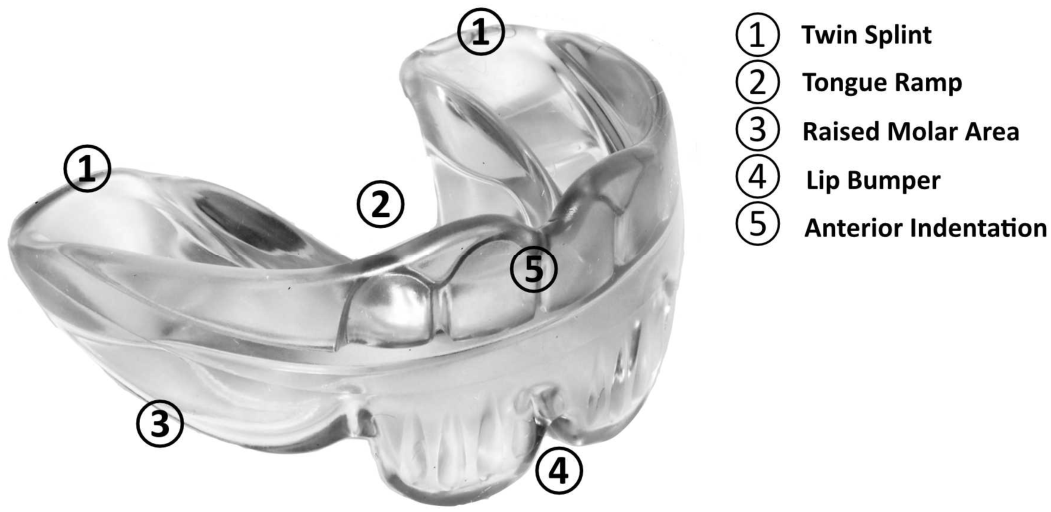
2.2. Selection and Use of Myofunctional Appliances and Exercise Protocol
- Panoramic radiography and cephalometric radiographs.
- Extraoral and intraoral photographs.
- Study models (dental casts).
2.3. Standardization of Cephalometric Acquisition and Head Positioning
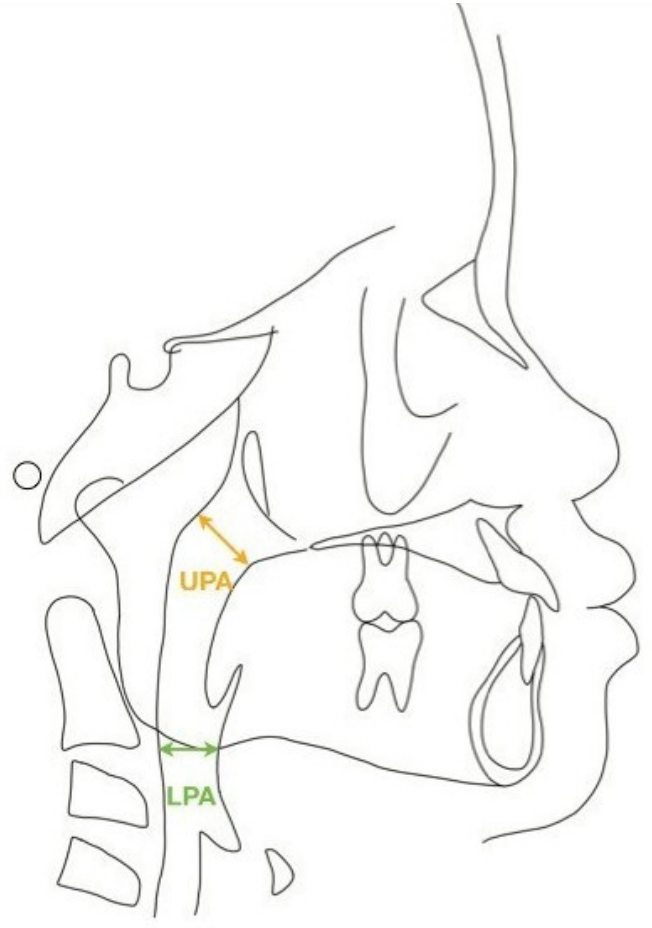
2.4. Airway Measurement
- (A)
- Nasopharyngeal airway area (cm2): the area was formed by a trapezoid-like area with inferior border formed by Ptm (pterygomaxillare) extending to most posterior border of pharyngeal wall along the palatal line (ANS-PNS) extension; posterior border formed by the posterior wall of pharynx; anterior wall formed by the PML (a line from Ptm vertical to palatal line) and the upper border formed by sphenoid line (a line tangent to the lower border of the sphenoid bone registered on basion) [15].
- (B)
- Oropharyngeal airway area (cm2): the upper border was located on the palatal line (PL); the lower border was located on the tip of the uvula line (TUL), registered on the tip of the uvula (TU), and parallel to the palatal line.
- (C)
- Hypopharyngeal area (cm2): the lower border was formed by the line starting from the most anterior and superior point of the hyoid bone parallel to the palatal line (anterior of hyoid bone line, AHL) [16].
2.5. Reliability Assessment
2.6. Total Nasal Symptom Score (TNSS)
2.7. Statistical Analysis
3. Results
3.1. Baseline Data with Age, Gender, and Cephalometric Measurements in the Two Groups (Table 1)

| Variables | Observation (n = 29) | Case (n = 34) | Effect Size | p-Value |
|---|---|---|---|---|
| Gender (n, %) | 0.10 | 0.405 | ||
| Male | 20 (69.0%) | 20 (58.8%) | ||
| Female | 9 (31.0%) | 14 (41.2%) | ||
| Age (months) | 112.83 ± 16.74 | 116.26 ± 14.04 | 0.12 | 0.324 |
| Height percentile | 52.33 ± 25.49 | 52.51 ± 28.18 | 0.01 | 0.959 |
| Weight percentile | 58.30 ± 31.02 | 52.33 ± 31.33 | 0.12 | 0.387 |
| Nasopharyngeal airway | 3.21 ± 1.00 | 3.00 ± 0.84 | 0.06 | 0.620 |
| Oropharyngeal airway | 2.40 ± 0.46 | 2.59 ± 0.57 | 0.16 | 0.197 |
| Hypopharyngeal airway | 3.11 ± 1.13 | 2.98 ± 0.73 | 0.06 | 0.654 |
| NcNamara upper | 10.19 ± 3.24 | 9.85 ± 2.58 | 0.09 | 0.477 |
| NcNamara lower | 10.00 ± 2.69 | 9.75 ± 2.29 | 0.08 | 0.503 |
3.2. Analysis of Differences Within Groups After One Year (Table 2)
3.2.1. One-Year Airway Changes in the Observation Group
3.2.2. Between-Group Comparisons After One Year
3.2.3. Reliability Analysis
3.2.4. Total Nasal Symptom Score (TNSS) (Table 3)
| Variables | Observation (n = 29) | Case (n = 34) | Intergroup Comparison | |||||||||||||||
|---|---|---|---|---|---|---|---|---|---|---|---|---|---|---|---|---|---|---|
| Mean Before | SD | Mean After | SD | Mean Difference | SD | Effect Size | p-Value b | Mean Before | SD | Mean After | SD | Mean Difference | SD | Effect Size | p-Value b | Effect Size | p-Value a | |
| Nasopharyngeal airway | 3.21 | 1.00 | 3.51 | 1.15 | 0.30 | 0.80 | 0.19 | 0.294 | 3.00 | 0.84 | 3.54 | 0.95 | 0.54 | 0.62 | 0.67 | <0.001 ** | 0.25 | 0.044 * |
| Oropharyngeal airway | 2.40 | 0.46 | 2.81 | 0.81 | 0.41 | 0.66 | 0.58 | <0.001 ** | 2.59 | 0.57 | 3.42 | 0.98 | 0.83 | 0.91 | 0.74 | <0.001 ** | 0.26 | 0.039 * |
| Hypopharyngeal airway | 3.11 | 1.13 | 3.56 | 1.09 | 0.45 | 1.14 | 0.36 | 0.050 | 2.98 | 0.73 | 5.14 | 6.91 | 2.17 | 6.91 | 0.54 | 0.002 ** | 0.20 | 0.121 |
| NcNamara upper | 10.19 | 3.24 | 11.57 | 3.65 | 1.38 | 2.31 | 0.53 | <0.001 ** | 9.85 | 2.58 | 12.88 | 3.64 | 3.03 | 2.99 | 0.81 | <0.001 ** | 0.30 | 0.018 * |
| NcNamara lower | 10.00 | 2.69 | 10.88 | 3.18 | 0.87 | 3.04 | 0.28 | 0.127 | 9.75 | 2.29 | 11.45 | 3.29 | 1.70 | 3.20 | 0.50 | 0.004 ** | 0.15 | 0.235 |
| Variable | Observation (n = 29) | Case (n = 34) | Intergroup Comparison | |||||||||||||||
|---|---|---|---|---|---|---|---|---|---|---|---|---|---|---|---|---|---|---|
| Mean Before | SD | Mean After | SD | Mean Difference | SD | Effect Size | p-Value b | Mean Before | SD | Mean After | SD | Mean Difference | SD | Effect Size | p-Value b | Effect Size | p-Value a | |
| Rhinorrhea | 2.00 | 0.96 | 1.69 | 0.66 | −0.31 | 0.89 | 0.33 | 0.074 | 2.06 | 0.95 | 1.50 | 0.66 | −0.56 | 0.66 | 0.65 | <0.001 ** | 0.134 | 0.288 |
| Nose stuffiness | 2.47 | 0.76 | 1.66 | 0.72 | −0.81 | 0.81 | 0.70 | <0.001 ** | 2.47 | 0.72 | 1.38 | 0.60 | −1.09 | 0.66 | 0.83 | <0.001 ** | 0.160 | 0.204 |
| Nose itching | 1.88 | 1.01 | 1.31 | 0.60 | −0.57 | 0.82 | 0.57 | 0.002 ** | 1.90 | 1.00 | 1.12 | 0.64 | −0.78 | 0.62 | 0.77 | <0.001 ** | 0.130 | 0.302 |
| Nose sneezing | 1.93 | 0.92 | 1.52 | 0.57 | −0.41 | 1.05 | 0.36 | 0.054 | 1.96 | 0.92 | 1.32 | 0.64 | −0.63 | 0.57 | 0.74 | <0.001 ** | 0.108 | 0.391 |
| Total score changes | 8.17 | 1.89 | 6.17 | 1.26 | −2.00 | 1.96 | 0.70 | <0.001 ** | 8.26 | 2.03 | 5.29 | 1.53 | −2.97 | 1.31 | 0.87 | <0.001 ** | 0.222 | 0.078 |
4. Discussion
4.1. Airway Changes Along with Growth
4.2. Airway Changes Due to Intervention
4.3. Biological Mechanisms of Functional Appliances (FAs) and Prefabricated Myofunctional Appliances (PMAs) on Airway Dimensional Changes in Class II Malocclusion
4.4. The Use of Image Studies in Airway Measurement
4.5. Total Nasal Symptom Score (TNSS)
4.6. Strengths, Limitations, and Future Perspectives
5. Conclusions
Author Contributions
Funding
Institutional Review Board Statement
Informed Consent Statement
Data Availability Statement
Acknowledgments
Conflicts of Interest
References
- Bishara, S.E. Class II Malocclusions: Diagnostic and Clinical Considerations With and Without Treatment. Semin. Orthod. 2006, 12, 11–24. Available online: https://www.sciencedirect.com/science/article/pii/S107387460500068X (accessed on 2 May 2026). [CrossRef]
- Nguyen, T.T.N.; Le, L.N.; Truong, N.T.B.; Nguyen, P.T.T.; Tran, C.M.; Trinh, T.T.H.; Tan, L.T.; Van Nguyen, K. Evaluation of the pharyngeal airway dimensions measured by cephalometrics and cone beam computed tomography in patients with skeletal class II malocclusions. J. Orthod. Sci. 2025, 14, 24. [Google Scholar] [CrossRef]
- Kim, K.A.; Kim, S.J.; Yoon, A. Craniofacial anatomical determinants of pediatric sleep-disordered breathing: A comprehensive review. J. Prosthodont. 2025, 34, 26–34. [Google Scholar] [CrossRef]
- Hansen, C.; Markström, A.; Sonnesen, L. Specific dento-craniofacial characteristics in non-syndromic children can predispose to sleep-disordered breathing. Acta Paediatr. 2022, 111, 473–477. [Google Scholar]
- Shirke, S.R.; Katre, A.N. Association of Sleep-Disordered Breathing and Developing Malocclusion in Children: A Cross-Sectional Study. Cureus 2023, 15, e39813. [Google Scholar] [CrossRef]
- Cozza, P.; Baccetti, T.; Franchi, L.; De Toffol, L.; McNamara, J.A., Jr. Mandibular changes produced by functional appliances in Class II malocclusion: A systematic review. Am. J. Orthod. Dentofac. Orthop. 2006, 129, 599.e1–599.e12. [Google Scholar] [CrossRef]
- Rita, S.; Sadat, A. Growth Modification in Class II Malocclusion: A Review. Update Dent. Coll. J. 2015, 4, 23–26. [Google Scholar]
- Alhasyimi, A.A.; Syahfik, I. Growth Modification of Developing Class II Division 1 Malocclusion Using Myofunctional Appliances. Case Rep. Dent. 2023, 2023, 8201195. [Google Scholar] [CrossRef]
- Mohammed, H.; Čirgić, E.; Rizk, M.Z.; Vandevska-Radunovic, V. Effectiveness of prefabricated myofunctional appliances in the treatment of Class II division 1 malocclusion: A systematic review. Eur. J. Orthod. 2020, 42, 125–134. [Google Scholar] [PubMed]
- Vinoth, S.K.; Thomas, A.V.; Nethravathy, R. Cephalomteric changes in airway dimensions with twin block therapy in growing Class II patients. J. Pharm. Bioallied Sci. 2013, 5, S25–S29. [Google Scholar] [CrossRef]
- Han, S.; Choi, Y.J.; Chung, C.J.; Kim, J.Y.; Kim, K.H. Long-term pharyngeal airway changes after bionator treatment in adolescents with skeletal Class II malocclusions. Korean J. Orthod. 2014, 44, 13–19. [Google Scholar] [CrossRef] [PubMed]
- Kannan, A.; Sathyanarayana, H.P.; Padmanabhan, S. Effect of functional appliances on the airway dimensions in patients with skeletal class II malocclusion: A systematic review. J. Orthod. Sci. 2017, 6, 54–64. [Google Scholar] [CrossRef]
- Xiang, M.; Hu, B.; Liu, Y.; Sun, J.; Song, J. Changes in airway dimensions following functional appliances in growing patients with skeletal class II malocclusion: A systematic review and meta-analysis. Int. J. Pediatr. Otorhinolaryngol. 2017, 97, 170–180. [Google Scholar] [CrossRef]
- Elfouly, D.; Dumu, E.J.; Madian, A.M.; Eid, F.Y. The effect of different functional appliances on the sagittal pharyngeal airway dimension in skeletal class II: A retrospective study. Sci. Rep. 2024, 14, 19410. [Google Scholar] [CrossRef]
- Handelman, C.S.; Osborne, G. Growth of the nasopharynx and adenoid development from one to eighteen years. Angle Orthod. 1976, 46, 243–259. [Google Scholar] [PubMed]
- Madian, A.M.; Elfouly, D. Cephalometric changes in pharyngeal airway dimensions after functional treatment with twin block versus myobrace appliances in developing skeletal class II patients: A randomized clinical trial. BMC Oral Health 2023, 23, 998. [Google Scholar] [CrossRef]
- McNamara, J.A., Jr. A method of cephalometric evaluation. Am. J. Orthod. 1984, 86, 449–469. [Google Scholar] [CrossRef] [PubMed]
- Tamasauskiene, L.; Gasiuniene, E.; Sitkauskiene, B. Translation, adaptation and validation of the total nasal symptom score (TNSS) for the Lithuanian population. Health Qual. Life Outcomes 2021, 19, 54. [Google Scholar] [CrossRef]
- Crouse, U.; Laine-Alava, M.; Warren, D.; Wood, C. A longitudinal study of nasal airway size from age 9 to age 13. Angle Orthod. 1999, 69, 413–418. [Google Scholar]
- Chan, L.; Kaczynski, R.; Kang, H.K. A cross-sectional retrospective study of normal changes in the pharyngeal airway volume in white children with 3 different skeletal patterns from age 9 to 15 years: Part 1. Am. J. Orthod. Dentofac. Orthop. 2020, 158, 710–721. [Google Scholar] [CrossRef]
- Levrini, L.; Salone, G.S.; Ramirez-Yanez, G.O. Efficacy of a Pre-Fabricated Myofunctional Appliance for the Treatment of Mild to Moderate Pediatric Obstructive Sleep Apnea: A Preliminary Report. J. Clin. Pediatr. Dent. 2018, 42, 475–477. [Google Scholar] [CrossRef] [PubMed]
- Aboudara, C.; Nielsen, I.; Huang, J.C.; Maki, K.; Miller, A.J.; Hatcher, D. Comparison of airway space with conventional lateral headfilms and 3-dimensional reconstruction from cone-beam computed tomography. Am. J. Orthod. Dentofac. Orthop. 2009, 135, 468–479. Available online: https://www.sciencedirect.com/science/article/pii/S0889540608011293 (accessed on 2 May 2026). [CrossRef] [PubMed]
- Bronoosh, P.; Khojastepour, L. Analysis of Pharyngeal Airway Using Lateral Cephalogram vs CBCT Images: A Cross-sectional Retrospective Study. Open Dent. J. 2015, 9, 263–266. Available online: https://www.ncbi.nlm.nih.gov/pubmed/26464593 (accessed on 2 May 2026). [CrossRef] [PubMed]
- Palomo, J.M.; Cohen-Levy, J.; Flores-Mir, C.; Khosravi, R.; Levine, M.; Pickard, M.; Hittner, J.; Callahan, J.; Siegel, S.M. Sleep-disordered breathing and orthodontics: An American Association of Orthodontists white paper update. Am. J. Orthod. Dentofac. Orthop. 2026, 169, 419–427. [Google Scholar] [CrossRef]
- Zhang, J.; Yang, X.; Chen, G.; Hu, J.; He, Y.; Ma, J.; Ma, Z.; Chen, H.; Huang, Y.; Wu, Q.; et al. Efficacy and safety of intratonsillar immunotherapy for allergic rhinitis: A randomized, double-blind, placebo-controlled clinical trial. Ann. Allergy Asthma Immunol. 2024, 132, 346–354.e1. [Google Scholar]


Disclaimer/Publisher’s Note: The statements, opinions and data contained in all publications are solely those of the individual author(s) and contributor(s) and not of MDPI and/or the editor(s). MDPI and/or the editor(s) disclaim responsibility for any injury to people or property resulting from any ideas, methods, instructions or products referred to in the content. |
© 2026 by the authors. Licensee MDPI, Basel, Switzerland. This article is an open access article distributed under the terms and conditions of the Creative Commons Attribution (CC BY) license.
Share and Cite
Chen, L.-R.; Lai, C.-L.; Chen, I.-C.; Chen, J.-P.; Lee, M.-J. Airway Morphometric Changes Following Prefabricated Myofunctional Appliance in Class II Division 1 Patients: A Clinical Evaluation. Life 2026, 16, 911. https://doi.org/10.3390/life16060911
Chen L-R, Lai C-L, Chen I-C, Chen J-P, Lee M-J. Airway Morphometric Changes Following Prefabricated Myofunctional Appliance in Class II Division 1 Patients: A Clinical Evaluation. Life. 2026; 16(6):911. https://doi.org/10.3390/life16060911
Chicago/Turabian StyleChen, Liang-Ru, Chia-Li Lai, I-Chieh Chen, Jun-Peng Chen, and Ming-Ju Lee. 2026. "Airway Morphometric Changes Following Prefabricated Myofunctional Appliance in Class II Division 1 Patients: A Clinical Evaluation" Life 16, no. 6: 911. https://doi.org/10.3390/life16060911
APA StyleChen, L.-R., Lai, C.-L., Chen, I.-C., Chen, J.-P., & Lee, M.-J. (2026). Airway Morphometric Changes Following Prefabricated Myofunctional Appliance in Class II Division 1 Patients: A Clinical Evaluation. Life, 16(6), 911. https://doi.org/10.3390/life16060911