Article

USP13 Downregulation Distinguishes Malignant from Adjacent Non-Neoplastic Prostate Tissue and Suggests Altered PTEN-Related Regulatory Pathways in a Korean Cohort


by
Jae Heon Kim
1,†,
Miho Song
1,†,
Kwang Woo Lee
2,
Suyeon Park
3,4,
Eunkyung Han
5,
Ahrim Moon
5,* and
Yun Seob Song
1,*
1
Department of Urology, School of Medicine, Soonchunhyang University, Seoul 04401, Republic of Korea
2
Department of Urology, School of Medicine, Soonchunhyang University, Bucheon 14584, Republic of Korea
3
Academic Research Office, Department of Biostatistics, Soonchunhyang University Seoul Hospital, Seoul 04401, Republic of Korea
4
Department of Applied Statistics, Chung-Ang University, Seoul 06911, Republic of Korea
5
Department of Pathology, School of Medicine, Soonchunhyang University, Bucheon 14584, Republic of Korea
*
Authors to whom correspondence should be addressed.
These authors contributed equally to this work.
Life 2026, 16(5), 712; https://doi.org/10.3390/life16050712
Submission received: 11 February 2026 / Revised: 13 March 2026 / Accepted: 20 April 2026 / Published: 22 April 2026
(This article belongs to the Special Issue Diagnosis, Treatment and Prognosis of Prostate Cancer—2nd Edition)

Abstract

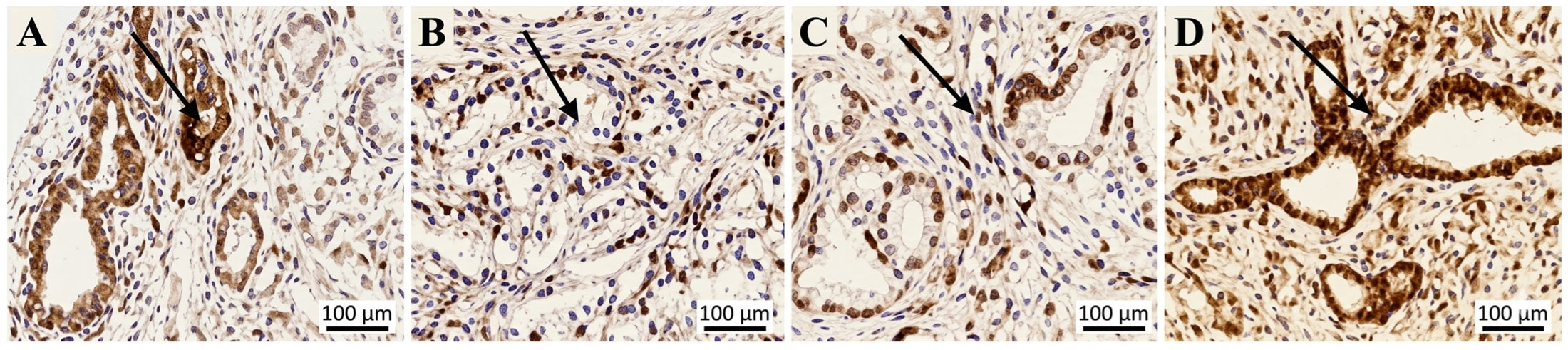
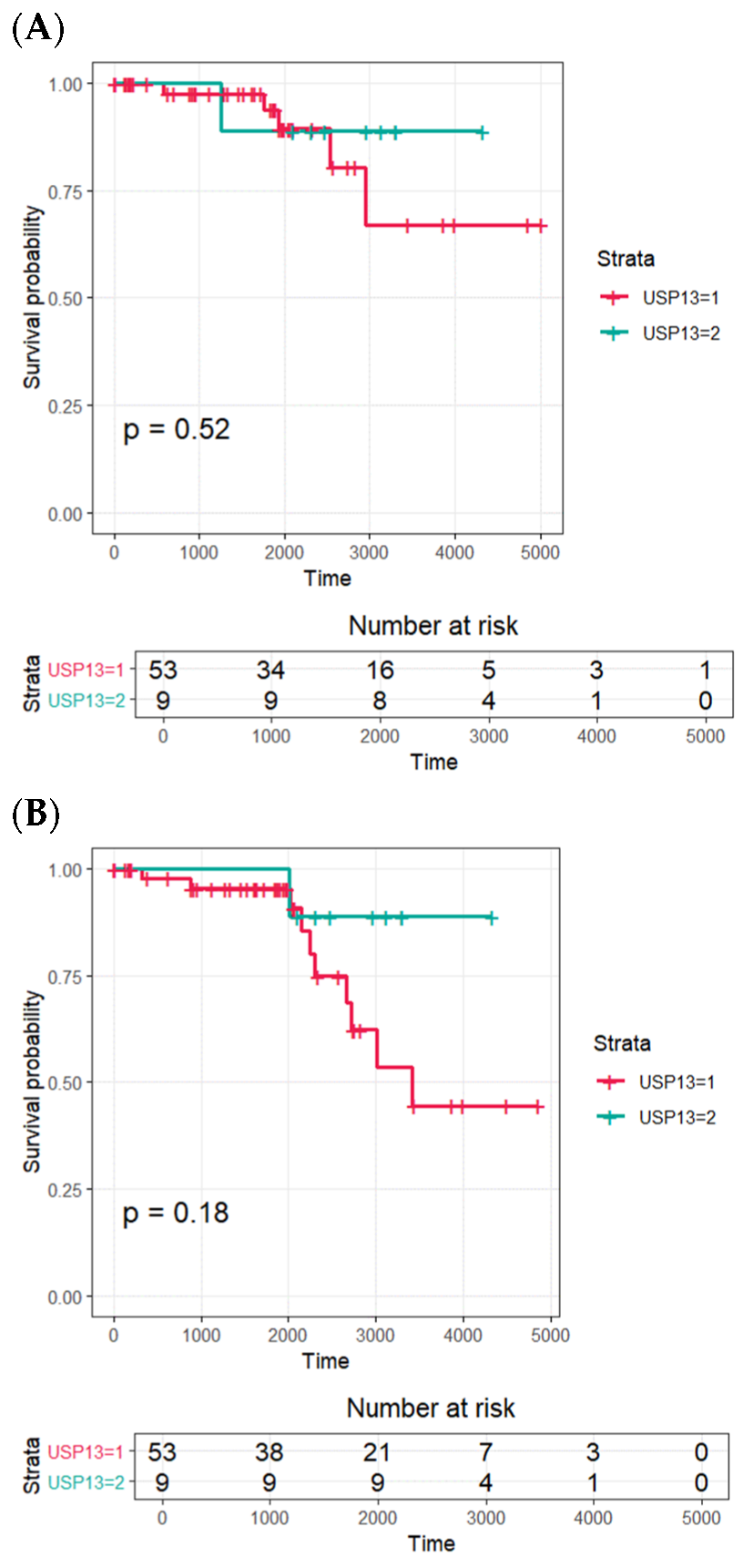
Ubiquitin-specific protease 13 (USP13) is a deubiquitinating enzyme that stabilizes phosphatase and tensin homolog deleted on chromosome 10 (PTEN), a well-established tumor suppressor involved in PI3K/AKT signaling. This study aimed to evaluate the relationship between USP13 immunohistochemical staining intensity and clinicopathological factors associated with prostate cancer progression. USP13 staining was scored as grade 0 (negative), 1 (weak), 2 (moderate), or 3 (strong) in 242 prostate cancer tissues and 22 adjacent non-neoplastic control tissues. Higher USP13 grades were exhibited by adjacent non-neoplastic tissues than prostate carcinoma. In comparison, lower USP13 grades were observed in 88.6% of the neoplastic regions (p < 0.001). No differences in PSA level, Gleason’s score, disease stage, involvement of either the seminal vesicle or lymph nodes, surgical margin positivity, biochemical or clinical recurrence rates, or overall survival statistics were found. Cox proportional hazards modeling showed no significant association between USP13 expression and biochemical recurrence-free survival or overall survival. Kaplan–Meier analysis demonstrated no statistically significant differences in survival outcomes according to USP13 expression, although a descriptive trend was observed. USP13 immunohistochemical staining distinguished malignant prostate tissue from adjacent non-neoplastic tissue in tissue microarrays. However, USP13 expression was not independently associated with pathological aggressiveness or survival outcomes in this cohort.
Keywords: deubiquitinases; ubiquitin-specific protease 13; prostate cancer deubiquitinases; ubiquitin-specific protease 13; prostate cancer