Review

Rejection-Focused Precision Medicine in Kidney Transplantation: Biology, Biomarkers, and Artificial Intelligence

by
Luis Ramalhete
1,2,3,4,*,
Rúben Araújo
2,
Miguel Bigotte Vieira
2,3,5,6,
Emanuel Vigia
2,3,4,6,7,
Cecília R. C. Calado
8,9 and
Anibal Ferreira
2,3,5,6
1
Blood and Transplantation Center of Lisbon, Instituto Português do Sangue e da Transplantação, Alameda das Linhas de Torres, n° 117, 1769-001 Lisbon, Portugal
2
NOVA Medical School, Faculdade de Ciências Médicas, Universidade NOVA de Lisboa, 1169-056 Lisbon, Portugal
3
iNOVA4Health—Advancing Precision Medicine, Núcleo de Investigação em Doenças Renais, NOVA Medical School, Faculdade de Ciências Médicas, Universidade NOVA de Lisboa, 1169-056 Lisbon, Portugal
4
LBS—Lisbon Business & Government School, Rua de São Bernardo, 34-A, 1200-427 Lisbon, Portugal
5
Serviço de Nefrologia, Nova Medical School, Hospital Curry Cabral, Unidade Local de Saúde de São José, 1050-099 Lisbon, Portugal
6
Centro Clínico Académico de Lisboa, 1169-024 Lisbon, Portugal
7
Hepatobiliopancreatic and Transplantation Center, Curry Cabral Hospital, Unidade Local de Saúde de São José, R. da Beneficência 8, 1050-099 Lisbon, Portugal
8
ISEL—Instituto Superior de Engenharia de Lisboa, Rua Conselheiro Emídio Navarro 1, 1959-007 Lisbon, Portugal
9
Institute for Bioengineering and Biosciences (iBB), The Associate Laboratory Institute for Health and Bioeconomy-i4HB, Av. Rovisco Pais, 1049-001 Lisbon, Portugal
*
Author to whom correspondence should be addressed.
Life 2026, 16(4), 674; https://doi.org/10.3390/life16040674
Submission received: 20 March 2026 / Revised: 10 April 2026 / Accepted: 13 April 2026 / Published: 15 April 2026

Abstract

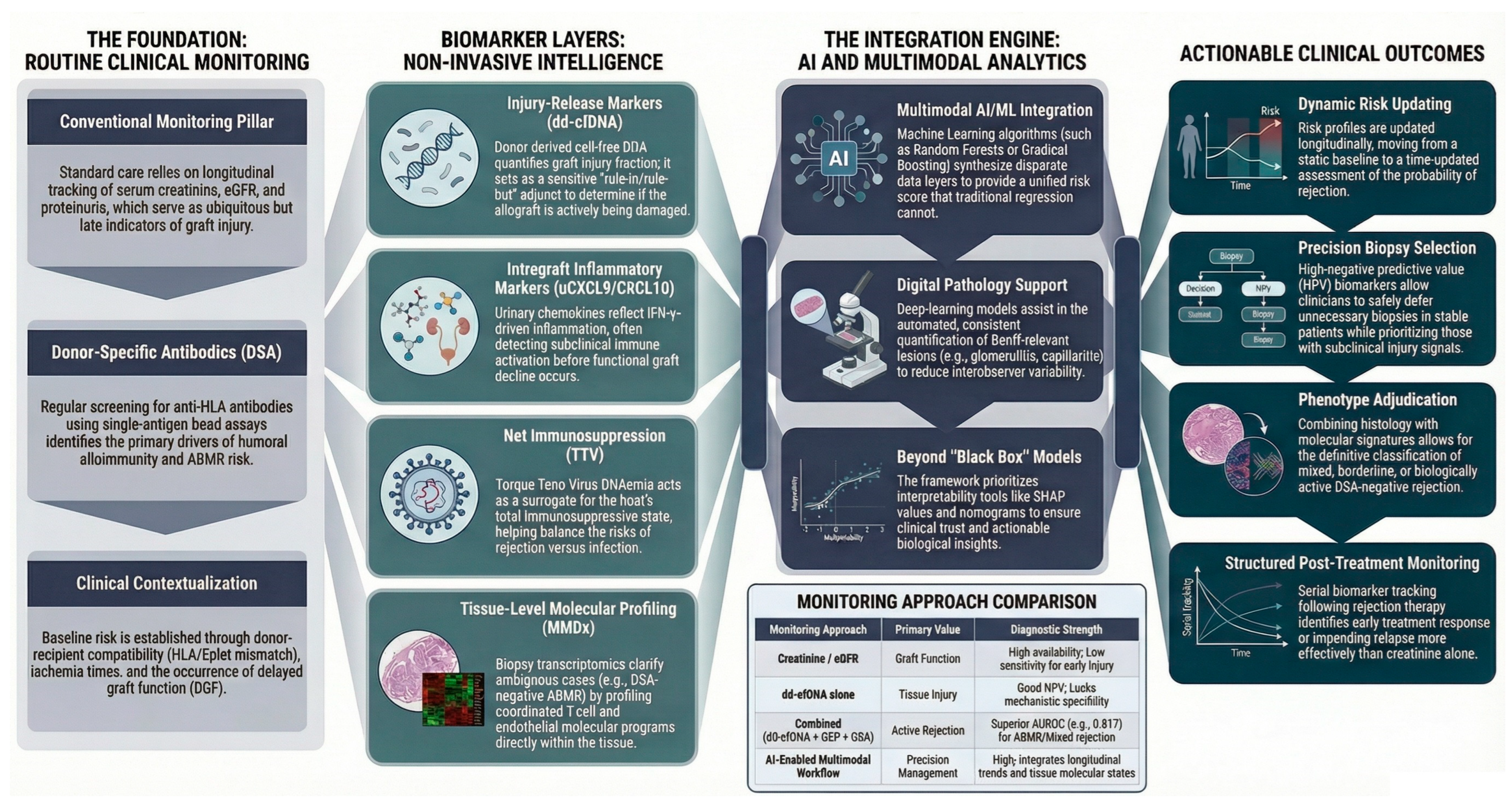
Chronic kidney disease is rising worldwide, and kidney transplantation remains the preferred modality of kidney replacement therapy. However, long-term graft survival continues to be limited by chronic alloimmune injury, particularly antibody-mediated rejection (ABMR) and its chronic active form. This narrative review synthesizes contemporary evidence on the immunopathogenesis, epidemiology, diagnosis, and management of kidney allograft rejection, with a deliberate focus on studies from the last five years and on United States and European cohorts. We summarize current concepts of T cell–mediated rejection (TCMR), ABMR, mixed and donor-specific antibody (DSA)–negative phenotypes, and the evolution of the Banff classification, highlighting how chronic active ABMR has emerged as a leading cause of death-censored graft loss. We then critically appraise the conventional diagnostic triad of creatinine/eGFR, DSA, and biopsy and review emerging tools, including donor-derived cell-free DNA, urinary chemokines such as CXCL9 and CXCL10, additional blood- and urine-based biomarkers, and biopsy transcriptomics. We also examine how artificial intelligence and machine learning may support digital pathology, multimodal risk prediction, and data integration, while recognizing the current challenges of biological interpretability, external validation, and clinical implementation. Finally, we propose a rejection-focused precision-medicine framework and outline key research gaps, including multicenter validation, trial-ready endpoints, and governance for AI-enabled pathways. Overall, the field is moving from isolated diagnostic signals toward integrated, biologically informed, and clinically actionable approaches to rejection detection and risk stratification.
Keywords: kidney transplantation; kidney allograft rejection; antibody-mediated rejection; T cell–mediated rejection; biomarkers; artificial intelligence; machine learning; precision medicine kidney transplantation; kidney allograft rejection; antibody-mediated rejection; T cell–mediated rejection; biomarkers; artificial intelligence; machine learning; precision medicine