Biomarkers on the Icy Jovian Moons: Can Europa Also Provide Insights into Life’s Origin?



Abstract
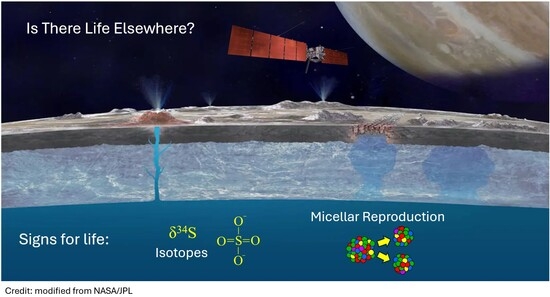
1. Introduction
2. Probing for Chemical Elements and Their Isotopes on the Icy Surfaces of Jovian Moons
- Pyrites in banded iron formations (BIFs) from the Isua Greenstone Belt dating from the Archaean in the time interval of 3.7–3.8 Gyr BP, which have been assigned a δ34S (‰) of −4 ± 2 [23].
- A second example is from a rock formation in the Pilbara region of Western Australia, in which barite deposits of some 3.47 Gyr BP have been assigned values of δ34S of −5 ± 7 [24].
- A third example is given by pyrites in black shales from 2.7 to 2.8 Gyr BP from Western Australia, which have a δ34S of −8 ± 7 [25].
3. The Identification of Fractionation Due to Abiotic Processes
4. Fractionation from the Rock Record to the Jovian Moons

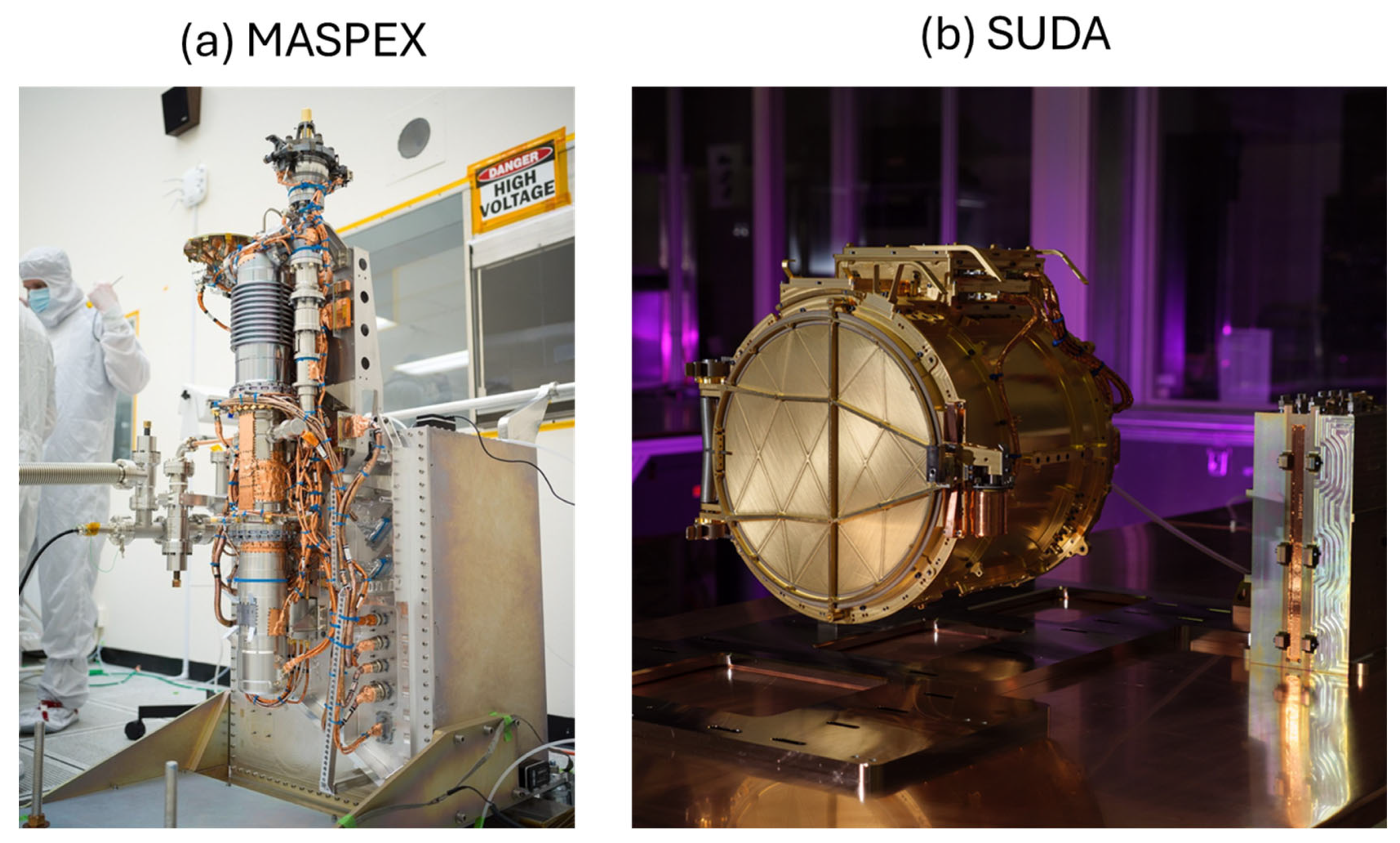
| MASPEX [44] | NIM [45] | SUDA [46] | |
|---|---|---|---|
| Agency | NASA | ESA | NASA |
| Resolution | achieving over 25,000 M/ΔM | M/ΔM > 1100 | Roughly 200–250 M/ΔM |
| Mass range | 1–1000 u | 1 to 1000 amu (atomic mass units). | 1–250 atomic mass units |
| Isotopic capability | Sensitivity for detecting trace volatile isotopes and complex organics, with a dynamic range >5000 | expect an accuracy of 1% for the isotope measurements | The precision of the isotopic ratios in individual mass spectra will generally be quite low |
5. The Future of Jovian Ocean World Exploration
6. Instrumentation Challenges, Uncertainties and Implicit Hypotheses
7. Discovering Evidence for Future Life on Ocean Moons
8. Conclusions
Author Contributions
Funding
Institutional Review Board Statement
Informed Consent Statement
Data Availability Statement
Acknowledgments
Conflicts of Interest
Abbreviations
| BIF | Banded Iron Formation |
| BP | Before the Present |
| BSR | Bacterial Sulfate Reduction |
| CE | Capillary Electrophoresis |
| CDM | Canyon Diablo Meteorite |
| CMC | Critical Micelle Concentration |
| CytoFLEX | Cytometer, Flexible (nano flow cytometer) |
| ESA | European Space Agency |
| GARD | Graded Autocatalysis Replication Domain |
| LIF | Laser-Induced Fluorescence |
| LDKB | Life Detection Knowledge Base |
| LDMS | Laser-Desorption Mass Spectrometry |
| LIMS | Laser Ablation Ionization Mass Spectrometry |
| LMS | Laser-Ablation Time-of-Flight Mass Spectrometer |
| LNPs | Lipid Nanoparticles |
| MASPEX | MAss SPectrometer for Planetary Exploration (Europa Clipper) |
| MOA | Microfluidic Organic Analyzer |
| MSR | Microbial Sulfate Reducers |
| NASA | National Aeronautics Space Administration |
| NIM | Neutral Ion Mass Spectrometer (JUICE) |
| NIMS | Near-Infrared Mapping Spectrometer (Galileo) |
| ORIGIN | ORganics Information Gathering Instrument |
| OW | Ocean World |
| PEP | Particle Environment Package (JUICE) |
| PRIME | Probe using Radioisotopes for Icy Moons Exploration |
| SETI | Search for Extraterrestrial Intelligence |
| SIG | Stable Isotope Geochemistry |
| SMOC | Standard Mean Ocean Chloride |
| SPLIce | Sample Processor for Life on Icy Worlds |
| SRM | Sulfate Reducing Microorganisms |
| SUDA | SUrface Dust Analyzer (Europa Clipper) |
| TSR | Thermochemical Sulfate Reduction |
References
- Oparin, A.I. The Origin of Life; MacMillan: New York, NY, USA, 1938. [Google Scholar]
- Galimov, E.M.; Kostitsyn, Y.A. Planned earth-based studies of the phobos material. Sol. Syst. Res. 2012, 46, 476–488. [Google Scholar] [CrossRef] [Scilit]
- Chacko, T.; Cole, D.R.; Horita, J. Equilibrium Oxygen, Hydrogen and Carbon Isotope Fractionation Factors Applicable to Geologic Systems. Rev. Mineral. Geochem. 2001, 43, 1–81. [Google Scholar] [CrossRef] [Scilit]
- Cole, D.R.; Chakraborty, S. Rates and Mechanisms of Isotopic Exchange. Rev. Mineral. Geochem. 2001, 43, 83–223. [Google Scholar] [CrossRef] [Scilit]
- Hurowitz, J.A.; Tice, M.M.; Allwood, A.C.; Cable, M.L.; Hand, K.P.; Murphy, A.E.; Uckert, K.; Bell, J.F.; Bosak, T.; Broz, A.P.; et al. Redox-driven mineral and organic associations in Jezero Crater, Mars. Nature 2025, 645, 332–340. [Google Scholar] [CrossRef] [Scilit]
- Schidlowski, M.; Hayes, J.M.; Kaplan, I.R. Isotopic inferences of ancient biochemistries: Carbon, sulfur, hydrogen and nitrogen. In Earths Earliest Biosphere, Its Origin and Evolution; Schopf, J.W., Ed.; Princeton University Press: Princeton, NJ, USA, 1983; pp. 149–186. [Google Scholar]
- Des Marais, D.J.; Caro, T.; Dhingra, R.; Fox, A.C.; Galloway, T. Stable Isotope Abundance Patterns as Potential Biosignatures. Astrobiology 2025, 25, 537–549. [Google Scholar] [CrossRef] [Scilit]
- Pohorille, A.; Lau, G.; Gliniewiez, S.; Davila, A.; Parenteau, N.; Marais, D.D.; Quinn, R.; Shkolyar, S.; Everroad, R.; Hoehler, T. The life detection knowledge base: A community tool for knowledge management and representation. Astrobiology 2025, 25, 454–463. [Google Scholar] [CrossRef] [Scilit]
- Grasset, O.; Dougherty, M.K.; Coustenis, A.; Bunce, E.; Erd, C.; Titov, D.; Blanc, M.; Coates, A.; Drossart, P.; Fletcher, L.; et al. JUpiter ICy Moons Explorer (JUICE): An ESA Mission to Orbit Ganymede and to Characterize the Jupiter System. Planet. Space Sci. 2013, 78, 1–21. [Google Scholar] [CrossRef] [Scilit]
- Phillips, C.B.; Pappalardo, R.T. Europa Clipper Mission Concept. Eos Trans. Am. Geophys. Union 2014, 95, 165–167. [Google Scholar] [CrossRef] [Scilit]
- Ryu, J.; Zierenberg, R.; Dahlgren, R.A. Sulfur biogeochemistry and isotopic fractionation in shallow groundwater and sediments of Owens Dry Lake, California. Chem. Geol. 2006, 229, 257–272. [Google Scholar] [CrossRef] [Scilit]
- Schopf, J.W. Cradle of Life; Princeton University Press: Princeton, NJ, USA, 2009; p. 179. [Google Scholar]
- Kaplan, I.R. Stable isotopes as a guide to biogeochemical processes. Proc. R. Soc. Lond. Ser. B 1975, 189, 183–211. [Google Scholar] [CrossRef] [Scilit]
- Coplen, T.B.; Böhlke, J.K.; De Bièvre, P.; Ding, T.; Holden, N.E.; Hopple, J.A.; Krouse, H.R.; Lamberty, A.; Peiser, H.S.; Revesz, K.; et al. Isotope-abundance variations of selected elements (IUPAC Technical Report). Pure Appl. Chem. 2002, 74, 1987–2017. [Google Scholar] [CrossRef] [Scilit]
- Kaufmann, R.S.; Long, A.; Campbell, D.J. Chlorine isotope distribution in formation waters, Texas and Louisiana. Am. Assoc. Pet. Geol. Bull. 1988, 72, 839–844. [Google Scholar]
- Trumbo, S.; Brown, M.E.; Hand, K. Sodium Chloride on the Surface of Europa. Sci. Adv. 2019, 5, eaaw7123. [Google Scholar] [CrossRef] [Scilit]
- Ligier, N.; Poulet, F.; Carter, J.; Brunetto, R.; Gourgeot, F. VLT/SINFONI Observations of Europa: New Insights into the Surface Composition. Astron. J. 2016, 151, 163. [Google Scholar] [CrossRef] [Scilit]
- Coates, J.D.; Achenbach, L.A. Microbial perchlorate reduction: Rocket-fueled metabolism. Nat. Rev. Microbiol. 2004, 2, 569–580. [Google Scholar] [CrossRef] [Scilit] [PubMed]
- Coleman, M.L.; Ader, M.; Chaudhuri, S.; Coates, J.D. Microbial isotopic fractionation of perchlorate chlorine. Appl. Environ. Microbiol. 2003, 69, 4997–5000. [Google Scholar] [CrossRef] [Scilit] [PubMed]
- Glein, C.R.; Baross, J.A.; Waite, J.H., Jr. The pH of Enceladus’ ocean. Geochim. Cosmochim. Acta 2015, 162, 202–219. [Google Scholar] [CrossRef] [Scilit]
- Zolotov, M.Y. An oceanic composition on early and today’s Enceladus. Geophys. Res. Lett. 2007, 34, L23203. [Google Scholar] [CrossRef] [Scilit]
- Glein, C.R.; Shock, L. A geochemical model of non-ideal solutions in the methane–ethane–propane–nitrogen–acetylene system on Titan. Geochim. Cosmochim. Acta 2010, 115, 217–240. [Google Scholar] [CrossRef] [Scilit]
- Monster, J.; Appel, P.W.U.; Thode, H.G.; Schidlowski, M.; Carmichael, C.; Bridgwater, D. Sulfur isotope studies on Early Archaean sediments from Isua, West Greenland: Implications for the antiquity of bacterial sulfate reduction. Geochim. Cosmochim. Acta 1979, 43, 405–413. [Google Scholar] [CrossRef] [Scilit]
- Shen, Y.; Buick, R.; Canfield, D.E. Isotopic evidence for microbial sulphate reduction in the Early Archaean era. Nature 2001, 410, 77–81. [Google Scholar] [CrossRef] [Scilit] [PubMed]
- Donnelly, T.H.; Lambert, I.B.; Oehler, D.Z.; Hallberg, J.A.; Hudson, D.R.; Smith, J.W.; Bavinton, O.A.; Golding, L. A reconnaissance study of stable isotope ratios in Archaean rocks from the Yilgarn Block, Western Australia. J. Geol. Soc. Aust. 1977, 24, 409–420. [Google Scholar] [CrossRef] [Scilit]
- Goodwin, A.M.; Monster, J.; Thode, H.G. Carbon and sulfur isotope abundances in Archean iron-formations and early Precambrian life. Econ. Geol. 1976, 71, 870–891. [Google Scholar] [CrossRef] [Scilit]
- Chela-Flores, J. Habitability of Ganymede. In Ganymede; Volwerk, M., McGrath, M., Jia, X., Spohn, T., Eds.; Cambridge Planetary Science (28) Series; Cambridge University Press: Cambridge, UK, 2025. [Google Scholar]
- Chela-Flores, J. Instrumentation for the search for habitable ecosystems in the future exploration of Europa and Ganymede. Int. J. Astrobiol. 2010, 9, 101–108. [Google Scholar] [CrossRef] [Scilit]
- Machel, H.G.; Krouse, H.R.; Sassen, R. Products and distinguishing criteria of bacterial and thermochemical sulfate reduction. Appl. Geochem. 1995, 10, 373–389. [Google Scholar] [CrossRef] [Scilit]
- Krouse, H.R.; Viau, C.A.; Eliuk, L.S.; Ueda, A.; Halas, S. Chemical and isotopic evidence of thermochemical sulfate reduction by light-hydrocarbon gases in deep carbonate reservoirs. Nature 1998, 333, 415–419. [Google Scholar] [CrossRef] [Scilit]
- Kiyosu, Y.; Krouse, H.R. The role of organic acid in the abiogenic reduction of sulfate and the sulfur isotope effect. Geochem. J. 1990, 24, 21–27. [Google Scholar] [CrossRef] [Scilit]
- Moreras-Marti, A.; Fox-Powell, M.; Cousins, C.R.; Macey, M.C.; Zerkle, A.L. Sulfur isotopes as biosignatures for Mars and Europa exploration. J. Geol. Soc. 2022, 179, jgs2021-134. [Google Scholar] [CrossRef] [Scilit]
- Gao, X.; Thiemens, M.H. Systematic study of sulfur isotopic composition in iron meteorites and the occurrence of excess 33S and 36S. Geochim. Cosmochim. Acta 1991, 55, 2671–2679. [Google Scholar] [CrossRef] [Scilit]
- Ono, S.; Shanks, W.C.; Rouxel, O.; Rumble, D. S-33 constraints on the seawater sulfate contribution in modern seafloor hydrothermal vent sulfides. Geochim. Cosmochim. Acta 2007, 71, 1170–1182. [Google Scholar] [CrossRef] [Scilit]
- Farquhar, J.; Savarino, J.; Airieau, S.; Thiemens, M.H. Observation of wavelength-sensitive mass-independent sulfur isotope effects during SO2 photolysis: Implications for the early atmosphere. J. Geophys. Res. 2001, 106, 32829–32839. [Google Scholar] [CrossRef] [Scilit]
- Kokh, M.A.; Assayag, N.; Mounic, S.; Cartigny, P.; Gurenko, A.; Pokrovski, G.S. Multiple sulfur isotope fractionation in hydrothermal systems in the presence of radical ions and molecular sulfur. Geochim. Cosmochim. Acta 2020, 285, 100–128. [Google Scholar] [CrossRef] [Scilit]
- Ciazela, J.; Koepke, J.; Dick, H.J.B.; Botcharnikov, R.; Muszynski, A.; Lazarov, M.; Schuth, S.; Pieterek, B.; Kuhn, T. Sulfide enrichment at an oceanic crust-mantle transition zone: Kane Megamullion (23 N, MAR). Geochim. Cosmochim. Acta 2018, 230, 155–189. [Google Scholar] [CrossRef] [Scilit]
- Chela-Flores, J. The sulphur dilemma: Are there biosignatures on Europa’s icy and patchy surface? Int. J. Astrobiol. 2006, 5, 17–22. [Google Scholar] [CrossRef] [Scilit]
- Fanale, F.P.; Li, Y.H.; De Carlo, E.; Farley, C.; Sharma, S.K.; Horton, K.; Granahan, J.C. An experimental estimate of Europa’s ‘ocean’ composition independent of Galileo orbital remote sensing. J. Geophys. Res. Planets 2001, 106, 14595–14600. [Google Scholar] [CrossRef] [Scilit]
- Kargel, J.S.; Kaye, J.Z.; Head, J.W.; Marion, G.M.; Sassen, R.; Crowley, J.K.; Ballesteros, O.P.; Grant, S.A.; Hogenboom, D.L. Europa’s crust and ocean: Origin, composition, and the prospects for life. Icarus 2000, 148, 226–265. [Google Scholar] [CrossRef] [Scilit]
- Zolotov, M.Y.; Shock, E.L. Composition and stability of salts on the surface of Europa and their oceanic origin. J. Geophys. Res. Planets 2001, 106, 32815–32827. [Google Scholar] [CrossRef] [Scilit]
- Chela-Flores, J. Miniaturized instrumentation for biosignatures on the ocean worlds in the solar system. Front. Space Technol. 2021, 2, 703809. [Google Scholar] [CrossRef] [Scilit]
- Föhn, M.; Galli, A.; Vorburger, A.; Tulej, M.; Lasi, D.; Riedo, A.; Fausch, R.G.; Althaus, M.; Brungger, S.; Fahrer, P.; et al. Description of the Mass Spectrometer for the Jupiter Icy Moons Explorer Mission. In Proceedings of the 2021 IEEE Aerospace Conference (50100), Big Sky, MT, USA, 6–13 March 2021; pp. 1–14. [Google Scholar]
- Burch, J.; Persyn, S.C.; Brockwell, T.; Hsu, H.-W.; Westlake, J.H.; McNutt, R.L., Jr. Horizons in Icy Satellite Science at the Launch of the Historic Europa Clipper Mission. In Proceedings of the AGU Fall Meeting, San Francisco, CA, USA, 9–13 December 2013. [Google Scholar]
- Barabash, S.; Brandt, P.; Wurz, P.; Clark, G.; Fraenz, M.; Mitchell, D. Particle Environment Package (PEP) for the JUICE mission: Current status and coming activities. In Proceedings of the 55th Annual Meeting of the Division for Planetary Sciences, San Antonio, TX, USA, 1–6 October 2023; Volume 55. [Google Scholar]
- Kempf, S.; Altobelli, N.; Briois, C.; Grun, E.; Horanyi, M.; Postberg, F.; Schmidt, J.; Srama, R.; Sternovsky, Z.; Tobie, G.; et al. SUDA: A Dust Mass Spectrometer for Compositional Surface Mapping for a Mission to Europa. In Proceedings of the European Planetary Science Congress 2014, Cascais, Portugal, 7–12 September 2014; Volume 9. [Google Scholar]
- Chela-Flores, J. Testing the Drake Equation in the Solar System. In Bioastronomy ’99: A New Era in Astronomy, Proceedings of the Meeting at Hapuna Beach Prince Hotel, Kohala Coast, HI, USA, 2–6 August 1999; Lemarchand, G.A., Meech, K., Eds.; Astronomical Society of the Pacific Conference Series: San Francisco, CA, USA, 2000; Volume 213, pp. 402–410. [Google Scholar]
- Michaelian, K. Thermodynamic dissipation theory for the origin of life. Earth Syst. Dyn. 2011, 2, 37–51. [Google Scholar] [CrossRef] [Scilit]
- Michaelian, K. Non-equilibrium thermodynamic foundations of the origin of life. Foundations 2022, 2, 308–337. [Google Scholar] [CrossRef] [Scilit]
- Chela-Flores, J. Habitability of Europa: Possible degree of evolution of Europan biota. In European Ocean Conference, Capistrano Conference; San Juan Capistrano Research Institute: San Juan Capistrano, CA, USA, 1996; pp. 21–21a. Available online: https://users.ictp.it/~chelaf/ss29.html (accessed on 9 March 2026).
- Chela-Flores, J. A search for extraterrestrial eukaryotes: Physical and paleontological aspects. Orig. Life Evol. Biosph. 1998, 28, 583–596. [Google Scholar] [CrossRef] [Scilit] [PubMed]
- Drake, F.; Sobel, D. Is Anyone Out There? The Scientific Search for Extraterrestrial Intelligence; Dalacorte Press: New York, NY, USA, 1992; pp. ix–xv. [Google Scholar]
- Wortmann, U.G.; Bernasconi, S.M.; Böttcher, M.E. Hypersulfidic deep biosphere indicates extreme sulfur isotope fractionation during single-step microbial sulfate reduction. Geology 2001, 29, 647–650. [Google Scholar] [CrossRef] [Scilit]
- Pitesky, J.K.P.; Hand, C.B. The Europa Lander Mission Concept: Situ Exploration of an Ocean World. In Proceedings of the AGU Fall Meeting, Virtual, 1–17 December 2020. [Google Scholar]
- Horvath, J.; Carsey, F.; Cutts, J.; Jones, J.A.; Johnson, E.D.; Landry, B.M.; Lane, A.L.; Lynch, G.; Jezek, K.C.; Chela-Flores, J.; et al. Searching for ice and ocean biogenic activity on Europa and Earth. In Instruments, Methods and Missions for Investigation of Extraterrestrial Microorganisms; Hoover, R.B., Ed.; Society of Photo-Optical Instrumentation Engineers (SPIE): Washington, DC, USA, 1997; pp. 490–500. [Google Scholar]
- Hockman, B.J.; Smith, M.W.; Howell, S.M.; Rajguru, A.; Klonicki, E.; Bar-Cohen, Y. PRIME: Probe using Radioisotopes for Icy Moons Exploration—A Comprehensive Cryobot Architecture for Accessing Europa’s Ocean. In Proceedings of the The Astrobiology Science Conference (AbSciCon) 2022, Atlanta, GA, USA, 15–20 May 2022. [Google Scholar]
- Ligterink, N.F.W.; Grimaudo, V.; Moreno-García, P.; Lukmanov, R.; Tulej, M.; Leya, I.; Lindner, R.; Wurz, P.; Cockell, C.S.; Ehrenfreund, P.; et al. ORIGIN: A Novel and Compact Laser Desorption—Mass Spectrometry System for Sensitive in situ Detection of Amino Acids on Extraterrestrial Surfaces. Sci. Rep. 2020, 10, 9641. [Google Scholar] [CrossRef] [Scilit] [PubMed]
- Emran, A. Detection of an NH3 Absorption Band at 2.2 μm on Europa. Planet. Sci. J. 2025, 6, 255. [Google Scholar] [CrossRef] [Scilit]
- Spohn, T.; Schubert, G. Oceans in the icy Galilean satellites of Jupiter? Icarus 2003, 161, 456–467. [Google Scholar] [CrossRef] [Scilit]
- Hand, K.P.; Chyba, C.F.; Priscu, J.C.; Carlson, R.W.; Nealson, K.H. Astrobiology and the Potential for Life on Europa. Europa 2009, 589, 629. [Google Scholar]
- Segré, D.; Ben-Eli, D.; Deamer, D.W.; Lancet, D. The lipid world. Orig. Life Evol. Biosph. 2001, 31, 119–145. [Google Scholar] [CrossRef] [Scilit] [PubMed]
- Kahana, A.; Lancet, D. Self-reproducing catalytic micelles as nanoscopic protocell precursors. Nat. Rev. Chem. 2021, 5, 870–878. [Google Scholar] [CrossRef] [Scilit]
- Segré, D.; Ben-Eli, D.; Lancet, D. Compositional genomes: Prebiotic information transfer in mutually catalytic noncovalent assemblies. Proc. Natl. Acad. Sci. USA 2000, 97, 4112–4117. [Google Scholar] [CrossRef] [Scilit]
- Lancet, D.; Zidovetzki, R.; Markovitch, O. Systems protobiology: Origin of life in lipid catalytic networks. J. R. Soc. Interface 2018, 15, 20180159. [Google Scholar] [CrossRef] [Scilit]
- Kahana, A.; Segev, L.; Lancet, D. Attractor dynamics drives self-reproduction in protobiological catalytic networks. Cell Rep. Phys. Sci. 2023, 4, 101384. [Google Scholar] [CrossRef] [Scilit]
- Lancet, D.; Yaniv, R. Reproducing lipid micelles permit early Darwinian evolution. Scientia 2025, 1302. [Google Scholar] [CrossRef] [Scilit]
- Edwards, M.R. From a soup or a seed—Pyritic metabolic complexes in the origin of life. Trends Ecol. Evol. 1998, 13, 178–181. [Google Scholar] [CrossRef] [Scilit] [PubMed]
- Waite, J.H.; Burch, J.L.; Brockwell, T.G.; Young, D.T.; Miller, G.P.; Persyn, S.C.; Stone, J.M.; Wilson, P.; Miller, K.E.; Glein, C.R.; et al. MASPEX-Europa: The Europa Clipper Neutral Gas Mass Spectrometer Investigation. Space Sci. Rev. 2024, 220, 30. [Google Scholar] [CrossRef] [Scilit]
- Kempf, S.; Tucker, S.; Altobelli, N.; Briois, C.; Cable, M.L.; Grün, E.; Gudipati, M.S.; Henderson, B.L.; Hsu, H.-W.; Hand, K.; et al. SUDA: A SUrface Dust Analyser for Compositional Mapping of the Galilean Moon Europa. Space Sci. Rev. 2025, 221, 10. [Google Scholar] [CrossRef] [Scilit]
- Kehl, F.; Drevinskas, T.; Creamer, J.; DeMartino, A.J.; Willis, P.A. Providing Enhanced Migration Time Reproducibility with a High-Voltage-Compatible Flow Sensor for Capillary Electrophoresis. Anal. Chem. 2022, 94, 5734−5740. [Google Scholar] [CrossRef] [Scilit] [PubMed]
- Oborny, N.J.; Kehl, F.; Cretu, V.; Noell, A.C.; Willis, P.A. A radiation tolerant laser-induced fluorescence detection system for a potential Europa Lander mission. Acta Astronaut. 2021, 186, 465–472. [Google Scholar] [CrossRef] [Scilit]
- Butterworth, A.L.; Golozar, M.; Estlack, Z.; McCauley, J.; Mathies, R.A.; Kim, J. Integrated high performance microfluidic organic analysis instrument for planetary and space exploration. Lab Chip 2024, 24, 2551–2560. [Google Scholar] [CrossRef] [Scilit] [PubMed]
- Arevalo, R.; Willhite, L.; Bardyn, A.; Ni, Z.; Ray, S.; Southard, A.; Danell, R.; Grubisic, A.; Gundersen, C.; Minasola, N.; et al. Laser desorption mass spectrometry with an Orbitrap analyser for in situ astrobiology. Nat. Astron. 2023, 7, 359–365. [Google Scholar] [CrossRef] [Scilit]
- Harandi, B.; Ng, S.; Liddell, L.C.; Gentry, D.M.; Santa Maria, S.R. Fluidic-Based Instruments for Space Biology Research in CubeSats. Front. Space Technol. 2022, 3, 853980. [Google Scholar] [CrossRef] [Scilit]
- MacKenzie, S.M.; Neveu, M.; Davila, A.F.; Lunine, J.I.; Cable, M.L.; Phillips-Lander, C.M.; Eigenbrode, J.L.; Waite, J.H.; Craft, K.L.; Hofgartner, J.D.; et al. Science Objectives for Flagship-Class Mission Concepts for the Search for Evidence of Life at Enceladus. Astrobiology 2022, 22, 685–712. [Google Scholar] [CrossRef] [Scilit]
- Jensen, E.C.; Stockton, A.M.; Chiesl, T.N.; Kim, J.; Bera, A.; Mathies, R.A. Digitally programmable microfluidic automaton for multiscale combinatorial mixing and sample processing. Lab Chip 2013, 13, 288–296. [Google Scholar] [CrossRef] [Scilit] [PubMed]
- Cao, L.; Wang, H.; Zhu, J.; Li, W.; Han, L.; Wang, Z.; Wang, X.; Guo, B.; Ding, J.; Tong, D.; et al. Exploring exosome profiling via CytoFLEX Nano flow cytometer: Approaches and applications. View 2025, 6, 20250068. [Google Scholar] [CrossRef] [Scilit]
- Hu, Q.; Wu, J.; Chen, J.; Chen, X.; Di, H.; Yan, X. See the Unseen: Rapid, Multiparametric Single-Particle Analysis of Extracellular Vesicles With Nano-Flow Cytometry. Proteomics 2025, e70078. [Google Scholar] [CrossRef] [Scilit] [PubMed]
- Yu, H.; Song, S. Application of nano-flow cytometry for the detection of extracellular vesicles and lipid nanoparticles. J. Chin. Pharm. Sci. 2025, 34, 943–953. [Google Scholar] [CrossRef] [Scilit]
- Gao, W.; An, K.; Ma, Y.; Xu, X.; Wang, Z.; Liu, J. Resolving the mRNA Encapsulation-Release Trade-off via Compensatory Forces in Engineered Ioni zable Lipids. Adv. Mater. 2025, 38, 12235. [Google Scholar] [CrossRef] [Scilit]


Disclaimer/Publisher’s Note: The statements, opinions and data contained in all publications are solely those of the individual author(s) and contributor(s) and not of MDPI and/or the editor(s). MDPI and/or the editor(s) disclaim responsibility for any injury to people or property resulting from any ideas, methods, instructions or products referred to in the content. |
© 2026 by the authors. Licensee MDPI, Basel, Switzerland. This article is an open access article distributed under the terms and conditions of the Creative Commons Attribution (CC BY) license.
Share and Cite
Chela-Flores, J.; Lancet, D.; Yaniv, R. Biomarkers on the Icy Jovian Moons: Can Europa Also Provide Insights into Life’s Origin? Life 2026, 16, 489. https://doi.org/10.3390/life16030489
Chela-Flores J, Lancet D, Yaniv R. Biomarkers on the Icy Jovian Moons: Can Europa Also Provide Insights into Life’s Origin? Life. 2026; 16(3):489. https://doi.org/10.3390/life16030489
Chicago/Turabian StyleChela-Flores, Julian, Doron Lancet, and Roy Yaniv. 2026. "Biomarkers on the Icy Jovian Moons: Can Europa Also Provide Insights into Life’s Origin?" Life 16, no. 3: 489. https://doi.org/10.3390/life16030489
APA StyleChela-Flores, J., Lancet, D., & Yaniv, R. (2026). Biomarkers on the Icy Jovian Moons: Can Europa Also Provide Insights into Life’s Origin? Life, 16(3), 489. https://doi.org/10.3390/life16030489