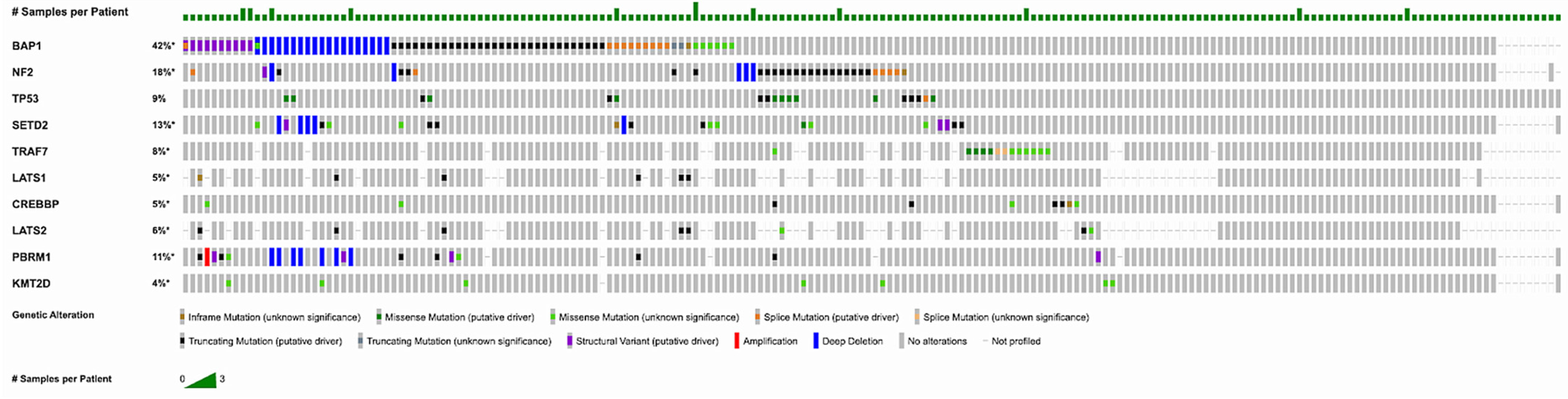
Inactivation of BAP1 and the Hippo Pathway Characterizes the Genomic Alterations of Peritoneal Mesothelioma
 , ,
, ,
Abstract
1. Introduction
2. Materials and Methods
3. Results
3.1. Patient Demographics of Peritoneal Mesothelioma
3.2. Most Prevalent Somatic Mutations and Copy Number Alterations
3.3. Genetic Variations by Race and Sex
3.4. Mutation Co-Occurrence and Mutual Exclusivity Relationships
3.5. Primary and Metastatic Mutations
4. Discussion
4.1. Study Overview and Key Findings
4.2. Demographic Differences and Mutation Patterns
4.3. Commonly Mutated Genes and Altered Pathways
4.4. BAP1 and Chromatin Remodeling
4.5. Hippo Signaling and NF2 Mutation
4.6. p53 Pathway
4.7. Co-Occurrence and Mutual Exclusivity Patterns
4.8. Primary vs. Metastatic Mutation Patterns
4.9. Study Limitations
5. Conclusions
Author Contributions
Funding
Institutional Review Board Statement
Informed Consent Statement
Data Availability Statement
Conflicts of Interest
Abbreviations
| AACR | American Association for Cancer Research |
| ASR | Age-Standardized Rate |
| BAP1 | BRCA1-Associated Protein 1 |
| CARM1 | Coactivator-Associated Arginine Methyltransferase 1 |
| CDKN2A | Cyclin-Dependent Kinase Inhibitor 2A |
| CDKN2B | Cyclin-Dependent Kinase Inhibitor 2B |
| CHEK2 | Checkpoint Kinase 2 |
| CNAs | Copy Number Alterations |
| CT | Computed Tomography |
| DNA | Deoxyribonucleic Acid |
| EZH2 | Enhancer of Zeste Homolog 2 |
| FDR | False Discovery Rate |
| GENIE | Genomics Evidence Neoplasia Information Exchange |
| HDAC | Histone Deacetylase |
| H2A-Ub | Monoubiquitinated Histone H2A |
| LATS1 | Large Tumor Suppressor 1 |
| LATS2 | Large Tumor Suppressor 2 |
| LOH | Loss of Heterozygosity |
| MCL1 | Myeloid Cell Leukemia 1 |
| MDM2 | Mouse Double Minute 2 Homolog |
| MPM | Malignant Peritoneal Mesothelioma |
| NF2 | Neurofibromatosis Type 2 |
| PARP | Poly (ADP-ribose) Polymerase |
| PBRM1 | PolyBromo 1 |
| SETD2 | SET Domain Containing 2 |
| SF3B1 | Splicing Factor 3B Subunit 1 |
| SRSF2 | Serine- and Arginine-Rich Splicing Factor 2 |
| TAZ | Tafazzin |
| TEAD4 | TEA Domain Transcription Factor 4 |
| TERT | Telomerase Reverse Transcriptase |
| TMB | Tumor Mutational Burden |
| TPM1 | Tropomyosin 1 |
| TP53 | Tumor Protein p53 |
| TRAF7 | TNF Receptor-Associated Factor 7 |
| KMT2D | Histone-Lysine N-Methyltransferase 2D |
| WEE1 | WEE1 G2 Checkpoint Kinase |
| WES | Whole-Exome Sequencing |
| WGS | Whole-Genome Sequencing |
| WT1 | Wilms’ Tumor 1 |
| YAP | Yes-Associated Protein |
References
- Greenbaum, A.; Alexander, H.R. Peritoneal mesothelioma. Transl. Lung Cancer Res. 2020, 9, S120–S132. [Google Scholar] [CrossRef] [PubMed]
- Inai, K. Pathology of mesothelioma. Environ. Health Prev. Med. 2008, 13, 60–64. [Google Scholar] [CrossRef] [PubMed]
- Nakano, T. Current therapies for malignant pleural mesothelioma. Environ. Health Prev. Med. 2008, 13, 75–83. [Google Scholar] [CrossRef] [PubMed]
- Zalcman, G.; Mazieres, J.; Margery, J.; Greillier, L.; Audigier-Valette, C.; Moro-Sibilot, D.; Molinier, O.; Corre, R.; Monnet, I.; Gounant, V.; et al. Bevacizumab for newly diagnosed pleural mesothelioma in the Mesothelioma Avastin Cisplatin Pemetrexed Study (MAPS): A randomised, controlled, open-label, phase 3 trial. Lancet 2016, 387, 1405–1414. [Google Scholar] [CrossRef]
- Fear, V.S.; Tilsed, C.; Chee, J.; Forbes, C.A.; Casey, T.; Solin, J.N.; Lansley, S.M.; Lesterhuis, W.J.; Dick, I.M.; Nowak, A.K.; et al. Combination immune checkpoint blockade as an effective therapy for mesothelioma. Oncoimmunology 2018, 7, e1494111. [Google Scholar] [CrossRef]
- Boussios, S.; Moschetta, M.; Karathanasi, A.; Tsiouris, A.K.; Kanellos, F.S.; Tatsi, K.; Katsanos, K.H.; Christodoulou, D.K. Malignant peritoneal mesothelioma: Clinical aspects, and therapeutic perspectives. Ann. Gastroenterol. 2018, 31, 659–669. [Google Scholar] [CrossRef]
- Chapel, D.B.; Schulte, J.J.; Absenger, G.; Attanoos, R.; Brcic, L.; Butnor, K.J.; Chirieac, L.; Churg, A.; Galateau-Salle, F.; Hiroshima, K.; et al. Malignant peritoneal mesothelioma: Prognostic significance of clinical and pathologic parameters and validation of a nuclear-grading system in a multi-institutional series of 225 cases. Mod. Pathol. 2021, 34, 380–395. [Google Scholar] [CrossRef]
- Granieri, A.; Tamburello, S.; Tamburello, A.; Casale, S.; Cont, C.; Guglielmucci, F.; Innamorati, M. Quality of life and personality traits in patients with malignant pleural mesothelioma and their first-degree caregivers. Neuropsychiatr. Dis. Treat. 2013, 9, 1193–1202. [Google Scholar] [CrossRef]
- Amin, W.; Linkov, F.; Landsittel, D.P.; Silverstein, J.C.; Bashara, W.; Gaudioso, C.; Feldman, M.D.; Pass, H.I.; Melamed, J.; Friedberg, J.S.; et al. Factors influencing malignant mesothelioma survival: A retrospective review of the National Mesothelioma Virtual Bank cohort. F1000Research 2018, 7, 1184. [Google Scholar] [CrossRef]
- Walker-Bone, K.; Benke, G.; MacFarlane, E.; Klebe, S.; Takahashi, K.; Brims, F.; Sim, M.R.; Driscoll, T.R. Incidence and mortality from malignant mesothelioma 1982–2020 and relationship with asbestos exposure: The Australian Mesothelioma Registry. Occup Environ. Med. 2023, 80, 186–191. [Google Scholar] [CrossRef]
- Abratt, R.P.; White, N.W.; Vorobiof, D.A. Epidemiology of mesothelioma—A South African perspective. Lung Cancer 2005, 49, S13–S15. [Google Scholar] [CrossRef]
- Tuomi, T.; Huuskonen, M.S.; Virtamo, M.; Tossavainen, A.; Tammilehto, L.; Mattson, K.; Lahdensuo, A.; Mattila, J.; Karhunen, P.; Liippo, K.; et al. Relative risk of mesothelioma associated with different levels of exposure to asbestos. Scand. J. Work. Environ. Health 1991, 17, 404–408. [Google Scholar] [CrossRef]
- Zhao, Z.; Li, J.; Tan, F.; Xue, Q.; Gao, S.; He, J. Assessing the global burden of mesothelioma: Trends, socioeconomic influences, and asbestos exposure—A retrospective cohort study. Int. J. Surg. 2025, 111, 93–103. [Google Scholar] [CrossRef] [PubMed]
- Zhu, W.; Liu, J.; Li, Y.; Shi, Z.; Wei, S. Global, regional, and national trends in mesothelioma burden from 1990 to 2019 and the predictions for the next two decades. SSM Popul. Health 2023, 23, 101441. [Google Scholar] [CrossRef] [PubMed]
- Van Gelder, T.; Damhuis, R.A.; Hoogsteden, H.C. Prognostic factors and survival in malignant pleural mesothelioma. Eur. Respir. J. 1994, 7, 1035–1038. [Google Scholar] [CrossRef] [PubMed]
- Chen, Z.; Cai, Y.; Ou, T.; Zhou, H.; Li, H.; Wang, Z.; Cai, K. Global burden of mesothelioma attributable to occupational asbestos exposure in 204 countries and territories: 1990–2019. J. Cancer Res. Clin. Oncol. 2024, 150, 282. [Google Scholar] [CrossRef]
- Syed, H.A.; Wallen, J.M. Malignant Mesothelioma. In StatPearls; StatPearls Publishing: Orlando, FL, USA, 2025. [Google Scholar]
- Kindler, H.L.; Ismaila, N.; Armato, S.G., 3rd; Bueno, R.; Hesdorffer, M.; Jahan, T.; Jones, C.M.; Miettinen, M.; Pass, H.; Rimner, A.; et al. Treatment of Malignant Pleural Mesothelioma: American Society of Clinical Oncology Clinical Practice Guideline. J. Clin. Oncol. 2018, 36, 1343–1373. [Google Scholar] [CrossRef]
- Sinn, K.; Mosleh, B.; Hoda, M.A. Malignant pleural mesothelioma: Recent developments. Curr. Opin. Oncol. 2021, 33, 80–86. [Google Scholar] [CrossRef]
- Janes, S.M.; Alrifai, D.; Fennell, D.A. Perspectives on the Treatment of Malignant Pleural Mesothelioma. N. Engl. J. Med. 2021, 385, 1207–1218. [Google Scholar] [CrossRef]
- Lund-Andersen, C.; Nakken, S.; Nygard, S.; Fromm, B.; Aasheim, L.B.; Davidson, B.; Julsrud, L.; Abrahamsen, T.W.; Kristensen, A.T.; Dybdahl, B.; et al. Integrative genomic analysis of peritoneal malignant mesothelioma: Understanding a case with extraordinary chemotherapy response. Cold Spring Harb. Mol. Case Stud. 2019, 5, a003566. [Google Scholar] [CrossRef]
- Joseph, N.M.; Chen, Y.Y.; Nasr, A.; Yeh, I.; Talevich, E.; Onodera, C.; Bastian, B.C.; Rabban, J.T.; Garg, K.; Zaloudek, C.; et al. Genomic profiling of malignant peritoneal mesothelioma reveals recurrent alterations in epigenetic regulatory genes BAP1, SETD2, and DDX3X. Mod. Pathol. 2017, 30, 246–254. [Google Scholar] [CrossRef]
- Dietz, M.V.; van Kooten, J.P.; Paats, M.S.; Aerts, J.; Verhoef, C.; Madsen, E.V.E.; Dubbink, H.J.; von der Thusen, J.H. Molecular alterations and potential actionable mutations in peritoneal mesothelioma: A scoping review of high-throughput sequencing studies. ESMO Open 2023, 8, 101600. [Google Scholar] [CrossRef] [PubMed]
- Pass, H.I.; Alimi, M.; Carbone, M.; Yang, H.; Goparaju, C.M. Mesothelioma Biomarkers: A Review Highlighting Contributions from the Early Detection Research Network. Cancer Epidemiol. Biomark. Prev. 2020, 29, 2524–2540. [Google Scholar] [CrossRef] [PubMed]
- Kim, J.E.; Kim, D.; Hong, Y.S.; Kim, K.P.; Yoon, Y.K.; Lee, D.H.; Kim, S.W.; Chun, S.M.; Jang, S.J.; Kim, T.W. Mutational Profiling of Malignant Mesothelioma Revealed Potential Therapeutic Targets in EGFR and NRAS. Transl. Oncol. 2018, 11, 268–274. [Google Scholar] [CrossRef] [PubMed]
- Gregory, S.N.; Sarvestani, A.L.; Blakely, A.M. Malignant peritoneal mesothelioma literature review: Past, present, and future. Dig. Med. Res. 2022, 5, 29. [Google Scholar] [CrossRef]
- Singhi, A.D.; Krasinskas, A.M.; Choudry, H.A.; Bartlett, D.L.; Pingpank, J.F.; Zeh, H.J.; Luvison, A.; Fuhrer, K.; Bahary, N.; Seethala, R.R.; et al. The prognostic significance of BAP1, NF2, and CDKN2A in malignant peritoneal mesothelioma. Mod. Pathol. 2016, 29, 14–24. [Google Scholar] [CrossRef]
- Cheung, M.; Testa, J.R. BAP1, a tumor suppressor gene driving malignant mesothelioma. Transl. Lung Cancer Res. 2017, 6, 270–278. [Google Scholar] [CrossRef]
- Carbone, M.; Harbour, J.W.; Brugarolas, J.; Bononi, A.; Pagano, I.; Dey, A.; Krausz, T.; Pass, H.I.; Yang, H.; Gaudino, G. Biological Mechanisms and Clinical Significance of BAP1 Mutations in Human Cancer. Cancer Discov. 2020, 10, 1103–1120. [Google Scholar] [CrossRef]
- Fu, M.; Hu, Y.; Lan, T.; Guan, K.L.; Luo, T.; Luo, M. The Hippo signalling pathway and its implications in human health and diseases. Signal Transduct. Target. Ther. 2022, 7, 376. [Google Scholar] [CrossRef]
- Cedres, S.; Valdivia, A.; Priano, I.; Rocha, P.; Iranzo, P.; Pardo, N.; Martinez-Marti, A.; Felip, E. BAP1 Mutations and Pleural Mesothelioma: Genetic Insights, Clinical Implications, and Therapeutic Perspectives. Cancers 2025, 17, 1581. [Google Scholar] [CrossRef]
- Duan, W.; Yang, L.; Liu, J.; Dai, Z.; Wang, Z.; Zhang, H.; Zhang, X.; Liang, X.; Luo, P.; Zhang, J.; et al. A TGF-β signaling-related lncRNA signature for prediction of glioma prognosis, immune microenvironment, and immunotherapy response. CNS Neurosci. Ther. 2024, 30, e14489. [Google Scholar] [CrossRef]
- Li, F.; Tian, J.; Zhang, L.; He, H.; Song, D. A multi-omics approach to reveal critical mechanisms of activator protein 1 (AP-1). Biomed. Pharmacother. 2024, 178, 117225. [Google Scholar] [CrossRef] [PubMed]
- Sun, M.; Wang, M.; Gao, H.; Li, L.; Wu, M.; Li, Q.; Bu, F.; Dong, H.; Han, J.; Ying, J.; et al. The interplay between post-transcriptional RNA regulation and Wnt/β-Catenin signaling in cancer: A Review. Int. J. Biol. Macromol. 2025, 328, 147657. [Google Scholar] [CrossRef] [PubMed]
- Hiltbrunner, S.; Fleischmann, Z.; Sokol, E.S.; Zoche, M.; Felley-Bosco, E.; Curioni-Fontecedro, A. Genomic landscape of pleural and peritoneal mesothelioma tumours. Br. J. Cancer 2022, 127, 1997–2005. [Google Scholar] [CrossRef] [PubMed]
- Ariyoshi, M.; Yuge, R.; Kitadai, Y.; Shimizu, D.; Miyamoto, R.; Yamashita, K.; Hiyama, Y.; Takigawa, H.; Urabe, Y.; Oka, S. WEE1 Inhibitor Adavosertib Exerts Antitumor Effects on Colorectal Cancer, Especially in Cases with p53 Mutations. Cancers 2024, 16, 3136. [Google Scholar] [CrossRef]
- Ning, Q.; Yang, T.; Guo, X.; Huang, Y.; Gao, Y.; Liu, M.; Yang, P.; Guan, Y.; Liu, N.; Wang, Y.; et al. CHB patients with rtA181T-mutated HBV infection are associated with higher risk hepatocellular carcinoma due to increases in mutation rates of tumour suppressor genes. J. Viral Hepat. 2023, 30, 951–958. [Google Scholar] [CrossRef]
- Bueno, R.; Stawiski, E.W.; Goldstein, L.D.; Durinck, S.; De Rienzo, A.; Modrusan, Z.; Gnad, F.; Nguyen, T.T.; Jaiswal, B.S.; Chirieac, L.R.; et al. Comprehensive genomic analysis of malignant pleural mesothelioma identifies recurrent mutations, gene fusions and splicing alterations. Nat. Genet. 2016, 48, 407–416. [Google Scholar] [CrossRef]
- Gupta, A.; Vasileva, A.; Manthri, S. The Rarest of the Rare: A Case of BAP1-Mutated Primary Peritoneal Mesothelioma. Cureus 2021, 13, e18380. [Google Scholar] [CrossRef]
- Carbone, M.; Adusumilli, P.S.; Alexander, H.R., Jr.; Baas, P.; Bardelli, F.; Bononi, A.; Bueno, R.; Felley-Bosco, E.; Galateau-Salle, F.; Jablons, D.; et al. Mesothelioma: Scientific clues for prevention, diagnosis, and therapy. CA Cancer J. Clin. 2019, 69, 402–429. [Google Scholar] [CrossRef]
- Machida, Y.J.; Machida, Y.; Vashisht, A.A.; Wohlschlegel, J.A.; Dutta, A. The deubiquitinating enzyme BAP1 regulates cell growth via interaction with HCF-1. J. Biol. Chem. 2009, 284, 34179–34188. [Google Scholar] [CrossRef]
- ClinicalTrials.gov. Long-Term Follow-Up of Mesothelioma Patients with Germline Mutations in BAP1 and Other Cancer-Associated Genes; NCT03830229. Available online: https://clinicaltrials.gov/study/NCT03830229 (accessed on 29 August 2025).
- ClinicalTrials.gov. Mesothelioma Stratified Therapy (MiST): A Multi-Arm Trial for Relapsed Mesothelioma Using Molecular Pre-Screening to Classify Patients into Treatment Arms Based on Their Molecular Profile; NCT03654833. Available online: https://clinicaltrials.gov/study/NCT03654833 (accessed on 29 August 2025).
- Elsayed, A.M.; Kittaneh, M.; Cebulla, C.M.; Abdel-Rahman, M.H. An overview of BAP1 biological functions and current therapeutics. Biochim. Biophys. Acta Rev. Cancer 2025, 1880, 189267. [Google Scholar] [CrossRef]
- Straining, R.; Eighmy, W. Tazemetostat: EZH2 Inhibitor. J. Adv. Pract. Oncol. 2022, 13, 158–163. [Google Scholar] [CrossRef] [PubMed]
- Zauderer, M.G.; Szlosarek, P.W.; Le Moulec, S.; Popat, S.; Taylor, P.; Planchard, D.; Scherpereel, A.; Koczywas, M.; Forster, M.; Cameron, R.B.; et al. EZH2 inhibitor tazemetostat in patients with relapsed or refractory, BAP1-inactivated malignant pleural mesothelioma: A multicentre, open-label, phase 2 study. Lancet Oncol. 2022, 23, 758–767. [Google Scholar] [CrossRef] [PubMed]
- Cunningham, R.; Jia, S.; Purohit, K.; Salem, O.; Hui, N.S.; Lin, Y.; Carragher, N.O.; Hansen, C.G. YAP/TAZ activation predicts clinical outcomes in mesothelioma and is conserved in in vitro model of driver mutations. Clin. Transl. Med. 2023, 13, e1190. [Google Scholar] [CrossRef] [PubMed]
- Yang, H.; Hall, S.R.R.; Sun, B.; Zhao, L.; Gao, Y.; Schmid, R.A.; Tan, S.T.; Peng, R.W.; Yao, F. NF2 and Canonical Hippo-YAP Pathway Define Distinct Tumor Subsets Characterized by Different Immune Deficiency and Treatment Implications in Human Pleural Mesothelioma. Cancers 2021, 13, 1561. [Google Scholar] [CrossRef]
- Wu, M.; Hu, L.; He, L.; Yuan, L.; Yang, L.; Zhao, B.; Zhang, L.; He, X. The tumor suppressor NF2 modulates TEAD4 stability and activity in Hippo signaling via direct interaction. J. Biol. Chem. 2024, 300, 107212. [Google Scholar] [CrossRef]
- ClinicalTrials.gov. A Phase I Study of IAG933 in Patients with Advanced Mesothelioma and Other Solid Tumors; NCT04857372. Updated 19 September 2025. Available online: https://clinicaltrials.gov/study/NCT04857372 (accessed on 29 August 2025).
- Chapeau, E.A.; Sansregret, L.; Galli, G.G.; Chene, P.; Wartmann, M.; Mourikis, T.P.; Jaaks, P.; Baltschukat, S.; Barbosa, I.A.M.; Bauer, D.; et al. Direct and selective pharmacological disruption of the YAP-TEAD interface by IAG933 inhibits Hippo-dependent and RAS-MAPK-altered cancers. Nat. Cancer 2024, 5, 1102–1120. [Google Scholar] [CrossRef]
- Gounder, M.M.; Bauer, T.M.; Schwartz, G.K.; Weise, A.M.; LoRusso, P.; Kumar, P.; Tao, B.; Hong, Y.; Patel, P.; Lu, Y.; et al. A First-in-Human Phase I Study of Milademetan, an MDM2 Inhibitor, in Patients With Advanced Liposarcoma, Solid Tumors, or Lymphomas. J. Clin. Oncol. 2023, 41, 1714–1724. [Google Scholar] [CrossRef]
- Machlowska, J.; Kapusta, P.; Szlendak, M.; Bogdali, A.; Morsink, F.; Wolkow, P.; Maciejewski, R.; Offerhaus, G.J.A.; Sitarz, R. Status of CHEK2 and p53 in patients with early-onset and conventional gastric cancer. Oncol. Lett. 2021, 21, 348. [Google Scholar] [CrossRef]
- Kong, A.; Mehanna, H. WEE1 Inhibitor: Clinical Development. Curr. Oncol. Rep. 2021, 23, 107. [Google Scholar] [CrossRef]
- Embaby, A.; Kutzera, J.; Geenen, J.J.; Pluim, D.; Hofland, I.; Sanders, J.; Lopez-Yurda, M.; Beijnen, J.H.; Huitema, A.D.R.; Witteveen, P.O.; et al. WEE1 inhibitor adavosertib in combination with carboplatin in advanced TP53 mutated ovarian cancer: A biomarker-enriched phase II study. Gynecol. Oncol. 2023, 174, 239–246. [Google Scholar] [CrossRef]
- ClinicalTrials.gov. Study of ASD1775 (WEE1 Inhibitor) in Combination with Paclitaxel in Advance Gastric Adenocarcinoma Patients with TP53 Mutations as Second-Line Chemotherapy; NCT02448321. Available online: https://clinicaltrials.gov/study/NCT02448329 (accessed on 29 August 2025).
- Li, S.; Juengpanich, S.; Topatana, W.; Xie, T.; Hou, L.; Zhu, Y.; Chen, J.; Shan, Y.; Han, Y.; Lu, Z.; et al. Adavosertib-encapsulated metal-organic frameworks for p53-mutated gallbladder cancer treatment via synthetic lethality. Sci. Bull. 2024, 69, 1286–1301. [Google Scholar] [CrossRef]
- ClinicalTrials.gov. Adavosertib (WEE1 Inhibitor) in Combination with Carboplatin and Paclitaxel in Women with Ovarian Cancer; NCT01357161. Available online: https://clinicaltrials.gov/study/NCT01357161 (accessed on 29 August 2025).
- Oza, A.M.; Estevez-Diz, M.; Grischke, E.M.; Hall, M.; Marme, F.; Provencher, D.; Uyar, D.; Weberpals, J.I.; Wenham, R.M.; Laing, N.; et al. A Biomarker-enriched, Randomized Phase II Trial of Adavosertib (AZD1775) Plus Paclitaxel and Carboplatin for Women with Platinum-sensitive TP53-mutant Ovarian Cancer. Clin. Cancer Res. 2020, 26, 4767–4776. [Google Scholar] [CrossRef]
- Zotti, T.; Scudiero, I.; Vito, P.; Stilo, R. The Emerging Role of TRAF7 in Tumor Development. J. Cell Physiol. 2017, 232, 1233–1238. [Google Scholar] [CrossRef]
- Zhang, J.; Lieu, Y.K.; Ali, A.M.; Penson, A.; Reggio, K.S.; Rabadan, R.; Raza, A.; Mukherjee, S.; Manley, J.L. Disease-associated mutation in SRSF2 misregulates splicing by altering RNA-binding affinities. Proc. Natl. Acad. Sci. USA 2015, 112, E4726–E4734. [Google Scholar] [CrossRef]
- Santos, M.; Hwang, J.W.; Bedford, M.T. CARM1 arginine methyltransferase as a therapeutic target for cancer. J. Biol. Chem. 2023, 299, 105124. [Google Scholar] [CrossRef]


| Demographics | Category | n (%) |
|---|---|---|
| Sex | Male | 80 (41.7) |
| Female | 104 (54.2) | |
| Ethnicity | Non-Hispanic | 151 (78.6) |
| Unknown/Not collected | 25 (13.5) | |
| Hispanic | 10 (5.2) | |
| Race | White | 139 (72.4) |
| Asian | 12 (6.3) | |
| Black | 8 (4.2) | |
| Other | 10 (5.12) | |
| Unknown | 21 (10.9) | |
| Sample type | Primary | 146 (71.6) |
| Metastasis | 25 (12.3) | |
| Not collected | 10 (4.9) |
| Gene (Chi-Squared) | Male, n (%) | Female, n (%) | p Value |
|---|---|---|---|
| SETD2 | 4 (4.76) | 20 (19.42) | p = 0.0036 |
| CDC42 | 0 (0.0) | 6 (10.34) | p = 0.032 |
| SLC45A3 | 1 (33.33) | 0 (0.0) | n/a |
Disclaimer/Publisher’s Note: The statements, opinions and data contained in all publications are solely those of the individual author(s) and contributor(s) and not of MDPI and/or the editor(s). MDPI and/or the editor(s) disclaim responsibility for any injury to people or property resulting from any ideas, methods, instructions or products referred to in the content. |
© 2026 by the authors. Licensee MDPI, Basel, Switzerland. This article is an open access article distributed under the terms and conditions of the Creative Commons Attribution (CC BY) license.
Share and Cite
Samuels, M.; Williams, M.; Hasan, A.; Rafie, S.; Saglimbeni, G.S.; Hsia, B.; Nair, S.; Aeilias, S.; Tauseef, A. Inactivation of BAP1 and the Hippo Pathway Characterizes the Genomic Alterations of Peritoneal Mesothelioma. Life 2026, 16, 385. https://doi.org/10.3390/life16030385
Samuels M, Williams M, Hasan A, Rafie S, Saglimbeni GS, Hsia B, Nair S, Aeilias S, Tauseef A. Inactivation of BAP1 and the Hippo Pathway Characterizes the Genomic Alterations of Peritoneal Mesothelioma. Life. 2026; 16(3):385. https://doi.org/10.3390/life16030385
Chicago/Turabian StyleSamuels, Maya, Madi Williams, Angela Hasan, Susan Rafie, Grace S. Saglimbeni, Beau Hsia, Sunil Nair, Sweety Aeilias, and Abubakar Tauseef. 2026. "Inactivation of BAP1 and the Hippo Pathway Characterizes the Genomic Alterations of Peritoneal Mesothelioma" Life 16, no. 3: 385. https://doi.org/10.3390/life16030385
APA StyleSamuels, M., Williams, M., Hasan, A., Rafie, S., Saglimbeni, G. S., Hsia, B., Nair, S., Aeilias, S., & Tauseef, A. (2026). Inactivation of BAP1 and the Hippo Pathway Characterizes the Genomic Alterations of Peritoneal Mesothelioma. Life, 16(3), 385. https://doi.org/10.3390/life16030385