


Environmental Pollution and Its Impact on Kidney Diseases: A Comprehensive Review of Current Evidence


Abstract
1. Introduction
2. Air Pollution and Kidney Diseases
2.1. Fine Particulate Matter (PM2.5 and PM10)
2.2. Gaseous Air Pollutants
2.3. Biological Mechanisms Linking Air Pollution to Kidney Injury
2.4. Susceptible Populations and Effect Modification
2.5. Public Health and Policy Implications
3. Heavy Metals and Metal Mixtures
3.1. Cadmium
3.2. Lead
3.3. Mercury, Uranium, and Other Nephrotoxic Metals
3.4. Metal Mixtures and Cumulative Nephrotoxicity
3.5. Susceptibility, Life-Course Exposure, and Environmental Justice
3.6. Public Health and Policy Implications
4. Organic Chemical Pollutants
4.1. Persistent Organic Pollutants (POPs)
4.2. Endocrine-Disrupting Chemicals (EDCs)
4.3. Per- and Polyfluoroalkyl Substances (PFAS)
4.4. Pesticides and Industrial Chemicals
4.5. Food-Related Organic Contaminants
4.6. Mixture Effects and the Exposome
4.7. Susceptibility and Life-Course Considerations
4.8. Public Health and Policy Implications
5. Emerging Contaminants: Microplastics and Nanomaterials
5.1. Microplastics
5.2. Nanomaterials
5.3. Interaction with Other Environmental Pollutants
5.4. Knowledge Gaps and Research Challenges
5.5. Public Health and Policy Implications
6. Biological Mechanisms Linking Environmental Pollution to Kidney Injury
6.1. Oxidative Stress and Redox Imbalance
6.2. Inflammation and Immune Dysregulation
6.3. Endothelial Dysfunction and Renal Microvascular Injury
6.4. Mitochondrial Dysfunction and Metabolic Disruption
6.5. Glomerular-Specific Biological Mechanisms of Environmental Kidney Injury
6.6. Tubular Transporter–Mediated Toxicity and Bioaccumulation
6.7. Epigenetic Modification and Developmental Programming
6.8. Fibrosis as a Final Common Pathway
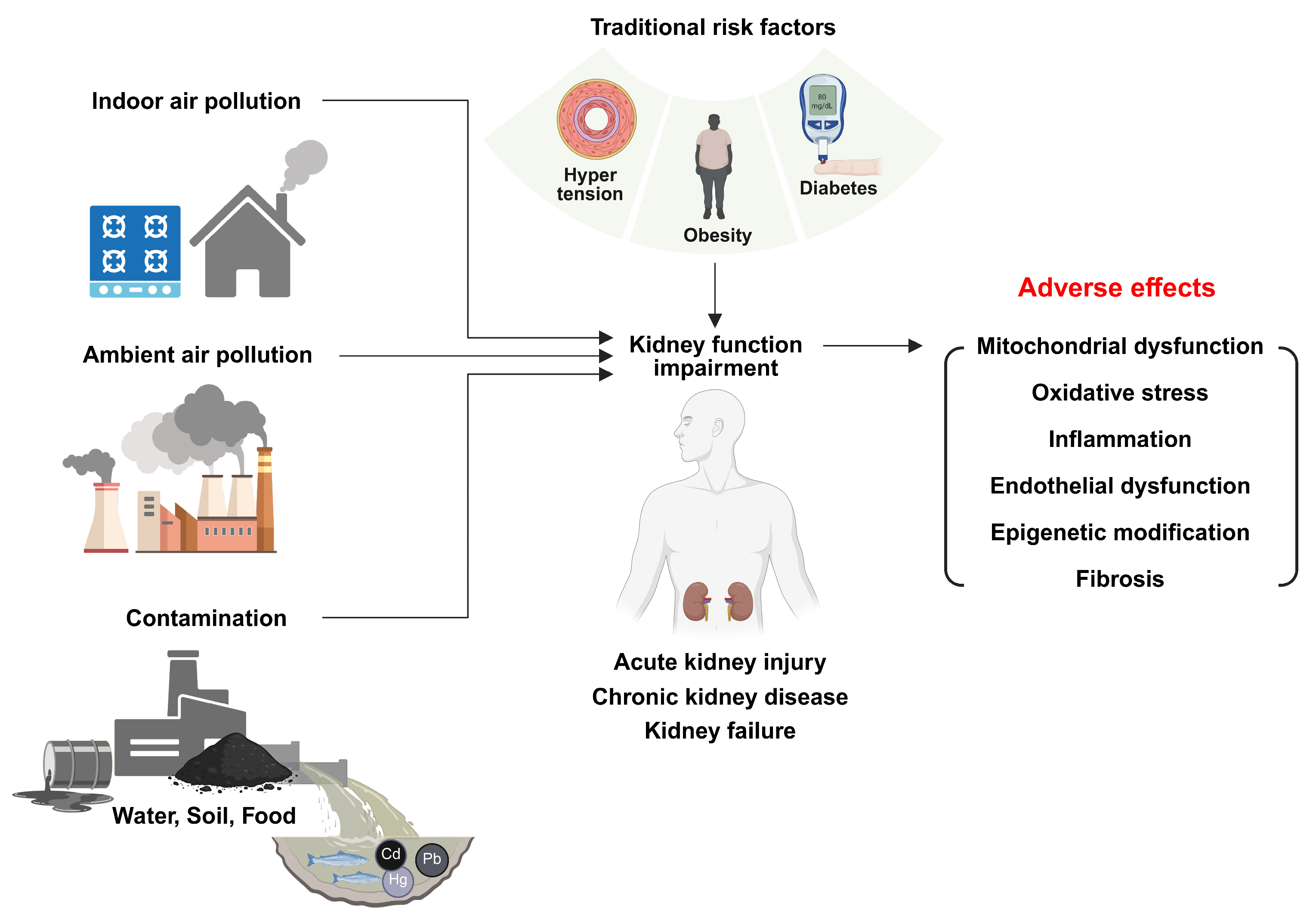
6.9. Integrative Conceptual Framework
7. Future Directions and Clinical Implications
7.1. Advancing Exposure Science and Causal Inference
7.2. Integrating Multi-Omics and Mechanistic Approaches
7.3. Mixture Toxicology and the Exposome Framework
7.4. Implications for Clinical Nephrology Practice
7.5. Public Health, Policy, and Systems-Level Interventions
8. Conclusions
Author Contributions
Funding
Institutional Review Board Statement
Informed Consent Statement
Data Availability Statement
Acknowledgments
Conflicts of Interest
References
- GBD 2023 Chronic Kidney Disease Collaborators. Global, regional, and national burden of chronic kidney disease in adults, 1990–2023, and its attributable risk factors: A systematic analysis for the Global Burden of Disease Study 2023. Lancet 2025, 406, 2461–2482. [Google Scholar] [CrossRef] [PubMed]
- Francis, A.; Harhay, M.N.; Ong, A.C.M.; Tummalapalli, S.L.; Ortiz, A.; Fogo, A.B.; Fliser, D.; Roy-Chaudhury, P.; Fontana, M.; Nangaku, M.; et al. Chronic kidney disease and the global public health agenda: An international consensus. Nat. Rev. Nephrol. 2024, 20, 473–485. [Google Scholar] [CrossRef]
- Matsushita, K.; Coresh, J.; Sang, Y.; Chalmers, J.; Fox, C.; Guallar, E.; Jafar, T.; Jassal, S.K.; Landman, G.W.; Muntner, P.; et al. Estimated glomerular filtration rate and albuminuria for prediction of cardiovascular outcomes: A collaborative meta-analysis of individual participant data. Lancet Diabetes Endocrinol. 2015, 3, 514–525. [Google Scholar] [CrossRef]
- Al-Aly, Z.; Cepeda, O. Rate of change in kidney function and the risk of death: The case for incorporating the rate of kidney function decline into the CKD staging system. Nephron Clin. Pract. 2011, 119, c179–c185, discussion c186. [Google Scholar] [CrossRef]
- Bots, M.L.; Blankestijn, P.J. [The relevance of a decline in renal function for risk of renal failure, cardiovascular events and all-cause mortality]. Ned. Tijdschr. Geneeskd. 2015, 159, A8106. [Google Scholar]
- Choi, Y.; Jacobs, D.R., Jr.; Shroff, G.R.; Kramer, H.; Chang, A.R.; Duprez, D.A. Progression of Chronic Kidney Disease Risk Categories and Risk of Cardiovascular Disease and Total Mortality: Coronary Artery Risk Development in Young Adults Cohort. J. Am. Heart Assoc. 2022, 11, e026685. [Google Scholar] [CrossRef]
- Li, Z.; He, R.; Wang, Y.; Qu, Z.; Liu, J.; Yu, R.; Yang, S. Global trends of chronic kidney disease from 1990 to 2021: A systematic analysis for the global burden of disease study 2021. BMC Nephrol 2025, 26, 385. [Google Scholar] [CrossRef]
- Bruce, M.A.; Beech, B.M.; Sims, M.; Brown, T.N.; Wyatt, S.B.; Taylor, H.A.; Williams, D.R.; Crook, E. Social environmental stressors, psychological factors, and kidney disease. J. Investig. Med. 2009, 57, 583–589. [Google Scholar] [CrossRef] [PubMed]
- Hill, N.R.; Fatoba, S.T.; Oke, J.L.; Hirst, J.A.; O’Callaghan, C.A.; Lasserson, D.S.; Hobbs, F.D. Global Prevalence of Chronic Kidney Disease—A Systematic Review and Meta-Analysis. PLoS ONE 2016, 11, e0158765. [Google Scholar] [CrossRef] [PubMed]
- Kshirsagar, A.V.; Zeitler, E.M.; Weaver, A.; Franceschini, N.; Engel, L.S. Environmental Exposures and Kidney Disease. Kidney360 2022, 3, 2174–2182. [Google Scholar] [CrossRef]
- Xu, X.; Nie, S.; Ding, H.; Hou, F.F. Environmental pollution and kidney diseases. Nat. Rev. Nephrol. 2018, 14, 313–324. [Google Scholar] [CrossRef]
- Lao, X.Q.; Bo, Y.; Chen, D.; Zhang, K.; Szeto, C.C. Environmental pollution to kidney disease: An updated review of current knowledge and future directions. Kidney Int. 2024, 106, 214–225. [Google Scholar] [CrossRef]
- Lash, L.H. Environmental and Genetic Factors Influencing Kidney Toxicity. Semin. Nephrol. 2019, 39, 132–140. [Google Scholar] [CrossRef] [PubMed]
- Vervaet, B.A.; D’Haese, P.C.; Verhulst, A. Environmental toxin-induced acute kidney injury. Clin. Kidney J. 2017, 10, 747–758. [Google Scholar] [CrossRef]
- Satarug, S.; Vesey, D.A.; Waeyeng, D.; Khamphaya, T.; Yimthiang, S. Enhanced Kidney Damage in Individuals with Diabetes Who Are Chronically Exposed to Cadmium and Lead: The Emergent Role for beta(2)-Microglobulin. Int. J. Mol. Sci. 2025, 26, 9208. [Google Scholar] [CrossRef] [PubMed]
- Liu, H.; Wang, T.; Zhou, X.; Kang, D. The impact of complex environmental chemical mixtures on chronic kidney disease: A mixture analysis approach in a national population. Medicine 2025, 104, e45469. [Google Scholar] [CrossRef] [PubMed]
- Liu, S.S.; Wang, H.; Cao, Y.F.; Lu, L.P.; Wu, Y.Y.; Lian, F.Z.; Yang, J.; Song, Q. The association between low-concentration heavy metal exposure and chronic kidney disease risk through α-klotho. Sci. Rep. 2025, 15, 11320. [Google Scholar] [CrossRef]
- Perl, A.J.; Schuh, M.P.; Kopan, R. Regulation of nephron progenitor cell lifespan and nephron endowment. Nat. Rev. Nephrol. 2022, 18, 683–695. [Google Scholar] [CrossRef]
- Sanders, A.P.; Gennings, C.; Tamayo-Ortiz, M.; Mistry, S.; Pantic, I.; Martinez, M.; Estrada-Gutierrez, G.; Espejel-Nunez, A.; Olascoaga, L.T.; Wright, R.O.; et al. Prenatal and early childhood critical windows for the association of nephrotoxic metal and metalloid mixtures with kidney function. Environ. Int. 2022, 166, 107361. [Google Scholar] [CrossRef]
- Hsu, C.N.; Tain, Y.L. Adverse Impact of Environmental Chemicals on Developmental Origins of Kidney Disease and Hypertension. Front. Endocrinol. 2021, 12, 745716. [Google Scholar] [CrossRef]
- Price, N.F.; Lin, P.D.; Cardenas, A.; Rifas-Shiman, S.L.; Zota, A.R.; Hivert, M.F.; Oken, E.; Aris, I.M.; Sanders, A.P. Prenatal metal exposures and kidney function in adolescence in Project Viva. Environ. Health 2024, 23, 94. [Google Scholar] [CrossRef]
- Bridges, C.C.; Zalups, R.K. The aging kidney and the nephrotoxic effects of mercury. J. Toxicol. Environ. Health. B Crit. Rev. 2017, 20, 55–80. [Google Scholar] [CrossRef]
- Chogtu, B.; Magazine, R.; Prabhu, R.; Lakshmi, R.V. Air pollution and chronic kidney disease: An emerging challenge. Clin. Epidemiol. Glob. 2025, 36, 102204. [Google Scholar] [CrossRef]
- Malyszko, S.J.; Gryko, A.; Malyszko, J.; Jakubowska, Z.; Musialowska, D.; Fabianska, A.; Kuzma, L. Air Pollution, Kidney Injury, and Green Nephrology-Thinking About Its Association and Causation. J. Clin. Med. 2025, 14, 7278. [Google Scholar] [CrossRef]
- Bowe, B.; Xie, Y.; Li, T.; Yan, Y.; Xian, H.; Al-Aly, Z. Estimates of the 2016 global burden of kidney disease attributable to ambient fine particulate matter air pollution. BMJ Open 2019, 9, e022450. [Google Scholar] [CrossRef]
- Hou, T.; Jiang, Y.; Zhang, J.; Hu, R.; Li, S.; Fan, W.; Chen, R.; Zhang, L.; Li, R.; Qin, L.; et al. Kidney Injury Evoked by Fine Particulate Matter: Risk Factor, Causation, Mechanism and Intervention Study. Adv. Sci. 2024, 11, e2403222. [Google Scholar] [CrossRef] [PubMed]
- Luo, C.; Ouyang, Y.; Shi, S.; Li, G.; Zhao, Z.; Luo, H.; Xu, F.; Shao, L.; Chen, Z.; Yu, S.; et al. Particulate matter of air pollution may increase risk of kidney failure in IgA nephropathy. Kidney Int. 2022, 102, 1382–1391. [Google Scholar] [CrossRef]
- Cai, M.; Wei, J.; Zhang, S.; Liu, W.; Wang, L.; Qian, Z.; Lin, H.; Liu, E.; McMillin, S.E.; Cao, Y.; et al. Short-term air pollution exposure associated with death from kidney diseases: A nationwide time-stratified case-crossover study in China from 2015 to 2019. BMC Med. 2023, 21, 32. [Google Scholar] [CrossRef]
- Liu, M.; Gao, M.; Hu, D.; Hu, J.; Wu, J.; Chen, Z.; Chen, J. Prolonged exposure to air pollution and risk of acute kidney injury and related mortality: A prospective cohort study based on hospitalized AKI cases and general population controls from the UK Biobank. BMC Public Health 2024, 24, 2911. [Google Scholar] [CrossRef]
- Xu, W.; Wang, S.; Jiang, L.; Sun, X.; Wang, N.; Liu, X.; Yao, X.; Qiu, T.; Zhang, C.; Li, J.; et al. The influence of PM(2.5) exposure on kidney diseases. Hum. Exp. Toxicol. 2022, 41, 9603271211069982. [Google Scholar] [CrossRef] [PubMed]
- Zhang, Y.; Xia, Y.; Chang, Q.; Ji, C.; Zhao, Y.; Zhang, H. Exposure to ambient air pollution and metabolic kidney diseases: Evidence from the Northeast China Biobank. Nephrol. Dial. Transplant. 2023, 38, 2222–2231. [Google Scholar] [CrossRef]
- Zhang, Y.; Liu, D.; Liu, Z. Fine Particulate Matter (PM(2.5)) and Chronic Kidney Disease. Rev. Environ. Contam. Toxicol. 2021, 254, 183–215. [Google Scholar] [CrossRef] [PubMed]
- Li, R.R.; Wang, K.; Li, M.; Liu, H.M.; You, Y.; Liu, D.D.; Guo, X.X.; Chen, J.; Wu, S.W. Association between ambient air pollution and renal function indicators: A comprehensive systematic review and meta-analysis. Environ. Res. 2025, 286, 122841. [Google Scholar] [CrossRef]
- Min, J.; Lee, W.; Kang, D.H.; Ahn, S.; Kim, A.; Kang, C.; Oh, J.; Jang, H.; Ho Jo, C.; Oh, J.; et al. Air pollution and acute kidney injury with comorbid disease: A nationwide case-crossover study in South Korea. Environ. Res. 2024, 260, 119608. [Google Scholar] [CrossRef]
- Al-Aly, Z.; Bowe, B. The Road Ahead for Research on Air Pollution and Kidney Disease. J. Am. Soc. Nephrol. 2021, 32, 260–262. [Google Scholar] [CrossRef]
- Kilbo Edlund, K.; Xu, Y.; Andersson, E.M.; Christensson, A.; Dehlin, M.; Forsblad-d’Elia, H.; Harari, F.; Ljunggren, S.; Molnar, P.; Oudin, A.; et al. Long-term ambient air pollution exposure and renal function and biomarkers of renal disease. Environ. Health 2024, 23, 67. [Google Scholar] [CrossRef]
- Chu, L.; Chen, K.; Di, Q.; Crowley, S.; Dubrow, R. Associations between short-term exposure to PM(2.5), NO(2) and O(3) pollution and kidney-related conditions and the role of temperature-adjustment specification: A case-crossover study in New York state. Environ. Pollut. 2023, 328, 121629. [Google Scholar] [CrossRef]
- Yi, J.; Kim, S.H.; Lee, H.; Chin, H.J.; Park, J.Y.; Jung, J.; Song, J.; Kwak, N.; Ryu, J.; Kim, S. Air quality and kidney health: Assessing the effects of PM(10), PM(2.5), CO, and NO(2) on renal function in primary glomerulonephritis. Ecotoxicol. Environ. Saf. 2024, 281, 116593. [Google Scholar] [CrossRef]
- Yang, C.; Wang, W.; Wang, Y.; Liang, Z.; Zhang, F.; Chen, R.; Liang, C.; Wang, F.; Li, P.; Ma, L.; et al. Ambient ozone pollution and prevalence of chronic kidney disease: A nationwide study based on the China National survey of chronic kidney disease. Chemosphere 2022, 306, 135603. [Google Scholar] [CrossRef] [PubMed]
- Min, J.; Kang, D.H.; Kang, C.; Bell, M.L.; Kim, H.; Yang, J.; Gasparrini, A.; Lavigne, E.; Hashizume, M.; Kim, Y.; et al. Fluctuating risk of acute kidney injury-related mortality for four weeks after exposure to air pollution: A multi-country time-series study in 6 countries. Environ. Int. 2024, 183, 108367. [Google Scholar] [CrossRef] [PubMed]
- Chu, L.Z.; Chen, K.; Yang, Z.R.; Crowley, S.; Dubrow, R. A unified framework for assessing interaction effects among environmental exposures in epidemiologic studies: A case study on temperature, air pollution, and kidney-related conditions in New York state. Environ. Res. 2024, 248, 118324. [Google Scholar] [CrossRef] [PubMed]
- Khraishah, H.; Rajagopalan, S. Inhaling Poor Health: The Impact of Air Pollution on Cardiovascular Kidney Metabolic Syndrome. Methodist. Debakey Cardiovasc. J. 2024, 20, 47–58. [Google Scholar] [CrossRef]
- Chen, Y.; Cao, F.; Xiao, J.P.; Fang, X.Y.; Wang, X.R.; Ding, L.H.; Wang, D.G.; Pan, H.F. Emerging role of air pollution in chronic kidney disease. Environ. Sci. Pollut. Res. Int. 2021, 28, 52610–52624. [Google Scholar] [CrossRef]
- Shubham, S.; Kumar, M.; Sarma, D.K.; Kumawat, M.; Verma, V.; Samartha, R.M.; Tiwari, R.R. Role of air pollution in chronic kidney disease: An update on evidence, mechanisms and mitigation strategies. Int. Arch. Occup. Environ. Health 2022, 95, 897–908. [Google Scholar] [CrossRef] [PubMed]
- Tain, Y.L.; Hsu, C.N. The Impact of the Aryl Hydrocarbon Receptor on Antenatal Chemical Exposure-Induced Cardiovascular-Kidney-Metabolic Programming. Int. J. Mol. Sci. 2024, 25, 4599. [Google Scholar] [CrossRef]
- Tavera Busso, I.; Mateos, A.C.; Juncos, L.I.; Canals, N.; Carreras, H.A. Kidney damage induced by sub-chronic fine particulate matter exposure. Environ. Int. 2018, 121, 635–642. [Google Scholar] [CrossRef]
- Son, M.H.; Park, E.; Yim, H.E.; Nam, Y.J.; Lee, Y.S.; Choi, E.K.; Jeong, S.H.; Lee, J.H. Maternal exposure to airborne particulate matter during pregnancy and lactation induces kidney injury in rat dams and their male offspring: The role of vitamin D in pregnancy and beyond. Kidney Res. Clin. Prac. 2024, 43, 648–662. [Google Scholar] [CrossRef]
- Ge, C.X.; Xu, M.X.; Qin, Y.T.; Gu, T.T.; Lv, J.X.; Wang, M.X.; Wang, S.J.; Ma, Y.J.; Lou, D.S.; Li, Q.; et al. iRhom2 loss alleviates renal injury in long-term PM2.5-exposed mice by suppression of inflammation and oxidative stress. Redox Biol. 2018, 19, 147–157. [Google Scholar] [CrossRef]
- Chen, M.; Qin, X.; Qiu, L.; Chen, S.; Zhou, H.; Xu, Y.; Hu, Z.; Zhang, Y.; Cao, Q.; Ying, Z. Concentrated Ambient PM(2.5)-Induced Inflammation and Endothelial Dysfunction in a Murine Model of Neural IKK2 Deficiency. Environ. Health Perspect. 2018, 126, 027003. [Google Scholar] [CrossRef]
- Xu, M.X.; Qin, Y.T.; Ge, C.X.; Gu, T.T.; Lou, D.S.; Li, Q.; Hu, L.F.; Li, Y.Y.; Yang, W.W.; Tan, J. Activated iRhom2 drives prolonged PM(2.5) exposure-triggered renal injury in Nrf2-defective mice. Nanotoxicology 2018, 12, 1045–1067. [Google Scholar] [CrossRef] [PubMed]
- Zhang, Y.; Li, Q.; Fang, M.; Ma, Y.; Liu, N.; Yan, X.; Zhou, J.; Li, F. The Kidney Injury Induced by Short-Term PM(2.5) Exposure and the Prophylactic Treatment of Essential Oils in BALB/c Mice. Oxid. Med. Cell Longev. 2018, 2018, 9098627. [Google Scholar] [CrossRef]
- Huang, J.; Zhang, P.; An, Q.; He, L.; Wang, L. New insights into the treatment mechanisms of Vitamin D on PM-induced toxicity and inflammation in mouse renal tubular epithelial cells. Int. Immunopharmacol. 2022, 108, 108747. [Google Scholar] [CrossRef]
- Chen, W.L.; Luo, Y.F.; Quan, J.J.; Zhou, J.; Yi, B.; Huang, Z.J. PM2.5 induces renal tubular injury by activating NLRP3-mediated pyroptosis. Ecotoxicol. Environ. Saf. 2023, 265, 115490. [Google Scholar] [CrossRef]
- Chen, Y.Z.; Lo, Y.C.; Lin, W.Y.; Huang, P.C.; Wu, C.C.; Lin, T.Y.; Huang, H.B. Does epigenetic aging mediate the associations between phthalate exposure and renal function? Ecotoxicol. Environ. Saf. 2025, 303, 118858. [Google Scholar] [CrossRef]
- Jung, J.Y.; Park, J.Y.; Kim, Y.C.; Lee, H.; Kim, E.; Kim, Y.S.; Lee, J.P.; Kim, H. Effects of air pollution on mortality of patients with chronic kidney disease: A large observational cohort study. Sci. Total Environ. 2021, 786, 147471. [Google Scholar] [CrossRef]
- Zhang, F.; Yang, C.; Wang, F.; Liu, Y.; Guo, C.G.; Li, P.; Zhang, L. Air pollution and the risk of incident chronic kidney disease in patients with diabetes: An exposure-response analysis. Ecotoxicol. Environ. Saf. 2024, 270, 115829. [Google Scholar] [CrossRef]
- Paranjpe, I.; Chaudhary, K.; Paranjpe, M.; O’Hagan, R.; Manna, S.; Jaladanki, S.; Kapoor, A.; Horowitz, C.; DeFelice, N.; Cooper, R.; et al. Association of APOL1 Risk Genotype and Air Pollution for Kidney Disease. Clin. J. Am. Soc. Nephrol. 2020, 15, 401–403. [Google Scholar] [CrossRef] [PubMed]
- Benedetti, M.; Minichilli, F.; Soggiu, M.E.; Manno, V.; Fazzo, L. Ecological meta-analytic study of kidney disease in Italian contaminated sites. Ann. Ist. Super. Sanita 2021, 57, 314–323. [Google Scholar] [CrossRef] [PubMed]
- Al-Aly, Z. We Must all Join the Effort to Dismantle Environmental Racism. J. Am. Soc. Nephrol. 2022, 33, 12–14. [Google Scholar] [CrossRef] [PubMed]
- Pan, Z.; Gong, T.; Liang, P. Heavy Metal Exposure and Cardiovascular Disease. Circ. Res. 2024, 134, 1160–1178. [Google Scholar] [CrossRef]
- Jing, S.; Ge, Y.; Pan, J.; Chang, P.; Qiao, X. The independent and interactive effects of heavy metal pollution and vitamin D deficiency on early kidney injury indicators: Analysis of the National Health and Nutrition Examination Survey 2001-2004. BMC Public Health 2025, 25, 719. [Google Scholar] [CrossRef]
- Jomova, K.; Alomar, S.Y.; Nepovimova, E.; Kuca, K.; Valko, M. Heavy metals: Toxicity and human health effects. Arch. Toxicol. 2025, 99, 153–209. [Google Scholar] [CrossRef]
- Soderland, P.; Lovekar, S.; Weiner, D.E.; Brooks, D.R.; Kaufman, J.S. Chronic kidney disease associated with environmental toxins and exposures. Adv. Chronic Kidney Dis. 2010, 17, 254–264. [Google Scholar] [CrossRef] [PubMed]
- Lentini, P.; Zanoli, L.; Granata, A.; Santo Signorelli, S.; Castellino, P.; Dell’Aquila, R. Kidney and heavy metals—The role of environmental exposure. Mol. Med. Rep. 2017, 15, 3413–3419. [Google Scholar] [CrossRef]
- Hayat, M.T.; Nauman, M.; Nazir, N.; Ali, S.; Bangash, N. Environmental hazards of cadmium: Past, present, and future. In Cadmium Toxicity and Tolerance in Plants; Elsevier: Amsterdam, The Netherlands, 2019; pp. 163–183. [Google Scholar]
- Goyer, R.A. Mechanisms of lead and cadmium nephrotoxicity. Toxicol. Lett. 1989, 46, 153–162. [Google Scholar] [CrossRef]
- Sakuma, S.; Nogawa, K.; Watanabe, Y.; Sakurai, M.; Nishijo, M.; Ishizaki, M.; Morikawa, Y.; Kido, T.; Nakagawa, H.; Suwazono, Y. Effect of renal tubular damage on non-cancer mortality in the general Japanese population living in cadmium non-polluted areas. J. Appl. Toxicol. 2023, 43, 1849–1858. [Google Scholar] [CrossRef] [PubMed]
- Jin, Y.Y.; Lu, Y.W.; Li, Y.Y.; Zhao, H.J.; Wang, X.; Shen, Y.T.; Kuang, X.Y. Correlation between environmental low-dose cadmium exposure and early kidney damage: A comparative study in an industrial zone a living quarter in Shanghai, China. Environ. Toxicol. Pharmacol. 2020, 79, 103381. [Google Scholar] [CrossRef] [PubMed]
- Doccioli, C.; Sera, F.; Francavilla, A.; Cupisti, A.; Biggeri, A. Association of cadmium environmental exposure with chronic kidney disease: A systematic review and meta-analysis. Sci. Total Environ. 2024, 906, 167165. [Google Scholar] [CrossRef]
- Kim, Y.D.; Yim, D.H.; Eom, S.Y.; Moon, S.I.; Park, C.H.; Kim, G.B.; Yu, S.D.; Choi, B.S.; Park, J.D.; Kim, H. Temporal changes in urinary levels of cadmium, -acetyl-β-D-glucosaminidase and β-microglobulin in individuals in a cadmium-contaminated area. Environ. Toxicol. Pharmacol. 2015, 39, 35–41. [Google Scholar] [CrossRef] [PubMed]
- Satarug, S. Challenges in Toxicological Risk Assessment of Environmental Cadmium Exposure. Toxics 2025, 13, 404. [Google Scholar] [CrossRef]
- Zhuang, J.H.; Nie, G.H.; Yang, F.; Dai, X.Y.; Cao, H.B.; Xing, C.H.; Hu, G.L.; Zhang, C.Y. Cadmium induces cytotoxicity through oxidative stress-mediated apoptosis pathway in duck renal tubular epithelial cells. Toxicol. In Vitro 2019, 61, 104625. [Google Scholar] [CrossRef]
- Turkington, R.E.; Hukriede, N.A.; Ho, J.; Jayasundara, N.; Sanders, A.P. Metal mechanisms of mitochondrial toxicity: Recent review of arsenic, cadmium, and lead-induced nephrotoxicity. Environ. Sci. Pollut. Res. Int. 2025, 32, 14439–14451. [Google Scholar] [CrossRef]
- Gidlow, D.A. Lead toxicity. Occup. Med. 2015, 65, 348–356. [Google Scholar] [CrossRef] [PubMed]
- Roncal, C.; Mu, W.; Reungjui, S.; Kim, K.M.; Henderson, G.N.; Ouyang, X.; Nakagawa, T.; Johnson, R.J. Lead, at low levels, accelerates arteriolopathy and tubulointerstitial injury in chronic kidney disease. Am. J. Physiol-Renal 2007, 293, F1391–F1396. [Google Scholar] [CrossRef][Green Version]
- Upadhyay, K.; Viramgami, A.; Bagepally, B.S.; Balachandar, R. Association between chronic lead exposure and markers of kidney injury: A systematic review and meta-analysis. Toxicol. Rep. 2024, 13, 101837. [Google Scholar] [CrossRef] [PubMed]
- He, Y.J.; Zheng, Y.L.; Tang, W.W.; Xing, B.W.; Xu, H.; He, J.J.; Mai, W.; Wang, X.Y.; Zhou, M. Impact of lead exposure on global hypertensive CKD: YLDs/YLLs-based findings from 1990 to 2021 and projected trends to 2035. Ecotoxicol. Environ. Saf. 2025, 305, 119192. [Google Scholar] [CrossRef] [PubMed]
- Bertke, S.J.; Lehman, E.J.; Wurzelbacher, S.J.; Hein, M.J. Mortality of lead smelter workers: A follow-up study with exposure assessment. Am. J. Ind. Med. 2016, 59, 979–986. [Google Scholar] [CrossRef]
- Collin, M.S.; Venkatraman, S.K.; Vijayakumar, N.; Kanimozhi, V.; Arbaaz, S.M.; Stacey, R.G.S.; Anusha, J.; Choudhary, R.; Lvov, V.; Tovar, G.I.; et al. Bioaccumulation of lead (Pb) and its effects on human: A review. J. Hazard. Mater. Adv. 2022, 7, 100094. [Google Scholar] [CrossRef]
- Li, L.H.; Zhao, J.H. Association of urinary and blood lead concentrations with all-cause mortality in US adults with chronic kidney disease: A prospective cohort study. Sci. Rep. 2024, 14, 23230. [Google Scholar] [CrossRef]
- Qiao, L.C.; Li, M.Q.; Wen, X.Y.; Deng, F.D.; Hou, X.W.; Zou, Q.Q.; Liu, H.B.; Fan, X.Y.; Han, J. Epidemiological trends in the burden of chronic kidney disease due to lead exposure in China from 1990 to 2021 compared to global, and projections until 2050. Int. J. Environ. Health Res. 2025, 35, 2795–2806. [Google Scholar] [CrossRef]
- Hodgson, S.; Nieuwenhuijsen, M.J.; Elliott, P.; Jarup, L. Kidney disease mortality and environmental exposure to mercury. Am. J. Epidemiol. 2007, 165, 72–77. [Google Scholar] [CrossRef] [PubMed]
- Miller, S.; Pallan, S.; Gangji, A.S.; Lukic, D.; Clase, C.M. Mercury-Associated Nephrotic Syndrome: A Case Report and Systematic Review of the Literature. Am. J. Kidney Dis. 2013, 62, 135–138. [Google Scholar] [CrossRef]
- Qin, A.B.; Su, T.; Wang, S.X.; Zhang, F.; Zhou, F.D.; Zhao, M.H. Mercury-associated glomerulonephritis: A retrospective study of 35 cases in a single Chinese center. BMC Nephrol. 2019, 20, 228. [Google Scholar] [CrossRef]
- Abdeldayem, R. Domestic water and accumulating mercury toxicity in the kidney. Appl. Water Sci. 2022, 12, 114. [Google Scholar] [CrossRef]
- Zhou, Y.; Vaidya, V.S.; Brown, R.P.; Zhang, J.; Rosenzweig, B.A.; Thompson, K.L.; Miller, T.J.; Bonventre, J.V.; Goering, P.L. Comparison of kidney injury molecule-1 and other nephrotoxicity biomarkers in urine and kidney following acute exposure to gentamicin, mercury, and chromium. Toxicol. Sci. 2008, 101, 159–170. [Google Scholar] [CrossRef]
- Wu, Y.S.; Osman, A.I.; Hosny, M.; Elgarahy, A.M.; Eltaweil, A.S.; Rooney, D.W.; Chen, Z.H.; Rahim, N.S.; Sekar, M.; Gopinath, S.C.B.; et al. The Toxicity of Mercury and Its Chemical Compounds: Molecular Mechanisms and Environmental and Human Health Implications: A Comprehensive Review. Acs Omega 2024, 9, 5100–5126. [Google Scholar] [CrossRef]
- Zhang, L.D.; Chu, J.; Xia, B.Y.; Xiong, Z.H.; Zhang, S.Y.; Tang, W. Health Effects of Particulate Uranium Exposure. Toxics 2022, 10, 575. [Google Scholar] [CrossRef]
- Ashish, A.; Bangotra, P.; Dillu, V.; Prasad, M.; Banerjee, S.; Mehra, R.; Singh, N.L. Human exposure to uranium through drinking water and its detrimental impact on the human body organs. Environ. Geochem. Hlth 2024, 46, 397. [Google Scholar] [CrossRef]
- Faqir, Y.; Li, Z.; Gul, T.; Zahoor; Jiang, Z.; Yu, L.; Tan, C.; Chen, X.; Ma, J.; Feng, J. Uranium’s hazardous effects on humans and recent developments in treatment. Ecotoxicol. Environ. Saf. 2025, 293, 118043. [Google Scholar] [CrossRef] [PubMed]
- Nan, Y.X.; Yang, J.L.; Ma, L.; Jin, L.M.; Bai, Y.A. Associations of nickel exposure and kidney function in US adults, NHANES 2017-2018. J. Trace Elem. Med. Biol. 2022, 74, 127065. [Google Scholar] [CrossRef] [PubMed]
- Yin, H.; Li, X.L.; Wang, C.B.; Li, X.C.; Liu, J.B. Nickel induces mitochondrial damage in renal cells in vitro and in vivo through its effects on mitochondrial biogenesis, fusion, and fission. Chem. Biol. Interact. 2024, 394, 110975. [Google Scholar] [CrossRef]
- Yin, H.; Wang, C.B.; Guo, H.R.; Li, X.C.; Liu, J.B. The mechanism of nickel-induced autophagy and its role in nephrotoxicity. Ecotoxicol. Environ. Saf. 2024, 273, 116150. [Google Scholar] [CrossRef]
- Chen, C.Y.; Lin, T.K.; Chang, Y.C.; Wang, Y.F.; Shyu, H.W.; Lin, K.H.; Chou, M.C. Nickel(II)-Induced Oxidative Stress, Apoptosis, G2/M Arrest, and Genotoxicity in Normal Rat Kidney Cells. J. Toxicol. Environ. Health Part A 2010, 73, 529–539. [Google Scholar] [CrossRef]
- Concessao, P.L.; Prakash, J. Arsenic-induced nephrotoxicity: Mechanisms, biomarkers, and preventive strategies for global health. Vet. World 2025, 18, 2136–2157. [Google Scholar] [CrossRef]
- Xu, Y.; Zou, Z.; Liu, Y.; Wang, Q.; Sun, B.; Zeng, Q.; Liu, Q.; Zhang, A. miR-191 is involved in renal dysfunction in arsenic-exposed populations by regulating inflammatory response caused by arsenic from burning arsenic-contaminated coal. Hum. Exp. Toxicol. 2020, 39, 37–46. [Google Scholar] [CrossRef]
- Liu, S.H.; Zhang, L.E.; Luo, N.; Wang, M.J.; Tang, C.Q.; Jing, J.J.; Chen, H.; Hu, Q.H.; Tan, L.A.; Ma, X.L.; et al. Metal mixture exposure and the risk for immunoglobulin A nephropathy: Evidence from weighted quantile sum regression. Environ. Sci. Pollut. R. 2023, 30, 87783–87792. [Google Scholar] [CrossRef]
- Shi, X.R.; Wang, X.; Zhang, J.; Dang, Y.; Ouyang, C.P.; Pan, J.H.; Yang, A.M.; Hu, X.B. Associations of mixed metal exposure with chronic kidney disease from NHANES 2011-2018. Sci. Rep. 2024, 14, 13062. [Google Scholar] [CrossRef] [PubMed]
- Wang, Y.C.; Qiao, M.Y.; Yang, H.T.; Chen, Y.Y.; Jiao, B.; Liu, S.; Duan, A.R.; Wu, S.Y.; Wang, H.H.; Yu, C.Y.; et al. Investigating the relationship of co-exposure to multiple metals with chronic kidney disease: An integrated perspective from epidemiology and adverse outcome pathways. J. Hazard. Mater. 2024, 480, 135844. [Google Scholar] [CrossRef] [PubMed]
- Zhang, S.; Fu, X.J. Evaluating the impact of environmental metal mixtures on chronic kidney disease risk: Insights from the National Health and Nutrition Examination Survey 2011-2016. J. Int. Med. Res. 2025, 53, 03000605251378695. [Google Scholar] [CrossRef]
- Sabath, E.; Robles-Osorio, M.L. Renal health and the environment: Heavy metal nephrotoxicity. Nefrologia 2012, 32, 279–286. [Google Scholar] [CrossRef] [PubMed]
- Deng, Y.T.; Wen, Y.M.; Duan, W.X.; Zhao, Z.Q.; Li, G.L.; Zhou, J.Z.; Yang, L.; Yang, J.Y.; Sun, Y.P.; Qiu, M.Y.; et al. Interactive effects between lead-cadmium co-exposure and VEGFA gene polymorphisms on renal dysfunction: A gene-environment interaction study. Front. Public Health 2025, 13, 1627634. [Google Scholar] [CrossRef] [PubMed]
- Chen, T.H.; Huang, J.J.; Lee, H.Y.; Kung, W.S.; Luo, K.H.; Lu, J.Y.; Chuang, H.Y. The Association of Renal Function and Plasma Metals Modified by EGFR and TNF-alpha Gene Polymorphisms in Metal Industrial Workers and General Population. Int. J. Environ. Res. Public Health 2021, 18, 8965. [Google Scholar] [CrossRef]
- Quasmi, M.N.; Singh, J.; Kumar, D.; Dhingra, D.; Jangra, A. Insights into the molecular mechanisms underlying phthalates-induced nephrotoxicity. Toxicology 2025, 516, 154187. [Google Scholar] [CrossRef]
- Su, W.T.; An, Z.W.; Mei, Y.Y.; Tan, Z.Z.; Jiang, Z.X.; Zeng, X.L.; Dong, Z.Q.; Yang, M.; Wu, J.T.; Guo, H.C.; et al. Impact of per- and polyfluoroalkyl substances exposure on renal dysfunction: Integrating epidemiological evidence with mechanistic insights. Environ. Pollut. 2025, 382, 126744. [Google Scholar] [CrossRef]
- Zuo, X.; Tan, S.; Zhang, Y.; Zhang, C.; Ma, L.; Hou, X.; Wang, W.; Sun, R.; Yin, L.; Pu, Y.; et al. Linking PFOS exposure to chronic kidney disease: A multimodal study integrating epidemiology, network toxicology, and experimental validation. Ecotoxicol. Environ. Saf. 2025, 302, 118770. [Google Scholar] [CrossRef]
- Wang, J.Y.; Gao, T.Y.; Li, X.H.; Pan, L. Associations between per- and polyfluoroalkyl substances exposure and renal function as well as poor prognosis in chronic kidney disease patients. Ren. Fail. 2025, 47, 2520903. [Google Scholar] [CrossRef]
- Xie, C.; Yang, S.; Li, Y.; Zhang, M.; Xu, Q.; Wan, Z.; Song, L.; Lv, Y.; Luo, D.; Li, Q.; et al. Associations of exposure to organochlorine pesticides and polychlorinated biphenyls with chronic kidney disease among adults: The modifying effects of lifestyle. Environ. Sci. Pollut. Res. Int. 2024, 31, 45192–45203. [Google Scholar] [CrossRef]
- Hsu, C.N.; Hou, C.Y.; Chen, Y.W.; Chang-Chien, G.P.; Lin, S.F.; Tain, Y.L. Environmental Nephrotoxicity Across the Life Course: Oxidative Stress Mechanisms and Opportunities for Early Intervention. Antioxidants 2025, 14, 1205. [Google Scholar] [CrossRef]
- Zhang, X.; Flaws, J.A.; Spinella, M.J.; Irudayaraj, J. The Relationship between Typical Environmental Endocrine Disruptors and Kidney Disease. Toxics 2023, 11, 32. [Google Scholar] [CrossRef] [PubMed]
- Lee, J.; Lee, I.; Park, J.Y.; Kim, S.; Park, H.; Jung, S.K.; Lee, C.; Lee, J.P.; Choi, K. Exposure to several polychlorinated biphenyls (PCBs) is associated with chronic kidney disease among general adults: Korean National Environmental Health Survey (KoNEHS) 2015–2017. Chemosphere 2022, 303, 134998. [Google Scholar] [CrossRef]
- Wei, D.; Shi, J.; Xu, H.; Guo, Y.; Wu, X.; Chen, Z.; Chen, T.; Lou, H.; Han, E.; Han, G.; et al. Prospective study on the joint effect of persistent organic pollutants and glucose metabolism on chronic kidney disease: Modifying effects of lifestyle interventions. Sci. Total Environ. 2024, 951, 175694. [Google Scholar] [CrossRef]
- Kumar, J.; Monica Lind, P.; Salihovic, S.; van Bavel, B.; Lind, L.; Ingelsson, E. Influence of persistent organic pollutants on oxidative stress in population-based samples. Chemosphere 2014, 114, 303–309. [Google Scholar] [CrossRef]
- Gowder, S.J. Nephrotoxicity of bisphenol A (BPA)—An updated review. Curr. Mol. Pharmacol. 2013, 6, 163–172. [Google Scholar] [CrossRef] [PubMed]
- Zhu, Y.P.; Chen, L.; Wang, X.J.; Jiang, Q.H.; Bei, X.Y.; Sun, W.L.; Xia, S.J.; Jiang, J.T. Maternal exposure to di-n-butyl phthalate (DBP) induces renal fibrosis in adult rat offspring. Oncotarget 2017, 8, 31101–31111. [Google Scholar] [CrossRef] [PubMed]
- Ma, N.A.; Liu, X.; Zhao, L.N.; Liu, Y.; Peng, X.Y.; Ma, D.; Ma, L.; Kiyama, R.; Dong, S.J. Bisphenol P induces increased oxidative stress in renal tissues of C57BL/6 mice and human renal cortical proximal tubular epithelial cells, resulting in kidney injury. Sci. Total Environ. 2024, 949, 175159. [Google Scholar] [CrossRef]
- Chen, J.Y.; Wang, Y.; Zhao, Z.X.; Deng, Y.; Wang, T.Y.; Xiang, Y.T.; Wang, Y.T.; Chen, J.M.; He, M. Associations of endocrine disrupting chemicals with renal function in older individuals. Hyg. Environ. Health Adv. 2024, 11, 100098. [Google Scholar] [CrossRef]
- Li, X.R.; Ye, X.A.; Xu, L.H.; Chen, H.Y. Association between endocrine disrupting chemicals exposure and diabetic kidney disease in adults: A national cross-sectional NHANES study. Ecotoxicol. Environ. Saf. 2025, 293, 118044. [Google Scholar] [CrossRef] [PubMed]
- Carwile, J.L.; Seshasayee, S.M.; Ahrens, K.A.; Hauser, R.; Driban, J.B.; Rosen, C.J.; Gordon, C.M.; Fleisch, A.F. Serum PFAS and Urinary Phthalate Biomarker Concentrations and Bone Mineral Density in 12–19 Year Olds: 2011-2016 NHANES. J. Clin. Endocrinol. Metab. 2022, 107, e3343–e3352. [Google Scholar] [CrossRef]
- Jian, J.M.; Chen, D.; Han, F.J.; Guo, Y.; Zeng, L.X.; Lu, X.W.; Wang, F. A short review on human exposure to and tissue distribution of per- and polyfluoroalkyl substances (PFASs). Sci. Total Environ. 2018, 636, 1058–1069. [Google Scholar] [CrossRef]
- Sunderland, E.M.; Hu, X.D.C.; Dassuncao, C.; Tokranov, A.K.; Wagner, C.C.; Allen, J.G. A review of the pathways of human exposure to poly- and perfluoroalkyl substances (PFASs) and present understanding of health effects. J. Expo. Sci. Environ. Epidemiol. 2019, 29, 131–147. [Google Scholar] [CrossRef]
- Shankar, A.; Xiao, J.; Ducatman, A. Perfluoroalkyl Chemicals and Chronic Kidney Disease in US Adults. Am. J. Epidemiol. 2011, 174, 893–900. [Google Scholar] [CrossRef]
- Kataria, A.; Trachtman, H.; Malaga-Dieguez, L.; Trasande, L. Association between perfluoroalkyl acids and kidney function in a cross-sectional study of adolescents. Environ. Health-Glob. 2015, 14, 89. [Google Scholar] [CrossRef] [PubMed]
- Watkins, D.J.; Josson, J.; Elston, B.; Bartell, S.M.; Shin, H.M.; Vieira, V.M.; Savitz, D.A.; Fletcher, T.; Wellenius, G.A. Exposure to Perfluoroalkyl Acids and Markers of Kidney Function among Children and Adolescents Living near a Chemical Plant. Environ. Health Perspect. 2013, 121, 625–630. [Google Scholar] [CrossRef] [PubMed]
- Chen, Y.R.; Lin, S.B.; Lv, J.Y.; Wu, Y.; Feng, W.R. Dissect the association between per- and polyfluoroalkyl substances (PFAS) and kidney function from the perspective of lipid molecules. Environ. Pollut. 2024, 361, 124865. [Google Scholar] [CrossRef] [PubMed]
- Tang, L.L.; Yu, J.W.; Zhuge, S.; Chen, H.P.; Zhang, L.D.; Jiang, G.J. Oxidative stress and Cx43-mediated apoptosis are involved in PFOS-induced nephrotoxicity. Toxicology 2022, 478, 153283. [Google Scholar] [CrossRef]
- Du, Y.Z.; Xu, T.; Luo, D.L.; Wang, Y.X.; Yin, H.; Liu, C.G.; Li, S. Perfluorooctane sulfonate-induced apoptosis in kidney cells by triggering the NOX4/ROS/JNK axis and antagonism of cannabidiol. Environ. Toxicol. 2023, 38, 1651–1664. [Google Scholar] [CrossRef]
- Wen, Y.; Rashid, F.; Fazal, Z.; Singh, R.; Spinella, M.J.; Irudayaraj, J. Nephrotoxicity of perfluorooctane sulfonate (PFOS)-effect on transcription and epigenetic factors. Environ. Epigenet 2022, 8, dvac010. [Google Scholar] [CrossRef]
- Liang, Y.F.; Zhou, H.; Zhang, J.C.; Li, S.J.; Shen, W.T.; Lei, L.J. Exposure to perfluoroalkyl and polyfluoroalkyl substances and estimated glomerular filtration rate in adults: A cross-sectional study based on NHANES (2017-2018). Environ. Sci. Pollut. R. 2023, 30, 57931–57944. [Google Scholar] [CrossRef]
- Song, S.Y.; Huang, L.J.; Zhou, X.Q.; Han, Y.; Yu, J.Y. Impact of per- and polyfluoroalkyl substances on diabetic kidney disease. Front. Endocrinol. 2025, 16, 1594897. [Google Scholar] [CrossRef]
- Paidi, G.; Jayarathna, A.I.I.; Salibindla, D.B.A.M.R.; Amirthalingam, J.; Karpinska-Leydier, K.; Alshowaikh, K.; Ergin, H.E. Chronic Kidney Disease of Unknown Origin: A Mysterious Epidemic. Cureus J. Med. Sci. 2021, 13, e17132. [Google Scholar] [CrossRef]
- Wanigasuriya, K.P.; Peiris-John, R.J.; Wickremasinghe, R. Chronic kidney disease of unknown aetiology in Sri Lanka: Is cadmium a likely cause? BMC Nephrology 2011, 12, 32. [Google Scholar] [CrossRef]
- Orantes, C.M.; Herrera, R.; Almaguer, M.; Brizuela, E.G.; Hernández, C.E.; Bayarre, H.; Amaya, J.C.; Calero, D.J.; Orellana, P.; Colindres, R.M.; et al. Chronic Kidney Disease and Associated Risk Factors in the Bajo Lempa Region of El Salvador: Nefrolempa Study, 2009. MEDICC Rev. 2011, 13, 14–22. [Google Scholar]
- Omote, D.; Makino, S.I.; Okunaga, I.; Ishii, M.; Tatsumoto, N.; Aizawa, M.; Asanuma, K. Unusual course of glyphosate-induced acute kidney injury: A case report of tubulointerstitial nephritis treated with steroids. Cen. Case Rep. 2025, 14, 128–134. [Google Scholar] [CrossRef]
- Bravo, M.I.; Medina, J.; Marcano, S.; Finol, H.J.; Boada-Sucre, A. Effects of herbicide on the kidneys of two Venezuelan cultured fish: Caquetaia kraussii and Colossoma macropomum (Pisces: Ciclidae and Characeae). Rev. Biol. Trop. 2005, 53, 55–60. [Google Scholar] [PubMed]
- Noor, M.I.; Rahman, M.S. Effects of Environmentally Relevant Concentrations of Roundup on Oxidative-Nitrative Stress, Cellular Apoptosis, Prooxidant-Antioxidant Homeostasis, Renin and CYP1A Expressions in Goldfish: Molecular Mechanisms Underlying Kidney Damage During Roundup Exposure. Environ. Toxicol. 2025, 40, 817–834. [Google Scholar] [CrossRef]
- Rihani, R.; Charles, A.L.; Oulehri, W.; Geny, B. The Effects of Glyphosate and Roundup((R)) Herbicides on the Kidneys’ Cortex and the Medulla and on Renal Tubular Cells’ Mitochondrial Respiration and Oxidative Stress. Molecules 2025, 30, 2335. [Google Scholar] [CrossRef]
- Lim, C.; Oh, H. Organic solvent exposure for the chronic kidney disease: Updated systematic review with meta-analysis. Ann. Occup. Environ. Med. 2023, 35, e11. [Google Scholar] [CrossRef]
- Jacob, S.; Héry, M.; Protois, J.C.; Rossert, J.; Stengel, B. New insight into solvent-related end-stage renal disease: Occupations, products and types of solvents at risk. Occup. Environ. Med. 2007, 64, 843–848. [Google Scholar] [CrossRef] [PubMed]
- Park, M.Y.; Kang, M.Y. Occupational Risk Factors for Kidney Disease: A Comprehensive Review. J. Korean Med. Sci. 2025, 40, e224. [Google Scholar] [CrossRef]
- Sauvant, C.; Holzinger, H.; Gekle, M. Proximal tubular toxicity of ochratoxin A is amplified by simultaneous inhibition of the extracellular signal-regulated kinases 1/2. J. Pharmacol. Exp. Ther. 2005, 313, 234–241. [Google Scholar] [CrossRef] [PubMed]
- Song, Y.Y.; Liu, W.; Zhao, Y.; Zang, J.T.; Gao, H. Ochratoxin A induces human kidney tubular epithelial cell apoptosis through regulating lipid raft/PTEN/AKT signaling pathway. Environ. Toxicol. 2021, 36, 1880–1885. [Google Scholar] [CrossRef]
- Sorrenti, V.; Di Giacomo, C.; Acquaviva, R.; Barbagallo, I.; Bognanno, M.; Galvano, F. Toxicity of Ochratoxin A and Its Modulation by Antioxidants: A Review. Toxins 2013, 5, 1742–1766. [Google Scholar] [CrossRef] [PubMed]
- Wu, C.F.; Peng, C.Y.; Liu, C.C.; Lin, W.Y.; Pan, C.H.; Cheng, C.M.; Hsieh, H.M.; Hsieh, T.J.; Chen, B.H.; Wu, M.T. Ambient Melamine Exposure and Urinary Biomarkers of Early Renal Injury. J. Am. Soc. Nephrol. 2015, 26, 2821–2829. [Google Scholar] [CrossRef]
- Ding, J. Childhood urinary stones induced by melamine-tainted formula: How much we know, how much we don’t know. Kidney Int. 2009, 75, 780–782. [Google Scholar] [CrossRef][Green Version]
- Hu, P.; Wang, J.; Hu, B.; Lu, L.; Zhang, M. Clinical observation of childhood urinary stones induced by melamine-tainted infant formula in Anhui province, China. Arch. Med. Sci. 2013, 9, 98–104. [Google Scholar] [CrossRef] [PubMed]
- Langman, C.B.; Alon, U.; Ingelfinger, J.; Englund, M.; Saland, J.; Somers, M.J.G.; Stapleton, F.B.; Sibú, N.O.; Cochat, P.; Wong, W.; et al. A position statement on kidney disease from powdered infant formula-based melamine exposure in Chinese infants. Pediatr. Nephrol. 2009, 24, 1263–1266. [Google Scholar] [CrossRef]
- Chen, C.Y.; Lee, C.C.; Hsu, H.J.; Wu, I.W.; Chen, Y.C.; Pan, H.C.; Chen, Y.T.; Hsu, C.K.; Sun, C.Y. Long-term impacts of endocrine-disrupting chemicals exposure on kidney function: A community-based cohort study. Environ. Toxicol. Pharmacol. 2024, 106, 104379. [Google Scholar] [CrossRef]
- Sands, M.; Sachdeva, A.; Bukavina, L.; Irudayaraj, J. PFAS and heavy metals mixture Insights into synergistic toxicity across multiple cell lines. J. Hazard. Mater. Adv. 2025, 20, 100913. [Google Scholar] [CrossRef]
- Chen, J.J.; Wu, C.F.; Li, S.S.; Chen, C.C.; Wang, Y.H.; Hsieh, C.J.; Wang, S.L.; Chen, M.L.; Wu, M.T. Association of multiple environmental toxicants with markers of early kidney injury in pregnant women: An exposome approach. Environ. Health-Glob. 2025, 24, 47. [Google Scholar] [CrossRef]
- Dupre, T.V.; Schnellmann, R.G.; Miller, G.W. Using the exposome to address gene-environment interactions in kidney disease. Nat. Rev. Nephrol. 2020, 16, 621–622. [Google Scholar] [CrossRef] [PubMed]
- Charytan, D.M.; Wu, W.B.; Liu, M.L.; Li, Z.M.; Kannan, K.; Trasande, L.; Pal, V.K.; Lee, S.; Trachtman, H.; Investigators, C.S. Organic Pollutant Exposure and CKD: A Chronic Renal Insufficiency Cohort Pilot Study. Kidney Med. 2024, 6, 100778. [Google Scholar] [CrossRef]
- Tan, R.Y.; She, Q.Y.; Ma, Y.C.; Liu, M.H.; Li, L.J.; Huang, L.L.; Zhong, Y.W.; Bi, H.X. The threat of microplastics to human kidney health: Mechanisms of nephrotoxicity and future research directions. Environ. Res. 2025, 283, 122124. [Google Scholar] [CrossRef]
- Lee, S.E.; Kim, D.; Jeong, T.S.; Park, Y.S. Micro- and Nano-Plastic-Induced Adverse Health Effects on Lungs and Kidneys Linked to Oxidative Stress and Inflammation. Life 2025, 15, 392. [Google Scholar] [CrossRef] [PubMed]
- La Porta, E.; Exacoustos, O.; Lugani, F.; Angeletti, A.; Chiarenza, D.S.; Bigatti, C.; Spinelli, S.; Kajana, X.; Garbarino, A.; Bruschi, M.; et al. Microplastics and Kidneys: An Update on the Evidence for Deposition of Plastic Microparticles in Human Organs, Tissues and Fluids and Renal Toxicity Concern. Int. J. Mol. Sci. 2023, 24, 14391. [Google Scholar] [CrossRef] [PubMed]
- Rafa, N.; Ahmed, B.; Zohora, F.; Bakya, J.; Ahmed, S.; Ahmed, S.F.; Mofijur, M.; Chowdhury, A.A.; Almomani, F. Microplastics as carriers of toxic pollutants: Source, transport, and toxicological effects. Environ. Pollut. 2024, 343, 123190. [Google Scholar] [CrossRef] [PubMed]
- Zou, H.; Chen, Y.; Qu, H.Y.; Sun, J.; Wang, T.; Ma, Y.G.; Yuan, Y.; Bian, J.C.; Liu, Z.P. Microplastics Exacerbate Cadmium-Induced Kidney Injury by Enhancing Oxidative Stress, Autophagy, Apoptosis, and Fibrosis. Int. J. Mol. Sci. 2022, 23, 14411. [Google Scholar] [CrossRef]
- Rana, S. Recent advances on renal toxicity of engineered nanoparticles—A review. J. Toxicol. Risk Assess. 2021, 7, 36. [Google Scholar]
- Liu, Y.; Sun, L.; Yang, G.L.; Yang, Z. Nephrotoxicity and genotoxicity of silver nanoparticles in juvenile rats and possible mechanisms of action. Arh. Hig. Rada Toksiko 2020, 71, 121–129. [Google Scholar] [CrossRef]
- Waris, A.; Sharif, S.; Naz, S.; Manzoor, F.; Rashid, F.; Tabassum, S.; Jamil, F.; Hussain, M.; Choi, Y.J.; Park, Y.K. Review on metallic nanoparticles induced toxicity on renal function and overall health of kidneys. Environ. Eng. Res. 2024, 29, 230549. [Google Scholar] [CrossRef]
- Jiang, N.; Zheng, X.Y.; Zhang, N.; Cao, Y.J. The detrimental effects of microplastic exposure on kidney function. Front. Med-Lausanne 2025, 12, 1620733. [Google Scholar] [CrossRef]
- Ali, N.; Katsouli, J.; Auyang, E.; Bernardino de la Serna, J. Microplastic and nanoplastic pollution and associated potential disease risks. Lancet Planet. Health 2025, 9, 101390. [Google Scholar] [CrossRef] [PubMed]
- Peng, S.X.; Lu, T.J.; Liu, Y.S.; Li, Z.Y.; Liu, F.F.; Sun, J.H.; Chen, M.J.; Wang, H.J.; Xiang, H. Short-term exposure to fine particulate matter and its constituents may affect renal function via oxidative stress: A longitudinal panel study. Chemosphere 2022, 293, 133570. [Google Scholar] [CrossRef]
- Hassanein, E.H.M.; Mohamed, W.R.; Ahmed, O.S.; Abdel-Daim, M.M.; Sayed, A.M. The role of inflammation in cadmium nephrotoxicity: NF-ΚB comes into view. Life Sci. 2022, 308, 120971. [Google Scholar] [CrossRef]
- Dong, W.; Zhang, K.; Wang, X.; Li, J.; Zou, H.; Yuan, Y.; Gu, J.; Zhu, J.; Liu, G.; Liu, Z.; et al. SIRT1 alleviates Cd nephrotoxicity through NF-kappaB/p65 deacetylation-mediated pyroptosis in rat renal tubular epithelial cells. Sci. Total Environ. 2024, 929, 172392. [Google Scholar] [CrossRef]
- Stulak, J.M.; Lerman, A.; Caccitolo, J.A.; Wilson, S.H.; Romero, J.C.; Schaff, H.V.; Porcel, M.R.; Lerman, L.O. Impaired renal vascular endothelial function in vitro in experimental hypercholesterolemia. Atherosclerosis 2001, 154, 195–201. [Google Scholar] [CrossRef]
- Sanches, T.R.; Parra, A.C.; Sun, P.Q.; Graner, M.P.; Itto, L.Y.U.; Butter, L.M.; Claessen, N.; Roelofs, J.J.T.H.; Florquin, S.; Veras, M.M.; et al. Air pollution aggravates renal ischaemia-reperfusion-induced acute kidney injury. J. Pathol. 2024, 263, 496–507. [Google Scholar] [CrossRef]
- Li, F.R.; Zhu, B.; Liao, J.; Cheng, Z.Y.; Jin, C.; Mo, C.B.; Liang, F.C. Ambient Air Pollutants and Incident Microvascular Disease: A Cohort Study. Environ. Sci. Technol. 2022, 56, 8485–8495. [Google Scholar] [CrossRef] [PubMed]
- Wathanavasin, W.; Banjongjit, A.; Phannajit, J.; Eiam-Ong, S.; Susantitaphong, P. Association of fine particulate matter (PM) exposure and chronic kidney disease outcomes: A systematic review and meta-analysis. Sci. Rep. 2024, 14, 1048. [Google Scholar] [CrossRef]
- Jiang, Y.C.; Peng, Y.Z.; Yang, X.; Yu, J.L.; Yu, F.X.; Yuan, J.; Zha, Y. PM2.5 exposure aggravates kidney damage by facilitating the lipid metabolism disorder in diabetic mice. Peerj 2023, 11, e15856. [Google Scholar] [CrossRef] [PubMed]
- Mehta, A.J.; Zanobetti, A.; Bind, M.A.; Kloog, I.; Koutrakis, P.; Sparrow, D.; Vokonas, P.S.; Schwartz, J.D. Long-Term Exposure to Ambient Fine Particulate Matter and Renal Function in Older Men: The Veterans Administration Normative Aging Study. Environ. Health Perspect. 2016, 124, 1353–1360. [Google Scholar] [CrossRef]
- Bowe, B.; Xie, Y.; Li, T.; Yan, Y.; Xian, H.; Al-Aly, Z. Particulate Matter Air Pollution and the Risk of Incident CKD and Progression to ESRD. J. Am. Soc. Nephrol. 2018, 29, 218–230. [Google Scholar] [CrossRef] [PubMed]
- Reiser, J.; Sever, S. Podocyte Biology and Pathogenesis of Kidney Disease. Annu. Rev. Med. 2013, 64, 357–366. [Google Scholar] [CrossRef]
- Mishra, M.; Nichols, L.; Dave, A.A.; Pittman, E.H.; Cheek, J.P.; Caroland, A.J.V.; Lotwala, P.; Drummond, J.; Bridges, C.C. Molecular Mechanisms of Cellular Injury and Role of Toxic Heavy Metals in Chronic Kidney Disease. Int. J. Mol. Sci. 2022, 23, 11105. [Google Scholar] [CrossRef] [PubMed]
- Reyes, J.L.; Molina-Jijon, E.; Rodriguez-Munoz, R.; Bautista-Garcia, P.; Debray-Garcia, Y.; Namorado Mdel, C. Tight junction proteins and oxidative stress in heavy metals-induced nephrotoxicity. Biomed. Res. Int. 2013, 2013, 730789. [Google Scholar] [CrossRef]
- Ekong, E.B.; Jaar, B.G.; Weaver, V.M. Lead-related nephrotoxicity: A review of the epidemiologic evidence. Kidney Int. 2006, 70, 2074–2084. [Google Scholar] [CrossRef]
- Yan, L.J.; Allen, D.C. Cadmium-Induced Kidney Injury: Oxidative Damage as a Unifying Mechanism. Biomolecules 2021, 11, 1575. [Google Scholar] [CrossRef]
- Shang, Z.; Gao, Y.M.; Deng, Z.L.; Wang, Y. Long-term exposure to ambient air pollutants and increased risk of end-stage renal disease in patients with type 2 diabetes mellitus and chronic kidney disease: A retrospective cohort study in Beijing, China. Environ. Sci. Pollut. Res. Int. 2024, 31, 5429–5443. [Google Scholar] [CrossRef]
- Zhao, L.; Zhao, C.; Wang, Z.; Chen, Z.; Zheng, H.; Ai, S.; Tao, J.; Li, D.; Sun, W.; Wang, Y. Joint impacts of air pollution and healthy lifestyles on kidney function decline: Insights from a nationwide cohort study. Ren. Fail. 2025, 47, 2508295. [Google Scholar] [CrossRef]
- Satarug, S.; Gobe, G.C.; Ujjin, P.; Vesey, D.A. A Comparison of the Nephrotoxicity of Low Doses of Cadmium and Lead. Toxics 2020, 8, 18. [Google Scholar] [CrossRef] [PubMed]
- Park, Y.; Lee, S.J. Association of Blood Heavy Metal Levels and Renal Function in Korean Adults. Int. J. Environ. Res. Public. Health 2022, 19, 6646. [Google Scholar] [CrossRef]
- Kwon, J.Y.; Lee, S.H.; Surenbaatar, U.; Lim, H.J.; Kim, B.G.; Eom, S.Y.; Cho, Y.M.; Kim, W.J.; Yu, B.C.; Lee, K.; et al. Association between levels of exposure to heavy metals and renal function indicators of residents in environmentally vulnerable areas. Sci. Rep. 2023, 13, 2856. [Google Scholar] [CrossRef]
- Das, K.K.; Buchner, V. Effect of nickel exposure on peripheral tissues: Role of oxidative stress in toxicity and possible protection by ascorbic acid. Rev. Environ. Health 2007, 22, 157–173. [Google Scholar] [CrossRef] [PubMed]
- Wei, Y.; Wang, X.C.; Sun, Q.; Shi, W.Y.; Zhang, W.L.; Gao, X.; Li, Y.W.; Hao, R.T.; Dong, X.J.; Chen, C.; et al. Associations of environmental cadmium exposure with kidney damage: Exploring mediating DNA methylation sites in Chinese adults. Environ. Res. 2024, 251, 118667. [Google Scholar] [CrossRef]
- Wei, S.X.; Shu, Z.W.; Li, X.Y.; Zhong, S.Q.; Xiao, L.; Shen, R.H.; Lu, X.J.; He, L.B.; Zhang, Y.T.; Quan, Y.; et al. Air pollution exacerbates cardiovascular-kidney-metabolic syndrome and sarcopenia comorbidity via shared genetic-epigenetic mechanisms: A multi-omics and Mendelian Randomization study. Metab.-Clin. Exp. 2026, 175, 156452. [Google Scholar] [CrossRef] [PubMed]
- Rasking, L.; Van Pee, T.; Vangeneugden, M.; Renaers, E.; Wang, C.R.; Penders, J.; De Vusser, K.; Plusquin, M.; Nawrot, T.S. Newborn glomerular function and gestational particulate air pollution. Ebiomedicine 2024, 107, 105253. [Google Scholar] [CrossRef]
- Li, C.H.; Dong, F.D.; Dilixiati, Y.; Bai, Y.B.; Zhang, Z.L. Environmental cadmium exposure aggravates renal fibrosis and reduced renal lipid accumulation in diabetic mice. Lipids Health Dis. 2025, 24, 262. [Google Scholar] [CrossRef] [PubMed]
- Hong, R.Y.; Shi, Y.J.; Fan, Z.C.; Gao, Y.J.; Chen, H.; Pan, C. Chronic exposure to polystyrene microplastics induces renal fibrosis via ferroptosis. Toxicology 2024, 509, 153996. [Google Scholar] [CrossRef]
- Lin, Y.J.; Hsiao, J.L.; Hsu, H.T. Integration of biomonitoring data and reverse dosimetry modeling to assess population risks of arsenic-induced chronic kidney disease and urinary cancer. Ecotoxicol. Environ. Saf. 2020, 206, 111212. [Google Scholar] [CrossRef]
- Liu, W.; Liu, T.; Si, X.X.; Liang, J.X.; Yan, X.; Zhang, J.X.; Pang, B.; Luo, W.M.; Liu, J.H.; Yang, H.Z.; et al. Multi-omic characterization of air pollution effects: Applications of AirSigOmniTWP Hub. Ecotoxicol. Environ. Saf. 2024, 284, 116939. [Google Scholar] [CrossRef]
- Sharma, P.; Singh, S.P.; Iqbal, H.M.N.; Tong, Y.W. Omics approaches in bioremediation of environmental contaminants: An integrated approach for environmental safety and sustainability. Environ. Res. 2022, 211, 113102. [Google Scholar] [CrossRef]
- Pan, S.D.; Li, Z.J.; Rubbo, B.; Quon-Chow, V.; Chen, J.C.; Baumert, B.O.; Garcia, E.; Aung, M.T.; Conti, D.V.; Chatzi, L. Applications of mixture methods in epidemiological studies investigating the health impact of persistent organic pollutants exposures: A scoping review. J. Expo. Sci. Environ. Epidemiol. 2025, 35, 522–534. [Google Scholar] [CrossRef]
- Barouki, R.; Audouze, K.; Becker, C.; Blaha, L.; Coumoul, X.; Karakitsios, S.; Klanova, J.; Miller, G.W.; Price, E.J.; Sarigiannis, D. The Exposome and Toxicology: A Win-Win Collaboration. Toxicol. Sci. 2022, 186, 1–11. [Google Scholar] [CrossRef]
- Wu, J.T.; Xu, J.; Zhao, M.D.; Li, K.; Yin, G.H.; Ge, X.Y.; Zhao, S.Z.; Liu, X.L.; Wei, L.P.; Xu, Q. Threshold effect of urinary chromium on kidney function biomarkers: Evidence from a repeated-measures study. Ecotoxicol. Environ. Saf. 2023, 262, 115139. [Google Scholar] [CrossRef] [PubMed]
- Xu, W.; Jia, L.; Lin, Y.; Zhang, C.; Sun, X.; Jiang, L.; Yao, X.; Wang, N.; Deng, H.; Wang, S.; et al. Association of air pollution and risk of chronic kidney disease: A systematic review and meta-analysis. J. Biochem. Mol. Toxicol. 2024, 38, e23610. [Google Scholar] [CrossRef]
- Ix, J.H.; Shlipak, M.G. The Promise of Tubule Biomarkers in Kidney Disease: A Review. Am. J. Kidney Dis. 2021, 78, 719–727. [Google Scholar] [CrossRef] [PubMed]
- Karam, S.; Wong, M.M.Y.; Jha, V. Sustainable Development Goals: Challenges and the Role of the International Society of Nephrology in Improving Global Kidney Health. Kidney360 2023, 4, 1494–1502. [Google Scholar] [CrossRef]
- Hsu, C.Y.; McCulloch, C.E.; Darbinian, J.; Go, A.S.; Iribarren, C. Elevated blood pressure and risk of end-stage renal disease in subjects without baseline kidney disease. Arch. Intern. Med. 2005, 165, 923–928. [Google Scholar] [CrossRef]
- Peralta, C.A.; Ziv, E.; Katz, R.; Reiner, A.; Burchard, E.G.; Fried, L.; Kwok, P.Y.; Psaty, B.; Shlipak, M. African ancestry, socioeconomic status, and kidney function in elderly African Americans: A genetic admixture analysis. J. Am. Soc. Nephrol. 2006, 17, 3491–3496. [Google Scholar] [CrossRef]
- Lash, J.P.; Go, A.S.; Appel, L.J.; He, J.; Ojo, A.; Rahman, M.; Townsend, R.R.; Xie, D.; Cifelli, D.; Cohan, J.; et al. Chronic Renal Insufficiency Cohort (CRIC) Study: Baseline characteristics and associations with kidney function. Clin. J. Am. Soc. Nephrol. 2009, 4, 1302–1311. [Google Scholar] [CrossRef] [PubMed]
- Navas-Acien, A.; Sharrett, A.R.; Silbergeld, E.K.; Schwartz, B.S.; Nachman, K.E.; Burke, T.A.; Guallar, E. Arsenic exposure and cardiovascular disease: A systematic review of the epidemiologic evidence. Am. J. Epidemiol. 2005, 162, 1037–1049. [Google Scholar] [CrossRef]
- Nagai, K.; Suzuki, H.; Ueda, A.; Agar, J.W.M.; Itsubo, N. Assessment of environmental sustainability in renal healthcare. J. Rural Med. 2021, 16, 132–138. [Google Scholar] [CrossRef] [PubMed]


| Category | Key Pollutants | Primary Exposure Routes | Mechanisms of Renal Injury | Clinical/Renal Outcomes |
|---|---|---|---|---|
| Air Pollution | PM2.5, NO2, SO2 | Inhalation | Systemic inflammation, oxidative stress, endothelial dysfunction | Reduced eGFR, CKD progression, Albuminuria |
| Heavy Metals | Lead, Cadmium, Arsenic, Uranium | Ingestion (water/food), Occupational | Proximal tubular accumulation, mitochondrial damage, oxidative stress | Tubular dysfunction, Fanconi-like syndrome, CKD |
| Organic Pollutants | PFAS, Phthalates, BPA, Pesticides | Consumer products, Food/Water, Occupational | Receptor-mediated signaling, endocrine disruption, metabolic interference | Reduced eGFR, CKD/CKDu, tubular injury markers |
| Food Contaminants | Ochratoxin A, Melamine | Ingestion (contaminated food) | Fibrotic signaling, crystal formation, tubular obstruction | Kidney stones, AKI, Chronic tubulointerstitial fibrosis |
| Emerging Contaminants | Microplastics, Nanomaterials | Ingestion, Inhalation, Medical | Translocation across barriers, vector effects (carrying other toxins) | Potential tubular accumulation, oxidative stress, fibrosis |
Disclaimer/Publisher’s Note: The statements, opinions and data contained in all publications are solely those of the individual author(s) and contributor(s) and not of MDPI and/or the editor(s). MDPI and/or the editor(s) disclaim responsibility for any injury to people or property resulting from any ideas, methods, instructions or products referred to in the content. |
© 2026 by the authors. Licensee MDPI, Basel, Switzerland. This article is an open access article distributed under the terms and conditions of the Creative Commons Attribution (CC BY) license.
Share and Cite
Lee, S.E.; Park, Y.S. Environmental Pollution and Its Impact on Kidney Diseases: A Comprehensive Review of Current Evidence. Life 2026, 16, 291. https://doi.org/10.3390/life16020291
Lee SE, Park YS. Environmental Pollution and Its Impact on Kidney Diseases: A Comprehensive Review of Current Evidence. Life. 2026; 16(2):291. https://doi.org/10.3390/life16020291
Chicago/Turabian StyleLee, Seung Eun, and Yong Seek Park. 2026. "Environmental Pollution and Its Impact on Kidney Diseases: A Comprehensive Review of Current Evidence" Life 16, no. 2: 291. https://doi.org/10.3390/life16020291
APA StyleLee, S. E., & Park, Y. S. (2026). Environmental Pollution and Its Impact on Kidney Diseases: A Comprehensive Review of Current Evidence. Life, 16(2), 291. https://doi.org/10.3390/life16020291