Alteplase and Angioedema: Can Clinical Exome Sequencing Redefine the Paradigm?

 , , , , , , ,
  ,
,  and
and 
Abstract
1. Introduction
2. Methods
2.1. Patient Cohort and Phenotypic Characterization
2.2. Genomic DNA Extraction
2.3. Clinical Exome Sequencing and Primary Data Processing
2.4. Bioinformatic Processing on the SOPHiA DDM Platform

2.5. Variant Annotation, Filtration, and Analysis Strategy
- •
- Pathogenicity: Retention of variants with a predicted damaging impact (e.g., missense, frameshift, splice-site).
- •
- Rarity: Application of a Minor Allele Frequency (MAF) filter of <0.05% in the gnomAD database, a threshold chosen to capture variants with potential incomplete penetrance.
2.6. Gene Prioritization
3. Results
3.1. Integrative Multi-Genic Analysis of Acute Angioedema Following Thrombolytic Therapy
3.2. Stratification of Patients into Discrete Pathophysiological Clusters
3.3. Integrative Analysis of Shared Genomic Architecture Across Patients
4. Discussion
5. Conclusions
Supplementary Materials
Author Contributions
Funding
Institutional Review Board Statement
Informed Consent Statement
Data Availability Statement
Acknowledgments
Conflicts of Interest
Abbreviations
| SCN10A | Sodium Voltage-Gated Channel Alpha Subunit 10 |
| EPHX2 | Epoxide Hydrolase 2 |
| CYP3A5 | Cytochrome P450 Family 3 Subfamily A Member 5 |
| ALK | Anaplastic Lymphoma Receptor Tyrosine Kinase |
| CD36 | CD36 Molecule |
| DSP | Desmoplakin |
| SERPING1 | Serpin Family G Member 1 |
| DSG2 | Desmoglein 2 |
| CFTR | Cystic Fibrosis Transmembrane Conductance Regulator |
| HMOX1 | Heme Oxygenase 1 |
| ACE | Angiotensin I Converting Enzyme |
| HCN4 | Hyperpolarization Activated Cyclic Nucleotide Gated Potassium Channel 4 |
| MPL | MPL Proto-Oncogene, Thrombopoietin Receptor |
| GPT | Glutamic-Pyruvic Transaminase |
| RET | RET Proto-Oncogene |
| ACP1 | Acid Phosphatase 1 |
| ALOX5 | Arachidonate 5-Lipoxygenase |
| COL4A1 | Collagen Type IV Alpha 1 Chain |
| RYR1 | Ryanodine Receptor 1 |
| BRCA2 | BRCA2 DNA Repair Associated |
| ABI3BP | ABI Family Member 3 Binding Protein |
| KCNMA1 | Potassium Calcium-Activated Channel Subfamily M Alpha 1 |
| ANGPTL6 | Angiopoietin Like 6 |
| ITPR1 | Inositol 1,4,5-Trisphosphate Receptor Type 1 |
| ALPL | Alkaline Phosphatase, Biomineralization Associated |
| B3GNT5 | UDP-GlcNAc:BetaGal Beta-1,3-N-Acetylglucosaminyltransferase 5 |
| VWF | Von Willebrand Factor |
| PSEN2 | Presenilin 2 |
| SCN5A | Sodium Voltage-Gated Channel Alpha Subunit 5 |
| NOTCH1 | Notch Receptor 1 |
| VCAM1 | Vascular Cell Adhesion Molecule 1 |
| PLG | Plasminogen |
| SH2B3 | SH2B Adaptor Protein 3 |
| CLCNKB | Chloride Voltage-Gated Channel Kb |
| PTCHD1 | Patched Domain Containing 1 |
| CDH23 | Cadherin Related 23 |
| SERPINB5 | Serpin Family B Member 5 |
| SERPINA3 | Serpin Family A Member 3 |
References
- Goyal, M.; Menon, B.K.; van Zwam, W.H.; Dippel, D.W.; Mitchell, P.J.; Demchuk, A.M.; Dávalos, A.; Majoie, C.B.; van der Lugt, A.; de Miquel, M.A.; et al. Endovascular thrombectomy after large-vessel ischaemic stroke: A meta-analysis of individual patient data from five randomised trials. Lancet 2016, 387, 1723–1731. [Google Scholar] [CrossRef]
- Tanswell, P.; Tebbe, U.; Neuhaus, K.L.; Gläsle-Schwarz, L.; Wojcik, J.; Seifried, E. Pharmacokinetics and fibrin specificity of alteplase during accelerated infusions in acute myocardial infarction. J. Am. Coll. Cardiol. 1992, 19, 1071–1075. [Google Scholar] [CrossRef]
- Napolitano, F.; Montuori, N. The Role of the Plasminogen Activation System in Angioedema: Novel Insights on the Pathogenesis. J. Clin. Med. 2021, 10, 518. [Google Scholar] [CrossRef] [PubMed] [PubMed Central]
- Powers, W.J.; Rabinstein, A.A.; Ackerson, T.; Adeoye, O.M.; Bambakidis, N.C.; Becker, K.; Biller, J.; Brown, M.; Demaerschalk, B.M.; Hoh, B.; et al. Guidelines for the Early Management of Patients With Acute Ischemic Stroke: 2019 Update to the 2018 Guidelines for the Early Management of Acute Ischemic Stroke: A Guideline for Healthcare Professionals From the American Heart Association/American Stroke Association. Stroke 2019, 50, e344–e418, Erratum in Stroke 2019, 50, e440–e441. https://doi.org/10.1161/STR.0000000000000215. [Google Scholar] [CrossRef] [PubMed]
- Campbell, B.C.V.; Mitchell, P.J.; Churilov, L.; Yassi, N.; Kleinig, T.J.; Dowling, R.J.; Yan, B.; Bush, S.J.; Dewey, H.M.; Thijs, V.; et al. Tenecteplase versus Alteplase before Thrombectomy for Ischemic Stroke. N. Engl. J. Med. 2018, 378, 1573–1582. [Google Scholar] [CrossRef] [PubMed]
- Zhao, X.; Zhu, Y.; Zhang, Z.; Tao, G.; Xu, H.; Cheng, G.; Gao, W.; Ma, L.; Qi, L.; Yan, X.; et al. Tenecteplase versus alteplase in treatment of acute ST-segment elevation myocardial infarction: A randomized non-inferiority trial. Chin. Med. J. 2024, 137, 312–319. [Google Scholar] [CrossRef] [PubMed]
- Schettini, N.; Corazza, M.; Schenetti, C.; Pacetti, L.; Borghi, A. Urticaria: A Narrative Overview of Differential Diagnosis. Biomedicines 2023, 11, 1096. [Google Scholar] [CrossRef]
- Kim, C.; Hladik, A. Angioedema Secondary to tPA Use in Acute Ischemic Stroke Patient with Hypertension: A Case Report. Clin. Pract. Cases Emerg. Med. 2021, 5, 159–162. [Google Scholar] [CrossRef] [PubMed] [PubMed Central]
- Hill, M.D.; Barber, P.A.; Takahashi, J.; Demchuk, A.M.; Feasby, T.E.; Buchan, A.M. Reactions to alteplase in patients with acute thrombotic stroke. CMAJ 2000, 163, 388–389. [Google Scholar] [PubMed Central]
- Palestra, F.; Bova, M.; Servillo, G.; Chetta, M.; Ciardi, R.; Candelaresi, P.; Tarsitano, M.; Suffritti, C.; Gualtierotti, R.; Miniello, S.; et al. Effect of recombinant tissue-type plasminogen activator on blood mononuclear cells of patients with alteplase-associated angioedema. J. Investig. Allergol. Clin. Immunol. 2025, in press. [Google Scholar]
- Suffritti, C.; Chan, S.; Ferrara, A.L.; Lekli, E.; Palestra, F.; Tuncay, G.; Loffredo, S.; Bova, M. Bradykinin-Mediated Angioedema Induced by Drugs. J. Clin. Med. 2025, 14, 5712. [Google Scholar] [CrossRef] [PubMed] [PubMed Central]
- Maurer, M.; Magerl, M.; Betschel, S.; Aberer, W.; Ansotegui, I.J.; Aygören-Pürsün, E.; Banerji, A.; Bara, N.A.; Boccon-Gibod, I.; Bork, K.; et al. The international WAO/EAACI guideline for the management of hereditary angioedema-The 2021 revision and update. Allergy 2022, 77, 1961–1990. [Google Scholar] [CrossRef] [PubMed]
- Baş, M.; Greve, J.; Stelter, K.; Havel, M.; Strassen, U.; Rotter, N.; Veit, J.; Schossow, B.; Hapfelmeier, A.; Kehl, V.; et al. A randomized trial of icatibant in ACE-inhibitor-induced angioedema. N. Engl. J. Med. 2015, 372, 418–425. [Google Scholar] [CrossRef] [PubMed]
- Kaplan, A.P.; Joseph, K. Pathogenic mechanisms of bradykinin mediated diseases: Dysregulation of an innate inflammatory pathway. Adv. Immunol. 2014, 121, 41–89. [Google Scholar] [CrossRef] [PubMed]
- Chetta, M.; Tarsitano, M.; Rivieccio, M.; Oro, M.; Cammarota, A.L.; De Marco, M.; Marzullo, L.; Rosati, A.; Bukvic, N. A Copernican revolution of multi-genic analysis: A retrospective study on clinical exome sequencing in unclear genetic disorders. Comput. Struct. Biotechnol. J. 2024, 23, 2615–2622. [Google Scholar] [CrossRef] [PubMed] [PubMed Central]
- Piñero, J.; Bravo, À.; Queralt-Rosinach, N.; Gutiérrez-Sacristán, A.; Deu-Pons, J.; Centeno, E.; García-García, J.; Sanz, F.; Furlong, L.I. DisGeNET: A comprehensive platform integrating information on human disease-associated genes and variants. Nucleic Acids Res. 2017, 45, D833–D839. [Google Scholar] [CrossRef] [PubMed]
- Einhorn, Y.; Einhorn, M.; Kurolap, A.; Steinberg, D.; Mory, A.; Bazak, L.; Paperna, T.; Grinshpun-Cohen, J.; Basel-Salmon, L.; Weiss, K.; et al. Community data-driven approach to identify pathogenic founder variants for pan-ethnic carrier screening panels. Hum. Genom. 2023, 17, 30. [Google Scholar] [CrossRef] [PubMed]
- Kopanos, C.; Tsiolkas, V.; Kouris, A.; Chapple, C.E.; Aguilera, M.A.; Meyer, R.; Massouras, A. VarSome: The human genomic variant search engine. Bioinformatics 2019, 35, 1978–1980. [Google Scholar] [CrossRef] [PubMed] [PubMed Central]
- Gudmundsson, S.; Singer-Berk, M.; Watts, N.A.; Phu, W.; Goodrich, J.K.; Solomonson, M.; Genome Aggregation Database Consortium; Rehm, H.L.; MacArthur, D.G.; O’Donnell-Luria, A. Variant interpretation using population databases: Lessons from gnomAD. Hum. Mutat. 2022, 43, 1012–1030. [Google Scholar] [CrossRef]
- Mather, C.A.; Mooney, S.D.; Salipante, S.J.; Scroggins, S.; Wu, D.; Pritchard, C.C.; Shirts, B.H. CADD score has limited clinical validity for the identification of pathogenic variants in noncoding regions in a hereditary cancer panel. Genet. Med. 2016, 18, 1269–1275. [Google Scholar] [CrossRef]
- Yazaki, S.; Pei, X.; Powell, S.; Khan, A.; Setton, J.; Riaz, N. AlphaMissense for Identifying Pathogenic Missense Mutations in DNA Damage Repair Genes in Cancer. JCO Precis. Oncol. 2025, 9, e2400908. [Google Scholar] [CrossRef] [PubMed]
- Landrum, M.J.; Lee, J.M.; Benson, M.; Brown, G.R.; Chao, C.; Chitipiralla, S.; Gu, B.; Hart, J.; Hoffman, D.; Jang, W.; et al. ClinVar: Improving access to variant interpretations and supporting evidence. Nucleic Acids Res. 2018, 46, D1062–D1067. [Google Scholar] [CrossRef]
- Blasius, A.L.; Dubin, A.E.; Petrus, M.J.; Lim, B.K.; Narezkina, A.; Criado, J.R.; Wills, D.N.; Xia, Y.; Moresco, E.M.; Ehlers, C.; et al. Hypermorphic mutation of the voltage-gated sodium channel encoding gene Scn10a causes a dramatic stimulus-dependent neurobehavioral phenotype. Proc. Natl. Acad. Sci. USA 2011, 108, 19413–19418. [Google Scholar] [CrossRef]
- Edin, M.L.; Gruzdev, A.; Bradbury, J.A.; Graves, J.P.; Lih, F.B.; DeGraff, L.M.; Fleming, I.; Zeldin, D.C. Disruption of Ephx2 in cardiomyocytes but not endothelial cells improves functional recovery after ischemia-reperfusion in isolated mouse hearts. J. Biol. Chem. 2023, 299, 103049. [Google Scholar] [CrossRef]
- Zhu, J.K.; Wang, J. Cytochrome P450 3A gene family in gastric cancer: Unveiling diagnostic biomarkers and therapeutic targets for personalized treatment. World J. Clin. Oncol. 2025, 16, 101548. [Google Scholar] [CrossRef]
- Al Tabosh, T.; Liu, H.; Koça, D.; Al Tarrass, M.; Tu, L.; Giraud, S.; Delagrange, L.; Beaudoin, M.; Rivière, S.; Grobost, V.; et al. Impact of heterozygous ALK1 mutations on the transcriptomic response to BMP9 and BMP10 in endothelial cells from hereditary hemorrhagic telangiectasia and pulmonary arterial hypertension donors. Angiogenesis 2024, 27, 211–227. [Google Scholar] [CrossRef]
- Chen, Y.; Zhang, J.; Cui, W.; Silverstein, R.L. CD36, a signaling receptor and fatty acid transporter that regulates immune cell metabolism and fate. J. Exp. Med. 2022, 219, e20211314. [Google Scholar] [CrossRef] [PubMed]
- Jiang, L.; Dai, C.; Duan, S.; Wang, T.; Xie, C.; Zhang, L.; Ye, Z.; Ma, X.; Shi, Y. Uncovering a novel SERPING1 pathogenic variant: Insights into the aggregation of C1-INH in hereditary angioedema. Orphanet. J. Rare Dis. 2024, 19, 341, Erratum in Orphanet. J. Rare Dis. 2025, 20, 52. https://doi.org/10.1186/s13023-025-03572-z. [Google Scholar] [CrossRef]
- Yuan, Z.Y.; Cheng, L.T.; Wang, Z.F.; Wu, Y.Q. Desmoplakin and clinical manifestations of desmoplakin cardiomyopathy. Chin. Med. J. 2021, 134, 1771–1779. [Google Scholar] [CrossRef] [PubMed]
- Chiang, S.K.; Chen, S.E.; Chang, L.C. The Role of HO-1 and Its Crosstalk with Oxidative Stress in Cancer Cell Survival. Cells 2021, 10, 2401. [Google Scholar] [CrossRef]
- Moliteo, E.; Sciacca, M.; Palmeri, A.; Papale, M.; Manti, S.; Parisi, G.F.; Leonardi, S. Cystic Fibrosis and Oxidative Stress: The Role of CFTR. Molecules 2022, 27, 5324. [Google Scholar] [CrossRef] [PubMed]
- van Opbergen, C.J.M.; den Braven, L.; Delmar, M.; van Veen, T.A.B. Mitochondrial Dysfunction as Substrate for Arrhythmogenic Cardiomyopathy: A Search for New Disease Mechanisms. Front. Physiol. 2019, 10, 1496. [Google Scholar] [CrossRef]
- Ignjacev-Lazich, I.; Kintsurashvili, E.; Johns, C.; Vitseva, O.; Duka, A.; Shenouda, S.; Gavras, I.; Gavras, H. Angiotensin-converting enzyme regulates bradykinin receptor gene expression. Am. J. Physiol. Heart Circ. Physiol. 2005, 289, H1814–H1820. [Google Scholar] [CrossRef] [PubMed]
- Kashyap, M.; Singh, N.; Yoshimura, N.; Chermansky, C.; Tyagi, P. Constitutively active HCN channels constrain detrusor excitability and modulate evoked contractions of human bladder. Am. J. Clin. Exp. Urol. 2020, 8, 163–176. [Google Scholar]
- Vannucchi, A.M.; Antonioli, E.; Guglielmelli, P.; Pancrazzi, A.; Guerini, V.; Barosi, G.; Ruggeri, M.; Specchia, G.; Lo-Coco, F.; Delaini, F.; et al. Characteristics and clinical correlates of MPL 515W>L/K mutation in essential thrombocythemia. Blood 2008, 112, 844–847. [Google Scholar] [CrossRef]
- Zhang, B.; Chen, Y.; Bao, L.; Luo, W. GPT2 Is Induced by Hypoxia-Inducible Factor (HIF)-2 and Promotes Glioblastoma Growth. Cells 2022, 11, 2597. [Google Scholar] [CrossRef] [PubMed]
- Jones, F.E.; Murray, L.S.; McNeilly, S.; Dean, A.; Aman, A.; Lu, Y.; Nikolova, N.; Malomgré, R.; Horsburgh, K.; Holmes, W.M.; et al. 4-Sodium phenyl butyric acid has both efficacy and counter-indicative effects in the treatment of Col4a1 disease. Hum. Mol. Genet. 2019, 28, 628–638. [Google Scholar] [CrossRef]
- Porter, K.M.; Kang, B.Y.; Adesina, S.E.; Murphy, T.C.; Hart, C.M.; Sutliff, R.L. Chronic hypoxia promotes pulmonary artery endothelial cell proliferation through H2O2-induced 5-lipoxygenase. PLoS ONE 2014, 9, e98532. [Google Scholar] [CrossRef]
- Hendriks, W.J.; Pulido, R. Protein tyrosine phosphatase variants in human hereditary disorders and disease susceptibilities. Biochim. Biophys. Acta 2013, 1832, 1673–1696. [Google Scholar] [CrossRef]
- Verrienti, A.; Tallini, G.; Colato, C.; Boichard, A.; Checquolo, S.; Pecce, V.; Sponziello, M.; Rosignolo, F.; de Biase, D.; Rhoden, K.; et al. RET mutation and increased angiogenesis in medullary thyroid carcinomas. Endocr. Relat. Cancer 2016, 23, 665–676. [Google Scholar] [CrossRef]
- van den Bersselaar, L.R.; Jungbluth, H.; Kruijt, N.; Kamsteeg, E.J.; Fernandez-Garcia, M.A.; Treves, S.; Riazi, S.; Malagon, I.; van Eijk, L.T.; van Alfen, N.; et al. Neuromuscular symptoms in patients with RYR1-related malignant hyperthermia and rhabdomyolysis. Brain Commun. 2022, 4, fcac292. [Google Scholar] [CrossRef]
- Witberg, G.; Lev, E.; Ber, Y.; Tabachnik, T.; Sela, S.; Belo, I.; Leshem-Lev, D.; Margel, D. Vascular endothelium function among male carriers of BRCA 1&2 germline mutation. Oncotarget 2019, 10, 5041–5051. [Google Scholar] [CrossRef]
- Delfín, D.A.; DeAguero, J.L.; McKown, E.N. The Extracellular Matrix Protein ABI3BP in Cardiovascular Health and Disease. Front. Cardiovasc. Med. 2019, 6, 23. [Google Scholar] [CrossRef]
- Avolio, E.; Pearce, S.F.; Wambeke, D.; Madeddu, P. Single-cell transcriptomic analysis of the human vascular atlas provides new insights into vasorelaxation redundancy and heterogeneity. Front. Cardiovasc. Med. 2025, 12, 1634645. [Google Scholar] [CrossRef] [PubMed]
- Synofzik, M.; Helbig, K.L.; Harmuth, F.; Deconinck, T.; Tanpaiboon, P.; Sun, B.; Guo, W.; Wang, R.; Palmaer, E.; Tang, S.; et al. De novo ITPR1 variants are a recurrent cause of early-onset ataxia, acting via loss of channel function. Eur. J. Hum. Genet. 2018, 26, 1623–1634. [Google Scholar] [CrossRef] [PubMed]
- Li, A.M.; Lan, X.Y.; Sun, X.M.; Gao, Y.; Ma, W.; Ma, Y.; Chen, H. Genetic variations of ANGPTL6 gene and their associations with growth traits and slaughter traits in Qinchuan cattle. Mol. Biol. Rep. 2012, 39, 9223–9232. [Google Scholar] [CrossRef]
- Tourel, A.; Reynaud-Dulaurier, R.; Brocard, J.; Fauré, J.; Marty, I.; Petiot, A. RyR1 Is Involved in the Control of Myogenesis. Cells 2025, 14, 158. [Google Scholar] [CrossRef]
- Chen, B.; Li, L.; Ren, W.; Yi, L.; Wang, Y.; Yan, F. A novel missense mutation in the ALPL gene causes dysfunction of the protein. Mol. Med. Rep. 2017, 16, 710–718. [Google Scholar] [CrossRef] [PubMed]
- Clark, L.E.; Rorie, K.H.; Dickinson, A.J.G.; Lima, S. Regulation of EMT-MET and chemoresistance by the Lc3Cer-synthase B3GNT5. BMC Cancer 2025, 25, 1356. [Google Scholar] [CrossRef]
- Federici, A.B.; Berkowitz, S.D.; Zimmerman, T.S.; Mannucci, P.M. Proteolysis of von Willebrand factor after thrombolytic therapy in patients with acute myocardial infarction. Blood 1992, 79, 38–44. [Google Scholar] [CrossRef]
- Raut, S.; Patel, R.; Al-Ahmad, A.J. Presence of a mutation in PSEN1 or PSEN2 gene is associated with an impaired brain endothelial cell phenotype in vitro. Fluids Barriers CNS 2021, 18, 3. [Google Scholar] [CrossRef]
- Rizzo, P.; Mele, D.; Caliceti, C.; Pannella, M.; Fortini, C.; Clementz, A.G.; Morelli, M.B.; Aquila, G.; Ameri, P.; Ferrari, R. The role of notch in the cardiovascular system: Potential adverse effects of investigational notch inhibitors. Front. Oncol. 2015, 4, 384. [Google Scholar] [CrossRef]
- Arauna, D.; Navarrete, S.; Albala, C.; Wehinger, S.; Pizarro-Mena, R.; Palomo, I.; Fuentes, E. Understanding the Role of Oxidative Stress in Platelet Alterations and Thrombosis Risk among Frail Older Adults. Biomedicines 2024, 12, 2004. [Google Scholar] [CrossRef]
- Kroncke, B.M.; Glazer, A.M.; Smith, D.K.; Blume, J.D.; Roden, D.M. SCN5A (NaV1.5) Variant Functional Perturbation and Clinical Presentation: Variants of a Certain Significance. Circ. Genom. Precis. Med. 2018, 11, e002095. [Google Scholar] [CrossRef] [PubMed]
- Tang, M.; Ma, G.; Xu, C.; Yang, H.; Lin, H.; Bian, C.; Hu, C.; Lu, M.; Chen, L.; Jie, W.; et al. A facultative plasminogen-independent thrombolytic enzyme from Sipunculus nudus. Nat. Commun. 2025, 16, 3852. [Google Scholar] [CrossRef]
- Wang, W.; Tang, Y.; Wang, Y.; Tascau, L.; Balcerek, J.; Tong, W.; Levine, R.L.; Welch, C.; Tall, A.R.; Wang, N. LNK/SH2B3 Loss of Function Promotes Atherosclerosis and Thrombosis. Circ Res. 2016, 119, e91–e103. [Google Scholar] [CrossRef]
- Cheng, C.J.; Lo, Y.F.; Chen, J.C.; Huang, C.L.; Lin, S.H. Functional severity of CLCNKB mutations correlates with phenotypes in patients with classic Bartter’s syndrome. J. Physiol. 2017, 595, 5573–5586. [Google Scholar] [CrossRef]
- Veerman, C.C.; Wilde, A.A.; Lodder, E.M. The cardiac sodium channel gene SCN5A and its gene product NaV1.5: Role in physiology and pathophysiology. Gene 2015, 573, 177–187. [Google Scholar] [CrossRef] [PubMed]
- Ung, D.C.; Martin, S.; Hérault, Y.; Laumonnier, F. The PTCHD1 protein: A prominent actor in brain function and in neurodevelopmental disorders. Neurosci. Biobehav. Rev. 2025, 176, 106307. [Google Scholar] [CrossRef]
- Jaiganesh, A.; De-La-Torre, P.; Patel, A.A.; Termine, D.J.; Velez-Cortes, F.; Chen, C.; Sotomayor, M. Zooming in on Cadherin-23: Structural Diversity and Potential Mechanisms of Inherited Deafness. Structure 2018, 26, 1210–1225.e4. [Google Scholar] [CrossRef]
- Huang, X.; Xie, X.; Kang, N.; Qi, R.; Zhou, X.; Wang, Y.; Jiang, H. SERPINB5 is a novel serum diagnostic biomarker for gastric high-grade intraepithelial neoplasia and plays a role in regulation of macrophage phenotypes. Transl. Oncol. 2023, 37, 101757. [Google Scholar] [CrossRef]
- de Mezer, M.; Rogaliński, J.; Przewoźny, S.; Chojnicki, M.; Niepolski, L.; Sobieska, M.; Przystańska, A. SERPINA3: Stimulator or Inhibitor of Pathological Changes. Biomedicines 2023, 11, 156. [Google Scholar] [CrossRef]
- Chetta, M.; Tarsitano, M.; Bukvic, N.; Fontana, L.; Miozzo, M.R. Lost in .*VCF Translation. From Data Fragmentation to Precision Genomics: Technical, Ethical, and Interpretive Challenges in the Post-Sequencing Era. J. Pers. Med. 2025, 15, 390. [Google Scholar] [CrossRef] [PubMed] [PubMed Central]
- Kousi, M.; Katsanis, N. Genetic modifiers and oligogenic inheritance. Cold Spring Harb. Perspect. Med. 2015, 5, a017145. [Google Scholar] [CrossRef] [PubMed] [PubMed Central]
- Kircher, M.; Witten, D.M.; Jain, P.; O’Roak, B.J.; Cooper, G.M.; Shendure, J. A general framework for estimating the relative pathogenicity of human genetic variants. Nat. Genet. 2014, 46, 310–315. [Google Scholar] [CrossRef] [PubMed] [PubMed Central]
- Rentzsch, P.; Schubach, M.; Shendure, J.; Kircher, M. CADD-Splice-improving genome-wide variant effect prediction using deep learning-derived splice scores. Genome Med. 2021, 13, 31. [Google Scholar] [CrossRef] [PubMed] [PubMed Central]
- Pan, Z.; Yao, Q.; Kong, W.; Ma, X.; Tian, L.; Zhao, Y.; Zhu, S.; Chen, S.; Sun, M.; Liu, J.; et al. Generation of iPSC-derived human venous endothelial cells for the modeling of vascular malformations and drug discovery. Cell Stem. Cell 2025, 32, 227–245.e9. [Google Scholar] [CrossRef] [PubMed]
- Collinge, B.; Hilton, L.K.; Wong, J.; Alduaij, W.; Ben-Neriah, S.; Slack, G.W.; Farinha, P.; Boyle, M.; Meissner, B.; Cook, J.R.; et al. High-grade B-cell lymphoma, not otherwise specified: An LLMPP study. Blood Adv. 2025, 9, 5409–5422. [Google Scholar] [CrossRef] [PubMed] [PubMed Central]
- Lambert, D.W.; Clarke, N.E.; Turner, A.J. Not just angiotensinases: New roles for the angiotensin-converting enzymes. Cell Mol Life Sci. 2010, 67, 89–98. [Google Scholar] [CrossRef] [PubMed] [PubMed Central]
- Storini, C.; Bergamaschini, L.; Gesuete, R.; Rossi, E.; Maiocchi, D.; De Simoni, M.G. Selective inhibition of plasma kallikrein protects brain from reperfusion injury. J. Pharmacol. Exp. Ther. 2006, 318, 849–854. [Google Scholar] [CrossRef] [PubMed]



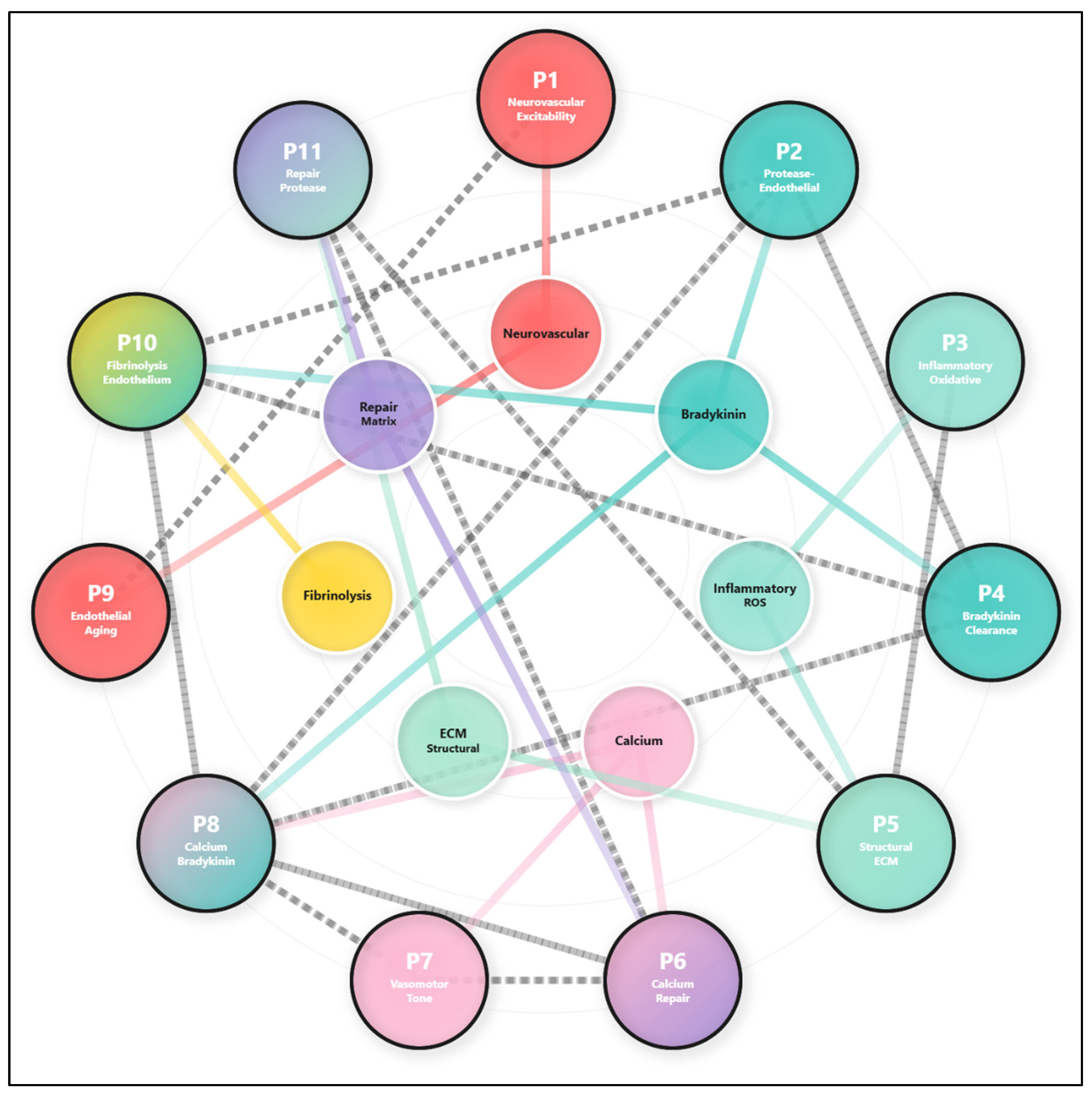
| Patient | Dominant Pathophysiological Pattern | Primary Rare Variants (HGVS) | Additional Rare Modulators (HGVS) | Shared Axis/Overlap |
|---|---|---|---|---|
| 1 | Neurovascular excitability bias | SCN10A c.4291G>A | EPHX2 c.1083+4A>G; CYP3A5 c.188A>G; ALK c.1202G>A | Neuronal–endothelial signaling |
| 2 | Protease–endothelial imbalance | CD36 c.1155dupA; SERPING1 c.857G>A | DSP c.6575G>A; XRCC1 c.1727A>C | Bradykinin/barrier axis |
| 3 | Inflammatory–oxidative susceptibility | HMOX1 c.836C>T; CFTR c.1795A>G; IFNG c.–5A>G | DSG2 c.1781T>C | Inflammation–ROS axis |
| 4 | Bradykinin clearance sensitivity | ACE c.1420T>C | GPT c.194G>A; HCN4 c.3599C>T | Bradykinin axis |
| 5 | Structural ECM vulnerability | COL4A1 c.1454C>T; ALOX5 c.178G>A | ACP1 c.97G>A | ECM–inflammation |
| 6 | Calcium and repair modulation | RYR1 c.10648C>T | BRCA2 c.7972T>C; ABI3BP c.1608G>C | Calcium/repair |
| 7 | Vasomotor tone modulation | KCNMA1 c.1613C>T | ITPR1 c.4543G>A; ANGPTL6 c.887G>A | Calcium axis |
| 8 | Calcium–bradykinin convergence | RYR1 c.7921C>T; XPNPEP2 c.644C>T | VWF c.3692A>C; ALPL c.571G>A | Calcium/bradykinin |
| 9 | Endothelial aging profile | PSEN2 c.766del; NOTCH1 c.1838G>A | SCN5A c.4853C>T; VCAM1 c.353A>T | Neurovascular integrity |
| 10 | Fibrinolysis–endothelium stress | PLG c.1748G>A; VWF c.974G>T | SH2B3 c.364G>A; intronic CNVs | Bradykinin/fibrinolysis |
| 11 | Repair and protease regulation bias | PTCHD1 c.2396T>C | CDH23 c.457G>A; SERPINB5 c.547T>C; SERPINA3 c.338C>T | Repair/matrix balance |
Disclaimer/Publisher’s Note: The statements, opinions and data contained in all publications are solely those of the individual author(s) and contributor(s) and not of MDPI and/or the editor(s). MDPI and/or the editor(s) disclaim responsibility for any injury to people or property resulting from any ideas, methods, instructions or products referred to in the content. |
© 2026 by the authors. Licensee MDPI, Basel, Switzerland. This article is an open access article distributed under the terms and conditions of the Creative Commons Attribution (CC BY) license.
Share and Cite
Tarsitano, M.; Russo, M.; Andreone, V.; Bova, M.; Palestra, F.; Candelaresi, P.; Servillo, G.; Ferrara, A.L.; Varricchi, G.; Ferrara, L.; et al. Alteplase and Angioedema: Can Clinical Exome Sequencing Redefine the Paradigm? Life 2026, 16, 200. https://doi.org/10.3390/life16020200
Tarsitano M, Russo M, Andreone V, Bova M, Palestra F, Candelaresi P, Servillo G, Ferrara AL, Varricchi G, Ferrara L, et al. Alteplase and Angioedema: Can Clinical Exome Sequencing Redefine the Paradigm? Life. 2026; 16(2):200. https://doi.org/10.3390/life16020200
Chicago/Turabian StyleTarsitano, Marina, Maurizio Russo, Vincenzo Andreone, Maria Bova, Francesco Palestra, Paolo Candelaresi, Giovanna Servillo, Anne Lise Ferrara, Gilda Varricchi, Luigi Ferrara, and et al. 2026. "Alteplase and Angioedema: Can Clinical Exome Sequencing Redefine the Paradigm?" Life 16, no. 2: 200. https://doi.org/10.3390/life16020200
APA StyleTarsitano, M., Russo, M., Andreone, V., Bova, M., Palestra, F., Candelaresi, P., Servillo, G., Ferrara, A. L., Varricchi, G., Ferrara, L., Loffredo, S., & Chetta, M. (2026). Alteplase and Angioedema: Can Clinical Exome Sequencing Redefine the Paradigm? Life, 16(2), 200. https://doi.org/10.3390/life16020200