Article

Functional Characterization of OsWRKY7, a Novel WRKY Transcription Factor in Rice

1
Hainan Institute, Zhejiang University, Yazhou Bay Science and Technology City, Sanya 572025, China
2
National Key Laboratory of Rice Breeding and Biology, The Advanced Seed Institute, Zhejiang University, Hangzhou 310058, China
3
School of Chemistry, Faculty of Science, University of Bristol, Bristol BS8 1TS, UK
*
Author to whom correspondence should be addressed.
These authors contributed equally to this work.
Life 2025, 15(12), 1852; https://doi.org/10.3390/life15121852
Submission received: 3 November 2025 / Revised: 29 November 2025 / Accepted: 30 November 2025 / Published: 2 December 2025
(This article belongs to the Special Issue Advancing Plant Resilience: Genetics and Agronomy)

Abstract

Transcription factors (TFs) orchestrate plant growth and development, yet the functional landscape of many TF gene families remains incomplete. Here, we systematically characterize OsWRKY7, an unannotated WRKY TF in rice. Phylogenomic analyses revealed that the WRKY7 subfamily originated in basal angiosperms and evolved under strong purifying selection. We demonstrate OsWRKY7 functions as a WRKY transcriptional activator, with its activity uniquely encoded within the N-terminal domain—a distinctive mechanism among WRKY proteins. The promoter is enriched with cis-elements responsive to hormone and stress signaling, and the gene shows predominant expression in seeds. Strikingly, haplotype analysis revealed exceptionally low genetic diversity at the OsWRKY7 locus, suggesting evolutionary constraint or a recent selective sweep. Our findings establish OsWRKY7 as a conserved regulator with unique molecular features, specifically the WRKY domain, providing a strategic target for both fundamental research and crop improvement.

1. Introduction

Oryza sativa L. (rice) is a staple food for more than half of the global population and stands as a core crop for safeguarding food security [1,2,3]. The adaptive responses of rice to abiotic and biotic challenges, as well as its growth and development, are directed by complex gene regulatory networks [4,5,6]. As key nodes within this network, transcription factors (TFs) maintain rice’s adaptability to environmental signals by binding to cis-elements in target genes and regulating their expression [7,8,9]. Among the plant-specific transcription factor families, the WRKY family has emerged as a core regulator of rice’s stress tolerance, disease resistance, and growth and development [10]. The WRKY family, a class of plant-specific transcription factors, constitutes a central regulatory module that coordinates rice stress tolerance, immunity, and agronomic traits [4,11]. WRKY proteins are characterized by their namesake WRKY domain, a 60-residue region that contains the invariant WRKYGQK heptapeptide at its N-terminus and a C2H2-type zinc-finger motif [12]. While WRKYGQK is the canonical sequence, variants such as WRKYGKK exist, with the consensus broadly defined as W(R/K)(K/R)Y [13,14]. This domain confers the ability to bind W-box cis-elements, thereby modulating transcriptional outputs [4,10]. Given their profound influence on critical phenotypes, members of the rice WRKY family represent high-value targets for molecular breeding strategies designed to engineer stress-resilient and high-yielding varieties [15].
WRKY transcription factors are hierarchically classified into three principal groups (I, II, and III) based on two structural features: the number of WRKY domains (two in Group I, one in Groups II and III) and the type of zinc-finger motif (C2H2 for Groups I and II, C2HC for Group III) [11]. This classification provides a structural framework for understanding the functional diversity of this key protein family [11,15,16]. Members of Group I often exhibit specialized roles in stress adaptation [17]. For instance, OsWRKY53 acts as a negative regulator under both cold and salt stress [18,19]. It attenuates cold tolerance by repressing gibberellic acid biosynthesis, thereby compromising pollen fertility [19], and impairs salt tolerance by directly suppressing the expression of key salt-tolerance genes such as OsMKK10.2 and OsHKT1;5 [18]. Group II is the largest and most functionally diverse [17]. Its members frequently exert opposing effects within the same stress context. Under cold stress, OsWRKY71 [20] and OsWRKY76 [21] act as positive regulators, whereas OsWRKY63 functions as a negative regulator by suppressing OsWRKY76 expression [22]. Similarly, in drought responses, OsWRKY11 enhances tolerance [23], while OsWRKY5, OsWRKY55, and OsWRKY114 negatively impact it [24,25,26]. During salt stress, however, Group II members such as OsWRKY54 predominantly serve positive roles—for example, by activating OsHKT1 to maintain Na+/K+ homeostasis [27]. In Group III, OsWRKY70 and OsWRKY94 promote cold tolerance by upregulating cold-responsive genes such as OsLti6b and OsICE1, while fine-tuning the balance between defense and growth [28]. In contrast, OsWRKY10 acts as a negative regulator of thermotolerance; its inhibitory effect is alleviated through interaction with VQ8, thereby enhancing heat stress resilience [29]. Collectively, WRKY proteins from different groups constitute a sophisticated and interconnected regulatory network that enables rice to coordinate adaptive responses to diverse environmental challenges [4,30].
While the WRKY transcription factor family is well-established as a central regulator of crop stress responses, the functional characterization of OsWRKY7 remains incomplete. Based on the nucleotide and amino acid sequence analysis of the poorly studied OsWRKY7, we hypothesize that this protein plays a role in stress adaptation due to the presence of conserved WRKY motifs and nuclear localization signals, but it also exhibits unique characteristics, such as distinct C-terminal domain organization. To investigate this hypothesis, we will systematically examine its evolutionary lineage, protein architecture, subcellular localization, and transcriptional activation potential. Furthermore, we will profile its expression patterns under various abiotic stresses and validate its binding to key cis-regulatory elements. Through this comprehensive approach, our work aims to elucidate the molecular mechanisms underlying OsWRKY7 function in environmental adaptation, ultimately establishing its value as a candidate gene for developing stress-resilient rice varieties.

2. Materials and Methods

2.1. Cloning and Sequence Analysis of OsWRKY7

Protein sequences of WRKY7 homologs from diverse plant species were retrieved from the NCBI database. Phylogenetic analysis was performed with MEGA 7.0 [31] to reconstruct the evolutionary relationships among these sequences, and a phylogenetic tree was generated. The tree was then visualized and refined using the Interactive Tree of Life (iTOL) (available online: https://itol.embl.de/ (accessed on 28 November 2025) (iTOL) [32]).
To investigate closely related lineages, we selected homologous protein sequences from plant species phylogenetically adjacent to OsWRKY7. Multiple sequence alignments (MSAs) of these homologs—including OsWRKY7 and its orthologs from other plants—were generated using DNAMAN (version 9) [33] software. Homology models of the target proteins from representative species were subsequently constructed using the SWISS-MODEL (available online: https://swissmodel.expasy.org/ (accessed on 28 November 2025)) [34].

2.2. Bioinformatic Analysis of OsWRKY7

For comprehensive protein characterization, we utilized several tools. We used ProtScale (available online: https://web.expasy.org/protscale/ (accessed on 28 November 2025) [35]) to generate residue-level hydrophobicity/hydrophilicity profiles (e.g., Kyte-Doolittle scale) for mapping amphipathic regions [31]. We interrogated the SMART database to identify evolutionarily conserved domains within the OsWRKY7 protein for functional annotation. We applied TMHMM 2.0 (DTU Health Tech) (available online: http://www.cbs.dtu.dk/services/TMHMM/ (accessed on 28 November 2025) [36]) to predict transmembrane helices while noting potential signal peptide overlaps in N-terminal predictions (with cross-validation considered using DeepTMHMM (available online: https://dtu.biolib.com/DeepTMHMM (accessed on 28 November 2025) [37]) for enhanced accuracy). In addition, we applied NetPhos 3.1 Server (available online: https://services.healthtech.dtu.dk/services/NetPhos-3.1/ (accessed on 28 November 2025)) to prioritize serine/threonine/tyrosine phosphorylation sites, integrating evolutionary conservation scores to contextualize functional relevance (prediction of post-translational glycosylation and phosphorylation of proteins from the amino acid sequence [38]).

2.3. Subcellular Localization Prediction

The subcellular localization of OsWRKY7 was predicted using the CELLO v.2.5 CELLO—SubCELlular LOcalization predictor (available online: http://cello.life.nctu.edu.tw/ (accessed on 27 November 2025) [39]). The protein sequence file of OsWRKY7 was retrieved from the NCBI database and stored for subsequent analysis. The online tool CELLO v.2.5 was accessed, and the OsWRKY7 protein sequence was submitted to this platform. Subsequent submission of the sequence enabled the prediction of the subcellular localization of the target gene.

2.4. Analysis of Conserved Motifs and Domains in Rice WRKY Proteins

To characterize the conserved motifs of rice WRKY proteins, we employed the MEME online tool MEME—Multiple Em for Motif Elicitation (available online: https://meme-suite.org/meme/ (accessed on 28 November 2025) [40]) with parameters configured to identify 10 motifs spanning 6–50 amino acids in length. Conserved domain annotations for these proteins were retrieved from the NCBI Conserved Domain Database (CDD) (available online: http://www.ncbi.nlm.nih.gov/Structure/bwrpsb/bwrpsb.cgi (accessed on 28 November 2025) [41]). Gene structure analysis of the rice WRKY family in chromosome 5 was conducted using the rice genome annotation file (version 7.0) from the Rice Genome Annotation Project (RGAP) Rice Genome Annotation Project (available online: http://rice.uga.edu/ (accessed on 28 November 2025) [42]). Finally, conserved motifs, domains, and gene structures were visualized using the advanced GeneStructureView tool integrated within TBtools-II [43].

2.5. Analysis of the Transcriptional Activation Activity of OsWRKY7

All chemical reagents, prepared media, and cloning vectors employed in this work were obtained from Coolaber Science and Technology Co., Ltd. (Beijing, China). (YM2000-1Set, YS3093, YS3091).
The transcriptional activation activity was assessed using a yeast two-hybrid (Y2H) assay, as previously described by Li et al. [44] with minor modifications. The full-length coding sequence (CDS) of OsWRKY7, along with its N-terminal (1–360 bp) and C-terminal (361–666 bp) CDS fragments, was used as a template for primer design. For each fragment, forward and reverse primers of 18–22 bp in length were designed, with annealing temperatures around 60 °C, and homologous arms matching the pGBKT7 vector were added to their respective ends. Using rice cDNA as the template, polymerase chain reaction (PCR) was performed to amplify the corresponding fragments, each flanked by the pGBKT7 homologous arms. These fragments were then assembled into the linearized pGBKT7 vector via homologous recombination, resulting in the construction of the recombinant vectors pGBKT7-OsWRKY7, pGBKT7-OsWRKY7-N, and pGBKT7-OsWRKY7-C. Primer sequences are listed in Table S1. These plasmids were then co-transformed with pGADT7 (carrying the transcriptional activation domain) into Y2HGold yeast competent cells using the PEG/LiAc method, in accordance with the Yeastmaker™ Yeast Transformation System 2 kit (coolaber). Transformed yeast cells were selected on SD/-Leu/-Trp (DDO) solid medium and incubated at 30 °C for 3 days. Individual colonies were subsequently inoculated into DDO liquid medium and grown at 30 °C until shake-cultured for 16–18 h until OD600 ≈ 0.8. A 10 μL aliquot of each culture was spotted onto both SD/-Leu/-Trp and SD/-Leu/-Trp/-His/-Ade (QDO) agar plates, followed by incubation at 30 °C for 3–4 days to monitor growth. Yeast cells co-transformed with empty pGBKT7 and pGADT7 vectors served as the negative control.

2.6. Analysis of Promoter Cis-Element and Haplotype

The 2000 bp promoter region upstream of the ATG translation initiation codon of the OsWRKY7 gene was extracted from the Rice Genome Annotation Project (RGAP, version 7.0) database. Using the PlantCARE online platform (available online: http://bioinformatics.psb.ugent.be/webtools/plantcare/html/ (accessed on 28 November 2025) [45]), we conducted a comprehensive computational scan of this sequence to systematically identify cis-acting elements, characterizing their types, genomic distribution patterns, and putative regulatory roles. To visually resolve the spatial arrangement of these elements, TBtools-II software was employed to generate high-resolution visualizations of the predicted cis-acting elements within the promoter, enabling intuitive interpretation of their compositional diversity and positional distribution characteristics across the regulatory region.
Single-nucleotide polymorphisms (SNPs) were obtained from 10,548 rice accessions deposited in the RiceSuperPIRdb database (available online: RiceSuperPIRdb (http://www.ricesuperpir.com, accessed on 28 November 2025) [46,47]). Wild rice SNPs were sourced from our previous study [48]. Pairwise values were analyzed using Haploview 4.0 [49].

2.7. Analysis of OsWRKY7 Expression Characteristics

The tissue-specific expression pattern of OsWRKY7 was predicted using the eFP website eFP Browser (available online: http://bar.utoronto.ca/efp_rice/cgi-bin/efpWeb.cgi (accessed on 27 May 2024) [50,51]).

2.8. RNA Extraction and Quantitative Real-Time PCR (qRT-PCR)

The rice cultivar ‘ZH11’ was selected as the experimental material for quantifying the expression of OsWRKY7. Two-week-old hydroponically cultivated rice variety ‘ZH11’ seedlings, grown at 28 °C, provided the experimental materials (0.5 g of samples), including leaves, stems, and roots. Total RNA was isolated using the Easy Rice RNA Rapid Extraction Kit (Non-TRIzol method, Cat# DR0408050, Hangzhou, China), and qRT-PCR was performed with the HieffqPCR SYBR Green Master Mix (Cat# 11201ES60, Shanghai, China) according to the manufacturer’s protocol, employing gene-specific primers (Table S1). Transcript levels were normalized to the ACTIN gene using the 2−ΔΔCt method.

2.9. Statistical Analysis

All quantitative experiments were performed with at least three independent biological replicates. Data are presented as mean ± standard deviation (SD). Prior to parametric analysis, the normality of all datasets was verified using the Shapiro–Wilk test (p > 0.05), and homogeneity of variances was confirmed by Levene’s test (p > 0.05). One-way ANOVA with Tukey’s post hoc test was employed for multiple comparisons when more than two groups were analyzed. Statistical analyses were conducted using GraphPad Prism 9.0, with p < 0.05 considered statistically significant.

3. Results

3.1. Analysis of WRKY7 Structural Conservation

This study systematically identifies homologous genes of OsWRKY7, a key member of the WRKY transcription factor family in rice (Oryza sativa), and reconstructs the evolutionary history of the WRKY7 subfamily across diverse plant lineages. We initiated our analysis by performing homology searches using the BLASTP 2.17.0 algorithm (E-value threshold = 1 × 10⁻¹⁰, maximum target sequences = 1000, coverage ≥ 30%) against the NCBI non-redundant protein database, with the OsWRKY7 protein sequence as the query. This approach successfully identified WRKY7 homologs from over 50 representative plant species, spanning angiosperms (e.g., Arabidopsis thaliana, Zea mays, Setaria italica), gymnosperms (e.g., Pinus spp.), ferns (e.g., Nephrolepis cordifolia), and lycophytes (e.g., Selaginella moellendorffii) (Table S2).
To elucidate evolutionary relationships, we reconstructed a neighbor-joining phylogenetic tree with 1000 bootstrap replicates using WRKY7 protein sequences from 20 strategically selected species representing key evolutionary nodes, including basal monocots, core eudicots, and basal fern lineages. The resulting phylogeny, presented in a circular layout (Figure 1A), highlights Oryza sativa within a red rectangle. Our analysis reveals that the OsWRKY7 ortholog in Setaria italica shares 78.6% sequence identity and clusters with rice in a basal clade. Molecular dating estimates indicate their divergence predates the monocot–eudicot split (≈160 million years ago), suggesting the WRKY7 subfamily originated in basal angiosperm lineages, particularly within the Poales order, and has been functionally maintained across diverse plant groups throughout evolution.
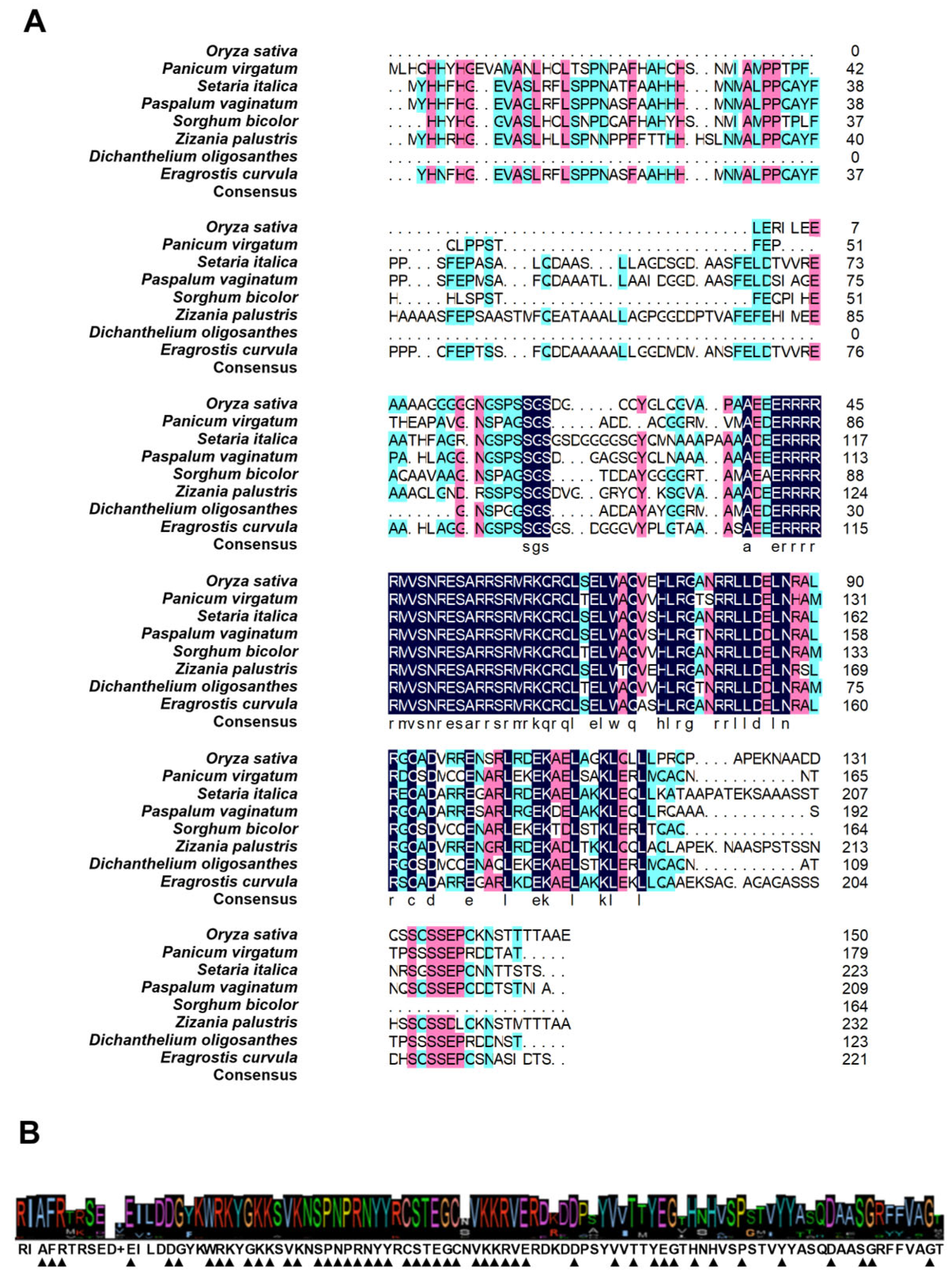
To investigate structural conservation, we selected WRKY7 orthologs from a phylogenetically diverse set of species, including Oryza sativa, Panicum virgatum, Setaria italica, Paspalum vaginatum, Sorghum bicolor, Zizania palustris, Dichanthelium oligosanthes, and Eragrostis curvula. Homology models of the corresponding WRKY7 proteins were generated using the SWISS-MODEL server (https://swissmodel.expasy.org, accessed on 28 November 2025), enabling comparative analysis of conserved structural features across representative monocot and eudicot taxa (Figure 1B). This integrated (WRKYGQK sequence and zinc finger structure) approach provides valuable insights into the evolutionary preservation of critical structural determinants underlying WRKY7 function in plant biology.
To complement our phylogenetic findings, we performed multiple sequence alignment (MSA) using ClustalW and predicted secondary structures with MEMSAT-SVM. These analyses revealed remarkable conservation in both sequence and structural features among WRKY7 proteins across all examined species. The MSA identified several highly conserved regions (gray-shaded) and core functional motifs (red-highlighted), including EILDGKYW and RNYVRCST, which showed minimal sequence variation despite moderate length differences among orthologs (ranging from 64 residues in Dichanthelium oligosanthes to 132 residues in Eragrostis curvula) (Figure 2).
Collectively, these findings establish the evolutionary origins of the WRKY7 subfamily (basal angiosperms) and its functional conservation across the plant kingdom, providing critical evidence for further investigations into its biological roles and adaptive evolution (Figure 1 and Figure 2).

3.2. Physicochemical Properties and Structural Analysis of the OsWRKY7 Encoding Protein

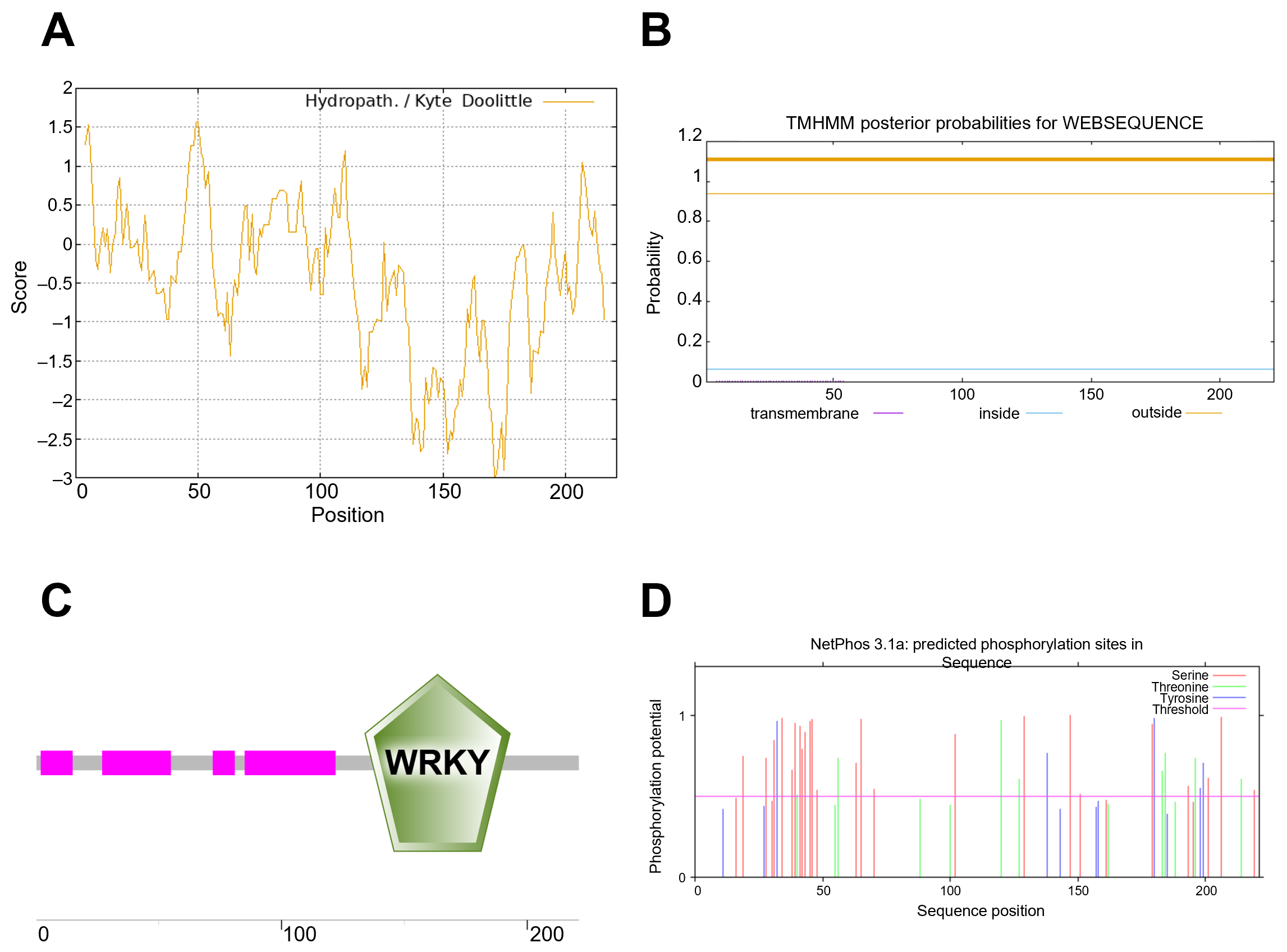
The OsWRKY7 protein is encoded by a 711 bp open reading frame and comprises 221 amino acids, with a predicted molecular weight of 23.17 kDa and a theoretical isoelectric point (pI) of 6.59. Biochemical characterization classified OsWRKY7 as an unstable hydrophilic protein, supported by an instability index of 52.76 and a grand average of hydropathicity (GRAVY) score of −0.441 (Figure 3A). Structural analysis using TMHMM confirmed the absence of transmembrane domains, indicating OsWRKY7 is not membrane-associated (Figure 3B). Domain architecture analysis revealed a canonical WRKY DNA-binding domain spanning residues 134–193, consistent with the conserved structure of plant WRKY transcription factors (Figure 3C). Post-translational modification prediction via NetPhos 3.1 identified 42 potential phosphorylation sites, including 28 serine, 13 threonine, and 11 tyrosine residues (Figure 3D), suggesting OsWRKY7 may undergo extensive regulatory phosphorylation by Ser/Thr/Tyr kinases. Subcellular localization prediction using CELLO v.2.5 indicated nuclear enrichment of OsWRKY7, supporting its predicted function as a transcription factor (Figure S1).

3.3. Structural Characteristics of the WRKY Protein Family Domains and Genes in Rice

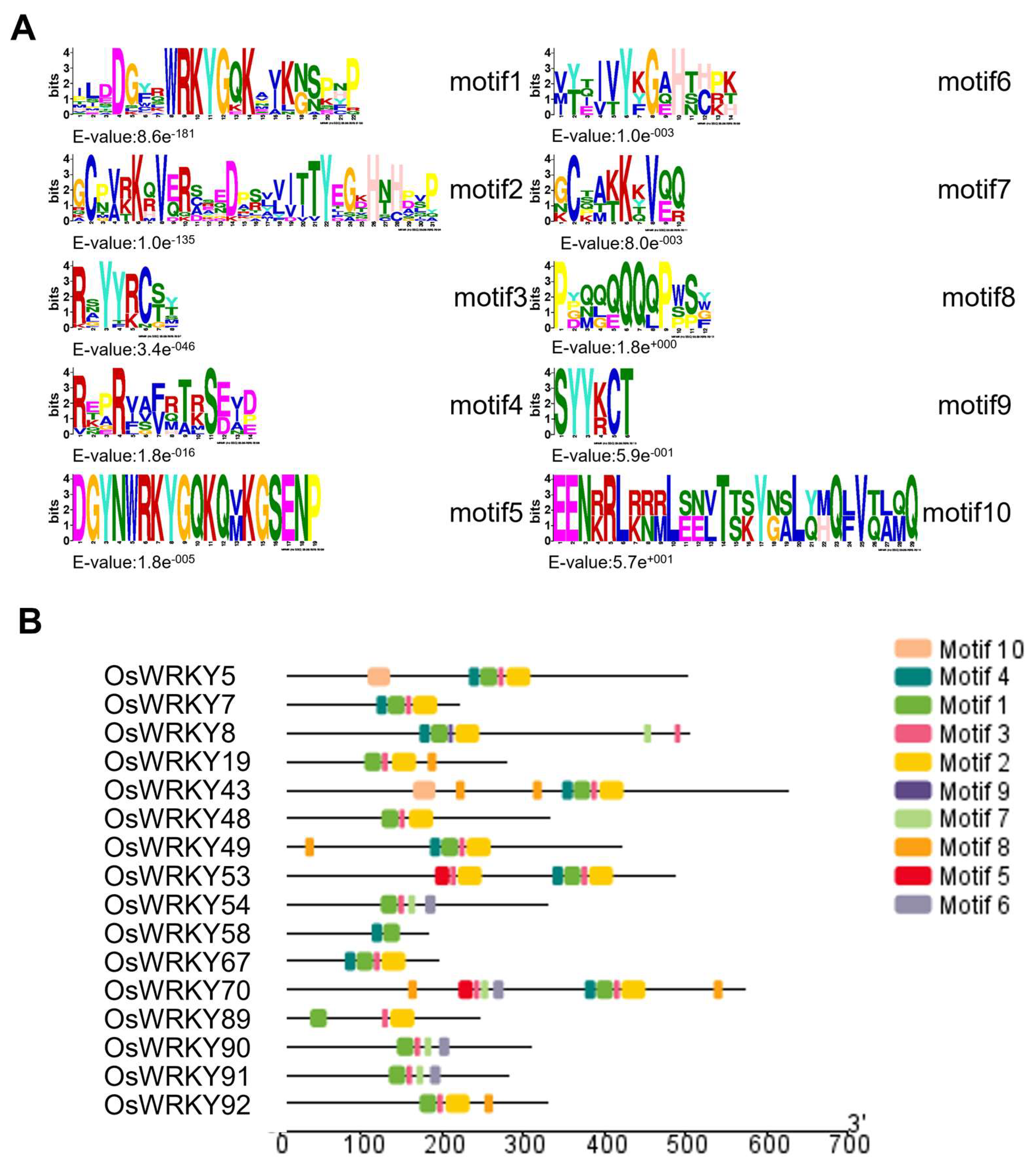
Our analysis identified ten conserved motifs, designated motif 1 to motif 10 in order of increasing E-values (Figure 4A). Notably, motif1 was present in all WRKY proteins encoded by chromosome 5-localized genes (Figure 4B), indicating that it represents a core, evolutionarily conserved signature of OsWRKY proteins. Furthermore, most WRKY family members contained motifs 1 through 7, reflecting substantial sequence conservation and suggesting potential functional redundancy among rice WRKY factors. Together, these findings support the hypothesis that OsWRKY7 may perform biological roles analogous to those of other WRKY family members in rice.

3.4. Transcriptional Activation Analyses of OsWRKY7

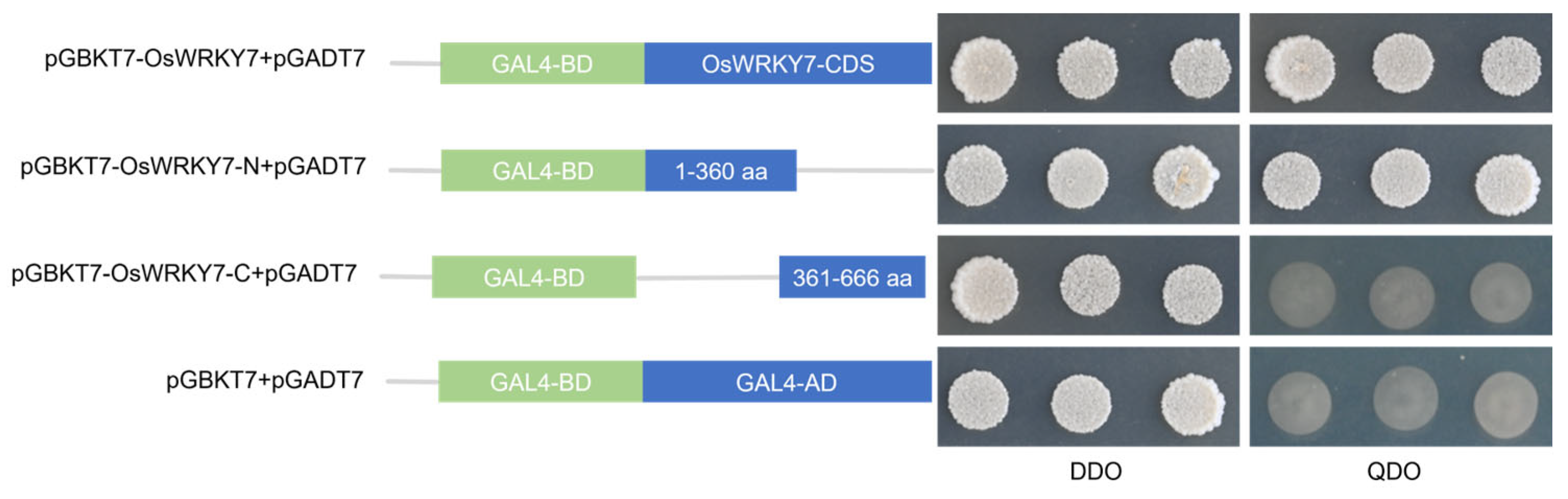
To further investigate the transcriptional activation potential of OsWRKY7, we conducted a functional assay in yeast cells. The results demonstrated that OsWRKY7 possesses strong transcriptional activation activity in yeast (Figure 5). Domain-deletion analysis further revealed that this transactivation capability is primarily mediated by its N-terminal domain (Figure 5).

3.5. Analysis of OsWRKY7’s Promoter Elements and Haplotype

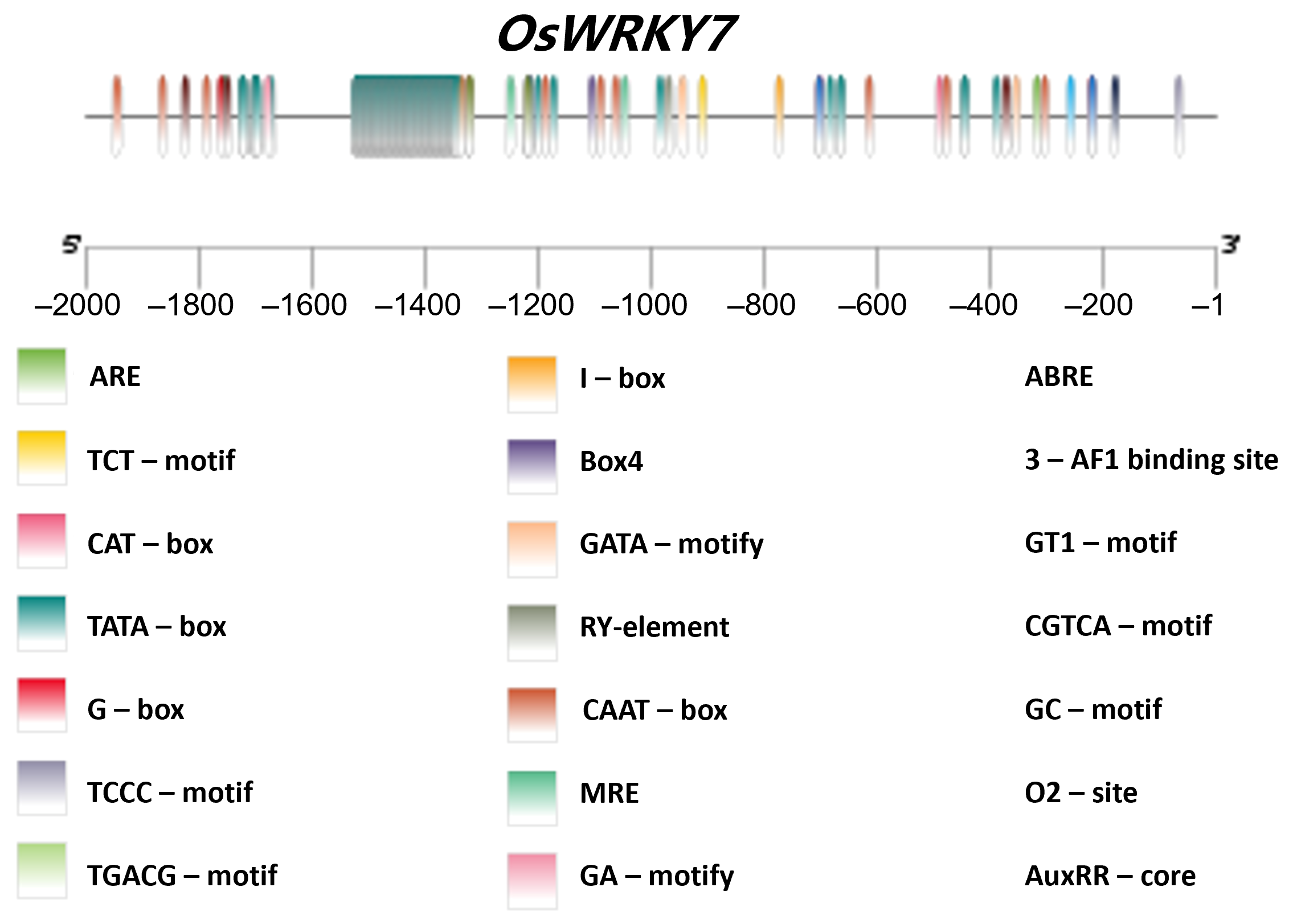
To characterize the cis-acting elements within the promoter region of OsWRKY7, we extracted the 2.0 kb genomic sequence upstream of its translational start codon from the Rice Annotation Project Database (RAP-DB) (Figure S2). Subsequent analysis of these promoter sequences was performed using the online tool PlantCARE (Table S3). Our results revealed that, in addition to the canonical TATA-box and CAAT-box core promoter elements, the OsWRKY7 promoter contains multiple cis-acting regulatory elements associated with hormone signaling and abiotic stress responses. Specifically, these include elements responsive to abscisic acid (ABA), methyl jasmonate (MeJA), auxin, and drought stress. Notably, we also identified light-responsive cis-acting elements within the promoter, suggesting that OsWRKY7 may function in integrating hormone-mediated, abiotic stress, and light perception signaling pathways during plant growth and development (Figure 6).
To investigate the genetic diversity and evolutionary dynamics of the rice OsWRKY7 gene, we conducted a haplotype analysis using Haploview software 4.0. The following parameters were evaluated for each polymorphic site: Position (physical location on the chromosome), ObsHET (observed heterozygosity), PredHET (predicted heterozygosity under Hardy–Weinberg equilibrium), HWval (p-value from Hardy–Weinberg equilibrium test), %Geno (genotyping success rate), FamTrio (number of family trios analyzed), MendErr (number of Mendelian errors detected), MAF (minor allele frequency), and Alleles (nucleotide variants observed). Values preceded by ‘<’ indicate measurements below the detection threshold. We focused on single-nucleotide polymorphisms (SNPs) within the OsWRKY7 locus and filtered SNP data from a natural rice population with a minor allele frequency (MAF) threshold of ≥0.05 (Table S4). This analysis identified only two well-differentiated haplotypes, designated Hap1 and Hap2, which were stably present across accessions. However, the limited number of haplotypes (n = 2) substantially restricts the ability to perform subsequent evolutionary and functional analyses, as the low genetic diversity provides insufficient resolution for robust statistical inference (Figure S3).

3.6. The Expression Patterns of OsWRKY7 in Different Tissues

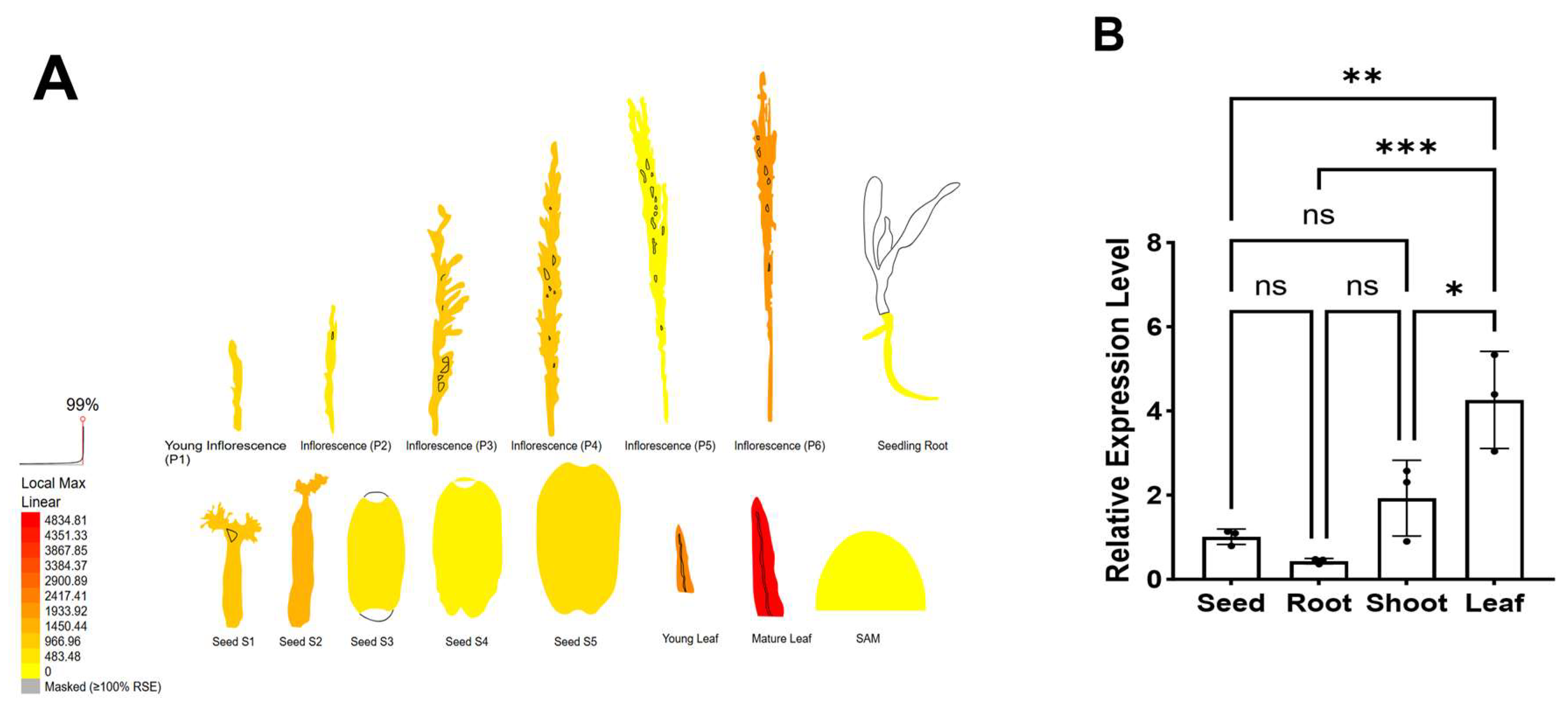
By analyzing the expression of OsWRKY7 in different rice tissues through the rice eFP online website (https://bar.utoronto.ca/efprice/cgi-bin/efpWeb.cgi, accessed on 28 November 2025) (Figure 7A), it was found that OsWRKY7 is expressed in rice seeds, roots, leaves, inflorescences, and shoot apical meristems, with the highest expression in mature leaves. This indicates that the expression of OsWRKY7 has significant spatiotemporal specificity and may play its biological function in different parts of rice. Furthermore, we performed quantitative real-time PCR (qRT-PCR) to monitor OsWRKY7 expression across various rice tissues (Figure 7B). The results aligned with bioinformatic predictions: OsWRKY7 expression was highest in leaves, while no significant differences were observed among seeds, roots, and stems. This tissue-specific expression pattern corroborates the computational predictions and substantiates the proposed functional diversification of OsWRKY7 in different plant tissues.

4. Discussion

This study provides a systematic characterization of the transcription factor OsWRKY7 in rice, elucidating its evolutionary origin and functional properties. Our findings demonstrate that the WRKY7 subfamily originated in basal angiosperms and exhibits remarkable conservation in both protein sequence and three-dimensional structure across monocot and eudicot lineages, suggesting its fundamental and non-redundant biological role. OsWRKY7 encodes a nuclear-localized, unstable hydrophilic protein with strong transcriptional activation capacity mediated by its N-terminal domain. Promoter analysis revealed the presence of multiple cis-acting elements responsive to abscisic acid, methyl jasmonate, and drought stress. Furthermore, expression profiling showed predominant accumulation in mature leaves with distinct spatiotemporal specificity. Collectively, these results indicate that OsWRKY7 appears to integrate hormonal and environmental signals to modulate stress adaptation and developmental processes in rice. This functional role supports its potential as a candidate gene for molecular breeding of stress-resilient varieties.
OsWRKY7 exhibits a dual pattern of “highly conserved commonality” and “subfamily-specificity” in its evolution and homology compared to other rice WRKY family genes. Similar to defense-related members such as OsWRKY53 [52], OsWRKY7 possesses the complete WRKYGQK sequence and zinc finger structure, which are essential for binding to the W-box cis-element in target genes, reflecting a core functional commonality within the family. However, in contrast to certain WRKY genes (e.g., OsWRKY45 [53]) that have undergone artificial selection during domestication, resulting in novel alleles, OsWRKY7 displays remarkable evolutionary stability. This conservation strongly suggests that OsWRKY7 may fulfill a more fundamental and core physiological role, the integrity of which is critical enough to be maintained under natural selection, thereby rendering its function non-redundant and irreplaceable by other WRKY members.
Furthermore, the full-length OsWRKY7 protein exhibits typical transactivation activity in a yeast system, a characteristic shared with several documented rice WRKY members such as OsWRKY95 [54] and OsWRKY53 [55]. This functional similarity suggests evolutionary conservation of regulatory mechanisms among these transcription factors, likely linked to their central roles in disease resistance and abiotic stress responses. Notably, analogous to OsWRKY26 [56], the transactivation domain of OsWRKY7 was mapped to its N-terminal region. Based on this finding, we generated a truncated version of OsWRKY7 lacking the N-terminal activation domain. This construct can serve as bait in subsequent yeast one-hybrid or two-hybrid screens to systematically identify proteins that interact with OsWRKY7. This approach will provide critical experimental groundwork for elucidating the regulatory network and downstream signaling pathways governed by OsWRKY7.
The regulatory potential of OsWRKY7 is further emphasized by its promoter architecture, which is enriched with cis-acting elements responsive to abscisic acid, jasmonic acid, auxin, and drought stress. This structural feature parallels the regulatory patterns observed in other rice WRKY members: for instance, OsWRKY45 expression is strongly induced by the SA analog BTH [57], while OsWRKY72 is upregulated by ABA and PEG-mediated drought simulation [58]. At the post-translational level, OsWRKY53 serves as a substrate for OsMPK3/OsMPK6, and phosphorylation of its N-terminal region significantly enhances its transactivation activity [59,60]. In light of these conserved regulatory mechanisms, we propose that OsWRKY7 likely functions as a key transcriptional decoder of developmental and environmental signals, potentially orchestrating resource allocation between stress resilience and reproductive development—a fundamental trade-off in rice.
By elucidating the strong purifying selection and pronounced haplotype bottleneck that define OsWRKY7’s evolutionary distinctiveness, this study reveals its non-redundant biological functions [61,62,63,64]; furthermore, the discovery of its N-terminal transcriptional activation mechanism—distinct from conventional WRKY domain-centric models—establishes a unique molecular regulatory paradigm for this gene. Most significantly, its seed-specific expression pattern combined with cis-regulatory complexity underscores specialized roles in developmental regulation [65,66,67,68]. These findings systematically elevate OsWRKY7 from an uncharacterized WRKY member to an evolutionarily constrained regulator, not only opening new avenues for deciphering rice transcriptional networks but also enabling the utilization of its genetic stability for trait consolidation in breeding programs.

Supplementary Materials

The following supporting information can be downloaded at https://www.mdpi.com/article/10.3390/life15121852/s1, Figure S1. Prediction of OsWRKY7 subcellular localization. Figure S2. Analysis of the OsWRKY7 promoter. Figure S3. Haplotype analysis of OsWRKY7. Table S1. Primers and sequences in this study. Table S2. Protein sequences of OsWRKY7 homologs from diverse plant species. Table S3. Cis-acting elements in the OsWRKY7 promoter region. Table S4. Haplotype analysis of OsWRKY7.

Author Contributions

Conceptualization, M.J.; methodology, Y.W., Z.S., H.Z., C.H., C.Z. and Y.T.; software, Y.W. and B.L.; validation, Y.W., Z.S. and H.Z.; formal analysis, Y.W., Z.S. and H.Z.; investigation, Y.W., Z.S. and H.Z.; resources, M.J.; data curation, Y.W. and B.L.; writing—original draft preparation, Y.W., B.L., Q.S. and M.J.; writing—review and editing, Q.S. and M.J.; visualization, Q.S. and M.J.; supervision, Q.S. and M.J.; project administration, Q.S. and M.J.; funding acquisition, Q.S. and M.J. All authors have read and agreed to the published version of the manuscript.

Funding

This research was funded by the Hainan Provincial Natural Science Foundation of China (325RC799), the National Science Foundation of China (32570362, 32460077), the Hainan Province Science and Technology Special Fund (ZDYF2025XDNY093), the ‘Nanhai New Star’ Technology Innovation Talent Platform Project of Hainan Province (NHXXRCXM202362), and the Research Startup Funding from Hainan Institute of Zhejiang University (0201-6602-A12203).

Institutional Review Board Statement

Not applicable.

Informed Consent Statement

Not applicable.

Data Availability Statement

The original contributions presented in this study are included in the article/Supplementary Material. Further inquiries can be directed to the corresponding author.

Conflicts of Interest

The authors declare no conflicts of interest.

References

  1. D’Odorico, P.; Carr, J.A.; Laio, F.; Ridolfi, L.; Vandoni, S. Feeding Humanity Through Global Food Trade. Earth’s Future 2014, 2, 458–469. [Google Scholar] [CrossRef]
  2. Hu, C.; Wang, Z.; Zhang, L.; Liu, Y.; Chen, H. Transcriptome and Hormonal Analyses Reveal an Important Role of Auxin and Cytokinin in Regulating Rice Ratooning Ability. Plant Stress 2025, 16, 100866. [Google Scholar] [CrossRef]
  3. Jiang, M.; Li, X.; Wang, K.; Zhang, Q.; Zhou, Y. Transcription Factor OsbZIP10 Modulates Rice Grain Quality by Regulating OsGIF1. Plant J. 2024, 119, 2181–2198. [Google Scholar] [CrossRef] [PubMed]
  4. Eulgem, T.; Rushton, P.J.; Robatzek, S.; Somssich, I.E. The WRKY Superfamily of Plant Transcription Factors. Trends Plant Sci. 2000, 5, 199–206. [Google Scholar] [CrossRef] [PubMed]
  5. Jiang, M.; Chen, S.; Wang, H.; Li, F.; Zhang, R. An Alanine to Valine Mutation of Glutamyl-tRNA Reductase Enhances 5-Aminolevulinic Acid Synthesis in Rice. Theor. Appl. Genet. 2022, 135, 2817–2831. [Google Scholar] [CrossRef] [PubMed]
  6. Sun, L.; Wang, X.; Chen, J.; Liu, S.; Yang, H. Role of Serotonin in Plant Stress Responses: Quo Vadis? J. Integr. Plant Biol. 2025, 67, 1706–1724. [Google Scholar] [CrossRef]
  7. Eulgem, T.; Somssich, I.E. Networks of WRKY Transcription Factors in Defense Signaling. Curr. Opin. Plant Biol. 2007, 10, 366–371. [Google Scholar] [CrossRef]
  8. Jiang, M.; Zhang, Y.; Wang, L.; Liu, X.; Zhou, T. Melatonin Activates the OsbZIP79-OsABI5 Module that Orchestrates Nitrogen and ROS Homeostasis to Alleviate Nitrogen-Limitation Stress in Rice. Plant Commun. 2023, 4, 100674. [Google Scholar] [CrossRef]
  9. Li, R.; Wang, H.; Chen, M.; Liu, Y.; Zhang, K. OsbZIP83-OsCOMT15 Module Confers Melatonin-Ameliorated Cold Tolerance in Rice. Plant J. 2025, 123, e70402. [Google Scholar] [CrossRef]
  10. Xie, Z.; Zhang, Z.L.; Zou, X.; Huang, J.; Ruas, P.; Thompson, D.; Shen, Q.J. Annotations and Functional Analyses of the Rice WRKY Gene Superfamily Reveal Positive and Negative Regulators of Abscisic Acid Signaling in Aleurone Cells. Plant Physiol. 2005, 137, 176–189. [Google Scholar] [CrossRef]
  11. Rushton, P.J.; Somssich, I.E.; Ringler, P.; Shen, Q.J. WRKY Transcription Factors. Trends Plant Sci. 2010, 15, 247–258. [Google Scholar] [CrossRef]
  12. Yamasaki, K.; Kigawa, T.; Inoue, M.; Tateno, M.; Yamasaki, T.; Yabuki, T.; Aoki, M.; Seki, E.; Matsuda, T.; Nunokawa, E.; et al. Structural Basis for Sequence-specific DNA Recognition by an Arabidopsis WRKY Transcription Factor. J. Biol. Chem. 2012, 287, 7683–7691. [Google Scholar] [CrossRef]
  13. Dhatterwal, P.; Basu, S.; Mehrotra, S.; Mehrotra, R. Genome Wide Analysis of W-box Element in Arabidopsis thaliana Reveals TGAC Motif with Genes Down Regulated by Heat and Salinity. Sci. Rep. 2019, 9, 1681. [Google Scholar] [CrossRef]
  14. Huang, S.; Gao, Y.; Liu, J.; Peng, X.; Niu, X.; Fei, Z.; Cao, S.; Liu, Y. Genome-wide Analysis of WRKY Transcription Factors in Solanum lycopersicum. Mol. Genet. Genom. 2012, 287, 495–513. [Google Scholar] [CrossRef]
  15. Li, T.; Zhang, H.; Wang, J.; Chen, Y.; Wang, F.; Liu, J. WRKY Transcription Factors in Rice: Key Regulators Orchestrating Development and Stress Resilience. Plant Cell Environ. 2025, 48, 8388–8406. [Google Scholar] [CrossRef] [PubMed]
  16. Yang, L.; Liu, J.; Wang, X.; Wang, R.; Ren, F.; Liu, Q.; Chen, L.; Pang, Y.; Zhao, F. WRKY Transcription Factors: Hubs for Regulating Plant Growth and Stress Responses. J. Integr. Plant Biol. 2025, 67, 488–509. [Google Scholar] [CrossRef] [PubMed]
  17. Jiang, J.; Ma, S.; Ye, N.; Jiang, M.; Cao, J.; Zhang, J. WRKY Transcription Factors in Plant Responses to Stresses. J. Integr. Plant Biol. 2017, 59, 86–101. [Google Scholar] [CrossRef]
  18. Yu, J.; Zhan, X.; Zhang, D.; Wang, L.; Zhang, Y.; Wang, S.; Li, S. Genome-wide Association Studies Identify OsWRKY53 as a Key Regulator of Salt Tolerance in Rice. Nat. Commun. 2023, 14, 3550. [Google Scholar] [CrossRef]
  19. Tang, J.; Wu, D.; Li, X.; Wang, L.; Xu, L.; Zhang, Y.; Xu, F.; Liu, H.; Xie, Q.; Dai, S.; et al. WRKY53 Negatively Regulates Rice Cold Tolerance at the Booting Stage by Fine-tuning Anther Gibberellin Levels. Plant Cell 2022, 34, 4495–4515. [Google Scholar] [CrossRef]
  20. Kim, C.; Lee, J.; Baek, D.; Park, H.C.; Kim, J.K. Functional Analysis of a Cold-responsive Rice WRKY Gene, OsWRKY71. Plant Biotechnol. Rep. 2016, 10, 13–23. [Google Scholar] [CrossRef]
  21. Yokotani, N.; Sato, Y.; Tanabe, S.; Chujo, T.; Shimizu, T.; Okada, K.; Yamane, H.; Shimono, M.; Sugano, S.; Takatsuji, H.; et al. WRKY76 is a Rice Transcriptional Repressor Playing Opposite Roles in Blast Disease Resistance and Cold Stress Tolerance. J. Exp. Bot. 2013, 64, 5085–5097. [Google Scholar] [CrossRef]
  22. Zhang, M.; Su, J.; Zhang, Y.; Xu, J.; Zhang, S. The OsWRKY63-OsWRKY76-OsDREB1B Module Regulates Chilling Tolerance in Rice. Plant J. 2022, 112, 383–398. [Google Scholar] [CrossRef]
  23. Wu, X.; Shiroto, Y.; Kishitani, S.; Ito, Y.; Toriyama, K. Enhanced Heat and Drought Tolerance in Transgenic Rice Seedlings Overexpressing OsWRKY11 under the Control of HSP101 Promoter. Plant Cell Rep. 2009, 28, 21–30. [Google Scholar] [CrossRef]
  24. Song, G.; Kwon, C.T.; Kim, S.H.; Shim, Y.; Lim, C.; Koh, H.J.; An, G.; Kang, K. OsWRKY114 Negatively Regulates Drought Tolerance by Restricting Stomatal Closure in Rice. Plants 2022, 11, 1938. [Google Scholar] [CrossRef] [PubMed]
  25. Kim, T.; Kang, K.; Kim, S.H.; An, G.; Paek, N.C. OsWRKY5 Promotes Rice Leaf Senescence via Senescence-Associated NAC and Abscisic Acid Biosynthesis Pathway. Int. J. Mol. Sci. 2019, 20, 4437. [Google Scholar] [CrossRef] [PubMed]
  26. Huang, K.; Wu, T.; Ma, Z.; Li, Z.; Chen, H.; Zhang, M.; Bian, M.; Bai, H.; Huang, W.; Liu, H.; et al. Rice Transcription Factor OsWRKY55 Is Involved in the Drought Response and Regulation of Plant Growth. Int. J. Mol. Sci. 2021, 22, 4337. [Google Scholar] [CrossRef]
  27. Huang, J.; Chen, J.; Fang, H.; Peng, X.; Zhang, X.; Li, Y.; Li, Y.; Wang, X.; Wang, A.; Li, Z.; et al. The WRKY Transcription Factor OsWRKY54 Is Involved in Salt Tolerance in Rice. Int. J. Mol. Sci. 2022, 23, 11999. [Google Scholar] [CrossRef] [PubMed]
  28. Li, J.; Liu, J.; Zhang, H.; Wang, Y.; Li, X.; Li, Z.; Wang, J.; Qin, P.; Yang, Y.; Li, S.; et al. OsWRKY70 Plays Opposite Roles in Blast Resistance and Cold Stress Tolerance in Rice. Rice 2024, 17, 61. [Google Scholar] [CrossRef]
  29. Chen, S.; Jiang, W.; Yin, J.; Zhang, H.; Asif, M.H.; Li, Y.; Liu, H.; Zhan, X.; Zhang, Y.; Yang, S.; et al. The WRKY10-VQ8 Module Safely and Effectively Regulates Rice Thermotolerance. Plant Cell Environ. 2022, 45, 2126–2144. [Google Scholar] [CrossRef]
  30. Ross, C.A.; Liu, Y.; Shen, Q.J. The WRKY Gene Family in Rice (Oryza sativa). J. Integr. Plant Biol. 2007, 49, 827–842. [Google Scholar] [CrossRef]
  31. Kumar, S.; Stecher, G.; Suleski, M.; Sanderford, M.; Sharma, S.; Tamura, K. Molecular Evolutionary Genetics Analysis Version 12 for Adaptive and Green Computing. Mol. Biol. Evol. 2024, 41, msae129. [Google Scholar] [CrossRef]
  32. Letunic, I.; Bork, P. Interactive Tree Of Life (iTOL) v5: An Online Tool for Phylogenetic Tree Display and Annotation. Nucleic Acids Res. 2021, 49, W293–W296. [Google Scholar] [CrossRef] [PubMed]
  33. Altschul, S.F.; Gish, W.; Miller, W.; Myers, E.W.; Lipman, D.J. Basic Local Alignment Search Tool. J. Mol. Biol. 1990, 215, 403–410. [Google Scholar] [CrossRef] [PubMed]
  34. Waterhouse, A.; Bertoni, M.; Bienert, S.; Studer, G.; Tauriello, G.; Gumienny, R.; Heer, F.T.; de Beer, T.A.P.; Rempfer, C.; Bordoli, L.; et al. SWISS-MODEL: Homology Modelling of Protein Structures and Complexes. Nucleic Acids Res. 2018, 46, W296–W303. [Google Scholar] [CrossRef]
  35. Gasteiger, E.; Hoogland, C.; Gattiker, A.; Duvaud, S.; Wilkins, M.R.; Appel, R.D.; Bairoch, A. Protein Identification and Analysis Tools on the ExPASy Server. In The Proteomics Protocols Handbook; Walker, J.M., Ed.; Humana Press: Totowa, NJ, USA, 2005; pp. 571–607. [Google Scholar]
  36. Krogh, A.; Larsson, B.; von Heijne, G.; Sonnhammer, E.L. Predicting Transmembrane Protein Topology with a Hidden Markov Model: Application to Complete Genomes. J. Mol. Biol. 2001, 305, 567–580. [Google Scholar] [CrossRef]
  37. Hallgren, J.; Tsirigos, K.D.; Pedersen, M.D.; Almagro Armenteros, J.J.; Marcatili, P.; Nielsen, H.; Krogh, A.; Winther, O. DeepTMHMM Predicts Alpha and Beta Transmembrane Proteins Using Deep Neural Networks. BioRxiv 2022. [Google Scholar] [CrossRef]
  38. Blom, N.; Sicheritz-Pontén, T.; Gupta, R.; Gammeltoft, S.; Brunak, S. Prediction of Post-translational Glycosylation and Phosphorylation of Proteins from the Amino Acid Sequence. Proteomics 2004, 4, 1633–1649. [Google Scholar] [CrossRef] [PubMed]
  39. Yu, C.S.; Lin, C.J.; Hwang, J.K. Predicting Subcellular Localization of Proteins for Gram-negative Bacteria by Support Vector Machines Based on n-peptide Compositions. Protein Sci. 2004, 13, 1402–1406. [Google Scholar] [CrossRef]
  40. Bailey, T.L.; Elkan, C. Fitting a Mixture Model by Expectation Maximization to Discover Motifs in Biopolymers. In Proceedings of the Second International Conference on Intelligent Systems for Molecular Biology, Stanford, CA, USA, 14–17 August 1994; AAAI Press: Menlo Park, CA, USA, 1994; pp. 28–36. [Google Scholar]
  41. Wang, J.; Chitsaz, F.; Derbyshire, M.K.; Gonzales, N.R.; Gwadz, M.; Lu, S.; Marchler, G.H.; Song, J.S.; Thanki, N.; Yamashita, R.A.; et al. The Conserved Domain Database in 2023. Nucleic Acids Res. 2023, 51, D384–D388. [Google Scholar] [CrossRef]
  42. Kawahara, Y.; de la Bastide, M.; Hamilton, J.P.; Kanamori, H.; McCombie, W.R.; Ouyang, S.; Schwartz, D.C.; Tanaka, T.; Wu, J.; Zhou, S.; et al. Improvement of the Oryza sativa Nipponbare Reference Genome Using Next Generation Sequence and Optical Map Data. Rice 2013, 6, 4. [Google Scholar] [CrossRef]
  43. Chen, C.; Chen, H.; Zhang, Y.; Thomas, H.R.; Frank, M.H.; He, Y.; Xia, R. TBtools: An Integrative Toolkit Developed for Interactive Analyses of Big Biological Data. Mol. Plant 2020, 13, 1194–1202. [Google Scholar] [CrossRef]
  44. Li, R.; Liu, C.; Zhao, R.; Wang, L.; Chen, L.; Yu, W.; Zhang, H.; Sheng, J.; Shen, L. OsNAC5 Orchestrates OsABI5 to Fine-tune Cold Tolerance in Rice. J. Integr. Plant Biol. 2024, 66, 660–682. [Google Scholar] [PubMed]
  45. Rombauts, S.; Déhais, P.; Van Montagu, M.; Rouzé, P. PlantCARE, a Plant Cis-Acting Regulatory Element Database. Nucleic Acids Res. 1999, 27, 295–296. [Google Scholar] [PubMed]
  46. Shang, L.; He, W.; Wang, T.; Yang, Y.; Xu, Q.; Zhao, X.; Yang, L.; Zhang, H.; Li, X.; Lv, Y.; et al. A Complete Assembly of the Rice Nipponbare Reference Genome. Mol. Plant 2023, 16, 1232–1236. [Google Scholar] [CrossRef] [PubMed]
  47. Zhao, H.; Li, J.; Yang, L.; Qin, G.; Xia, C.; Xu, X.; Su, Y.; Liu, Y.; Ming, L.; Chen, L.L.; et al. An Inferred Functional Impact Map of Genetic Variants in Rice. Mol. Plant 2021, 14, 1584–1599. [Google Scholar] [CrossRef]
  48. Wang, X.; Xu, Y.; Li, T.; Lin, Z.; Li, S.; Wang, L.; Ma, D.; Li, F.; Zhu, Y.; Gao, T.; et al. Evolution of Different Rice Ecotypes and Genetic Basis of Flooding Adaptability in Deepwater Rice by GWAS. BMC Plant Biol. 2022, 22, 526. [Google Scholar] [CrossRef]
  49. Barrett, J.C.; Fry, B.; Maller, J.; Daly, M.J. Haploview: Analysis and Visualization of LD and Haplotype Maps. Bioinformatics 2005, 21, 263–265. [Google Scholar] [CrossRef]
  50. Jain, M.; Nijhawan, A.; Arora, R.; Agarwal, P.; Ray, S.; Sharma, P.; Kapoor, S.; Tyagi, A.K.; Khurana, J.P. F-Box Proteins in Rice. Genome-Wide Analysis, Classification, Temporal and Spatial Gene Expression During Panicle and Seed Development, and Regulation by Light and Abiotic Stress. Plant Physiol. 2007, 143, 1467–1483. [Google Scholar]
  51. Winter, D.; Vinegar, B.; Nahal, H.; Ammar, R.; Wilson, G.V.; Provart, N.J. An “Electronic Fluorescent Pictograph” Browser for Exploring and Analyzing Large-scale Biological Data Sets. PLoS ONE 2007, 2, e718. [Google Scholar]
  52. Li, J.; Wang, Y.; Zhang, Y.; Wang, K.; Wang, Y.; Zhang, H.; Qin, P.; Yang, Y.; Li, S. Expression Identification of Three OsWRKY Genes in Response to Abiotic Stress and Hormone Treatments in Rice. Plant Signal. Behav. 2023, 18, 2292844. [Google Scholar] [CrossRef]
  53. Tao, Z.; Kou, Y.; Liu, H.; Li, X.; Xiao, J.; Wang, S. OsWRKY45 Alleles Play Different Roles in Abscisic Acid Signalling and Salt Stress Tolerance but Similar Roles in Drought and Cold Tolerance in Rice. J. Exp. Bot. 2011, 62, 4863–4874. [Google Scholar] [CrossRef]
  54. Chen, C. Functional Study of OsWRKY95 in Regulating Drought Tolerance in Rice. Ph.D. Thesis, Jilin University, Changchun, China, 2024. [Google Scholar]
  55. Shang, H.X. Preliminary Study on the Molecular Mechanism of OsWRKY53 Regulating Plant Type and Grain Shape in Rice. Master’s Thesis, Lanzhou University, Lanzhou, China, 2023. [Google Scholar]
  56. Yuan, X.Y. Functional Study of OsWRKY26 Gene in Regulating Resistance to Bacterial Blight in Rice. Master’s Thesis, Fujian Agriculture and Forestry University, Fuzhou, China, 2022. [Google Scholar]
  57. Ueno, Y.; Yoshida, R.; Kishi-Kaboshi, M.; Matsushita, A.; Jiang, C.J.; Goto, S.; Takahashi, A.; Hirochika, H.; Takatsuji, H. Abiotic Stresses Antagonize the Rice Defence Pathway through the Tyrosine-dephosphorylation of OsMPK6. PLoS Pathog. 2015, 11, e1005231. [Google Scholar] [CrossRef]
  58. Hou, Y.; Wang, Y.; Tang, L.; Tong, X.; Wang, L.; Liu, L.; Huang, S.; Zhang, J. SAPK10-mediated Phosphorylation on WRKY72 Releases Its Suppression on Jasmonic Acid Biosynthesis and Bacterial Blight Resistance. iScience 2019, 16, 499–510. [Google Scholar] [CrossRef]
  59. Liu, Z.; Li, N.; Zhang, Y.; Li, Y. OsMKKK70 Regulates Grain Size and Leaf Angle in Rice through the OsMKK4-OsMAPK6-OsWRKY53 Signaling Pathway. J. Integr. Plant Biol. 2021, 63, 2043–2057. [Google Scholar]
  60. Tian, X.; Li, X.; Zhou, W.; Ren, Y.; Wang, Z.; Liu, Z.; Tang, J.; Tong, H.; Fang, J.; Bu, Q. Transcription Factor OsWRKY53 Positively Regulates Brassinosteroid Signaling and Plant Architecture. Plant Physiol. 2017, 175, 1337–1349. [Google Scholar] [CrossRef] [PubMed]
  61. Ke, X.; Xiao, H.; Peng, Y.; Xia, X.; Wang, X. Nitrogen deficiency modulates carbon allocation to promote nodule nitrogen fixation capacity in soybean. Exploration 2023, 4, 20230104. [Google Scholar] [CrossRef] [PubMed]
  62. Liu, H.; Yan, N.; Bai, H.; Kwok, R.T.K.; Tang, B.Z. Aggregation-induced emission luminogens for augmented photosynthesis. Exploration 2022, 2, 20210053. [Google Scholar] [PubMed]
  63. Wang, W.; He, F.; Zhang, H.; Yang, Y.; Wang, X.; Fu, Y.; Shou, H.; Zheng, L. OsbHLH062 regulates iron homeostasis by inhibiting iron deficiency responses in rice. aBIOTECH 2025, 6, 215–231. [Google Scholar] [CrossRef]
  64. Xiong, J.; Wang, H.; Zhong, Z.; Li, S.; Qin, P. Emerging Strategies to Improve Heat Stress Tolerance in Crops. aBIOTECH 2025, 6, 97–115. [Google Scholar] [CrossRef]
  65. Yuan, J.; Cao, H.; Qin, W.; Yang, S.; Zhang, D.; Zhu, L.; Song, H.; Zhang, Q. Genomic and Modern Biotechnological Strategies for Enhancing Salt Tolerance in Crops. New Crops 2024, 2, 100057. [Google Scholar] [CrossRef]
  66. Liu, J.; Jin, W. Molecular Underpinnings of Plant Stress Granule Dynamics in Response to High-Temperature Stress. New Crops 2025, 2, 100069. [Google Scholar] [CrossRef]
  67. Jeky, C.; Khushbu, K.; Deepak, K.J.; Mrunmay, K.G.; Nrisingha, D. Pearl millet WRKY transcription factor PgWRKY52 positively regulates salt stress tolerance through ABA-MeJA mediated transcriptional regulation. Plant Stress 2025, 16, 100814. [Google Scholar]
  68. Sindho, W.; Maqsood, A.; Muneer, A.K.; Intikhab, A.; Khuzin, D.; Amjad, H.; Nazir, A.B.; Hakim, M.; Fen, L. Deciphering the role of WRKY transcription factors in plant resilience to alkaline salt stress. Plant Stress 2024, 13, 100526. [Google Scholar] [CrossRef]
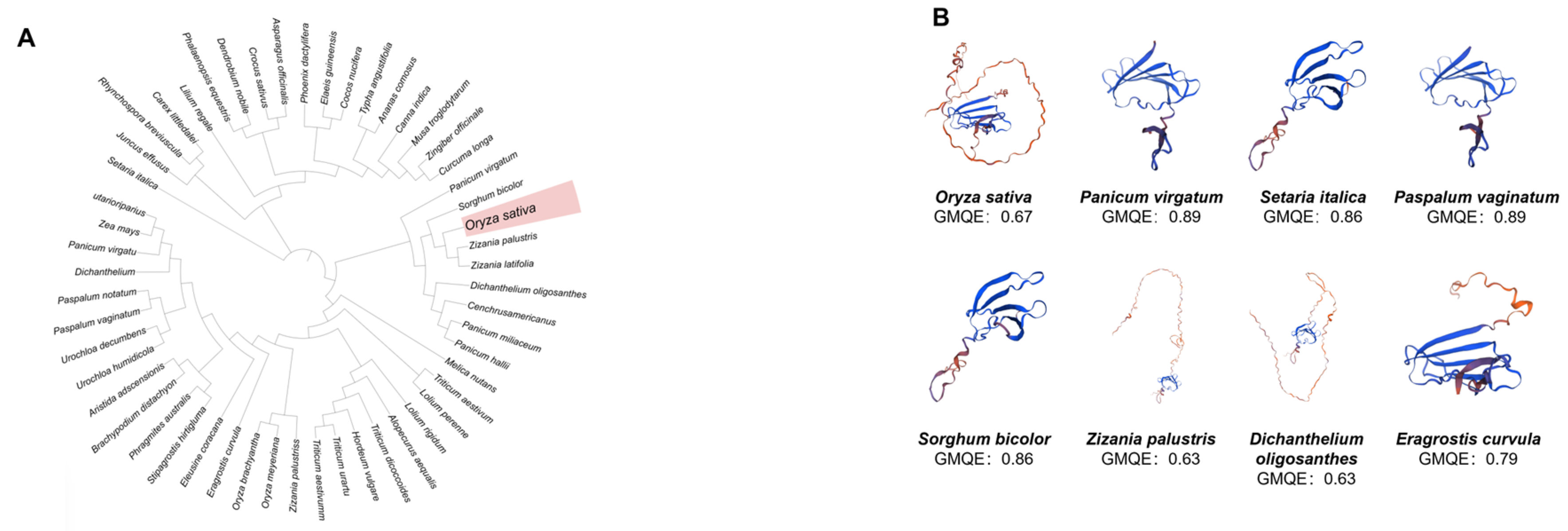
Figure 1. Evolutionary analysis of WRKY7 in green plants. (A) Maximum likelihood-based phylogenetic analysis of WRKY7 proteins in representative species of plants. Oryza sativa was showen in red color. (B) The three-dimensional structure of the protein predicted based on the protein sequences of Oryza sativa and various species of WRKY7 (https://swissmodel.expasy.org/).
Life 15 01852 g001
Figure 2. Phylogenetic and structural analysis of the WRKY7 protein across Poaceae species. (A) Multiple sequence alignment of WRKY7 amino acid sequences from eight representative Poaceae species: Oryza sativa, Panicum virgatum, Setaria italica, Paspalum vaginatum, Sorghum bicolor, Zizania palustris, Dichanthelium oligosanthes, and Eragrostis curvula. The alignment highlights the invariant WRKYGQK motif (indicated by the navy blue bar) and the zinc-finger-like structures, demonstrating high conservation of the core functional domains. (B) Schematic representation of the conserved protein motifs identified in WRKY7 proteins. Motifs were predicted using the MEME suite.
Life 15 01852 g002
Figure 3. In-depth bioinformatic characterization of OsWRKY7. (A) Hydropathy profile of OsWRKY7 predicted by the Kyte-Doolittle algorithm. The plot reveals the distribution of hydrophilic and hydrophobic regions along the protein sequence, with positive values indicating hydrophobic areas (https://web.expasy.org/protscale/, accessed on 28 November 2025). (B) Prediction of transmembrane helices. Analysis using TMHMM or a similar tool indicates the absence of substantial transmembrane domains, suggesting OsWRKY7 is not an integral membrane protein (https://services.healthtech.dtu.dk/services/TMHMM-2.0/, accessed on 28 November 2025). (C) Schematic architecture of OsWRKY7 domain organization. The diagram depicts the relative positions of key domains, including the N-terminal region, the central WRKY domain, and the potential zinc-finger motif (https://dtu.biolib.com/DeepTMHMM/, accessed on 28 November 2025). (D) Forecast of potential phosphorylation sites. NetPhos or a similar predictor was employed to identify serine (S), threonine (T), and tyrosine (Y) residues that are likely targets for post-translational modification by kinases (https://services.healthtech.dtu.dk/services/NetPhos-3.1/, accessed on 28 November 2025).
Life 15 01852 g003
Figure 4. Analysis of conserved motifs in the rice WRKY gene family. (A) Sequence logos of individual conserved motifs. The logos depict the amino acid sequence and conservation level for each motif, with the height of letters representing the information content at each position. The highly conserved ‘WRKYGQK’ signature within the core WRKY domain is explicitly visible. (B) Schematic distribution of conserved motifs across OsWRKY proteins. Each colored box represents a distinct motif (e.g., Motifs 1–10) identified by MEME analysis. The connecting black lines, scaled to protein length, illustrate the order and arrangement of these motifs within each protein.
Life 15 01852 g004
Figure 5. Transcriptional activation assay of full-length and truncated OsWRKY7 proteins in yeast. The full-length (OsWRKY7, 1–666 aa) and truncated segments, comprising the N-terminal domain (OsWRKY7-N, 1–360 aa) and the C-terminal domain (OsWRKY7-C, 361–666 aa), were fused to the GAL4 DNA-Binding Domain (BD) in the pGBKT7 vector. Yeast transformants were spotted on synthetic dropout (SD) media lacking Leu and Trp (DDO) to confirm transformation efficiency and on selective media lacking Leu, Trp, His, and Ade (QDO) supplemented to assess transcriptional activation.
Life 15 01852 g005
Figure 6. Visualization of the promoter element analysis of OsWRKY7. Schematic representation of the distribution of predicted cis-regulatory elements within the 2.0 kb promoter region upstream of the OsWRKY7 translational start site. The analysis was performed using PlantCARE (PlantCARE, a database of plant promoters and their cis-acting regulatory elements). Key identified elements are color-coded and include core promoter elements (TATA-box, CAAT-box), hormone-responsive elements (e.g., for abscisic acid, methyl jasmonate, and auxin), stress-responsive elements (e.g., for drought), and light-responsive elements.
Life 15 01852 g006
Figure 7. The expression patterns of OsWRKY7 in different tissues. (A) In silico analysis of OsWRKY7 expression across different rice tissues and developmental stages, obtained from the Rice eFP Browser (https://bar.utoronto.ca/efprice/cgi-bin/efpWeb.cgi). Data indicate that OsWRKY7 is ubiquitously expressed in seeds, roots, leaves, inflorescences, and shoot apical meristems (SAM), with the highest transcript abundance detected in mature leaves. (B) Experimental validation of OsWRKY7 expression by qRT-PCR in the cultivar ZH11. Relative expression levels were measured in seed, root, shoot, and leaf. Data were reported relative to the seeds, which were assigned as 1.0. Values were shown as means ± standard deviation (n = 3) and analyzed by one-way ANOVA followed by Tukey’s multiple comparisons test (p < 0.05). *, **, ***, and ns indicate statistical significance levels: * p < 0.05, ** p < 0.01, *** p < 0.001, and ns (not significant) for p ≥ 0.05, respectively.
Life 15 01852 g007
Disclaimer/Publisher’s Note: The statements, opinions and data contained in all publications are solely those of the individual author(s) and contributor(s) and not of MDPI and/or the editor(s). MDPI and/or the editor(s) disclaim responsibility for any injury to people or property resulting from any ideas, methods, instructions or products referred to in the content.