Article

A New Postoperative Stability Score to Predict Loss of Reduction in Intertrochanteric Fractures in Elderly Patients


1
Department of Rehabilitation, Taoyuan General Hospital, Ministry of Health and Welfare, Taoyuan 330, Taiwan
2
School of Medicine, National Yang Ming Chiao Tung University, Taipei 112, Taiwan
3
Department of Orthopedics, Kaohsiung Veterans General Hospital, Kaohsiung 81341, Taiwan
*
Author to whom correspondence should be addressed.
Life 2024, 14(7), 858; https://doi.org/10.3390/life14070858
Submission received: 19 May 2024 / Revised: 28 June 2024 / Accepted: 3 July 2024 / Published: 9 July 2024
(This article belongs to the Special Issue Advanced Strategies in Fracture Treatments)

Abstract

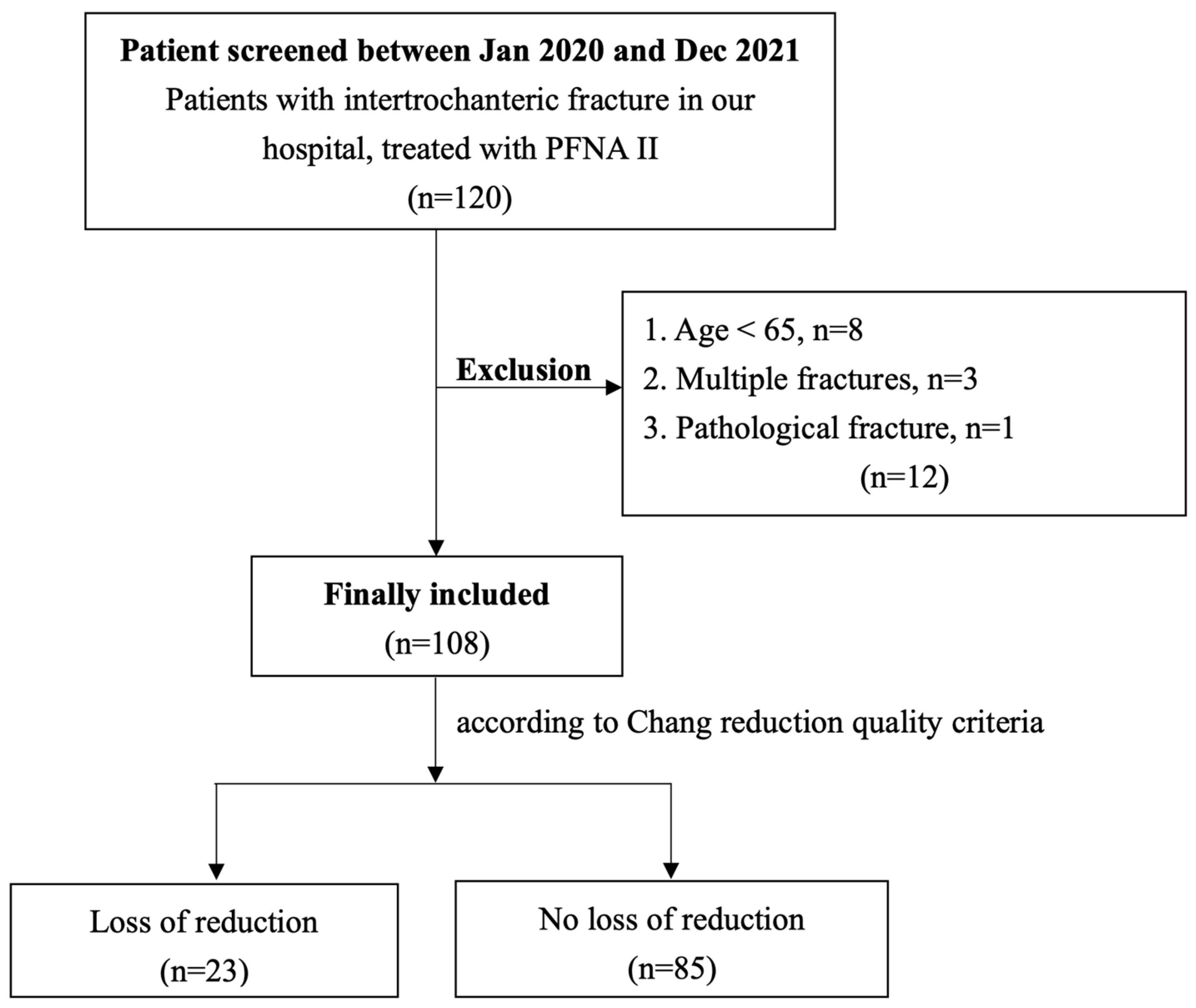
The study aimed to validate a newly developed postoperative stability score for evaluating clinical follow-up in elderly patients with low-energy hip fractures. From 1 January 2020 to 31 December 2021, we enrolled patients aged over 65 who underwent cephalomedullary nail fixation using proximal femoral nail antirotation II (PFNAII) and had at least 6 months of follow-up; excluding multiple fractures, pathological fractures, and periprosthetic fractures. We collected general patient data. Parameters such as TAD, Parker’s ratio (AP and lateral), and the new postoperative stability score were recorded. A loss of reduction was defined using the decline in the Chang reduction quality criteria (CRQC) score within one month. Among the 108 enrolled patients, 23 (21.3%) experienced a loss of reduction, with a mean age of 82.1 years and a mean follow-up time of 7.4 months. Univariate analysis showed no significant association between loss of reduction and general data. However, the new postoperative stability score correlated significantly with loss of reduction (mean scores: 6.68 vs. 4.83, p = 0.045). Multivariate analysis confirmed this association (odds ratio: 0.076, 95% confidence interval: 0.022–0.263, p < 0.05). The newly developed postoperative stability score, incorporating surgical technique assessment, improves prediction accuracy for loss of reduction in elderly intertrochanteric fracture (ITF) patients.
Keywords: hip fracture; geriatric; intramedullary nailing; stability score hip fracture; geriatric; intramedullary nailing; stability score