

A Comparative Study of Open-Source and Licensed CAD Software to Support Garment Development Learning



Abstract
1. Introduction
2. CAD-Based Design Skills for Fashion Education
- development principles and functions;
- the principles of garment pattern design;
- the rules of pattern design by size;
- the definition of a style and its versions;
- marker making;
- creating markers on fabrics with definition and changing parameters;
- preproduction garment specifications;
- preparation of pattern blocks for 3D simulation in 3D virtual prototype tools.
3. Methodology
3.1. Aim of the Research
3.2. Literature Research
3.3. Problem Statement
- New pattern creation—the workbench to draw a new pattern piece from scratch with specific measurements;
- Insert new points and notches—the workbench to put grading and curve points on any place of the pattern;
- Measuring—the workbench to evaluate if a specific distance is correct;
- Curves—the workbench to model curves;
- Editing—the workbench to edit any part of the pattern by move, cut, unite, rotate, mirror, etc.;
- Darts, folds and gathers—the workbench to create, edit, and delete darts, and to fold and gather to any point of the garment.
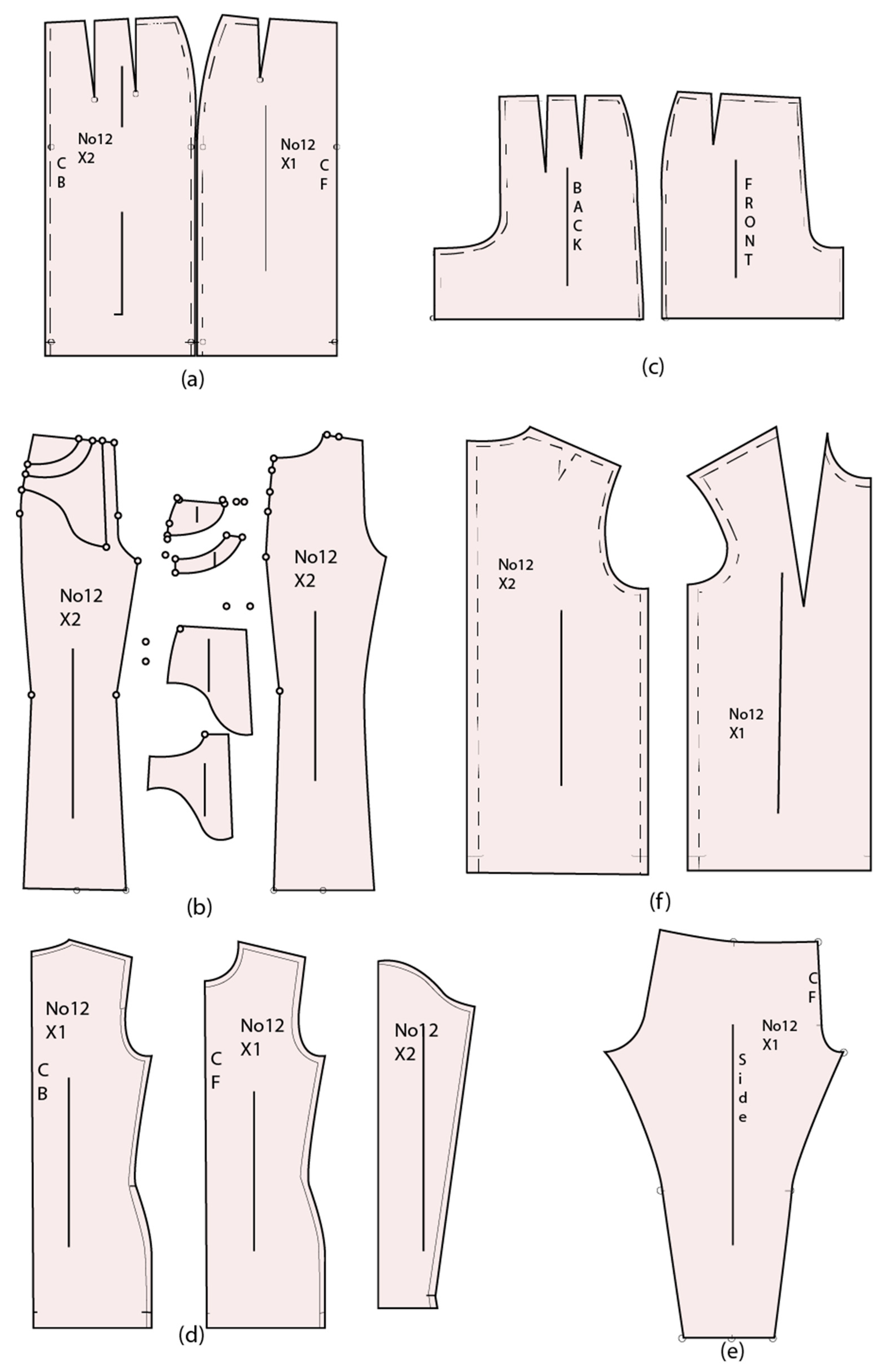
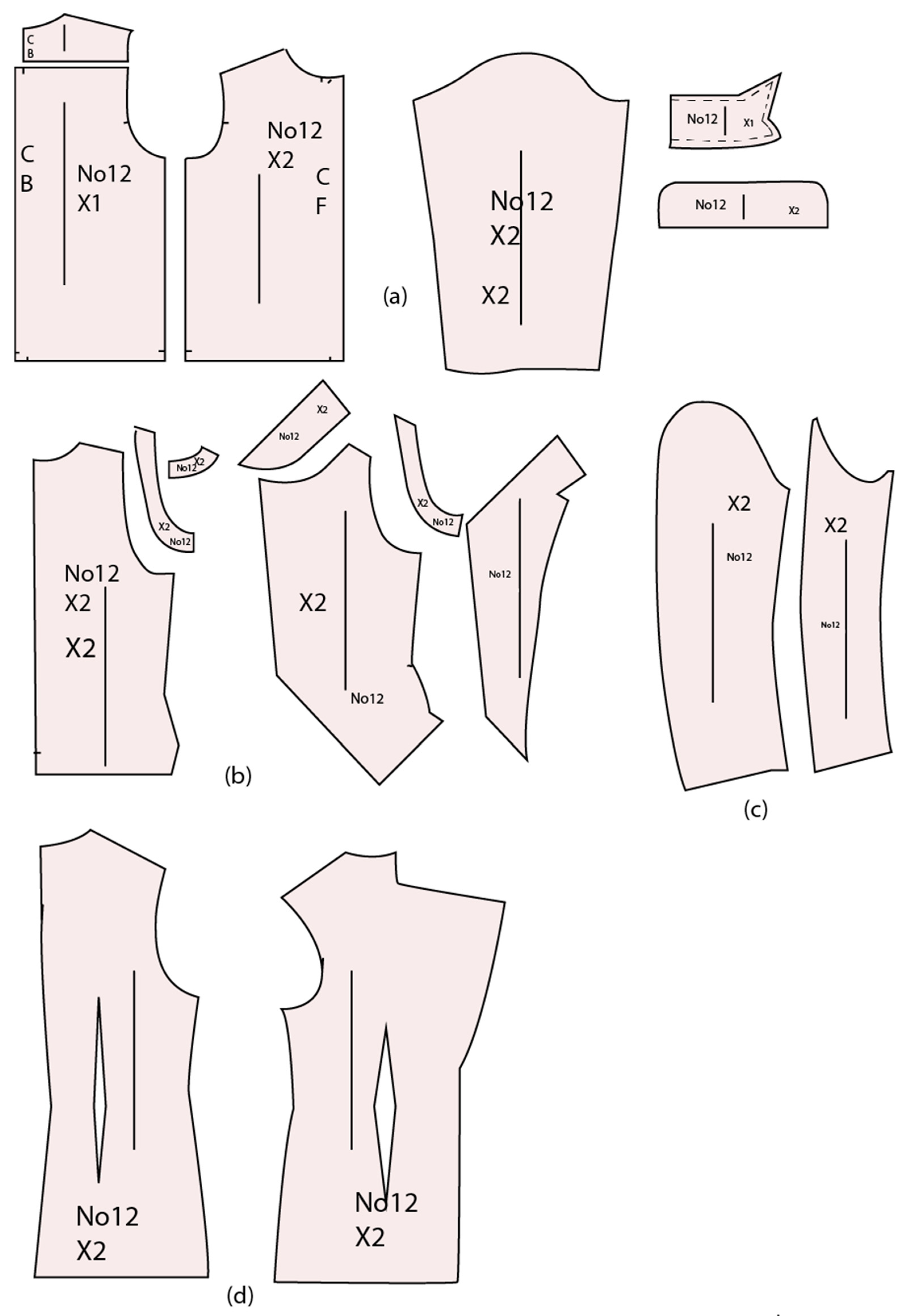
- Selection of the basic pattern blocks in a standard size (12) that the students have the skills to develop digitally.
- Development of prototype patterns in all four CAD systems through monitoring the passage of time for every task and every different CAD system.
- Analysis of the results with respect to the time, efficiency, and number of steps.
4. Results
4.1. Selection of Basic Pattern Blocks in a Standard Size 12
4.2. Development of Prototype Patterns in All Four CAD Systems with Monitoring the Passage of Time for Every Task and Every Different CAD System
4.3. Analysis of the Results with Respect to the Time, Efficiency, and Number of Steps
- Creation of a new pattern piece: The development method in the non-licensed software (Seamly2D and Cameo) has many similarities to the traditional pattern development by hand. Above all, it is time consuming.
- New point and notch inputs: All four software tools have different ways to put a new point or a notch on a pattern. However, moving a point takes longer in Seamly2D and Cameo.
- Measure tape: The ruler and measure tape for distances and curves is one of the basic tools of a programme. However Seamly2D does not support such a feature.
- Create curves: All four programmes can easily create curves
- Section move: Too complicated for Seamly2D, feasible in Cameo, easier in Polypattern and Crea
- Darts, folds and gatherings: The easier way to create them is in Crea and Polypattern. Open source Seamly2D needs to create a new pattern from the beginning and the exact distances for every new point are required by the user. Cameo requires multiple moves; the functions are not automatic.
- Cut and unite of pattern pieces: Seamly2D cannot unite cut pieces. Comparing all four, Polypattern provides the easiest and more efficient method.
- Rotation of pattern pieces: Seamly2D cannot rotate; the other three can do this easily.
- Seams: An older version of Seamly2D had a tool for seam allowance. The newer version has none. Cameo also lacks this function. If the user wants to add seams, they need to create parallel lines with the desired distance. Polypattern and Crea provide the seam allowance with three clicks.
- Sizing: Seamly2D and Cameo cannot cover this very important need for a pattern developer. Crea and Polypattern are both focused in satisfying the demands of creating complex styles in a rapid changing manufacturing environment like the one of apparel.
5. Conclusions
Author Contributions
Funding
Conflicts of Interest
References
- Papachristou, E.; Bilalis, N. 3D virtual prototyping traces new avenues for fashion design & product development—A qualitative study. J. Text. Sci. Eng. 2017, 6, 297. [Google Scholar] [CrossRef]
- Papachristou, E.; Bilalis, N. Can 3D prototype conquer the apparel industry? J. Fash. Technol. Text. Eng. 2016, 4, 2. [Google Scholar] [CrossRef]
- Istook, C. Rapid prototyping in the textile & apparel industry: A pilot project. J. Text. Appar. Technol. Manag. 2000, 1, 1. [Google Scholar]
- Bae, J.; May-Plumplee, T. Customer focused textile & apparel manufacturing systems: Toward an Effective e-commerce model. J. Text. Appar. Technol. Manag. 2005, 4, 1–19. [Google Scholar]
- Summers, J.D.; Shah, J.J. Mechanical Engineering Design Complexity Metrics: Size, Coupling, and Solvability. J. Mech. Des. 2010, 132, 021004. [Google Scholar] [CrossRef] [Scilit]
- Amadori, K.; Tarkian, M.; Ölvander, J.; Krus, P. Flexible and robust CAD models for design automation. Adv. Eng. Inform. 2012, 26, 180–195. [Google Scholar] [CrossRef] [Scilit]
- Bodein, Y.; Rose, B.; Caillaud, E. A roadmap for parametric CAD efficiency in the automotive industry. Comput. Aided Des. 2013, 45, 1198–1214. [Google Scholar] [CrossRef] [Scilit]
- Bodein, Y.; Rose, B.; Caillaud, E. Explicit reference modeling methodology in parametric CAD system. Comput. Ind. 2014, 65, 136–147. [Google Scholar] [CrossRef] [Scilit]
- Johnson, M.D.; Valverde, M.L.; Thomison, D.W. An investigation and evaluation of computer-aided design model complexity metrics. Comput.-Aided Des. Appl. 2018, 15, 61–75. [Google Scholar] [CrossRef] [Scilit]
- Diwakaran, R.P.; Johnson, M.D. Analyzing the effect of alternative goals and model attributes on CAD model creation and alteration. Comput.-Aided Des. 2012, 44, 343–353. [Google Scholar] [CrossRef] [Scilit]
- Hamade, R.F.; Ammouri, A.H.; Artail, H. Toward pre-dicting the performance of novice CAD users based on their profiled technical attributes. Eng. Appl. Artif. Intell. 2012, 25, 628–639. [Google Scholar] [CrossRef] [Scilit]
- Hamade, R.F.; Artail, H.A.; Jaber, M.Y. A study of the impact of the willingness-to-learn of CAD novice users on their competence development. Comput. Ind. Eng. 2011, 61, 709–720. [Google Scholar] [CrossRef] [Scilit]
- Camba, J.D.; Contero, M.; Company, P. Parametric CAD modelling: An analysis of strategies for design reusability. Comput.-Aided Des. 2016, 74, 18–31. [Google Scholar] [CrossRef] [Scilit]
- Johnson, M.D.; Diwakaran, R.P. An educational exercise examining the role of model attributes on the creation and alteration of CAD models. Comput. Educ. 2011, 57, 1749–1761. [Google Scholar] [CrossRef] [Scilit]
- Seamly2D. Available online: http://valentina-project.org/ (accessed on 10 October 2017).
- Cameo v.6 (Wild Ginger). Available online: https://www.wildginger.com/downloads/cameo6download.htm (accessed on 10 October 2017).
- ABET. Available online: https://www.abet.org/accreditation/accreditation-criteria/criteria-for-accrediting-engineering-programs-2019-2020/#GC3 (accessed on 20 January 2019).
- Ullah, S.; Harib, K. Tutorials for Integrating CAD/CAM in Engineering Curricula. Educ. Sci. 2018, 8, 151. [Google Scholar] [CrossRef] [Scilit]
- Di Angelo, L.; Di Stefano, P.; Leali, F. Can Open-Source 3D Mechanical CAD Systems Effectively Support University Courses? Int. J. Eng. Educ. 2016, 32, 1313–1324. [Google Scholar]
- Garcıa, R.R.; Santos, R.G.; Quiros, J.S.; Penin, P.I.A. Present state of CAD teaching in Spanish Universities. Comput. Educ. 2005, 44, 201–215. [Google Scholar] [CrossRef] [Scilit]
- Modaris, Lectra. Available online: https://www.lectra.com/en/modaris (accessed on 2 October 2017).
- Accumark Gerber Technologies. Available online: http://www.gerbertechnology.com/fashion-apparel/plan/accumark/ (accessed on 3 May 2018).
- Crea Solution. Available online: http://www.creasolution.it/en/products/design/2d-cad-fashion/?lang=en (accessed on 25 March 2018).
- Polypattern Polytropon. Available online: http://www.polytropon.com/en/PolyPattern/cad-pattern-design-software.html (accessed on 25 March 2018).
- Optitex. Available online: https://optitex.com/solutions/odev/pattern/ (accessed on 25 March 2018).
- Junk, S.; Kuen, C. Review of Open Source and Freeware CAD Systems for Use with 3D-Printing. Procedia CIRP 2016, 50, 430–435. [Google Scholar] [CrossRef] [Scilit]
- Seamly. Available online: https://seamly2d.wordpress.com/about/ (accessed on 20 January 2019).
- Field, D.A. Education and training for CAD in the auto industry. Comput.-Aided Des. 2004, 36, 1431–1437. [Google Scholar] [CrossRef] [Scilit]
- Katz, R. Integrated thinking in mechanical engineering education. Int. J. Eng. Educ. 2015, 31, 1613–1621. [Google Scholar]
- Cheng, N. Teaching CAD with language learning methods. Acadia 1997, 97, 173–188. [Google Scholar]
- Singh, V.; Holt, L. Learning and best practices for learning in open-source software Communities. Comput. Educ. 2013, 63, 98–108. [Google Scholar] [CrossRef] [Scilit]
- Beazley, A. Size and fit: The development of size charts for clothing—Part 3. J. Fash. Mark. Manag. 1999, 3, 66–84. [Google Scholar] [CrossRef] [Scilit]
- Aldrich, W. Metric Pattern Cutting for Women’s Wear, 6th ed.; Wiley: Hoboken, NJ, USA, 2015. [Google Scholar]
- Jhanji, Y. Computer-aided design—Garment designing and patternmaking. In Automation in Garment Manufacturing; Nayak, R., Padhye, R., Eds.; A Volume in the Textiles Institute Book Series; Technological Institute of Textile and Sciences: Bhiwani, India, 2018; pp. 253–290. [Google Scholar]

| Time in Minutes for Each Pattern Cutting Programme | ||||
|---|---|---|---|---|
| Type of Garment | Seamly2D | Cameo V6 | Polypattern | Crea |
| Straight skirt | 30′ | 8′ | 5′ | 13′ |
| Culottes | 45′ | 20′ | 9′ | 46′ |
| Basic trousers | 3 h | 32′ | 20′ | 45′ |
| Tracksuit trousers | 13′ | 12′ | 5′ | 13′ |
| Close fitting bodice block | 40′ | 20′ | 20′ | 9′ |
| Tracksuit top | 15′ | 19′ | 8′ | 19′ |
| Basic shirt | 55′ | 1 h 7′ | 1 h 10′ | 58′ |
| Vest | 1 h | 40′ | 35′ | 26′ |
| Tailored jacket | 45′ | 33′ | 45′ | 45′ |
| Two-piece sleeve | 30′ | 20′ | 35′ | 23′ |
© 2019 by the authors. Licensee MDPI, Basel, Switzerland. This article is an open access article distributed under the terms and conditions of the Creative Commons Attribution (CC BY) license (http://creativecommons.org/licenses/by/4.0/).
Share and Cite
Papachristou, E.; Kyratsis, P.; Bilalis, N. A Comparative Study of Open-Source and Licensed CAD Software to Support Garment Development Learning. Machines 2019, 7, 30. https://doi.org/10.3390/machines7020030
Papachristou E, Kyratsis P, Bilalis N. A Comparative Study of Open-Source and Licensed CAD Software to Support Garment Development Learning. Machines. 2019; 7(2):30. https://doi.org/10.3390/machines7020030
Chicago/Turabian StylePapachristou, Evridiki, Panagiotis Kyratsis, and Nikolaos Bilalis. 2019. "A Comparative Study of Open-Source and Licensed CAD Software to Support Garment Development Learning" Machines 7, no. 2: 30. https://doi.org/10.3390/machines7020030
APA StylePapachristou, E., Kyratsis, P., & Bilalis, N. (2019). A Comparative Study of Open-Source and Licensed CAD Software to Support Garment Development Learning. Machines, 7(2), 30. https://doi.org/10.3390/machines7020030

