Article

U-GRA: Uncertainty-Gated Residual Adaptation for Physically Robust Three-Finger Grasping

1
Faculty of Data Science, City University of Macau, Taipa 999078, Macau
2
International College, Zhengzhou University, Zhengzhou 450001, China
3
Shenzhen Institutes of Advanced Technology, Chinese Academy of Sciences, Shenzhen 518055, China
*
Author to whom correspondence should be addressed.
Machines 2026, 14(8), 924; https://doi.org/10.3390/machines14080924
Submission received: 30 June 2026 / Revised: 31 July 2026 / Accepted: 7 August 2026 / Published: 11 August 2026
(This article belongs to the Section Robotics, Mechatronics and Intelligent Machines)

Abstract

Robust three-finger grasping under physical-domain variation remains challenging because contact stability can change substantially with object mass, effective friction, and observation noise. This work develops U-GRA, a conservative offline-to-online residual adaptation framework for simulated three-finger grasping. U-GRA introduces a unified prior-preserving and critic-disagreement-regulated architecture that couples a frozen behavioral prior with a spectrally normalized and bounded residual stream, scalar Twin-Q reliability assessment, and critic-conditioned residual fusion. The framework first learns a nominal behavioral prior from successful demonstrations and then freezes it as a stable action anchor during online adaptation. Before execution, the twin critics evaluate a candidate action formed from the prior action and the bounded residual proposal, and their absolute scalar Q-value disagreement conditions a state-dependent gate that regulates residual-injection strength. Experiments are conducted in CoppeliaSim using an offline dataset of 40,000 successful demonstrations and online randomization of object mass, effective friction, and observation noise. Across three independent seeds, U-GRA achieves a mean success rate of 84.8 ± 2.3 % , a normalized return of 82.7 ± 4.1 , and a jitter value of 0.12 ± 0.03 . Relative to AWAC-Res, the strongest evaluated baseline, U-GRA improves mean success by 9.2 percentage points and reduces jitter by 57.1%. It also retains the highest mean success rate and normalized return over the unseen simulated high-mass–low-friction OOD region. These results provide simulation evidence that preserving a nominal behavioral prior while regulating bounded residual correction through critic disagreement improves three-finger grasping robustness under physical-domain variation.

1. Introduction

Manufacturing is increasingly moving toward high-mix, low-volume production, where product variants may change within short time intervals. This trend motivates robotic grasping systems that can tolerate object and contact variability without frequent hardware retooling. Parallel-jaw grippers remain widely used because of their simple structure, fast control, and reliability in well-constrained pick-and-place settings. However, their limited contact redundancy and single closing direction can reduce grasp stability when object geometry, friction, or mass distribution changes. At the other end of the spectrum, high-DoF four- or five-finger dexterous hands provide stronger manipulation capability, but their large action space, mechanical complexity, and sensing requirements increase the burden of data collection, control, and maintenance. Three-finger grippers therefore provide a useful engineering compromise for production-inspired scenarios: they offer richer contact configurations and a larger grasp wrench space than two-finger grippers, while remaining more compact and easier to actuate than highly dexterous hands [1,2,3]. This motivates policy-level adaptation for changeover-like physical variation. Nevertheless, stable three-finger grasping remains challenging due to underactuated mechanics, high-dimensional sensing, discontinuous contacts, and the difficulty of maintaining reliable grasping behavior under physical-domain variation.
Recent progress in large-scale robot learning suggests that reusable behavioral priors are becoming increasingly practical. Open X-Embodiment consolidates large-scale trajectories across diverse robots and skills [4], while RT-2 demonstrates that vision-language pretraining can transfer web-scale knowledge to robotic control [5]. PLEX further shows that video-only data can improve manipulation representations when combined with limited robot interaction [6]. At the same time, scalable data-collection systems such as UMI and DexCap reduce the cost of collecting dexterous demonstrations outside specialized laboratory settings [7,8]. In dexterous grasping, datasets such as DexGraspNet have transformed grasp synthesis into a data-driven problem [9], and expressive visuomotor policies such as Diffusion Policy highlight the value of high-quality behavioral priors before online refinement [10]. Perception-side advances, including vision-guided grasping and active reconstruction, further improve grasp preparation under visual uncertainty [11,12]. These developments motivate the use of reusable priors, but they do not remove the need for online correction when contact dynamics shift after deployment.
A key bottleneck in changeover-like grasping is therefore not only object-level geometric generalization, but physical-domain adaptation. A grasping behavior that is reliable for one batch of workpieces can become unstable for another batch with different mass, effective friction, compliance, or sensing noise. This shift is strongly state-dependent: most states benefit from preserving a conservative nominal behavior, whereas a subset of contact states requires corrective action. Classical grasp analysis provides a principled foundation through force-closure and grasp-quality metrics [13,14], yet these guarantees depend on accurate friction estimates, contact consistency, and modeling assumptions that are often violated in production-like settings [15]. Surveys on deep grasp synthesis similarly emphasize that robustness to imperfect sensing and execution remains a central barrier to real deployment [16]. Even in impedance-controlled systems, the appropriate stiffness and damping depend on the contact regime and task phase, making fixed-gain strategies insufficient under rapidly changing contact conditions [17,18].
Learning-based methods provide a more flexible adaptation mechanism but introduce their own limitations. Behavior cloning can efficiently acquire conservative manipulation behaviors from demonstrations and has been systematically studied in robotic manipulation benchmarks such as RoboMimic [19]. However, imitation learning remains sensitive to distribution shift, and errors can compound when the robot encounters states outside the demonstration support [20]. Reinforcement learning can directly optimize stability-related objectives, and actor–critic algorithms such as PPO, DDPG, TD3, SAC, and AWAC provide representative tools for continuous control and online adaptation [21,22,23,24,25]. Contact-rich RL studies also show that learned compliance, pushing-and-grasping, and structured motion representations can improve manipulation under uncertainty [26,27,28]. Nevertheless, direct online RL for three-finger grasping remains sample-inefficient and can produce unstable action updates during contact transitions.
Offline-to-online reinforcement learning reduces interaction cost by leveraging static datasets and then refining the policy through online experience. Representative offline RL methods, including IQL, CQL, and TD3+BC, address conservative value learning and policy improvement from offline data [29,30,31], with standardized evaluation supported by D4RL [32]. Recent offline-to-online studies further improve adaptation stability through balanced replay, actor–critic alignment, online pre-training, and diffusion-based data generation [33,34,35,36]. These works indicate that online fine-tuning is sensitive to value-estimation reliability under distribution shift. Residual methods provide another practical direction: residual reinforcement learning from demonstrations, ResiP, and IBRL show that an offline prior can be refined through online correction rather than replaced entirely [37,38,39]. More recent residual adaptation methods, including RFS and ResDex, further demonstrate the relevance of residual steering and residual policy learning in dexterous manipulation [40,41]. However, these methods target pretrained generative policies, precise assembly, or universal dexterous grasping, whereas this work focuses on simulated physical-domain adaptation around a frozen three-finger grasping prior.
The central challenge is that residual correction should not be trusted uniformly. A residual branch can compensate for contact-domain shifts, but unconstrained residual injection may overwrite reliable nominal behaviors or amplify oscillatory corrections. This is particularly problematic during grasp stabilization, where critic estimates can become unreliable around discontinuous contact transitions. Motivated by this observation, we develop U-GRA, an uncertainty-gated residual adaptation framework for three-finger grasping under randomized mass, friction, and observation noise. U-GRA preserves a frozen behavioral prior learned from nominal demonstrations and instantiates online adaptation as a bounded residual correction around this prior. Before the residual correction is injected, the candidate action is evaluated by two independently parameterized scalar Q critics. Their absolute disagreement defines a critic-disagreement statistic for the candidate correction. The gating network conditions the residual-injection strength on both the latent state and this disagreement statistic, allowing residual fusion to adapt to the consistency of the two value estimates.
To improve contact stability within the proposed architecture, U-GRA incorporates an SN-Block into the residual branch. The SN-Block constrains the sensitivity of the residual network through spectral normalization, while bounded projection limits the maximum residual magnitude. A temporal residual-smoothness loss penalizes abrupt residual changes between adjacent steps, reducing oscillatory behavior during contact transitions [42]. Unlike work that primarily targets universal object-level grasp synthesis [43,44,45,46,47], U-GRA focuses on physical-domain robustness around a reusable nominal prior. The evaluation is conducted as a physics-based simulation study, not as a real-world deployment study. This distinction is important because real hardware may introduce additional compliance, actuator, tactile, latency, and calibration uncertainties. Residual adaptation around a frozen behavioral prior, twin-critic value estimation, critic disagreement as a reliability indicator, and spectral normalization are established techniques and provide the methodological foundations of U-GRA [23,37,38,39,42]. Building on these foundations, U-GRA introduces a task-specific architecture that functionally couples prior preservation, a spectrally normalized and bounded residual stream, pre-execution twin-critic reliability assessment, and critic-conditioned residual fusion. The uncertainty gate serves as the core coupling mechanism by converting critic disagreement into a state-dependent residual-injection coefficient. To the best of our knowledge, this is the first joint integration of critic-conditioned uncertainty gating and spectral normalization for residual adaptation in three-finger grasping under mass, friction, and observation-noise variations.
The contributions of this work are summarized as follows:
  • We develop U-GRA, a unified offline-to-online residual adaptation architecture for robust three-finger grasping under variations in object mass, friction, and observation noise. U-GRA preserves a frozen behavioral prior as a nominal action anchor and organizes online adaptation through a bounded and uncertainty-regulated residual pathway.
  • We design a critic-conditioned residual fusion strategy within U-GRA, in which the disagreement between two scalar Q critics provides a critic-disagreement signal for state-dependent residual injection. Spectral normalization, bounded projection, and temporal regularization are jointly incorporated to constrain the sensitivity, magnitude, and temporal variation of residual corrections during contact transitions.
  • We conduct a systematic simulation evaluation through matched offline-to-online comparisons, training-curve analysis, mass–friction robustness analysis, observation-noise evaluation, component ablations, and a regional out-of-distribution sweep. The results demonstrate that U-GRA consistently improves grasping success, normalized return, completion efficiency, and contact stability under the evaluated physical-domain variations.
The remainder of the paper is organized as follows. Section 2 reviews related work. Section 3 presents the U-GRA framework and learning procedure. Section 4 reports experimental results and discussion. Section 5 concludes the paper.

2. Related Work

2.1. Dexterous Grasp Planning, Stability Metrics, and Residual Policies

Force-closure analysis and grasp-quality metrics remain fundamental tools for reasoning about whether contact forces can resist external wrenches [13,14]. These analytical criteria provide interpretable stability measures, but they usually assume known contact geometry and friction conditions. In recent years, dexterous grasping has increasingly shifted toward large-scale data-driven synthesis. UniDexGrasp learns diverse grasp proposals and goal-conditioned policies for universal dexterous grasping [43], while UniDexGrasp++ improves policy learning through geometry-aware curricula and iterative generalist–specialist training [44]. Grasp’D-1M and GenDexGrasp further extend large-scale dexterous grasp synthesis and generalizable grasp generation [45,46].Score-based grasping primitives also indicate that adaptive dexterous grasping can benefit from correction-oriented policy structures rather than relying on a single monolithic controller [47].
Benchmark platforms such as TriFinger improve reproducible evaluation for three-finger dexterity [48], and foundation-style controllers further broaden the scope of dexterous control [49]. These studies primarily improve geometric generalization, grasp synthesis, or platform-level evaluation. U-GRA addresses a complementary problem: physical-domain adaptation when mass, effective friction, and sensing noise change after a nominal grasping prior has been learned. Recent residual adaptation methods are closely related to this motivation. RFS introduces residual flow steering for pretrained flow-matching policies, and ResDex combines residual policy learning with mixture-of-experts for universal dexterous grasping [40,41]. These works support the broader view that residual correction is useful for dexterous manipulation. U-GRA differs by focusing on non-generative frozen behavioral priors and by regulating residual injection through critic-derived uncertainty under simulated mass–friction randomization.

2.2. Multi-Modal Perception and Tactile Representations

Vision-only grasping policies can degrade under occlusion, ambiguous geometry, and uncertain contact states. Recent work therefore explores tactile and visuotactile representations as stabilizing signals for dexterous manipulation. Unified multimodal tactile representations bind touch to visual semantics [50], while See to Touch uses visual incentives to learn tactile dexterity [51]. NeuralFeels integrates visual and tactile signals for in-hand pose and shape tracking [52], and 3D-ViTac learns fine-grained manipulation from visuotactile sensing [53]. Dense tactile measurement and tactile-based stability prediction further enrich contact-state estimation [54,55].
Vision-guided dexterous grasping and active reconstruction also improve pre-grasp state estimation under visual uncertainty [11,12]. These methods improve perception and state estimation, whereas U-GRA focuses on adapting the control policy under physical-domain shift. The two directions are complementary: richer tactile and visual inputs could further improve the critic reliability signal used by U-GRA.

2.3. Demonstration Learning and Offline-to-Online Adaptation

Demonstration learning is attractive for robotic learning because it produces conservative initial behaviors with limited online interaction. Scalable demonstration systems such as Holo-Dex, TILDE, DexMimicGen, UMI, and DexCap reduce the cost of collecting dexterous manipulation data [7,8,56,57,58]. Human-in-the-loop reinforcement learning further demonstrates that online human feedback can refine precise dexterous behaviors [59]. However, demonstrations usually encode actions rather than explicit stability objectives, making purely imitative policies vulnerable to contact-dynamics shifts.
Offline-to-online RL addresses this limitation by combining offline priors with online improvement. IQL, CQL, and TD3+BC reduce dependence on online exploration by learning from static datasets [29,30,31]. Balanced replay, actor–critic alignment, online pre-training, and diffusion-based data generation further improve the stability of offline-to-online transitions [33,34,35,36]. These studies highlight that value estimation can become unreliable under distribution shift. U-GRA follows this observation and uses critic-derived uncertainty as an explicit signal to regulate residual correction.

2.4. Residual Correction, Domain Randomization, and Stability Regularization

Residual policy learning is useful when a reasonable prior already exists. Instead of learning a full policy from scratch, a residual branch learns corrective actions around the prior. ResiP shows that a frozen imitation prior can be refined by a closed-loop residual policy for precise assembly [38], while IBRL demonstrates that imitation policies can bootstrap online reinforcement learning [39]. Residual reinforcement learning from demonstrations further supports the use of demonstration priors for complex dexterous manipulation [37]. U-GRA follows this prior-to-residual adaptation view but constrains online improvement through uncertainty-gated residual fusion.
Domain randomization is widely used to expose policies to controlled physical variation. Balanced domain randomization emphasizes the importance of covering meaningful hard domains [60], and simulation-based robot learning frameworks provide controlled environments for repeatable online evaluation [61]. In U-GRA, domain randomization is applied to object mass, effective friction, and observation noise. This design evaluates physical-domain robustness rather than merely testing interpolation over object geometry. Entropy-guided distributional reinforcement learning explicitly models a return distribution as part of uncertainty-aware value learning [62]. U-GRA uses a different formulation: it employs two scalar Q critics and uses their disagreement as a reliability statistic for residual gating, without learning an explicit return distribution.
Stability regularization is also important for contact-rich residual learning. Classical impedance control indicates that appropriate compliance depends on the contact regime and task phase [18]. Spectral normalization constrains layer-wise Lipschitz behavior and can reduce overly sensitive network responses [42]. U-GRA incorporates this idea through an SN-Block and further adds residual smoothness regularization to suppress oscillatory corrections during contact transitions. Building on these established foundations, U-GRA differs through their task-specific functional coupling. The scalar twin critics assess the candidate residual action before execution, their disagreement provides a reliability signal, and the critic-conditioned gate regulates the strength of residual injection. Spectral normalization, bounded projection, and temporal regularization further constrain the residual stream for physical-domain adaptation in simulated three-finger grasping.

3. Materials and Methods

3.1. Problem Formulation

The three-finger grasping task is formulated as a discounted Markov decision process:
M = ( S , A , p , r , γ , ρ 0 ) ,
where S denotes the state space, A [ 1 , 1 ] d denotes the bounded continuous action space, p ( · | s , a ) is the transition function, r ( s , a , s ) is the transition-based reward function, γ is the discount factor, and  ρ 0 is the initial-state distribution. At time step t, the policy observes s t , outputs a t , receives r t , and transitions to s t + 1 .
The objective is to retain a nominal grasping behavior learned from offline demonstrations while allowing online correction under physical-domain shift. The physical-domain configuration is represented by ξ = ( c m , c μ , ϵ ) , where c m , c μ , and  ϵ denote the mass coefficient, effective contact-friction coefficient, and observation-noise level, respectively. The policy is optimized to maximize the expected discounted return under randomized physical conditions:
J ( π ) = E ξ p DR χ p π ( · ξ ) t = 0 T 1 γ t r ( s t , a t , s t + 1 ) .
Here, p DR is the physical-domain randomization distribution, and  χ = ( s 0 , a 0 , s 1 , , s T 1 , a T 1 , s T ) denotes a trajectory generated by the policy under the sampled physical-domain configuration ξ . The concrete physical ranges of ξ are specified in the experimental protocol rather than in the method definition.

3.2. Reward Function and Episode Termination

The same transition-based reward is used for U-GRA and all baselines. The randomized mass, friction, and observation-noise parameters are not direct inputs to the reward and affect learning only through the resulting transition dynamics.
The normalized task variables are defined as
e t app = clip p t g p t o 2 d ref , 0 , 1 , κ t = 1 3 j = 1 3 I t , j contact , t = clip h t o h 0 o h lift , 0 , 1 , ν t = clip v t o 2 v ref , 0 , 1 .
Here, p t g is the centroid of the three fingertip positions, p t o is the object center-of-mass position, κ t is the fraction of fingers in contact with the object, h t o is the object center-of-mass height, and  v t o is the object linear velocity. The normalization constants are d ref = 0.30 m , h lift = 0.10 m , and  v ref = 0.20 m s 1 .
The per-step reward is
r t = w d e t app e t + 1 app + w c κ t + 1 κ t + w h t + 1 t + b s I t + 1 succ b f I t + 1 fail w v κ t + 1 ν t + 1 2 w Δ d a a t a t 1 2 2 w a d a a t 2 2 w T .
The action dimension is d a = 4 , and  a 1 = 0 at the beginning of each episode. The first three terms reward progress toward the object, contact acquisition, and object lifting. The remaining terms reward successful completion and penalize failure, unstable object motion, abrupt action changes, excessive action magnitude, and long episodes; the coefficients of all reward terms used throughout the online experiments are summarized in Table 1.
A grasp is considered successful when the object is lifted by at least 0.10 m, at least two fingers remain in contact, and the object linear speed remains below 0.02 m s−1 for five consecutive environment steps. A failure is recorded when unstable contact causes the object to be dropped or when the 50-step episode limit is reached without satisfying the success condition. The success and failure bonuses are applied only once on the corresponding terminal transition.

3.3. Overview of U-GRA

U-GRA follows a conservative offline-to-online residual adaptation design. In the offline stage, a nominal behavioral prior is learned from successful demonstrations. In the online stage, this prior is frozen and used as a stable action anchor. Online adaptation is restricted to the Spectral-Dense Residual Stream, the Critic-Derived Uncertainty Gate, and the Twin-Q Reliability Assessment module. This design prevents full-policy fine-tuning from overwriting demonstrated grasping behavior, while still enabling closed-loop residual correction when physical-domain shift occurs.
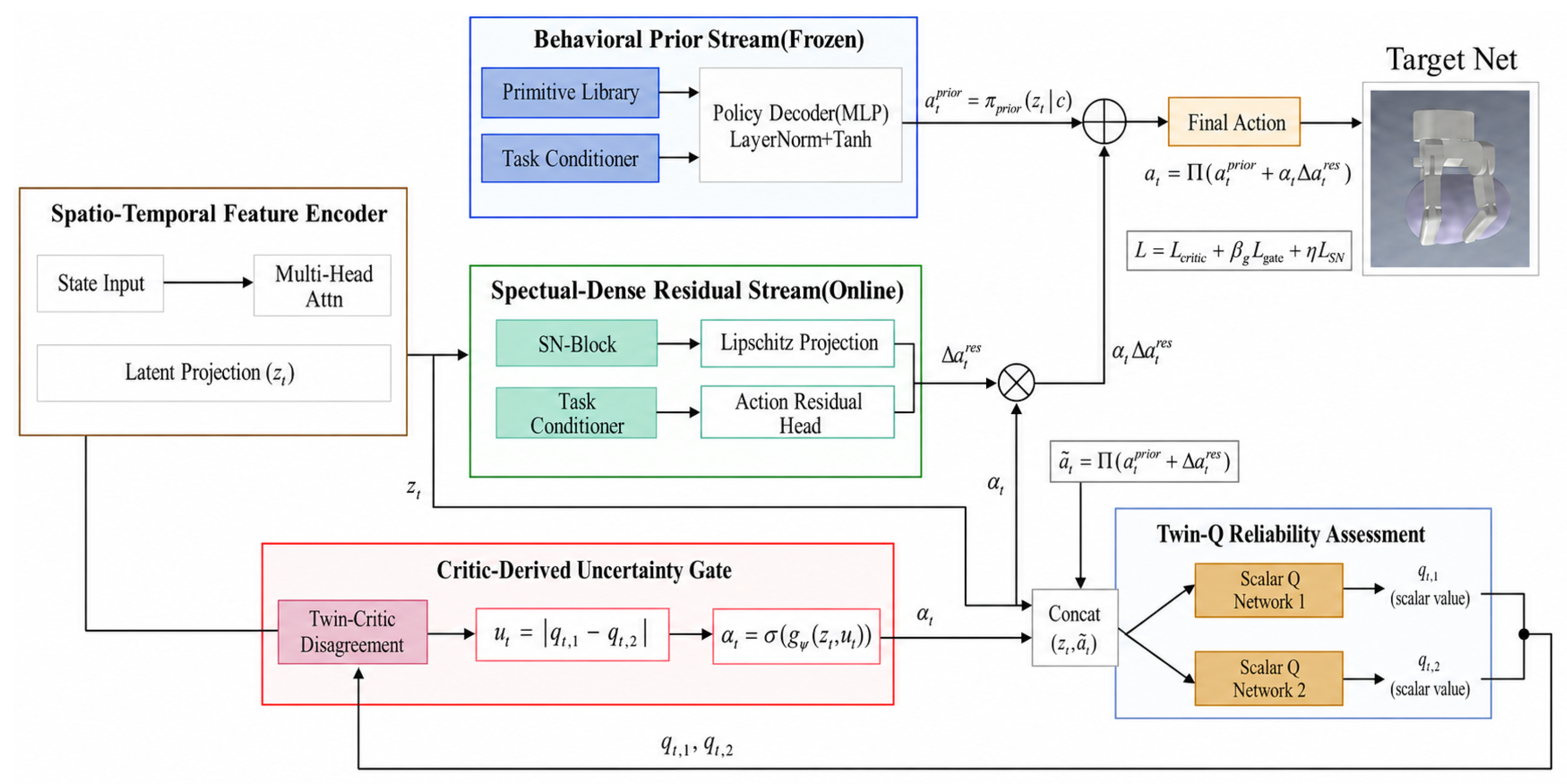
The architecture is shown in Figure 1. A Spatio-Temporal Feature Encoder produces the latent state z t . The Behavioral Prior Stream outputs the nominal action a t prior . The Spectral-Dense Residual Stream generates a bounded residual correction Δ a t res . The Critic-Derived Uncertainty Gate receives a reliability statistic from the Twin-Q Reliability Assessment module and produces the gate value α t . The final action is obtained by uncertainty-gated residual fusion and is then executed in the simulated grasping scene. The rightmost visualization panel in Figure 1 illustrates the execution result and is not used as an additional network input.

3.4. Spatio-Temporal Feature Encoder and Behavioral Prior Stream

The Spatio-Temporal Feature Encoder maps the state-history window into a latent representation:
z t = f enc ( s t k : t ) ,
where s t k : t denotes the observation window and f enc is the encoder. The latent state z t is shared by the Behavioral Prior Stream, the Spectral-Dense Residual Stream, the Critic-Derived Uncertainty Gate, and the Twin-Q Reliability Assessment module.
The Behavioral Prior Stream outputs the nominal action:
a t prior = π θ ( z t , c ) ,
where c denotes the task or object condition. The prior is trained by behavior cloning on the offline demonstration dataset:
L BC ( θ ) = E ( s t k : t , a t , c ) D off π θ ( f enc ( s t k : t ) , c ) a t 2 2 ,
where a t is the demonstration action. After offline convergence, both f enc and π θ are frozen. Therefore, the prior acts as a stable nominal policy rather than a component to be modified during online adaptation.

3.5. Spectral-Dense Residual Stream

The Spectral-Dense Residual Stream learns a corrective action around the frozen prior. The raw residual is generated by:
Δ a t = π ϕ ( z t , c ) ,
where π ϕ denotes the residual policy. To restrict online correction to a local action neighborhood around the prior, the raw residual is mapped into a bounded residual correction:
Δ a t res = δ tanh ( Δ a t ) ,
where δ controls the residual correction budget.
The residual branch contains an SN-Block to reduce overly sensitive responses during contact transitions. For a weight matrix W in the residual stream, spectral normalization rescales the weight as:
W ¯ = W σ max ( W ) ,
where σ max ( W ) is the largest singular value of W. This constrains the layer-wise Lipschitz behavior of the residual branch and improves the stability of residual correction in contact-rich phases [42]. In addition, temporal smoothness of the residual correction is encouraged by:
L SN = E Δ a t res Δ a t 1 res 2 2 .
This term penalizes abrupt changes in adjacent residual corrections and is removed in the w/o SN-Loss ablation. Here, the subscript “SN” denotes the temporal stability term associated with the spectrally normalized residual stream; spectral normalization itself is imposed directly on the residual-network weights.

3.6. Critic-Derived Uncertainty Gate

Before the residual correction is injected into the executed action, U-GRA evaluates the candidate residual action using two scalar Q critics. The candidate action is
a ˜ t = Π a t prior + Δ a t res .
Here and below, Π denotes projection onto the bounded action space A ; Algorithm 1 writes the same operator explicitly as Π A . The candidate action is used only for critic assessment and is not directly executed. The Twin-Q Reliability Assessment module produces two scalar value estimates:
q t , i = Q ω , i ( z t , a ˜ t ) R , i { 1 , 2 } .
Their absolute disagreement is used as the critic-disagreement statistic:
u t = q t , 1 q t , 2 = Q ω , 1 ( z t , a ˜ t ) Q ω , 2 ( z t , a ˜ t ) .
The statistic u t measures empirical disagreement between the two scalar Q-value estimators. A larger value indicates lower agreement between their estimates for the same candidate action. The gate value is
α t = σ g ψ ( z t , u t ) .
The gating network conditions the residual-injection strength on both the latent state and the critic-disagreement statistic.
Algorithm 1 Training and execution of U-GRA
   Input: Offline data D off ; environment; γ , τ , β , w max , β g , λ α , λ res , η , δ
Output: Frozen prior π θ ; adapted residual π ϕ ; gate g ψ ; scalar critics Q ω , 1 , Q ω , 2
           1: Subroutine  Act ( s , c ; θ , ϕ , ψ , ω )
           2:       z f enc ( s ) ; a prior π θ ( z , c )
           3:       Δ a δ tanh ( π ϕ ( z , c ) )
           4:       a ˜ Π A ( a prior + Δ a )
           5:       u | Q ω , 1 ( z , a ˜ ) Q ω , 2 ( z , a ˜ ) |
           6:       α σ ( g ψ ( z , u ) )
           7:       a Π A ( a prior + α Δ a ) ; return  ( a , α , Δ a )
           8: Initialize f enc , π θ , π ϕ , g ψ , Q ω , 1 , Q ω , 2 , target critics Q ω ¯ , 1 , Q ω ¯ , 2 , and  D on
           9: Offline pretraining of the behavioral prior
         10: for each offline epoch do
         11:    Sample ( s t , c t , a t ) D off
         12:     z t f enc ( s t ) ; a ^ t π θ ( z t , c t )
         13:     L BC a ^ t a t 2 2
         14:    Update f enc and π θ by minimizing L BC
         15: end for; freeze f enc and π θ
         16: Online residual adaptation with critic-derived reliability
         17: for each online environment step t do
         18:    At each episode reset, sample ξ = ( c m , c μ , ϵ ) according to the domain-randomization protocol and hold it fixed until termination
         19:     ( a t , α t , Δ a t ) Act ( s t , c t ; θ , ϕ , ψ , ω )
         20:    Step environment; store ( s t , c t , a t , r t , s t + 1 , c t + 1 , d t ) in D on
         21:    for each gradient update do
         22:       Sample transitions and valid preceding within-episode states from D on
         23:        z f enc ( s ) ; z f enc ( s ) ; z f enc ( s )
         24:        ( a , α , Δ a ) Act ( s , c ; θ , ϕ , ψ , ω ¯ )
         25:        y r + γ ( 1 d ) min i Q ω ¯ , i ( z , a )
         26:        L critic E [ i = 1 2 ( Q ω , i ( z , a ) y ) 2 ] ; update ω
         27:        ω ¯ τ ω + ( 1 τ ) ω ¯
         28:        ( a π , α , Δ a ) Act ( s , c ; θ , ϕ , ψ , ω )
         29:        Δ a δ tanh ( π ϕ ( z , c ) )
         30:        Q min ( z , a ) min i Q ω , i ( z , a )
         31:        A ( z , a ) Q min ( z , a ) Q min ( z , a π )
         32:        w ( z , a ) clip ( exp ( A ( z , a ) / β ) , 0 , w max )
         33:        L gate E [ w ( z , a ) a π a 2 2 ] + λ α E [ α 2 ] + λ res E [ Δ a 2 2 ]
         34:        L SN E [ Δ a Δ a 2 2 ]
         35:       Update ϕ and ψ by minimizing β g L gate + η L SN
         36:    end for
         37: end for

3.7. Uncertainty-Gated Residual Fusion

The executed action is obtained through uncertainty-gated residual fusion:
a t = Π a t prior + α t Δ a t res .
The latent state and the critic-disagreement statistic jointly condition the gate output. The gate regularization introduced in the online objective discourages unnecessarily large residual-injection coefficients, while the critic-disagreement input provides an explicit reliability signal for the candidate correction. Because the sigmoid output satisfies α t [ 0 , 1 ] and the residual correction is bounded, the executed action remains within a controlled neighborhood of the frozen prior action.

3.8. Online Learning Objective

During online adaptation, only the Spectral-Dense Residual Stream, the Critic-Derived Uncertainty Gate, and the Twin-Q Reliability Assessment module are updated. The frozen behavioral prior and encoder remain fixed. Transitions are stored in the online replay buffer D on .
The next action is generated by the same frozen-prior residual-fusion pipeline, using the target critics to compute its reliability statistic. The scalar temporal-difference target is
y t = r t + γ ( 1 d t ) min i { 1 , 2 } Q ω ¯ , i ( z t + 1 , a t + 1 ) .
Here, d t is the terminal indicator, and ω ¯ denotes the target-critic parameters. The scalar twin critics are trained using the squared temporal-difference loss
L critic = E D on i = 1 2 Q ω , i ( z t , a t ) y t 2 .
The target critics are updated by Polyak averaging:
ω ¯ τ ω + ( 1 τ ) ω ¯ .
For the residual and gate update, let a π ( z , c ) denote the fused action generated by the frozen-prior residual pipeline. The minimum scalar critic and the corresponding advantage estimate are
Q min ( z , a ) = min i { 1 , 2 } Q ω , i ( z , a ) , A ( z , a ) = Q min ( z , a ) Q min ( z , a π ( z , c ) ) .
The advantage weight is
w ( z , a ) = clip exp A ( z , a ) β , 0 , w max .
Here, β > 0 controls the sharpness of the exponential advantage weighting, while w max limits the maximum weight to prevent excessively large updates. The gate-aware residual loss is
L gate = E ( z , a ) D on w ( z , a ) a π ( z , c ) a 2 2 + λ α E α t 2 + λ res E Δ a t res 2 2 .
The coefficient λ α weights the gate-magnitude penalty, while λ res weights the residual-magnitude penalty. During the residual and gate update, the scalar critics are held fixed when computing the reliability statistic and the advantage weights. The total online objective is
L = L critic + β g L gate + η L SN .
The coefficient β g controls the contribution of the gate-aware residual objective, while η weights the temporal residual-smoothness term.

3.9. Training and Execution Procedure

The first term trains the scalar twin critics, the second term updates the residual branch and the gate, and the third term regularizes the temporal smoothness of the residual correction. For the temporal smoothness term, adjacent residual corrections are sampled from the same episode; transitions without a valid preceding state are excluded from this term. This objective is consistent with the architecture in Figure 1: critic-derived uncertainty regulates residual injection, while the SN-related term suppresses abrupt residual changes.

4. Experimental Results and Discussion

4.1. Experimental Setup

The experiments are designed as a physics-based simulation study rather than a real-world deployment study. The goal is to evaluate whether the proposed residual adaptation mechanism improves robustness under controlled physical-domain variation. All grasping experiments are conducted in CoppeliaSim using a BarrettHand-like three-finger dexterous gripper. CoppeliaSim provides a physics-based simulation environment in which object geometry, rigid-body dynamics, contact parameters, gravity, joint actuation, and observation noise can be consistently specified for all compared algorithms.
The simulated gripper follows the kinematic and actuation characteristics of the BarrettHand BH8-282. The hand consists of a palm and three fingers. Each finger contains two phalangeal joints, and the distal joint is mechanically coupled with the proximal joint. One finger is fixed with respect to the palm, while the other two fingers can spread synchronously around the palm. Therefore, although the hand contains eight mechanical axes, it is actuated by four motors: three motors control the flexion motions of the three fingers, and one motor controls the synchronous spread motion of the two movable fingers. This structure provides richer contact configurations than a two-finger parallel gripper while keeping the control dimension lower than that of high-DoF four- or five-finger dexterous hands. The official BarrettHand specification reports a self-weight of approximately 0.98 kg, a rated payload of more than 6 kg, three fingers, eight mechanical axes, and four motors [63]. These specifications are used to guide the simulated gripper configuration and the physical-parameter ranges; they do not imply real-hardware validation.
The grasping task is formulated as a bounded continuous-control problem. Following the original simulation interface, the state space has dimension 25 and the action space has dimension 4. The four action dimensions correspond to the four controllable motor commands of the BarrettHand-like gripper, including three finger-flexion commands and one finger-spread command. This action definition is consistent with the underactuated four-motor structure of the hand, in which three motors drive finger flexion and the fourth motor controls finger spreading. The policy output is squashed by a tanh function and further clipped to [ 1 , 1 ] before being sent to the simulated joint controller. The same state representation, action bounds, reset conditions, reward function, and termination rules are used for U-GRA and all baselines to ensure a fair comparison.
At the beginning of each episode, an object is initialized in the grasping workspace. The policy then generates continuous actions until the object is successfully grasped and lifted, the episode fails due to unstable contact, or the maximum episode length is reached. Each episode lasts at most 50 environment steps. All methods are evaluated under the same simulation protocol, random-seed setting, and online interaction budget.
All algorithms are implemented in Python 3.14.2 using PyTorch 2.9.1 and optimized with Adam. The simulation and learning procedures are executed on a workstation equipped with an NVIDIA GeForce RTX 5080 GPU with 16 GB memory. The GPU driver version is 576.80, and the CUDA version is 12.9. The same software environment, simulator configuration, random-seed protocol, and training budget are used throughout the experiments to ensure a consistent comparison.

4.2. Offline Dataset Construction and Data Split

The offline dataset is collected under the nominal physical domain. It contains 20 geometric categories. For each category, 100 volume variants are generated by scaling the object while preserving the basic geometric family, resulting in 2000 object instances. For each object instance, 20 successful grasping trajectories are collected. The full offline dataset therefore contains 40,000 successful trajectories.
To avoid trajectory-level leakage, the dataset is split at the object-instance level rather than at the trajectory level. For each geometric category, 70 volume variants are assigned to the training split, 15 variants to the validation split, and 15 variants to the test split. All trajectories belonging to the same object instance are kept in the same split. This produces 28,000 training trajectories, 6000 validation trajectories, and 6000 test trajectories, as summarized in Table 2. The training split is used to train the behavioral prior, the validation split is used for checkpoint and hyperparameter selection, and the test split is held out for final evaluation. This split controls object-instance-level generalization, while online domain randomization controls physical-domain robustness.
During offline data collection, the physical coefficients are fixed at c m = 1.0 and c μ = 1.0 . This nominal-domain dataset is used only to learn the behavioral prior before online domain-randomized adaptation.

4.3. Physical Parameter Setting for Simulation

To make the simulated domain-randomization range physically interpretable, the mass coefficient is defined with respect to a BarrettHand-compatible nominal object mass. According to the official BH8-282 specification, the BarrettHand has a self-weight of approximately 0.98 kg and a rated payload of more than 6 kg [63]. We therefore set the nominal object mass to m 0 = 1.0 kg , which represents a moderate hand-scale object mass rather than an extremely light object or a near-payload-limit load.
During online randomization, the actual object mass is computed as m ( c m ) = c m m 0 . With c m [ 0.1 , 3.0 ] , the actual mass range is 0.1 3.0 kg . The upper bound 3.0 kg is approximately one half of the official BarrettHand payload capacity, leaving a conservative margin so that failures are dominated by contact adaptation rather than actuator overload. The lower bound 0.1 kg represents lightweight objects within the simulated task range.
The effective friction coefficient is defined by the coefficient multiplier c μ with nominal value μ 0 = 1.0 . During online randomization, c μ [ 0.1 , 3.0 ] , where the lower bound represents low-friction slippery contacts and the upper bound represents high-grip or compliant contacts in the simulator. Since friction in simulation is an effective contact parameter, this range is used to cover difficult, nominal, and stabilizing contact regimes. Observation noise is sampled from [ 0 , 0.1 ] , and the complete physical parameter settings used for simulation domain randomization are summarized in Table 3. Here, specification-informed means that the simulated gripper configuration and object-mass range are selected with reference to the published specifications of the BarrettHand BH8-282, so that the evaluated loads remain within its stated payload envelope. The friction and observation-noise ranges are controlled simulation variables rather than measured hardware ranges. This definition does not imply that the simulator has been calibrated against a physical gripper, that real contact dynamics are reproduced exactly, or that real-hardware or validated sim-to-real performance has been established.

4.4. Domain-Randomized Online Adaptation

In the online stage, the learned behavioral prior is used as the initialization for all methods. For U-GRA and all residualized baselines, the prior is frozen, and only the online adaptation modules are updated. At the beginning of each online episode, c m and c μ are sampled uniformly from [ 0.1 , 3.0 ] , and the observation-noise level ϵ is sampled uniformly from [ 0 , 0.1 ] . The mass coefficient is mapped to the actual object mass through m ( c m ) = c m m 0 , so online training covers 0.1 3.0 kg . The friction coefficient is treated as an effective contact-friction multiplier rather than a pure material constant.
Each online experiment is trained for 500,000 environment steps. Each episode has a maximum length of 50 steps. Replay sampling starts after the replay buffer contains at least 128 transitions. The mini-batch size is 128, and policy/critic updates are performed every 4 environment steps, with the complete online adaptation hyperparameters listed in Table 4. The final reported performance is computed over the last 10% of environment steps. Unless otherwise specified, each method is trained independently using three random seeds. Evaluation episodes are first averaged within each seed, after which the reported mean and sample standard deviation are computed across the three seed-level results rather than across individual evaluation episodes.

4.5. Baselines and Fairness Protocol

We compare U-GRA with five baselines: BC+FT, DDPG-Res, SAC-Res, TD3-Res, and AWAC-Res. None of these methods are trained purely online from scratch. All methods first use the same behavioral prior trained by behavior cloning on the same 40,000 offline demonstrations. BC+FT uses the parameters of this offline-trained prior as its initialization and subsequently fine-tunes the full policy online. For U-GRA and all residualized baselines, the same offline-trained prior is frozen, and online learning is restricted to the corresponding residual adaptation components. All methods use the same offline dataset, online domain-randomization protocol, interaction budget, evaluation conditions, and random seeds.
The online update rules of DDPG-Res, SAC-Res, TD3-Res, and AWAC-Res are based on the published DDPG, SAC, TD3, and AWAC algorithms, respectively [22,23,24,25]. Under the shared residual interface, each method adds its learned residual correction to the frozen prior action and projects the resulting action into the valid action range. These residualized baselines do not include the uncertainty-gating or spectral-stabilization components of U-GRA. The main comparison evaluates the overall U-GRA architecture under matched offline initialization, online interaction budget, and evaluation conditions, while the ablation study separately examines the contributions of uncertainty gating and spectral stabilization.

4.6. Evaluation Metrics

The success rate is defined as:
S = N succ N eval × 100 % ,
where N succ and N eval denote the number of successful and total evaluation episodes, respectively. For evaluation episode i, the undiscounted episode return is G i = t = 0 T i 1 r t , and R denotes its average over all evaluation episodes. The normalized return is computed as
R norm = 100 · clip R R min R max R min + ε R , 0 , 1 .
The fixed normalization anchors are R min = 10 , R max = 20 , and ε R = 10 8 . The same anchors are used for all methods and evaluation conditions.
Completion steps are computed by assigning failed trials the maximum episode length:
T i comp = t i succ ,       if   episode   i   succeeds ,   T max ,       otherwise ,     T ¯ comp = 1 N eval i = 1 N eval T i comp .
Jitter is evaluated over the stabilization window T stab = { t e t app < 0.15 } :
J = Var t T stab v t o 2 + 0.1 E t T stab [ a t a t 1 2 ] ,
where v t o 2 is the object linear speed. Action cost is measured as the average squared action magnitude, and the ablation study additionally reports the mean gate value α ¯ as the average residual injection strength.

4.7. Main Comparison

Table 5 reports the main comparison under domain-randomized online evaluation. Within the matched offline-to-online protocol described above, U-GRA achieves the best overall performance among the evaluated methods across all five metrics, with a success rate of 84.8 ± 2.3 % , a normalized return of 82.7 ± 4.1 , completion steps of 26.4 ± 3.6 , jitter of 0.12 ± 0.03 , and an action cost of 0.34 ± 0.07 . Compared with AWAC-Res, the strongest baseline in terms of success rate, U-GRA improves the success rate by 9.2 percentage points and the normalized return by 9.3 points. It also reduces the average completion steps by 7.1 steps, indicating faster grasp stabilization and more efficient task completion.
A Welch ANOVA applied to the seed-level success rates of all six methods gives F ( 5 , 5.25 ) = 8.74 and p = 0.014 , indicating a statistically significant overall difference among the evaluated methods. For the primary comparison with AWAC-Res, the strongest baseline in success rate, a two-sided Welch test gives p = 0.089 , while the bias-corrected Hedges’ effect size is g = 1.72 . Thus, although the pairwise result does not meet the conventional p < 0.05 threshold under the three-seed protocol, the observed 9.2-percentage-point improvement represents a large seed-level effect.
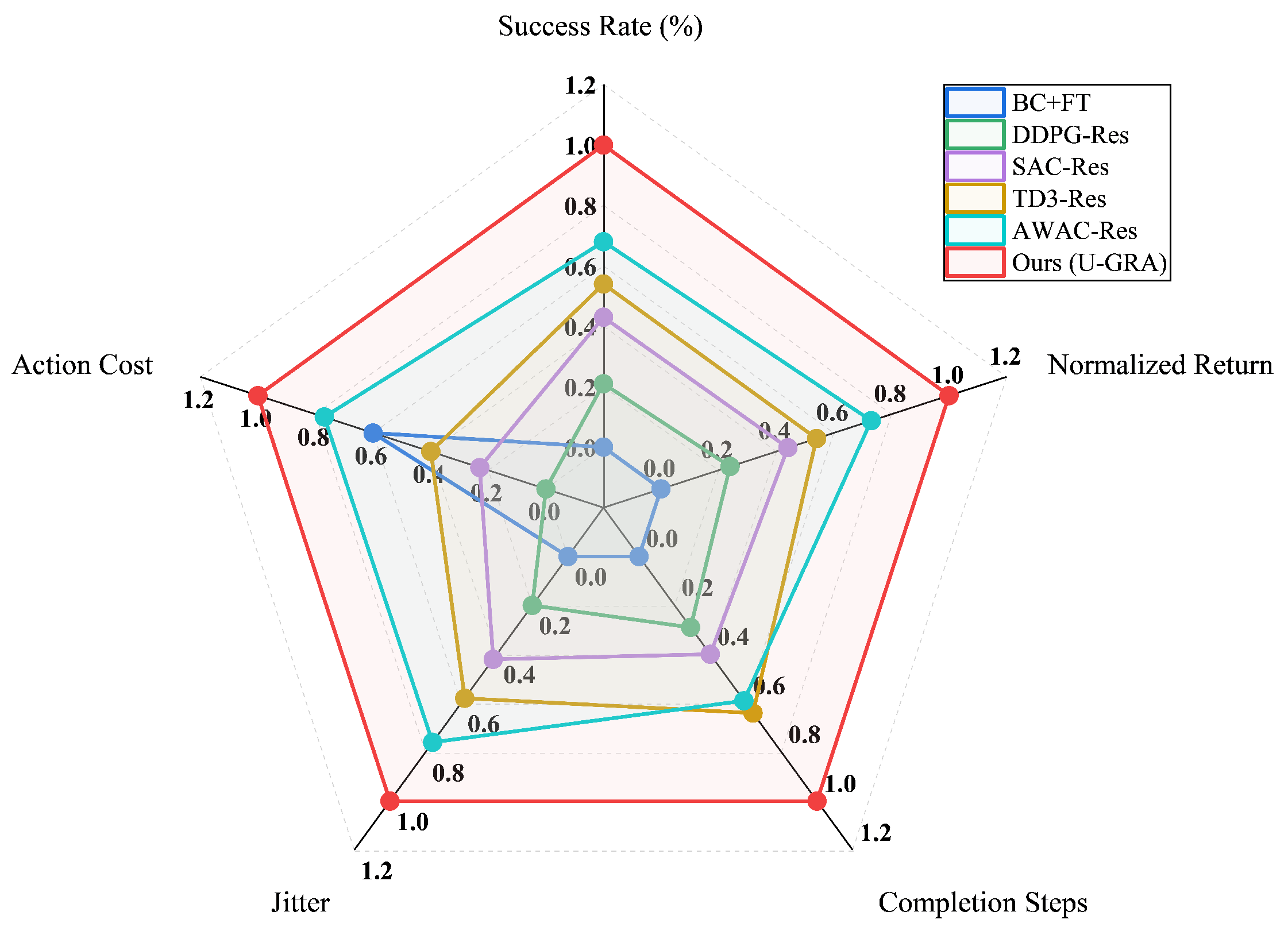
Beyond the seed-level analysis of success rate, the overall performance is further examined across all five evaluation metrics. Because these metrics have different numerical scales and optimization directions, we normalize them to a unified higher-is-better range before radar-chart visualization, as shown in Table 6. The normalized radar map in Figure 2 further visualizes the relative multi-metric performance of U-GRA within the matched offline-to-online comparison protocol. After aligning all metrics to a higher-is-better direction, U-GRA forms the outermost and most balanced polygon, indicating consistent advantages in success, return, completion efficiency, motion smoothness, and action economy.
The stability-related metrics further clarify the advantage of uncertainty-gated residual adaptation. U-GRA reduces jitter from 0.28 ± 0.06 in AWAC-Res to 0.12 ± 0.03 , corresponding to a relative reduction of 57.1%. Compared with BC+FT, the jitter reduction reaches 84.6%. At the same time, U-GRA maintains a lower action cost than all residualized baselines. This indicates that the performance gain is not obtained by applying larger or more aggressive actions, but by preserving the frozen behavioral prior and selectively injecting bounded residual correction.
The standard deviation of the success rate also decreases from 5.6 8.8 % in the baselines to 2.3 % in U-GRA. This suggests that the Critic-Derived Uncertainty Gate improves not only average performance but also seed-level stability under randomized mass, friction, and observation-noise conditions. Overall, within the matched offline-to-online residual adaptation protocol, the main comparison supports the central design motivation of U-GRA: residual learning benefits physical-domain adaptation, and its effect becomes more stable when residual injection is regulated by critic-derived uncertainty.

4.8. Training Curves

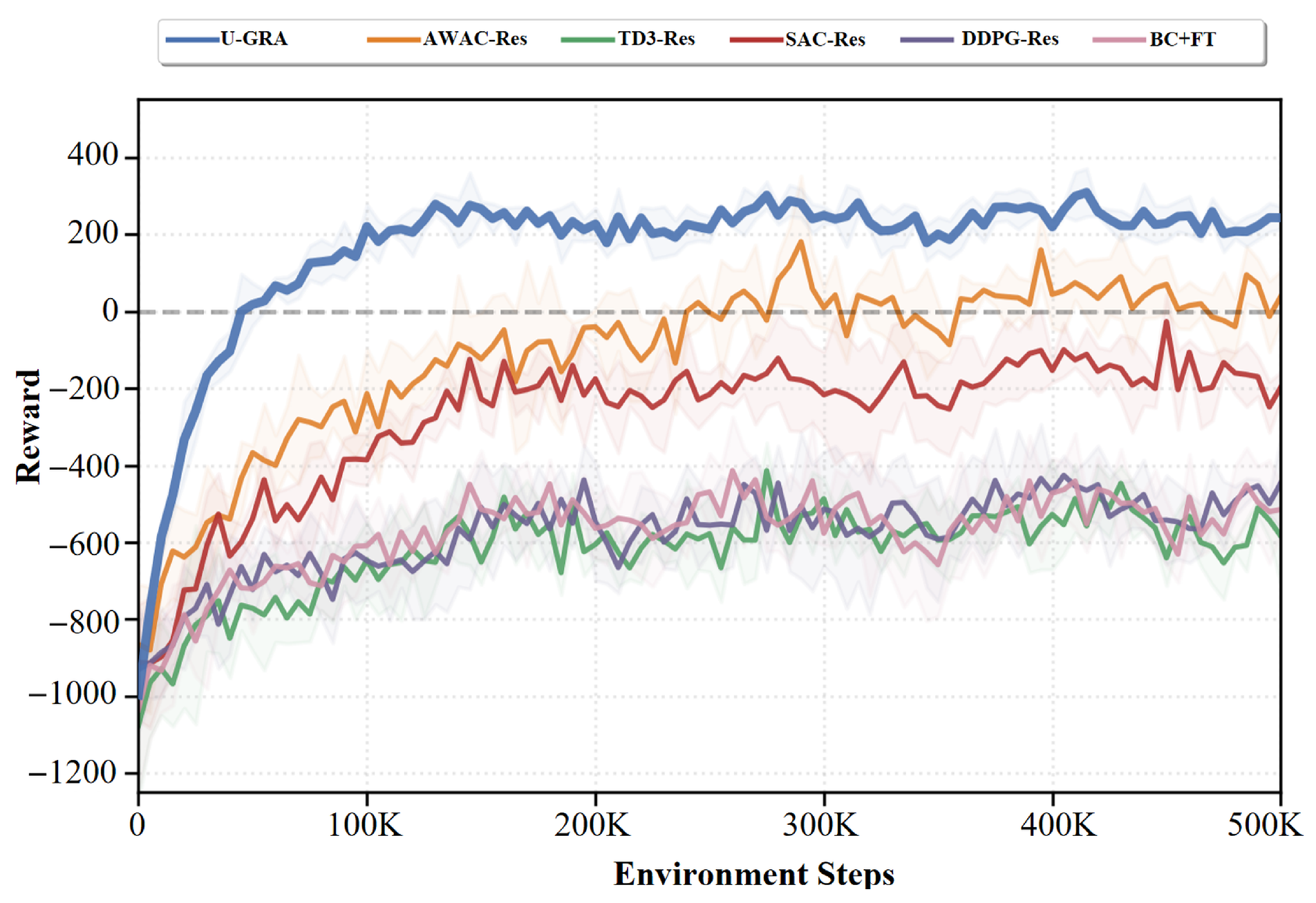
Figure 3 reports the raw undiscounted episode-return curves over 500,000 environment steps. The episode return is computed from the reward defined in Equation (4), following the definition provided in the Evaluation Metrics subsection. Returns are recorded every 5K environment steps. Each curve denotes the mean episode return over three random seeds, and the shaded region denotes the standard deviation across seeds.
U-GRA shows a faster transition from the initial low-reward region to the positive-reward region and reaches a higher final reward plateau than all baselines. This trend indicates that the frozen behavioral prior provides an effective action anchor during the early stage of online adaptation, while the residual branch gradually learns contact-dependent corrections under domain randomization. In contrast, BC+FT and the residualized baselines exhibit either slower improvement or lower final rewards, suggesting that direct fine-tuning or ungated residual correction is less stable under randomized physical conditions.
Among the baselines, AWAC-Res performs better than DDPG-Res, TD3-Res, SAC-Res, and BC +FT, which is consistent with its relatively strong performance in Table 5. However, its reward curve still remains below U-GRA and exhibits larger late-stage fluctuations. This difference is consistent with the quantitative jitter results: without critic-derived uncertainty gating, residual correction can improve return but remains more susceptible to oscillatory contact behavior. Therefore, the reward curves provide temporal evidence that U-GRA improves both learning efficiency and late-stage adaptation stability.

4.9. Mass–Friction Robustness Heatmaps

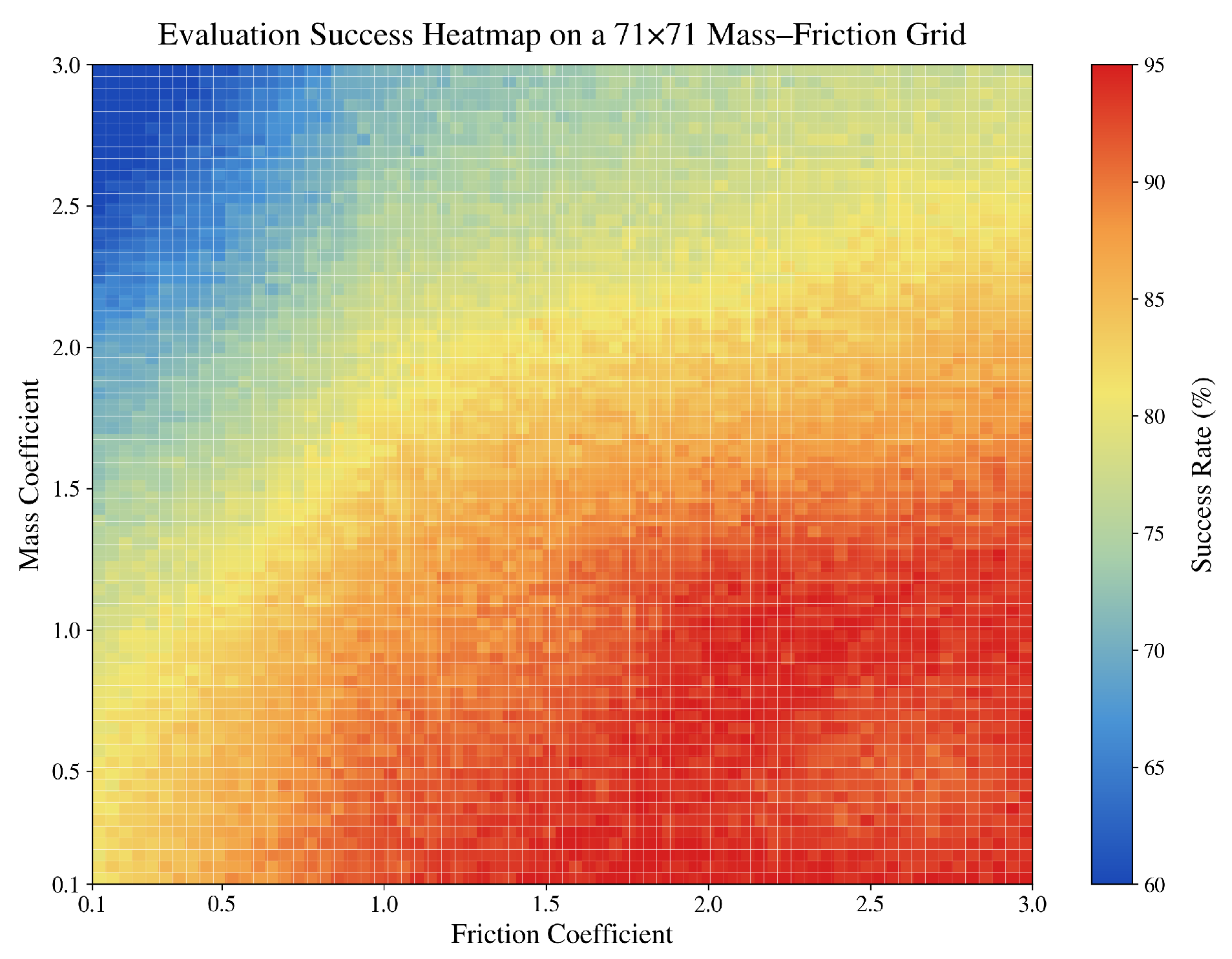
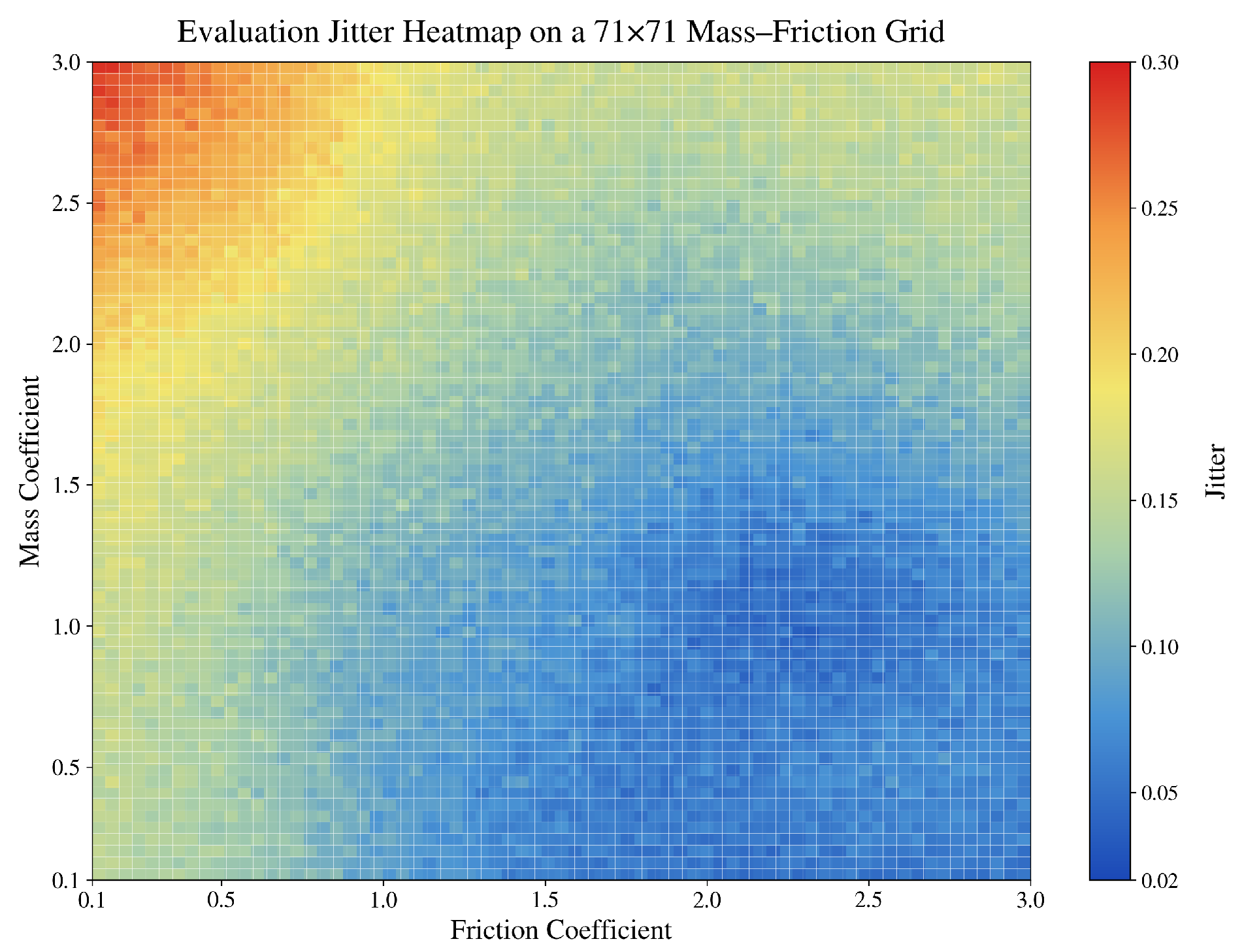
To visualize local robustness across the physical-parameter space, the trained policy is evaluated on a fixed 71 × 71 mass–friction grid over c m [ 0.1 , 3.0 ] and c μ [ 0.1 , 3.0 ] . The grid is used only for post-training evaluation to obtain reproducible heatmaps of success rate and jitter. During online training, c m and c μ are sampled from continuous uniform distributions, whereas the fixed grid is used after training to visualize how performance varies over the two dominant physical variables. For each grid location, evaluation is repeated over multiple rollouts and random seeds, and object instances are sampled from the held-out test split with observation noise sampled from [ 0 , 0.1 ] . The grid evaluation is not used for policy training or hyperparameter selection.
Figure 4 shows the local success-rate distribution over the mass–friction space. U-GRA maintains a broad high-success region under low-to-medium mass and sufficient friction, while performance gradually decreases in the high-mass and low-friction region. This pattern is physically interpretable: increasing mass raises the required grasp wrench, whereas decreasing friction reduces the available tangential contact force. Therefore, the success heatmap provides a local robustness view that complements the averaged results in Table 5.
Figure 5 reports the corresponding jitter distribution. The jitter map is broadly consistent with the success-rate pattern: regions with high mass and low friction exhibit stronger oscillatory behavior, while regions with moderate mass and sufficient friction show smoother stabilization. This indicates that local performance degradation is associated not only with failed lifting but also with contact instability during the stabilization phase. Together, the two heatmaps show that U-GRA remains robust over most of the randomized physical domain, with failure and instability concentrated in physically challenging mass–friction regions.

4.10. Ablation Study

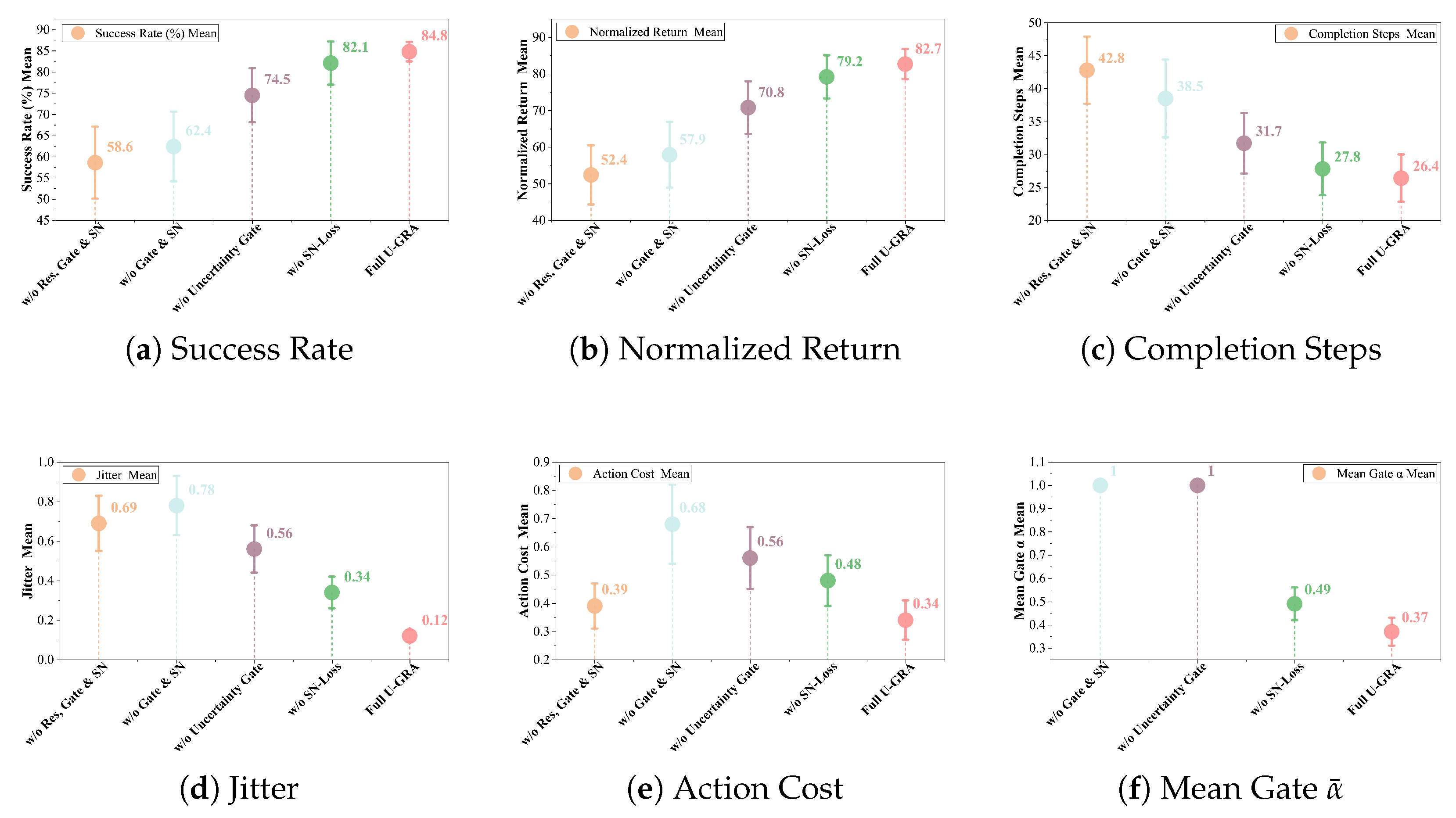
Table 7 isolates the contributions of the frozen prior, residual correction, critic-derived uncertainty gating, and spectral stabilization. The Frozen Prior Only variant achieves a success rate of 58.6 ± 8.5 % , which confirms that the nominal behavioral prior provides a useful but insufficient grasping behavior under physical-domain randomization. Without online residual correction, the policy cannot adequately compensate for changes in object mass, effective friction, and observation noise. As shown in Figure 6, removing the residual branch, gate mechanism, or spectral normalization leads to clear performance degradation, while Full U-GRA consistently achieves the best success rate, normalized return, completion efficiency, and motion smoothness. The lower mean gate value of Full U-GRA further suggests that the proposed uncertainty-aware gate does not rely on excessive residual correction, but adaptively injects residual actions only when needed.
Introducing a residual branch without gating and spectral stabilization improves the success rate to 62.4 ± 8.2 % , but the jitter increases to 0.78 ± 0.15 and the action cost rises to 0.68 ± 0.14 . This result shows that residual correction can improve adaptability, but unconstrained residual injection may produce aggressive or oscillatory contact behavior. When the uncertainty gate is removed but residual learning remains active, the success rate increases to 74.5 ± 6.4 % , but jitter remains high at 0.56 ± 0.12 . Compared with this variant, Full U-GRA improves success by 10.3 percentage points and reduces jitter by 78.6%.
The w/o SN-Loss variant reaches a success rate of 82.1 ± 5.1 % , close to Full U-GRA, but its jitter and action cost are still substantially higher. Full U-GRA reduces jitter from 0.34 ± 0.08 to 0.12 ± 0.03 , a 64.7% reduction, and decreases action cost from 0.48 ± 0.09 to 0.34 ± 0.07 . This indicates that the SN-related regularization mainly improves contact-phase smoothness rather than acting as the sole source of task success.
Full U-GRA achieves the best trade-off among all variants, with the highest success rate, highest normalized return, lowest jitter, and lowest action cost. The mean gate value of 0.37 ± 0.06 indicates that residual correction is not fully injected at every time step. Instead, the gate selectively modulates the correction strength according to critic-derived uncertainty. The ablation results therefore support the intended division of roles: the frozen behavioral prior provides nominal stability, the residual branch provides adaptation capacity, the Critic-Derived Uncertainty Gate controls when the residual should be trusted, and the SN-related term suppresses abrupt residual changes during contact transitions.

4.11. OOD Robustness over an Unseen Mass–Friction Region

To evaluate regional extrapolation beyond the randomized training support, we conduct a continuous two-dimensional OOD sweep. The mass–friction supports used for online training and OOD evaluation are
D train ( m , μ ) = [ 0.1 , 3.0 ] × [ 0.1 , 3.0 ] , D OOD ( m , μ ) = ( 3.0 , 4.0 ] × [ 0.05 , 0.1 ) .
At the beginning of each OOD evaluation episode, the mass and friction coefficients are sampled independently from the continuous intervals defining D OOD ( m , μ ) . Therefore, every evaluated parameter pair lies outside the online-training support in both dimensions. Given the nominal object mass m 0 = 1.0 kg , the OOD mass interval corresponds to m ( 3.0 , 4.0 ] kg . The object split, observation-noise range, episode length, and evaluation protocol are kept identical to those used in the main comparison.
As shown in Table 8, all methods exhibit lower performance in the unseen high-mass and low-friction region. Nevertheless, U-GRA retains the highest success rate of 64.52 ± 9.36 % , exceeding AWAC-Res by 5.79 percentage points and TD3-Res by 10.13 percentage points. U-GRA also obtains the highest normalized return of 58.41 ± 9.63 and the fewest completion steps of 36.98 ± 4.24 .
The stability metrics show the same trend. U-GRA achieves the lowest jitter of 0.52 ± 0.14 , representing a 23.5% reduction relative to AWAC-Res, and the lowest action cost of 0.55 ± 0.13 , representing a 14.1% reduction. These results indicate that the advantage of uncertainty-gated residual adaptation extends across the evaluated OOD region rather than being restricted to a single extreme parameter pair.

4.12. Gate-Value Distribution and Conservative Operating Range

To characterize the Critic-Derived Uncertainty Gate beyond its overall mean value, we record the per-step gate values under six representative evaluation conditions using the three independently trained U-GRA policies. The last condition uses the same continuous, multi-point OOD mass–friction sweep defined in Section 4.11, rather than a single extreme parameter pair. For each seed, the gate distribution is computed over all evaluation steps. The mean gate is first calculated within each seed and then reported as the mean and sample standard deviation across seeds. Percentiles and conservative-range proportions are computed within each seed and subsequently averaged across the three seeds.
As shown in Table 9, the gate distribution exhibits a non-monotonic response to physical-domain variation. In the nominal neighborhood, the frozen behavioral prior already provides an effective action anchor, and the mean gate value is relatively low. Over the full randomized in-distribution domain, the mean gate is consistent with the value reported in the ablation study.
At the high-mass and low-friction training edges, the mean gate increases because these conditions require stronger residual correction while remaining within the online-training support. In contrast, the mean gate decreases under high observation noise and over the regional OOD sweep. This pattern indicates that the gate jointly reflects the state-dependent need for residual correction and the critic-derived reliability of the candidate residual action. In particular, the OOD result is aggregated across continuously sampled mass–friction pairs, showing that residual suppression is not an artifact of a single extreme test point.
To define an empirical conservative operating range, let S e denote the binary success indicator of evaluation episode e, and let J e denote its jitter value. We define the empirically stable episode set as
E stable = e : S e = 1 , J e 0.15 .
The jitter threshold of 0.15 corresponds to the reported U-GRA mean jitter plus one across-seed standard deviation. Let Q 0.95 denote the empirical 95th percentile. The conservative gate threshold is defined as
α c = Q 0.95 α t e E stable = 0.60 .
Accordingly, the empirical conservative operating range is
G cons = α t [ 0 , 1 ] : α t 0.60 .
Because the residual correction is bounded and the action projection is non-expansive, the deviation from the frozen-prior action satisfies
a t a t prior α t Δ a t res α t δ .
With the selected residual bound and conservative gate threshold, the component-wise action deviation satisfies
a t a t prior 0.60 × 0.20 = 0.12 .
Thus, the conservative range limits the deviation from the frozen-prior action to at most 0.12 per normalized action dimension. The proportion of steps within this range is lower at the high-mass and low-friction training edges, where stronger residual correction is more frequently required, and higher under high observation noise and across the regional OOD sweep, where residual injection is predominantly suppressed.
The threshold of 0.60 is an empirical criterion for conservative residual injection in the present simulation rather than a formal hardware-safety certificate. Values above this threshold indicate high-injection events but do not necessarily represent unsafe actions. Conversely, satisfying this criterion does not guarantee real-hardware safety, which would require hardware-calibrated actuator limits, contact-force measurements, and real-system validation.

4.13. Representative Hyperparameter Sensitivity

We conduct a one-factor-at-a-time sensitivity analysis for three parameters that directly control the principal mechanisms of U-GRA: the maximum residual-correction scale, the gate-magnitude regularization coefficient, and the temporal residual-smoothness coefficient. For each configuration, only one parameter is changed from its default value. All remaining hyperparameters, the frozen behavioral prior, offline dataset, domain-randomization protocol, online interaction budget, and evaluation procedure are kept unchanged. Each configuration is trained independently using three random seeds, and the results are reported as the mean and sample standard deviation across the three seed-level results.
Table 10 shows that the default configuration provides the best overall task performance. When the maximum residual scale is reduced from 0.20 to 0.10 , the mean gate increases from 0.37 to 0.44 , but the product of the residual scale and mean gate decreases from 0.074 to 0.044 . The resulting correction is more conservative and produces lower jitter, but the reduced residual capacity also lowers the success rate and normalized return. Increasing the maximum residual scale to 0.30 reduces the mean gate to 0.31 , partially compensating for the larger residual bound. Nevertheless, the residual envelope increases to 0.093 , leading to higher jitter and action cost.
The gate-magnitude regularization coefficient directly controls the learned residual-injection strength. Reducing this coefficient from 0.05 to 0.01 increases the mean gate to 0.48 and the residual envelope to 0.096 , producing more aggressive corrections and higher jitter. Increasing it to 0.10 reduces the mean gate to 0.29 and the residual envelope to 0.058 . Although this setting improves smoothness, the stronger gate penalty limits the correction required under physical-domain variation and reduces task performance.
The temporal residual-smoothness coefficient primarily affects motion stability rather than average residual-injection strength. Reducing it from 0.10 to 0.05 increases jitter from 0.12 to 0.17 , while the mean gate remains close to its default value. Increasing it to 0.20 reduces jitter to 0.09 , but excessive temporal smoothing suppresses rapid corrective changes during contact transitions and lowers both success rate and normalized return.
Across the evaluated ranges, the performance changes smoothly rather than collapsing under small parameter variations. The default configuration therefore represents a balanced operating point rather than an isolated setting, providing the highest success rate and normalized return while retaining low jitter, moderate action cost, and controlled residual injection.

4.14. Qualitative Simulation Visualization

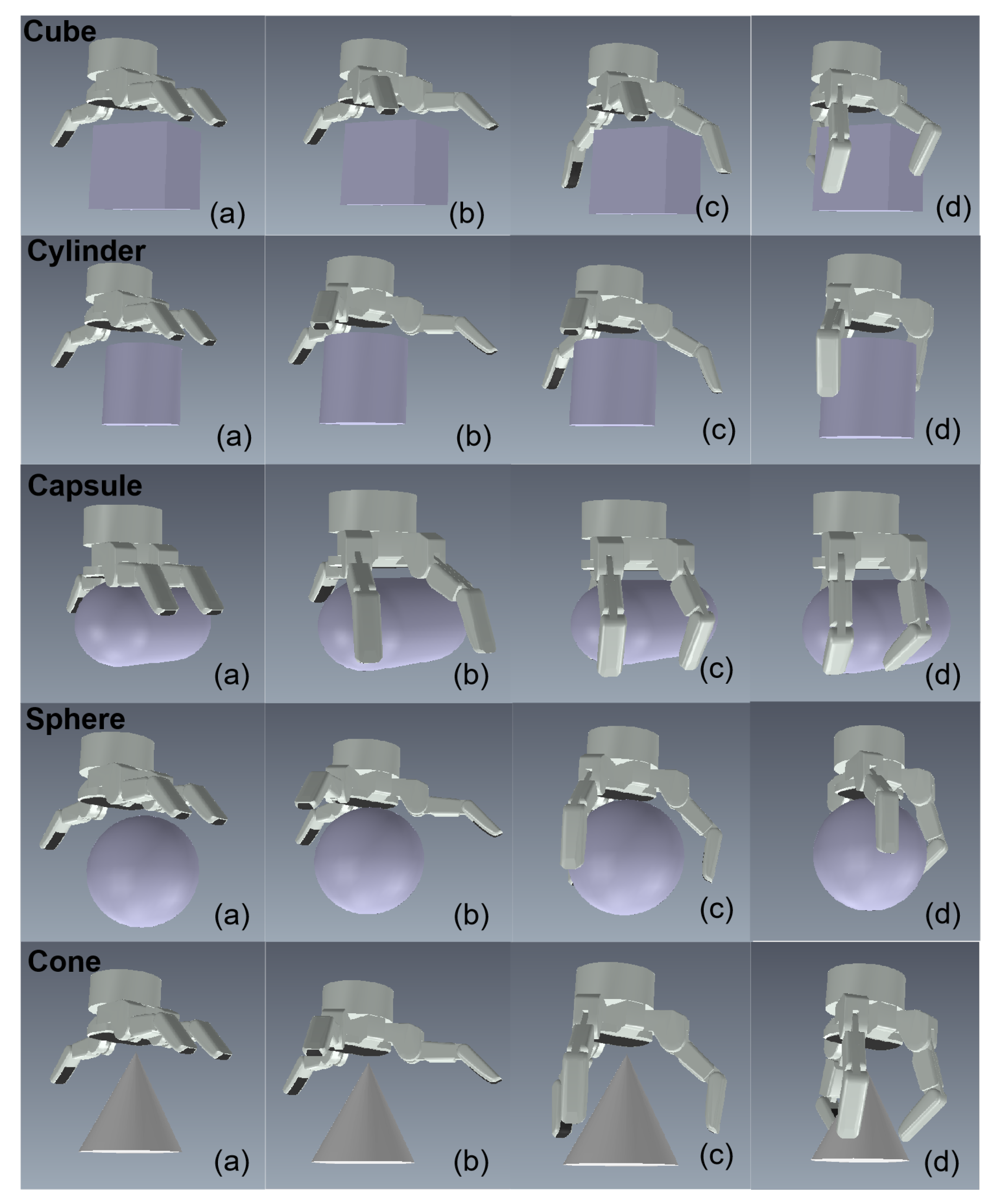
Figure 7 provides representative simulation rollouts of U-GRA on selected geometric object types. This figure is intended as qualitative evidence of the learned closed-loop behavior rather than exhaustive coverage of all object categories in the offline dataset. Each row corresponds to one representative object type, and columns (a)–(d) illustrate initial pose, approach and alignment, contact stabilization, and stable lifting.
Across the shown objects, U-GRA exhibits a consistent align–contact stabilization–lift behavior. For objects with clear edges or corners, such as cubes and cones, the policy adjusts the gripper posture before closure to reduce lateral disturbance during contact formation. For curved objects, such as cylinders, capsules, and spheres, the fingers form more enveloping contacts, which increases the effective friction margin and supports stable lifting. These qualitative behaviors are consistent with the quantitative results in Table 5: the frozen behavioral prior preserves a stable grasping structure, while the uncertainty-gated residual branch provides controlled correction under changed physical conditions.
The visualization also supports the jitter analysis. During contact stabilization and lifting, U-GRA avoids large oscillatory finger motions and maintains a relatively stable object pose. This observation is consistent with the low jitter value of 0.12 ± 0.03 in the main comparison and the smoother regions in Figure 5. Therefore, the qualitative results do not serve as independent proof of generalization, but they provide interpretable visual evidence for the closed-loop behavior underlying the quantitative improvements.

4.15. Discussion

The experimental results provide converging evidence that stable physical-domain adaptation benefits from separating nominal behavior preservation and online physical correction. The main comparison shows that U-GRA achieves the best overall performance, improving the success rate by 9.2 percentage points and reducing jitter by 57.1% compared with the strongest residualized baseline, AWAC-Res. The reward curves further show that this advantage emerges during online adaptation rather than only at the final evaluation stage. The heatmaps then reveal that U-GRA’s robustness is not uniformly averaged over the test domain; instead, it follows physically interpretable mass–friction patterns, with degradation concentrated in high-mass and low-friction regions.
The ablation study explains why this improvement occurs. A frozen behavioral prior alone is too conservative under physical-domain shift, while ungated residual correction introduces higher jitter and action cost. The Critic-Derived Uncertainty Gate allows the policy to inject residual correction selectively, and the SN-related regularization further suppresses abrupt residual changes during contact transitions. This mechanism is particularly important for three-finger grasping because contact stability depends on the coordinated evolution of multiple finger contacts rather than on a single closing direction.
The regional OOD sweep shows that U-GRA still degrades when mass and friction are simultaneously shifted beyond their training ranges, but it retains the highest success rate, normalized return, and stability among all evaluated methods. Across c m ( 3.0 , 4.0 ] and c μ [ 0.05 , 0.1 ) , U-GRA achieves a success rate of 64.52 ± 9.36 % . This result indicates that the proposed framework improves extrapolation over the evaluated unseen region rather than fitting only a single OOD parameter point. However, the remaining performance degradation also shows that U-GRA does not eliminate the physical limitations associated with simultaneously increased mass and reduced friction. The results should therefore be interpreted as simulation evidence of improved regional OOD robustness rather than proof of unrestricted generalization or real-world deployment readiness.
The gate-value analysis provides additional mechanism-level evidence. Residual injection increases at the high-mass and low-friction edges of the training support, where stronger correction is required, but decreases under high observation noise and throughout the multi-point OOD sweep, where critic disagreement more often indicates unreliable extrapolation. The empirical conservative range α t 0.60 contains 97.2 % of the gate values in the regional OOD evaluation, and the bounded residual design limits the corresponding component-wise action deviation from the frozen prior to 0.12 . The sensitivity analysis further shows smooth performance changes around the selected values of δ , λ α , and η , supporting the default configuration as a balanced operating point rather than an isolated optimum.
RFS and ResDex are conceptually relevant residual-learning methods, but their published task and policy interfaces differ substantially from the matched protocol used in this study. RFS adapts a pretrained flow-matching policy by jointly optimizing latent-noise steering and action-space residual correction, whereas U-GRA adapts a frozen non-generative behavioral prior through uncertainty-regulated residual fusion. ResDex learns residual actions together with mixture-of-experts weights over multiple geometry-unaware base policies to address universal geometric generalization, whereas U-GRA uses a single frozen prior and isolates adaptation to mass, effective friction, and observation noise in a simulated three-finger grasping task. Simplifying either method to the present policy interface would remove its defining latent-steering or mixture-of-experts mechanism. We therefore provide a conceptual comparison and restrict the quantitative evaluation to methods that share the same frozen prior, offline dataset, residual-action interface, online interaction budget, and evaluation protocol [40,41].

5. Conclusions

This work develops U-GRA as an uncertainty-gated residual adaptation framework for simulated three-finger grasping under physical-domain shift. The framework preserves a nominal behavioral prior learned from offline demonstrations and restricts online adaptation to bounded residual correction. A critic-disagreement statistic, computed from two scalar Q-value estimators, conditions the residual-injection strength under the current contact state. The SN-Block, bounded projection, and residual smoothness regularization further constrain residual sensitivity and reduce abrupt residual changes during contact transitions.
Within the matched offline-to-online comparison protocol, the experimental results show that U-GRA achieves the best overall performance among the evaluated methods under simulated mass–friction domain randomization. In the main comparison, U-GRA reaches a success rate of 84.8 ± 2.3 % , a normalized return of 82.7 ± 4.1 , and a jitter value of 0.12 ± 0.03 . Compared with AWAC-Res, the strongest baseline, U-GRA improves success by 9.2 percentage points and reduces jitter by 57.1%. The ablation study further confirms that the performance gain arises from the combination of frozen-prior preservation, bounded residual correction, critic-derived uncertainty gating, and spectral stabilization. The fixed-grid mass–friction heatmaps reveal physically meaningful robustness patterns, while the regional OOD sweep shows that U-GRA retains the highest success rate of 64.52 ± 9.36 % over the unseen region c m ( 3.0 , 4.0 ] and c μ [ 0.05 , 0.1 ) . The gate-distribution and sensitivity analyses further show that residual injection is suppressed across the multi-point OOD sweep and that performance varies smoothly around the selected hyperparameters. These results indicate that uncertainty-gated residual correction around a frozen behavioral prior is an effective strategy for improving physical robustness in simulated three-finger grasping.

5.1. Limitations

Several limitations should be acknowledged. First, all experiments are conducted in simulation. Although the mass range and gripper configuration are selected with reference to the BarrettHand BH8-282 specification, the current results do not constitute real-hardware validation. Real robotic systems may introduce actuator backlash, joint friction, unmodeled compliance, latency, calibration errors, tactile sensing noise, and sim-to-real contact mismatch. Therefore, the present results should be interpreted as simulation evidence rather than deployment-level proof.
Second, the empirical comparison focuses on residualized versions of representative actor–critic algorithms, including DDPG-Res, SAC-Res, TD3-Res, and AWAC-Res. This design is intentional because the purpose of the experiments is to isolate the effect of uncertainty-gated residual fusion under the same frozen behavioral prior, offline dataset, online interaction budget, and domain-randomization protocol. Some recent top-conference methods, such as residual flow steering and universal dexterous grasping frameworks, rely on different policy classes, data assumptions, pretraining pipelines, and large-scale simulation resources. Directly reproducing these methods under the present simulated physical-domain adaptation setting would introduce additional implementation and resource variables, making it difficult to attribute performance differences specifically to the proposed uncertainty-gated residual adaptation mechanism. For this reason, these methods are discussed in the related work as conceptually relevant studies, while the empirical comparison is restricted to baselines that can be implemented under the same residual adaptation interface.
Third, the current object set is constructed from geometric object families. This design helps isolate physical-domain adaptation by controlling object geometry while varying mass, effective friction, and observation noise. However, it does not cover the full diversity of industrial parts, such as deformable objects, thin-shell objects, highly irregular shapes, complex surface textures, or objects with nonuniform inertial distributions. Similarly, the robustness heatmaps focus on two dominant physical variables, mass and effective friction, while other uncertainty sources are not exhaustively evaluated.

5.2. Future Work

Future work will extend U-GRA in three directions. The first direction is real-hardware validation on a BarrettHand or comparable three-finger gripper. This will allow evaluation of sim-to-real transfer, actuator-level uncertainty, contact hysteresis, tactile sensing effects, and latency-induced instability. Such experiments are necessary before making deployment-level claims in production environments.
The second direction is to incorporate richer object categories, tactile feedback, and visual perception. The present study uses geometric object families to isolate physical-domain adaptation, but more realistic industrial objects may include complex shapes, variable surface textures, deformable materials, and nonuniform mass distributions. Integrating tactile and visual observations may provide more informative contact-state estimates and improve the reliability of the Critic-Derived Uncertainty Gate.
The third direction is to evaluate U-GRA against stronger residual, generative, and dexterous manipulation policies under a unified implementation budget. Recent methods based on residual flow steering, universal dexterous grasping, or large-scale generative policy learning are conceptually relevant, but their data requirements, pretraining assumptions, and computational costs differ substantially from the present setting. A fair comparison would require a shared task interface, comparable offline data, matched online interaction budgets, and consistent evaluation protocols. Establishing such a benchmark would further clarify the strengths and limitations of uncertainty-gated residual adaptation for physically robust three-finger grasping.


Author Contributions

Conceptualization, J.Z.; methodology, J.Z.; software, J.Z.; validation, J.Z., Z.G., Z.Y., and Y.G.; formal analysis, J.Z.; investigation, J.Z.; resources, Z.Y. and Y.G.; data curation, J.Z., Z.Y., and Y.G.; writing—original draft preparation, J.Z.; writing—review and editing, J.Z.; visualization, J.Z.; supervision, Z.G., Z.Y., and Y.G.; project administration, Z.Y. and Y.G.; funding acquisition, Z.Y. and Y.G. All authors have read and agreed to the published version of the manuscript.

Funding

This research is financially supported by Shenzhen Excellent Innovative Talents RCYX20221008093036022, and the Guangdong Special Support Plan Science and Technology Innovation Young Top-notch Talents (No. 2023TQ07L745).

Institutional Review Board Statement

Not applicable.

Informed Consent Statement

Not applicable.

Data Availability Statement

The offline demonstration dataset, simulator configuration files, implementation materials, and trained checkpoints used in this study are available from the corresponding author upon reasonable request.

Conflicts of Interest

The authors declare no conflicts of interest.

References

  1. Rojas, N.; Ma, R.R.; Dollar, A.M. The GR2 Gripper: An Underactuated Hand for Open-Loop In-Hand Planar Manipulation. IEEE Trans. Robot. 2016, 32, 763–770. [Google Scholar] [CrossRef] [Scilit]
  2. Borràs, J.; Dollar, A.M. Dimensional Synthesis of Three-Fingered Robot Hands for Maximal Precision Manipulation Workspace. Int. J. Robot. Res. 2015, 34, 1731–1746. [Google Scholar] [CrossRef] [Scilit]
  3. Chen, T.; Tippur, M.; Wu, S.; Kumar, V.; Adelson, E.; Agrawal, P. Visual Dexterity: In-Hand Reorientation of Novel and Complex Object Shapes. Sci. Robot. 2023, 8, eadc9244. [Google Scholar] [CrossRef] [Scilit] [PubMed]
  4. O’Neill, A.; Rehman, A.; Maddukuri, A.; Gupta, A.; Padalkar, A.; Lee, A.; Pooley, A.; Gupta, A.; Mandlekar, A.; Jain, A.; et al. Open X-Embodiment: Robotic Learning Datasets and RT-X Models. In Proceedings of the 2024 IEEE International Conference on Robotics and Automation (ICRA); IEEE: New York, NY, USA, 2024; pp. 6892–6903. [Google Scholar]
  5. Zitkovich, B.; Yu, T.; Xu, S.; Xu, P.; Xiao, T.; Xia, F.; Wu, J.; Wohlhart, P.; Welker, S.; Wahid, A.; et al. RT-2: Vision-Language-Action Models Transfer Web Knowledge to Robotic Control. In Proceedings of the Conference on Robot Learning; PMLR: Cambridge, MA, USA, 2023; pp. 2165–2183. [Google Scholar]
  6. Thomas, G.; Cheng, C.A.; Loynd, R.; Frujeri, F.V.; Vineet, V.; Jalobeanu, M.; Kolobov, A. PLEX: Making the Most of the Available Data for Robotic Manipulation Pretraining. In Proceedings of the Conference on Robot Learning; PMLR: Cambridge, MA, USA, 2023; pp. 2624–2641. [Google Scholar]
  7. Chi, C.; Xu, Z.; Pan, C.; Cousineau, E.; Burchfiel, B.; Feng, S.; Tedrake, R.; Song, S. Universal Manipulation Interface: In-the-Wild Robot Teaching Without In-the-Wild Robots. In Proceedings of the Robotics: Science and Systems; RSS Foundation: Pittsburgh, PA, USA, 2024. [Google Scholar]
  8. Wang, C.; Shi, H.; Wang, W.; Zhang, R.; Fei-Fei, L.; Liu, K. DexCap: Scalable and Portable Mocap Data Collection System for Dexterous Manipulation. In Proceedings of the Robotics: Science and Systems; RSS Foundation: Pittsburgh, PA, USA, 2024. [Google Scholar]
  9. Wang, R.; Zhang, J.; Chen, J.; Xu, Y.; Li, P.; Liu, T.; Wang, H. DexGraspNet: A Large-Scale Robotic Dexterous Grasp Dataset for General Objects Based on Simulation. In Proceedings of the 2023 IEEE International Conference on Robotics and Automation (ICRA); IEEE: New York, NY, USA, 2023; pp. 11359–11366. [Google Scholar]
  10. Chi, C.; Xu, Z.; Feng, S.; Cousineau, E.; Du, Y.; Burchfiel, B.; Tedrake, R.; Song, S. Diffusion Policy: Visuomotor Policy Learning via Action Diffusion. Int. J. Robot. Res. 2025, 44, 1684–1704. [Google Scholar] [CrossRef] [Scilit]
  11. Kadalagere Sampath, S.; Wang, N.; Yang, C.; Wu, H.; Liu, C.; Pearson, M. A Vision-Guided Deep Learning Framework for Dexterous Robotic Grasping Using Gaussian Processes and Transformers. Appl. Sci. 2025, 15, 2615. [Google Scholar] [CrossRef] [Scilit]
  12. Hong, Y.; Kim, J.; Cha, G.; Kim, E.; Lee, K. See-Then-Grasp: Object Full 3D Reconstruction via Two-Stage Active Robotic Reconstruction Using Single Manipulator. Appl. Sci. 2025, 15, 272. [Google Scholar] [CrossRef] [Scilit]
  13. Nguyen, V.D. Constructing Force-Closure Grasps in Three Dimensions. Int. J. Robot. Res. 1988, 7, 3–16. [Google Scholar] [CrossRef] [Scilit]
  14. Ferrari, C.; Canny, J. Planning Optimal Grasps. In Proceedings of the 1992 IEEE International Conference on Robotics and Automation; IEEE: New York, NY, USA, 1992; Volume 3, pp. 2290–2295. [Google Scholar]
  15. Bicchi, A.; Kumar, V. Robotic Grasping and Contact: A Review. In Proceedings of the IEEE International Conference on Robotics and Automation; IEEE: New York, NY, USA, 2000; pp. 348–353. [Google Scholar]
  16. Newbury, R.; Gu, M.; Chumbley, L.; Mousavian, A.; Eppner, C.; Leitner, J. Deep Learning Approaches to Grasp Synthesis: A Review. IEEE Trans. Robot. 2023, 39, 3994–4015. [Google Scholar] [CrossRef] [Scilit]
  17. Pollayil, M.J.; Angelini, F.; Xin, G.; Mistry, M.; Vijayakumar, S.; Bicchi, A.; Garabini, M. Choosing Stiffness and Damping for Optimal Impedance Planning. IEEE Trans. Robot. 2023, 39, 1281–1300. [Google Scholar] [CrossRef] [Scilit]
  18. Hogan, N. Impedance Control: An Approach to Manipulation. Part I—Theory. J. Dyn. Syst. Meas. Control 1985, 107, 1–7. [Google Scholar] [CrossRef] [Scilit]
  19. Mandlekar, A.; Xu, D.; Wong, J.; Nasiriany, S.; Wang, C.; Kulkarni, R.; Fei-Fei, L.; Savarese, S.; Zhu, Y.; Martín-Martín, R. What Matters in Learning from Offline Human Demonstrations for Robot Manipulation. In Proceedings of the Conference on Robot Learning; PMLR: Cambridge, MA, USA, 2022. [Google Scholar]
  20. Ross, S.; Gordon, G.J.; Bagnell, J.A. A Reduction of Imitation Learning and Structured Prediction to No-Regret Online Learning. In Proceedings of the Fourteenth International Conference on Artificial Intelligence and Statistics; PMLR: Cambridge, MA, USA, 2011; pp. 627–635. [Google Scholar]
  21. Schulman, J.; Wolski, F.; Dhariwal, P.; Radford, A.; Klimov, O. Proximal Policy Optimization Algorithms. arXiv 2017, arXiv:1707.06347. [Google Scholar]
  22. Lillicrap, T.P.; Hunt, J.J.; Pritzel, A.; Heess, N.; Erez, T.; Tassa, Y.; Silver, D.; Wierstra, D. Continuous Control with Deep Reinforcement Learning. In Proceedings of the International Conference on Learning Representations; ICLR: Appleton, WI, USA, 2016. [Google Scholar]
  23. Fujimoto, S.; van Hoof, H.; Meger, D. Addressing Function Approximation Error in Actor-Critic Methods. In Proceedings of the 35th International Conference on Machine Learning; PMLR: Cambridge, MA, USA, 2018; pp. 1587–1596. [Google Scholar]
  24. Haarnoja, T.; Zhou, A.; Abbeel, P.; Levine, S. Soft Actor-Critic: Off-Policy Maximum Entropy Deep Reinforcement Learning with a Stochastic Actor. In Proceedings of the 35th International Conference on Machine Learning; PMLR: Cambridge, MA, USA, 2018; pp. 1861–1870. [Google Scholar]
  25. Nair, A.; Dalal, M.; Gupta, A.; Levine, S. AWAC: Accelerating Online Reinforcement Learning with Offline Datasets. In Proceedings of the International Conference on Learning Representations; ICLR: Appleton, WI, USA, 2021. [Google Scholar]
  26. Beltran-Hernandez, C.C.; Petit, D.; Ramirez-Alpizar, I.G.; Harada, K. Variable Compliance Control for Robotic Peg-in-Hole Assembly: A Deep-Reinforcement-Learning Approach. Appl. Sci. 2020, 10, 6923. [Google Scholar] [CrossRef] [Scilit]
  27. Huang, C.Y.; Su, G.W.; Shao, Y.H.; Wang, Y.C.; Yang, S.K. Rapid-Learning Collaborative Pushing and Grasping via Deep Reinforcement Learning and Image Masking. Appl. Sci. 2024, 14, 9018. [Google Scholar] [CrossRef] [Scilit]
  28. Li, S.; Huang, W.; Miao, C.; Xu, K.; Chen, Y.; Sun, T.; Cui, Y. Efficient Robot Manipulation via Reinforcement Learning with Dynamic Movement Primitives-Based Policy. Appl. Sci. 2024, 14, 10665. [Google Scholar] [CrossRef] [Scilit]
  29. Kostrikov, I.; Nair, A.; Levine, S. Offline Reinforcement Learning with Implicit Q-Learning. In Proceedings of the International Conference on Learning Representations; ICLR: Appleton, WI, USA, 2022. [Google Scholar]
  30. Kumar, A.; Zhou, A.; Tucker, G.; Levine, S. Conservative Q-Learning for Offline Reinforcement Learning. Proc. Adv. Neural Inf. Process. Syst. 2020, 33, 1179–1191. [Google Scholar]
  31. Fujimoto, S.; Gu, S.S. A Minimalist Approach to Offline Reinforcement Learning. Proc. Adv. Neural Inf. Process. Syst. 2021, 34, 20132–20145. [Google Scholar]
  32. Fu, J.; Kumar, A.; Nachum, O.; Tucker, G.; Levine, S. D4RL: Datasets for Deep Data-Driven Reinforcement Learning. arXiv 2020, arXiv:2004.07219. [Google Scholar]
  33. Lee, S.; Seo, Y.; Lee, K.; Abbeel, P.; Shin, J. Offline-to-Online Reinforcement Learning via Balanced Replay and Pessimistic Q-Ensemble. In Proceedings of the Conference on Robot Learning; PMLR: Cambridge, MA, USA, 2022; pp. 1702–1712. [Google Scholar]
  34. Yu, Z.; Zhang, X. Actor-Critic Alignment for Offline-to-Online Reinforcement Learning. In Proceedings of the 40th International Conference on Machine Learning; PMLR: Cambridge, MA, USA, 2023; pp. 40452–40474. [Google Scholar]
  35. Shin, Y.; Kim, J.; Jung, W.; Hong, S.; Yoon, D.; Jang, Y.; Kim, G.H.; Chae, J.; Sung, Y.; Lee, K.; et al. Online Pre-Training for Offline-to-Online Reinforcement Learning. In Proceedings of the 42nd International Conference on Machine Learning; PMLR: Cambridge, MA, USA, 2025. [Google Scholar]
  36. Huang, X.; Liu, X.; Zhang, E.; Yu, T.; Li, S. Offline-to-Online Reinforcement Learning with Classifier-Free Diffusion Generation. In Proceedings of the 42nd International Conference on Machine Learning; PMLR: Cambridge, MA, USA, 2025; Volume 267, pp. 25581–25592. [Google Scholar]
  37. Rajeswaran, A.; Kumar, V.; Gupta, A.; Vezzani, G.; Schulman, J.; Todorov, E.; Levine, S. Learning Complex Dexterous Manipulation with Deep Reinforcement Learning and Demonstrations. In Proceedings of the Robotics: Science and Systems; RSS Foundation: Pittsburgh, PA, USA, 2018. [Google Scholar]
  38. Ankile, L.; Simeonov, A.; Shenfeld, I.; Torne, M.; Agrawal, P. From Imitation to Refinement—Residual RL for Precise Assembly. In Proceedings of the 2025 IEEE International Conference on Robotics and Automation; IEEE: New York, NY, USA, 2025. [Google Scholar]
  39. Hu, H.; Mirchandani, S.; Sadigh, D. Imitation Bootstrapped Reinforcement Learning. In Proceedings of the Robotics: Science and Systems; RSS Foundation: Pittsburgh, PA, USA, 2024. [Google Scholar]
  40. Su, E.; Westenbroek, T.; Nagabandi, A.; Gupta, A. RFS: Reinforcement Learning with Residual Flow Steering for Dexterous Manipulation. In Proceedings of the International Conference on Learning Representations; ICLR: Appleton, WI, USA, 2026. [Google Scholar]
  41. Huang, Z.; Yuan, H.; Fu, Y.; Lu, Z. Efficient Residual Learning with Mixture-of-Experts for Universal Dexterous Grasping. In Proceedings of the International Conference on Learning Representations; ICLR: Appleton, WI, USA, 2025. [Google Scholar]
  42. Miyato, T.; Kataoka, T.; Koyama, M.; Yoshida, Y. Spectral Normalization for Generative Adversarial Networks. In Proceedings of the International Conference on Learning Representations; ICLR: Appleton, WI, USA, 2018. [Google Scholar]
  43. Xu, Y.; Wan, W.; Zhang, J.; Liu, H.; Shan, Z.; Shen, H.; Wang, R.; Geng, H.; Weng, Y.; Chen, J.; et al. UniDexGrasp: Universal Robotic Dexterous Grasping via Learning Diverse Proposal Generation and Goal-Conditioned Policy. In Proceedings of the IEEE/CVF Conference on Computer Vision and Pattern Recognition; IEEE: New York, NY, USA, 2023; pp. 4737–4746. [Google Scholar]
  44. Wan, W.; Geng, H.; Liu, Y.; Shan, Z.; Yang, Y.; Yi, L.; Wang, H. UniDexGrasp++: Improving Dexterous Grasping Policy Learning via Geometry-Aware Curriculum and Iterative Generalist-Specialist Learning. In Proceedings of the IEEE/CVF International Conference on Computer Vision; IEEE: New York, NY, USA, 2023; pp. 3891–3902. [Google Scholar]
  45. Turpin, D.; Zhong, T.; Zhang, S.; Zhu, G.; Heiden, E.; Macklin, M.; Tsogkas, S.; Dickinson, S.; Garg, A. Fast-Grasp’D: Dexterous Multi-Finger Grasp Generation Through Differentiable Simulation. In Proceedings of the 2023 IEEE International Conference on Robotics and Automation; IEEE: New York, NY, USA, 2023; pp. 8082–8089. [Google Scholar] [CrossRef] [Scilit]
  46. Li, P.; Liu, T.; Li, Y.; Geng, Y.; Zhu, Y.; Yang, Y.; Huang, S. GenDexGrasp: Generalizable Dexterous Grasping. In Proceedings of the IEEE International Conference on Robotics and Automation; IEEE: New York, NY, USA, 2023; pp. 8068–8074. [Google Scholar] [CrossRef] [Scilit]
  47. Wu, Z.; Wu, H.; Zhou, Y.; Gu, Y.; Duan, L. Learning Score-Based Grasping Primitive for Human-Assisting Dexterous Grasping. In Proceedings of the Advances in Neural Information Processing Systems; Curran Associates, Inc.: Red Hook, NY, USA, 2023. [Google Scholar]
  48. Wüthrich, M.; Widmaier, F.; Grimminger, F.; Akpo, J.; Joshi, S.; Agrawal, V.; Hammoud, B.; Khadiv, M.; Bogdanovic, M.; Berenz, V.; et al. TriFinger: An Open-Source Robot for Learning Dexterity. In Proceedings of the 4th Conference on Robot Learning; PMLR: Cambridge, MA, USA, 2020; Volume 155, pp. 1871–1882. [Google Scholar]
  49. Yin, Z.H.; Wang, C.; Pineda, L.; Hogan, F.R.; Bodduluri, C.K.; Sharma, A.; Lancaster, P.; Prasad, I.; Kalakrishnan, M.; Malik, J.; et al. DexterityGen: Foundation Controller for Unprecedented Dexterity. In Proceedings of the Robotics: Science and Systems; RSS Foundation: Pittsburgh, PA, USA, 2025. [Google Scholar]
  50. Chen, X.; Zou, K.; Chen, D.; Li, Z.; Zhang, L.; Yuan, C. Binding Touch to Everything: Learning Unified Multimodal Tactile Representations. In Proceedings of the IEEE/CVF Conference on Computer Vision and Pattern Recognition; IEEE: New York, NY, USA, 2024; pp. 10415–10425. [Google Scholar]
  51. Guzey, I.; Dai, Y.; Evans, B.; Chintala, S.; Pinto, L. See to Touch: Learning Tactile Dexterity through Visual Incentives. In Proceedings of the IEEE International Conference on Robotics and Automation; IEEE: New York, NY, USA, 2024. [Google Scholar]
  52. Suresh, S.; Qi, H.; Wu, T.; Fan, T.; Pineda, L.; Lambeta, M.; Malik, J.; Kalakrishnan, M.; Calandra, R.; Kaess, M.; et al. NeuralFeels with Neural Fields: Visuotactile Perception for In-Hand Manipulation. Sci. Robot. 2024, 9, eadl0628. [Google Scholar] [CrossRef] [Scilit] [PubMed]
  53. Huang, B.; Wang, Y.; Yang, X.; Luo, Y.; Li, Y. 3D-ViTac: Learning Fine-Grained Manipulation with Visuo-Tactile Sensing. In Proceedings of the Conference on Robot Learning; PMLR: Cambridge, MA, USA, 2025; Volume 270, pp. 2557–2578. [Google Scholar]
  54. Vitrani, G.; Pasquale, B.; Wiertlewski, M. Dense Measurement of Shear and Normal Deformation of a Tactile Membrane from Colored Shadows. In Proceedings of the 2025 IEEE International Conference on Robotics and Automation; IEEE: New York, NY, USA, 2025; pp. 10700–10706. [Google Scholar]
  55. Zhao, Z.; He, W.; Lu, Z. Tactile-Based Grasping Stability Prediction Based on Human Grasp Demonstration for Robot Manipulation. IEEE Robot. Autom. Lett. 2024, 9, 2646–2653. [Google Scholar] [CrossRef] [Scilit]
  56. Arunachalam, S.P.; Güzey, I.; Chintala, S.; Pinto, L. Holo-Dex: Teaching Dexterity with Immersive Mixed Reality. In Proceedings of the 2023 IEEE International Conference on Robotics and Automation; IEEE: New York, NY, USA, 2023; pp. 5962–5969. [Google Scholar]
  57. Si, Z.; Zhang, K.L.; Temel, Z.; Kroemer, O. TILDE: Teleoperation for Dexterous In-Hand Manipulation Learning with a DeltaHand. In Proceedings of the Robotics: Science and Systems; RSS Foundation: Pittsburgh, PA, USA, 2024. [Google Scholar]
  58. Jiang, Z.; Xie, Y.; Lin, K.; Xu, Z.; Wan, W.; Mandlekar, A.; Fan, L.; Zhu, Y. DexMimicGen: Automated Data Generation for Bimanual Dexterous Manipulation via Imitation Learning. In Proceedings of the 2025 IEEE International Conference on Robotics and Automation; IEEE: New York, NY, USA, 2025. [Google Scholar]
  59. Luo, J.; Xu, C.; Wu, J.; Levine, S. Precise and Dexterous Robotic Manipulation via Human-in-the-Loop Reinforcement Learning. Sci. Robot. 2025, 10, ads5033. [Google Scholar] [CrossRef] [Scilit] [PubMed]
  60. Kang, C.; Chang, W.; Choi, J. Balanced Domain Randomization for Safe Reinforcement Learning. Appl. Sci. 2024, 14, 9710. [Google Scholar] [CrossRef] [Scilit]
  61. Laukaitis, A.; Šareiko, A.; Mažeika, D. Facilitating Robot Learning in Virtual Environments: A Deep Reinforcement Learning Framework. Appl. Sci. 2025, 15, 5016. [Google Scholar] [CrossRef] [Scilit]
  62. Cho, H.; Kim, H. Entropy-Guided Distributional Reinforcement Learning with Controlling Uncertainty in Robotic Tasks. Appl. Sci. 2025, 15, 2773. [Google Scholar] [CrossRef] [Scilit]
  63. Barrett Technology. BarrettHand BH8-282 Datasheet; Official Product Datasheet. Weight: 980 g; Payload: 6+ kg; Three Fingers, Eight Axes, and Four Motors; Barrett Technology: Newton, MA, USA, 2024. [Google Scholar]
Figure 1. Overview of U-GRA. A spatio-temporal feature encoder produces the latent state z t . The Behavioral Prior Stream outputs the nominal action a t prior , while the Spectral-Dense Residual Stream generates a bounded residual correction Δ a t res . The Twin-Q Reliability Assessment module evaluates the candidate action using two scalar Q critics. Their absolute disagreement forms the critic-disagreement statistic u t , which is used by the Critic-Derived Uncertainty Gate to produce α t . The final action is obtained through uncertainty-gated residual fusion, a t = Π ( a t prior + α t Δ a t res ) , and is executed in the simulated grasping scene.
Machines 14 00924 g001
Figure 2. Normalized radar chart of the main comparison results.
Machines 14 00924 g002
Figure 3. Raw undiscounted episode-return curves over 500,000 environment steps under the domain-randomized online training protocol. Returns are recorded every 5 K environment steps. Solid curves denote the mean episode return over three random seeds, and shaded regions indicate the standard deviation across seeds.
Machines 14 00924 g003
Figure 4. Evaluation success heatmap on a fixed 71 × 71 mass–friction grid. Each cell corresponds to one physical parameter pair. The color scale represents local success rate over repeated evaluation rollouts on held-out test object instances.
Machines 14 00924 g004
Figure 5. Evaluation jitter heatmap on the same 71 × 71 mass–friction grid. Higher jitter appears mainly in high-mass and low-friction regions, indicating stronger contact instability and more oscillatory residual correction under difficult physical conditions.
Machines 14 00924 g005
Figure 6. Ablation study of the main components of U-GRA across five evaluation metrics and the mean gate value. Points and error bars denote mean ± sample standard deviation across three random seeds. Higher values are better for Success Rate and Normalized Return, whereas lower values are better for Completion Steps, Jitter, and Action Cost. The Mean Gate α ¯ is reported to characterize the adaptive residual-injection behavior of the uncertainty gate.
Machines 14 00924 g006
Figure 7. Qualitative simulation visualizations of U-GRA on representative geometric object types. Columns (a)–(d) illustrate initial pose, approach and alignment, contact stabilization, and stable lifting. This figure is used for qualitative illustration and does not enumerate all object categories in the offline dataset.
Machines 14 00924 g007
Table 1. Reward coefficients used in all online experiments.
ComponentCoefficientValue
Approach progress w d 2.00
Contact acquisition/loss w c 1.00
Lift progress w h 5.00
Terminal success bonus b s 10.00
Terminal failure penalty b f 5.00
Contact-motion penalty w v 0.10
Action-variation penalty w Δ 0.05
Action-magnitude penalty w a 0.01
Per-step penalty w T 0.01
Table 2. Object-instance-level split of the offline demonstration dataset.
SplitVariants per CategoryObject InstancesTrajectories per InstanceTotal Trajectories
Training7014002028,000
Validation15300206000
Test15300206000
Total10020002040,000
Table 3. Physical parameter setting used for simulation domain randomization.
ParameterNominal ValueRandomization CoefficientActual Range
Object mass m 0 = 1.0 kg c m [ 0.1 , 3.0 ] 0.1 3.0 kg
Effective friction μ 0 = 1.0 c μ [ 0.1 , 3.0 ] 0.1 3.0
Observation noise ϵ [ 0 , 0.1 ] 0– 0.1
Table 4. Hyperparameter settings used in online experiments.
ParameterValueDescription
γ 0.98Discount factor
τ 0.005Target-critic soft-update coefficient
δ 0.20Maximum residual-correction scale
β 1.0Advantage-weighting temperature
w max 5.0Maximum clipped advantage weight
β g 1.0Gate-aware loss coefficient
λ α 0.05Gate-magnitude regularization coefficient
λ res 0.01Residual-magnitude regularization coefficient
η 0.10Temporal residual-smoothness coefficient
Batch size128Mini-batch size for replay sampling
Actor learning rate 3 × 10 4 Adam learning rate for actor/residual policy
Critic learning rate 1 × 10 3 Adam learning rate for critics
Initial noise σ 0 0.10Initial exploration noise standard deviation
Noise decay0.96Episode-wise exploration noise decay factor
Replay start128Minimum replay-buffer size before updates
Update interval4 stepsPolicy/critic update frequency
Max episode length50 stepsMaximum number of steps per episode
Total environment steps500,000Online interaction budget
Evaluation windowLast 10% stepsFinal performance averaging window
Random seeds3Number of independent experimental seeds
Table 5. Main comparison under domain-randomized online evaluation. Results are reported as mean ± sample standard deviation across three random seeds.
MethodSuccess Rate (%) ↑ Normalized Return ↑Completion Steps ↓Jitter ↓Action Cost ↓
BC+FT 55.7 ± 8.8 47.9 ± 8.6 43.8 ± 4.9 0.78 ± 0.16 0.46 ± 0.09
DDPG-Res 61.8 ± 8.0 56.4 ± 9.1 38.7 ± 5.7 0.65 ± 0.13 0.64 ± 0.13
SAC-Res 68.2 ± 7.2 63.1 ± 7.8 36.9 ± 5.2 0.50 ± 0.10 0.57 ± 0.11
TD3-Res 71.4 ± 6.5 66.8 ± 7.1 32.7 ± 4.8 0.40 ± 0.08 0.52 ± 0.10
AWAC-Res 75.6 ± 5.6 73.4 ± 6.3 33.5 ± 4.1 0.28 ± 0.06 0.41 ± 0.08
Ours (U-GRA) 84.8 ± 2.3 82.7 ± 4.1 26.4 ± 3.6 0.12 ± 0.03 0.34 ± 0.07
Note: ↑ indicates that a higher value is better, whereas ↓ indicates that a lower value is better. Bold values indicate the best result in each metric column.
Table 6. Normalization rules for the radar chart.
MetricDirectionMinMaxNormalization Formula
Success RateHigher is better55.7084.80 ( x min ) / ( max min )
Normalized ReturnHigher is better47.9082.70 ( x min ) / ( max min )
Completion StepsLower is better26.4043.80 ( max x ) / ( max min )
JitterLower is better0.120.78 ( max x ) / ( max min )
Action CostLower is better0.340.64 ( max x ) / ( max min )
Table 7. Ablation study of the main components of U-GRA. Results are reported as mean ± sample standard deviation across three random seeds.
VariantSuccess Rate
(%) ↑
Normalized
Return ↑
Completion
Steps ↓
Jitter
Action Cost
Mean Gate
α ¯
w/o Res, Gate & SN 58.6 ± 8.5 52.4 ± 8.1 42.8 ± 5.1 0.69 ± 0.14 0.39 ± 0.08
w/o Gate & SN 62.4 ± 8.2 57.9 ± 9.0 38.5 ± 5.9 0.78 ± 0.15 0.68 ± 0.14 1.00 fixed
w/o Uncertainty Gate 74.5 ± 6.4 70.8 ± 7.2 31.7 ± 4.6 0.56 ± 0.12 0.56 ± 0.11 1.00 fixed
w/o SN-Loss 82.1 ± 5.1 79.2 ± 5.9 27.8 ± 4.0 0.34 ± 0.08 0.48 ± 0.09 0.49 ± 0.07
Full U-GRA 84.8 ± 2.3 82.7 ± 4.1 26.4 ± 3.6 0.12 ± 0.03 0.34 ± 0.07 0.37 ± 0.06
Note: ↑ indicates that a higher value is better, whereas ↓ indicates that a lower value is better. Bold values indicate the best result in each metric column.
Table 8. Robustness evaluation over the unseen OOD region c m ( 3.0 , 4.0 ] and c μ [ 0.05 , 0.1 ) . Results are reported as mean ± sample standard deviation across three random seeds.
MethodSuccess Rate
(%) ↑
Normalized
Return ↑
Completion
Steps ↓
Jitter
Action Cost
BC+FT 43.27 ± 16.83 36.54 ± 15.67 47.92 ± 4.63 1.08 ± 0.27 0.72 ± 0.19
DDPG-Res 47.81 ± 15.92 40.23 ± 14.88 44.37 ± 4.91 0.98 ± 0.24 1.04 ± 0.28
SAC-Res 50.64 ± 13.27 42.75 ± 13.54 43.56 ± 4.38 0.89 ± 0.21 0.88 ± 0.23
TD3-Res 54.39 ± 14.46 47.08 ± 14.32 40.81 ± 4.07 0.79 ± 0.18 0.81 ± 0.19
AWAC-Res 58.73 ± 12.94 52.16 ± 12.77 41.23 ± 4.85 0.68 ± 0.17 0.64 ± 0.16
Ours (U-GRA) 64.52 ± 9.36 58.41 ± 9.63 36.98 ± 4.24 0.52 ± 0.14 0.55 ± 0.13
Note: ↑ indicates that a higher value is better, whereas ↓ indicates that a lower value is better. Bold values indicate the best result in each metric column.
Table 9. Gate-value distributions under representative physical conditions. The regional OOD result aggregates the same multi-point mass–friction sweep used in Table 8. The mean gate is reported as mean ± sample standard deviation across three seeds. Percentiles and conservative-range proportions are averaged across the three seed-level distributions.
ConditionParameter RangeMean Gate
α ¯
P 10 P 50 P 90 Conservative Range
Pr ( α t 0.60 )
Nominal neighborhood c m , c μ [ 0.8 , 1.2 ]
ϵ [ 0 , 0.02 ]
0.29 ± 0.04 0.08 0.27 0.52 95.1 %
Full randomized ID c m , c μ [ 0.1 , 3.0 ]
ϵ [ 0 , 0.1 ]
0.37 ± 0.06 0.14 0.35 0.64 87.8 %
High-mass training edge c m [ 2.5 , 3.0 ]
c μ [ 0.8 , 1.2 ]
ϵ [ 0 , 0.02 ]
0.44 ± 0.07 0.19 0.43 0.73 80.7 %
Low-friction training edge c m [ 0.8 , 1.2 ]
c μ [ 0.1 , 0.3 ]
ϵ [ 0 , 0.02 ]
0.41 ± 0.06 0.17 0.40 0.69 84.1 %
High-noise region c m , c μ [ 0.8 , 1.2 ]
ϵ [ 0.08 , 0.1 ]
0.26 ± 0.05 0.06 0.23 0.48 96.5 %
Regional OOD sweep c m ( 3.0 , 4.0 ]
c μ [ 0.05 , 0.1 )
ϵ [ 0 , 0.1 ]
0.24 ± 0.05 0.05 0.21 0.46 97.2 %
Table 10. One-factor-at-a-time sensitivity analysis of representative U-GRA hyperparameters. The default configuration uses δ = 0.20 , λ α = 0.05 , and η = 0.10 . Results are reported as mean ± sample standard deviation across three random seeds.
Varied
Parameter
ValueSuccess Rate
(%) ↑
Normalized
Return ↑
Jitter
Action Cost
Mean Gate
α ¯
Residual Envelope
δ α ¯
Default 84.8 ± 2.3 82.7 ± 4.1 0.12 ± 0.03 0.34 ± 0.07 0.37 ± 0.06 0.074
δ 0.10 81.0 ± 3.2 78.4 ± 4.7 0.09 ± 0.02 0.30 ± 0.06 0.44 ± 0.06 0.044
δ 0.30 82.5 ± 3.1 79.8 ± 4.6 0.19 ± 0.04 0.43 ± 0.08 0.31 ± 0.05 0.093
λ α 0.01 82.9 ± 3.0 80.3 ± 4.5 0.17 ± 0.04 0.40 ± 0.08 0.48 ± 0.07 0.096
λ α 0.10 81.8 ± 3.4 79.0 ± 4.8 0.10 ± 0.03 0.31 ± 0.06 0.29 ± 0.05 0.058
η 0.05 83.1 ± 2.9 80.7 ± 4.4 0.17 ± 0.04 0.38 ± 0.07 0.38 ± 0.06 0.076
η 0.20 81.9 ± 3.3 79.2 ± 4.7 0.09 ± 0.02 0.33 ± 0.06 0.35 ± 0.05 0.070
Note: ↑ indicates that a higher value is better, whereas ↓ indicates that a lower value is better.
Disclaimer/Publisher’s Note: The statements, opinions and data contained in all publications are solely those of the individual author(s) and contributor(s) and not of MDPI and/or the editor(s). MDPI and/or the editor(s) disclaim responsibility for any injury to people or property resulting from any ideas, methods, instructions or products referred to in the content.