Review

A Review on Performance Optimization and Relevant Application Research of Heat Pump Technologies for Energy System Decarbonization


1
Zhan Tianyou College, Dalian Jiaotong University, Dalian 116028, China
2
China ENFI Engineering Co., Ltd., Beijing 100038, China
3
School of Energy and Power Engineering, Dalian University of Technology, Dalian 116024, China
*
Author to whom correspondence should be addressed.
These authors contributed equally to this work.
Machines 2026, 14(8), 862; https://doi.org/10.3390/machines14080862
Submission received: 22 June 2026 / Revised: 24 July 2026 / Accepted: 27 July 2026 / Published: 31 July 2026
(This article belongs to the Special Issue Machine Tools for Precision Machining: Design, Control and Prospects)

Abstract

Heat pumps are core equipment for efficient low-grade thermal energy utilization and low-carbon transformation of the energy structure, offering significant energy-saving potential in building heating and industrial waste heat recovery. This paper reviews the research progress and technical challenges of compression, absorption, and adsorption heat pumps as well as nanofluid-enhanced heat transfer technology and elastocaloric heat pump systems. Air source heat pumps can delay frosting through variable frequency, heat storage, and waste heat recovery. However, accurate prediction models for performance degradation under extreme cold conditions are lacking. Although ground source and water source heat pumps exhibit significant energy efficiency advantages, ground source systems may suffer from performance degradation due to underground thermal imbalance. The application of water source systems is strictly constrained by water resource conditions. Driven by low-grade waste heat, absorption heat pumps employing traditional working pairs suffer from crystallization, corrosion, or high rectification energy consumption. The COP of a single-effect cycle under 80~100 °C waste heat is only 1.2~1.9, while hybrid cycles can reach approximately 3.2 at 120~150 °C. Although adsorption heat pumps achieve significantly improved performance under continuous heat recovery cycles, the full-scale power density of novel adsorbents such as metal–organic frameworks is inferior to the power density of traditional silica gel. Moreover, under off-design conditions, the performance drops by 23~48% compared to theoretical values. Nanofluids can enhance heat transfer, but the long-term effects of particle agglomeration at high temperatures on pump power consumption and system compatibility remain to be systematically evaluated. Elastocaloric heat pump systems can achieve refrigerant-free cooling, but current prototypes still cannot compete with traditional vapor compression systems in long-cycle fatigue reliability and power density. Current heat pump technologies generally face challenges such as insufficient adaptability to extreme conditions, bottlenecks in working fluids and materials, and a lack of long-term validation. Future research must construct a multi-source coupling optimization system, address common problems in working fluids and materials, promote long-term validation and kilowatt-level prototype demonstrations, and drive the large-scale deployment and engineering application of heat pump technology toward high efficiency, intelligence, and high reliability.

1. Introduction

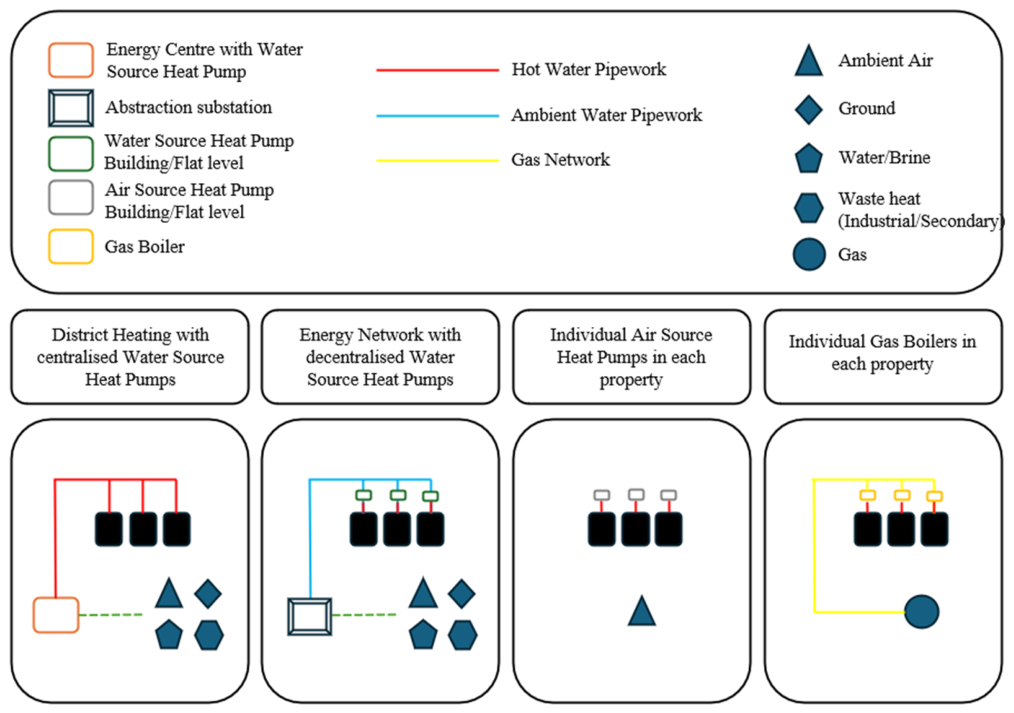
Driven by the accelerated transformation of the global energy structure and the “dual carbon” goals, the low-carbon retrofitting of buildings and industrial heating provides an important pathway for energy conservation and emission reduction in the building and industrial heating fields. Based on the reverse thermodynamic cycle principle, a heat pump system consumes a small amount of electricity to extract low-grade thermal energy from air, water, and soil. The system then upgrades the extracted energy for utilization, achieving significantly higher energy efficiency than conventional electric heating and other methods. The Coefficient of Performance (COP) reaches 3.0~5.0 [1]. Figure 1 shows the energy efficiency and principle comparison for different heating schemes, which intuitively demonstrates the energy-saving advantage of heat pumps. Owing to high efficiency and low carbon emissions, heat pumps are widely applied in building heating, cooling, vehicle thermal management, and industrial waste heat recovery (WHR) [2].
Various heat pump technologies have specific shortcomings, and theoretical design performance often deviates significantly from actual engineering performance, restricting the comparison and large-scale application of technical systems [4]. Vapor compression refrigeration (VCR) systems have the widest range of applications, but different models exhibit inherent defects. Air source heat pumps (ASHPs) feature simple structures and flexible installation, but are prone to frosting under low-temperature and high-humidity conditions, leading to a significant decline in heating capacity and operational energy efficiency. Ground source heat pumps (GSHPs) exhibit excellent seasonal operational stability and energy efficiency. However, in engineering practice, the coefficient of performance (COP) may be lower than design expectations due to underground thermal imbalance during long-term operation, and high initial investment further restricts large-scale application [5]. Water source heat pumps (WSHPs) depend heavily on hydrological conditions and are suitable only for specific geological regions, which limits the adaptation range of working conditions. In terms of underlying mechanisms, the industry still lacks accurate predictive theoretical models and unified standards for the heating attenuation law under low-temperature conditions and the dynamic energy efficiency loss mechanism during frosting and defrosting.
In addition to VCR systems, waste heat-driven absorption heat pumps (AHPs) and adsorption heat pumps (ADHPs) also face significant technical bottlenecks. The LiBr-H2O working pair in AHPs suffers from crystallization and corrosion [6], and the NH3-H2O system has high rectification energy consumption and a high risk of working fluid leakage. The COP of a single-effect cycle typically ranges from 1.2 to 1.9 under 80~100 °C waste heat, and hybrid cycles reach a COP of approximately 3.2 at 120~150 °C [7,8]. However, most alternative working fluids remain at the simulation stage. Metal–organic framework (MOF) materials in ADHPs exhibit excellent laboratory performance. However, after engineering scale-up, the power density is lower than the power density of traditional silica gel, and the measured COP under off-design conditions is 23~48% lower than the theoretical value [9,10]. This indicates a significant deviation between theory and engineering practice. Although the heat transfer enhancement technology represented by nanofluids and the novel elastocaloric heat pump based on elastocaloric cooling are technologically innovative, both remain at the prototype development stage and face problems such as particle agglomeration and material fatigue failure [11,12,13].
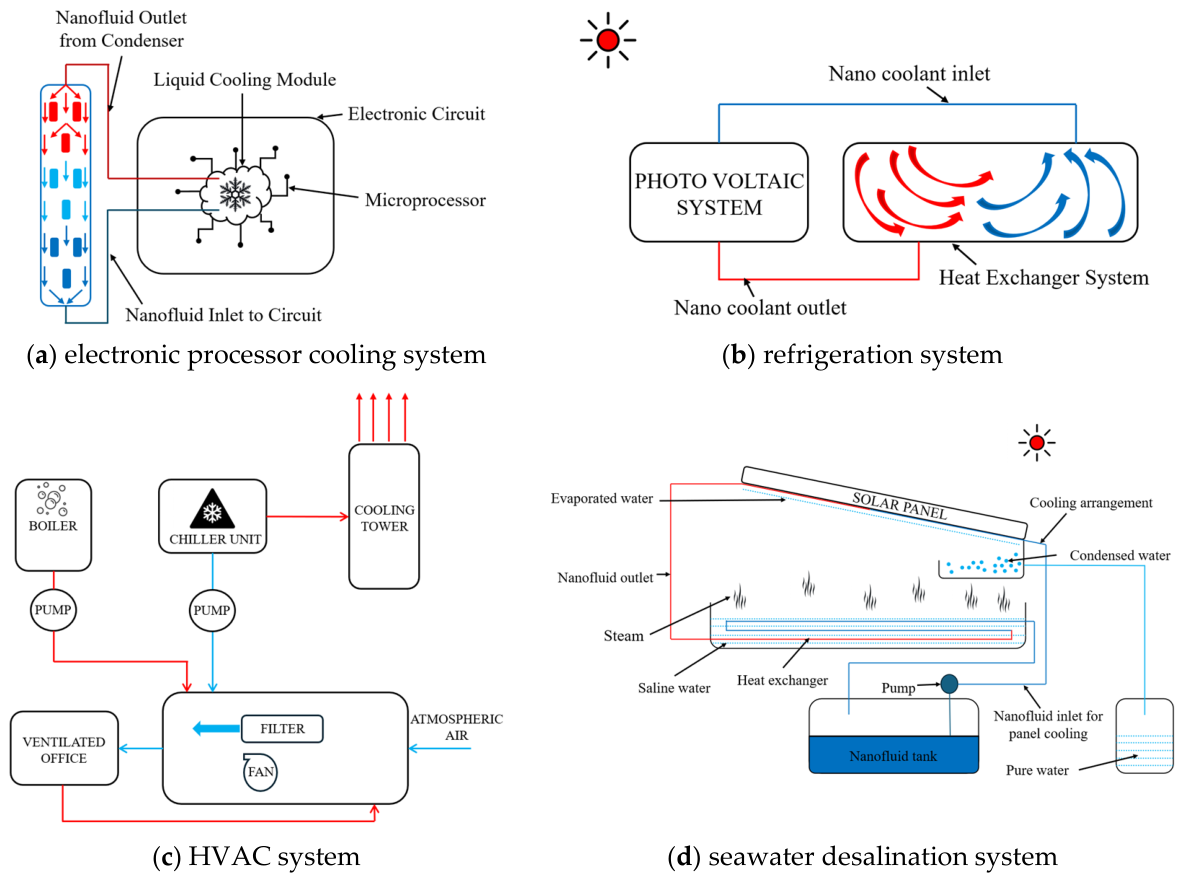
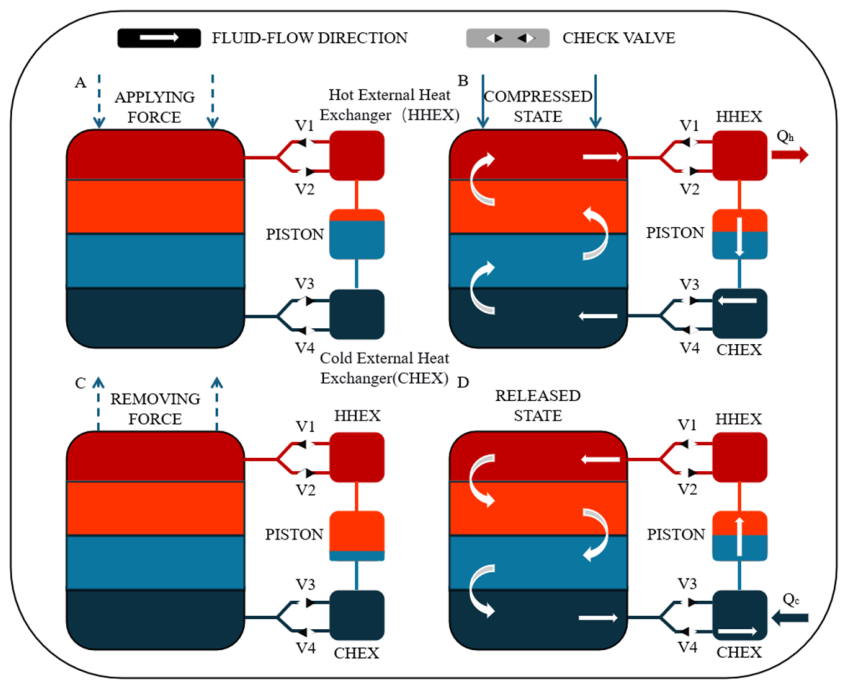
Reflecting on the technical shortcomings and engineering application limitations discussed above, existing research focuses on the local performance optimization of individual heat pump models and lacks systematic comparison and comprehensive evaluation across multiple categories, which fails to meet the optimal technology selection requirements for different climates and energy use scenarios. To address the existing research gap, this paper integrates and reviews the research progress on mainstream and cutting-edge heat pump technologies. The operational shortcomings and energy efficiency improvement technologies for the three VCR types are summarized. The advantages, disadvantages, and existing challenges of AHPs and ADHPs in industrial WHR scenarios are elaborated from the perspectives of working fluid properties, cycle structure, and system integration. The mechanism of nanofluid-assisted heat transfer enhancement is analyzed, along with the working principle, experimental results, and engineering difficulties of the novel elastocaloric heat pump system. A multi-dimensional comparison clarifies the performance characteristics, optimization potential, and operational boundaries of various heat pumps, providing theoretical support for engineering selection, system optimization, and subsequent research across multiple engineering application scenarios.

2. Heat Pump Performance Parameters

To quantitatively evaluate the energy conversion efficiency and operational characteristics of different heat pump types, a systematic set of performance parameters is required, since the COP definitions vary with driving forms and cycle configurations. Vapor compression refrigeration (VCR) relies on electric drive, and absorption heat pumps (AHPs) rely on thermal drive. Adsorption heat pumps (ADHPs) require special evaluation indices because the dynamic adsorption and desorption processes and material properties are involved. The basic Coefficient of Performance (COP) of each heat pump type and the specific parameters of ADHPs are described below.

2.1. Basic Coefficient of Performance

COP is the most fundamental parameter for measuring the instantaneous energy conversion efficiency of a heat pump, which is defined as the ratio of useful output heat (or cooling) to consumed work (or input heat). Different calculation formulas are used for different driving forms and cycle configurations.
For the vapor compression cycle, COPH in heating mode and COPC in cooling mode are expressed based on the refrigerant-side enthalpy difference as follows [14]:
COP H = Q H W
COP C = Q L W
where QH refers to the useful heat output at the hot reservoir side (Kw), QL represents the heat extracted from the load (Kw), and W is the compressor power (Kw).
In experimental evaluations, the measured values on the secondary fluid side are often used to indirectly calculate the instantaneous COP [15]:
COP = m ˙ chw c p , wp ( T chw , in T chw , out ) m ˙ hw c p , w ( T hw , in T hw , out )
where m ˙ is the mass flow rate (kg/s), and the subscripts chw and hw denote chilled water and heat source water, respectively. cp,w is the specific heat capacity of water (kJ/(kg·K)). T is the temperature (°C), and the subscripts in and out denote inlet and outlet, respectively.
For a single-effect absorption cycle, the COPAHP is constrained by the thermodynamic cycle and determined by the ratio of the generator heat input to the evaporator heat absorption [16]:
COP AHP = Q EVA Q GEN
where QEVA is the evaporator heat absorption (Kw) and QGEN is the generator heat input (Kw).
Because of the work and heat coupling between the two sub-cycles, the overall COPhybrid for an ultra-high-temperature absorption–compression hybrid cycle is expressed as the ratio of net heat supply to total compressor power consumption [7]:
COP hybrid = Q ABS W COM 1 + W COM 2
where QABS is the heat load of the absorber (Kw), WCOM1 is the compressor power consumption in the absorption subcycle (Kw), and WCOM2 is the compressor power consumption in the compression subcycle (Kw).

2.2. Specific Performance Parameters of Adsorption Heat Pumps

The working characteristics of ADHPs, which are closely related to the dynamic adsorption and desorption processes and the material’s physical properties, must be evaluated using special parameters different from the parameters for VCR and AHPs.
For the silica gel–water twin-bed adsorption chiller, Kwakye-Boateng et al. [17] established an empirical formula that directly relates COP and cooling capacity to operating variables based on regression analysis:
COP = 1.1469 + 0.0014 T hw , in 0.0085 T cw , in + 0.0124 T chw , in +
0.0050 m ˙ hw + 0.0099 m ˙ cw , bed + 0.0793 m ˙ chw +
0.0092 m ˙ cw , cond + 5.0687 × 10 6 U A bed +
5.2952 × 10 6 U A evap + 4.6260 × 10 7 U A cond
Q cc = 64.6199 + 0.3107 T hw , in 0.8625 T cw , in + 0.7601 T chw , in +
0.6108 m ˙ hw + 0.9944 m ˙ cw , bed + 4.4533 m ˙ chw +
0.5967 m ˙ cw , cond + 0.0006 U A bed + 0.0003 U A evap +
2.6623 × 10 5 U A cond
where Tin is the inlet temperature (°C) of various fluids, and the subscripts cw, chw and hw denote cooling water, chilled water and heat source water, respectively. m ˙ is the mass flow rate (kg/s) of the corresponding fluid, and the subscripts bed, cond and evap denote the adsorption bed, the condenser and the evaporator, respectively. UA is the product of the overall heat transfer coefficient and the area of the component (W/K), and Qcc denotes the cooling capacity (Kw).
In ADHP material screening and system design, the Specific Cooling Power (SCP) per unit mass of adsorbent and the Volumetric Cooling Power (VCP) per unit volume are often adopted as core indicators. Graf et al. [9] gave the following definition:
VCP = Q EVA V ads ( τ ads + τ des ) , SCP = Q EVA m ads ( τ ads + τ des )
where QEVA is the cooling capacity on the evaporator side per cycle, τads and τdes are the adsorption time and desorption time, Vads is the adsorber volume, and mads is the adsorbent mass.
The performance parameter definition described above provides a unified quantitative framework for comparing the energy efficiency of various heat pumps. Section 3 focuses on vapor compression heat pumps, which have higher technological maturity, and reviews the performance improvement technologies and engineering application progress of three types: air source, ground source, and water source.

3. Vapor Compression Heat Pumps

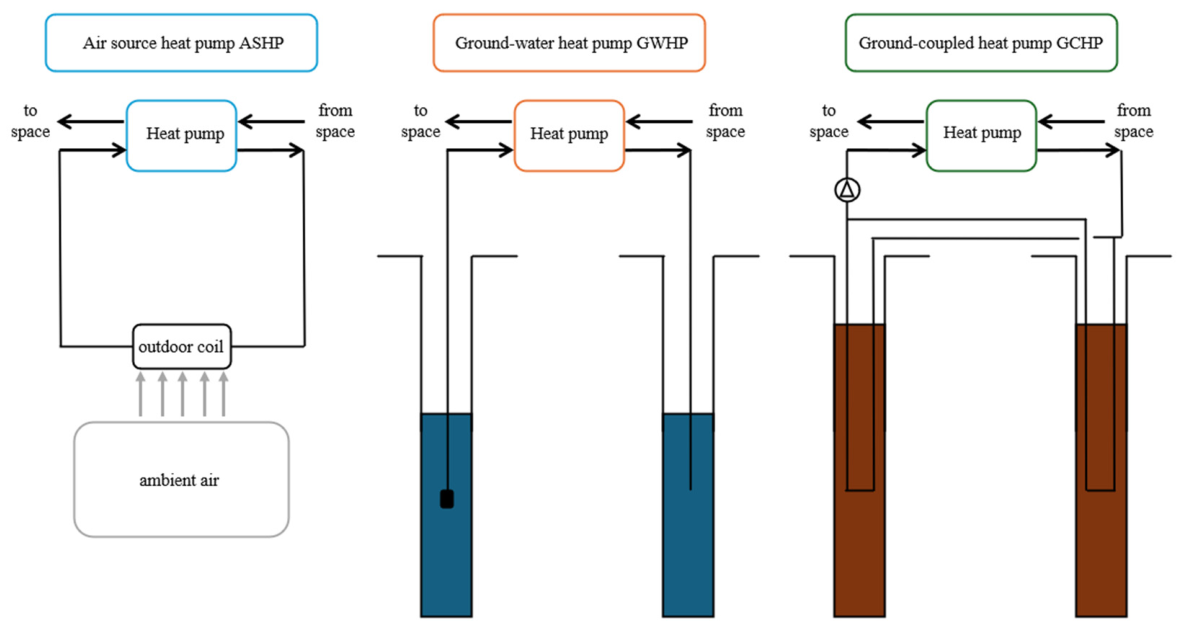
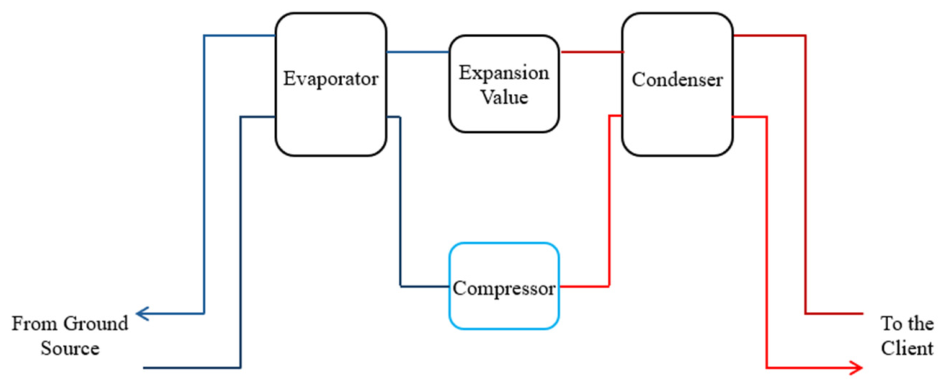
Driven by electricity, a vapor compression refrigeration (VCR) system operates on a vapor compression cycle in which the compressor circulates the working fluid and heat is released through condensation. VCR is characterized by high system efficiency, flexible operation, and a mature technological system. It not only forms a distinct technological category from thermally driven AHPs and ADHPs but also represents the most widely applied heat pump type in engineering. According to the heat source type, VCR systems are classified into ground source heat pumps (GSHPs), air source heat pumps (ASHPs), and water source heat pumps (WSHPs). GSHPs demonstrate significant advantages in seasonal energy efficiency and overall performance. Research on ASHPs focuses on expanding the low-temperature operating range and improving full-condition efficiency through component optimization and modification. WSHPs exhibit outstanding operational efficiency and economic benefits. A comprehensive performance comparison of the three technologies is presented in Table 1, and Figure 2 illustrates the working principles.
The three single-source VCR systems discussed above are widely used in heating and waste heat recovery (WHR). However, limitations remain because each system relies on a single heat source. Specifically, ASHPs experience significant performance degradation in extremely cold conditions. GSHPs involve high initial investment and the risk of thermal imbalance, which is caused by the long-term mismatch between annual heat extraction and rejection, leading to soil temperature drift and performance degradation [5]. WSHPs are constrained by water source distribution and regional conditions. The limitations of a single heat source cannot be fully resolved through local optimization of components and controls. Consequently, multi-source coupling and system integration optimization have become key research directions for addressing single-source limitations and expanding application scenarios.

3.1. Performance Enhancement Technologies and Engineering Applications of Air Source Heat Pumps

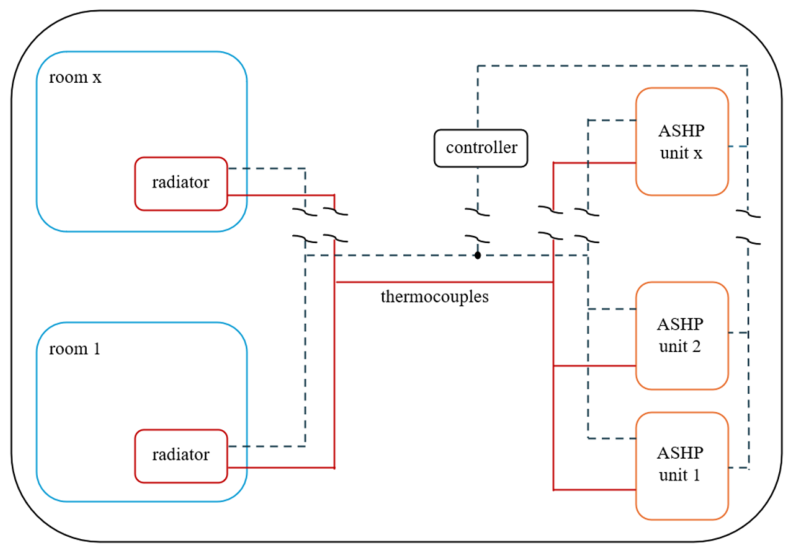
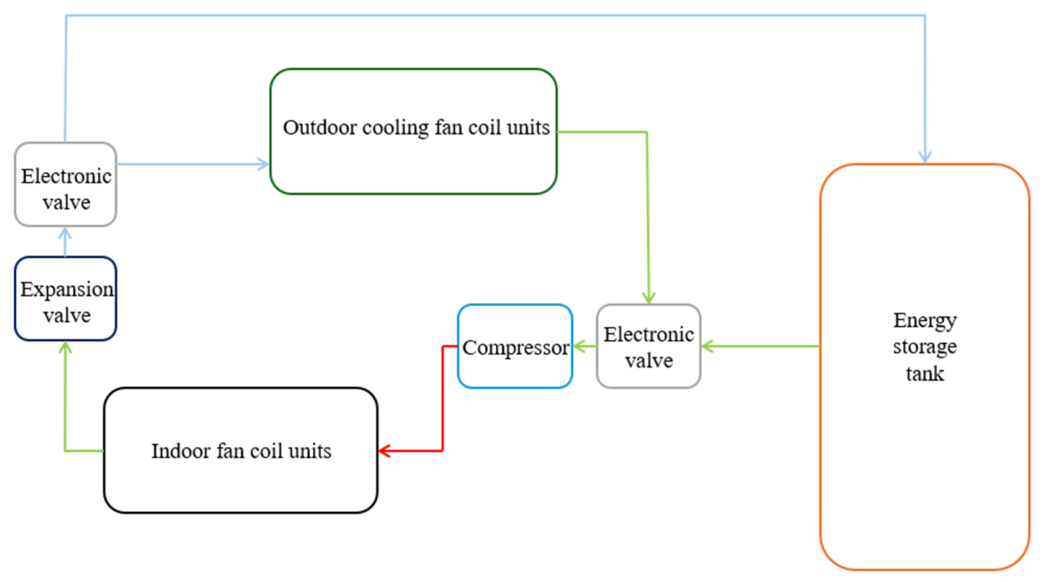
As an efficient and clean heating device, ASHPs use outdoor air as a low-grade heat source. The system consumes a portion of electrical energy to drive the compressor, extracting low-grade thermal energy from the air and upgrading the extracted energy to high-grade thermal energy for heating. The system composition and cycle principle are illustrated in Figure 3. The working principle is as follows: the ASHP unit absorbs low-grade thermal energy from outdoor air, which is upgraded to high-grade thermal energy by the compressor and then heats the circulating water. The circulating pump drives the hot water through the supply pipe to the indoor radiator, and after releasing heat indoors, the cooled return water flows back to the heat pump unit through the return pipe. Under low-temperature and high-humidity conditions, ASHPs are prone to frosting, which causes energy efficiency degradation. The frosting issue constitutes the core problem that distinguishes ASHPs from GSHPs and WSHPs. Compared with the stable underground and water heat sources of GSHPs and WSHPs, the air source exhibits large temperature fluctuations and a low thermal grade, which makes poor adaptability to low-temperature conditions its main competitive disadvantage. Enhancing ASHP performance has therefore become a research focus. In recent years, extensive research has been conducted on operational control optimization, thermal storage enhancement, WHR utilization, and performance adaptation under special conditions, and a relatively systematic technical route for performance improvement has been established.
Operational control optimization is a key means for improving the stability, overall energy efficiency, and adaptability of ASHPs to complex conditions. Variable-frequency technology shows a significant effect in suppressing frost formation. Liu et al. [22] conducted an experimental study by varying the compressor and outdoor fan speeds to construct a condensing–frosting performance map. The map revealed the trade-off between heating capacity and frosting suppression and indicated that, under the same heating capacity, selecting an appropriate speed combination allows the unit to operate in the dry or condensing zone, which avoids frosting and improves the continuous operating time and COP. Wu et al. [23] conducted field measurements and demonstrated that, compared with fixed-frequency units, the variable-frequency ASHP significantly extended the frost-free period, shortened the defrosting time, and improved the whole heating season’s comprehensive performance by approximately 16%, which verifies the positive role of variable-frequency technology in delaying frosting and reducing defrosting frequency. Beyond basic variable-frequency control, intelligent predictive control has become an important direction for further exploiting energy-saving potential. Zhao et al. [24] focused on a heat-pump-assisted solar water heating system and proposed an adaptive model predictive control method through simulation, which enhanced control adaptability using adaptive parameters under winter conditions. Simulation results showed that, compared with conventional strategies, the intelligent control scheme significantly saved operating cost and energy consumption (approximately 20% cost saving and 12% energy-saving) and achieved a technological upgrade from passive regulation with fixed parameters to dynamic adaptive regulation. However, the current control optimization framework still has limitations. Conventional variable-frequency control needs further breakthroughs in addressing single-stage operation limitations, and its adaptability to complex environments requires additional verification. The intelligent adaptive scheme currently relies heavily on simulation studies. Therefore, field effectiveness and long-term reliability remain unclear.
Thermal storage enhancement technology is a key means for mitigating load fluctuations, improving energy utilization, and suppressing ASHP performance degradation under extreme conditions. Adding thermal storage media increases system thermal inertia and offsets energy efficiency losses caused by environmental and load variations. Current research on thermal storage efficiency enhancement focuses on two main directions: phase change heat storage material modification and the coupling of active heat storage systems. Yin et al. [25] carried out numerical simulations on a residential building heating system, and Xiang et al. [26] conducted greenhouse field experiments. Both studies have fully demonstrated the efficiency advantages of the two approaches. Yin et al. [25] used sodium chloride solutions at different concentrations as the phase change heat storage material. A concentration of 8.5% enabled the system to achieve a heating seasonal performance factor (HSPF) of 2.24. Compared with traditional electric auxiliary heating, the heating and defrosting energy consumption were reduced by 19.6% and 38.8%, respectively. When the concentration was increased to 10%, the system HSPF reached 2.33, which offered the best operating economy and saved primary energy by 23.2% compared with the traditional system. For typical low-load and high-fluctuation scenarios such as greenhouse buildings, Xiang et al. [26] integrated ASHP with an active heat storage system and developed an active heat storage and release ASHP system. The system diagram is shown in Figure 4. Under greenhouse conditions, the optimized system achieves a maximum COP of 4.32 in heat storage mode. The nighttime heat release from the storage water tank accounts for 26.9~51.2% of the nighttime electric energy consumption, and the energy utilization efficiency is 59.6~497.0%. Phase change heat storage material modification can improve heat storage and release performance through composition optimization, which reduces heating and defrosting energy consumption. The active heat storage coupling system is suitable for greenhouse buildings with low thermal loads and high fluctuations and optimizes energy efficiency distribution through temporal and spatial heat shifting. Overall, current research has mainly verified the efficiency enhancement potential of the technologies under specific operating conditions. However, the engineering economics and long-term operational reliability remain to be fully established.
Building on control optimization and thermal storage peak regulation, exhaust air heat recovery and component enhancement technologies effectively recover low-grade waste heat from the system and the building environment or optimize internal heat exchange, achieving energy cascade utilization and further improving overall system efficiency. As key complementary approaches for ASHP performance enhancement under all operating conditions, current research on the two technologies focuses on two main scenarios: building low-grade exhaust air heat recovery and core heat exchange component optimization in the unit. Zhang et al. [27] carried out case simulations based on an experimentally validated thermodynamic model. To address exhaust air heat in public buildings, they integrated an exhaust air heat pump with advanced air distribution, which realized low-grade exhaust air heat recovery and achieved significant energy savings under high fresh air ratio conditions. Alkan et al. [28] constructed an experimental test bench for vehicle heat pumps. Targeting the high-speed variable-condition and high-temperature lift requirements of vehicle heat pumps, they adjusted the indoor unit air velocity and added auxiliary heat exchange components, such as a suction line heat exchanger, to improve heating capacity and COP. They also found that increasing the indoor air velocity could further improve COP while reducing discharge temperature and exergy destruction, which refined the heat pump technology system for special operating conditions. Overall, existing research has validated the two technologies in relatively concentrated scenarios. Exhaust air heat recovery studies mainly focus on large fresh air ratio conditions in public buildings, and their applicability to other building types remains to be explored. Component optimization research emphasizes the specific operating requirements of vehicle heat pumps, and the generalizability of the proposed solutions under multiple operating conditions still needs verification. Therefore, room for improvement remains in the breadth of scenario coverage and the systematic validation of the technologies.
Existing research has addressed multiple dimensions, including defrosting, intelligent control, thermal storage peak shaving, waste heat cascade utilization, and component enhancement. Such efforts have alleviated the performance degradation of ASHP to a certain extent. However, most approaches are developed independently and lack coordinated operation strategies. Frost prediction models mainly focus on steady-state conditions, and research on dynamic evolution remains insufficient. Most conclusions are drawn from ideal laboratory conditions, while performance variations under long-term operation are still unclear. Low-temperature frosting and the significant decline in energy efficiency under extremely cold conditions remain the most prominent shortcomings of ASHPs.

3.2. Design and Engineering Applications of Ground Source Heat Pump Systems

GSHPs are an efficient renewable energy technology that utilizes shallow geothermal energy. Research on GSHPs is progressing from fundamental thermophysical parameter acquisition toward system integration optimization, multi-energy complementary coupling, and long-term performance assurance. GSHPs use underground rock and soil as a low-grade heat source, which features temperature stability and climate independence and provides significant performance advantages over ASHPs. Compared with WSHPs, GSHPs eliminate dependence on surface water bodies but face challenges such as high initial investment and thermal imbalance. As illustrated in Figure 5, the system upgrades shallow geothermal energy through BHEs and heat pump units to supply heating, cooling, and domestic hot water. The working principle is as follows: the circulating fluid absorbs low-grade heat from the underground rock and soil through BHEs and, after being warmed, enters the heat pump unit. Inside the unit, the working fluid extracts heat through the evaporator, is compressed by the compressor with power consumption, and releases high-grade heat to the building through the condenser. After cooling, the fluid circulates through the expansion valve, which upgrades underground low-temperature heat into a usable heat source. After releasing heat and cooling, the circulating fluid flows back into the buried pipe to continue absorbing heat, which forms a closed cycle. Current research focuses on acquiring geotechnical thermophysical parameters, optimizing heat sources and improving energy efficiency, coupling control of complex systems, and evaluating the long-term operational economics of GSHP systems.
Precise measurement of geotechnical thermophysical parameters is a core prerequisite for scientific GSHP system design and BHE size matching. Measurement accuracy directly determines system heat transfer efficiency and long-term operational stability. Current industrial testing systems are primarily divided into field Thermal Response Tests (TRTs) and laboratory tests. Ma et al. [30] conducted field TRT and laboratory tests based on an improved combined TRT system. Priarone et al. [31] conducted numerical simulations. Both studies carried out extensive systematic investigations on test accuracy correction and low-cost test technology development. Ma et al. [30] clarified the correlation between geotechnical water content, density, porosity, and thermal conductivity through field TRTs and laboratory tests. The authors then constructed an in situ thermal conductivity prediction model using an Artificial Neural Network (ANN), with water content, density, and porosity obtained from laboratory tests as input parameters. Prediction errors of the model were mainly in the range of ±5%. Tests found that laboratory-layer thermal conductivity values are, on average, 12.2% lower than field values. To address the high cost of traditional equipment, Priarone et al. [31] proposed an electric depth-distributed TRT method that uses traditional low-cost temperature sensors instead of expensive optical fibers. This method can simultaneously estimate ground and grout thermal conductivities with an estimation error of no more than 10%, effectively reducing testing costs. However, existing studies mostly rely on simulations and laboratory tests, and the research sites investigated are relatively small. Method applicability under complex geological conditions and the standardization of correction procedures still require systematic validation, and the general applicability of the technology needs further improvement.
Given accurate basic parameter testing, heat source optimization, and energy efficiency improvement constitute the core directions of GSHP system research, which focuses mainly on renewable energy coupling and system operation strategy optimization. Zou et al. [32] conducted numerical simulations with fracture water velocity and fracture ratio as key variables, confirming that groundwater flow in fractures significantly enhances heat transfer, reduces the required number of boreholes, and mitigates heat buildup. The finding should be fully considered in GSHP system design and site selection. Multi-energy complementary coupling technology integrates renewable energy with GSHP systems, using photovoltaic and other clean energy sources to assist load peak shaving and thermal balance regulation. Lin et al. [33] developed a PV/T-assisted GSHP model coupled with a radiant ceiling and fresh air system based on the TRNSYS platform. Energy and exergy analyses were performed to account for energy quality loss. The demand-side and source-side circulation flow ratios and the bearing load ratio of the GSHP versus the PV/T system in the heating season were optimized. When both demand-side and source-side circulation flows are maintained at 65% of the design flow rate, the average exergy efficiency of the whole system reaches 37.56%, and the cumulative exergy loss in the cooling season is reduced by 16.5% compared with the design flow rate condition. However, current research on heat transfer enhancement by groundwater flow focuses on effect verification, and quantitative design methods remain insufficient. Multi-energy coupled system optimization mainly relies on specific system simulations, and the general applicability of the multi-energy coupled optimization methods in different energy use scenarios has not been verified. Therefore, the systematization of the technical system and the engineering promotion value still need improvement.
To ensure the long-term efficient and stable operation of GSHP systems, the academic community carried out long-term performance studies on scenario adaptation, structural parameters, and operation mode optimization based on dynamic simulations and field measurements, yielding systematic conclusions on operating condition adaptation. Zhou et al. [34] established a transient mathematical model to couple a heat pump system with free cooling and WHR, improving energy utilization efficiency in data centers and enabling the system to simultaneously meet the cooling demand of the data center and the heating and hot water demands of heat consumers. Zhang et al. [35] conducted simulations using TRNSYS and effectively alleviated soil heat accumulation and thermal imbalance in hot summer and cold winter regions by optimizing the auxiliary heat dissipation and operation time of the cooling tower. Kurevija et al. [36] carried out numerical simulations to analyze the effect of borehole depth on system energy efficiency. The results showed that deeper boreholes do not bring cumulative gains in energy efficiency compared with standard 100 m solutions, providing a reference for structural parameter design. In summary, most existing studies have been validated through simulations for specific scenarios. However, cross-regional applicability remains to be tested, and the systematic integration of design parameters and the establishment of universal standards require further improvement.
Engineering practice and simulation studies validate the energy-saving advantages and economic benefits of GSHP systems, providing important references for multiple building application types. Taking a karst area project as an example, Zhou et al. [20] verified through techno-economic analysis and simulation that a hybrid GSHP system can effectively reduce initial investment and operational costs, mitigate heat buildup, and improve long-term energy supply stability. Based on field measurements, Todorov et al. [37] proposed a method for managing highly uncertain data and analyzed the operational performance of a large-scale GSHP–borehole thermal energy storage system. Menegazzo et al. [5] designed a residential GSHP system and analyzed the energy consumption through dynamic simulation. Overall, existing research has validated the energy efficiency and operational performance of GSHP systems in specific projects. However, current research is mostly limited to a single geological or building scenario, and cross-scenario applicability and long-term operation mechanisms still require systematic verification.
Although GSHP systems improve single-system operation bottlenecks through thermophysical parameter optimization and multi-energy coupling, limitations remain. Actual heat transfer in buried pipes deviates from design parameters, and unified quantitative assessment and prediction standards for soil thermal imbalance are still lacking. Most existing optimization schemes are derived from simulation analysis for single scenarios and lack long-term field measurement support. High initial investment and the thermal imbalance induced by long-term operation are two major drawbacks that collectively restrict the large-scale application of GSHPs.

3.3. Progress in Development and Engineering Application of Water Source Heat Pump Systems

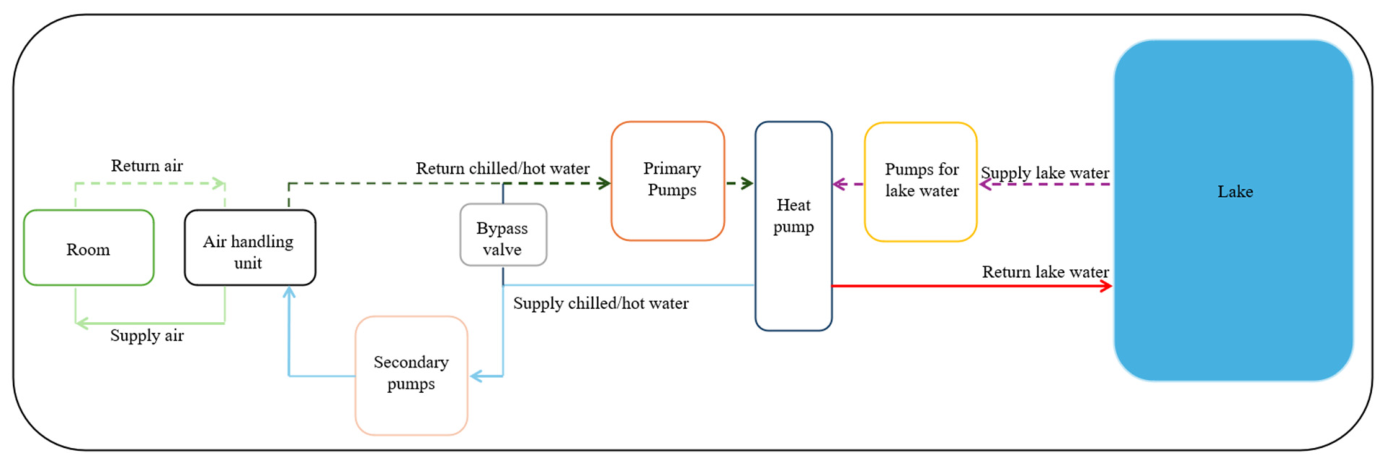
WSHPs use natural water as a heat source or cold source, offering high heat transfer efficiency and excellent operational stability. Their overall energy efficiency ranks highest among the three single-source VCR systems, and their operational stability is superior to that of ASHPs. The system also eliminates the need for GSHP drilling, but the application scope is strictly constrained by regional hydrological conditions, and the ecological restrictions are far stricter than the constraints for the other two heat pump types. As shown in Figure 6, the working principle is that a WSHP system takes surface water or groundwater as a low-grade heat source and cold source. In heating mode, the heat pump unit extracts low-grade heat from lake water through a reverse cycle, and the compressor elevates the refrigerant temperature to heat the user-side circulating water. A pump then delivers this water to terminal air handling units for space heating. In cooling mode, the unit operates in reverse, absorbing heat from the building interior and rejecting the heat to the lake to provide cooling. Heat transfer is completed through the user-side water loop and the water source loop. Against the backdrop of ongoing energy transition and low-carbon development strategies, WSHPs are a preferred solution for small- and medium-sized buildings and district energy supply because of their stable heat source and efficient thermal characteristics in engineering practice. Current research focuses on performance evaluation, experimental verification, thermal balance and water environment impact analysis, and industrial waste heat utilization. Such studies are gradually forming a multi-dimensional technical system.
The water source and load-side temperature conditions are the primary factors determining WSHP energy efficiency. The lower the source-side inlet water temperature or the higher the load-side supply water temperature, the lower the system’s energy efficiency. Conversely, under suitably mild operating conditions, the COP can be doubled (see Equations (1)–(3) in Section 2.1 for the definitions of heating and cooling COP and the experimental COP calculation method). Saleh [15] constructed a variable water temperature experimental platform to investigate the influence of water source temperatures of 5 °C and 17 °C on WSHP performance. The results indicate that, under heating mode, for every 1 °C increase in water source temperature from 5 °C to 17 °C, the system COP increases by approximately 2.8% on average. Although the COP at a 5 °C water source temperature is significantly lower than the COP at 17 °C, the overall system performance still exceeds the performance of a conventional ASHP. Viviescas Ibarra [14] built a water-to-water heat pump experimental platform to study the influence of source water inlet temperature and supply water temperature on the system COP. The results show that, under heating mode, when the temperature condition shifts from (10 °C, 45 °C) to (20 °C, 30 °C), the system COP increases from 3.5 to 7.0, achieving a doubling of energy efficiency. Qiu et al. [39] conducted dynamic performance experiments on a heat pump water heater with dual air and water heat sources and analyzed the effects of hot water temperature and evaporation-side inlet water temperature on operating characteristics. The results show that under a constant evaporation-side inlet water temperature of 15 °C, the system COP in water source mode reaches 4.65, and the system COP gradually decreases as the hot water temperature rises. However, existing studies on water temperature parameters are mostly confined to specific steady-state conditions. The energy efficiency response under continuously varying temperatures and dynamic loads remains unclear, and a systematic integrated analysis is still lacking.
Energy efficiency optimization and water environment thermal balance analysis based on operating condition characteristics are key research directions for large-scale WSHP application, where ecological impact assessment serves as the core constraint limiting technology implementation. At present, the academic community holds obvious disagreements on the ecological effects of thermal disturbance from water intake and drainage, and no unified industry standard has been established. Wang et al. [40] summarized the influence of water drainage on water temperature distribution of surface WSHP systems under heating and cooling conditions, and pointed out that unreasonable water intake and distribution may cause local water temperature anomalies, thus affecting the ecological balance. Ren et al. [41] used numerical simulation to evaluate the influence of water intake and drainage from energy stations on the temperature distribution of natural water bodies. The results show that the thermal disturbance range of WSHP water intake and drainage on water source temperature is limited and minor, and does not negatively affect water bodies or the aquatic ecological environment under standardized design. Current research still shows obvious disagreements on the ecological effects of thermal disturbance from water intake and drainage, and quantitative assessment criteria for water environment thermal disturbance have not been unified. This lack of consensus restricts the standardization and comparability of ecological impact assessments, constituting the core bottleneck for large-scale WSHP application.
With the development of smart energy technology, intelligent control optimization and engineering scenario adaptation have become emerging directions in WSHP research, aiming to balance system energy efficiency, grid flexibility, and operational stability. Buffa et al. [42] combined experimental tests with TRNSYS simulations to develop an ANN-MPC framework and implement predictive control for a fifth-generation district energy system. The study identified the operating temperature boundaries and safety constraints of WSHPs under low-temperature heat sources and confirmed that predictive control can effectively improve grid flexibility, but the load shifting strategy causes a small 3~4% reduction in heat pump COP. Tu et al. [43] built a waste heat central heating preheating system model for data centers based on mathematical modeling and numerical simulation, effectively solving the mismatch between waste heat supply and building heating load. Based on the optimization results, the team further developed a random forest parameter estimation model to determine optimal parameters. Under design conditions, compared with a traditional system without WHR, the primary energy-saving rate reaches 58.7~78.2%, providing an efficient solution for industrial waste heat resource utilization. Intelligent control optimization can improve grid flexibility, but the load shifting strategy causes a slight COP reduction in the heat pump. Industrial WHR schemes demonstrate significant energy savings in specific scenarios. However, current research focuses on stable heat sources such as data centers, and the applicability to other scenarios requires further exploration. Overall, the two technical directions show considerable potential, but the diversity of application scenarios and the value of cross-field promotion still need verification.
In summary, although WSHP research has formed a system focusing on operating condition optimization, ecological assessment, and intelligent operation and maintenance, obvious gaps remain. Optimal operating parameters under different hydrological conditions, seasons, and loads have not been unified. The ecological assessment of water intake and drainage lacks quantitative standards and design criteria. Intelligent control faces a trade-off between energy efficiency and flexibility, and collaborative optimization strategies for all operating conditions and all-weather scenarios need improvement. The gaps described above represent the core breakthrough points for large-scale promotion. WSHPs are constrained by hydrological conditions and ecological management, resulting in extremely poor regional applicability.

3.4. Engineering Application Study on Multi-Source Heat Pump Synergistic Systems

To address the above issues, multi-source heat pumps, by leveraging the complementary advantages of different heat sources, are a core direction for overcoming the limitations of single-source heat pump models and expanding the application boundaries of VCR systems, which has prompted further in-depth exploration of system design, performance verification, and operation optimization.
Research on the design and application of multi-source heat pump synergistic systems focuses on the adaptability and integration pathways of different heat source combinations. To address the optimization of heating systems for nearly zero-energy buildings, Hou et al. [44] used an experimental method to investigate the optimal configuration of a solar–ground dual-source heating system. Compared with the pre-optimization performance, the system COP can be improved by approximately 8.6% through the optimized control strategy. Emmi et al. [45] studied a multi-energy parallel coupling system that uses a water-to-water heat pump as the core, adopts a multi-source parallel configuration of ground, air, and solar sources, and incorporates phase change material terminal buffering in the radiant floor. The system achieves a significant energy-saving advantage under cooling conditions, with an energy-saving rate reaching 20~70%. However, under heating conditions, the energy-saving effect is less prominent due to constraints from the regional energy structure and the original heating system, resulting in obvious differences in the adaptability between cooling and heating conditions. Zhang et al. [46] combined experiments and simulations to conduct a comprehensive performance evaluation of a multi-source heat pump heating system under severe cold climate conditions. By comparing system operating characteristics and energy efficiency performance under various operating conditions, Zhang et al. [46] confirmed that the photovoltaic–dual-source coupled heat pump mode exhibits the best overall performance, achieving a comprehensive value improvement of 27.9~52.6% compared with other modes. Existing multi-source heat pump collaborative studies have verified the efficiency enhancement potential of different combination schemes under specific operating conditions. However, system performance is significantly constrained by regional climate and the original energy structure, and adaptability differences between cooling and heating conditions persist. Most schemes are developed for specific application scenarios, and the cross-climate-zone universality requires systematic verification.
Performance evaluation and optimization of multi-source heat pump synergistic systems focus on operation strategies and energy efficiency improvement under different operating conditions. The academic community carried out strategy optimization based on temperature thresholds, load matching, and simulation scheduling, constructing multi-source operation control logic and achieving orderly switching and load matching among multiple heat sources. Cavazzuti et al. [47] proposed a multi-step operation control rule through numerical simulation, clarifying that climate characteristics and building thermal parameters are the core factors influencing the optimal combination of heat sources. Emmi et al. [48] proposed a management strategy centered on heat source efficiency evaluation through experiments and dynamic simulations, and verified the strategy’s effectiveness under multiple operating conditions. However, current research mostly verifies control rule effectiveness using simulation platforms, and the adaptability of the control rules in actual operating environments still requires field testing. Meanwhile, existing evaluations emphasize energy efficiency indicators, but the consideration of economic performance and long-term operational stability remains insufficient.
Research on multi-source heat pump synergistic systems has shifted from verification to integration, but shortcomings remain. Design and adaptation are still insufficient. Although energy-saving potential has been confirmed under specific operating conditions, the adaptability for heating and cooling and cross-regional universality require verification due to climate and energy structure constraints. Evaluation and optimization are limited because strategies rely predominantly on simulations, lack field measurements, focus on energy efficiency, and overlook economic performance and long-term stability. Control technology lags behind, and integration is weak, as systems depend on preset rules, lack adaptive coordination and hydraulic–thermal decoupling, and the absence of intelligent regulation restricts large-scale application. Overall, the technology is transitioning toward integration and intelligent control, and universal design and adaptive decoupling are key.
Although the multi-source coupled heat pump system can compensate for the single-model working condition adaptation deficiency by leveraging the complementary advantages of multiple heat sources, thereby effectively broadening application scope and improving overall energy-saving benefits, the coupled system also introduces obvious technical drawbacks and engineering application limitations. Compared with traditional single-source heat pump systems, the multi-source coupling architecture requires auxiliary components including multi-channel heat exchange pipes, heat source switching devices, and energy storage and thermal storage equipment, a requirement that significantly raises system complexity and initial construction investment and thereby increases project cost [44]. The significant variation in hydraulic characteristics and thermal response patterns among heat sources such as air, soil, water, and solar energy leads to strong hydrothermal coupling, which complicates dynamic heat source switching and precise load ratio control and hinders existing strategies from achieving coordinated optimal operation under multiple working conditions [43]. Additionally, the operating performance of a multi-source coupling system strongly depends on regional climate conditions and building energy load characteristics, leading to unbalanced adaptability between heating and cooling modes, a lack of universal design standards, and insufficient cross-scenario and cross-regional adaptability. The long-term operational stability and overall economic viability still need validation through further field measurements [45,46].
In summary, the VCR technology system is built upon ASHP, GSHP, and WSHP systems and expands application boundaries through multi-source coupling. VCR systems are mature, electrically driven commercial heat pumps primarily serving civil buildings and conventional industrial heating and cooling. AHPs and ADHPs, discussed later, are mainly driven by low-grade waste heat and applied in industrial WHR. Together, VCR, AHP, and ADHP systems constitute a complete application system, complementing rather than replacing one another. ASHPs improve low-temperature performance through control optimization and thermal storage recovery, but accurate prediction methods for the dynamic energy efficiency loss during the frosting–defrosting process are still lacking. GSHPs offer significant seasonal energy efficiency advantages, but the deviation between actual heat transfer capacity and nominal values of buried pipes, along with the quantitative assessment of heat imbalance risk, remains a weak point. WSHPs exhibit outstanding energy efficiency, but operation is strictly constrained by water resource conditions, and assessment methods for the impact of water intake and drainage in ecologically sensitive areas remain ununified. Overall, research in this direction is transitioning from component-level performance enhancement to all-condition reliability and multi-energy synergy. Extreme climate adaptability, long-term operational evaluation criteria, and system-level optimization integration are key to subsequent breakthroughs.
Having clarified the technical characteristics and existing limitations of compression heat pumps, Section 4 and Section 5 discuss low-grade heat-driven AHPs and ADHPs. AHPs and ADHPs, which are heat-driven technologies mainly applied in industrial WHR, have working fluid systems and cycle architectures fundamentally different from those of electric drive systems and face distinct engineering bottlenecks.
Overall, existing review studies in the heat pump field still exhibit obvious shortcomings. Most studies focus only on local performance optimization and short-term condition analysis of single heat pump units without a systematic cross-comparison of compression, absorption, adsorption, and novel solid-state heat pump technologies. Two prominent research gaps exist in the current literature. First, quantitative evaluations of technology suitability, application advantages, and operating condition boundaries for different climate zones are particularly lacking, hindering effective engineering selection in diverse practical scenarios [4]. Second, existing studies are mostly limited to steady-state instantaneous performance analysis, few investigations uncover the long-term performance degradation mechanisms under the coupling effects of variable operating conditions, material aging, and heat source fluctuations, nor do they propose targeted long-term operation optimization schemes [7,23]. Therefore, this paper has systematically reviewed the research progress and core bottlenecks of various heat pump technologies, compared their adaptation characteristics under different scenarios and climatic conditions, and has revealed the performance degradation mechanisms during long-term operation. This work fills the two above-mentioned systematic research gaps in the field and provides comprehensive theoretical support for large-scale heat pump applications and subsequent related scientific research.

4. Absorption Heat Pump

Driven by industrial waste heat, solar energy, and other heat sources, absorption heat pumps (AHPs) achieve heat transfer through Working Pair (WP) phase transition. AHPs offer the advantages of low power consumption, the ability to utilize low-grade heat sources, and the adoption of natural working fluids such as water and ammonia. Possessing the environmental potential of zero ozone depletion potential (ODP) and low global warming potential (GWP), such working fluids make AHPs suitable for district heating, industrial WHR, and other scenarios. However, conventional WPs have thermodynamic defects. For example, a system operating with NH3-H2O as the absorption WP must be equipped with a distillation unit, which reduces system energy efficiency, narrows the applicable temperature range, and weakens operational reliability. Current research mainly focuses on WP screening and modification, cycle configuration optimization, and composite system integration to promote technology iteration and new technology implementation. Vapor compression refrigeration (VCR), driven by electric power, is suitable for all-scenario conventional heating and cooling, whereas AHPs and adsorption heat pumps (ADHPs), driven by low-grade waste heat, focus on industrial waste heat recovery (WHR), thus forming complementary application scenarios.

4.1. Absorption Heat Pump Cycle Theory and Research Basis

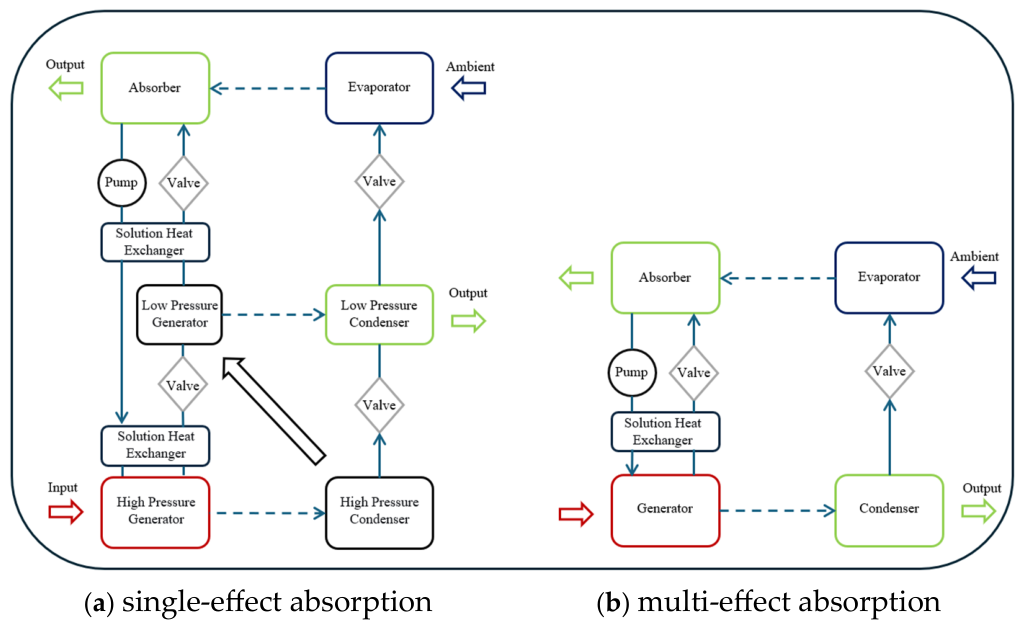
AHP classification, definition, and basic performance parameters serve as important prerequisites for subsequent research and engineering applications. An AHP is a device that upgrades low-grade thermal energy to high-grade thermal energy through a closed-loop cycle comprising four core components (generator, condenser, evaporator, and absorber), utilizing the strong absorption and desorption of the refrigerant by the absorbent in a liquid WP (such as lithium bromide–water or ammonia–water). Figure 7 illustrates the cycle characteristics of the AHP.
Early AHP systems mainly adopt a single-effect cycle configuration, which is technologically mature and structurally simple, making them suitable for low-temperature waste heat applications such as residential heating and domestic hot water production, but the energy efficiency ceiling is low (see Equation (4) in Section 2.1 for the COP definition of a single-effect AHP). According to the review by Xu et al. [8], the Coefficient of Performance (COP) of a single-effect AHP for heat amplification typically ranges from 1.5 to 1.8, but the inherent thermodynamic cycle constraints prevent the configuration from meeting industrial high-temperature lift demands. For industrial waste heat upgrading, multi-effect (e.g., double-effect) absorption cycles can improve heat utilization efficiency. However, the review by Dong et al. [49] indicated that double-effect AHPs offer a narrow available temperature lift range, being applicable only to cases with high heat source temperatures and limited temperature lift requirements, and thus exhibit restricted adaptability to operating conditions. In summary, single-effect cycles suffer from low energy efficiency, and multi-effect cycles provide a narrow temperature lift regulation range, so existing AHP technology still has evident limitations in addressing industrial high-temperature lift and variable-load scenarios.
To break through the performance bottleneck of conventional single cycles, absorption–compression hybrid cycles are the core optimization direction for high-temperature and variable-load industrial scenarios. The fundamental principle is to break the thermal boundary limits of a single cycle through the synergistic matching of dual cycles and dual working fluids (see Equation (5) in Section 2.1 for the system COP definition). Karakostas et al. [16] analyzed a thermodynamic cycle model using multiple working fluid pairs and clarified the application characteristics of working fluids in AHPs above 100 °C, providing a theoretical basis for working fluid matching in hybrid cycles. Building on this mechanism, Sun et al. [7] proposed an ultra-high-temperature absorption–compression hybrid heat pump cycle, which achieves heating supply at 200 °C with an optimal COP reaching 3.25 at a pressure ratio of 6.5 and coupling temperatures of 55 °C and 73 °C. This performance greatly surpasses the temperature and energy efficiency limits of traditional AHPs and offers a new scheme for industrial high-temperature WHR. However, current research on hybrid cycles remains largely based on theoretical models and working fluid analyses; thus, the actual performance of the proposed schemes under variable operating conditions still requires verification, and the transformation into engineering applications needs further deepening.
The evolution of AHP cycle theory from single-effect to multi-effect and hybrid configurations, accompanied by the expansion of operating conditions from civil low-temperature heating to industrial ultra-high-temperature WHR, has established a relatively systematic thermodynamic theoretical foundation. However, existing research still has notable shortcomings. Quantitative standards for the adaptation boundaries of different cycles remain absent, and engineering selection still depends largely on experience. Research on the thermodynamic coupling mechanism and exergy loss distribution of hybrid cycles remains insufficient, and the energy efficiency attenuation mechanism under dynamic operating conditions is still unclear. Optimization conclusions for high-temperature conditions are mostly based on steady-state simulations. The adaptability under complex industrial variable operating conditions lacks systematic verification, and systematic verification through prototype tests and field measurements has not been conducted.

4.2. Absorption Working Pair Characteristics and Performance Optimization

The WP is central to AHP performance improvement, whose thermophysical properties, stability, and environmental friendliness directly determine the system energy efficiency, applicable temperature range, and reliability. Research on improving traditional WPs and developing new ones has given rise to two technical routes: classical WP optimization and new WP replacement.
The water–lithium bromide (H2O-LiBr) WP represents the most industrially mature working fluid system, dominating civil and conventional industrial scenarios due to its stable performance, environmental friendliness, and low cost. However, inherent defects remain difficult to eliminate. To compensate for heat and mass transfer deficiencies, Zheng et al. [50] compared various enhancement methods through simulations and confirmed that surfactants significantly outperformed other methods, effectively improving unit heating capacity. Mussati et al. [51] optimized operating condition matching from an economic perspective, thereby refining the engineering application basis for this WP. Nevertheless, Oubourhim et al. [6] reviewed solar absorption refrigeration systems and noted that LiBr-H2O and NH3-H2O remain the mainstream WPs, with solar energy intermittency and low system energy efficiency still posing core problems requiring urgent improvement. Although the LiBr-H2O WP system is relatively mature, inherent limitations persist in its heat and mass transfer characteristics. Dynamic adaptation to fluctuating heat sources such as solar energy and system energy efficiency improvement still demands collaborative breakthroughs from perspectives including WP modification, and the applicability of this system in renewable energy coupling scenarios requires further investigation.
Ammonia–water (NH3-H2O), a natural working fluid with zero ODP and low GWP, exhibits excellent low-temperature evaporation performance and dual cooling/heating compatibility, which has attracted considerable attention in medium- and low-temperature WHR. Ahrens et al. [52] analyzed an NH3-H2O absorption–compression heat pump (ACHP) and reported that the COP could reach 9.1 at a heat source temperature of 95 °C and a heating temperature of 115 °C, with the COP ranging from 1.4 to 11.3 across different configurations. Nevertheless, the system still encounters challenges such as high compressor discharge temperature and poor lubricant compatibility. To address the operational shortcomings of the ammonia–water working fluid, Dubey et al. [53] reviewed coupling technologies of the ammonia–water cycle with supercritical and transcritical CO2 cycles and indicated that such hybrid cycles have the potential to improve thermal efficiency and reduce exergy losses, offering a new concept for composite systems. However, under high-temperature conditions, the NH3-H2O working fluid still faces engineering challenges, including high discharge temperature and lubricant compatibility issues. The CO2 cycle-based coupling scheme remains in the theoretical exploration stage, and its practical performance and operational reliability have yet to be verified. Consequently, the industrial application of the NH3-H2O system still requires overcoming key technical difficulties.
To break through the technical bottlenecks of the two traditional mainstream WPs, novel alternative WPs with low corrosion, a wide temperature range, and the elimination of distillation have become a research focus in recent years, aiming to achieve system simplification, operating condition expansion, and energy efficiency upgrading. Ahrens et al. [52] summarized the high-temperature adaptation potential of various novel WPs through a review analysis and reported that some WPs can achieve high-temperature heating at the 200 °C level. Füldner et al. [54] tested the application of novel WPs such as active carbon-ammonia and zeolite-water, broadening the adaptation boundaries of these WPs. Current research on novel WPs has verified their potential under high- and low-temperature conditions. However, the overall research remains at the stage of theoretical analysis and preliminary testing, with limited coverage of operating conditions. The engineering reliability and economy of the novel WPs still require further evaluation.
Research on absorption WPs has shifted from defect remediation to the iterative development of new systems featuring a wide temperature range, low corrosion, and high environmental compatibility. However, gaps still exist, as traditional WP modifications have mostly focused on single performance aspects, and the synergistic optimization of anti-crystallization, corrosion resistance, high heat transfer, and wide temperature range has not been achieved. Research on novel alternative WPs remains fragmented, and, to date,, relevant results have been limited to laboratory simulations and small-scale tests without support from engineering measurement data. Most novel WPs remain at the laboratory stage, and their long-term aging and failure mechanisms are still unclear, so reliability verification remains a prerequisite for engineering implementation.
Research on an AHP’s WP has shifted from defect remediation of a traditional WP to the iteration of entirely new systems. Existing improvement methods cannot simultaneously achieve the performance goals of anti-crystallization, corrosion resistance, high heat transfer, and a wide temperature range. Although new WPs exhibit significant potential, the conditions for industrialization are not yet met. A breakthrough in WP technology is the core prerequisite for the large-scale deployment of this heat pump.

4.3. Engineering Application Research on Absorption Heat Pumps

Through long-term technological iteration, AHPs are applied to industrial WHR and civil low-carbon energy supply scenarios, forming a demonstration system. Unlike the large-scale deployment of VCR, AHPs still suffer from engineering shortcomings such as insufficient process coupling, poor dynamic adaptability, and a lack of long-term operation and maintenance. Existing studies mainly focus on single-scenario energy-saving verification, but systematic optimization schemes are lacking, which hinders large-scale promotion.
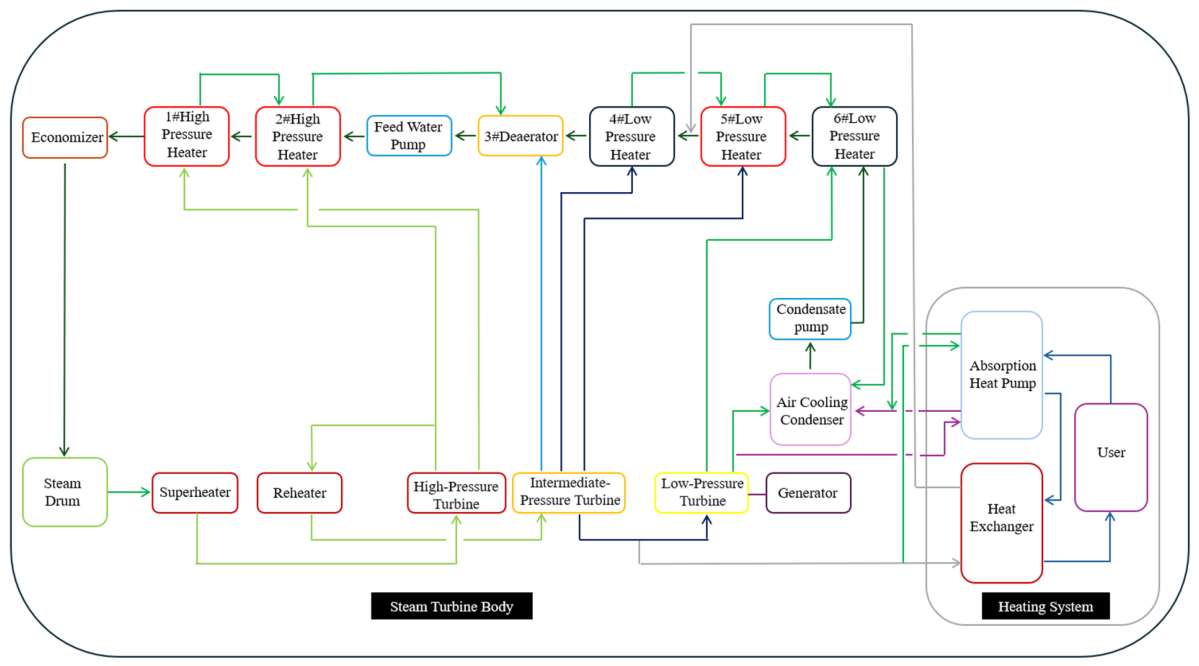
The industrial sector is not only the primary source of low- and medium-temperature waste heat but also the field with the fastest-growing application of AHP technology, where AHPs can efficiently recover waste heat and upgrade the recovered heat to higher-grade thermal energy. Ma et al. [55] reviewed combined heat and power systems and analyzed the application of AHPs, pointing out that an optimized system integration scheme can convert low-grade industrial waste heat into high-quality thermal energy, thereby effectively improving the energy efficiency of industrial systems (the system architecture is shown in Figure 8). Sanzo [56] confirmed through engineering case analysis that WHR technology can recover low-grade waste heat originally discharged directly and reuse the recovered heat in production processes, significantly reducing overall energy consumption. This technology serves as a core approach for industrial energy saving, carbon reduction, and green and low-carbon transition. Current WHR demonstrations for industrial AHPs are mainly based on reviews and specific engineering cases. The universality and long-term operational reliability of such demonstrations still require more extensive empirical validation.
The civil heating and building energy conservation field also possesses broad application prospects. The gradual maturation of compact equipment and multi-energy coupling modes enables the integrated supply of residential space heating and domestic hot water, using clean heat sources such as natural gas, biomass, and solar energy, to meet the demand for distributed low-carbon energy supply. Füldner et al. [54] evaluated, through simulations, the performance of gas-driven AHPs and adsorption heat pump (ADHPs) for space heating and domestic hot water in residential buildings and confirmed the potential of such systems to achieve efficient and low-carbon heating. However, current research is mainly based on simulation analyses of gas-driven configurations, and the actual operational performance of other heat source coupling schemes still requires verification.
Although the AHP demonstrates engineering value in industrial WHR and civil energy supply, large-scale deployment of AHPs still faces core bottlenecks. Specifically, insufficient coupling with industrial processes confines recovery mainly to the terminal and prevents whole-process cascade optimization. Moreover, AHPs exhibit poor adaptability to wide operating conditions, weak tolerance to waste heat fluctuations and abrupt load changes, and a lack of dynamic control strategies. The absence of systematic prevention and control of corrosion, scaling, and working fluid loss during long-term operation limits equipment lifespan and reliability.
Overall, the AHP demonstrates significant potential in decarbonizing the energy structure owing to its advantages of being driven by low-grade waste heat and using environmentally friendly working fluids, although its technological maturity still lags behind that of VCR. Current research bottlenecks span the cycle system, the working fluid system, and engineering applications. The cycle system exhibits insufficient adaptability to operating conditions, where the quantitative selection boundaries among single-effect, multi-effect, and hybrid cycles remain ambiguous, and the dynamic energy efficiency degradation mechanism is not well understood. The working fluid system lacks collaborative optimization, as the persistent challenges of crystallization, corrosion, or distillation in traditional working fluids have not been eradicated, and systematic evaluation of the physical properties, cycle compatibility, and long-term stability of novel alternative working fluids is still lacking. In engineering applications, prominent bottlenecks restrict large-scale deployment, including insufficient process coupling depth, weak dynamic adaptability across wide operating conditions, and the absence of prevention and control strategies for corrosion, scaling, and working fluid loss during long-term operation. Overall, AHP technology is advancing from unit-level optimization to system reliability verification. The key technical directions for achieving large-scale deployment are the synergistic breakthrough in working fluid systems, the development of dynamic control strategies covering all operating conditions, and the establishment of long-term operation and maintenance systems.
Although adsorption and AHPs are both heat-driven technologies, the adsorption heat pump employs a solid adsorbent in place of a liquid working fluid pair and upgrades heat quality through reversible adsorption and desorption processes, which leads to essential differences in cycle characteristics and material systems compared to AHPs. Section 5 systematically describes the technological progress of ADHPs.

5. Adsorption Heat Pump

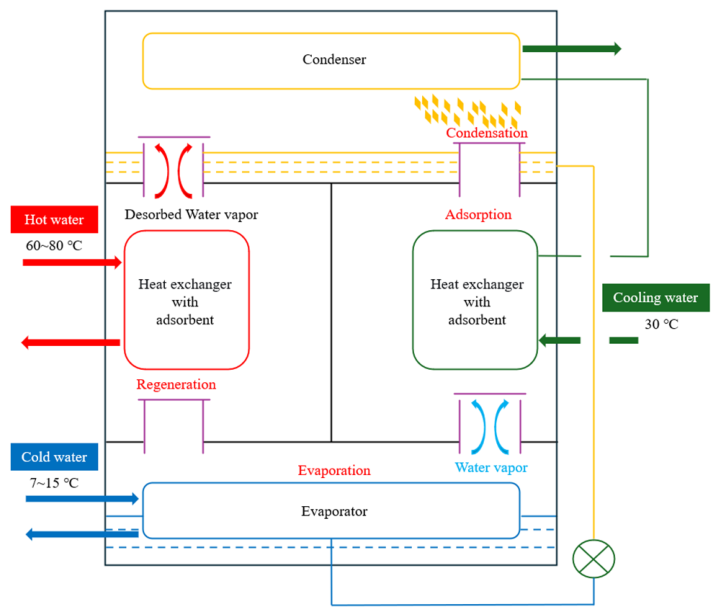
Driven by low-grade thermal energy, the adsorption heat pump (ADHP) upgrades and transfers heat through reversible physical adsorption and desorption between solid adsorbents and refrigerants, and offers potential for industrial waste heat recovery, low-temperature refrigeration, and energy supply in remote areas. Figure 9 illustrates the working principle. During the adsorption phase, the refrigerant absorbs heat and evaporates in the evaporator, producing cooling capacity, while the vapor is adsorbed by the adsorption bed, releasing adsorption heat. In the desorption phase, the adsorption bed is heated to desorb the refrigerant, which then condenses and releases heat in the condenser, and the condensate returns to the evaporator. Through valve switching, a dual-bed adsorber operates alternately to provide continuous cooling at the evaporator and heat rejection at the condenser. Compared with conventional vapor compression refrigeration (VCR), the ADHP does not rely on chlorofluorocarbons refrigerants, thereby fundamentally avoiding environmental problems caused by refrigerant leakage. However, the specific cooling power (SCP) and volumetric cooling power (VCP) of current ADHP systems remain relatively limited (see Equation (8) in Section 2.2 for definitions), restricting commercialization. Consequently, related research focuses on thermodynamic cycle modeling, efficient adsorbent development, and system integration optimization, emphasizing cycle configuration innovation, novel adsorbent materials such as metal–organic frameworks (MOFs), and heat storage structure enhancement to advance the technology from laboratory research to engineering applications.

5.1. Cycle Theory and Research Fundamentals of Adsorption Heat Pump

Centering on cycle characteristics, material compatibility, and system integration, the cycle mechanism and thermodynamic modeling constitute the core theoretical foundation for the performance analysis and structural optimization of adsorption heat pumps (ADHPs), and related studies have gradually established a comprehensive theoretical system that provides essential support for performance enhancement.
Existing theoretical studies have mainly improved the system from three dimensions: cycle mechanism, new material compatibility, and system-level thermal storage integration. Li [58] constructed a thermodynamic model and a design method for a high-performance adsorption-based atmospheric water harvesting device, identified the four-step cycle (including isosteric heating, desorption, isosteric cooling, and adsorption), and determined key physical parameters through a pressure–temperature (P-T) state diagram, thereby providing a theoretical method for performance analysis and structural optimization of adsorption devices. However, the applicability and reliability of Li’s theoretical model under actual engineering conditions need further verification.
In the field of novel adsorbent materials, existing studies not only focus on how new porous adsorbents are compatible with operating conditions but also have established that adsorption characteristics decisively influence system cycle performance. Studies on MOF-based ADHPs have clarified how the material’s isothermal adsorption behavior affects system operating conditions [59].
At the system integration level, optimizing the coupling between stratified storage and the adsorption cycle has become an important direction for overcoming the performance bottleneck of a single adsorber. Sadeghlu et al. [60] pointed out through simulation that coupling the stratified storage with the adsorber and evaporator/condenser loops can effectively recover heat, reduce system costs, and improve flexibility, which represents a major theoretical direction for achieving efficient operation of single-adsorber heat pumps. However, experimental verification and a quantitative design basis for the approach remain incomplete, as the field is still in the theoretical discussion stage.
Existing research has established a preliminary theoretical framework around cycle modeling, material screening, and heat storage and adsorption coupling optimization. However, most results remain at the theoretical deduction level, and insufficient experimental validation and quantitative data hinder the transformation of theoretical findings into practical applications.

5.2. Development of Adsorption Working Pair and Cycle Optimization

The performance of the adsorption working pair (WP) directly determines the cycle efficiency, operating temperature range, and system stability of ADHPs. Currently, the mainstream adsorption WPs in industrial applications include silica gel–water, zeolite–water, metal–organic frameworks (MOFs)–ethanol, and MOFs–water. Owing to their distinct physical properties, different WPs exhibit notable differences in application scenarios and performance, and each possesses inherent defects while commonly facing the bottlenecks of low thermal conductivity, slow adsorption kinetics, and high cost. Table 2 presents the comprehensive performance comparison. Related research focuses on synergistic material modification, cycle optimization, and additive enhancement, which form a systematic improvement pathway.
The silica gel–water WP is the mainstream choice for industrial waste heat-driven applications because of its large specific surface area, low cost, and low regeneration temperature. However, the low thermal conductivity and poor surface chemistry lead to insufficient adsorption/desorption kinetics, which limit system efficiency and stability. To address the kinetic deficiencies caused by surface chemistry, existing modification studies follow two paths: substrate heat treatment and filler doping. Christy [61] confirmed through gradient heat treatment experiments that the adsorption performance of silica gel depends heavily on the relative concentration of surface-free silanol groups and hydrogen-bonded silanol groups. Heating the silica gel above 450 °C noticeably decreases its silanol number, while reaching 650 °C induces the condensation of silanol groups into siloxane bonds. This high-temperature treatment disrupts the group balance and degrades adsorption performance, which reveals that a strict temperature threshold exists in silica gel heat treatment optimization, and blind high-temperature modification produces negative effects. Based on this, Hua et al. [62] conducted experiments on nano-copper-doped modified silica gel powder and confirmed that nano-copper doping delivers the best thermal conductivity enhancement. At a doping of 1.6 wt%, the thermal conductivity increased by 185% while stable adsorption capacity and cycle performance were maintained, providing an effective solution for heat transfer enhancement of silica gel-based materials. Nevertheless, silica gel heat treatment has a strict temperature threshold, beyond which adsorption performance degrades, and the process window remains narrow. Although nano-metal doping can significantly improve thermal conductivity and maintain adsorption capacity, the long-term comprehensive performance at the optimal doping level still requires systematic validation. Therefore, transitioning from laboratory to industrial applications demands overcoming challenges in process robustness and full-lifecycle reliability.
Building on material modification, optimization of cycle configuration and operating parameters can further unlock the energy-saving potential of adsorption heat pump (AHP) and refrigeration systems. He et al. [57] confirmed through experimental and simulation studies that a heat recovery cycle, in which the adsorption bed is preheated by desorption waste heat, can effectively reduce heat source consumption and improve system COP while being suitable for industrial waste heat scenarios. To address the poor adaptability of fixed-parameter operation, Kwakye-Boateng et al. [17] employed a multi-objective optimization algorithm (basic empirical model presented in Section 2.2, Equations (6) and (7)) to comprehensively match operating parameters such as load and regeneration temperature, thereby further exploiting system potential while balancing energy efficiency and energy consumption. However, most current cycle optimization studies are based on specific WPs and cover limited operating conditions, while synergistic matching between WP modification and cycle configuration has not been fully conducted. Moreover, optimization effects have mostly been verified under steady-state or simplified conditions, while the adaptability and long-term gains under wider fluctuating conditions still require systematic evaluation. Collaborative design should be strengthened to overcome the bottleneck of single-dimensional optimization.
Zeolites (e.g., type 13X) exhibit a typical molecular sieve effect and demonstrate extremely high adsorption selectivity in specific temperature ranges. Stach et al. [63] showed that the zeolite–water system typically requires desorption temperatures above 150 °C for standard heat storage cycles, and up to 350 °C for deep dehydration of ion-exchanged forms, thus offering no advantage in cyclic adsorption capacity under low-grade heat sources. From the perspectives of system design and material screening, Piccoli et al. [64] further pointed out that a combination strategy in which zeolites are applied to high-temperature lift applications and MOFs and activated carbon to low-temperature lift applications can effectively overcome the application limitations of a single material. Zeolite alone exhibits limited application fields and weak adsorption capacity under low-grade heat sources, a limitation that can be effectively mitigated by combining the zeolite with MOFs and activated carbon. However, the overall system optimization and long-term adaptability of the combination strategy still require systematic verification.
MOFs offer tunable pore size and high specific surface area, making them potential materials for breaking the performance ceiling of conventional WPs. Liu et al. [65] systematically evaluated a composite system of MIL-101(Cr) with inorganic salts for adsorption heat conversion. Modification with MgCl2 and LiCl increased the saturated water vapor adsorption capacity 1.5 to 2.3 times (reaching a maximum of 2.24 g/g) and significantly improved the heat storage density. Graf [9] evaluated MOFs using small-scale experiments and a dynamic model of a full-scale adsorption chiller, and pointed out that matching the isotherm shape to the operating temperature, raising the heat transfer and diffusion coefficients to silica gel levels, and increasing the density can double the power density and efficiency, enabling MOFs to far outperform commercially available materials. Current MOF research mainly focuses on improving adsorption capacity and thermodynamic properties. However, long-term hydrothermal stability, cycling durability, and the economics of large-scale preparation remain insufficiently studied. Moreover, the excellent performance has only been verified through experiments and models. Field operation validation remains inadequate, and a considerable gap to commercial application still exists.
The low thermal conductivity of adsorbents is a common bottleneck for ADHPs, and adding thermal conductivity enhancers constitutes an important approach to enhancing heat transfer in the adsorption bed, in which graphite-based carbon materials are the preferred modification medium. Fayazmanesh et al. [66] increased the thermal conductivity of the adsorbent coating from 0.13 to 0.3 W·m−1·K−1 through graphite flake doping experiments, which significantly improved heat transfer efficiency in the bed and promoted structural compactness. Yang et al. [67] further compared carbon-based and metal additives and demonstrated that the thermal conductivity of activated carbon modified with expanded natural graphite increased by a factor of 150, whereas metal fillers, though improving thermal conductivity, reduced the system COP by 22% because of increased heat capacity. Thus, expanded natural graphite demonstrates comprehensive advantages in simultaneously enhancing thermal conduction and controlling heat capacity. However, existing conclusions are mostly based on experiments that combine specific adsorbents with graphite-type fillers, and the universality of the strategy for different WPs and porous matrices remains unclear. Moreover, the mechanism by which material thermal conductivity enhancement translates into system dynamic cycle performance requires further investigation.
Research on adsorption WPs has shifted toward modification, cycle optimization, and additive synergy but still faces several challenges. Traditional systems improved certain properties through doping and combination, but process robustness and full-lifecycle reliability require verification. Cycle optimization has improved system energy efficiency, yet the synergy between the WP and the cycle configuration remains insufficient, and adaptability to wide operating conditions needs further evaluation. Although salt compounding enhances the adsorption capacity of MOFs and carbon-based additives improve heat transfer, industrial-scale power density, long-term stability, and additive universality remain core bottlenecks.

5.3. Engineering Application of Industrial Waste Heat-Driven Adsorption Heat Pump

In industrial production, it is difficult to efficiently recover a large amount of low-grade waste heat below 150 °C (e.g., boiler exhaust) with conventional heat transfer technology because the heat has a low temperature and fluctuates significantly, resulting in considerable energy waste. Through reversible adsorption and desorption cycles, the adsorption heat pump (ADHP) upgrades heat to an output temperature above 100 °C and adapts to heat source temperature fluctuations. The system thus overcomes the grade upgrading and low heat transfer efficiency bottlenecks under small temperature differences that conventional technologies cannot address, and provides a key technical pathway for the cascade utilization of industrial waste heat and low-carbon energy supply. Related research focuses on system integration, engineering verification, and material innovation.
At the system integration and cycle optimization level, research addresses the problems of bulky volume, slow response, and low heat source utilization that traditional ADHPs face. Coupling heat recovery cycles with heat storage is the mainstream approach for addressing system weaknesses. Rahbari et al. [68] and Scuiller et al. [69] pointed out that an ADHP is more advantageous for recovering low-grade waste heat than direct heat exchange without thermal upgrading. Specifically, the heat recovery cycle proposed by He et al. [57] can effectively reduce heat source consumption and improve Coefficient of Performance (COP), with good adaptability to low-grade waste heat. Scuiller et al. [69] discussed the common technical principles of adsorptive heat transformation and adsorptive heat storage and proposed a conceptual design decision-making process for an industrial ADHP heat storage system, providing a basis for large-scale system design. However, current research focuses mainly on validation under specific fluctuating conditions, and the adaptation and versatility of system architectures to the amplitude variations of different industrial heat sources still require further exploration.
At the engineering application and performance verification level, extensive experimental studies confirm the industrial feasibility of ADHPs and clarify the performance boundaries. The review by Rahbari et al. [68] points out that ADHPs can upgrade low-grade waste heat such as industrial flue gas, making ADHPs suitable for applications including district heating and data center cooling. However, Jobard et al. [10] experimentally verified the actual performance of a silica gel–water WP in the above applications. The measured data show that the heating COP reaches 1.46 under nominal conditions. In this paper, variable operating conditions are defined as the actual non-rated states where the heat pump system deviates from the rated design parameters, including environmental temperature deviations, heat source fluctuations, dynamic load changes, and intermittent equipment operation. All aforementioned operating scenarios are collectively defined as off-design conditions in this paper. A unified umbrella term covering all non-rated operating states is analyzed in Section 4 and Section 5. Specifically, Chapter 5 investigates off-design behaviors of adsorption heat pumps dominated by fluctuating waste heat sources, while Section 6.2 focuses on compression heat pump off-design characteristics driven by variable ambient temperatures and building thermal loads. Under variable conditions (i.e., variable operating conditions/off-design conditions), the unit energy efficiency and heat transfer characteristics usually deviate significantly from the theoretical design performance. The above results show that the performance degradation under variable operating conditions is prominent, and the energy efficiency under such off-design conditions still requires further optimization.
Innovation in low-cost structured adsorption materials represents a key breakthrough for addressing bulky system volume, low power density, and high engineering cost. To overcome the high cost and loose structure of traditional synthetic adsorbents, Piccoli et al. [70] used waste coffee grounds as a raw material to prepare monolithic activated carbon adsorbents and conducted model-based performance evaluation under combined heating and cooling conditions relevant to a district heating network. The results show that after screening treatment, the adsorption capacity increases by 60%. A 2 mm thick monolithic sample achieves a cooling COP of 0.79 and a cooling-oriented key performance indicator of 1.4 Kw/kg at a cycle time of 100 s. The biomass adsorbent, which features a simple and easily scalable fabrication process, provides a feasible pathway for reducing system volume and improving power density. However, performance validation of the biomass adsorbent has so far focused on short-term testing, while the long-term cyclic aging and adsorption degradation laws remain unclear, and systematic evaluation of long-term operational reliability is still required.
Industrial waste heat-driven ADHP applications show initial feasibility, but large-scale deployment remains constrained by several limitations. The system integration approach is uniform and lacks differentiated designs to accommodate heat source fluctuations, while energy efficiency degrades significantly under variable operating conditions and adaptive control strategies remain absent. Furthermore, the aging behavior of biomass adsorbents remains poorly understood, and reliability validation is insufficient. The technology is currently in the engineering transition phase, where cycle theories and the material–system correlation mechanism lack experimental validation. Traditional WPs suffer from insufficient process stability, and novel materials such as MOFs are constrained by power density and long-term stability limitations. Although coupling heat recovery and heat storage improves energy efficiency, the limitation in adaptability to varying working conditions caused by the uniform system architecture remains unresolved. Efforts should focus on strengthening long-term material validation and adaptive control to promote large-scale implementation.
The preceding discussion of the technical characteristics of the compression, absorption, and ADHP systems shows that the three types differ significantly in driving mode, energy efficiency, working fluid characteristics, and applicable scenarios. To systematically compare the relative advantages and inherent limitations of each technical route, Table 3 summarizes the core technical indicators.
The above comparison demonstrates that the compression, absorption, and ADHP systems form a relatively complete technology spectrum, covering the main technical routes of electric drives, thermal drives, mainstream engineering applications, and industrial waste heat recovery. However, the three technologies remain constrained by energy efficiency, cost, stability, and heat source adaptability and cannot simultaneously meet the demands of extreme operating conditions and large-scale applications. Section 6 further analyzes two frontier directions, nanofluid heat transfer enhancement technology and elastocaloric solid-state heat pumps, discussing the potential to break through existing technical boundaries.

6. Two Frontier Heat Pump Technologies

With the rapid development of nanotechnology and materials science, two frontier technologies with fundamentally different application logic have emerged in the heat pump field. Heat transfer enhancement technology, represented by nanofluids, does not alter the original cycle configuration of conventional heat pumps but serves as a working fluid or medium to improve equipment heat transfer performance. An ECHP, which uses shape memory alloys (SMAs) to construct an independent solid-state thermal cycle, belongs to a new generation of heating and cooling equipment.

6.1. Nanofluids, an Auxiliary Technology for Heat Transfer Enhancement

Nanofluids (NFs) are stable suspensions prepared by dispersing metal, metal oxide, or carbon nanoparticles into base liquids such as water, ethylene glycol, or oil. Because the dispersed nanoparticles have inherently much higher thermal conductivity than the base liquids, nanofluids can significantly enhance heat transfer performance when used as the working fluid or heat transfer medium in heat pumps.
The heat transfer enhancement of nanofluids results from multi-physics coupling. Revealing the underlying mechanism requires clarifying the relationship between nanoparticle microscopic motion and the fluid’s macroscopic thermophysical properties. Peer et al. [71] and Kulandaivel et al. [72] systematically reviewed controlled gradient experimental results in the literature and summarized the heat transfer enhancement ranges for different nanoparticle loadings and sizes, providing a reference for preliminary working fluid formulation. To improve the mechanistic understanding of gas–liquid coupling conditions, Siow et al. [73] experimentally investigated the enhanced heat transfer of rising bubbles in graphene oxide nanofluids and confirmed that the vortex-induced mixing effect can effectively disrupt the thermal boundary layer, thereby significantly improving two-phase heat transfer efficiency and advancing the understanding of synergistic heat transfer enhancement between nanofluids and bubbles. However, a quantitative model for multi-factor coupling has not been systematically established, and the current mechanistic understanding remains largely empirical. Strengthened theoretical guidance is therefore required for engineering formulation and design.
For high-temperature industrial heat pump applications, high-temperature-resistant nanofluids such as TiO2 and Al2O3 are a research focus, as nanofluid thermophysical properties and high-temperature stability directly determine unit operational reliability. Meesuppung et al. [11] confirmed through high–low-temperature comparison tests that TiO2 nanofluid stability decreases and particle agglomeration tendency increases when the temperature reaches 363 K, indicating that high-temperature heat pump design and operation must incorporate anti-agglomeration modification measures. The results further indicate that anti-agglomeration strategies are required for industrial applications because nanofluid stability degrades and the tendency increases at high temperatures. However, the effectiveness of relevant modification technologies and long-term suspension strategies remains unverified.
NF research is shifting from laboratory thermophysical property testing to engineering prototype testing, and engineering applications are gradually expanding in multiple fields, typical application is shown in Figure 10. A review by Singh et al. [74] pointed out that, compared with single nanofluids, hybrid nanofluids possess better thermophysical properties due to the synergistic effect between nanoparticles and yield more significant heat transfer enhancement in specific applications. The numerical study on Al2O3-TiO2 hybrid nanofluids in a radiator by Hidayat et al. [75] showed that the hybrid nanofluid can achieve a higher heat transfer coefficient than pure coolant. Abdulateef et al. [76] experimentally investigated how single Cu nanoparticles in a water/ethylene glycol base fluid enhance natural convection inside a porous heat exchanger and found that under a temperature difference of 20~50 °C, a low volume concentration of 0.05% yields the optimal heat transfer efficiency while the heat transfer coefficient decreases at higher concentrations. However, current research mainly focuses on short-term heat transfer performance verification, while evaluations of long-term operational stability and lifecycle energy efficiency remain limited.
Research on nanofluid-enhanced heat transfer has progressed from mechanism exploration to application verification but still faces several core bottlenecks. No quantitative model for multi-field coupled heat transfer has been established, and engineering formulations remain largely empirical. Long-term high-temperature suspension stability is insufficient, anti-agglomeration strategy effectiveness remains unverified, and the effects of long-term circulation on pump consumption and system compatibility remain unknown. Standards for optimal mixing ratios and operating condition boundaries are lacking, and a lifecycle performance and economic evaluation system is absent. NF-enhanced heat transfer technology is at a critical stage of transitioning from laboratory to engineering, and the development of a quantitative model, long-term stability, and a standardized evaluation system represents the key to subsequent breakthroughs.

6.2. Elastocaloric Heat Pump—A New Solid-State Heat Pump

The research status and bottlenecks of nanofluid-enhanced heat transfer technology have been summarized. Unlike auxiliary heat transfer enhancement technologies, the elastocaloric heat pump (ECHP) is a new heat pump unit with an independent cycle.
Based on the elastocaloric effect of SMAs, the ECHP is a new solid-state heat pump technology that abandons the traditional working fluid compression heat exchange mode and relies on solid-state phase transformation for thermal energy transfer. The core working principle is that the SMA undergoes an austenite-to-martensite phase transformation and releases heat when loaded by external forces such as compression or tension, while the reverse transformation from martensite to austenite occurs and absorbs heat during unloading. Heat is then transferred through a heat exchanger to achieve continuous cooling and heating, offering outstanding environmental friendliness and a compact structure.
Material performance optimization is fundamental to determining the heat transfer temperature difference, working efficiency, and service life of the ECHP. Current research focuses on SMA microstructure regulation, fatigue performance optimization, and stability enhancement, continuously breaking through inherent material performance bottlenecks. The experimental methods adopted by Chen et al. [77] (gradient structure preparation and laser surface annealing) and by Chen et al. [78] (grain size engineering experiments) not only effectively weaken phase transformation hysteresis loss and reduce cycle energy consumption but also improve the phase transformation response rate and significantly enhance the elastocaloric effect and cooling efficiency. Further, Yu et al. [79] constructed a two-scale thermo-mechanically coupled constitutive model that considers grain size and rate effects, providing a theoretical tool for analyzing the mechanical response of SMA materials under cyclic loading. Although material modification has progressed, experimental verification of the multi-scale constitutive models and investigation of system cycling performance still need to be deepened.
Structural morphology optimization is a key means to reduce microstructural defects in materials and enhance fatigue resistance. Related studies systematically explored the service characteristics of different NiTi material forms and provided a basis for selecting the optimal structural form in ECHP systems. Regarding the adaptation of different structures, Javed et al. [80] experimentally studied the performance degradation of NiTi thin sheets under tensile loading and clarified the limitations of the microstructure in tensile mode. Porenta et al. [12,81] established the stability advantage of tubular compression structures through long-term cyclic experiments and defined the geometric boundary conditions for functionally stable tubes, providing a basis for tube design in compression loading devices. Furthermore, Xu et al. [82] supplemented the latest progress in thin-film elastocaloric cooling technology and improved the hierarchical application system for thin-film elastocaloric cooling. Although previous studies have clarified the applicable boundaries and stability characteristics of different structures, a standardized design parameter system for varying operating conditions and capacities has not been established.
Building on material optimization, structural innovation, and operating parameter optimization are key to upgrading ECHP performance. Greibich et al. [83] and Ossmer et al. [84] experimentally verified the performance gains of different novel devices from a structural innovation perspective, and Dall’Olio et al. [85] reviewed the related progress, confirming that configuration and loading mode play a decisive role in overall system performance. On this basis, the shell-and-tube-like compression-loaded elastocaloric regenerator developed by Ahčin et al. [13] achieves a temperature span of over 31 K and heating and cooling power of over 60 W, significantly improving the regenerator’s anti-fatigue performance and heating and cooling capacity. Figure 11 shows the working principle. Snodgrass et al. [86] investigated multi-stage ECHP, showing that the cascade effect can effectively overcome the temperature difference limitation of a single-stage system and increase the maximum temperature span from 19.3 °C (single-stage) to 28.3 °C (multi-stage), thereby greatly broadening the adaptability to operating conditions. System-level studies have verified the advantages of structural innovation and multi-stage integration. However, current research efforts remain largely independent across different levels, and a collaborative material–structure–system optimization framework has not been established. The integration coupling mechanism and optimal operation sequence still require further exploration.
Besides the above technical issues, the key engineering challenges restricting practical ECHP deployment include driving device matching, engineering cost, and system integration difficulty. The ECHP achieves refrigerant-free heat transfer through solid-state phase transformation, but engineering maturity remains limited. Although microstructural modification of materials can enhance the elastocaloric performance, multi-scale constitutive model verification and long-term fatigue research require further investigation. Various anti-fatigue configurations have been explored, but standards tailored to different operating conditions and capacities remain to be established. Multi-stage integration and shell-and-tube regenerators have overcome temperature span and power limitations, but system-level synergy is absent, and the coupling mechanisms remain unclear. In summary, ECHP is transitioning from prototype validation to engineering verification. Long-term stability, efficient driving mechanisms, and multimodal integration represent the core challenges for industrial breakthroughs.
Overall, significant differences exist between the two frontier technologies in positioning, application systems, and development bottlenecks. NFs serve as a heat transfer enhancement medium in conventional heat pump systems and are currently constrained by high-temperature agglomeration, insufficient long-term operational stability, and a lack of standards for working fluid formulation. The ECHP is a stand-alone solid-state heat pump with a novel thermodynamic cycle, and its engineering bottlenecks lie in material fatigue, power density, integrated design, and manufacturing cost. Both technologies are currently at the critical stage of transitioning from laboratory validation to engineering prototype development. Future efforts should focus on overcoming limitations in long-term cycle stability and system integration design and verifying feasibility in heating and cooling through demonstration applications.

7. Conclusions, Technical Challenges, and Prospects

The diversified heat pump technology system features vapor compression refrigeration (VCR) as the mainstream, absorption heat pumps (AHPs) and adsorption heat pumps (ADHPs) as supplements, and nanofluid (NF) heat transfer enhancement and elastocaloric heat pumps (ECHPs) as frontier breakthroughs. By efficiently utilizing low-grade thermal energy, heat pump technology demonstrates significant energy-saving and low-carbon advantages in key applications such as building heating, cooling, and industrial waste heat recovery (WHR).

7.1. Conclusions and Significant Technical Challenges

From the perspectives of mechanism analysis, performance optimization, and engineering practice, this paper reviewed the research progress of mainstream and frontier technologies (VCR, AHP, ADHP, NF heat transfer enhancement, and ECHP). This paper also horizontally compared the application advantages and adaptation boundaries of various technologies and clarified the common industry challenges in the heat pump field and the specific shortcomings of each technology. The main conclusions are presented as follows.
Currently, four common industry challenges in the industrial promotion and long-term engineering operation of heat pump technologies have become key bottlenecks restricting large-scale, high-reliability, and wide-condition applications. First, heat pump technologies exhibit insufficient adaptability to extreme operating conditions and significant performance degradation under variable operating conditions. The actual energy efficiency deviates considerably from design parameters, and a complete dynamic performance prediction and control system is lacking. Second, the engineering verification system remains inadequate. Most optimization schemes and new materials are only verified through simulations or short-term experiments, leaving the long-term cyclic stability, aging degradation patterns and system reliability without sufficient engineering measurement support. Third, system integration and intelligent control technologies have shortcomings. Strong hydrothermal parameter coupling in multi-source coupling architectures complicates decoupling control and results in a lack of collaborative optimization strategies for multiple operating conditions, making balancing energy efficiency and operational stability difficult. Fourth, the industry standardization system is underdeveloped. Design specifications, testing standards, and economic evaluation frameworks for low global warming potential working fluids, functional adsorption materials, and solid-state elastocaloric devices remain incomplete. Universal design criteria across different climates and scenarios are also missing, which restricts the deployment and promotion of new technologies.
Beyond the common industry bottlenecks, heat pump systems adopting different driving forms and technical routes exhibit unique technical shortcomings and application limitations, which arise from differences in mechanism and structure.
1. Air source heat pumps (ASHPs), ground source heat pumps (GSHPs), and water source heat pumps (WSHPs), representing three types of VCR heat pumps, are the most mature mainstream models for most civil and conventional industrial applications; all three types, however, generally face insufficient operating condition adaptability and long-term performance degradation. In extremely cold environments, ASHP energy efficiency decreases significantly, and the accuracy of existing frost and defrost prediction models is limited. For GSHPs, long-term operation tends to cause underground soil thermal imbalance, and the actual heat exchange efficiency of buried pipes falls below the design target, while the initial investment remains high. WSHPs are constrained by hydrological conditions, and a unified assessment standard for water intake and discharge impacts in ecologically sensitive areas has not been established. Multi-source coupling technology can effectively compensate for the deficiencies of single-unit operation, with some systems achieving an energy-saving rate up to 52.6% [46]. However, high system complexity and control difficulty remain engineering challenges.
2. AHPs and ADHPs are suitable for industrial waste heat recovery and are free from the constraint of high electricity consumption, but their engineering deployment is limited by inherent deficiencies in working fluid systems and cycle architectures. The mainstream working fluid pairs for absorption heat pumps have notable shortcomings: the LiBr-H2O system suffers from crystallization and corrosion problems, and the NH3-H2O system presents ammonia leakage and high distillation energy consumption. Various new alternative working fluids remain only at the simulation and experimental stage, lacking long-term measurement verification under full operating conditions. ADHPs rely on solid adsorbents to upgrade thermal energy, yet its core materials face engineering adaptability shortcomings. When metal–organic framework (MOF) materials and other novel porous materials are applied to full-scale units, their power density becomes lower than that of traditional silica gel, and the Coefficient of Performance (COP) can decrease by up to 23~48% under off-design conditions [9,10]. Moreover, the immature fabrication of high-thermal-conductivity adsorption beds and the lack of field operation data significantly restrict overall technology deployment.
3. Nanofluids (NFs) serve as an auxiliary medium for heat transfer enhancement, while the ECHP is a stand-alone solid-state heat pump. The two differ fundamentally in technical routes and application scenarios, and both are currently at the bottleneck stage of transitioning from laboratory prototypes to engineering applications. NFs can effectively enhance system heat transfer performance, but they are prone to particle agglomeration and sedimentation under high-temperature conditions, exhibit poor long-term cyclic stability, and their overall impact on equipment power consumption and system compatibility remains unclear. The ECHP abandons traditional refrigerant cycles and relies on shape memory alloy phase change for heating and cooling, offering significant environmental advantages. However, the long-term service reliability of ECHP materials is insufficient, and existing prototypes offer lower power density and narrower operating temperature ranges than traditional heat pumps, while the lack of design specifications for driver-regenerator integration leads to high overall cost. Both technologies are currently at the critical stage of transitioning from laboratory prototypes to engineering applications.
4. Overall, traditional heat pumps have approached the technical upper limit in single-unit structural optimization and steady-state performance improvement, and the future industry will focus on multi-source coupling, novel functional material iteration, intelligent control, and modular design as core development directions. Overcoming common challenges—including adaptability to extreme operating conditions, long-term reliability verification, hydraulic–thermal coordinated control, and the absence of industry standard systems—is key to promoting heat pump technology toward high efficiency, intelligence, high reliability, and large-scale application.

7.2. Prospects

Future research focuses on equipment optimization, working fluid iteration, frontier technology transformation, and system integration and control, addressing heat pump technology bottlenecks and advancing heat pumps toward high efficiency, reliability, intelligence, and industrialization. The specific prospects are as follows.
1. To improve VCR heat pump adaptability to extreme conditions and long-term reliability, advanced compressor technologies and system configuration optimization are required, which enhance the frost-defrost prediction model for ASHPs, improve GSHP thermal regulation strategies and full-lifecycle design guidelines, and establish water intake and discharge assessment standards for ecologically sensitive areas that specify temperature rise and flow thresholds to define WSHP engineering application boundaries.
2. AHPs and ADHPs focus on working fluid upgrade and engineering system improvement, addressing the defects of traditional working fluids through high-temperature long-cycle experiments on new working fluids. The structures of high-thermal-conductivity adsorption beds and heat exchangers are optimized, adaptive control strategies are implemented, and system performance is validated through long-term experiments.
3. In the frontier technology field, working fluid development and whole-machine development are promoted simultaneously. For nanofluids, a high-temperature cycle stability test standard is established, the long-term operational impact is evaluated, and engineering pilot projects are carried out. Long-term fatigue tests on ECHPs clarify the long-term performance degradation law, while the whole machine and integrated structure are optimized to promote demonstration applications in distributed scenarios.
4. At the system integration level, a supporting technical system for multi-source coupling and intelligent control is established. Heat source selection tools are developed to solve decoupling control problems, intelligent control algorithms explicitly balance grid flexibility and COP efficiency, and a full-lifecycle techno-economic evaluation model is constructed to accelerate the standardization and industrialization of new materials and new working fluids.
The technical routes for future heat pump technology research, as presented in Table 4, continuously enhance the comprehensive performance of heat pumps and provide strong support for energy-saving, carbon reduction, and large-scale application in building heating, industrial heating, and WHR.

Author Contributions

Conceptualization, H.H. and B.N.; methodology, H.H., B.N. and J.H.; software, H.H., B.N. and S.S.; validation, H.H. and B.N., J.H., Y.L., Y.J., S.S. and Y.G.; formal analysis, H.H., B.N. and J.H.; investigation, H.H., B.N. and J.H.; resources, Y.L. and S.S.; data curation, H.H. and B.N.; writing—original draft preparation, H.H., B.N. and Y.L.; writing—review and editing, H.H., B.N. and Y.L.; visualization, J.H., Y.L.; supervision, Y.L., S.S. and Y.G.; project administration, S.S. and Y.G.; funding acquisition, Y.L. All authors have read and agreed to the published version of the manuscript. H.H. and B.N. contributed equally to this work.

Funding

This research was funded by the Fundamental Research Funds for the Provincial Universities of Liaoning (LJ212410150010), Liaoning Province Science and Technology Plan Joint Program Project 2025 (2025-BSLH-092 and 2025-BSLH-091), Department of Education Fund of Liaoning Province (LJ212510150032), Liaoning Province Market Supervision and Regulation Science and Technology Program (No. 2026ZC038), Liaoning Provincial Natural Science Foundation (2026-BS-0891). The authors are grateful for the support.

Data Availability Statement

Dataset available on request from the authors.

Conflicts of Interest

Author Bing Ni was employed by China ENFI Engineering Co., Ltd. The remaining authors declare that the research was conducted in the absence of any commercial or financial relationships that could be construed as a potential conflict of interest.

Nomenclature

cp,w[kJ/kg·K]Specific heat of water
mads[kg]Adsorbent mass
m ˙ chw[kg/s]Mass flow rate of chilled water
m ˙ cw,bed[kg/s]Mass flow rate of cooling water to the bed
m ˙ cw,cond[kg/s]Mass flow rate of cooling water to the condenser
m ˙ hw[kg/s]Mass flow rate of hot water
Q[kJ]Total cooling energy/Heat transferred
Tcw,in[°C]Cooling water inlet temperature
Tchw,in[°C]Temperature at inlet of chilled water tank
Tchw,out[°C]Temperature at outlet of chilled water tank
Thw,in[°C]Temperature at inlet of hot water tank
UAbed[W/K]Overall thermal conductance of the adsorbent bed
UAcond[W/K]Overall thermal conductance of the condenser
UAevap[W/K]Overall thermal conductance of the evaporator
Vads[m3]Adsorbent bed volume
W[Kw]Electrical power supplied by the compressor
τads[s]Adsorption time
τdes[s]Desorption time
hybrid Hybrid cycle
ABS Absorber
ADHP Adsorption heat pump
AHP Absorption heat pump
ASHP Air source heat pump
COM1 Compressor1
COM2 Compressor2
COP Coefficient of performance
COPC Coefficient of performance in cooling
COPH Coefficient of performance in heating
ECHP Elastocaloric heat pump
EVA Evaporator
GEN Generator
GSHP Ground source heat pump
GWP Global warming potential
NF Nanofluid
ODP Ozone depletion potential
SCP Specific cooling power
SMA Shape memory alloy
TRT Thermal response test
VCR Vapor compression refrigeration
WHR Waste heat recovery
WSHP Water source heat pump
WP Working pair

References

  1. Gaur, A.; Fitiwi, D.; Curtis, J. Heat Pumps and Their Role in Decarbonising Heating Sector: A Comprehensive Review; The Economic and Social Research Institute (ESRI): Dublin, Ireland, 2019. [Google Scholar]
  2. Tran, A.P.; Stathopoulos, P. Dynamic simulation and experimental validation of a high-temperature Brayton heat pump. Appl. Therm. Eng. 2025, 274, 126536. [Google Scholar] [CrossRef] [Scilit]
  3. Angelidis, O.; Ioannou, A.; Friedrich, D.; Thomson, A.; Falcone, G. Comparative technoeconomic analysis of centralised and decentralised water source heat pump systems using CATHeaPS. Heliyon 2025, 11, e41396. [Google Scholar] [CrossRef] [Scilit] [PubMed]
  4. Yan, H.; Wang, R.; Zhang, C.; Xu, Z.; Hu, B.; Shao, Z. The role of heat pump in heating decarbonization for China carbon neutrality. Carbon Neutrality 2022, 1, 40. [Google Scholar] [CrossRef] [Scilit]
  5. Menegazzo, D. Gestione e Progettazione Degli Impianti HVAC Dell’edificio Pilota UniZEB; Università degli Studi di Padova: Padova, Italy, 2019. [Google Scholar]
  6. Oubourhim, S.; M’Madi Hassane, M.; Filali Baba, Y.; Mers, A.; Kheiri, A.; Botella, O. Literature review on advancements in solar absorption refrigeration for sustainable cooling systems. EPJ Web Conf. 2025, 326, 4002. [Google Scholar] [CrossRef] [Scilit]
  7. Sun, J.; Wang, Y.; Wu, K.; Ge, Z.; Yang, Y. Analysis of a New Super High Temperature Hybrid Absorption-Compression Heat Pump Cycle. Energies 2022, 15, 7515. [Google Scholar] [CrossRef] [Scilit]
  8. Xu, Z.; Wang, R. Absorption heat pump for waste heat reuse: Current states and future development. Front. Energy 2017, 11, 414–436. [Google Scholar] [CrossRef] [Scilit]
  9. Graf, S.; Redder, F.; Bau, U.; de Lange, M.; Kapteijn, F.; Bardow, A. Toward Optimal Metal–Organic Frameworks for Adsorption Chillers: Insights from the Scale-Up of MIL-101(Cr) and NH2-MIL-125. Energy Technol. 2020, 8, 1900617. [Google Scholar] [CrossRef] [Scilit]
  10. Jobard, X.; Padey, P.; Guillaume, M.; Duret, A.; Pahud, D. Development and Testing of Novel Applications for Adsorption Heat Pumps and Chillers. Energies 2020, 13, 615. [Google Scholar] [CrossRef] [Scilit]
  11. Meesuppung, T.; Ngaotrakanwiwat, P. Effects of Preparation Parameters on TiO2/water Nanofluid Stability. Eng. Trans. A Res. Publ. Mahanakorn Univ. Technol. 2013, 16, 112–116. [Google Scholar]
  12. Porenta, L.; Kabirifar, P.; Žerovnik, A.; Čebron, M.; Žužek, B.; Dolenec, M.; Brojan, M.; Tušek, J. Thin-walled Ni-Ti tubes under compression: Ideal candidates for efficient and fatigue-resistant elastocaloric cooling. Appl. Mater. Today 2020, 20, 100712. [Google Scholar] [CrossRef] [Scilit]
  13. Ahčin, Ž.; Dall Olio, S.; Žerovnik, A.; Baškovič, U.; Porenta, L.; Kabirifar, P.; Cerar, J.; Zupan, S.; Brojan, M.; Klemenc, J.; et al. High-performance cooling and heat pumping based on fatigue-resistant elastocaloric effect in compression. Joule 2022, 6, 2338–2357. [Google Scholar] [CrossRef] [Scilit] [PubMed]
  14. Viviescas Ibarra, G. Modeling and Experimental Validation of a Water-to-Water Heat Pump; Polytechnique Montréal: Montreal, QC, Canada, 2024. [Google Scholar]
  15. Saleh, A. Experimental performance evaluation of water source heat pumps in different circumstances and comparison to air source heat pumps. J. Therm. Eng. 2023, 9, 954–967. [Google Scholar] [CrossRef] [Scilit]
  16. Karakostas, C.; Białko, B. Thermodynamic Cycle Model for Ammonia–Ionic Liquid in High Temperature Absorption Heat Pumps—Ionic Liquids Parameters. Energies 2025, 18, 6435. [Google Scholar] [CrossRef] [Scilit]
  17. Kwakye-Boateng, P.; Tartibu, L.; Tien-Chien, J. Performance Optimization of a Silica Gel–Water Adsorption Chiller Using Grey Wolf-Based Multi-Objective Algorithms and Regression Analysis. Algorithms 2025, 18, 542. [Google Scholar] [CrossRef] [Scilit]
  18. Sáez Blázquez, C.; Martín Nieto, I.; García, J.; Carrasco, P.; Martín, A.; González-Aguilera, D. Comparative Analysis of Ground Source and Air Source Heat Pump Systems under Different Conditions and Scenarios. Energies 2023, 16, 1289. [Google Scholar] [CrossRef] [Scilit]
  19. Zhou, J.; Wu, W.; Bellamy, L.; Bishop, D. Thermal energy storage–coupled heat pump systems: Review of configurations and modelling approaches. Renew. Sustain. Energy Rev. 2026, 226, 116226. [Google Scholar] [CrossRef] [Scilit]
  20. Zhou, W.; Pei, P.; Mao, R.; Qian, H.; Hu, Y.; Zhang, J. Selection and techno-economic analysis of hybrid ground source heat pumps used in karst regions. Sci. Prog. 2020, 103, 39847800. [Google Scholar] [CrossRef] [Scilit]
  21. Ling, J.; Tong, H.; Xing, J.; Zhao, Y. Simulation and optimization of the operation strategy of ASHP heating system: A case study in Tianjin. Energy Build. 2020, 226, 110349. [Google Scholar] [CrossRef] [Scilit]
  22. Liu, S.; Bai, X.; Zhang, L.; Lin, Y.; Deng, S.; Wang, W.; Wei, M. Developing condensing-frosting performance maps for a variable speed air source heat pump (ASHP) for frosting suppression. Appl. Therm. Eng. 2022, 211, 118397. [Google Scholar] [CrossRef] [Scilit]
  23. Wu, C.; Wang, Z.; Li, X.; Xu, Z.; Xu, C.; Yang, Y.; Zhao, W.; Wang, Y. Field experimental research on retarding frosting and improving defrosting performance of air source heat pumps through variable frequency technology. J. Build. Eng. 2023, 64, 105628. [Google Scholar] [CrossRef] [Scilit]
  24. Zhao, Z.; Wang, C.; Wang, B. Adaptive model predictive control of a heat pump-assisted solar water heating system. Energy Build. 2023, 300, 113682. [Google Scholar] [CrossRef] [Scilit]
  25. Yin, C.; Wu, R.; Zhan, H.; Yu, H.; Liu, C. Computational Intelligence Powered Performance Analysis on Phase Change Heat Storage Air Source Heat Pump System. Comput. Intell. Neurosci. 2022, 2022, 8906838. [Google Scholar] [CrossRef] [Scilit] [PubMed]
  26. Xiang, Y.; Shi, M.; Li, C.; Zhu, C.; Cao, Y.; Chen, Y.; Wu, W.; Li, Y.; Guo, X.; Sun, X. Active Air-Source Heat Storage and Release System for Solar Greenhouses: Design and Performance. Energies 2023, 16, 89. [Google Scholar]
  27. Zhang, S.; Yun, W.; Lin, Z. Integrated system of exhaust air heat pump and advanced air distribution for energy-efficient provision of outdoor air. Appl. Therm. Eng. 2022, 217, 119256. [Google Scholar] [CrossRef] [Scilit] [PubMed]
  28. Alkan, A. Experimental study on the impact of indoor unit airflow velocity on the performance of an automotive heat pump system with a suction line heat exchanger. Heliyon 2024, 10, e36719. [Google Scholar] [CrossRef] [Scilit] [PubMed]
  29. Christodoulides, P.; Christou, C.; Florides, G.A. Ground Source Heat Pumps in Buildings Revisited and Prospects. Energies 2024, 17, 3329. [Google Scholar] [CrossRef] [Scilit]
  30. Ma, Y.; Wang, J.; Hu, F.; Yan, E.; Zhang, Y.; Deng, H.; Gao, X.; Kang, J.; Shi, H.; Zhang, X.; et al. A case study on thermal conductivity characteristics and prediction of rock and soil mass at a proposed ground source heat pump (GSHP) site. Sci. Rep. 2025, 15, 8125. [Google Scholar] [CrossRef] [Scilit] [PubMed]
  31. Priarone, A.; Morchio, S.; Fossa, M.; Memme, S. Low-Cost Distributed Thermal Response Test for the Estimation of Thermal Ground and Grout Conductivities in Geothermal Heat Pump Applications. Energies 2023, 16, 7393. [Google Scholar] [CrossRef] [Scilit]
  32. Zou, H.; Pei, P.; Zhang, J. Impacts of hydrogeological characters of fractured rock on thermodynamic performance of ground-coupled heat pump. PLoS ONE 2021, 16, e252056. [Google Scholar] [CrossRef] [Scilit] [PubMed]
  33. Lin, Y.; Bu, Z.; Yang, W.; Chan, M.; Tian, L.; Dai, M. Energy and Exergy Analysis of a Photovoltaic-Thermal Geothermal Heat Pump Coupled with Radiant Ceiling and Fresh Air System. Energies 2025, 18, 2715. [Google Scholar] [CrossRef] [Scilit]
  34. Zhou, F.; Tian, X.; Song, Y.; Ma, G. Dynamic performance of an integrated heat pump system coupled free cooling and waste heat recovery in data centers. Energy 2025, 323, 135838. [Google Scholar] [CrossRef] [Scilit]
  35. Zhang, H.; Hao, S.; Wen, M.; Bai, X.; Liu, L.; Zhang, P. Optimization of Ground Source Heat Pump System Based on TRNSYS in Hot Summer and Cold Winter Region. Buildings 2024, 14, 2764. [Google Scholar] [CrossRef] [Scilit]
  36. Kurevija, T.; Macenić, M.; Tuschl, M. Drilling Deeper in Shallow Geoexchange Heat Pump Systems—Thermogeological, Energy and Hydraulic Benefits and Restraints. Energies 2023, 16, 6577. [Google Scholar] [CrossRef] [Scilit]
  37. Todorov, O.; Alanne, K.; Virtanen, M.; Kosonen, R. A Novel Data Management Methodology and Case Study for Monitoring and Performance Analysis of Large-Scale Ground Source Heat Pump (GSHP) and Borehole Thermal Energy Storage (BTES) System. Energies 2021, 14, 1523. [Google Scholar] [CrossRef] [Scilit]
  38. Zhang, Y.; Akkurt, N.; Yuan, J.; Xiao, Z.; Wang, Q.; Gang, W. Study on model uncertainty of water source heat pump and impact on decision making. Energy Build. 2020, 216, 109950. [Google Scholar] [CrossRef] [Scilit]
  39. Qiu, F.; Du, J.; Wang, Y.; Zhang, X.; Yu, C.; Nan, Y. Experimental research on dynamic performance of an air/water source heat pump water heater. Therm. Sci. 2024, 28, 2067–2074. [Google Scholar] [CrossRef] [Scilit]
  40. Wang, M.; Yu, Y. Analysis of Water Heat Pollution of Thermal Discharge in Surface Water Source Heat Pump System. Appl. Mech. Mater. 2013, 368–370, 364–368. [Google Scholar] [CrossRef] [Scilit]
  41. Ren, Z.; Yang, S.; Zhang, J.; Wang, Q.; Gui, S.; Zhou, J.; Tang, Y.; Zhu, K.; Shen, C.; Xiong, Z.; et al. Temperature Drainage and Environmental Impact of Water Source Heat Pump Energy Station. Water 2024, 16, 470. [Google Scholar] [CrossRef] [Scilit]
  42. Buffa, S.; Soppelsa, A.; Pipiciello, M.; Henze, G.; Fedrizzi, R. Fifth-Generation District Heating and Cooling Substations: Demand Response with Artificial Neural Network-Based Model Predictive Control. Energies 2020, 13, 4339. [Google Scholar] [CrossRef] [Scilit]
  43. Tu, R.; Wang, L.; Liu, L.; Yang, X. Performance analyses and optimization design of a heat recovery system used between data centers and centralized heating systems. Build. Simul. 2025, 18, 2559–2576. [Google Scholar] [CrossRef] [Scilit]
  44. Hou, Q.; Xu, W.; Zhang, Z.; Wang, Y.; Zhang, H.; Tao, J. Research on the Optimisation of Dual-Heat-Source Heating Systems in Nearly Zero-Energy Buildings. Sustainability 2024, 16, 4516. [Google Scholar] [CrossRef] [Scilit]
  45. Emmi, G.; Baccega, E.; Cesari, S.; Mainardi, E.; Bottarelli, M. Energy analysis of multi-source heat pump system: A real case study application. Renew. Energy 2024, 221, 119708. [Google Scholar] [CrossRef] [Scilit]
  46. Zhang, L.; Feng, G.; Li, A.; Huang, K.; Chang, S. Comprehensive evaluation and analysis of a nearly zero-energy building heating system using a multi-source heat pump in severe cold region. Build. Simul. 2023, 16, 1949–1970. [Google Scholar] [CrossRef] [Scilit]
  47. Cavazzuti, M.; Bottarelli, M. Performance analysis of a multi-source renewable energy system for temperature control in buildings of varied thermal transmittance and climate zone. Renew. Sustain. Energy Rev. 2023, 187, 113725. [Google Scholar] [CrossRef] [Scilit]
  48. Emmi, G.; Cavazzuti, M.; Bottarelli, M. A Management Strategy for Multi-Source Heat Pump Systems. Int. J. Heat Technol. 2022, 40, 879–887. [Google Scholar] [CrossRef] [Scilit]
  49. Dong, Y.; Wang, R. High temperature heat pump: Cycle configurations, working fluids and application potentials. CIESC J. 2023, 74, 133. [Google Scholar]
  50. Zheng, J.; Castro, J.; Papakokkinos, G.; Oliva, A. Sensitivity study to an absorption system performance considering heat and mass transfer enhancements. In Proceedings of the International Refrigeration and Air Conditioning Conference, West Lafayette, IN, USA, 10–14 July 2022. [Google Scholar]
  51. Mussati, S.; Mansouri, S.; Gernaey, K.; Morosuk, T.; Mussati, M. Model-Based Cost Optimization of Double-Effect Water-Lithium Bromide Absorption Refrigeration Systems. Processes 2019, 7, 50. [Google Scholar] [CrossRef] [Scilit]
  52. Ahrens, M.U.; Loth, M.; Tolstorebrov, I.; Hafner, A.; Kabelac, S.; Wang, R.; Eikevik, T. Identification of Existing Challenges and Future Trends for the Utilization of Ammonia-Water Absorption–Compression Heat Pumps at High Temperature Operation. Appl. Sci. 2021, 11, 4635. [Google Scholar] [CrossRef] [Scilit]
  53. Dubey, A.K.; Maheshwari, D.M.; Dosar, D.A.A. Advancing Thermodynamic Efficiency: A Review of Combined Ammonia-Water and Transcritical CO2 Power Cycles. Int. J. Res. Publ. Rev. 2024, 5, 8153–8159. [Google Scholar] [CrossRef] [Scilit]
  54. Füldner, G.; Wiemken, E.; Rivero Pacho, A.; Metcalf, S.; Gluesenkamp, K.; Yang, Z.; Frazzica, A.; Aprile, M.; Toppi, T.; Motta, M. Trends and Recent R&D Activities on Fuel Driven Sorption Heat Pumps. In Proceedings of the 13th IEA Heat Pump Conference, Jeju, Republic of Korea, 26–29 April 2020. [Google Scholar]
  55. Ma, W.; Han, W.; Liu, Q.; Xu, G. A Review of Combined Heat and Power (CHP). Preprint 2023. [Google Scholar] [CrossRef] [Scilit]
  56. Sanzo Alonso, A. The Impact of Innovative WHR Techniques on Improving the Energy Efficiency of Technological Processes. Bachelor’s Thesis, University of Applied Sciences, Nysa, Poland, 2023. [Google Scholar]
  57. He, F. Study on the Performance Enhancement of the Adsorption Heat Pump Applied Natural Meso-Porous Material; Hokkaido University: Sapporo, Japan, 2022. [Google Scholar]
  58. Li, A. Thermodynamic Modeling and Design of High-Performance Adsorption-Based Atmospheric Water Harvesting Devices. Master’s Thesis, Massachusetts Institute of Technology, Cambridge, MA, USA, 2022. [Google Scholar]
  59. Shamim, J.A.; Nawaz, K.; Hu, M.; Pasqualin, P.; Krishnan, E.; Kowalski, S.; Bhowmik, P.; Parameshwaran, R.; Hsu, W.; Hwang, Y.; et al. Review of the potential and challenges of MOF-based adsorption heat pumps for sustainable cooling and heating in the buildings. Energy 2025, 323, 135846. [Google Scholar] [CrossRef] [Scilit]
  60. Sadeghlu, A.; Schmidt, F.P. Simulation Study of Single-Adsorber Heat Pump Cycle with Heat Recovery Through Stratified Storage in Both Adsorber and Evaporator/Condenser Loops. Energies 2024, 17, 5472. [Google Scholar]
  61. Christy, A. Effect of Heat on the Adsorption Properties of Silica Gel. Int. J. Eng. Technol. 2012, 4, 484–488. [Google Scholar] [CrossRef] [Scilit]
  62. Hua, W.; Xie, W.; Zhang, X.; Gao, L.; Que, L.; Ding, X. Synthesis and characterization of silica gel composite with thermal conductivity enhancers and polymer binders for adsorption desalination and cooling system. Int. J. Refrig. 2022, 139, 93–103. [Google Scholar] [CrossRef] [Scilit]
  63. Stach, H.; Mugele, J.; Jänchen, J.; Weiler, E. Influence of Cycle Temperatures on the Thermochemical Heat Storage Densities in the Systems Water/Microporous and Water/Mesoporous Adsorbents. Adsorption 2005, 11, 393–404. [Google Scholar]
  64. Piccoli, E. Selection and Optimal Use of Nanoporous Materials for Adsorption Energy Technologies. Ph.D. Thesis, Faculté des Sciences et Techniques de L’ingénieur, Lausanne, Switzerland, 2023. [Google Scholar]
  65. Liu, S.; Wu, P.; Fu, G.; Zhang, S.; Yang, Y.; Huai, X.; Xu, M. Characterization of Water Vapor Sorption Performance and Heat Storage of MIL-101 (Cr) Complex MgCl2, LiCl/LaCl3 System for Adsorptive Thermal Conversion. ACS Omega 2024, 9, 509–519. [Google Scholar] [PubMed]
  66. Fayazmanesh, K.; Mccague, C.; Bahrami, M. Graphite-doped composite adsorbent coatings for heat-driven water sorption cooling systems. In Proceedings of the IX Minsk International Seminar “Heat Pipes, Heat Pumps, Refrigerators, Power Sources”, Minsk, Belarus, 7–10 September 2015. [Google Scholar]
  67. Yang, Z.; Mikšík, F.; Thu, K.; Miyazaki, T. A Review on Development of Heat and Mass Transfer Enhancement in Adsorption Heat Exchangers. In Proceedings of the International Exchange and Innovation Conference on Engineering & Sciences (IEICES), Fukuoka, Japan, 21–22 October 2021; Volume 7, pp. 240–246. [Google Scholar]
  68. Rahbari, H.R.; Elmegaard, B.; Bellos, E.; Tzivanidis, C.; Arabkoohsar, A. Thermochemical technologies for industrial waste heat recovery: A comprehensive review. Renew. Sustain. Energy Rev. 2025, 215, 115598. [Google Scholar] [CrossRef] [Scilit]
  69. Scuiller, E.; Bennici, S.; Dutournié, P.; Principaud, F. Towards industrial-scale adsorptive heat storage systems: From state-of-the-art selected examples to preliminary conception guidelines. J. Energy Storage 2022, 53, 105103. [Google Scholar] [CrossRef] [Scilit]
  70. Piccoli, E.; Civioc, R.; Galmarini, S.; Jobard, X.; Duret, A.; Daguenet, X.; Gantenbein, P. Optimized adsorption heat pump for efficiency increase of district heating networks. Proc. EuroSun 2022, 2022, 312–323. [Google Scholar]
  71. Peer, M.S.; Cascetta, M.; Migliari, L.; Petrollese, M. Nanofluids in Thermal Energy Storage Systems: A Comprehensive Review. Energies 2025, 18, 707. [Google Scholar] [CrossRef] [Scilit]
  72. Kulandaivel, S.; Samykano, M.; Wai Keng, N.; Rajamony, R.; Suraparaju, S.; Sofiah, A.; Balasubramanian, K. Nanotechnology Revolutionizing Heat Transfer: A Review of Nanofluid Research and Applications. Malays. J. Chem. 2024, 26, 192–210. [Google Scholar] [CrossRef] [Scilit]
  73. Siow, L.T.; Lee, J.R.; Ooi, E.H.; Von Lau, E. Heat Transfer Enhancement with Rising Air Bubbles in Graphene Oxide (GO) Nanofluid. In Proceedings of the 10th World Congress on Mechanical, Chemical, and Material Engineering, Barcelona, Spain, 22–24 August 2024; Avestia Publishing: Ottawa, ON, Canada, 2024; p. HTFF-252. [Google Scholar]
  74. Singh, U.; Pandey, H.; Gupta, N. An exploratory review on heat transfer mechanisms in nanofluid based heat pipes. J. Therm. Eng. 2022, 9, 1222–1238. [Google Scholar] [CrossRef] [Scilit]
  75. Hidayat, N. A Numerical Study of AL233-TIO2 Hybrid Nanofluid on Radiator Performance. In Proceedings of the 4th Borobudur International Symposium on Science and Technology, Magelang, Indonesia, 21 December 2022; Atlantis Press: Dordrecht, The Netherlands, 2023. [Google Scholar]
  76. Abdulateef, A.M. Experimental Approach for Enhancing the Natural Convection Heat Transfer by Nanofluid in a Porous Heat Exchanger Unit. Sustainability 2023, 15, 2580. [Google Scholar] [CrossRef] [Scilit]
  77. Chen, J.; Xing, L.; Fang, G.; Lei, L.; Liu, W. Improved elastocaloric cooling performance in gradient-structured NiTi alloy processed by localized laser surface annealing. Acta Mater. 2021, 208, 116741. [Google Scholar] [CrossRef] [Scilit]
  78. Chen, J.; Lei, L.; Fang, G.; Wang, D. Achieving great comprehensive elastocaloric cooling performances of superelastic NiTi by grain size engineering. Mater. Today Nano 2023, 21, 100279. [Google Scholar] [CrossRef] [Scilit]
  79. Yu, C.; Zhou, T.; Song, D.; Kan, Q.; Kang, G. A two-scale thermo-mechanically coupled constitutive model for grain size- and rate-dependent deformation of nano-crystalline NiTi shape memory alloy. Int. J. Eng. Sci. 2023, 187, 103843. [Google Scholar] [CrossRef] [Scilit]
  80. Javed, M.A.; Weidner, A.; Ebermann, M.; Steinert, P.; Zipplies, D.; Hinze, M.; Schaarschmidt, I.; Martin, A.; Hasse, A.; Wagner, M.; et al. Characterization of Thin NiTi-Based Shape Memory Alloy Sheets with Different Surface Properties for Utilization in Elastocaloric Regenerators. Shape Mem. Superelast. 2025, 11, 451–468. [Google Scholar] [CrossRef] [Scilit]
  81. Porenta, L.; Trojer, J.; Brojan, M.; Tušek, J. Experimental investigation of buckling stability of superelastic Ni-Ti tubes under cyclic compressive loading: Towards defining functionally stable tubes for elastocaloric cooling. Int. J. Solids Struct. 2022, 256, 111948. [Google Scholar] [CrossRef] [Scilit]
  82. Xu, J.; Bruederlin, F.; Bumke, L.; Ossmer, H.; Quandt, E.; Miyazaki, S.; Kohl, M. SMA Film-Based Elastocaloric Cooling Devices. Shape Mem. Superelast. 2024, 10, 119–133. [Google Scholar] [CrossRef] [Scilit]
  83. Greibich, F.; Schwödiauer, R.; Mao, G.; Wirthl, D.; Drack, M.; Baumgartner, R.; Kogler, A.; Stadlbauer, J.; Bauer, S.; Arnold, N.; et al. Elastocaloric heat pump with specific cooling power of 20.9 W g–1 exploiting snap-through instability and strain-induced crystallization. Nat. Energy 2021, 6, 260–267. [Google Scholar] [CrossRef] [Scilit]
  84. Ossmer, H.; Wendler, F.; Gueltig, M.; Lambrecht, F.; Miyazaki, S.; Kohl, M. Energy-efficient miniature-scale heat pumping based on shape memory alloys. Smart Mater. Struct. 2016, 25, 85037. [Google Scholar] [CrossRef] [Scilit]
  85. Dall Olio, S.; Ahčin, Ž.; Žerovnik, A.; Kabirifar, P.; Brojan, M.; Tušek, J. Development of a Tube-Based Elastocaloric Regenerator Loaded in Compression: A Review. Shape Mem. Superelast. 2024, 10, 99–118. [Google Scholar] [CrossRef] [Scilit]
  86. Snodgrass, R.; Erickson, D. A multistage elastocaloric refrigerator and heat pump with 28 K temperature span. Sci. Rep. 2019, 9, 18532. [Google Scholar] [CrossRef] [Scilit]
Figure 1. Schematic of different heat supply options [3].
Machines 14 00862 g001
Figure 2. Schematic diagrams of different heat pump systems [20].
Machines 14 00862 g002
Figure 3. A schematic diagram of the ASHP heating system [21].
Machines 14 00862 g003
Figure 4. Schematic diagram of active energy storage and release ASHP system [26].
Machines 14 00862 g004
Figure 5. GSHP system [29].
Machines 14 00862 g005
Figure 6. A schematic diagram of the WSHP system [38].
Machines 14 00862 g006
Figure 7. Schematic diagram of AHP [8].
Machines 14 00862 g007
Figure 8. Flow chart of CHP system for WHR by AHP [55].
Machines 14 00862 g008
Figure 9. Principle and structure of ADHP [57].
Machines 14 00862 g009
Figure 10. Applications of NFs in various fields [72].
Machines 14 00862 g010
Figure 11. Working principle of shell-type elastocaloric regenerator [13].
Machines 14 00862 g011
Table 1. Comparison of main technologies and advantages of different heat pumps.
TypeTechnical CharacteristicsAdvantages
ASHPUses air as heat source; flexible installation and low initial investmentAdvantages in installation and initial cost, but significantly affected by low temperature; operating cost rises and energy efficiency declines under extremely cold conditions
GSHP [18]Uses underground soil or aquifer as stable heat source, requiring borehole heat exchangers (BHEs) or drillingExcellent seasonal performance and high long-term energy efficiency, but high initial investment and thermal imbalance require prevention and control through system design
WSHP [19]Utilizes rivers, lakes, and groundwater; stable heat exchangeStable system and high efficiency (must adapt to terrain and water resource conditions)
Table 2. Comprehensive performance of typical adsorption WPs.
Adsorption WPCore AdvantagesApplicable Conditions and ScenariosMain Drawbacks
Silica gel–waterLarge specific surface area, low cost, relatively low regeneration temperatureIndustrial low-grade waste heat, distributed civil energy supplyLow thermal conductivity, insufficient adsorption kinetics, and susceptibility to failure under high-temperature heat treatment
Zeolite–waterOutstanding molecular sieve effect, strong adsorption at high temperaturesHigh-temperature-difference waste heat recovery (WHR), industrial systems with fixed heat sourcesHigh desorption temperature, drastic performance drop under low-grade heat sources, and limited applicable scenarios
MOFs–ethanol, MOFs–waterTunable pore size, high specific surface area, excellent adsorption capacity and thermal storage performanceLow-temperature-difference waste heat utilization, novel experimental systemsPoor hydrothermal stability, high cost; insufficient power density; significant degradation under off-design conditions [10]
Table 3. Comparison of key technologies for different types of heat pump cycles.
Comparison IndicatorVCRAHPADHP
Driving energyElectricity drives compressorLow-grade thermal energy (80~150 °C waste heat, solar energy, etc.)Low-grade thermal energy (<150 °C waste heat, solar energy, etc.)
Typical COP rangeCOP 3.0~5.0 under international standard conditions [1]; large commercial units can exceed 7.0 under specific conditions [14]; actual value may be lower than nominal due to heat source temperature, frosting, and thermal imbalanceSingle-effect cycle 1.2~1.9 [8] (80~100 °C); hybrid cycle up to ~3.2 (120~150 °C) [7]1.46 at nominal condition (80 °C heat source/20 °C cold source) [10]; actual COP can be 23–48% lower than theoretical value under off-design conditions [10]
Common working fluids/materialsChlorofluorocarbons or low-GWP alternative refrigerantsLiBr–H2O (crystallization, corrosion), NH3–H2O (requires distillation, risk of leakage), ionic liquids (laboratory stage)Silica gel, zeolite, MOFs, etc.; MOFs have high specific surface area but hydrothermal stability and cost are concerns
Applicable scenariosCivil building heating/cooling, conventional industrial heating; classified by heat source as air, ground, and water sourceIndustrial WHR, district heating, domestic hot water; especially suitable for upgrading waste heat at 80~150 °CUpgrading of industrial low-grade waste heat (e.g., boiler exhaust), low-temperature refrigeration, energy supply in remote areas
Core advantagesHigh technological maturity, outstanding system efficiency, flexible regulation, widest application rangeCan be driven by waste heat with very low electricity consumption; natural working fluids with zero ODP and low GWPDoes not rely on chlorofluorocarbons, can recover very low-grade waste heat; continuous heat recovery cycle adapts well to fluctuating sources
Main bottlenecksASHP: low-temperature frosting and efficiency decline; GSHP: thermal imbalance risk, high initial investment; WSHP: constrained by water resources and ecological restrictionsConventional fluids: corrosion, crystallization, high distillation energy; new fluids lack long-term validation; limited adaptability to variable conditionsLower full-scale power density compared to silica gel, resulting in bulky system configurations; marked performance degradation off-design; adsorbents have poor thermal conductivity, high cost, and lack long-term stability data
Technology maturityLarge-scale commercialization; multi-source coupling being promotedPartially commercialized, mainly for industrial WHR and large district heatingLaboratory research and small-scale demonstration; not yet large-scale commercial
Table 4. Technical routes for future development of heat pump technology.
Technical DirectionCore DifficultiesKey Research PathsExpected Goals
VCR1. Heating degradation under extremely cold conditions
2. Energy efficiency loss during frosting/defrosting
3. Performance degradation due to soil thermal imbalance and mismatch between ground-side heat transfer and unit performance
4. Lack of thermal imbalance assessment standards
5. Absence of ecological standards for water intake/discharge
1. Advanced compressor and system configuration optimization for cold climates
2. Dynamic energy efficiency prediction model for frosting-defrosting
3. Multi-well thermal interference balance algorithm and active ground temperature regulation
4. Assessment standards and threshold criteria for water intake/discharge in ecologically sensitive areas
Formulate full-lifecycle design guidelines for all climate zones, and improve extreme-condition efficiency and long-term reliability
AHP and ADHP1. LiBr-H2O crystallization and corrosion
2. High distillation energy and leakage risk of NH3-H2O
3. Lack of long-term experimental validation for alternative working fluids
4. Insufficient full-scale power density of MOFs
5. ADHP performance degradation of 23~48% under off-design conditions [10]
1. High-temperature long-cycle experiments and database for ionic liquids, ammonia-salt, etc.
2. Integrated design of high-thermal-conductivity adsorption bed and heat exchanger
3. Adaptive control strategy for waste heat fluctuation
4. On-site measurement over at least one heating season
Significantly enhance volumetric power density, and establish reliable working fluid system and design methodology
NF heat transfer enhancement and ECHP1. Nanoparticle agglomeration and sedimentation at high temperature, poor cycling stability
2. Unclear effects on pump consumption and pipeline wear
3. Long-cycle fatigue reliability and system stability of elastocaloric cooling lack systematic testing [12,81]
4. Difficulty in competing on power density and temperature span, no integration standard
1. Establish high-temperature cycling stability test standard; evaluate long-term component impacts
2. Prioritize single-application verification in industrial WHR
3. Accelerated fatigue testing and degradation curve calibration for elastocaloric cooling
4. Compact integration of driver and regenerator, scaling unit power to kilowatt level
Complete engineering prototype conversion, and demonstrate frontier technologies in typical scenarios
Multi-source coupling and intelligent control1. Hydraulic–thermal decoupling of multi-source switching unresolved
2. Load shifting in intelligent control causes COP drop of 3%~4% [42]
3. Economic feasibility of seasonal thermal storage heavily influenced by policies
4. Long material transformation cycle and lack of standards
1. Develop multi-source selection tool based on climate and load characteristics
2. Incorporate COP loss penalty term into control algorithm
3. Unify full-lifecycle techno-economic evaluation model
4. Accelerate batch conversion of functional materials, and establish testing and certification standards
Form general design methodology and multi-objective optimization framework, and reduce investment uncertainty
Disclaimer/Publisher’s Note: The statements, opinions and data contained in all publications are solely those of the individual author(s) and contributor(s) and not of MDPI and/or the editor(s). MDPI and/or the editor(s) disclaim responsibility for any injury to people or property resulting from any ideas, methods, instructions or products referred to in the content.