Remaining Useful Life Prediction for Rolling Bearings by Integrating Degradation Assessment with DK-Mamba


Abstract
1. Introduction
- (1)
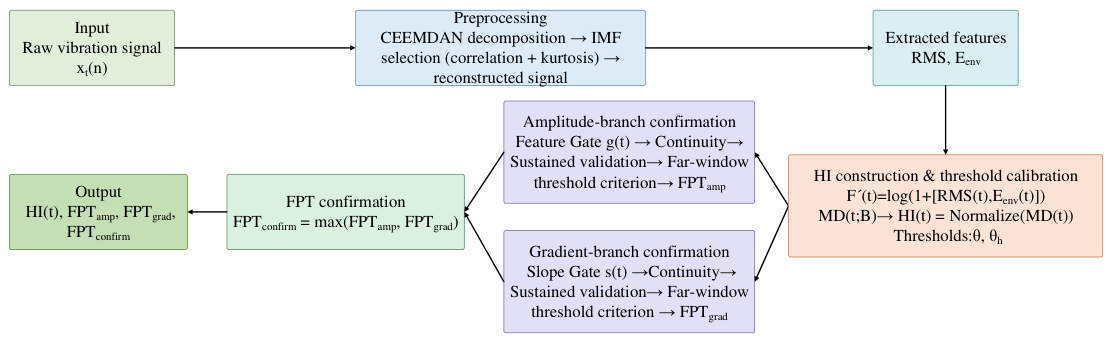
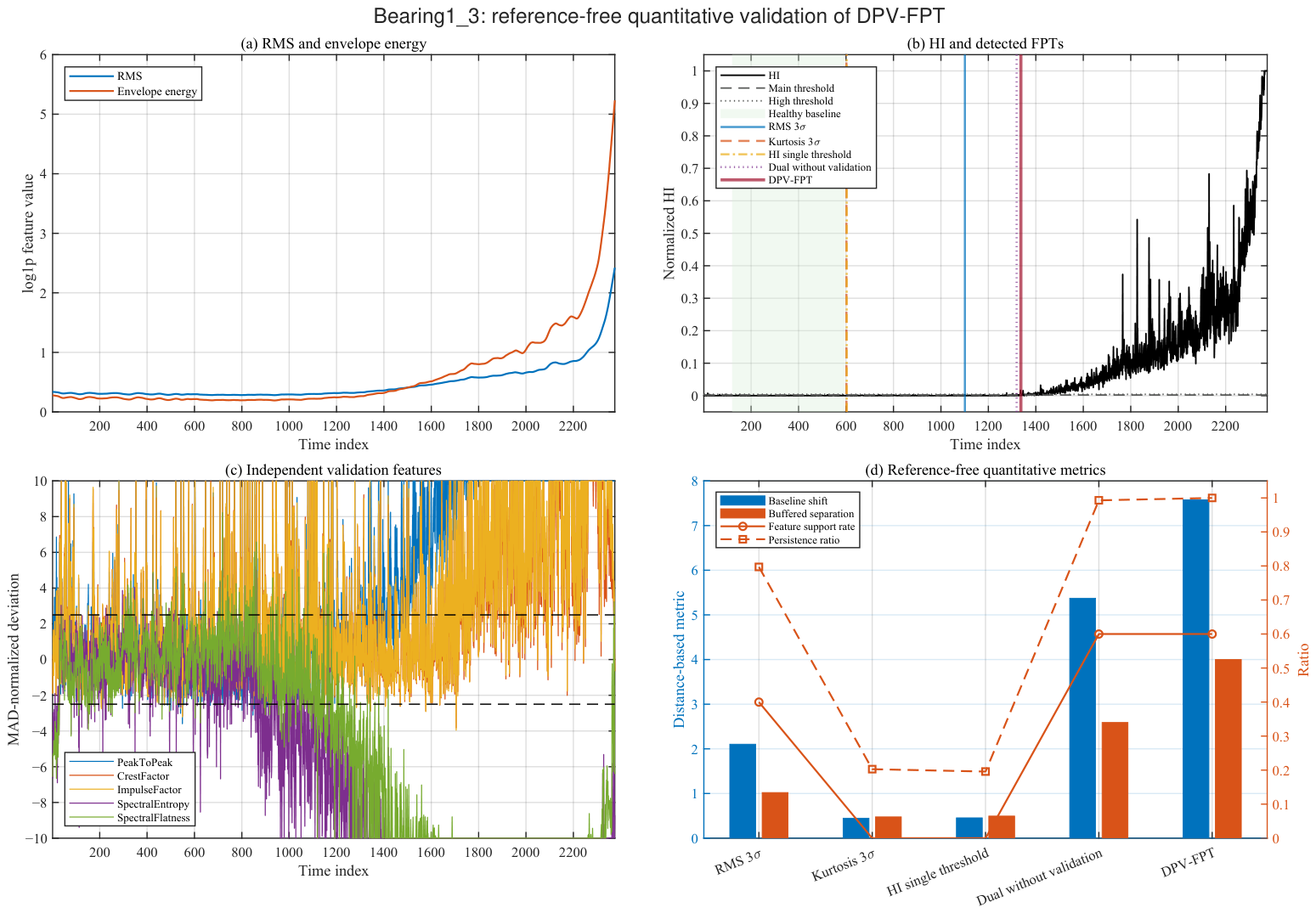
- A degradation-onset localization strategy based on dual-branch persistent validation is proposed. By jointly considering amplitude variation, local growth tendency, short- and long-window persistence, and future-window confirmation, the proposed DPV-FPT strategy distinguishes sustained degradation from transient threshold crossings.
- (2)
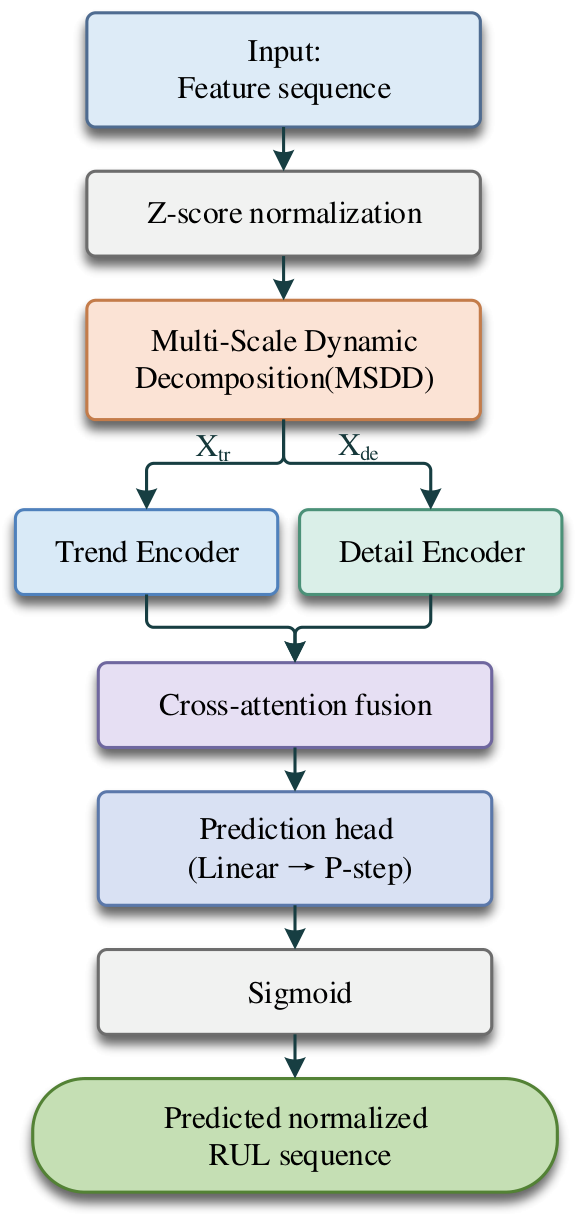
- An adaptive trend–detail RUL modeling framework is constructed for heterogeneous bearing degradation sequences. The proposed multi-scale dynamic decomposition module separates cumulative degradation trends from localized detail variations, while a Mamba-based trend encoder captures long-range temporal dependencies in the cumulative degradation trajectory.
- (3)
- A detail encoder combining wavelet soft-threshold shrinkage and JacobiKAN is introduced to suppress noise-like high-frequency disturbances and represent nonlinear localized degradation patterns. The suitability of JacobiKAN for the wavelet-processed detail branch is further examined through controlled replacement experiments with a standard KAN, ChebyshevKAN, and an MLP. Cross-attention is subsequently employed to integrate complementary trend and detail information for RUL prediction.
2. Degradation Assessment and FPT Identification
2.1. Problem Definition
2.2. CEEMDAN-Based Signal Enhancement
- (1)
- Construct the noise-assisted signal:where denotes the noise amplitude coefficient, and denotes the i-th added white-noise sequence.
- (2)
- Perform empirical mode decomposition (EMD) on each noise-assisted signal , and obtain the first intrinsic mode function (IMF) by averaging the first-mode components obtained from all decompositions, denoted as . The corresponding residual is then given by .
- (3)
- For higher-order components , adaptive noise is added to , after which decomposition is performed again. The averaged result yields , and the residual is updated as
- (4)
- The decomposition terminates when the residual exhibits a monotonic trend and can no longer be further decomposed. The original signal can then be expressed aswhere j denotes the index of IMF components, J denotes the total number of IMF components, and denotes the final residual component of the t-th sampling file obtained after CEEMDAN decomposition, which mainly represents the low-frequency trend that cannot be further decomposed.
2.3. Feature Extraction and Preprocessing
2.4. Health Indicator Construction via MD
2.5. DPV-FPT Criterion
- (1)
- Feature gating constraint: For a candidate time t, the feature-gating window is defined as:Within this window, the exceedance state of a single-point feature is defined as:where denotes the indicator function, which equals 1 if the condition is satisfied and 0 otherwise. Then, the proportion of exceedance points within the window is required to be no smaller than the preset threshold :
- (2)
- Persistence constraint: The health indicator is required to continuously exceed the primary threshold over the persistence interval, i.e., ,;
- (3)
- Persistent validation constraint: Within the short window , the proportion of points whose health-indicator values exceed the high threshold must be no smaller than .Meanwhile, within the long window , the mean value of the health indicator must exceed the high threshold
- (4)
- Future-window exceedance requirement: Within the future window , the proportion of points whose health-indicator values exceed the primary threshold must be no smaller than
2.6. Feature Selection
3. Methodology
3.1. Framework Overview
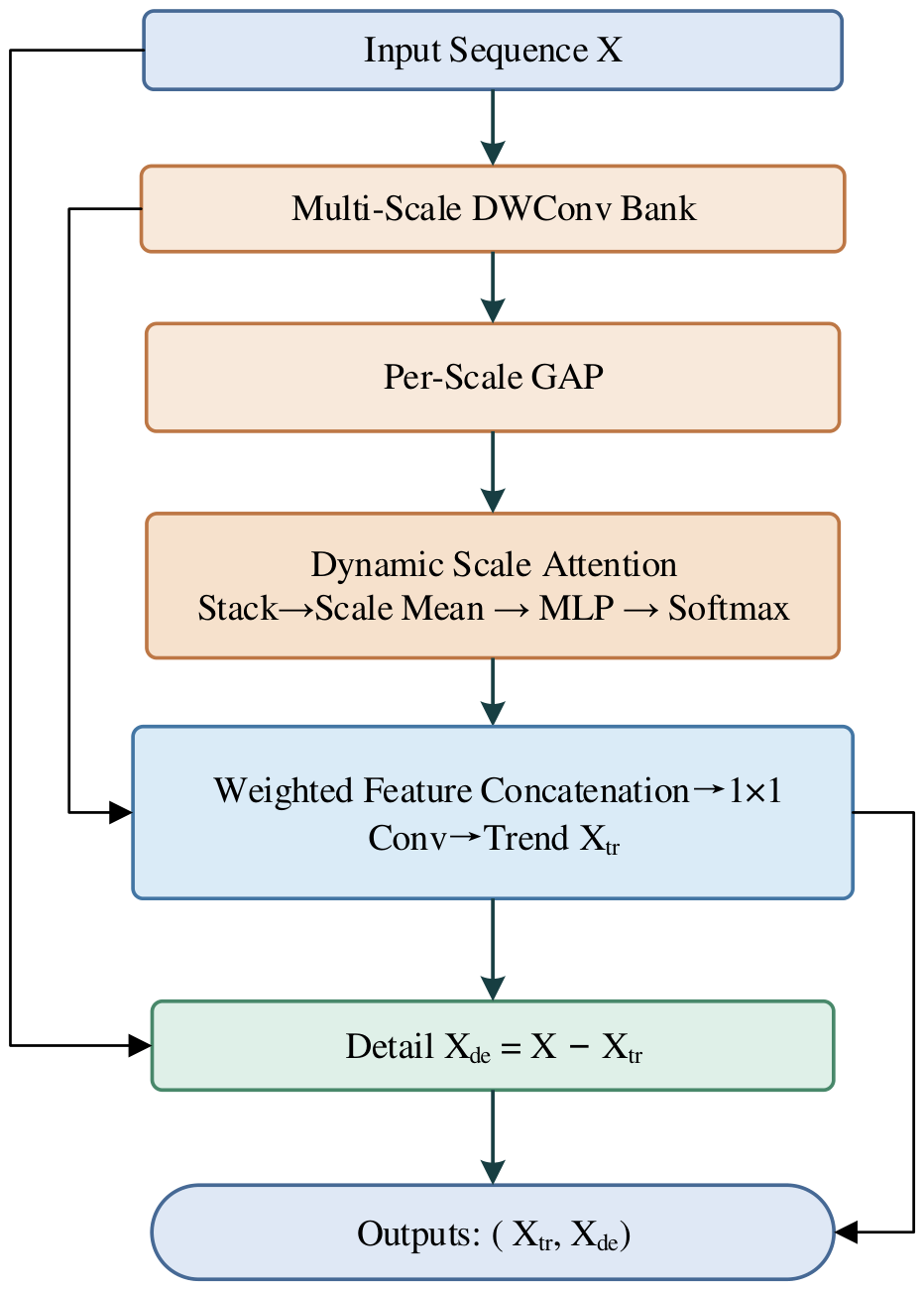
3.2. Multi-Scale Dynamic Decomposition
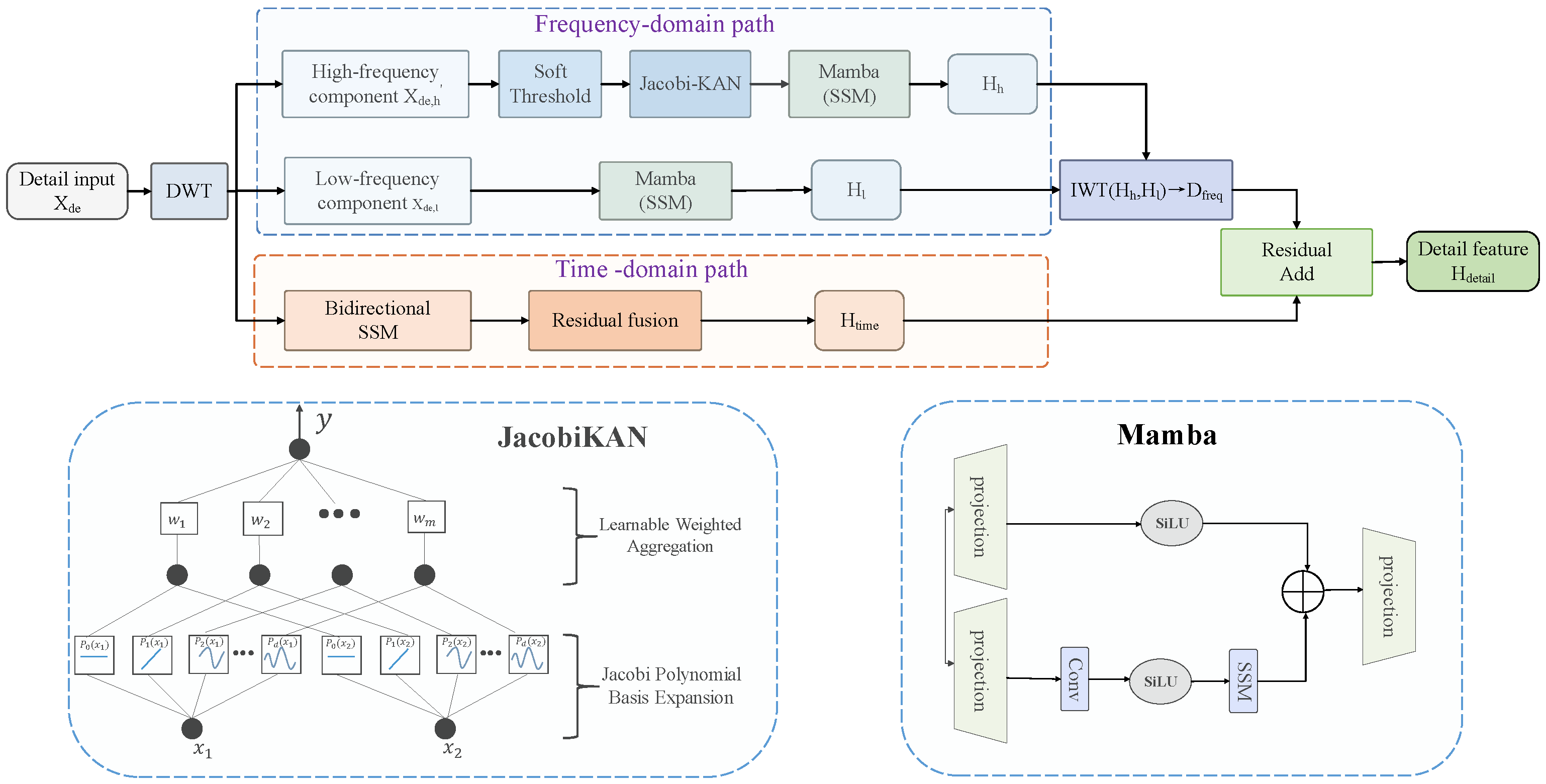
3.3. Detail Branch Encoder
3.4. Cross-Attention Fusion and RUL Prediction
3.5. Evaluation Metrics
4. Experimental Results
4.1. Experimental Settings on PHM2012
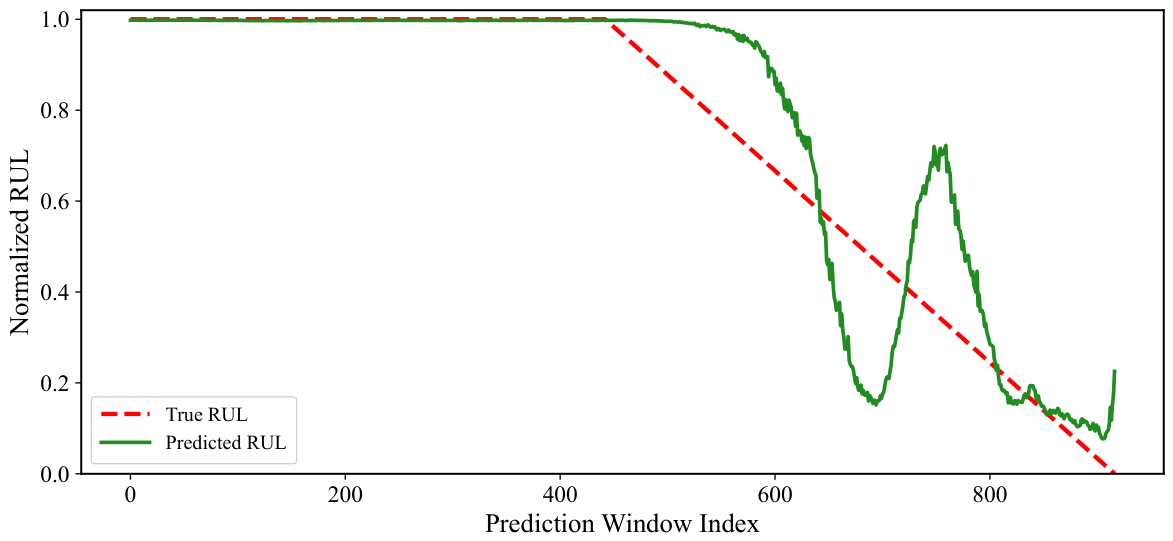
4.2. Results on the PHM2012 Dataset
4.3. Experimental Settings on the IMS Dataset
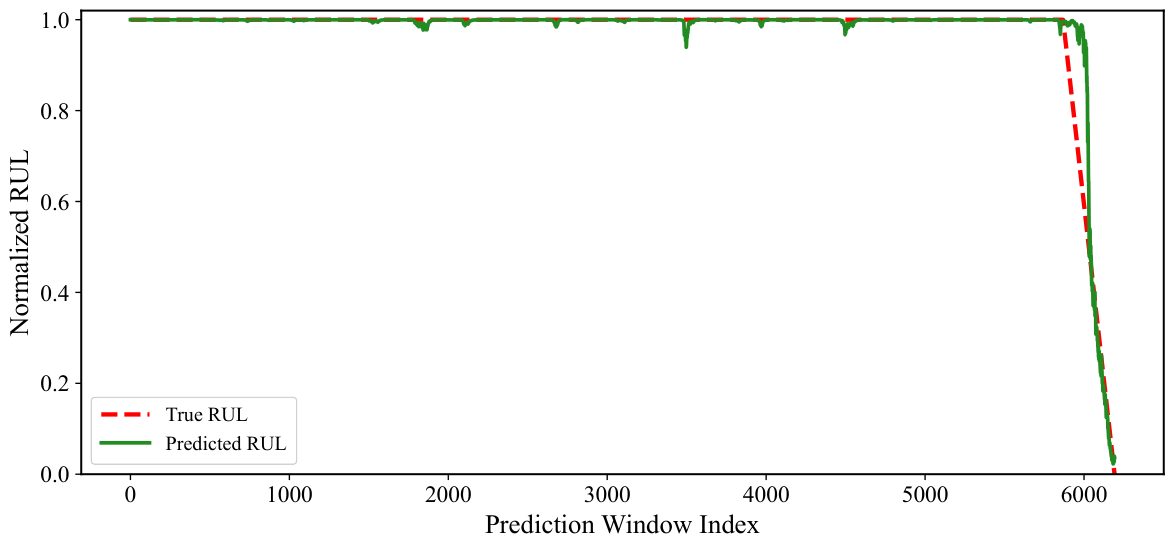
4.4. Results on the IMS Dataset
5. Conclusions
Author Contributions
Funding
Institutional Review Board Statement
Informed Consent Statement
Data Availability Statement
Conflicts of Interest
References
- Song, L.; Lin, T.; Jin, Y.; Zhao, S.; Li, Y.; Wang, H. Advancements in bearing remaining useful life prediction methods: A comprehensive review. Meas. Sci. Technol. 2024, 35, 092003. [Google Scholar] [CrossRef] [Scilit]
- Yan, B.; Ma, X.; Huang, G.; Zhao, Y. Two-stage physics-based Wiener process models for online RUL prediction in field vibration data. Mech. Syst. Signal Process. 2021, 152, 107378. [Google Scholar] [CrossRef] [Scilit]
- Yang, F.; Dong, E.; Zhong, Z.; Zhang, W.; Cui, Y.; Ye, J. Remaining useful life prediction of electric drive bearings in new energy vehicles: Based on degradation assessment and spatiotemporal feature fusion. Machines 2025, 13, 914. [Google Scholar] [CrossRef] [Scilit]
- Zhao, Y.-S.; Li, P.; Kang, Y.; Zhao, Y.-B. A health indicator enabling both first predicting time detection and remaining useful life prediction: Application to rotating machinery. Measurement 2024, 235, 114994. [Google Scholar] [CrossRef] [Scilit]
- Mi, J.; Hou, Y.; He, W.; He, C.; Zhao, H.; Huang, W. A nonparametric cumulative sum-based fault detection method for rolling bearings using high-level extended isolated forest. IEEE Sens. J. 2023, 23, 2443–2455. [Google Scholar] [CrossRef] [Scilit]
- Zhang, J.; Zhang, C.; Xu, S.; Liu, G.; Fei, H.; Wu, L. Remaining life prediction of bearings based on improved IF-SCINet. IEEE Access 2024, 12, 19598–19611. [Google Scholar] [CrossRef] [Scilit]
- Gugulothu, N.; Vishnu, T.V.; Malhotra, P.; Vig, L.; Agarwal, P.; Shroff, G. Predicting remaining useful life using time series embeddings based on recurrent neural networks. Int. J. Progn. Health Manag. 2018, 9, 1–13. [Google Scholar] [CrossRef] [Scilit]
- Kaleli, A.Y.; Unal, A.F.; Ozer, S. Simultaneous prediction of remaining-useful-life and failure-likelihood with GRU-based deep networks for predictive maintenance analysis. In Proceedings of the 2021 44th International Conference on Telecommunications and Signal Processing, Brno, Czech Republic, 26–28 July 2021; pp. 301–304. [Google Scholar]
- Yu, Y.; Si, X.; Hu, C.; Zhang, J. A review of recurrent neural networks: LSTM cells and network architectures. Neural Comput. 2019, 31, 1235–1270. [Google Scholar] [CrossRef] [Scilit] [PubMed]
- Wang, C.; Jiang, W.; Shi, L.; Zhang, L. Rolling bearing remaining useful life prediction using deep learning based on high-quality representation. Sci. Rep. 2025, 15, 8228. [Google Scholar] [CrossRef] [Scilit] [PubMed]
- Jin, X.; Ji, Y.; Li, S.; Lv, K.; Xu, J.; Jiang, H.; Fu, S. Remaining useful life prediction for rolling bearings based on TCN–Transformer networks using vibration signals. Sensors 2025, 25, 3571. [Google Scholar] [CrossRef] [Scilit] [PubMed]
- Jin, C.; Li, B.; Yang, Y.; Yuan, X.; Tu, R.; Qiu, L.; Chen, X. Remaining useful life prediction of rolling bearings based on empirical mode decomposition and Transformer Bi-LSTM network. Appl. Sci. 2025, 15, 9529. [Google Scholar] [CrossRef] [Scilit]
- Gu, A.; Dao, T. Mamba: Linear-time sequence modeling with selective state spaces. In Proceedings of the First Conference on Language Modeling (COLM 2024), Philadelphia, PA, USA, 7–9 October 2024. [Google Scholar]
- Yue, C.; Qin, Y.; Liu, X.; Gu, H.; Sun, S. Data–physics collaborative fusion prediction method for tool remaining useful life based on Mamba state space and physical description. J. Manuf. Syst. 2025, 81, 1–15. [Google Scholar] [CrossRef] [Scilit]
- Li, M.; Zhu, L.; Luo, M.; Ke, T. Remaining useful life prediction of airplane engine based on bidirectional Mamba and causal discovery. Sensors 2025, 25, 3429. [Google Scholar] [CrossRef] [Scilit] [PubMed]
- Liu, F.; Liu, S.; Chai, Y.; Zhu, Y. Enhanced Mamba model with multi-head attention mechanism and learnable scaling parameters for remaining useful life prediction. Sci. Rep. 2025, 15, 7178. [Google Scholar] [CrossRef] [Scilit] [PubMed]
- Zhang, G.; Lei, C.; Zhou, J.; Hao, D.; Li, X.; Li, M.; Feng, R. Remaining useful life prediction method for rolling bearings based on Mamba-SDP. J. Mech. Sci. Technol. 2025, 39, 7473–7488. [Google Scholar] [CrossRef] [Scilit]
- Liu, Z.; Wang, Y.; Vaidya, S.; Ruehle, F.; Halverson, J.; Soljačić, M.; Hou, T.Y.; Tegmark, M. KAN: Kolmogorov–Arnold networks. In Proceedings of the Thirteenth International Conference on Learning Representations (ICLR 2025), Singapore, 24–28 April 2025. [Google Scholar]
- Aghaei, A.A. fKAN: Fractional Kolmogorov–Arnold networks with trainable Jacobi basis functions. Neurocomputing 2025, 623, 129414. [Google Scholar] [CrossRef] [Scilit]
- Torres, M.E.; Colominas, M.A.; Schlotthauer, G.; Flandrin, P. A complete ensemble empirical mode decomposition with adaptive noise. In Proceedings of the 2011 IEEE International Conference on Acoustics, Speech and Signal Processing, Prague, Czech Republic, 22–27 May 2011; pp. 4144–4147. [Google Scholar]
- De Maesschalck, R.; Jouan-Rimbaud, D.; Massart, D.L. The Mahalanobis distance. Chemom. Intell. Lab. Syst. 2000, 50, 1–18. [Google Scholar] [CrossRef] [Scilit]
- Peng, H.; Long, F.; Ding, C. Feature selection based on mutual information: Criteria of max-dependency, max-relevance, and min-redundancy. IEEE Trans. Pattern Anal. Mach. Intell. 2005, 27, 1226–1238. [Google Scholar] [CrossRef] [Scilit] [PubMed]
- Whitney, A.W. A direct method of nonparametric measurement selection. IEEE Trans. Comput. 1971, C-20, 1100–1103. [Google Scholar] [CrossRef] [Scilit]
- Gu, A.; Goel, K.; Ré, C. Efficiently modeling long sequences with structured state spaces. In Proceedings of the Tenth International Conference on Learning Representations (ICLR 2022), Virtual, 25–29 April 2022. [Google Scholar]
- El Afia, H.; Ohamouddou, S.; Chiheb, R.; El Afia, A. Dynamic graph CNN with Jacobi Kolmogorov–Arnold networks for 3D classification of point sets. arXiv 2025, arXiv:2506.06296. [Google Scholar]
- Nectoux, P.; Gouriveau, R.; Medjaher, K.; Ramasso, E.; Chebel-Morello, B.; Zerhouni, N.; Varnier, C. PRONOSTIA: An experimental platform for bearings accelerated degradation tests. In Proceedings of the IEEE International Conference on Prognostics and Health Management, Denver, CO, USA, 18–21 June 2012; pp. 1–8. [Google Scholar]
- An, X.; Zhang, C.; Liu, C.; Zhao, W. An enhanced approach for remaining useful life prediction of bearings using incomplete lifecycle data. IEEE Access 2025, 13, 53305–53320. [Google Scholar] [CrossRef] [Scilit]
- Luo, X.; Wang, M. Bearing lifespan reliability prediction method based on multiscale feature extraction and dual attention mechanism. Appl. Sci. 2025, 15, 3662. [Google Scholar] [CrossRef] [Scilit]
- Wang, C.; Jiang, W.; Yang, X.; Zhang, S. RUL prediction of rolling bearings based on a DCAE and CNN. Appl. Sci. 2021, 11, 11516. [Google Scholar] [CrossRef] [Scilit]
- Qiu, H.; Lee, J.; Lin, J.; Yu, G. Wavelet filter-based weak signature detection method and its application on rolling element bearing prognostics. J. Sound Vib. 2006, 289, 1066–1090. [Google Scholar] [CrossRef] [Scilit]
- Ding, G.; Wang, W.; Zhao, J. Prediction of remaining useful life of rolling bearing based on fractal dimension and convolutional neural network. Meas. Control 2022, 55, 79–93. [Google Scholar] [CrossRef] [Scilit]
- Li, J.; Ding, W.; Mao, W.; Zhang, J.; Meng, Z.; Tong, K. Causal dilated convolution-based residual DenseNet with channel attention for RUL prediction of rolling bearings. Measurement 2024, 235, 115012. [Google Scholar] [CrossRef] [Scilit]




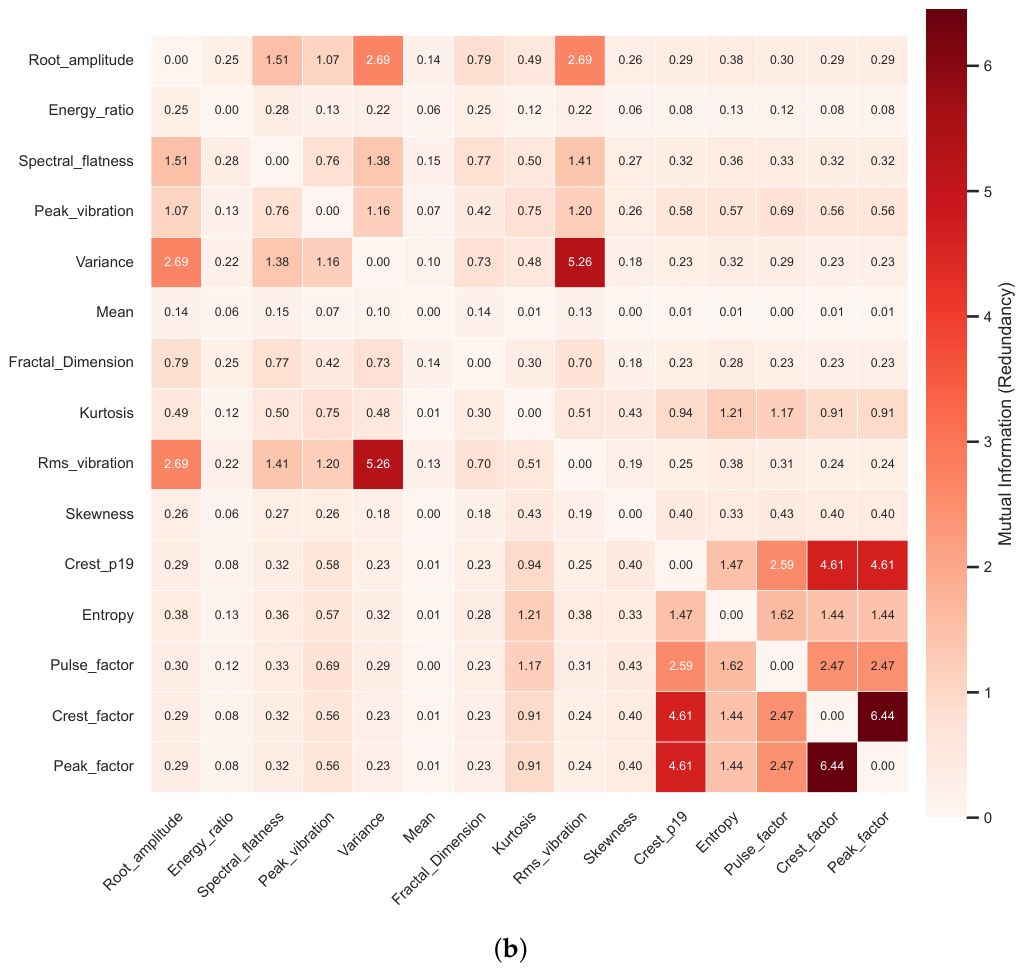




| Category | Features | Category | Features |
|---|---|---|---|
| Time Domain | Mean | Time Domain | Root_amplitude |
| Variance | p-norm Crest Factor () | ||
| Skewness | Margin factor | ||
| Kurtosis | Frequency | Spectral_flatness | |
| Peak_vibration | Energy_ratio | ||
| Rms_vibration | Complexity | Entropy | |
| Peak_factor | Fractal_Dimension | ||
| Pulse_factor |
| Method | FPT | Baseline Shift | Buffered Separation | Support Rate | Persistence Ratio | Relapse Ratio |
|---|---|---|---|---|---|---|
| RMS | 1101 | 2.104 | 1.022 | 0.40 | 0.797 | 0.203 |
| Kurtosis | 602 | 0.448 | 0.476 | 0.00 | 0.203 | 0.797 |
| HI single threshold | 603 | 0.455 | 0.495 | 0.00 | 0.196 | 0.804 |
| Dual branch without validation | 1319 | 5.373 | 2.591 | 0.60 | 0.993 | 0.007 |
| DPV-FPT | 1343 | 7.578 | 4.002 | 0.60 | 1.000 | 0.000 |
| Bearing | FPT | Bearing | FPT |
|---|---|---|---|
| Bearing1-1 | 1388 | Bearing1-6 | 2418 |
| Bearing1-2 | 827 | Bearing1-7 | 2172 |
| Bearing1-3 | 1343 | Bearing3-1 | 494 |
| Bearing1-4 | 1085 | Bearing3-2 | 1602 |
| Bearing1-5 | 2429 | Bearing3-3 | 322 |
| Metric | Bearing1_3 | Bearing1_5 | Bearing1_6 | Bearing1_7 | Bearing3_2 |
|---|---|---|---|---|---|
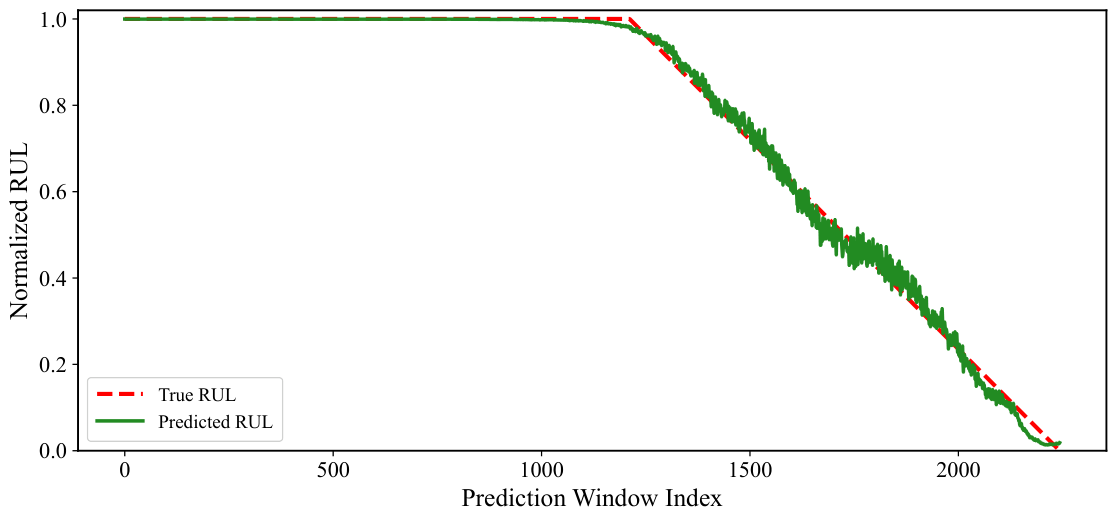
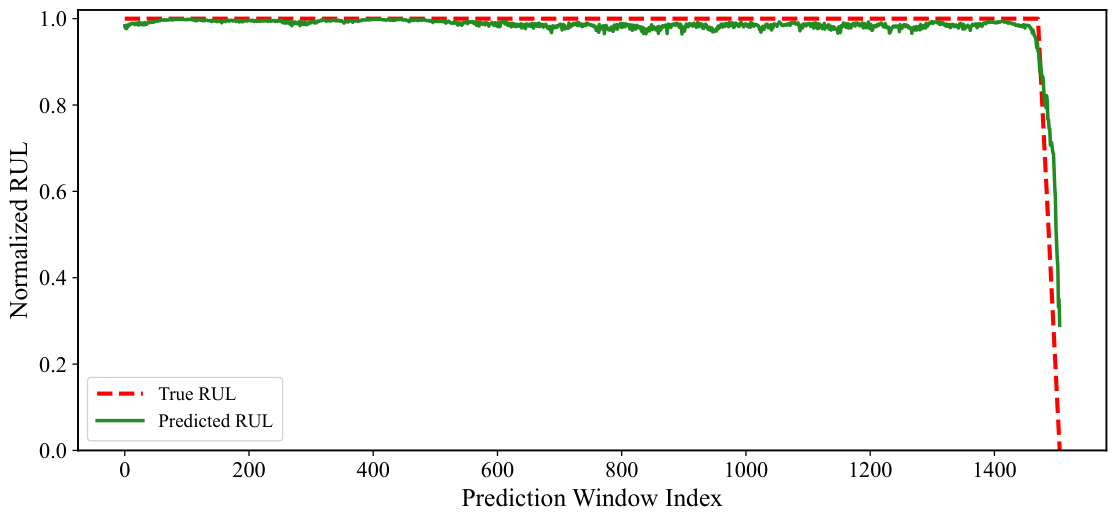
| RMSE | 0.0170 | 0.0360 | 0.0400 | 0.0069 | 0.0372 |
| MAE | 0.0102 | 0.0126 | 0.0076 | 0.0032 | 0.0166 |
| Model | Metric | Bearing1_3 | Bearing1_5 | Bearing1_7 | Average |
|---|---|---|---|---|---|
| Proposed Method | RMSE | 0.0170 | 0.0360 | 0.0069 | 0.0200 |
| MAE | 0.0102 | 0.0126 | 0.0032 | 0.0087 | |
| Ref. [12] | RMSE | 0.0454 | 0.0657 | — | 0.0556 |
| MAE | 0.0379 | 0.0542 | — | 0.0461 | |
| Ref. [27] | RMSE | 0.0470 | 0.0580 | 0.0630 | 0.0560 |
| MAE | 0.0380 | 0.0460 | 0.0500 | 0.0447 | |
| Ref. [28] | RMSE | 0.1050 | 0.0840 | 0.0590 | 0.0827 |
| MAE | 0.0890 | 0.0720 | 0.0480 | 0.0697 | |
| Ref. [29] | RMSE | 0.0540 | 0.0680 | — | 0.0610 |
| MAE | 0.0370 | 0.1030 | — | 0.0700 |
| Model | Metric | Bearing1_3 | Bearing1_7 | Bearing3_2 | Average |
|---|---|---|---|---|---|
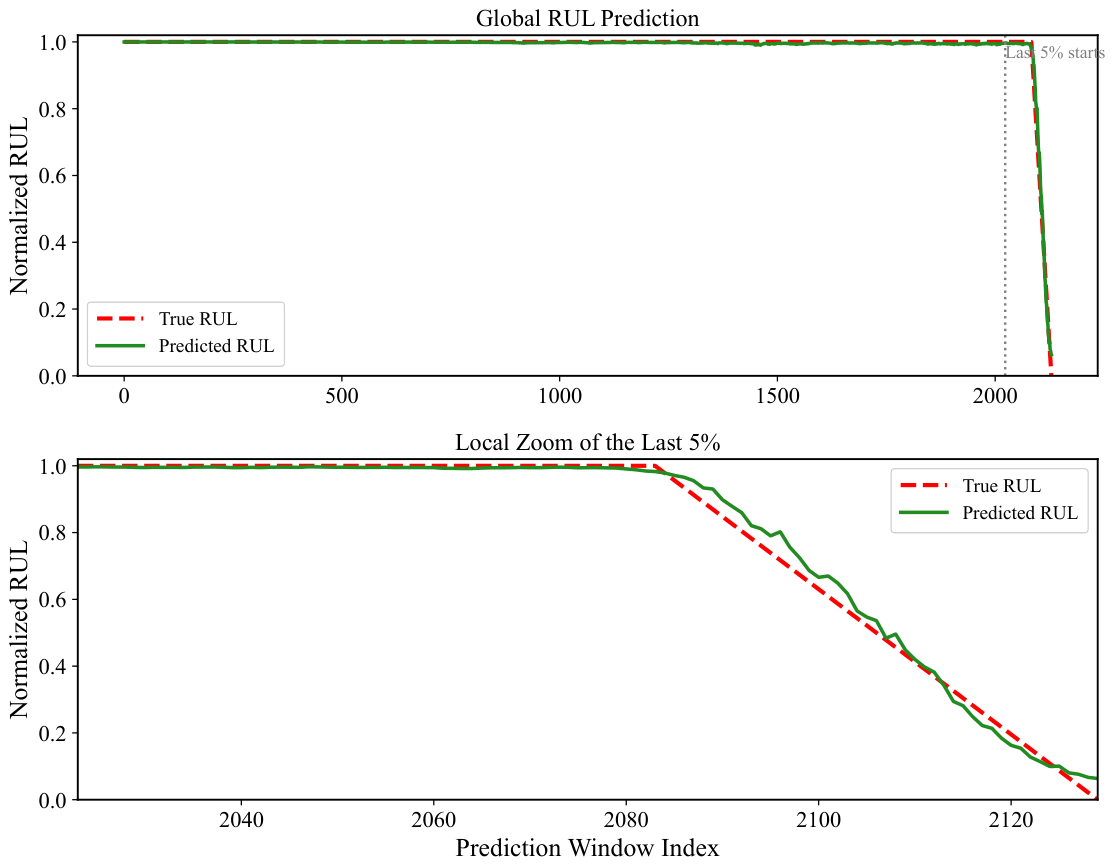
| Proposed Method | RMSE | 0.0170 | 0.0069 | 0.0372 | 0.0204 |
| MAE | 0.0102 | 0.0032 | 0.0166 | 0.0100 | |
| w/o MSDD | RMSE | 0.0346 | 0.0662 | 0.0837 | 0.0615 |
| MAE | 0.0175 | 0.0248 | 0.0210 | 0.0211 | |
| w/o JacobiKAN | RMSE | 0.0198 | 0.0179 | 0.0575 | 0.0317 |
| MAE | 0.0125 | 0.0038 | 0.0134 | 0.0099 | |
| w/o Wavelet | RMSE | 0.0177 | 0.0137 | 0.0485 | 0.0266 |
| MAE | 0.0096 | 0.0047 | 0.0216 | 0.0120 |
| Module | Bearing1_3 | Bearing1_7 | Bearing3_2 | Average | ||||
|---|---|---|---|---|---|---|---|---|
| MAE | RMSE | MAE | RMSE | MAE | RMSE | MAE | RMSE | |
| KAN | 0.0206 | 0.0367 | 0.0095 | 0.0150 | 0.0153 | 0.0469 | 0.0151 | 0.0329 |
| ChebyKAN | 0.0132 | 0.0231 | 0.0053 | 0.0109 | 0.0166 | 0.0372 | 0.0117 | 0.0237 |
| MLP | 0.0129 | 0.0208 | 0.0062 | 0.0109 | 0.0104 | 0.0559 | 0.0098 | 0.0333 |
| JacobiKAN | 0.0102 | 0.0170 | 0.0032 | 0.0069 | 0.0166 | 0.0372 | 0.0100 | 0.0204 |
| Bearing | FPT | Bearing | FPT |
|---|---|---|---|
| Bearing2-1 | 510 | Bearing3-1 | 6144 |
| Bearing2-2 | 874 | Bearing3-2 | 6000 |
| Bearing2-3 | 880 | Bearing3-3 | 6050 |
| Bearing2-4 | 864 | Bearing3-4 | 6012 |
| Bearing | RMSE | MAE | Bearing | RMSE | MAE |
|---|---|---|---|---|---|
| Bearing2_1 | 0.0611 | 0.0364 | Bearing3_1 | 0.0696 | 0.0144 |
| Bearing2_2 | 0.0317 | 0.0197 | Bearing3_2 | 0.0386 | 0.0072 |
| Bearing2_3 | 0.0334 | 0.0308 | Bearing3_3 | 0.0445 | 0.0077 |
| Bearing2_4 | 0.0476 | 0.0358 | Bearing3_4 | 0.0417 | 0.0073 |
| Model | Metric | Bearing2_1 | Bearing2_2 | Bearing2_3 | Bearing2_4 | Average |
|---|---|---|---|---|---|---|
| Ours | RMSE | 0.0611 | 0.0317 | 0.0334 | 0.0476 | 0.0435 |
| MAE | 0.0364 | 0.0197 | 0.0308 | 0.0358 | 0.0307 | |
| Ref. [31] | RMSE | 0.0691 | 0.1180 | 0.1071 | 0.0822 | 0.0941 |
| MAE | 0.0462 | 0.0980 | 0.0868 | 0.0677 | 0.0747 | |
| Ref. [32] | RMSE | 0.0612 | 0.0528 | 0.0342 | 0.0592 | 0.0519 |
| MAE | 0.0470 | 0.0414 | 0.0267 | 0.0456 | 0.0402 |
Disclaimer/Publisher’s Note: The statements, opinions and data contained in all publications are solely those of the individual author(s) and contributor(s) and not of MDPI and/or the editor(s). MDPI and/or the editor(s) disclaim responsibility for any injury to people or property resulting from any ideas, methods, instructions or products referred to in the content. |
© 2026 by the authors. Licensee MDPI, Basel, Switzerland. This article is an open access article distributed under the terms and conditions of the Creative Commons Attribution (CC BY) license.
Share and Cite
Zhang, Y.; Chen, Z. Remaining Useful Life Prediction for Rolling Bearings by Integrating Degradation Assessment with DK-Mamba. Machines 2026, 14, 836. https://doi.org/10.3390/machines14080836
Zhang Y, Chen Z. Remaining Useful Life Prediction for Rolling Bearings by Integrating Degradation Assessment with DK-Mamba. Machines. 2026; 14(8):836. https://doi.org/10.3390/machines14080836
Chicago/Turabian StyleZhang, Yusheng, and Zhibin Chen. 2026. "Remaining Useful Life Prediction for Rolling Bearings by Integrating Degradation Assessment with DK-Mamba" Machines 14, no. 8: 836. https://doi.org/10.3390/machines14080836
APA StyleZhang, Y., & Chen, Z. (2026). Remaining Useful Life Prediction for Rolling Bearings by Integrating Degradation Assessment with DK-Mamba. Machines, 14(8), 836. https://doi.org/10.3390/machines14080836