1. Introduction
Modern pipeline systems rely on distributed pump and valve stations to transport fluids efficiently while maintaining strict pressure safety limits. These stations are hydraulically coupled through shared flow and pressure dynamics, meaning that control actions taken at one location directly influence operating conditions at neighboring stations. As pipeline networks grow in size and complexity, centralized optimization becomes impractical due to communication constraints, latency, and limited fault tolerance. This has motivated increasing interest in distributed and cooperative control architectures for pipeline operation.
Recent studies have demonstrated that multi-agent and distributed optimization frameworks can significantly improve scalability and robustness in pipeline and energy transport systems [
1,
2,
3,
4]. In these approaches, individual stations are modeled as autonomous agents that optimize local objectives while interacting through shared hydraulic states such as pressure and flow. Results show that explicitly accounting for inter-station coupling can reduce pressure oscillations and improve overall energy efficiency. However, many existing formulations assume persistent communication or static cooperation structures that are not representative of real pipeline deployments.
Parallel advances in reinforcement learning and adaptive control have enabled pump and valve stations to learn efficient operating policies under uncertain demand and nonlinear dynamics [
2,
5,
6,
7]. These methods are particularly effective for local optimization and disturbance rejection; however, when applied in isolation, they may converge to stable yet globally inefficient operating points. In pipeline systems, this often manifests as excessive valve throttling or uneven pressure distribution as downstream stations compensate for upstream control actions they cannot observe.
Recent work has begun to explore game-theoretic interpretations of these interactions, showing that decentralized controllers naturally converge to equilibrium operating points determined by their local objectives and information sets [
8,
9,
10,
11]. When stations act non-cooperatively, the resulting equilibria are robust but can incur significant efficiency losses due to unmodeled hydraulic coupling. Conversely, cooperative formulations—enabled by information sharing—can drive the system toward Pareto-efficient operating points that reduce energy consumption and pressure stress. Despite this potential, few existing approaches provide a unified mechanism for transitioning between cooperative and non-cooperative operation as communication conditions change.
By building on previous work [
12,
13], this paper proposes a distributed game-theoretic coordination framework that explicitly addresses this gap. Each pump or valve station operates as a rational agent with local adaptive control and learning-based optimization. At the same time, an inter-station coordination layer enables cooperative behavior when communication links are available. Rather than assuming fixed cooperation, the framework dynamically detects communication topology, partitions stations into cooperative sub-games, and computes equilibrium setpoints accordingly. When communication is lost, stations revert seamlessly to non-cooperative operation using locally optimal fallback policies.
Unlike prior work that relies on centralized coordination or static bargaining structures, disagreement performance in the proposed framework emerges directly from each station’s locally optimal behavior. This allows cooperative setpoints to be negotiated using minimal shared information, ensuring robustness to intermittent communication failures. The resulting equilibria reflect the physical structure of the pipeline: upstream stations are incentivized to limit excessive suction pressure, while downstream stations balance discharge pressure against valve throttling losses. Compared with centralized optimization approaches, the proposed framework is intentionally designed for PLC- and SCADA-level deployment with limited inter-station communication and bounded supervisory setpoint negotiation. This prioritizes fault tolerance and practical deployability over globally optimal control performance.
The primary contributions of this work are a communication-aware, distributed game-theoretic coordination framework for mixed pump-and-valve pipeline systems, a physically interpretable station-level objective structure that captures hydraulic coupling, valve throttling, and energy usage, as well as a simulation-based evaluation demonstrating stable equilibrium formation, robustness to communication loss, an approximately 2–3% reduction in system energy usage, and reduced valve throttling relative to non-cooperative operation.
The existing literature reveals several limitations in the application of distributed coordination methods for industrial pipeline systems:
Existing pipeline control methods primarily rely on centralized supervisory optimization, creating computational and communication bottlenecks.
Distributed control approaches often assume persistent communication availability and do not explicitly account for communication degradation or topology changes.
Most existing coordination methods prioritize local station objectives without explicitly considering hydraulic coupling between adjacent pump and valve stations.
Real-time deployment constraints associated with industrial PLC and SCADA architectures are rarely considered in advanced distributed control formulations.
Accordingly, the primary objectives of this work are to:
Develop a reduced-order hydraulic abstraction suitable for repeated supervisory game evaluation.
Design a communication-aware distributed coordination framework capable of dynamically transitioning between cooperative and non-cooperative operation.
Evaluate whether iterative utility-based negotiation can achieve stable operating points without centralized optimization or explicit equilibrium solving.
Demonstrate a practical supervisory architecture suitable for deployment within industrial pipeline control systems.
3. Station-Level Decision Model
Each pump station in the pipeline network is modeled as an autonomous decision-making agent (or player) participating in a strategic game. The objective of each player is to select a local control action that maximizes its performance objective subject to all other players’ control actions, while respecting the physical coupling between suction and discharge pressures across adjacent stations [
8].
3.1. Player Definition
Let the set of stations be denoted as
where
is the total number of stations. Each station
is characterized by a local actuator type
, a decision variable
, representing either normalized pump speed (for VFD-driven stations) or normalized valve opening (for valve-controlled stations), a measurable suction pressure
and discharge pressure
. A local flow
satisfying the pressure continuity constraint in (
1)–(
9).
3.2. Strategy Space
The admissible control actions for each player are defined over a discrete or continuous set:
where
and
correspond to the minimum and maximum allowable speed ratios for VFD stations, and
,
represent the physical valve opening limits.
3.3. Station-Level Cooperative and Non-Cooperative Objectives
In the proposed iterative game-theoretic framework, each pump station is modeled as a rational decision-making agent that evaluates its operating condition based on a locally defined utility function. Rather than solving a global optimization problem, stations update their control setpoints sequentially, using changes in utility to determine whether further adjustment is beneficial. This formulation enables both cooperative and non-cooperative behavior to emerge naturally, depending on the availability of inter-station communication.
For a pipeline system comprising N stations, the primary hydraulic coupling occurs between the upstream station’s discharge pressure and the downstream station’s suction pressure. As a result, the utility of station i depends not only on its local regulation objectives but also on how its control actions influence the suction conditions of station .
The station-level utility for station
i is defined as
where
represents the local control performance of station
i, and
captures the hydraulic impact of station
i on the downstream station. The local utility weight,
Table 2, was set to (
), while the downstream coupling weight was set to (
). The local utility weight (
) was selected to place slightly higher priority on local regulation, while the downstream coupling weight (
) was set to strongly penalize downstream hydraulic impact. The selected values were empirically chosen to balance local regulation priority with downstream hydraulic coordination during simulation testing.
The local utility term is expressed as
where
denotes the normalized control effort produced by the station-level PI controller (e.g., pump speed command or valve position). This formulation allows a unified representation for both variable-frequency drive (VFD) stations and fixed-speed stations with control valves.
The coupling utility term penalizes adverse hydraulic interactions and is defined as
which reflects the deviation of the downstream suction pressure from its desired operating range.
In cooperative operations, stations include both local and coupling utilities in their decision-making, effectively internalizing the impact of their actions on neighboring stations. When communication between stations is unavailable, the coupling term is omitted, and each station maximizes only its local utility, resulting in non-cooperative behavior.
At each negotiation step, a station adjusts its active control setpoint in the direction that increases its utility. The iterative process continues until the change in utility for all participating stations falls below a predefined threshold,
where
is selected based on actuator resolution and measurement uncertainty.
In the non-cooperative setting, the operating point and satisfaction of (
17) indicate convergence toward a locally stationary operating point consistent with Nash-equilibrium behavior, where no station can further improve utility through unilateral incremental deviation. While stable, they are generally not globally efficient due to hydraulic coupling and localized valve losses.
Under cooperative operation, the stations jointly minimize a weighted sum of individual costs, yielding a Pareto-stationary operating point. At this point, no station’s performance can be improved without degrading another station’s performance, resulting in a balanced pressure distribution and reduced throttling losses. The distinction between these equilibria explains the observed differences in energy efficiency between cooperative and non-cooperative simulation cases.
3.4. Communication-Aware Game Operation
The proposed iterative game-theoretic coordination framework explicitly adapts station behavior based on the availability of inter-station communication. Rather than assuming persistent connectivity, the game formulation allows each station to dynamically transition between cooperative and non-cooperative decision-making based on real-time communication status.
At each negotiation iteration
k, the communication layer provides a binary indicator
where
denotes successful reception of relevant upstream and/or downstream hydraulic information for station
i, and
denotes communication loss or degradation.
When communication is available, stations incorporate hydraulic coupling terms into their utility evaluation. When communication is unavailable, stations revert automatically to local, non-cooperative utility evaluation without requiring any structural change to the control algorithm.
3.4.1. Communication-Enabled Cooperative Utility
If
, station
i has access to the downstream suction pressure measurements from the downstream station
. In this case, station
i evaluates a coupled utility function of the form
where the local utility term represents station-level control performance, and the coupling terms quantify the hydraulic impact of neighboring stations.
The downstream coupling utility penalizes excessive suction pressure at the downstream station,
The coupling term allows stations to internalize the hydraulic consequences of their actions, promoting coordinated behavior without centralized optimization.
3.4.2. Communication-Loss Non-Cooperative Utility
If
, station
i no longer has access to neighboring pressure measurements. In this scenario, the station evaluates a reduced utility function that depends solely on local control performance,
which preserves stable operation by ensuring each station continues to regulate its own controlled variables using only locally available measurements.
3.4.3. Iterative Update and Hybrid Game Structure
Stations update their active control setpoints sequentially according to changes in utility,
adjusting the loop currently in control only if
. This turn-based update structure allows the system to evolve toward equilibrium without evaluating all possible action combinations.
Because communication availability may vary across the pipeline, the resulting game at iteration
k may be heterogeneous:
The iterative process is deemed converged when the utility change for all stations satisfies
which is consistent with convergence toward a Nash-equilibrium operating condition in the non-cooperative case and a Pareto-stationary operating point in the cooperative case. This communication-aware formulation ensures robustness to information loss, enabling scalable deployment across large pipeline systems and preserving convergence properties under time-varying network conditions.
3.5. Time-Scale Separation Between Hydraulic Control and Game Negotiation
The proposed coordination framework relies on a deliberate separation of time scales between the fast inner-loop hydraulic control and the slower outer-loop game-theoretic negotiation. This separation is critical to ensuring stability, interpretability of utility evaluations, and convergence of the iterative game dynamics.
3.5.1. Fast Station-Level Control Dynamics
At each pump or valve station, local control loops (e.g., PI or adaptive RLS-based controllers) operate at a high sampling rate to regulate suction pressure, discharge pressure, or flow to their respective setpoints. These controllers are assumed to stabilize the local hydraulic dynamics within a short time horizon relative to the negotiation process.
As established in [
12,
13], the station-level controllers are capable of rejecting disturbances, compensating for parameter uncertainty, and enforcing operational constraints. As a result, during the game-theoretic negotiation, each station is assumed to operate sufficiently close to its commanded setpoint, allowing steady-state or quasi-steady-state hydraulic models for utility evaluation.
3.5.2. Slow Iterative Game Negotiation
The game-theoretic coordination layer operates on a slower time scale, with each station updating its active setpoint only after the local control loop has settled. At iteration
k, a single station (or a small subset of stations) is selected to propose a setpoint adjustment based on the observed change in utility,
This turn-based update structure avoids simultaneous significant setpoint changes, reduces oscillatory behavior, and enables each station to observe the hydraulic consequences of its action before the next negotiation step.
3.5.3. Negotiation Update Interval and Quasi-Steady-State Assumption
The negotiation update interval, denoted by , is selected to ensure that the supervisory game layer operates on a slower time scale than both the local control dynamics and the dominant hydraulic transient dynamics. This timescale separation is necessary because the game-theoretic layer evaluates utilities based on quasi-steady hydraulic states rather than on instantaneous transient pressures.
Let
denote the dominant settling time of the local station-level pressure or flow controller. In addition, let
denote the characteristic hydraulic transient time of the pipeline segment affected by a setpoint adjustment. For a pipeline segment of length
L and pressure-wave speed
a, a representative round-trip wave travel time may be approximated as [
14]
The relevant settling time for supervisory negotiation is therefore defined as
The game-layer update interval is then chosen such that
where
is a safety factor selected to allow local control action, pressure redistribution, and decay of dominant hydraulic transients before the next utility evaluation is performed.
During each negotiation interval, the lower-level controller continues to regulate the station to the most recently accepted setpoint. When the supervisory game layer proposes a new setpoint, the station-level controller tracks the updated setpoint while enforcing actuator limits and local safety constraints. The resulting utility is evaluated only after the system has settled sufficiently according to the criterion above. Thus, the game layer does not respond to instantaneous pressure-wave effects, but rather to the quasi-steady hydraulic consequence of each accepted setpoint change.
Communication latency and jitter must also remain small relative to the negotiation interval. If
denotes the effective communication delay, including packet transmission and processing time, then the proposed formulation assumes
When this condition is not satisfied, neighbor-state information may become stale, and the station may either reject the received data or revert to the non-cooperative local utility formulation described in
Section 3.4.
For a system with
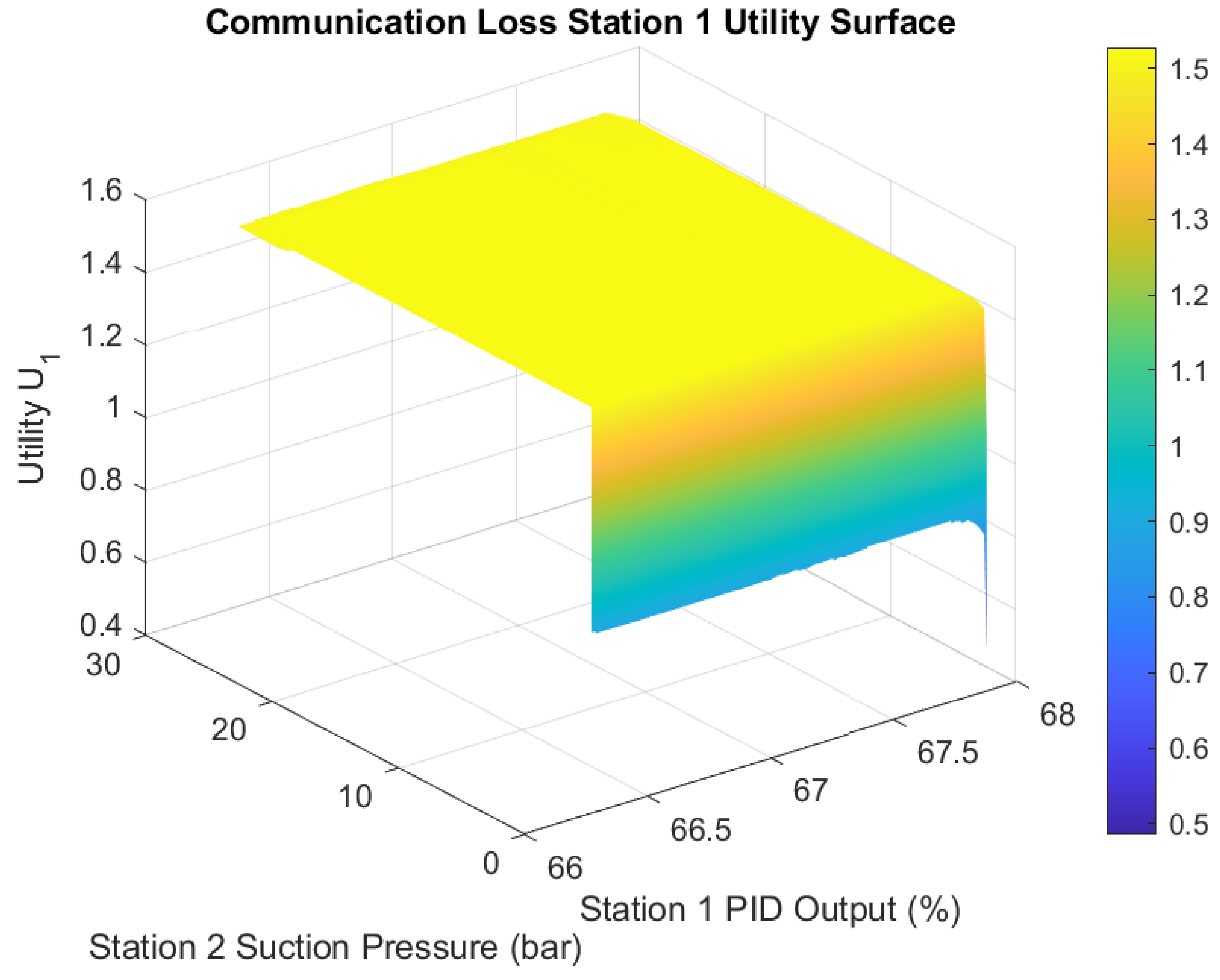
N active stations, the negotiation interval may be scaled to ensure that each station has sufficient time to respond before subsequent updates are made:
where
is selected according to the settling-time condition above.
This assumption limits the proposed framework to supervisory coordination problems in which setpoint changes occur more slowly than the dominant hydraulic transients. Fast events such as valve slam, emergency shutdowns, or severe water-hammer conditions must be handled by the lower-level protection and control layers rather than by the game-theoretic negotiation layer. Density variations associated with batch changes are treated as slowly varying disturbances that modify pump head and hydraulic resistance over the supervisory time scale.
3.5.4. Equilibrium Detection Under Time-Scale Separation
Because each station updates its setpoint only after the system has approximately settled, changes in utility can be interpreted as steady-state effects rather than transient artifacts. The system is considered to have reached an equilibrium when the utility variation for all stations satisfies
for a predefined tolerance
. In the non-cooperative case, this is consistent with convergence toward a Nash-equilibrium operating condition as no station can improve its utility through unilateral deviation. In the cooperative case, the same criterion indicates convergence to a Pareto-stationary operating point at which coordinated adjustments no longer yield additional benefits.
3.5.5. Practical Implications for Pipeline Operation
The separation of time scales provides several practical advantages: it allows the game-theoretic layer to operate with simplified hydraulic models (e.g., affinity laws and steady-state loss relationships) without compromising accuracy. It prevents excessive interaction between fast control loops and slow strategic updates. It enables robust operation in the presence of communication delays, packet loss, or asynchronous station updates. Additionally, it ensures that the negotiation process remains interpretable and tunable by operators. This structure allows the proposed coordination framework to be seamlessly integrated into existing industrial control architectures, in which fast regulatory control and slower supervisory decision-making are naturally decoupled.
3.6. Reaction Functions and Best-Response Interpretation
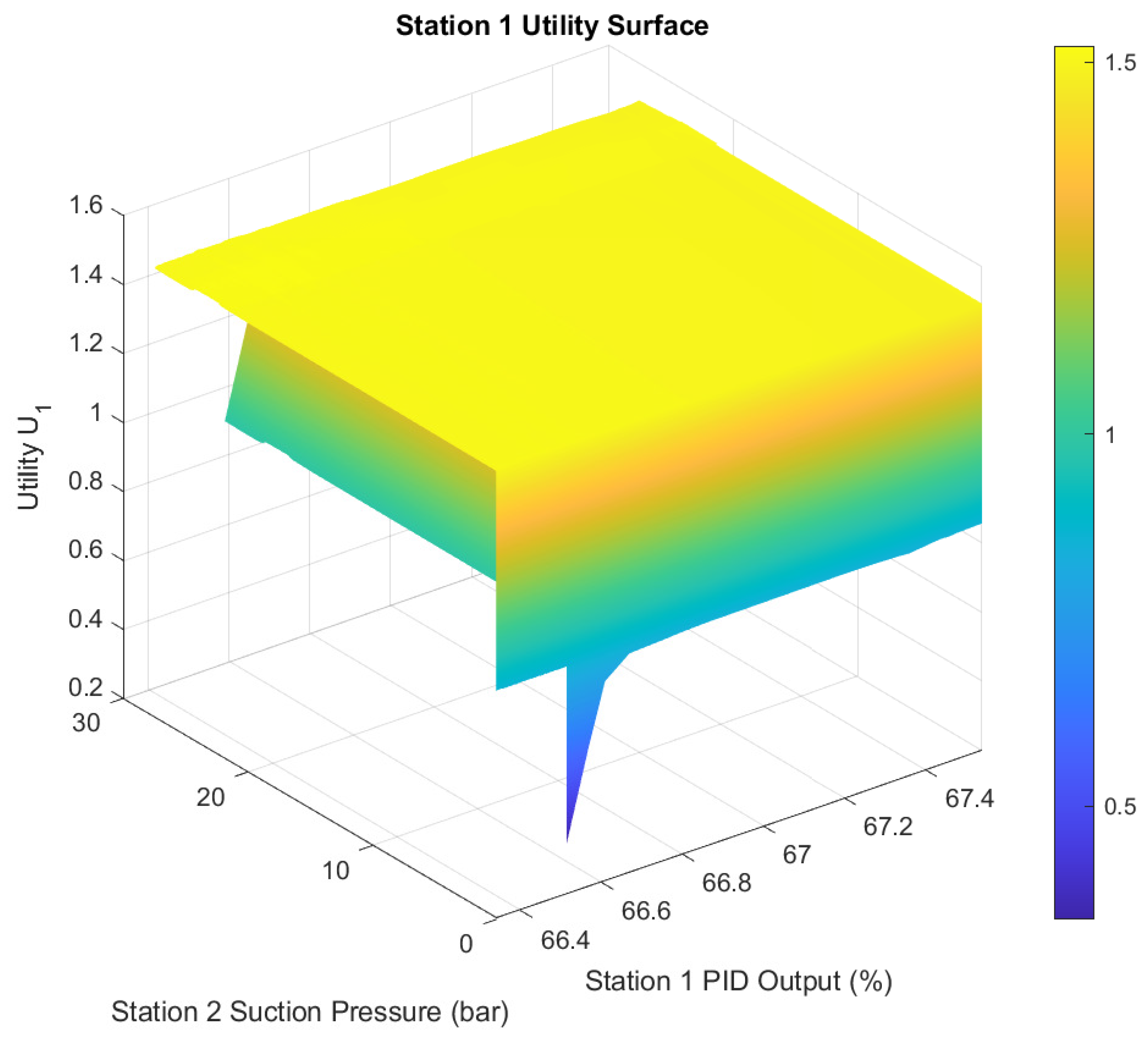
Reaction functions serve as a useful diagnostic and interpretive tool for understanding the strategic interaction between neighboring stations within the proposed iterative game-theoretic coordination framework. A reaction function describes how the preferred control action of one station changes in response to the operating condition of another station, assuming all other stations remain fixed.
For two interacting stations
i and
j, the reaction function of station
i is defined as
where
denotes the local actuator input of station
i (e.g., pump speed or valve position),
represents the neighboring station’s control action, and
is the station-level utility function.
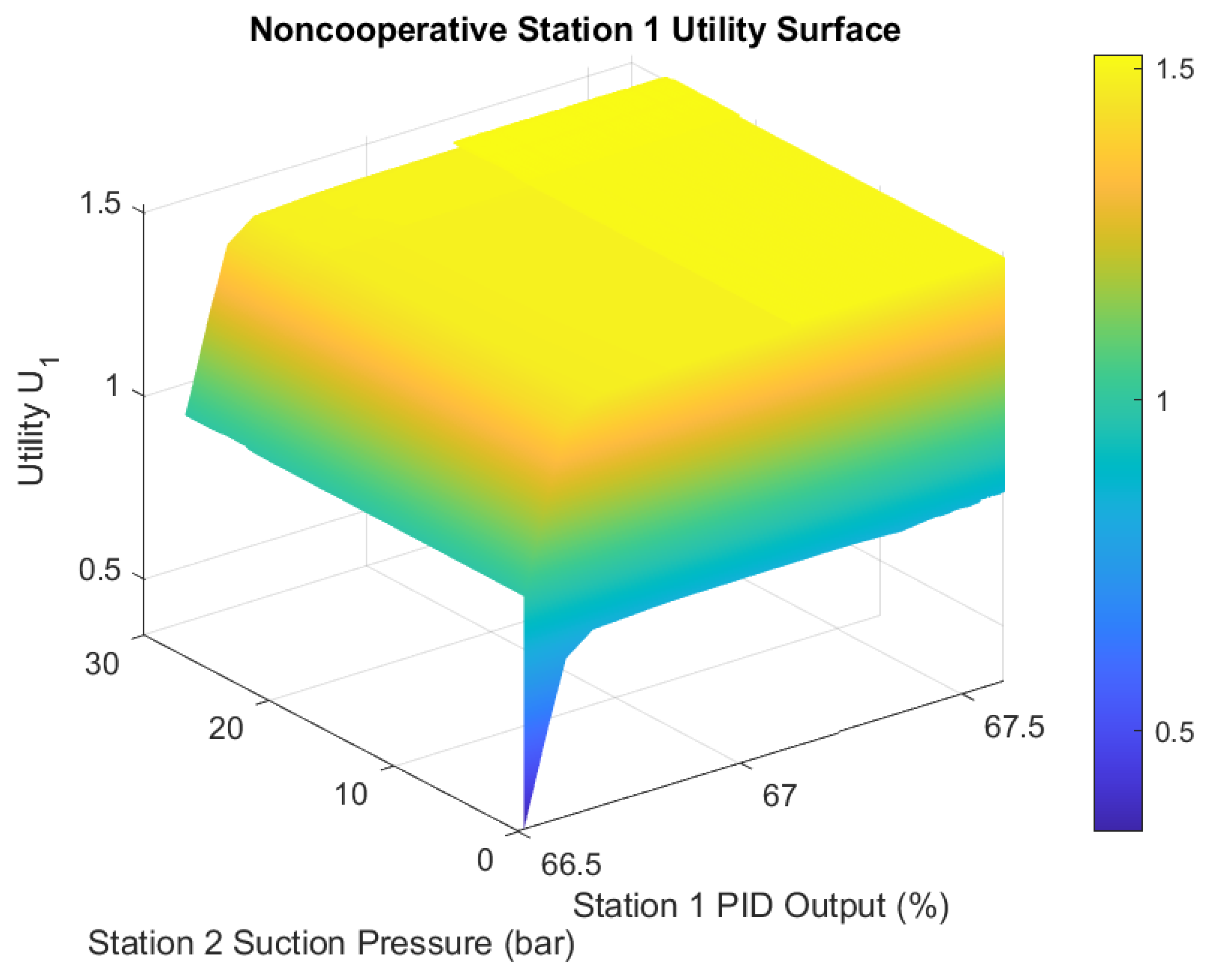
In the proposed framework, reaction functions are not used directly for online control. Instead, they provide a supervisory and diagnostic interpretation of the equilibrium-seeking behavior produced by the iterative negotiation algorithm. Specifically, reaction functions are used to assess the strength and direction of hydraulic coupling between neighboring stations, visualize cooperative and non-cooperative operating behavior, verify that local utility functions are smooth and well-posed, and identify the existence and location of equilibrium operating points.
From a physical perspective, the reaction functions emerge from the hydraulic coupling between discharge pressure, suction pressure, flow rate, and valve throttling losses along the pipeline. For example, the utility of a downstream valve station generally increases as upstream discharge pressure decreases because lower suction pressure allows the valve to remain more open, thereby reducing throttling losses. Conversely, excessive upstream pump discharge pressure increases downstream suction pressure and may force downstream valves toward more restrictive operating conditions. As a result, upstream and downstream stations naturally develop coupled reaction behavior through the shared hydraulic network.
In the non-cooperative case, each station evaluates only its local utility function. The resulting reaction curves, therefore, ignore downstream hydraulic consequences and generally intersect at operating points associated with increased valve throttling and higher overall energy usage. Under cooperative communication conditions, the utility functions include coupling terms with neighboring stations, thereby shifting the reaction curves toward operating points that reduce suction-pressure imbalance and distribute hydraulic head more efficiently throughout the pipeline.
The iterative negotiation framework approximates movement along these reaction functions without explicitly evaluating all possible strategy combinations. At each negotiation step, only the active station updates its supervisory setpoint according to the observed utility variation
If , the station continues adjusting its supervisory setpoint in the same direction. If , the adjustment is reversed, damped, or terminated according to the bounded negotiation rules. The lower-level pressure and flow controllers continue regulating the physical process while the supervisory game layer evaluates the resulting quasi-steady hydraulic response.
A Nash equilibrium corresponds to an intersection of the local reaction functions in the non-cooperative case, where no station can improve its utility through unilateral deviation. Under cooperative communication conditions, the coupled utility functions instead drive the system toward Pareto-stationary operating points in which further improvement for one station would negatively affect neighboring stations.
For larger multi-station pipeline systems, each station’s reaction behavior depends primarily on neighboring stations because hydraulic coupling is strongest between adjacent suction and discharge nodes. The communication-aware grouping mechanism, therefore, allows equilibrium behavior to emerge locally within connected communication components while remaining scalable to larger distributed pipeline networks.
Overall, the reaction-function interpretation provides a physically intuitive explanation for the equilibrium behavior observed in the simulations and reinforces the connection between the hydraulic dynamics and the proposed communication-aware game-theoretic coordination strategy.
4. Supervisory Coordination Algorithm
The hierarchical coordination layer developed in this work extends the adaptive, reinforcement-based station controllers of [
12,
13] into a distributed, communication-aware game-theoretic framework. Each pump or valve station is modeled as a rational agent that solves a local optimization problem while accounting for hydraulic interactions with neighboring stations. The proposed approach eliminates the need for a centralized optimizer and enables scalable, fault-tolerant coordination under varying communication conditions.
4.1. Coordination Algorithm
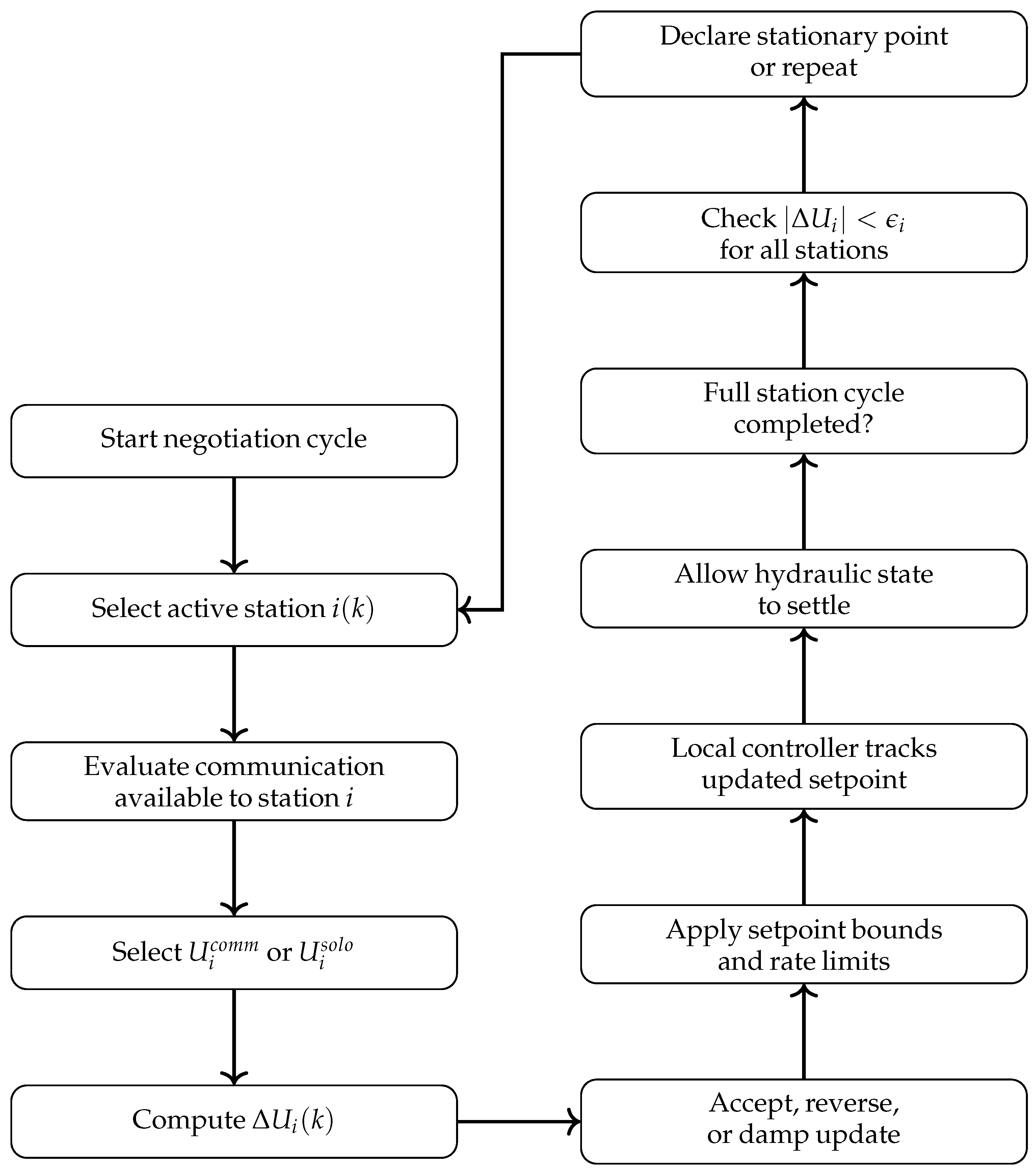
The supervisory coordination layer,
Figure 2, operates above the local station pressure and flow controllers and updates station setpoints at a slower negotiation interval. Unlike centralized optimization or exhaustive enumeration of strategies, the proposed method employs a sequential utility-based update process. At each negotiation step, one station acts as the active player, evaluates the effect of a bounded setpoint adjustment, and accepts the adjustment only if it improves the station utility defined in
Section 3.
Let
denote the active station at negotiation step
k. For a network of
stations, the active player is selected sequentially according to
At the beginning of each negotiation interval, the communication status is evaluated using the communication matrix . If valid neighbor information is available, the active station evaluates the cooperative utility . If communication is unavailable or stale, the station evaluates the local non-cooperative utility . In both cases, the update logic is expressed in terms of utility improvement rather than explicit cost minimization.
The active station computes the change in utility
where
is selected according to the current communication state. If
, the previous setpoint adjustment is considered beneficial and the station continues to update in the same direction. If
, the adjustment is rejected, reversed, or damped according to the bounded update rule. The supervisory setpoint is updated as
where
denotes the current update direction,
is the bounded setpoint step, and
enforces the admissible actuator or setpoint limits. To prevent abrupt supervisory action, the setpoint change is constrained by
and by the operator-defined supervisory authority window
After the active station updates its setpoint, the local pressure and flow controllers regulate the physical process to the new operating condition. The next station then evaluates its utility after the hydraulic state has settled sufficiently. This turn-based structure avoids simultaneous large setpoint changes and allows each station to observe the hydraulic consequences of the preceding station’s action.
The iterative process is considered converged when every station satisfies
over one complete negotiation cycle. In the non-cooperative case, this condition indicates that no station can improve its local utility through a unilateral bounded adjustment. Under cooperative communication, the same condition indicates convergence to a Pareto-stationary operating point with respect to the coupled utility formulation.
At the beginning of each negotiation interval, the active station evaluates the communication topology previously defined in
Section 3. Communication availability determines whether the station evaluates the cooperative utility formulation using neighboring hydraulic information or reverts to the local non-cooperative utility formulation when communication is unavailable.
4.2. Existence of Equilibrium and Convergence Considerations
The proposed coordination framework is formulated as a repeated strategic game in which each station iteratively updates its local actuator setpoint according to a communication-aware utility function. Because the framework operates using sequential local updates rather than centralized optimization, it is useful to clarify the conditions under which equilibrium points exist and discuss the practical convergence properties of the proposed negotiation process.
For a fixed communication topology, each station operates over a bounded actuator domain
where the admissible strategy set is compact and constrained by local safety limits. Because the station utility functions are continuous with respect to actuator position and hydraulic states, the resulting finite-player game satisfies the standard existence conditions for at least one equilibrium operating point under fixed network topology [
8].
The uniqueness of equilibrium is not guaranteed in the general case, since the hydraulic coupling strength depends on station spacing, pipeline resistance, and actuator configuration. However, when the local reaction functions remain monotonic over the admissible operating region and hydraulic coupling between neighboring stations remains sufficiently weak, the sequential best-response process empirically converges toward locally stable stationary operating points under the simulated hydraulic conditions considered in this study. Formal proof of global convergence for arbitrary hydraulic topologies and time-varying communication graphs remains an open problem and is left for future work.
4.2.1. Compact Strategy Spaces
For each station
, the admissible actuator set is assumed to be compact and bounded:
where the bounds correspond to physical actuator limits such as minimum and maximum pump speed or valve opening.
The overall joint strategy space is therefore
which is compact and nonempty.
4.2.2. Continuity of Utility Functions
The station utility functions are defined as continuous combinations of local control performance and hydraulic coupling terms. For station
i, the utility function depends on actuator position, local pressure conditions, and the downstream hydraulic response. Because the underlying hydraulic relationships developed in
Section 2 are continuous with respect to actuator position within the admissible operating range, the resulting utility function
remains continuous over the compact joint strategy space. The continuity of the utility functions ensures that small actuator adjustments produce correspondingly small changes in hydraulic state and utility, allowing the iterative negotiation process to evolve smoothly toward stationary operating points under a fixed communication topology.
4.2.3. Sequential Best-Response Interpretation
The proposed negotiation algorithm operates as a sequential best-response process in which stations iteratively update local setpoints according to observed changes in utility:
At each negotiation step, only one station adjusts its actuator setpoint while neighboring stations temporarily maintain their previously accepted operating points. The resulting hydraulic state is then allowed to settle before the next utility evaluation is performed. This update structure approximates a damped local best-response iteration while avoiding exhaustive enumeration of all joint strategy combinations.
4.2.4. Convergence Considerations
For discrete actuator resolutions and bounded update steps, the sequential negotiation process empirically converges to stationary operating points satisfying
where
is a prescribed equilibrium tolerance.
In the non-cooperative case, the resulting stationary point corresponds to a Nash equilibrium in the sense that no station can improve its local utility through unilateral deviation within the admissible update resolution. While under cooperative communication conditions, the coupled utility formulation shifts the equilibrium toward operating points with reduced throttling losses and improved pressure balancing.
The present work does not claim universal global convergence guarantees for arbitrary hydraulic topologies, communication delays, or utility-weight selections. Instead, the framework is intended as a practical supervisory coordination strategy whose convergence behavior depends on bounded hydraulic coupling, sufficiently slow negotiation updates, and physically reasonable utility weighting factors.
4.3. Comparison with Distributed Model Predictive Control
Distributed Model Predictive Control (DMPC) has emerged as a widely studied framework for coordinating interconnected industrial systems, including process plants, water distribution networks, and energy transport infrastructure [
22,
23]. In DMPC formulations, each subsystem solves a local constrained optimization problem while exchanging predicted future states with neighboring controllers in order to achieve globally coordinated behavior.
While DMPC provides strong theoretical guarantees for constraint handling and optimality, its practical deployment in large pipeline systems presents several challenges, particularly in long-distance transport networks, where hydraulic state estimation and optimization must be performed continuously [
24]. First, DMPC requires accurate dynamic process models and repeated online solution of constrained optimization problems at each control interval [
25]. For geographically distributed pipeline systems, this introduces a substantial computational burden and increases dependence on deterministic communication infrastructure.
In contrast, the proposed game-theoretic coordination framework is intentionally designed as a lightweight supervisory coordination layer operating above existing local station controllers. Rather than solving repeated constrained optimization problems, stations iteratively adjust local setpoints based on observed utility variations and neighboring hydraulic interactions. This substantially reduces online computational requirements and eliminates the need for centralized optimization servers.
A second distinction concerns communication requirements. DMPC generally requires frequent exchange of predicted future trajectories or state estimates between controllers [
26]. The proposed framework exchanges only a limited set of neighboring hydraulic measurements, including suction pressure, discharge pressure, and communication validity status. This reduced communication burden improves fault tolerance under intermittent network degradation.
From an industrial deployment perspective, the proposed framework is intended for implementation within existing PLC and SCADA architectures commonly used in pipeline systems. Although DMPC may provide stronger optimality guarantees under ideal communication conditions, the proposed iterative game-theoretic approach prioritizes scalability, robustness to communication loss, and compatibility with existing industrial control infrastructure.
This tradeoff can therefore be summarized as follows: DMPC emphasizes global optimality under strong model assumptions, while the proposed framework emphasizes distributed deployability, computational simplicity, and graceful degradation under uncertain communication conditions.
Table 3.
A practical advantage of the proposed framework is computational simplicity. For a pipeline containing N stations, each negotiation cycle requires only local hydraulic evaluation and utility computation for the active station. Computational complexity therefore scales approximately linearly with the number of participating stations, compared to DMPC formulations, which typically require repeated constrained optimization and matrix inversion, whose complexity grows significantly with system dimension and prediction horizon. This computational efficiency makes the proposed framework suitable for direct implementation on industrial PLC hardware with limited processing resources.
4.4. Practical Industrial Deployment
The proposed coordination layer is intended for deployment within existing industrial automation architectures. Communication between stations may be implemented using standard industrial protocols, including OPC UA, EtherNet/IP, or Modbus TCP. Because the supervisory negotiation interval operates on the order of 30 s, communication latency on the order of several hundred milliseconds has negligible impact on equilibrium formation.
4.5. Dynamic Communication and Group Partitioning
The communication matrix is updated in real time using network diagnostics, packet age monitoring, and link-quality indicators. The connected components of define temporary coalition groups, each of which plays an independent subgame.
Cooperative subgame: Stations within a connected communication component exchange hydraulic state information and iteratively converge to a Pareto-stationary point with respect to the coupled objectives .
Non-cooperative subgame: Stations isolated by communication degradation or confirmed communication loss revert to minimizing their local objective using only locally available measurements.
In practical industrial communication networks, packet delays, temporary jitter, and stale measurements may occur without complete communication failure. Consequently, communication availability is not treated as an instantaneous binary transition. Instead, each station maintains a communication-validity timer associated with neighboring measurements. Let
denote the age of the most recently received measurement from neighboring station
j to station
i.
If
the received information is considered sufficiently recent for cooperative utility evaluation. If the communication age exceeds the allowable threshold
for longer than a prescribed timeout interval, the communication link is declared degraded or unavailable, and the affected stations transition to the non-cooperative utility formulation.
To preserve operational safety during communication degradation, the supervisory game layer is constrained to modify local controller setpoints only within bounded limits around the operator-defined nominal setpoint:
where
is the operator-entered reference operating point and
is the maximum allowable supervisory adjustment.
Similarly, the negotiation update rate is bounded according to
where
limits the magnitude of individual supervisory setpoint changes between negotiation intervals.
These bounded supervisory constraints ensure that even if stale downstream measurements are temporarily used before communication loss is confirmed, the resulting setpoint adjustments remain limited and cannot drive the pipeline toward unsafe operating conditions. The lower-level pressure and flow controllers continue enforcing local safety constraints, actuator saturation limits, and protective interlocks independently of the communication state.
Changes in communication topology trigger graceful regrouping rather than abrupt mode switching. Cooperative behavior progressively degrades into localized optimization while preserving hydraulic stability, bounded pressure regulation, and safe actuator operation throughout the transition.
4.6. Practical Deployment Considerations
Although the proposed coordination framework has been evaluated in simulation, the architecture was intentionally designed around practical industrial pipeline control systems commonly deployed in field operations. In typical pipeline installations, each pump station is controlled by a local Programmable Logic Controller (PLC) responsible for pressure regulation, flow control, actuator protection, and emergency shutdown logic. Supervisory monitoring and higher-level coordination are commonly handled through SCADA systems communicating over industrial Ethernet, fiber-optic networks, or wide-area telemetry systems.
The proposed game-theoretic coordination layer operates at a supervisory timescale above the local regulatory control loops. Local pressure controllers continue to operate independently at high sampling rates, while the coordination layer periodically adjusts bounded supervisory setpoints based on inter-station utility evaluations.
Communication between neighboring stations requires only a limited set of variables:
where
and
denote local discharge and suction pressures,
represents communication validity status, and
denotes packet age or communication timestamp.
To ensure safe operation under communication degradation, stations maintain a communication-validity timer. If the communication delay exceeds a prescribed threshold
the station automatically transitions from cooperative to non-cooperative operation using only locally available measurements.
The supervisory negotiation layer is constrained to modify operator-entered setpoints only within bounded limits
ensuring that communication errors or stale measurements cannot drive the pipeline toward unsafe operating conditions.
Because the proposed coordination algorithm relies solely on algebraic hydraulic calculations and sequential utility evaluation, the computational requirements are sufficiently low to enable direct implementation on industrial PLC hardware or edge computing devices already deployed at modern pipeline stations.
Future work will focus on a hardware-in-the-loop implementation using industrial PLC hardware and SCADA communication infrastructure to validate real-time deployment performance under realistic communication delays, packet loss, and asynchronous station updates.
4.7. Rationale for Nash Equilibrium Formulation
The supervisory coordination problem considered in this study involves multiple geographically distributed stations operating as independent decision-making agents. Each station possesses local operational objectives while simultaneously influencing the hydraulic operating conditions experienced by neighboring stations. Game-theoretic coordination was selected because it naturally represents this distributed decision structure without requiring centralized optimization or complete system-wide process models. In the absence of communication, each station independently adjusts its operating point in an attempt to maximize local utility. The resulting stationary operating condition corresponds to a Nash equilibrium, where no individual station can improve its utility through unilateral action.
When communication is available, stations incorporate downstream hydraulic effects into their utility calculations. In this cooperative setting, the iterative negotiation process no longer represents a purely non-cooperative game, and the resulting operating point approaches a Pareto-stationary solution in which stations collectively balance local and downstream objectives. The Nash framework therefore provides a natural mathematical foundation for describing how distributed industrial stations transition between independent local control and cooperative system-wide coordination as communication conditions vary over time.
5. Simulation and Case Study
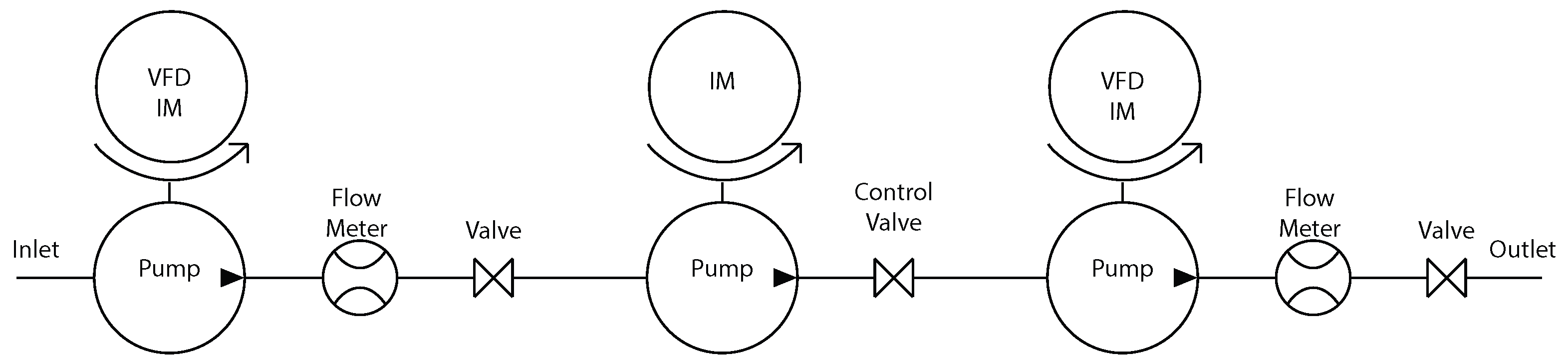
The proposed communication-aware, iterative game-theoretic coordination framework was implemented in MATLAB 2023b and evaluated using a three-station pipeline case study. The system consists of two variable-frequency drive (VFD) pump stations and one midstream fixed-speed pump with a pressure control valve (CV) connected in series. Station 1 operates as the upstream pump, Station 2 regulates its pressure using a control valve, and Station 3 serves as the downstream pump. This configuration reflects a common field topology in long-distance pipelines, where pressure regulation is achieved through a combination of a variable-speed drive or a control valve.
The objective of the simulation is to evaluate how distributed stations, acting as rational players, iteratively adjust their local setpoints to improve individual or collective utility while respecting hydraulic coupling and actuator constraints. Particular emphasis is placed on the proposed framework’s ability to converge to stable operating points under both cooperative and non-cooperative communication conditions.
5.1. Simulation Configuration
Each station is modeled using steady-state hydraulic relationships derived from pump affinity laws and simplified valve characteristics. The discharge pressure and flow rate at station
i are approximated as
where
represents the normalized actuator input. For VFD-driven pump stations,
denotes the normalized rotational speed, whereas for the control valve station, it denotes the normalized valve opening;
indicates a fully open valve.
Hydraulic losses between adjacent stations are represented using a quadratic head-loss model,
where
is the effective resistance coefficient for the pipeline segment between stations
i and
. The suction pressure at the downstream station is then computed recursively as
These steady-state relationships are intentionally simplified to reflect the slower timescale of the inter-station negotiation layer. Fast inner-loop pressure and flow regulation, including actuator limits and safety constraints, is handled by station-level controllers, which are assumed to enforce feasible operating conditions. The hydraulic model evaluates pressures, flows, and station-level utilities for a given set of actuator inputs. Rather than solving a centralized optimization problem, stations participate in an iterative game in which players update their setpoints sequentially. At each update, the change in local utility () is evaluated to determine whether further adjustment is beneficial.
Equilibrium conditions are identified when all stations, after taking turns as the active player, experience utility changes below a prescribed threshold. This local -based criterion enables rapid convergence detection without enumerating all possible strategy combinations, making the approach scalable to larger pipeline networks.
5.2. Simulation Methodology and Sensitivity Evaluation
The simulation study was designed to reflect the operating philosophy of practical long-distance pipeline systems. Initial station pressure and flow setpoints were not randomized. Instead, each simulation case was initialized with an operator-defined hydraulic schedule that satisfied the required shipper demand, the nominal flow rate, and the allowable station pressure limits.
Similarly, the negotiation sequence was not randomized. Because the stations are hydraulically coupled in series, supervisory updates were evaluated from upstream to downstream, beginning at the origin station and proceeding toward the destination station. This ordering reflects practical pipeline operation, where upstream pump actions directly influence downstream suction pressure, flow distribution, and control-valve throttling behavior.
The supervisory game layer was evaluated as a bounded coordination mechanism operating around the scheduled operating condition rather than as a replacement for operator scheduling. Each station was therefore allowed to adjust only within a limited supervisory operating window around the operator-entered reference setpoint:
where
is the scheduled operating setpoint and
is the maximum allowable supervisory adjustment.
To maintain focus on the communication-aware coordination problem, fluid density variation and batch-transition dynamics were not treated as primary sources of uncertainty in this paper. Those effects are addressed by the lower-level adaptive station controllers developed in the companion studies. In the present work, density is treated as fixed for a given scheduled operating case, while the supervisory coordination layer is evaluated primarily with respect to communication behavior and bounded negotiation dynamics.
Sensitivity studies were performed by perturbing physically meaningful supervisory-layer quantities around the scheduled operating condition. Rather than introducing unrealistic random operating points, the analysis focused on communication and supervisory control uncertainties representative of practical industrial pipeline operations. These studies examined the effects of communication delays, temporary packet loss, stale downstream pressure measurements, and partial changes to the communication topology resulting from intermittent inter-station connectivity loss. Additional sensitivity cases evaluated the influence of utility-weight selection, bounded supervisory setpoint authority, and actuator update-rate limits on the negotiation process and resulting equilibrium behavior.
For each sensitivity case, the lower-level controllers continued to regulate local pressure and flow variables, while the supervisory game layer iteratively adjusted station setpoints according to the communication-aware utility formulation. Supervisory setpoint adjustments remained bounded around the operator-defined scheduled operating point to ensure that all negotiated operating conditions remained within acceptable hydraulic and operational limits. This structure allowed the sensitivity analysis to evaluate the robustness of the communication-aware coordination layer independently of the lower-level regulatory control loops.
The performance of the proposed framework was evaluated using several operational and coordination metrics. These included total system energy consumption, average control valve opening, the number of negotiation rounds required to reach equilibrium, and the final pressure deviation from the scheduled operating targets. Additional metrics included the minimum and maximum station suction and discharge pressures observed during negotiation, as well as the system’s ability to recover from communication degradation and re-establish coordinated operation following restoration of communication links.
The proposed framework was compared against the following operating strategies:
Fixed scheduling baseline: Operator-defined static pressure setpoints without supervisory coordination.
Fully cooperative communication case: All stations exchange hydraulic information and evaluate the coupled communication-aware utility formulation. This case represents the ideal communication upper-bound operating condition for the distributed coordination framework.
Communication-aware coordination framework: Stations dynamically transition between cooperative and non-cooperative utility evaluation according to communication availability, stale-data detection, and communication timeout logic.
Non-cooperative decentralized operation: Each station optimizes only its local objective using locally available measurements.
Convergence was declared when both the utility variation and supervisory actuator updates satisfied
for all active stations over one complete negotiation cycle.
This evaluation structure preserves realistic pipeline scheduling assumptions while assessing whether the proposed communication-aware coordination framework remains stable, bounded, and operationally beneficial under practical communication degradation and supervisory-control uncertainties.
5.3. Case Study 1: Cooperative Operation
In the first case study, all three stations maintain active communication links, resulting in a fully connected communication matrix
Under this condition, all stations operate in a cooperative mode, meaning that each station incorporates information on neighboring pressures into its local utility evaluation. Rather than solving a centralized optimization problem, the stations participate in an iterative, turn-based negotiation process. At each negotiation step, a single station acts as the active player. It adjusts the setpoint of its control loop to increase utility, including both local performance and coupling terms associated with downstream stations.
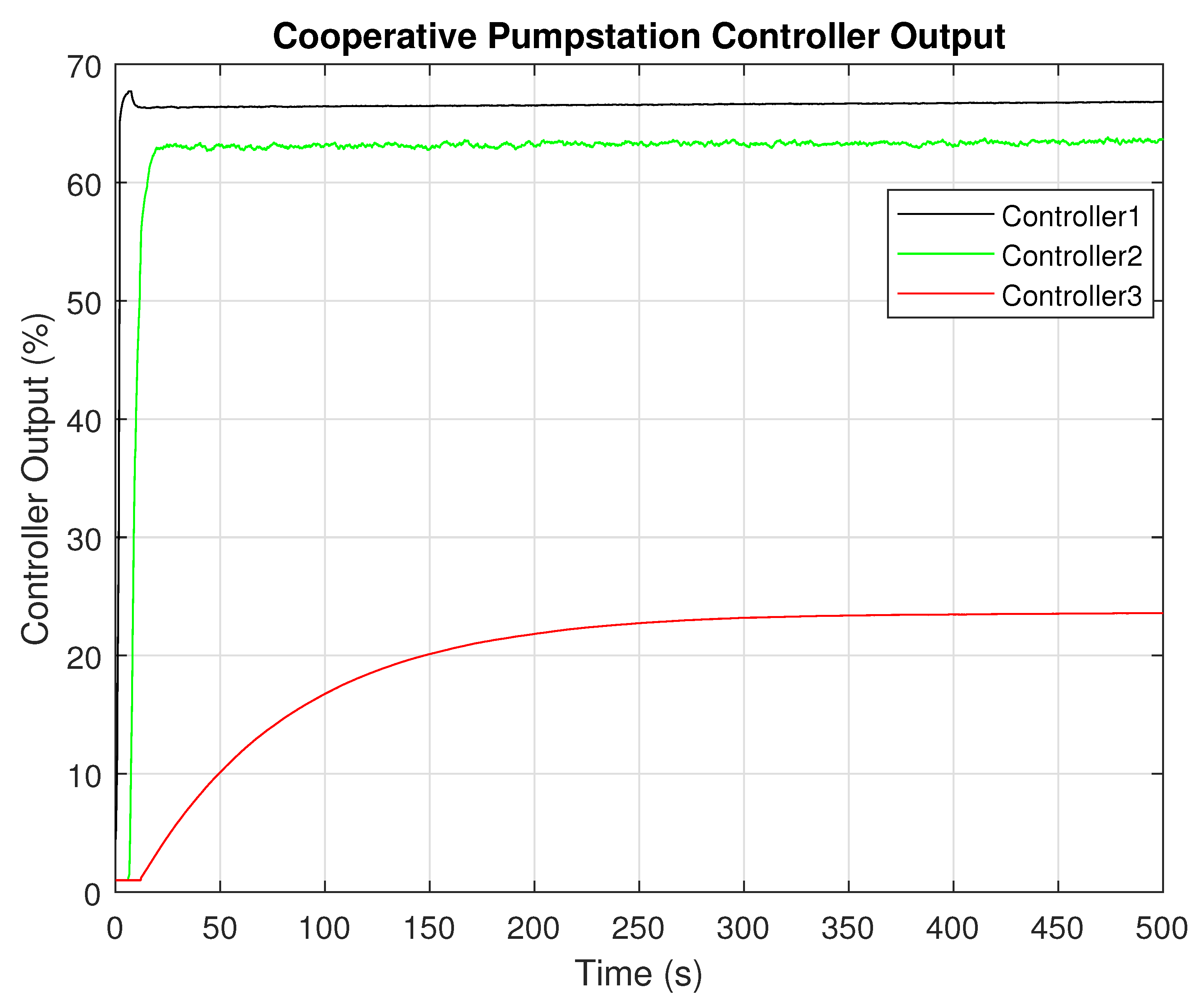
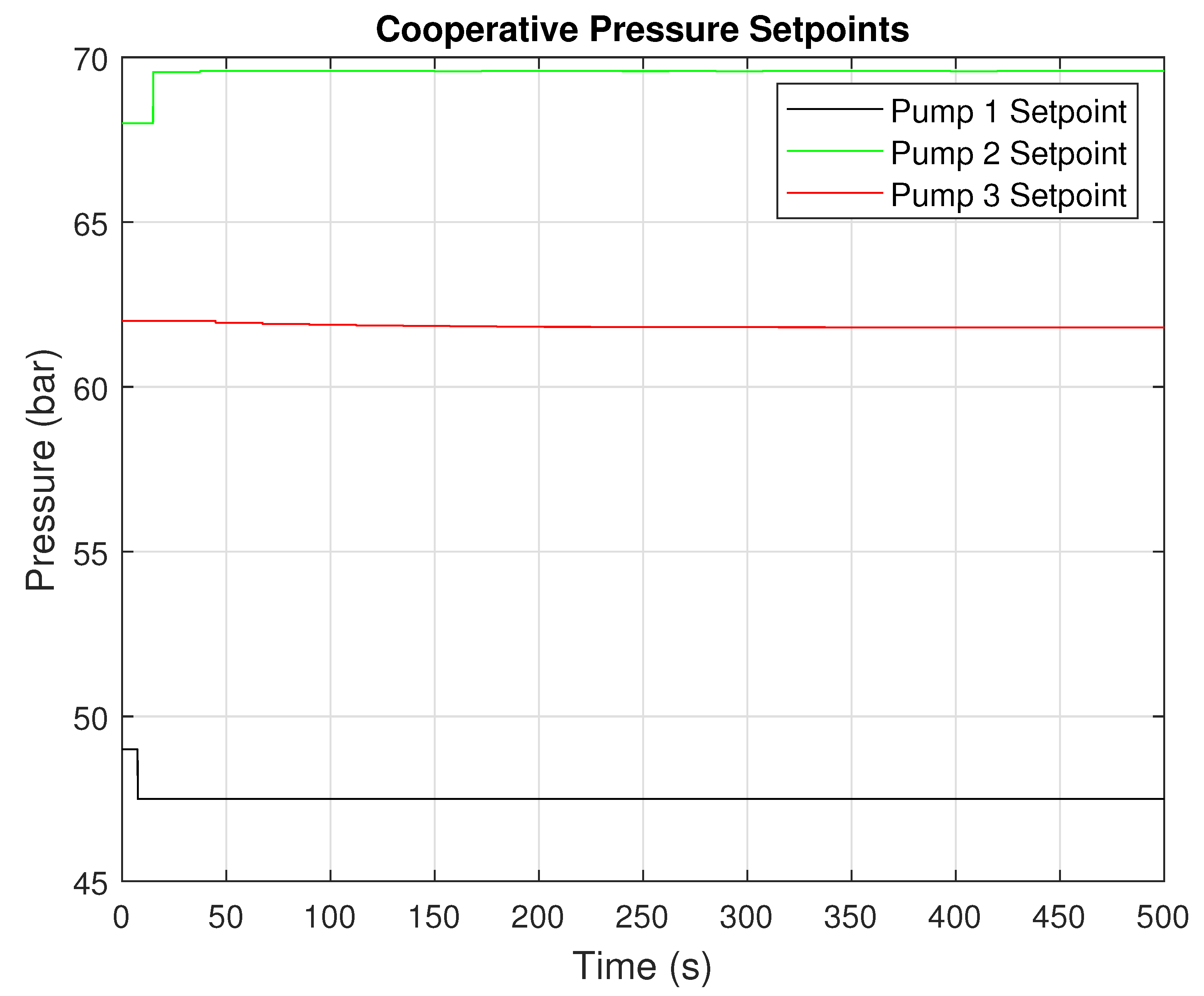
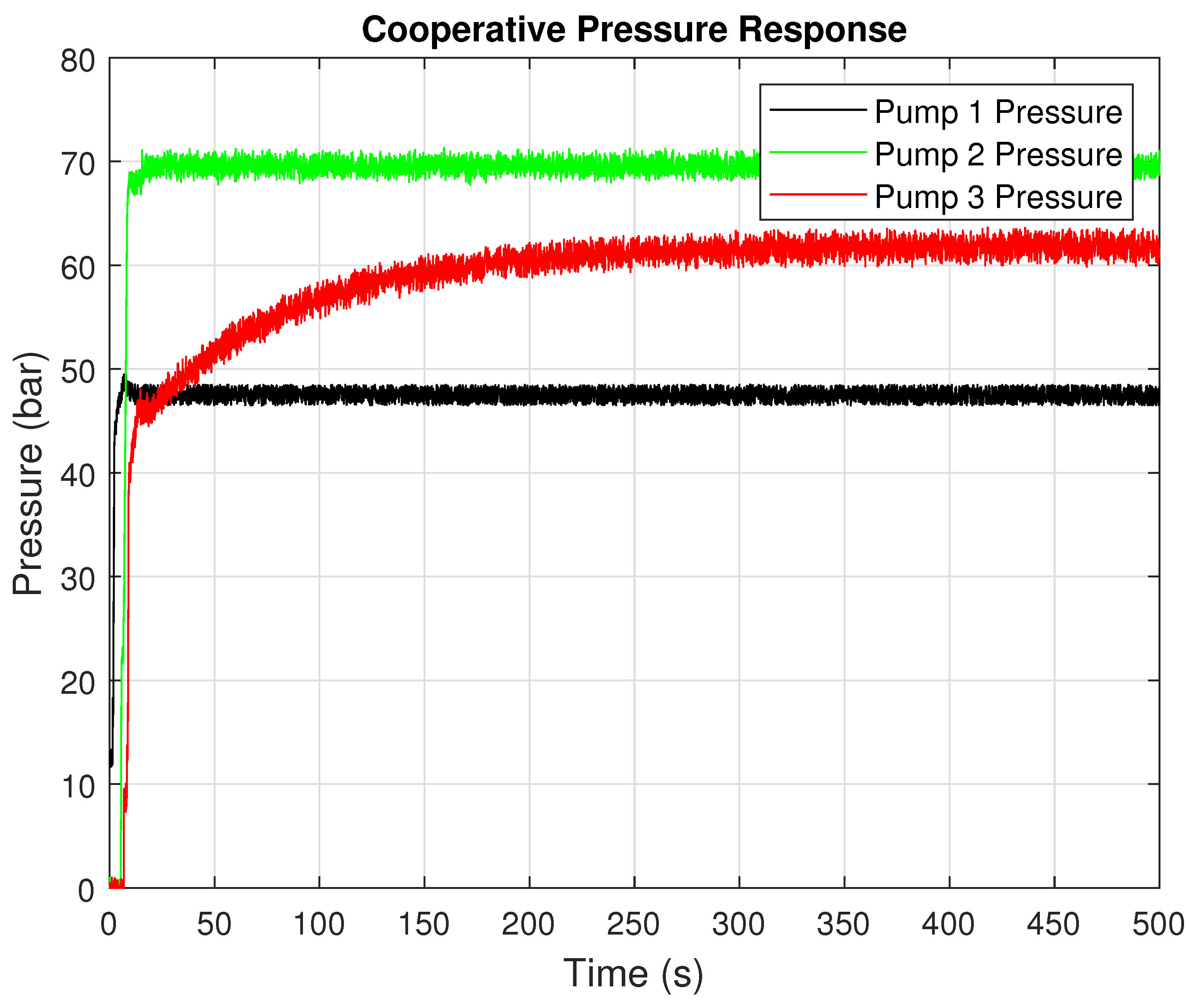
As the negotiation proceeds, Station 1 gradually reduces its setpoint and pump speed, as shown in
Figure 3 and
Figure 4, thereby lowering the discharge pressure delivered to Station 2. This reduction decreases the suction pressure at the midstream valve, as shown in
Figure 5, allowing Station 2 to increase the valve opening and reduce throttling losses. Station 3 responds by incrementally increasing pump speed to maintain its downstream pressure objectives. These adjustments occur sequentially over multiple negotiation rounds, with each station responding to the updated hydraulic state resulting from prior players’ actions.
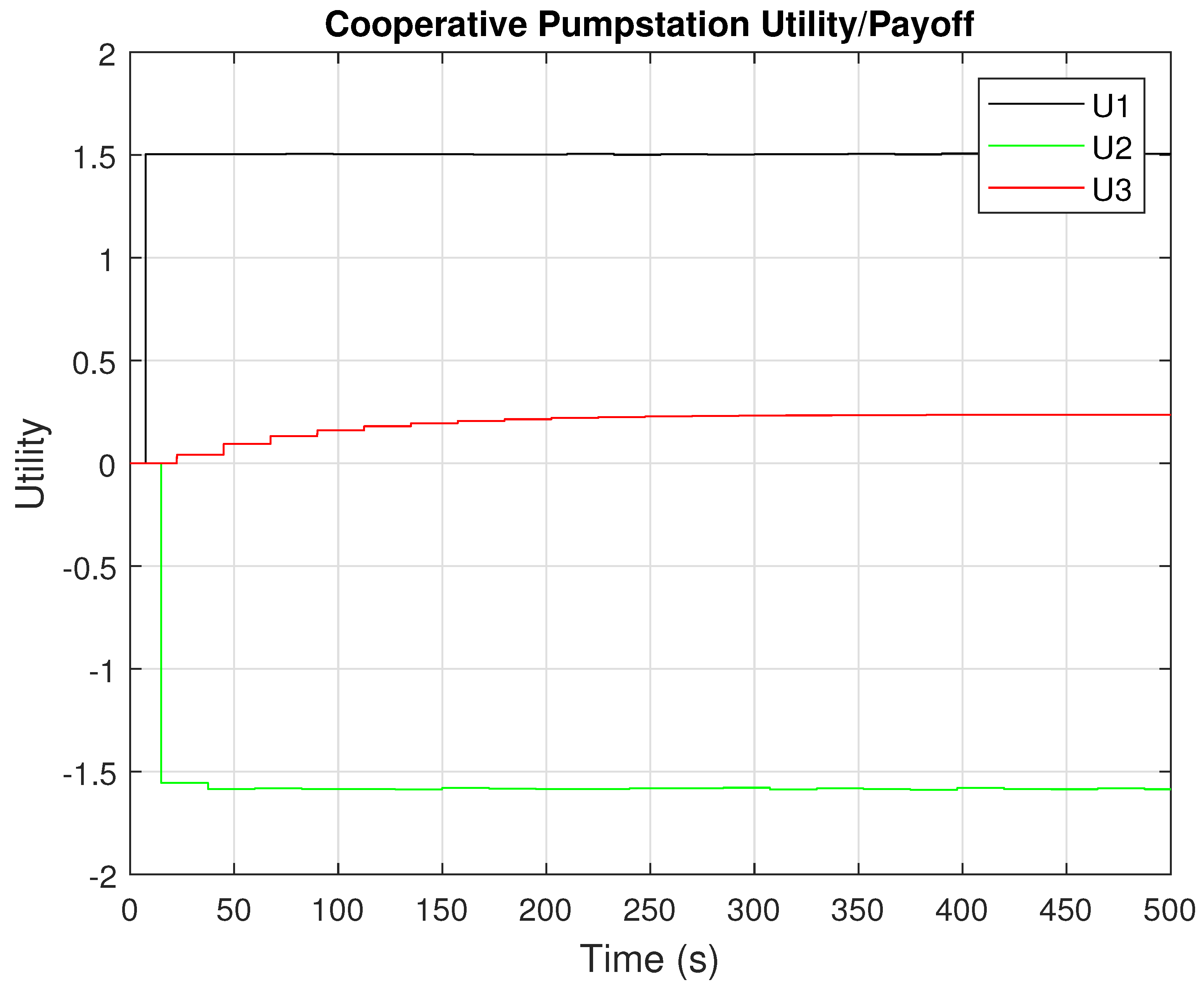
Convergence is identified when the change in utility, as shown in
Figure 6 and
Figure 7 for all stations, remains below a prescribed threshold over a complete negotiation cycle. The resulting operating point represents a Pareto-stationary cooperative solution, since all stations include neighbor-coupling information in their utility evaluations.
Figure 3 illustrates the final pressure and flow distribution, showing a more balanced head profile and reduced control valve restriction compared to non-coordinated operation.
5.4. Case Study 2: Non-Cooperative Operation
In the second case study, all three stations no longer have active communication links, resulting in an entirely disconnected communication matrix
Under this condition, all stations operate in a noncooperative mode, meaning that each station no longer incorporates information about neighboring pressures into its local utility evaluation. The stations still participate in an iterative, turn-based negotiation process. At each negotiation step, a single station acts as the active player. It adjusts the setpoint of its control loop to increase its utility, now limited to local performance.
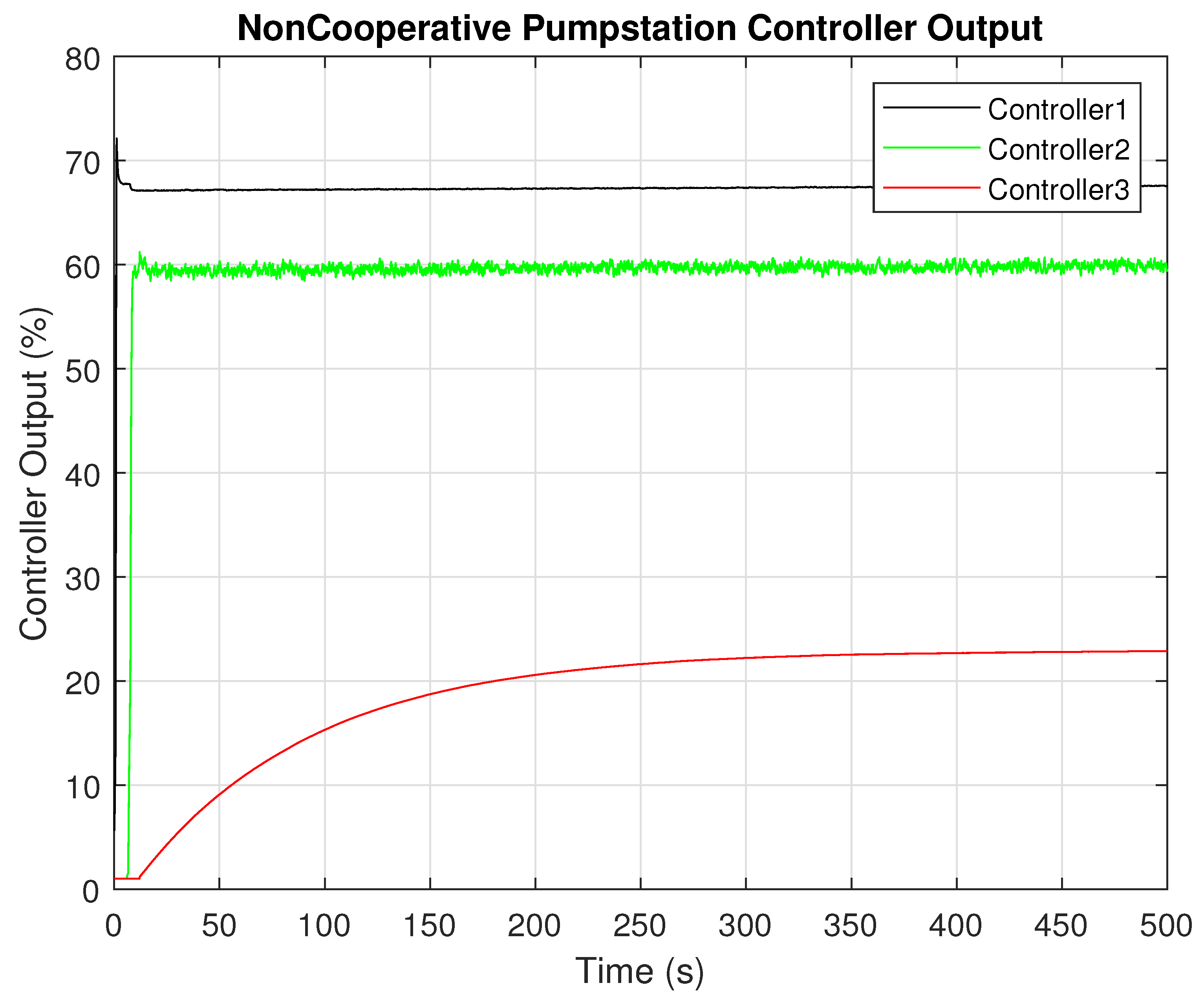
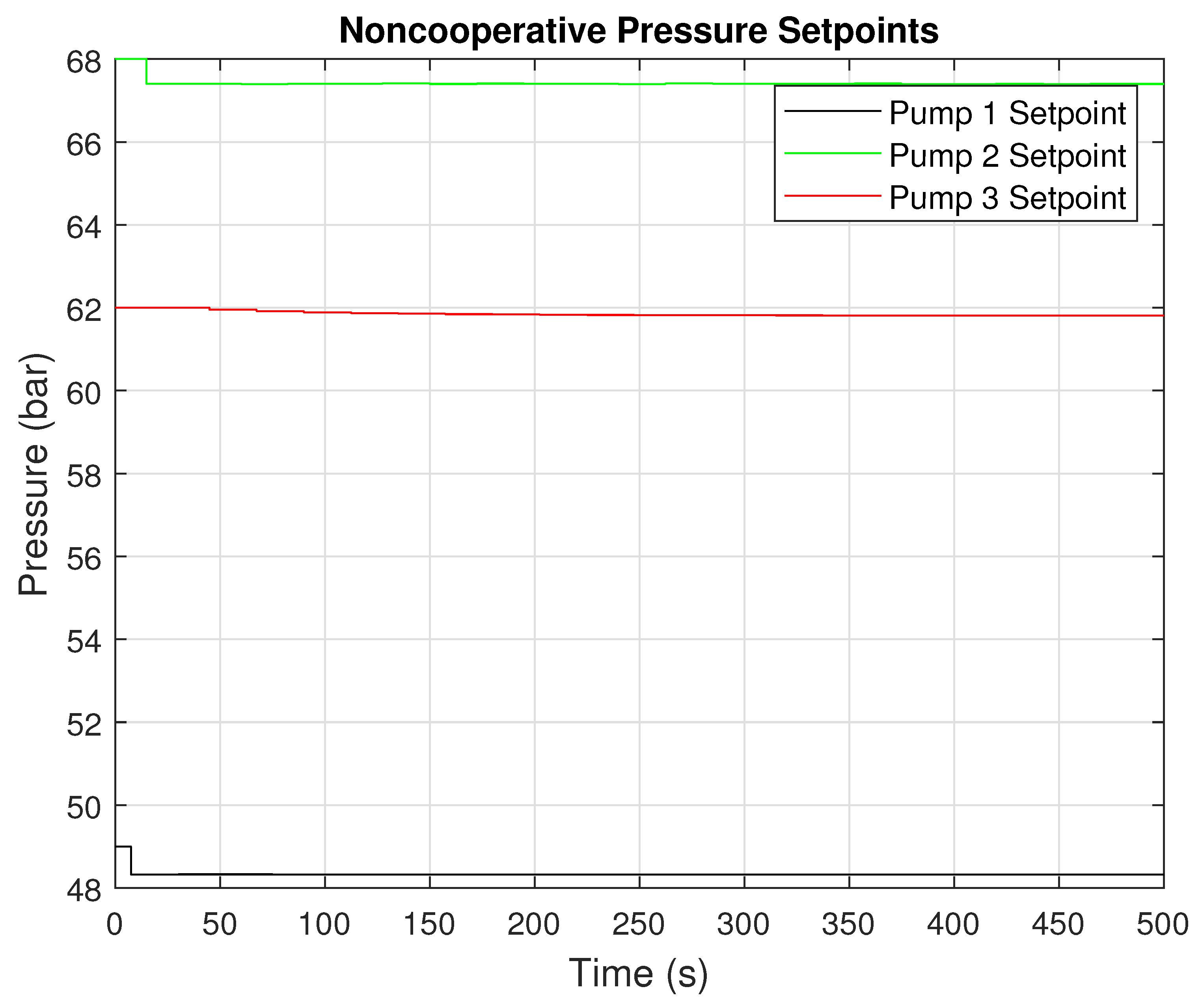
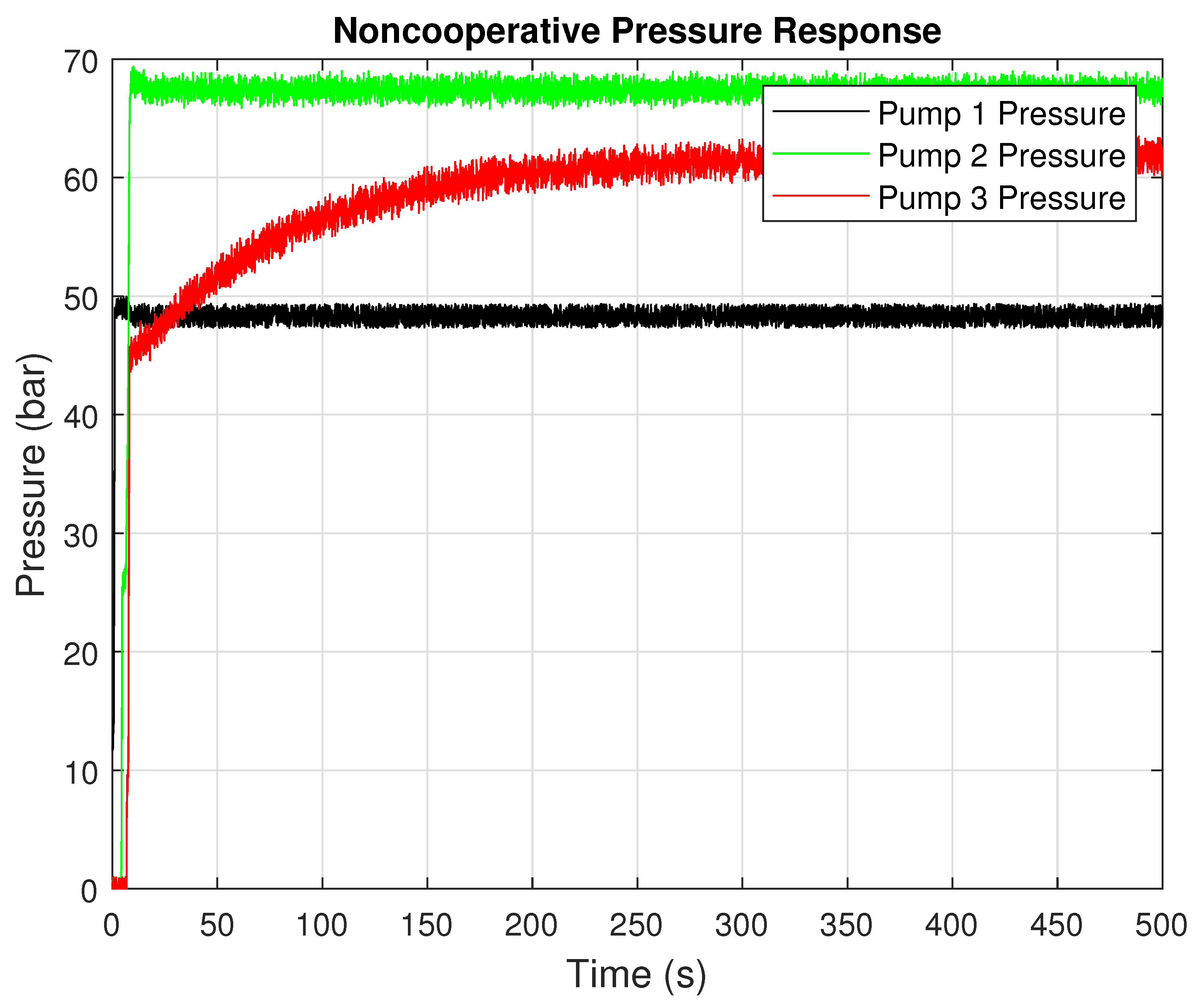
As the negotiation proceeds, Station 1 gradually increases its pump speed (
Figure 8 and
Figure 9), thereby increasing the discharge pressure delivered to Station 2 (
Figure 10). This change increases suction pressure at the midstream valve, causing Station 2 to reduce the control valve opening and increase throttling losses. Station 3 responds by incrementally increasing pump speed to maintain its downstream pressure objectives. These adjustments occur sequentially over multiple negotiation rounds, with each station responding to the updated hydraulic state resulting from prior players’ actions.
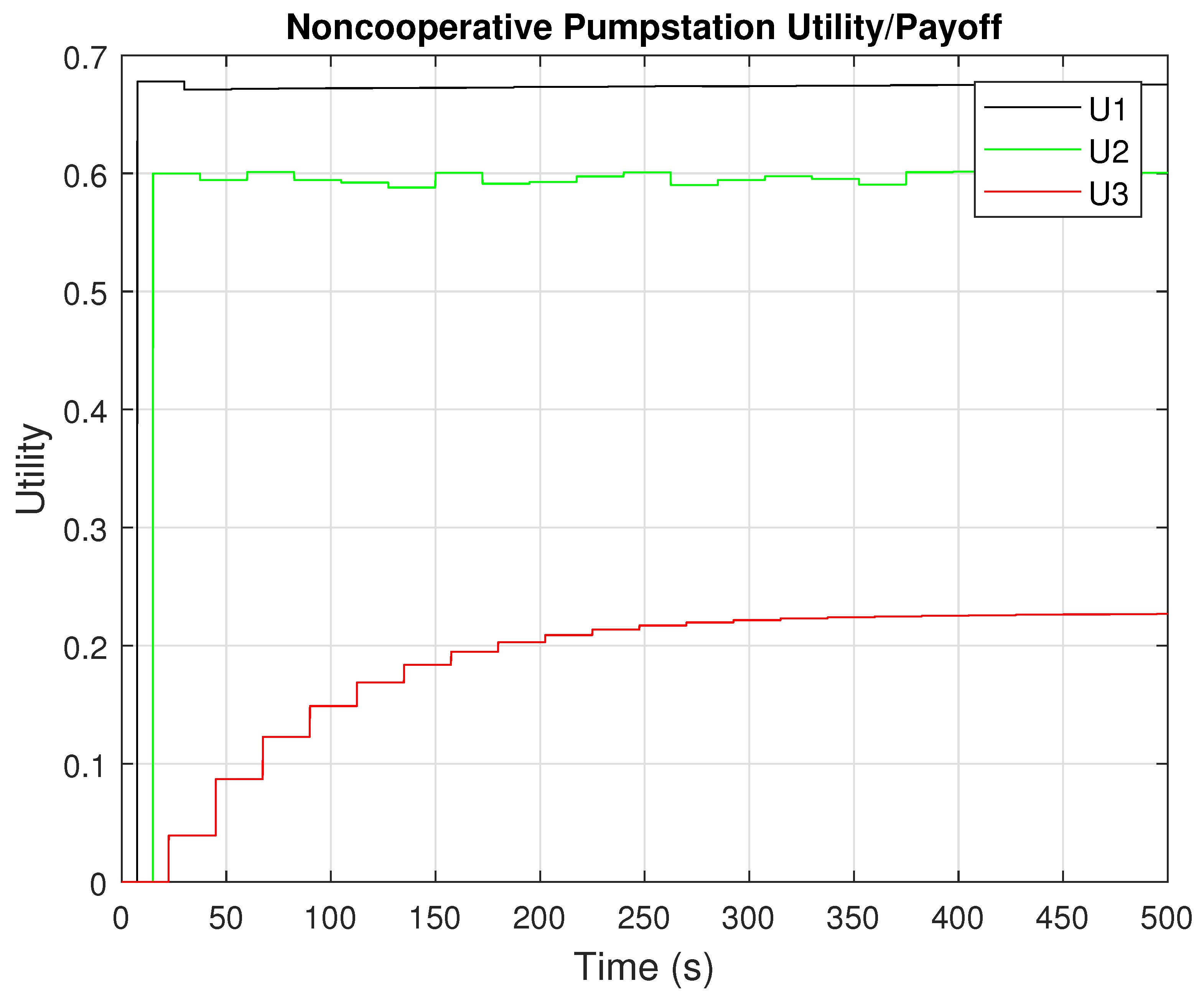
Convergence is identified when the change in utility, as shown in
Figure 11 and
Figure 12 for all stations, remains below a prescribed threshold over a complete negotiation cycle. The resulting operating point represents a non-cooperative Nash equilibrium in which no station can further improve its utility through unilateral adjustment.
Figure 8 illustrates the final pressure and flow distribution, showing a more balanced head profile and reduced control valve restriction compared to non-coordinated operation.
5.5. Case Study 3: Partial Communication Loss
In the third case study, a partial communication loss is introduced by severing the link between the origin station (Station 1) and the downstream pump (Station 2), yielding the communication matrix
This communication topology partitions the system into two distinct interaction regimes: a cooperative subgame between Stations 2 and 3, and an isolated station (Station 1) operating in a non-cooperative mode. The communication analysis layer detects the resulting connected components and assigns cooperative or local utility formulations accordingly.
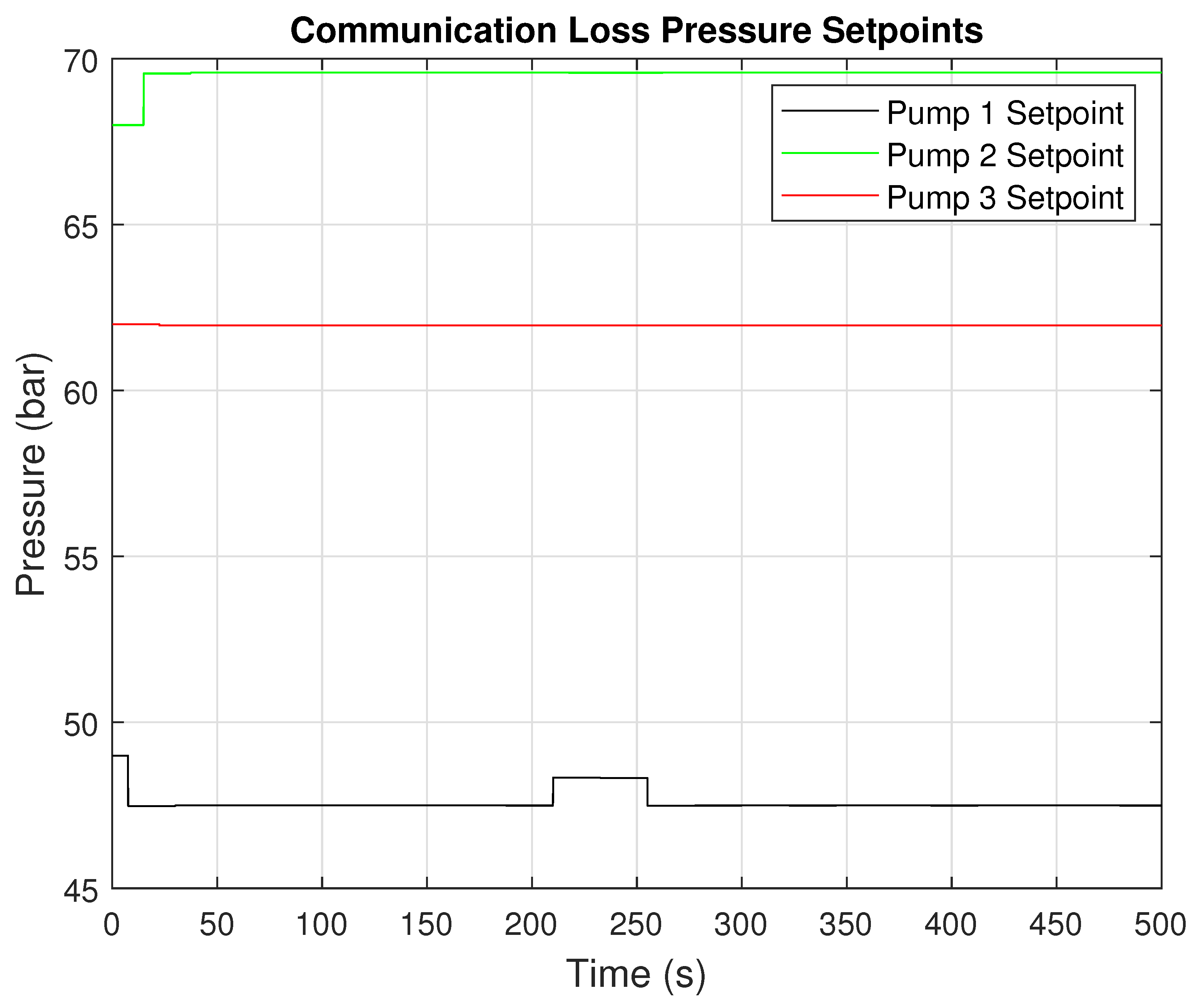
Stations 2 and 3 continue to exchange pressure information and update their setpoints through cooperative negotiation (
Figure 13 and
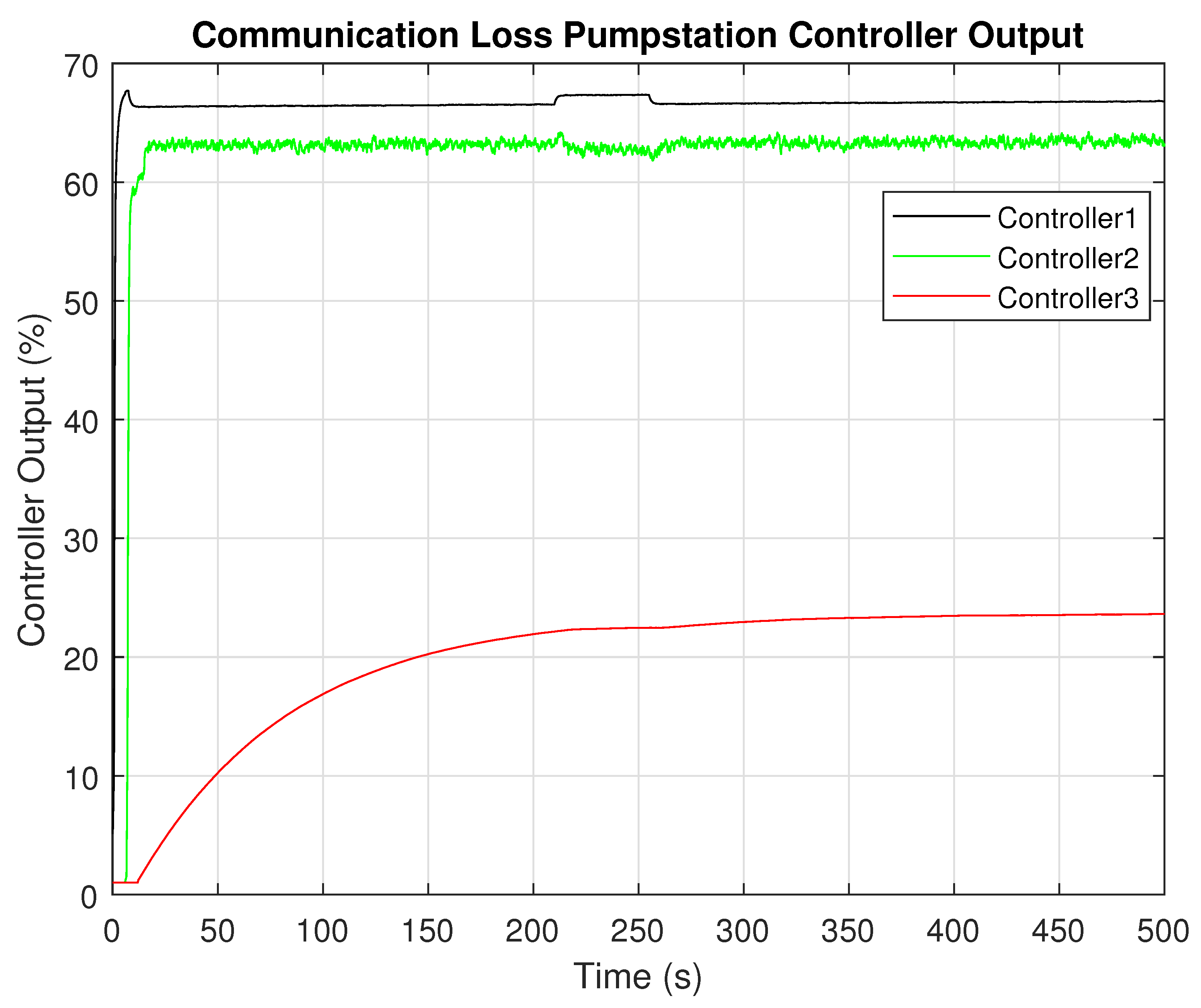
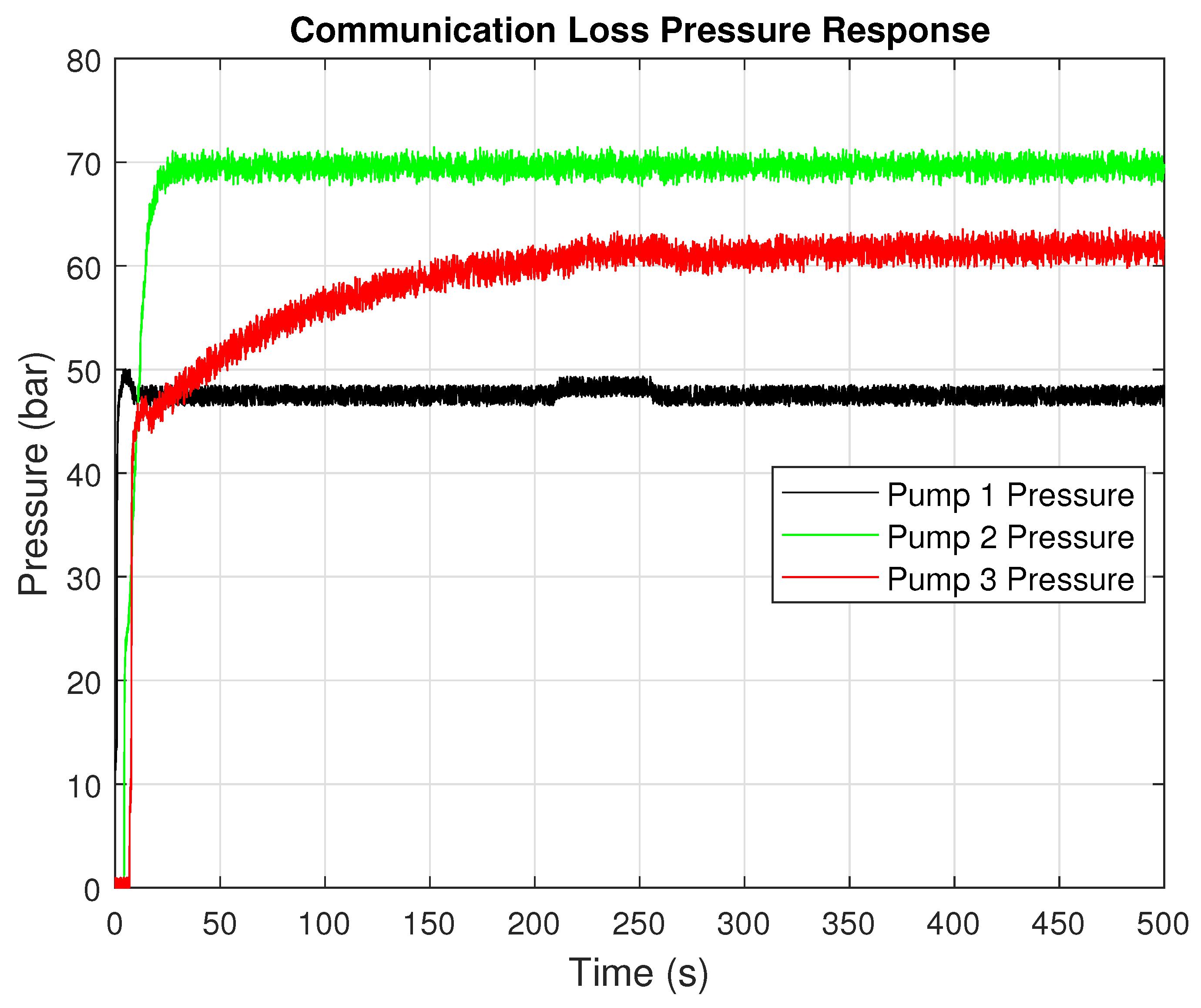
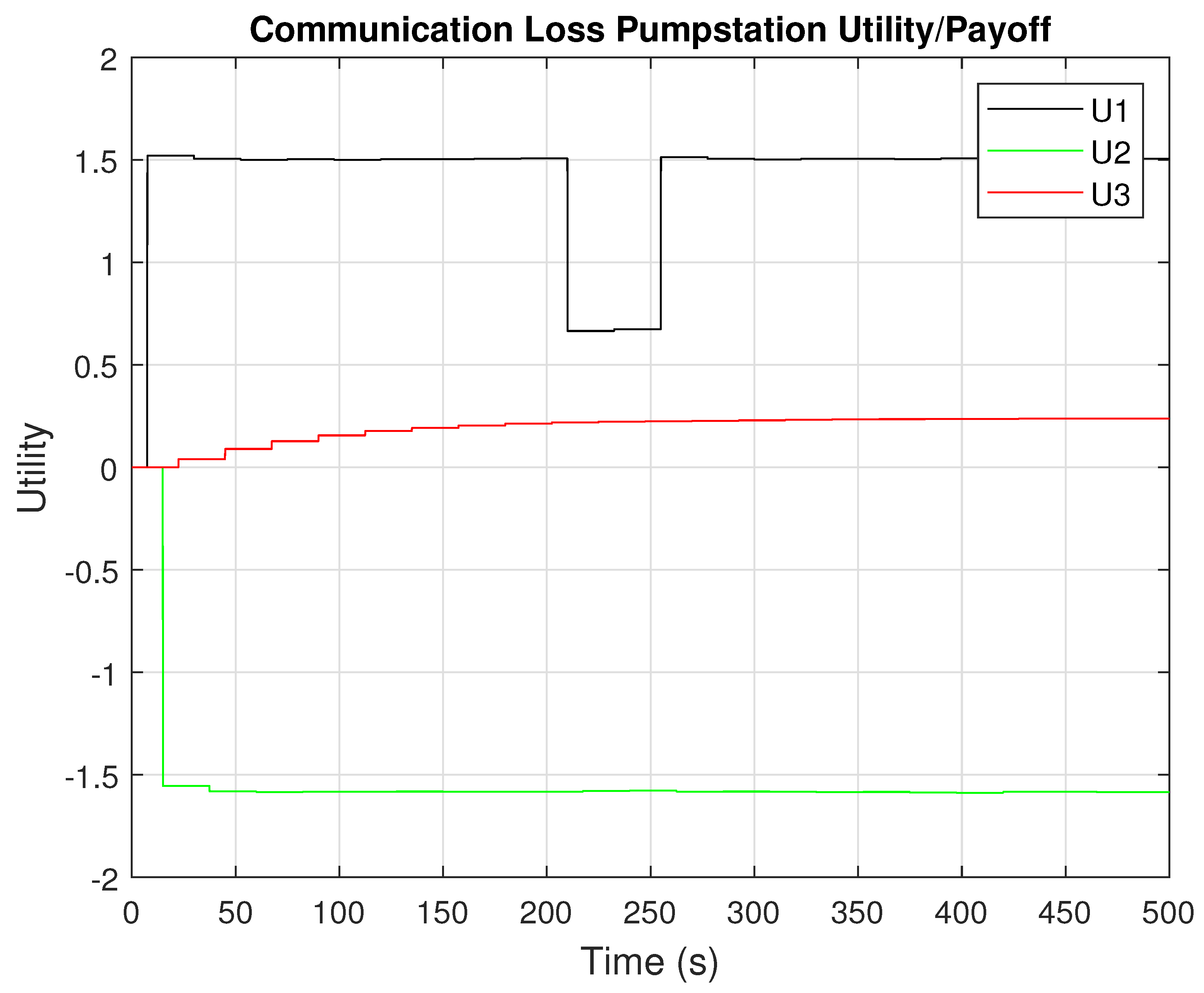
Figure 14), adjusting pump speed and valve position to reduce suction pressure at Station 3. In contrast, Station 1 no longer receives downstream suction pressure information at t = 200 s and therefore evaluates its utility solely based on local control objectives. Its setpoint updates are determined independently and do not explicitly account for downstream coupling effects, which in turn causes an increase in the control valve throttling at Station 2,
Figure 15. Once communication is restored at t = 250 s, Station 1 reverts to determining its utility based on local and Station 2 suction information.
Despite the loss of coordination between Stations 1 and 2, the iterative game converges to a stable operating point, as shown in
Figure 16 and
Figure 17. A modest increase in suction pressure at Station 3 is observed relative to the fully cooperative case; however, all stations remain in safe operation and maintain stable control performance. This case study demonstrates the robustness of the proposed framework to communication failures, as cooperative behavior gracefully degrades into localized optimization without destabilizing the overall pipeline.
5.6. Summary of Results
Across all simulation scenarios (
Table 4), the proposed game-theoretic coordination layer consistently demonstrated robust and adaptive behavior in managing interactions between heterogeneous pump and valve stations. The iterative negotiation mechanism reliably converged to stable operating points and consistent behavior, enabling effective coordination among mixed actuators, including VFD-driven pumps and midstream control valves. System stability was preserved under both full and partial communication availability. When communication links were lost, affected stations seamlessly reverted to local, non-cooperative operation, maintaining pressure regulation and avoiding unsafe operating conditions. The framework dynamically identified and reconfigured cooperative subgames in response to changes in network connectivity, enabling coordinated behavior among communicating stations without centralized supervision. Improved energy efficiency at the system level by up to 3% through emergent behaviors, reduced throttling losses in the cooperative game by 5%, and achieved a more balanced head distribution across pump stations.
Collectively, these results confirm that the proposed distributed game-theoretic control architecture can effectively manage hydraulic coupling in multi-station pipeline systems. By relying on local utilities, minimal information exchange, and iterative negotiation rather than centralized optimization, the framework demonstrates strong potential for real-time deployment in large-scale and communication-constrained pipeline networks.
6. Results and Discussion
The simulation results demonstrate the proposed game-theoretic coordination framework’s ability to manage interactions among heterogeneous actuators in a multi-station pipeline system. Each simulation step was evaluated using the steady-state pipeline model coupled with the iterative Nash coordination layer, which dynamically identifies cooperative subgroups, evaluates station-level utilities, and updates control setpoints through sequential negotiation. Importantly, equilibrium conditions are inferred implicitly from diminishing changes in utility rather than from the explicit solution of a centralized optimization problem.
6.1. Steady-State Equilibria and Pressure Distribution
Figure 5 and
Figure 10 illustrate the steady-state pressure distribution along the pipeline for the cooperative (Case 1) and non-cooperative (Case 2) configurations. In the cooperative case, the upstream VFD (Station 1) slightly reduces its speed, lowering the suction pressure at the midstream valve station and allowing the valve (Station 2) to open further. This behavior reduces throttling losses and shifts flow regulation from the valve to the upstream pump, thereby improving energy efficiency. The downstream VFD (Station 3) compensates by increasing speed to maintain the desired delivery pressure.
This equilibrium arises directly from the structure of the coupled utility functions. Reductions in excess upstream discharge pressure simultaneously improve the local utility of Station 1 by reducing control effort and the utility of Station 2 by increasing valve openness. As a result, the best-response reactions of Stations 1 and 2 become mutually reinforcing. The system converges to a balanced pressure distribution characterized by a smoother head gradient and reduced total energy dissipation.
In contrast, under non-cooperative operation or partial communication loss, stations optimize only their local objectives. In this regime, the upstream VFD maintains a higher discharge pressure to satisfy its own setpoint without accounting for downstream consequences. The resulting increase in suction pressure at Station 2 forces the valve to throttle more aggressively, narrowing its opening and increasing energy losses. While the pipeline remains hydraulically stable, overall energy efficiency decreases by approximately 1.02% relative to the cooperative baseline, highlighting the cost of uncoordinated local optimization.
6.2. Dynamic Coordination and Communication Switching
Figure 14 shows the temporal evolution of actuator setpoints and communication topology under dynamic link switching (Case 3). When a communication failure isolates one or more stations, the coordination layer automatically partitions the network into independent sub-games, each of which is solved locally. When communication is restored, the affected stations rejoin the cooperative game and iteratively reconverge to a new equilibrium.
Crucially, equilibrium transitions remain smooth because the negotiation layer operates on incremental changes in utility rather than abrupt setpoint reassignment. Stations adjust their setpoints gradually in response to observed utility improvements, allowing continuous operation during topology changes. Transient deviations in suction pressure are damped within approximately two control cycles following a communication change, demonstrating robustness to intermittent communication disturbances.
6.3. Energy Efficiency and Valve Throttling Analysis
To quantify performance improvements, the total hydraulic power
and valve loss power
were computed for each scenario
In cooperative operation, the system achieved a 2.02% reduction in total hydraulic power and a 5.5% reduction in valve-loss power relative to the non-cooperative configuration. These improvements are directly attributable to the redistribution of hydraulic effort from throttling-based regulation toward pump-based control, which is explicitly encouraged by the cooperative utility structure.
Notably, the non-cooperative case converged more rapidly but yielded inferior energy performance, illustrating the fundamental tradeoff between convergence speed and global optimality. The cooperative equilibrium required additional negotiation iterations to reconcile coupled objectives, but yielded superior steady-state efficiency and reduced mechanical stress on valve components.
Overall, these results confirm that the proposed iterative game-theoretic coordination framework produces physically meaningful equilibria that align with engineering intuition: pumps share head more evenly, valves remain more open, and energy losses are minimized when stations internalize the hydraulic impact of their actions on neighboring stations.
6.4. Interpretation of Game-Theoretic Behavior
The observed equilibrium trajectories can be interpreted using reaction functions, which describe how each station’s optimal operating decision responds to the actions of neighboring stations. In the proposed framework, a reaction function maps the current operating state of adjacent stations to the locally optimal setpoint adjustment that maximizes a station’s utility.
For pump stations, the reaction function reflects the tradeoff between maintaining local discharge or flow objectives and mitigating adverse impacts on downstream suction pressure. An upstream VFD station, for example, may reduce speed when an increase in discharge pressure raises the suction pressure at a downstream valve station, thereby increasing throttling losses. Conversely, a downstream station responds to upstream behavior by adjusting its actuator to maintain the desired delivery pressure while minimizing local control effort.
For valve stations, the reaction function is dominated by sensitivity to suction pressure. Higher inlet pressure forces the valve to close, thereby regulating downstream conditions and increasing energy dissipation across the valve. As a result, the valve station’s utility strongly incentivizes operating points that reduce upstream discharge pressure or flow, effectively encouraging upstream pumps to share a greater share of the hydraulic burden. This interaction explains why cooperative equilibria consistently exhibit increased valve openness and more balanced head distribution.
In a non-cooperative operation, each station’s reaction function depends solely on local measurements and objectives. The absence of coupling terms in the utility function leads to locally optimal responses that are insensitive to downstream or upstream consequences. While this preserves stability, it results in equilibria with higher discharge pressures, greater valve throttling, and reduced system-wide efficiency.
In cooperative communication, coupling terms are incorporated into the utility function, thereby reshaping the reaction functions to internalize the effects of neighboring stations. In this regime, the equilibrium coincides with a Pareto-stationary operating point, as no station can improve its utility without degrading the utility of at least one neighboring station. The equilibrium emerges naturally at the intersection of the coupled reaction functions, without the need for centralized coordination or explicit solution of a global optimization problem.
The iterative negotiation process implemented in this work can therefore be interpreted as a numerical traversal of the reaction-function landscape. At each update, a station perturbs its setpoint, evaluates the resulting change in utility, and adjusts its action accordingly. Convergence is achieved when successive updates produce negligible changes in utility, indicating that all stations are operating at points where their reaction functions are mutually consistent.
This interpretation provides a clear physical explanation for the convergence behavior observed in the simulation. Faster convergence in non-cooperative cases arises from simpler, decoupled reaction functions, whereas in cooperative cases, additional iterations are required to reconcile coupled objectives. Nevertheless, the cooperative equilibria yield superior energy efficiency and reduced valve throttling, demonstrating the practical value of explicitly accounting for hydraulic interdependence in distributed pipeline control.
6.5. Tradeoff Between Local and Global Coordination
When communication between stations is unavailable, each station optimizes only its local utility function without incorporating downstream hydraulic effects. This allows the system to maintain stable, decentralized operation while preserving local pressure-regulation objectives.
However, because hydraulic coupling between neighboring stations is ignored, the resulting operating point no longer minimizes system-wide energy losses. In particular, upstream stations may continue to produce excess discharge pressure, forcing downstream control valves to throttle more aggressively and increasing irreversible hydraulic losses.
This behavior reflects a fundamental tradeoff between reliability and global coordination. Communication-independent operation improves robustness by ensuring continued local control authority during network degradation, but sacrifices the cooperative information exchange required to approach globally efficient Pareto-stationary operating conditions.
6.6. Limitations and Future Validation
The present study focuses on validating the supervisory coordination framework through reduced-order hydraulic simulation. Although the underlying station dynamics have been validated against measured field data in prior work, the proposed game-theoretic coordination layer has not yet been validated through hardware-in-the-loop or field deployment testing. Although distributed model predictive control can provide globally optimal solutions, its computational burden and reliance on accurate centralized system models often limit its practical deployment in industrial PLC-based pipeline control architectures.
Several practical effects, including communication jitter, asynchronous PLC scan timing, sensor noise, and packet loss, may influence convergence under real industrial deployment. Future work will focus on hardware-in-the-loop validation using an industrial PLC and SCADA communication infrastructure to characterize deployment performance under realistic field conditions.
7. Conclusions
This paper presented a communication-aware, game-theoretic coordination framework for distributed pipeline pump and valve stations, which enables both cooperative and non-cooperative operation without reliance on centralized optimization. By leveraging a separation of time scales between fast station-level control and slower inter-station negotiation, the proposed approach integrates seamlessly with existing adaptive PI, RLS-based, and Q-learning controllers previously developed.
Unlike traditional game-theoretic formulations that require explicit enumeration of strategy spaces or the solution of coupled optimization problems, the proposed framework relies on an iterative negotiation process in which stations update operating setpoints based on local changes in utility. Equilibrium conditions are implicitly detected via diminishing utility, enabling the identification of Nash equilibria in non-cooperative settings and the attainment of Pareto-stationary operating points under cooperative communication.
Simulation results on a multi-station pipeline with mixed actuator types demonstrate the effectiveness of the proposed coordination strategy. Relative to a fixed-setpoint baseline with a total system energy usage of 39.6 MW and average valve openness of 60.4%, cooperative operation reduced energy consumption to 38.8 MW while increasing control valve openness to 63.7%. Non-cooperative operation converged more rapidly but resulted in higher energy consumption (39.2 MW) and greater valve throttling. Under partial communication loss, the system preserved near-cooperative energy performance (38.8 MW) with only a moderate increase in convergence time, confirming the robustness of the communication-aware switching mechanism.
The reaction function analysis further illustrated how hydraulic coupling between adjacent stations shapes the strategic interaction space. The intersections of station reaction curves aligned closely with the equilibria reached through iterative negotiation, validating the use of local utility gradients and -based stopping criteria in place of complete strategy enumeration. These diagnostics provide physical insight into how station spacing, actuator type, and pipeline losses influence the formation of equilibrium.
Overall, the proposed framework offers a scalable, practical approach to coordinating large pipeline networks with minimal communication overhead. By embedding game-theoretic reasoning into a supervisory layer that complements existing control architectures, the method enables energy-efficient, resilient operation under varying hydraulic conditions and varying communication availability. Future work will focus on incorporating stochastic demand variations, extending the framework to networks with branching topologies, exploring the effects of stale data on the game before communication loss is detected, or analyzing field data from operational pipeline systems. Additional efforts will explore adaptive tuning of utility weights based on long-term performance metrics to further improve convergence speed and coordination efficiency. Although the supervisory coordination framework was evaluated only via simulation, the reduced-order hydraulic model and the underlying station-level controllers were previously validated against field SCADA measurements. Future work will focus on hardware-in-the-loop validation using industrial PLC hardware and OPC/SCADA communication architectures representative of field deployment.