Article

An Optimization-Based Approach to Twist Control Through Tool Geometry and Feed Coordination in Worm-Type Gear Generation

1
Department of Mechanical Engineering, National Chung Hsing University, Taichung 40227, Taiwan
2
Bachelor’s Program of Precision Systems Design, Feng Chia University, Taichung 407102, Taiwan
*
Author to whom correspondence should be addressed.
Machines 2026, 14(6), 679; https://doi.org/10.3390/machines14060679 (registering DOI)
Submission received: 18 May 2026 / Revised: 7 June 2026 / Accepted: 9 June 2026 / Published: 11 June 2026
(This article belongs to the Section Advanced Manufacturing)

Abstract

In precision gear manufacturing, longitudinal crowning on tooth flanks is commonly produced by applying diagonal feed in worm-type generating processes using tools such as variable-tooth-thickness hobs and dressable grinding worms. However, precise twist control remains difficult because the geometric parameters of the generating tool are strongly coupled with the machine feed settings in the underlying generating kinematics. In addition, direct numerical optimization becomes unreliable near the standard tool state, where the sensitivity of the diagonal-feed coefficient degenerates and conventional linearized solvers may lose effectiveness. To address these issues, this study proposes a multi-variable optimization framework for twist-constrained worm-type gear generation. An iterative singular value decomposition (SVD) scheme is developed to construct and update the sensitivity matrix, while a warm-start continuation strategy is introduced to overcome the local singularity and improve numerical robustness. Two closed-form expressions for the diagonal-feed coefficient are also proposed as practically useful initial estimates, corresponding respectively to the minimum SVD topographic residual and the minimum tooth-flank twist. Numerical validation over a 60-case parameter sweep shows maximum relative errors below 1.6% within the tested range. The proposed framework coordinates the tool-geometry design and diagonal-feed selection to generate tooth flanks with prescribed crowning characteristics while satisfying a specified twist requirement and limiting the required diagonal shift. Numerical examples show that the iterative framework reduces the root-mean-square (RMS) topographic error from 1.14 μm to 0.027 μm relative to the analytical setting of Hsu and Fong. These results indicate that the proposed method provides a reliable computational basis for twist control and process-parameter design in advanced CNC gear generation. From a manufacturing standpoint, because the three design criteria are accessed by adjusting only the diagonal-feed ratio on the machine, a single generating-tool design can serve a range of crowning and twist requirements without retooling, reducing setup and tooling efforts in production.

1. Introduction

Worm-type gear generation processes, especially continuous generating grinding and related generating finishing operations, remain among the most efficient approaches for manufacturing precision cylindrical gears. In practical transmissions, however, shaft deflection, assembly misalignment, and load-induced deformation often shift the contact pattern toward the tooth edges. To localize the contact zone and alleviate edge contact, longitudinal modification is commonly introduced on the tooth flanks. Consequently, the design of modified tooth flanks has become an essential topic in precision gear manufacturing and transmission performance optimization [1,2,3,4,5,6].
In conventional practice, longitudinal modification is often achieved through coordinated machine motions or center-distance-related generating strategies. A well-known consequence of such an approach is the occurrence of flank twist, because the generating kinematics remain strongly coupled while the crossed-axis relationship is constrained by the machine setting. Earlier studies in gear hobbing demonstrated that a variable-tooth-thickness (VTT) generating tool, combined with a diagonal feed, can substantially reduce tooth-flank twist during longitudinal modification [7,8,9,10]. More recent studies further showed that flank twist is also a critical issue in continuous generating grinding and gear skiving, where the generated topography must be controlled with high precision [11,12,13]. Fong and Chen [14] proposed a variable-lead grinding worm method that achieves anti-twist modification on a CNC gear grinding machine by introducing corrective motions into the machine axes, confirming that the underlying difficulty is common to generating-based processes. Collectively, these studies indicate that twist control is not limited to a single manufacturing process, but is a common challenge in generating-based gear manufacturing and finishing [15,16].
Besides direct anti-twist strategies, several studies have established important methodological foundations for topographic correction and parameter identification, both of which are prerequisites for any systematic optimization of generating-tool geometry and feed coordination. Artoni et al. [17] formulated machine-setting identification as a nonlinear least-squares problem and employed a Levenberg–Marquardt method with a trust-region strategy to address ill-conditioning in the sensitivity matrix. Gabiccini et al. [18] further investigated the performance of various identification algorithms and proposed an SVD-based classification of topographic modifications according to the condition of the sensitivity matrix. For cylindrical gears, Shih and Chen [19] developed a flank-correction methodology that discretizes the tooth surface into a grid and solves for correction parameters using SVD, while Wang et al. [20] reported the closed-loop feedback correction of topographic flank errors in form grinding. Zhang et al. [21] further introduced a dynamic sensitivity matrix combined with high-order polynomial axis motions for accurate lead crowning without twist on a form-grinding machine. Related developments in power honing, internal-meshing gear honing, and continuous generating grinding further confirmed that topographic correction is fundamentally a coupled problem involving the generating-tool geometry, machine-axis coordination, and parameter identification [22,23,24,25]. Although these methods demonstrated the effectiveness of sensitivity-matrix-based approaches, they were primarily developed for machine-setting identification under a given process configuration rather than for the joint design of tool geometry and feed parameters from the outset.
Nevertheless, a numerically robust framework for the joint optimization of tool geometry and feed coordination is still lacking for worm-type and related generating processes. Existing studies mainly focus on analytical parameter selection, local correction rules, or process-specific compensation strategies. In the present problem, the diagonal-feed coefficient is strongly coupled with the generating-tool geometry, and a fundamental difficulty arises: when the generating tool has a standard uniform thickness distribution, the diagonal feed produces no first-order change in the generated flank topography, such that the corresponding column of the sensitivity matrix vanishes identically. This sensitivity degeneracy renders direct linearization ineffective near the standard tool state. Although Hsu and Fong [7] derived an analytical expression for the diagonal-feed coefficient, their formulation did not explicitly address this degeneracy as a numerical optimization issue, and the resulting coefficient remains an approximation whose accuracy depends on the degree of nonlinearity in the generating kinematics. As a result, the simultaneous optimization of geometric and kinematic variables remains difficult, especially when twist must be controlled under prescribed modification requirements rather than merely minimized in an unconstrained sense. This unresolved numerical difficulty motivates the present study.
To address this issue, this study proposes a multi-variable optimization framework for twist-constrained worm-type gear generation. The framework contains three tightly connected components. First, the sensitivity degeneracy at the standard tool state is identified as a structural rather than purely numerical issue. Its physical origin is interpreted through the modal behavior of tool-thickness perturbations, where the deviation produced by a tooth-thickness change is decomposed into a small number of characteristic spatial patterns: a longitudinal-crowning mode, a twist mode, and a radial mode, as developed in Section 3.4.1. Second, an iterative singular value decomposition (SVD) scheme with warm-start continuation is introduced to overcome this degeneracy and improve numerical robustness. Third, two compact closed-form expressions for the diagonal-feed coefficient are proposed and numerically validated over a broad parameter sweep: one targeting the minimum SVD residual and the other targeting minimum flank twist. Together, these analytical estimates and the iterative refinement scheme provide a practical basis for designing tool geometry and diagonal-feed coordination under prescribed twist constraints.

2. Kinematic Modeling of Worm-Type Gear Generation

The optimization framework proposed in this study is built upon a kinematic model that describes how modified tooth flanks are generated through the combined action of the generating-tool geometry and machine feed coordination. Accordingly, this section first establishes the basic crossed-axis generating configuration and the associated meshing setup (Section 2.1), then introduces the parametric representation of the modified generating tool (Section 2.2), and formulates the coupled generating kinematics that govern the formation of the modified tooth flanks under diagonal-feed coordination (Section 2.3). On this basis, the deviation of the generated flank from a prescribed target topography is defined and the optimization problem is stated (Section 2.4), thereby providing the modeling foundation for the sensitivity-based multi-variable optimization developed in Section 3.

2.1. Basic Generating Configuration and Meshing Setup

In the present study, the generating tool and the work gear are modeled as a crossed helical gear pair under operating conditions. The basic generating configuration is determined by four standard compatibility conditions—corresponding to the crossed angle, transverse pressure angle, normal pitch, and tooth thickness—derived from the meshing theory of involute crossed helical gears [2,7]. These conditions are solved simultaneously for the four operating quantities: the operating transverse pressure angles α o t , t and α o t , w and the operating helix angles β o , t and β o , w of the generating tool and the work gear. The sign convention for the crossed angle, γ o = β o , t ± β o , w , depends on the helix-hand combination of the two members. In practice, the four compatibility conditions are solved using Newton iteration. The initial guesses are set to the nominal design values of the operating quantities, namely the standard transverse pressure angles and helix angles computed directly from the input data. Because these initial guesses are close to the operating solution, the iteration reliably converges to the physically meaningful crossed-axis state.
Once these operating angles are obtained, the operating pitch radii are evaluated as r o , t = r b , t / c o s α o t , t and r o , w = r b , w / c o s α o t , w , where r b , t and r b , w are the base-circle radii of the generating tool and the work gear, respectively. The operating center distance is then given by
E o = r o , t + r o , w
The input data required for solving the above conditions comprise the tooth numbers N t and N w , the normal circular tooth thicknesses s p n , t and s p n , w , the pitch-circle helix angles β p , t and β p , w , and the common normal module m p n and normal pressure angle α p n of the generating tool and the work gear. All auxiliary geometric quantities—including the transverse modules, pitch-circle pressure angles, and pitch radii—follow directly from these input data and the standard involute gear relations [2,26,27].
These operating quantities define the basic geometric foundation of the generating setup adopted throughout this study. The subsequent optimization does not alter the fundamental meshing compatibility itself, but introduces controlled variations into the generating-tool thickness distribution and the diagonal-feed relation under the same operating setup. This separation ensures that the optimized process parameters remain compatible with the established machine configuration. The modified generating-tool geometry and the associated coordinate systems used in the present formulation are introduced in the next subsection.

2.2. Parametric Representation of the Modified Generating Tool

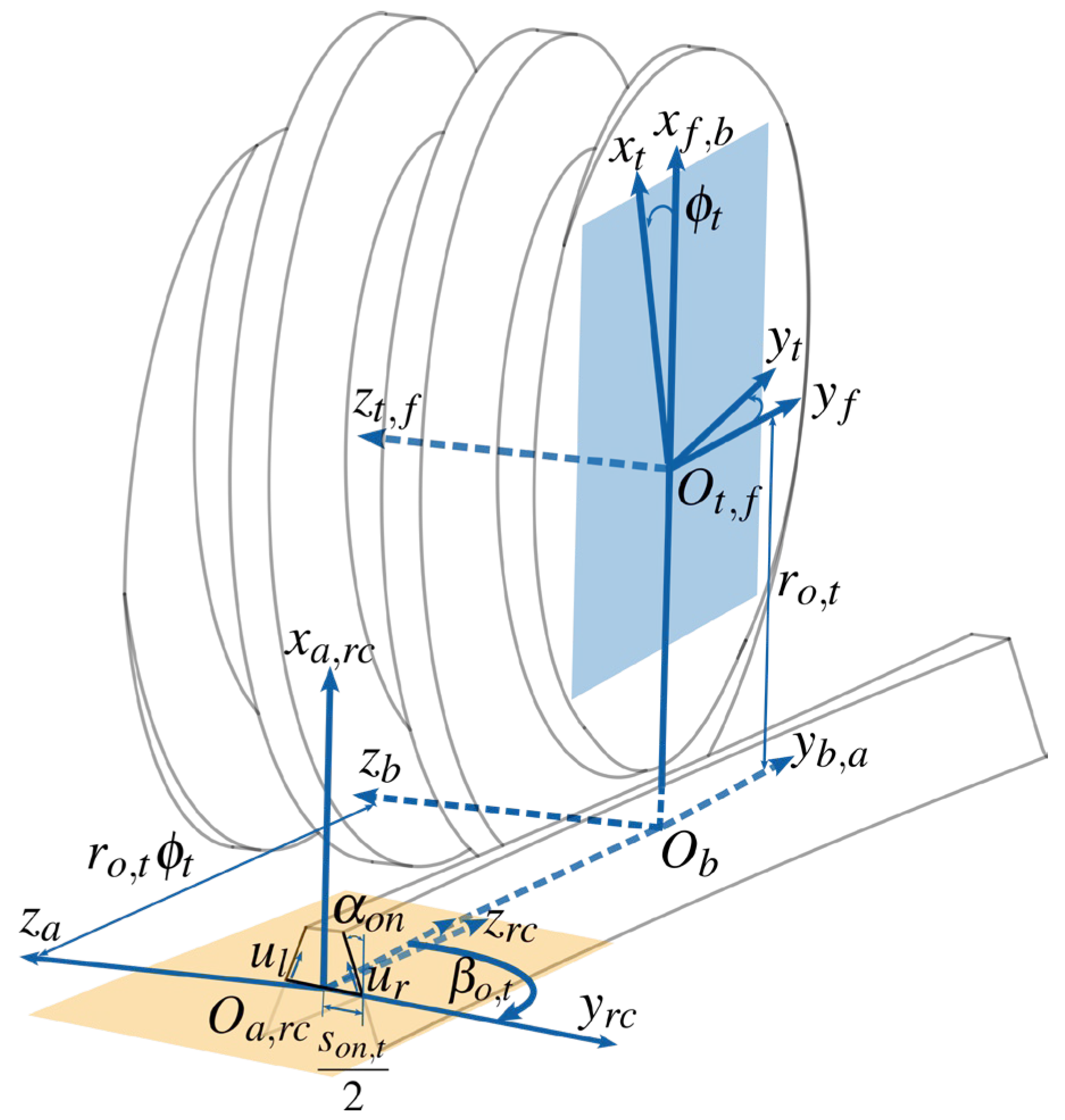
The worm-type generating tool is described through an equivalent rack-cutter-based mathematical construction adapted from the VTT concept established in [7]. As shown in Figure 1, the equivalent rack-cutter surface is parameterized based on the transverse profile coordinates u l and u r on the left and right flanks, respectively, together with the axial coordinate v . In the present study, this representation is extended to include both longitudinal tooth-thickness variation and transverse profile modification, thereby providing additional degrees of freedom for topographic optimization.
Coordinate systems S r c , S t , and S f are attached to the equivalent rack-cutter construction, the generating tool, and the fixed frame, respectively. The modified construction surface is described separately for the right and left flanks. The first type of modification is the longitudinal tooth-thickness variation along the axial direction. In the present formulation, the thickness increments on the two flanks are written as
Δ s o n , R v = 2 v a 1 + a 2 v , Δ s o n , L v = 2 v c 1 + c 2 v
where a 1 , a 2 , c 1 , and c 2 are the linear and quadratic tooth-thickness modification coefficients for the right and left flanks, respectively. The total normal tooth thicknesses on the two flanks are then given by
s o n , R v = s o n , t + Δ s o n , R v , s o n , L v = s o n , t + Δ s o n , L v
where s o n , t denotes the standard normal tooth thickness of the generating tool. When all four coefficients are zero, the standard uniform-thickness generating tool is recovered. This representation generalizes the single quadratic VTT parameter in [7] by allowing independent left-right thickness modification and by including a linear term to control asymmetric longitudinal variation.
The second type of modification is the transverse profile modification governed by the coefficients d R and d L for the right and left flanks, respectively. This modification introduces a parabolic deviation from the standard involute profile and provides additional control over the profile curvature of the generated tooth flank. Using a unified notation, the homogeneous position vector of the modified equivalent rack cutter is written as
r r c , i u i , v = u i c o s α o n d i u i s i n α o n η i u i s i n α o n + d i u i c o s α o n + 1 2 s o n , i v v 1 , i { R , L }
where η i is the sign indicator determined by the flank convention, and d i { d R , d L } is the profile-modification coefficient of the corresponding flank. When d i = 0 , Equation (4) reduces to the standard involute profile.
The unit normal vector on the modified equivalent rack-cutter surface is obtained from the cross product of the partial derivatives,
n r c , i = r r c , i / u i × r r c , i / v r r c , i / u i × r r c , i / v
The equivalent rack-cutter surface is then transformed into the generating-tool coordinate system through the rigid-body motion
r t , i u i , v , φ t = M t , r c φ t r r c , i u i , v
with the corresponding normal vector
n t , i u i , v , φ t = L t , r c φ t n r c , i u i , v
where L t , r c is the upper-left 3 × 3 submatrix of the homogeneous transformation matrix M t , r c . Following the theory of gearing, the meshing condition between the equivalent rack cutter and the generating tool is imposed by
f r c , t , i u i , v , φ t = n t , i r t , i / φ t = 0
By solving Equations (4)–(8), the modified generating-tool surface is obtained in the tool-fixed coordinate system. The resulting position vector and unit normal vector are denoted by r t , i and n t , i , respectively. In summary, each flank of the generating tool is characterized by three modification coefficients: two for the longitudinal tooth-thickness variation and one for the transverse profile modification. Together with the diagonal-feed coefficient c introduced in the next subsection, these seven parameters constitute the design variables of the optimization framework developed in Section 3.

2.3. Generation of the Modified Tooth Flank with Diagonal-Feed Coordination

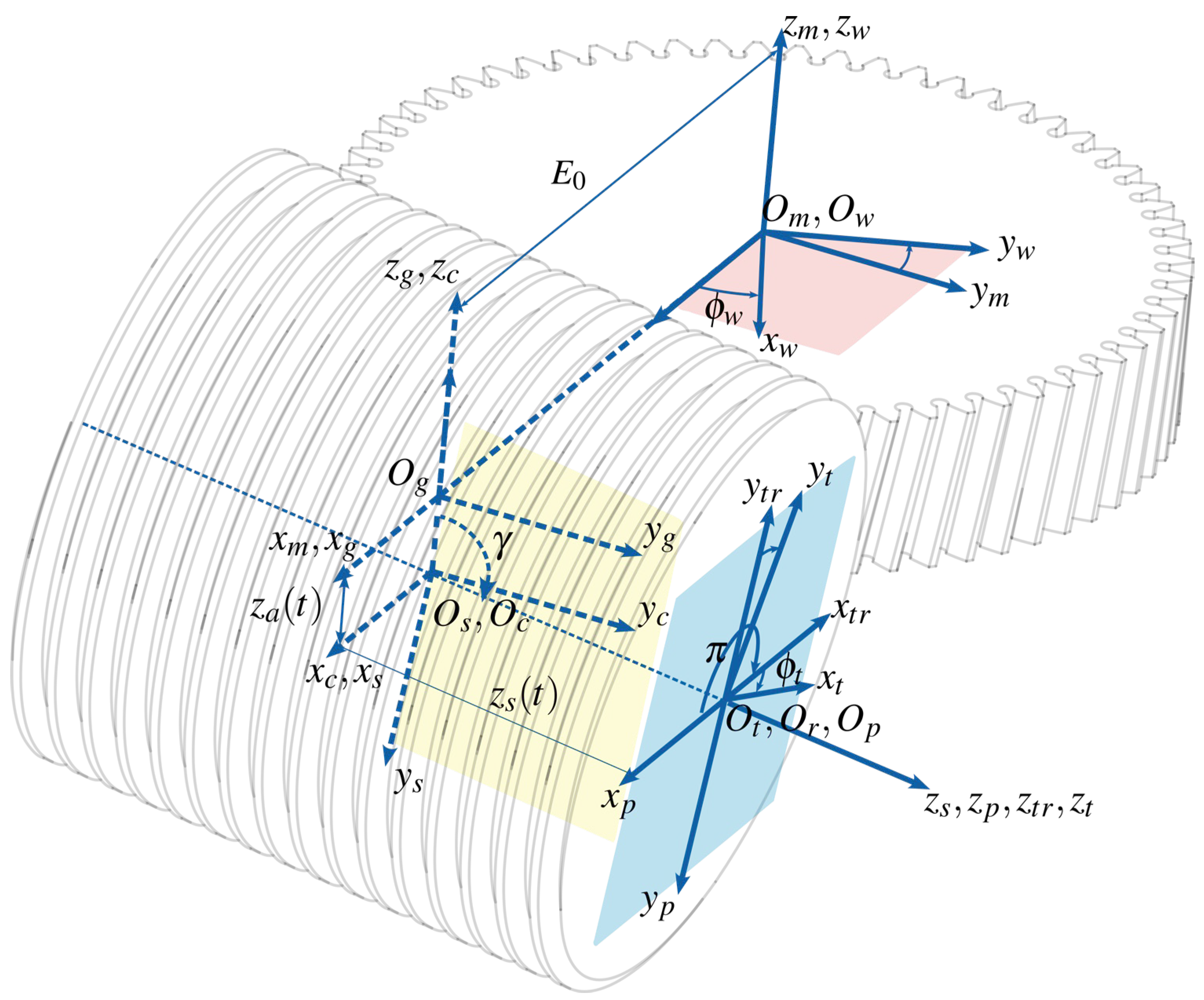
The generation of the modified tooth flank is formulated in terms of the relative motion among the generating-tool frame S t , the machine frame S m , and the work-gear frame S w , as illustrated in Figure 2. Several auxiliary frames shown in Figure 2 are introduced only to decompose the crossed-angle rotation and the feed motions. In the following derivation, however, the generated flank is expressed mainly through the composite transformations among S t , S m , and S w . The auxiliary frames S g , S c , S s , S p , and S t r are retained only for geometric interpretation.
During generation, the tool rotation, the work-gear rotation, the axial traverse, and the tangential feed act simultaneously to determine the final tooth-flank topography. Let z a t denote the axial traverse motion and z s t denote the tangential feed motion. In the present formulation, the tangential feed is assumed to be proportional to the axial traverse, namely,
z s t = c z a t
where c is the diagonal-feed coefficient. This coefficient governs the degree of feed coordination and plays a central role in the control of longitudinal modification and flank twist. Note that the diagonal-feed coefficient c in Equation (9) is a single scalar, distinct from the left-flank tooth-thickness coefficients c 1 , c 2 introduced in Equation (2); the subscript notation distinguishes the two roles throughout the remainder of this paper.
The work-gear rotation angle φ w is coupled with the tool rotation angle φ t through the generating ratio and the additional rotation induced by the feed motion. Accordingly, the work-gear rotation is written as
φ w t = N t N w φ t t + a z a t
where N t and N w are the tooth numbers of the generating tool and the work gear, respectively, and a is the rotational feed coefficient. For the crossed-axis generating setup considered here, a is given by
a = c / c o s β o , w s i n β o , t + t a n β o , w r o , w
where β o , t and β o , w are the operating helix angles of the generating tool and the work gear, and r o , w is the operating pitch radius of the work gear.
Using the above kinematic relations, the composite transformation from the generating-tool frame to the work-gear frame is expressed as
M w , t φ t , φ w , z a , z s = M w , m φ w , z a , z s M m , t φ t , γ o
where γ o is the operating crossed angle. The transformed position vector of the generated flank is then written as
r w , i u i , v , φ t , z a = M w , t φ t , φ w , z a , z s r t , i u i , v , i { R , L }
and the corresponding unit normal vector is given by
n w , i u i , v , φ t , z a = L w , t φ t , φ w , z a , z s n t , i u i , v
where L w , t is the rotational submatrix of M w , t . The generated tooth flank is obtained as the envelope of the transformed generating-tool surface. Accordingly, the meshing condition between the generating tool and the work gear is imposed by
f t , w , i u i , v , φ t , z a = n w , i v w , i t , w = 0 , i { R , L }
where v w , i t , w denotes the relative velocity vector between the generating tool and the work gear at the corresponding contact point, expressed in the work-gear frame. For a prescribed point on the generated flank, the unknown parameters u i , v , φ t , and z a are determined from the transformed surface coordinates together with the meshing condition. In this way, the generated tooth flank is governed jointly by the modified generating-tool geometry and the diagonal-feed coordination.
The above formulation shows that the generated work-gear topography is not determined by a single machine setting alone. Instead, it depends on the coupled influence of tool-geometry modification, crossed-axis kinematics, and feed coordination. This coupled structure forms the basis for the sensitivity-based multi-variable optimization developed in Section 3.

2.4. Surface Deviation Representation and Problem Statement

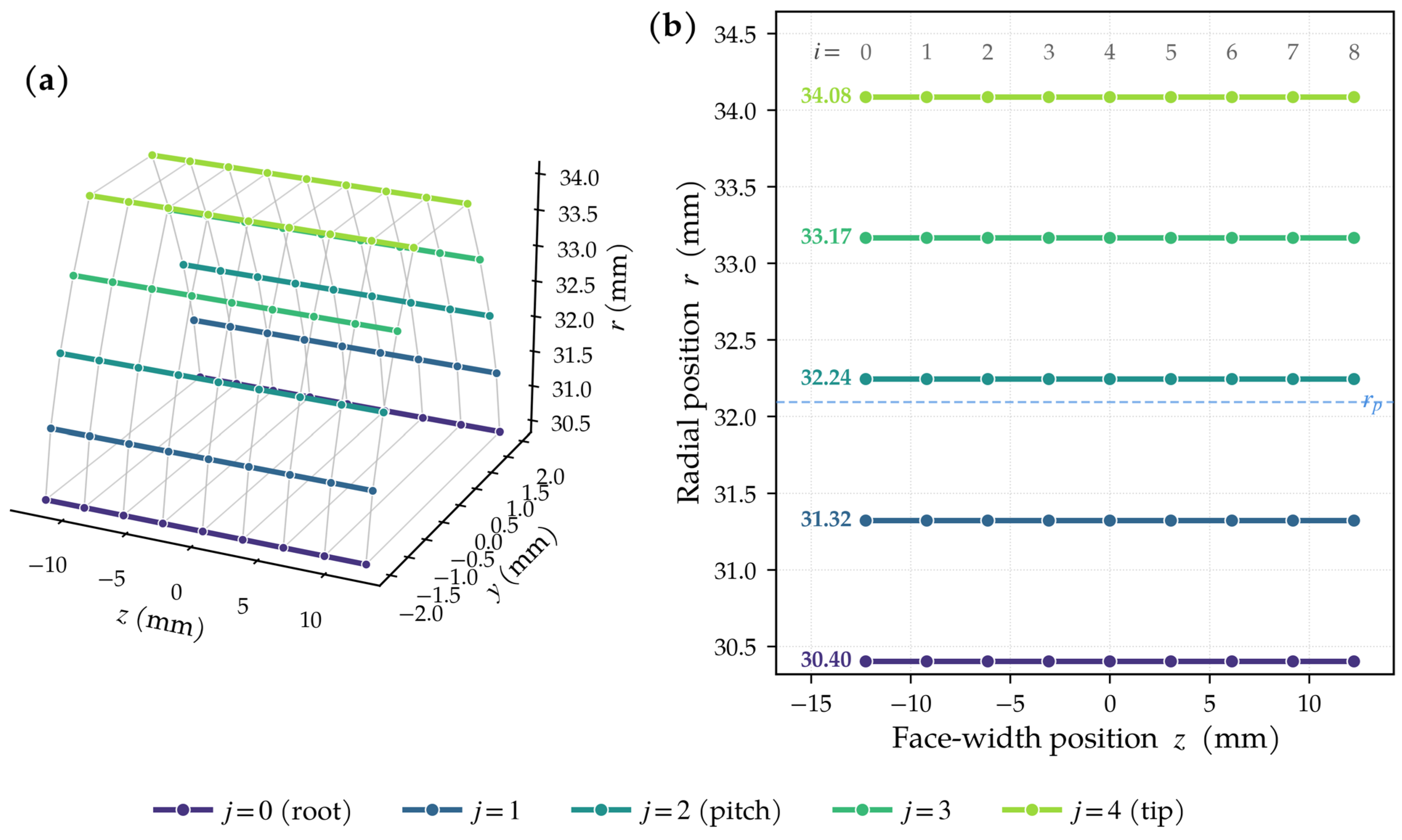
To evaluate the generated tooth flank, a target tooth surface is first defined on the work gear. The deviation of the generated flank from the target flank is then measured in the local normal direction of the target surface. The generated and target flanks are evaluated on a structured 9 × 5 surface grid, applied independently to the right and left flanks. At the grid point i j of a given flank, the normal deviation is written as
δ i , j = n r e f , i , j r w , i , j r r e f , i , j
where r ref , i , j and n ref , i , j are the reference position vector and the reference unit normal vector at the corresponding sampling point, respectively. The index i = 0 , , 8 runs along the longitudinal (face-width) direction, and j = 0 , , 4 runs along the radial (tooth-depth) direction; the flank label is suppressed in the notation, with the same expression applied independently on the right and left flanks, yielding 90 scalar deviations in total.
In addition to the pointwise deviation, a twist metric is introduced to quantify the non-uniformity of longitudinal modification across the tooth depth. For each longitudinal position i , the deviation spread along the tooth-depth direction is defined by
Δ i = m a x j δ i , j m i n j δ i , j
and the overall twist index is taken as
T t w i s t = m a x i Δ i
A smaller value of T t w i s t indicates that the prescribed longitudinal modification is distributed more uniformly across the tooth depth, whereas a larger value indicates a more pronounced flank twist on the generated tooth surface. The maximum-spread metric is adopted, rather than an RMS or integrated twist measure, because it captures the worst-case longitudinal non-uniformity across the tooth depth. This worst-case quantity is directly related to edge-contact risk and meshing-noise excitation, both of which are important practical concerns in noise-sensitive precision gear applications. The metric also provides a single physically interpretable value in micrometers. The optimization result is, however, not sensitive to this choice. As shown by the modal decomposition in Section 3.4.1, the residual deviation field is dominated by a single twist mode, which accounts for about 98% of its variance. Therefore, the maximum-spread, RMS, and integrated twist measures are mutually proportional over the scanned diagonal-feed range. Direct evaluation confirms that all three measures attain their minimum at the same coefficient. The choice of twist metric therefore changes the reported twist value, but not the optimal diagonal-feed setting.
Based on the above definitions, the design problem considered in this study can be stated as follows: determine the generating-tool modification parameters and the diagonal-feed coefficient, represented by the design vector x = [ a 1 , a 2 , d R , c 1 , c 2 , d L , c ] T , such that the generated tooth flanks satisfy the prescribed target topography while keeping the resulting twist and diagonal shift within allowable bounds. Formally, the optimization problem is written as
min x δ x δ t a r g e t 2 s . t . T t w i s t x T t w i s t m a x , c f w L s .
where δ t a r g e t is the prescribed target topography sampled on the 9 × 5 grid, T t w i s t m a x is the maximum admissible flank twist, and L s is the usable worm shift length introduced in Section 4.5.
The kinematic model and deviation measures developed in this section therefore provide the mathematical basis for the sensitivity-based multi-variable optimization framework presented in Section 3.

3. Sensitivity-Matrix Formulation and Numerical Methodology

The optimization problem stated in Section 2.4 involves seven design variables and ninety scalar deviation measurements (forty-five grid points per flank). Although the direct nonlinear minimization of δ 2 is conceptually straightforward, the strongly nonlinear coupling between the generating-tool geometry and the diagonal-feed coordination produces an optimization landscape with poor numerical conditioning. In particular, as will be shown in Section 3.2, the linearized sensitivity of the residual to the diagonal-feed coefficient degenerates identically at the standard tool state. This section formalizes the sensitivity-matrix formulation (Section 3.1), characterizes the structural degeneracy of the diagonal-feed direction (Section 3.2), develops an iterative SVD scheme with a warm-start continuation strategy to overcome the degeneracy (Section 3.3), and then derives two closed-form expressions for the diagonal-feed coefficient that minimize, respectively, the SVD residual and the resulting flank twist (Section 3.4). Section 3.5 summarizes the integrated twist-constrained workflow.

3.1. Sensitivity Matrix Formulation

Let δ x R 90 denote the column vector that stacks the ninety normal deviations defined by Equation (16) for a given design vector x R 7 . The sensitivity matrix of the deviation with respect to the design variables is defined componentwise as
S k j x 0 = δ k x j x = x 0 , k = 1 , , 90 , j = 1 , , 7
so that S x 0 R 90 × 7 is the Jacobian of δ evaluated at the operating point x 0 . In the present implementation, S is constructed by forward differences with carefully chosen perturbation magnitudes for each design variable, in order to preserve the sign and order of magnitude of the corresponding physical effect. Typical perturbation magnitudes adopted in this work are Δ a k = 10 7 mm, Δ b k = 5 × 10 9 mm (where b k refers collectively to the quadratic coefficients a 2 and c 2 ), Δ d k = 10 4 , and Δ c = 10 2 . These values are selected so that the resulting deviation increments lie well above the numerical noise of the envelope solver while remaining within the regime of validity of first-order linearization. The results are insensitive to these choices: varying each perturbation magnitude by two orders of magnitude, from one tenth to ten times the values above, changed the converged diagonal-feed coefficient by less than 10 4 and the topographic residual by less than 10 4 μm, well within the accuracy reported in Section 4.2. This insensitivity is consistent with first-order linearization: within the linear regime, each sensitivity column scales approximately linearly with its perturbation magnitude, so the pseudo-inverse solution is largely independent of the perturbation size.
For a prescribed target deviation δ t a r g e t R 90 —corresponding, for example, to a desired longitudinal crowning of specified amplitude—the linearized correction problem at the operating point x 0 reads
S x 0 Δ x = δ t a r g e t δ x 0
Because S is generally rank-deficient or numerically ill-conditioned [28], the Moore–Penrose pseudo-inverse S + is used to obtain the minimum-norm least-squares correction:
Δ x * = S + δ t a r g e t δ x 0
The pseudo-inverse S + is computed through the singular value decomposition [28,29] S = U Σ V T , in which singular values below a relative truncation threshold are suppressed in order to filter out directions of vanishing or near-vanishing sensitivity. This treatment is essential because, as discussed below, the diagonal-feed direction systematically produces a singular value that approaches zero whenever the generating tool is close to its standard uniform-thickness state. The SVD-based pseudo-inverse therefore plays a dual role in the present problem: it provides the least-squares solution of an overdetermined system, and it identifies and isolates the structurally degenerate direction of the design space.
It is worth noting that the sensitivity matrix is itself a function of the operating point x 0 . A correction Δ x * that is optimal at one operating point will, in general, not be optimal once the operating point is updated. This observation motivates an iterative scheme in which S , δ , and Δ x * are recomputed at each step until the design vector and the corresponding deviation stabilize. Such an iterative procedure is developed in Section 3.3, after the structural degeneracy of the diagonal-feed direction has been characterized in Section 3.2.

3.2. Sensitivity Degeneracy at the Standard Tool State

A structural feature of the present problem is that the seventh column of the sensitivity matrix, s c = δ / c , vanishes identically when the generating tool is at its standard uniform-thickness state. That is, at the design vector
x 0 = 0 , 0 , 0 , 0 , 0 , 0 , c 0 T
with c 0 arbitrary, one has
s c x 0 = 0
The physical origin of Equation (24) is straightforward. Under the diagonal-feed relation z s = c z a , varying c alters how rapidly the tool shifts tangentially as the work gear advances axially. When the tool has a uniform tooth thickness distribution along its axis, however, this tangential shift exchanges identical tooth-thickness profiles between adjacent axial positions of the work gear. Consequently, no first-order change in the generated flank topography is produced, and the linearized sensitivity s c vanishes regardless of the value of c 0 .
This degeneracy admits a direct kinematic derivation. The standard uniform-thickness worm-type tool is a helicoidal, or screw-symmetric, surface. It is mapped onto itself by a one-parameter screw motion that combines an axial translation with the corresponding rotation about the tool axis. Under the diagonal-feed relation z s = c z a , increasing c superimposes an additional tangential shift as the work gear advances. For a helicoidal tool, this additional shift is, to first order, equivalent to a rigid screw displacement, which is already compensated by the generating motion through the work-gear rotation. Formally, δ k / c = n r e f , k · r w , k / c = z a , k n r e f , k · r w , k / z s ; at the standard tool state, the displacement r w , k / z s produced by the tangential shift lies in the tangent plane of the generated flank. Its projection onto the reference normal n r e f , k therefore vanishes, giving δ k / c = 0 for every grid point k. This argument no longer holds when the tooth thickness varies along the tool axis, that is, when any of a 1 , a 2 , c 1 , or c 2 is nonzero, because the surface is no longer screw-invariant and the tangential shift exposes a locally different tooth thickness. The degeneracy is therefore an exact consequence of the screw symmetry of the standard tool, in contrast to ordinary numerical ill-conditioning in sensitivity-matrix methods [30,31,32], which depends on the grid resolution, perturbation size, and solver tolerance.
Equation (24) implies that the diagonal-feed coefficient cannot be resolved by direct linearization at the standard tool state. The seventh singular value of S x 0 is identically zero in this case, and the corresponding right singular vector lies entirely along the c -axis of the design space. Consequently, the pseudo-inverse S + x 0 contains no information about how c should be adjusted in response to a prescribed target deviation. A conventional Newton-type iteration started from the standard tool state would either keep c fixed throughout the iteration—if the truncated SVD discards the zero-singular value—or diverge if regularization is insufficient.
This degeneracy is structural rather than numerical. It does not arise from finite-difference noise, from grid-resolution limitations, or from a particular choice of solver tolerance. It is a property of the underlying generating kinematics and reflects the fact that the diagonal feed has no first-order effect when the tool has nothing to “carry” along the axial direction. The same observation can be expressed in modal form. Expanding the meshing equations to second order in x around the standard tool state, one finds that contributions involving the quadratic tooth-thickness coefficients a 2 and c 2 enter the residual at order c 2 , with the corresponding spatial modes resembling a pure longitudinal crowning. The linear-in- c contribution to the residual, in contrast, vanishes whenever the linear tooth-thickness coefficients a 1 and c 1 vanish. The diagonal-feed coefficient is therefore not a first-order design variable at the standard tool state but only becomes resolvable once the tool acquires a non-zero longitudinal thickness variation.
Two consequences follow. First, any iterative linearization-based optimization must be initialized at an operating point at which s c 0 . In practice, this requires that the iteration be started either with non-zero longitudinal tooth-thickness coefficients or with an analytically pre-set value of c , so that the subsequent linearization is meaningful. Second, the value of c itself cannot be derived from the linearized SVD alone; it must be supplied externally, either through an analytical estimate (as in [7]) or through a nonlinear iterative procedure that does not rely on s c being non-zero at every step. Both of these strategies are developed in the remainder of Section 3: the iterative scheme with warm-start continuation in Section 3.3, and the closed-form expressions for the diagonal-feed coefficient in Section 3.4.

3.3. Iterative SVD with Warm-Start Continuation

To resolve the sensitivity degeneracy described in Section 3.2 and to refine the design vector beyond the accuracy attainable from a single linearized correction, an iterative scheme is developed in which both the sensitivity matrix and the diagonal-feed coefficient are updated at each step. The scheme operates in two nested layers: an outer iteration on the design vector x , and an inner continuation procedure on the grid of evaluation points.

3.3.1. Outer Iteration on the Design Vector

Let x n denote the design vector at iteration n , and let S n and δ n denote the corresponding sensitivity matrix and deviation vector evaluated at x n . The next iterate is computed by
x n + 1 = x n + α n S n + δ t a r g e t δ n
where α n ( 0 , 1 ] is a damping factor that prevents overshoot when the linearization is locally poor. The pseudo-inverse S n + is computed using SVD with the truncation of singular values below a relative threshold of 10 6 times the largest singular value. The iteration is terminated when either Δ c n < 10 2 or the root-mean-square residual falls below 0.05 μm, with a hard maximum of five iterations. This cap reflects the rapid convergence observed in practice. When initialized from a closed-form coefficient (Section 3.4), the scheme satisfies the convergence criteria within one to three iterations. Even when initialized far from the optimum, such as from the Hsu–Fong evenness coefficient in Section 4.1, it converges within four iterations. The five-iteration cap therefore serves as a safety margin rather than an active limit.
The initial iterate x 0 requires special attention because of the degeneracy at the standard tool state. Three options are available:
Set c 0 to the analytical estimate of Hsu and Fong [7] and the remaining six coefficients to zero. This initialization breaks the degeneracy because the seventh column of S becomes non-zero only after the first SVD correction introduces non-zero longitudinal coefficients.
Set c 0 to one of the closed-form expressions derived in Section 3.4, and proceed as in option 1. This typically yields faster convergence because the initial c is closer to the converged value.
Initialize c 0 heuristically and rely on the iteration to converge. This is the least reliable option in practice and is not recommended.
In the numerical examples reported in Section 4, option 2 is used by default; option 1 is retained as a baseline for comparison.

3.3.2. Inner Continuation on the Grid

A second numerical difficulty arises within each evaluation of δ . For a given design vector x and a prescribed work-gear grid point z a * , r * , the unknowns u i , v , φ t , z a are determined from the transformed surface coordinates together with the meshing condition Equation (15). This nonlinear system is solved by a Newton-type iteration. The convergence criterion is based on the norm of the Newton update for the unknown vector, with a tolerance of 10 10   ( 10 12 for the conventional center-distance baseline) and a maximum of 10 4 function evaluations. These settings were found to be sufficiently tight that further reduction of the tolerances did not change the reported topographic deviations. The system is well-conditioned near the center of the grid but becomes progressively stiffer toward the grid corners, where the contact line approaches the boundaries of the active flank region.
To stabilize the envelope solver across the grid, a warm-start continuation strategy [33] is adopted. The grid points are visited in the order i = 4 i = 5 , 3 i = 6 , 2 i = 7 , 1 i = 8 , 0 , that is, starting from the central longitudinal section and proceeding outward symmetrically toward both ends of the working face width. At each new grid point, the initial guess for the envelope solver is taken from the converged solution at the previous point. Because adjacent contact configurations differ only slightly, this strategy keeps the Newton iteration within the basin of attraction of the correct solution branch throughout the grid and avoids the spurious jumps to other solution branches that are observed when each grid point is solved independently from a fixed initial guess.
The combined iterative SVD scheme with warm-start continuation forms the numerical backbone of the proposed framework. It is robust against the structural degeneracy of s c , it converges rapidly when initialized from a good estimate of c , and it returns a design vector that achieves the prescribed target deviation to within a residual significantly smaller than that obtainable from a single linearized correction. The remaining question is how to choose the initial value of c effectively. This question is addressed analytically in the next subsection.

3.4. Closed-Form Diagonal-Feed Coefficients

Although the iterative scheme of Section 3.3 resolves the sensitivity degeneracy and converges to a numerically improved design vector, it still requires a reasonable initial estimate of the diagonal-feed coefficient to behave robustly. This analytical estimate remains a useful reference, but additional numerical evidence suggests that two other closed-form choices are especially relevant in the present framework: one associated with the minimum SVD residual and one associated with the minimum tooth-flank twist. The formulas introduced in this subsection should therefore be interpreted as empirically motivated and numerically validated closed-form relations, rather than as fully derived consequences of the meshing equations.

3.4.1. Modal Decomposition of the Tool-Thickness Perturbation

The starting point of the analysis is the observation that the sensitivity column corresponding to the dominant longitudinal modification coefficient (denoted generically by b in this subsection, corresponding to a 2 on the right flank and c 2 on the left flank) admits a clean structural expansion in the diagonal-feed coefficient. Define s b c = δ / b as a 90-dimensional vector that depends parametrically on c . Direct expansion of the generating kinematics around the standard tool state shows that s b c can be written in the form
s b c = c 2 G 0 + c H + O c 3
where G 0 , H R 90 are fixed vectors that depend on the operating gear geometry but not on c . The leading c 2 contribution arises from the direct effect of the tooth-thickness variation on the workpiece flank, while the linear-in- c contribution arises from the implicit dependence of the meshing solution on c through the envelope equations.
In practice, G 0 and H need not be derived in closed form. For a given gear set, the sensitivity column s b ( c ) = δ / b is evaluated based on forward finite differences: the dominant longitudinal coefficient b is perturbed, and the 90 deviation values are recomputed through the envelope solver at several diagonal-feed values c spanning the range of interest. The resulting vector-valued data are then fitted componentwise by the least-squares approximation s b ( c ) c 2 G 0 + c H . The fitted quadratic and linear coefficient vectors are taken as G 0 and H , respectively. The fit is well conditioned over the validated c -range, and the recovered vectors reproduce s b ( c ) within the tolerance reported for the closed-form coefficients. An engineer reproducing the method therefore needs only the existing envelope solver and a small c -scan; no separate analytical expansion is required.
Empirically, three spatial modes can be identified in the sensitivity vector s b c . The first mode, denoted M 1 , has a z a 2 profile on the work gear with no radial dependence and represents pure longitudinal crowning. The second mode, denoted M 2 , has a z a r r o , w profile and represents pure tooth-flank twist. The third mode, denoted M 3 , has a r r o , w 2 profile and represents a pure radial variation. Numerical decomposition of s b c onto these three modes shows that the M 1 amplitude scales as c 2 with high precision (variation of less than two percent across the validated range of c ), the M 2 amplitude is essentially zero for all c , and the M 3 amplitude exhibits a clear minimum near a specific value of c that coincides with the value that minimizes the SVD residual.
This modal picture has two important consequences. First, the longitudinal tooth-thickness perturbation alone does not directly generate a twist-mode component in the work-gear deviation; any twist that appears in the residual after SVD correction must originate from the interplay between the linear coefficients a 1 , c 1 and the diagonal feed, or from the higher-order coupling between the longitudinal and profile coefficients. Second, the diagonal-feed coefficient c controls the relative weighting of the crowning and radial modes in s b c in a manner that admits a closed-form description. A full analytical derivation of the modal amplitudes from the meshing equations remains an open problem and is left for future work. The closed-form expressions reported in the following two subsections are therefore established empirically and validated by an extensive parameter sweep in Section 4.

3.4.2. Minimum-Residual Diagonal-Feed Coefficient

Define the diagonal-feed coefficient that minimizes the SVD topographic residual as
c R M S = a r g m i n c δ t a r g e t S x 0 c S x 0 c + δ t a r g e t 2
where x 0 c is the standard-tool state parameterized by the diagonal-feed coefficient alone. Extensive numerical experimentation across the tested parameter range indicates that c R M S can be approximated accurately by the following closed-form expression
c R M S = c o s λ o , t s i n β o , w
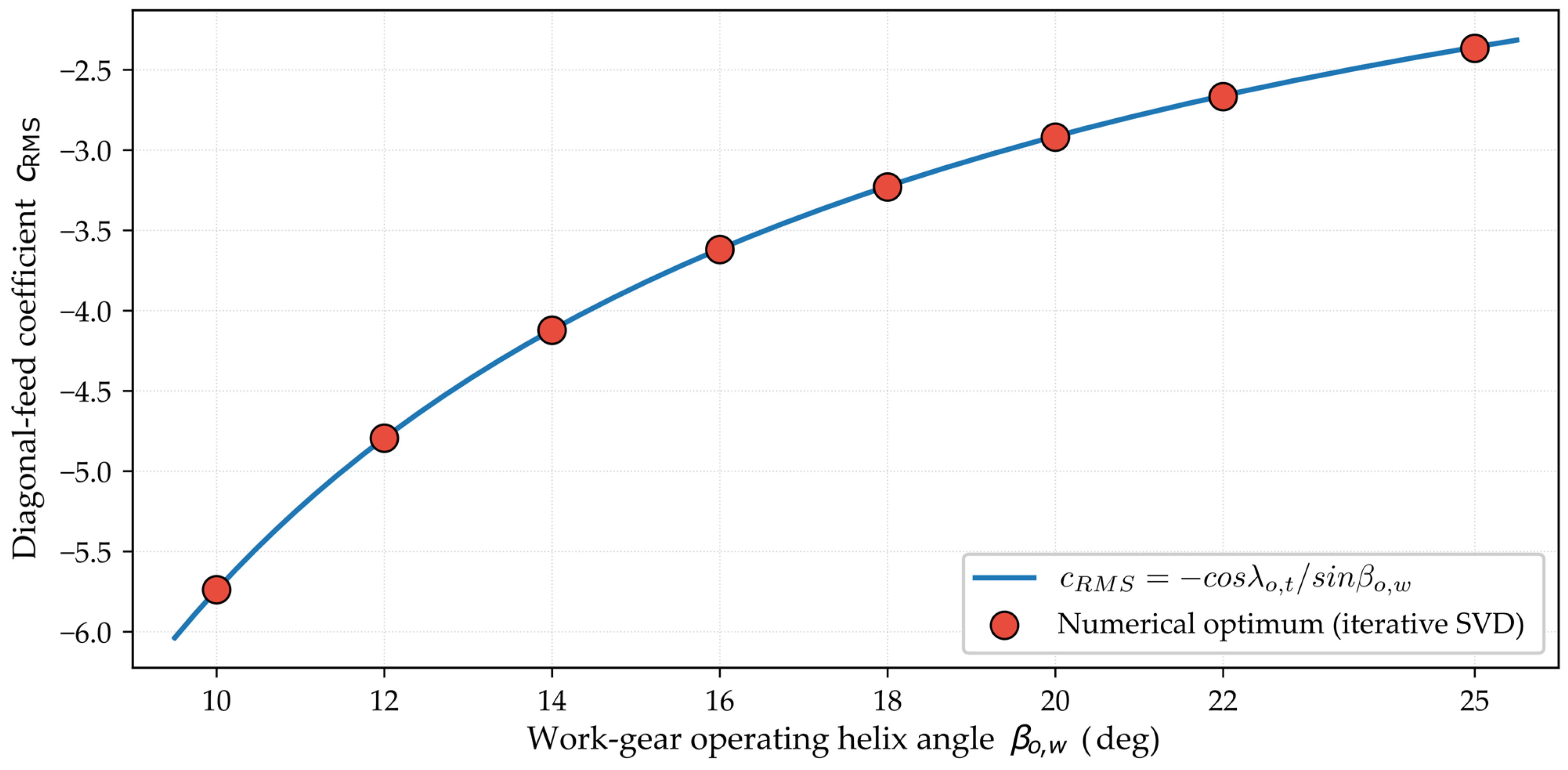
where λ o , t is the operating lead angle of the generating tool. Over the validated sixty-case parameter sweep reported in Section 4, the maximum relative error of Equation (28) with respect to the numerically determined optimum remains below 0.6%.
The sign of Equation (28) corresponds to the same-hand configuration in which the work gear and the generating tool have helices of identical orientation. For an opposite-hand configuration—in which the work gear and the generating tool are of opposite handedness—the same closed-form magnitude applies with the sign reversed, so that the general form of Equation (28) reads c R M S = c o s λ o , t s i n β o , w where the upper (negative) sign applies to same-hand combinations and the lower (positive) sign to opposite-hand combinations. This sign convention reflects the kinematic reflection symmetry of the crossed-axis configuration: a change of handedness on either member reverses the effective direction of the tool’s tangential motion and hence the sign of the optimum diagonal-feed coefficient, while leaving its magnitude invariant. A direct numerical verification of this convention is reported in Section 4.2.
Three properties of Equation (28) merit comment. First, c R M S depends only on the operating helix angle of the work gear and the lead angle of the generating tool and is independent of the module, the work-gear tooth number, the face width, the target crowning amplitude, and the normal pressure angle. This amplitude independence was verified directly: with the tool geometry held fixed, sweeping the target crowning amplitude from 0.5 to 40 μm changed the numerically optimal diagonal-feed coefficient by less than 0.3%, while the residual and twist scaled approximately linearly with amplitude. Therefore, the 30 μm amplitude used in the illustrative case lies well within the validated range. This decoupling is consistent with the modal picture of Section 3.4.1: the minimum-residual condition reflects the geometric balance between the crowning and radial modes of s b c , both of which are governed by the operating kinematics rather than by the absolute scale of the gear.
Second, the magnitude of c R M S exceeds unity for typical helix angles encountered in industrial practice. For a work gear with β o , w = 15 ° and a generating tool with β o , t = 85.25 ° (so that λ o , t = 4.75 ° ), Equation (28) gives c R M S 3.85 . The negative sign indicates that the generating tool shifts in the direction opposite to the axial traverse of the work gear, consistent with the convention adopted in Section 2.3.
Third, Equation (28) remains finite and well-defined for β o , w λ o , t , in contrast to the analytical expression of Hsu and Fong [7], which diverges when the work-gear helix angle approaches the tool lead angle. This regular behavior is of practical relevance for low-helix work gears generated by multi-start grinding worms or by tools with intentionally elevated lead angles, where this analytical expression becomes unreliable.

3.4.3. Minimum-Twist Diagonal-Feed Coefficient

The diagonal-feed coefficient that minimizes the work-gear flank twist is, in general, different from the minimum-residual coefficient. Define
c t w i s t = a r g m i n c T t w i s t x S V D c
where x S V D c is the SVD-corrected design vector starting from the standard tool state with diagonal-feed coefficient c . Over the same sixty-case parameter sweep, the numerically observed optimum can be approximated by the following closed-form expression
c t w i s t = c o s λ o , t + t a n 2 α n s i n β o , w
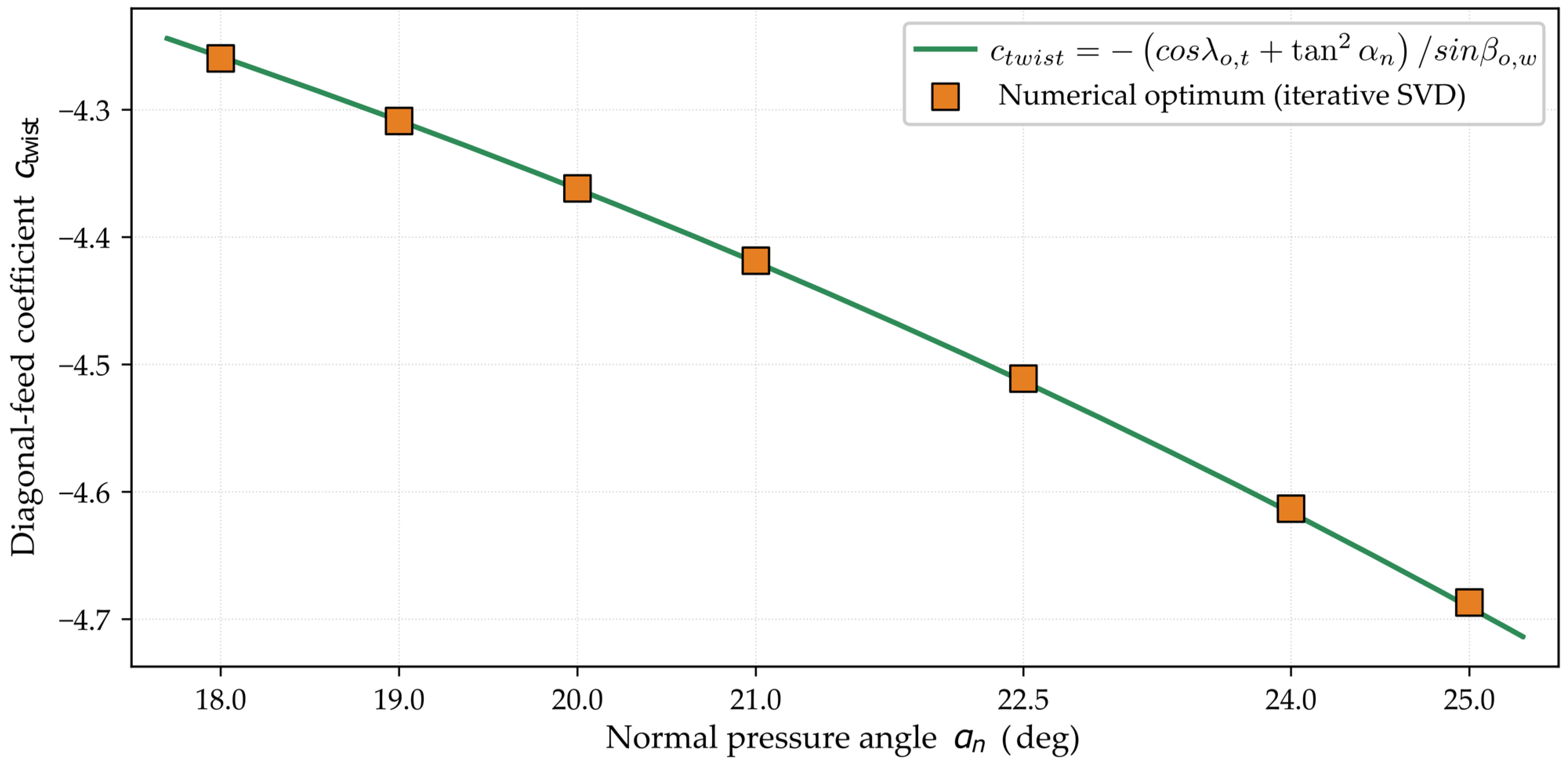
The maximum relative error of Equation (30) with respect to the numerically determined optimum remains below 1.6% across the validated parameter range. In the limit α n 0 , the expression reduces to c R M S , thereby recovering the minimum-residual condition for an idealized zero-pressure-angle gearing.
The additional term t a n 2 α n / s i n β o , w in Equation (30) shifts the optimum toward larger absolute values of c relative to Equation (28). For the default case with β o , w = 15 ° , λ o , t = 4.75 ° , and α n = 20 ° , one obtains c t w i s t 4.35 as compared with c R M S 3.85 , a difference of about 13%. This difference is sufficient to produce a measurably different work-gear topography after SVD correction, as documented in Section 4.
The physical origin of the correction can be understood qualitatively as follows. The twist mode couples the axial coordinate with the radial deviation from the pitch line. The strength of this coupling depends on the pressure angle through the geometry of the contact line on the work-gear flank: as the pressure angle increases, the projection of the axial displacement onto the radial direction at the contact point also increases. The empirical observation that this correction enters quadratically rather than linearly is consistent with the bilinear structure of the twist mode in the longitudinal-radial plane. A rigorous analytical derivation of Equation (30) from the meshing equations is beyond the scope of the present study and is left for future work.
The same sign convention as in Equation (28) applies to Equation (30): its general form may likewise be written as c t w i s t = c o s λ o , t + t a n 2 α n s i n β o , w where the upper (negative) sign applies to same-hand combinations and the lower (positive) sign to opposite-hand combinations.

3.4.4. Connection to the Hsu–Fong Evenness Coefficient

The closed-form expressions of Equations (28) and (30) are companions to, rather than replacements for, the analytical coefficient of Hsu and Fong [7]:
c e v e n n e s s = 1 s i n β o , w λ o , t
Equation (31) is derived from the condition that the longitudinal crowning amplitude be distributed evenly across the tooth depth, with no requirement that the resulting twist or SVD residual be small. Geometrically, all three coefficients can be interpreted as defining a coordination ratio between the tool’s tangential motion and the work gear’s axial traverse, but they correspond to three distinct optimization criteria: even distribution (Equation (31)), minimum residual (Equation (28)), and minimum twist (Equation (30)).
For the default case considered in this study ( β o , w = 15 ° , λ o , t = 4.75 ° , α n = 20 ° ), the three coefficients evaluate to c e v e n n e s s 5.62 , c R M S 3.85 , and c t w i s t 4.35 . The ordering c e v e n n e s s > c t w i s t > c R M S reflects the increasingly strict optimization criteria embodied in each expression. Section 4 reports the resulting work-gear topographies for each of these choices, together with the corresponding result of the iterative SVD scheme.

3.5. Twist-Constrained Optimization Procedure

The methodological components developed in the preceding subsections are integrated into the following twist-constrained design procedure.
  • Compute the operating geometry of the gear pair from the input data following Section 2.1, and obtain the operating helix angles β o , t and β o , w , the lead angle λ o , t , and the pressure angle α n .
  • Specify the target longitudinal crowning amplitude and the maximum admissible flank twist T t w i s t m a x .
  • Evaluate the three closed-form coefficients c R M S , c t w i s t , and c e v e n n e s s from Equations (28), (30) and (31). Select the initial estimate c 0 according to the prevailing design priority: c R M S for minimum residual, c t w i s t for minimum twist, or any value within the interval c t w i s t , c R M S for a balanced compromise.
  • Initialize the design vector as x 0 = 0 , 0 , 0 , 0 , 0 , 0 , c 0 T .
  • Apply the iterative SVD scheme of Section 3.3 with warm-start continuation on the grid, updating x n according to Equation (25), until the convergence criteria are satisfied.
  • Evaluate the converged twist index T t w i s t from Equation (18). If T t w i s t T t w i s t m a x , accept the design vector. Otherwise, repeat steps 3–5 with a different initial c 0 chosen within the feasible interval until the twist constraint is satisfied.
This procedure separates the analytical estimation of the diagonal-feed coefficient from the iterative numerical refinement of the full design vector. The closed-form expressions of Section 3.4 provide effective starting points and useful physical guidance, while the iterative SVD scheme of Section 3.3 supplies the numerical accuracy required for high-precision twist control. The combination yields a workflow that is both practical and numerically robust within the validated operating range.

4. Numerical Examples and Validation

This section reports numerical examples that demonstrate the effectiveness of the proposed framework and validate the closed-form expressions of Section 3.4. Section 4.1 presents a five-method comparison on a representative default case. Section 4.2 then validates the closed-form coefficients across a sixty-case parameter sweep spanning the practically relevant range of helix angles, modules, tooth numbers, and pressure angles. Section 4.3 examines the behavior of the closed-form expressions in limiting cases of practical interest, particularly the divergence of c e v e n n e s s for low-helix gears. Section 4.4 illustrates the twist-constrained feasible region in the design space, Section 4.5 introduces an additional constraint arising from the grinding-worm geometry, and Section 4.6 discusses the engineering interpretation of the results.

4.1. Five-Method Comparison Based on the Default Case

The default case adopted for the numerical comparison corresponds to a representative passenger-vehicle helical gear cut by a single-start worm-type generating tool. The basic parameters are summarized in Table 1.
Five methods of selecting the diagonal-feed coefficient are compared:
  • Conventional center-distance crowning with c = 0 .
  • The analytical evenness coefficient of Hsu and Fong [7], c e v e n n e s s = 1 / s i n β o , w λ o , t .
  • The minimum-residual coefficient of the present study, c R M S = c o s λ o , t / s i n β o , w .
  • The minimum-twist coefficient of the present study, c t w i s t = c o s λ o , t + t a n 2 α n / s i n β o , w .
  • The iterative SVD scheme of Section 3.3, initialized from c 0 = c R M S .
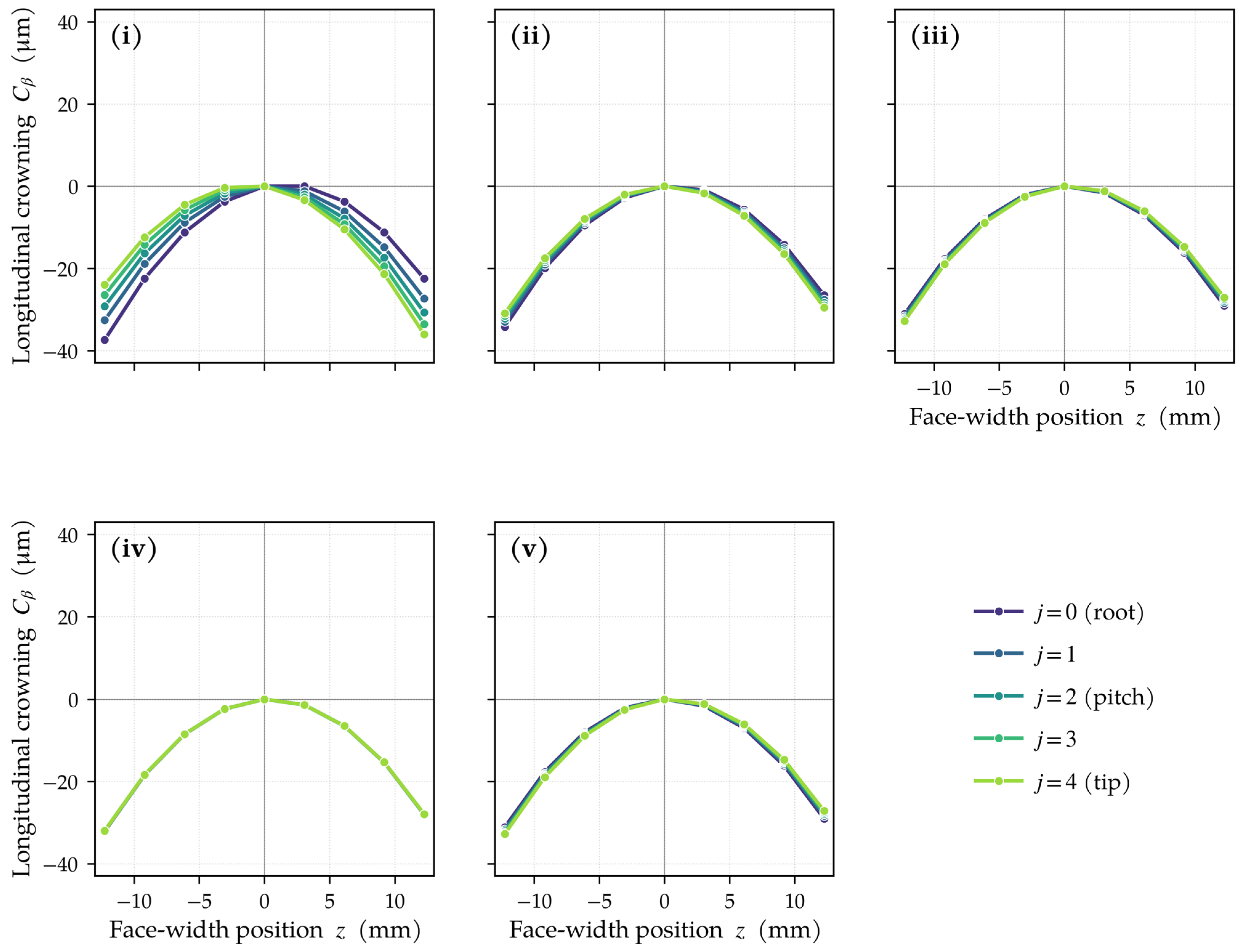
In cases (ii)–(iv), the diagonal-feed coefficient c is fixed at the prescribed value listed above, and the six tool-geometry coefficients a 1 , a 2 , d R , c 1 , c 2 , and d L are subsequently determined. Case (ii) uses a single SVD correction with the Hsu–Fong analytical coefficient [7], whereas cases (iii) and (iv) use the iterative SVD scheme of Section 3.3 with c fixed at c R M S and c t w i s t , respectively. In case (v), the iterative SVD scheme is initialized from c 0 = c R M S , and the diagonal-feed coefficient is additionally updated during the iteration. Case (i) represents the conventional center-distance crowning method with c = 0 . The resulting work-gear topographies are evaluated on the 9 × 5 grid, and the RMS deviation and twist index are computed from Equations (16)–(18). Table 2 reports the results. The sampling grid used for the work-gear flank topography evaluation is shown in Figure 3. Based on this grid, the corresponding work-gear flank topographies obtained by the five methods are compared in Figure 4.
Several observations follow from Table 2. First, the conventional center-distance crowning produces a flank twist of 13.59 μm—nearly half the prescribed 30 μm longitudinal crowning—which may be excessive for many precision applications. The evenness coefficient of [7] reduces the twist to 7.59 μm and the RMS deviation to 1.14 μm, a substantial improvement, but the RMS residual remains about 42 times larger than that of the iterative-SVD solution.
Second, the minimum-residual coefficient c R M S reduces the RMS deviation to 0.027 μm, a factor of 42 improvement over c e v e n n e s s , and the twist index from 7.59 μm to 6.52 μm. This result confirms that the closed-form expression of Equation (28) is essentially equivalent to the converged solution of the iterative scheme for the present problem class: the two methods produce identical RMS deviations and twist indices to within the displayed precision. The fully joint optimization of case (v) converges to c = 3.847 , confirming that the closed-form coefficient pins down the optimal diagonal-feed value. Once c is set to this value, no search over c is required, and the iterative scheme only needs to refine the six tool-geometry coefficients.
Third, the minimum-twist coefficient c t w i s t reduces the twist index further to 5.40 μm, at the cost of a moderate increase in RMS deviation to 0.31 μm. This trade-off is consistent with the distinct optimization criteria embodied in c R M S and c t w i s t : the former minimizes the integrated topographic residual, while the latter minimizes the worst-case longitudinal spread. The two coefficients span a one-parameter family of design solutions, any member of which represents a different trade-off between residual and twist.
Fourth, the iterative SVD scheme converges to essentially the same operating point as the c R M S solution in this case. This agreement is consistent with the role of the iterative scheme as a numerical solver for the minimum residual condition, whereas Equation (28) provides a compact closed-form estimate of that operating point over the tested range. The iterative scheme remains valuable as a fallback for parameter combinations outside the validated range of the closed-form expressions and as a numerical verification tool when additional geometric or process constraints are introduced. In summary, for a standard longitudinally crowned target within the validated range, the closed-form coefficient already provides the minimum-residual diagonal-feed value, so a full joint iterative search over c is required only when the gear parameters fall outside that range, when additional constraints such as the grinding-worm shift bound of Section 4.5 are active or when more general target topographies are sought (Section 5.3). In those cases, the additional computational cost is justified by the precision and feasibility check it provides.
Convergence for the default case is rapid. With the diagonal-feed coefficient fixed at a closed-form value, the iterative refinement of the tool-geometry coefficients reduces the RMS residual from 0.246 μm (initial single SVD correction) to about 0.027 μm within a single step at the minimum-residual coefficient and from 0.481 μm to 0.31 μm at the minimum-twist coefficient. The converged residual is independent of the initial tool-coefficient guess, as verified from 0.5×, 2×, and zero starting states. When the diagonal-feed coefficient is also treated as free and initialized far from the optimum, namely at the evenness coefficient c e v e n n e s s = 5.62 , the joint iteration converges to the same operating point c = 3.85 within four iterations, well inside the five-iteration cap, with the damping factor preventing overshoot.

4.2. Validation Across the Parameter Space

The closed-form expressions of Equations (28) and (30) are validated across a parameter sweep covering the following ranges. All parameters not explicitly varied are held at their default values from Table 1.
  • Work-gear operating helix angle β o , w 10 ° , 25 ° .
  • Generating-tool operating helix angle β o , t 77 ° , 89 ° (corresponding to λ o , t 1 ° , 13 ° ).
  • Normal module m p n 1.0 , 4.0 mm.
  • Normal pressure angle α n 20 ° , 25 ° .
  • Work-gear tooth number N w 25 , 80 .
  • Effective face width f w 15 , 40 mm.
  • Target crowning amplitude 0.5 , 40 μm.
For each parameter combination, the numerically determined optimum diagonal-feed coefficient (obtained from the iterative SVD scheme initialized with several distinct starting values) is compared with the closed-form prediction from Equation (28) for c R M S and from Equation (30) for c t w i s t . Table 3 summarizes the worst-case relative errors observed across the sweep, grouped by the parameter being varied.
Two observations follow from Table 3 and Figure 5 and Figure 6. First, the c R M S expression remains accurate to better than 0.6% across the validated parameter range, and the c t w i s t expression remains accurate to better than 1.6%. Both relations therefore provide practically useful estimates of the diagonal-feed coefficient within the tested range, and they remain robust under simultaneous variation of multiple parameters.
Second, the closed-form expressions exhibit essentially zero sensitivity to the parameters that the modal analysis of Section 3.4.1 suggests should be secondary—namely, the work-gear tooth number, the module, the face width, and the target crowning amplitude. Variations in these parameters change the absolute scale of the deviation field but not the geometric balance between the crowning and twist modes that determines the optimum diagonal-feed coefficient. This observed decoupling provides additional support for the proposed modal interpretation.
Verification of the handedness sign convention. As a complementary verification, the iterative SVD scheme was applied to a single representative opposite-hand configuration in which the work gear is right-handed ( β o , w = + 15 ° ) and the generating tool is left-handed ( β o , t = 85.25 ° ), with all other operating parameters held at the default values of Table 1. The numerically determined optimum diagonal-feed coefficient was c + 3.85 , of opposite sign and approximately equal magnitude to the same-hand baseline value c 3.85 obtained for the same operating geometry. This result is consistent with the kinematic reflection symmetry described in Section 3.4.2 and supports the ∓ sign convention adopted in Equations (28) and (30). A comprehensive parameter sweep across the four handedness combinations is identified as future work in Section 5.3.

4.3. Limiting Cases and Practical Bounds

The closed-form expressions of Equations (28) and (30) are uniformly bounded throughout the practically relevant parameter range, in contrast to the Hsu–Fong expression of Equation (31). Specifically, c e v e n n e s s diverges as β o , w λ o , t , that is, when the work-gear helix angle equals the lead angle of the generating tool. This condition can be encountered in two practical contexts: (i) generating grinding of low-helix work gears by multi-start grinding worms, where the tool lead angle is intentionally elevated to several degrees; (ii) gear skiving with a worm-type cutter at near-tangential approach. In both cases, the Hsu–Fong evenness condition cannot be applied directly because the analytical evenness coefficient becomes undefined.
The closed-form expressions of the present study suffer no such divergence. Equation (28) gives a well-defined value of c R M S for every β o , w > 0 , irrespective of the magnitude of λ o , t , and the same is true of Equation (30). For the multi-start grinding-worm case, the regular behavior of c R M S and c t w i s t allows the proposed framework to be applied without modification, and the iterative SVD scheme converges as readily as for the default single-start worm-type generating case considered in this study. This robustness of the closed-form expressions broadens the practical applicability of the proposed framework beyond the single-start hobbing-derived setting from which the evenness coefficient of [7] was originally developed.
Conversely, both closed-form expressions diverge as β o , w 0 , that is, in the spur-gear limit. This divergence is a physical rather than a mathematical artifact: for a spur work gear, longitudinal modification cannot be produced by the diagonal feed alone, because the contact line does not slope across the face width. In this limit, twist, as defined by Equation (18), is identically zero, and the question of twist control becomes vacuous. The proposed framework should therefore not be applied for β o , w smaller than approximately 5°, below which the diagonal-feed mechanism loses physical effectiveness.

4.4. Twist-Constrained Feasible Region

In many practical noise-sensitive gear applications, the design requirement is not to achieve the absolute minimum twist but to keep the twist below an application-specific threshold while satisfying other constraints such as a limited tool diagonal shift, available machine stroke, or process cycle time. The closed-form expressions c R M S and c t w i s t together delineate a one-parameter family of design solutions within which such trade-offs can be examined analytically.
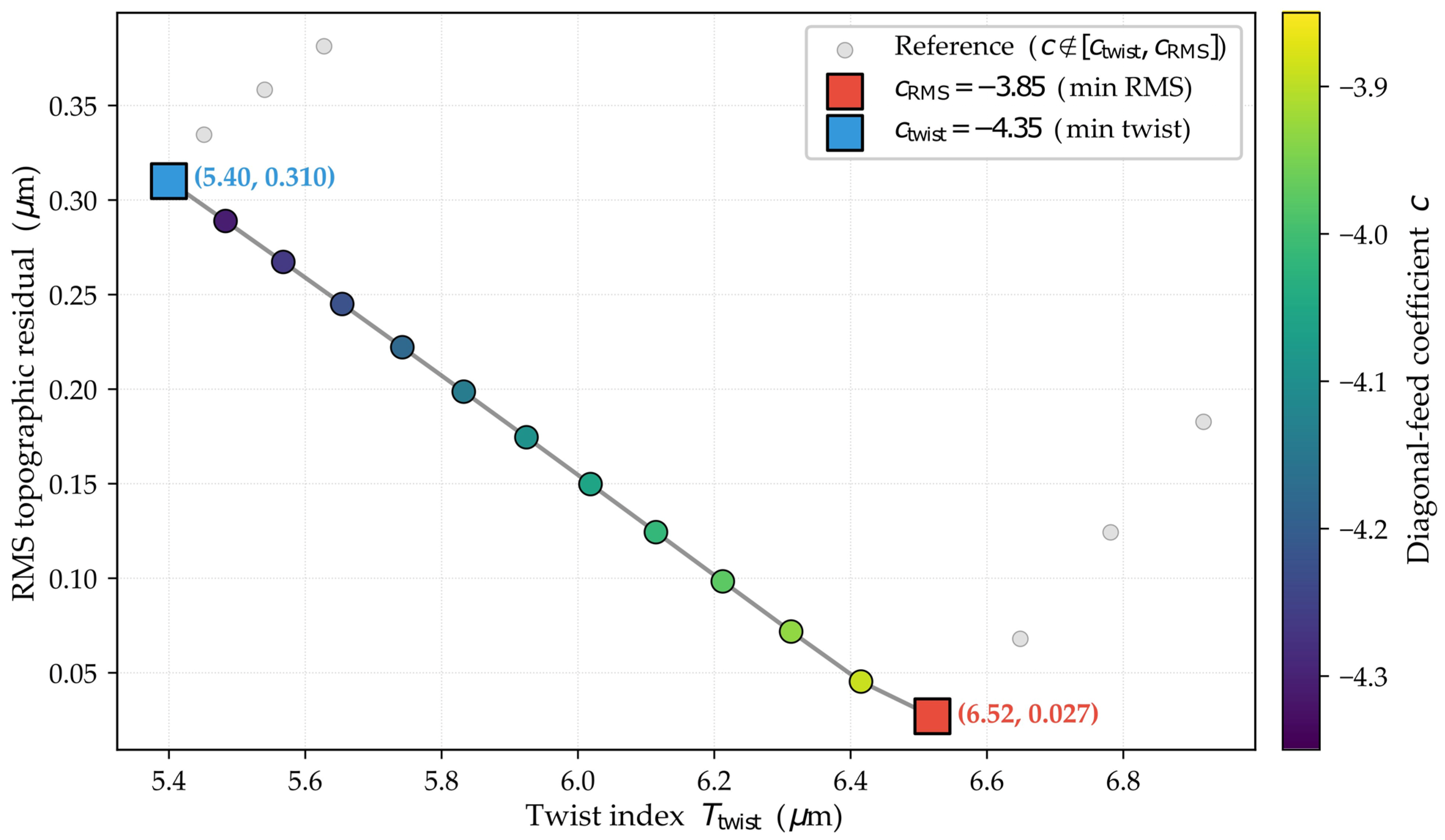
For a fixed work-gear and tool geometry, the iterative SVD scheme can be run with c swept across the interval c t w i s t , c R M S to map the resulting twist index against the corresponding RMS residual. The result is a Pareto-like front in the (RMS, twist) plane, on which any specified twist threshold corresponds to a unique admissible interval of c . The resulting Pareto-like front between the RMS residual and the twist index is shown in Figure 7.
For the default case, sweeping c between c twist = 4.35 and c R M S = 3.85 traces a smooth Pareto front: the RMS residual decreases from 0.31 μm to 0.027 μm, while T twist increases from 5.40 μm to 6.52 μm. Applying a twist constraint then selects a subset of this front. With T twist 6 μm, the admissible interval shrinks to approximately 4.35 , 4.06 , and the corresponding RMS residual ranges from 0.31 μm at c twist to about 0.15 μm at the upper end ( c 4.06 ). A stricter tolerance of T twist 5.5 μm restricts the operating point to a narrow neighborhood of c twist , with the RMS residual remaining near 0.31 μm. These quantitative trade-offs provide a transparent basis for design decisions, and they bypass the need for repeated full-iterative-SVD runs by using the closed-form coefficients to bracket the relevant interval at the outset.

4.5. Grinding-Worm Geometry Constraints on the Diagonal-Feed Coefficient

The analysis up to this point has treated the diagonal-feed coefficient c as a free design variable, constrained only by the twist-bounded interval c t w i s t , c R M S discussed in Section 4.4. The following constraint is particularly relevant for continuous generating grinding with a worm-type grinding tool, where the usable shift length of the grinding worm imposes a direct geometric bound on the admissible diagonal-feed coefficient. In production gear-grinding practice, the grinding worm is commonly traversed across its full usable shift length during each work-gear cycle. This requirement distributes the dressing-induced wear evenly across the worm, stabilizes the dimensional accuracy of successive workpieces, and synchronizes the worm-redressing schedule with the production rate.
Under this production constraint, the total tangential shift of the worm is fixed by the tool geometry as z s , t o t a l   =   L s , where L s is the usable shift length of the grinding worm. Substitution into the diagonal-feed relation z s = c   z a evaluated over the full face width gives the tool-imposed diagonal-feed coefficient
c t o o l = ±   L s   /   f w
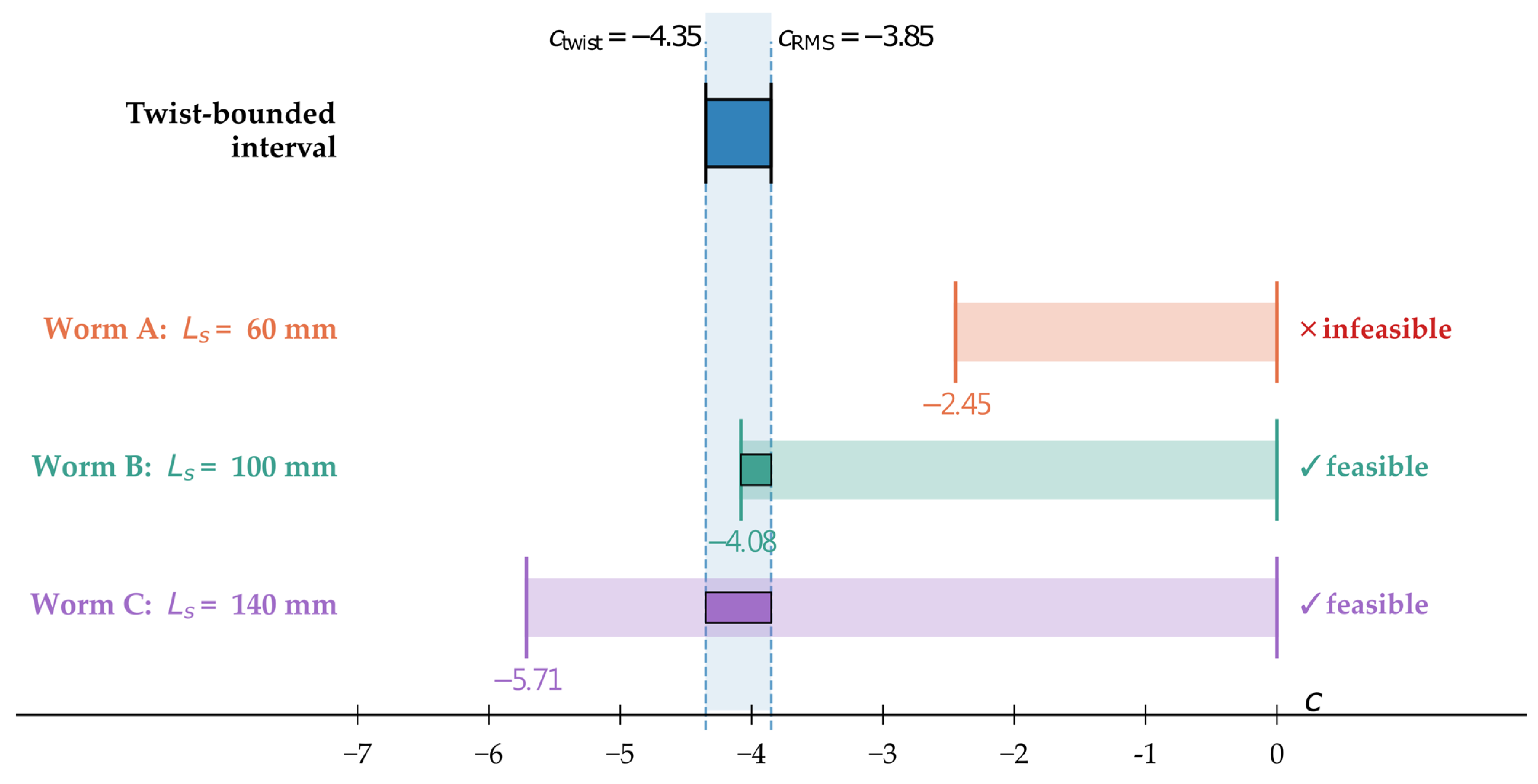
with the sign determined by the chosen direction of the worm shift. For the default work gear with f w = 24.5 mm, the closed-form coefficients c R M S 3.85 and c t w i s t 4.35 of Section 3.4 correspond, respectively, to required worm shift lengths of approximately 94 mm and 107 mm. A grinding worm with L s 100 mm therefore admits c R M S within its usable shift range, whereas c t w i s t falls just outside this bound because c t w i s t f w 107 mm > L s . A shorter worm with L s = 60 mm gives c t o o l     2.45 , which lies outside the twist-constrained interval and prevents the twist-optimized operating point from being reached without additional process measures.
Three design scenarios then arise. In the first scenario, the worm geometry can still be chosen at the design stage, and the recommended choice is L s = c R M S   f w for the minimum residual or L s = c t w i s t   f w for the minimum twist, so that the optimum coefficient is reached exactly while the worm is fully traversed during each cycle. In the second scenario, an existing worm is to be used and the resulting c t o o l from Equation (32) lies within the twist-constrained interval; the framework then operates without modification, and the residual and twist values are obtained by running the iterative SVD scheme of Section 3.3 at the prescribed c. In the third scenario, c t o o l lies outside the twist-constrained interval, and the desired twist threshold cannot be reached by adjusting c alone. Three remedies are available: (a) accept a residual twist higher than what would be achievable with an unconstrained c; (b) use the remaining tool-geometry coefficients a 1 , c 1 , d R , and d L to absorb part of the twist that c cannot remove; or (c) adopt a multi-pass strategy in which a roughing pass traverses the full worm length while a finishing pass uses a shorter traverse with c closer to the topographic optimum.
The combined effect of the twist constraint and the tool-geometry constraint defines a practically admissible interval for the diagonal-feed coefficient as the intersection
c c t w i s t , c R M S L s / f w , + L s / f w
Figure 8 illustrates this intersection schematically for the default case with three representative worm lengths. When the intersection is non-empty, any c within it represents a feasible operating point that satisfies both the topographic and the tool-geometry requirements; when it is empty, one of the three remedies listed above must be invoked, with the choice depending on the relative weight of cost, machine availability, and process flexibility.
This dual-constraint perspective frames the diagonal-feed selection not as a single optimization but as a joint design decision involving both the work-gear specification and the grinding-worm geometry. The closed-form expressions of Section 3.4 enter this decision in two ways: they bracket the topographically optimal range of c without requiring iterative computation, and they provide a direct rule for choosing the worm length L s when the worm geometry is still open at the design stage.

4.6. Engineering Interpretation

The numerical results of Section 4.1, Section 4.2, Section 4.3, Section 4.4 and Section 4.5 admit a clear engineering interpretation. The diagonal-feed coefficient c does not have a single canonical optimum value; rather, it has at least three distinguished values corresponding to three distinct design criteria: even distribution of crowning along the tooth depth ( c e v e n n e s s ), minimum overall topographic residual after SVD correction ( c R M S ), and minimum tooth-flank twist ( c t w i s t ). For typical industrial parameters, these three values differ by 20–50%, with c e v e n n e s s furthest from the standard tool state and c R M S closest to it.
In practice, the relevant design criterion depends on the application. Applications prioritizing geometric accuracy may select c R M S , whereas applications more sensitive to flank-twist-induced contact non-uniformity may select c t w i s t or a value slightly larger than c t w i s t in absolute terms, even at the cost of a small increase in the RMS residual. For applications in which an established standard practice prescribes evenness of crowning rather than absolute minimum twist, c e v e n n e s s remains the appropriate choice.
A practical consequence of the proposed framework is that all three regimes can be accessed without changing the basic tool design: only the diagonal-feed ratio needs to be adjusted on the machine. This in turn implies that a single worm-type generating-tool design can serve a range of design requirements, with the machine setting providing the fine adjustment between minimum residual and minimum twist. The closed-form expressions of Section 3.4 enable this adjustment to be made analytically, without recourse to extensive numerical optimization for each individual design case.

5. Discussion

5.1. Structural Versus Numerical Degeneracy

The sensitivity degeneracy identified in Section 3.2 is a structural property of the diagonal-feed direction in the design space, not an artifact of numerical implementation. It persists for any grid resolution, any reasonable solver tolerance, and any practical perturbation magnitude in the finite-difference construction of the sensitivity matrix. Recognizing this distinction is important: interpreting the degeneracy as merely numerical ill-conditioning would invite stronger regularization or higher-order differencing, neither of which resolves the underlying kinematic cause. The appropriate remedy is instead to initialize the optimization away from the standard uniform-thickness state or to supply the diagonal-feed coefficient from an external estimate.
A related observation is that the seventh singular value of S remains small—though not strictly zero—throughout the iterative SVD scheme. This persistent small singular value reflects the fact that the diagonal-feed direction is a “soft” direction of the design space: large changes in c produce relatively small changes in the deviation field once the longitudinal coefficients are non-zero. The closed-form expressions of Equations (28) and (30) pin down the position of the minimum along this soft direction, and the iterative scheme then takes care of the remaining six “stiff” directions corresponding to the tool-geometry coefficients.
The robustness of the converged diagonal-feed coefficient does not rely on the SVD truncation threshold. The truncation acts only on the linearized correction at each step, where it suppresses the nearly degenerate diagonal-feed direction. The candidate value of c is determined independently of this truncation, either from the closed-form expressions of Section 3.4 or from a direct scan. To confirm that the converged c is a genuine minimum rather than an arbitrary stopping point, the topographic residual was computed as a function of c over the practical interval. The resulting curve is smooth and exhibits a single, well-defined minimum, which coincides with the closed-form prediction within the validation accuracy reported in Section 4.2. This behavior is also consistent with the direct c -scan used to generate the Pareto-like front in Section 4.4 and with the parameter-space validation in Figure 5 and Figure 6. The numerically determined optima were obtained from several distinct starting values and were found to be independent of the initialization. The optimum along the soft direction is therefore an objective minimum of the deviation field within the practical operating interval, not a numerical artifact of the truncation level.

5.2. Process-Agnostic Applicability

The kinematic model developed in Section 2 and the optimization framework of Section 3 are formulated for a generic worm-type generating tool in a crossed-axis configuration. No assumption is made about a single specific manufacturing process, and the same mathematical structure can be interpreted for gear hobbing, continuous generating grinding, gear skiving, or related worm-type generating operations. In that sense, the framework is process-agnostic at the kinematic level within the tested range of geometries considered in this study.
Three caveats apply, however. First, the modification coefficients a 1 , a 2 , c 1 , c 2 , d R , d L of Equations (2)–(4) refer to the equivalent rack-cutter representation of the generating tool, and their physical realization differs across processes. For a VTT hob, they correspond to a continuous variation of the tooth-thickness distribution along the hob axis [7]; for a grinding worm, they correspond to the dressing-induced modifications of the worm profile [14]; for a skiving cutter, the realization is constrained by the geometric tolerances of the cutter blanks [13]. The optimization framework returns the required values of the coefficients, but the practical implementation depends on the process-specific tooling.
Second, the diagonal-feed coefficient c acquires slightly different physical meanings across processes. In gear hobbing, it corresponds to a programmed shift of the hob along its own axis during the axial traverse of the work gear; in continuous generating grinding, it corresponds to the well-known diagonal-feed strategy implemented through the electronic gearbox; in gear skiving, it corresponds to a coordinated motion between the cutter axis and the work-gear axis. In all three cases, however, the linear relation z s = c z a governs the feed coordination, and the optimization framework treats c uniformly as a single scalar design variable.
Third, the sensitivity degeneracy identified in Section 3.2 is structural and therefore not tied to one specific process. It appears whenever a uniform-thickness worm-type generating tool is combined with a linear diagonal-feed relation, regardless of whether the tool is realized as a hob, a grinding worm, or a skiving cutter. The closed-form expressions of Section 3.4 should therefore be viewed as broadly applicable within the validated parameter range, while their exact realization in production still depends on process-specific tooling and machine constraints.
A practical consequence of these process differences concerns the on-machine implementation of the diagonal-feed coefficient. For modern CNC continuous-generating-grinding machines equipped with an electronic gearbox (EGB), the coefficient c determined from the framework can be entered directly as the programmed ratio between the grinding worm’s tangential shift axis and the work gear’s axial-feed axis. The EGB then automatically generates the corresponding rotation compensation on the work-gear C-axis, given by the c-dependent term of Equation (11), to prevent the cutter from inadvertently meshing with an adjacent tooth gap as the worm shifts. In this sense, the coefficient c determined by the proposed framework maps onto a single scalar parameter at the machine level, with the kinematically required rotation compensation handled automatically by the controller.
One practical caution applies. Industrial parameter tables sometimes report the diagonal-feed setting as a normalized “diagonal ratio” or “shift coefficient” referenced to the working face width, rather than as the raw ratio c = z s / z a used in the present analysis. The two conventions are related by a fixed factor that depends on the chosen reference length, and a one-time consistency check against the machine manufacturer’s documentation is recommended before using the closed-form expressions of Section 3.4 in production. For gear-hobbing machines, the diagonal shift is typically programmed in an analogous manner, with the corresponding rotation compensation prescribed by Equation (11). For gear skiving, the implementation depends on the specific cutter-spindle architecture, but the same kinematic structure of the diagonal-feed relation applies. The framework developed in this study is therefore process-agnostic at the level of the design coefficient c, while the practical implementation of c remains process-specific.

5.3. Limitations and Future Work

The present study has five principal limitations, each of which suggests a direction for future work.
First, the closed-form expressions of Section 3.4 are proposed from empirical observation and validated numerically. Although the modal decomposition of Section 3.4.1 provides a physically meaningful interpretation, a rigorous analytical derivation from the meshing equations remains an open problem. Such a derivation would clarify the relation between Equations (28) and (30), extend the formulas to higher-order tool modifications, and determine whether the observed maximum relative error of 1.6% is fundamental or simply a consequence of the present approximation.
Second, the optimization framework has been validated for a single longitudinally crowned target topography. Extension to more general topographies—double crowning, axial root-relief, pressure-angle modification, and combinations thereof—is conceptually straightforward but has not been fully implemented in the present study. The seven-variable design vector defined in Section 2.4 provides a useful starting point for such extensions, but the corresponding sensitivity-matrix conditioning and the form of the closed-form coefficients, if any, for non-longitudinal targets remain to be characterized.
Third, the numerical verification of the handedness sign convention reported in Section 4.2 was based on a single representative opposite-hand configuration with the default operating parameters. A comprehensive parameter sweep across the four handedness combinations (RH+RH, LH+LH, RH+LH, LH+RH) and across the full range of helix and pressure angles considered in Section 4.2 remains to be conducted to confirm the universality of the ∓ sign convention proposed in Equations (28) and (30).
Fourth, the present framework assumes that the operating crossed angle is held fixed during generation. Crossed-angle modulation, used in some advanced topology-modification processes [22,23,24], introduces an additional degree of freedom that is not represented in the current seven-variable design vector. Incorporating crossed-angle modulation as an eighth design variable would extend the framework to topology-modified work-gear flanks but would require a renewed analysis of the sensitivity-matrix conditioning at the resulting standard tool state.
Fifth, the present validation is entirely computational. Although the kinematic model rests on established involute meshing theory and the closed-form coefficients are validated numerically across sixty parameter combinations, experimental confirmation on a CNC generating-grinding or hobbing machine—comparing measured flank topographies before and after the proposed twist correction on a gear-measuring instrument—has not yet been carried out and is a priority for future work. Such measurements would quantify the residual twist achievable in practice once machine-tool errors, tool-preparation or dressing inaccuracies, and elastic effects are included.
Despite these limitations, the framework developed in this study provides a coherent and practically useful basis for twist-constrained worm-type gear generation. Within the validated range, the combination of closed-form guidance and iterative numerical refinement offers both physical interpretability and design-level accuracy.

6. Conclusions

This study has developed an optimization-based framework for twist control in worm-type gear generation that combines closed-form analytical guidance with iterative numerical refinement. The main contributions of the work can be summarized as follows.
  • The sensitivity of the work-gear deviation to the diagonal-feed coefficient was shown to vanish identically at the standard uniform-thickness tool state. This degeneracy is structural rather than merely numerical, and it represents a fundamental obstacle for direct linearization-based optimization of the seven-variable design problem.
  • An iterative singular value decomposition scheme, combined with a warm-start continuation strategy on the work-gear evaluation grid, was developed to overcome the structural degeneracy and to refine the design vector to numerical precision. The iterative scheme converges reliably when initialized from a reasonable estimate of the diagonal-feed coefficient and is robust against the small but persistent singular value associated with the diagonal-feed direction.
  • Two closed-form expressions for the diagonal-feed coefficient were proposed and numerically validated within the tested range. The minimum-residual coefficient targets the root-mean-square deviation of the SVD-corrected topography, whereas the minimum-twist coefficient targets the resulting tooth-flank twist. Together with the analytical evenness coefficient of Hsu and Fong [7], they define three practically distinct design choices for diagonal-feed selection.
  • A twist-constrained workflow was formulated that exploits the closed-form expressions to bracket the feasible interval of the diagonal-feed coefficient at the outset and then refines the full design vector by the iterative SVD scheme. The workflow is applicable to a range of worm-type generating processes—gear hobbing, continuous generating grinding, gear skiving—and the closed-form expressions remain valid in limiting cases such as low-helix work gears generated by multi-start tools, where the evenness coefficient diverges.
Numerical examples for a representative passenger-vehicle helical gear showed that the iterative SVD scheme reduces the RMS deviation from 1.14 μm with the analytical setting [7] to 0.027 μm at the converged operating point, while the closed-form coefficient c R M S provides the same optimal diagonal-feed value in closed form, without a numerical search over c, over the validated range. The minimum-twist coefficient further reduces the twist index from 6.52 μm to 5.40 μm at the cost of a modest increase in RMS deviation to 0.31 μm. These results indicate that the proposed framework provides a reliable computational basis for twist control and diagonal-feed selection in worm-type gear generation.
A further outcome concerns the trade-off between residual and twist: the coefficient that minimizes the overall topographic residual does not simultaneously minimize flank twist. Minimizing the RMS residual balances the crowning and radial deviation modes, whereas minimizing twist requires nulling the twist mode specifically, which calls for a slightly larger diagonal-feed ratio and admits a small radial residual. The two closed-form coefficients therefore bracket a one-parameter family of designs, allowing practitioners to select the operating point according to the dominant design requirement. Applications prioritizing geometric accuracy may choose the minimum-residual setting, whereas applications more sensitive to flank-twist-induced contact non-uniformity may choose the minimum-twist setting or an intermediate compromise.
Future work will focus on deriving the closed-form expressions directly from the underlying meshing equations, extending the framework to more general topographic targets, and incorporating crossed-angle modulation as an additional design variable.

Author Contributions

Conceptualization, R.-H.H.; methodology, R.-H.H. and S.-S.C.; software, S.-S.C.; validation, S.-S.C. and R.-H.H.; formal analysis, S.-S.C.; investigation, S.-S.C.; resources, R.-H.H.; writing—original draft preparation, S.-S.C.; writing—review and editing, R.-H.H. and J.-L.C.; supervision, R.-H.H. and J.-L.C. All authors have read and agreed to the published version of the manuscript.

Funding

This research was funded by the National Science and Technology Council (NSTC), Taiwan, under Grant No. NSTC 113-2221-E-035-055.

Data Availability Statement

The data presented in this study are available on request from the corresponding author.

Conflicts of Interest

The authors declare no conflict of interest.

References

  1. Hotait, M.; Kahraman, A. Experiments on root stresses of helical gears with lead crown and misalignments. J. Mech. Des. 2008, 130, 074502. [Google Scholar] [CrossRef]
  2. Litvin, F.L.; Fuentes, A. Gear Geometry and Applied Theory, 2nd ed.; Cambridge University Press: Cambridge, UK, 2004. [Google Scholar]
  3. Wang, C. Multi-objective optimal design of modification for helical gear. Mech. Syst. Signal Process. 2021, 157, 107762. [Google Scholar] [CrossRef]
  4. ISO 1328-1:2013; Cylindrical Gears—ISO System of Flank Tolerance Classification—Part 1: Definitions and Allowable Values of Deviations Relevant to Flanks of Gear Teeth. International Organization for Standardization: Geneva, Switzerland, 2013.
  5. Bouzakis, K.-D.; Lili, E.; Michailidis, N.; Friderikos, O. Manufacturing of cylindrical gears by generating cutting processes: A critical synthesis of analysis methods. CIRP Ann. 2008, 57, 676–696. [Google Scholar] [CrossRef]
  6. Wagaj, P.; Kahraman, A. Influence of tooth profile modification on helical gear durability. J. Mech. Des. 2002, 124, 501–510. [Google Scholar] [CrossRef]
  7. Hsu, R.-H.; Fong, Z.-H. Novel variable-tooth-thickness hob for longitudinal crowning in the gear-hobbing process. Mech. Mach. Theory 2011, 46, 1084–1096. [Google Scholar] [CrossRef]
  8. Hsu, R.-H.; Su, H.-H. Tooth contact analysis for helical gear pairs generated by a modified hob with variable tooth thickness. Mech. Mach. Theory 2014, 71, 40–51. [Google Scholar] [CrossRef]
  9. Tran, V.-T.; Hsu, R.-H.; Tsay, C.-B. Tooth contact analysis for a double-crowned involute helical gear with twist-free tooth flanks generated by dual-lead hob cutters. J. Mech. Des. 2015, 137, 052601. [Google Scholar] [CrossRef]
  10. Tran, V.-T.; Hsu, R.-H.; Tsay, C.-B. A novel finish hobbing methodology for longitudinal crowning of a helical gear with twist-free tooth flanks by using dual-lead hob cutters. In Proceedings of the ASME 2014 International Mechanical Engineering Congress and Exposition, Montreal, QC, Canada, 14–20 November 2014; Paper No. IMECE2014-36149. [Google Scholar] [CrossRef]
  11. Tian, X.; Zhou, L.; Han, J.; Xia, L. Research on gear flank twist compensation of continuous generating grinding gear based on flexible electronic gearbox. IEEE Access 2021, 9, 151080–151088. [Google Scholar] [CrossRef]
  12. Yu, B.; Kou, H.; Zhao, B.; Shi, Z.; Sun, Y.; Wu, G. Approximation model for longitudinal-crowned involute helical gears with flank twist in continuous generating grinding. Int. J. Adv. Manuf. Technol. 2021, 114, 3675–3694. [Google Scholar] [CrossRef]
  13. Hilligardt, A.; Schulze, V. Gear skiving with minimum twist errors. Forsch. Ingenieurwes. 2023, 87, 997–1007. [Google Scholar] [CrossRef]
  14. Fong, Z.-H.; Chen, G.-H. Gear flank modification using a variable lead grinding worm method on a computer numerical control gear grinding machine. J. Mech. Des. 2016, 138, 083302. [Google Scholar] [CrossRef]
  15. Stadtfeld, H.J. Gleason Bevel Gear Technology: The Science of Gear Engineering and Modern Manufacturing Methods for Angular Transmissions; Gleason Works: Rochester, NY, USA, 2014. [Google Scholar]
  16. Brecher, C.; Brumm, M.; Hübner, F.; Henser, J. Influence of the manufacturing method on the running behavior of beveloid gears. Prod. Eng. 2013, 7, 265–274. [Google Scholar] [CrossRef]
  17. Artoni, A.; Gabiccini, M.; Guiggiani, M. Nonlinear identification of machine settings for flank form modifications in hypoid gears. J. Mech. Des. 2008, 130, 112602. [Google Scholar] [CrossRef]
  18. Gabiccini, M.; Artoni, A.; Guiggiani, M. On the identification of machine settings for gear surface topography corrections. J. Mech. Des. 2012, 134, 041004. [Google Scholar] [CrossRef]
  19. Shih, Y.-P.; Chen, S.-D. A flank correction methodology for a five-axis CNC gear profile grinding machine. Mech. Mach. Theory 2012, 47, 31–45. [Google Scholar] [CrossRef]
  20. Wang, H.; Li, J.; Gao, Y.; Yang, J. Closed-loop feedback flank errors correction of topographic modification of helical gears based on form grinding. Math. Probl. Eng. 2015, 2015, 635156. [Google Scholar] [CrossRef]
  21. Zhang, H.; Fang, C.; Huang, X. Accurate tooth lead crowning without twist in cylindrical helical gear grinding. Adv. Mech. Eng. 2014, 6, 496181. [Google Scholar] [CrossRef]
  22. Han, J.; Zhu, Y.; Xia, L.; Tian, X. A novel gear flank modification methodology on internal gearing power honing gear machine. Mech. Mach. Theory 2018, 121, 669–682. [Google Scholar] [CrossRef]
  23. Tian, X.; Li, D.; Huang, X.; Liu, H.; Han, J.; Xia, L. A topological flank modification method based on contact trace evaluated genetic algorithm in continuous generating grinding. Mech. Mach. Theory 2022, 172, 104820. [Google Scholar] [CrossRef]
  24. Tran, V.-Q.; Wu, Y.-R. Dual lead-crowning for helical gears with long face width on a CNC internal gear honing machine. Mech. Mach. Theory 2018, 130, 170–183. [Google Scholar] [CrossRef]
  25. Han, J.; Jiang, H.; Tian, X.; Li, G.; You, T.; Xia, L. Topology modification method of generating gear grinding based on multi-axis linkage parameter optimization. Int. J. Adv. Manuf. Technol. 2023, 124, 449–466. [Google Scholar] [CrossRef]
  26. Litvin, F.L.; Chen, N.X.; Hsiao, C.-L.; Handschuh, R.F. Generation of helical gears with new surface topology by application of CNC machines. Gear Technol. 1994, 11, 30–33. [Google Scholar]
  27. Radzevich, S.P. Theory of Gearing: Kinematics, Geometry, and Synthesis, 2nd ed.; CRC Press: Boca Raton, FL, USA, 2018. [Google Scholar] [CrossRef]
  28. Hansen, P.C. Rank-Deficient and Discrete Ill-Posed Problems: Numerical Aspects of Linear Inversion; SIAM: Philadelphia, PA, USA, 1998. [Google Scholar] [CrossRef]
  29. Golub, G.H.; Van Loan, C.F. Matrix Computations, 4th ed.; Johns Hopkins University Press: Baltimore, MD, USA, 2013. [Google Scholar]
  30. Feng, Y. The grinding and correction of face gears based on an internal gear grinding machine. Machines 2024, 12, 496. [Google Scholar] [CrossRef]
  31. Nie, S.; Chen, J.; Liu, S. Research on noise reduction of drive axle hypoid gear based on tooth surface mismatch modification. Adv. Mech. Eng. 2024, 16, 16878132241228195. [Google Scholar] [CrossRef]
  32. Tang, J.-P.; Han, J.; Tian, X.-Q.; Li, Z.-F.; You, T.-F.; Li, G.-H.; Xia, L. Flexible modification and texture prediction and control method of internal gearing power honing tooth surface. Adv. Manuf. 2025, 13, 784–798. [Google Scholar] [CrossRef]
  33. Allgower, E.L.; Georg, K. Numerical Continuation Methods: An Introduction; Springer: Berlin, Germany, 1990. [Google Scholar]
Figure 1. Unified schematic of the equivalent rack-cutter construction and the associated coordinate systems used for generating-tool construction.
Machines 14 00679 g001
Figure 2. Coordinate systems for worm-type gear generation. The main derivation uses the tool frame S t , the machine frame S m , and the work-gear frame S w ; the auxiliary frames S g , S c , S s , S p , and S t r are used only to decompose the crossed-angle rotation and the feed motions.
Machines 14 00679 g002
Figure 3. Sampling grid for work-gear flank topography evaluation. (a) Three-dimensional view of the structured 9 × 5 grid covering the active flank region. (b) Two-dimensional unrolled representation showing the longitudinal index i (face-width direction) and radial index j (tooth-depth direction).
Machines 14 00679 g003
Figure 4. Comparison of work-gear flank topographies for the five methods of Table 2. Each panel shows the normal deviation from the unmodified involute on a 9 × 5 grid covering the active flank region. In each panel the dome along the face width is the prescribed 30 μm longitudinal crowning, and the fan-out between the tooth-depth lines (j = 0…4) is the residual flank twist; the twist is largest for the conventional method (i) and is progressively removed in (ii)–(v), with the depth lines in panel (iv) nearly coinciding at the minimized twist.
Machines 14 00679 g004
Figure 5. Validation of the closed-form expression c R M S across the work-gear helix angle. Solid line: prediction of Equation (28). Markers: numerically determined optima from the iterative SVD scheme.
Machines 14 00679 g005
Figure 6. Validation of the closed-form expression c t w i s t across the normal pressure angle. Solid line: prediction of Equation (30). Markers: numerically determined optima from the iterative SVD scheme.
Machines 14 00679 g006
Figure 7. Pareto-like front of RMS residual versus twist index, obtained by sweeping the diagonal-feed coefficient between c t w i s t and c R M S for the default case. The two closed-form coefficients delimit the practically relevant operating interval; arbitrary intermediate values correspond to balanced compromises.
Machines 14 00679 g007
Figure 8. Schematic representation of the admissible interval for the diagonal-feed coefficient as the intersection of the twist-constrained interval c t w i s t , c R M S and the tool-geometry-constrained interval L s / f w , + L s / f w . The default case is shown for three representative grinding worm lengths.
Machines 14 00679 g008
Table 1. Basic parameters of the default case.
ParameterSymbolValue
Work-gear tooth number N w 31
Generating-tool tooth number N t 1
Normal module m p n 2.0 mm
Work-gear helix angle (operating) β o , w 15° (right-hand)
Generating-tool helix angle (operating) β o , t 85.25°
Tool lead angle λ o , t 4.75°
Normal pressure angle α n 20°
Effective face width f w 24.5 mm
Target longitudinal crowning (peak-to-edge)--30 μm
Evaluation grid (longitudinal × radial)--9 × 5 (per flank)
Table 2. Five-method comparison of the default case.
Method c RMS Deviation (μm)Twist Index T t w i s t (μm)
(i) Conventional ( c = 0 )04.4113.59
(ii) Hsu–Fong c e v e n n e s s [7]−5.621.147.59
(iii) Present, c R M S −3.850.0276.52
(iv) Present, c t w i s t −4.350.315.40
(v) Iterative SVD (init. from c R M S )−3.850.0276.52
Table 3. Worst-case relative errors of the closed-form expressions across the parameter sweep.
Varied ParameterRangeMax. Error in c R M S Max. Error in c t w i s t
β o , w 10–25°<0.3%<1.6%
β o , t (equiv. λ o , t )77–89°<0.3%<1.6%
m p n 1.0–4.0 mm<0.6%<0.6%
α n 20–25°<0.5%<1.6%
N w 25–80<0.1%<0.2%
f w 15–40 mm<0.4%<0.5%
Target crowning0.5–40 μm<0.05%<0.05%
Disclaimer/Publisher’s Note: The statements, opinions and data contained in all publications are solely those of the individual author(s) and contributor(s) and not of MDPI and/or the editor(s). MDPI and/or the editor(s) disclaim responsibility for any injury to people or property resulting from any ideas, methods, instructions or products referred to in the content.