
Hierarchical Cooperative Trajectory Planning for Air–Ground Robotic Systems in Communication-Constrained Urban Canyons


Abstract
1. Introduction
- The UGV-UAV cooperative trajectory planning problem is decoupled into a hierarchical computational framework. A guided RL algorithm first derives a high-quality initial solution that mitigates the adverse effects of non-convexity and non-differentiability. This initial solution then serves as a warm start for an optimization-based solver, thereby enhancing real-time performance while improving the quality of feasible solutions.
- We introduce a heuristic search algorithm as prior guidance for the RL agent. The heuristic search provides feasible reference paths in complex topological spaces. Based on this guidance, the RL agent explores a reduced search space. This design helps alleviate the sparse-reward problem caused by complex obstacle configurations and improves the efficiency of initial solution generation.
- To further enhance solver efficiency, a corridor-based constraint formulation method is integrated into the optimization-based solver. This method transforms the original non-convex obstacle avoidance constraints into a set of convex safe corridors, enabling the solver to operate within convex domains and reducing computational overhead for real-time trajectory generation.
2. Related Research
2.1. Trajectory Planning for UGVs or UAVs
2.2. Cooperative Trajectory Planning of UGV-UAV System
2.3. Research on Urban Canyons
3. Problem Statement
3.1. Cost Function
3.2. Constraints
3.2.1. Two-Point Boundary Value Constraints
3.2.2. Kinematic Constraints
3.2.3. Collision Avoidance Constraints
3.2.4. Communication Range Constraints
3.3. Remarks
4. Overall Framework
4.1. Motivation
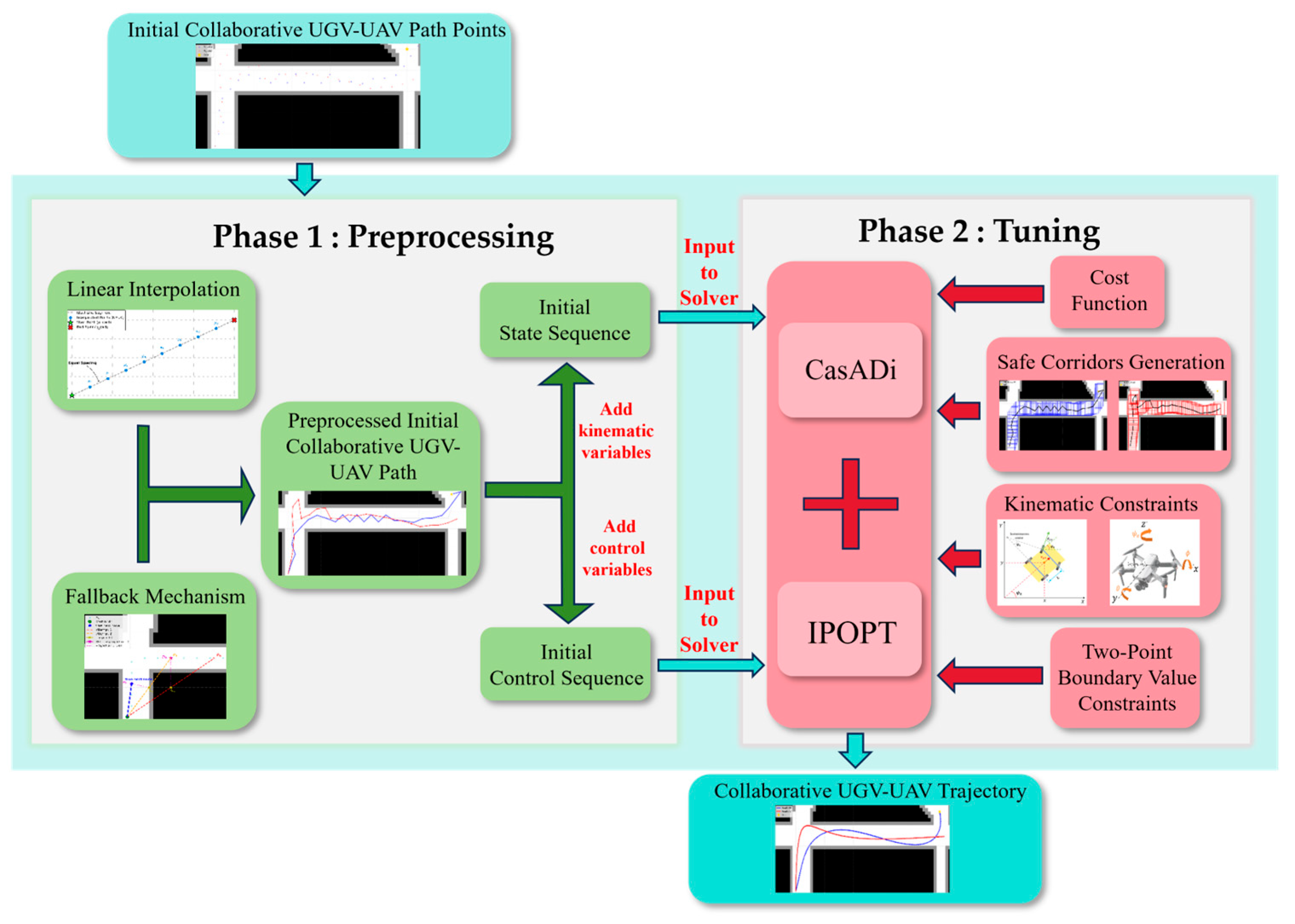
4.2. Two-Layered Planner
5. Methodology
5.1. Upper-Layer Planner
5.1.1. Components and Operational Pipeline
5.1.2. Forward Planning in RL
| Algorithm 1. RL Single-Step Execution Logic |
| Input: Current coordinates , reference paths , action vectors Output: Updated coordinates , step total reward |
| 1: 2: // Update positions with boundary truncation 3: 4: 5: // Calculate reward components 6: ,,, 7: 8: if or then 9: 10: end if 11: if based on then 12: 13: end if 14: if then 15: 16: end if 17: 18: // ‘Soft reset’ strategy for collision avoidance 19: if then 20: 21: 22: end if |
| return |
5.1.3. DRL Training Network
5.2. Lower-Layer Planner
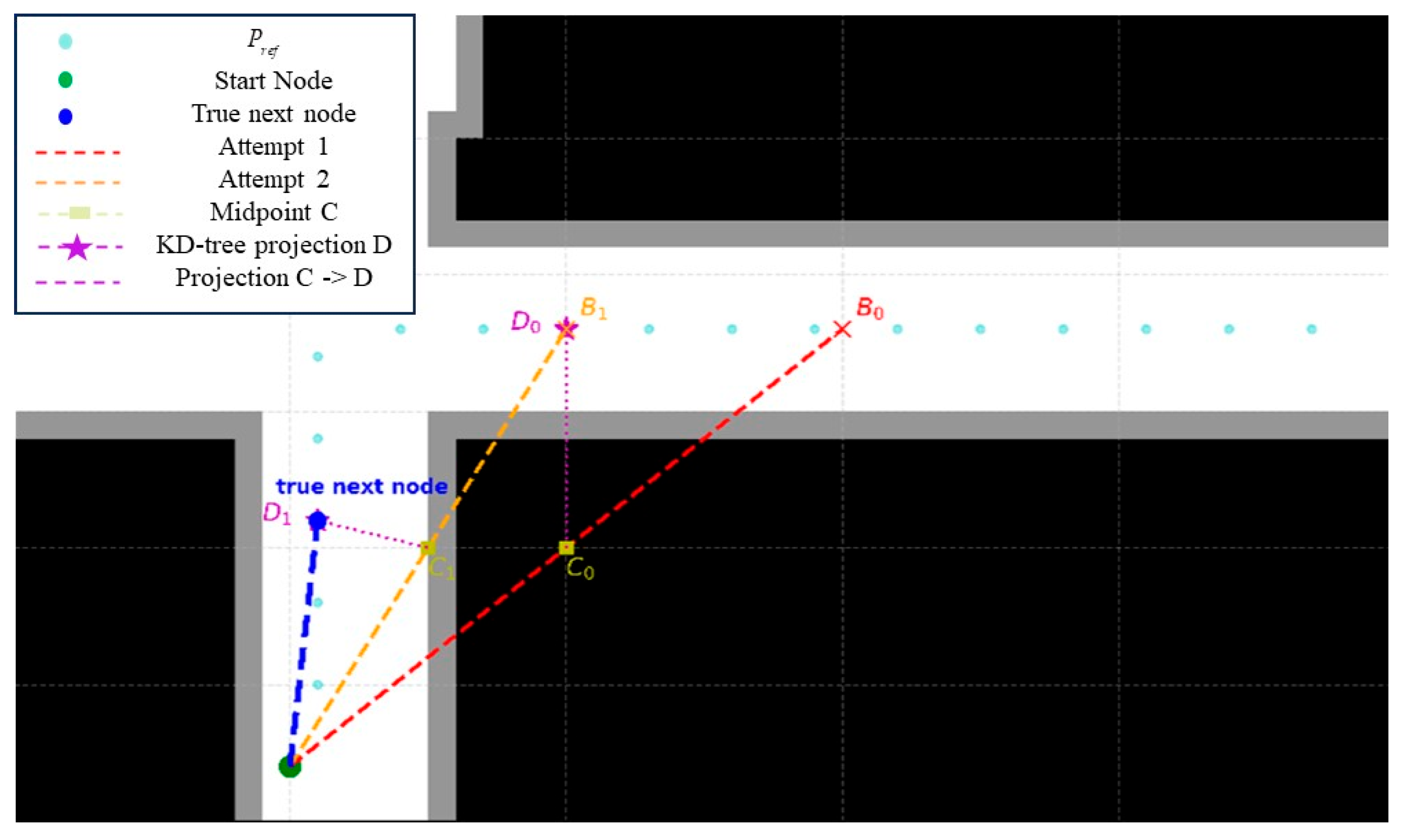
5.2.1. Components and Operational Pipeline
| Algorithm 2. Linear interpolation with KD-tree-based Fallback Mechanism |
| Input: Initial waypoint sequence , A*-guided reference path , Inflated obstacle map , Maximum retry number Output: Interpolated initial waypoint sequence |
| 1: Construct a KD-tree from the A*-guided path 2: 3: for each candidate segment (,) generated from do 4: 5: while (,) collides with and do 6: 7: Query KD-tree to find the nearest A*-guided point to 8: 9: 10: end while 11: 12: 13: end for |
| return |
5.2.2. NLP Resolution via OCDT
5.2.3. Obstacle-Inflation-Based Safe Corridor Generation
| Algorithm 3. Safety-Corridor Generation Based on Map Inflation |
| Input: 3D map , Unified robot radius , Initial path , Expansion limit Output: Safety corridors |
| 1: Step 1: Map Inflation 2: Define Map Element where are voxel index offsets relative to any point in 3: 4: Step 2: Adaptive Box Expansion and Corridor Generation 5: for each do 6: 7: Initialize 8: For UGV expansion (4 directions): 9: 10: while do 11: Expand along by 12: if or then 13: 14: end if 15: end while 16: For UAV expansion (6 directions): 17: 18: while do 19: Expand along by 20: if or then 21: 22: end if 23: end while 24: Construct corridor 25: end for |
| return |
6. Experiments and Results
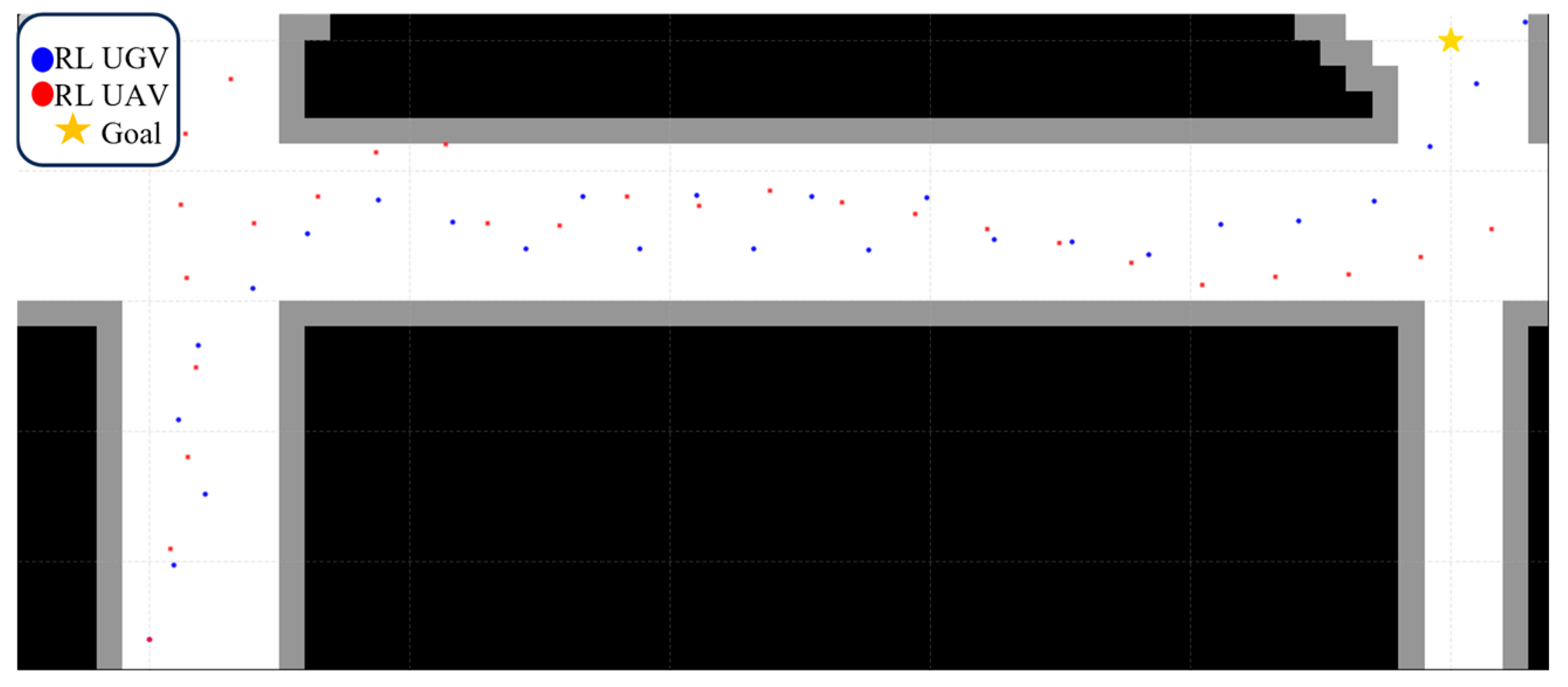
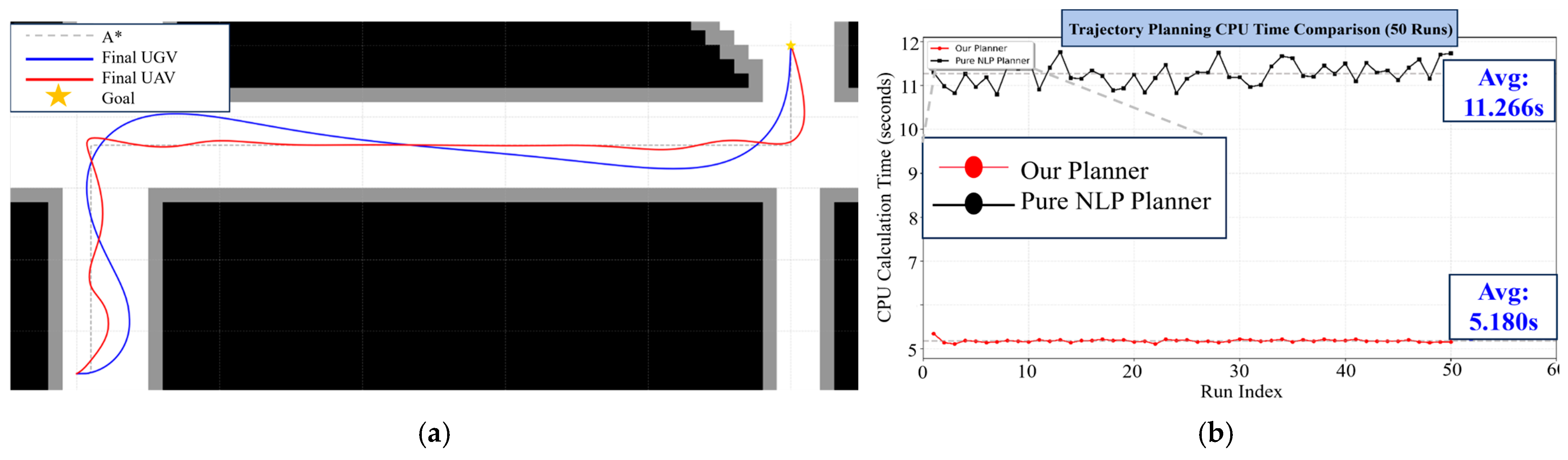
6.1. Visualization of Planning Results
6.2. Ablation and Comparison Experiments
6.2.1. Ablation Experiments
6.2.2. Comparison Experiment
7. Discussion
8. Conclusions
Author Contributions
Funding
Data Availability Statement
Acknowledgments
Conflicts of Interest
References
- Nie, L.; Zhang, T.; Zhao, Y.; Li, Y.; Li, H.; Yang, J. Distributed Multi-Vehicle Cooperative Trajectory Planning and Control for Ramp Merging and Diverging Based on Deep Neural Networks and MPC. Machines 2026, 14, 262. [Google Scholar] [CrossRef]
- Balaska, V.; Tsiakas, K.; Giakoumis, D.; Kostavelis, I.; Folinas, D.; Gasteratos, A.; Tzovaras, D. A Viewpoint on the Challenges and Solutions for Driverless Last-Mile Delivery. Machines 2022, 10, 1059. [Google Scholar] [CrossRef]
- Quero, C.O.; Martinez-Carranza, J. Unmanned aerial systems in search and rescue: A global perspective on current challenges and future applications. Int. J. Disaster Risk Reduct. 2025, 118, 105199. [Google Scholar] [CrossRef]
- Wandelt, S.; Wang, S.; Zheng, C.; Sun, X. AERIAL: A Meta Review and Discussion of Challenges Toward Unmanned Aerial Vehicle Operations in Logistics, Mobility, and Monitoring. IEEE Trans. Intell. Transp. Syst. 2024, 25, 6276–6289. [Google Scholar] [CrossRef]
- Franceschetti, G.; Iodice, A.; Riccio, D. Radio Propagation in the Urban Scenario; Artech House: Norwood, MA, USA, 2023. [Google Scholar]
- Browning, J.W.; Cotton, S.L.; Sofotasios, P.C.; Morales-Jimenez, D.; Yacoub, M.D. A Unification of LoS, Non-LoS, and Quasi-LoS Signal Propagation in Wireless Channels. IEEE Trans. Antennas Propag. 2023, 71, 2682–2696. [Google Scholar] [CrossRef]
- Rappaport, T.S. Wireless Communications: Principles and Practice, 2nd ed.; Cambridge University Press: Cambridge, UK, 2024. [Google Scholar] [CrossRef]
- Meng, X.; Zhang, Z.; Zhu, X.; Zhao, J.; Wu, X.; Zhang, X.; Yang, J. Obstacle Avoidance Path Planning for Unmanned Aerial Vehicle in Workshops Based on Parameter-Optimized Artificial Potential Field A* Algorithm. Machines 2025, 13, 967. [Google Scholar] [CrossRef]
- Qiao, L.; Luo, X.; Luo, Q. Control of Trajectory Tracking for Mobile Manipulator Robot with Kinematic Limitations and Self-Collision Avoidance. Machines 2022, 10, 1232. [Google Scholar] [CrossRef]
- Bao, Z.; Zhang, Z.; Xie, C. Landmark selection and path planning for unmanned vehicles with position error corrections. Transp. Res. Part C Emerg. Technol. 2023, 153, 104186. [Google Scholar] [CrossRef]
- Chen, X.; Qin, G.; Sun, J. Coordinated routing policy for connected vehicles to monitor city-wide traffic. Transp. Res. Part C Emerg. Technol. 2025, 176, 105147. [Google Scholar] [CrossRef]
- Wu, Y.; Low, K.H.; Hu, X. Trajectory-based flight scheduling for AirMetro in urban environments by conflict resolution. Transp. Res. Part C Emerg. Technol. 2021, 131, 103355. [Google Scholar] [CrossRef]
- Ayalew, M.; Zhou, S.; Memon, I.; Heyat, M.B.B.; Akhtar, F.; Zhang, X. View-Invariant Spatiotemporal Attentive Motion Planning and Control Network for Autonomous Vehicles. Machines 2022, 10, 1193. [Google Scholar] [CrossRef]
- Du, W.; Guo, T.; Chen, J.; Li, B.; Zhu, G.; Cao, X. Cooperative pursuit of unauthorized UAVs in urban airspace via Multi-agent reinforcement learning. Transp. Res. Part C Emerg. Technol. 2021, 128, 103122. [Google Scholar] [CrossRef]
- Xia, H.; Zhang, M.; Ma, Z.; Cui, M.; Yan, C. Optimization of Urban Emergency Multimodal Transportation Scheduling with UAV-Ground Traffic Coordination. IEEE Trans. Intell. Transp. Syst. 2026, 27, 692–708. [Google Scholar] [CrossRef]
- Wang, C.; Wang, J.; Ma, Z.; Xu, M.; Qi, K.; Ji, Z.; Wei, C. Integrated Learning-Based Framework for Autonomous Quadrotor UAV Landing on a Collaborative Moving UGV. IEEE Trans. Veh. Technol. 2024, 73, 16092–16107. [Google Scholar] [CrossRef]
- Zeng, F.; Chen, Z.; Clarke, J.-P.; Goldsman, D. Nested vehicle routing problem: Optimizing drone-truck surveillance operations. Transp. Res. Part C Emerg. Technol. 2022, 139, 103645. [Google Scholar] [CrossRef]
- Park, J.; Choi, S.; Kim, T.; Lee, C.; Lee, S. Public Bus-Assisted Task Offloading for UAVs. IEEE Trans. Intell. Transp. Syst. 2024, 25, 20561–20573. [Google Scholar] [CrossRef]
- Qin, P.; Wang, Y.; Zhang, J.; Li, P.; Fu, Y. Multi-Type Disaster Scenario Task Offloading in Air–Ground Integrated Search and Rescue Networks: A Blockchain-Assisted MFL Approach. IEEE Trans. Veh. Technol. 2025, 74, 19583–19597. [Google Scholar] [CrossRef]
- Xie, R.; Meng, Z.; Wang, L.; Li, H.; Wang, K.; Wu, Z. Unmanned Aerial Vehicle Path Planning Algorithm Based on Deep Reinforcement Learning in Large-Scale and Dynamic Environments. IEEE Access 2021, 9, 24884–24900. [Google Scholar] [CrossRef]
- Oubbati, O.S.; Alotaibi, J.; Alromithy, F.; Atiquzzaman, M.; Altimania, M.R. A UAV-UGV Cooperative System: Patrolling and Energy Management for Urban Monitoring. IEEE Trans. Veh. Technol. 2025, 74, 13521–13536. [Google Scholar] [CrossRef]
- Sun, L.; Wan, L.; Wang, J.; Lin, L.; Gen, M. Joint Resource Scheduling for UAV-Enabled Mobile Edge Computing System in Internet of Vehicles. IEEE Trans. Intell. Transp. Syst. 2023, 24, 15624–15632. [Google Scholar] [CrossRef]
- Jang, G.; Lee, K. Joint Optimization of Path Planning and Cooperative Strategy for UAV–UGV Delivery. IEEE Trans. Intell. Transp. Syst. 2025, 26, 20176–20186. [Google Scholar] [CrossRef]
- Li, K.; Cui, H.; Meng, Q.; Zhang, X. Dynamic truck-drone collaborative transportation during hurricanes. Transp. Res. Part C Emerg. Technol. 2025, 180, 105322. [Google Scholar] [CrossRef]
- Yoon, S.; Lee, K. Optimal Load Balancing of Cooperative UAV-UGV Parcel Pickup to Minimize Completion Time. IEEE Trans. Intell. Transp. Syst. 2025, 26, 12712–12718. [Google Scholar] [CrossRef]
- Li, Y.; Wang, S.; Sun, H.; Zhou, S. Collaborative vessel–unmanned aerial vehicle routing for time-window-constrained offshore parcel delivery. Transp. Res. Part C Emerg. Technol. 2025, 178, 105189. [Google Scholar] [CrossRef]
- Ma, Z.; Xiong, J.; Gong, H.; Wang, X. Adaptive Depth Graph Neural Network-Based Dynamic Task Allocation for UAV-UGVs Under Complex Environments. IEEE Trans. Intell. Veh. 2025, 10, 3573–3586. [Google Scholar] [CrossRef]
- Zhu, B.; Zheng, Y.; Wang, M.; Ge, Q.; Huang, Y. IMM-AIS-UKF: A GAN-Enhanced Dynamics-Constrained Trajectory Predictor with DDPG Method for UAV-USV Interaction. IEEE Trans. Intell. Transp. Syst. 2025. [Google Scholar] [CrossRef]
- Tian, L.; Wang, X.; Chen, H. Heterogeneous Formation Tracking for Fixed-Wing UAVs and Nonholonomic UGVs with Different Asymmetric Constraints. IEEE Trans. Veh. Technol. 2025, 74, 13350–13360. [Google Scholar] [CrossRef]
- Yan, Y.; Liang, H.; Cheng, Y.; Li, T. Robust Distributed Formation Control for Heterogeneous UAVs–UGVs Systems: An Adaptive Asymptotic Funnel Control Approach. IEEE Trans. Veh. Technol. 2025, 74, 15619–15630. [Google Scholar] [CrossRef]
- Liang, H.; Yang, S.; Li, T.; Zhang, H. Distributed Adaptive Cooperative Control for Human-in-the-Loop Heterogeneous UAV-UGV Systems with Prescribed Performance. IEEE Trans. Intell. Veh. 2024, 9, 6912–6925. [Google Scholar] [CrossRef]
- Cosenza, C.; Malfi, P.; Melluso, F.; Nicolella, A.; Niola, V.; Savino, S.; Spirto, M.; Tordela, C. A Virtual Sensor for Wheel Angular Speed Estimation: Application on a Differential Drive Wheeled Robot. J. Intell. Robot. Syst. 2025, 111, 117. [Google Scholar] [CrossRef]
- Zhao, X.; Tang, P.; Song, Q.; Jiang, T.; Wang, Y.; Tian, L.; Li, W.; Zhang, J. Experimental Analysis of Multipath Effects on GNSS Positioning in Urban Canyon. In Proceedings of the 2021 IEEE 4th International Conference on Electronic Information and Communication Technology (ICEICT), Xi’an, China, 14–16 May 2021; pp. 557–562. [Google Scholar] [CrossRef]
- Liu, X.; Wen, W.W.; Huang, F.; Gao, H.; Wang, Y.; Hsu, L. 3-D LiDAR-Aided GNSS NLOS Mitigation for Reliable GNSS-RTK Positioning in Urban Canyons. IEEE Trans. Instrum. Meas. 2025, 74, 1–15. [Google Scholar] [CrossRef]
- Zhong, Y.; Wen, W.; Hsu, L.-T. Trajectory Smoothing Using GNSS/PDR Integration via Factor Graph Optimization in Urban Canyons. IEEE Internet Things J. 2024, 11, 25425–25439. [Google Scholar] [CrossRef]
- Ni, H.; Chen, P.; Yu, G.; Chen, Z. Collaborative trajectory planning for CAVs at unstructured intersections considering departure time windows and terrain features. IEEE Trans. Veh. Technol. 2026. [Google Scholar] [CrossRef]
- Liao, Y.; Yu, G.; Chen, P.; Zhou, B.; Li, H. Integration of Decision-Making and Motion Planning for Autonomous Driving Based on Double-Layer Reinforcement Learning Framework. IEEE Trans. Veh. Technol. 2024, 73, 3142–3158. [Google Scholar] [CrossRef]
- Huang, L.; Chai, R.; Chen, K.; Zhang, J.; Chai, S.; Xia, Y. Navigating Partially Unknown Environments: A Weakly Supervised Learning Approach to Path Planning. IEEE Trans. Intell. Veh. 2024, 9, 7084–7096. [Google Scholar] [CrossRef]
- Biegler, L.T. Nonlinear Programming: Concepts, Algorithms, and Applications to Chemical Processes; Society for Industrial and Applied Mathematics: Philadelphia, PA, USA, 2010; pp. 287–324. [Google Scholar] [CrossRef]
- Akay, R.; Yildirim, M.Y. Multi-strategy and self-adaptive differential sine–cosine algorithm for multi-robot path planning. Expert Syst. Appl. 2023, 232, 120849. [Google Scholar] [CrossRef]
- Zhu, W.; Fang, W.; Su, Y. Path Planning for Multi-UAV Based on Improved Proximal Policy Optimization Algorithm. In Proceedings of the 2024 39th Youth Academic Annual Conference of Chinese Association of Automation (YAC), Dalian, China, 7–9 June 2024; pp. 1890–1894. [Google Scholar] [CrossRef]
- Wang, J.; Li, J.; Yang, J.; Meng, X.; Fu, T. Automatic Parking Trajectory Planning Based on Random Sampling and Nonlinear Optimization. J. Frankl. Inst. 2023, 360, 9579–9601. [Google Scholar] [CrossRef]









| Symbol | Description |
|---|---|
| Position of the UGV | |
| Heading angle of the UGV | |
| Velocity of the UGV | |
| UGV state vector | |
| UGV control vector | |
| Position of the UAV | |
| UAV roll, pitch, and yaw angle | |
| Complete UAV state vector | |
| Velocity of the UAV | |
| Body-frame angular velocity of the UAV | |
| Complete UAV control vector | |
| Joint state vector of the UGV-UAV system | |
| Joint control vector of the UGV-UAV system | |
| Transformation matrix from the body-frame angular velocities to the Euler angle rates |
| Parameter | Description and Unit | Value |
|---|---|---|
| Map Dimension | Length/Height of simulated urban canyon environment (m) | |
| Resolution | Resolution of the map | |
| Goal Tolerance | Threshold to determine a successful arrival at the goal | |
| Obstacle Inflation Radius | Inflation radius to raw map (m) | |
| Maximum Communication Range | Maximum stable communication link distance between UGV and UAV (m) | |
| Wheelbase | Distance between the front and rear axles of UGV (m) | |
| RL Step Range of UGV/UAV | UGV/UAV displacement per step under the RL policy (m) | / |
| UGV/UAV Velocity Range | Velocity range for UGV/UAV in the lower-layer planner (m/s) | / |
| UGV Acceleration Range | Acceleration range of the UGV in the lower-layer planner (m/s2) | |
| Maximum Steering Angle/Maximum Inclination Angle | Maximum of the UGV’s front-wheel steering angle (rad)/Maximum of UAV’s roll and pitch angles (rad) | / |
| Maximum Angular Velocity | Roll/Pitch/Yaw velocity of the UAV (rad/s) | |
| Communication penalty constant | Unit penalty for each NLoS communication occurrence | 1.0 |
| Reward Function Parameters | |||
| Parameter | Symbol | Value | Description |
| UGV progress reward weight | 2 | Weight for UGV progress reward | |
| UAV progress reward weight | 4 | Weight for UAV progress reward | |
| Collision penalty weight | 20 | Penalty for obstacle collision | |
| Communication blockage penalty weight | 2 | Penalty for NLoS communication | |
| Neural Actor Network Parameters | |||
| Layers | Number | Size | Activation Function |
| Input | 1 | 80 × 100 × 100 + 5 | - |
| Hidden | 6 | 32, 64, 256, 64, 64, 128 | ReLU |
| Output | 1 | 5 | Tanh |
| Neural Critic Network Parameters | |||
| Layers | Number | Size | Activation Function |
| Input | 1 | 80 × 100 × 100 + 5 | - |
| Hidden | 6 | 32, 64, 256, 64, 64, 128 | ReLU |
| Output | 1 | 1 | - |
| PPO Training Parameters | |||
| Parameter | Symbol | Value | Description |
| Actor learning rate | 2 × 10⁻⁴ | Learning rate of the Actor network | |
| Critic learning rate | 1 × 10⁻³ | Learning rate of the Critic network | |
| Discount factor | 0.99 | Discount factor for cumulative reward | |
| PPO clipping threshold | 0.2 | Clipping threshold in PPO objective | |
| Entropy coefficient | 0.01 | Entropy regularization coefficient | |
| Replay buffer size | 2048 | Size of experience replay buffer | |
| Batch size | 32 | Mini-batch size for PPO update | |
| Number of PPO epochs | 10 | Update epochs per iteration | |
| Maximum steps per episode | 200 | Maximum time steps in each episode | |
| Total number of episodes | 4000 | Total number of training episodes | |
| Algorithm | UGV Collision Rate | UAV Collision Rate | NLoS Rate | UGV Smoothness | UAV Smoothness | Computational Times (s) | Solver Success Rate |
|---|---|---|---|---|---|---|---|
| Layered Planner | 0.0% | 0.0% | 0.0% | 0.0157 | 0.0165 | 6.172 | 100% (only once) |
| sdSCA | 24.8 ± 15.5% | 0.0 ± 0.0% | 48.0 ± 10.1% | 0.1842 ± 0.1500 | 0.7151 ± 0.0977 | 220.471 ± 75.693 | 60.9% |
| RB-PPO | 3.8% | 7.7% | 3.7% | 0.7785 | 0.443 | 0.594 | 100% (only once) |
| RRT*-NLP | 0.1 ± 0.6% | 0.0 ± 0.3% | 0.5 ± 1.2% | 0.2202 ± 0.0813 | 0.3097 ± 0.1331 | 16.679 ± 4.981 | 82% |
| Comparison | UGV Collision Rate | UAV Collision Rate | NLoS Rate | UGV Smoothness | UAV Smoothness | Computational Times (s) |
|---|---|---|---|---|---|---|
| sdSCA vs. Layered Planner | 1.78 × 10⁻⁷ *** | 1.000 ns | 5.27 × 10⁻⁹ *** | 2.13 × 10⁻¹⁴ *** | 2.13 × 10⁻¹⁴ *** | 2.13 × 10⁻¹⁴ *** |
| Cooperative RRT*-NLP vs. Layered Planner | 0.204 ns | 0.635 ns | 0.020 * | 2.13 × 10⁻¹⁴ *** | 2.13 × 10⁻¹⁴ *** | 5.86 × 10⁻⁸ *** |
| RB-PPO vs. Layered Planner | n/a | n/a | n/a | n/a | n/a | n/a |
Disclaimer/Publisher’s Note: The statements, opinions and data contained in all publications are solely those of the individual author(s) and contributor(s) and not of MDPI and/or the editor(s). MDPI and/or the editor(s) disclaim responsibility for any injury to people or property resulting from any ideas, methods, instructions or products referred to in the content. |
© 2026 by the authors. Licensee MDPI, Basel, Switzerland. This article is an open access article distributed under the terms and conditions of the Creative Commons Attribution (CC BY) license.
Share and Cite
Ge, D.; Bu, F.; Zhuang, Y.; Ni, H. Hierarchical Cooperative Trajectory Planning for Air–Ground Robotic Systems in Communication-Constrained Urban Canyons. Machines 2026, 14, 594. https://doi.org/10.3390/machines14060594
Ge D, Bu F, Zhuang Y, Ni H. Hierarchical Cooperative Trajectory Planning for Air–Ground Robotic Systems in Communication-Constrained Urban Canyons. Machines. 2026; 14(6):594. https://doi.org/10.3390/machines14060594
Chicago/Turabian StyleGe, Dongting, Fan Bu, Yufeng Zhuang, and Haoyuan Ni. 2026. "Hierarchical Cooperative Trajectory Planning for Air–Ground Robotic Systems in Communication-Constrained Urban Canyons" Machines 14, no. 6: 594. https://doi.org/10.3390/machines14060594
APA StyleGe, D., Bu, F., Zhuang, Y., & Ni, H. (2026). Hierarchical Cooperative Trajectory Planning for Air–Ground Robotic Systems in Communication-Constrained Urban Canyons. Machines, 14(6), 594. https://doi.org/10.3390/machines14060594