Article

Optimization of Lightweight Design for a Certain Range Hood Model Under Strength and Vibration Limitations

1
Faculty of Maritime and Transportation, Ningbo University, Ningbo 315211, China
2
Changshan County Highway, Port, Shipping, and Transportation Management Center, Quzhou 324200, China
3
Fotile Group Ningbo Fotile Kitchenware Co., Ltd., Ningbo 315336, China
*
Authors to whom correspondence should be addressed.
Machines 2026, 14(5), 566; https://doi.org/10.3390/machines14050566
Submission received: 17 April 2026 / Revised: 14 May 2026 / Accepted: 14 May 2026 / Published: 19 May 2026
(This article belongs to the Section Machine Design and Theory)

Abstract

To address structural redundancy and excessive vibration in a specific range hood model, this study focuses on structural lightweighting design optimization. Under strength and resonance avoidance constraints, optimization integrates experimental testing and finite element analysis. Modal analysis reveals a prominent resonance at 49.8 Hz, which coincides with the test results. Topography optimization of the impeller side plate ribs shifts its natural frequency, eliminating resonance while reducing weight significantly. Subsequently, topography optimization of key parts such as the fan housing improves stiffness, facilitating further lightweighting. Two optimization methods, direct solver and orthogonal experiment were applied to minimize the total mass under strength and dynamic constraints. Both schemes met all design requirements with weight reductions of 17.7% and 18.3%, respectively. Vibration test of the optimized design shows that accelerations at key points were reduced significantly.

1. Introduction

Currently, with the continuous advancement of technology, household appliances are trending toward lighter weights and smaller sizes. The sales volume of products in the appliance industry is substantial, but their performance often suffers from over-engineering, with low utilization rates of structural and material resources, leading to unnecessary production costs. Lightweight design can significantly contribute to reducing production costs [1]. Additionally, excessive vibration during the operation of appliances such as range hoods not only accelerates mechanical wear, shortens service life, and causes noise pollution and structural fatigue, increasing maintenance costs, but also degrades performance, negatively impacting smoke purification efficiency [2]. Meanwhile, current lightweight structural technologies primarily focus on automotive applications, with relatively limited research on vibration reduction and lightweighting for household appliances. Therefore, this paper takes a specific model of Fotile range hood as the research subject, addressing its vibration and lightweighting needs, and conducts an in-depth study centered on resource conservation and green design.
Vibration control technologies are mainly divided into active and passive methods [3]. Passive vibration reduction involves installing damping devices between the vibration source and the system to absorb and dissipate vibrational energy or adjusting the mass distribution of the structure to achieve vibration suppression. Hu et al. [4] reduced the radiated noise of a range hood by optimizing the shell thickness. Zheng Dawei et al. [5] resolved abnormal noise issues in the impeller by increasing the thickness of the rear ring, thereby altering its natural frequency. Li S et al. [6] achieved vibration reduction by fixing the bracket to the compressor cleaning device, avoiding mechanical system resonance. Schmitt R V et al. [7] proposed that the stiffness of vibration isolators is a key factor in evaluating system vibration characteristics, and adjusting isolator stiffness can optimize vibration reduction effects.
Lightweight design is an important direction in product design, aiming to reduce product weight and enhance performance through material, process, and structural optimizations [8]. Kang, Ji Heon et al. [9] designed a carbon fiber-reinforced composite automotive B-pillar reinforcement, manufactured via injection and compression processes, achieving significant weight reduction. Hou, Zhanghao et al. [10] developed an innovative 3D printing integration technology, particularly suitable for producing lightweight structural components with complex shapes, high mechanical performance, and multifunctional continuous fiber-reinforced composites. Hartmann M et al. [11] used OptiStruct software to perform topological optimization on a battery casing, significantly improving dynamic stiffness, avoiding resonance frequency ranges, and enhancing static strength. Homsnit Thonn et al. [12] determined the initial thickness of rod surfaces and core structures for all components of an electric heavy-duty four-wheel vehicle, then conducted free-size optimization with mass minimization as the goal, considering material costs, to identify the optimal thickness for each layer of the hard-shell sandwich structure. Recent studies on metaheuristic and population-based optimization techniques provide broader methodological perspectives for multi-constraint structural lightweight design, supporting the optimization strategies adopted in this work [13,14,15]. Recent studies on vibration and lightweight optimization for household appliances [16,17] and thin-walled stiffened structures [18,19] further support the research context of this study.

2. Theoretical Analysis

2.1. Modal Analysis Theory

Modal characteristics represent the inherent vibration properties of a structural system. Each mode corresponds to specific modal parameters, including natural frequency, mode shape, and damping ratio. The governing differential equation for finite element modal analysis is given by Equation (1) [20,21]:
M { x ¨ t } + C { x ˙ t } + K { x t } = { f t }
In the equation, M represents the system’s overall mass matrix; C denotes the system’s overall damping matrix; K signifies the system’s overall stiffness matrix; { x t } , { x ˙ t } and { x ¨ t } correspond to the system’s nodal displacement, velocity, and acceleration vectors, respectively; and { f t } represents the global external load vector acting on the system.
Since the modal parameters of the range hood system are essentially unaffected by damping, the damping effect can be neglected. When the system structure is in free vibration mode, the value of { f t } becomes 0. Consequently, the free vibration equation of the complete system’s modal without damping is expressed in Equation (2) [22]:
M { x ˙ t } + K { x t } = 0
During free vibration, all nodes in the system undergo simple harmonic motion, and the displacement at any point can be expressed by Equation (3):
x t = ϕ c o s ω t
In the equation, { ω } is the angular frequency; { } is the amplitude column vector.
By combining Equations (2) and (3), we obtain:
K ω 2 M ϕ = 0
Since { } is a non-zero vector, by setting d e t ( K ω 2 M ) = 0 , we can solve for the system’s eigenvalues { ω } and { } . Given that ω = 2 π f , this allows for the calculation of each order’s natural frequency and mode shape of the vibration system.

2.2. Structural Lightweighting and Optimization Design Methods

Topography optimization is essentially based on the principles of optimal design. Using a finite element simulation model as the foundation, it firstly discretizes the geometric structure. Taking the coordinate positions of each node as input conditions, the method allows free transformation within the design space, with a specific physical response value as the optimization objective. Through computational analysis, the grid nodes are iteratively repositioned to form reinforcing ribs until the design constraints are satisfied. The final output provides the optimal coordinate positions for each node, enabling geometric surface reconstruction to achieve the optimal topography. The mathematical model for topography optimization is expressed in Equation (5) [23,24].
e = ( e 1 , e 2 , e 3 , , e N ) T M i n C = D T K ( e i ) D 0 e i D m a x
In the equation, e i represents the displacement vector of element nodes within the specified design domain; C denotes the structural compliance; D indicates the displacement vector of element nodes under specified loading conditions; K ( e i ) signifies the optimized structural stiffness magnitude at element nodes; and D m a x represents the prescribed maximum allowable movement limit for element nodes.
Size optimization, as a subset of structural optimization techniques, falls under the category of parametric optimization. It achieves optimal design by adjusting dimensional parameters of structures, including: thickness of shell elements, mass properties of concentrated mass points, magnitude of applied loads, and cross-sectional areas of beam members. The objective function typically aims to: minimize structural weight, maximize stiffness, and optimize overall performance. The simplest form of size optimization follows a linear relationship, expressed as:
p = C 0 + d i C i
In the equation, p represents the optimization objective; C 0 denotes the constant term; d i indicates the design variable; and C i corresponds to the linear coefficient of each design variable.
When linear relationships prove insufficient, complex relationships between beam cross-sectional area, moment of inertia, and torsional constant can be established by introducing functional equations. This study primarily focuses on optimizing sheet metal thickness for lightweight purposes. Consequently, the optimization targets the thickness parameter T in shell element properties. With only one design variable d 1 required, and given prescribed parameters C 0 = 0 and C 1 = 1 , the equation reduces to its simplest form:
T = d 1

3. Whole Machine Vibration Analysis and Damping Optimization

3.1. Vibration Testing and Finite Element Modal Analysis

3.1.1. Vibration Testing and Spectrum Analysis

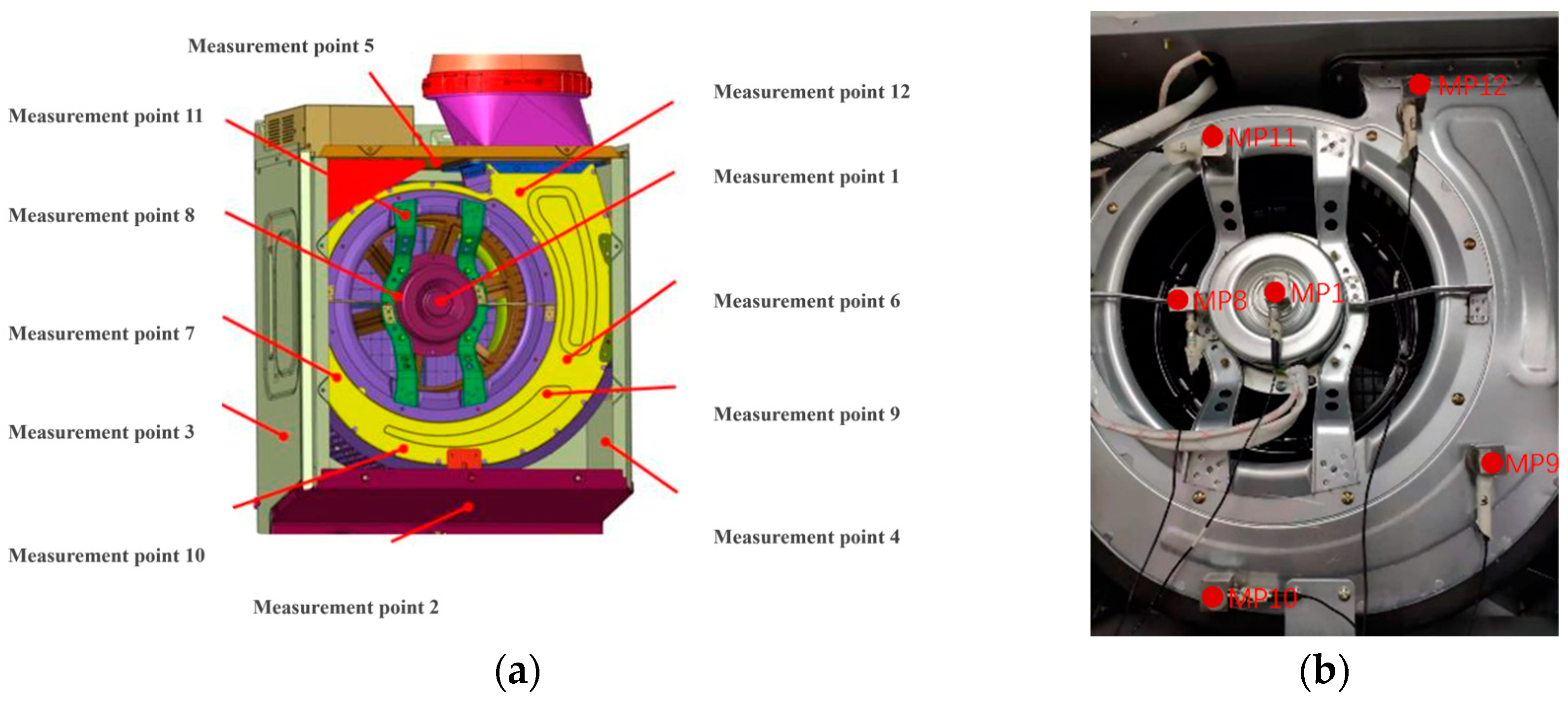
The DH5922D dynamic signal testing system was employed to acquire triaxial acceleration data from 12 measurement points on the range hood operating at maximum power setting. A three-axis IEPE accelerometer (Model 1A314E, Donghua, Jingjiang, China) was used, with a sensitivity of 10 mV/g, a measurement range of 500 g, a frequency response of 0.5–7000 Hz, and a mass of 17 g. Six experimental trials were conducted, with each trial maintaining a 30 s data acquisition duration.
In this study, the selection of measurement points on the range hood was based on the client’s observation of significant vibration at the impeller side panel. A total of 12 test points were strategically distributed across key sheet metal components and the impeller side panel, as illustrated in Figure 1. The specific arrangement is as follows: Measurement points 1 and 8 are positioned on the motor housing, points 2 to 5 are located on sheet metal components, and point 11 is situated on the impeller rib, while all remaining measurement points are distributed across the impeller side panel.
After removing abnormal data, the average value of the remaining test data was calculated. The average vibration acceleration data of each measuring point of the whole machine under different gear positions are shown in Table 1.
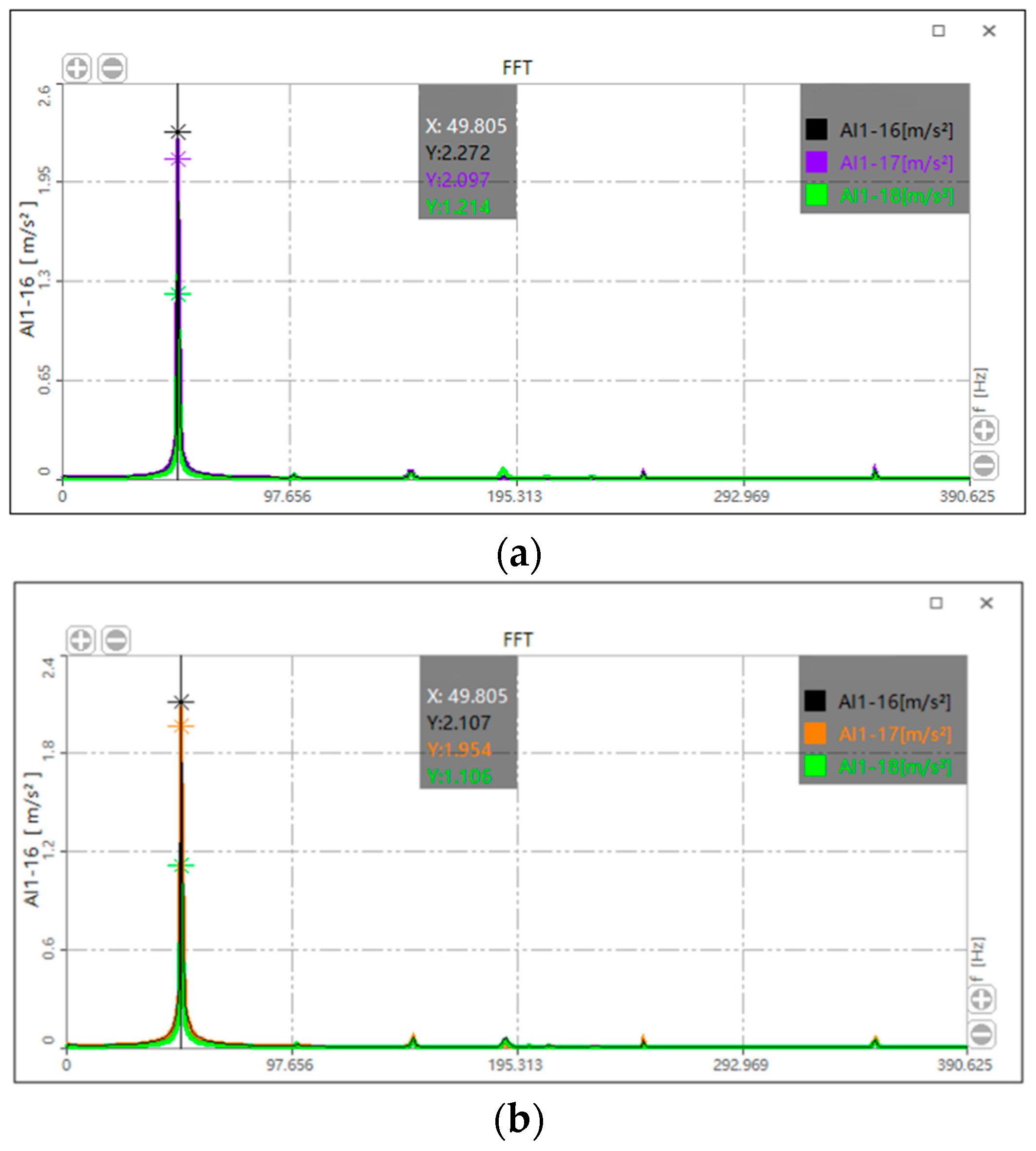
The test data indicate that the vibration acceleration values at measuring points 6 and 12 are relatively high. Subsequent optimization should focus on reducing vibration in these areas while avoiding resonance in the range hood. Therefore, the test data from points 6 and 12 were selected for analysis. Points 6 and 12 are located near the impeller side plate. The measured time-domain acceleration signals were converted into frequency-domain data using FFT (Fast Fourier Transform). The corresponding frequency spectrum diagrams for points 6 and 12 are shown in Figure 2.
The frequency analysis of the two measuring points in Figure 2 reveals that both points exhibit prominent peaks at 49.805 Hz across all three directions (X, Y, and Z). This indicates that the range hood experiences resonance at the motor’s fundamental frequency of 49.8 Hz.

3.1.2. Finite Element Modal Analysis and Calibration

This study employs HyperMesh (version 2019.1, Altair Engineering, Inc., Troy, MI, USA) software to establish a finite element model of the range hood assembly. The element size of all components is controlled within 2–15 mm. Connection points are simulated through node coupling, with CBAR elements used to model screw and bolt connections. Welding spots and snap-fit connections between components are established using either RBE2 rigid elements or TIE constraints. Material properties are assigned to each sheet metal component, with element attributes configured according to their actual thickness specifications. The final mesh consists of 1,105,020 elements and 330,105 nodes. A combination of solid and shell elements was employed. A schematic diagram of the complete finite element model is presented in Figure 3.
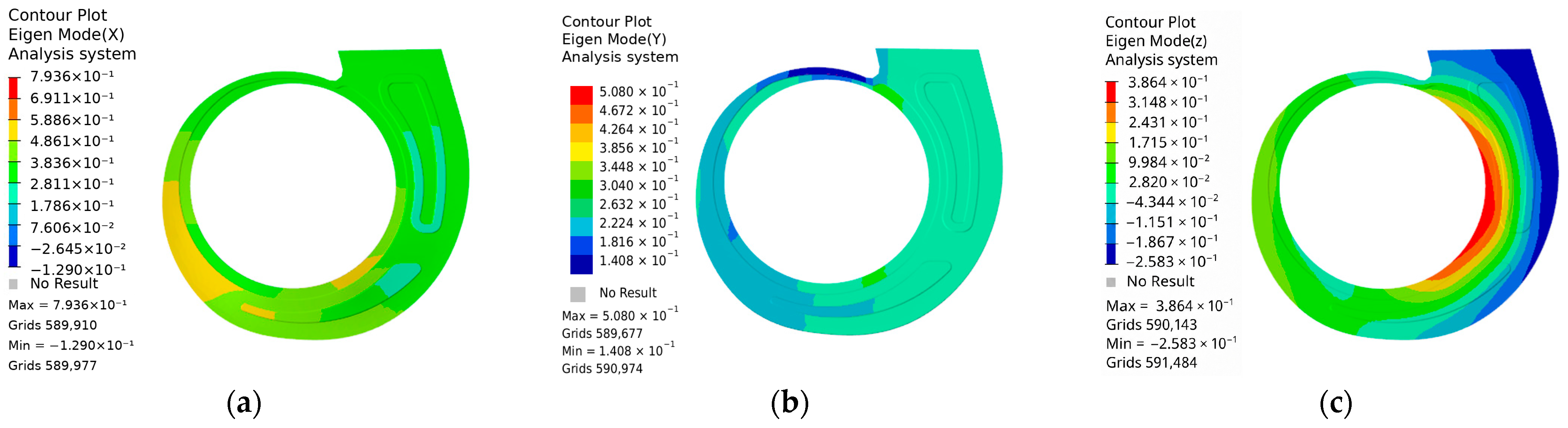
Modal analysis was performed on the integrated range hood finite element model. Through boundary condition sensitivity studies, the optimal simulation parameters were determined to be spring constraints of 8500 N/mm (X-direction), 8000 N/mm (Y-direction), and 4500 N/mm (Z-direction) and applied to all nodes of the wall simulation model. This configuration yielded simulation results consistent with experimental measurements. Under these boundary conditions, localized vibration occurred on the impeller side panel at 49.967 Hz, with the corresponding vibration contour plot presented in Figure 4. The close agreement between the simulated frequency and the experimental result indicates a high consistency between finite element analysis and test measurements. These findings confirm resonance at the motor’s fundamental frequency of 49.8 Hz. A dedicated experimental modal test was not performed; however, the finite element modal analysis predicts a natural frequency of 49.967 Hz for the impeller side panel, which is within 0.34% of the motor operating frequency (49.8 Hz) observed in the forced vibration spectra. This close agreement, together with the vibration mode shape shown in Figure 4, confirms that resonance was the cause of the excessive vibration at points 6 and 12. Consequently, subsequent component optimization should prioritize shifting modal frequencies away from this excitation source through targeted design modifications.

3.2. Vibration Reduction in Lightweight Through Topography Optimization

Vibration testing and modal analysis identified resonance near the motor’s fundamental frequency. This finding led to the implementation of topography optimization, which should avoid resonance while guaranteeing structural weight reduction at the same time.
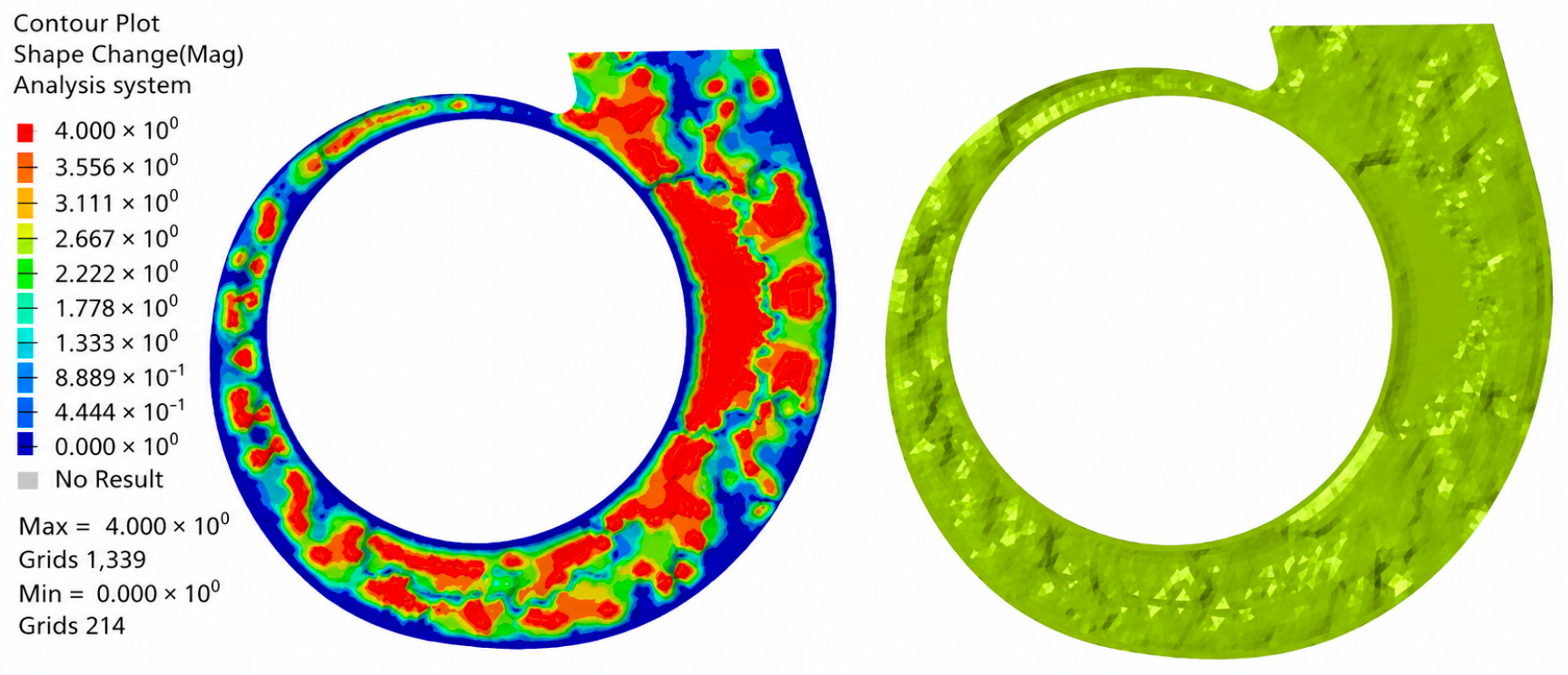
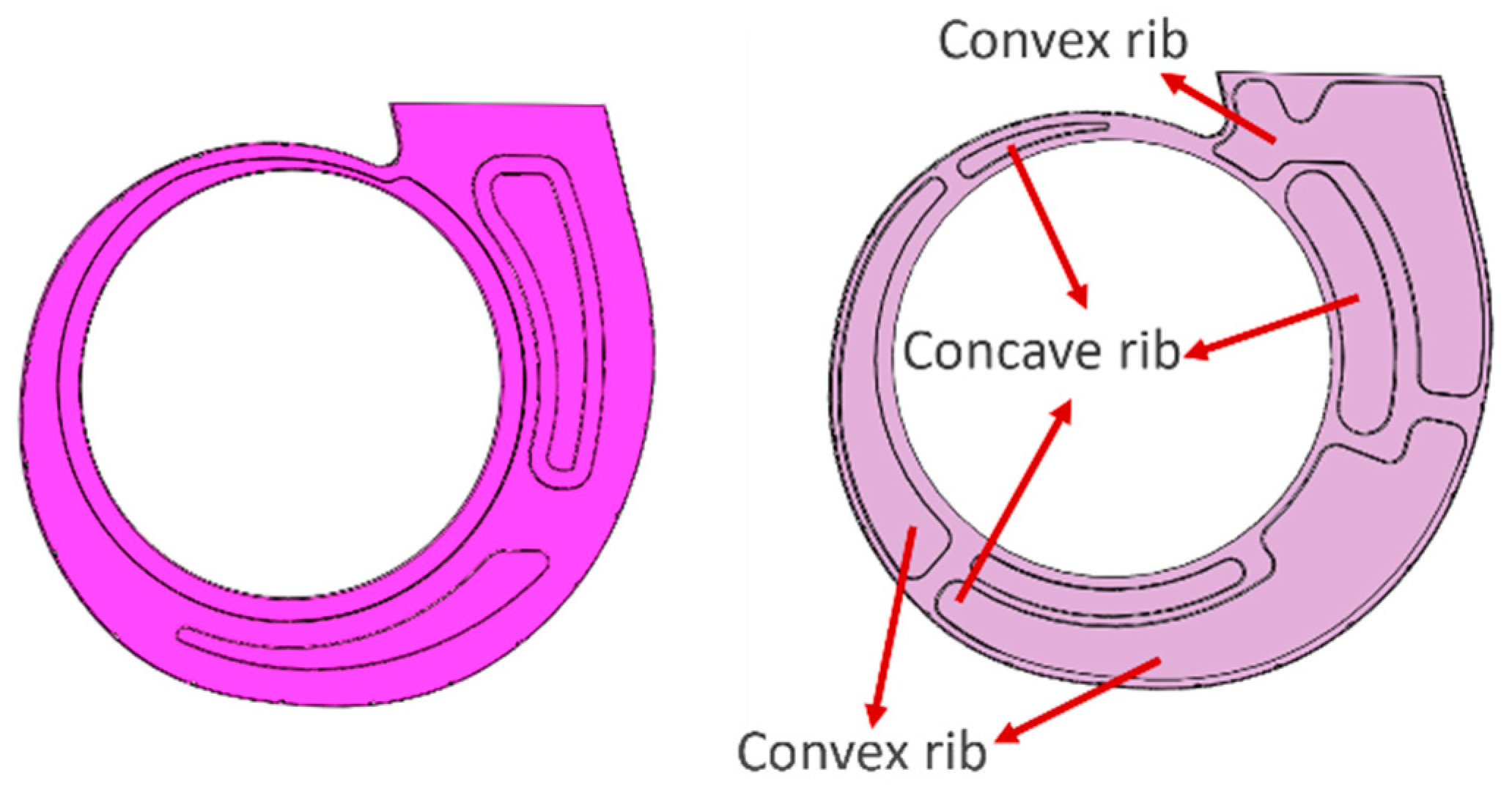
To avoid the influence of the fundamental excitation frequency, topography optimization was performed for this component in OptiStruct. The optimization algorithm works by perturbing the coordinates of surface nodes within the design domain to form stiffening ribs. The optimization was set up with the front surface of the impeller side plate as the design variable and the modal frequency of the range hood as the design response. The optimization was set with the constraint that the fundamental and second-order natural frequencies must avoid the excitation frequency band, and with the objective of maximizing the first-order natural frequency. Rib parameters were strictly controlled as follows: rib heights of 3–5 mm, a minimum rib width of 10 mm, and rib angles between 60° and 70°. The optimization converged after 10 iterations, and the resulting rib height distribution is shown in Figure 5.
Following the optimization of the impeller side panel, a modal analysis was conducted. As shown in Table 2, the natural frequencies of all orders successfully avoided both the fundamental excitation frequency of 49.805 Hz and its second to third-order harmonics. This effectively prevents resonance with the motor, thereby preliminarily resolving the issue of excessive vibration in the range hood.
Based on the ribbing results recommended by topography optimization, considering requirements such as manufacturing feasibility, feature details, and assembly conditions, the final ribbing solution was designed in the 3D modeling software SolidWorks 2023 (Dassault Systèmes SolidWorks Corporation, Waltham, MA, USA), as shown in Figure 6.

4. Whole Machine Strength Evaluation and Stiffness Optimization

4.1. Whole Machine Strength Characteristics Analysis

The rib reinforcement scheme after the optimization of the impeller side plate is incorporated into the finite element model, and the assembly load of the range hood and the dynamic load under the operating state of the centrifugal fan are applied to carry out the overall strength analysis.
The range hood is suspended on the wall through a hook, which is fixed by tightening four expansion screws. A tightening torque of 3 N·m is applied to each screw, and gravity is applied to the finite element model of the assembled range hood. Frictional contact is established between the back of the range hood body and the wall surface, with the friction coefficient set to 0.2, to simulate the stress state of the range hood when it is statically suspended on the wall in a non-working state.
To simulate the actual stress conditions of each component under rotation of the centrifugal fan impeller, vibration acceleration loads are applied to the impeller and the motor turntable. These loads are based on the vibration acceleration signal measured at the motor center under the highest gear setting. Acceleration loads of 0.441 m/s2, 0.392 m/s2, and 0.502 m/s2 are, respectively, applied in the X, Y, and Z directions to simulate the operating condition of the centrifugal fan impeller.
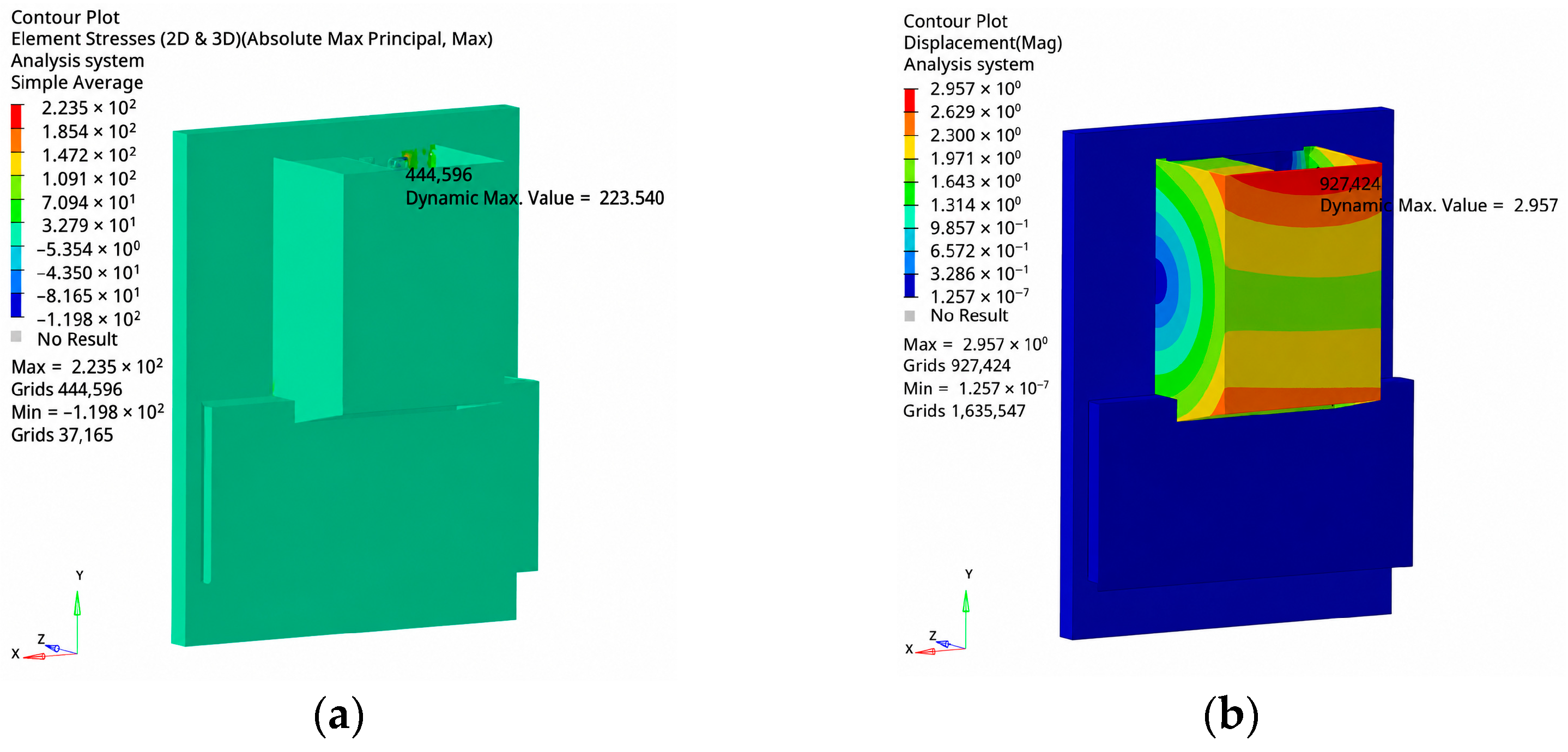
The overall stress nephogram of the range hood under the assembly load condition is shown in Figure 7a. It can be seen from the figure that the maximum principal stress value of the entire range hood is 223.540 MPa, and the maximum stress value does not exceed the strength limit of the corresponding DC01 material (270 MPa). The stress distribution is relatively uniform, meeting the strength requirements. The overall displacement deformation nephogram is shown in Figure 7b. The maximum displacement deformation of the entire machine is 2.957 mm, which exceeds the enterprise product use requirement of 2 mm. The position of the maximum deformation is located at the upper end of the fan cover on the side away from the wall. From the displacement nephogram, it can be seen that the suspension area of the upper part of the range hood protrudes more and has a large deformation, which is much larger than that of the lower box area, consistent with the test results.
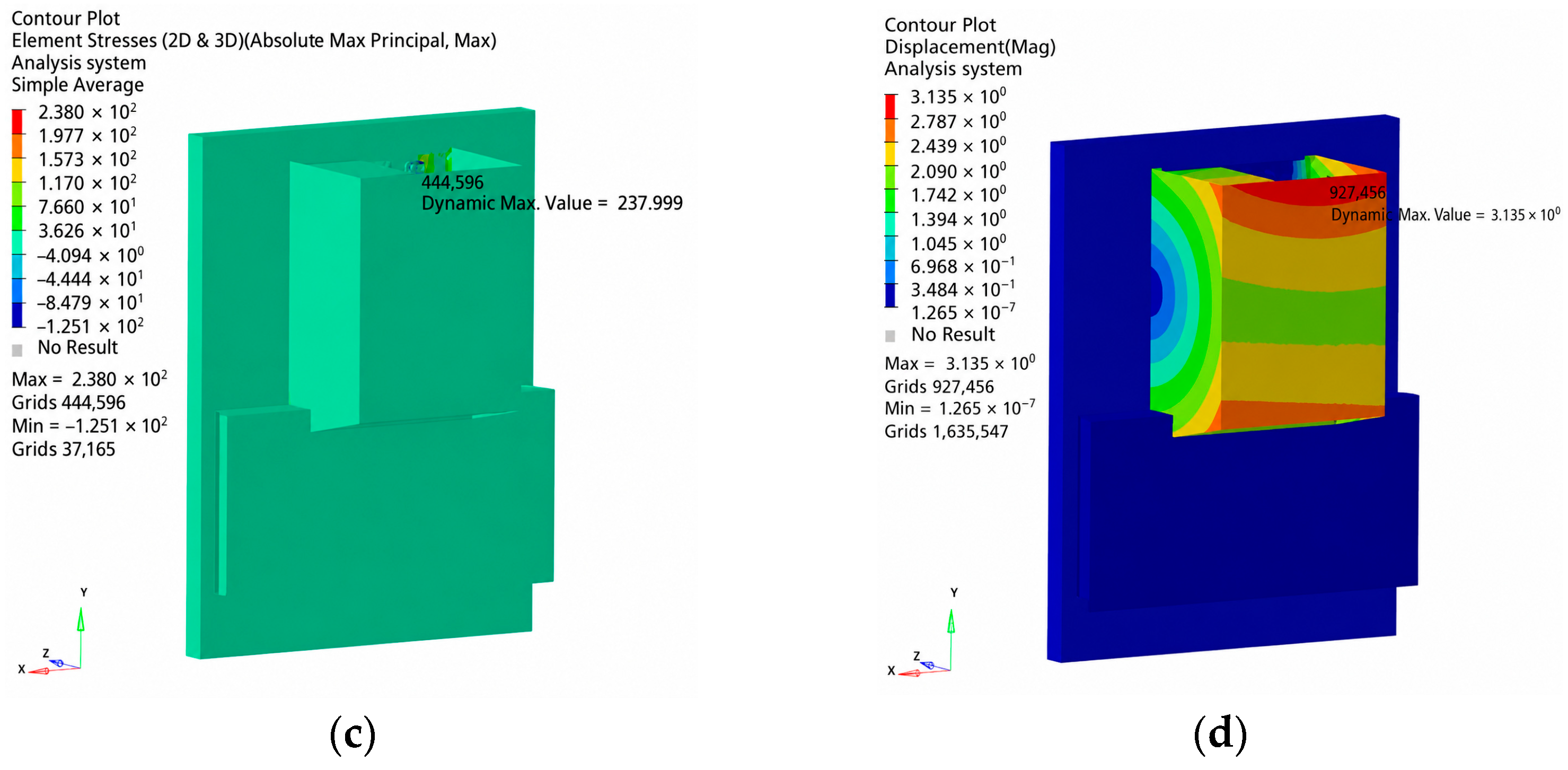
The operating condition of the centrifugal fan is analyzed by adding the dynamic loads to the assembly load condition. Figure 7c shows the overall stress nephogram of the range hood under this condition. The maximum principal stress of the whole machine is 237.999 MPa, slightly higher than that under the assembly load condition, and the maximum stress does not exceed the strength limit of DC01 material (270 MPa). The overall displacement deformation nephogram is shown in Figure 7d. The maximum displacement deformation of the whole machine is 3.135 mm, far exceeding the enterprise product requirement of 2 mm, indicating that optimization design is needed.
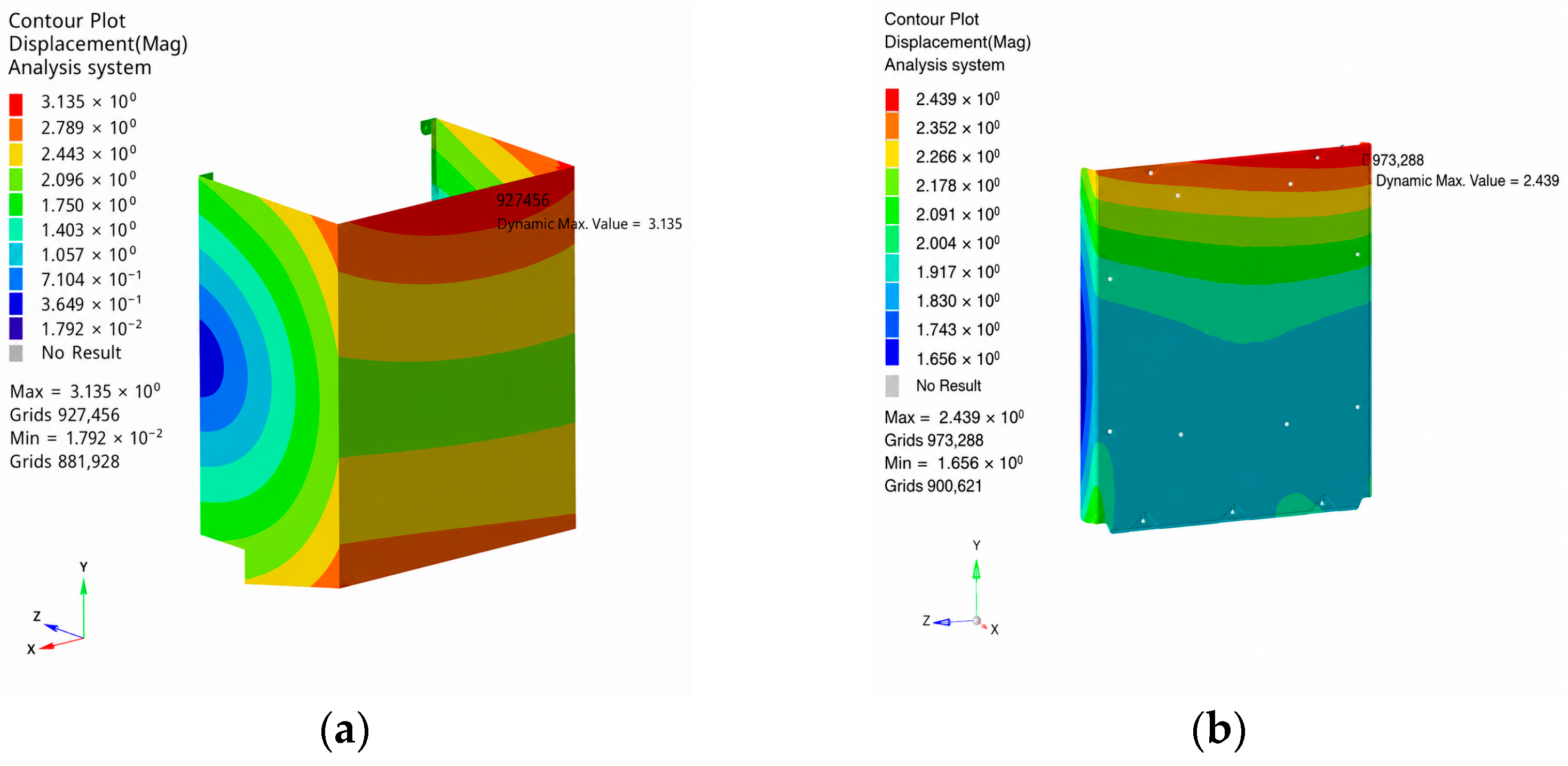
From the strength analysis results, it can be seen that from the assembly load condition to the operating condition of the centrifugal fan, the maximum stress and maximum displacement of the whole machine and each main component show an increasing trend. The range hood is subjected to the maximum force when the centrifugal fan is operating. In order to further analyze the stress distribution and deformation of each main component of the range hood, and identify the components with design defects for subsequent optimization design, the stress nephograms and displacement deformation nephograms of each main component were analyzed. It is found that the maximum deformation of the fan cover and fan housing exceeds the design requirements. The displacement deformation nephograms of the fan cover and fan housing are shown in Figure 8.

4.2. Stiffness Optimization in Lightweight Through Topography Optimization

Preliminary nephogram analysis reveals excessive deformation in the fan housing and cover, exceeding the design limit and indicating insufficient stiffness. To address this, topography optimization is employed to redesign the stiffening rib layout and geometry for both components. This approach aims not only to enhance structural stiffness but also to achieve material redistribution and weight reduction, thereby pursuing the co-optimization of stiffness and lightweighting.
(1)
Optimization Design of Fan Casing
Using the Topography module in OptiStruct software (version 2019, Altair Engineering, Inc., Troy, MI, USA), a topography optimization and strength compensation design was performed on the fan casing. The design variables were the displacement coordinates of each node on the fan casing. The rib height was controlled to 1 mm, the rib angle was set to 65 degrees during optimization, and the rib width was 30 mm. With static displacement as the design response, the constraint condition was that the maximum displacement should be less than 2 mm, and the optimization objective was to minimize the mass. Additionally, a symmetric constraint was set for the rib shape, and the calculation was submitted for topography optimization analysis. The optimization results are shown in Figure 9a.
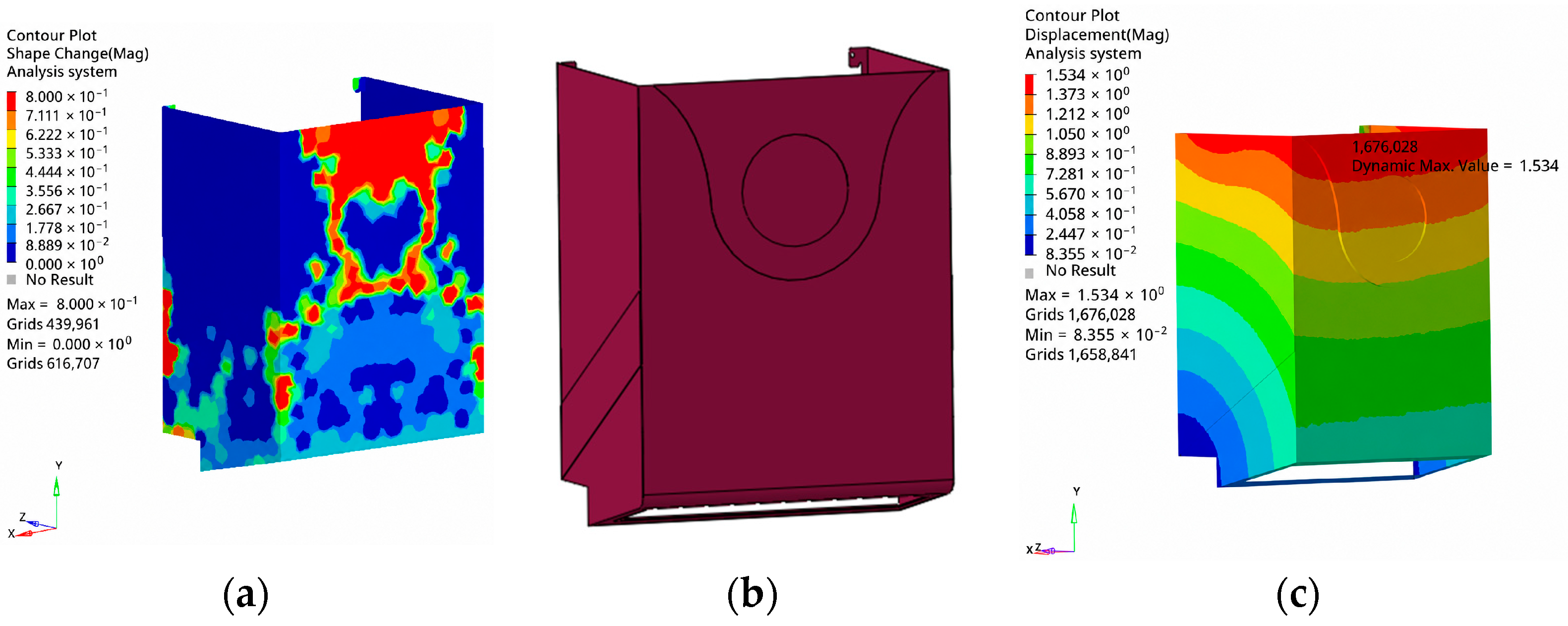
From the figure, it can be seen that the red area is the optimized rib region. The ribs on the upper front part of the fan casing are significantly optimized, indicating that this area has the lowest stiffness, which is consistent with the simulation displacement results. The maximum rib height was 0.8 mm. Accordingly, the rib height for subsequent rib optimization design was uniformly set to 0.8 mm.
Using the OSSmooth tool under the post function of HyperMesh, the topography optimization results were exported in step. format. The STEP geometric model was imported into SolidWorks as a reference. Considering factors such as formability, feature details, and assembly manufacturing, the geometric model of the fan cover was redesigned according to the general outline of the topography optimization results, resulting in the final ribbed design of the fan casing shown in Figure 9b.
The geometric model of the final rib design for the fan casing is imported into HyperMesh again for meshing, with the mesh size kept consistent with that before optimization. Contact connections are established with the whole range hood model, and the loading conditions under various working conditions of the range hood remain unchanged to conduct strength analysis on the optimized fan casing. Under the operating condition of the centrifugal fan, the displacement deformation cloud diagram of the optimized fan casing is shown in Figure 9c. The maximum displacement deformation decreases from 3.135 mm to 1.534 mm, a reduction of 51.07%. The deformation meets the design requirements and improves the stiffness of the fan casing.
(2)
Optimization Design of Fan Cover
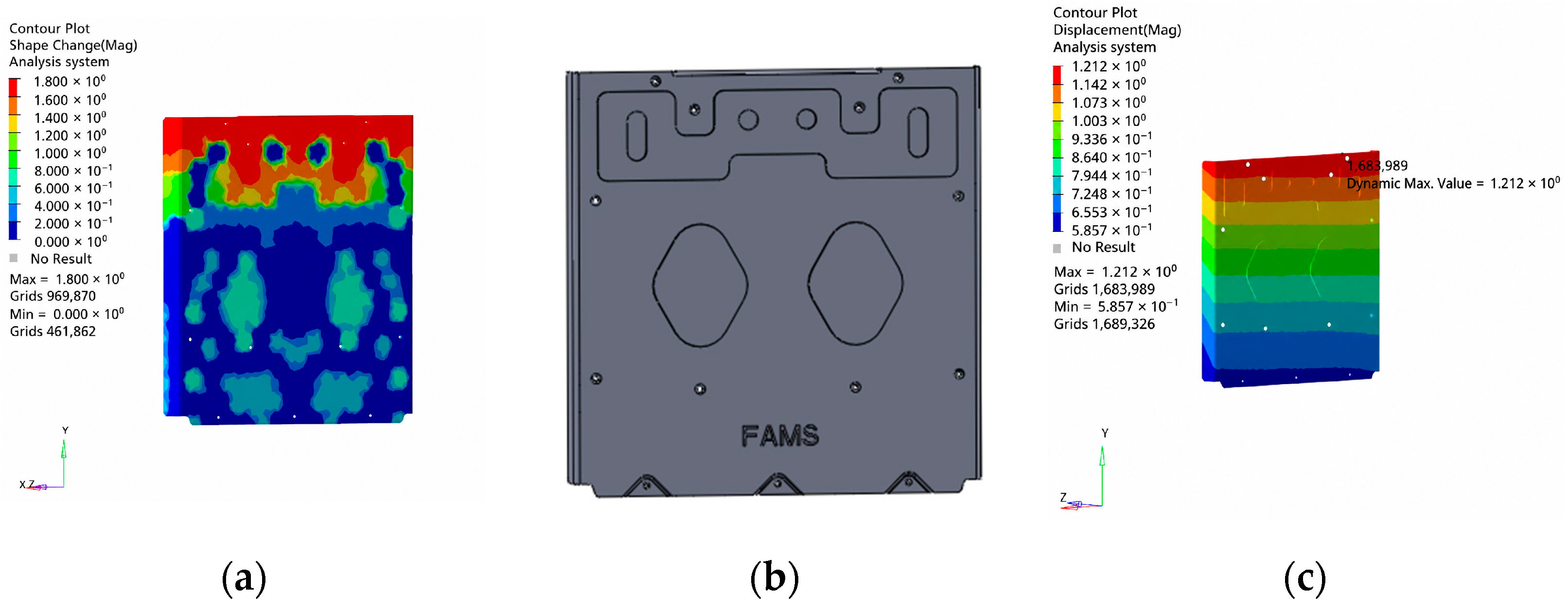
A topography optimization and strength compensation design was conducted for the fan cover by setting rib parameters: rib height at 3 mm, rib angle at 65°, rib width at 30 mm, symmetric constraint for rib shape, and maximum rib layers set to 1. A static displacement response was established with the design constraint of maximum displacement less than 2 mm and the objective of mass minimization for topography optimization analysis, and the optimization results are shown in Figure 10a. It can be seen from the rib displacement deformation cloud diagram that the calculation results converge when the maximum rib height is 1.8 mm. According to the general outline of the optimization scheme and the rib displacement cloud diagram, the geometric model of the fan cover was redesigned in 3D modeling software, with the rib height in the upper rib region of the fan cover designed as 1.8 mm and the rib height in the two diamond-shaped rib regions in the middle designed as 1 mm, and the geometric model of the final rib design is shown in Figure 10b.
Strength analysis was conducted on the optimized fan cover, and the displacement cloud diagram of the optimized fan cover is shown in Figure 10c. The maximum displacement deformation decreased from 2.439 mm to 1.212 mm, with a reduction of 50.31%, significantly improving the problem of insufficient stiffness of the fan cover. The increase in the stiffness of each component provides more design space for the subsequent size optimization in structural lightweighting.

5. Lightweight Design Optimization of Component Dimensions Considering Strength and Vibration Constraints

5.1. Relative Sensitivity Analysis of Sheet Metal Parts

To achieve efficient lightweight design, this study employs a two-stage sizing optimization strategy. First, sensitivity analysis is used to screen nine key components from twenty panels, thereby reducing the dimensionality of the design space. Subsequently, based on the screening results, orthogonal experiments are applied for refined optimization within the reduced space to determine the optimal panel thickness combination that satisfies all multiple constraints.
To investigate the impact of thickness variations in each sheet metal component of the range hood on overall mass, strength, and modal frequencies, this study uses OptiStruct software to perform sensitivity analysis. Taking the thickness of 20 main panels as design variables, and using mass, stress, displacement, and avoidance of 1st–3rd order excitation frequencies as response indicators, the analysis targeted total mass minimization. By calculating mass sensitivity, strength sensitivity, and modal frequency sensitivity, relative sensitivity (the ratio of each response sensitivity to mass sensitivity) was derived to identify optimal components where thinning would significantly reduce weight with minimal impact on structural strength and modal characteristics. Furthermore, to fundamentally prevent resonance with the motor excitation, the optimized natural frequencies must be kept away from the excitation frequency band of 45–55 Hz.
Nine components were selected for subsequent size optimization from those with strength-mass and modal frequency sensitivity values between 0 and 1 and higher mass: fan casing, lower cabinet, fan frame, panel bracket, fan cover, front cabinet panel, bottom plate, glass panel, and upper cover.

5.2. Multi-Objective Optimization Analysis of Plate Thickness Parameters

Based on the sensitivity analysis results, a lightweight analysis was performed on the screened nine panels using the sizing optimization module in OptiStruct. The boundary conditions applied to the complete range hood remained unchanged from those used in the strength analysis. Under the constraints of unit stress ≤ 270 MPa for the entire casing and displacement ≤ 2 mm in X/Y/Z directions at all loading points, size optimization was conducted under centrifugal fan operation conditions with mass minimization as the objective. The calculation was submitted via the size optimization module, converging after three iterations.
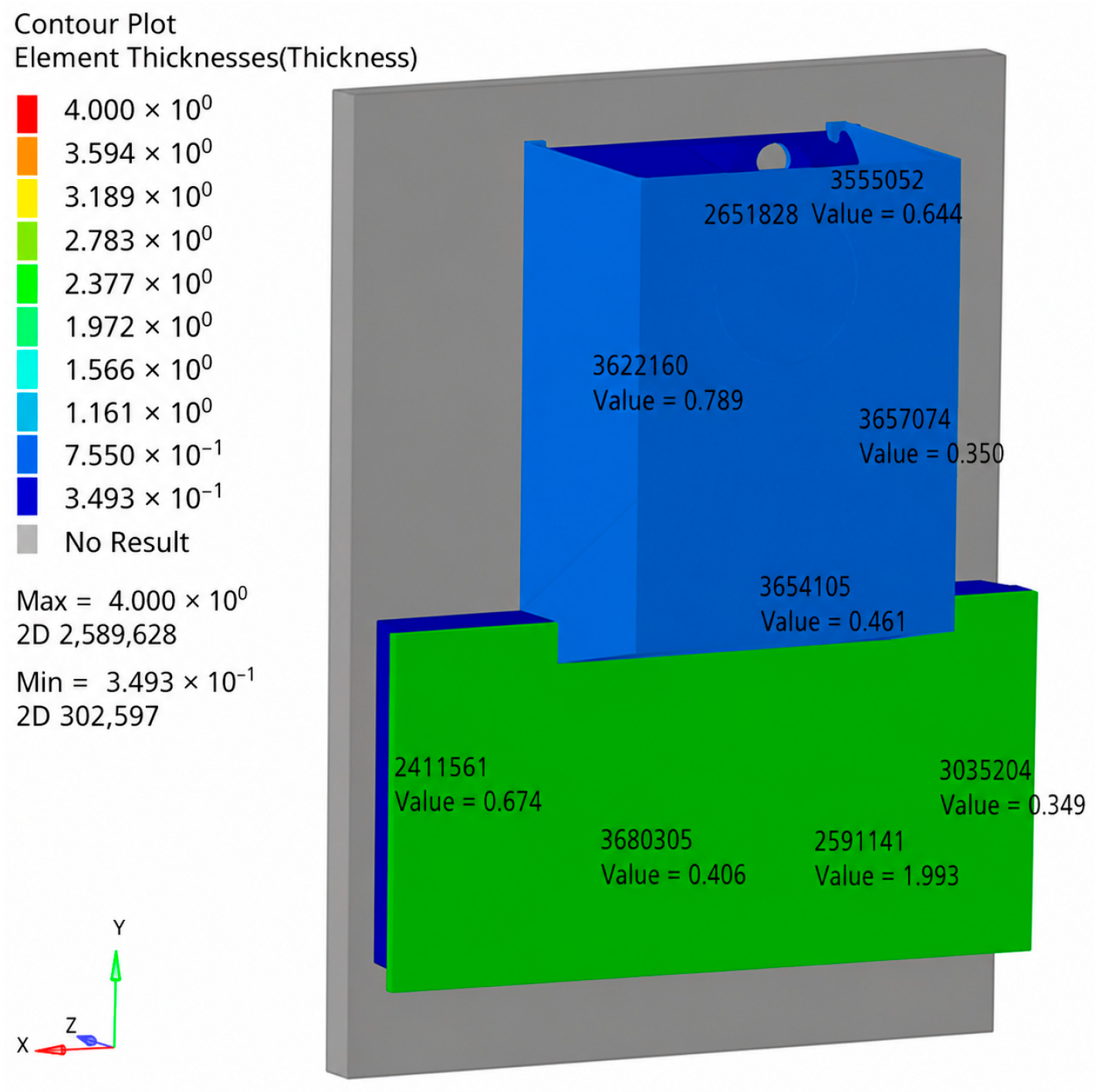
The size optimization results are shown in Figure 11, with thickness values rounded to ensure manufacturability (detailed in Table 3). The optimization reduced the overall weight from 31.39 kg to 25.84 kg, achieving a mass reduction of 5.55 kg (17.68%).

5.3. Optimization Analysis of Dimensional Parameters Based on Orthogonal Experiments

According to the size optimization results from sensitivity analysis, the thickness of the fan casing and lower cabinet showed minimal change before and after optimization. Due to the large number of variables in the orthogonal test, these components were excluded as design variables, and calculations were performed using the optimized thickness values: 0.79 mm for the fan casing and 0.68 mm for the lower cabinet. Seven factors were selected for experimental design—fan frame, panel bracket, fan cover, front cabinet panel, bottom plate, glass panel, and upper cover—with each factor taking four level variables. The test was conducted using standard orthogonal array, involving 36 simulation trials in total.
Statistical data on maximum stress and maximum displacement for each group are used to perform quadratic response surface fitting with Python (version 3.10, with the Pandas, NumPy, and Statsmodels libraries) programming. The stress and displacement functions are fitted, and 36 coefficients for each constraint response are solved using 36 sets of linear equations. The fitting results are shown in Equations (8) and (9).
S ( t i ) = 171.6287 10.2399 t 1 16.3221 t 2 + 38.8972 t 3 + 87.0629 t 4 37.8191 t 5 3.2775 t 6 21.6475 t 7 37.3466 t 1 2 9.3420 t 2 2 + 34.1932 t 3 2 100.9818 t 4 2 6.8422 t 5 2 + 1.7002 t 6 2 + 23.2386 t 7 2 + 8.4578 t 1 t 2 83.0909 t 1 t 3 + 12.9326 t 1 t 4 + 126.9913 t 1 t 5 4.8276 t 1 t 6 + 5.2600 t 1 t 7 + 56.1831 t 2 t 3 3.8966 t 2 t 4 7.6984 t 2 t 5 1.2790 t 2 t 6 + 7.3123 t 2 t 7 + 5.5893 t 3 t 4 47.6392 t 3 t 5 + 7.3500 t 3 t 6 47.2548 t 3 t 7 67.3291 t 4 t 5 + 4.8274 t 4 t 6 + 25.9268 t 4 t 7 2.1666 t 5 t 6 + 38.5323 t 5 t 7 8.3182 t 6 t 7
L ( t j ) = 5.6142 20.0566 t 1 + 15.7750 t 2 2.8820 t 3 2.8811 t 4 + 12.8145 t 5 1.9288 t 6 1.7682 t 7 + 13.3426 t 1 2 3.9352 t 2 2 3.1652 t 3 2 + 5.4880 t 4 2 0.5842 t 5 2 + 0.0048 t 6 2 0.9504 t 7 2 12.8103 t 1 t 2 9.3304 t 1 t 3 0.3510 t 1 t 4 12.1073 t 1 t 5 + 1.7380 t 1 t 6 + 6.9549 t 1 t 7 4.1329 t 2 t 3 0.5400 t 2 t 4 2.3396 t 2 t 5 + 0.0565 t 2 t 6 0.8962 t 2 t 7 + 1.9251 t 3 t 4 6.1985 t 3 t 5 + 0.0199 t 3 t 6 + 5.7169 t 3 t 7 + 1.0154 t 4 t 5 0.0522 t 4 t 6 4.2017 t 4 t 7 + 1.1442 t 5 t 6 5.1239 t 5 t 7 + 0.3339 t 6 t 7
In the equations, represents the stress fitting function, and represents the displacement deformation fitting function. denote the thickness values of the fan frame, panel bracket, fan cover, front cabinet panel, bottom plate, glass panel, and upper cover, respectively.
After function fitting, the coefficient of determination of the fitting function is used to evaluate the goodness of fit—the closer to 1.0, the better the fitting degree. The measured values are derived from simulation data, while the predicted values are calculated by substituting the thickness of each panel into the analytical expressions of the constraint response fitting functions. This study also employs Python to solve for the coefficient of determination. The results show that the coefficient of determination for the stress constraint function approximation model is 0.993, and that for the displacement deformation constraint function approximation model is 0.989. Each fitting function has a coefficient of determination close to 1 and above 0.8, indicating a good fitting effect and high fitting accuracy.
The problem of solving the maximum/minimum value of the objective function under nonlinear constraints due to the influence of plate thickness changes on strength and deformation belongs to nonlinear programming. This paper uses the commercial software Lingo to solve the optimal result of size thickness. First, a mathematical expression for the objective function of minimizing the total mass was developed. This mass objective function is calculated based on the material density and surface area of each sheet metal part, as shown in Equation (10). In the equation, the constant term is the weight of other components except the seven optimized panels, and the coefficient of the optimized panel is the unit thickness weight, that is, the numerical value of mass sensitivity. This constraint model ensures that the optimized design meets both the static strength requirements and the dynamic performance criteria by preventing resonance through frequency detuning. The constraint condition model of nonlinear programming is shown in Equation (11).
m i n M = 17.81 + 4.37 t 1 + 2.88 t 2 + 1.66 t 3 + 1.48 t 4 + 1.14 t 5 + 0.997 t 6 + 0.941 t 7
s . t . S ( t i ) < 270 i = 1 , 2 , , 7 L ( t j ) < 2 j = 1 , 2 , , 7 0.4 t 1 1.2 0.3 t 2 , t 3 , t 4 , t 5 1.1 1.5 t 6 6 0.4 t 7 1.6
The solution process converged after 26 iterations. The nonlinear programming solution results for the thickness of each panel are shown in Table 4. After rounding the thickness variables, the overall weight of the machine was reduced to 25.66 kg, a weight reduction of 5.73 kg, achieving a weight loss of 18.25%.
Comparison of the two optimization schemes shows that the thickness optimization results of the panels are basically consistent. The optimization method based on the orthogonal test in Section 5.3 verifies the accuracy of the optimization method using the software OptiStruct in Section 5.2. Although the dimensional parameter optimization method based on the orthogonal test achieves slightly better weight reduction (0.18 kg more than the sensitivity analysis-based dimensional optimization method), its optimization calculation process is more cumbersome and slower.

5.4. Effect Evaluation Before and After Whole Machine Structural Optimization

(1)
Overall Strength Analysis of the Optimized Design
After optimizing all defective components, strength analysis was conducted on the final optimization schemes of the range hood obtained by the two size optimization methods under centrifugal fan operation conditions to compare their optimization effects. The size parameter optimization based on relative sensitivity analysis is referred to as Optimization Scheme 1, and the size parameter optimization based on orthogonal test analysis is referred to as Optimization Scheme 2.
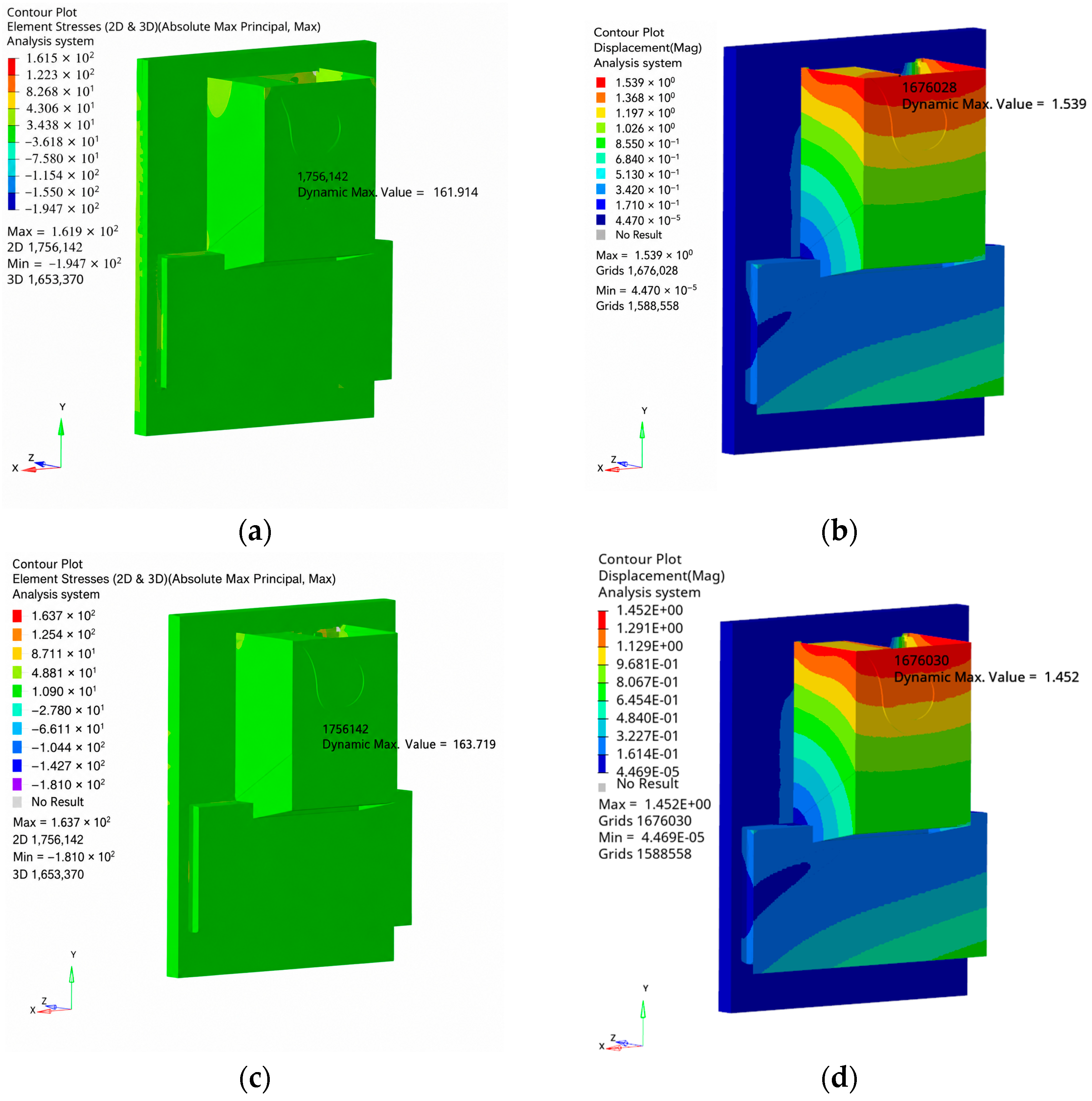
The stress cloud diagram of the overall machine after Optimization Scheme 1 is shown in Figure 12a. The maximum stress of the whole machine is 161.9 MPa, and the stress level is significantly reduced with a more uniform distribution. The displacement cloud diagram of the whole machine is shown in Figure 12b, with the maximum displacement deformation of 1.539 mm, indicating a substantial improvement in the degree of deformation.
The stress cloud diagram of the overall machine for Optimization Scheme 2 is shown in Figure 12c. The maximum stress of the whole machine is 163.7 MPa, with a relatively uniform stress distribution and no stress concentration. The displacement cloud diagram of the overall machine is shown in Figure 12d, with the maximum displacement deformation of 1.452 mm. Compared with 3.135 mm before optimization, the degree of deformation has been significantly improved.
(2)
Optimization Scheme Whole Machine Test Validation
Simulation results show that both optimized schemes meet the design and service requirements in terms of strength indicators such as stress and deformation. To better verify the vibration optimization effect, after improving the structure, ribbing patterns, and dimensional thickness of each component in the final optimization scheme, vibration acceleration tests were conducted on the test prototype.
The measurement points for this test verification remained consistent with those before optimization. Six vibration tests were performed at the super-strong gear setting. After removing outliers, the test results were averaged. The comparative data of average vibration acceleration before and after optimization are shown in Table 5.
The results indicate that after lightweight optimization of the overall structure, the acceleration values at each measurement point decreased at the peak frequency of the excitation source, especially at the impeller side plate where the excessive vibration at measurement points 6 and 12 was significantly mitigated. This outcome shows that the optimization scheme effectively altered the natural frequency of the range hood, preventing overlap with the excitation source frequency at this specific excitation frequency, thus avoiding resonance. The vibration amplitude of the range hood was significantly reduced, and the problem of excessive vibration was effectively alleviated.

6. Conclusions

This study addresses the vibration reduction and lightweight design of a range hood by proposing and implementing an integrated optimization methodology that combines experimental testing, finite element simulation, and structural optimization design. Unlike single-step optimization approaches, this systematic workflow employs topography optimization to resolve resonance issues, then again optimization to compensate for structural stiffness, and finally, size optimization with modal constraints to achieve weight reduction. This tiered strategy ensures a balanced and reliable final design that meets dynamic performance, static strength, and lightweight targets. Listed below are the main conclusions:
(1)
Through vibration testing and modal simulation analysis, the source of resonance in the range hood was identified as the overlap between the motor excitation frequency of 49.805 Hz and the natural frequency of the range hood at 49.967 Hz. Topography optimization was employed to reinforce the impeller side plate with ribs, successfully shifting the natural frequency away from the resonance frequency range and resolving the issue of excessive vibration.
(2)
Through the strength analysis of the range hood under typical working conditions, it is found that under the working condition of fan rotation, the displacement deformation of components such as the fan housing and fan cover of the range hood is relatively larger, and the rigidity is not good enough. Through the topography optimization design of reasonably ribbing the fan housing and fan cover parts, the structural rigidity is significantly improved after optimization, and the displacement deformation is controlled within the target value of 2 mm.
(3)
Dimension-based lightweight optimization was conducted using sensitivity analysis and orthogonal test methods, resulting in overall weight reductions of 5.55 kg and 5.73 kg, corresponding to 17.68% and 18.25% weight decrease, respectively. The optimization demonstrates remarkable effectiveness with a notable improvement in material utilization efficiency.
(4)
Strength and modal validation analyses were performed on the optimized structural design of the whole machine. The strength simulation results show that the maximum stress of the whole machine is 161.914 MPa, and the maximum displacement deformation is 1.539 mm, both of which meet the design requirements. Modal analysis and test results indicate that the natural frequency of the optimized whole machine avoids the excitation frequency of the excitation source, and the vibration issue is significantly alleviated.

Author Contributions

L.Z.: Conceptualization, Writing—original, Methodology. Z.H.: Visualization. X.Z. (Xiangrui Zhao): Investigation. X.Z. (Xixia Zheng) and F.Y.: Date Curation. C.Y. and Z.C.: Supervision. All authors have read and agreed to the published version of the manuscript.

Funding

This research received no external funding.

Data Availability Statement

Data will be made available on request.

Acknowledgments

We would like to thank the Healthy & Intelligent Kitchen Engineering Research Center of Zhejiang Province, the Digital Simulation Design for High End Equipment Manufacturing of Shijiazhuang Science and Technology Bureau, and the National “111” Centre on Safety and Intelligent Operation of Sea Bridges for providing technical support and research facilities.

Conflicts of Interest

The authors declare no conflicts of interest. Author Feng Ye is employed by Fotile Group Ningbo Fotile Kitchenware Co., Ltd., which had no involvement in any aspect of this research. The affiliation of Xixia Zheng with a public transportation management center is not considered a competing interest.

References

  1. Development Guidance for China’s Household Electrical Appliance Industry During the 14th Five-Year Plan Period (Abstract). Available online: https://upload.cheaa.com/2021/0524/1621844892682.pdf (accessed on 21 April 2026).
  2. Yi, Q.; Li, C. Research status and development trends of active vibration control technology in mechanical systems. Mech. Eng. Autom. 2016, 3, 220–221. [Google Scholar]
  3. Balaji, P.S.; Karthik SelvaKumar, K. Applications of nonlinearity in passive vibration control: A review. J. Vib. Eng. Technol. 2021, 9, 183–213. [Google Scholar] [CrossRef]
  4. Yu, H.; Hou, H.; Dai, Y. Design optimization of vibration response for range hood’s shell. J. Vib. Shock 2011, 30, 179–182. [Google Scholar]
  5. Zheng, D.W.; Li, B.; Chen, Z.L.; Weng, J.S.; Shang, Q. Vibration noise and optimization analysis of fan impeller in range hood. J. Mech. Strength 2021, 43, 972–976. [Google Scholar]
  6. Li, S.; Yu, G.; Tang, D.; Li, M.; Han, H. Vibration diagnosis and treatment for a scrubber system connected to a reciprocating compressor. J. Sens. 2020, 2020, 6687295. [Google Scholar] [CrossRef]
  7. Schmitt, R.V.; Leingang, C.J. Design of elastomeric vibration isolation mounting systems for internal combustion engines. SAE Trans. 1976, 85, 1511–1523. [Google Scholar]
  8. Guo, Z. Topology Optimization Design of Structures and Its Engineering Applications. Master’s Thesis, Dalian Maritime University, Dalian, China, 2022. [Google Scholar]
  9. Kang, J.H.; Kim, K.W.; Jang, J.S.; Kim, J.W.; Yang, M.S.; Gu, Y.S.; Ahn, T.M.; Kwon, S.D.; Lee, J.W. Structural analysis and design of B-pillar reinforcement using composite materials. Compos. Res. 2021, 34, 35–46. [Google Scholar]
  10. Hou, Z.; Tian, X.; Zhang, J.; Li, D. 3D printed continuous fibre reinforced composite corrugated structure. Compos. Struct. 2018, 184, 1005–1010. [Google Scholar] [CrossRef]
  11. Hartmann, M.; Roschitz, M.; Khalil, Z. Enhanced battery pack for electric vehicle: Noise reduction and increased stiffness. In Proceedings of the 6th International Light Metals Technology Conference (LMT2013), Old Windsor, UK, 24–26 July 2013. [Google Scholar]
  12. Homsnit, T.; Kongwat, S.; Ruangjirakit, K.; Noykanna, P.; Thuengsuk, T.; Jongpradist, P. Optimizing stiffness and lightweight design of composite monocoque sandwich structure for electric heavy quadricycle. Lat. Am. J. Solids Struct. 2023, 20, e485. [Google Scholar] [CrossRef]
  13. Moloodpoor, M.; Mortazavi, A. A Comparative Review of Fuzzy Reinforced Search Algorithms: Methods and Applications. Arch. Comput. Methods Eng. 2025, 32, 3933–3977. [Google Scholar] [CrossRef]
  14. Mortazavi, A.; Kandemir, E.Ç. Simultaneous optimization of seismic isolation system capacity and topology of multi-story buildings using fuzzy-enhanced differential evolution method. Adv. Eng. Softw. 2024, 198, 103781. [Google Scholar] [CrossRef]
  15. Moloodpoor, M.; Mortazavi, A. Thermo-Economic optimization for saving energy in residential buildings using population-based optimization techniques. J. Constr. Eng. Manag. Innov. 2022, 5, 45–63. [Google Scholar] [CrossRef]
  16. Su, S.Z.; He, X.K.; Wei, X.M.; Hu, Q.; Jiang, J.W.; Hao, M. Simulation analysis and experimental verification of vibration in thin range hoods. J. Home Appl. Technol. 2025, 1, 90–94. [Google Scholar]
  17. Wu, X.; Bao, M.; Luo, X.C.; Yang, H.; Liu, Z.F.; Yu, M.Y. Application research of adjoint topology optimization design method in the flow channel of range hood. J. Home Appl. Technol. 2024, 5, 193–200. [Google Scholar]
  18. Zhang, D.H.; Ding, X.H.; Hu, T.N.; Zhang, H. Optimization design of natural frequencies for thin-walled structures based on improved adaptive growth method. Acta Aeronaut. Astronaut. Sin. 2023, 44, 199–212. [Google Scholar] [CrossRef]
  19. Kim, S.M.; Kim, J.J. Rib thickness optimization of vibration test fixture based on orthogonal array for weight reduction. Mathematics 2026, 14, 1269. [Google Scholar] [CrossRef]
  20. Lin, X. Modal Parameter Identification of Vibration and Its Applications; Southeast University Press: Nanjing, China, 1994. [Google Scholar]
  21. Yao, M.; Tang, X.; Jia, Z. Modal analysis and optimization design of vehicle frame structure based on CAE. Mach. Des. Manuf. Eng. 2021, 50, 97–100. [Google Scholar]
  22. Hu, M.; Kong, D.; Yang, Q.; Zhu, H.; Hou, L.; Kong, D. Topography optimization of battery pack upper shell based on Optistruct. J. Mach. Des. 2019, 36, 186–190. [Google Scholar]
  23. Zhou, M.; Pagaldipti, N.; Thomas, H.L.; Shyy, Y.K. An integrated approach to topology, sizing, and shape optimization. Struct. Multidiscip. Optim. 2004, 26, 308–317. [Google Scholar] [CrossRef]
  24. Yu, M.; Li, J.; Yang, S.; Xu, C.; Xu, Q. Lightweight analysis of rail vehicle onboard container structure based on OptiStruct. Manuf. Autom. 2023, 45, 179–183. [Google Scholar]
  25. GB 4706.28-2008; Household and Similar Electrical Appliances—Safety—Particular Requirements for Range Hoods. Standards Press of China: Beijing, China, 2008.
Figure 1. Measurement point arrangement. (a) Schematic diagram of measurement point. (b) Measurement point arrangement on site. (Note: MP, measurement point).
Machines 14 00566 g001
Figure 2. Vibration spectrum analysis for measurement point 6 and 12. (a) Point 6. (b) Point 12.
Machines 14 00566 g002
Figure 3. Integrated assembly finite element model.
Machines 14 00566 g003
Figure 4. Vibration contour plot of impeller side panel at 49.967 Hz. (a) X-direction; (b) Y-direction; (c) Z-direction.
Machines 14 00566 g004
Figure 5. Optimization results of impeller side panel topography.
Machines 14 00566 g005
Figure 6. Comparison of the impeller side panel before and after topography optimization.
Machines 14 00566 g006
Figure 7. The overall stress nephogram and the overall displacement nephogram of the whole machine. (a) The overall stress nephogram of the whole machine under the assembly load condition. (b) The overall displacement nephogram of the whole machine under the assembly load condition. (c) The overall stress nephogram of the whole machine under the operating condition of the centrifugal fan. (d) The overall displacement nephogram of the whole machine under the operating condition of the centrifugal fan.
Machines 14 00566 g007aMachines 14 00566 g007b
Figure 8. The displacement deformation nephograms of the fan cover and fan housing. (a) The displacement nephogram of the fan housing under the operating condition of the centrifugal fan. (b) The displacement nephogram of the fan cover under the operating condition of the centrifugal fan.
Machines 14 00566 g008
Figure 9. Optimization design results for fan casing. (a) Results of topography optimization for fan casing. (b) Final rib design for fan casing. (c) Displacement contour plot of the optimized fan casing.
Machines 14 00566 g009
Figure 10. The optimization design results for fan cover. (a) Topography optimization results of fan cover. (b) Final rib design for fan cover. (c) Displacement cloud diagram of the optimized fan cover.
Machines 14 00566 g010
Figure 11. Size optimization results of the overall range hood.
Machines 14 00566 g011
Figure 12. Stress and displacement cloud diagrams of the optimization schemes. (a) Stress cloud diagram of Optimization Scheme 1. (b) Displacement cloud diagram of Optimization Scheme 1. (c) stress cloud diagram of Optimization Scheme 2. (d) Displacement cloud diagram of Optimization Scheme 2.
Machines 14 00566 g012
Table 1. Average measured vibration acceleration at each measurement point (m/s2).
Measurement Point Numbers123456789101112
X-Direction0.2640.510.3380.4710.622.2280.2880.6160.3230.4990.6652.155
Y-Direction0.3850.5330.3590.4680.592.0540.4210.6380.3440.4950.6341.993
Z-Direction0.420.60.3090.4630.5791.1850.470.6920.2920.4880.6211.144
Table 2. Modal frequencies of the impeller side plate before and after optimization.
ModeInitial Natural Frequency (Hz)Final Natural Frequency (Hz)
Mode 15.1925.860
Mode 213.69920.311
Mode 324.00832.225
Mode 440.50344.662
Mode 549.96766.412
Mode 668.72574.061
Mode 770.99995.892
Mode 883.326108.233
Mode 994.548132.544
Mode 10112.632161.998
Table 3. Thickness size optimization analysis results of each component.
Variable NamesInitial ValuesOptimized ValuesRounded Values/mm
fan casing0.80.7890.79
lower cabinet0.70.6740.68
fan frame0.80.6440.65
panel bracket0.70.3490.35
fan cover0.70.3500.35
front cabinet panel0.70.4060.41
bottom plate0.70.4610.47
glass panel41.9932
upper cover10.4990.5
Table 4. Nonlinear programming solution results.
Variable NamesInitial ValuesOptimized ValuesRounded Values/mm
fan frame0.80.6290.63
panel bracket0.70.3420.35
fan cover0.70.3610.36
front cabinet panel0.70.4240.43
bottom plate0.70.4730.48
glass panel 141.8461.85
upper cover10.4910.49
1 The glass panel is tempered safety glass and the optimized thickness complies with relevant safety standards (e.g., GB 4706.28-2008 [25]).
Table 5. Comparative analysis of average vibration acceleration before and after optimization.
Measurement Point Numbers123456789101112
X-DirectionBefore Optimization0.2640.510.3380.4710.622.2280.2880.6160.3230.4990.6652.155
After Optimization0.2430.3920.1170.310.3470.3040.2770.5370.3160.4970.6690.494
Y-DirectionBefore Optimization0.3850.5330.3590.4680.592.0540.4210.6380.3440.4950.6341.993
After Optimization0.3390.3910.1270.3210.3520.3160.3960.5550.3230.4980.6390.473
Z-DirectionBefore Optimization0.420.60.3090.4630.5791.1850.470.6920.2920.4880.6211.144
After Optimization0.3780.4620.1050.3030.330.2870.4410.6080.2840.4920.6250.471
Disclaimer/Publisher’s Note: The statements, opinions and data contained in all publications are solely those of the individual author(s) and contributor(s) and not of MDPI and/or the editor(s). MDPI and/or the editor(s) disclaim responsibility for any injury to people or property resulting from any ideas, methods, instructions or products referred to in the content.