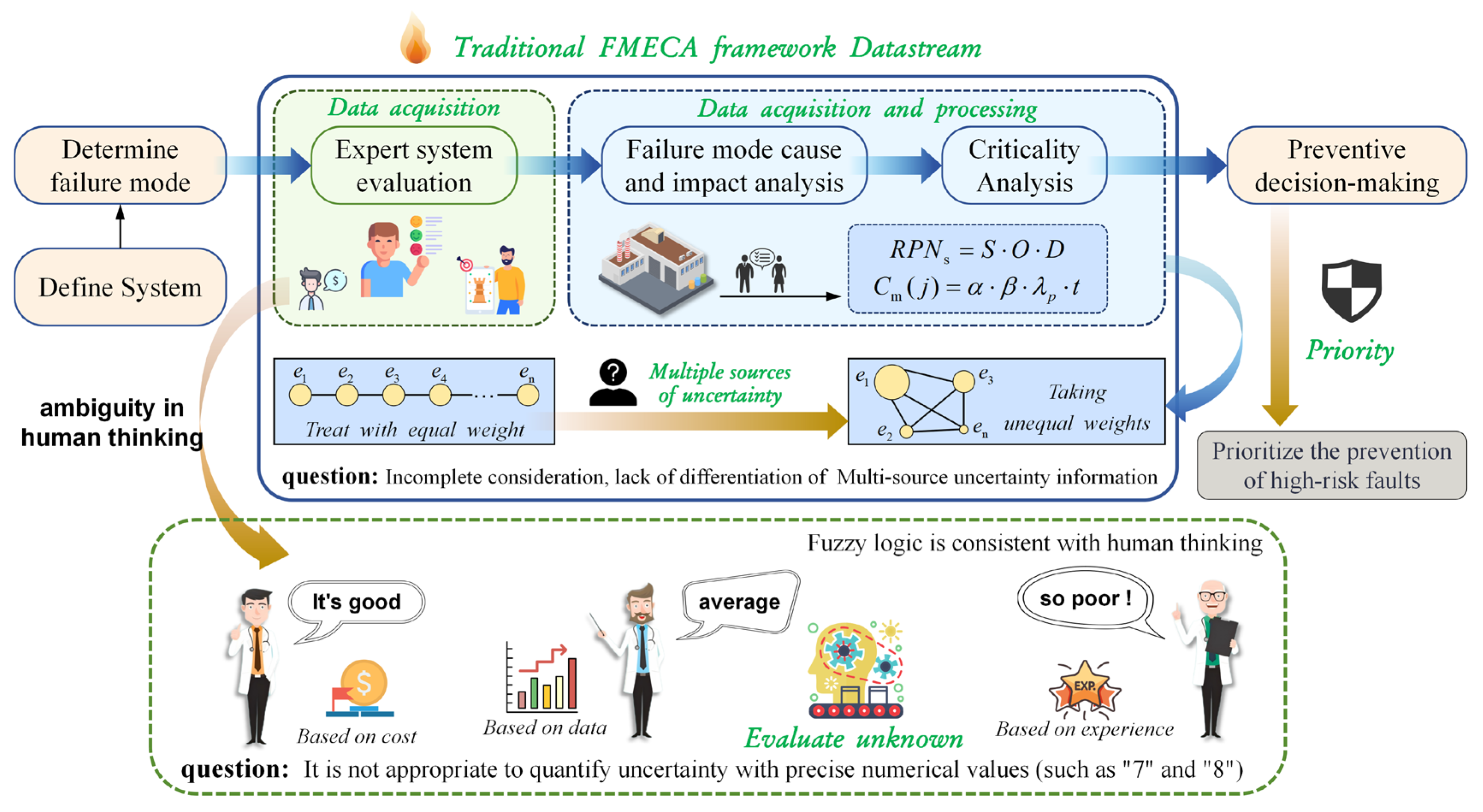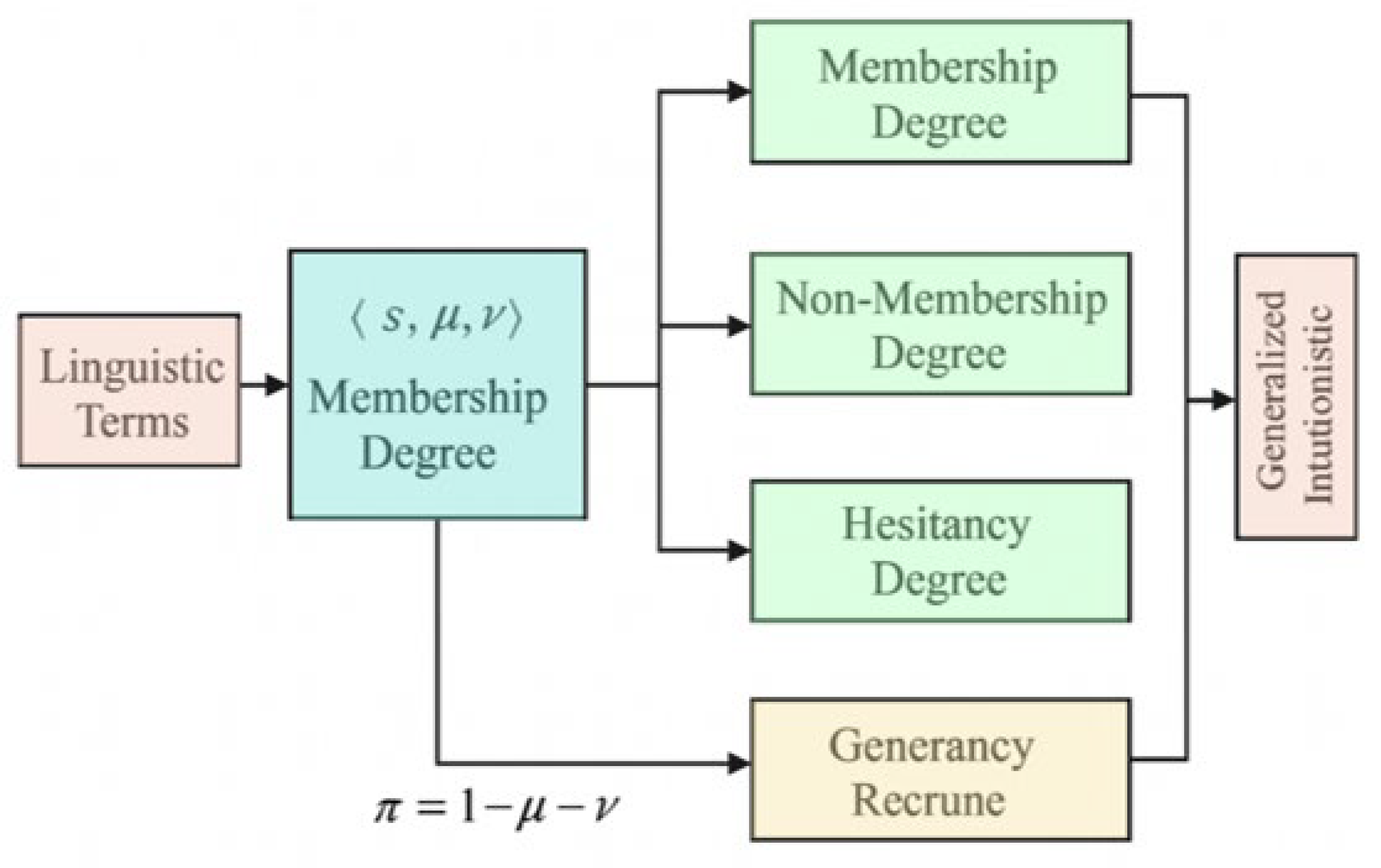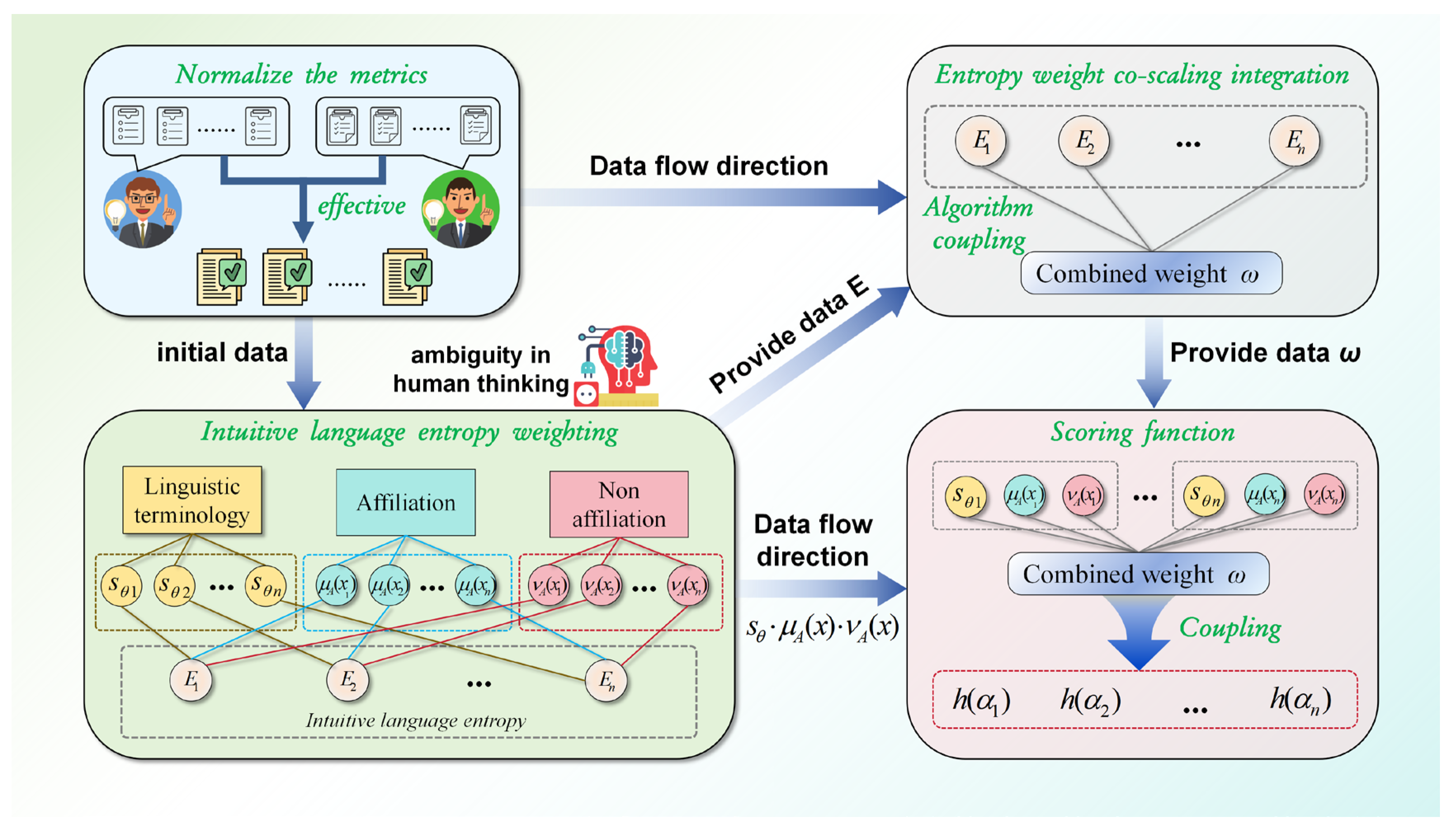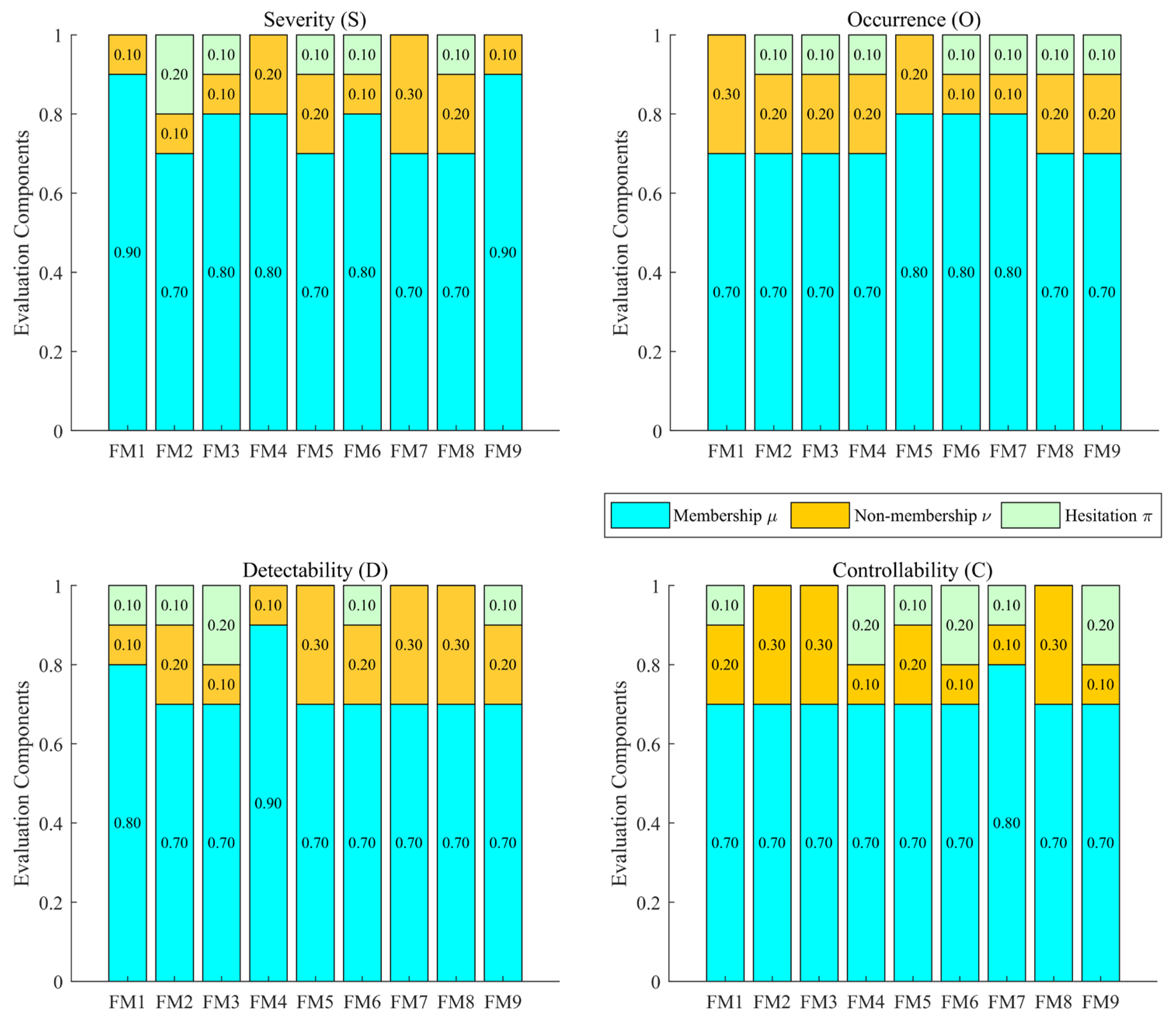

Reliability Analysis of Aerospace Blade Manufacturing Equipment: A Multi-Source Uncertainty FMECA Method for Five-Axis CNC Machine Tool Spindle Systems
 , ,
, ,
Abstract
1. Introduction
2. Literature Review
2.1. Applications of FMECA in Aerospace Manufacturing and CNC Machine Tools
2.2. Generalized Intuitionistic Language Operator
3. Methodology
3.1. Engineering Advantages of Controllability (C)
3.2. Explanation and Usage of Intuitionistic Linguistic Numbers for Experts
3.3. Basic Theory of GILWGA Operator
3.4. Intuitive Language Entropy Determines Weights
3.5. Properties and Calculation Methods of GILWGA
4. FMECA Based on Intuitive Language Entropy and GILWGA Operator
5. Case Analysis
5.1. Calculation Process
5.2. Effectiveness Analysis and Comparison
6. Conclusions
Author Contributions
Funding
Data Availability Statement
Acknowledgments
Conflicts of Interest
Appendix A
References
- Yang, C.; Wang, Y.; Yan, J.; Liu, Z.; Zhang, T. A fault hierarchical propagation reliability improvement method for CNC machine tools based on spatiotemporal factors coupling. Reliab. Eng. Syst. Saf. 2024, 255, 110672. [Google Scholar] [CrossRef]
- Li, H.; Deng, Z.-M.; Golilarz, N.A.; Soares, C.G. Reliability analysis of the main drive system of a CNC machine tool including early failures. Reliab. Eng. Syst. Saf. 2021, 215, 107846. [Google Scholar] [CrossRef]
- Wang, Y.; Yam, R.C.M.; Zuo, M.J.; Tse, P.W. A comprehensive reliability allocation method for design of CNC lathes. Reliab. Eng. Syst. Saf. 2001, 72, 247–252. [Google Scholar] [CrossRef]
- Yang, L.; Wang, J.; Xie, M. Graph-based reliability evaluation of a reconfigurable multi-stage system using sequential unconnected path sets. Reliab. Eng. Syst. Saf. 2025, 261, 111093. [Google Scholar] [CrossRef]
- Cai, X.; Li, N.; Xie, M. RUL prediction for two-phase degrading systems considering physical damage observations. Reliab. Eng. Syst. Saf. 2024, 244, 109926. [Google Scholar] [CrossRef]
- Yang, L.; Zhang, X.; Lu, Z.; Fu, Y.; Moens, D.; Beer, M. Reliability evaluation of a multi-state system with dependent components and imprecise parameters: A structural reliability treatment. Reliab. Eng. Syst. Saf. 2024, 250, 110240. [Google Scholar] [CrossRef]
- Yang, L. An evidence-based likelihood approach for the reliability of a complex system with overlapped failure data. Comput. Ind. Eng. 2025, 201, 110893. [Google Scholar] [CrossRef]
- Li, Y.; Liu, P.; Li, G. An asymmetric cost consensus based failure modes and effects analysis method with personalized risk attitude information. Reliab. Eng. Syst. Saf. 2023, 235, 109196. [Google Scholar] [CrossRef]
- Sun, Y.; Li, H.; Sun, L.; Guedes Soares, C. Failure Analysis of Floating Offshore Wind Turbines with Correlated Failures. Reliab. Eng. Syst. Saf. 2023, 238, 109485. [Google Scholar] [CrossRef]
- Chen, Y.; Tian, Z.; He, R.; Wang, Y.; Xie, S. Discovery of potential risks for the gas transmission station using monitoring data and the OOBN method. Reliab. Eng. Syst. Saf. 2022, 232, 109084. [Google Scholar] [CrossRef]
- Dhalmahapatra, K.; Garg, A.; Singh, K.; Xavier, N.F.; Maiti, J. An integrated RFUCOM–RTOPSIS approach for failure modes and effects analysis: A case of manufacturing industry. Reliab. Eng. Syst. Saf. 2022, 221, 108333. [Google Scholar] [CrossRef]
- Qiu, Y.; Tian, H.; Chen, C.W.; Liu, Z.; Sun, Y.; Li, H.; Li, Y. An improved dynamic reliability analysis method for heavy-duty CNC lathes considering maintenance. Comput. Ind. Eng. 2026, 213, 111823. [Google Scholar] [CrossRef]
- Zhou, Y.; Li, X.; Yuen, K.F. Holistic risk assessment of container shipping service based on Bayesian Network Modelling. Reliab. Eng. Syst. Saf. 2022, 220, 108305. [Google Scholar] [CrossRef]
- Jiang, S.; He, R.; Chen, G.; Zhu, Y.; Shi, J.; Liu, K.; Chang, Y. Semi-supervised health assessment of pipeline systems based on optical fiber monitoring. Reliab. Eng. Syst. Saf. 2022, 230, 108932. [Google Scholar] [CrossRef]
- Kumar, M.P.; Raju, S.; Satish, V.; Gupta, G. Risk assessment and prioritization using fuzzy FMECA: A case study of dumper breakdowns. Int. J. Syst. Assur. Eng. Manag. 2024. Early Access. [Google Scholar] [CrossRef]
- ElKasrawy, N.H.; Farouk, H.A.; Youssef, Y.M. Maintenance optimization based on modified FMECA: A case study applied to a spinning factory. Int. J. Syst. Assur. Eng. Manag. 2024, 16, 73–88. [Google Scholar] [CrossRef]
- Tian, H.; Sun, Y.; Chen, C.; Zhang, Z.; Liu, T.; Zhang, T.; He, J.; Yu, L. A novel FMECA method for CNC machine tools based on D-GRA and data envelopment analysis. Sci. Rep. 2024, 14, 26596. [Google Scholar] [CrossRef]
- Yu, L.; Zhang, T.; Tian, H.; Yang, Z.; Liu, A.; Zhang, F. FMECA of CNC machine tool design stage based on CBWM and DEA. Qual. Reliab. Eng. Int. 2023, 40, 154–169. [Google Scholar] [CrossRef]
- Yu, L.; Zhang, T.; Zang, J.; Zhang, F.; Deng, F.; Liu, A.; Tian, H. FMECA of NC Machine Tool Manufacturing Stage Based on Fuzzy Mathematics and Data Envelopment Analysis. In Proceedings of the 2022 6th International Conference on System Reliability and Safety (ICSRS), Venice, Italy, 23–25 November 2022. [Google Scholar] [CrossRef]
- Alkabaa, A.S.; Taylan, O.; Guloglu, B.; Baik, S.; Sharma, V.; Mishra, R.; Alharbi, R.; Upreti, G. A fuzzy ANP-based criticality analyses approach of reliability-centered maintenance for CNC lathe machine components. J. Radiat. Res. Appl. Sci. 2024, 17, 100738. [Google Scholar] [CrossRef]
- Wang, X.; Zhang, Y.; Shen, G. An improved FMECA for feed system of CNC machining center based on ICR and DEMATEL method. Int. J. Adv. Manuf. Technol. 2015, 83, 43–54. [Google Scholar] [CrossRef]
- Yang, H.; Li, G.; He, J.; Wang, L.; Zhou, X. Improved FMEA based on IVF and fuzzy VIKOR method: A case study of workpiece box system of CNC gear milling machine. Qual. Reliab. Eng. Int. 2021, 37, 2478–2498. [Google Scholar] [CrossRef]
- Benbachir, M.; Chenaf, D.; Cherrared, M. Fuzzy-FMECA Decision-Making Tool for Assessment and Analysis of Performance of Urban Sewerage Networks. J. Pipeline Syst. Eng. Pract. 2022, 13, 04021078. [Google Scholar] [CrossRef]
- Zúñiga, A.A.; Fernandes, J.F.P.; Branco, P.J.C. Fuzzy-Based Failure Modes, Effects, and Criticality Analysis Applied to Cyber-Power Grids. Energies 2023, 16, 3346. [Google Scholar] [CrossRef]
- Giardina, M.; Tomarchio, E.; Buffa, P.; Palagonia, M.; Veronese, I.; Cantone, M.C. FMECA Application in Tomotherapy: Comparison between Classic and Fuzzy Methodologies. Environments 2022, 9, 50. [Google Scholar] [CrossRef]
- Brafman, R.I.; De Giacomo, G. Regular decision processes. Artif. Intell. 2024, 331, 104113. [Google Scholar] [CrossRef]
- Dyczkowski, K.; Grochowalski, P.; Kosior, D.; Gil, D.; Kozioł, W.; Pękala, B.; Kaymak, U.; Fuchs, C.; Nobile, M.S. Python library for interval-valued fuzzy inference. SoftwareX 2024, 26, 101730. [Google Scholar] [CrossRef]
- Frischauf, L.; Scherzer, O.; Shi, C. Quadratic Neural Networks for Solving Inverse Problems. Numer. Funct. Anal. Optim. 2024, 45, 112–135. [Google Scholar] [CrossRef]
- Yu, Y.; Karimi, H.R.; Gelman, L.; Cetin, A.E. MSIFT: A novel end-to-end mechanical fault diagnosis framework under limited & imbalanced data using multi-source information fusion. Expert Syst. Appl. 2025, 274, 126947. [Google Scholar] [CrossRef]
- Jiang, X.; Wang, Z.; Chen, Q.; Cheng, X.; Xu, S.; Yang, S.; Meng, J. An orbit-based encoder–forecaster deep learning method for condition monitoring of large turbomachines. Expert Syst. Appl. 2023, 238, 122215. [Google Scholar] [CrossRef]
- Liu, Y.; Wei, G.; Liu, H.; Xu, L. Group decision making for internet public opinion emergency based upon linguistic intuitionistic fuzzy information. Int. J. Mach. Learn. Cybern. 2021, 13, 579–594. [Google Scholar] [CrossRef]
- Naqvi, D.R.; Verma, R.; Aggarwal, A.; Sachdev, G. Solutions of matrix games involving linguistic interval-valued intuitionistic fuzzy sets. Soft Comput. 2022, 27, 783–808. [Google Scholar] [CrossRef]
- Saha, A.; Garg, H.; Dutta, D. Probabilistic linguistic q-rung orthopair fuzzy Generalized Dombi and Bonferroni mean operators for group decision-making with unknown weights of experts. Int. J. Intell. Syst. 2021, 36, 7770–7804. [Google Scholar] [CrossRef]
- Li, Q.; Rong, Y.; Pei, Z.; Ren, F. A novel linguistic decision making approach based on attribute correlation and EDAS method. Soft Comput. 2023, 27, 7751–7771. [Google Scholar] [CrossRef]
- Wan, S.-P.; Rao, T.; Dong, J.-Y. Time-series based multi-criteria large-scale group decision making with intuitionistic fuzzy information and application to multi-period battery supplier selection. Expert Syst. Appl. 2023, 232, 120749. [Google Scholar] [CrossRef]
- Sun, Y.; Tian, H.; He, J.; Chen, C.; Liu, Z.; Yang, Z. Dynamic failure modes and effects analysis method considering synergistic standards of failure correlation and expert evaluation. Expert Syst. Appl. 2025, 279, 127461. [Google Scholar] [CrossRef]
- Zhong, Y.; Li, G.; Chen, C.; Liu, Y. Failure mode and effects analysis method based on Fermatean fuzzy weighted Muirhead mean operator. Appl. Soft Comput. 2023, 147, 110789. [Google Scholar] [CrossRef]
- Urgo, M.; Terkaj, W.; Simonetti, G. Monitoring manufacturing systems using AI: A method based on a digital factory twin to train CNNs on synthetic data. CIRP J. Manuf. Sci. Technol. 2024, 50, 249–268. [Google Scholar] [CrossRef]
- Kumar, D.; Jha, S. Interpretable generative machine learning model based in-situ process monitoring in robotic wire arc based directed energy deposition of aluminum alloys. CIRP J. Manuf. Sci. Technol. 2025, 63, 185–204. [Google Scholar] [CrossRef]



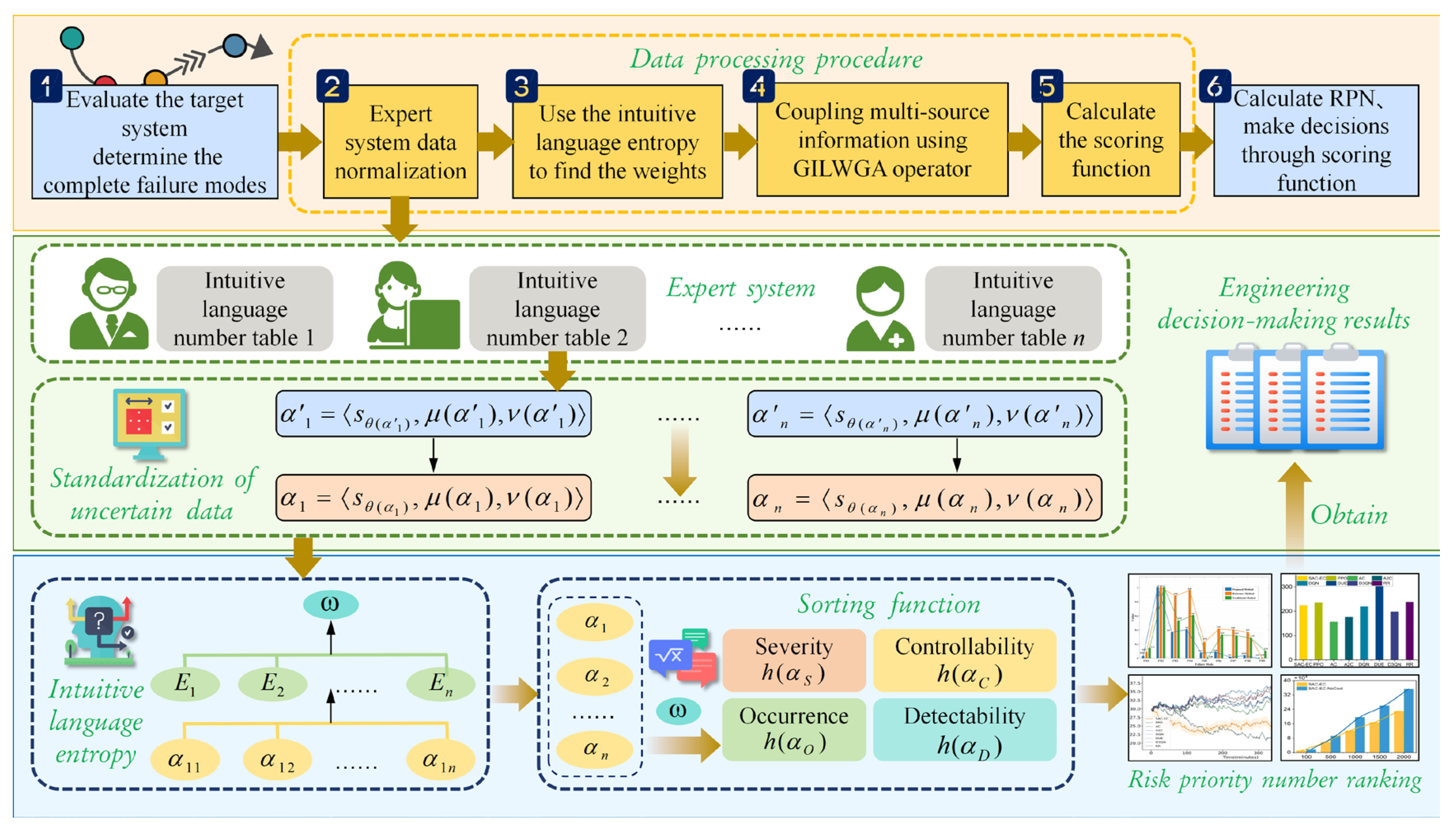


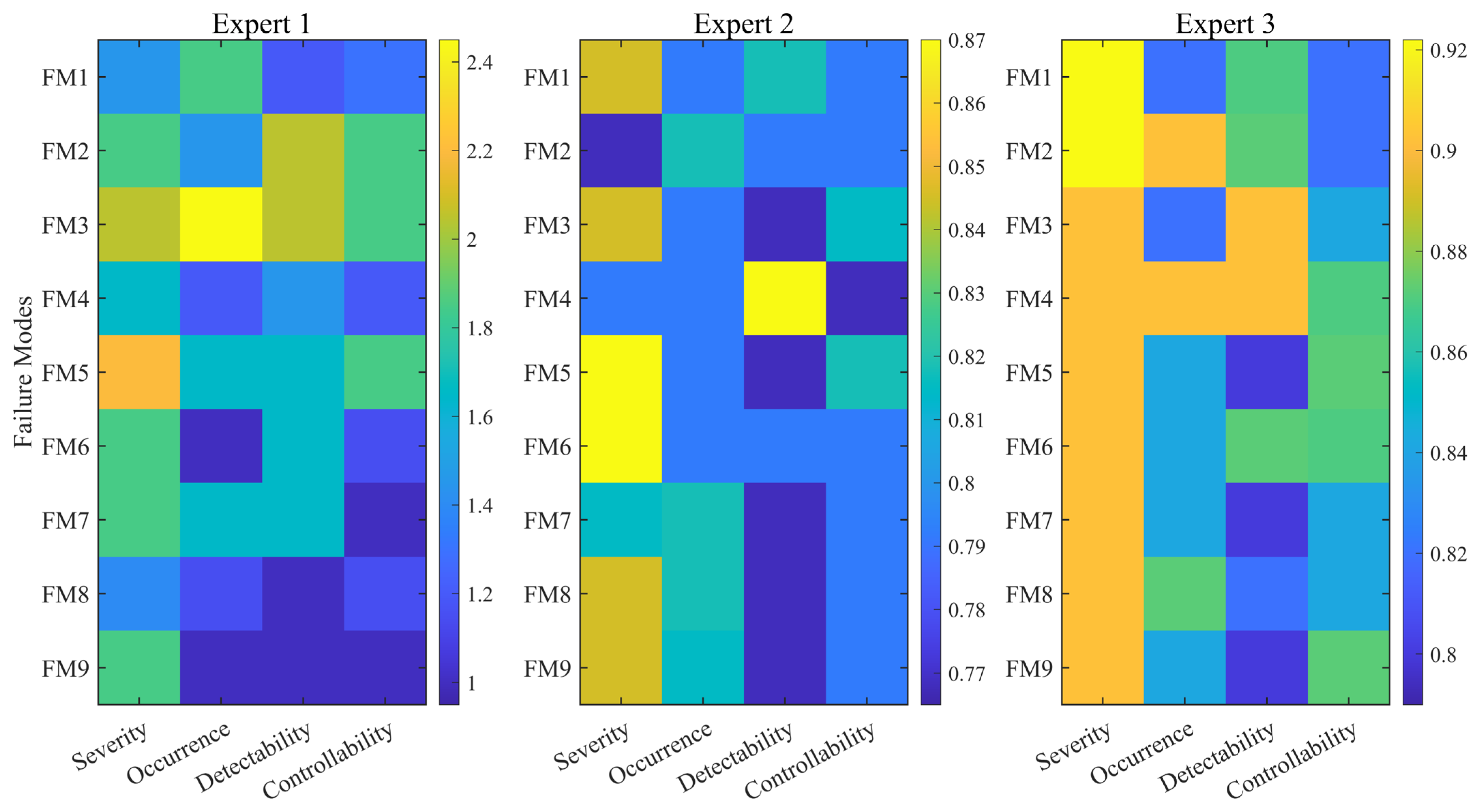



| Serial | Evaluation Index | Standard | Scores |
|---|---|---|---|
| 1 | Occurrence (O) | 85~100% | 4 |
| 70~85% | 3 | ||
| 55~70% | 2 | ||
| 40~55% | 1 | ||
| ≤40% | 1/2 | ||
| 2 | Severity (S) | >80% | 4 |
| 65~80% | 3 | ||
| 50~65% | 2 | ||
| 35~50% | 1 | ||
| ≤35% | 1/2 | ||
| 3 | Detectability (D) | >80% | 4 |
| 65~80% | 3 | ||
| 50~65% | 2 | ||
| 35~50% | 1 | ||
| ≤35% | 1/2 | ||
| 4 | Controllability (C) | >90% | 4 |
| 75~90% | 3 | ||
| 60~75% | 2 | ||
| 45~60% | 1 | ||
| ≤45% | 1/2 |
| Evaluation Index | Standard | Scores |
|---|---|---|
| Occurrence (O) | 85~100% | The ratio of the number of times that a fault occurs to the total number of times that all faults occur in a unit time is used for reference. |
| 70~85% | ||
| 55~70% | ||
| 40~55% | ||
| ≤40% | ||
| Severity (S) | >80% | Based on historical data or expert experience, the impact of failure on the operation of the enterprise and the proportion of income loss generated are used as references. |
| 65~80% | ||
| 50~65% | ||
| 35~50% | ||
| ≤35% | ||
| Detectability (D) | >80% | Based on the existing fault detection data, the fault detection ability is evaluated from the point of difficulty and cost of detection. |
| 65~80% | ||
| 50~65% | ||
| 35~50% | ||
| ≤35% | ||
| Controllability (C) | >90% | According to the previous data and expert experience, the risk shows a weakening trend after taking emergency measures. |
| 75~90% | ||
| 60~75% | ||
| 45~60% | ||
| ≤45% |
| Serial | Failure Mode | Failure Cause | Failure Impact | |
|---|---|---|---|---|
| Local Impact | Final Impact | |||
| FM1 | gear wear | Poor lubrication, excessive load | Poor gear meshing | Reduced transmission efficiency |
| FM2 | oil leakage | Aging and wear of seals | Oil-contaminated parts | System performance degradation |
| FM3 | disk spring failure | Long-term high load | Spring force decreases | Unstable spindle operation |
| FM4 | gear shift failure | Worn-out mechanical parts, abnormal control signals | Gear shifting failure | Reduced processing accuracy |
| FM5 | excessive noise | Aging equipment and improper maintenance | Performance degradation is obvious | Interference with peripheral equipment, causing unstable system operation |
| FM6 | bearing temperature is too high | Cooling system failure, improper lubrication | Reduced bearing life | Spindle not working |
| FM7 | low spindle positioning accuracy | Bearing wear or large clearance | Workpiece position deviation | Decreased workpiece quality and effect on efficiency |
| FM8 | positioning key wear | Excessive friction due to long-term stress | Positioning accuracy decreases | Unstable spindle operation |
| FM9 | bearing burnout | Poor lubrication or excessive grease, overheating, severe overload | Bearing damage | Loss of function, machine tool alarm |
| Serial | Failure Mode | Severity (S) | Occurrence (O) | Detectability (D) | Controllability (C) |
|---|---|---|---|---|---|
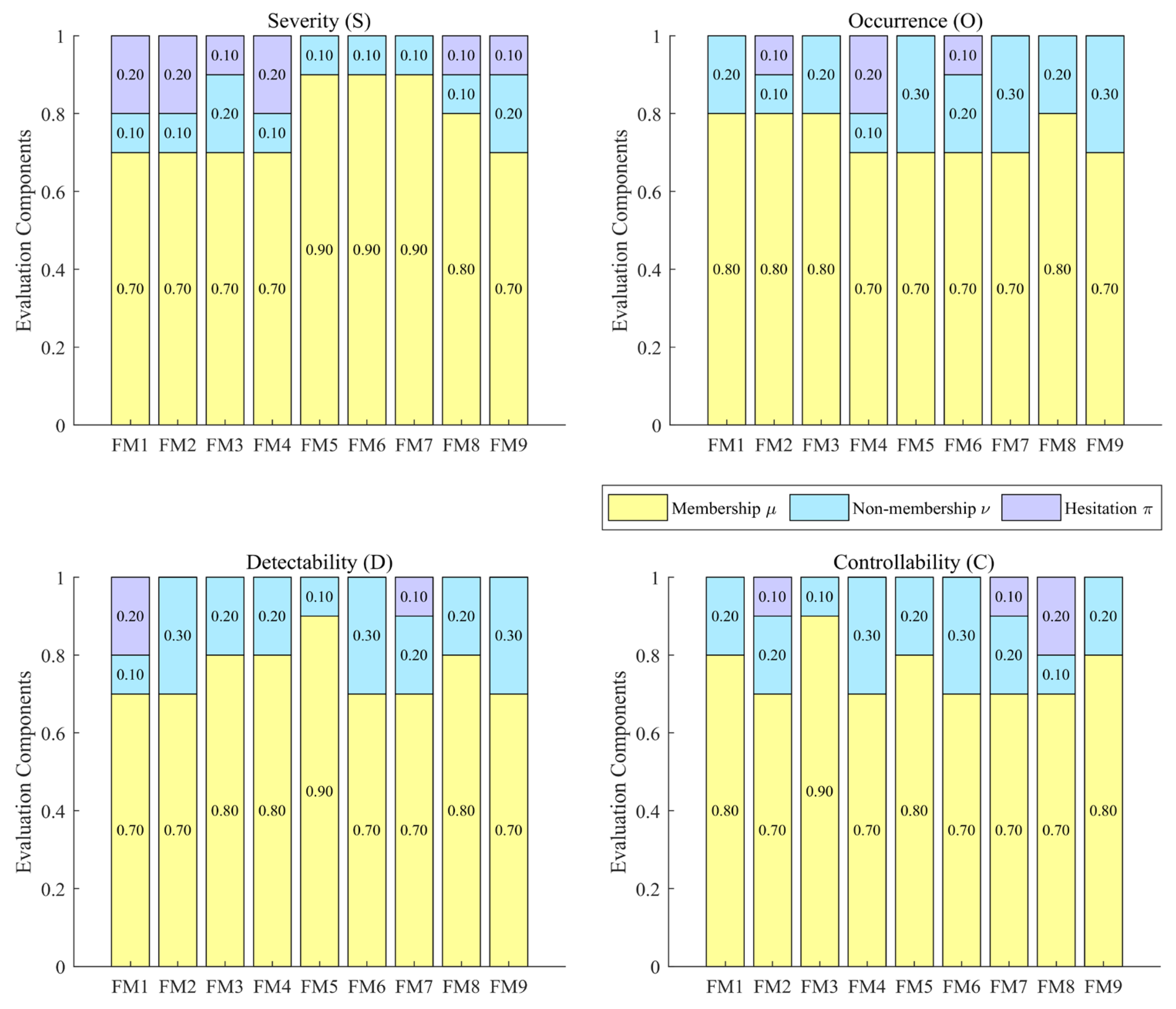
| FM1 | gear wear | <s3, 0.9, 0.1> | <s3, 0.7, 0.3> | <s2, 0.8, 0.1> | <s1/2, 0.7, 0.2> |
| FM2 | oil leakage | <s3, 0.7, 0.1> | <s1, 0.7, 0.2> | <s3, 0.7, 0.2> | <s3, 0.7, 0.3> |
| FM3 | disk spring failure | <s2, 0.8, 0.1> | <s4, 0.7, 0.2> | <s3, 0.7, 0.1> | <s3, 0.7, 0.3> |
| FM4 | gear shift failure | <s2, 0.8, 0.2> | <s2, 0.7, 0.2> | <s2, 0.9, 0.1> | <s1, 0.7, 0.1> |
| FM5 | excessive noise | <s3, 0.7, 0.2> | <s2, 0.8, 0.2> | <s2, 0.7, 0.3> | <s3, 0.7, 0.2> |
| FM6 | bearing temperature is too high | <s2, 0.8, 0.1> | <s3, 0.8, 0.1> | <s2, 0.7, 0.2> | <s1/2, 0.7, 0.1> |
| FM7 | low spindle positioning accuracy | <s3, 0.7, 0.3> | <s2, 0.8, 0.1> | <s2, 0.7, 0.3> | <s1, 0.8, 0.1> |
| FM8 | positioning key wear | <s2, 0.7, 0.2> | <s1, 0.7, 0.2> | <s1, 0.7, 0.3> | <s2, 0.7, 0.3> |
| FM9 | bearing burnout | <s3, 0.9, 0.1> | <s1, 0.7, 0.2> | <s1, 0.7, 0.2> | <s1, 0.7, 0.1> |
| Serial | Failure Mode | Severity (S) | Occurrence (O) | Detectability (D) | Controllability (C) |
|---|---|---|---|---|---|
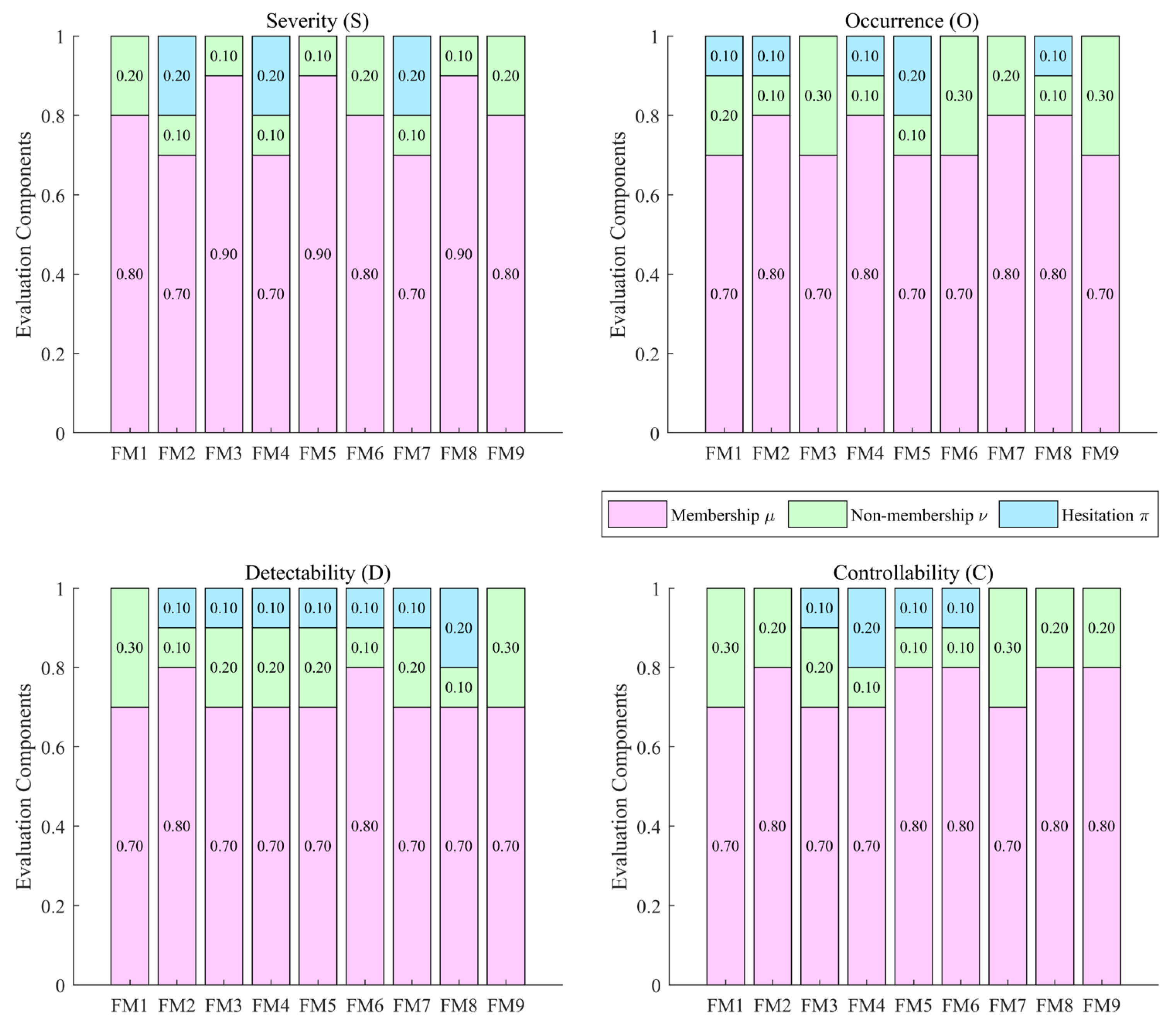
| FM1 | gear wear | <s1/2, 0.7, 0.1> | <s2, 0.8, 0.2> | <s2, 0.7, 0.1> | <s3, 0.8, 0.2> |
| FM2 | oil leakage | <s2, 0.7, 0.1> | <s2, 0.8, 0.1> | <s2, 0.7, 0.3> | <s2, 0.7, 0.2> |
| FM3 | disk spring failure | <s3, 0.7, 0.2> | <s3, 0.8, 0.2> | <s2, 0.8, 0.2> | <s2, 0.9, 0.1> |
| FM4 | gear shift failure | <s2, 0.7, 0.1> | <s1, 0.7, 0.1> | <s2, 0.8, 0.2> | <s1, 0.7, 0.3> |
| FM5 | excessive noise | <s3, 0.9, 0.1> | <s2, 0.7, 0.3> | <s2, 0.9, 0.1> | <s2, 0.8, 0.2> |
| FM6 | bearing temperature is too high | <s3, 0.9, 0.1> | <s1/2, 0.7, 0.2> | <s1, 0.7, 0.3> | <s2, 0.7, 0.3> |
| FM7 | low spindle positioning accuracy | <s2, 0.9, 0.1> | <s2, 0.7, 0.3> | <s2, 0.7, 0.2> | <s1, 0.7, 0.2> |
| FM8 | positioning key wear | <s1, 0.8, 0.1> | <s2, 0.8, 0.2> | <s1, 0.8, 0.2> | <s1, 0.7, 0.1> |
| FM9 | bearing burnout | <s2, 0.7, 0.2> | <s1/2, 0.7, 0.3> | <s1, 0.7, 0.3> | <s2, 0.8, 0.2> |
| Serial | Failure Mode | Severity (S) | Occurrence (O) | Detectability (D) | Controllability (C) |
|---|---|---|---|---|---|
| FM1 | gear wear | <s3, 0.8, 0.1> | <s2, 0.7, 0.2> | <s1/2, 0.7, 0.3> | <s2, 0.7, 0.3> |
| FM2 | oil leakage | <s2, 0.7, 0.1> | <s2, 0.8, 0.1> | <s2, 0.8, 0.1> | <s2, 0.8, 0.2> |
| FM3 | disk spring failure | <s3, 0.9, 0.1> | <s3, 0.7, 0.3> | <s2, 0.7, 0.2> | <s2, 0.7, 0.2> |
| FM4 | gear shift failure | <s2, 0.7, 0.1> | <s1, 0.8, 0.1> | <s1, 0.7, 0.2> | <s2, 0.7, 0.1> |
| FM5 | excessive noise | <s3, 0.9, 0.1> | <s2, 0.7, 0.1> | <s2, 0.7, 0.2> | <s2, 0.8, 0.1> |
| FM6 | bearing temperature is too high | <s2, 0.8, 0.2> | <s1/2, 0.7, 0.3> | <s2, 0.8, 0.1> | <s2, 0.8, 0.1> |
| FM7 | low spindle positioning accuracy | <s2, 0.7, 0.1> | <s2, 0.8, 0.2> | <s2, 0.7, 0.2> | <s1, 0.7, 0.3> |
| FM8 | positioning key wear | <s2, 0.9, 0.1> | <s1, 0.8, 0.1> | <s1, 0.7, 0.1> | <s1, 0.8, 0.2> |
| FM9 | bearing burnout | <s2, 0.8, 0.1> | <s2, 0.9, 0.1> | <s1, 0.7, 0.3> | <s1/2, 0.7, 0.2> |
| Serial | Failure Mode | Severity (S) | Occurrence (O) | Detectability (D) | Controllability (C) |
|---|---|---|---|---|---|
| FM1 | gear wear | 0.1186 | 0.0498 | 0.0591 | 0.0354 |
| FM2 | oil leakage | 0.2954 | 0.1115 | 0.1649 | 0.0501 |
| FM3 | disk spring failure | 0.1125 | 0.0655 | 0.2721 | 0.0516 |
| FM4 | gear shift failure | 0.1781 | 0.1256 | 0.0416 | 0.1221 |
| FM5 | excessive noise | 0.067 | 0.086 | 0.0437 | 0.099 |
| FM6 | bearing temperature is too high | 0.0484 | 0.0477 | 0.1346 | 0.0911 |
| FM7 | low spindle positioning accuracy | 0.0985 | 0.041 | 0.0437 | 0.0514 |
| FM8 | positioning key wear | 0.0772 | 0.063 | 0.0497 | 0.0611 |
| FM9 | bearing burnout | 0.1016 | 0.0276 | 0.026 | 0.08 |
| Serial | Failure Mode | RPN (10−5) | Sorting |
|---|---|---|---|
| FM1 | gear wear | 1.2357 | 7 |
| FM2 | oil leakage | 27.2110 | 1 |
| FM3 | disk spring failure | 10.3460 | 3 |
| FM4 | gear shift failure | 11.3622 | 2 |
| FM5 | excessive noise | 2.4928 | 5 |
| FM6 | bearing temperature is too high | 2.8309 | 4 |
| FM7 | low spindle positioning accuracy | 0.9071 | 8 |
| FM8 | positioning key wear | 1.4769 | 6 |
| FM9 | bearing burnout | 0.5833 | 9 |
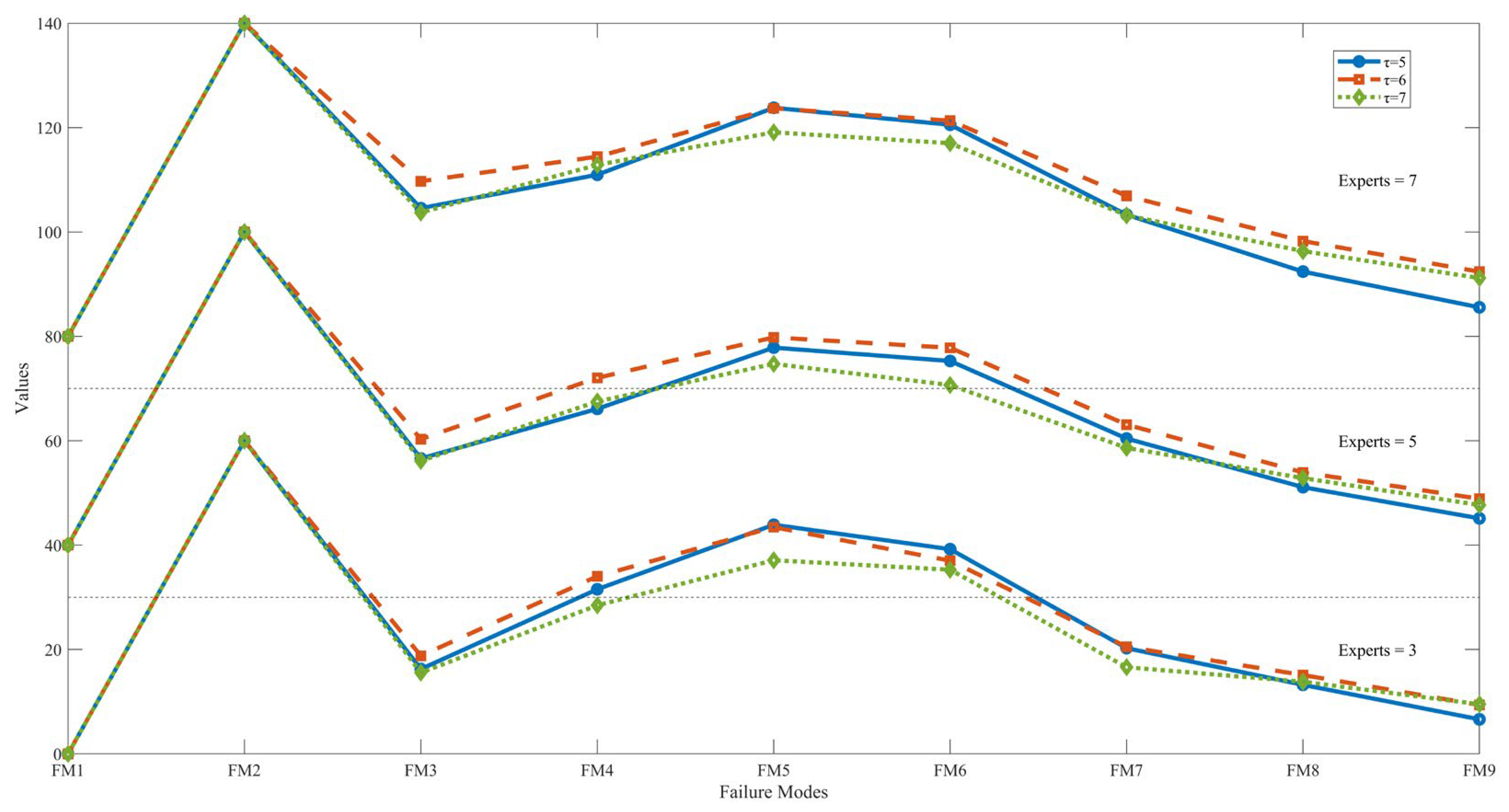
| Number of Experts | Granularity Parameter | RPN | Rank | Kendall τ | ||||||||
|---|---|---|---|---|---|---|---|---|---|---|---|---|
| FM1 | FM2 | FM3 | FM4 | FM5 | FM6 | FM7 | FM8 | FM9 | ||||
| 3 | 5 | 1.2357 | 27.211 | 10.346 | 11.362 | 2.4928 | 2.8309 | 0.9071 | 1.4769 | 0.5833 | FM2 > FM4 > FM3 > FM6 > FM5 > FM8 > FM1 > FM7 > FM9 | 0.333 |
| 5 | 5 | 76.285 | 460.1 | 182.44 | 229.18 | 128.94 | 154.95 | 60.824 | 25.611 | 11.935 | FM2 > FM4 > FM3 > FM6 > FM5 > FM1 > FM7 > FM8 > FM9 | 1 |
| 7 | 5 | 1059.8 | 5295.8 | 2793.5 | 3341.5 | 1460.9 | 1741.4 | 755.59 | 199.23 | 19.294 | FM2 > FM4 > FM3 > FM6 > FM5 > FM1 > FM7 > FM8 > FM9 | 1 |
| 3 | 6 | 1.4078 | 16.999 | 6.2889 | 11.088 | 2.9537 | 5.371 | 1.5586 | 0.3346 | 0.4938 | FM2 > FM4 > FM3 > FM6 > FM5 > FM7 > FM1 > FM9 > FM8 | 0.556 |
| 5 | 6 | 53.503 | 494.87 | 202.84 | 229.62 | 142.61 | 189.93 | 47.863 | 7.1507 | 6.4426 | FM2 > FM4 > FM3 > FM6 > FM5 > FM1 > FM7 > FM8 > FM9 | 1 |
| 7 | 6 | 532.85 | 5698.3 | 3092.2 | 3345.5 | 1168 | 2000.7 | 498.53 | 55.568 | 10.409 | FM2 > FM4 > FM3 > FM6 > FM5 > FM1 > FM7 > FM8 > FM9 | 1 |
| 3 | 7 | 1.1846 | 20.777 | 6.2611 | 12.263 | 2.9482 | 5.3837 | 1.7176 | 0.3107 | 0.6477 | FM2 > FM4 > FM3 > FM6 > FM5 > FM7 > FM1 > FM9 > FM8 | 0.556 |
| 5 | 7 | 53.56 | 606.64 | 202.44 | 253.91 | 142.53 | 189.7 | 47.722 | 8.7678 | 5.9935 | FM2 > FM4 > FM3 > FM6 > FM5 > FM1 > FM7 > FM8 > FM9 | 1 |
| 7 | 7 | 533.22 | 6985.1 | 3085.2 | 3698.5 | 1169.5 | 2001 | 498.02 | 57.054 | 9.7069 | FM2 > FM4 > FM3 > FM6 > FM5 > FM1 > FM7 > FM8 > FM9 | 1 |
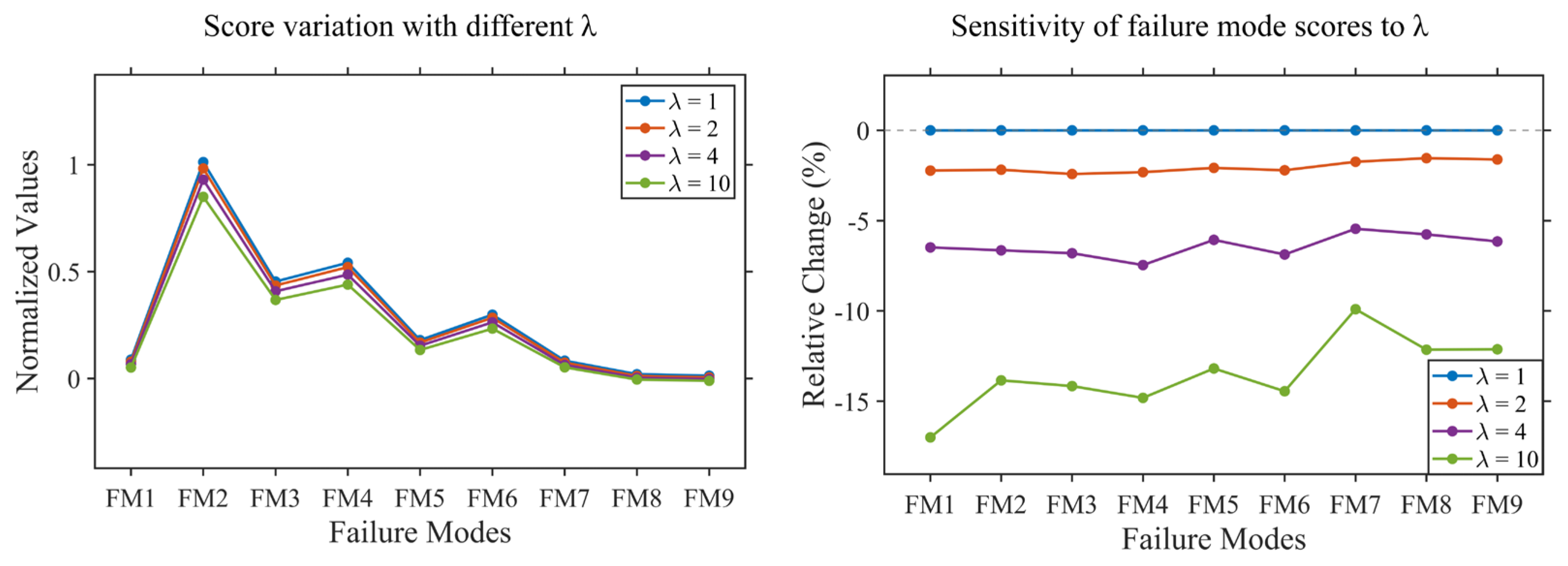
| Parameter λ | Scores | Ranking Order | ||||||||
|---|---|---|---|---|---|---|---|---|---|---|
| FM1 | FM2 | FM3 | FM4 | FM5 | FM6 | FM7 | FM8 | FM9 | ||
| λ = 1 | 533.22 | 6985.1 | 3085.2 | 3698.5 | 1169.5 | 2001 | 498.02 | 57.054 | 9.7069 | FM2 > FM4 > FM3 > FM6 > FM5 > FM1 > FM7 > FM8 > FM9 |
| λ = 2 | 521.34 | 6832.7 | 3010.6 | 3612.9 | 1145.2 | 1956.8 | 489.36 | 56.175 | 9.5504 | FM2 > FM4 > FM3 > FM6 > FM5 > FM1 > FM7 > FM8 > FM9 |
| λ = 4 | 498.67 | 6521.3 | 2875.4 | 3422.7 | 1098.6 | 1863.5 | 470.89 | 53.769 | 9.11 | FM2 > FM4 > FM3 > FM6 > FM5 > FM1 > FM7 > FM8 > FM9 |
| λ = 10 | 442.57 | 6018.2 | 2648.3 | 3150.6 | 1015.3 | 1711.9 | 448.69 | 50.124 | 8.53 | FM2 > FM4 > FM3 > FM6 > FM5 > FM7 > FM1 > FM8 > FM9 |
| Failure Mode | RPN (10−5) | Risk Level | Reliability Improvement Decisions | Justification |
|---|---|---|---|---|
| FM2—oil leakage | 6985.1 | high | Reliability Improvement Decision | High uncontrollability and expert consensus; risk may be underestimated in traditional FMECA |
| FM4—gear shift failure | 3698.5 | high | Inspect seals and monitor leakage | Cross-impact potential revealed through expert coupling and fuzzy assessments |
| FM3—disk spring failure | 3085.2 | high | Inspect shift actuator and control logic | Low entropy in severity; traditional RPN may ignore this hidden hazard |
| FM6—bearing temperature is too high | 2001 | medium | Evaluate fatigue life and optimize load | Fuzzy modeling uncovers systemic impact of perceived non-critical issue |
| FM5—excessive noise | 1169.5 | medium | Monitor temperature and adjust lubrication | High severity and controllability scores suggest early intervention |
| FM1—gear wear | 533.22 | medium | Acoustic monitoring for imbalance detection | Stable entropy but moderate hesitation indicates long-term degradation risk |
| FM7—low spindle positioning accuracy | 498.02 | medium | Periodic inspection and lubrication | High controllability and low severity; situational rather than structural |
| FM8—positioning key wear | 57.054 | low | Routine calibration and compensation | High detectability and controllability reduce practical risk |
| FM9—bearing burnout | 9.7069 | low | Temperature monitoring and overload protection | Low expert differentiation and moderate fuzzy evaluations |
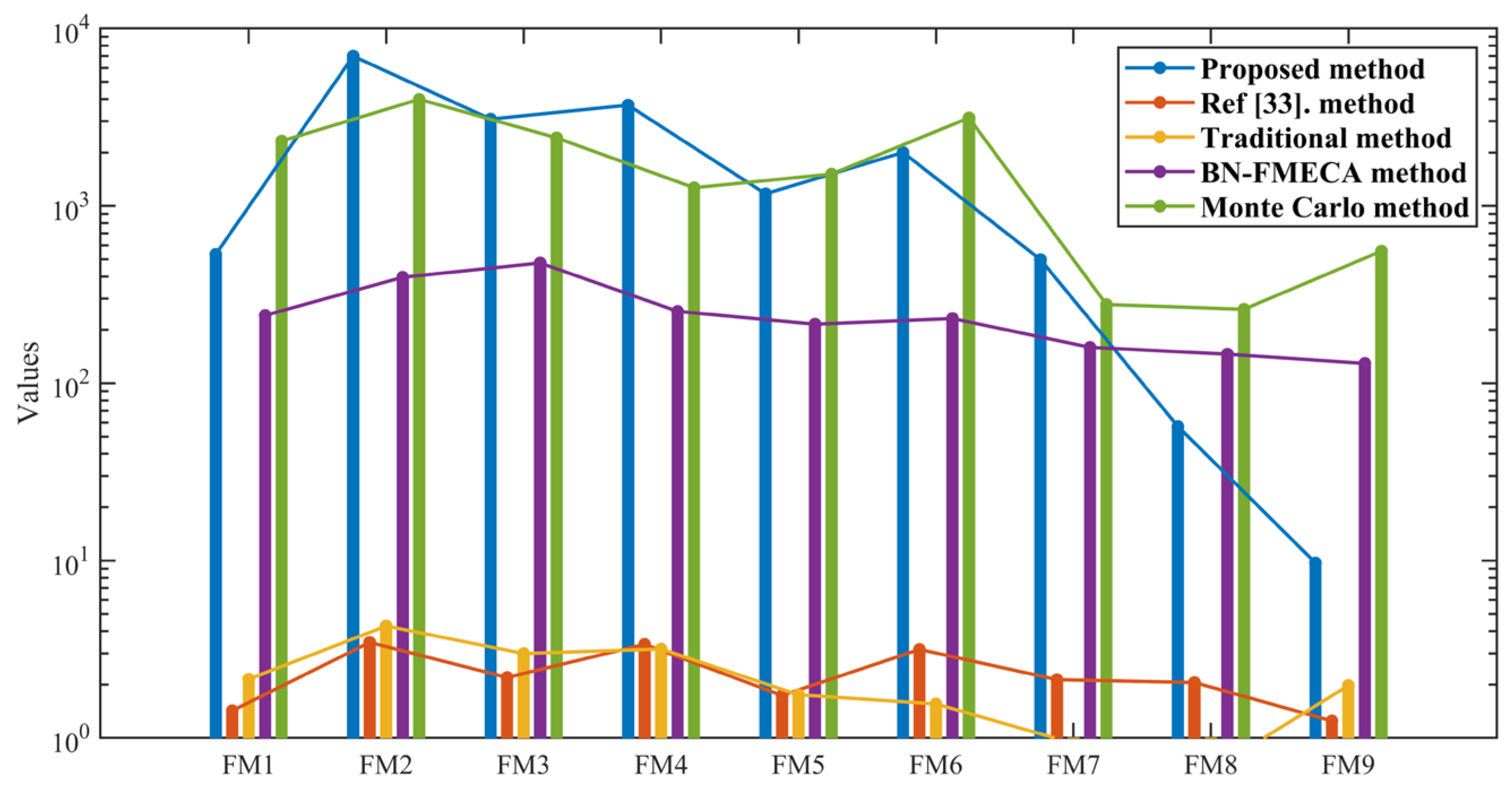
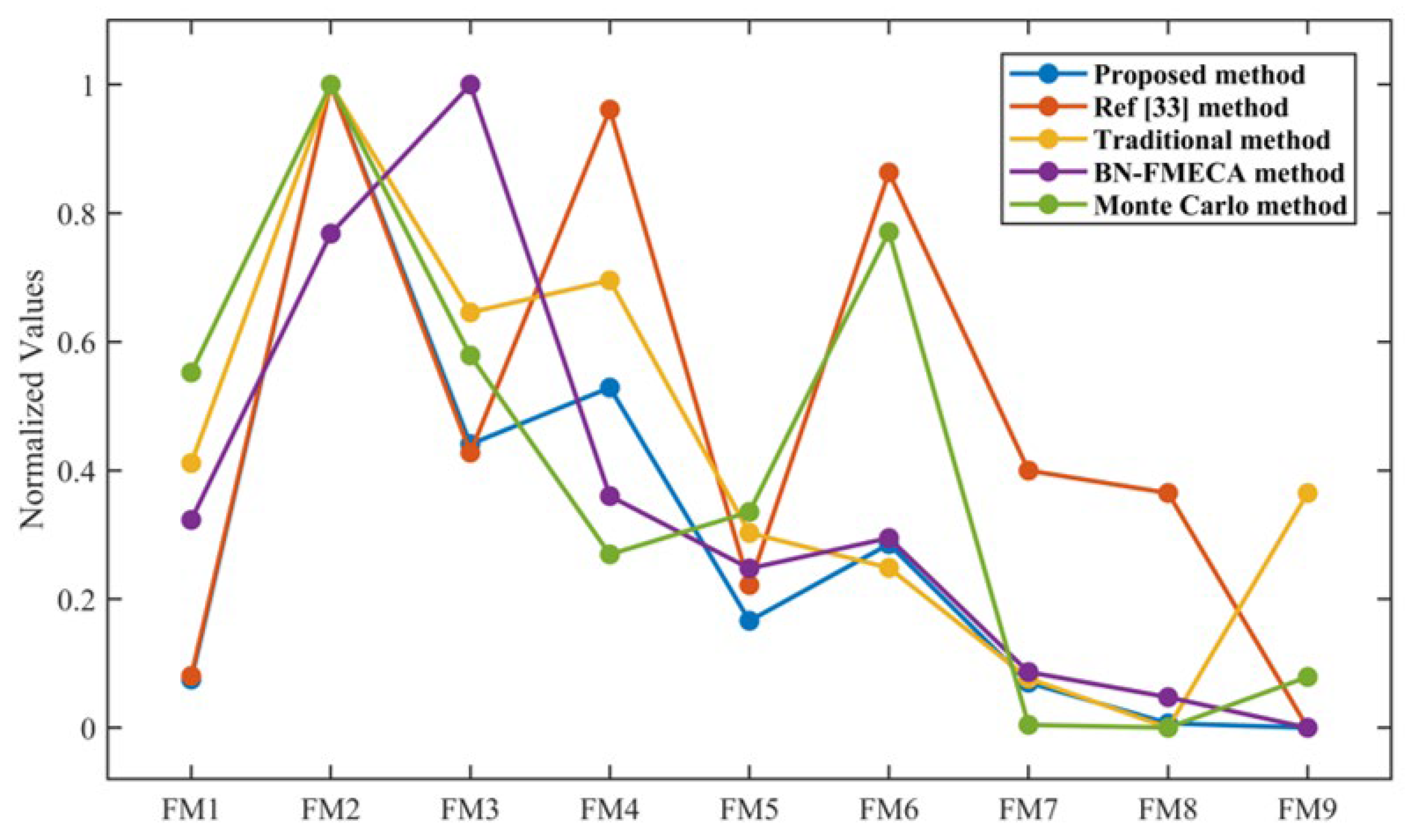
| Method | Scores | Ranking Order | ||||||||
|---|---|---|---|---|---|---|---|---|---|---|
| FM1 | FM2 | FM3 | FM4 | FM5 | FM6 | FM7 | FM8 | FM9 | ||
| Proposed method | 533.22 | 6985.1 | 3085.2 | 3698.5 | 1169.5 | 2001 | 498.02 | 57.054 | 9.7069 | FM2 > FM4 > FM3 > FM6 > FM5 > FM1 > FM7 > FM8 > FM9 |
| Ref [37] method | 1.425 | 3.4578 | 2.1926 | 3.372 | 1.7376 | 3.1558 | 2.1312 | 2.0538 | 1.2472 | FM2 > FM4 > FM6 > FM3 > FM7 > FM8 > FM5 > FM1 > FM9 |
| Traditional method | 2.1447 | 4.2756 | 2.9927 | 3.1736 | 1.7514 | 1.5548 | 0.9318 | 0.6548 | 1.9756 | FM2 > FM4 > FM3 > FM1 > FM9 > FM5 > FM6 > FM7 > FM8 |
| BN-FMECA (OOBN-based) | 241.47 | 395.9 | 476.26 | 254.32 | 215.28 | 231.67 | 159.38 | 145.82 | 129.36 | FM3 > FM2 > FM4 > FM1 > FM6 > FM5 > FM7 > FM8 > FM9 |
| Monte Carlo RPN | 2320.28 | 3988.66 | 2418.81 | 1265.83 | 1511.85 | 3134.52 | 277.85 | 261.26 | 555.66 | FM2 > FM6 > FM3 > FM1 > FM5 > FM4 > FM9 > FM7 > FM8 |
Disclaimer/Publisher’s Note: The statements, opinions and data contained in all publications are solely those of the individual author(s) and contributor(s) and not of MDPI and/or the editor(s). MDPI and/or the editor(s) disclaim responsibility for any injury to people or property resulting from any ideas, methods, instructions or products referred to in the content. |
© 2026 by the authors. Licensee MDPI, Basel, Switzerland. This article is an open access article distributed under the terms and conditions of the Creative Commons Attribution (CC BY) license.
Share and Cite
Han, M.; Li, Y.; Tian, H.; Sun, Y.; Ni, Z.; Qiu, Y.; Li, H. Reliability Analysis of Aerospace Blade Manufacturing Equipment: A Multi-Source Uncertainty FMECA Method for Five-Axis CNC Machine Tool Spindle Systems. Machines 2026, 14, 360. https://doi.org/10.3390/machines14040360
Han M, Li Y, Tian H, Sun Y, Ni Z, Qiu Y, Li H. Reliability Analysis of Aerospace Blade Manufacturing Equipment: A Multi-Source Uncertainty FMECA Method for Five-Axis CNC Machine Tool Spindle Systems. Machines. 2026; 14(4):360. https://doi.org/10.3390/machines14040360
Chicago/Turabian StyleHan, Muhao, Yufei Li, Hailong Tian, Yuzhi Sun, Zixuan Ni, Yunshenghao Qiu, and Haoyuan Li. 2026. "Reliability Analysis of Aerospace Blade Manufacturing Equipment: A Multi-Source Uncertainty FMECA Method for Five-Axis CNC Machine Tool Spindle Systems" Machines 14, no. 4: 360. https://doi.org/10.3390/machines14040360
APA StyleHan, M., Li, Y., Tian, H., Sun, Y., Ni, Z., Qiu, Y., & Li, H. (2026). Reliability Analysis of Aerospace Blade Manufacturing Equipment: A Multi-Source Uncertainty FMECA Method for Five-Axis CNC Machine Tool Spindle Systems. Machines, 14(4), 360. https://doi.org/10.3390/machines14040360