
Article

An Adaptive Enhancement Method for Weak Fault Diagnosis of Locomotive Gearbox Bearings Under Wheel–Raisl Excitation

1
School of Mechanical Engineering, Lanzhou Jiaotong University, Lanzhou 730070, China
2
School of Locomotive Vehicle, Sichuan Railway College, Chengdu 611732, China
*
Author to whom correspondence should be addressed.
Machines 2026, 14(3), 353; https://doi.org/10.3390/machines14030353
Submission received: 14 February 2026 / Revised: 12 March 2026 / Accepted: 19 March 2026 / Published: 21 March 2026

Abstract

Wheel–rail coupled excitation introduces strong low-frequency modulation, random impact interference, and broadband background noise into the vibration system of locomotive gearboxes, causing early weak bearing fault features to become submerged and making traditional deconvolution methods insufficient for effective enhancement. To address this challenge, this study proposes an adaptive parameter optimization method for MCKD based on the weighted envelope spectrum factor (WESF). WESF integrates the Hoyer index, kurtosis, and envelope spectrum energy to jointly characterize sparsity, impulsiveness, and periodicity of signal components. By using WESF as the fitness function, the sparrow search algorithm (SSA) is employed to simultaneously optimize the key MCKD parameters L, T, and M, enabling optimal enhancement of weak periodic impacts. To further mitigate modal aliasing caused by wheel–rail excitation, the original signal is first adaptively decomposed using successive variational mode decomposition (SVMD), and modes with WESF values above the average are selected for signal reconstruction. The reconstructed signal is subsequently enhanced via SSA–MCKD, and fault characteristic frequencies are extracted using envelope spectrum analysis. Experimental validation using gearbox bearing data collected under 40, 50, and 60 Hz operating conditions shows that the proposed method achieves fault feature coefficient (FFC) values of 12.8%, 7.5%, and 7.2%, respectively—representing an average improvement of approximately 156% compared with traditional methods (average FFC of 3.6%). These results demonstrate that the proposed SVMD–WESF–SSA–MCKD approach can significantly enhance weak periodic impact features under strong background noise and wheel–rail excitation, exhibiting strong practical applicability for engineering implementation.

1. Introduction

Gearbox bearings are critical components in the power transmission systems of railway freight locomotives, responsible for transmitting dynamic wheel–rail loads and ensuring the efficient and reliable transfer of torque from the traction motors to propel the locomotive [1,2,3,4]. However, the operational environment of these bearings presents significant challenges. As most freight locomotives in China operate on existing lines, long-term service and environmental factors have led to track irregularities, embankment settlement, and rail wear. Furthermore, compared to integrally welded bogies, those used in freight locomotives exhibit weaker anti-diamond stiffness and more pronounced hunting motion. These conditions result in highly variable and unstable wheel–rail contact, disturbing the service state of gearbox bearings [5,6,7]. Consequently, early weak fault signatures are often masked by broadband background noise and multi-source interference. This makes it difficult for traditional signal analysis methods to separate fault features from noise, reducing diagnostic accuracy and increasing the risk of misdiagnosis or missed faults, ultimately compromising operational safety.
To address the difficulty of extracting fault features from noise-corrupted signals, signal decomposition techniques are commonly employed for preprocessing. Variational mode decomposition (VMD) is an adaptive, fully non-recursive signal processing method whose performance is highly dependent on the selection of two key parameters: the number of decomposition modes K and the penalty factor α [8,9]. Researchers often utilize optimization algorithms such as the whale optimization algorithm (WOA) or grey wolf optimizer (GWO) to identify these parameters [10,11], thereby enhancing the decomposition of bearing fault signals in noisy environments. Nevertheless, the parameter determination process for VMD is computationally intensive and heavily reliant on the chosen optimization algorithm and objective function. Moreover, its residual component lacks a rigorous mathematical definition and physical interpretation, which can compromise decomposition accuracy. In contrast, successive variational mode decomposition (SVMD), proposed by Nazari et al., introduces a constraint criterion to achieve adaptive decomposition with lower computational complexity and greater robustness in initializing the central frequencies of modes [12]. For instance, Zhang et al. [13] and Xue et al. [14] successfully applied SVMD to denoise whale vocalizations and diagnose composite faults in train bearings, respectively.

To address the issue that early bearing fault features are extremely weak under wheel–rail excitation and that the corresponding envelope-modulated components are easily submerged, signal enhancement techniques have become an important means for improving fault extraction performance. In recent years, researchers have proposed various convolution-based enhancement algorithms aimed at recovering periodic impulsive components, among which the maximum second-order cyclostationarity blind deconvolution (CYCBD) and the multipoint optimal minimum entropy deconvolution with convolution adjustment (MOMEDA) represent two widely used approaches. CYCBD enhances periodic structures by maximizing the second-order cyclostationarity of the signal and has demonstrated good performance in demodulating bearing fault impulses [15]. MOMEDA constructs an optimal pulse sequence using a least-squares filter, enabling direct recovery of weak periodic impulses when the period is known or estimated, and achieves high computational efficiency due to its non-iterative nature [16]. Nevertheless, both methods strongly rely on accurate a priori estimation of the impulse period T. When rotational speed fluctuates or random impacts are present, even small errors in period estimation may be amplified during the demodulation process, resulting in unstable enhancement performance [17,18]. In addition, CYCBD and MOMEDA primarily emphasize periodic structures while exploiting sparsity and impulsiveness to a lesser extent, which limits their robustness under strong background noise.
In recent years, several signal processing techniques have been developed for rolling bearing fault diagnosis. Among them, the combination of Cepstrum Pre-Whitening (CPW) and the Squared Envelope Spectrum (SES) has been reported as an effective approach for enhancing fault signatures. CPW suppresses deterministic components and masking effects in vibration signals, while SES emphasizes periodic impulsive components related to bearing defects. Such a strategy has demonstrated a promising performance in extracting weak fault features from vibration signals [19,20]. However, when the vibration signal is strongly contaminated by random impacts and complex modulation components under wheel–rail excitation, further enhancement methods are still required to recover weak impulsive signatures.
In contrast, the maximum correlated kurtosis deconvolution (MCKD) proposed by McDonald et al. can effectively recover weak impulsive signatures under heavy noise by maximizing the correlated kurtosis of the signal [21,22]. Numerous recent studies have further demonstrated the effectiveness of MCKD in enhancing weak bearing fault impulses [23,24]. Considering that wheel–rail excitation signals often exhibit pronounced speed fluctuations and random impact disturbances, MCKD provides better physical consistency and noise resistance in such highly contaminated environments. Therefore, this study selects MCKD as the core impulsive enhancement framework and further introduces a composite fitness function and adaptive optimization strategy to improve the extraction of weak fault features under complex noise conditions.
In summary, although optimization algorithms are commonly employed to determine the key parameters of MCKD, most existing approaches construct the fitness function based on a single evaluation criterion, which makes it difficult to fully characterize the complexity of fault signals. Particularly under complex wheel–rail excitation conditions, early fault signals of locomotive gearbox bearings often exhibit multiple characteristics simultaneously, including sparsity, impulsiveness, and periodic modulation. However, a single evaluation indicator is usually sensitive to only one specific feature and may neglect other important characteristics during the optimization process. Consequently, the enhancement capability of MCKD for weak periodic impulsive signals may be reduced, which further affects the accurate extraction of fault characteristic frequencies. To address this issue, this study proposes a novel composite fitness function termed the weighted envelope spectrum factor (WESF). The proposed indicator integrates the Hoyer index to describe signal sparsity, kurtosis to characterize impulsiveness, and the envelope spectrum factor to represent periodicity, thereby enabling a more comprehensive evaluation of the multidimensional characteristics of weak fault signals. On this basis, the sparrow search algorithm (SSA), which features strong global search capability and fast convergence, is introduced to adaptively optimize the key parameters of MCKD using WESF as the fitness function. By combining SVMD-based signal decomposition with MCKD-based impulsive enhancement, an SVMD–WESF–SSA–MCKD weak feature enhancement method is developed to achieve accurate extraction and effective enhancement of weak fault features of locomotive gearbox bearings under strong noise conditions induced by complex wheel–rail excitation.
The main contributions of this study are summarized as follows:
(1) To address the masking of weak periodic impulsive features under strong wheel–rail excitation, a weighted envelope spectrum factor (WESF) is employed as a composite evaluation criterion to support more stable component selection and parameter optimization in high-noise conditions.
(2) By organizing signal decomposition, component evaluation, parameter selection, and impulsive enhancement in a sequential manner, a reproducible weak-feature enhancement workflow is established to improve the reliability of fault feature extraction under strong wheel–rail excitation.
(3) Using excitation signals generated from a wheel–rail coupled dynamic model, the proposed workflow is validated with both simulation and experimental data to evaluate its stability under representative noise levels and operating conditions.
All authors have read and agreed to the published version of the manuscript.
The structure of this paper is organized as follows: Section 2 introduces the wheel–rail coupled dynamic model and the characteristics of the excitation signal. Section 3 provides a detailed description of the proposed SVMD–WESF–SSA–MCKD method. Section 4 presents a simulation signal experiment of impact noise. Section 5 presents the verification and comparison of the method under theoretical conditions. Section 6 reports the validation experiments under wheel–rail excitation conditions. Section 7 concludes the paper and discusses directions for future research.

2. Locomotive-Track Coupling Dynamics Model and Disturbance Characteristics

To validate the performance of the proposed method in extracting fault features under real-world noise conditions during locomotive operation, a dynamics model of the locomotive was developed using multibody dynamics software. Track irregularities and wheel polygon-induced excitation were applied to simulate the dynamic wheel–rail interaction. Arrays of triaxial acceleration virtual sensors were mounted at the gearbox bearing housing to acquire vibration responses. Here, the term wheel polygon denotes periodic radial deviations caused by uneven wear along the wheel circumference, which manifest as periodic fluctuations [25,26]. Track irregularities refer to geometric deviations resulting from factors such as initial rail defects, ballast deformation, and wheel–rail interaction [27,28,29]. Owing to its high fidelity in representing the dynamic characteristics of railway locomotives, the American track spectrum was employed to generate vibration responses induced by track irregularities.
This study focuses on the HXD2 electric locomotive, a mainstay model in China’s heavy-haul freight railway system. Configured for a 25-ton axle load, it delivers a continuous power output of up to 9600 kW. The vehicle system comprises the car body, bogie frames, wheelsets, axle boxes, and a gear transmission mechanism. To accurately capture the system’s dynamic behavior, the degrees of freedom (DFs) for each component were appropriately defined during modeling: the car body, bogie frames, and wheelsets were each assigned six DFs (longitudinal, lateral, vertical, roll, pitch, and yaw); and the axle boxes and gear transmission system (including the gearbox, driving wheels, coupling, and motor rotor) were permitted rotational motion in the pitch direction relative to the wheelsets. Key structural parameters of the full-vehicle model—including mass, moment of inertia, suspension stiffness, and damping coefficients—were strictly configured according to actual engineering design values, as summarized in Table 1.

2.1. Linear Operating Condition Dynamics Analysis (40 km/h)

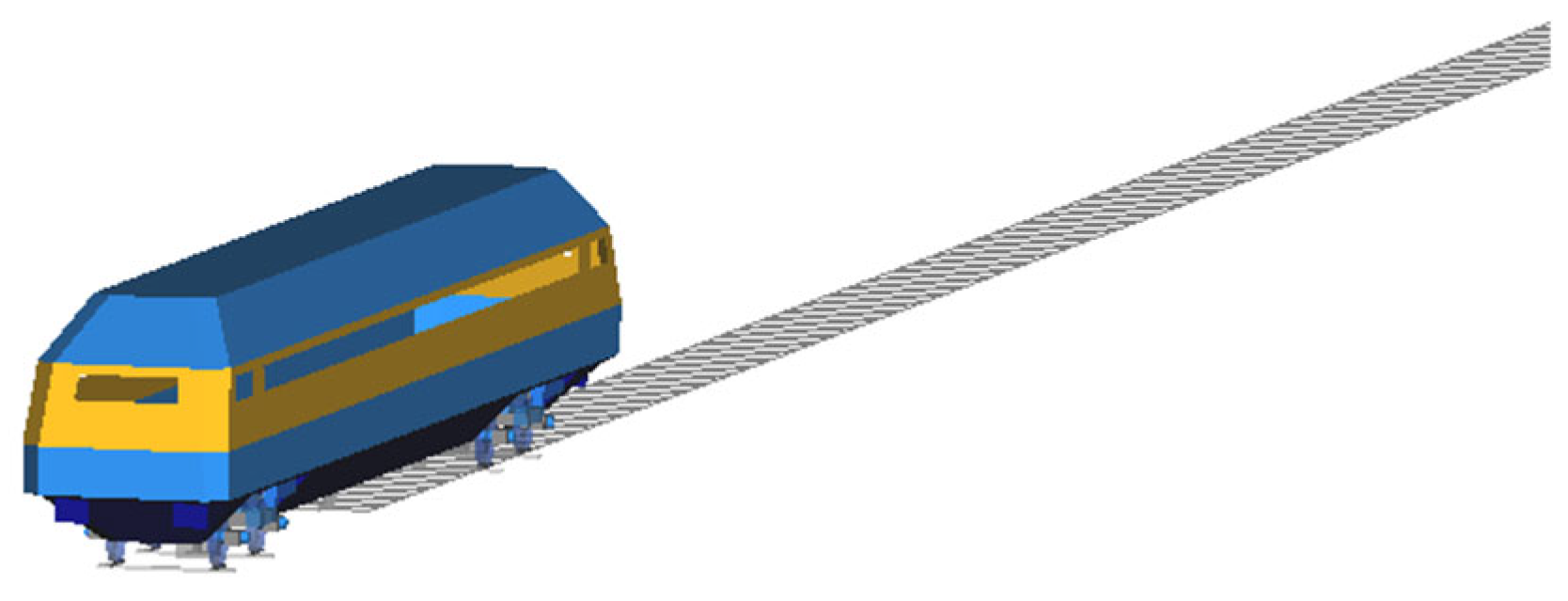
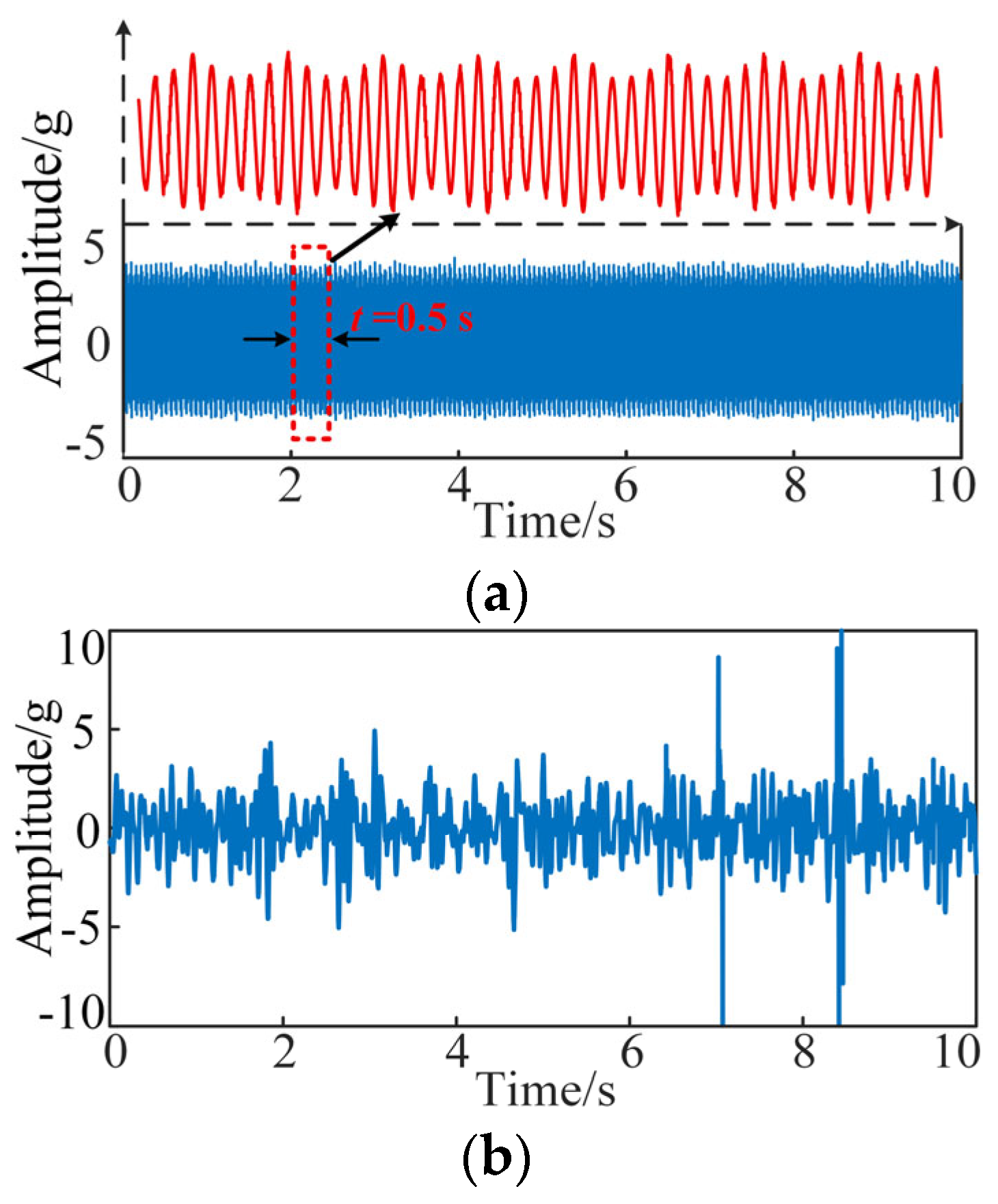
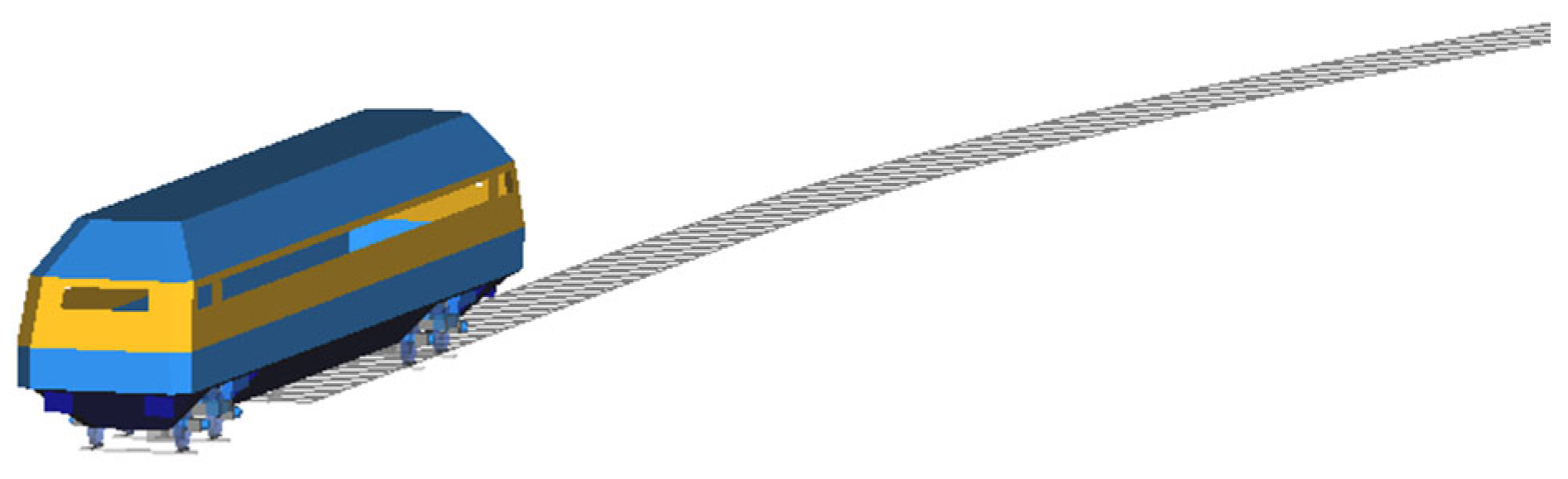
Using the parameters listed in Table 1, a locomotive dynamics model was developed, as illustrated in Figure 1. The operating speed was set to 40 km/h, with excitations from both wheel polygon and track irregularity applied. A triaxial accelerometer was mounted on the gearbox bearing housing to acquire vibration signals at a sampling frequency of 20,000 Hz. The resulting time-domain waveform is presented in Figure 2.
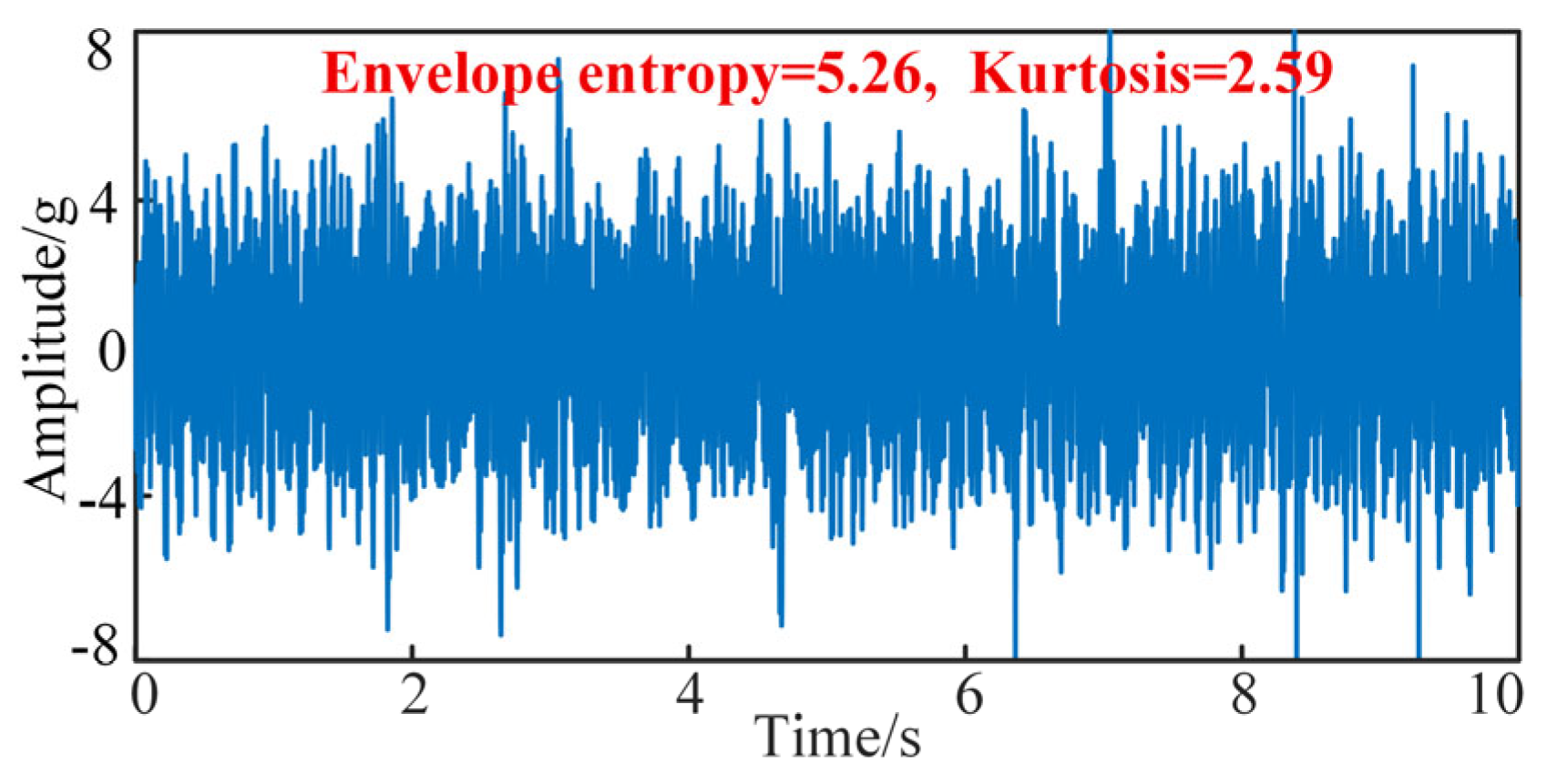
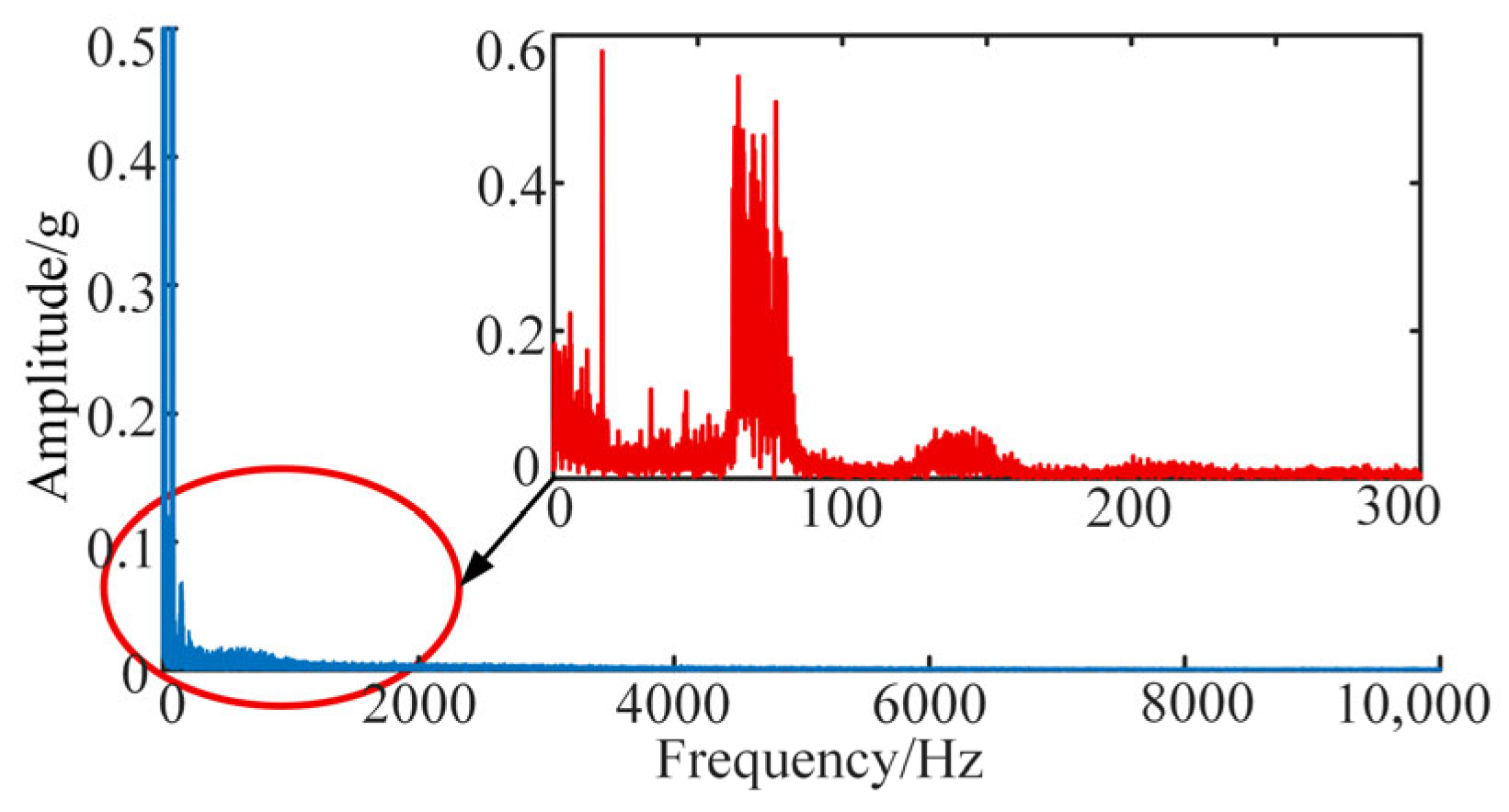
When track irregularities and wheel polygon wear were applied simultaneously to the locomotive’s dynamic model, the resulting time-domain vibration signal is shown in Figure 3. The periodicity and impulsiveness of this signal were assessed using envelope entropy and kurtosis. The analysis results yielded an envelope entropy value of 5.26 and a kurtosis value of 2.59, both indicating that the periodic and impulsive features of the combined excitation signal are not pronounced. To further characterize the spectral properties of the signal, frequency-domain analysis was performed, as shown in Figure 4. Within the analyzed range of [0, 10,000] Hz, the signal exhibits a dominant energy concentration in the 0–300 Hz band, suggesting that the disturbance primarily manifests as low-frequency interference.

2.2. Curve Operating Condition Dynamics Analysis (80 km/h)

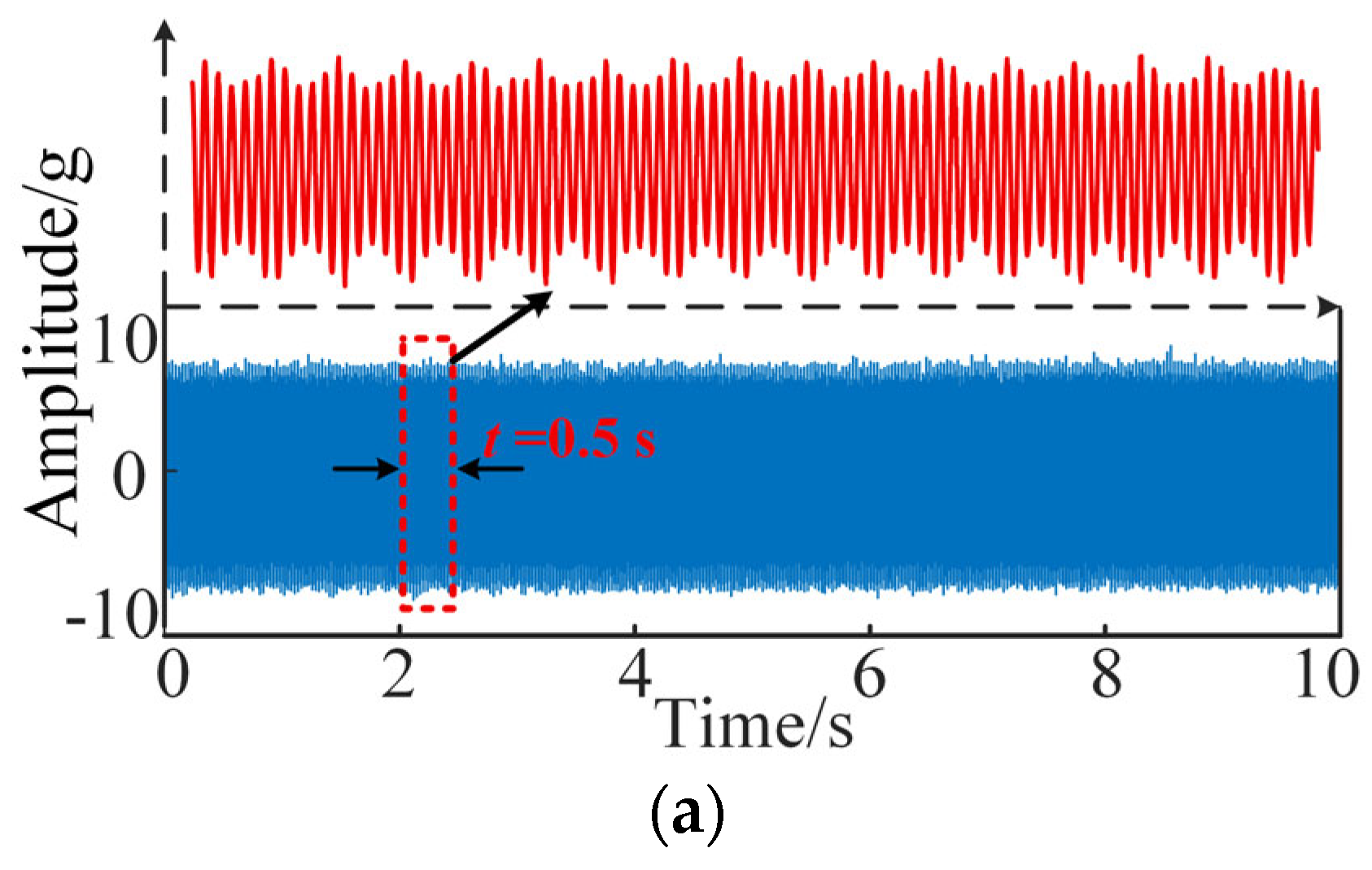
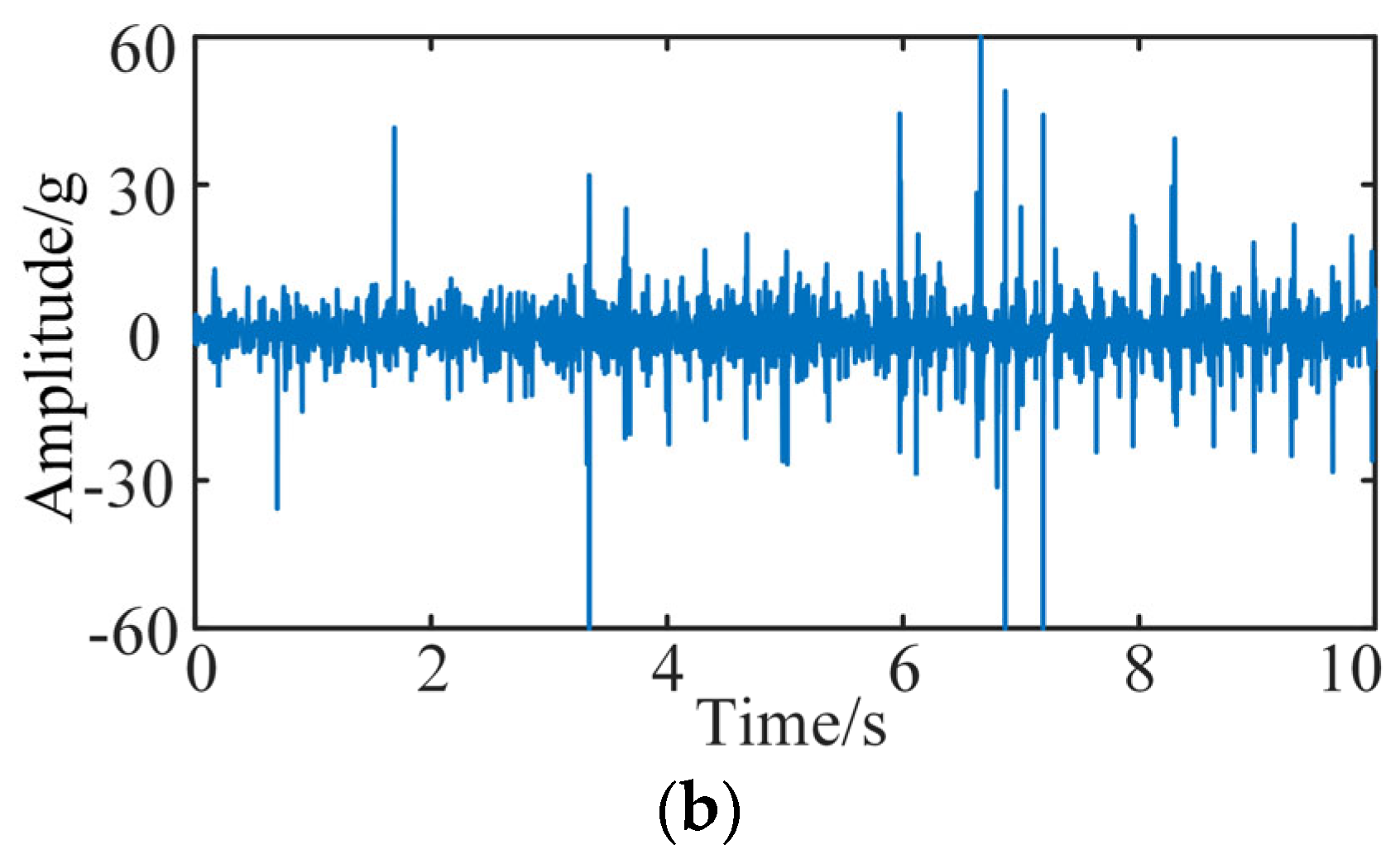
To investigate the influence of curved tracks on the dynamic response of locomotive systems, this study focused on the common minimum curve radius of 800–1200 m prevalent in China’s mainline railways. Since locomotives traversing small-radius curves are susceptible to increased lateral wheel–rail forces, accelerated wear, and potentially more complex dynamic behavior accompanied by intense vibrations, an 800 m radius was selected as a representative case. A dynamics model for curved-track negotiation was developed, as depicted in Figure 5. The operating speed was set to 80 km/h, and excitations from wheel polygonal wear and track irregularities were incorporated into the model to extract vibration response signals. The resulting dynamic response of the locomotive on the curved track is presented in Figure 6.
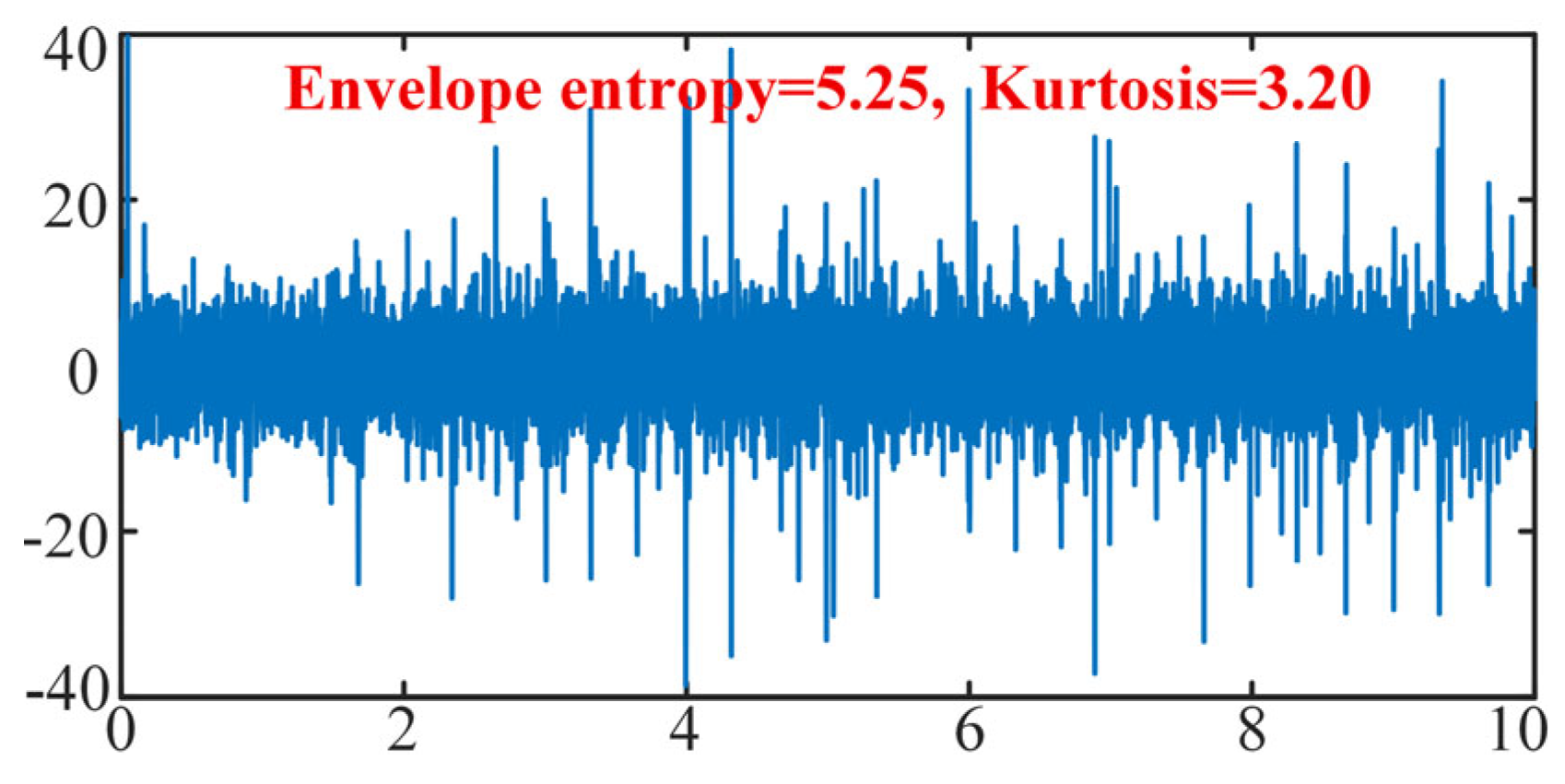
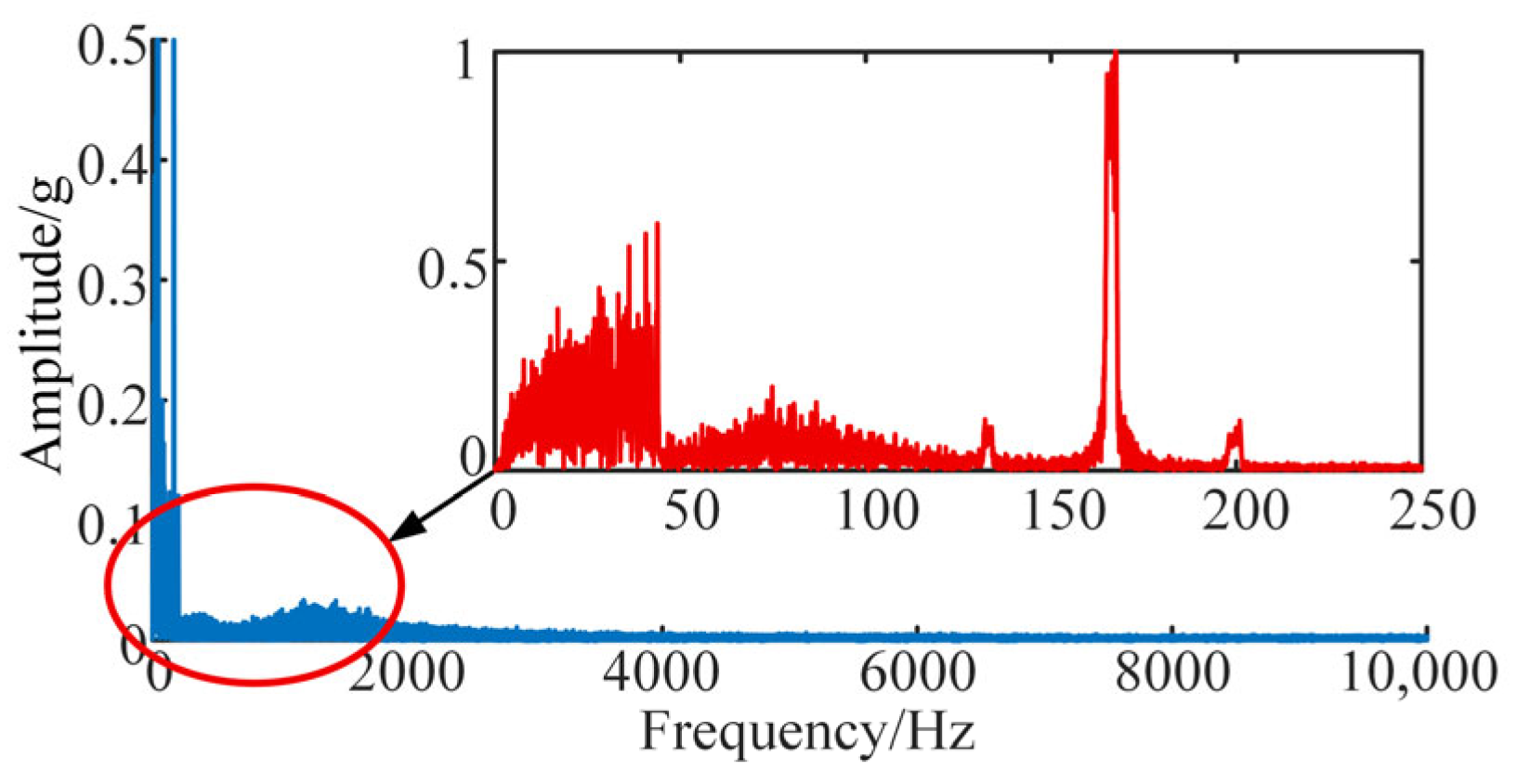
Both types of excitation were applied to the locomotive dynamics model, and the resulting wheel–rail coupled vibration response was extracted, the time-domain waveform of which is presented in Figure 7. The signal characteristics were evaluated using envelope entropy and kurtosis. The results show that the wheel–rail excitation signal has an envelope entropy of 5.25 and a kurtosis of 3.20, suggesting a highly impulsive nature with relatively weak periodicity. Furthermore, the frequency-domain characteristics of the excitation signal were analyzed, as shown in Figure 8. Within the analysis band of [0, 10,000] Hz, the signal exhibits concentrated energy in the 0–250 Hz band, demonstrating its pronounced disruptive nature in the low-frequency region.
The analysis of the locomotive–track coupled dynamic model indicates that wheel–rail excitation signals under practical operating conditions exhibit significant complexity. Track irregularities and wheel polygonal wear cause the signal energy to be dominated by low-frequency components, while random load fluctuations during wheel–rail contact introduce random impacts and broadband background noise. Under the combined effects of strong low-frequency modulation and random impacts, the periodic impulsive signatures generated by early bearing faults are easily submerged, making fault feature extraction difficult. To address these characteristics, SVMD is employed to adaptively decompose the vibration signal and alleviate mode mixing caused by low-frequency modulation and multi-source noise. Considering that weak fault signals usually exhibit sparsity, impulsiveness, and periodicity simultaneously, a weighted envelope spectrum factor (WESF) is constructed as a comprehensive evaluation index. The sparrow search algorithm (SSA) is further introduced to optimize the key parameters of MCKD. By integrating SVMD-based signal decomposition with MCKD-based impulsive enhancement, the proposed method enables stable extraction of weak periodic impulsive features under complex noisy environments.

3. SVMD-WESF-SSA-MCKD Algorithm

3.1. SVMD

Variational mode decomposition (VMD) is widely used in signal analysis due to its capability of decomposing signals into a set of band-limited intrinsic mode functions. However, when applied to fault signal processing, the parameter optimization involved in VMD often leads to increased computational complexity and reduced efficiency. To address this limitation, the successive variational mode decomposition (SVMD) method is adopted in this study. SVMD extracts intrinsic mode functions through a successive variational process, enabling adaptive decomposition of fault signals while effectively suppressing noise interference. A predefined threshold is used as the stopping criterion to avoid over-decomposition while maintaining decomposition accuracy [30,31].
In SVMD, the signal decomposition is performed by successively extracting modal components from the input signal. Assume that L − 1 modes have already been obtained, and the objective is to determine the next mode. The input signal f(t) can be expressed as the sum of the current mode uL(t) and the residual signal fr(t):
f ( t ) = u L ( t ) + f r ( t )
where u L ( t ) denotes the L -th extracted modal component and f r ( t ) represents the residual signal containing the remaining components of the signal that have not yet been extracted.
The residual signal f r ( t ) consists of two parts: the previously extracted modal components and the unprocessed part of the signal. It can be written as
f r ( t ) = i = 1 L 1 u i ( t ) + f u ( t )
where u i ( t ) denotes the i -th extracted modal component and f u ( t ) represents the unprocessed portion of the signal.
The SVMD decomposition is constructed based on three constraints to ensure that the extracted modes remain compact around their center frequencies while minimizing spectral overlap between modes. Under the assumption that each mode has a narrow-band structure, the first constraint is defined as
J 1 = ( t ) δ ( t ) + j π t u L ( t ) e j ω L t 2 2
where δ ( t ) denotes the Dirac delta function and j represents the imaginary unit.
To suppress spectral overlap between the residual signal and the extracted mode, a filter with a specific frequency response is introduced. Let β L ( t ) denote the impulse response of the filter corresponding to the L -th mode. Its frequency response can be expressed as
β ^ L ( ω ) = 1 α ( ω ω L ) 2
where α is the balancing parameter controlling the bandwidth of the mode.
Based on this filter, the second constraint is defined as
J 2 = β L ( t ) f r ( t ) 2 2
Similarly, for the previously extracted modes, the frequency response of the corresponding filters can be written as
β ^ i ( ω ) = 1 α ( ω ω i ) 2     i = 1 ,   2 ,   ,   L 1  
Thus, the third constraint is given by
J 3 = i = 1 L 1 β i ( t ) u L ( t ) 2 2
Based on the above constraints, the SVMD decomposition can be formulated as the following optimization problems:
min u L .   ω L .   f r α J 1 + J 2 + J 3     s . t .         u L ( t ) + f r ( t ) = f ( t )
To solve the above constrained optimization problem, Lagrange multipliers are introduced to construct an augmented Lagrangian function. The problem is then transformed into an unconstrained optimization problem and solved in the frequency domain using the alternating direction method of multipliers (ADMM). Through iterative updates of u L ( ω ) , ω L , and the Lagrange multiplier, the optimal modal component can be obtained.

3.2. MCKD

The fault signal is first decomposed into a series of modal components using the SVMD method. Subsequently, envelope spectrum analysis is applied to extract fault-related features. However, these features tend to be weak due to interference from strong background noise. To enhance the impulsive components within the fault characteristics, the MCKD algorithm is introduced for further processing.
Let y = y 1   y 2     y N T be the impact signal. The actual acquired signal x can be expressed as
x = h y + e
where h is the system transfer function of y transmitted through the surrounding environment and path.
The MCKD algorithm aims to recover the input signal y (containing fault impulses) from the measured output signal x by applying an optimal deconvolution filter f of length L. This process can be summarized as follows:
y n = f x = k = 1 L f k x n k + 1
The MCKD algorithm employs the correlated kurtosis (CK) as a criterion to quantify the prominence of periodic impulse sequences within a signal. The equation for the correlated kurtosis is defined as
Δ CK M ( T ) = n = 1 N m = 0 M y n m T 2 n = 1 N y n 2 M + 1
where y n denotes the output signal after filtering, N represents the signal length, M is the shift number, and T denotes the period of the impulse signal. The numerator reflects the periodic correlation of impulses separated by the interval T , while the denominator acts as a normalization term to eliminate the influence of signal amplitude.
To effectively separate periodic fault characteristics from background noise, a deconvolution filter f of length L is applied to the output signal x. The optimal recovery of the input signal y is achieved when the CK is maximized. This maximization process is formulated as the following optimization problem:
max f CK M ( T ) = max f n = 1 N m = 0 M y n m T 2 n = 1 N y n 2 M + 1
To maximize the correlated kurtosis, the numerator and denominator of Equation (12) are differentiated with respect to the filter coefficient. This differentiation process can be formulated as follows:
d d f k CK M ( T ) = 0 ,     k = 1 , 2 , , L
The optimal filter coefficients, derived by setting the derivatives to zero, are given in matrix form by the following expression:
f = y 2 2 H 2 ( X 0 X 0 T ) 1 m = 0 M X m T P m
where
X m T = x 1 m T x N m T 0 x N L m T + 1 L × N ,   P m = y 1 m T 1 ( y 1 2 y 1 M T 2 ) y 2 m T 1 ( y 2 2 y 2 M T 2 ) y N m T 1 ( y N 2 y N M T 2 ) ,   H = y 1 y 1 M T y 2 y 2 M T y N y N M T .
According to Equation (12), the enhancement effect of MCKD is governed by three key parameters: L, T, and M.

3.3. Weighted Envelope Spectrum Factor

The envelope spectrum of the vibration signal is analyzed to obtain a sequence of amplitude values, denoted as X(i). The envelope spectrum factor (ESF) is then defined as the ratio of the maximum amplitude within a specified frequency band to the root mean square (RMS) value of the entire amplitude sequence. This metric serves to quantify both the periodicity and strength of impulsive components in the vibration signal. The envelope spectrum of the vibration signal is analyzed to obtain a sequence of amplitude values, denoted as X ( i ) , where X ( i ) represents the amplitude of the envelope spectrum at the i -th frequency bin.
ESF ( j ) = max ( X ( i ) ) i = 1 Z X ( i ) 2 / Z
where X ( i ) denotes the envelope spectrum amplitude at the i -th frequency bin, Z represents the total number of spectral points, and i is the frequency index. In addition, j denotes the index of the modal component obtained from SVMD decomposition, and E S F ( j ) represents the ESF value calculated from the j -th modal component. The ESF reflects the prominence of characteristic frequency components in the envelope spectrum and is used to evaluate the periodic impulsive features in the vibration signal.
To improve the comprehensiveness of the ESF in characterizing vibration signals, a weighted factor is constructed by incorporating the Hoyer measure and kurtosis. The Hoyer measure—defined as the normalized ratio of the L2 norm to the L1 norm—quantifies the transient sparsity of the fault signal and demonstrates strong robustness against outliers, as given in Equation (16). Kurtosis, on the other hand, reflects the impulse intensity of the fault signal, with its value positively correlated with the energy of fault impacts, as shown in Equation (17).
Hoy ( j ) = Z X j 1 X j 2 Z 1 = Z i = 1 Z X ( i ) / i = 1 Z X ( i ) 2 Z 1
where X j   denotes the envelope spectrum amplitude sequence corresponding to the j -th SVMD modal component, Z   represents the length of this sequence, and X j 1 and X j 2 denote the L 1 norm and L 2 norm.
Ku ( j ) = 1 Z i = 0 Z 1 X 4 ( i ) 1 Z i = 1 Z 1 X 2 ( i ) 2
Equations (16) and (17) reveal the complementary characteristics of the Hoyer index and kurtosis. The Hoyer index is highly sensitive to sparsity but lacks sensitivity to amplitude, which impedes its ability to discriminate low-amplitude fault impulses from high-frequency noise and can result in the omission of weak yet periodic fault transients. Conversely, kurtosis is highly sensitive to the impulse amplitude but is indifferent to temporal structure, making it vulnerable to contamination from non-periodic, high-amplitude outliers. Owing to this complementarity, both indicators are incorporated as weights to enhance the ESF, forming a WESF.
Since the Hoyer index is a normalized sparsity measure based on the L 1 and L 2 norms, its values typically range between 0 and 1. The ESF is defined as the ratio of the maximum spectral amplitude to the root mean square of the overall spectral energy and therefore exhibits a certain degree of scale normalization. Kurtosis, as a statistical indicator of impulsiveness, generally remains within a stable numerical range in vibration signals. Consequently, these indicators do not present significant differences in magnitude, which avoids the dominance of any single indicator in the objective function. By combining these indicators multiplicatively, the periodicity, sparsity, and impulsiveness of the signal can be emphasized simultaneously.
WESF ( j ) = [ Hoy ( j ) Ku ( j ) ] ESF ( j )
Equation (18) integrates the sparsity, impulsivity, and periodicity of the signal, thereby significantly enhancing the detection of periodic transient impulses from weak bearing faults in noisy environments. A larger WESF value indicates more distinct fault features. Therefore, the optimization is formulated as the minimization of -WESF. The combination of parameters (L, T, M) that yields the global minimum of this fitness function corresponds to the optimal MCKD configuration.
It should be noted that WESF is not a simple empirical combination of multiple statistical indicators but is designed based on the structural characteristics of weak periodic impulsive signals. Under complex wheel–rail excitation conditions, early bearing fault signals usually exhibit sparsity, impulsiveness, and periodicity simultaneously. Accordingly, the WESF indicator is constructed to reflect these multidimensional characteristics: the Hoyer index describes signal sparsity, kurtosis characterizes impulsive intensity, and the envelope spectrum factor represents periodic features. By integrating these complementary indicators, WESF provides a more comprehensive representation of the structural characteristics of weak periodic impulsive signals, thereby enabling the optimization process to more accurately guide the algorithm toward identifying signal components that contain fault-related information.

3.4. SVMD-WESF-SSA-MCKD Process

To address the challenge of weak damage characterization in locomotive gearbox bearings under wheel–rail excitation, where fault features are often obscured by random varying loads, a novel fault feature enhancement algorithm (SVMD-WESF-SSA-MCKD) is proposed. The implementation procedure comprises three steps:
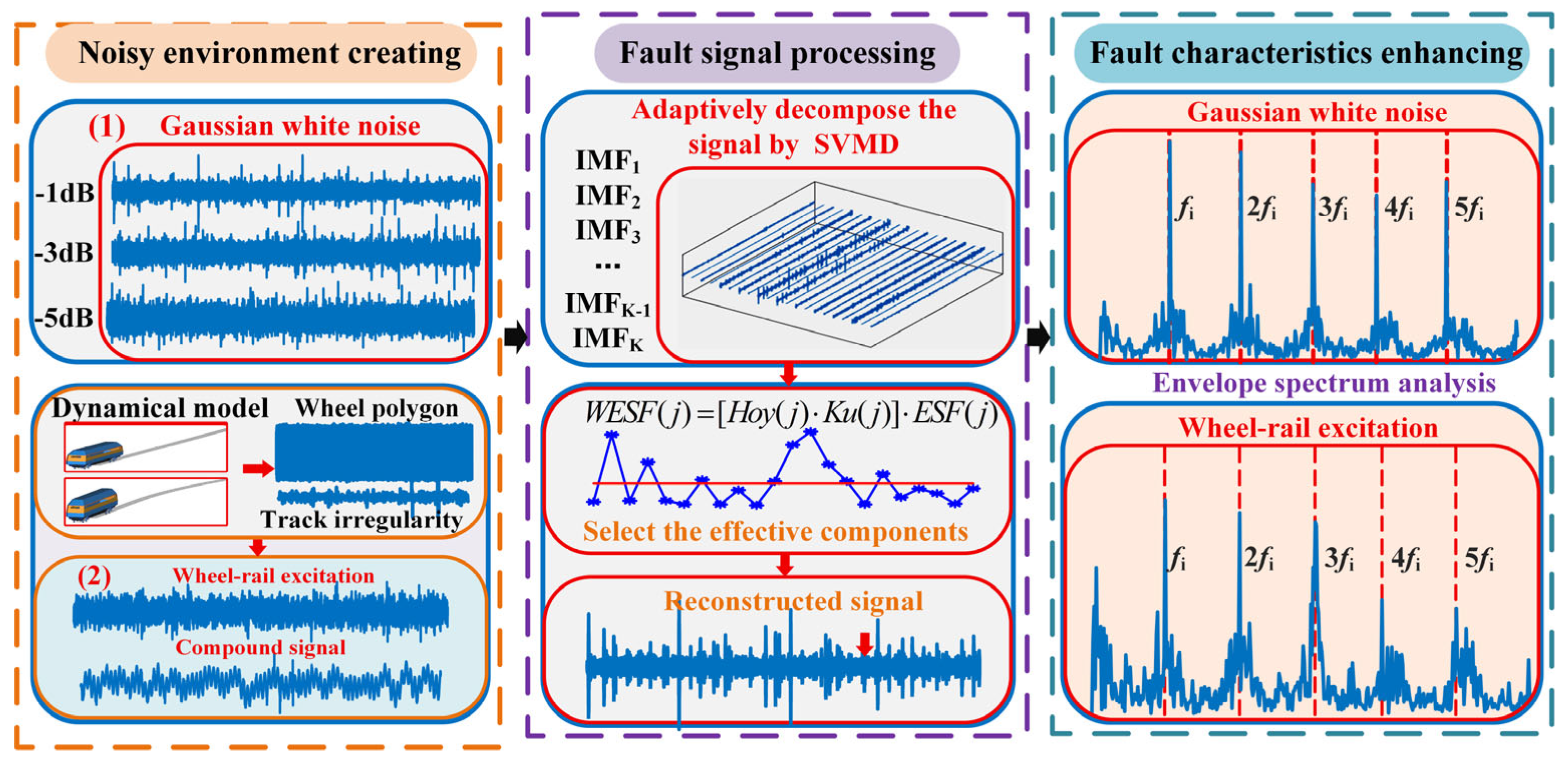
Step 1: Noise environment construction. To simulate real operational conditions, two types of noise are introduced: (1) Theoretical noise: Addition of Gaussian white noise at different signal-to-noise ratios (SNRs). (2) Engineering noise: Establishment of a locomotive–track coupled dynamics model in multibody dynamics software, applying excitations from wheel polygonization and track irregularities, followed by extraction of the wheel–rail coupled noise component.
Step 2: Fault signal processing. SVMD parameters are initialized to adaptively decompose the noise-contaminated fault signal into K IMF components. The WESF value of each IMF is computed, and components with above-average WESF values are selected for signal reconstruction.
Step 3: Fault feature enhancement. The reconstructed signal serves as the input to the MCKD algorithm, whose optimal parameters [L0, T0, M0] are determined using the s SSA with WESF as the fitness function. Enhanced fault features are then extracted via envelope spectrum analysis, enabling the identification of bearing characteristic frequencies and diagnosis of the fault state.
To further clarify the interaction among the SVMD decomposition, WESF-based mode selection, SSA-driven MCKD parameter optimization, and the final envelope spectrum extraction, the complete algorithmic workflow is summarized in Algorithm 1.
In this study, SSA is adopted as a parameter optimization tool primarily to reduce the uncertainty associated with manual parameter tuning, rather than to emphasize the performance superiority of any specific optimization algorithm. It should be noted that the proposed framework does not rely on a particular optimization strategy; in principle, any algorithm with global search capability can be employed to replace SSA. The effectiveness of the method is mainly determined by the adopted evaluation criterion and the front-end signal processing procedure, rather than by the optimizer itself.
Algorithm 1. SVMD–WESF–SSA–MCKD Algorithm
Input: Raw vibration signal x(t)
Step 1: Decompose the signal x(t) into K intrinsic mode functions (IMFs) using SVMD:
               {uk(t)}, k = 1, 2, …, K.
Step 2: Compute the weighted envelope spectrum factor (WESF) for each IMF uk(t).
Step 3: Select IMFs whose WESF values are greater than the average value, and reconstruct the signal: xr(t) = Σ uk(t).
Step 4: Initialize the SSA population and define WESF as the fitness function.
Step 5: Use SSA to optimize the key parameters of MCKD, i.e., (L, T, M), by minimizing the negative WESF.
Step 6: Apply MCKD to the reconstructed signal xr(t) using the optimized parameters.
Step 7: Perform envelope spectrum analysis on the enhanced signal to extract fault characteristic frequencies.
Output: Enhanced signal and corresponding fault characteristic frequencies.
The overall flowchart of the proposed algorithm is shown in Figure 9.

4. Simulation Signal Experiment of Impact Noise

To evaluate the capability of the proposed method in extracting weak periodic impulsive features under strong interference, simulated signals with known characteristics are constructed under controlled conditions. Compared with experimental signals, simulated signals contain clearly defined fault impulses, providing a verifiable reference for algorithm performance evaluation. To better approximate real operating conditions, a typical wheel–rail excitation noise model is introduced into the fault signal, including low-frequency modulation components, random impacts, and broadband background noise. The resulting composite signal allows validation of the proposed method under a known fault period, particularly demonstrating the effectiveness of the core module WESF–SSA–MCKD in enhancing weak periodic impulsive signals, and providing a reference for subsequent analysis of more complex experimental signals.

4.1. Composite Signal Under Wheel–Rail Excitation

Low-frequency modulation component (track irregularity):
x lf ( t ) = A 1 sin ( 2 π   f 1 t ) + A 2 sin ( 2 π   f 2 t )
where f1 and f2 denote low-frequency excitation components induced by track irregularities.
Random impact component (wheel polygonization): A Poisson process is employed to generate random impact instants tk, and each impact is expressed using an exponentially decaying oscillation:
x i m p ( t ) = k = 1 N λ B k e β ( t t k ) sin ( 2 π   f r , k ( t t k ) )
where B k is the impact amplitude, f r , k is the resonance frequency, β is the decay coefficient, and N λ is the number of impulses generated by the Poisson process.
Broadband background noise:
x w n ( t ) = σ n ( t )
where n ( t ) is zero-mean Gaussian white noise and σ is the noise intensity determined based on engineering practice.
Total wheel–rail excitation:
x e x c ( t ) = x l f ( t ) + x imp ( t ) + x wn ( t )
This synthesized excitation simultaneously incorporates low-frequency modulation, random impulsive noise, and broadband disturbance, consistent with the dynamic characteristics of wheel–rail interaction.
Single impulse response:
h ( t ) = A 0 e α 0 t sin ( 2 π   f c t )
where fc is the structural resonance frequency, α is the decay rate, and A0 is a small impulse amplitude representing early-stage damage.
The periodic impulses follow:
x fault ( t ) = k = 1 K A 0 e α 0 ( t k T f ) sin ( 2 π   f c ( t k T f ) )
where the fault characteristic frequency is selected as ff = 80 Hz, rotational frequency fr = 15 Hz, and T f = 1 / f f .
Fault signal with weak noise:
x fault ( t ) = x fault ( t ) + η ( t )
The final simulated signal is constructed as
x c o m p ( t ) = x e x c ( t ) + x f a u l t ( t )
Due to the strong interference of x e x c ( t ) , the fault impulses are heavily masked, forming a typical weak fault under strong noise diagnosis scenario.
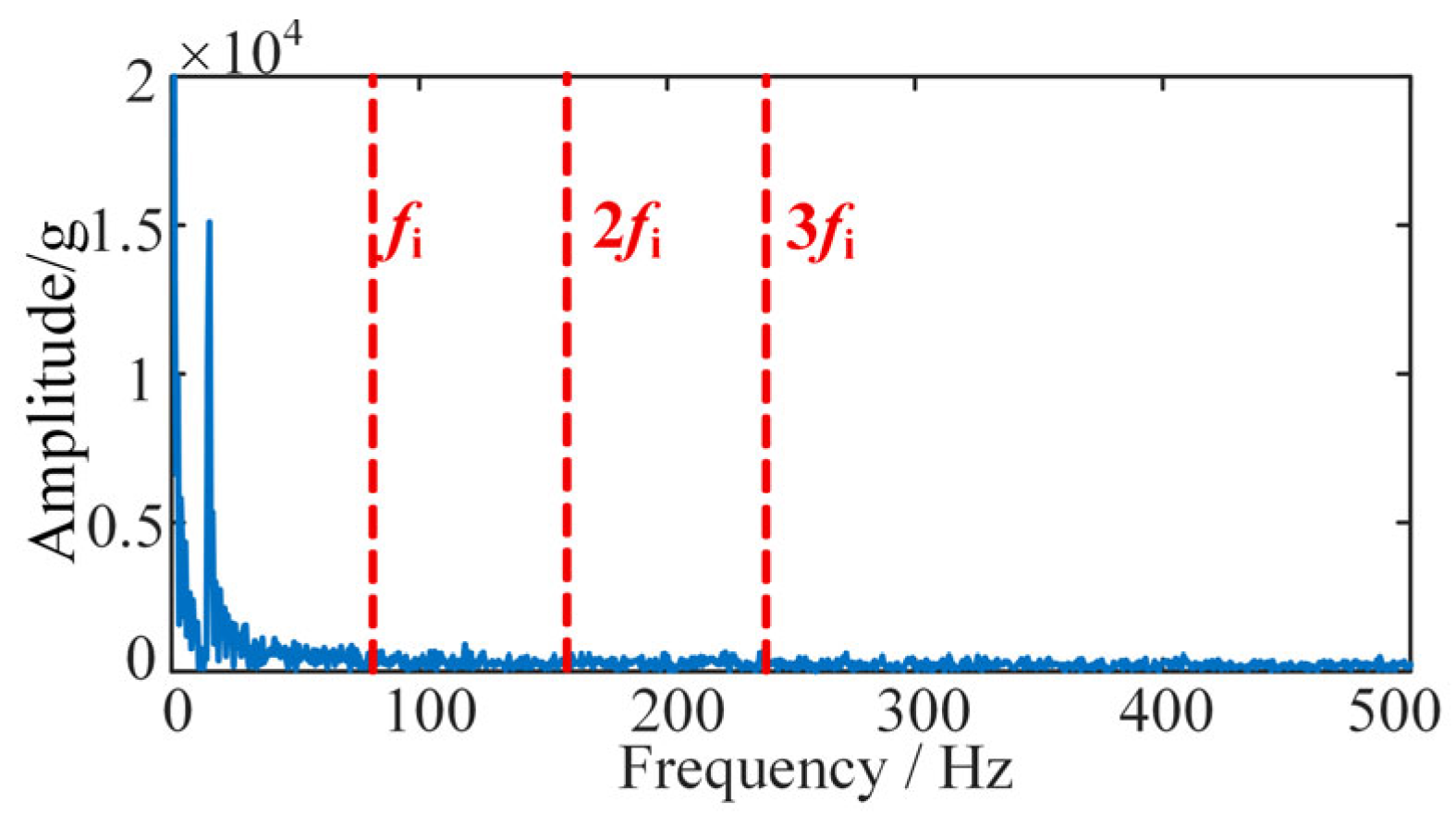
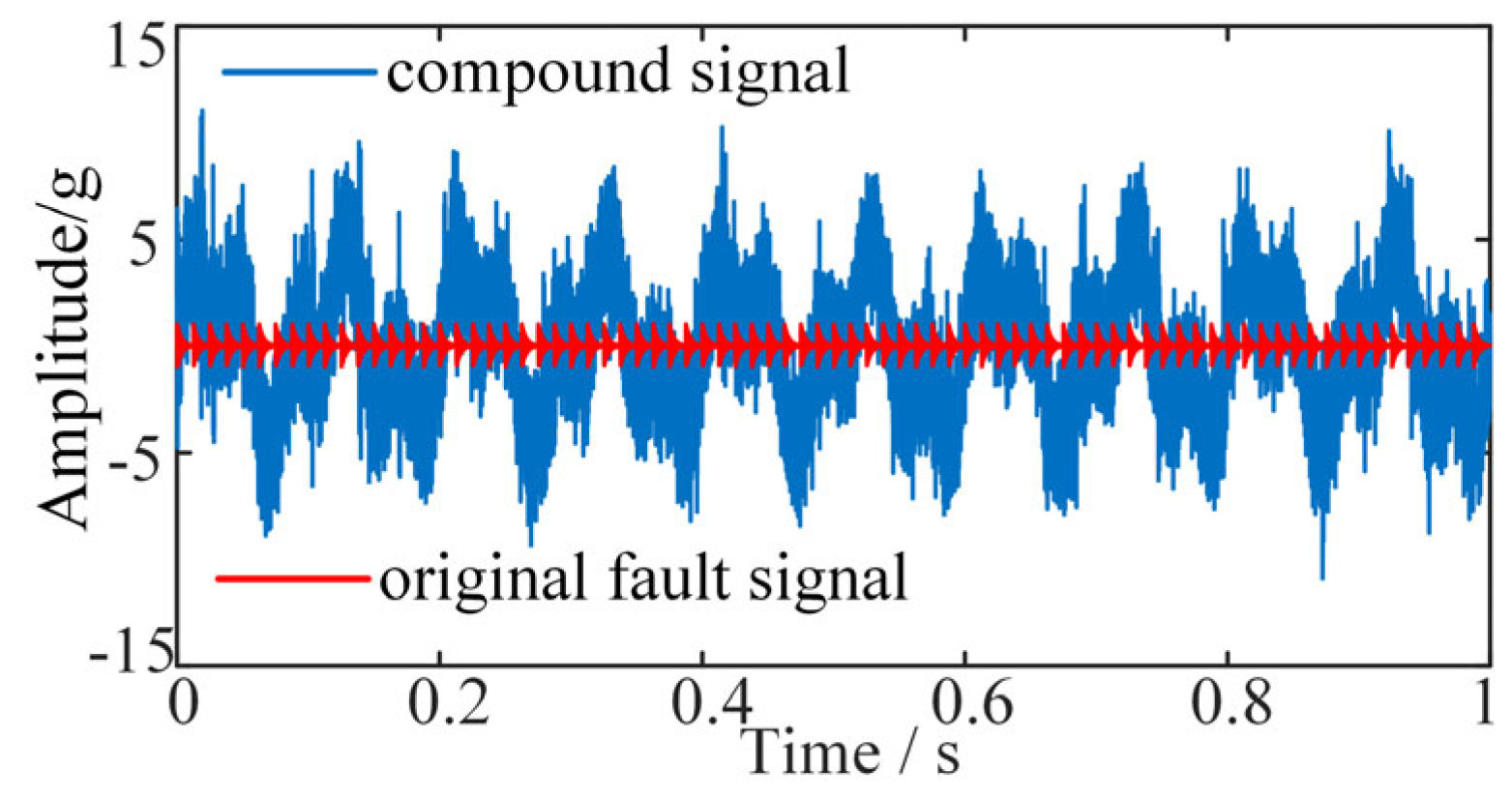
By superimposing the wheel–rail excitation signal with the bearing fault signal, the composite signal shown in Figure 10 is obtained. As illustrated in the figure, the high-energy excitation completely obscures the impulsive fault characteristics. Before applying the proposed method, an envelope spectrum analysis was performed on the composite signal, and the result is presented in Figure 11. It can be observed that extracting meaningful fault features directly under such strong wheel–rail interference remains difficult.

4.2. Composite Signal Diagnosis and Analysis

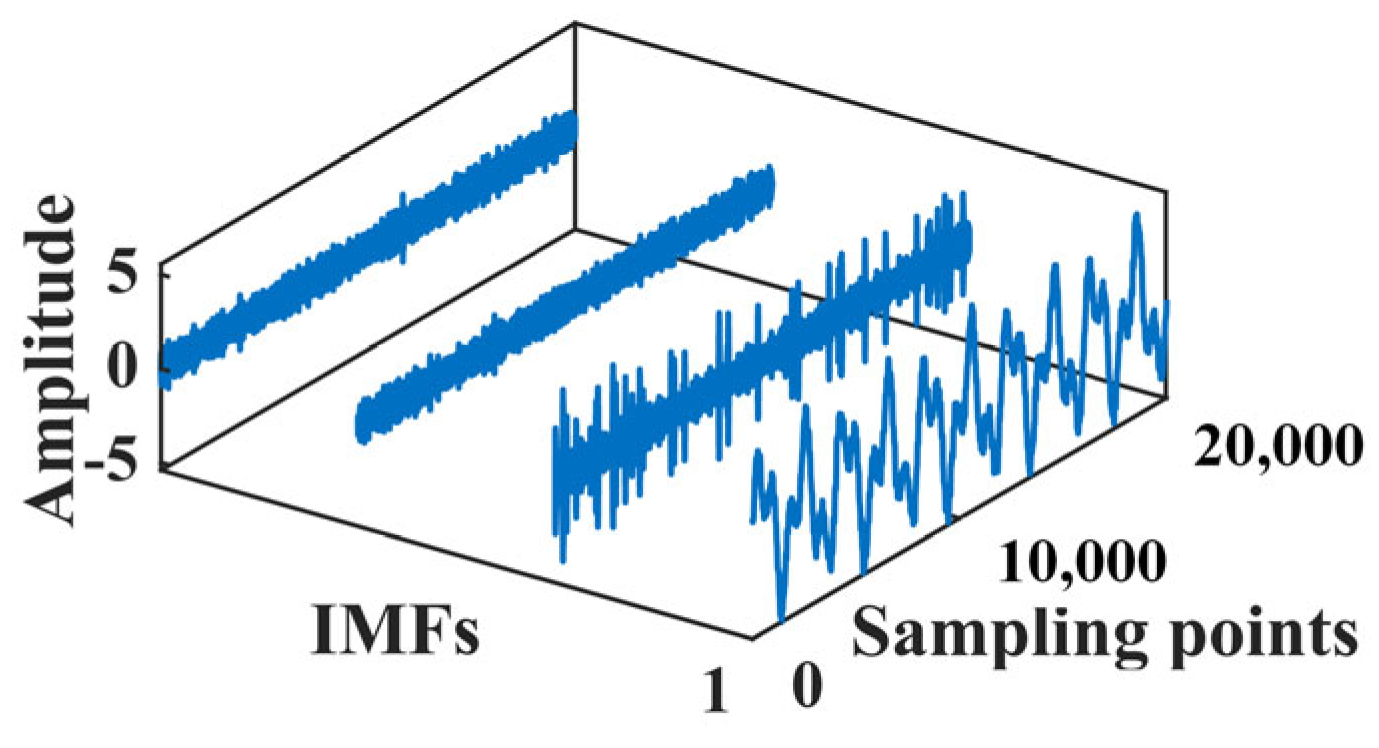
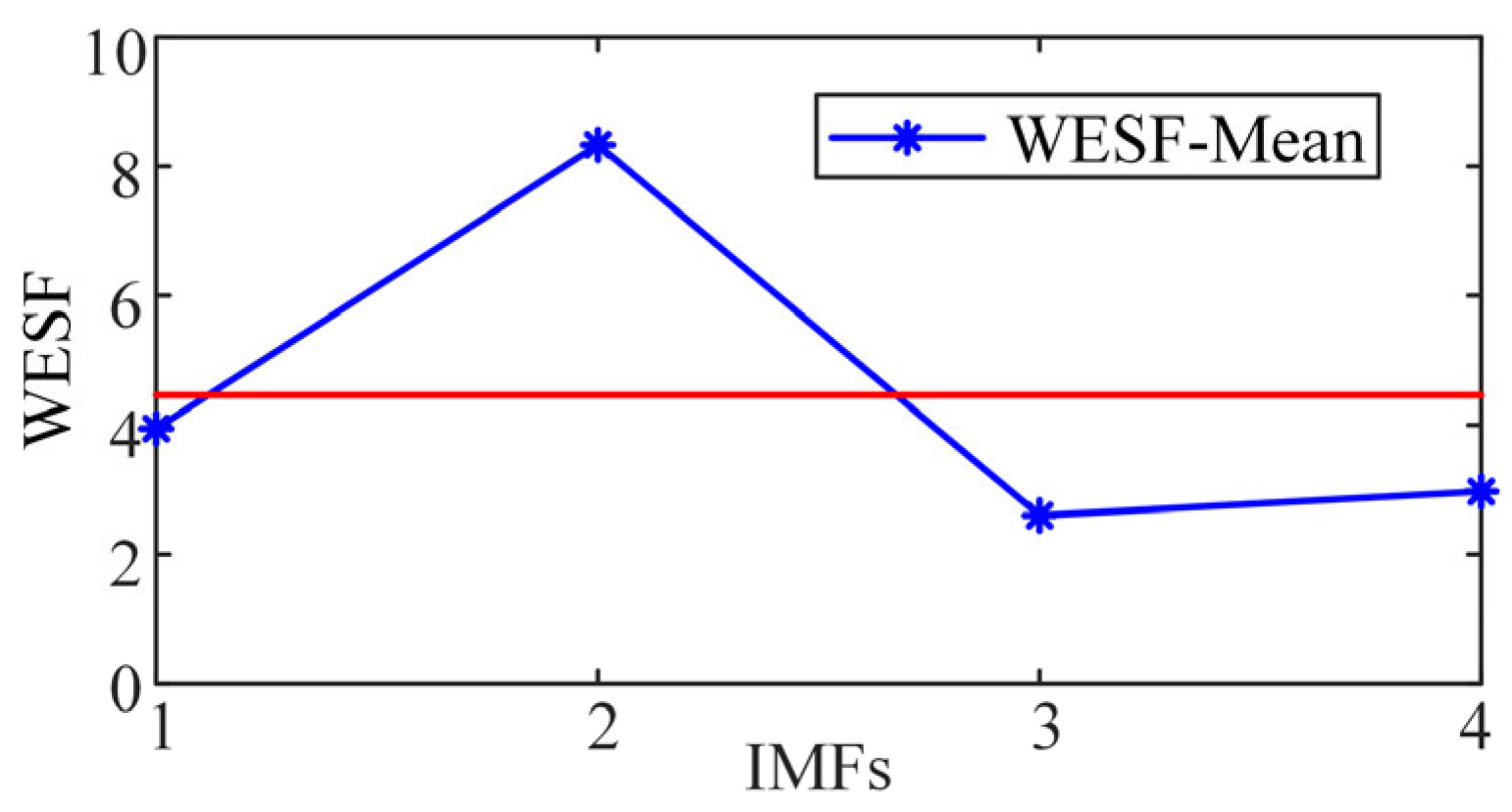
Following the parameter selection guideline established in Reference [32]—which provides both theoretical and empirical evidence that setting α to 2000 allows SVMD to effectively preserve impulsive features while mitigating mode mixing, particularly in noise-corrupted vibration signals—the same value of α = 2000 was adopted in this study, consistent with the signal characteristics under investigation. The composite signal was subsequently decomposed into four IMFs by SVMD, and their time-domain waveforms are shown in Figure 12. The WESF values computed for each IMF are plotted in Figure 13. As indicated, IMF2 exhibits the highest WESF value and is therefore selected as the optimal input component for the MCKD stage.
The reconstructed signals were used as inputs to the MCKD algorithm, whose three key parameters (M, L, T) were optimized using the SSA. The search ranges were predefined as follows: M was bounded within [1, 7], L within [500, 1000], and preliminary calculations were performed using the equation T = f S / f f . The optimization range for T was set to [ f S / 1.02 f f ,   f S / 0.98 f f ] . The feasible range of the deconvolution period T was determined to be [245, 256].
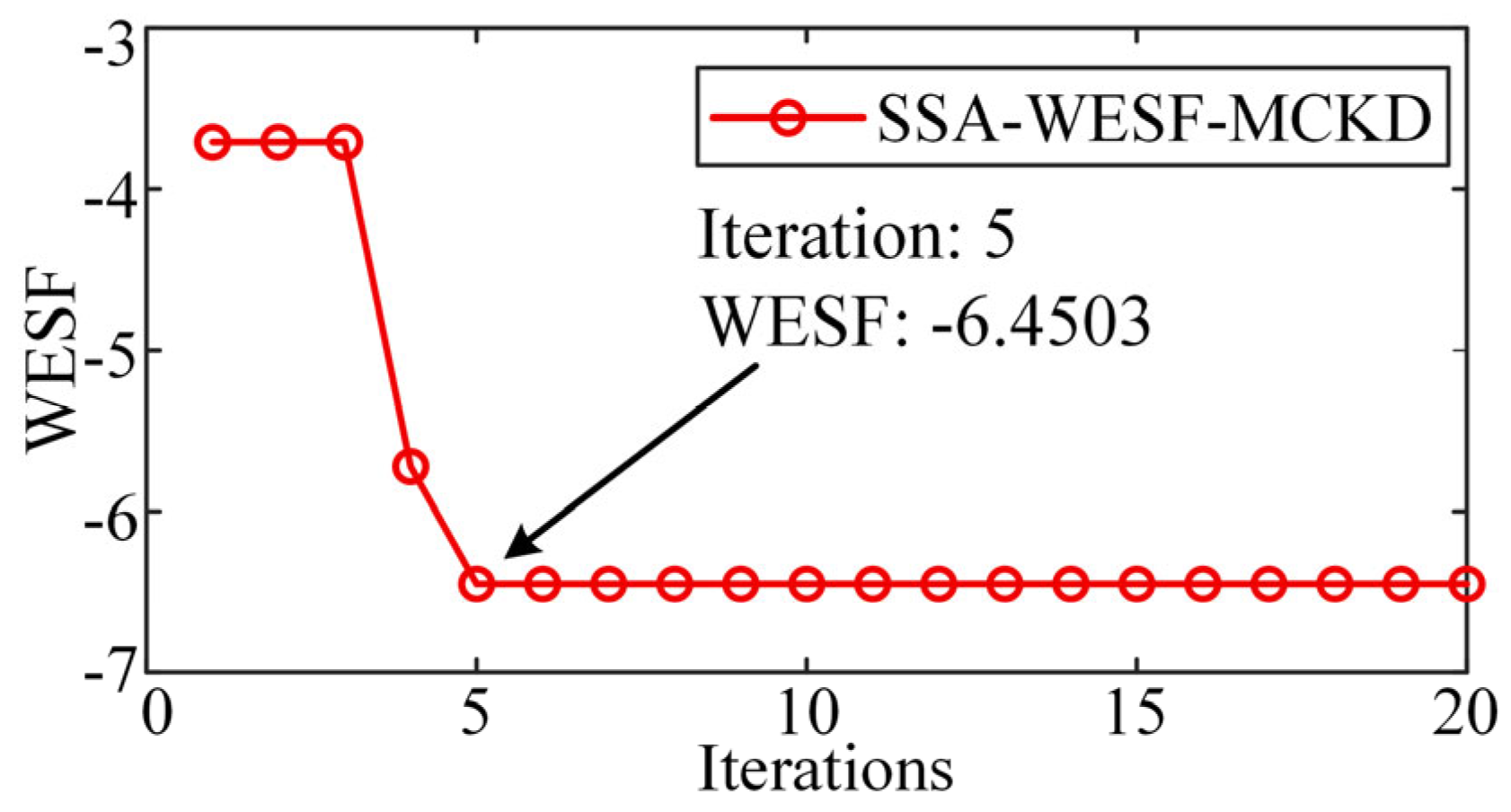
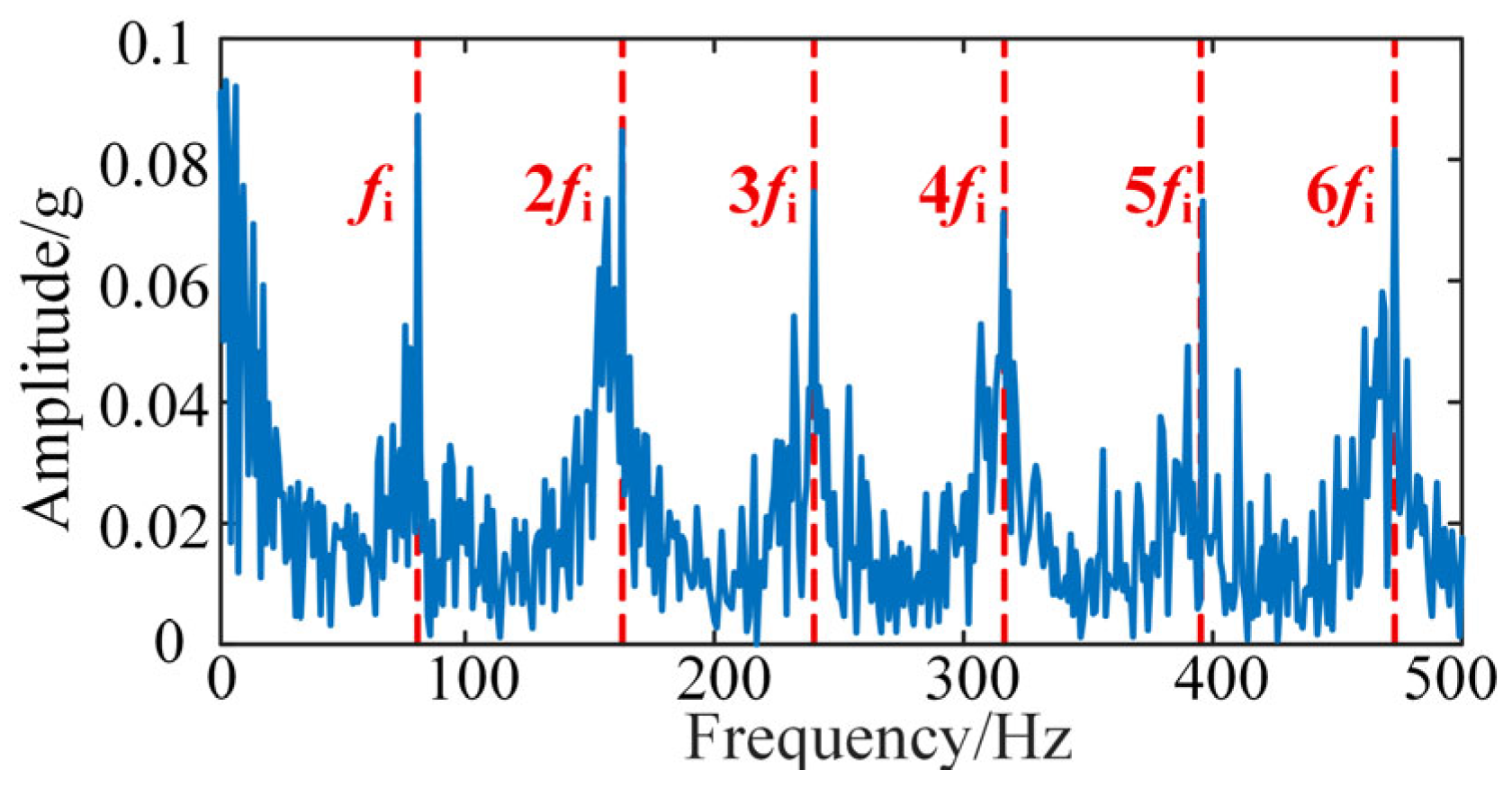
Using WESF as the fitness function, the SSA was employed to optimize the key MCKD parameters. The convergence curve in Figure 14 shows that the SSA–MCKD algorithm converges at the fifth iteration, with a final WESF value of −6.4503, yielding the optimal parameter set [L, T, M] = [851, 255, 6]. After applying MCKD with these optimized parameters, the enhanced signal was obtained, and its envelope spectrum was calculated. As shown in Figure 15, the proposed method effectively amplifies the impulsive characteristics of the fault signal under strong noise conditions, enabling the clear identification of the fundamental fault frequency fi and its second–sixth harmonics (2fi, 3fi, 4fi, 5fi, 6fi).

5. Validation of the Proposed Method

5.1. Experimental Design and Signal Acquisition

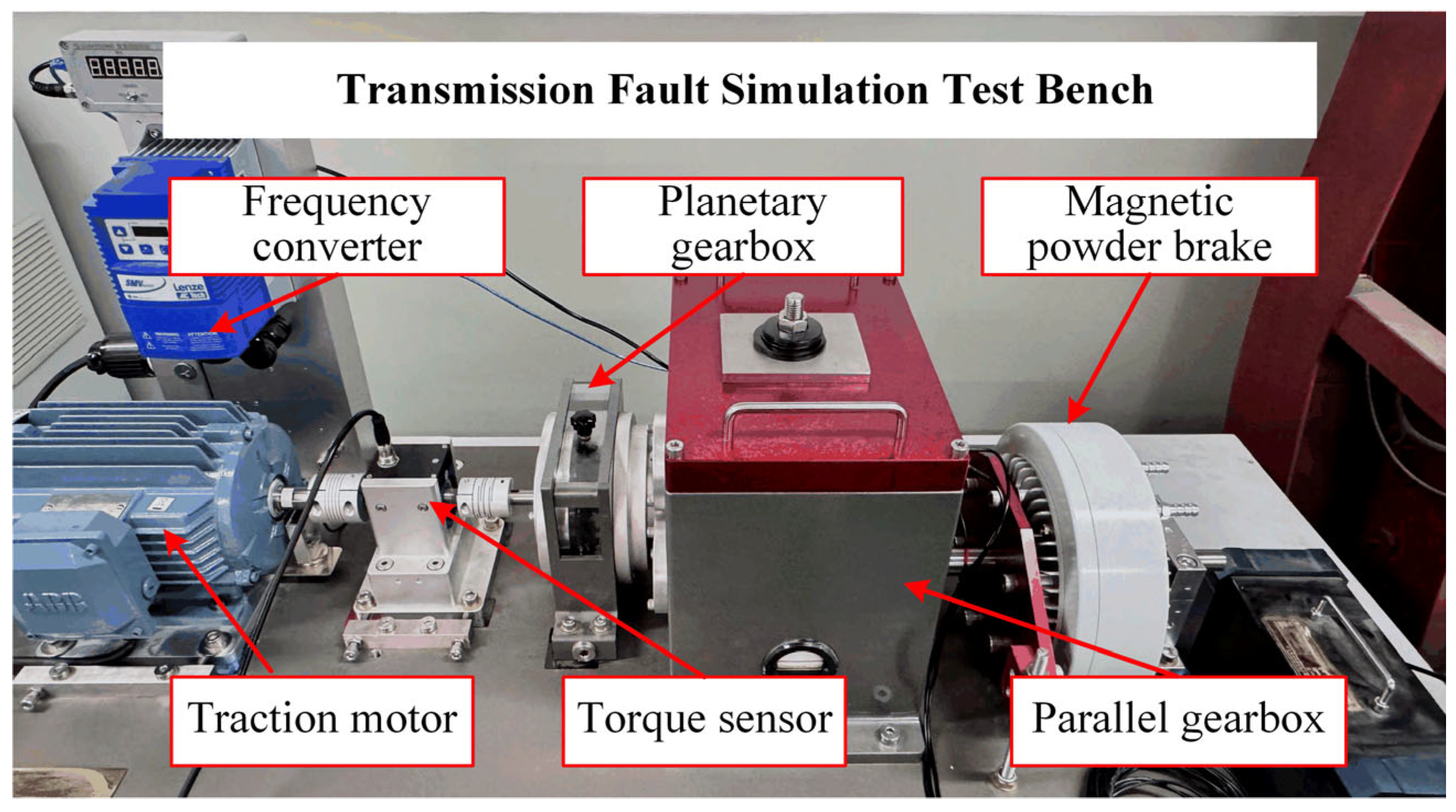
To validate the effectiveness of the proposed method, a transmission fault simulation test bench was constructed, as shown in Figure 16. The setup primarily comprised a variable frequency converter, a traction motor, a torque sensor, a planetary gearbox, a parallel gearbox, and a magnetic powder brake, enabling the simulation of various bearing fault states under different operating conditions. For this experiment, the planetary gearbox was removed to focus on fault diagnosis in a typical locomotive transmission system, with the intermediate shaft bearing of the parallel gearbox selected as the object of study. Based on the tooth numbers of the gears in the parallel gearbox, the transmission ratio between the input shaft and the intermediate shaft was calculated to be 3.3.
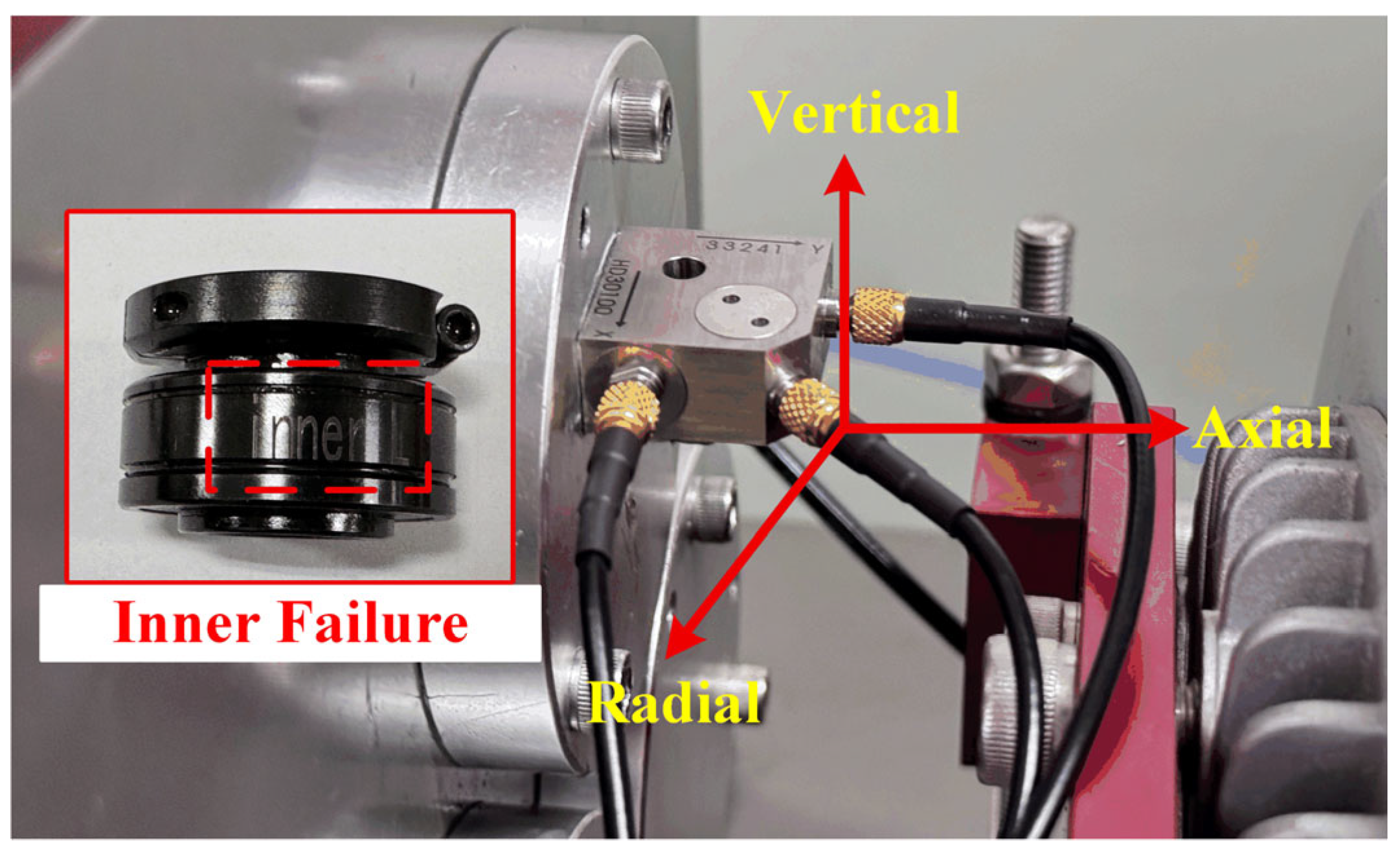
An ER16K ball bearing with an artificial localized defect on its inner race was used to simulate the fault. Vibration signals were acquired using a triaxial accelerometer mounted on the bearing housing cover at the right end of the parallel gearbox’s intermediate shaft, as shown in Figure 17. The sampling frequency was set to 20 kHz. The motor speed was controlled by the variable frequency drive with an output frequency range of 0–60 Hz. To investigate the influence of rotational speed on fault feature extraction, vibration signals were collected and analyzed under three operating conditions: 40 Hz, 50 Hz, and 60 Hz. The corresponding rotational speeds and theoretical fault characteristic frequencies are listed in Table 2.
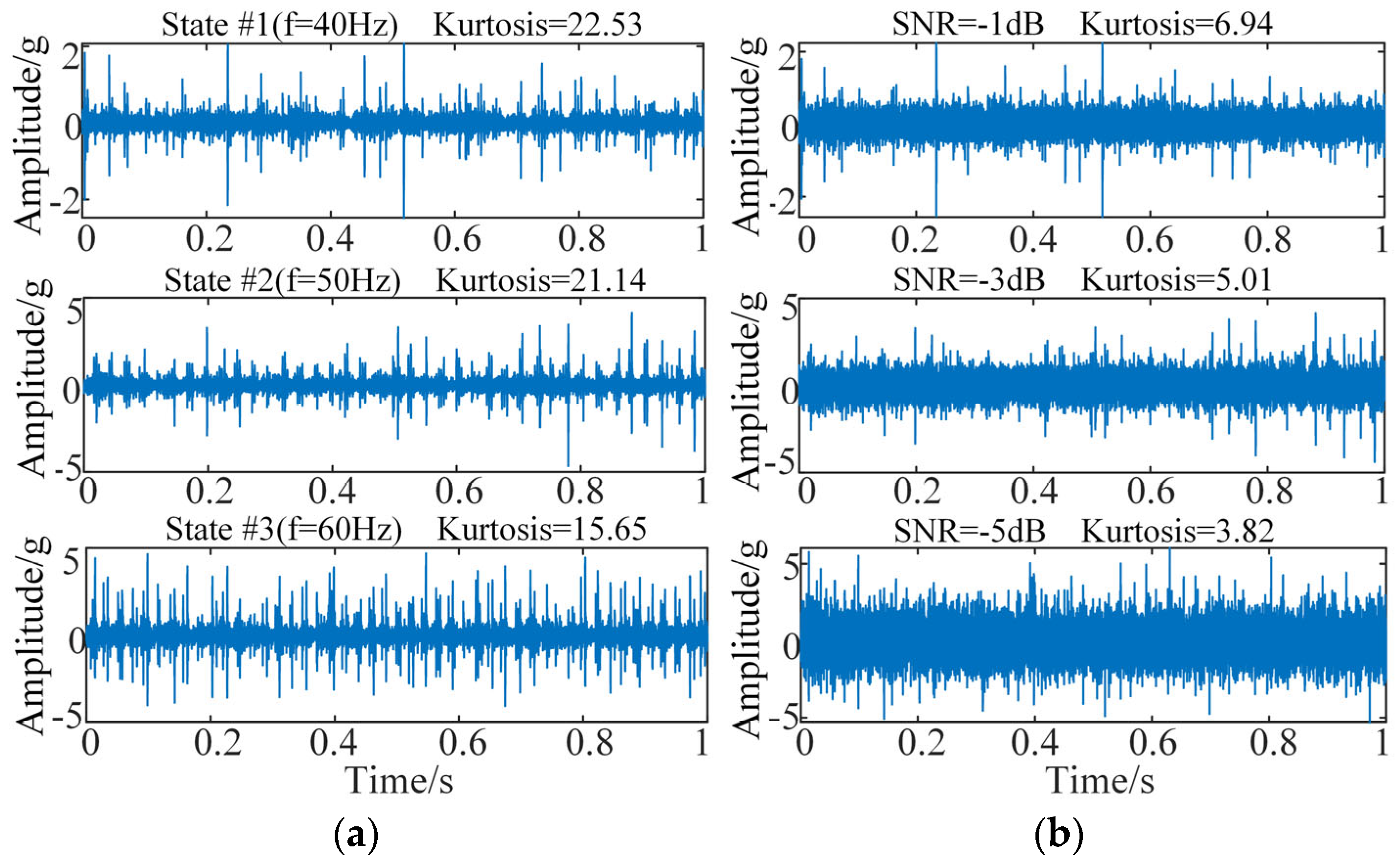
The time-domain waveforms of the raw vibration signals acquired from the bearing inner ring under operating conditions of 40 Hz, 50 Hz, and 60 Hz are presented in Figure 18a. To quantitatively evaluate the influence of noise on fault characteristics, Gaussian white noise was introduced to the raw signals at levels of −1 dB, −3 dB, and −5 dB. The kurtosis values, which reflect the impulsivity of the signals, were calculated before and after noise addition [33,34]. The results are shown in Figure 18b. It can be observed that the kurtosis values decreased markedly after the injection of noise, with an overall reduction of 73.4%, indicating that the noise substantially masked the fault-induced impulses and considerably impeded accurate fault feature extraction. This phenomenon can be attributed to the nature of Gaussian white noise, which has a uniform power spectral density across the entire frequency band and an amplitude following a Gaussian distribution. Its random and broadband characteristics allow the noise energy to overwhelm low-amplitude impact components, leading to a pronounced decrease in impulse amplitude statistics. As a result, the signal distribution becomes closer to a normal distribution, thereby significantly reducing the kurtosis value.

5.2. Fault Signal Diagnosis Analysis and Comparative Verification

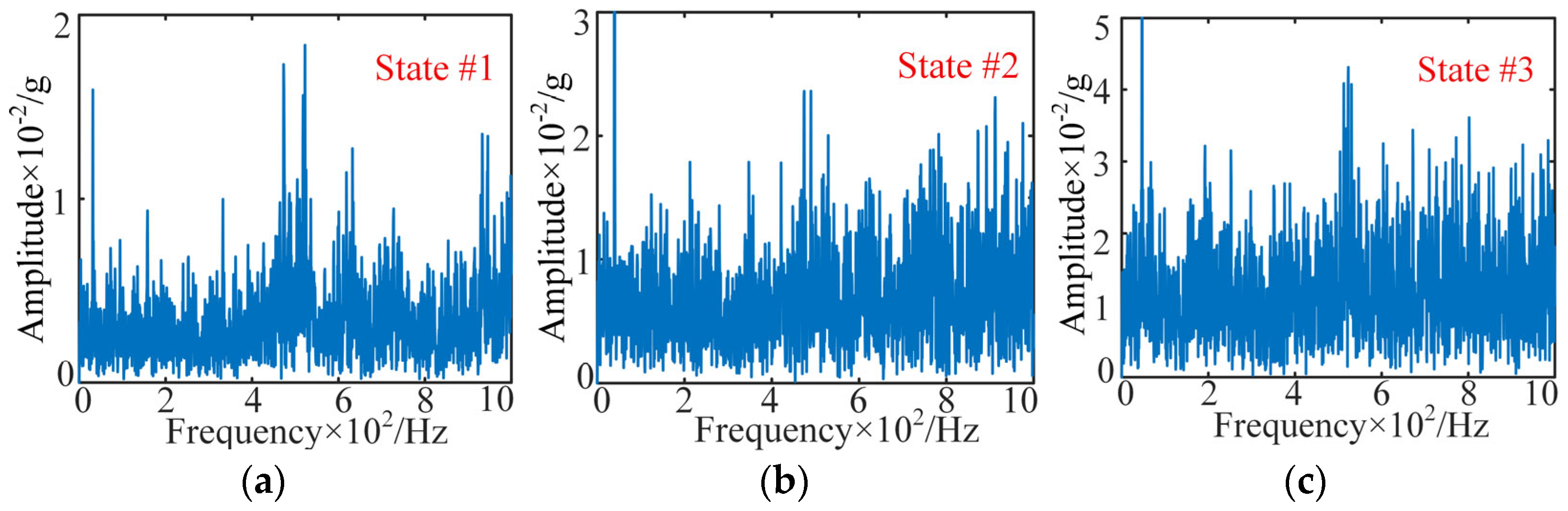
The influence of noise on fault characteristics was further examined in the frequency-domain. Figure 19 shows the frequency spectra of the fault signals under different operating conditions. It can be observed that, although certain fault-related frequency components remain discernible, the strong background interference considerably obscures the characteristic frequencies associated with inner ring defects. As a result, the fault features are not prominent enough to allow a reliable diagnosis of inner ring faults based on spectral analysis alone.
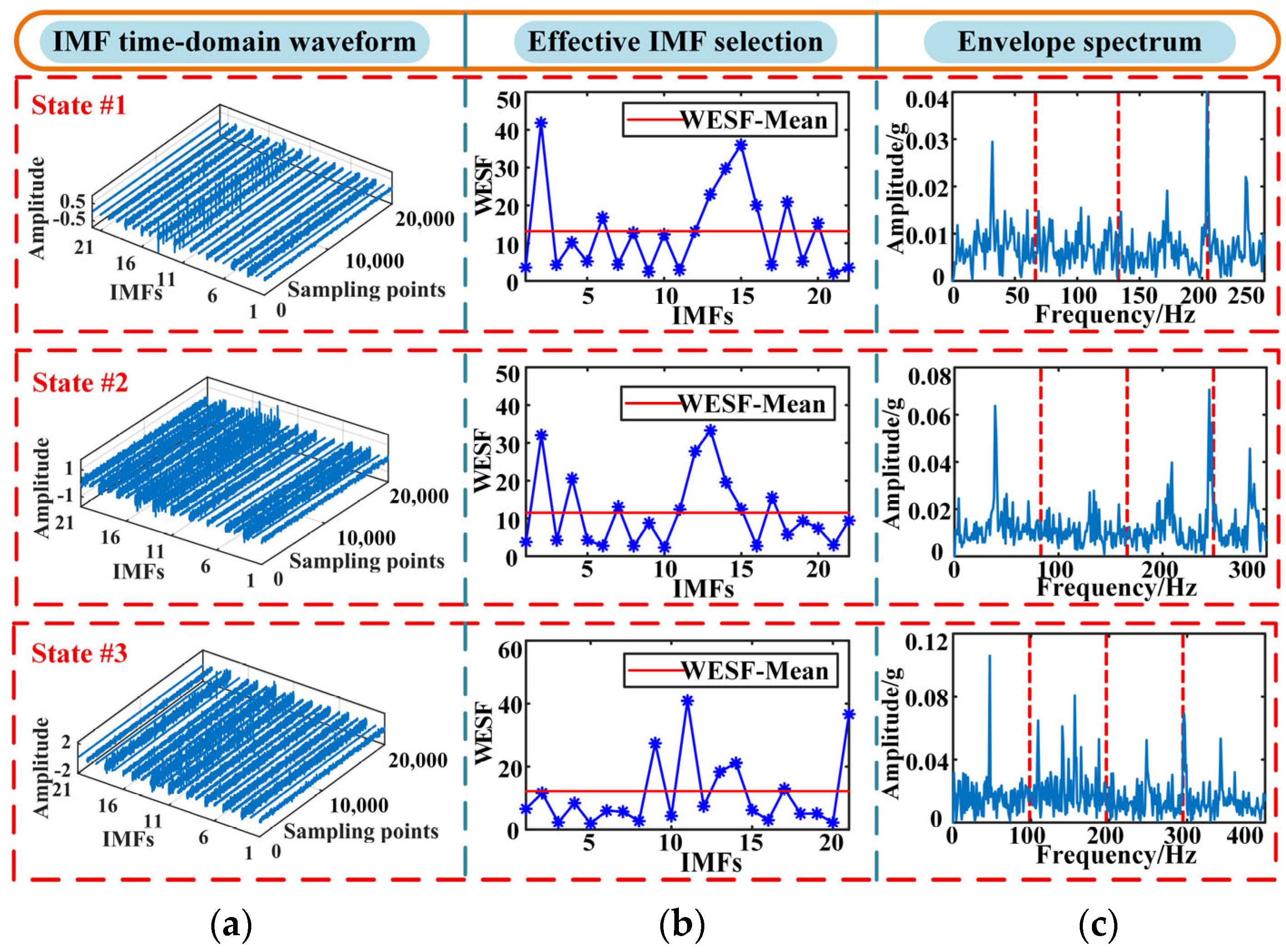
The fault signals were adaptively decomposed by SVMD. As illustrated in Figure 20a, the signals under 40 Hz and 50 Hz operating conditions are decomposed into 22 IMF components, while the signal under 60 Hz is decomposed into 21 IMFs. The WESF value of each IMF was computed, and those exceeding the average WESF were selected as effective components, as shown in Figure 20b. These components were then reconstructed to serve as the input to the MCKD algorithm. To demonstrate the necessity of further processing with MCKD, the envelope spectrum of the reconstructed signal was analyzed. The resulting spectrum, presented in Figure 20c, reveals that only a limited number of fault characteristic frequencies are discernible, while the majority remain faint and poorly resolved. This outcome confirms that noise interference continues to considerably suppress the impulsive fault components, thereby limiting the effectiveness of the reconstruction alone for clear fault identification.
Based on the bearing inner ring fault characteristic frequencies under each operating condition in Table 2, specifically, the ranges for T were [294, 307], [236, 246], and [199, 208] for the 40 Hz, 50 Hz, and 60 Hz conditions, respectively.
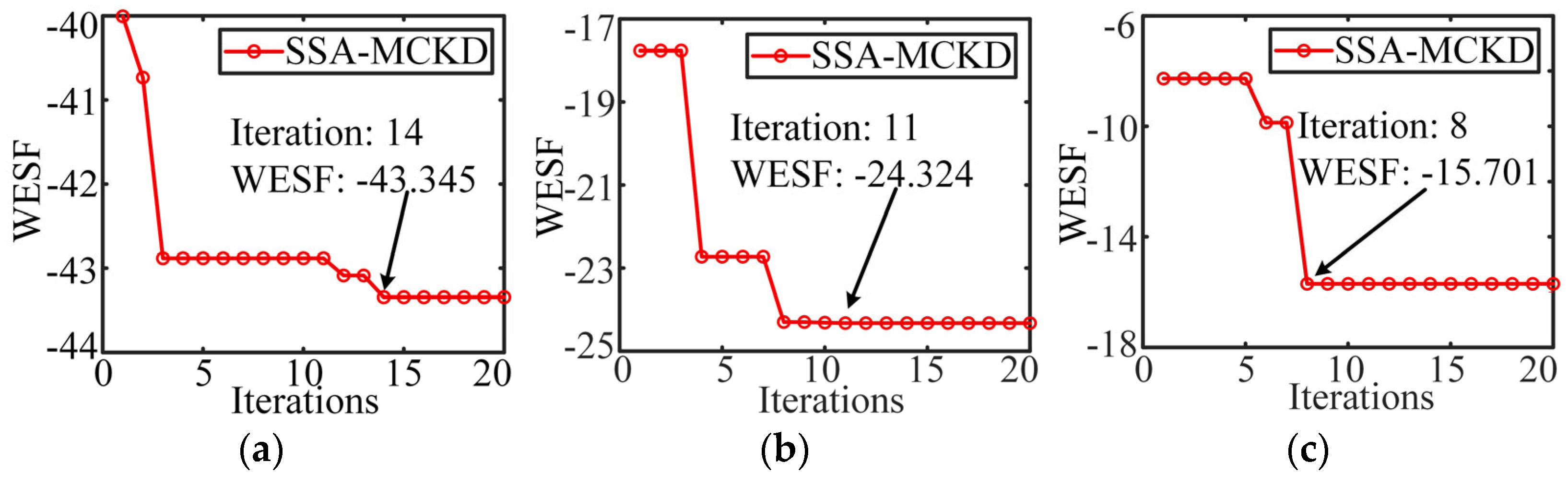
The SSA was configured with a population size of 20, a maximum of 20 iterations, and an optimization dimension of 3. Using the WESF as the fitness function, the algorithm optimizes the parameters of MCKD. The convergence behavior was illustrated in Figure 21. Under the 40 Hz condition, the algorithm converges at the 14th iteration with the WESF value of −43.345, yielding an optimal parameter set of [700, 305, 4]. For the 50 Hz condition, convergence occurs at the 11th iteration with the WESF of −24.324 and parameters [505, 246, 1]. At 60 Hz, convergence is reached by the eighth iteration, resulting in the WESF of −15.701 and parameters [500, 202, 1]. The notable variation in optimal parameters across different operating conditions demonstrates the ability of the WESF-based SSA optimization strategy to adaptively capture fault dynamic features under varying operational states. This adaptability provides a solid foundation for achieving high-precision fault feature enhancement.
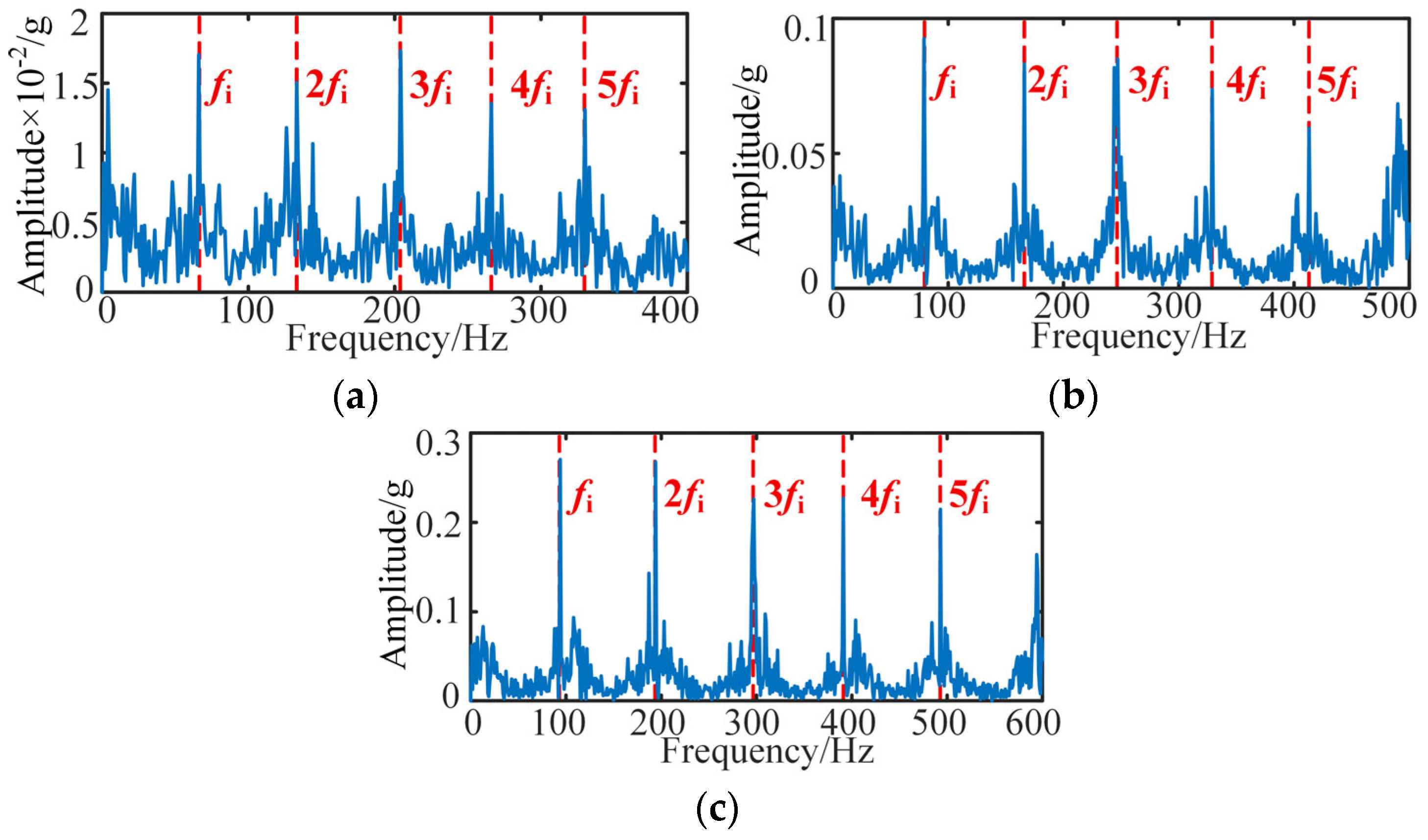
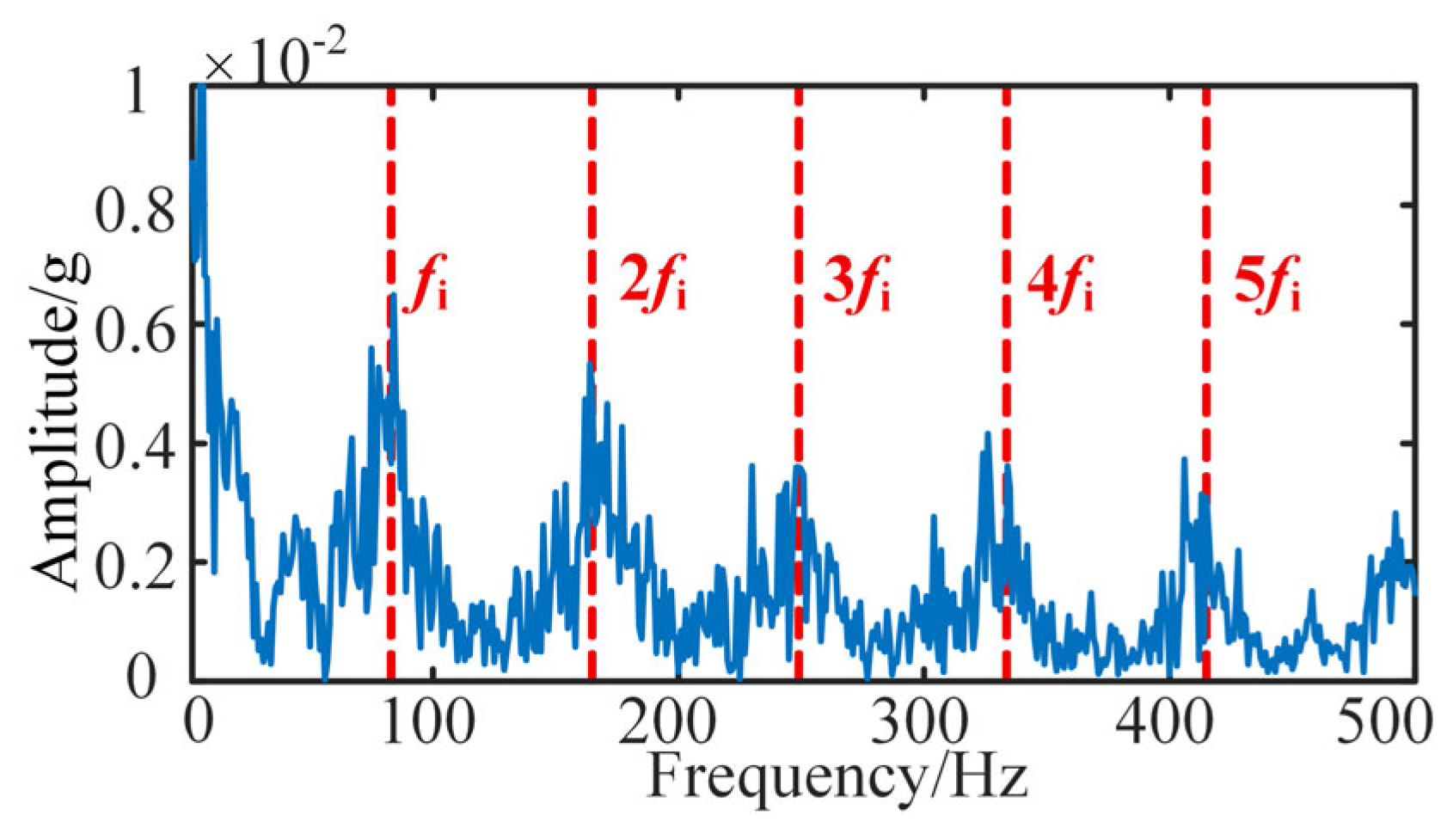
The obtained optimal parameters were applied to the MCKD algorithm to enhance the impulsive features of the reconstructed signal. Fault characteristics were then extracted via envelope spectrum analysis. The resulting spectra are presented in Figure 22, which shows that the MCKD algorithm effectively enhances the transient impulse components under all operating conditions, enabling clear identification of the fundamental frequency fi and its harmonics up to the fifth order (2fi–5fi). This performance is attributed to the SSA, which accurately identifies the optimal MCKD parameters through the WESF fitness function. As a result, MCKD successfully amplifies fault-related transient impulses while suppressing irrelevant noise. Consequently, the fundamental inner ring frequency and its harmonics are clearly discernible in the envelope spectrum, significantly improving the recognizability of fault features and the reliability of diagnosis.
To validate the superiority of the proposed method, comparative analyses were conducted against conventional approaches, with the richness of the extracted fault-related impulsive features quantified using the fault feature coefficient (FFC). The FFC is adopted as the primary evaluation indicator because it reflects the prominence of the fault characteristic frequency and its harmonic components in the envelope spectrum, making it particularly suitable for evaluating the performance of fault feature enhancement methods. A higher FFC value indicates more distinct fault characteristics. The expression for FFC is given as follows [35,36]:
FFC = [ A ( f c ) ] 2 [ A ( f c ) ] 2 + [ A ( f c ) ] 2 × 100 %
where fc and f c are the fault component and noise component, and A ( f c ) and A ( f c ) are the corresponding spectral amplitudes.
The calculated FFC values for the proposed method, as shown in Figure 22, were 12.8%, 7.5%, and 7.2%, respectively. A detailed comparative analysis is provided below:
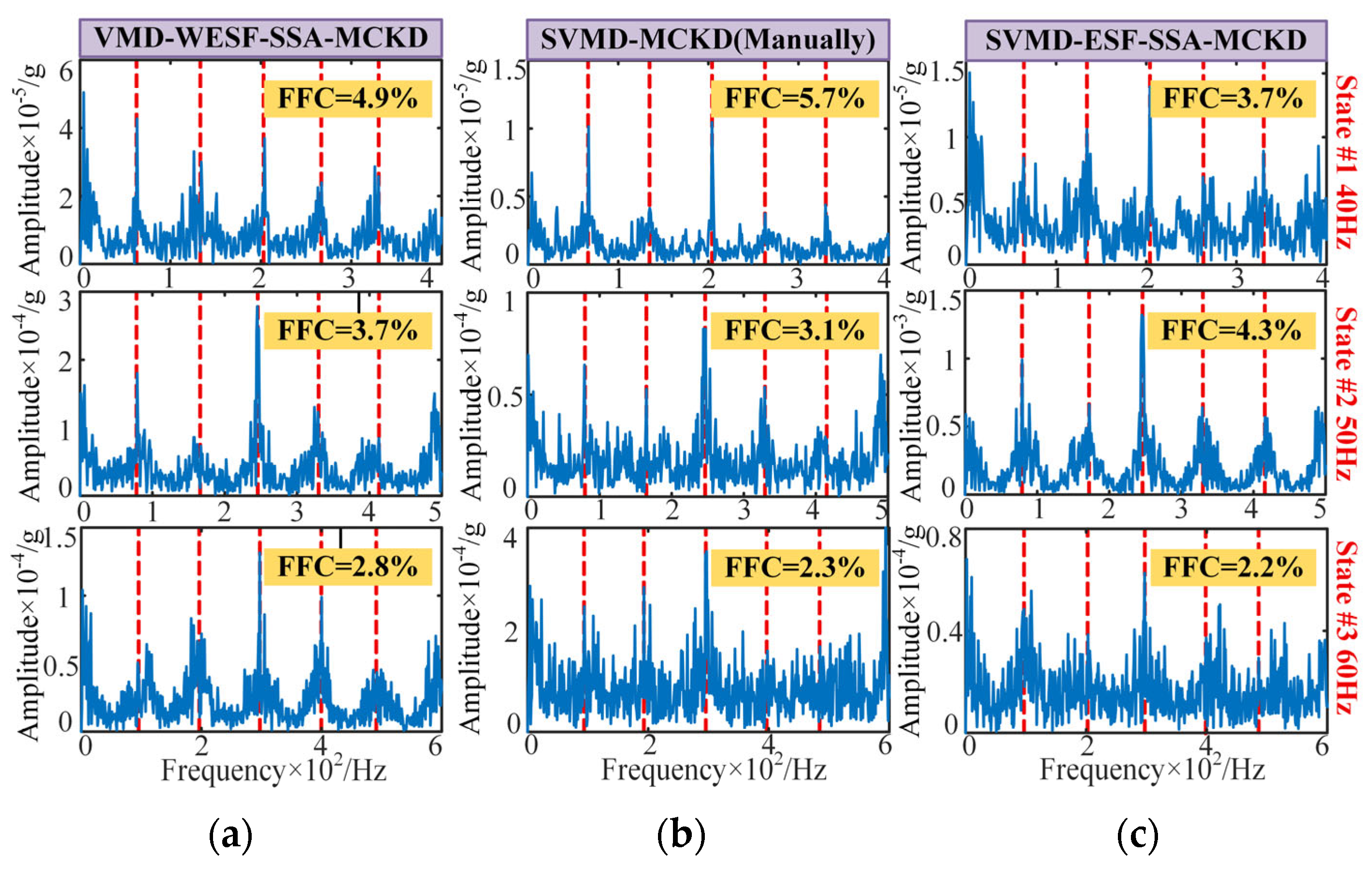
(1) To demonstrate the advantage of SVMD’s adaptive decomposition within the SVMD-WESF-SSA-MCKD framework, a comparison was made with conventional VMD. VMD was configured with a decomposition level K = 7 and a penalty factor α = 2000. The fault signal was decomposed by VMD, and the component with the highest WESF value was selected as the input to MCKD. After iterative optimization, the resulting MCKD parameters were [742, 306, 4], [505, 246, 1], and [996, 202, 2] for the three operating conditions. The enhanced spectra are presented in Figure 23a. Although the MCKD-processed signal reveals several distinct frequency components, some key fault frequencies remain faint, making a comprehensive fault diagnosis challenging. This limitation is attributed to mode mixing caused by the fixed parameterization of VMD.
(2) To verify the effectiveness of the SSA-optimized MCKD parameters, a manually configured parameter set was tested. The parameter L was adjusted by ±10% of the optimized range relative to the values obtained in Figure 15, while T and M were varied by ±1. This resulted in the parameter set [750, 304, 3], [555, 245, 2], and [550, 203, 2] for the three conditions. The enhancement results are shown in Figure 23b. Some characteristic frequencies remain poorly emphasized, confirming the superior global search capability of SSA in identifying optimal MCKD parameters.
(3) To evaluate the accuracy of the composite fitness function (WESF), a comparison was made using a single metric, the ESF, as the fitness function. The resulting spectra are shown in Figure 23c. Some fault characteristic frequencies are not clearly enhanced, due to the limited sensitivity of ESF to signal sparsity and impulsivity. This simplification reduces the optimization process’s ability to emphasize fault-related features, thereby diminishing feature extraction accuracy.
The experimental results show that different methods exhibit significant differences in their ability to enhance fault features. The main reasons are summarized as follows:
(1) VMD–MCKD method: Since VMD requires the parameters K and α to be predefined, energy overlap among different frequency components may occur under complex wheel–rail excitation conditions. When the parameters are not properly selected, low-frequency modulation components and fault impulsive components may be decomposed into the same mode, resulting in mode mixing and consequently reducing the effectiveness of the subsequent MCKD-based impulsive enhancement.
(2) MCKD with manually selected parameters: The enhancement performance of MCKD strongly depends on the parameters L , T , and M, which exhibit complex coupling relationships. Parameter tuning based on empirical experience generally leads only to locally optimal solutions, making it difficult to achieve stable and optimal impulsive enhancement under complex noise environments.
(3) Optimization based on a single ESF indicator: Since ESF mainly reflects the periodicity of the signal, weak impulsive characteristics may be neglected in strong noise environments. In contrast, the WESF indicator integrates the Hoyer index, kurtosis, and the envelope spectrum factor, enabling simultaneous characterization of signal sparsity, impulsiveness, and periodicity. This allows the optimization process to more accurately guide the algorithm toward identifying fault-related components.
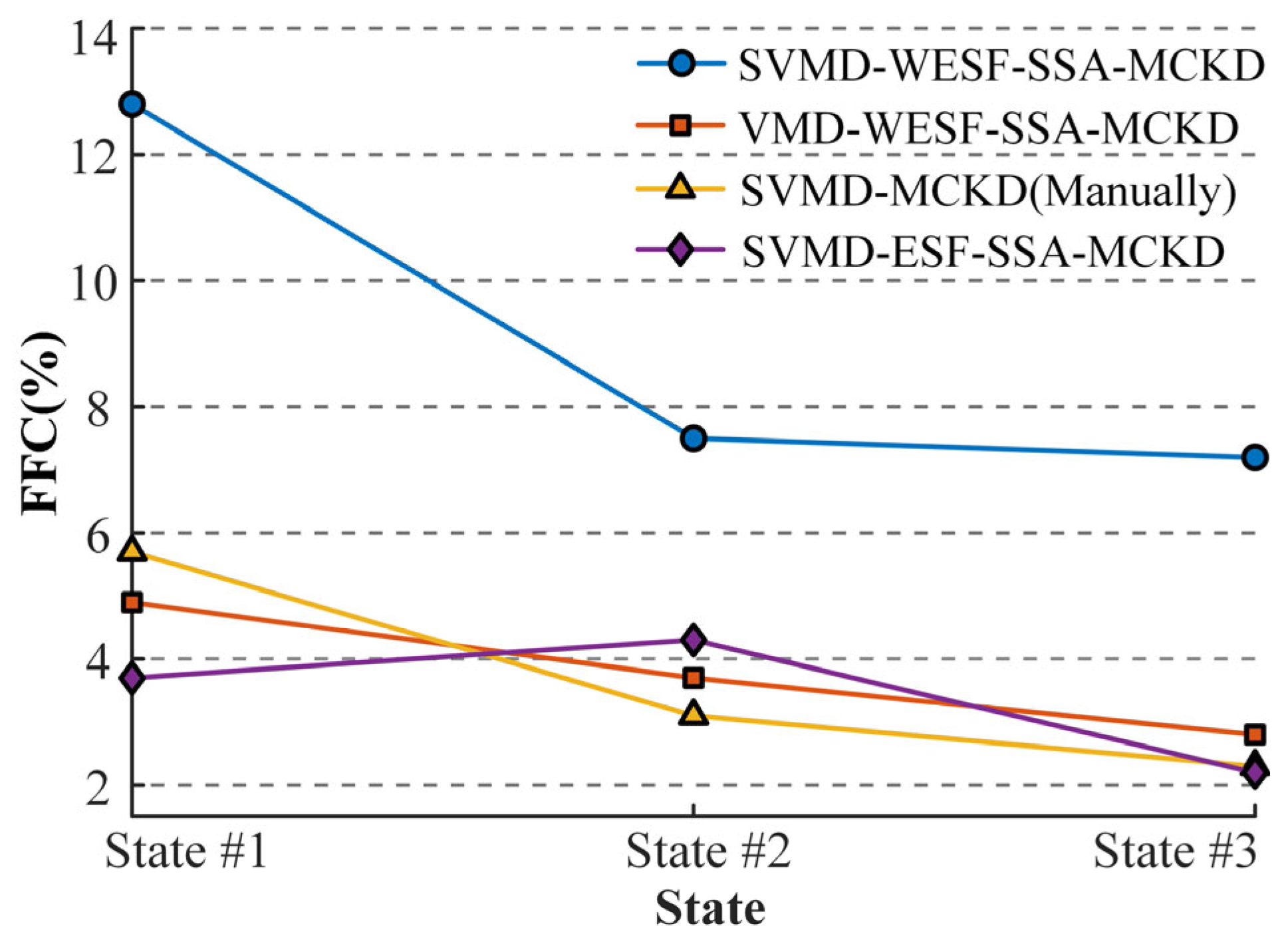
A quantitative comparison using the FFC metric is summarized in Figure 23. The results indicate that all compared methods yield lower FFC values than the proposed approach. To further visualized the comparison, a trend curve is plotted in Figure 24. It can be observed that the FFC values of all baseline methods are consistently lower than those achieved by the proposed method, with average values of 3.6% and 9.2%, respectively. This represents a 156% improvement in FFC, confirming the effectiveness of the SVMD-WESF-SSA-MCKD framework.

6. Diagnosis of Weak Bearing Faults Based on Wheel–Rail Excitation

6.1. Linear Operating Condition

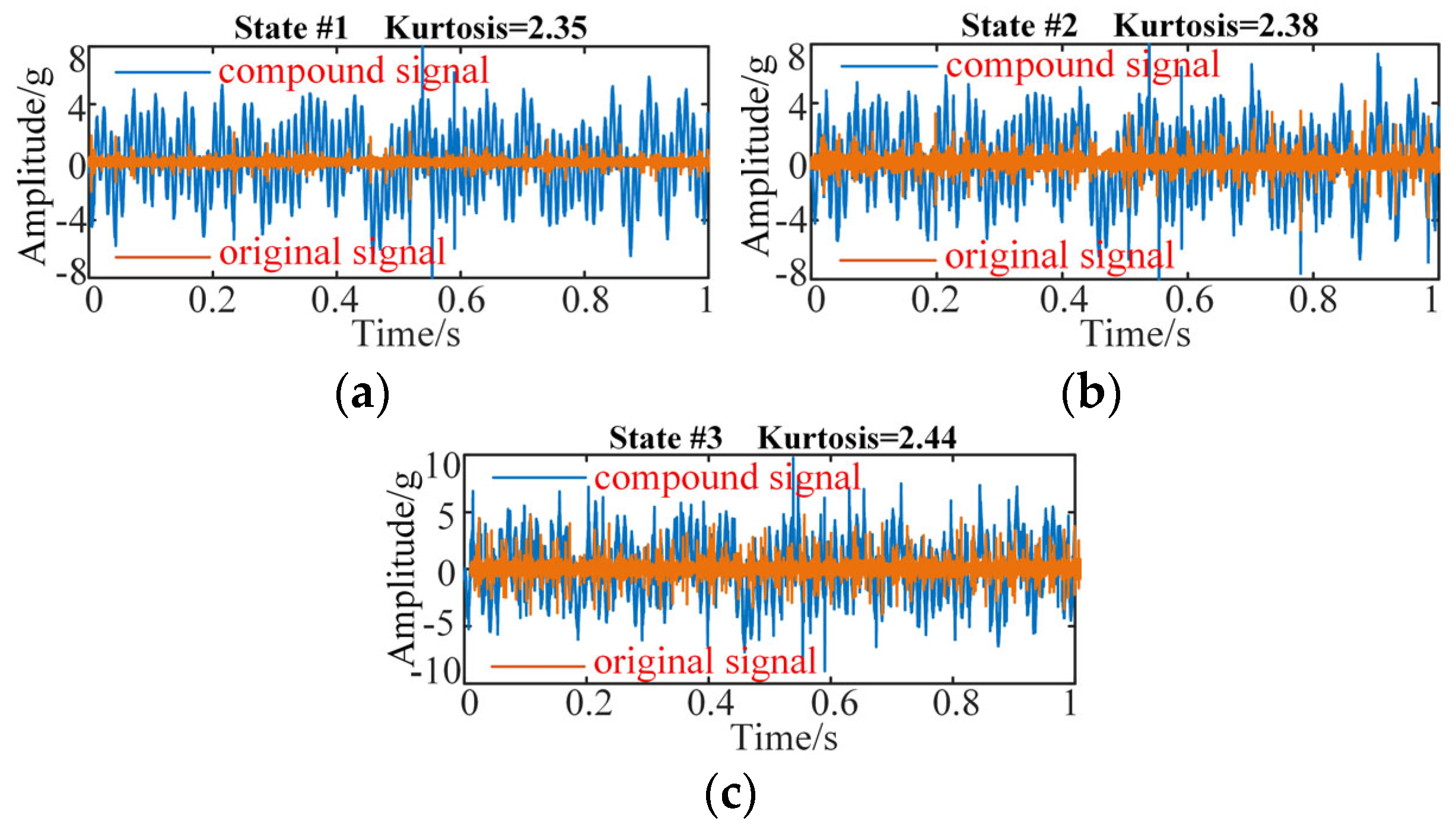
To investigate the influence of wheel–rail excitation on locomotive bearing fault feature extraction under straight-track conditions, the disturbance signal shown in Figure 3 was superimposed onto the experimental signal from Figure 18a, forming a composite signal for analysis. A comparison between the composite and original signals is presented in Figure 25. To quantify the masking effect of wheel–rail noise on fault impact components, the kurtosis of the composite signal was calculated. The results show a significant increase in the time-domain amplitude of the composite signal, while the introduced wheel–rail excitation markedly masks the impulsive characteristics of the experimental signal, resulting in an overall reduction in kurtosis of 87.9%. This confirms that wheel–rail excitation substantially obscures fault-induced impacts.
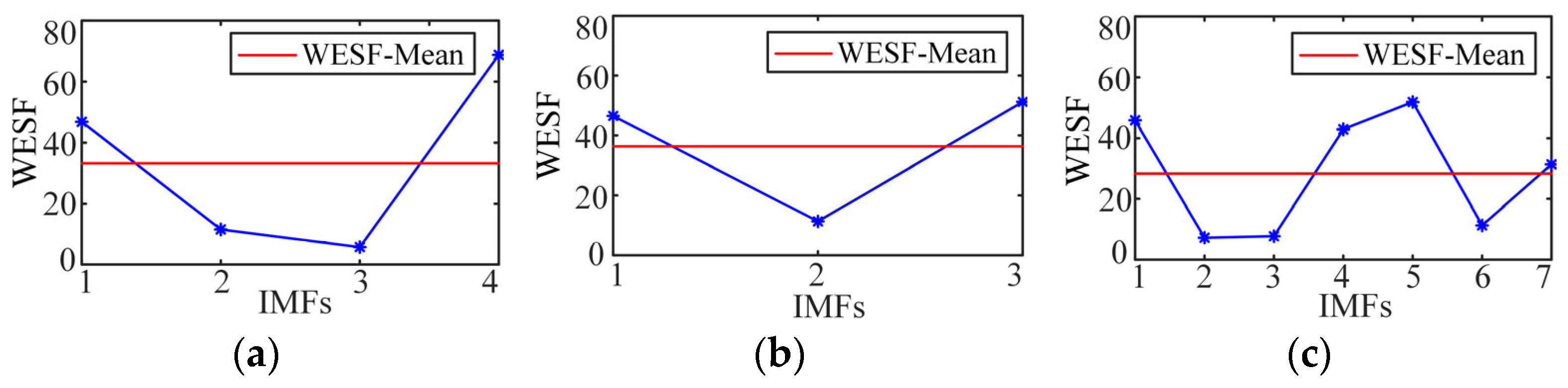
The composite signal was adaptively decomposed using SVMD. Under the 40 Hz condition, it was decomposed into four IMF components; under 50 Hz, three components; and under 60 Hz, seven components. The WESF values of the resulting IMFs are illustrated in Figure 26. Components with WESF values above the average are reconstructed and used as the optimized input to the MCKD algorithm.
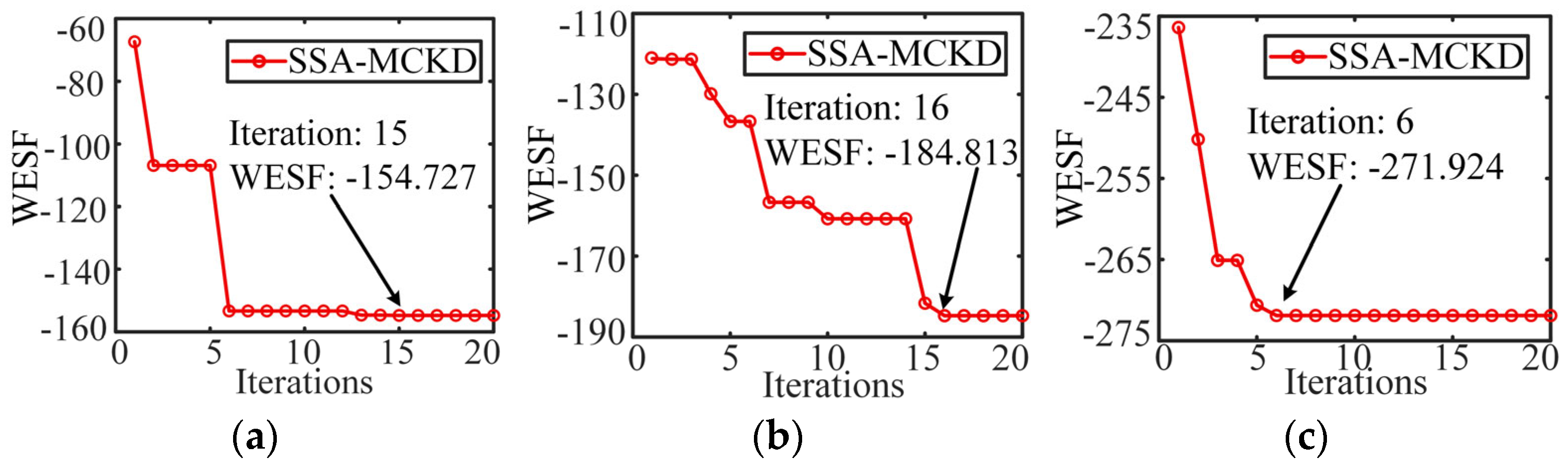
The convergence behavior during the MCKD optimization process is shown in Figure 27. Under the 40 Hz condition, the algorithm converges at the 15th iteration with the WESF value of −154.727, yielding the optimal parameter set [793, 294, 5]. At 50 Hz, convergence occurs at the 16th iteration with the WESF of −184.813 and parameters [500, 239, 4]. Under the 60 Hz condition, the algorithm converges at the sixth iteration with the WESF of −271.924 and parameters [721, 199, 3].
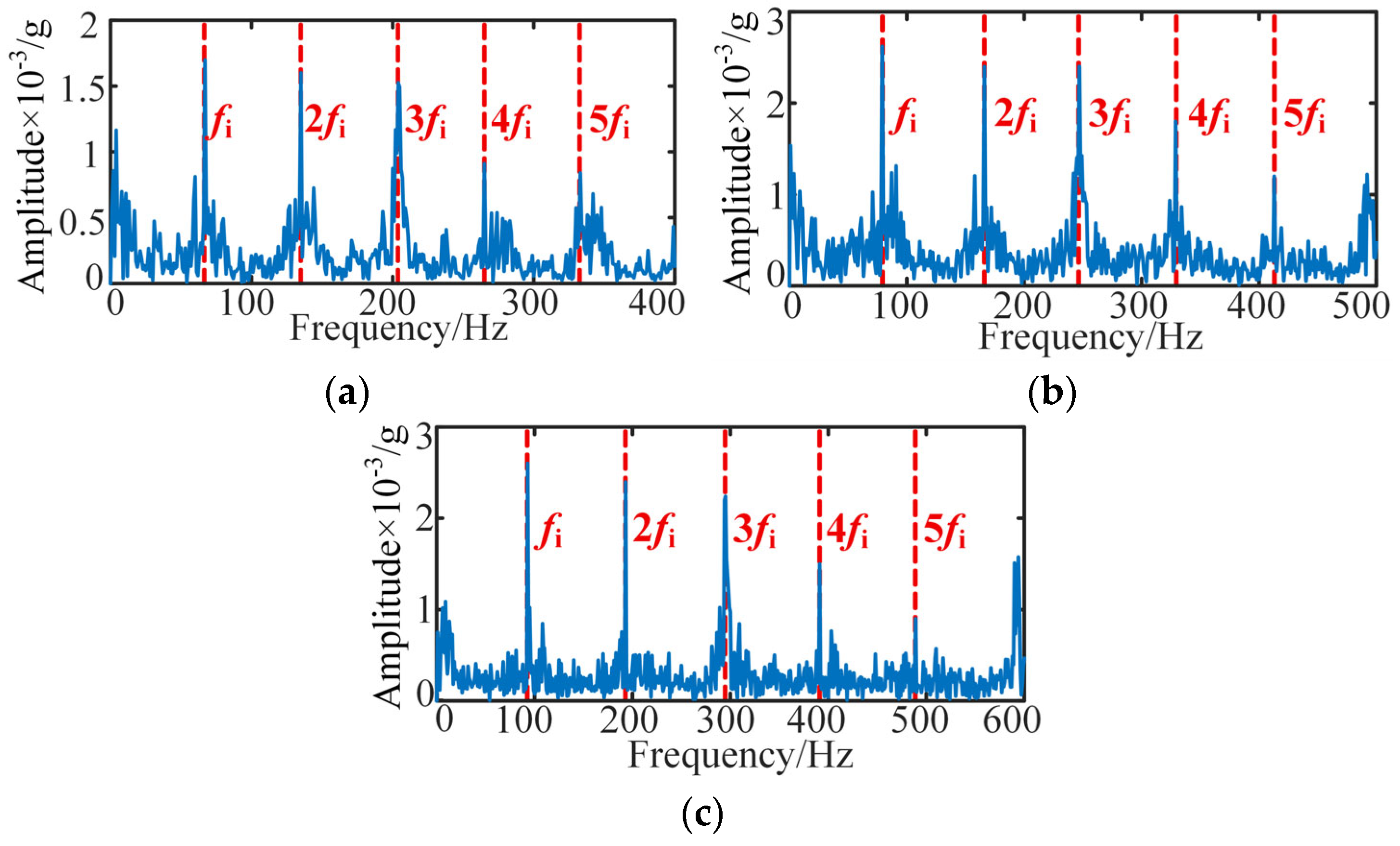
The optimized parameter set was applied to the MCKD algorithm to enhance the impulsive features of the reconstructed signal. Fault characteristics were subsequently extracted through envelope spectrum analysis. The resulting spectra are shown in Figure 28. It can be observed that, under wheel–rail excitation noise, MCKD significantly enhances the impulsive components across all operating conditions, enabling clear identification of the fundamental frequency fi and its harmonics up to the fifth order (2fi–5fi). This performance is attributed to the ability of MCKD to selectively emphasize periodic impulse components. Specifically, impulses generated by bearing inner ring faults exhibit a consistent periodicity with a fundamental frequency fi, whereas wheel–rail excitation noise is non-periodic and broadband. The parameters (L, M, T), optimized via SSA, accurately match the fault periodicity, allowing MCKD to construct an optimal filter that enhances impulses synchronized with this period while suppressing non-periodic noise interference. As a result, the fault characteristic frequency and its harmonics are clearly revealed in the envelope spectrum.
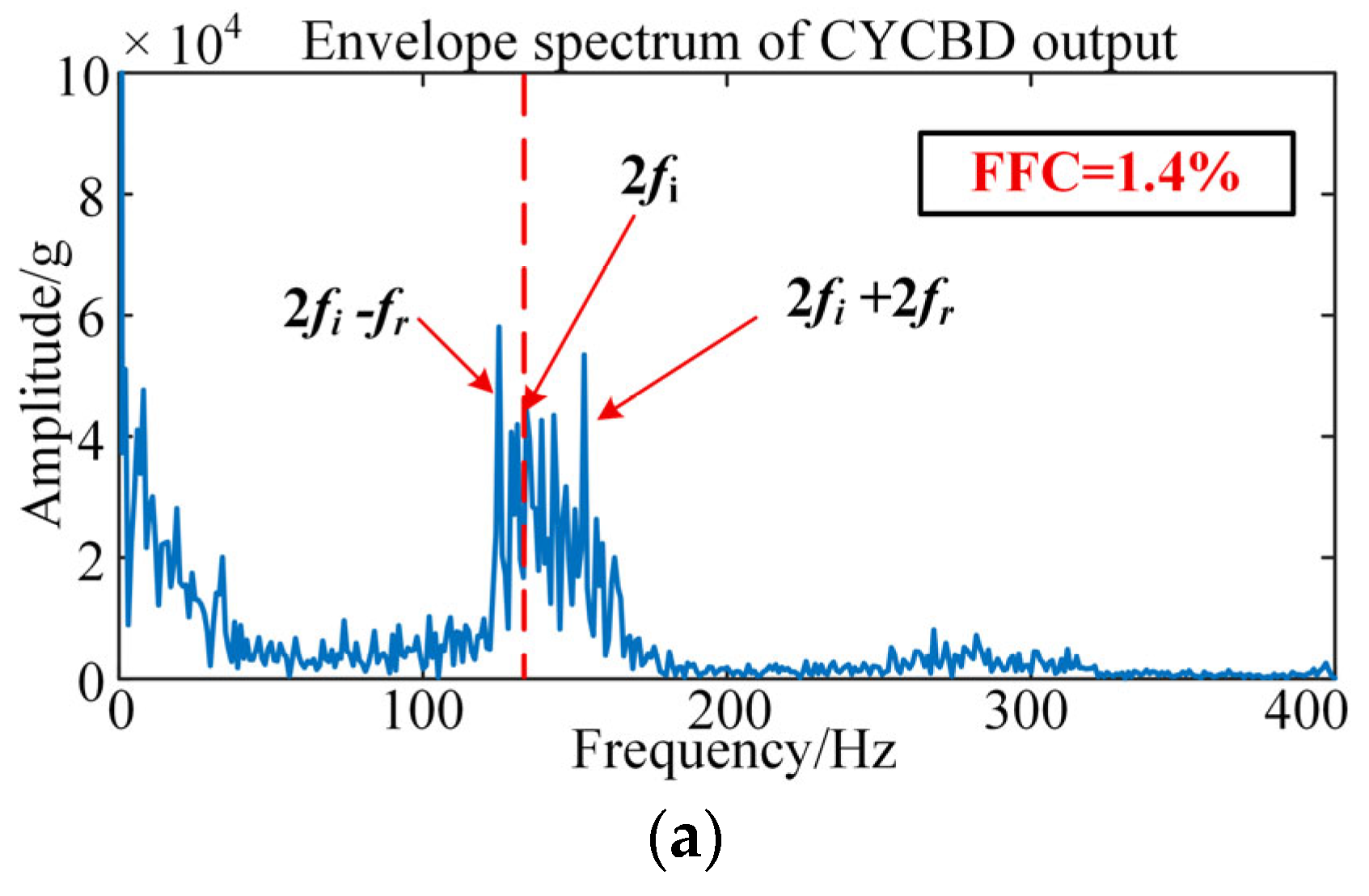
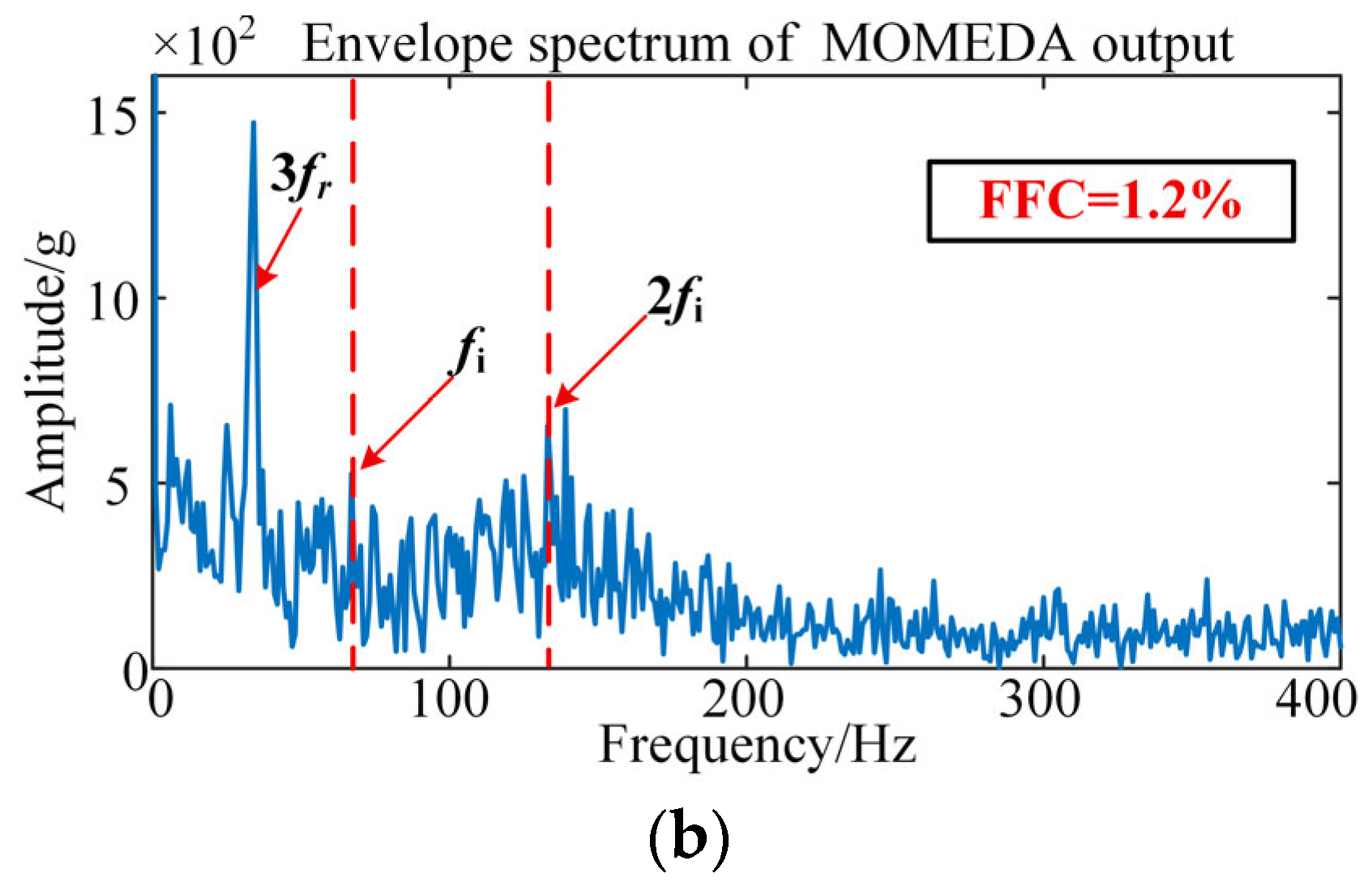
To more comprehensively verify the effectiveness of the proposed algorithm, a comparative analysis was conducted using the 40 Hz operating condition, in which the method was evaluated against the CYCBD and MOMEDA enhancement algorithms. The corresponding results are shown in Figure 29. As illustrated, although all three methods are capable of enhancing certain modulated components, their performance differs significantly. CYCBD and MOMEDA enhance part of the impulsive features; however, the clarity of their main spectral peaks remains limited, and the background interference is relatively strong. In contrast, the proposed method produces the most prominent envelope-spectrum peak and demonstrates a markedly enhanced modulation structure.
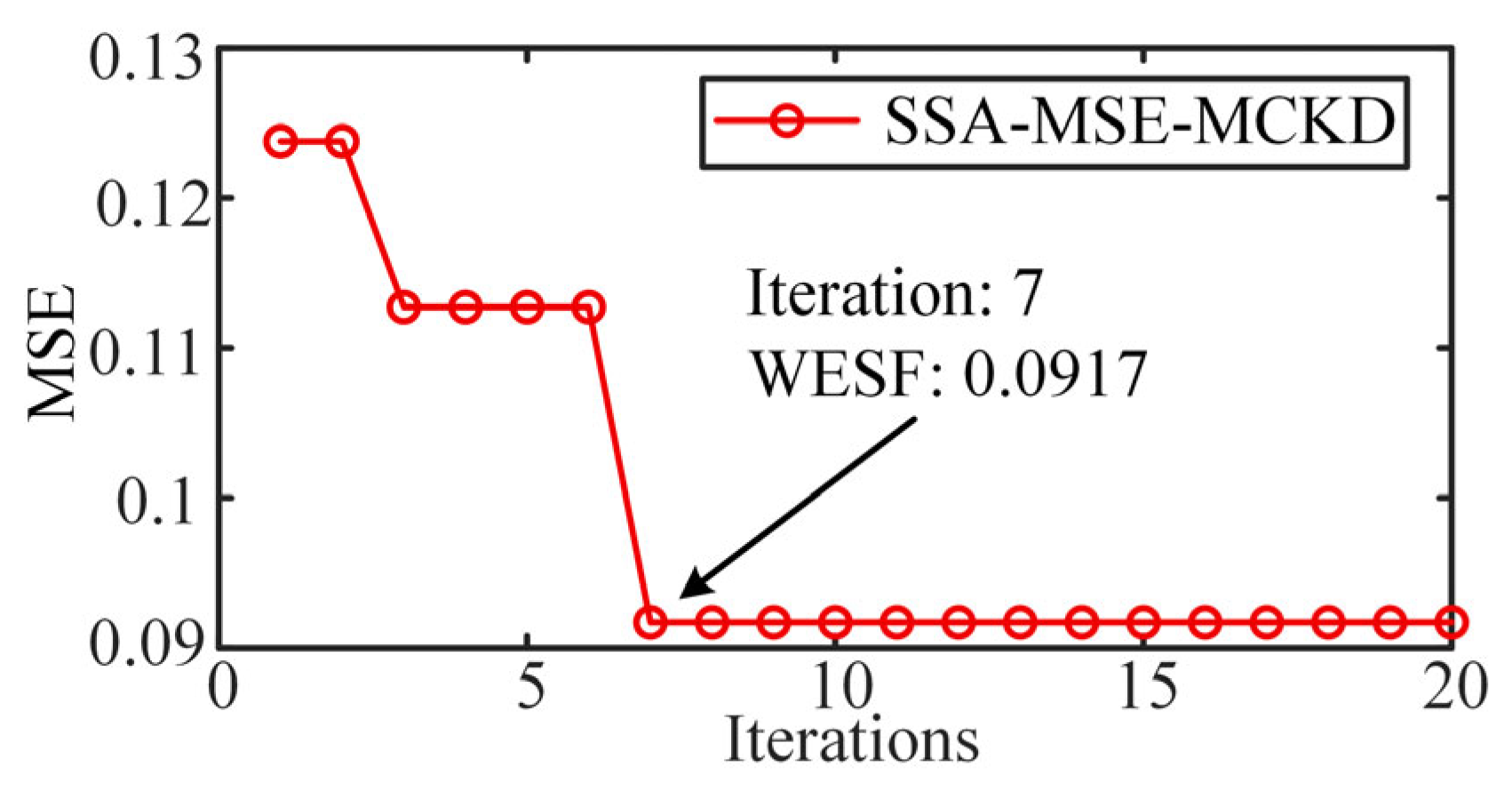
To further verify the superiority of the proposed WESF indicator, an additional comparison was conducted in which multiscale entropy (MSE) was used to replace WESF under the straight-running 50 Hz condition. The algorithm was re-executed with MSE as the optimization objective. The convergence curve is shown in Figure 30, from which it can be observed that the algorithm converges at the seventh iteration with a final value of 0.0917, yielding the MCKD parameters [500, 243, 2]. The envelope spectrum of the enhanced signal obtained using these parameters is presented in Figure 31. As shown, the enhancement effect achieved with MSE is significantly weaker than that of the proposed method in the presence of strong wheel–rail excitation.
The underlying reasons are as follows: MCKD is designed to enhance impulsive and periodic components, whereas MSE primarily measures signal complexity and is weakly associated with mechanical impact features. Under strong wheel–rail excitation, the entropy value tends to increase, causing the optimization process to favor reducing signal complexity, which in turn suppresses impulsive peaks rather than enhancing them.

6.2. Curved Operating Condition

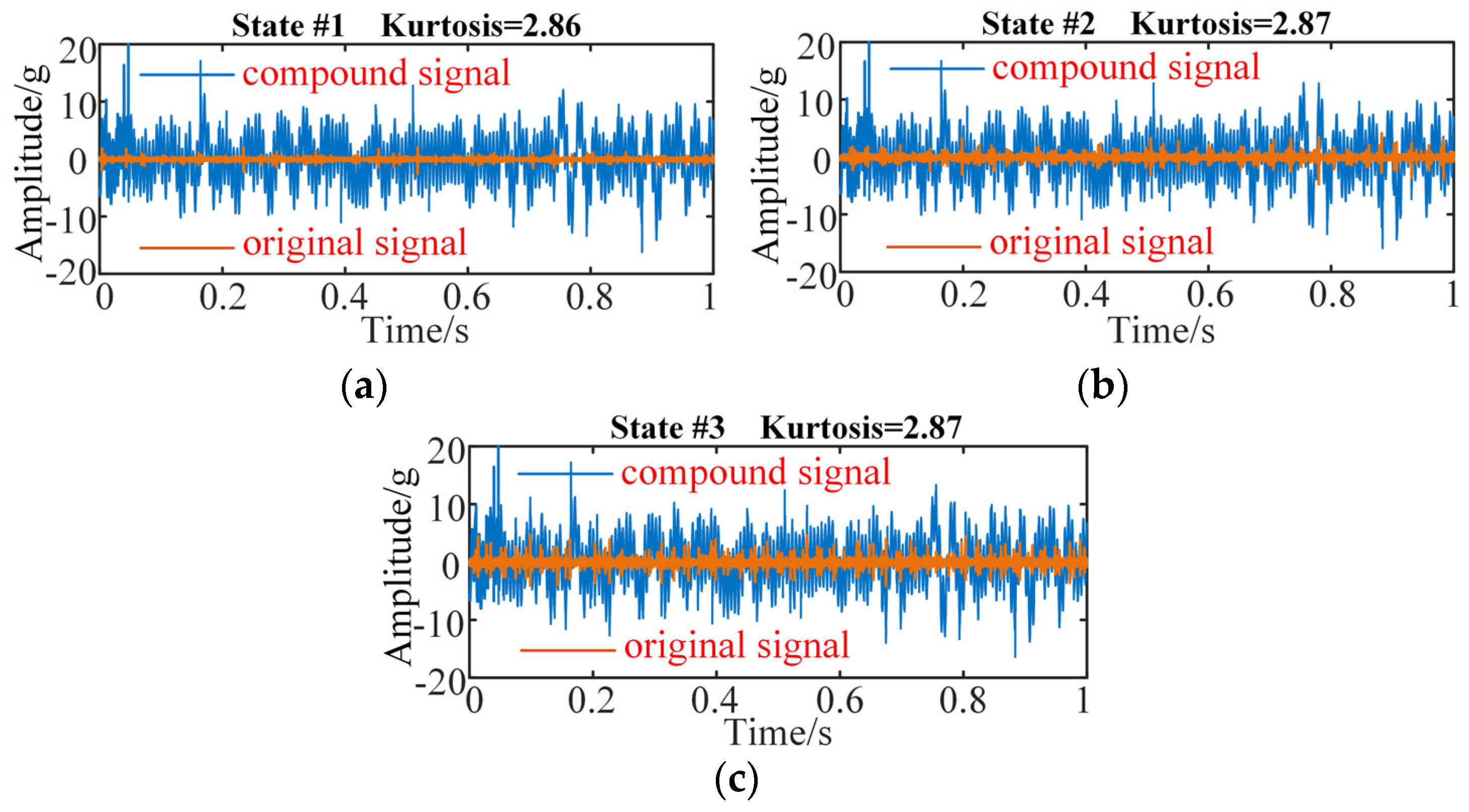
To evaluate the effect of wheel–rail excitation on locomotive bearing fault feature extraction under curved track conditions, the disturbance signal from Figure 7 was superimposed onto the experimental signal from Figure 18a to form a composite signal containing wheel–rail noise. A comparison between the time-domain waveform of the composite signal and the original signal is shown in Figure 32. The results indicate that the wheel–rail noise considerably masks the impulsive features of the fault signal, with an overall reduction in kurtosis of 85.4%, demonstrating that the excitation significantly weakens the fault-induced impacts.
The composite signal was adaptively decomposed using SVMD. Under the 40 Hz and 50 Hz conditions, the signal decomposed into four IMF components, while under the 60 Hz condition, it decomposed into five IMF components. The WESF values of these components are presented in Figure 33. Those components with WESF values above the average are reconstructed and used as the optimal input to the MCKD algorithm.
The reconstructed signal was processed using MCKD with iterative optimization. The convergence behavior is illustrated in Figure 34. At 40 Hz, the algorithm converges at the 11th iteration with the WESF value of −64.963, yielding the optimal parameters [701, 297, 7]. At 50 Hz, convergence occurs at the fourth iteration with the WESF of −20.771 and parameters [900, 244, 6]. Under the 60 Hz condition, the algorithm converges at the 13th iteration with a WESF of −9.124 and parameters [741, 208, 7].
The optimized parameters were applied to the MCKD algorithm to enhance the impulsive features of the fault signal. The resulting signal was then analyzed using envelope spectrum analysis, with the spectral results shown in Figure 35. It can be observed that even under strong wheel–rail excitation, the fundamental frequency fi and its harmonics up to the fifth order (2fi–5fi) are successfully identified. This is attributed to the fact that although the intensity of wheel–rail excitation increases significantly under curved track conditions at 80 km/h and higher speeds, the periodic impulses generated by the inner ring bearing fault remain stable at the characteristic frequency fi. The MCKD parameters, accurately optimized via the SSA and the WESF fitness function, effectively enhance these periodic impulses while suppressing the non-periodic, broadband noise interference induced by high-speed curve negotiation. As a result, the fault characteristic frequency and its harmonics are clearly revealed in the envelope spectrum.

6.3. The Robustness Verification of the Proposed Algorithm

To evaluate the robustness of the proposed method under parameter perturbations, the 60 Hz curved-track condition—representative of high-speed operation—was selected for sensitivity analysis. The SVMD parameter α and the MCKD parameter set [L, T, M] were examined. Using the SSA-optimized parameters as the baseline, ±5% perturbations were applied in their vicinity. Since T and M reached the upper bounds of their feasible search intervals [199, 208] and [1, 7] during optimization, upward perturbation would exceed the allowable range; therefore, only downward adjustments were applied for these two parameters. The resulting perturbed parameter sets are summarized in Table 3.
The algorithm was executed using each perturbed parameter combination, and the corresponding envelope spectra are presented in Figure 36. The results indicate the following:
(1) The positions of the fault characteristic frequency and its harmonics remain consistent under all perturbation conditions, without missing or shifted peaks, demonstrating that the method is insensitive to parameter variations and exhibits strong robustness;
(2) Although the amplitude of the envelope spectrum shows slight fluctuations, the overall spectral pattern remains stable, indicating that the feature extraction process maintains good consistency within reasonable parameter ranges;
(3) The SSA-optimized parameters display high consistency across multiple perturbation scenarios, further confirming the robustness and convergence reliability of the optimization procedure.
Therefore, the sensitivity analysis clearly demonstrates that although the performance of SVMD and MCKD is inherently influenced by their parameter settings, the proposed method maintains stable diagnostic results within a reasonable range of parameter perturbations, indicating strong engineering applicability. Meanwhile, the automatic optimization mechanism of SSA effectively ensures the stability and reliability of parameter selection.

6.4. Engineering Applicability Analysis

To assess the engineering feasibility of the proposed method for locomotive online monitoring systems, we evaluated the computational runtime of its main processing modules. Using a 1 s signal sampled at 20 kHz, the SVMD–WESF–SSA–MCKD algorithm was implemented in MATLAB R2022b (i7 CPU), and the execution time of each submodule is summarized in Table 4. As shown, the SSA-based parameter optimization constitutes the most time-consuming part of the overall process. It is important to emphasize that this runtime corresponds to the offline optimization performed in the manuscript to ensure reproducibility and optimal parameter selection, and is not required during online monitoring.
Because the structural characteristics of the same type of gearbox bearing remain essentially stable over its service period, the optimal parameter range of MCKD exhibits high consistency. Consequently, SSA optimization can be carried out once offline, either before vehicle commissioning or during scheduled maintenance. During online monitoring, only MCKD filtering and envelope spectrum analysis with fixed parameters are required, both of which have a very low computational cost and easily satisfy real-time diagnostic requirements at the millisecond level. Moreover, the sensitivity analysis indicates that reasonable parameter perturbations do not significantly affect the extraction of fault features, further confirming the robustness of the proposed method under practical operating conditions.
In conclusion, the proposed method adopts offline optimization to ensure parameter optimality during theoretical analysis, while enabling fixed-parameter operation in engineering applications, resulting in a low computational overhead and strong real-time performance. Therefore, the SVMD–WESF–SSA–MCKD framework fulfills the operational requirements of locomotive online monitoring systems.
In practical locomotive condition monitoring systems, the proposed “offline optimization–online fixed parameter” strategy can be implemented as follows. Since gearbox bearings of the same locomotive type generally maintain consistent structural parameters, transmission ratios, and installation conditions, the periodic structure of their fault impulsive signals remains relatively stable. Therefore, during the initial deployment stage of the monitoring system, laboratory test data or historical operational data can be used to perform offline optimization of the MCKD parameters using the SSA, thereby obtaining an optimal parameter set for this type of bearing. This parameter set can then be used as the standard configuration for the online monitoring system to perform real-time signal processing and fault feature extraction. During long-term operation, when significant changes occur in operating conditions (such as speed range, load conditions, or monitoring environment), the parameters can be periodically updated through offline optimization using newly collected operational data to ensure their adaptability to the current operating state. Since parameter optimization is conducted only during the offline stage, the online monitoring process only involves computationally efficient steps such as signal decomposition, MCKD enhancement, and feature extraction, thereby meeting the real-time requirements of locomotive condition monitoring systems.
It should be noted that the proposed method is validated using inner-race faults as an example because the periodic impulsive signatures generated by such faults are often relatively weak under complex wheel–rail excitation conditions, making them representative for evaluation. From the methodological perspective, the SVMD–WESF–SSA–MCKD approach is primarily designed to enhance periodic impulsive features in vibration signals. Since such features commonly exist in various rolling bearing faults, including outer-race faults, rolling element faults, and compound faults, the proposed method is theoretically applicable to the analysis of other types of bearing faults as well.

7. Conclusions

To address the challenge of weak damage characterization in freight locomotive gearbox bearings under wheel–rail excitation, where fault features are often masked by strong background noise, a novel signal enhancement method named SVMD-WESF-SSA-MCKD is proposed. The method is validated using inner race fault data collected from a transmission fault simulation test bench. The main conclusions are as follows:
(1) SVMD is employed to adaptively decompose the fault signal, significantly improving the accuracy of mode separation and ensuring the precision and robustness of the resulting components.
(2) A composite fitness function, WESF, is constructed by integrating signal sparsity and impulsivity, which enhances the richness and completeness of bearing fault feature extraction. This results in an increase in the FFC from 3.6% to 9.2%, representing a 156% improvement.
(3) The proposed method effectively enhances fault features under wheel–rail excitation across operating conditions from 40 to 60 Hz, enabling clear identification of the fundamental frequency fi and its harmonics up to the fifth order (2fi–5fi).
In future work, we will further validate the proposed method using real locomotive operation data to assess its generalization capability under more complex conditions, including load variations, speed fluctuations, and multi-source noise. Furthermore, we plan to investigate the integration of the proposed framework as a feature-extraction front end for deep learning models, with the aim of enhancing the adaptive representation of weak fault features and improving its robustness in engineering applications.

Author Contributions

Conceptualization, Y.L.; methodology, Y.L.; software, Y.L. and W.D.; validation, Y.L., W.D. and Y.M.; data curation, Y.L.; writing—original draft preparation, Y.L.; writing—review and editing, W.D. and Y.M.; visualization, Y.L. and W.D.; supervision, W.D.; project administration, W.D.; funding acquisition, W.D. All authors have read and agreed to the published version of the manuscript.

Funding

This research was funded by the National Natural Science Foundation of China (No. 12262017).

Data Availability Statement

The raw data supporting the conclusions of this article will be made available by the authors on request.

Acknowledgments

During the preparation of this manuscript, the authors used ChatGPT (OpenAI, version 5.2) for language polishing and structural refinement. The authors have reviewed and edited the output and take full responsibility for the content of this publication.

Conflicts of Interest

The authors declare no conflicts of interest.

References

  1. Li, Y.J.; Song, H.; Miao, J.R.; Zhang, W.H.; Xiong, Q. Improved multiscale weighted-dispersion entropy and its application in fault diagnosis of train bearing. Meas. Sci. Technol. 2021, 32, 075002. [Google Scholar] [CrossRef]
  2. Wang, G.; Xiang, J.W. Remain useful life prediction of rolling bearings based on exponential model optimized by gradient method. Measurement 2021, 176, 109161. [Google Scholar] [CrossRef]
  3. Deng, D.; Li, W.; Liu, J.; Qin, Y. Node-Incremental-Based Multisource Domain Adaptation for Fault Diagnosis of Rolling Bearings with Limited Data. Machines 2026, 14, 71. [Google Scholar] [CrossRef]
  4. Chen, X.; Chen, Z.G. Cross-domain fault diagnosis of induction motor based on an improved unsupervised generative adversarial network and fine-tuning under limited labeled data. Measurement 2025, 249, 116988. [Google Scholar] [CrossRef]
  5. Wang, Q.; Wang, Z.W.; Mo, J.L.; Zhang, L.; Du, L.Q.; Gou, Q.B. Coupled dynamic behaviours of the brake system considering wheel-rail interactions. Int. J. Rail Transp. 2022, 10, 749–771. [Google Scholar] [CrossRef]
  6. Wang, Z.Y.; Yao, L.G.; Chen, G.; Ding, J.X. Modified multiscale weighted permutation entropy and optimized support vector machine method for rolling bearing fault diagnosis with complex signals. ISA Trans. 2021, 114, 470–484. [Google Scholar] [CrossRef]
  7. Yang, J.S.; Peng, Y.Z.; Xie, J.S.; Wang, P.S. Remaining useful life prediction method for bearings based on LSTM with uncertainty quantification. Sensors 2022, 22, 4549. [Google Scholar] [CrossRef]
  8. Dragomiretskiy, K.; Zosso, D. Variational mode decomposition. IEEE Trans. Signal Process. 2014, 62, 531–544. [Google Scholar] [CrossRef]
  9. Lei, W.; Wang, G.; Wan, B.Q.; Min, Y.Z.; Wu, J.M.; Li, B.P. High voltage shunt reactor acoustic signal denoising based on the combination of VMD parameters optimized by coati optimization algorithm and wavelet threshold. Measurement 2024, 224, 113854. [Google Scholar] [CrossRef]
  10. Wang, Y.P.; Zhang, S.; Cao, R.F.; Xu, D.; Fan, Y.Q. A rolling bearing fault diagnosis method based on the WOA-VMD and the GAT. Entropy 2023, 25, 889. [Google Scholar] [CrossRef]
  11. Jin, Z.Z.; He, D.Q.; Wei, Z.X. Intelligent fault diagnosis of train axle box bearing based on parameter optimization VMD and improved DBN. Eng. Appl. Artif. Intell. 2022, 110, 104713. [Google Scholar] [CrossRef]
  12. Nazari, M.; Sakhaei, S.M. Successive Variational Mode Decomposition. Signal Process. 2020, 174, 107610. [Google Scholar] [CrossRef]
  13. Zhang, Y.Y.; Bai, Y.S.; Wen, Y.T.; Luo, X.Y. Whale sound signal denoising based on SVMD and improved wavelet thresholding. Meas. Sci. Technol. 2024, 35, 097001. [Google Scholar] [CrossRef]
  14. Xue, H.; Chen, J.T.; Bai, Y.L.; Ye, C.L. Train axlebox bearing composite fault denoising method based on SVMD and dual threshold classification criteria. Meas. Sci. Technol. 2025, 36, 026139. [Google Scholar] [CrossRef]
  15. Gang, Y.; Lei, C.; Xu, W.Y.; Deng, Q. Adaptive enhanced CYCBD fault diagnosis algorithm for bearings. Eng. Res. Express. 2025, 7, 025263. [Google Scholar] [CrossRef]
  16. Meng, Z.; Zhang, Y.; Zhu, B.; Pan, Z.Z.; Cui, C.C.; Li, J.M.; Fan, F.J. Research on rolling bearing fault diagnosis method based on ARMA and optimized MOMEDA. Measurement 2022, 189, 110465. [Google Scholar] [CrossRef]
  17. Sun, H.E.; Liang, F.W.; Liu, Y.T.; Liu, K.X.; Wang, Z.J.; Zhang, T.Y. Application of a novel improved adaptive CYCBD method in gearbox compound fault diagnosis. IEEE Access 2021, 9, 133835–133848. [Google Scholar] [CrossRef]
  18. Cheng, Y.; Wang, Z.; Zhang, W.; Huang, G.H. Particle swarm optimization algorithm to solve the deconvolution problem for rolling element bearing fault diagnosis. ISA Trans. 2019, 90, 244–267. [Google Scholar] [CrossRef]
  19. Sacerdoti, D.; Strozzi, M.; Secchi, C. A comparison of signal analysis techniques for the diagnostics of the IMS rolling element bearing dataset. Appl. Sci. 2023, 13, 5977. [Google Scholar] [CrossRef]
  20. Randall, R.B.; Antoni, J. Rolling element bearing diagnostics—A tutorial. Mech. Syst. Sig. Process. 2011, 25, 485–520. [Google Scholar] [CrossRef]
  21. Mcdonald, G.L.; Zhao, Q.; Zuo, M.J. Maximum correlated kurtosis deconvolution and application on gear tooth chip fault detection. Mech. Syst. Sig. Process. 2012, 33, 237–255. [Google Scholar] [CrossRef]
  22. Ke, Z.Y.; Liu, H.Z.; Shi, J.Q.; Shi, B.J. Fault diagnosis method of weak vibration signal based on improved VMD and MCKD. Meas. Sci. Technol. 2023, 35, 025113. [Google Scholar] [CrossRef]
  23. Zhang, Y.C.; Chen, Y.X.; Bei, G.X.; Liu, S.S.; Zhang, S.R.; Yang, H.K. Rolling bearing signal denoising method based on MCKD-VMD algorithm. Eng. Res. Express. 2025, 7, 025228. [Google Scholar] [CrossRef]
  24. Zhao, L.; Chi, X.; Li, P.; Ding, J.W. Incipient fault feature enhancement of rolling bearings based on CEEMDAN and MCKD. Appl. Sci. 2023, 13, 5688. [Google Scholar] [CrossRef]
  25. Dong, Y.H.; Cao, H.Q. The mechanism of wheel polygonal wear based on rotor dynamics. Veh. Syst. Dyn. 2024, 62, 411–427. [Google Scholar] [CrossRef]
  26. Cui, D.B.; Zhang, X.; Wang, R.C.; An, B.Y.; Li, L. The effect of 3D wear state of wheel polygon on wheel-rail system dynamics. Veh. Syst. Dyn. 2022, 60, 3109–3126. [Google Scholar] [CrossRef]
  27. Song, L.; Liu, H.B.; Xu, L.; Yu, Z.W. Random simulation method of track irregularities and its application in vehicle-track dynamic analysis. Int. J. Rail Transp. 2023, 11, 169–187. [Google Scholar] [CrossRef]
  28. Costa, M.A.; Costa, J.N.; Andrade, A.R.; Ambrósio, J. Combining wavelet analysis of track irregularities and vehicle dynamics simulations to assess derailment risks. Veh. Syst. Dyn. 2023, 61, 150–176. [Google Scholar] [CrossRef]
  29. Chen, Z.W.; Li, S.H.; Yuan, M.A.; Wang, L.; Chen, Z.H.; Yang, J.Z.; Yang, W. Mechanism of track random irregularity affecting dynamic characteristics of rack vehicle. Nonlinear Dyn. 2023, 111, 8083–8101. [Google Scholar] [CrossRef]
  30. He, G.F.; Feng, L.J.; Yang, G. A new method for bearing fault diagnosis based on adaptive SVMD and RCMDSE-IDHT. IEEE Access. 2024, 12, 3486363. [Google Scholar] [CrossRef]
  31. Li, Y.X.; Tang, B.Z.; Jiao, S.B. SO-slope entropy coupled with SVMD: A novel adaptive feature extraction method for ship-radiated noise. Ocean Eng. 2023, 280, 114677. [Google Scholar] [CrossRef]
  32. Ma, H.M.; Xu, Y.F.; Wang, J.Y.; Song, M.M.; Zhang, S.L. SVMD coupled with dual-threshold criteria of correlation coefficient:A self-adaptive denoising method for ship-radiated noise signal. Ocean Eng. 2023, 281, 114931. [Google Scholar] [CrossRef]
  33. Miao, Y.H.; Zhao, M.; Lin, J.; Lin, Y.G. Application of an improved maximum correlated kurtosis deconvolution method for fault diagnosis of rolling element bearings. Mech. Syst. Sig. Process. 2017, 92, 173–195. [Google Scholar] [CrossRef]
  34. Li, P.H.; Dang, J.; Jia, R.; Li, J.F.; Ma, X.P. Research on wind turbine composite fault decoupling and slight fault extraction based on continuous spectral kurtosis deconvolution. J. Vib. Eng. Technol. 2023, 12, 2975–2986. [Google Scholar] [CrossRef]
  35. Gu, R.; Chen, J.; Hong, R.J.; Wang, H.; Wu, W.W. Incipient fault diagnosis of rolling bearings based on adaptive variational mode decomposition and Teager energy operator. Measurement 2020, 149, 10694. [Google Scholar] [CrossRef]
  36. Zhao, H.S.; Li, L. Fault diagnosis of wind turbine bearing based on variational mode decomposition and teager energy operator. IET Renew. Power Gener. 2017, 11, 453–460. [Google Scholar] [CrossRef]
Figure 1. Locomotive whole vehicle dynamics model (straight track).
Machines 14 00353 g001
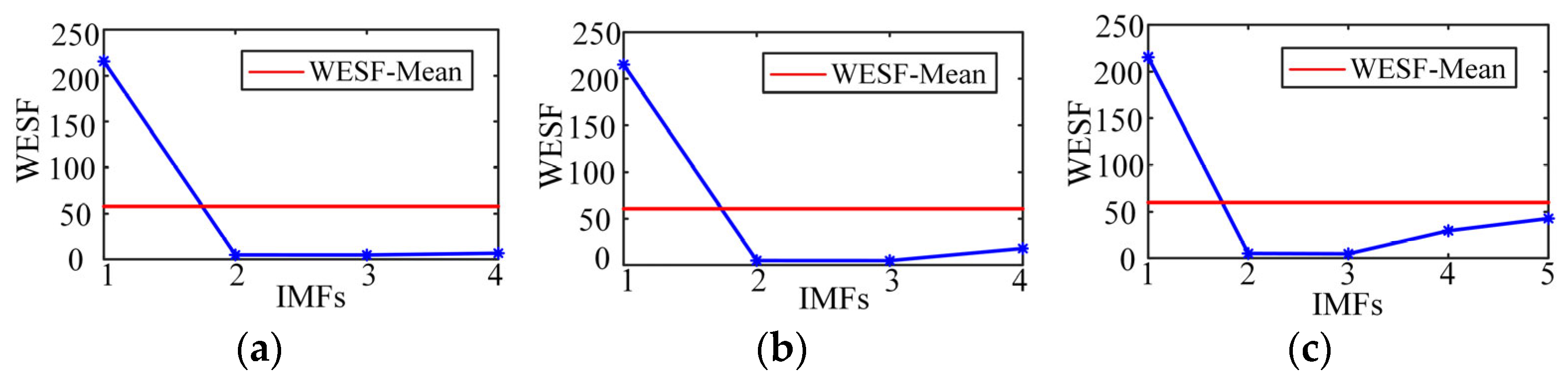
Figure 2. Wheel–rail excitation vibration signal under 40 km/h linear conditions: (a) wheel polygon; (b) track irregularity. The blue line represents the original excitation signal, while the red line shows the effect of amplification. The red dotted box indicates the selected amplification time interval.
Machines 14 00353 g002
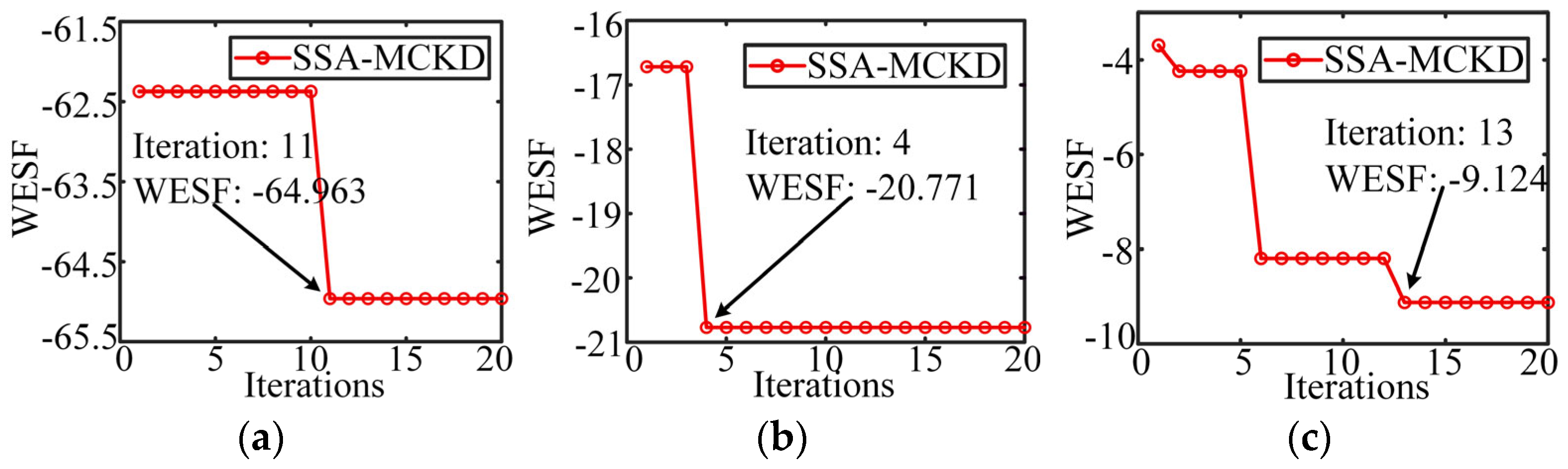
Figure 3. Wheel–rail excitation vibration signal under 40 km/h linear conditions. The red area represents the calculation results of the envelope entropy and kurtosis of the excitation signal.
Machines 14 00353 g003
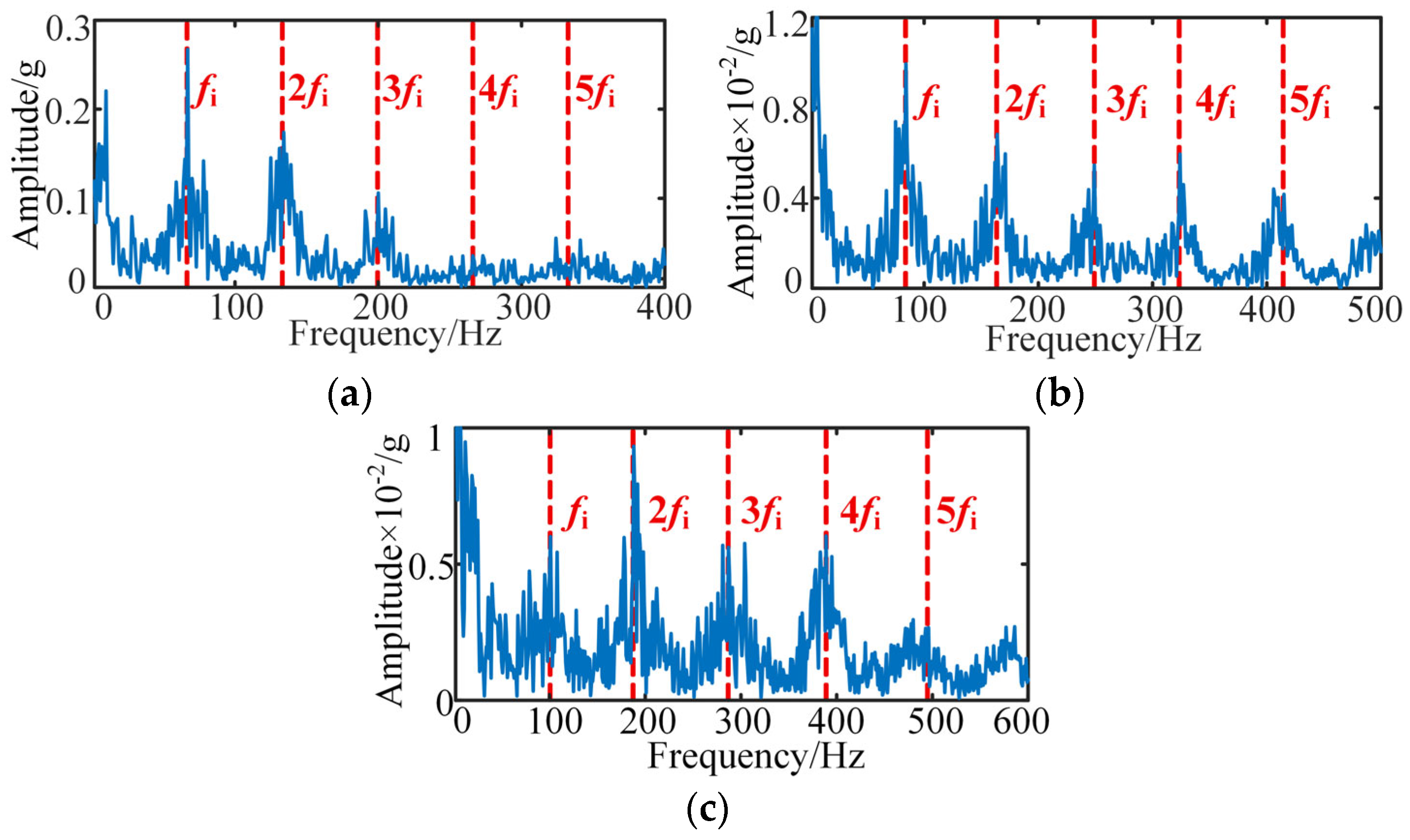
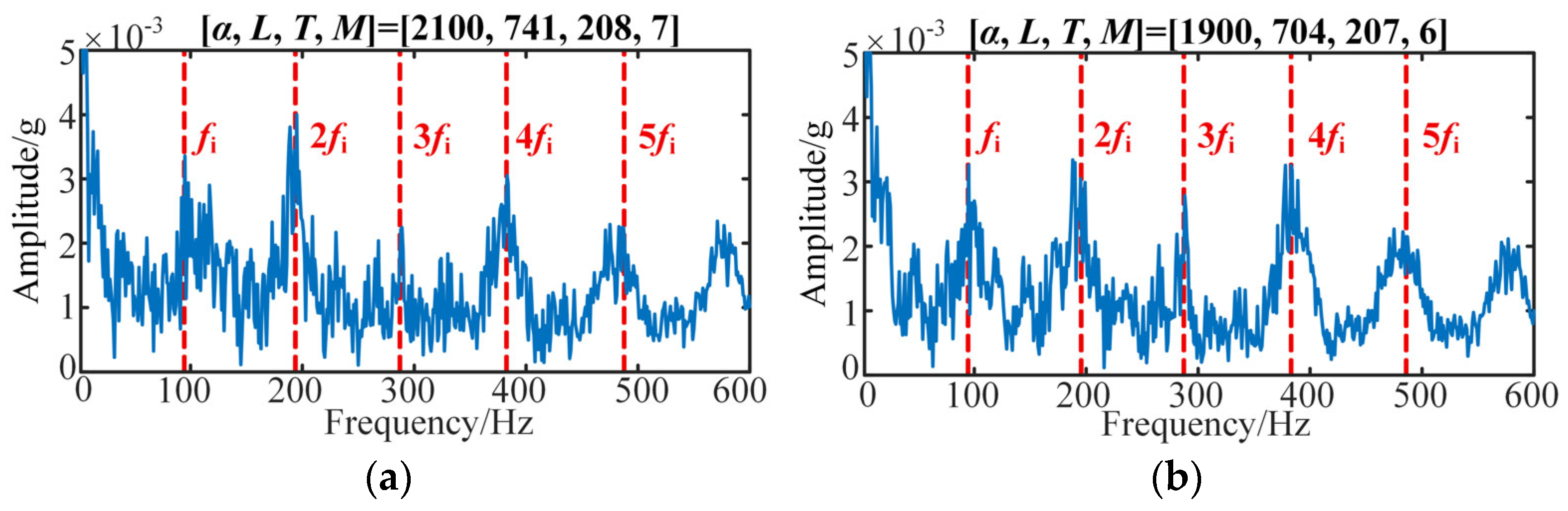
Figure 4. Frequency-domain analysis of wheel–rail excitation signal. The red line represents the effect after amplifying the high-frequency part of the excitation signal.
Machines 14 00353 g004
Figure 5. Whole vehicle dynamics model of locomotive (curved track).
Machines 14 00353 g005
Figure 6. Wheel–rail excitation vibration signal under 80 km/h curved conditions: (a) wheel polygon; (b) track irregularity. The blue line represents the original excitation signal, while the red line shows the effect of amplification. The red dotted box indicates the selected amplification time interval.
Machines 14 00353 g006aMachines 14 00353 g006b
Figure 7. Wheel–rail excitation vibration signal under 80 km/h curve conditions. The red area represents the calculation results of the envelope entropy and kurtosis of the excitation signal.
Machines 14 00353 g007
Figure 8. Frequency-domain analysis of wheel–rail excitation signals under curve conditions. The red line represents the effect after amplifying the high-frequency part of the excitation signal.
Machines 14 00353 g008
Figure 9. Flowchart of the SVMD-WESF-SSA-MCKD algorithm.
Machines 14 00353 g009
Figure 10. Composite signal and original fault signal.
Machines 14 00353 g010
Figure 11. Envelope spectrum of composite signal.
Machines 14 00353 g011
Figure 12. IMFs time-domain waveform.
Machines 14 00353 g012
Figure 13. Selecting the effective component signal.
Machines 14 00353 g013
Figure 14. Convergence curves of the SSA-MCKD.
Machines 14 00353 g014
Figure 15. Enhanced envelope spectrum of MCKD.
Machines 14 00353 g015
Figure 16. Transmission fault simulation test bench.
Machines 14 00353 g016
Figure 17. Layout positions of inner ring fault bearings and acceleration sensors.
Machines 14 00353 g017
Figure 18. Time-domain waveform of inner ring fault signal: (a) original fault signal; (b) added Gaussian white noise. “#” denotes the index of different signal states, this applies consistently to all similar notations throughout the manuscript.
Machines 14 00353 g018
Figure 19. Frequency-domain analysis results of noise signals under different operating states: (a) 40 Hz; (b) 50 Hz; (c) 60 Hz.
Machines 14 00353 g019
Figure 20. Process of fault signal decomposition and reconstruction: (a) time-domain waveform during SVMD decomposition; (b) selection of effective components; (c) reconstruction of signal envelope spectrum.
Machines 14 00353 g020
Figure 21. Convergence curves of the SSA-MCKD algorithm under each state: (a) 40 Hz; (b) 50 Hz; (c) 60 Hz.
Machines 14 00353 g021
Figure 22. Enhanced envelope spectrum of MCKD algorithm under each state: (a) 40 Hz, (b) 50 Hz, (c) 60 Hz.
Machines 14 00353 g022
Figure 23. Verification comparison of the proposed method: (a) verification of the superiority of the SVMD method; (b) verification of the effectiveness of algorithm optimization for MCKD parameters; (c) verification of the accuracy of the established fitness function.
Machines 14 00353 g023
Figure 24. FFC values of different methods.
Machines 14 00353 g024
Figure 25. Time-domain waveforms of fault signals and original signals under wheel–rail excitation (Linear operating condition): (a) 40 Hz; (b) 50 Hz; (c) 60 Hz.
Machines 14 00353 g025
Figure 26. Selecting the effective component signal (Linear operating condition): (a) 40 Hz; (b) 50 Hz; (c) 60 Hz.
Machines 14 00353 g026
Figure 27. Convergence curves of the SSA-MCKD algorithm under various operating conditions in the wheel–rail excitation (Linear operating condition): (a) 40 Hz; (b) 50 Hz; (c) 60 Hz.
Machines 14 00353 g027
Figure 28. Enlarged envelope spectrum of the MCKD algorithm under different operating conditions under wheel–rail excitation (Linear operating condition): (a) 40 Hz, (b) 50 Hz, (c) 60 Hz.
Machines 14 00353 g028
Figure 29. Comparison between the proposed method and other enhancement algorithms: (a) CYCBD; (b) MOMEDA.
Machines 14 00353 g029aMachines 14 00353 g029b
Figure 30. Convergence curve of SSA–MSE–MCKD.
Machines 14 00353 g030
Figure 31. Envelope spectrum of the enhanced signal using MSE as the objective function.
Machines 14 00353 g031
Figure 32. Time-domain waveforms of fault signals and original signals under wheel–rail excitation (Curved operating condition): (a) 40 Hz; (b) 50 Hz; (c) 60 Hz.
Machines 14 00353 g032
Figure 33. Selecting the effective component signal (Curved operating condition): (a) 40 Hz; (b) 50 Hz; (c) 60 Hz.
Machines 14 00353 g033
Figure 34. Convergence curves of the SSA-MCKD algorithm under various operating conditions in the wheel–rail excitation (Curved operating condition): (a) 40 Hz; (b) 50 Hz; (c) 60 Hz.
Machines 14 00353 g034
Figure 35. Enlarged envelope spectrum of the MCKD algorithm under different operating conditions under wheel–rail excitation (Curved operating condition): (a) 40 Hz; (b) 50 Hz; (c) 60 Hz.
Machines 14 00353 g035
Figure 36. Robustness verification of the proposed method: (a) downward perturbation; (b) upward perturbation.
Machines 14 00353 g036
Table 1. Main design parameters of the locomotive.
Parameter DesignationsUnitParameter Value
Car body mass, frame mass, wheelset masskg(62.6, 6.275, 2.77) × 103
Car body mass moment of inertia: roll, pitch, yawkg·m2(2.76, 14.34, 12.2) × 105
Frame mass moment of inertia: roll, pitch, yawkg·m2(5.39, 13.11, 16.8) × 103
Wheelset mass moment of inertia: roll, pitch, yawkg·m2(2.48, 1.081, 2.96) × 103
Primary vertical stiffness per axle boxMN/m2.1
Primary vertical damping coefficient per axle boxN·s/m25,000
Primary lateral and longitudinal stiffness per axle boxMN/m5.7, 1.44
Secondary vertical stiffness per side frameMN/m1.07
Secondary vertical damping coefficient per side frameN·s/m45,000
Secondary lateral stiffness per side frameMN/m0.332
Secondary lateral damping coefficient per side frameN·s/m79,000
Secondary longitudinal stiffness per side frameMN/m0.332
Secondary lateral stop stiffnessMN/m1.575
Axle box rod longitudinal and lateral stiffnessMN/m164.5, 57
Low-position traction rod lengthm1.232
Low-position traction rod stiffnessMN/m120
Low-position traction rod damping coefficientN·s/m100,000
Table 2. Fault signal information under each operating condition.
StateFrequency/HzRtate Speed/RPMfr/Hzfi/Hz
140242612.366.5
250303115.383.0
360359418.198.2
Table 3. Parameter perturbations for robustness validation.
60 Hz: α = 2000; [L, T, M] = [741, 208, 7] T ∈ [199, 208]; M ∈ [1, 7]
αLTM
1+5% (2100)+5% (778)--
2−5% (1900)−5% (704)−1 (207)−1 (6)
Table 4. Runtime evaluation.
ModuleTime
SVMD decomposition24.6 s
WESF computation0.02 s
SSA optimization19.7 min
MCKD deconvolution10 s
Total20.3 min
Disclaimer/Publisher’s Note: The statements, opinions and data contained in all publications are solely those of the individual author(s) and contributor(s) and not of MDPI and/or the editor(s). MDPI and/or the editor(s) disclaim responsibility for any injury to people or property resulting from any ideas, methods, instructions or products referred to in the content.