Article

Defective Photovoltaic Module Detection Using EfficientNet-B0 in the Machine Vision Environment

Department of Industrial and Systems Engineering, Dongguk University-Seoul, Seoul 04620, Republic of Korea
*
Author to whom correspondence should be addressed.
Machines 2026, 14(2), 232; https://doi.org/10.3390/machines14020232
Submission received: 21 January 2026 / Revised: 7 February 2026 / Accepted: 15 February 2026 / Published: 16 February 2026

Abstract

Machine vision based on artificial intelligence technology is being actively utilized to reduce defect rates in the photovoltaic module production process. This study aims to propose a machine vision approach using EfficientNet-B0 for defective photovoltaic module detection. In particular, the proposed approach is applied to the electroluminescence (EL) operation, which identifies microcracks in PV modules by using polarization current. The proposed approach extracts low-level structures and local brightness variations, such as busbars, fingers, and cell boundaries, from a single convolutional block. Furthermore, the mobile inverted bottleneck convolution (MBConv) block progressively transforms defect patterns—such as microcracks and dark spots—that appear at various shooting angles into high-level feature representations. The converted image is then processed using global average pooling (GAP), Dropout, and a final fully connected layer (Dense) to calculate the probability of a defective module. A sigmoid activation function is then used to determine whether a PV module is defective. Experiments show that the proposed Efficient-B0-based methodology can stably achieve defect detection accuracy comparable to AlexNet and GoogLeNet, despite its relatively small number of parameters and fast processing speed. Therefore, this study will contribute to increasing the efficiency of EL operation in industrial fields and improving the productivity of PV modules.

1. Introduction

Machine vision is a technology that uses camera sensors installed in manufacturing facilities and uses artificial intelligence (AI) to assess product quality based on captured images [1]. It automates the product quality assessment process previously performed by humans. By automating human quality assessment through machine vision, machine vision can reduce errors in quality judgments caused by human perception and worker fatigue [2]. With recent advancements in AI technology, demand for machine vision has steadily increased, and its application fields are expanding to include semiconductors, electric vehicles, and healthcare [3]. The machine vision market was estimated at approximately $13.95 billion in 2025 and is projected to reach $19.81 billion by 2030, growing at a compound annual growth rate (CAGR) of 7.27% during the forecast period (2025–2030) [4].
The production of photovoltaic (PV) modules—devices that directly convert solar energy into electrical energy using semiconductors—also actively utilizes machine vision technology, as in semiconductor production. Because solar cells, the core components of PV modules, are made primarily of semiconductor materials like silicon, quality inspection of PV modules is crucial for ensuring excellent photovoltaic performance (the phenomenon of sunlight striking a semiconductor and generating electricity) [5]. Machine vision is utilized to accurately verify the alignment and position of PV cells, minimizing errors during assembly [6]. In 2024, global new solar power generation capacity was expected to reach approximately 599 GW, and it was projected to increase 17% year-on-year to approximately 700 GW by 2025. Consequently, demand for photovoltaic modules is expected to continue to grow. PV module manufacturing capacity is projected to steadily increase from 1155 GW in 2023 to 1546 GW by 2035 [7], implying continued growth in machine vision applications.
According to [6], the PV module manufacturing process typically involves sequential production operations, including a tapping operation to connect solar cells, a framing operation to assemble frames onto individual modules, and a junction box mounting operation to connect busbars and junction box terminals. Because connecting solar cells and individual PV modules is a key manufacturing step, defects in solar cells and modules can occur in various ways during the connection process [8]. These defects lead to additional tasks, such as product disassembly, reassembly, and disposal, which increase production costs [9]. Therefore, efforts to reduce defects in the PV module manufacturing process are actively being pursued in major PV module-producing countries (e.g., China [10], Taiwan [11], and South Korea [12]), including the development of early defect detection technologies using machine vision.
In particular, because electroluminescence (EL) is an important operation in the PV module manufacturing process and can be used to obtain images of microcracks, automating the detection of defective PV modules using machine vision can improve manufacturing efficiency and reduce defective products. This study aims to improve the machine vision approach by utilizing EfficientNet-B0 to enhance the production quality of PV modules. EfficientNet-B0 employs a hybrid model scaling strategy that simultaneously expands network depth, channel width, and input resolution. It is designed with a lightweight architecture that includes mobile inverted bottleneck convolution (MBConv) and squeeze-and-excitation (SE) modules [13]. It is designed to have excellent scalability across depth, width, and resolution, effectively limiting computational load and model size while maintaining high-resolution input, which makes it suitable for defective PV module inspection environments during the EL operation. To address the class imbalance problem between good and bad PV module images, this study uses ImageNet pretrained weights as initial values and applies data augmentation and hierarchical segmentation strategies in parallel to stabilize representation learning for the bad class and mitigate overfitting. In experiments, we compare the performance of the proposed methodology with existing convolutional neural network (CNN)-based algorithms (e.g., AlexNet, ResNet50, DenseNet121, and GoogLeNet). We also perform a sensitivity analysis of how performance changes with the optimal image capture angle and bad detection threshold for the proposed methodology to achieve optimal performance. As a result, the proposed EfficientNet-B0-based methodology is a suitable solution for integration with machine vision due to its small model size and easy deployment on industrial PCs or GPUs.
The contributions of this study are as follows. First, the proposed Efficient-B0-based methodology demonstrates superior performance in PV module defect detection compared to existing CNN-based algorithms (e.g., AlexNet, ResNet50, DenseNet121, and GoogLeNet) in terms of accuracy, precision, recall, and F1-score. Compared to existing CNN-based algorithms, EfficientNet-B0 achieves high expressive power with fewer parameters and fewer floating-point operations (FLOPs). Second, this study analyzes the performance sensitivity to the image capture angle, confirming that the proposed Efficient-B0-based methodology achieves optimal performance. Unlike previous studies that focused solely on performance comparisons of AI algorithms, we analyzed performance sensitivity to the image capture angle, considering that defective component detection performance can vary depending on the angle of the image sensor used to capture PV modules during the EL process. Finally, we performed a sensitivity analysis on the performance of the proposed methodology with respect to the classification threshold settings used to detect defective PV modules. Since the performance of defect detection varies not only with the given algorithm but also with the threshold value that serves as the classification criterion, this analysis reveals which threshold value should be set for more accurate detection of defective PV modules in the EL process.
This study is structured as follows. Section 2 describes the PV manufacturing process and a PV module defect detection technique utilizing a machine vision framework and Efficient-B0 technology. Section 3 validates the performance of the proposed Efficient-B0-based PV module defect detection method using data collected from a PV module manufacturing facility in Korea. Section 4 presents the results of this study and proposes future research directions.

2. Materials and Methods

2.1. Machine Vision in Photovoltaic Module Manufacturing

A photovoltaic (PV) system consists of a frame, front and back covers, an encapsulant, solar cells, and a junction box that converts solar radiant energy into direct current (DC) through multiple PV modules [14]. It is crucial to manufacture PV modules in which solar cells can efficiently convert photon energy associated with a specific wavelength into electrical energy through semiconductors (i.e., p-type and n-type silicon layers) at high efficiency [15]. That is, when a solar cell receives sunlight, electrons within the silicon layer are emitted from the n-type silicon layer and move to an external wire through the p-type silicon layer, generating direct current. Since the final output is determined by the physical conversion efficiency, research is being conducted on the crystal structure of the solar cell itself and the utilization of materials such as cadmium telluride (CdTe) and CuInGaSe2 (CIGS) [5].
In terms of the manufacturing process, the focus is on the efficient production of PV modules, and the production process typically involves seven sequential operations, including tapping, automatic bussing, EL, laminating, a framing station, and frame and junction box mounting [14]. The tapping process is the first step in which multiple solar cells are soldered and connected in series to form string cells, while automatic bussing is the process of connecting panel strings consisting of multiple solar cells to a board to manufacture PV modules [16,17]. EL testing utilizes a polarization current to emit EL radiation from solar cells, which can be used to obtain high-resolution images that can identify microcracks [18]. Laminating is the process of covering the panel strings with encapsulating material under high pressure and high temperature conditions; the framing station manufactures frames for the encapsulated panels, and frame and junction box mounting is the operation of attaching the encapsulated panel strings to the PV frame and using sealant or adhesive, attaching the junction box to the back of the frame, which is connected to the busbar of the solar string and transmits the generated electricity to external electrical devices [19].
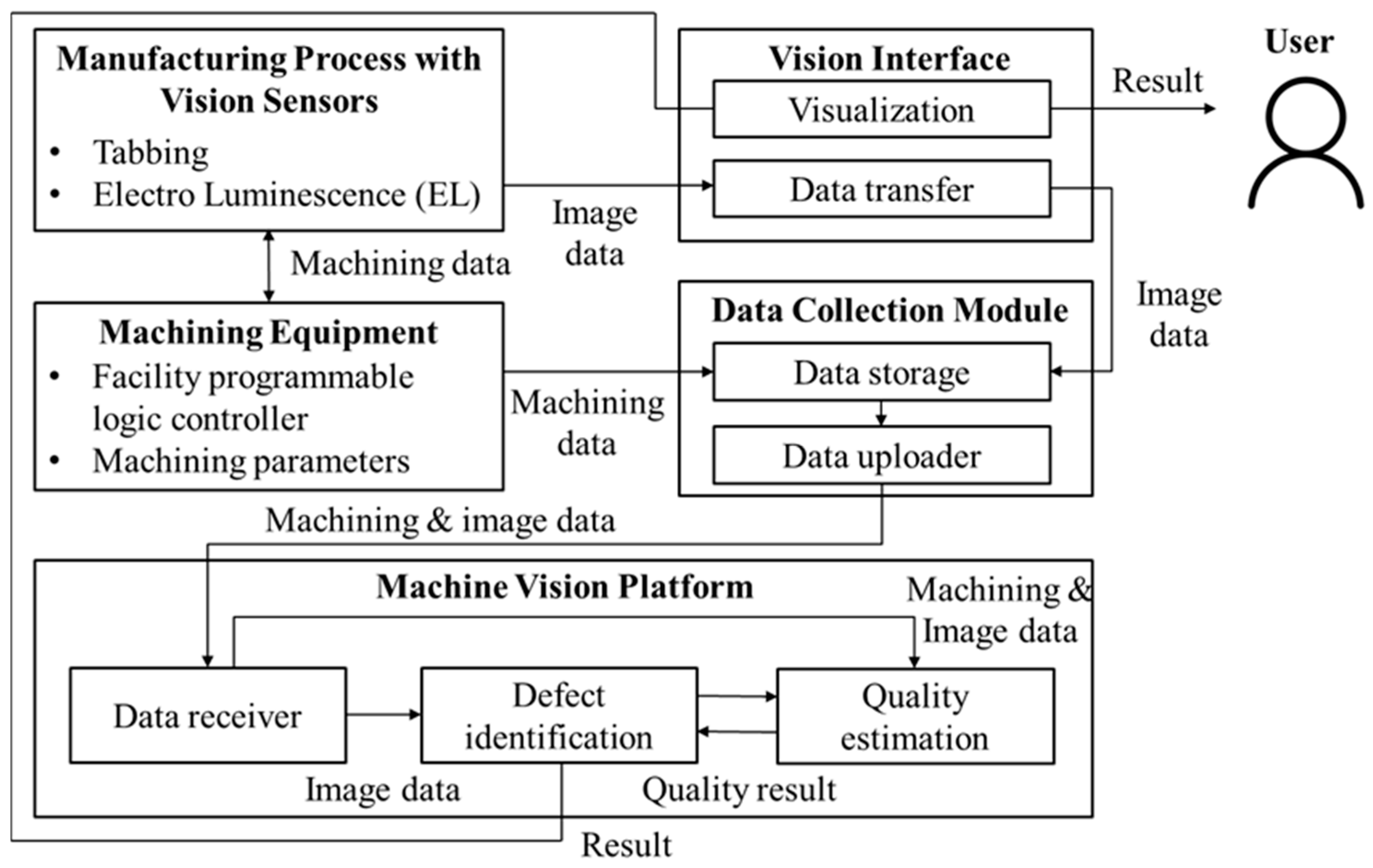
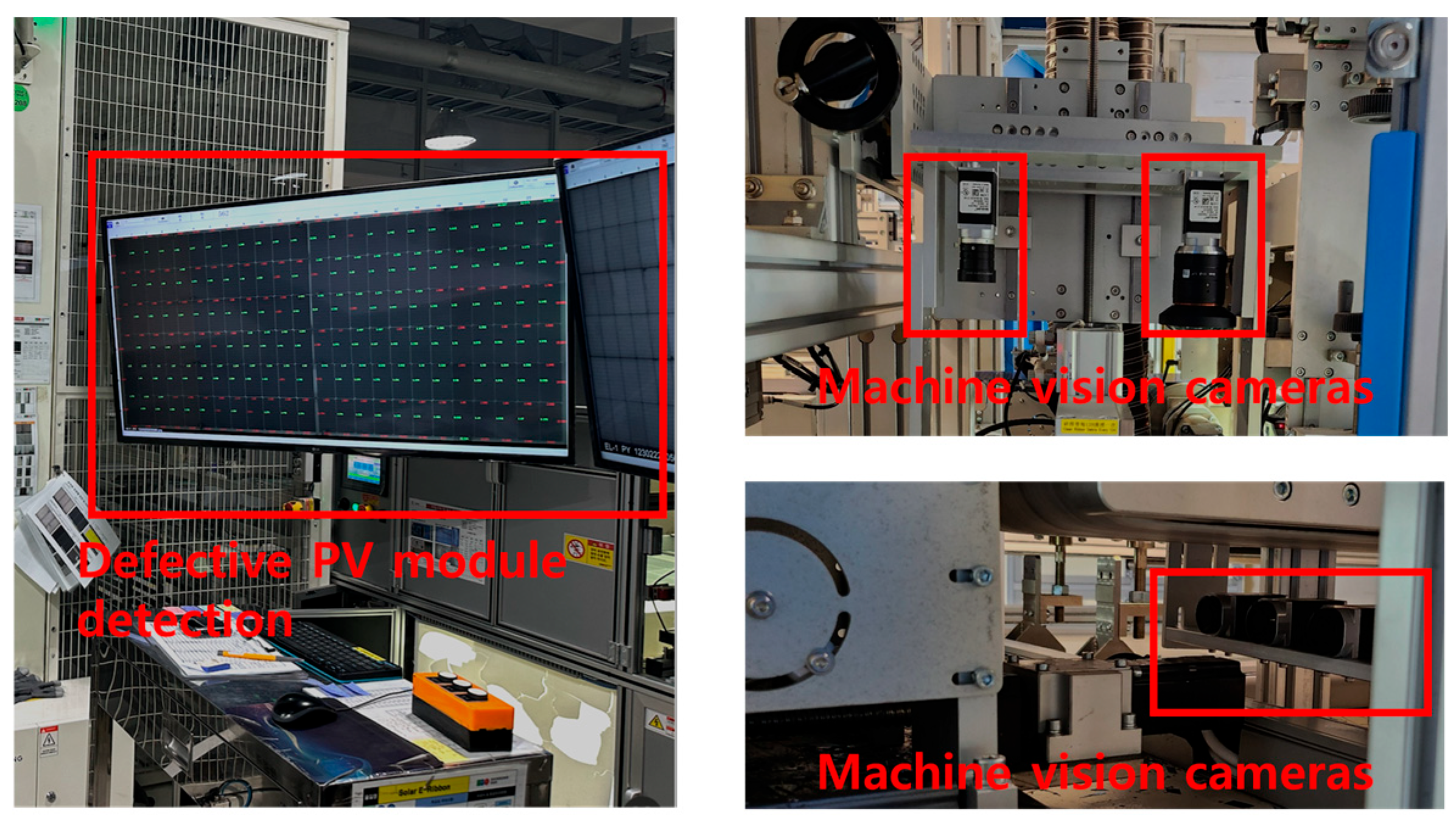
Among these seven operations, the EL operation is the one in which machine vision can be utilized to detect defective manufactured parts, as it can provide images of microcracks. Figure 1 shows the machine vision framework for PV manufacturing [6], which monitors the appearance of PV module components (solar cells, strings, frames, etc.) in real time via camera sensors. Figure 2 shows examples using acA1920-25gm cameras, Basler AG, hrensburg, Germany. The images used in this study were acquired at an indoor PV module manufacturing facility. RGB images were captured using a machine vision camera fixedly installed on the production line for the EL and tapping processes. The camera installation location and shooting geometry were maintained throughout the data collection period to ensure consistent acquisition conditions. Furthermore, because the experiments were conducted in an indoor manufacturing environment, external lighting factors such as sunlight were excluded. To minimize image noise and subtle variations in acquisition conditions, preprocessing steps such as geometric alignment, region of interest extraction, and image resizing were applied to standardize the input data before model training and inference.
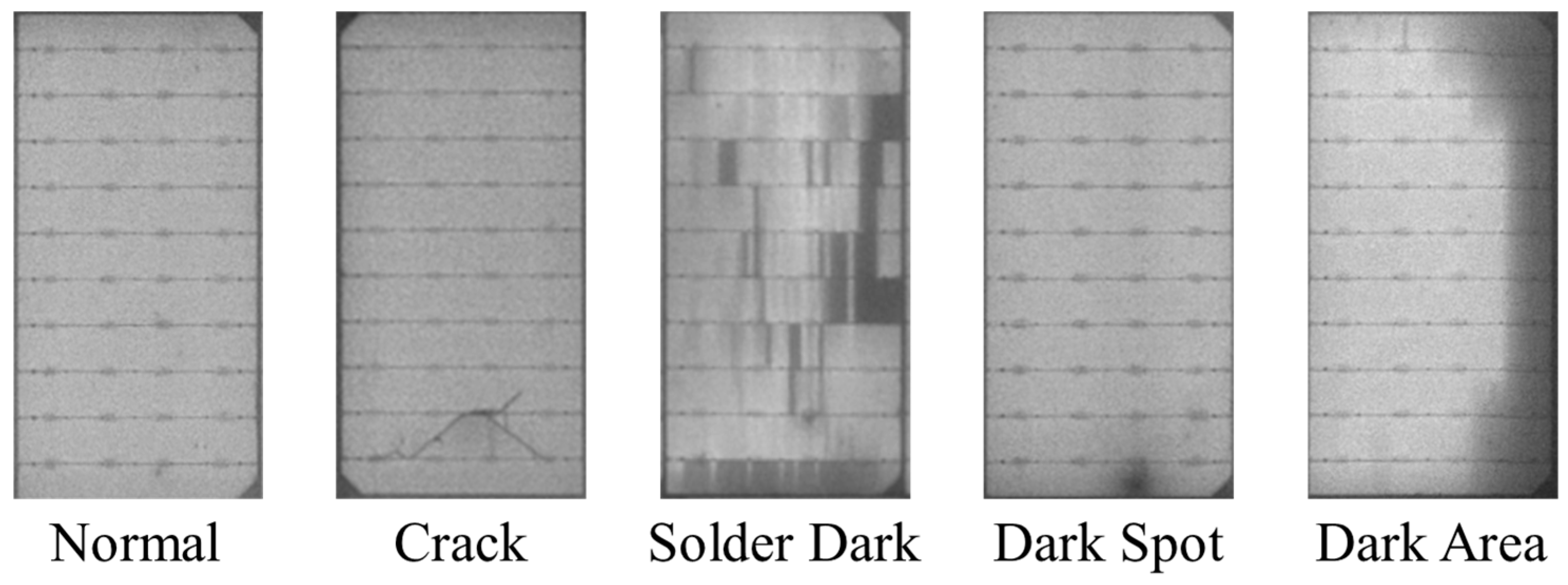
By utilizing a camera sensor, five types of EL images, including normal ones, are collected, as shown in Figure 3. Defective images include ‘crack’, ‘solder dark’, ‘dark spot’, and ‘dark area’. A crack is a defect in which microcracks occur inside the PV module; it is observed as a linear pattern along the crack path in the EL image [20]. A dark spot is a defect in which light emission is reduced locally in the form of a small dot at a specific location in the EL image [21]. A dark area is a defect in which light emission is reduced over a wide area in a specific region [22]. Solder dark is observed as a rectangular dark area in the EL image when current transmission becomes unstable due to a defect in the solder layer at the connection [23].
In this study, criteria considering morphology and location were applied to identify the defect types in Figure 3. A crack was determined when a continuous linear luminescence reduction was observed within the module and either crossed the cell region or extended beyond a certain length. A dark spot was determined when a localized region inside the module showed a pronounced luminescence reduction compared to normal areas, and when the candidate region occupied a relatively small area within the region of interest (ROI) with a sufficient drop in mean intensity. In contrast, a dark area was determined when a luminescence reduction was similarly observed but appeared as a relatively large and contiguous region within the ROI, and it was distinguished from a dark spot using an area-based criterion. Solder dark was determined when a rectangular or band-shaped luminescence reduction pattern was observed around the busbar interconnection region.
In Figure 1, PV images collected via camera sensors during the EL operation are transmitted to the data collection module and stored in a database. The stored image data is used for real-time defect detection and judgment, subsequent AI algorithm training, and product quality management. During this process, PV module manufacturing environment information (processing parameters and PLC control information) provided by the manufacturing equipment is also stored in the database. Image data acquired through machine vision is transmitted to the data collection module in real time via the Internet of Things (IoT). Structured and unstructured data are standardized and classified into specific analysis datasets, and the stored processing and image data are transmitted to the machine vision platform. During this process, the quality prediction and defect identification module uses AI to extract defective products. These modules analyze images to detect defective products that exhibit different patterns from existing products and predict potential defects [6]. In this study, we aim to improve the detection performance of defective PV modules by utilizing EfficientNet-B0, an existing machine vision technology.

2.2. Defective PV Module Detection Using EfficientNet-B0 with Machine Vision

In this study, EfficientNet-B0, a basic model of the EfficientNet series, is selected as the CNN architecture for PV module EL image classification. EfficientNet-B0 is one of the CNN-based approaches proposed by Tan et al. (2019) [13]. It uses a compound model scaling strategy that simultaneously expands network depth, channel width, and input resolution, and is designed with a lightweight structure that includes mobile inverted bottleneck convolution (MBConv) and squeeze-and-excitation (SE) modules. This structure offers the advantage of achieving high representational power with fewer parameters and fewer floating-point operations (FLOPs) compared to existing CNNs such as the Visual Geometry Group (VGG), the residual network (ResNet), and GoogLeNet. In EL images of PV modules, small defects such as microcracks and dark spots directly impact classification accuracy, making high-resolution image input essential. EfficientNet-B0 is designed to scale well across depth, width, and resolution, effectively limiting computational load and model size while maintaining high-resolution input, which makes it suitable for this inspection environment [24]. Furthermore, EL images present a class imbalance problem, with a relatively small number of defective images compared to normal images, and data distribution varies depending on shooting conditions. In this context, several studies have applied EfficientNet-B0 to detect defective PV modules. Liu et al. (2024) [25] demonstrated 97.81% accuracy on the PVEL dataset by utilizing the contrast-limited adaptive histogram equalization (CLAHE) algorithm and the EfficientNet-B0 backbone for EL image-based PV cell defect detection. Furthermore, Joshua et al. (2025) [26] compared VGG16, ResNet50, DenseNet121, and EfficientNet-B0 for solar panel defect and status classification, and found that EfficientNet-B0 achieved 80.0% accuracy while also offering a small number of parameters and fast inference time, making it an advantageous model for an edge computing environment. This study utilizes ImageNet pretrained weights as initial values and employs data augmentation and hierarchical segmentation strategies in parallel to stabilize representation learning for defective classes and mitigate overfitting [27]. Compared with other backbones such as ResNet-50, EfficientNet-B0 has a smaller model size, making it easy to deploy on industrial PCs or GPUs. For these reasons, EfficientNet-B0 is considered a suitable model for application to actual PV module EL inspection equipment and production lines [28].
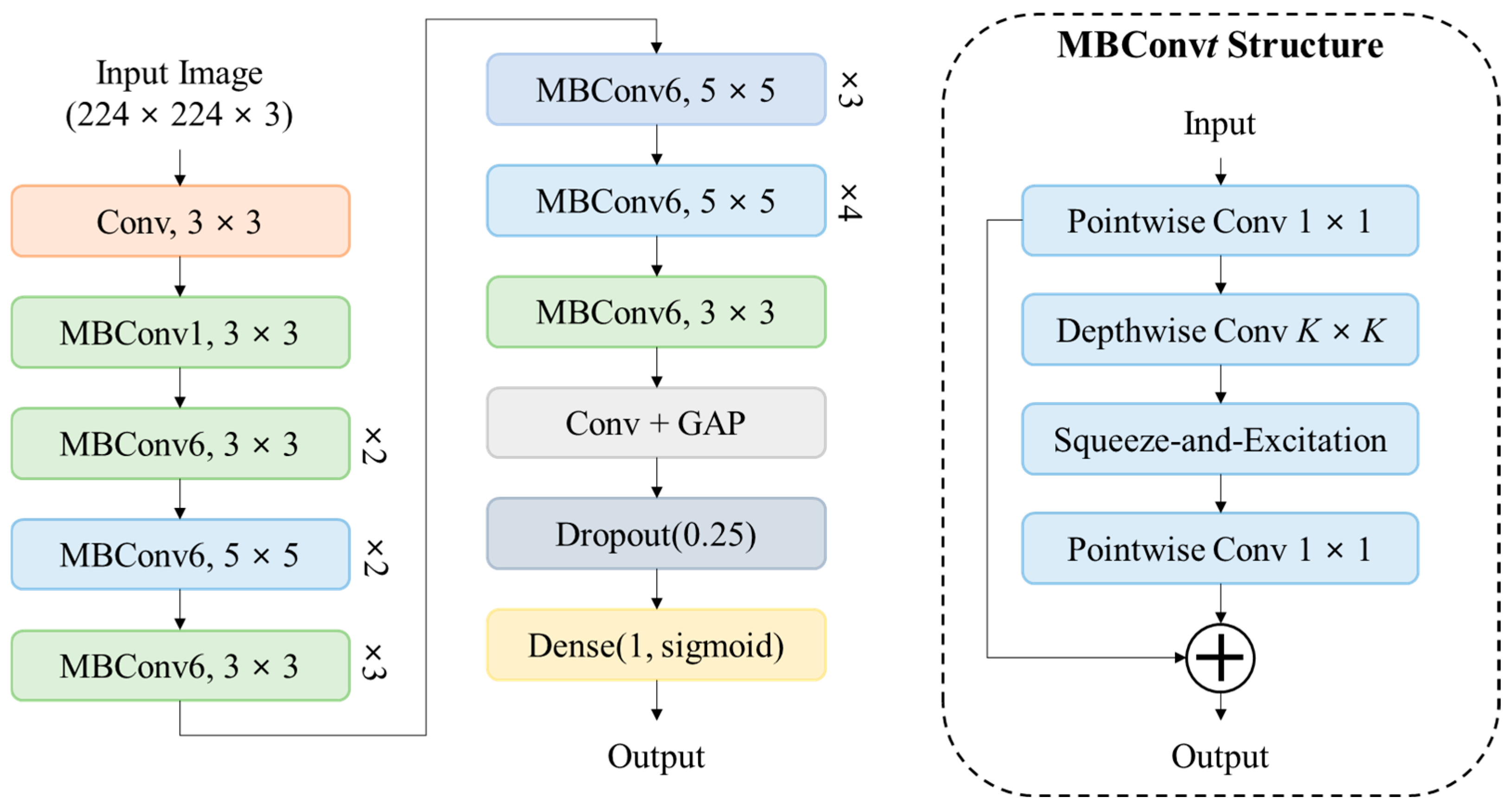
Figure 4 shows the defective PV module detection structure based on EfficientNet-B0, which consists of one convolutional block and seven MBConv blocks. First, the PV module image is converted to an input size of 224*224*3. Then, features are extracted from the image through convolution operations. The initial 3*3 convolution layer extracts low-level structures such as busbars, fingers, and cell boundaries, as well as local brightness variations. By sequentially passing the image through a total of 16 MBConv blocks, defect patterns such as microcracks and dark spots that appear at various shooting angles are gradually converted into high-level feature representations. In the final step, global average pooling (GAP) is applied to obtain a 1280-dimensional feature vector representing a single module. Dropout is used to mitigate overfitting. The final fully connected layer (Dense) is then used to output the probability that the input EL image is from a normal or defective module. The output layer uses the sigmoid activation function in Equation (1) to convert the final linear output value into a probability value between 0 and 1.
y = 1 1 + e x
where y is a sigmoid function, and x is a linear output of the final fully connected layer (Dense). In this model, when x is input, Equation (1) calculates the estimated probability that the EL image is a defective module. The closer y is to 1, the higher the probability that the input EL image is defective. For a threshold value (Threshold, θ ) set in advance, if y is less than or equal to θ , it is classified as normal, and if y is larger than θ , it is classified as defective. Since the boundary between normal and defective classification changes when θ is adjusted, it is important to set an appropriate θ according to an acceptable level.

2.2.1. Compound Model Scaling

EfficientNet-B0 uses compound model scaling, which adjusts the network depth d, width w, and resolution r together with a single scale factor ϕ and constants α, β, and γ. The scaling relationship among the three dimensions is as shown in Equation (2).
d = α ϕ , w = β ϕ , r = γ ϕ
where α, β, and γ ( 1 ) are constants determined through small-scale exploration, and ϕ is a hyperparameter that adjusts the model scale according to the given computational size. Since depth, width, and resolution increase by factors of α, β, and γ, respectively, as ϕ increases by 1, it is possible to control the three dimensions to grow together at a certain rate, unlike when only a single dimension is expanded.
While increasing only depth allows for detailed model control as the model grows deeper, it unnecessarily increases parameters and computational complexity. Increasing only width can lead to inefficiencies in modeling and utilization due to the increased number of channels. Increasing only resolution increases the input size, leading to a sharp increase in computational complexity. Scaling only a single dimension tends to result in excessive growth in a specific axis. Composite model scaling, a strategy that simultaneously scales all three dimensions, offers better accuracy and efficiency within the same FLOPs range.
In the EL operation during PV module production, lowering the resolution too much can lead to the disappearance of microcracks and small dark spots, while increasing the model size excessively can lengthen production line processing times. Using composite model scaling, resolution, depth, and width can be adjusted simultaneously to secure sufficient expressiveness to handle high-resolution EL images while enabling real-time inspection with relatively low computational load.

2.2.2. Pointwise Convolution

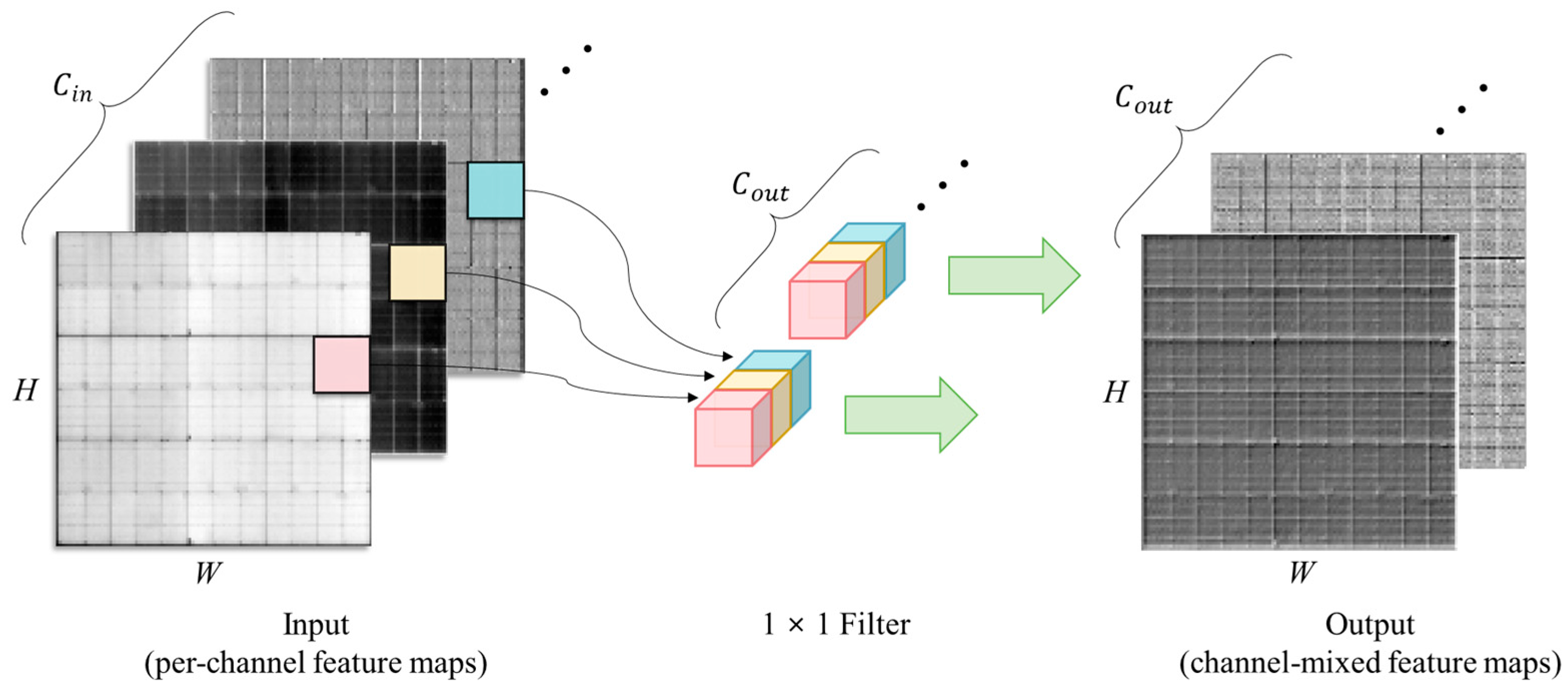
Pointwise convolution (1 × 1) remixes the defects (microcracks, dark spots, etc.) extracted by each channel by depthwise convolution into the combinations required for defect classification, and reduces or expands them to the required number of channels. Figure 5 shows the operational process of linearly combining the input channel vectors at each spatial coordinate ( h , w ) using pointwise convolution to mix information between channels and convert the dimension. The input feature map in the form of H × W × C i n is rearranged into a matrix of size ( H · W ) × C i n , and the 1 × 1 filter weights are rearranged into a C i n × C o u t matrix. Afterwards, a general matrix multiplication is performed to calculate the H · W × C o u t output, which is then restored to the H · W × C o u t feature map. At this time, the multiply-accumulate (MAC) operation amount ( O p o i n t w i s e ) and the number of parameters ( P p o i n t w i s e ) based on one forward pass are as shown in Equations (3) and (4), respectively.
O p o i n t w i s e = H · W · C i n · C o u t
P p o i n t w i s e = C i n · C o u t
where H and W represent the height and width of the output feature map, C i n is the number of input channels, and C o u t is the number of output channels.
In PV module images from the EL operation, each channel contains different filter results, such as vertical and horizontal edges, cracks in a specific direction, and partial brightness reduction (dark spots). Pointwise convolution linearly combines these channels to reconstruct defect-related information, such as cracks and dark spots, into a single, high-level representation, allowing the classifier to distinguish defect patterns.

2.2.3. Depthwise Convolution

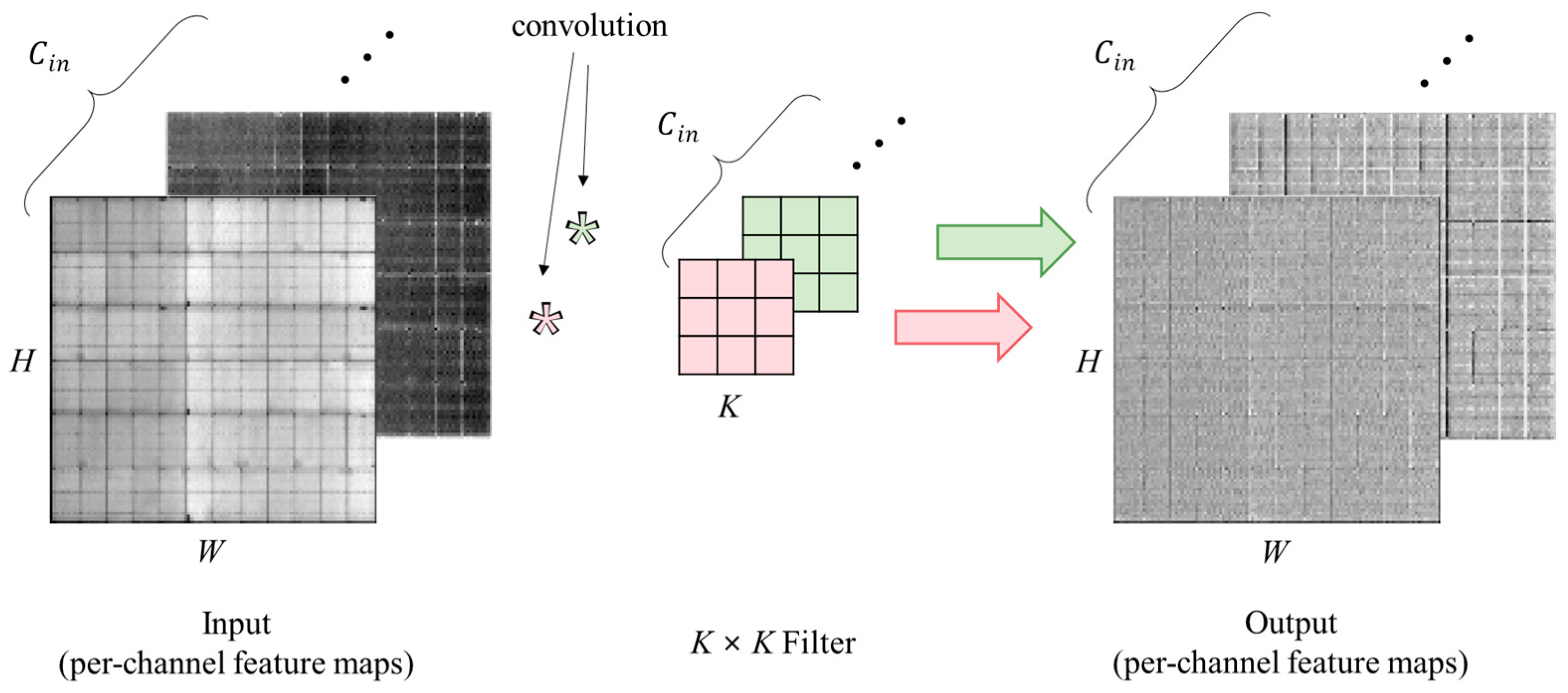
Depthwise convolution is used to independently extract spatial patterns such as cracks and dark spots for each channel of the input feature map. Figure 6 shows the associative process of depthwise convolution, which applies different K   ×   K filters to each channel of the input and performs only spatial convolution without mixing the channels. With the channel axis fixed, the K   ×   K kernels for each channel slide over all spatial coordinates ( h , w ) to calculate the convolution, and the outputs for each channel are stacked again in the channel direction to form the output feature map in the form of H × W × C i n . The number of MAC operations ( O d e p t h w i s e ) and the number of parameters ( P d e p t h w i s e ) based on one forward pass are shown in Equations (5) and (6), respectively:
O d e p t h w i s e = K 2 · H · W · C i n
P d e p t h w i s e = K 2 · C i n
where K represents the size of one side of the kernel. Compared to the computational complexity of standard convolution with the same kernel size, depthwise convolution eliminates the C o u t term, significantly reducing computational complexity and the number of parameters.
In PV module images from the EL operation, each channel can represent different spatial patterns, such as crack edges, dark spots, and internal cell surface patterns, depending on the direction. Depthwise convolution searches for these patterns across the module without mixing channels, efficiently extracting spatial defect structures such as cracks and dark spots from high-resolution images from the EL operation. This method has a lower computational complexity than standard convolution, making it advantageous for maintaining computational speed even in environments where PV module images acquired from multiple shooting angles are massively processed.

3. Results

3.1. Experiment Scenario

Experiments are conducted on three aspects: PV module defect detection performance, optimal image capture angle selection, and sensitivity analysis of classification thresholds. First, the PV module defect detection performance of the proposed methodology is measured and compared with that of existing CNN-based algorithms (e.g., AlexNet, ResNet50, DenseNet121, and GoogLeNet) based on accuracy, precision, recall, and F1-score. Second, the performance sensitivity to the image capture angle is compared to ensure that the proposed Efficient-B0-based methodology achieves optimal performance. Finally, a sensitivity analysis is performed on the performance change of the proposed methodology depending on the setting of the classification threshold used to detect defective PV modules.
This experiment utilizes a PV module image dataset collected from an actual EL operation to evaluate PV module defect detection performance. Table 1 describes the collected images, which consist of 2772 images: 1512 normal PV modules and 1260 defective PV modules. This dataset contains cracks, dark spots, dark areas, and dark solder defects. Machine vision systems are installed at various angles to capture PV modules. In this study, to analyze the variation in defect detection performance with varying image capture angles, PV module images in the EL operation are collected at 10° intervals from 0° to 80°. Changes in the image capture angle can physically affect the measured EL signal and defect visibility. Therefore, this study evaluates performance variations across different capture angles. Although the emission characteristics of EL may vary with viewing angle, radiance can be treated as approximately invariant with respect to viewing direction. However, because practical PV modules have a multilayer structure including glass and encapsulant, changes in viewing angle can increase reflectance and decrease transmittance as a function of the incident angle [29]. In addition, variations in viewing angle can change the scattering components at the surface and interfaces, which may affect brightness uniformity and defect contrast in the recorded signal. Consequently, the EL intensity reaching the camera can vary with capture angle. Accordingly, this experiment was designed to quantify the effect of capture-angle changes on defect classification performance. The final dataset consists of 168 normal PV modules and 140 defective PV modules for each angle. To independently evaluate the impact of each angle, 60% of the images collected at each angle are used for training, 20% for validation, and 20% for testing. To compare performance, CNN-based algorithm models are evaluated under the same data segmentation criteria, and defect detection performance is compared.
Accuracy, precision, recall, and F1-score are used to evaluate the defect detection performance of each algorithm. Equations (7)–(10) are the formulas for calculating each performance indicator:
A c c u r a y =   T P + T N T P + F P + F N + T N
P r e c i s i o n = T P T P + F P
R e c a l l = T P T P + F N
F 1   s c o r e = 2 × P r e c i s i o n × R e c a l l P r e c i s i o n + R e c a l l
where a defect is defined as positive and a normal module as negative. True positive (TP) refers to a case where an actual defective module is correctly classified as defective, and true negative (TN) refers to a case where an actual normal module is correctly classified as normal. False positive (FP) refers to a false detection where an actual normal module is incorrectly classified as defective, and false negative (FN) refers to a non-detection where an actual defective module is incorrectly classified as normal. Therefore, precision reflects the level of suppression of false positive (FP) detections, and recall reflects the ability to reduce non-detections (FN). F1-score is the harmonic mean of precision and recall, and it represents the judgment performance without the two indicators being biased to one side.

3.2. PV Module Defective Detection Performance

This experiment uses a baseline dataset of PV module images taken at 0° to compare the performance of each algorithm. In addition to EfficientNet-B0, experiments are conducted by changing the architecture to Alex Krizhevsky’s Network (AlexNet), the residual network (ResNet50), the densely connected convolutional network (DenseNet121), and InceptionV1 (GoogLeNet). To compare performance changes attributable to architectural differences, all models were trained and evaluated under identical conditions. All models were trained for 100 epochs, and the weights corresponding to the highest validation accuracy during training were selected to compute the final results on the test set. In addition, the batch size was fixed at 8, the random seed was set to 42, the learning rate was set to 0.0001, and the Adam optimizer was used consistently across backbones to ensure a fair comparison. These architectures are widely used in defect classification research of PV modules, and since they have different structural characteristics, they are suitable for comparing performance changes due to structural differences under the same data and conditions. AlexNet is a relatively early CNN architecture and achieved an accuracy of 99.3% in PV module status classification research [30]. ResNet50, a network architecture that utilizes residual connections to ensure learning stability, achieves an F1-score of 87.37% in PV panel crack detection based on EL images [31]. DenseNet121, designed for feature reuse through dense connectivity between layers, achieved an accuracy of 98% in a study of PV module defect identification [32]. GoogLeNet, a multi-scale architecture that extracts features from different receptive fields in parallel, achieved an accuracy of 94.6% in PV defect detection [33].
Table 2 describes the performance metrics for different CNN-based algorithms used to detect defects in PV modules. DenseNet121 achieves high performance across all metrics, with an accuracy of 0.8387, a precision of 0.8750, a recall of 0.7500, and an F1-score of 0.8077. This represents approximately 36.9% higher accuracy and 25.0% higher precision than AlexNet, which has the lowest classification performance. DenseNet121’s higher accuracy compared to other algorithms is due to the fact that the defect patterns in the data include localized and subtle features, such as cracks and black spots. The direct connection structure of DenseNet50 allows features from previous layers to be accumulated and reused in subsequent layers, reducing information loss and maintaining a stable representation of micro-defects. On the other hand, AlexNet has limited depth, and the difficulty of hierarchically accumulating high-level features makes it difficult to isolate weak signals, such as micro-defects. The proposed EfficientNet-B0 shows overall stable performance with an accuracy of 0.7903, a precision of 0.8000, a recall of 0.7143, and an F1-score of 0.7547. Compared with DenseNet121, which had the highest performance, its accuracy, precision, and recall are 5.8%, 8.6%, and 4.8% lower, respectively, but it maintains relatively balanced performance without an excessive decrease in any specific indicator. EfficientNet-B0 can maintain stable performance even with low computational resources because it uses a convolutional structure that repeats the flow of channel expansion, feature extraction, and channel reduction in each block. Although its classification performance may be lower than that of structures that utilize accumulated features, such as DenseNet121, it can efficiently learn the features necessary for fault determination even with limited model capacity, thereby achieving stable performance. Meanwhile, compared with ResNet50, EfficientNet-B0 showed 2.0% and 7.4% lower accuracy and precision, respectively, but 5.3% higher recall. ResNet50’s residual connections ensure stable learning even in structures with many layers. However, if the decision boundary is formed conservatively, the failure rate increases instead of reducing the FP, resulting in a lower recall and defective cases being classified as normal.
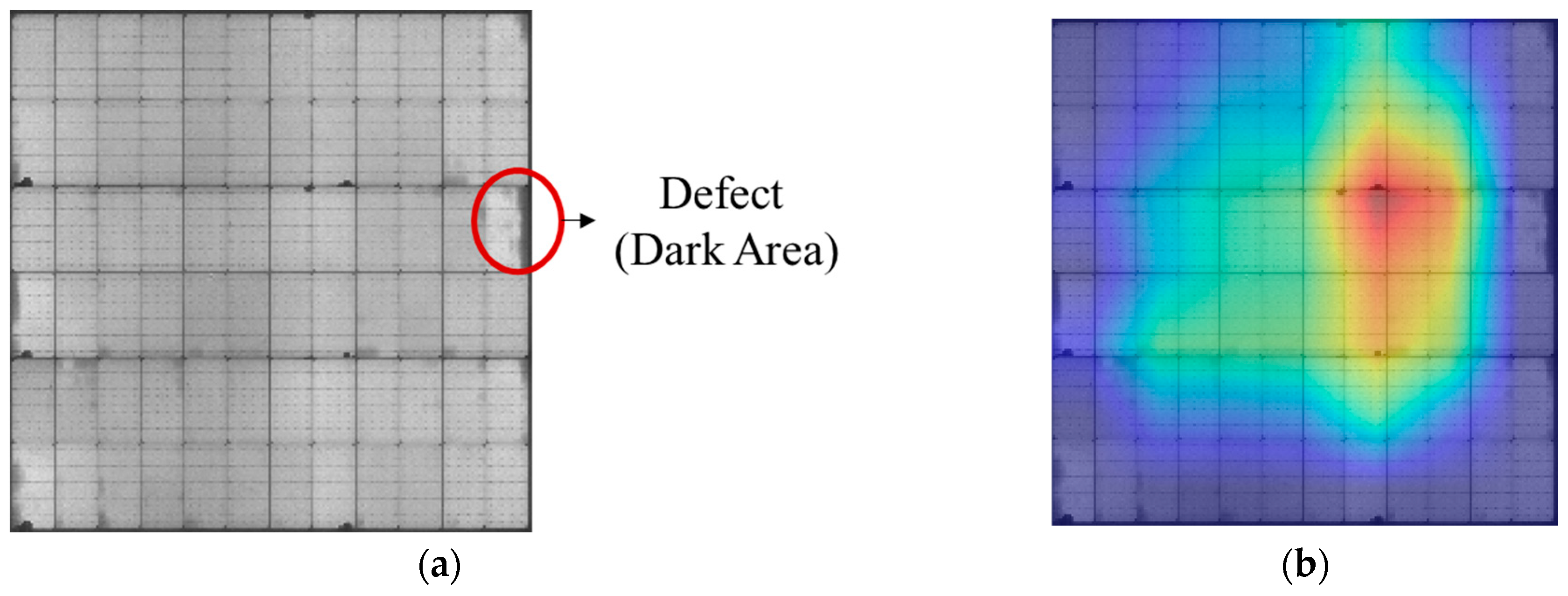
Figure 7 shows the original EL image and the corresponding activation map derived from the final convolutional feature maps of EfficientNet-B0. The dark area in Figure 7a was identified as a localized region exhibiting a clear reduction in luminance compared with surrounding normal regions, appearing as a large, contiguous area within the ROI. The heatmap in Figure 7b highlights regions with high model attention, where red indicates stronger activation. In other words, the color scale from 0 to 1 represents blue to red, with values closer to 1 indicating greater differences from normal PV panels. The results show that the model primarily focused on the surrounding areas rather than the actual dark area defect in Figure 7a. Therefore, the model relied more on visual patterns in normal regions than on defect-specific features, leading to a biased feature representation and ultimately resulting in misclassification.
In addition to Table 2, model complexity and computational efficiency are also important evaluation factors for PV module defect detection, which requires accurate detection within limited computational resources and a given time. Table 3 compares the computational resource requirements of each algorithm based on the number of parameters (Parameters), computational load (FLOPs), inference time, peak memory usage, and frames per second (FPS).
Parameters, the total number of weights determined by the model through learning, determine the model size and the memory requirements for storing weights during inference. Increasing the number of parameters generally improves expressive power, enabling the learning of complex features. However, using excessive parameters relative to the data size can lead to overfitting, which can degrade generalization performance. Furthermore, increasing model complexity tends to reduce interpretability. Floating-point operations per second (FLOPs) are used to measure the computational complexity required for a single inference. As FLOPs increase, the computational burden increases, potentially slowing down processing speed. Inference time is the actual processing time per image, which comprehensively reflects the impact of FLOPs and memory access. Peak memory usage refers to the maximum amount of memory occupied during the inference process of the detection algorithm. Finally, frames per second (FPS) denotes the maximum number of images that can be processed per second and is used to evaluate the real-time performance of machine vision systems.
DenseNet121, which achieved the highest classification accuracy, had relatively high FLOPs (5.7004 G) and inference time (78.13 milliseconds/image). This is because, although the number of parameters itself is small, the dense connectivity structure of DenseNet121 increases memory accesses and feature map size as blocks are repeated and previous feature maps are repeatedly connected to later layers. While DenseNet121 achieves performance through feature reuse, the cumulative combination of features increases computational and memory overhead, leading to increased actual inference time. This can potentially lead to throughput degradation in environments with limited computational resources. This is reflected in its high peak memory usage of 1810.23 MB and relatively low throughput of 12.8 FPS. ResNet50 secures learning stability even in structures with many layers through residual connections, but its structural characteristics of repeated bottleneck blocks result in high FLOPs, reaching 7.7512 G. Consequently, ResNet50 recorded approximately 33% higher peak memory usage (1336.62 MB) compared with EfficientNet-B0 (1005.38 MB), as well as the lowest FPS (11.2) among the evaluated models. In contrast, EfficientNet-B0, utilized in this study, uses MBConv-based convolution to separate channel mixing and feature extraction. Designed to construct the same representation with fewer computations, it exhibits the lowest parameters (4.1 M) and FLOPs (0.8008 G), and its inference time (47.85 milliseconds/image) is also among the lowest among the compared models. Notably, EfficientNet-B0 demonstrates superior computational efficiency, with a 41.4% reduction in parameters, an 86.0% reduction in FLOPs, and a 38.8% reduction in inference time compared with DenseNet121. Moreover, peak memory usage is reduced by 44.4%, while FPS is approximately 2.3 times higher. PV module production lines are expected to continue increasing unit production volume, leading to an increase in throughput required throughout the manufacturing process [34]. Consequently, detection algorithms applied to inline inspection systems must be satisfied with increasing deployment latency constraints.
Table 3 and Table 4 show that while EfficientNet-B0 exhibits lower classification accuracy than DenseNet121 and ResNet50, considering its defect detection performance, model complexity, and efficiency, it can secure throughput in limited computational resources, making it a suitable algorithm for production line applications.

3.3. Selecting the Optimal Image Capturing Angle

In Section 3.2, EfficientNet-B0 is considered the most suitable model when considering both classification performance and computational resource requirements. Accordingly, this experiment is conducted based on EfficientNet-B0, varying the angle of the PV module, and analyzing the impact of these angle conditions on EL-based defect detection performance. Through experiments at various angles, we aim to identify the conditions that maximize performance in PV module defect detection.
Table 4 describes the binary classification performance metrics based on EfficientNet-B0 for EL images captured while rotating the PV module from 0° to 80° in 10° increments. The angle of capture is set to the relative angle between the camera lens and the PV module. The dataset for each angle is split into 60% training, 20% validation, and 20% testing to independently evaluate the impact of angle conditions. The training conditions are fixed at a batch size of 8 and 100 epochs. During the testing phase, the sigmoid output probability is used as a threshold of 0.5 to determine whether the image is normal or defective.
Comparing performance by angle in Table 4, the condition with the highest accuracy was 70°, with an accuracy of 0.9032, precision of 0.9231, recall of 0.8571, and F1-score of 0.8889. This demonstrates a stable defect detection system, maintaining a high level of precision to suppress false positives while ensuring sufficient recall for identifying defects as defects. Conversely, the condition with the lowest accuracy was 30°, with a 16.7% higher accuracy rate than that at 70°, demonstrating a clear difference in classification performance depending on the shooting angle.
This performance difference is due to the fact that changing the PV module rotation angle changes the area per pixel on the module surface, altering the contrast and boundary sharpness of defects. Because PV modules have a multilayer structure, changes in viewing angle can modify interface reflection and scattering contributions, which may alter the effective EL intensity distribution and defect-to-background contrast recorded by the camera. In addition, oblique viewing changes the projective geometry and pixel-to-surface correspondence, which can affect the apparent sharpness of fine defect boundaries. These combined radiometric and geometric effects provide a physical rationale for why defect patterns can be more separable at 70° than at 0° in this inspection geometry. Therefore, in machine vision-based PV module inspection, optimizing the shooting angle can impact defect detection performance. Defect detection on production lines requires stable judgment performance that suppresses unnecessary false positives while ensuring no defects are missed. Furthermore, performance indicators can vary depending on the shooting angle, resulting in variable detection reliability even within the same inspection system. Determining the shooting conditions that ensure the most stable performance and incorporating these conditions into the inspection environment is crucial for maintaining high detection performance.
The test results under 70° conditions are summarized in Table 5 by dividing them into a confusion matrix. The confusion matrix can be used to determine what type of error occurred by classifying whether the actual label and the model prediction match as true positive (TP), true negative (TN), false positive (FP), and false negative (FN). In this study, a defect is defined as positive and a normal module as negative. Accordingly, TP is a case where an actual defective module is correctly classified as defective, and TN is a case where an actual normal module is correctly classified as normal. FP is a Type 1 error, which corresponds to a false detection in which an actual normal module is incorrectly classified as defective, and FN is a Type 2 error, which corresponds to a non-detection in which an actual defective module is incorrectly classified as normal.
Under the 70° condition in Table 5, TP is correctly classified as 32, TN as 24, FP as 2, and FN as 4. A Type I error (FP) is a false detection of a normal module as defective, which can lead to unnecessary additional testing, such as retesting. On the other hand, a Type II error (FN) is a false detection of a defective module as defective, which can increase the possibility of defect leakage.
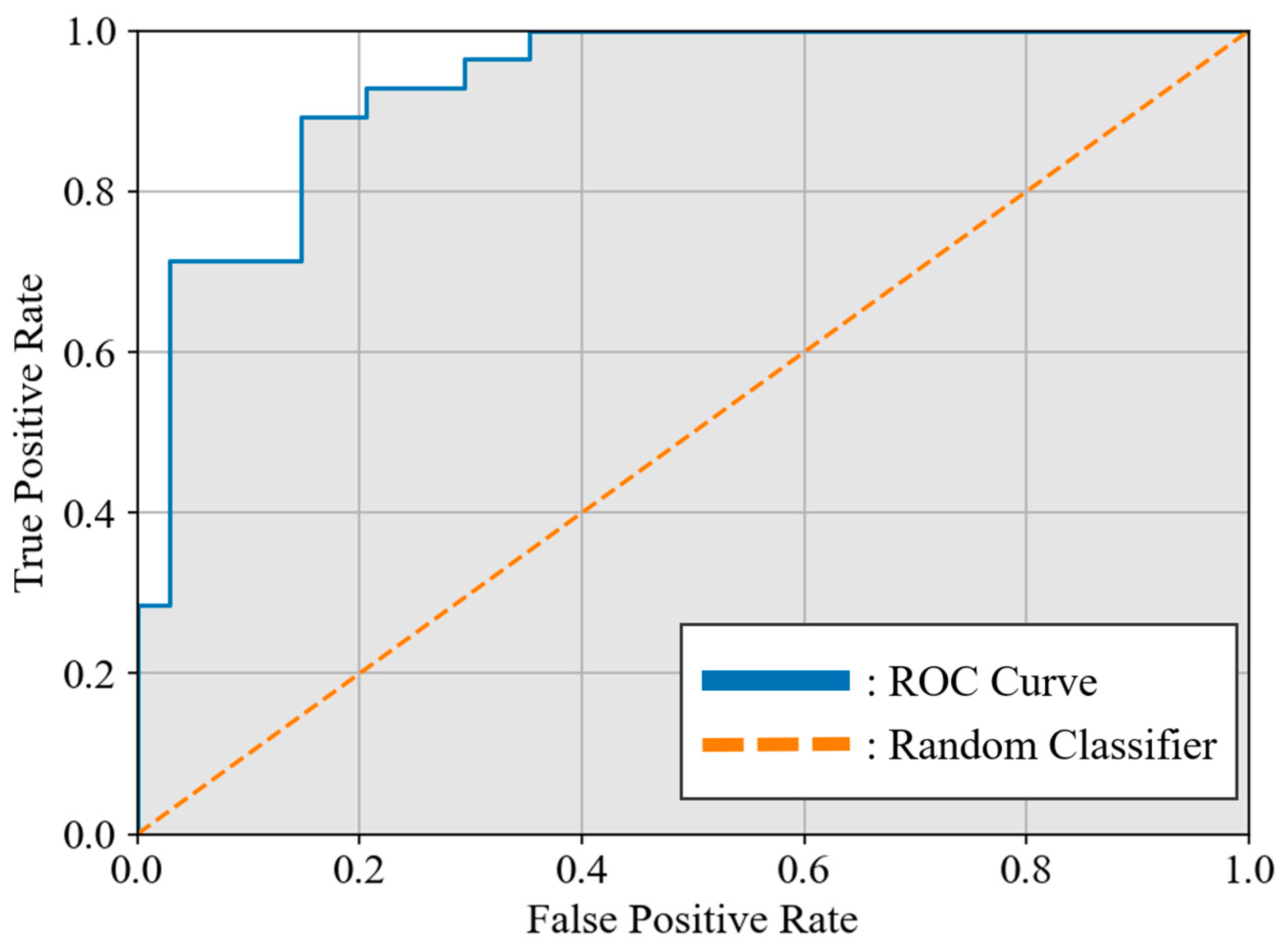
To quantitatively evaluate the classification performance at the optimal rotation angle of 70°, we analyzed the receiver operating characteristic (ROC) curve. Figure 8 shows the ROC curve derived under the 70° rotation angle condition utilizing EfficientNet-B0. The ROC curve shows a shape close to the upper left area, which means that it maintains a high true positive rate (TPR) even at a low false positive rate (FPR). This means that the model has a low probability of misclassifying normal modules while accurately detecting most defective modules. In addition, the area under the curve (AUC) value, which indicates the area under the ROC curve, was 0.9538, which means that the classification model has high classification performance regardless of the data ratio by class.

3.4. Sensitivity Analysis of Classification Threshold

In this study, PV module defect detection uses binary classification, applying a threshold based on the sigmoid output probability of EfficientNet-B0 to determine whether a module is normal or defective. While a threshold of 0.5 is commonly used, the dataset in this study consists of imbalanced data with an uneven distribution of normal and defective data. Because the majority class dominates in imbalanced data, fixing the threshold to 0.5 could result in the model frequently predicting the majority class, potentially compromising defect detection performance. Therefore, this study conducts a sensitivity analysis to examine performance changes as the threshold is varied.
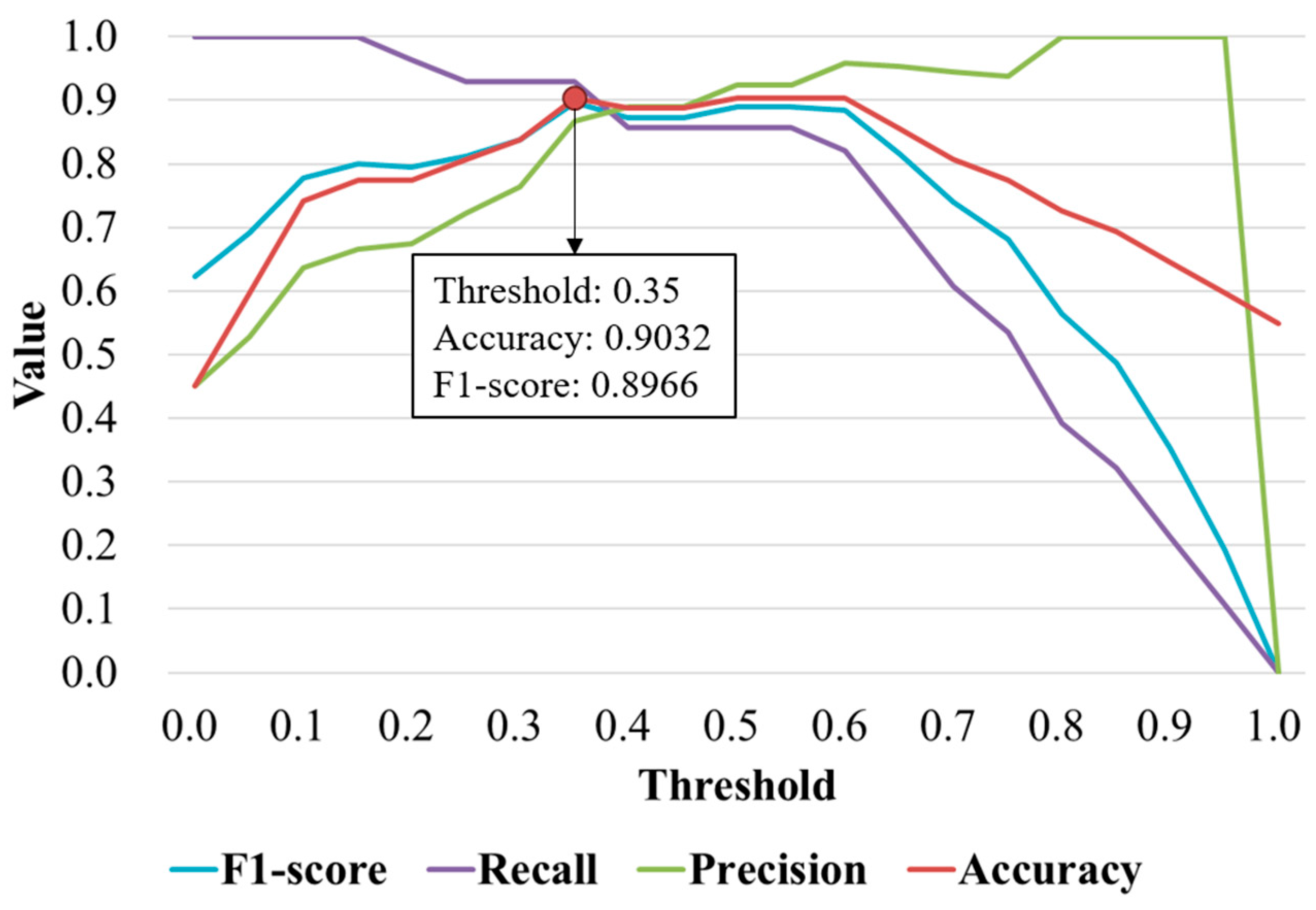
Figure 9 shows the performance indicator trends for each threshold, varying the threshold-old in 0.05 intervals for the sigmoid output probability of the trained EfficientNet-B0. Lower thresholds increase the proportion of defective models, leading to higher recall. However, higher false positives (FPs) lead to lower precision. Conversely, higher thresholds lead to more conservative defective model judgments, leading to higher precision. However, higher false negatives (FNs), which are cases where actual defective models are classified as normal, lead to lower recall. Thresholds induce trade-offs between precision and recall, and in imbalanced data environments, this balance point influences optimal model performance. In this study, we define the optimal threshold ( θ ) as shown in Equation (11) to reduce the bias of a single metric and reflect the overall classification performance balance.
S c o r e ( θ ) = A c c u r a c y ( θ ) + F 1   s c o r e ( θ ) 2
where A c c u r a c y ( θ ) represents the classification accuracy ratio, and F 1   s c o r e ( θ ) reflects the balance between precision and recall, representing the overall performance of defect detection.
S c o r e ( θ ) is defined based on accuracy and the F1-score for θ selection, and θ is chosen at the operating point that maximizes S c o r e ( θ ) . As the threshold directly shifts the decision boundary for the sigmoid probability, each curve shows different trends. Accuracy changes as the balance between FP and FN changes, depending on θ . In this dataset, accuracy is maximized when θ is around 0.35 because FP and FN are relatively balanced, and then it decreases as θ increases due to the increase in FN. In addition, when θ is 0, almost all samples are predicted as defective, so FN rarely occurs. As θ approaches 1.0, almost no samples are predicted as defective, so TP decreases, FN increases, and recall converges to 0. Precision generally tends to increase as θ increases because defect judgment becomes stricter. However, when θ is 1.0, the number of predicted defects becomes 0, causing the curve to drop sharply to 0. The F1-score is maximum at the point where the balance between precision and recall is the best, but as θ increases, the number of cases classified as defective decreases, so recall decreases and tends to approach 0. Therefore, at θ of 0.35, the accuracy is 0.9032, and the F1-score is 0.8966, demonstrating a higher F1-score than the commonly used threshold of 0.5. Therefore, a threshold of 0.35 is adopted as the optimal classification criterion.

4. Conclusions

This study selects EfficientNet-B0, the baseline model of the EfficientNet series, as the CNN architecture for classifying defective images of PV modules in the EL operation. EfficientNet-B0 employs a hybrid model scaling strategy that simultaneously expands network depth, channel width, and input resolution. It is designed with a lightweight architecture that includes MBConv and SE modules. Compared with existing CNN-based algorithms (e.g., VGG, ResNet, and GoogLeNet), it achieves high expressiveness with fewer parameters and FLOPs. These advantages of EfficientNet-B0 allow it to effectively limit the computational load and model size while maintaining high-resolution inputs for detecting small defects, such as microcracks or black spots, on PV modules during the EL process. Furthermore, to address the class imbalance between normal and defective PV module images, this study uses ImageNet pretrained weights as initial values and applies data augmentation and hierarchical segmentation strategies in parallel to stabilize representation learning for defective classes and mitigate overfitting. Experimental results show that DenseNet121 achieves the highest classification accuracy (FLOPs (5.7004 G) and inference time (78.13 milliseconds per image). However, the EfficientNet-B0 method proposed in this study shows superior computational efficiency with a 41.4% reduction in the number of parameters, an 86.0% reduction in FLOPs, and a 38.8% reduction in inference time compared with DenseNet121, while showing similar accuracy to DenseNet121 and ResNet50, making it more suitable for the EL process that produces a large number of PV modules. In particular, EfficientNet-B0 has the advantage of being easy to deploy on industrial PCs or GPUs due to its small model size, making it a suitable model for application to actual PV module EL inspection equipment and production lines that utilize machine vision.
However, this study has several limitations. Because of the class imbalance between defect data and normal parts, more defect data collection is necessary to overcome this. Although this study attempted to stabilize representation learning for defect classes by applying data augmentation and hierarchical segmentation strategies in parallel, continued efforts are needed to collect more data, as higher-performance models are possible with more data. In addition, since cross-validation using external datasets was not conducted, further verification is required to establish the proposed approach as a generalized algorithm. Accordingly, future work will focus on collecting additional external datasets and deploying the system across different PV module manufacturing facilities to enhance generalizability. Furthermore, this study simplified the defect categories by considering multiple defect types as a single defective class in a binary classification setting. Future work will investigate multi-class defect classification, allowing more precise identification of defect types.

Author Contributions

Conceptualization, M.S., I.-B.L. and S.K.; methodology, M.S., I.-B.L., J.S. and S.K.; software, M.S., J.S. and S.K.; validation, M.S., J.S. and S.K.; formal analysis, M.S., J.S. and S.K.; investigation, M.S., J.S. and S.K.; resources, I.-B.L. and S.K.; writing—original draft, M.S., I.-B.L., J.S., and S.K.; writing—review and editing, M.S., I.-B.L., J.S. and S.K.; visualization, M.S. and J.S.; funding acquisition, S.K.; supervision, S.K. All authors have read and agreed to the published version of the manuscript.

Funding

This work was supported by a Basic Science Research Program through the National Research Foundation of Korea (NRF), funded by the Ministry of Education (No. RS-2023–00239448).

Institutional Review Board Statement

Not applicable.

Informed Consent Statement

Not applicable.

Data Availability Statement

The original contributions presented in the study are included in the article; further inquiries can be directed to the corresponding author.

Acknowledgments

The authors gratefully acknowledge the support of the National Research Foundation of Korea (NRF) and the Ministry of Education. The views expressed in this paper are solely those of the authors and do not represent the opinions of the funding agency.

Conflicts of Interest

The authors declare no conflicts of interest.

References

  1. Malamas, E.N.; Petrakis, E.G.; Zervakis, M.; Petit, L.; Legat, J.-D. A survey on industrial vision systems, applications and tools. Image Vis. Comput. 2003, 21, 171–188. [Google Scholar] [CrossRef]
  2. Reichenstein, T.; Raffin, T.; Sand, C.; Franke, J. Implementation of machine vision based quality inspection in production: An approach for the accelerated execution of case studies. Procedia CIRP 2022, 112, 596–601. [Google Scholar] [CrossRef]
  3. Ren, Z.; Fang, F.; Yan, N.; Wu, Y. State of the art in defect detection based on machine vision. Int. J. Precis. Eng. Manuf. Green Technol. 2022, 9, 661–691. [Google Scholar] [CrossRef]
  4. Mordor Intelligence, Machine Vision Systems (MVS) Market Size and Share Analysis—Growth Trends and Forecast (2026–2030). Available online: https://www.mordorintelligence.com/industry-reports/machine-vision-systems-market (accessed on 30 October 2025).
  5. Gray, J.L. The physics of the solar cell. Handb. Photovolt. Sci. Eng. 2011, 2, 82–128. [Google Scholar]
  6. Lee, I.-B.; Kim, Y.; Kim, S. A Data-Driven Machine Vision Framework for Quality Management in Photovoltaic Module Manufacturing. Machines 2025, 13, 285. [Google Scholar] [CrossRef]
  7. International Energy Agency (IEA). Energy Technology Perspectives 2024. Available online: https://www.iea.org/reports/energy-technology-perspectives-2024 (accessed on 30 October 2025).
  8. Pavlík, M.; Beňa, L.U.; Medved’, D.; Čonka, Z.; Kolcun, M. Analysis and evaluation of photovoltaic cell defects and their impact on electricity generation. Energies 2023, 16, 2576. [Google Scholar] [CrossRef]
  9. Benda, V.; Cerna, L. A note on limits and trends in PV cells and modules. Appl. Sci. 2022, 12, 3363. [Google Scholar] [CrossRef]
  10. Ding, H.; Zhou, D.; Liu, G.; Zhou, P. Cost reduction or electricity penetration: Government R&D-induced PV development and future policy schemes. Renew. Sustain. Energy Rev. 2020, 124, 109752. [Google Scholar]
  11. Wu, C.-Y.; Mathews, J.A. Knowledge flows in the solar photovoltaic industry: Insights from patenting by Taiwan, Korea, and China. Res. Policy 2012, 41, 524–540. [Google Scholar] [CrossRef]
  12. Choi, H.; Anadón, L.D. The role of the complementary sector and its relationship with network formation and government policies in emerging sectors: The case of solar photovoltaics between 2001 and 2009. Technol. Forecast. Soc. Change 2014, 82, 80–94. [Google Scholar] [CrossRef]
  13. Tan, M.; Le, Q. Efficientnet: Rethinking model scaling for convolutional neural networks. In Proceedings of the International Conference on Machine Learning (ICML), Long Beach, CA, USA, 9–15 June 2019. [Google Scholar]
  14. Haney, J.; Burstein, A. PV System Operations and Maintenance Fundamentals. Solar America Board for Codes and Standards. 2013. Available online: https://www.secondenergy.me/wp-content/uploads/2021/03/SolarABCs-35-2013-3.pdf (accessed on 20 January 2026).
  15. Munoz, M.; Alonso-García, M.d.C.; Vela, N.; Chenlo, F. Early degradation of silicon PV modules and guaranty conditions. Sol. Energy 2011, 85, 2264–2274. [Google Scholar] [CrossRef]
  16. Borgers, T.; Voroshazi, E.; Govaerts, J.; Szlufcik, J.; Poortmans, J. Multi-wire interconnection technologies weaving the way for back contact and bifacial PV modules. In Proceedings of the 2016 IEEE 43rd Photovoltaic Specialists Conference (PVSC), Portland, OR, USA, 5–10 June 2016. [Google Scholar]
  17. Al-Refaie, A. Optimizing the performance of the tapping and stringing process for photovoltaic panel production. Int. J. Manag. Sci. Eng. Manag. 2015, 10, 165–175. [Google Scholar] [CrossRef]
  18. Hassan, S.; Dhimish, M. Broad-scale Electroluminescence analysis of 5 million+ photovoltaic cells for defect detection and degradation assessment. Renew. Energy 2024, 237, 121868. [Google Scholar] [CrossRef]
  19. AbouJieb, Y.; Hossain, E. Solar System Components. In Photovoltaic Systems; Springer: Cham, Switzerland, 2022; pp. 95–192. [Google Scholar]
  20. Pratt, L.; Govender, D.; Klein, R. Defect detection and quantification in electroluminescence images of solar PV modules using U-net semantic segmentation. Renew. Energy 2021, 178, 1211–1222. [Google Scholar] [CrossRef]
  21. Acikgoz, H.; Korkmaz, D.; Budak, U. Photovoltaic cell defect classification based on integration of residual-inception network and spatial pyramid pooling in electroluminescence images. Expert Syst. Appl. 2023, 229, 120546. [Google Scholar] [CrossRef]
  22. Jia, Y.; Chen, G.; Zhao, L. Defect detection of photovoltaic modules based on improved VarifocalNet. Sci. Rep. 2024, 14, 15170. [Google Scholar] [CrossRef]
  23. Park, S.; Han, C. Analysis of EL images on Si solar module under thermal cycling. J. Mech. Sci. Technol. 2022, 36, 3429–3436. [Google Scholar] [CrossRef]
  24. Raza, R.; Zulfiqar, F.; Khan, M.O.; Arif, M.; Alvi, A.; Iftikhar, M.A.; Alam, T. Lung-EffNet: Lung cancer classification using EfficientNet from CT-scan images. Eng. Appl. Artif. Intell. 2023, 126, 106902. [Google Scholar] [CrossRef]
  25. Liu, Q.; Liu, M.; Wang, C.; Wu, Q.J. An efficient CNN-based detector for photovoltaic module cells defect detection in electroluminescence images. Sol. Energy 2024, 267, 112245. [Google Scholar] [CrossRef]
  26. Joshua, S.R.; Palilingan, K.Y.; Lengkong, S.P.; Park, S. Deep Learning-Driven Solar Fault Detection in Solar–Hydrogen AIoT Systems: Implementing CNN VGG16, ResNet-50, DenseNet121, and EfficientNetB0 in a University-Based Framework. Hydrogen 2025, 7, 1. [Google Scholar] [CrossRef]
  27. Tiwari, K.K.; Singh, A.; Kumar, S. A Comprehensive Analysis of CNN-Based Deep Learning Models: Evaluating the Impact of Transfer Learning on Model Accuracy. In Proceedings of the 2025 2nd International Conference on Computational Intelligence, Communication Technology and Networking (CICTN), Ghaziabad, India, 6–7 February 2025. [Google Scholar]
  28. Ali, H.; Shifa, N.; Benlamri, R.; Farooque, A.A.; Yaqub, R. A fine tuned EfficientNet-B0 convolutional neural network for accurate and efficient classification of apple leaf diseases. Sci. Rep. 2025, 15, 25732. [Google Scholar] [CrossRef] [PubMed]
  29. Mochizuki, T.; Kim, C.; Yoshita, M.; Mitchell, J.; Lin, Z.; Chen, S.; Takato, H.; Kanemitsu, Y.; Akiyama, H. Solar-cell radiance standard for absolute electroluminescence measurements and open-circuit voltage mapping of silicon solar modules. J. Appl. Phys. 2016, 119, 034501. [Google Scholar] [CrossRef]
  30. Aman, R.; Rizwan, M.; Kumar, A. Fault classification using deep learning based model and impact of dust accumulation on solar photovoltaic modules. Energy Sources Part A 2023, 45, 4633–4651. [Google Scholar] [CrossRef]
  31. Abdelsattar, M.; AbdelMoety, A.; Emad-Eldeen, A. ResNet-based image processing approach for precise detection of cracks in photovoltaic panels. Sci. Rep. 2025, 15, 24356. [Google Scholar] [CrossRef]
  32. Lakshmi, P.S.; Rayudu, M.S.; Bapuji, K. IoT based Fault Detection in Dusty Solar Panels using Modified DenseNet121. In Proceedings of the 2024 Fourth International Conference on Advances in Electrical, Computing, Communication and Sustainable Technologies (ICAECT), Bhilai, India, 11–12 January 2024. [Google Scholar]
  33. Al-Otum, H.M. Classification of anomalies in electroluminescence images of solar PV modules using CNN-based deep learning. Sol. Energy 2024, 278, 112803. [Google Scholar] [CrossRef]
  34. Mechanical Engineering Industry Association, International Technology Roadmap for Photovoltaics. 2023. Available online: https://www.qualenergia.it/wp-content/uploads/2024/06/ITRPV-15th-Edition-2024-2.pdf (accessed on 6 February 2026).
Figure 1. Machine vision framework for PV manufacturing [6].
Machines 14 00232 g001
Figure 2. Machine vision installation examples [6].
Machines 14 00232 g002
Figure 3. Defect types and normal images of PV modules are considered in this study.
Machines 14 00232 g003
Figure 4. Proposed machine vision approach with EfficientNet-B0 for defective photovoltaic module detection.
Machines 14 00232 g004
Figure 5. Process of pointwise convolution.
Machines 14 00232 g005
Figure 6. Process of depthwise convolution.
Machines 14 00232 g006
Figure 7. Heatmaps for misclassified samples: (a) original EL image with defects, (b) heatmap of the final convolution layer.
Machines 14 00232 g007
Figure 8. ROC curve of EfficietNet-B0.
Machines 14 00232 g008
Figure 9. Performance indicator trends under different classification threshold values.
Machines 14 00232 g009
Table 1. Dataset composition by photographing angle for the PV module.
Photographing Angle (°)Number of Images
NormalAbnormal
0168140
10168140
20168140
30168140
40168140
50168140
60168140
70168140
80168140
Total15121260
Table 2. Detection performance using different types of algorithms.
Detection AlgorithmEvaluation Metrics
AccuracyPrecisionRecallF1-Score
AlexNet0.61290.70000.25000.3684
ResNet500.80650.86360.67860.7600
DenseNet1210.83870.87500.75000.8077
GoogLeNet0.74190.71430.71430.7143
Efficient-B0 0.79030.80000.71430.7547
Table 3. Complexity and efficiency comparison of algorithms.
Detection AlgorithmModel Complexity and Efficiency
Parameters (M)FLOPs (G)Inference Time
(Millisecond/Image)
Peak Memory
Usage (MB)
Frames per Second (FPS)
AlexNet71.92.534123.394048.0642.8
ResNet5023.67.751289.091336.6211.2
DenseNet1217.05.700478.131810.2312.8
GoogLeNet21.85.693482.291530.0712.2
EfficientNet-B04.10.800847.851005.3828.9
Table 4. Detection performance under different rotation angles.
PV Module
Rotation Angle (°)
Evaluation Metrics
AccuracyPrecisionRecallF1-Score
00.79030.80000.71430.7547
100.87101.00000.71430.8333
200.88710.95650.78570.8627
300.77420.75000.75000.7500
400.83870.95000.67860.7917
500.82260.79310.82140.8070
600.80650.76670.82140.7931
700.90320.92310.85710.8889
800.79030.89470.60710.7234
Table 5. Confusion matrix at 70° rotation angle.
CategoryEstimated Values
TrueFalse
Observed valuesTrue322
False424
Disclaimer/Publisher’s Note: The statements, opinions and data contained in all publications are solely those of the individual author(s) and contributor(s) and not of MDPI and/or the editor(s). MDPI and/or the editor(s) disclaim responsibility for any injury to people or property resulting from any ideas, methods, instructions or products referred to in the content.