1. Introduction
The aviation industry plays a pivotal role in global transportation, connecting economies and facilitating international commerce. With the continuous growth in air traffic—global passenger numbers reached approximately 4.7 billion in 2024, representing a full recovery to pre-pandemic levels [
1]—ensuring the safety and reliability of aircraft systems has become increasingly critical. Among the most safety-critical components of commercial aircraft, turbofan engines demand particular attention due to their complex operational dynamics and the catastrophic consequences associated with in-flight failures [
2,
3].
Predictive maintenance (PdM) has emerged as a transformative paradigm in the aviation industry, fundamentally shifting maintenance strategies from reactive and scheduled approaches toward data-driven, condition-based methodologies [
4,
5]. Unlike traditional maintenance practices that rely on fixed time intervals or post-failure interventions, PdM leverages real-time sensor data, historical operational records, and advanced analytics to anticipate equipment degradation and predict failures before they occur [
6,
7]. This proactive approach offers substantial benefits including reduced unplanned downtime, optimized maintenance scheduling, extended component lifespans, and most importantly, enhanced flight safety [
8,
9].
The concept of RUL prediction lies at the heart of prognostics and health management (PHM) systems [
9,
10]. RUL represents the expected operational time remaining before a component or system reaches its failure threshold and requires maintenance intervention. Accurate RUL prediction enables maintenance planners to optimize the timing of interventions, balancing the competing objectives of maximizing asset utilization while minimizing failure risk [
11,
12]. For turbofan engines specifically, where component failures can have severe safety implications, reliable RUL estimation is essential for maintaining airworthiness and operational efficiency [
13,
14].
The NASA Commercial Modular Aero-Propulsion System Simulation (C-MAPSS) dataset has become the de facto benchmark for evaluating RUL prediction algorithms in the turbofan engine domain [
2,
13]. This simulated dataset provides run-to-failure trajectories for multiple engine units operating under various conditions and fault modes, enabling systematic comparison of different prognostic approaches. The dataset comprises four subsets (FD001–FD004) with increasing complexity in terms of operational conditions and fault types, offering a comprehensive testbed for algorithm development and validation [
15].
Recent years have witnessed remarkable advances in data-driven approaches for RUL prediction, particularly through the application of deep learning techniques [
16,
17]. Long Short-Term Memory (LSTM) networks have demonstrated exceptional capability in capturing temporal dependencies within sequential sensor data [
18,
19]. Convolutional Neural Networks (CNNs) have been successfully employed for automatic feature extraction from raw sensor signals [
17,
20]. Hybrid architectures combining CNNs and LSTMs have shown improved performance by leveraging both spatial feature extraction and temporal modeling capabilities [
21,
22]. Attention mechanisms have further enhanced these models by enabling selective focus on the most relevant temporal patterns [
23,
24]. Transformer-based architectures have recently been explored for RUL prediction, demonstrating competitive performance through self-attention mechanisms [
25,
26]. Contemporary developments have further expanded these capabilities through hybrid approaches integrating large-kernel convolutions with Markov transition modeling [
27], change point detection for operational condition variations [
28], and comprehensive reviews of machine learning-based predictive maintenance methodologies [
29], unsupervised autoencoder–GMM frameworks [
30], multi-scale dilated fusion attention models [
31], and dual-attention mechanisms for power machinery [
32].
Despite the impressive results achieved by deep learning methods, they present several limitations that motivate the exploration of alternative approaches. Deep neural networks typically require large volumes of training data to achieve optimal performance—a requirement that may not be satisfied in practical scenarios where failure events are rare [
33,
34]. The black-box nature of deep learning models poses challenges for interpretability and trust in safety-critical applications [
35,
36]. Furthermore, these models often lack the ability to incorporate physical knowledge about degradation processes, potentially limiting their extrapolation capabilities [
13,
37].
To address these challenges, Kalman filtering techniques have emerged as a compelling alternative offering theoretical advantages across multiple dimensions. Unlike autoregressive models that treat observations independently with fixed coefficients, Kalman filters provide optimal recursive state estimation through dynamic adjustment based on measurement uncertainty [
38]. For nonlinear degradation processes, the Extended Kalman Filter (EKF) employs first-order Taylor-series linearization [
39], while the Unscented Kalman Filter (UKF) uses deterministic sigma point sampling for improved accuracy [
40]. These methods have been successfully applied to RUL prediction in lithium-ion batteries [
41,
42,
43], rolling bearings [
44,
45,
46], and aircraft components [
47,
48].
When integrated with Linear Discriminant Analysis (LDA)-based dimensionality reduction, three synergistic benefits emerge for turbofan engine prognostics. First, computational efficiency: LDA projection from 21 sensors to 2 discriminant components enables O(
) Kalman operations with approximately
speedup compared to the original sensor space, facilitating real-time embedded implementation [
47,
48]. Second, enhanced robustness: the supervised LDA projection [
49,
50] concentrates discriminative signals into low-dimensional subspace while distributing sensor-specific noise across discarded dimensions—preventing misinterpretation of operational variability as degradation. Third, unified interpretability: hyperplane boundaries in LDA space [
51,
52] provide natural thresholds for multi-class health-state classification (nominal, warning, critical), while signed distances enable direct RUL regression. This geometrically meaningful representation, where degradation trajectories exhibit clear progression toward failure boundaries, enables simultaneous classification and regression with uncertainty quantification through covariance matrices—capabilities demonstrating effective for machinery fault diagnosis and condition monitoring [
53,
54,
55].
Despite these advantages, Kalman filtering in discriminant subspaces remains underexplored for turbofan prognostics. Existing studies have combined Kalman filters with data-driven models [
56,
57], but direct application in LDA-projected spaces specifically designed for degradation monitoring represents a significant opportunity to leverage optimal state estimation where class separability is maximized.
Building upon the previous work of Yıldırım et al. [
58], which proposed a unified linear classification–regression framework using LDA-based hyperplane boundaries, this study extends the methodology by incorporating Kalman filtering for improved state estimation. While [
58] achieved RMSE values of 30.40–45.80 cycles across C-MAPSS sub-datasets through autoregressive modeling, that approach exhibited two key limitations: (1) sensitivity to measurement noise during transitional degradation phases, and (2) fixed coefficients unable to adapt to varying degradation rates. The present work addresses these limitations by replacing the regression component with optimal state-space estimation, providing adaptive noise filtering and dynamic parameter estimation while retaining the effective LDA-based dimensionality reduction and boundary-based classification.
The key novelty lies in integrating Kalman filtering within an LDA-projected discriminant subspace. Unlike conventional Kalman-based prognostics operating in high-dimensional sensor spaces [
47,
48] or physics-derived feature spaces [
59], our method performs state estimation in a subspace where degradation trajectories align with maximum class separability. While LDA has been used for fault diagnosis [
51,
52,
53,
54,
55], combining it with recursive state estimation for continuous RUL prediction enables unified classification and regression within a single framework. Compared to deep learning approaches [
17,
18,
19,
20,
21,
22,
23,
24], our method provides natural uncertainty quantification through Kalman covariances and interpretability through linear projection weights—capabilities requiring additional modifications (MC dropout, ensembles) in neural networks.
The main contributions of this work are summarized as follows:
A novel framework that integrates Linear Discriminant Analysis with Kalman filtering for turbofan engine RUL prediction, enabling simultaneous state estimation and boundary-based classification in a reduced-dimensional discriminant space.
A comprehensive comparative analysis of three Kalman filter variants (LKF, EKF, UKF) against an AR baseline, providing insights into the trade-offs between prediction accuracy and computational complexity.
Empirical validation on the NASA C-MAPSS benchmark dataset demonstrating that Kalman filter methods achieve RMSE improvements ranging from 2.4% (LKF) to 7.1% (UKF) and Score improvements ranging from 36.1% (EKF) to 54.9% (UKF) compared to the AR baseline.
Analysis of the bias characteristics of different estimation methods, revealing that EKF provides nearly unbiased predictions while UKF exhibits conservative bias suitable for safety-critical applications.
The remainder of this paper is organized as follows.
Section 2 presents the materials and methods, including the problem formulation, LDA-based feature extraction, and detailed descriptions of the Kalman filter variants.
Section 3 presents the experimental results and comparative analysis.
Section 4 concludes the paper with a summary of contributions and directions for future research.
2. Materials and Methods
2.1. Problem Definition
This study considers turbofan engines monitored by D sensors, where . Let denote the vector of sensor readings at any given time. These sensors measure physical quantities such as temperature, pressure, and rotational speed at various engine cross-sections.
The predictive maintenance problem involves two interconnected objectives:
Firstly, classification objective: Partition the measurement space into three disjoint regions:
Nominal region : Represents healthy operational states.
Warning region : Indicates degradation onset.
Critical region : Requires immediate maintenance action.
These regions satisfy
and are mutually exclusive. The classification function is defined as
Secondly, regression objective: Given a sequence of sensor readings
with current state
, estimate the RUL:
In the presented framework, these regions are defined using hyperplane boundaries in LDA space. Let
and
define two hyperplanes that partition the space:
The signed distances to these hyperplanes serve as features for RUL estimation:
These distances provide a natural connection between classification boundaries and continuous degradation estimation, ensuring consistency between discrete state classification and continuous RUL prediction.
2.2. Linear Discriminant Analysis for Degradation Feature Extraction
Linear Discriminant Analysis (LDA) provides a principled approach for dimensionality reduction that maximizes class separability [
49,
50]. By projecting high-dimensional sensor data onto a lower-dimensional subspace that maximizes the ratio of between-class scatter to within-class scatter, LDA creates a feature space where different operational states are optimally distinguishable [
51,
52]. This property is particularly valuable for degradation monitoring, where the goal is to track the progression from healthy to degraded states. Recent studies have demonstrated the effectiveness of LDA-based feature extraction for machinery fault diagnosis [
53,
54] and condition monitoring [
55].
The LDA is employed to project the high-dimensional sensor measurements onto a lower-dimensional subspace that maximizes class separability. This projection serves two purposes: dimensionality reduction and enhanced discrimination between operational states.
2.2.1. Health Index-Based Class Definition
Unlike fixed-cycle thresholds commonly used in the literature, this study employs a normalized health index approach for class definition. The health index (HI) is computed by normalizing the RUL values with respect to the maximum observed lifetime across the dataset:
where
represents the maximum RUL observed across all training and test engine units. This normalization maps all RUL values to the interval
, where
indicates a healthy engine at the beginning of its operational life and
corresponds to failure.
The continuous health index is then discretized into
classes using predefined thresholds:
This health index-based classification partitions the operational space into three distinct regions:
Critical region (): —Engines approaching imminent critical failure requiring immediate maintenance intervention.
Warning region (): —Degraded engines requiring increased monitoring and maintenance planning.
Healthy region (): —Engines operating within normal parameters.
The advantage of this normalized approach over fixed-cycle thresholds is that it inherently adapts to varying engine lifetimes across the dataset, providing consistent classification boundaries regardless of the absolute RUL scale.
2.2.2. LDA Formulation
Let
denote the training set where
is the sensor measurement vector and
is the class label. The within-class scatter matrix
and between-class scatter matrix
are defined as
where
denotes the set of samples belonging to class
k,
is the number of samples in class
k,
is the mean of class
k, and
is the global mean.
The LDA projection matrix
is obtained by maximizing the Fisher criterion:
The solution is given by the generalized eigenvalue problem:
The projection matrix
consists of the
eigenvectors corresponding to the largest eigenvalues. For the three-class problem, this yields a two-dimensional LDA space.
2.2.3. Projection to LDA Space
Each sensor measurement vector is projected onto the discriminant subspace:
where
represents the coordinates in LDA space. The degradation trajectory
in this reduced space exhibits a systematic progression from the nominal region toward the critical region as the engine degrades.
2.2.4. RUL Estimation in LDA Space
In the LDA-projected space, the RUL can be estimated using the distance to the critical failure boundary. Assuming linear degradation dynamics, the trajectory in LDA space can be modeled as
where
is the degradation rate vector and
represents process noise.
Given the current position
and estimated degradation rate
, the RUL is computed as the time required to reach the critical boundary:
where
is the signed distance to the critical boundary and
is the angle between the degradation direction and the boundary normal. When the trajectory is approximately perpendicular to the boundary, a simplified computation yields
The key advantage of performing RUL estimation in LDA space is that the projection inherently aligns the degradation trajectory with the direction of maximum class separation, making the distance-based RUL estimation more robust to sensor noise and correlated measurements.
2.2.5. Rationale for LDA-Based Projection
The selection of LDA over alternative dimensionality reduction techniques is motivated by three key considerations. First, unlike PCA which maximizes variance irrespective of class structure, LDA’s supervised optimization directly aligns the projection with health-state separability—essential for degradation tracking where operational variations may dominate total variance [
49]. Second, nonlinear methods such as t-SNE and UMAP lack parametric projection functions, preventing real-time application to new test samples and producing stochastic embeddings that compromise reproducibility [
60]. Third, LDA’s linear projection preserves Gaussian noise characteristics, ensuring Kalman filter optimality in the projected space. Additionally, the hyperplane boundaries inherent in LDA enable direct geometric interpretation of distance-to-failure as RUL (Equation (7)), unifying classification and regression within a single framework.
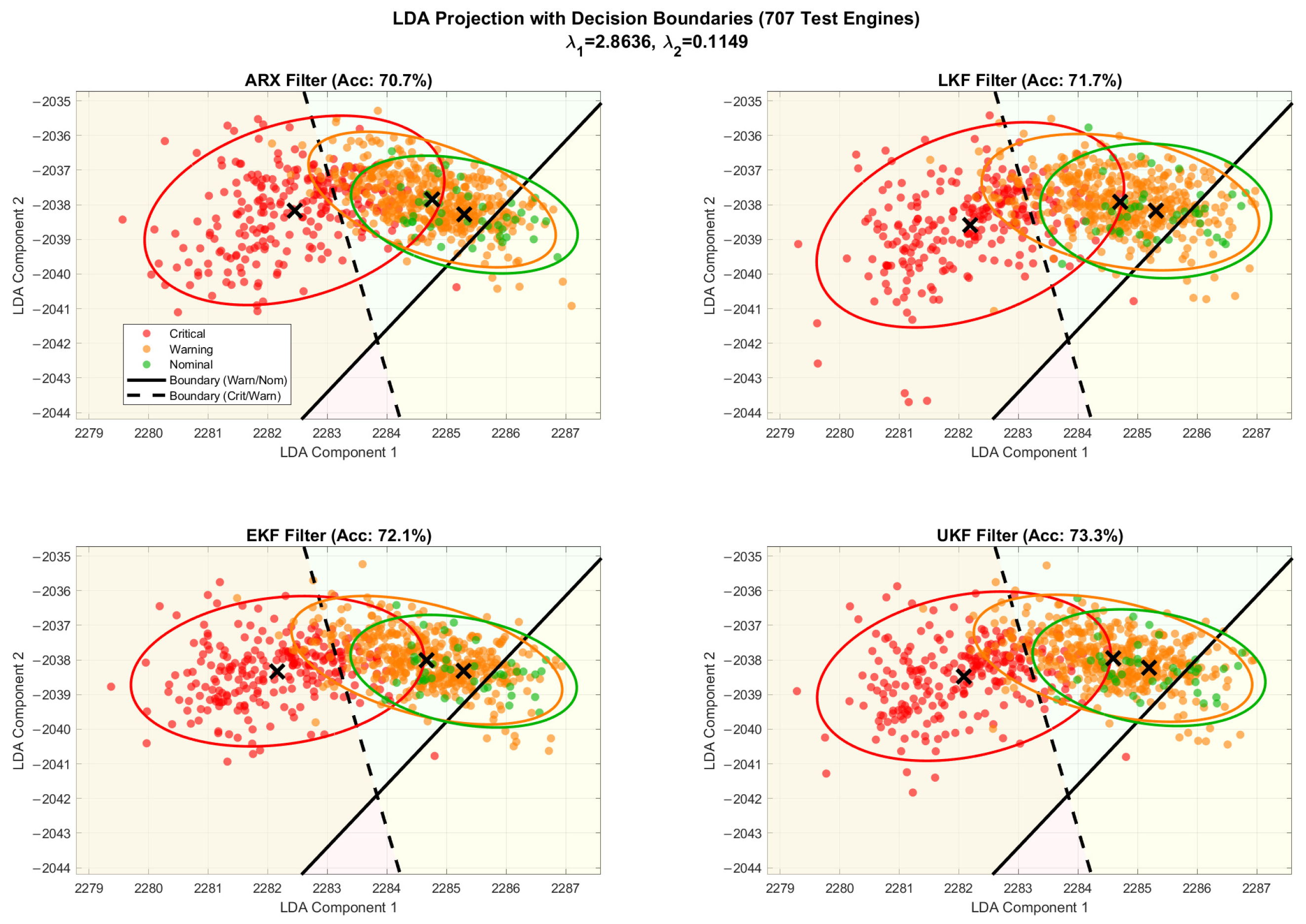
Validity of Linear Separability Assumptions: While degradation processes may exhibit nonlinear characteristics in the original sensor space, the LDA projection empirically yields approximately linear degradation trajectories in the reduced space. As shown in
Figure 1, the near-parallel decision boundaries confirm that degradation paths follow approximately linear trajectories through the discriminant space. This linearization occurs because LDA’s optimization objective inherently straightens class boundaries by maximizing between-class separation.
Robustness to Non-Gaussian Characteristics: The framework addresses potential non-Gaussian deviations through the hybrid LDA–Kalman approach. While LDA performs dimensionality reduction under locally linear assumptions, the nonlinear Kalman filters (EKF, UKF) capture accelerating wear behavior via the exponential degradation model (Equation (
42)). The UKF’s sigma point sampling is particularly effective for non-Gaussian distributions, capturing statistics accurately to second order without requiring explicit Gaussian assumptions [
40]. The consistent performance across all four C-MAPSS sub-datasets—encompassing different operational conditions and fault modes—provides empirical validation that the linear separability assumption holds sufficiently well for practical turbofan engine prognostics.
2.2.6. Advantages of Kalman Filtering in LDA Space
Computational Efficiency: The Kalman filter has complexity per update. In the original sensor space with sensors augmented with velocity states, operations on a 42-dimensional state vector would be required. The LDA projection reduces this to (LKF) or (EKF/UKF), yielding a complexity reduction exceeding and enabling real-time implementation on embedded systems.
Robustness to Noise: In the original sensor space, measurement noise from 21 sensors propagates independently, potentially obscuring degradation trends. The LDA projection concentrates discriminative signal into the low-dimensional subspace while distributing sensor-specific noise across discarded dimensions. The projected noise covariance retains only noise components aligned with discriminant directions, effectively filtering uncorrelated sensor noise.
Geometrical Interpretability: State estimation in the original 21-dimensional space yields filtered values with complex interdependencies lacking intuitive interpretation. In contrast, the two-dimensional LDA state corresponds to positions along maximum health-state separability directions, where the signed distance to critical boundaries (Equation (7)) provides an immediately geometrically interpretable degradation severity measure.
2.3. Linear Kalman Filter
The Linear Kalman Filter (LKF) provides optimal state estimation for linear systems with Gaussian noise. In the context of RUL prediction, LKF is applied to filter the noisy degradation trajectory in LDA space.
2.3.1. State-Space Model
The degradation dynamics in LDA space are modeled as a linear state-space system:
where
is the state vector,
is the observation vector,
is the control input,
is the state transition matrix,
is the control input matrix, and
is the observation matrix. The process noise
and measurement noise
are assumed to be zero-mean Gaussian with covariance matrices
and
, respectively.
2.3.2. Prediction Step
The a priori state estimate and error covariance are computed as
where
denotes the predicted state at time
t given observations up to
, and
is the corresponding error covariance matrix.
2.3.3. Update Step
When a new observation
becomes available, the Kalman gain and posterior estimates are computed:
where
is the Kalman gain that optimally weights the innovation
.
For the constant velocity model in LDA space, the state vector is defined as
where
and
are the LDA coordinates, and
,
are their respective velocities.
The state transition matrix with unit time step (
) is
The observation matrix extracts position components:
The process noise covariance matrix is configured as
where
represents position process noise and
represents velocity process noise.
The measurement noise covariance
is estimated adaptively from the first
observations:
The initial state covariance is set to
2.3.4. Application to RUL Prediction
For degradation modeling in LDA space, the state vector is augmented to include both position and degradation rate:
The filtered state estimate
provides a smoothed trajectory in LDA space, from which the RUL is computed using the distance to the critical boundary as described in Equation (
17).
2.4. Extended Kalman Filter
For nonlinear degradation processes, the Extended Kalman Filter (EKF) employs first-order Taylor-series linearization [
39], while the Unscented Kalman Filter (UKF) uses deterministic sigma point sampling for improved accuracy [
40]. Additionally, the EKF extends the Linear Kalman Filter framework to handle nonlinear state transition and observation models. This is particularly relevant for degradation processes that exhibit nonlinear behavior, such as exponential wear patterns commonly observed in turbofan engines.
2.4.1. Nonlinear State-Space Model
The nonlinear system dynamics are described by
where
and
are nonlinear state transition and observation functions, respectively. The noise terms
and
remain Gaussian.
2.4.2. Linearization via Taylor-Series Expansion
The EKF approximates the nonlinear functions using first-order Taylor-series expansion around the current state estimate. The Jacobian matrices are computed as
where
is the Jacobian of the state transition function and
is the Jacobian of the observation function.
2.4.3. Prediction Step
The a priori state estimate is propagated through the nonlinear function, while the covariance uses the linearized model:
2.4.4. Update Step
The measurement update follows the standard Kalman filter form with the linearized observation model:
2.4.5. Extended Kalman Filter Parameter Configuration
The EKF employs an exponential degradation model with the state vector:
where
is the normalized health index (derived from LDA component 1),
is the degradation rate parameter, and
is the second LDA component.
The nonlinear state transition follows
The Jacobian matrix for linearization is
The process noise covariance matrix is
State constraints are enforced at each iteration:
2.4.6. Degradation Model for RUL Prediction
For turbofan engine degradation, an exponential model captures the accelerating wear behavior:
where
is the degradation rate parameter,
controls the acceleration of degradation, and
is the unit direction vector toward the critical region. The corresponding Jacobian is
The EKF provides improved state estimation when the degradation dynamics deviate from linearity, at the cost of requiring Jacobian computation at each time step.
2.5. Framework Overview
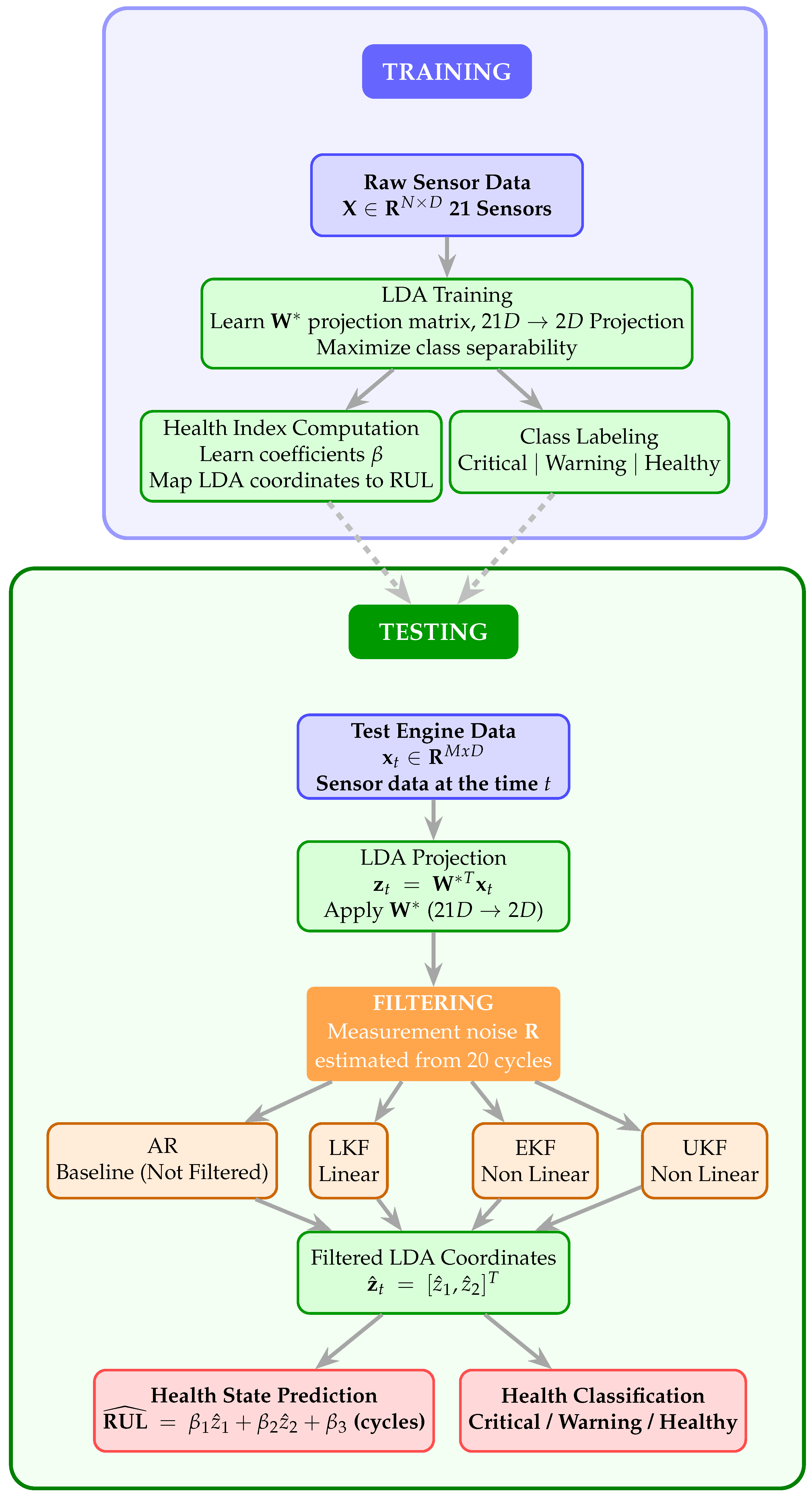
Figure 2 illustrates the complete LDA–Kalman framework for turbofan engine prognostics, consisting of two main phases: training and testing.
During the training phase, raw sensor measurements from run-to-failure engine trajectories are first preprocessed to remove zero-variance sensors that provide no discriminative information. The health index is then computed by normalizing RUL values with respect to the maximum observed lifetime across the dataset. Based on predefined thresholds (0.1 and 0.3), each sample is assigned to one of three health states: Critical, Warning, or Healthy. Linear Discriminant Analysis is applied to learn the optimal projection matrix that maximizes class separability in a two-dimensional discriminant space. Finally, linear regression coefficients are estimated to map LDA coordinates to normalized RUL values.
During the testing phase, sensor measurements from a test engine are projected onto the learned LDA subspace using . Four parallel filtering approaches are then applied to the projected coordinates: the AR model serves as a baseline, while three Kalman filter variants (LKF, EKF, and UKF) provide state-space estimation with different modeling assumptions. The filtered LDA coordinates are used for two simultaneous outputs: RUL prediction through the learned regression model, and health-state classification based on the position relative to class boundaries. This unified framework enables both continuous degradation monitoring and discrete maintenance decision support within a single computationally efficient architecture.
2.6. Unscented Kalman Filter
The Unscented Kalman Filter uses deterministic sigma point sampling to achieve improved accuracy for highly nonlinear systems without requiring explicit calculation of Jacobian matrices [
40]. The method has demonstrated effectiveness across diverse applications in prognostics and health management [
42,
45,
48]. Additionally, UKF addresses the limitations of EKF linearization by using a deterministic sampling approach called the unscented transform. Instead of linearizing the nonlinear functions, UKF propagates a set of carefully chosen sigma points through the true nonlinear model, providing more accurate mean and covariance estimates for highly nonlinear systems.
2.6.1. Sigma Point Generation
For a state vector
with covariance
, a set of
sigma points is generated:
where
denotes the
i-th column of the matrix square root, and
is a scaling parameter typically set as
for Gaussian distributions.
The associated weights for mean and covariance computation are
where
controls the spread of sigma points and
incorporates prior knowledge of the distribution (typically
for Gaussian).
2.6.2. Prediction Step
Each sigma point is propagated through the nonlinear state transition function:
The predicted mean and covariance are computed from the transformed sigma points:
2.6.3. Update Step
The sigma points are transformed through the observation function:
The predicted observation mean, innovation covariance, and cross-covariance are
The Kalman gain and state update are
2.6.4. Unscented Kalman Filter Parameter Configuration
The UKF uses the same state vector and exponential degradation model as EKF but employs sigma point sampling instead of linearization.
The composite scaling parameter:
where
is the state dimension.
The negative mean weight arises from the chosen scaling parameters () and is mathematically valid within the unscented transform framework. While unusual, negative weights do not cause numerical instability when the sigma point spread is appropriately constrained. The key requirement is that the weighted combination of sigma points accurately captures the mean and covariance of the transformed distribution. To mitigate potential numerical issues,
Process Noise Covariance:
Note that the UKF process noise values differ from EKF to account for the sigma point propagation characteristics.
Numerical Stability: To ensure positive definiteness of the covariance matrix, a minimum eigenvalue threshold
is enforced. The Joseph form update is used:
2.6.5. Advantages of Kalman Filter Variants for RUL Prediction
Each Kalman filter variant offers distinct advantages for degradation modeling in the LDA-projected space.
The LKF provides optimal state estimation for linear systems with Gaussian noise, offering theoretical guarantees on estimation accuracy. It is computationally efficient with complexity, making it suitable for real-time implementation on embedded systems. The LKF requires minimal parameter tuning, with only process and measurement noise covariances to be specified, and its constant velocity model effectively captures gradual degradation trends in LDA space.
The EKF accommodates nonlinear degradation dynamics through first-order Taylor-series linearization. The exponential degradation model naturally captures accelerating wear behavior commonly observed in turbofan engines. A key advantage of EKF is its ability to jointly estimate the health index and degradation rate parameter , providing insight into critical failure progression speed while maintaining computational efficiency comparable to LKF.
The UKF eliminates the need for Jacobian computation, simplifying implementation for complex degradation models. The unscented transform captures mean and covariance accurately to at least second order for any nonlinearity, compared to first-order accuracy of EKF. Additionally, the sigma point approach naturally handles asymmetric degradation distributions that may arise near critical boundaries, providing more robust estimation when degradation dynamics deviate significantly from linearity, particularly during rapid state transitions.
The selection among these variants depends on the trade-off between computational complexity and modeling fidelity required for the specific application.
2.6.6. Parameter Selection Methodology
The process noise covariance matrices for all Kalman filter variants were determined through grid search optimization on the training dataset, minimizing RMSE as the objective function. For LKF, the search covered
and
, yielding 25 combinations. For EKF, a two-phase approach tuned
and
first, followed by
. UKF employed identical
Q parameter ranges with sigma point parameters fixed at
,
,
following standard guidelines [
40]. The measurement noise covariance
R was estimated adaptively from the initial 20 observations of each trajectory (Equation (
29)), eliminating manual tuning. Sensitivity analysis showed that varying
by factors of
to
from optimal values resulted in RMSE changes within
, indicating moderate robustness to parameter selection.
3. Results
This section presents the experimental evaluation of the proposed LDA–Kalman framework on the NASA C-MAPSS dataset, comparing four estimation methods: Autoregressive (AR) baseline, Linear Kalman Filter (LKF), Extended Kalman Filter (EKF), and Unscented Kalman Filter (UKF).
3.1. Experimental Setup
The experiments were conducted using all four C-MAPSS sub-datasets (FD001–FD004) combined into a unified framework. The combined dataset comprises 709 training units with 160,359 total samples and 707 test engines. For normalization purposes, the maximum RUL across the dataset was determined to be 554 cycles.
3.1.1. Health Index Classification Thresholds
The health index-based classification partitions the measurement space into three operational regions based on normalized RUL values:
Critical (Class 1): RUL < 55.4 cycles (normalized RUL < 0.1).
Warning (Class 2): 55.4 ≤ RUL < 166.2 cycles (0.1 ≤ normalized RUL < 0.3).
Healthy (Class 3): RUL ≥ 166.2 cycles (normalized RUL ≥ 0.3).
Table 1 presents the training and test data distributions across the three health-state classes.
3.1.2. LDA Projection Parameters
The Linear Discriminant Analysis projection yielded two discriminant components with eigenvalues and , indicating that the first component captures significantly more between-class variance. The LDA coordinate ranges were as follows:
LDA Component 1: [2277.12, 2288.31].
LDA Component 2: [−2049.43, −2034.24].
The normalized RUL regression coefficients in LDA space were determined as .
3.1.3. LDA Space Visualization
Figure 1 presents the two-dimensional LDA projection of all 707 test engines at their final measurement cycle. The visualization displays the spatial distribution of health states (Critical, Warning, Nominal) along with the learned decision boundaries for each filtering method.
The eigenvalue ratio (, ) indicates that the first discriminant component captures 96.1% of the between-class variance, explaining the horizontal arrangement of class centroids along LDA Component 1. The 95% confidence ellipses reveal substantial overlap between adjacent classes, reflecting the continuous nature of the degradation process. Despite this inherent overlap, the UKF achieves the highest classification accuracy (73.3%) by providing robust state estimates that reduce misclassification near decision boundaries. The near-parallel orientation of the two boundaries confirms that degradation trajectories follow approximately linear paths through the discriminant space.
3.1.4. Analysis of Sensor Contributions
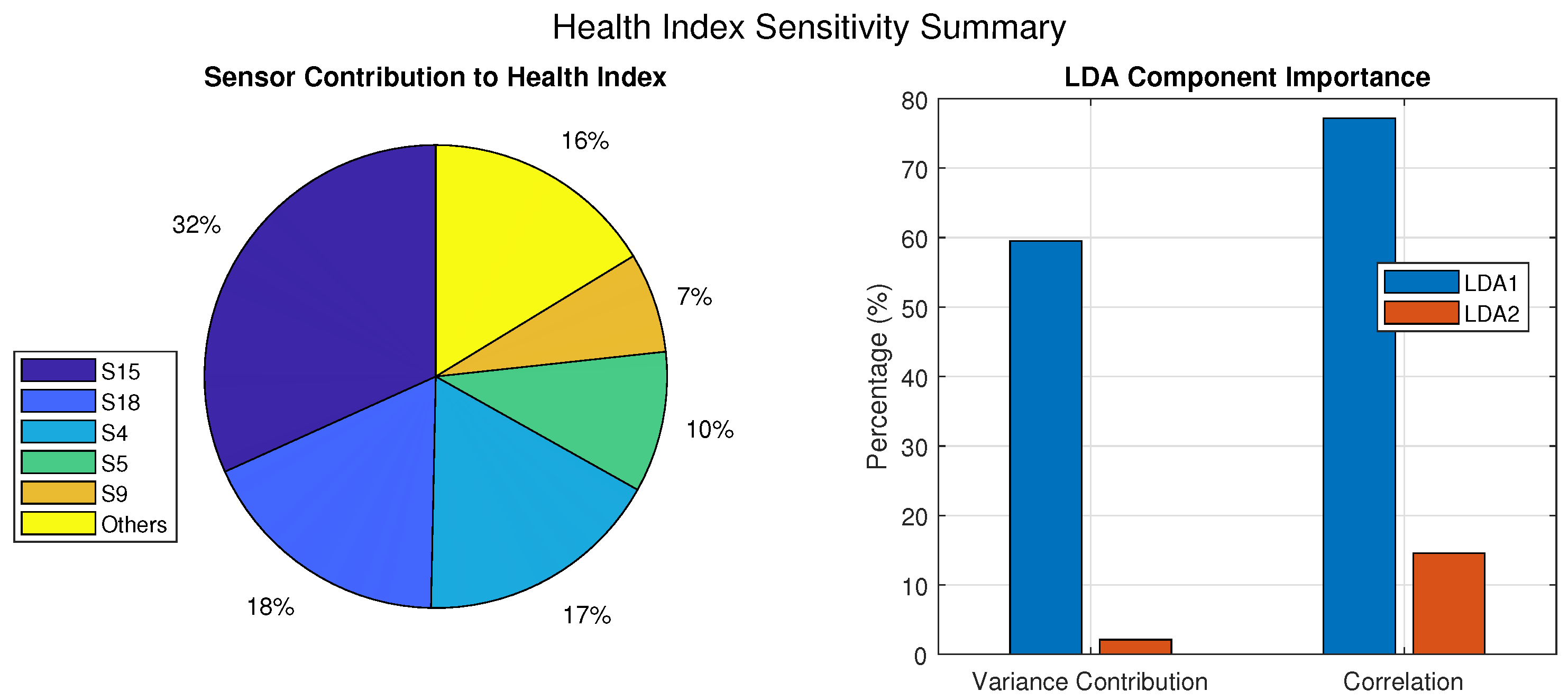
A sensitivity analysis was conducted to identify the most influential sensors contributing to the health index (HI) estimation. As illustrated in
Figure 3 (left), the analysis reveals that five sensors dominate the HI calculation—S15 (32%), S18 (18%), S4 (17%), S5 (10%), and S9 (7%)—collectively accounting for 68% of the total contribution, while the remaining sensors contribute 16%. This finding suggests that monitoring these critical sensors could provide efficient degradation assessment without requiring the full sensor suite. The LDA component analysis (
Figure 3, right) demonstrates that LDA1 is the dominant component, explaining approximately 60% of the HI variance and exhibiting a strong correlation of 78% with the normalized RUL. In contrast, LDA2 contributes minimally to variance (<5%) but maintains a moderate correlation of 15% with RUL, indicating its supplementary role in capturing secondary degradation patterns.
3.2. Performance Metrics
The methods are evaluated using five performance metrics:
3.3. Quantitative Comparison of Proposed Methods
Table 2 summarizes the performance of all four methods on the combined C-MAPSS dataset.
The Extended Kalman Filter achieved the lowest RMSE (36.43 cycles), while the Unscented Kalman Filter achieved the best performance in both the Score metric (552,572) and classification accuracy (73.27%). The UKF’s substantially lower Score value indicates superior performance in avoiding late predictions, which is critical for safety-oriented maintenance scheduling.
Improvement Analysis
Table 3 presents the relative improvement of Kalman filter methods over the AR baseline.
The results demonstrate that while RMSE values remain comparable across all methods, the nonlinear Kalman filter variants (EKF and UKF) achieve substantial improvements in the Score metric. The UKF provides a 54.9% reduction in Score compared to the AR baseline, indicating significantly fewer late predictions that could lead to unexpected failures. The EKF also demonstrates substantial improvement with 36.1% Score reduction while achieving the lowest absolute RMSE.
3.4. Training Data Analysis
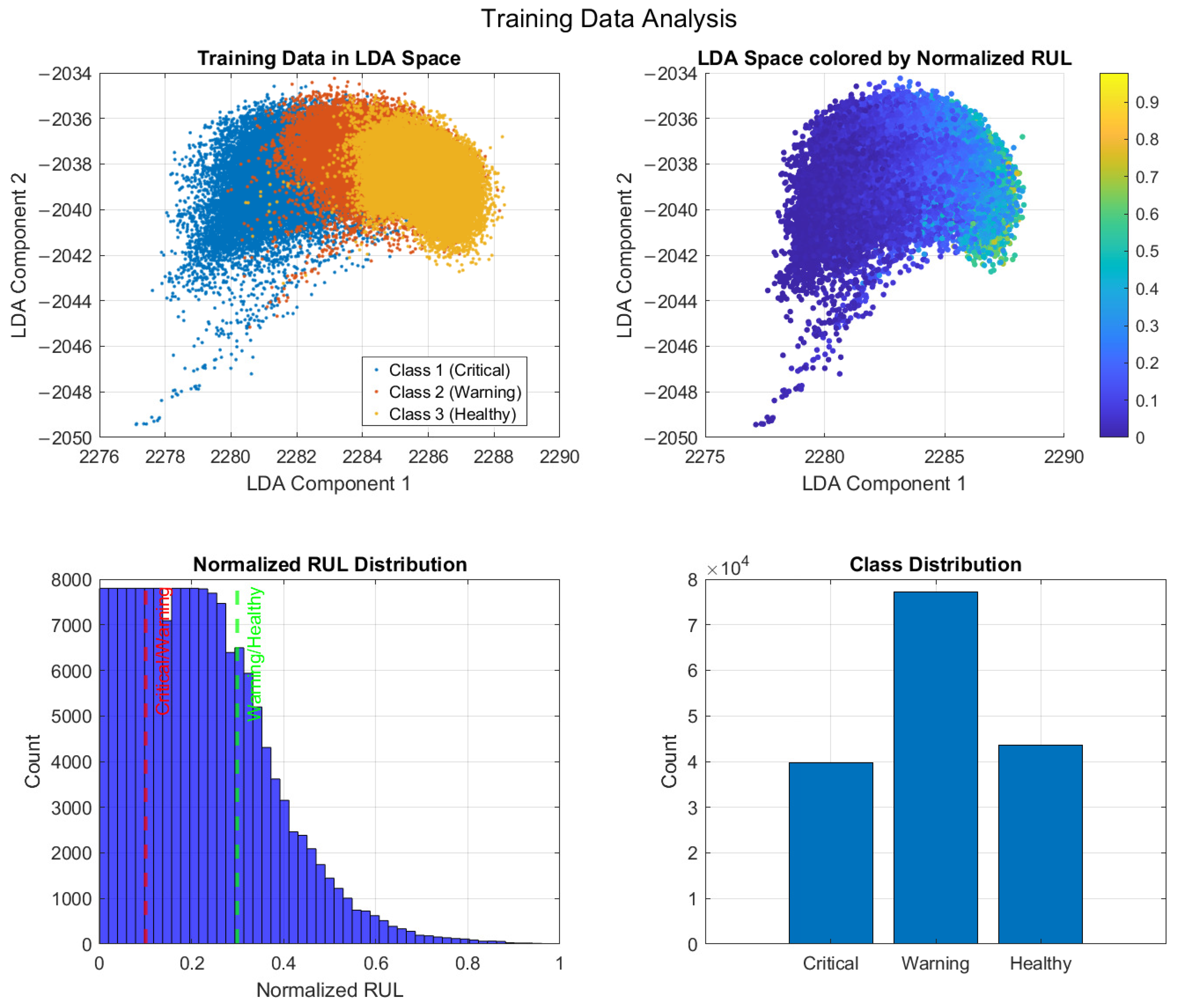
Figure 4 presents the training data distribution in LDA space, demonstrating the effectiveness of LDA-based dimensionality reduction for health-state separation.
The LDA projection successfully separates the three health states into distinct regions, with clear boundaries visible between Critical, Warning, and Healthy classes. The normalized RUL color gradient confirms that degradation progresses systematically from the upper-right (healthy) to lower-left (critical) regions of the LDA space.
3.5. Error Distribution Analysis
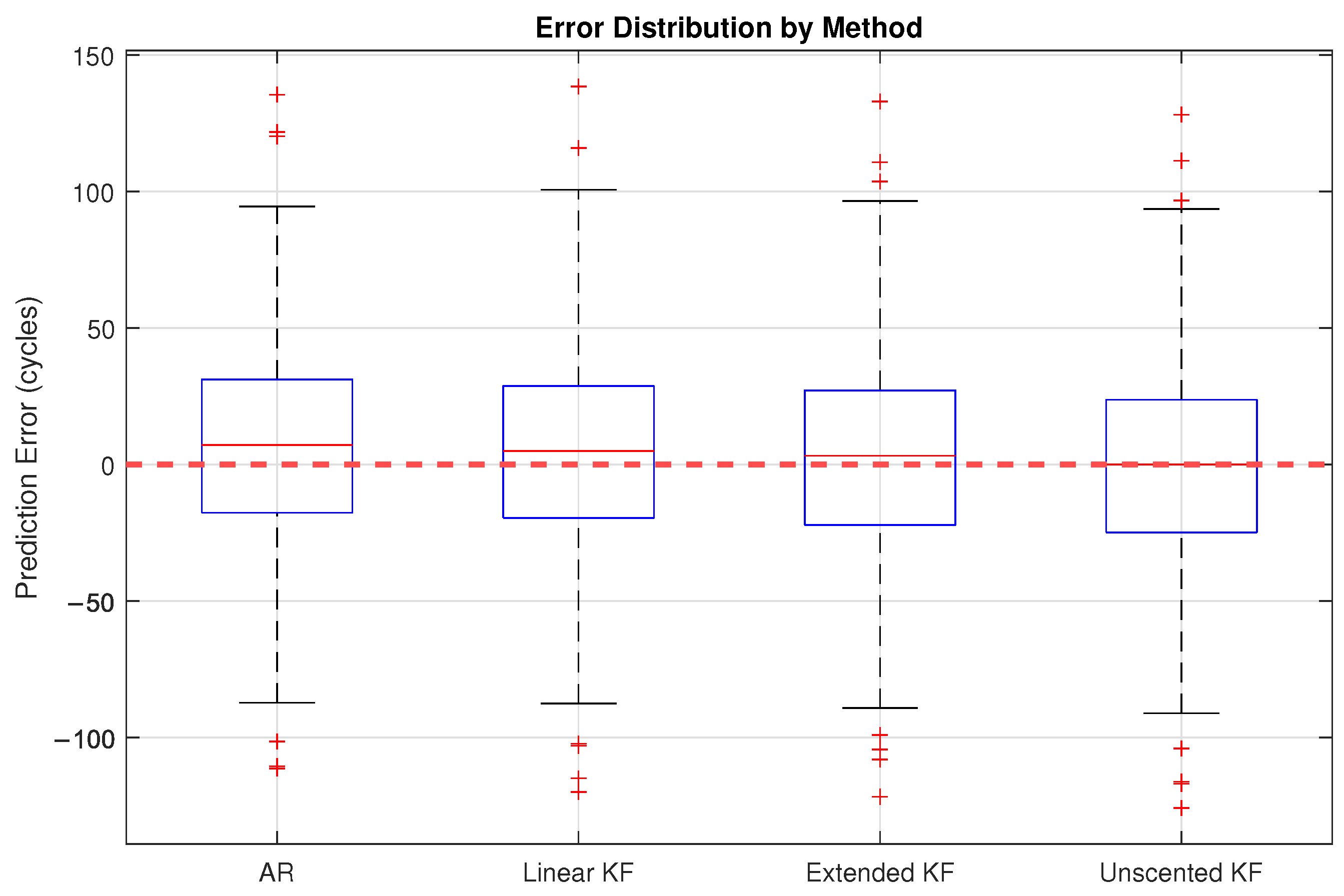
Figure 5 presents the distribution of prediction errors across all methods using box plots. The error statistics reveal distinct bias characteristics for each method.
Table 4 summarizes the error distribution statistics for each method.
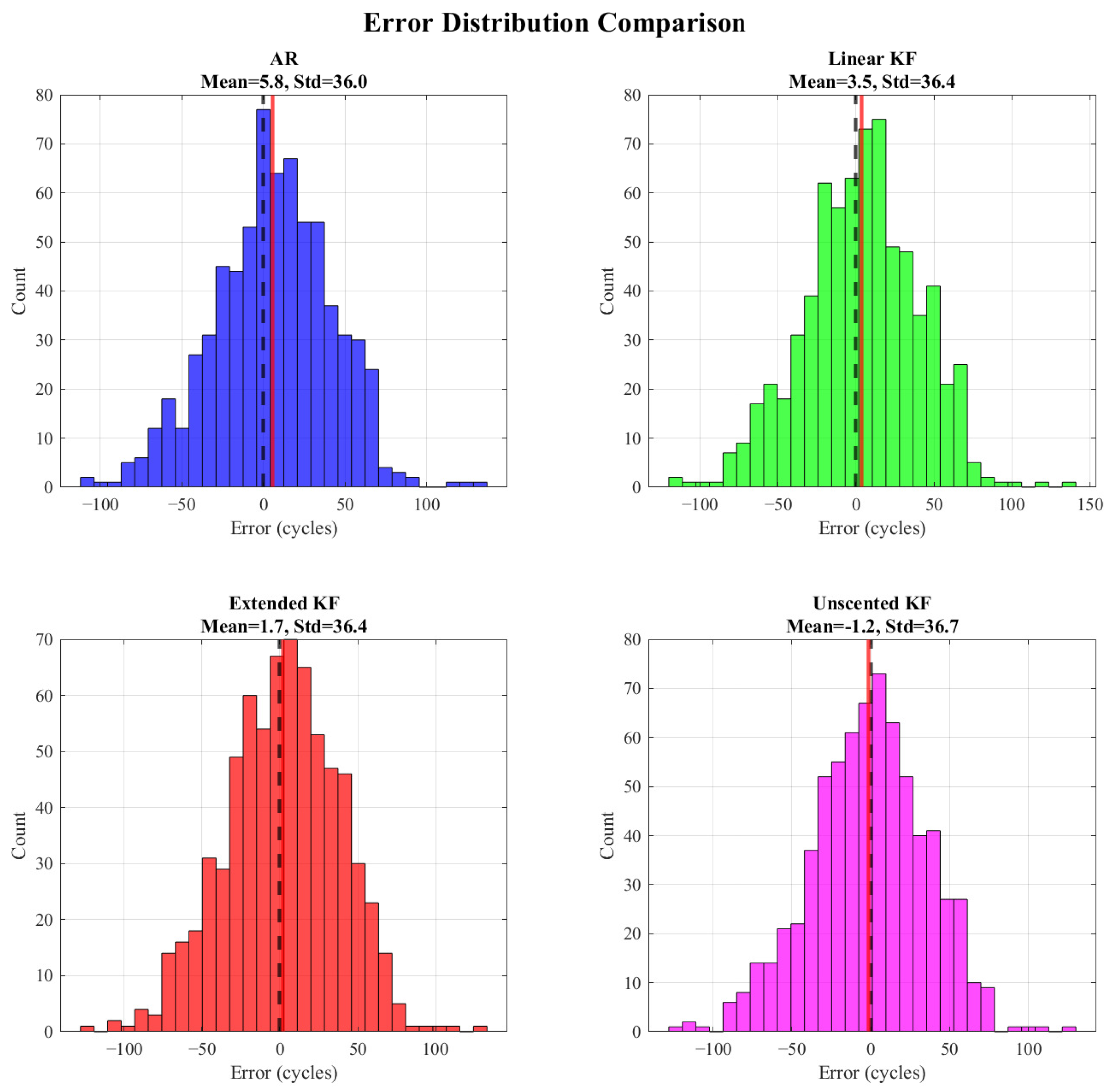
The near-zero mean error of EKF (1.7 cycles) indicates that this method provides essentially unbiased RUL estimates. The negative bias of UKF (−1.2 cycles) reflects a conservative estimation strategy that predicts slightly earlier maintenance needs, which may be preferable in safety-critical aviation applications where the consequences of late predictions outweigh those of early maintenance interventions.
Figure 6 presents the error histograms for each method, providing a detailed view of the error distribution shapes.
3.6. Classification Performance
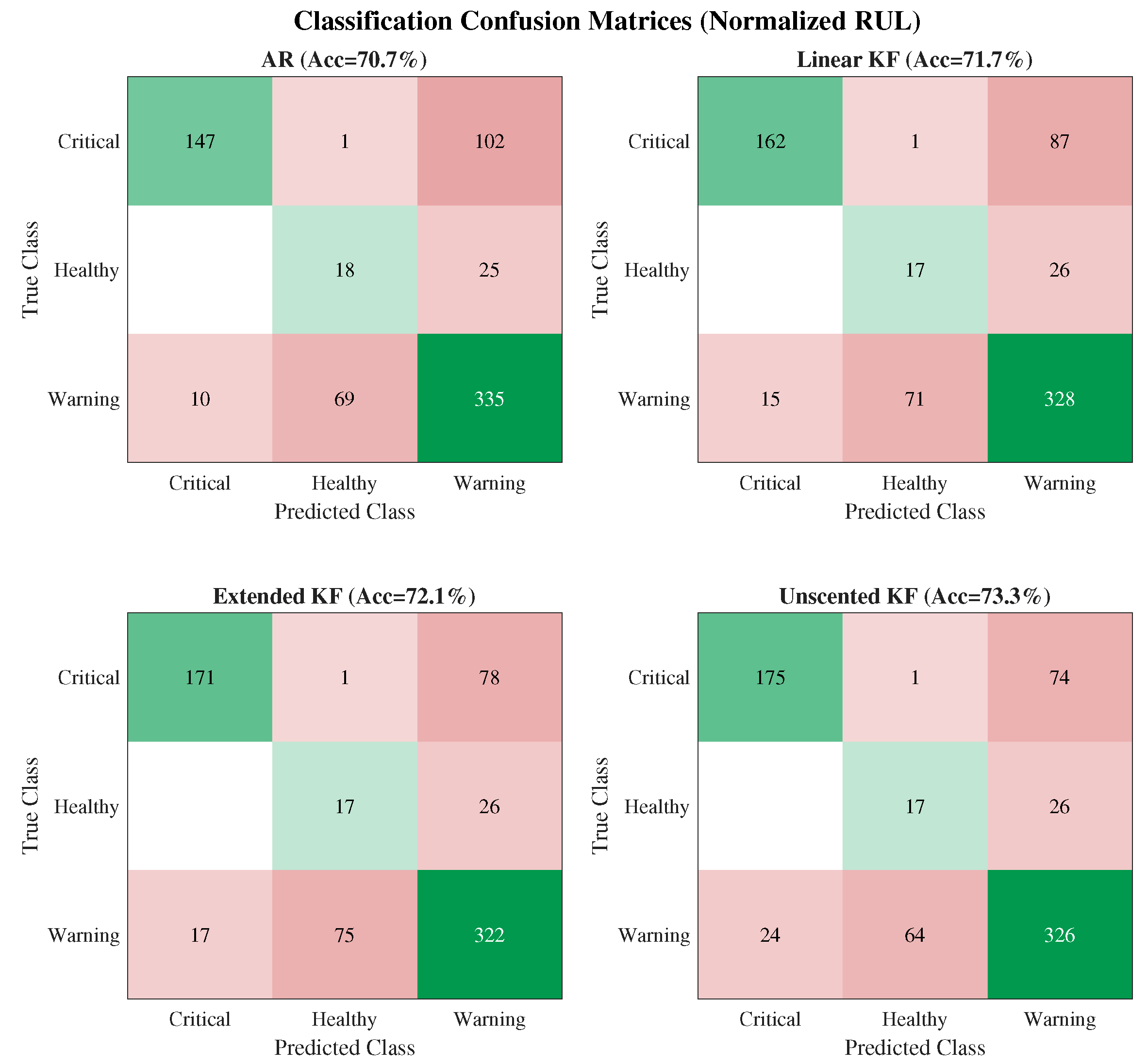
Figure 7 presents the confusion matrices for the three-class classification task across all methods.
Key observations from the classification results:
All methods achieve the highest accuracy in classifying Warning states, which constitute the majority of test samples (58.6%).
The Healthy class presents the greatest classification challenge due to its small sample size (6.1% of test data).
UKF demonstrates improved Critical state detection (175 correct out of 250) compared to AR (147 correct), which is crucial for identifying engines requiring immediate maintenance attention.
The Kalman filter methods show progressive improvement in Critical state classification accuracy, with UKF achieving the best performance.
3.7. Prediction Accuracy Visualization
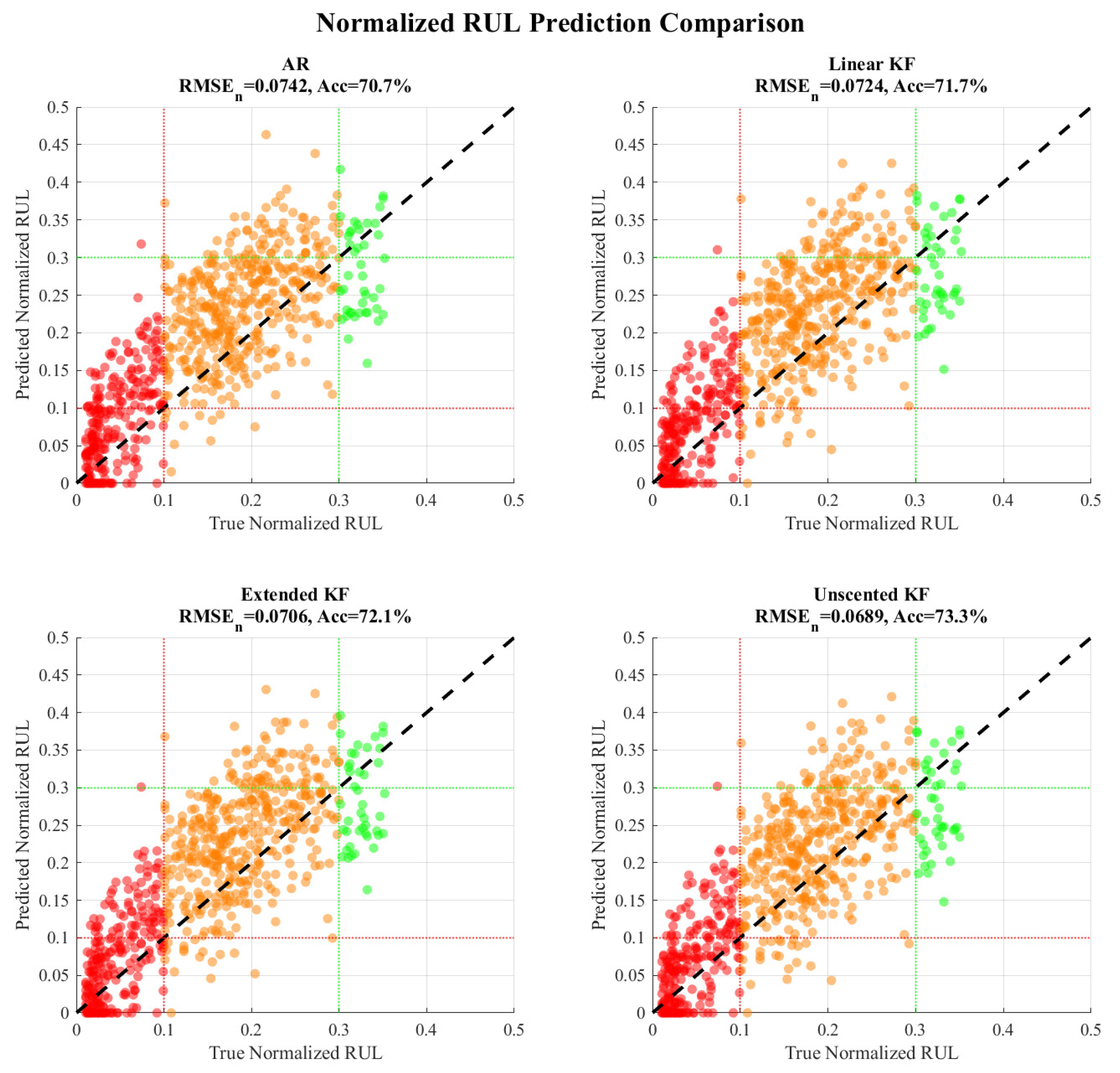
Figure 8 shows scatter plots of predicted versus true normalized RUL values for all methods. Points closer to the diagonal line indicate more accurate predictions.
The scatter plots reveal that all methods exhibit similar patterns of prediction accuracy, with tighter clustering around the ideal prediction line for mid-range normalized RUL values (0.1–0.4). The three-zone classification boundaries demonstrate the alignment between continuous RUL prediction and discrete health-state classification.
3.8. Trajectory Filtering Performance
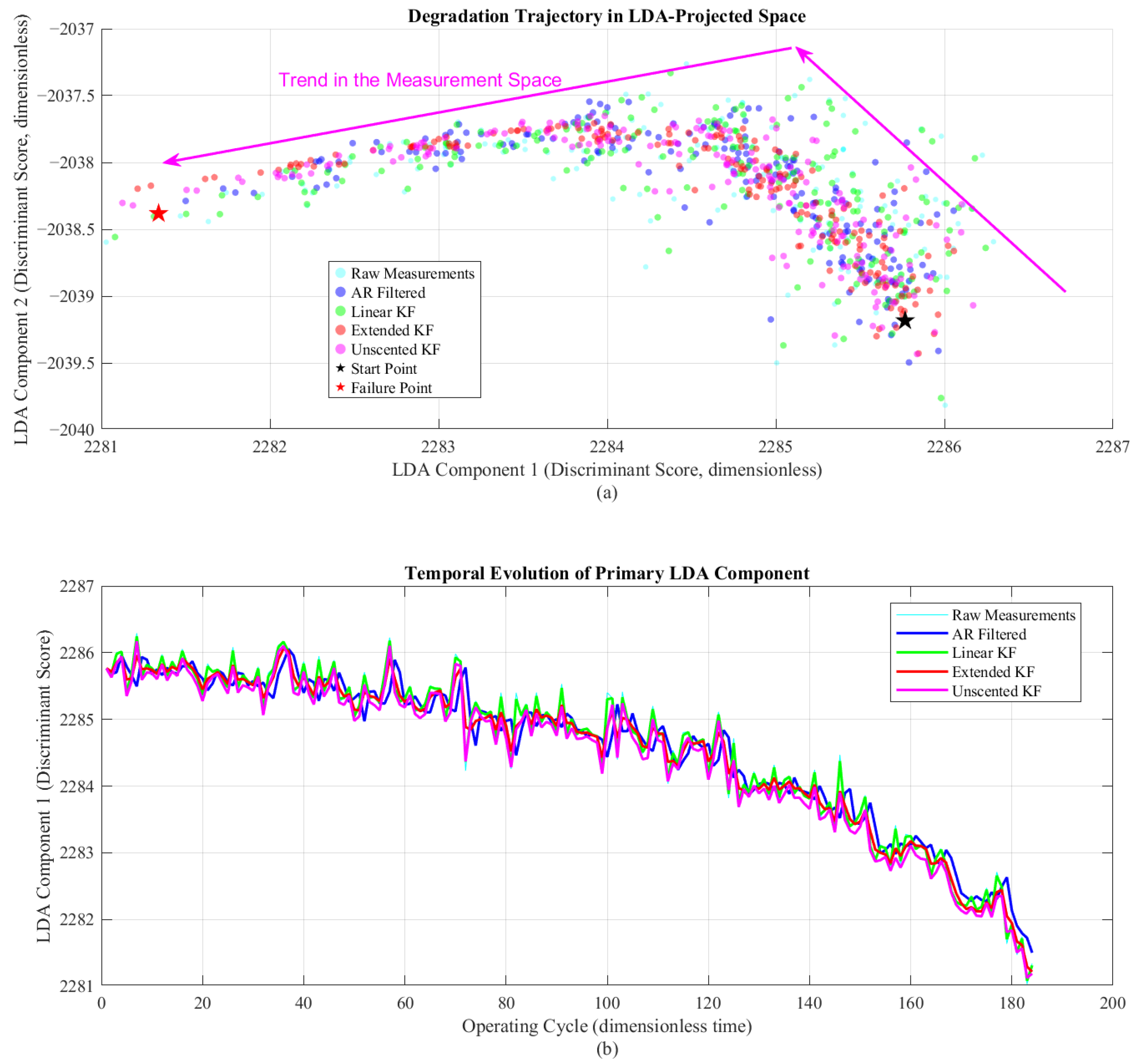
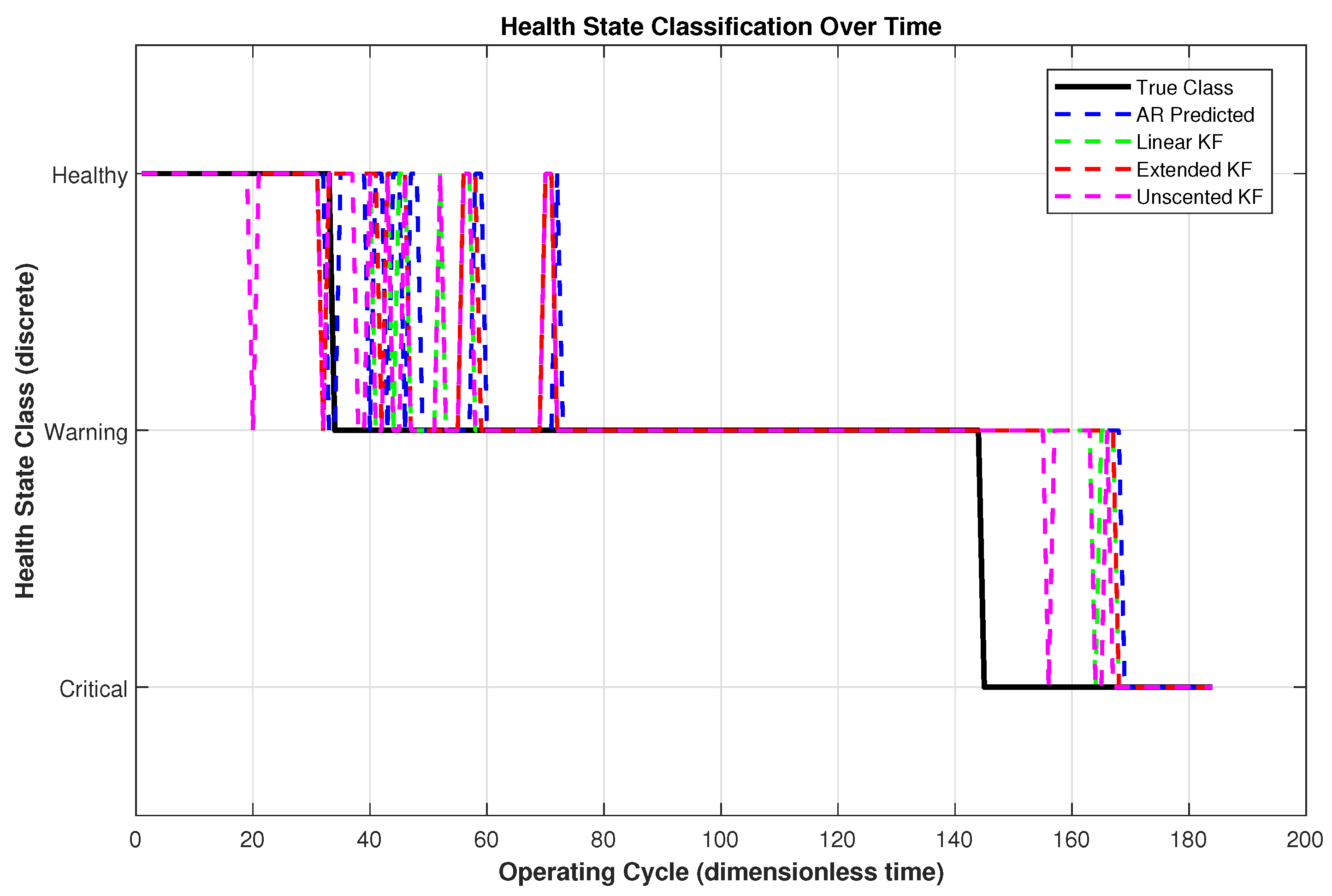
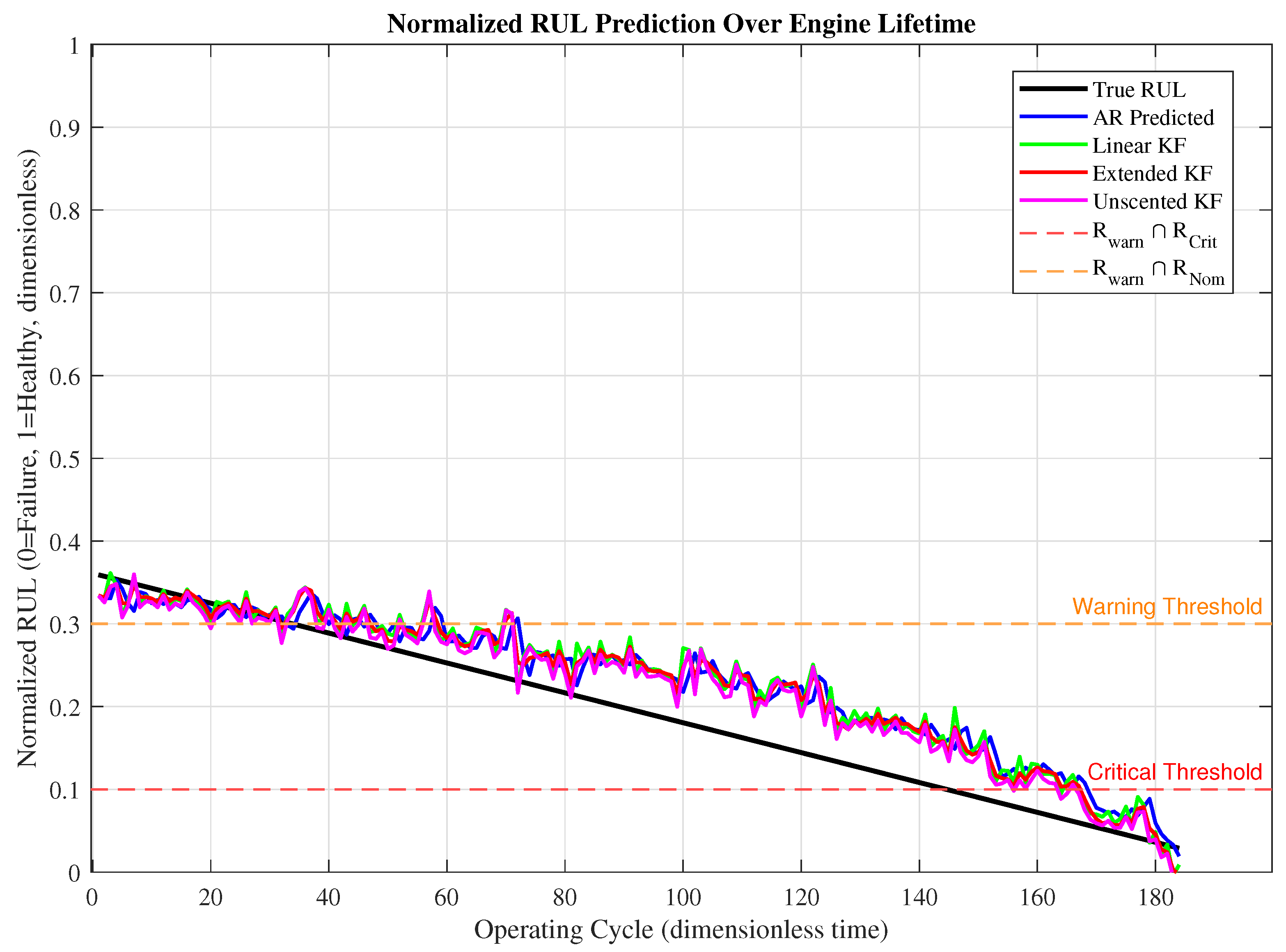
The selected engine represents a typical degradation scenario with 184 operational cycles spanning all three health states. In the LDA-projected space (
Figure 9a), the raw measurements exhibit considerable scatter due to sensor noise and operational variations, while the filtered trajectories clearly reveal the systematic progression toward the critical failure region. The temporal analysis (
Figure 9b) confirms that all filtering methods successfully extract the underlying degradation signal, with the primary LDA component decreasing approximately 4 units over the engine’s lifetime. The Kalman filter variants provide visibly smoother trajectories compared to raw measurements, demonstrating effective noise suppression.
Health-state classification (
Figure 10) demonstrates performance across all methods, correctly identifying the Healthy→Warning transition around cycle 30 and the Warning→Critical transition near cycle 160, with only minor misclassifications during the initial healthy phase.
RUL predictions (
Figure 11) from all methods closely follow the true degradation curve, with convergence improving as the engine approaches failure. The Critical and Warning thresholds (0.1 and 0.3 normalized RUL) provide clear decision points for maintenance planning.
The trajectory analysis demonstrates the following:
Raw sensor measurements exhibit substantial noise in LDA space, while filtered trajectories from LKF, EKF, and UKF provide smoothed degradation estimates.
The health index curves from EKF and UKF show monotonic decline from approximately 1.0 (healthy) to near 0 (critical failure).
Normalized RUL predictions track the true degradation curve closely, with all methods converging near the actual critical point.
The degradation rate parameter () estimated by EKF and UKF shows adaptive behavior, with increasing rates as the engine approaches critical region.
3.9. Ablation Experiments
To quantify the contribution of LDA dimensionality reduction to the overall framework performance, we conducted ablation experiments comparing Kalman filter variants operating directly in the original 21-dimensional sensor space (Without LDA) versus the 2-dimensional LDA-projected space.
Table 5 presents the results across all four C-MAPSS sub-datasets.
The ablation results reveal distinct patterns depending on the dataset complexity:
FD001 (Single Condition, Single Fault): Without LDA, RMSE is 31.22–31.87 cycles with 60–63% accuracy. LDA improves RMSE by 14–15% (to 26.83–26.99 cycles), accuracy by 5–8 points, and Score by 40%.
FD002 (Six Conditions, Single Fault): Without LDA, RMSE exceeds 7400 cycles with infinite Score and 20% accuracy—effectively unusable predictions. LDA reduces RMSE to 31.84–32.91 cycles (>99.5% improvement) and increases accuracy to 72–74%. The six operating conditions create variance that obscures degradation signals; LDA filters this operational variability.
FD003 (Single Condition, Two Faults): Without LDA, RMSE is 56.31–56.96 cycles with Score ∼. LDA reduces RMSE by 27–28% (to 40.75–41.24 cycles), Score by 99% (to ∼), and improves accuracy from 57% to 62–63%.
FD004 (Six Conditions, Two Faults): The most complex dataset shows the most dramatic results. Without LDA, RMSE exceeds 13,000 cycles with infinite Score and 23% accuracy. LDA reduces RMSE to 39.21–40.03 cycles (>99.7% improvement) and increases accuracy to 68–69%.
The ablation study demonstrates that LDA dimensionality reduction is not merely an optional preprocessing step but a fundamental component of the framework. For single-condition datasets (FD001, FD003), LDA provides moderate but consistent improvements of 14–28% in RMSE. For multi-condition datasets (FD002, FD004), LDA is absolutely essential—without it, the Kalman filtering approach fails catastrophically. This occurs because operational variations dominate the variance structure of the original sensor space, preventing the filters from tracking degradation trajectories. LDA’s supervised projection specifically maximizes health-state separability, creating a reduced-dimensional space where degradation dynamics can be effectively modeled regardless of operating conditions.
3.10. Computational Cost Analysis
To evaluate the computational efficiency of the proposed framework, comprehensive timing measurements were conducted for both training and inference phases. All experiments were performed on a desktop workstation equipped with an Intel Core i7-12700KF processor (3.60 GHz, 12 cores, 25 MB cache) running MATLAB R2024B.
The LDA-based feature extraction processes 160,359 training samples in 1.3617 s (8.49
s per sample), enabling rapid model development and periodic recalibration.
Table 6 presents the inference phase computational costs for the test dataset comprising 707 engines and 104,897 operational cycles.
The results reveal significant computational advantages of the Kalman filter variants operating in the LDA-projected space. Extended Kalman Filter (EKF) achieves the fastest inference time at 1.70 s per cycle (78% of LKF complexity), despite incorporating nonlinear dynamics through Jacobian computations. The low dimensionality of the LDA space (2D) ensures minimal matrix operation overhead. Unscented Kalman Filter (UKF) requires 10.26 s per cycle (4.69× LKF), with increased cost stemming from sigma point propagation (5 sigma points for 2D state space). The Autoregressive (AR) Model exhibits unexpectedly high computational cost at 345.6 s per cycle (157.9× LKF) due to dynamic matrix reconstruction at each time step.
All Kalman filter variants demonstrate strict real-time capability. With typical sensor sampling intervals of 1 Hz (1,000,000 s), even UKF occupies less than 0.001% of the computational budget. For Engine 20 (184 cycles), EKF completes trajectory analysis in 0.298 ms, enabling deployment on resource-constrained embedded systems.
3.11. Comparison with State-of-the-Art Methods
Table 7 reveals distinct performance tiers across method categories. Deep learning methods, particularly Transformer-based architectures (TTSNet, EGG-Transformer, TCRSCANet), achieve the lowest RMSE values (11–18 cycles on individual sub-datasets), benefiting from end-to-end feature learning and extensive hyperparameter optimization on each sub-dataset separately. Traditional machine learning methods (SVR, RVR) show moderate performance (20–45 cycles), while the proposed LDA–Kalman framework yields 26–41 cycles across sub-datasets. Notably, our combined dataset evaluation (36.43–36.69 cycles) represents a more challenging scenario than individual sub-dataset results, as the model must generalize across different operational conditions (FD002, FD004) and fault modes without dataset-specific tuning. Compared to the only other Kalman-based method (UKF+LR), the proposed approach shows higher RMSE on individual sub-datasets (FD002: 31.84 vs. 21.50, FD003: 40.75 vs. 22.40); however, UKF+LR was optimized separately for each sub-dataset, whereas our unified framework uses identical parameters across all four sub-datasets while additionally providing health-state classification capability.
The comparison reveals that while deep learning methods (particularly Transformer-based architectures) achieve lower RMSE values on individual sub-datasets, the proposed LDA–Kalman framework offers several practical advantages:
Interpretability: The linear nature of LDA projection and Kalman filtering provides transparent insight into how sensor measurements influence predictions through the learned hyperplane coefficients.
Computational Efficiency: The framework requires no GPU acceleration and can process predictions in real time on embedded systems, with complexity for Kalman filtering, where n is the state dimension (3 for this implementation).
Unified Classification–Regression: Unlike most deep learning approaches that focus solely on RUL regression, the proposed method simultaneously provides health-state classification with accuracy up to 73.27%.
Uncertainty Quantification: Kalman filter covariance matrices provide natural uncertainty bounds on predictions, enabling risk-informed maintenance decision-making.
Robustness: The framework demonstrates consistent performance across combined datasets with varying operational conditions and fault modes, without requiring dataset-specific hyperparameter tuning.
Reduced Data Requirements: Unlike deep learning methods that require large training datasets, the proposed framework can operate effectively with limited failure instances.
3.12. Summary of Findings
The experimental results demonstrate several key findings regarding the performance of Kalman filter variants in the LDA-projected discriminant space. In terms of the asymmetric Score metric, the nonlinear Kalman filter variants (EKF and UKF) improve upon the AR baseline, with improvements ranging from 36.1% (EKF) to 54.9% (UKF), indicating significantly fewer dangerous late predictions that could lead to unexpected failures. Regarding point prediction accuracy, the EKF achieves the best performance with the lowest RMSE (36.43 cycles) and near-zero mean bias (1.7 cycles), suggesting that first-order linearization adequately captures the degradation dynamics in LDA space. The UKF provides the most conservative predictions with the lowest Score (552,572) and highest classification accuracy (73.27%), making it particularly suitable for safety-critical applications where late predictions must be minimized. Furthermore, classification accuracy remains consistent across all methods (70.72–73.27%), indicating that the LDA-based boundary classification is robust to the choice of filtering method and that the learned hyperplane boundaries effectively partition the discriminant space regardless of the state estimation approach employed.
4. Conclusions
This paper presented a novel framework that integrates Linear Discriminant Analysis with Kalman filtering for turbofan engine remaining useful life prediction. The key innovation lies in performing state-space estimation directly within the LDA-projected discriminant subspace, where degradation trajectories are inherently aligned with directions of maximum class separability. This approach fundamentally differs from existing methods that either apply Kalman filtering in the original high-dimensional sensor space or use LDA solely for classification purposes. By unifying dimensionality reduction, state estimation, and boundary-based classification within a single coherent framework, the proposed methodology enables optimal noise filtering in a geometrically meaningful space where distances to critical failure boundaries directly correspond to remaining useful life.
Building upon the previous work on linear classification–regression methods, this study specifically addressed the sensitivity of Autoregressive models to measurement noise during transitional degradation phases. The experimental evaluation on the NASA C-MAPSS benchmark dataset demonstrated that Kalman filter variants achieve substantial reductions in the asymmetric PHM08 Score (36–55%) while maintaining comparable RMSE performance to the AR baseline. These results indicate that the primary benefit lies in conservative prediction bias—fewer late predictions—rather than improved point accuracy. Deep learning methods achieve 2–3× lower RMSE on individual sub-datasets, positioning the proposed framework as complementary for scenarios prioritizing interpretability, computational efficiency, and conservative predictions over raw accuracy, with the Unscented Kalman Filter attaining a 54.9% reduction in the PHM08 asymmetric Score metric (from 1,224,299 to 552,572) and improving classification accuracy from 70.72% to 73.27%. The analysis revealed distinct bias characteristics: the Extended Kalman Filter provided nearly unbiased predictions with a mean error of only 1.7 cycles, while the UKF exhibited a conservative negative bias suitable for safety-critical applications where late predictions pose greater risks.
The proposed LDA–Kalman framework offers several practical advantages for industrial deployment:
The linear LDA projection, combined with Kalman filter covariance matrices, provides full interpretability and natural uncertainty quantification for risk-informed maintenance decisions.
The unified treatment of classification and regression ensures consistency between discrete health-state assessment and continuous RUL prediction within a single architecture.
The framework operates effectively with limited failure instances and maintains consistent performance across combined datasets with varying operational conditions and fault modes, without requiring dataset-specific hyperparameter tuning.
Future research directions include the development of adaptive noise covariance estimation techniques capable of handling non-stationary degradation dynamics, the incorporation of physics-based degradation knowledge into state transition equations to enhance extrapolation capabilities, and comprehensive validation using real-world operational flight data.
Limitations and Practical Deployment Considerations
While the proposed framework demonstrates promising results on the C-MAPSS benchmark, several limitations should be considered for real-world deployment.
Data Requirements: The framework requires complete run-to-failure trajectories for training. In operational contexts, preventive maintenance typically intervenes before failure, resulting in right-censored data that would require modified training procedures or transfer learning approaches.
Stationarity Assumptions: The current implementation assumes consistent degradation dynamics across operating conditions. Real engines experience variable flight profiles, environmental variations, and maintenance interventions that may shift the learned LDA boundaries over time.
Sensor Challenges: Practical deployment introduces sensor drift, missing data from communication dropouts, and irregular sampling rates—factors not present in the C-MAPSS simulation that may degrade prediction accuracy.
Fleet Variability: Manufacturing tolerances and differing operational histories create unit-to-unit variability that may exceed the within-class scatter captured during training, potentially increasing false alarm rates or missed detections.
Accuracy Trade-offs: As shown in
Table 7, deep learning methods achieve 2–3× lower RMSE on individual sub-datasets. The proposed framework is most appropriate for applications prioritizing interpretability, conservative predictions, and embedded deployment rather than minimizing point prediction error.
The interpretability claims of this framework refer to geometric interpretability in the two-dimensional LDA space, where degradation trajectories can be directly visualized and decision boundaries are explicitly defined, rather than causal explanation of physical component failures. Spatial fault localization in LDA space enables systematic analysis of prediction patterns facilitating algorithm debugging and refinement that is not possible with high-dimensional deep learning embeddings.