Article

Influence of Lateral Wheelset Force on Track Buckling Behaviour

1
ÖBB-Produktion GmbH, 1100 Vienna, Austria
2
Rail Cargo Austria, 1100 Vienna, Austria
3
Institute of Structural Durability and Railway Technology, Graz University of Technology, 8010 Graz, Austria
4
Institute of Railway Infrastructure, Graz University of Technology, 8010 Graz, Austria
*
Author to whom correspondence should be addressed.
Machines 2026, 14(2), 203; https://doi.org/10.3390/machines14020203
Submission received: 8 January 2026 / Revised: 2 February 2026 / Accepted: 4 February 2026 / Published: 9 February 2026
(This article belongs to the Section Vehicle Engineering)

Abstract

The Prud’homme criterion, the limit value for lateral wheelset forces, has increasingly become a topic of discussion due to doubts about its correct application in railway vehicle assessment. Interpreted as a safety-related limit value for running dynamics, it is not precisely stated what hazard is to be avoided, especially since Prud’homme himself refers to maintenance relevance. The criterion does not apply to sudden track shifts under the wheelset, and the occurrence of track buckling does not depend on it. To help clarify this question, the influence of lateral wheelset forces on track buckling is specifically investigated by means of simulation. A track section is modelled and validated against historical measurements, and the influence of wheelsets on track buckling is calculated. We conclude that this limit cannot be relevant to safety. A revision of this approach is necessary.

1. Introduction

Track stability has always been an important issue for railway engineers, because it had long been known that rail vehicles can experience strong lateral wheelset forces induced by oscillations at maximum speed [1]. However, in the 1950s, with the general introduction of continuously welded rail (CWR) [2], it became even more essential. Despite this, it would take another three decades before the vehicle oscillations could properly be analysed and prevented by means of vehicle assessment.
Therefore, in the 1960s, two issues needed to be investigated:
  • Prevention of lateral track buckling at high temperatures;
  • Limitation of lateral wheelset forces.
In 1967, the French engineer A. Prud’homme published the results of several years of research into horizontal track stability. He not only dealt with the behaviour of continuously welded rails (CWR) [3,4] but also with the influence of lateral wheelset forces on track stability [5,6,7]. He limited these forces with the wheelset load-dependent threshold value (see Equation (1)), which is still valid today in its originally defined sense. It describes the limit below which incremental maintenance-relevant lateral track displacement in the weak reference track is reliably avoided (this references a track that has just been aligned during maintenance work and consists of rails that are 46 kg/m as well as wooden sleepers with 60 cm spacing. The factor k of the formula depends on the chosen track maintenance method [5,6,7]):
Y < k × 10 + P 3
where
  • ΣY—sum of lateral wheel forces, lateral wheelset forces [kN];
  • k—coefficient, depending on track maintenance technology;
  • P—vertical wheelset force [kN].
When several serious derailments involving track displacement occurred in the early 1970s [8], Prud’homme’s limit value, which had been determined at great expense, was subsequently implemented as a safety-related limit for vehicle assessment [9,10].
With today’s knowledge, the circumstances surrounding lateral track failure must be characterised in a more nuanced manner. Outside Europe, the Prud’homme limit value has long been considered as too conservative [11], a view that is also supported by studies conducted in the US [12]. It makes sense to question the current application of the limit value in the context of vehicle assessment in accordance with EN 14363 [13].
A review of the literature on this subject [14] compiles relevant research findings and works out the technical context that can be derived from them, suggesting that wheelset lateral forces do not trigger or even influence snap-through buckling of the track. This would open up the possibility of establishing a new perception of these damage mechanisms.
It must therefore be proven that wheelset lateral forces do not influence the probability of track buckling. Measurements on the track suggest this [15], but it should also be verified by simulations.
The novel contribution of this work is therefore to scrutinise whether excessive lateral wheelset forces can still cause or at least encourage track buckling. As field test parameter studies, which describe various influences in the track, are very complex, this question is answered through computer simulation [16], which includes the wheelset load as a key parameter.

2. Methods

The following procedure has been selected for processing the task:
  • Determination of the analytical solution for buckling a rail according to Euler’s buckling bar theory;
  • Analysis and selection of the optimal simulation method compared to the analytical solution, considering the necessary computing time;
  • Determination of the lateral track resistance (LTR) when the track is loaded as a function of wheelset load and the distance to the wheelset;
  • Designing of the track model (straight line, track curve of very small radius);
  • Validation of the simulation model with buckling temperatures measured in large-scale tests;
  • Studies with variation in the parameters critical for buckling (wheelset load, initial track alignment error, rail temperature increase, lateral wheelset forces).

2.1. Theoretical Basics

In continuously welded tracks, variation in rail temperature (e.g., due to solar radiation or air temperature) cannot be balanced by rail strain. Therefore, at rail temperatures above the so-called ‘neutral temperature’ (according to Ref. [17]: neutral temperature (Tn): chosen design rail temperature for fastening down the rails to the sleeper for CWR track. In the design phase, the neutral temperature is the stress-free temperature), longitudinal compressive stresses occur in the rails, which can lead to track buckling. Track buckling behaviour is particularly influenced by the lateral track resistance (LTR) of the track grid and any initial lateral deflection of the track due to alignment errors or the alignment of a track curve. The bending stiffness of the track grid also has an influence on it, but is neglected here.
Track buckling occurs when the compressive load reaches a critical value. This is due to temperature increase (∆T) and depends on the cross-section geometry and material properties. Figure 1 shows the basic behaviour of a track under temperature-induced longitudinal compressive forces. Starting with the original alignment error, this alignment error continues to increase as the temperature rises until the maximum temperature difference above the neutral temperature is reached. The track then buckles sideways until the change in position reduces the rail compressive stress again (snap-through buckling). Even below this maximum temperature difference, buckling can occur (if the minimum temperature difference is exceeded) due to imperfections in the track. Therefore, the diagram can also be split in three temperature areas: the “safe” temperature increase (with an increase below ∆Tmin), the “risk of buckling” with a rail temperature increase between ∆Tmin and ∆Tmax, and the certainly unsafe temperature increase above ∆Tmax.
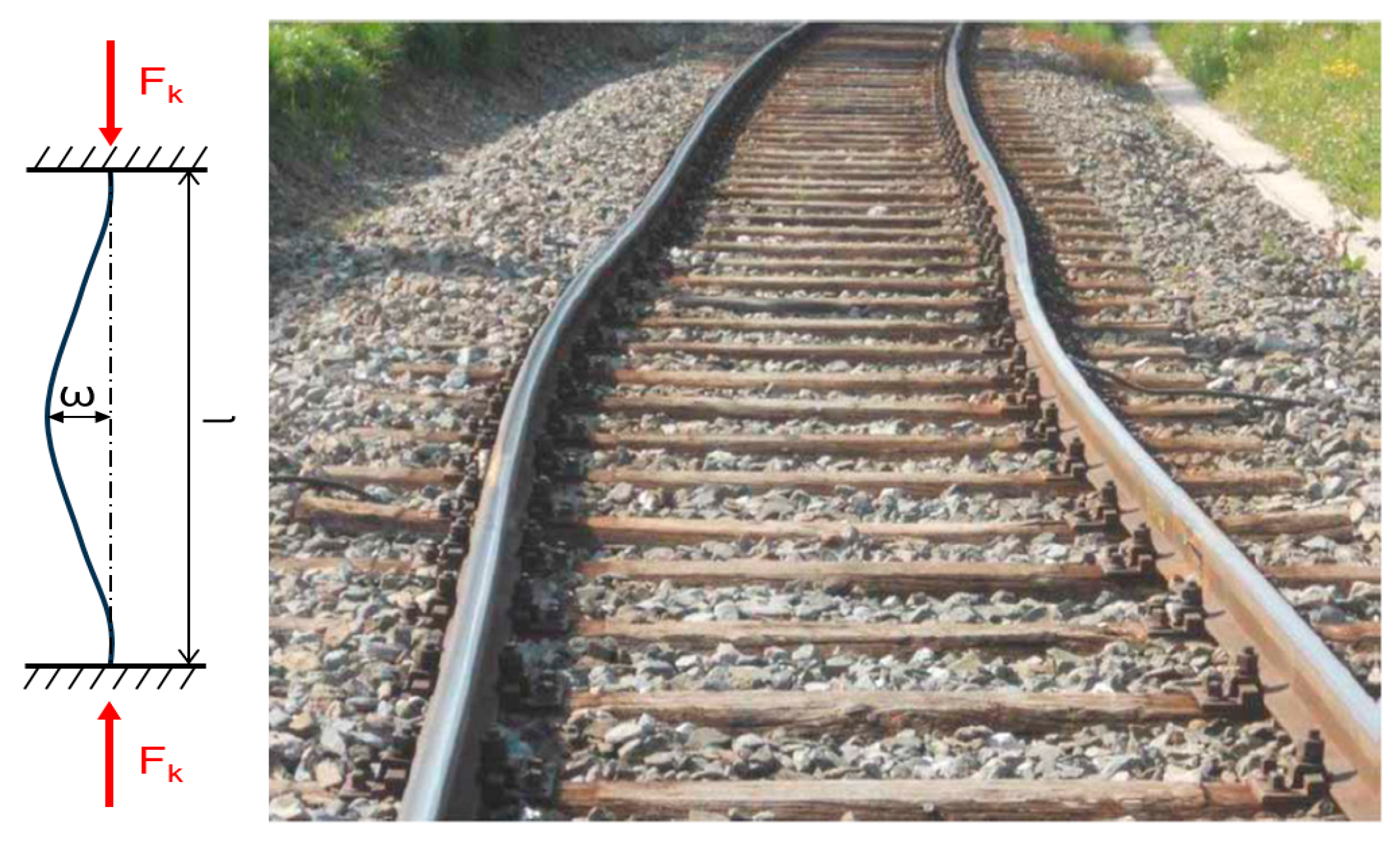
Euler described four buckling cases for a bar, which differ in the support of this bar. The fourth Euler buckling case, where the bar is clamped on both sides, is suitable for modelling track buckling (Figure 2).
The buckling load Fk of one single rail, which is used in Section 2.2 to assess the suitability of numerical models, can be calculated according to Equation (2). Since we will neglect the torsional resistance of the track grid later on, we focus here on the single rail.
F k = 4 · π 2 · E · I L ^ 2
where
  • Fk—buckling load (since we are only considering compressive forces, we show these as positive values for better readability);
  • E—modulus of elasticity;
  • I—(smaller) moment of inertia;
  • L ^ —length of the rail (assumed to be 10 m for the comparative calculations).
Equation (3) determines the longitudinal force in the rail due to temperature differences:
F T = E · α T · T · A
where
  • E—modulus of elasticity of steel = 210,000 N/mm2;
  • αT—coefficient of thermal expansion for steel = 1.2 × 10⁻⁵ K−1;
  • ∆T—temperature difference to neutral temperature;
  • A—cross-sectional area of the rail.
If FT is set equal to the buckling load Fk, the maximum critical temperature difference ∆T results in ∆Tmax, as shown in Equation (4).
T m a x = 4 π 2 L ^ 2 · I α T · T
If the values for a single rail with the dimensions of 60E1 according to EN 13674-1 [19] are applied, the result is Fk = 425 kN and ∆Tmax = 22 °C.

2.2. Evaluation of the Simulation Method

A series of simulations were carried out with two different software packages (NX Nastran (FEM) [20] and Simpack (MBS) [21]) in order to find a best fit numerical method that ensures sufficient accuracy of the results with acceptable computing time. All simulation tools used were set up using the same modelling assumptions. Depending on the characteristics of the simulation tool, it was possible, for example, to model not only 1D and 3D cases but also, in some tools, the temperature, while in others only the resulting forces were modelled. Table 1 provides an overview of all simulations carried out and serves as a basis for the selection of simulation methodology based on accuracy and time efficiency. Further details to the modelling approaches are given in [16].
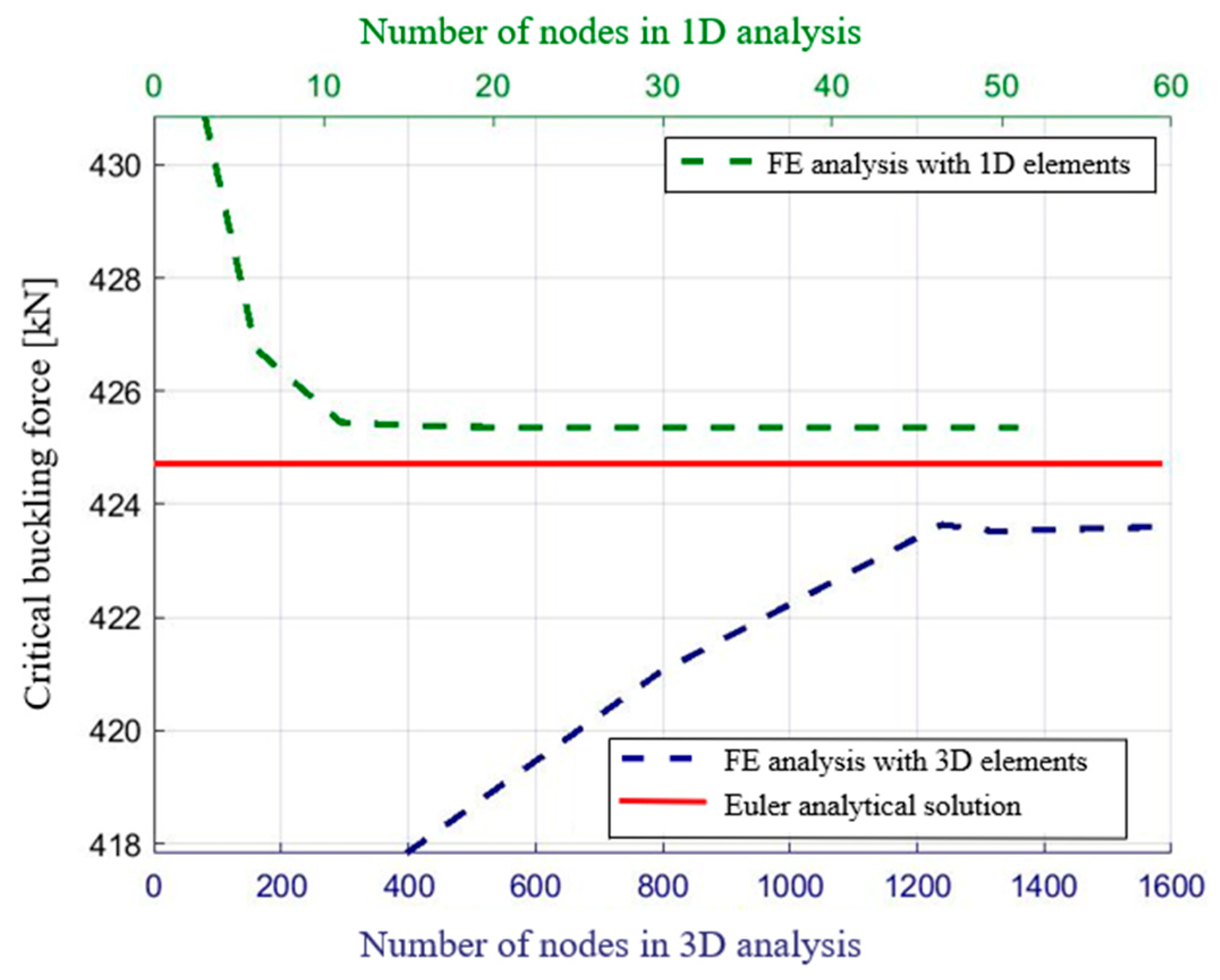
The results of the various simulations are compared with the analytically determined Euler buckling force for a single rail. In finite-element simulations with NX Nastran, a distinction is made between meshing one-dimensional (1D) or three-dimensional (3D) elements and between the linear solver SOL 105 or the non-linear solver SOL 106. As can be seen from Figure 3, 1D elements show a better agreement with the analytical solution, even using a lower number of nodes, and are therefore much more efficient than 3D elements, which is supported by the comparison of the computing time (Table 1). Therefore, the use of 3D elements was excluded after the first analyses.
In Table 1, the simulation models with thermal loading show a greater deviation from the Euler analytical solution than those with direct force application. The reason for this is because temperature-induced expansion of the rails in the lateral direction also changes their cross-sectional values and therefore the critical buckling force. Nevertheless, applying thermal load in the simulation better reflects reality than the direct application of longitudinal forces because in the railway network the rails also expand under solar radiation. The modulus of elasticity is also temperature dependent but is no longer included in the equation for ∆T.
When integrating flexible bodies from NX Nastran into Simpack, it was not possible to model buckling, even with very high forces and with implemented initial deflection. Therefore, Simpack is only further considered when using flexible bodies with Simbeam. With Simbeam, a distinction is made between linear and non-linear modelling, whereby the structural as well as mass damping of the body is taken into account with the non-linear Simbeam. In addition, Simbeam offers the option to choose between Euler–Bernoulli and Timoshenko elements within the beam (the rail). The simulations with all four alternative options are performed to compare the accuracy of the results.
Despite the threefold increase in computing time, no improvement in accuracy was achieved with the non-linear Simbeam, which is why it can be excluded from further discussion. For the remaining linear Simbeam, the Euler–Bernoulli theory should be favoured, as it is more suitable for slender beams (length over cross-section greater than 10) [16].
This leaves two options: finite-element simulation with 1D elements with thermal load and multi-body simulation using linear Simbeam with Euler–Bernoulli beams. In the end, NX Nastran with 1D elements is chosen for the construction of the detailed track models, as with NX Nastran the temperature is used directly as a load type in the simulation and therefore allows for a better replication to be achieved. The finite-element simulations with 1D elements best fulfil the requirements regarding load application and simultaneously ensure accuracy and time efficiency. To model the non-linearities in the track system, the non-linear solver SOL 106 is used to set up the model.

2.3. Lateral Track Resistance (LTR)

An important input parameter for calculating track stability is the lateral track resistance (LTR) of the sleepers in the ballast. Here, the single sleeper push test is used as explained in [17]. This is usually measured in an unloaded state, but these values alone are not sufficient for the task at hand. For the simulation of track behaviour with respect to the influence of the wheelsets, it is necessary to know the LTR in all load conditions in the vicinity of a wheelset.
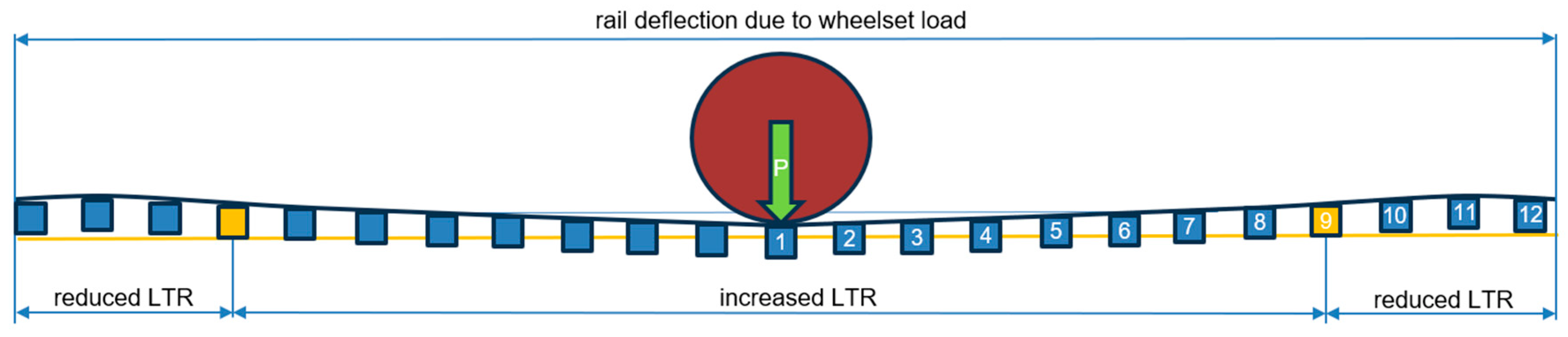
Due to the deflection of the rail (Figure 4), the sleepers are pressed into the ballast to different depths. The greater the deflection, the greater the LTR of the respective sleeper.
The deflection under the wheelset load can be used to calculate the bending line of the rail [2,22]. If the wheelset load is high, a lift-off wave forms at the end of its influence. In Figure 4, this is exemplified by sleepers 10 to 12.
For the simulation, the LTR of each sleeper is determined by measurement under the load of a heavy locomotive and derived by calculation under the load of a passenger coach and an empty freight waggon.
The Universität Innsbruck, Institut für Infrastruktur (University of Innsbruck, Institute for Infrastructure) carried out LTR and deflection measurements on a track loaded with a locomotive [23]. Three measurement sections were selected on a consolidated (meaning well-used) track with wooden sleepers.
The width of the ballast beside the sleepers was 60 to 70 cm. The vehicle was a locomotive with a nominal wheelset load of 22 t. By measuring the depression of the sleeper head under the wheelset, the track modulus C and the basic value of the longitudinal sleeper superstructure L (according to Zimmermann [22]) can be determined (Table 2) according to Equations (5) and (6) from [2].
C = F 4 · b · y · F E · I · y 3   [ N / mm 3 ]
L = 4 · E · I b · C 4 [ mm ]
Table 2. Measured depression, basic value of the longitudinal sleeper superstructure and track modulus of the three measuring sections [23].
Depression y [mm]Basic Value L [mm]Track Modulus C [N/mm3]
measuring section 11.328750.092
measuring section 21.088170.121
measuring section 32.8111210.034
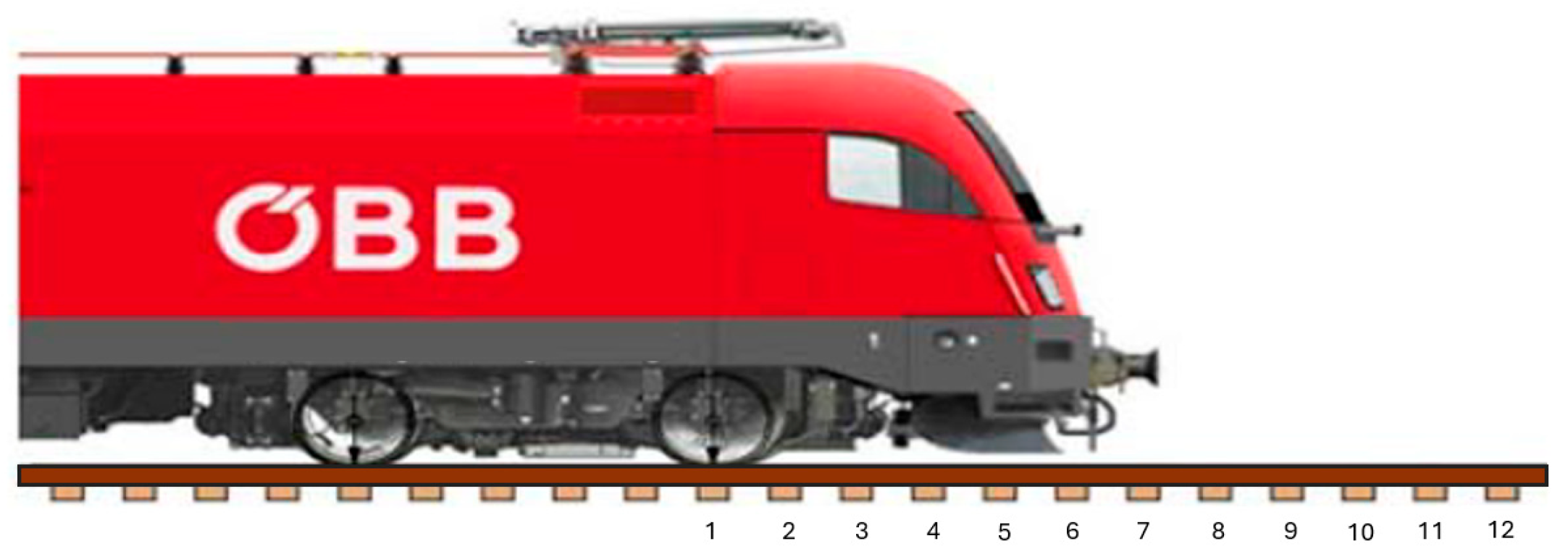
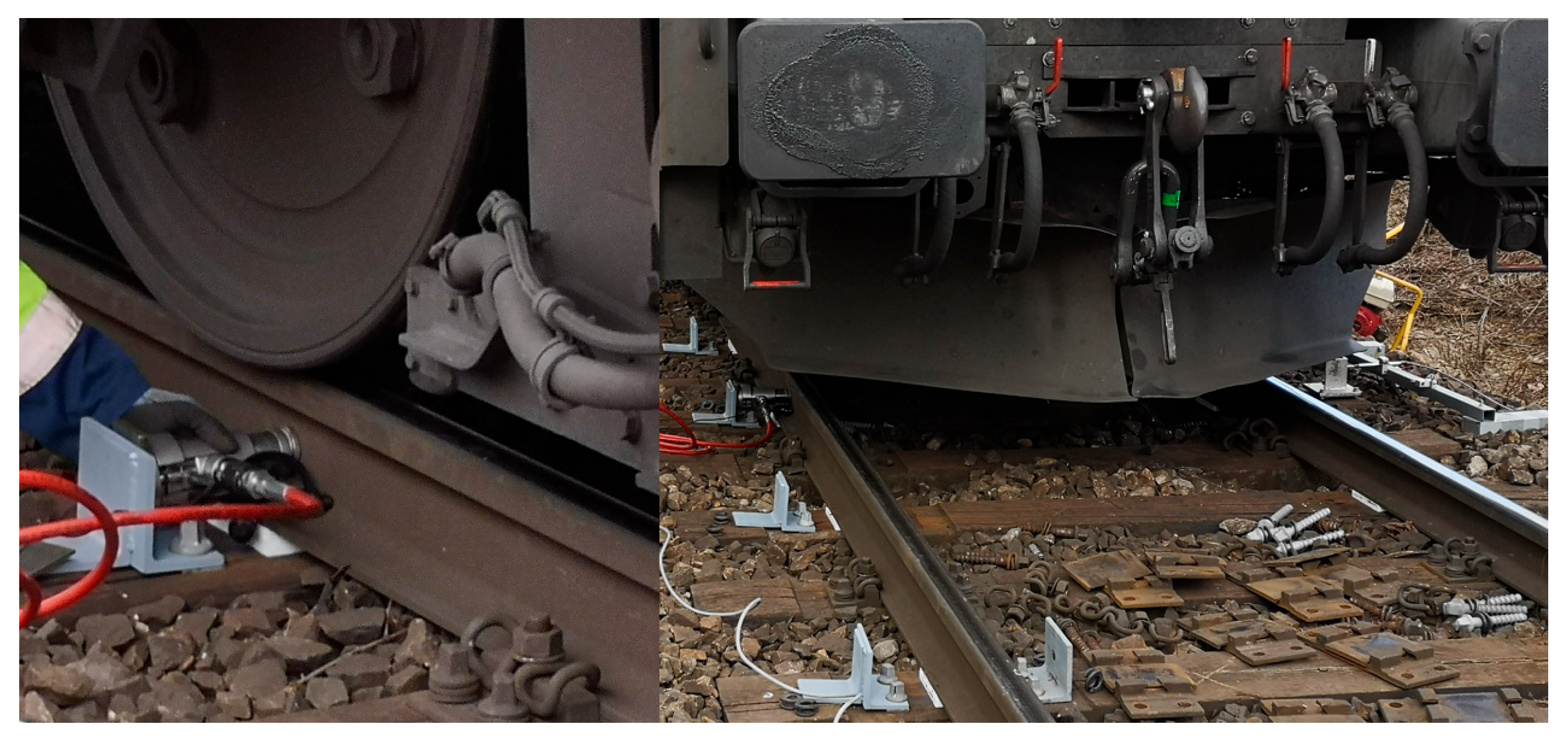
The LTR of a sleeper under the influence of the wheelset was determined by loosening and removing the rail fastening on every second sleeper, starting with the sleeper directly above which the wheelset is positioned for the measurements (Figure 5 and Figure 6).
Teflon plates were inserted into the resulting free space in order to transfer the vertical forces from the wheelset while not hindering the lateral movement of the sleeper. After positioning the leading wheelset of the locomotive over the first sleeper with the Teflon insert, the detached sleepers were moved sideways against the rail using a hydraulic press and then returned to their original position.
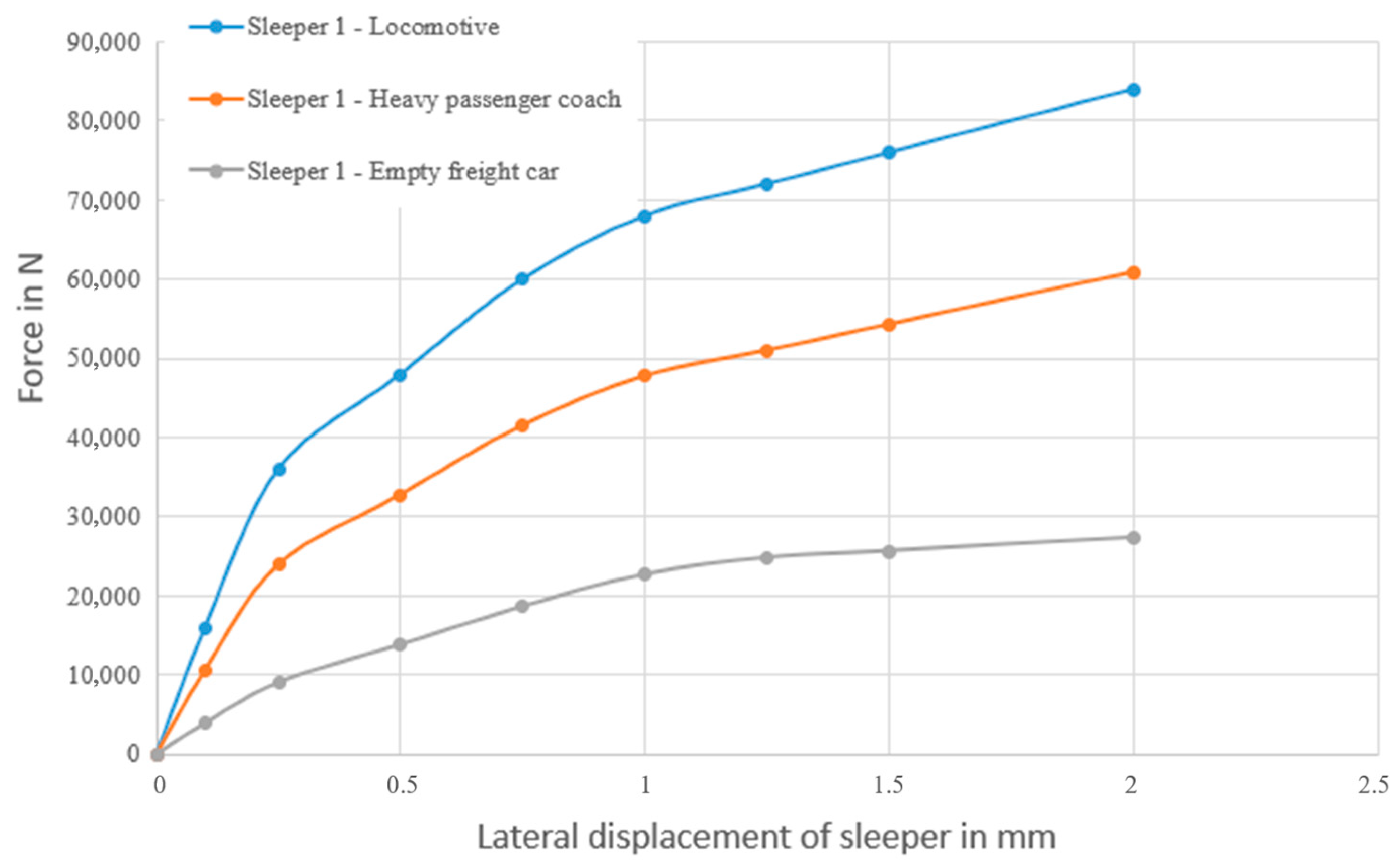
The force required for the displacement of 2 mm was recorded. In the next step, the sleepers were reattached to the rail, and the measurement was repeated on the previously undetached sleepers to include all sleepers in the result.
Based on the measurement results from the third section, the following track parameters are specified for the simulation.
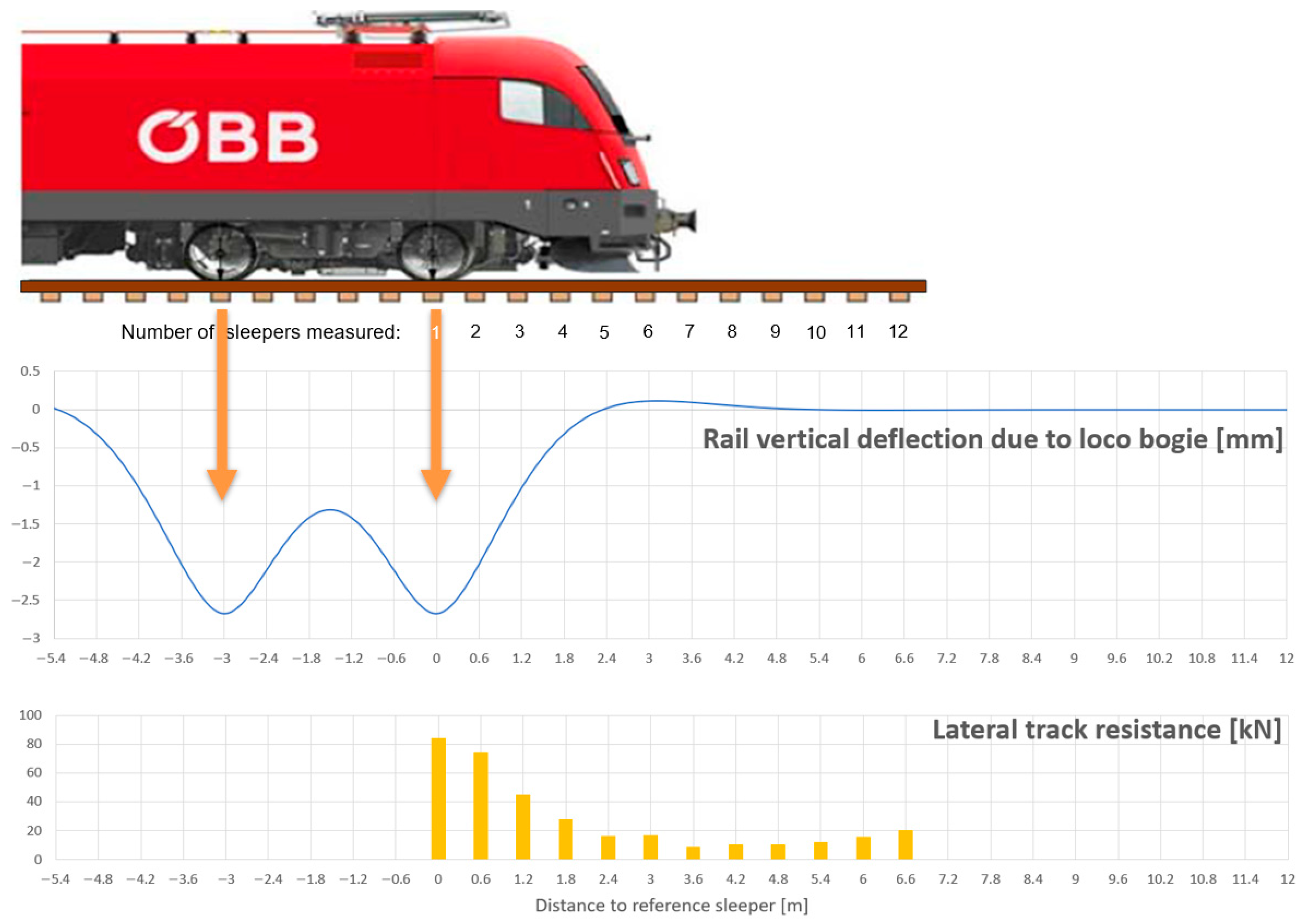
The rail deflection under the wheelset (Sleeper 1) is equal to 2.7 mm; this corresponds to a calculated track modulus of 0.0435 N/mm3. For the LTR of the single sleepers, see Table 3.
Figure 7 shows the rail deflection under the loco bogie calculated according to Zimmermann [22] and the additionally used LTR of the sleepers based on the measurements. The calculated maximum of the lift-off wave is in the vicinity of the sleeper with the minimal LTR (Sleeper 7).
To show the influence of the wheelset load in further calculations, examples of a heavy passenger coach and an empty freight car, given in Table 4, are also calculated. The maximum deflection of the rail under the different vehicles is determined accordingly.
Using the LTR values under load of the locomotive as reference, the following factors of rail deflection can be derived for the other wheelset loads (Equations (7) and (8)):
f a c t o r P C = 1.8   m m 2.7   m m = 0.66
f a c t o r F C = 0.5   m m 2.7   m m = 0.185
The conversion of the LTR for the sleepers under different vehicles is carried out according to F. Karic [16]. Starting from the sleeper directly under the wheelset of the locomotive, the LTR is divided into two parts. The first is equal to the track in its unloaded state (LTR unloaded), and the second is assigned to the locomotive.
L T R i l o c o = L T R u n l o a d e d + L T R i l o c o L T R u n l o a d e d
This second part is then reduced by a factor that depends on the rail deflection under different wheelset loads (see above). This results in the following equations for the two vehicle types:
L T R ( i ) P C = L T R u n l o a d e d + f a c t o r P C ( L T R i l o c o L T R u n l o a d e d )
L T R ( i ) F C = L T R u n l o a d e d + f a c t o r F C ( L T R i l o c o L T R u n l o a d e d )
where
  • L T R   u n l o a d e d L T R   o f   a n   u n l o a d e d   s l e e p e r   ( r e f e r e n c e   s l e e p e r   n u m b e r   12 w i t h o u t   w h e e l   l o a d   i n f l u e n c e ) ;
  • L T R ( i ) l o c o L T R   o f   s l e e p e r   i   c o n c e r n i n g   a   22   t   w h e e l s e t   l o a d   ( l o c o ) ;
  • L T R ( i ) P C L T R   o f   s l e e p e r   i   c o n c e r n i n g   a 17.6   t   w h e e l s e t   l o a d   ( p a s s e n g e r   c o a c h ) ;
  • L T R ( i ) F C L T R   o f   s l e e p e r   i   c o n c e r n i n g   a   3.9   t   w h e e l s e t   l o a d ( f r e i g h t   c a r );
  • f a c t o r P C f a c t o r   t o   c o n v e r s e   t o   p a s s e n g e r   c o a c h ;
  • f a c t o r F C f a c t o r   t o   c o n v e r s e   t o   f r e i g h t   c a r .
Figure 8 shows the results of the LTR measurement of Sleeper 1 under the loco as well as the converted values of the LTR regarding the heavy passenger coach and empty freight car.

2.4. Track Model

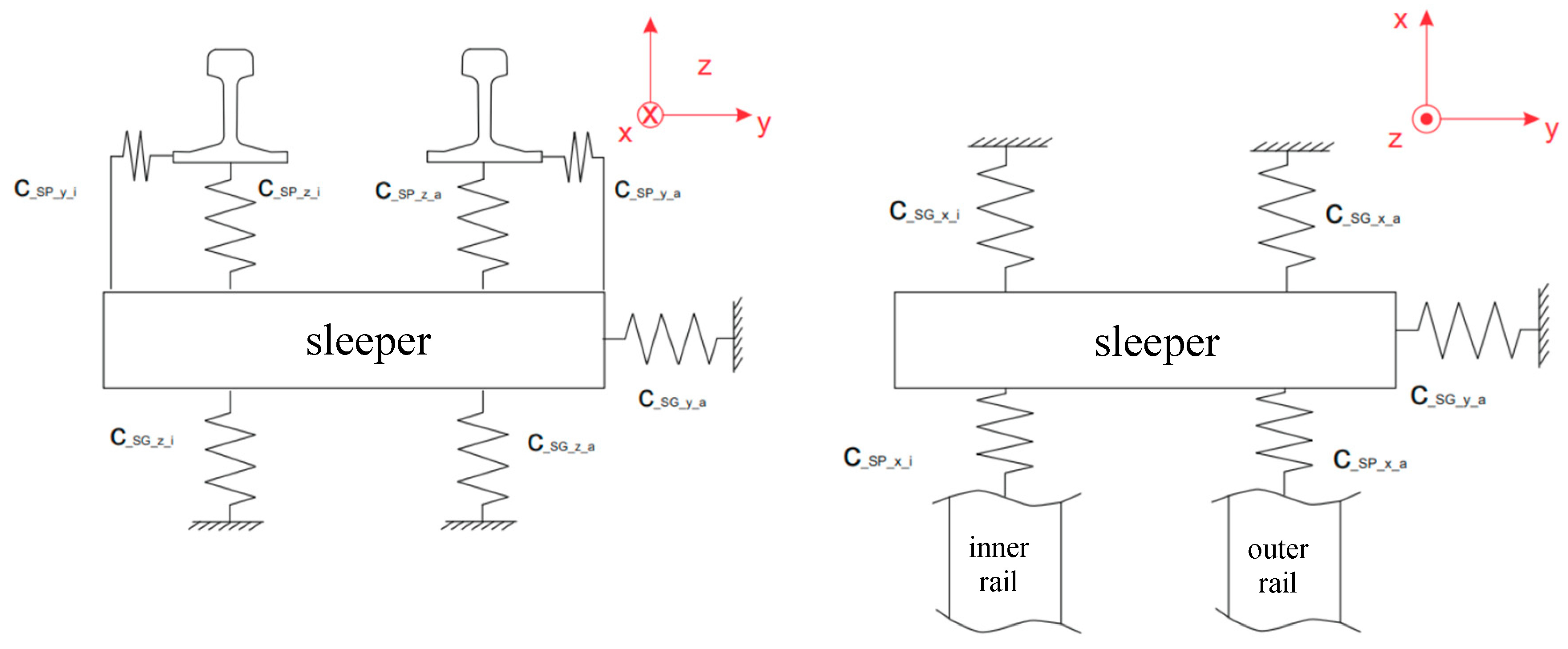
Two track models (straight line and 183 m radius track curve) are constructed. The rails (1D elements with 1 node per cm length) are connected to each sleeper by a vertical and a horizontal spring crosswise to the track axis (Figure 9). The sleepers are also supported vertically under each rail and horizontally to the basis. In the longitudinal direction, the rails are supported on the sleepers, and the sleepers themselves are again supported to the basis. Table 5 shows the stiffness of the conjunctions derived from different sources. The difference between the vertical stiffnesses of the sleeper and rail pad is striking. These values were determined on the basis of the deflection of Sleeper 1, which is significantly high in this case (sleeper installed in 2004). The corresponding stiffness of the rail pad was then determined via simulation [16]. It should be noted that the absolute parameter values are not decisive for the simulation objective; rather, it is important to map an already worn track.
Damper forces are not considered in the couplings, as this is a static simulation (with regard to the vehicle position).
Since we are not focusing on the absolute values of the results in this analysis but rather want to capture the influence of lateral forces, we have neglected two aspects:
  • Since the investigation concerns the behaviour of the entire track grid, the torsional stiffness of the rails and the rail fastenings were not taken into account.
  • The influence of torsional resistance of the track grid is low compared to the LTR. Prud’homme himself describes it as negligible [5,6,7].
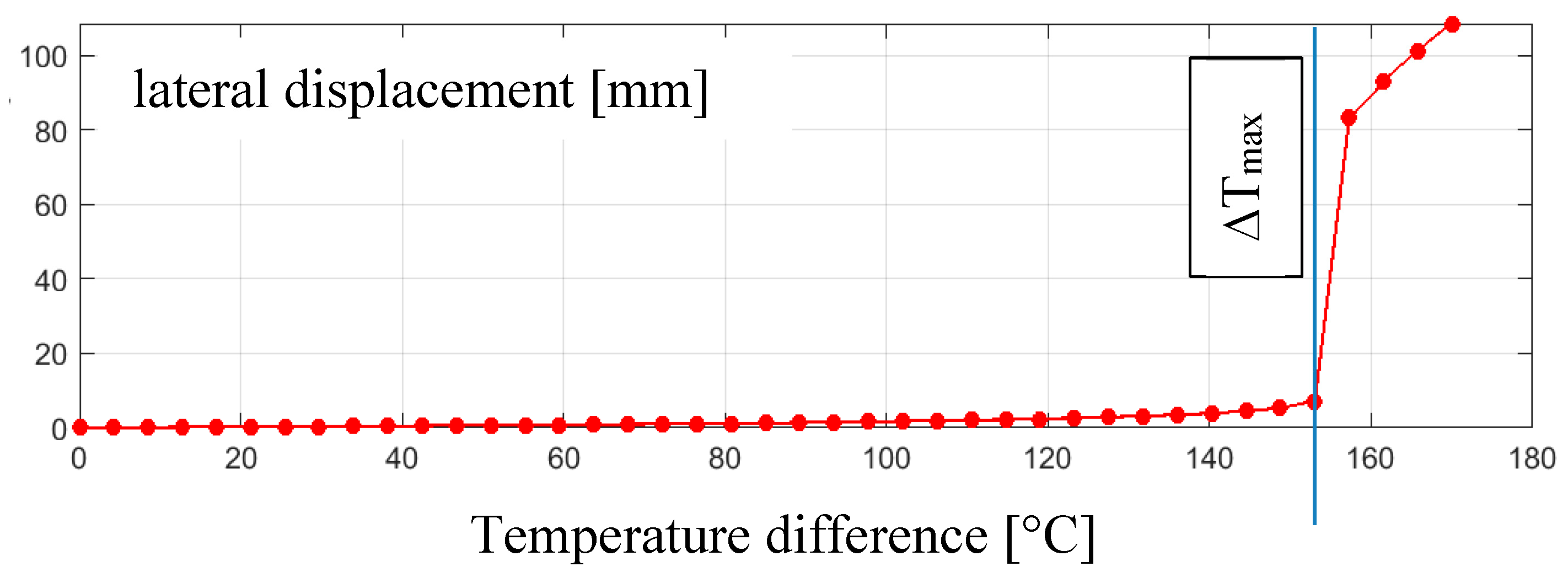
The track buckles at the value of ∆Tmax, at which point the second derivative of the lateral track displacement over the temperature difference shows its maximum (Figure 10).

2.5. Validation of the Track Model

In the 1980s, the Technische Universität München, Prüfamt für Bau von Landverkehrswegen (Technical University of Munich, Inspection office for the construction of traffic routes by land) carried out large-scale field tests on track buckling behaviour under the leadership of Eisenmann [25,26]. At several locations in the Deutsche Bahn network, the rails were heated until buckling occurred, and the ambient conditions were documented. Two tests were selected from the test series to validate the simulation model: a straight section and a track curve with a radius of 246 m.
In preparation for the tests, the lateral track resistances of the sleepers were measured, and track alignment errors were applied in the form of a sine curve. It should be noted that these alignment errors were 23 mm and 21.5 mm, respectively. The current standard EN13848-5 ‘Railway applications—Track—Track geometry quality—Part 5: Geometric quality levels—Plain line, switches and crossings’ [27] defines the immediate intervention threshold of track maintenance for speeds v ≤ 80 km/h, i.e., in the lowest speed range with the largest possible track geometry errors, as 22 mm (in the wavelength range D1 from 3 to 25 m). So, from today’s point of view, these directional errors are de facto already to be regarded as inadmissible for operational purposes.
In addition to the rail temperature, the normal stresses and longitudinal and lateral displacements of the track grid were also measured during the tests. The heating of the rails was ensured by direct application of current through the rails. The tests were carried out unloaded, i.e., without a vehicle, in both the straight and curved sections.
For validation, the simulation model was parameterised accordingly. One difference to the field tests, however, is the assumption of equal LTRs for all sleepers. The scatter that occurs in real-world circumstances was therefore not taken into account here.
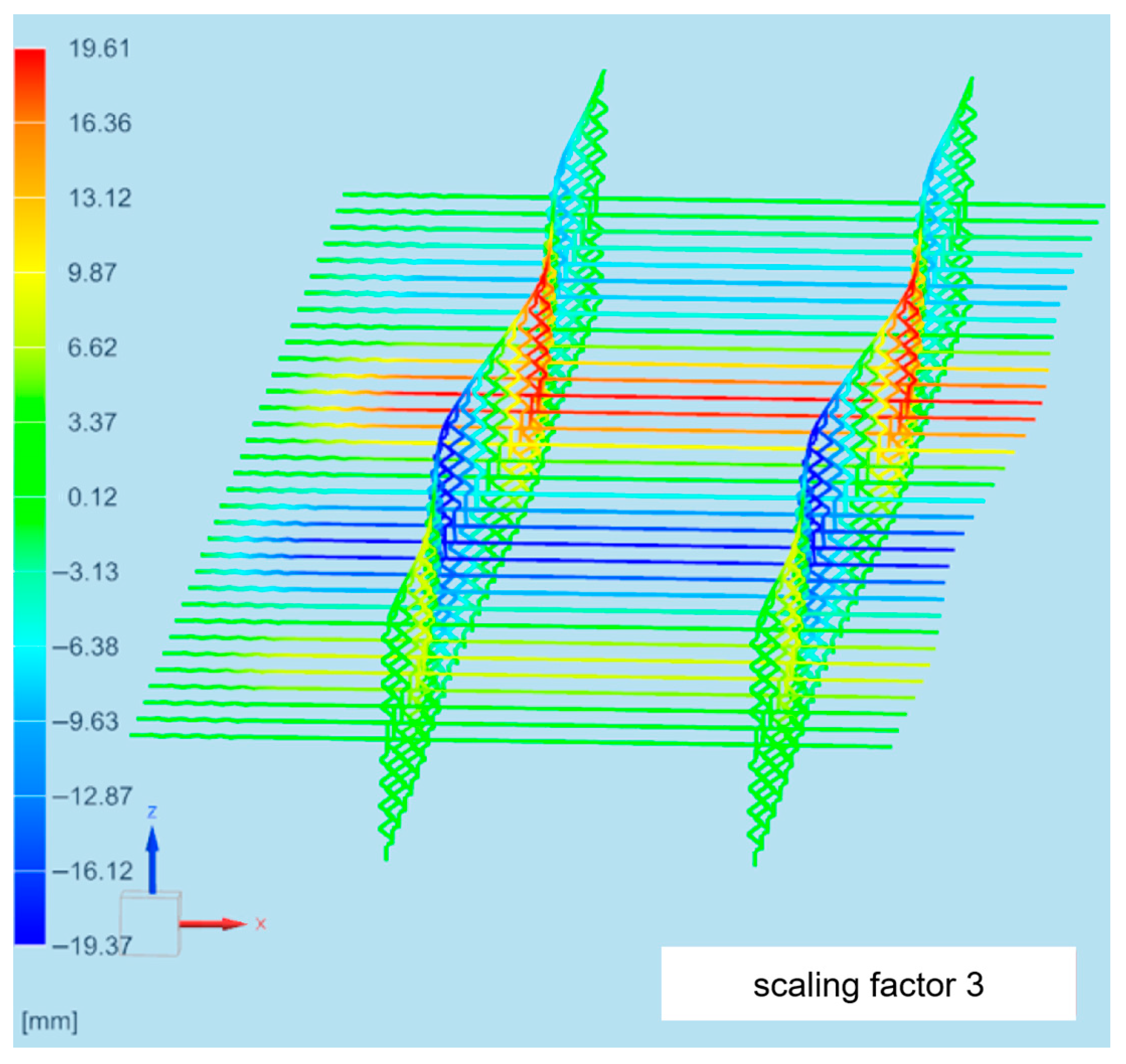
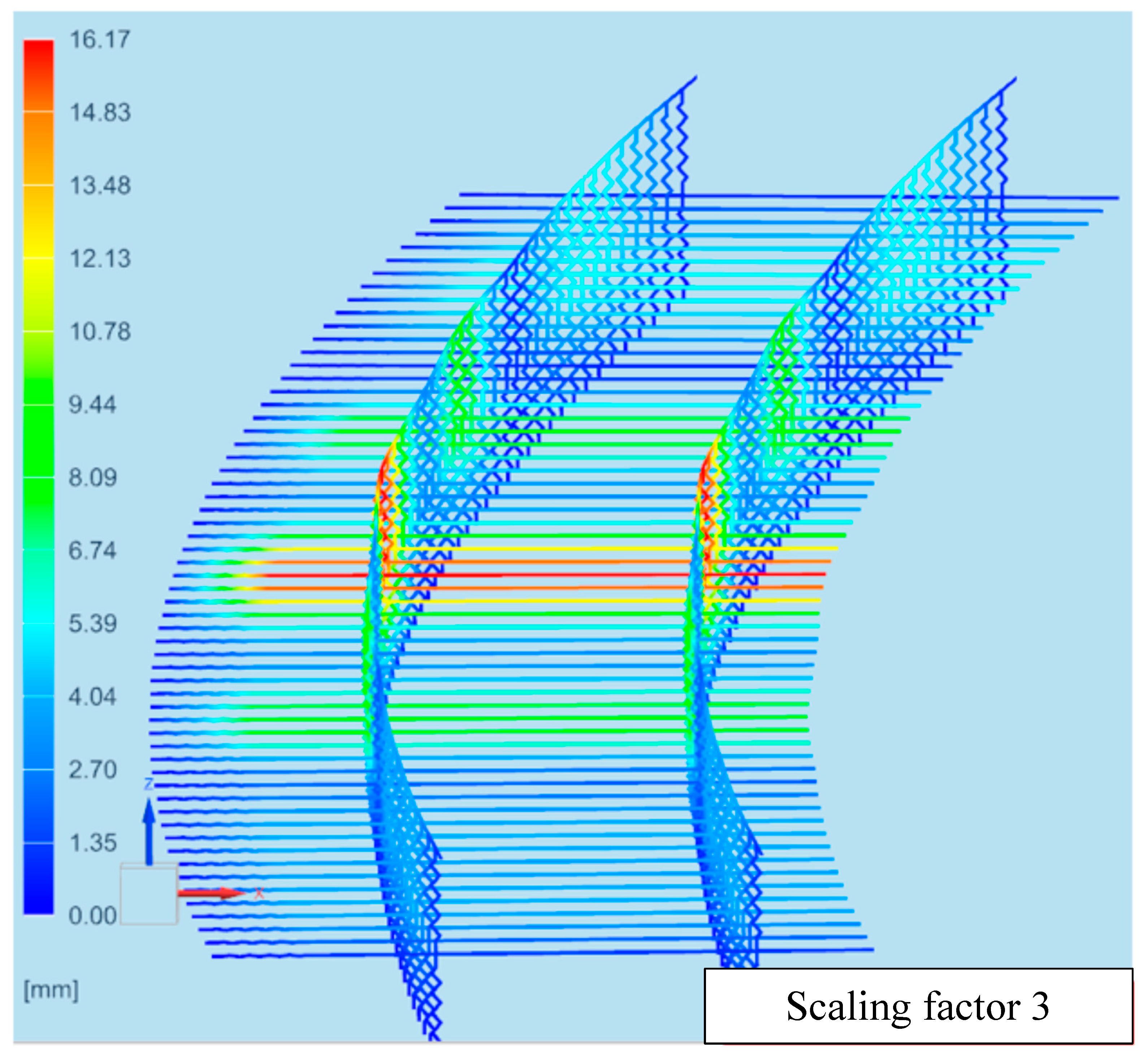
In the test on the straight track, track buckling was triggered at a temperature increase of ΔT = 72 °C. Figure 11 shows the model with lateral displacements at a temperature load ΔT = 73 °C, when buckling occurs according to the previously defined criterion. The lateral displacement scale shown is to be understood, in addition to the track alignment error already introduced before the simulation, as a starting condition.
During testing in a track curve, buckling occurred at temperatures of 35–38 °C, measured along the length of the test track. The model for this track section is constructed with a radius of 246 m and the corresponding track alignment error. Furthermore, rail 49E1 is implemented in the model with a sleeper spacing of 670 mm.
Figure 12 shows the model with lateral displacement at the calculated critical temperature rise of ΔT = 40 °C. This corresponds very well with the historical tests. The small deviation can be explained by the fact that the simulations are based on a stress-free rail, i.e., without taking into account the longitudinal stresses caused by the initial alignment error in the test. Also, as already mentioned, the scattering of the lateral track resistance in the test track is not taken into account in the simulation model.
As the created model provides comparable results for the buckling temperature under conditions of the historical tests (see Table 6), it is used as the basis for further simulations in a straight track and the track curve of a very small radius as part of the parameter studies.

2.6. Parameter Studies

2.6.1. Wheelset Load

In order to be able to estimate the influence of the lateral wheelset force on track buckling, different variants in the straight track and the track curve with a radius of 183 m are calculated. Subsequent to the determination of the LTR in chapter 2.3, the wheelset load is varied with
  • A heavy traction unit (22 t);
  • A modern heavy passenger coach (17.6 t);
  • An empty freight waggon (3.9 t).

2.6.2. Track Positions

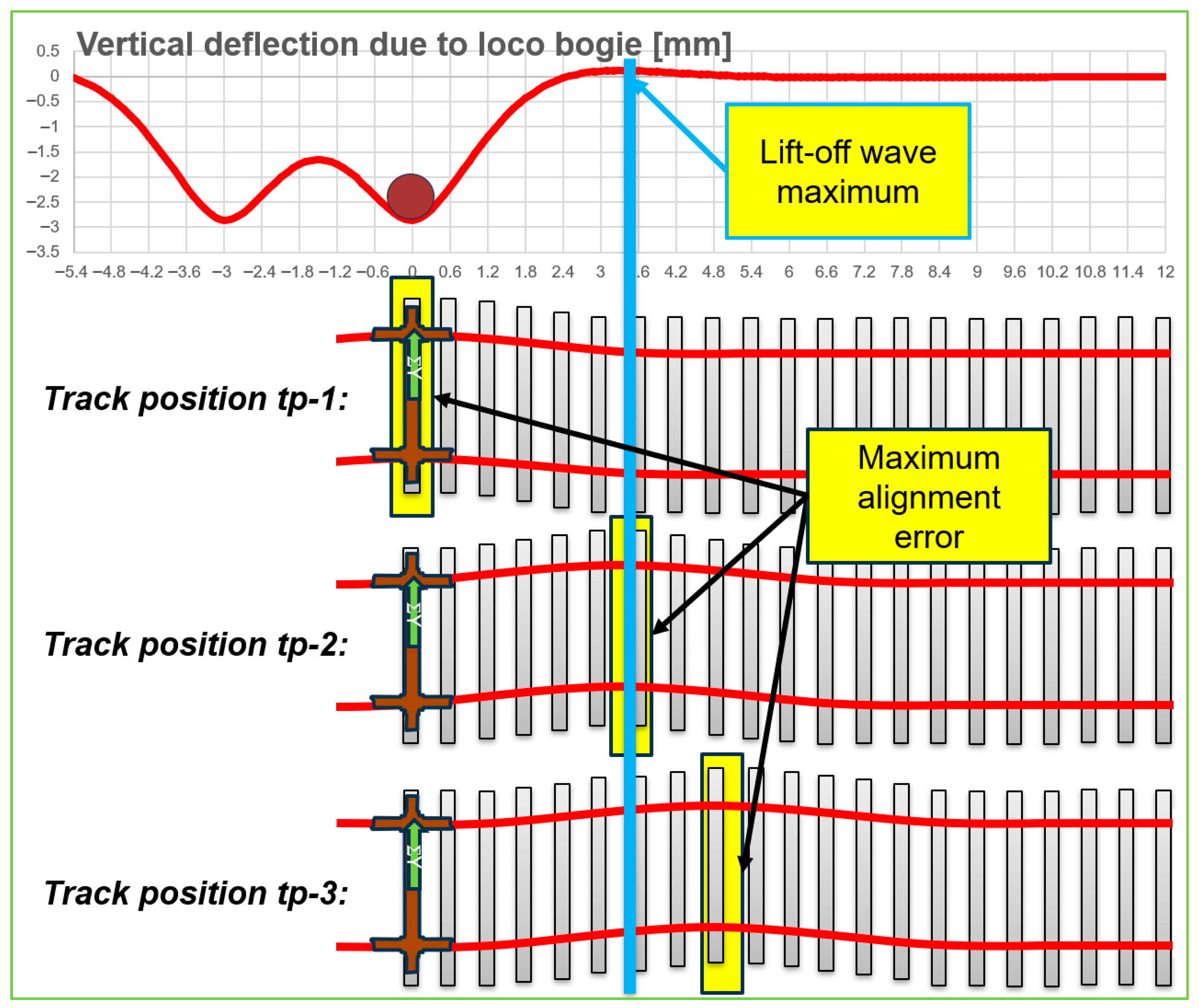
Three different track positions (tp) of the wheelset are considered, which depended on where the vehicle with its first wheelset (and the resulting changed LTR) is located in relation to the modelled alignment error (Figure 13).
Track position tp-1: The wheelset is positioned exactly above the maximum alignment error. Therefore, the maximum of the LTR and the alignment error are positioned on the same track cross-section.
Track position tp-2: The wheelset is approaching the track position error. It is positioned as such that the reduced LTR of the lift-off wave maximum and the largest alignment error coincide.
Track position tp-3: The wheelset is even further away from the alignment error. Accordingly, the reduced LTR still occurs within the alignment error (but not at its maximum).

2.6.3. Alignment Errors

The alignment error in the track is assigned two values, with 0 mm as a reference case:
  • Either 22 mm (the immediate action limit (IAL) for speeds v ≤ 80 km/h, in accordance with EN13848-5 [27]);
  • Or 18 mm (as a comparison).

2.6.4. Lateral Wheelset Forces

The introduction of lateral wheelset forces in the simulation is set with each of the following values:
  • Prud’homme limit value;
  • Double Prud’homme limit value;
  • Quadruple Prud’homme limit value.
This variation is intended to determine whether the lateral wheelset forces are able to influence the critical temperature for track buckling.

3. Results

At the beginning, the wheelset load and the track alignment error are varied while simulating the straight track; hereinafter, the lateral wheelset forces (ΣY) are included when investigating track curves of very small radius.
As the simulation with NX Nastran cannot take running dynamics into account, the track geometry stability is considered at various stationary points during the train passage. The aim is to find a worst-case scenario for the individual parameters and to continue working with this, which is done so that the most critical scenarios can be identified.

3.1. Straight Track

To begin with, the straight track is considered to better understand the situation in the track curve. Here, for properly maintained vehicles, major lateral wheelset forces are only to be expected from unstable vehicle behaviour, which is not analysed in this paper. These are therefore not taken into account here.
In order to find out which parameter combinations most promote track buckling, several scenarios are simulated.
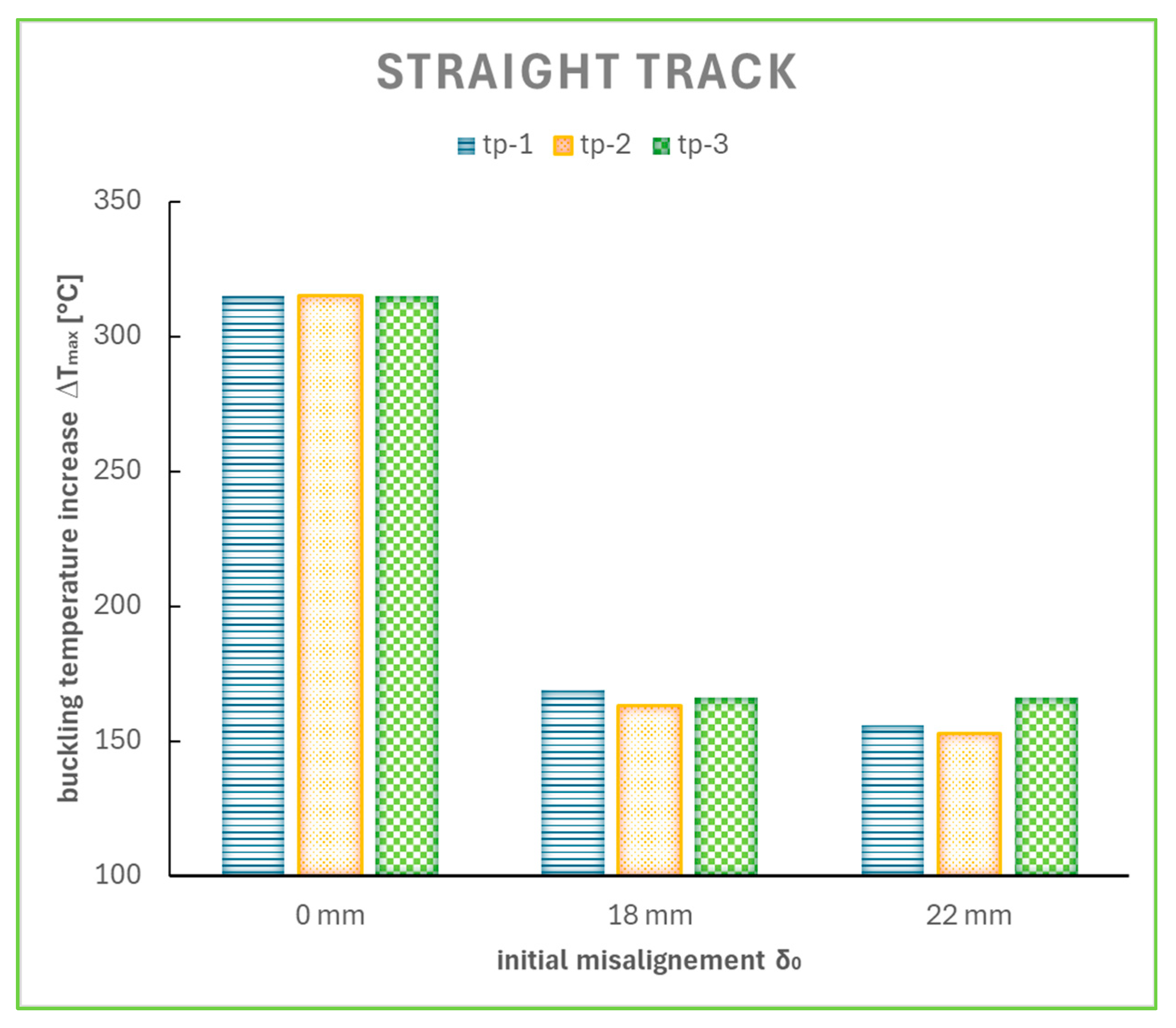
In the first round of simulations, the influence of the alignment error is investigated. The critical case is tp-2, where the lift-off wave and the alignment error coincide. The bigger the alignment error, the lower the bearable temperature increase becomes (Figure 14).
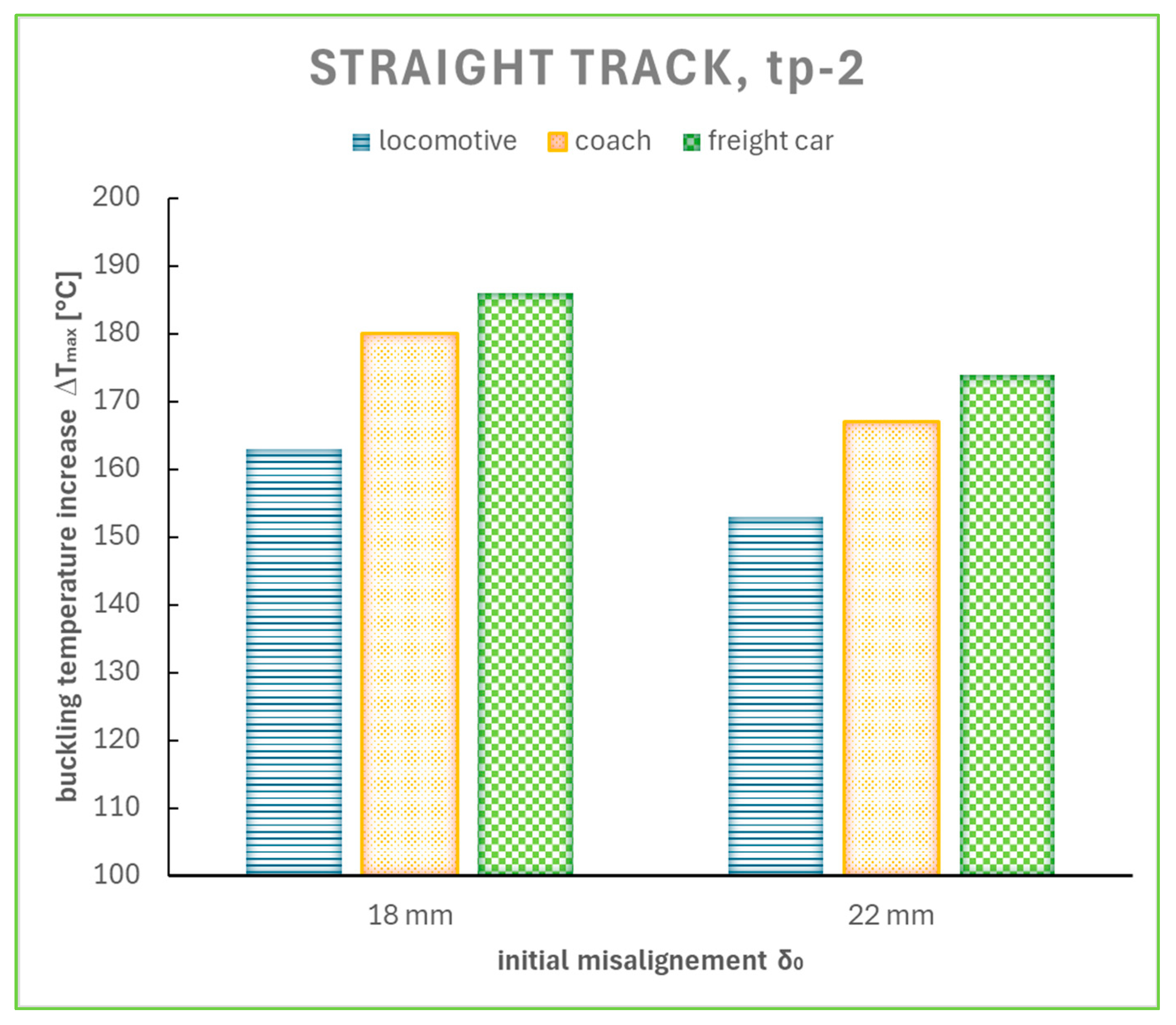
Therefore, the second round of simulations focusses on tp-2 and includes different wheelset loads. The following results are obtained for the heavy passenger coach and the empty freight waggon (Figure 15):
The smallest critical temperature difference in a straight track occurs at the highest wheelset load (with the biggest lift-off wave) and the biggest alignment error.

3.2. Curved Track

When travelling a curve, lateral wheelset forces impel the vehicle to go according to the track curve around the vertical axes. Depending on the running characteristics and other influencing variables, these lateral wheelset forces can increase. For this reason, lateral wheelset forces are also considered in the simulations. If the Prud’homme criterion represents a relevant limit in stable curve running, this should be recognisable when exceeded by a factor of 2 or 4. This also applies in both loosened and consolidated track.
As we have seen in straight track simulations, the empty freight waggon does not cause any critical track behaviour and is therefore skipped.
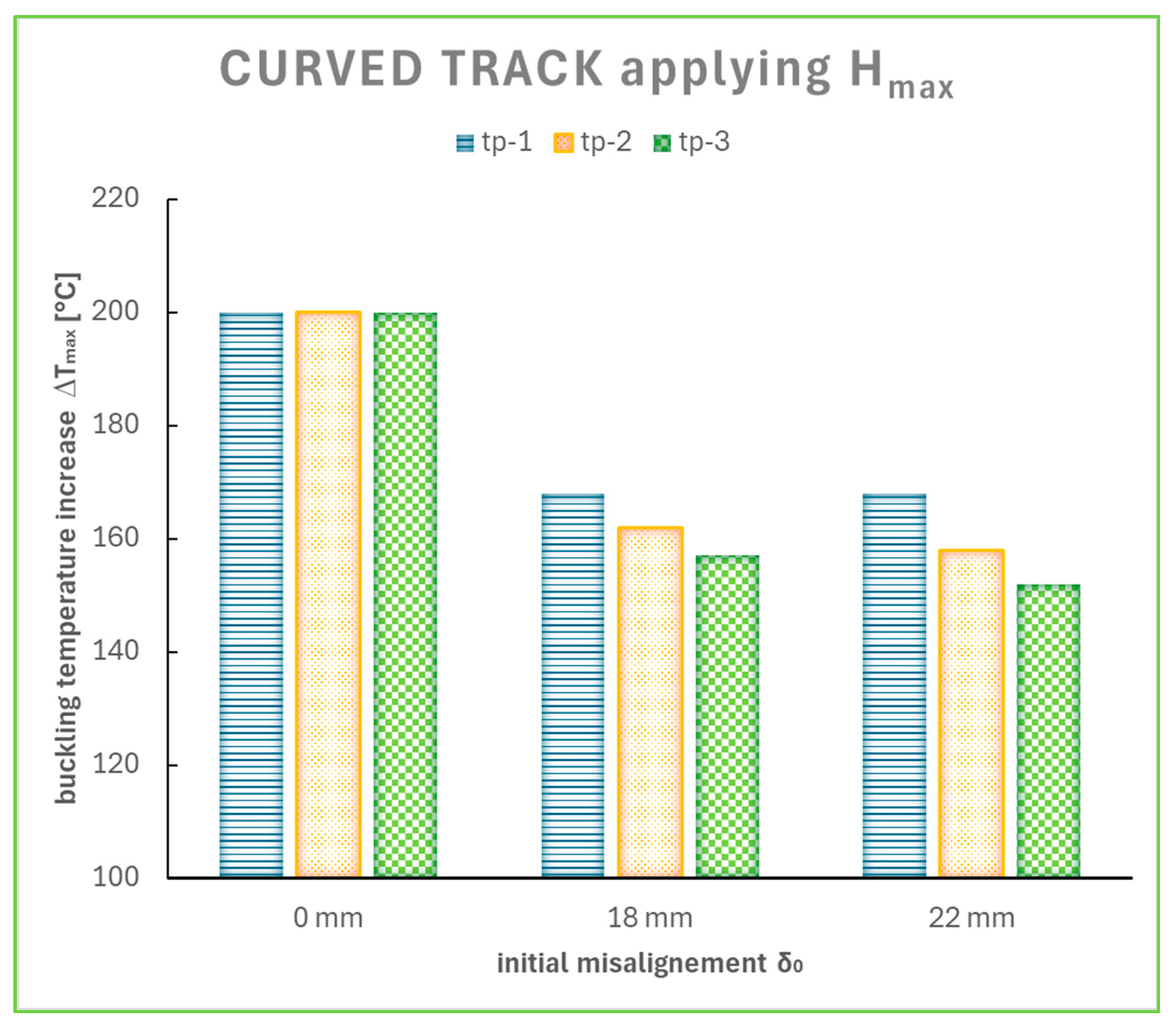
The critical thermal loads with a locomotive for track positions 1, 2 and 3 are shown in Figure 16. Lateral wheelset forces that equal the limit of Prud’homme (Hmax) are applied. Track position 3 leads to the lowest critical temperature differences; therefore, it can be regarded as the worst-case position in a curved track.
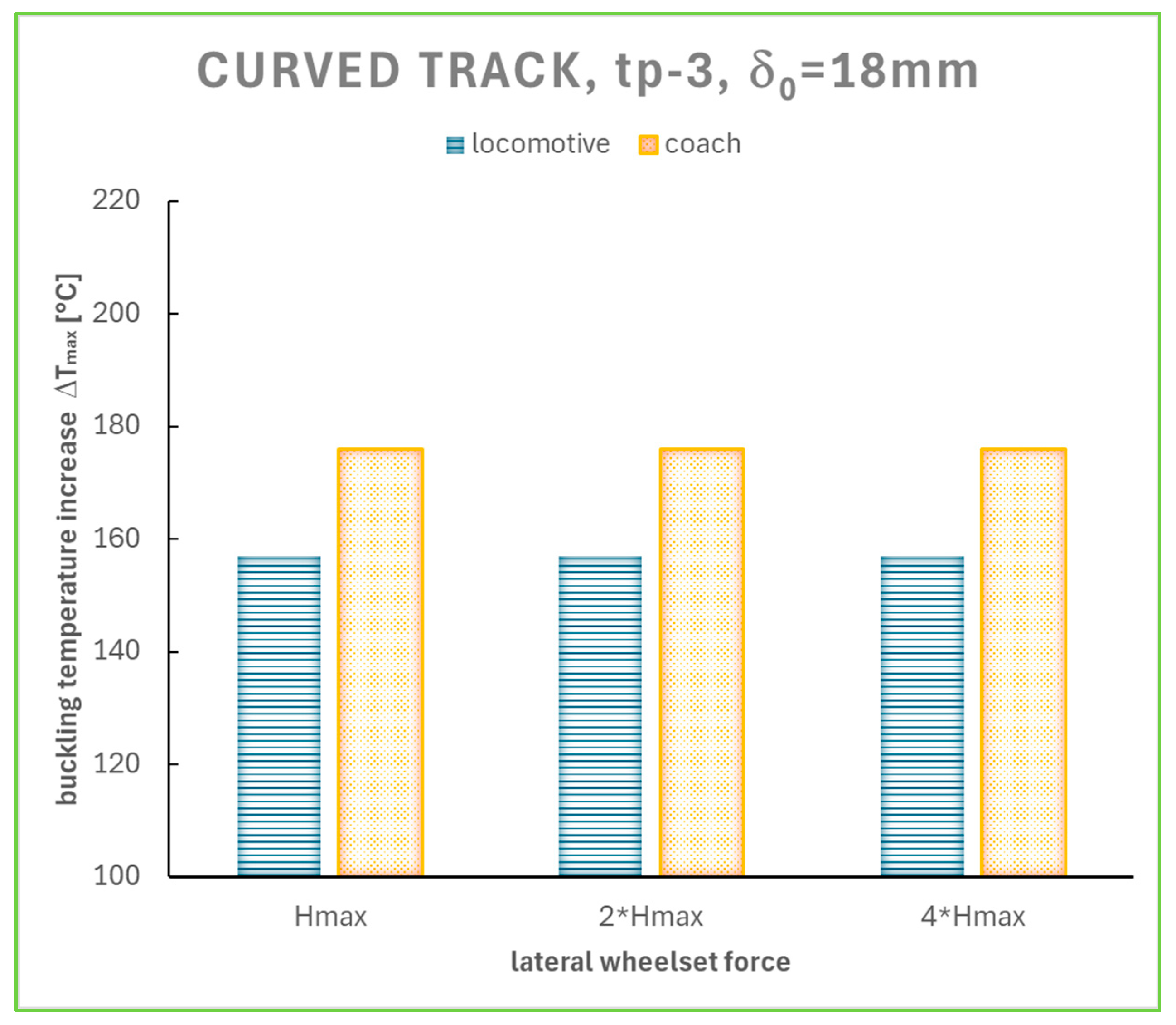
In the second round of simulations, further parameter studies with track position 3 for locomotives and passenger coaches are carried out. The lateral wheelset forces (Hmax) are doubled or quadrupled in this case.
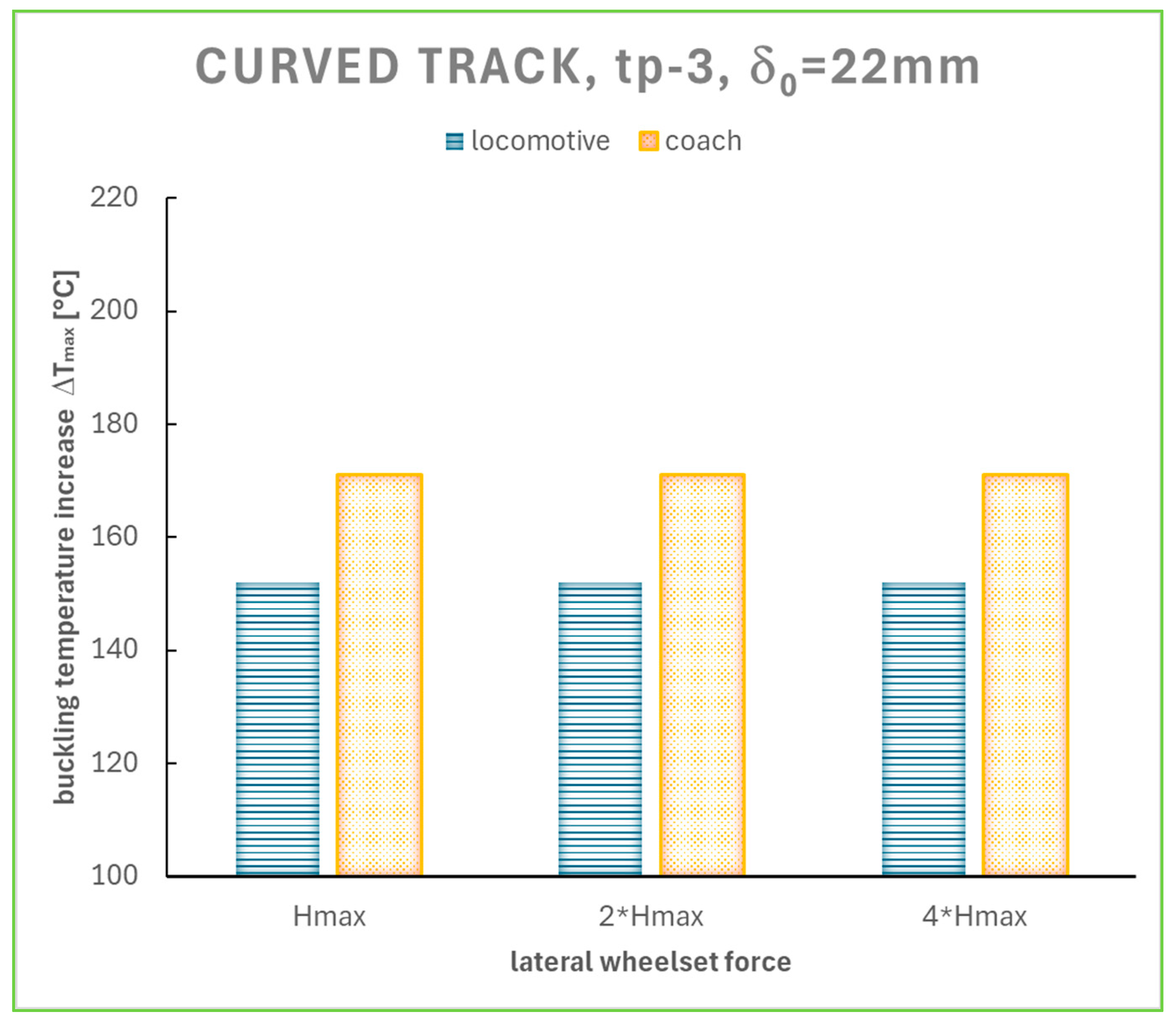
Figure 17 shows a comparison of critical thermal loads with increasing lateral wheelset forces. The simulations are carried out with an initial alignment error of 18 mm. It can be seen that, for each vehicle type, the critical temperature rise remains unchanged, no matter how much lateral wheelset force is applied.
Lastly, Figure 18 shows the critical temperature for buckling as a function of the lateral wheelset forces for a 22 mm alignment error. As expected, the critical temperatures are lower than in Figure 17. Figure 18 confirms that the track stability remains unchanged, even with lateral wheelset forces at four times the Prud’homme criterion.

4. Discussion

The fourth Euler buckling case clamped on both sides was recognised as relevant for the analytical calculation of the buckling load of a rail. The comparative image of a buckled track (Figure 2) clearly shows similarity with the theoretical approach.
By comparing the different calculation methods, it was seen that the influence of temperature not only builds up the longitudinal forces in the rails, thus making track buckling possible, but also that the cross-sectional values change due to the material expansion (so that the maximum buckling temperature also increases with rising rail temperature).
Only a consolidated track was available for determining the LTR under the load of a vehicle, so the calculations were carried out with these values. Even though the Prud’homme criterion refers to a recently maintained track, it can be assumed that an influence on the simulation results must be recognisable when the applied lateral wheelset forces are exceeded to such a massive extent. However, this is not the case.
The critical temperature differences in Eisenmann’s field test are remarkably low. This could have three reasons. The first is that the test track was not consolidated. The second is that the alignment error of the track is at a level which is already considered impermissible from today’s operational point of view. And the third reason is that the LTR dispersion of the sleepers can lower the actual buckling temperature. However, the lowness of the critical temperature is not decisive for the issue at hand, as it is not the absolute limit temperature that has to be determined but the relative influence of the lateral wheelset forces.
The three different cases for the simulation—the relative position of the alignment error in relation to the lift-off wave—show impressively that the track fails easiest where the lift-off wave reduces the LTR.
In track position 1, track buckling occurs in the area of the reduced LTR. This is in line with expectations, as the area of the largest alignment error has a LTR maximised by the wheelset load. In tp-2, the buckling point is clear, as the areas of the largest alignment error and the reduced LTR coincide. Finally, track buckling in tp-3 occurs in the area of the largest alignment error. The track stability is weakened by both the track alignment error and the reduced LTR.
∆Tmin (see Figure 1) is very often referenced for the design of the track, but as the focus is on the failure of the track, only ∆Tmax is considered in this work.
The simulation in straight track clearly shows that the lift-off wave is bigger with a high wheelset load than with a low one. Therefore, the lateral track resistance in the lift-off wave is reduced most by heavy vehicles. The permissible temperature difference is then at its lowest. The lifting wave can therefore again be described as the initiator of track buckling.
In the curve, an “alignment error” is already inherent in the system due to the track layout in curves (so that the critical temperature difference is significantly lower compared to the straight track without additional alignment errors).
In contrast to the straight track, in curves tp-3, one can find the lowest permissible temperature difference. A deviation in the temperature difference after the application of lateral wheelset forces is not detectable for this case.

5. Conclusions

From the described calculations, several conclusions can be deduced:
  • The application of a finite-element analysis is best suited for simulating related track behaviour.
  • The maximum deviation of ∆Tmax from Eisenmann’s field tests was 5 °C. This is a remarkable agreement between tests and measurements, although the scatter of the lateral resistance of sleepers in the field test was not taken into account in the simulation.
  • The parametrisation with measurement data leads to realistic results.
  • In a straight track, the magnitude of the alignment error clearly determines the height of ∆T.
  • The second largest influence comes from the wheelset load induced lift-off wave.
  • In a curved track, the magnitude of the alignment error continues to dominate ∆T, even if the curve radius already reduces ∆T compared to the straight track.
  • No influence of lateral wheelset forces on track buckling was found.
The conclusion derived from the literature review [14], that of the lateral wheelset forces with a magnitude far above the Prud’homme limit value having no influence on the occurrence of track buckling, is again confirmed.
This work is intended to supplement an overall concept that re-examines the role of the Prud’homme limit value in wheel–rail interaction (see details in [14]). Since the terms ‘track buckling’ and ‘track shifting’ are often used in a misleading way, the effects of wheelset lateral force are not generally known in detail. The influence of the wheelset lateral force on snap-through buckling was not possible to confirm. These findings will be part of the overall verification process.

Author Contributions

Conceptualization, R.S., M.L. and F.P.; Methodology, R.S., M.L. and F.P.; Software, R.S., F.K. and M.L.; Validation, R.S., M.L. and F.P.; Formal analysis, R.S.; Investigation, R.S.; Resources, R.S. and M.L.; Data curation, R.S.; Writing—original draft, R.S.; Writing—review & editing, F.K., M.L. and F.P.; Visualization, R.S.; Supervision, F.P.; Project administration, F.P.; Funding acquisition, F.P. All authors have read and agreed to the published version of the manuscript.

Funding

This work is part of the Project “Examination of the Prud’homme criterion, especially in very narrow curves” and is supported by the ÖBB-Infrastruktur AG.

Data Availability Statement

Data are contained within the article.

Acknowledgments

This work is part of the Project “Examination of the Prud’homme criterion, especially in very narrow curves” and is supported by the ÖBB-Infrastruktur AG and the Open Access Funding by the Graz University of Technology.

Conflicts of Interest

Author Roman Schmid was employed by the company ÖBB-Produktion GmbH. Author Faris Karic was employed by the company Rail Cargo Austria. The remaining authors declare that the research was conducted in the absence of any commercial or financial relationships that could be construed as a potential conflict of interest.

References

  1. Birk, A. Der Eisenbahnunfall bei Borki [The railway accident near Borki]. Wochenschr. Osterr. Ing. Archit. Vereines 1889, 14, 80–83. (In German) [Google Scholar]
  2. Fastenrath, F. Die Eisenbahnschiene [The Railway Rail]; Wilhelm Ernst & Sohn: Berlin, Germany, 1977. (In German) [Google Scholar]
  3. Prud‘homme, A.; Janin, G. Die Stabilität des mit durchgehend geschweißten Schienen verlegten Gleises, Teil 1 [Stability of tracks with continuous welded rails, part 1]. Monatsschrift Intern. Eisenb. Kongr. Ver. 1969, 6, 398–427. (In German) [Google Scholar]
  4. Prud‘homme, A.; Janin, G. Die Stabilität des mit durchgehend geschweißten Schienen verlegten Gleises, Teil 2 [Stability of tracks with continuous welded rails, part 2]. Monatsschrift Intern. Eisenb. Kongr. Ver. 1969, 7/8, 460–480. (In German) [Google Scholar]
  5. Prud’homme, A. La résistance de la voie aux efforts transversaux exercés par le matériel roulant [Track resistance to the lateral load exerted by the vehicles]. Rev. Générale Chemins Fer 1967, 86, 1–23. (In French) [Google Scholar]
  6. Prud’homme, A. The resistance of the permanent way to thre transversal stresses exerted by the rolling stock. Bull. Int. Railw. Congr. Assoc. 1967, 11, 731–766. [Google Scholar]
  7. Prud‘homme, A. Der Widerstand des Gleises gegen die von den Fahrzeugen ausgehende seitliche Beanspruchung [Track resistance to the lateral load exerted by the vehicles]. Monatsschrift Intern. Eisenb. Kongr. Ver. 1967, 8/9, 577–595. (In German) [Google Scholar]
  8. Ritzau, H.-J. Katastrophen der Deutschen Bahnen 1945–1992, Teil 1 [Disasters on German Railways 1945–1992, Part 1]; Ritzau KG—Verlag Zeit und Eisenbahn: Pürgen, Germany, 1992. (In German) [Google Scholar]
  9. ORE. ORE C138 Report 9. Permissible Maximum Values for the Y- and Q-Forces and Derailment Criteria; ORE: Utrecht, The Netherlands, 1986. [Google Scholar]
  10. UIC. UIC Leaflet 518. Testing and Approval of Railway Vehicles from the Point of View of Their Dynamic Behaviour—Safety—Track fatigue—Running Behaviour; International Union of Railways—UIC: Paris, France, 1995. [Google Scholar]
  11. Ahmad, S.N.; Mandal, N.K.; Chattopadhyay, G. A comparative study of track buckling parameters of continuous welded rail. In Proceedings of the International Conference on Mechanical Engineering, Dhaka, Bangladesh, 26–28 December 2009. [Google Scholar]
  12. Kish, A. Influence of Vehicle Induced Loads on the Lateral Stability of CWR Track; Office of Research and Development: Washington, DC, USA, 1985.
  13. EN 14363; Railway Applications—Testing and Simulation for the Acceptance of Running Characteristics of Railway Vehicles—Running Behaviour and Stationary Tests. CEN: Brussels, Belgium, 2022.
  14. Schmid, R.; Micić Batka, V.; Pospischil, F. Prud’homme criterion: A review of its application in railway vehicle approval. Int. J. Rail Transp. 2026, 14, 1–16. [Google Scholar] [CrossRef]
  15. Metnitzer, K.; Schmid, R.; Pospischil, F. Prud’hommes Kriterium und seine Relevanz für den heutigen Fahrweg [Prud’homme’s criterion and its relevance for the modern railway track]. ZEVrail 2023, 147, 67–73. (In German) [Google Scholar]
  16. Karic, F. Simulative Untersuchung des Knickversagens von Endlosgeschweißten Eisenbahnschienen [Simulative Investigation of Buckling Failure of Continuously Welded Railway Rails]. Master’s Thesis, Graz University of Technology, Graz, Austria, 2024. (In German) [Google Scholar]
  17. UIC. IRS-70720 Laying and Maintenance of Tracks with Continuous Welded Rails (CWR Track); UIC leaflet draft; UIC: Paris, France, 2023. [Google Scholar]
  18. Ruef, N. Gleisverwerfungen in Westösterreich [Buckled Tracks in Western Austria]; Technical Report; ÖBB-Infrastruktur AG: Wien, Austria, 2015. (In German) [Google Scholar]
  19. EN 13674-1; Railway Applications—Rail—Part 1: Vignole Railway Rails 46 kg/m and Above. CEN: Brussels, Belgium, 2023.
  20. Finite Element Based Solver NX Nastran, version 2306 v.2023.06; Siemens: Munich, Germany, 2023.
  21. Simulia. Simpack: Simulations Software for Multibody Systems, version 2023.x2; Dassault Systemes: Vélizy-Villacoublay, France, 2023.
  22. Zimmermann, H. Die Berechnung des Eisenbahnoberbaus [The Calculation of the Railroad Superstructure]; Ernst & Korn: Berlin, Germany, 1888. (In German) [Google Scholar]
  23. Steiner, E. Bericht Durchführung von Querverschiebewiderstandsmessungen an Holzschwellen im Auflastbereich Einer Lokachse [Report Carrying out Lateral Track Resistance Measurements on Wooden Sleepers in the Load Area of a Locomotive Wheelset]; Universität Innsbruck, Institut für Infrastruktur: Innsbruck, Austria, 2023. (In German) [Google Scholar]
  24. Weilguny, R.; Leitner, M.; Brunnhofer, P.; Pospischil, F. Investigation of dynamic gauge widening in small radius curves and the impact on lateral wheel-rail contact forces. Veh. Syst. Dyn. 2024, 62, 2112–2137. [Google Scholar] [CrossRef]
  25. Eisenmann, J. Gleisverwerfungsversuch an Einem Geraden Gleis im Durchgearbeitetem Zustand [Track Buckling Test on a Straight, Just Maintained Track]; Technical Report No. 1216; Prüfamt für Bau von Landesverkehrswegen, TU München: Munich, Germany, 1987. (In German) [Google Scholar]
  26. Eisenmann, J. Gleisverwerfungsversuch in Einem Bogen Mit 246 m Halbmesser im Durchgearbeitetem Zustand [Track Buckling Test on a Just Maintained Curve With 246 m Radius]; Technical Report No. 1075; Prüfamt für Bau von Landesverkehrswegen, TU München: Munich, Germany, 1984. (In German) [Google Scholar]
  27. EN13848-5; Railway Applications—Track—Track Geometry Quality—Part 5: Geometric Quality Levels—Plain Line, Switches and Crossings. CEN: Brussels, Belgium, 2017.
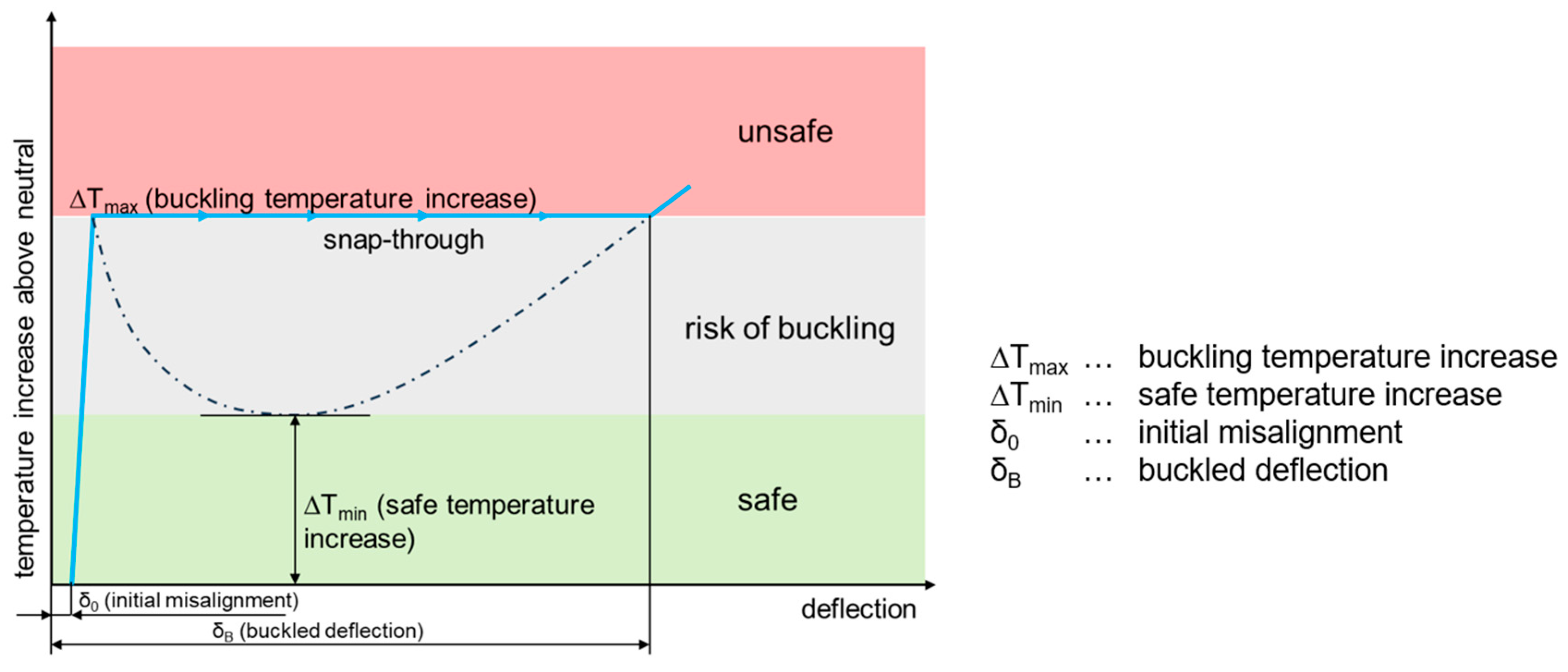
Figure 1. Basic behaviour of a track under temperature-induced longitudinal compressive forces (snap-through buckling (in reference to [17])).
Machines 14 00203 g001
Figure 2. The fourth Euler buckling case on the left. In comparison, a buckled track is shown on the right (from [18]).
Machines 14 00203 g002
Figure 3. Comparison of finite-element simulations in NX Nastran with 1D and 3D elements.
Machines 14 00203 g003
Figure 4. Deflection of the rails due to wheelset load with different effects on the LTR. (LTR of yellow sleepers remain unchanged.)
Machines 14 00203 g004
Figure 5. Numbering of sleepers measured. Due to vertical rail deflection each sleeper has a different LTR.
Machines 14 00203 g005
Figure 6. Measurement of the wheelset-influenced LTR.
Machines 14 00203 g006
Figure 7. Derived LTR of the individual sleepers under load, with the associated rail vertical deflection calculated.
Machines 14 00203 g007
Figure 8. Measured and converted LTR of the first sleeper under the wheelset regarding three different vehicle types [16].
Machines 14 00203 g008
Figure 9. Components of the track model with the spring connections [16].
Machines 14 00203 g009
Figure 10. Illustration of the track lateral displacement as a function of temperature.
Machines 14 00203 g010
Figure 11. Displacements in the model of the straight track at 73 °C.
Machines 14 00203 g011
Figure 12. Displacements in the model of the track curve at 40 °C.
Machines 14 00203 g012
Figure 13. The investigated positions of the vehicle in relation to the alignment error (track positions).
Machines 14 00203 g013
Figure 14. Critical temperature load for various alignment errors in a straight track while a locomotive passes over.
Machines 14 00203 g014
Figure 15. Critical temperature load for various rail vehicles in the straight track when considering wheelset position 2 (tp-2).
Machines 14 00203 g015
Figure 16. Critical temperature load for various alignment errors in a track curve of a very small radius.
Machines 14 00203 g016
Figure 17. Critical temperature load for locomotives and passenger coaches with 18 mm alignment error in a track curve of very small radius.
Machines 14 00203 g017
Figure 18. Critical temperature load for locomotives and passenger coaches with a 22 mm alignment error in a track curve of very small radius.
Machines 14 00203 g018
Table 1. Performance of the various simulation methods for the buckling bar (from [16]).
ApproachMethodSuitable for TaskCritical Force [kN]Computing Time [s]Number of Nodes
AnalyticalEuler-425--
Finite-element method1D elements
Temperature load
Solver SOL106
440120
1D elements
Temperature load
Solver SOL105
454120
1D elements
Force applied
425120
3D-elements
CTETRA(10)
4248222.2 × 105
Multi-body simulationImported flexible bodies ---
Linear Simbeam
Euler–Bernoulli beam
427421
Linear Simbeam
Timoshenko beam
453421
Non-linear Simbeam
Euler–Bernoulli beam
4301221
Non-linear Simbeam
Timoshenko beam
4301221
Table 3. LTR of the single sleepers used for the simulation derived from measurements.
Sleeper NumberLTR [kN]
184.00
274.00
344.67
427.90
515.98
616.24
78.53
89.92
910.17
1011.78
1115.45
1219.85
Table 4. Vehicle type and the calculated corresponding deflection of the rail.
Vehicle TypeWheelset LoadMax. Deflection of the Rail
locomotive22 t2.7 mm
heavy passenger coach (PC)17.6 t1.8 mm
empty freight car (FC)3.9 t0.5 mm
Table 5. Track parameters for the simulation.
ConjunctionIDStiffness [kN/mm]Source
sleeper
vertical stiffness
C_SG_z_i, C_SG_z_a2Correlates with measured depression under sleeper no. 1
sleeper
lateral stiffness
C_SG_y_i, C_SG_y_aspecific value per sleeperCorrelates with measured LTR
sleeper
longitudinal stiffness
C_SG_x_i, C_SG_x_a25Determined by simulation
rail pad
vertical stiffness
C_SP_z_i, C_SP_z_a315Correlates with measured depression under sleeper no. 1
rail pad
lateral stiffness
C_SP_y_i, C_SP_y_a80Value from literature, reference [24]
rail pad
longitudinal stiffness
C_SP_x_i, C_SP_x_a6Value derived from EN1991-2
Table 6. Buckling temperature in historical test and simulation.
ModelHistorical TestSimulation
Straight track72 °C73 °C
Curved track
with track radius R = 246 m
35–38 °C40 °C
Disclaimer/Publisher’s Note: The statements, opinions and data contained in all publications are solely those of the individual author(s) and contributor(s) and not of MDPI and/or the editor(s). MDPI and/or the editor(s) disclaim responsibility for any injury to people or property resulting from any ideas, methods, instructions or products referred to in the content.