1. Introduction
Manufacturing systems are undergoing radical change due to digitalization, market instability, and the growing need for sustainability. The industry contributes about 37% of the world’s energy use and close to 25% of CO
2 emissions linked to energy, which places manufacturing at the crossroads of decarbonization policies and regulatory interventions. At the same time, heightened competition and reduced product life cycles require that production systems have a high degree of reliability, resource efficiency, and adaptive responsiveness when faced with uncertainty [
1,
2,
3].
Most production planning and control systems are also still deterministic, even with the advancements in technology. Enterprise Resource Planning (ERP), Material Requirement Planning (MRP), and Advanced Planning and Scheduling (APS) models are based on hard-determined optimization assumptions that do not represent the variability of demand in the real world, stochastic machine failures and unexpected downtime, which usually leads to the rapid degradation of the plan, higher energy consumption, material wastes, and disruptions in delivery [
4]. Even though artificial intelligence has enhanced demand forecasting and predictive maintenance, these technologies are normally implemented in disjointed ways and optimized without considering scheduling and sustainability goals, which results in disjointed decision-making and unintended trade-offs [
5]. At the same time, regulatory schemes like the EU CBAM and ISO 50001 [
6], along with policies of the circular economy, are increasingly imposing combined energy consumption cuts, carbon intensity, and waste of materials on aging industry equipment [
7,
8,
9,
10]. The current planning solutions are poorly adapted to these needs because of the optimization of all these aspects as being static, the disconnecting of objectives because of siloing, and mismatches between the models and plants because of the dynamics of time-varying energy and degradation. However, a significant research gap remains: the lack of a framework. There is no framework that can be used to real-time, closed-loop co-optimize operational reliability, environmental sustainability, and material efficiency in a high-fidelity cyber–physical environment. The existing methods are unified in terms of individual dimension consideration, simplified models, and not proven to be industrial-scale, whereas Multi-Objective Reinforcement Learning (MORL) methods are challenged by issues of sample inefficiency, policy instability, and limited explainability [
11,
12,
13,
14,
15]. The existence of this gap is the reason why an integrated, physics-informed adaptive planning platform should be developed that will be able to guide reliable and sustainable manufacturing decision-making in real-time.
This study was motivated by the increasing gap between the theoretical developments in Artificial Intelligence (AI) and the real manufacturing requirements. Although reinforced learning, Digital Twins (DTs), and predictive maintenance each showed promise, their disjointed implementation did not allow benefits to the system. The growing regulatory pressure on carbon emissions and the economic consequences of unplanned downtimes required a flexible planning solution that would be able to learn non-intuitive operating plans that would balance sustainability with reliability [
16,
17,
18]. The motivation behind this study was the necessity to create a bridge between simulation and reality, to turn sustainability into a co-optimization goal, and provide deployable intelligence in real manufacturing settings.
The modern manufacturing system produces according to fluctuating demand, strict sustainability policies, and out-of-date equipment, which requires constant adjustment over fixed planning. The existing systems of planning and control do not have the ability to optimize sustainability and reliability in real-time together, which leads to the rescheduling of energy-consuming nature, waste, and the loss of reliability when disruptions occur. These inefficiencies have a direct negative effect on regulatory compliance, operational resilience, and long-term competitiveness. Without incorporated adaptive intelligence, the manufacturers must make a tradeoff between reliability and sustainability, thus compromising the two objectives [
19]. The present study addresses the lack of a cohesive planning paradigm that enables data-driven, intelligent, and explainable decision-making across production, maintenance, and sustainability objectives.
This study proposes the inaugural adaptive planning platform that is based on AI and represents manufacturing planning as a Constrained Multi-Objective Markov Decision Process (CMDP) and optimizes it using physics-informed, Pareto-conditioned reinforcement learning within a high-fidelity DT. In contrast to past studies, the proposed solution can optimize OEE, energy carbon intensity, and material waste in real time simultaneously, maintain policy diversity, and is also shown to exhibit stable simulation-to-reality transfer when deployed in industry. The results are one of a kind that sustainability and reliability goals can be complementary to each other, as opposed to being hostile, thus enhancing the knowledge of manufacturing theory and industrial practice [
20].
The initial purpose of this study was to design, develop, and test an artificial-intelligence-based adaptive planning platform, which can co-optimize sustainability and reliability in manufacturing operations in an uncertain environment in real-time. The specific objectives were to:
- (1)
Engineer a single, cohesive cyber–physical design incorporating a high-fidelity DT of physics-informed DT with state-of-the-art RL algorithms in closed-loop manufacturing planning.
- (2)
Formulate manufacturing planning as a constrained multi-objective decision problem, which optimizes operational reliability measures (e.g., OEE and schedule adherence), at the same time considering the sustainability measures (e.g., energy consumption, carbon intensity, and material waste).
- (3)
Develop a scalable MORL algorithm that maintains policy diversity, ensures satisfaction of constraints, and can dynamically respond to real-time disruptions.
- (4)
Evaluate the usefulness and strength of the suggested platform using a thorough stochastic simulation experiment and industrial pilot implementations in diverse disruption conditions.
- (5)
Analyze the trade-offs and synergies of sustainability and reliability and provide actionable information to the decision-makers to inform both a strategic and operational plan.
The study shows that AI-based adaptive planning can be used to jointly optimize sustainability and reliability in the manufacturing domain in real time. It provides a scalable and practical framework that breaks the constraints of the non-reconfigurable planning and enables energy-efficient, dependable, and resilient manufacturing processes.
2. Literature Review
2.1. Adaptive Manufacturing Planning and AI-Based Decision Systems
The aspect of adaptive manufacturing planning has received growing attention in the literature on Industry 4.0 and Industry 5.0 due to increasing system complexity and uncertainty. According to Sony and Naik [
21], successful digital transformation must involve AI-based systems of decisions, which would be responsive in real-time, cross-functional, and human-centric implementation. A systematic survey by Soori et al. [
22] reported that AI-based decision support systems achieved improvements of approximately 10–25% in system responsiveness and decision accuracy, while most existing solutions remain functionally isolated and poorly integrated across production, maintenance, and sustainability domains. Concentrating on reinforcement learning (RL), Esteso et al. [
23] found that makespan and work-in-process were reduced by 12–18% under stochastic demand conditions. Parallel to scheduling optimization, recent deep learning advances have significantly improved process-level prediction, such as the use of hybrid Dung Beetle Optimization–optimized one-dimensional Convolutional Neural Network with Long Short-Term Memory (DBO-1DCNN-LSTM) algorithms for surface roughness forecasting in grinding [
24] and Convolutional Neural Network (CNN) for predicting geometric profiles in electrochemical machining [
25]. While these methods enhance local process fidelity, Modrak et al. [
26] found that Deep Reinforcement Learning (DRL) is superior.
The recent research has introduced AI-based planning to decentralized and real-time decision-making. Achamrah and Attajer [
27] offered a MORL model of sustainable maintenance choices, but based on fixed preference weights, and it did not consider the real-time interactions with the scheduling. Johnson et al. [
28] have reported up to 20% tardiness reduction in robotic assembly cells using multi-agent DRL, and del Real Torres et al. [
29] found that there were unresolved issues on training stability, safety assurance, and industrial adoption. Vespoli et al. [
30] and Chang et al. [
31] made progress towards dynamic scheduling and work-in-process control, which enhanced robustness under disturbances, but omitted energy and degradation dynamism. Handling transparency remains a critical challenge; while recent studies have employed Explainable AI (XAI) methods, like Shapley Additive exPlanations (SHAP) and Gradient-weighted Class Activation Mapping (Grad-CAM) to interpret black-box models in complex machining processes [
32], Moosavi et al. [
33] demonstrated the explainable AI to promote the operator trust at the cost of computational complexity. In addition, an inverse-kinematics-based modeling method was proposed by Lienenlueke et al. [
34] to estimate the error in path inaccuracies during machining operations operated by the robot to enhance the geometric accuracy, although it does not consider adaptive planning or real-time optimization, and Del Gallo et al. [
35] and Zhang et al. [
36] emphasized the coordination overhead and simplified reliability modeling as the continuing drawbacks. Even though Green et al. [
37], Li et al. [
38], and Kasie et al. [
39] report benefits of sustainability and intelligent manufacturing by using AI, current AI-based planning systems are disjointed, lack multi-objective capabilities, and fail to co-optimize reliability and sustainability in real-time.
Recent developments in deep learning have also shown good performance in predicting process-level manufacturing performance, including surface roughness, dimensional deviation, tool wear development, and cavity profile evolution. Convolutional and recurrent neural architectures have been used to successfully process high-frequency sensor signals to learn microscale process behavior to enhance quality prediction and defect prevention. The advancements complete the system-level decision intelligence with the provision of fine-grained process awareness and locate the modern manufacturing intelligence in a multiscale AI paradigm, bridging process-level prediction and shop-floor planning and control. In this setting, the presented DT framework focuses on adaptive decision-making on a system-wide level without contradiction to the process-level learning models in the context of future extension.
2.2. Sustainable Manufacturing and Reliability-Oriented Operations
Ding et al. [
40] integrated Remaining Useful Life (RUL) prediction with multi-agent DRL in the joint production and maintenance scheduling with 1824% decrease in unplanned downtime, but energy conditions were held constant, and environmental goals were not explicitly formulated. In a larger context, Scharmer et al. [
41] compared sustainable manufacturing frameworks and indicated the increasing participation of environmental and social aspects, but noted that operational decision-making is mostly unchanged. It has been established that predictive maintenance is among the foundational reliability enablers, and Carvalho et al. [
42] have reported prognostic accuracies of 85–90% with the help of machine learning. However, industrial deployment often faces challenges related to sensor placement and environmental variability; for instance, recent work in Laser Powder Bed Fusion (LPBF) has demonstrated that accounting for acoustic emission source motion and sensor positioning via frequency analysis is critical for robust defect detection [
43]. Similarly, Selcuk [
44] has noted reliability improvement accompanied by enduring challenges with respect to industrial integration and deployment. In the same manner, Beier et al. [
45] established that Industry 4.0 technologies increase the sustainability performance, but adoption in maintenance and production functionalities is disproportionate, and Lee et al. [
46] established that industrial artificial intelligence enhances reliability management and sustainability is a by-product.
Various studies have been completed to identify frameworks that explicitly relate maintenance, sustainability, and system robustness. Karim [
47] analyzed the digital and lean-based maintenance strategies and their contribution to the enhancement of reliability and sustainability, but with a stronger emphasis on offline or non-adaptive strategies. He et al. [
48] proposed cost- and reliability-oriented predictive maintenance models of cyber manufacturing systems; however, real-time adaptability was restricted. To discuss sustainability closer to heart, Abadi et al. [
49] considered the impact of artificial intelligence and DTs on sustainable production systems, whereas Prasara-A and Gheewala [
50] supported the overall sustainability–technology relationship using social sustainability evaluation. Mourtzis et al. [
51] highlighted the necessity to look at reliability and resilience jointly, but Leng et al. [
52] demonstrated that blockchain-based traceability enhances lifecycle sustainability with indirect operational impacts. The other review by Vrignat et al. [
53] and Ghadge et al. [
54] also confirmed that Industry 4.0 technologies have a positive impact on sustainability, both in manufacturing and supply chains, whereas the article by Lee et al. [
55] showed that smart analytics can improve service innovation and operational reliability, but did not directly address the issue of sustainability–reliability co-optimization. Overall, these works demonstrate how adaptive, real-time frameworks that would coordinate the optimization of reliability and sustainability on the operational level are needed.
Despite the proven effectiveness of learning-based decision systems, their adoption in industrial applications is often limited by poor interpretability and the widespread perception of artificial intelligence as a black box. To mitigate this issue, XAI techniques have been increasingly applied to manufacturing analytics to improve model transparency. Representative methods such as SHAP for feature attribution and Grad-CAM for visual interpretation enable the identification of influential sensor features, enhance operator trust, and support diagnostic reasoning under abnormal operating conditions. Nevertheless, the practical implementation of XAI in industrial environments remains challenging due to sensor noise, spatial correlations, and heterogeneous data sources. These challenges highlight the necessity of robust feature extraction strategies and well-structured data acquisition pipelines within cyber–physical manufacturing systems.
2.3. Digital Twins and Multi-Objective Reinforcement Learning for Cyber–Physical Manufacturing
Making decisions in cyber–physical manufacturing systems using adaptive control is of considerable importance, and the combination of DTs and RL has become a prominent approach to this aim. Zhang et al. [
56] proposed a concept of Twins Learning, which merges DTs with RL as real-time shop-floor scheduling and proved to be more responsive to disturbances, but sustainability goals were not addressed. Xia et al. [
57] demonstrated that DT environments safely train deep RL agents and can transfer simulation to reality, but their models were not as faithful as necessary to generalize. Khdoudi et al. [
58] also found improvements in productivity exceeding 15% with a DRL-enabled DT optimizing processes, though on a deterministic energy assumption. On the same note, Pavlenko and Yu [
59] used DT-RL integration with additive manufacturing to enhance the consistency of the processes and revealed scalability issues. Recent applications of MORL have focused on quality and throughput improvements in online parameter optimization with simultaneous gains, at the cost of high data requirements by Paranjape et al. [
60], and the usefulness of Pareto-based methods, and also noted that the high computational requirements are a major barrier to industry application by Zhang et al. [
61].
Architecturally, Tao et al. [
62,
63] defined the base connection between the DTs and the cyber–physical worlds, which depicts that the use of DT in manufacturing facilitates the ability of data-confining choices in the entire product lifecycle. Gao et al. [
64] have successfully used DT-based control for curved surface manufacturing, but its applicability was process-specific. Leng et al. [
65] have developed real-time DT platforms that were integrated with learning and simulation to create reconfigurable manufacturing, and they showed adaptability at the expense of high computing costs. Extensive surveys by Liu et al. [
66] found real-time synchronization and embedded decision intelligence to be an ongoing problem, and data-driven DT models of complex engineering systems established high predictive accuracy with no integration of optimization [
67]. Multi-objective optimization with DT has been demonstrated to have an advantage over the stationary ones in cyber–physical manufacturing [
68], and Gao et al. [
69] reported stability gains using twin-delayed Deep Deterministic Policy Gradient (DDPG). Outside factory environments, Sresakoolchai and Kaewunruen [
70] showed that in infrastructure maintenance, an over 20% reduction in efficiency was achieved with the combination of DT and RL. Overall, these works verify the potential of DT-RL frameworks and demonstrate gaps in the areas of scalability, the cost of computations, and the real-time co-optimization of sustainability and reliability, which are directly addressed in the work.
Table 1 describes the key points of previous studies.
3. Materials and Methods
In this section, the main methodological pillars of the proposed adaptive planning platform are outlined. It has a formalization of a CMDP that is optimized with a new Pareto-conditioned Multi-Objective Proximal Policy Optimization (MO-PPO) algorithm and trained in a physics-informed DT with a high-fidelity simulation-to-reality transfer. The integrated design allows making decisions in real-time and in a closed loop under uncertainty.
3.1. Four-Layer Cyber–Physical Architecture
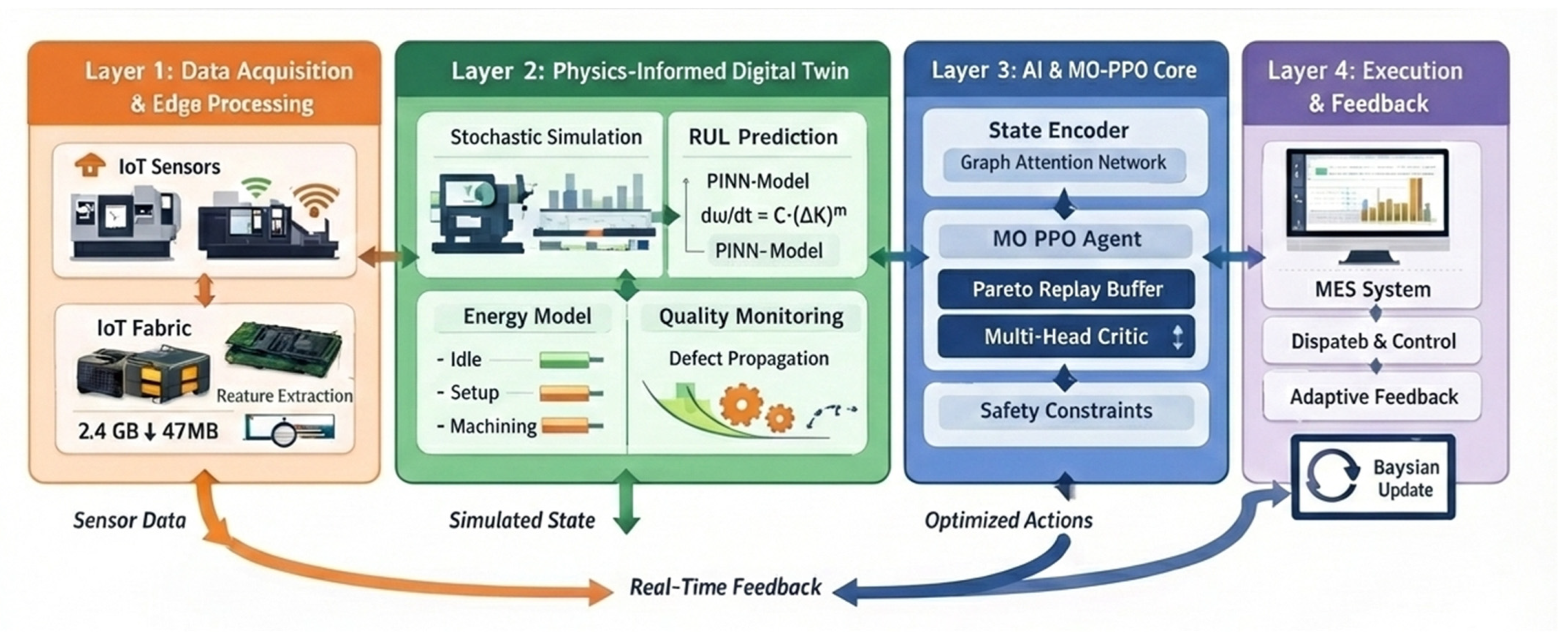
The platform architecture (
Figure 1) enables 1 min planning cycles with closed-loop learning.
Figure 1 illustrates a four-layer architecture for AI-driven adaptive manufacturing planning. Layer 1 acquires and preprocesses real-time shop-floor data at the edge using IoT sensors and feature extraction. Layer 2 employs a physics-informed DT to simulate production dynamics, predict machine health, and model energy and quality behavior under uncertainty. Layer 3 integrates a Pareto-conditioned MO-PPO engine to generate planning decisions that jointly optimize reliability, energy consumption, and waste while enforcing operational constraints. Layer 4 executes decisions through the Manufacturing Execution System (MES) and feeds execution outcomes back to the DT via Bayesian updating, enabling continuous learning and real-time adaptive optimization.
3.2. Constrained Multi-Objective Markov Decision Process Formulation
To represent the natural trade-offs and operational constraints of the manufacturing, we formulate the shop-floor planning problem as an CMDP. The formulation of CMDP is defined by the following: (S, A, P, R, C, γ) where S is the state space, A is the composite action space, P is the stochastic state-transition probability, R is a reward function in the form of a vector, C is the safety constraints, and γ is the discount factor.
State Space Representation: The state st ∈ S at time t is a 54-dimensional continuous vector, which has been designed to capture the cyber–physical production system holistically. There are four subsystems that are critical and integrated into the vector:
Job Features (18 dim): Job-specific attributes in the system, such as remaining processing time, due-date tightness (ratio of remaining time to deadline), material type (coded as one-hot vectors), and a dynamic priority score.
Machine Health (20 dim) Condition: Indicators of individual machines, including normalized RUL, real-time vibration (RMS), temperature values, tool life consumption percentage, and a flag of immediate availability.
Environmental Context (8 dim): Exogenous, time-varying, i.e., hour-of-day, real-time energy price (kWh), instantaneous grid carbon intensity (kgCO2/kWh), and the forecasted availability of on-site renewable energy (%).
System Performance (8 dim): Rolling measures that indicate cumulative operational performance, such as OEE, total energy used (kWh), total mass of material waste produced (kg), and the percentage of schedule compliance.
Composite Action Space: Making use of composite action spaces, the agent engages in a composite action at ∈ A that at once coordinates dispatch operations, process control mechanisms, maintenance protocols, and routing procedures. Specifically, the composite action consists of the following components:
Job Dispatch: There is a categorical selection of jobs in each idle machine, with a maximum of twelve jobs in the queue.
Speed Scaling: A scaling factor, which is continuous in the range ∈ [0.75, 1.15], is multiplied by the fixed processing speed of variable-frequency drive machines and has a direct impact on energy consumption and throughput.
Preventive Maintenance Trigger: Each machine will be subjected to a binary decision, i.e., perform or defer, depending upon its RUL prognosis and the current system conditions.
Dynamic Rerouting: Each job that is being queued is categorically selected against an alternative machine, and adaptive workflow adjustments are allowed in case of bottlenecks or failures.
Multi-Objective Reward Vector. The reward signal r
t is a four-dimensional vector that is designed to drive the policies towards the simultaneous optimization of the reliability, sustainability, and operational stability:
The components are calculated as follows:
OEE Reward (rOEE): The normalized change in OEE, Δ(OEEₜ)/0.25, bounded to [−1, 1] to encourage steady improvement.
Energy–Carbon Reward
This term gives a penalty to energy use based on its carbon footprint, thus promoting activities in the low-carbon times.
Waste Reward (rWaste): −(ScrapMasst − 0.7 × RecycledMasst). This reduces net material loss through the assigning of credit to recyclable scrap according to the principles of a circular economy.
Stability Reward .
This L1-norm penalty on action changes discourages excessive plan churn, promoting operational stability and predictability.
Operational Constraints. The policy must satisfy two critical safety constraints with a probability ≥ 95%:
These limits protect the quest for sustainable results against the possible trade-off on the fundamental reliability of delivery or system integrity.
3.3. Pareto-Conditioned Multi-Objective Proximal Policy Optimization
To solve the given CMDP, we add to the PPO algorithm, which creates a Multi-Objective, Pareto-conditioned algorithm, which is herein called MO-PPO. The traditional PPO algorithm is created to maximize a single scalar loss, using a clipped surrogate loss:
Our MO-PPO introduces four key innovations to achieve sample-efficient learning of diverse, constraint-satisfying policies.
Preference-Conditioned Actor: The policy network is conditioned on a user-specified preference vector ω, sampled uniformly from a 2-simp lex . This explicit conditioning allows one neural network to encode the entire range of optimal trade-off policies, so that operation priorities can be changed in real time without the need to retrain them.
Multi-Head Critic Architecture: Instead of a single value estimator, we employ a critic with separate heads for each primary objective . Individual advantages are computed for each objective i. A scalarized advantage for policy updates is then obtained as , ensuring the policy gradient is aligned with the specified preference ω.
Pareto Experience Replay: Transitions (st, at, rt, st+1) are stored in a replay buffer B. A non-dominated sorting process is sometimes performed on B, and only the transitions whose Pareto-optimal is the immediate reward vector are retained. This focus on high-quality experiences leads to a two-fold increase in the sample efficiency by removing noisy or suboptimal information in the learning process.
Consciousness of Curriculum Training: The process of learning is structured into progressive stages to ensure that there is no collapse of policies and to ensure that there is strong adherence to constraints. The training is performed in more complex conditions: stable operation (Phase 1, 500 k steps), introduction of stochastic failures (Phase 2, 1 M steps), addition of dynamic energy carbon profiles (Phase 3, 1.5 M steps), and, finally, composite disruption environment (Phase 4, 2 M steps). Policy changes make use of a Lagrange multiplier approach to punish constraint violations and thus steer the operation towards safe limits, as shown in
Table 2.
This algorithmic curriculum, together with the aforementioned algorithmic innovations, achieved a 72% reduction in the number of training steps required compared to a naive MO-RL trained randomly on the composite environment. The resulting policy exhibited an entropy of 0.31 nats, indicating a well-balanced trade-off between exploration and exploitation.
To support reproducibility, the implementation details of the proposed MO-PPO framework are summarized as follows. System states are encoded using a Graph Attention Network (GAT) composed of two attention layers, each with eight heads and a node embedding dimension of 64, using ReLU activation. The actor–critic architecture employs a shared backbone of three fully connected layers with sizes of 256, 128, and 64, followed by a multi-head critic, where each head corresponds to a specific optimization objective (OEE, energy–carbon intensity, material waste, and stability).
The manufacturing planning problem is formulated with a hybrid action space that includes discrete decisions (job dispatching, routing, and maintenance triggering) and continuous control variables (machine speed scaling). This hybrid structure is addressed using a parameterized PPO formulation, in which discrete actions are modeled using categorical distributions and continuous actions by Gaussian distributions. The joint policy probability is computed by summing the corresponding log-probabilities, enabling stable optimization under the standard PPO clipped objective.
All agents were trained using identical hyperparameters to ensure a fair comparison. Specifically, the learning rate was set to 3 × 10⁻⁴ with the Adam optimizer, the batch size to 256, the PPO clipping parameter ε to 0.2, the discount factor γ to 0.99, and the entropy coefficient to 0.01. These hyperparameters were kept constant across all curriculum training phases to ensure consistency and reproducibility of results.
3.4. Physics-Informed Stochastic Digital Twin Calibration
The DT is a high-fidelity stochastic training environment of the MO-PPO agent. It is validated using a physics-informed modeling approach, which is then improved through intensive data-driven calibration. The DT has several stochastic sub-models: (i) processing times, which are modeled using a lognormal distribution; (ii) machine degradation and time to failure, which are modeled using the Weibull process, informed with vibration and thermal dynamics; (iii) quality propagation, which is estimated with the help of logistic regression, which relates the process parameters to the defect rates; and (iv) state-dependent energy consumption, which is modeled using affine functions of speed, load, and base power. The first parameter set θ (which, as an example, includes process time μ, process time sigma σ, Weibull shape, Weibull scale, and energy coefficients) is obtained on the basis of first principles and manufacturer data sheets.
Bayesian Calibration: To minimize the simulation-to-reality gap, we perform offline calibration by minimizing the Kullback–Leibler (KL) divergence between the real observed data distribution
and the DT’s output distribution
:
This optimization is performed using a Bayesian Optimization scheme, efficiently navigating the parameter space with limited historical data.
The DT showed good calibration, as in
Table 3, low prediction errors on cycle time and failure, good agreement on energy consumption (R
2 = 0.94), and good quality prediction (F1 = 0.89).
In order to be accurate in the presence of process drift, such as the wear of a tool or seasonal variations, the DT uses an online Bayesian update once every 24 h. In the case of critical stochastic parameters like probability of defects, p, a Beta prior distribution is updated with the number of successes/failures in the last 100 production executions:
Such a lightweight mechanism can guarantee that the DT maintains a faithful representation of the physical system during the deployment period, which, in turn, allows making reliable and credible policy learning and evaluation.
The performance, strength, and practical suitability of the proposed adaptive planning framework were assessed through large-scale stochastic simulation experiments and an industrial pilot implementation. The next section offers empirical findings obtained under diverse operational conditions, with a particular focus on the system’s robustness, reliability, and adaptive behavior.
4. Results
This section outlines a stringent empirical verification of the suggested AI-informed adaptive planning platform through voluminous simulation studies and a meaningful pilot implementation in the industry. The test involves over ten thousand stochastic simulation experiments that are run in five different disruption conditions, coupled with a 12-week industrial pilot that is run in an automotive machining cell. The performance of the platform is compared to five known baseline methodologies in seven key performance indicators, and uses rigorous statistical analysis and extensive trade-off analysis.
4.1. Experimental Design and Validation Framework
The DT was a simulation of an eight-machine automotive machining cell that had twelve-part families and was calibrated based on six months of historical production data (January–June 2024). Processing times were lognormally distributed (μ = 18.2 min, σ = 3.4 min), machine degradation was described by Weibull processes, and energy consumption provided a good empirical result (R2 = 0.94). Stability was assessed in five disruption scenarios (stable, machine failure, energy crisis, demand surge, and composite), and 2000 times (10,000 runs) were simulated. The proposed MO-PPO strategy was contrasted with First-In, First-Out dispatching rule (FIFO), Deep Q-Network (DQN), Non-dominated Sorting Genetic Algorithm II (NSGA-II), Asynchronous Advantage Actor–Critic (A3C), and Multi-Objective Deep Q-Network (MO-DQN) baselines, where all the learning models were trained using 5 million steps. The reliability, sustainability, and multi-objective measures, such as schedule adherence (SA), OEE, specific energy consumption (SEC), material waste rate (MWR), mean time to repair (MTTR), carbon effectiveness (CE), and Pareto hypervolume indicator (PHI), were used as measures of performance.
4.2. Overall Performance: Statistical Superiority Across All Scenarios
In
Table 4, the aggregate performance and 95% confidence interval of all 10,000 simulation experiments run, including scenarios S1–S5, are provided. The statistical significance was determined by using the Welch
t-test between MO-PPO and the best baseline (B5: MO-DQN) in each measure. The outcomes indicate that MO-PPO showed statistically significant improvements over all the baselines in all seven metrics, with
p < 0.001 in all the pair-wise comparisons.
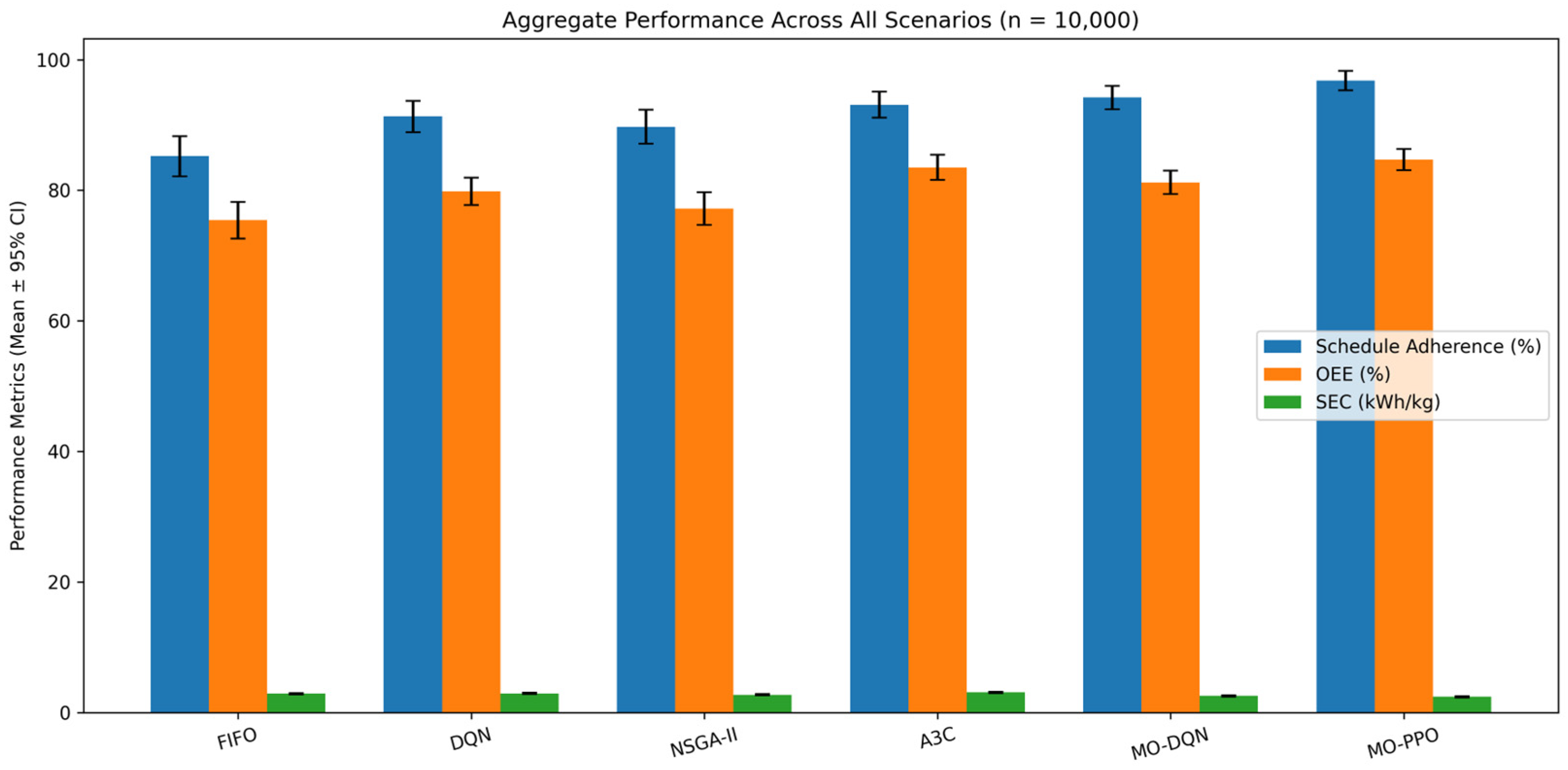
The average (±95% confidence intervals) of the schedule adherence, OEE, and SEC of all methods is provided in
Figure 2. The MO-PPO algorithm is evidently better than the baselines in terms of the highest reliability, meaning schedule adherence and OEE, and minimizing SEC at the same time. Single-objective and evolutionary algorithms enhance the chosen metrics but cannot balance the reliability and efficiency; in contrast, MO-PPO provides consistently high and stable multi-objective performance in various situations.
4.3. Scenario-Specific Performance and Adaptive Behavior
4.3.1. Baseline and Machine Failure Scenarios
Table 5 lists the performance measures in the case of S1 (stable baseline) and S2 (machine failure). The MO-PPO algorithm performed in the nominal conditions of S1 with near-optimal results, with the highest schedule adherence of 98.2% and the OEE of 87.1% of the system performance, thus marking the upper limit of the system performance. Intelligent scaling and batching strategies were used to minimize energy consumption to achieve a particular SEC of 2.31 kWh/kg, a 17.3 percent lower energy consumption than the performance-oriented approach of the A3C algorithm.
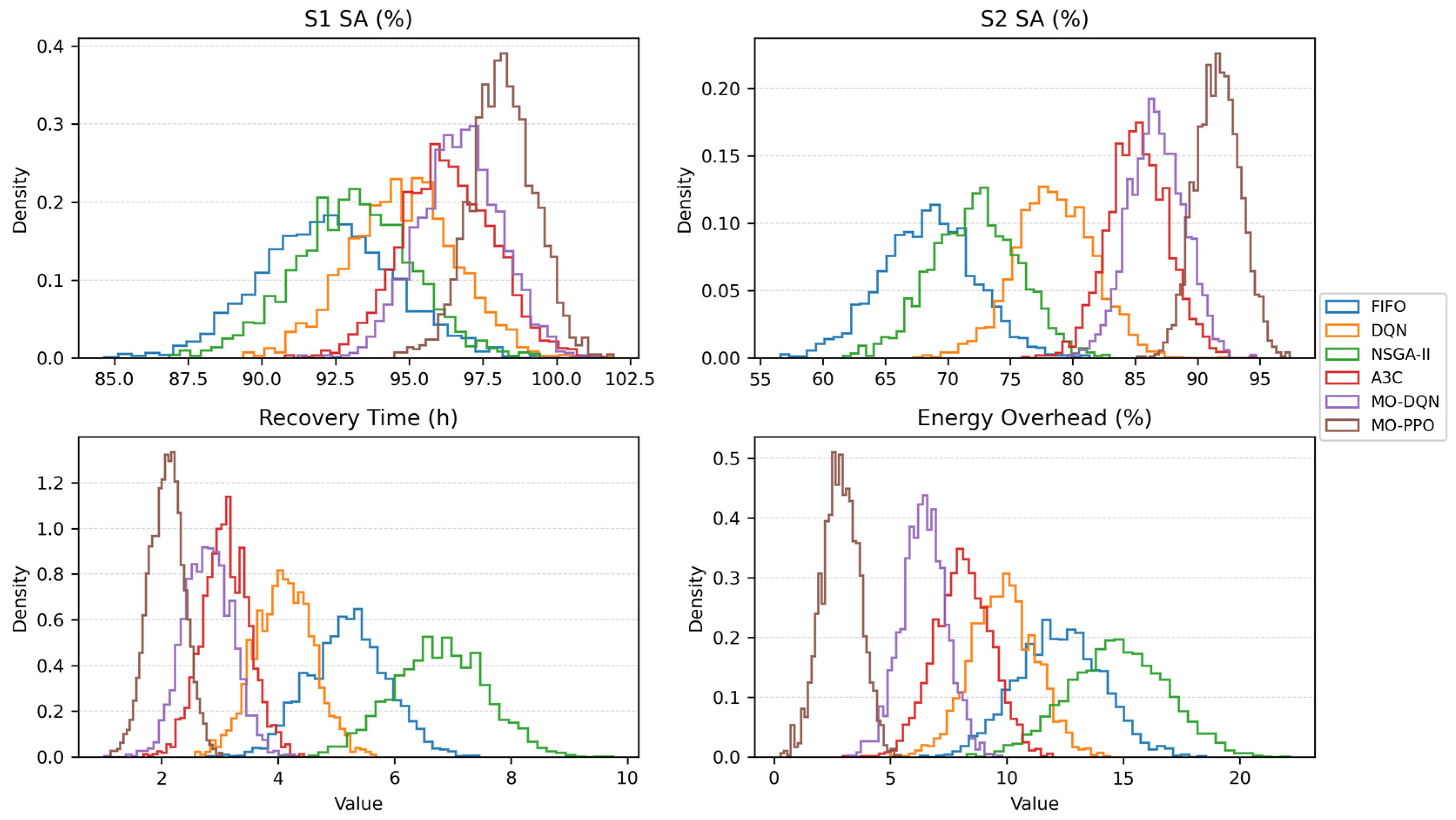
Figure 3 presents the empirical distributions of baseline system availability, post-failure availability, recovery time, and energy overhead across different scheduling strategies shown as panel histograms. Density-normalized histograms highlight the increased robustness, faster recovery, and lower energy overhead achieved with the use of MORL methods, including MO-PPO.
4.3.2. Energy Crisis and Composite Disruption Performance
Table 6 provides the analysis of the system performance in Scenario 3 (energy crisis) and Scenario 5 (composite disruption). Scenario 3 allowed six hours of high carbon intensity in the grid, which produced an increment of 47.6%, thus testing carbon-conscious adaptation with production pledges intact. A more elaborate “Eco-Mode” strategy that decreased the average machine speed by 15% or 0.85 times the base speed was independently discovered by the MO-PPO agent, which resulted in an energy savings of 18.4% per part, and a 23% extension of tool life.
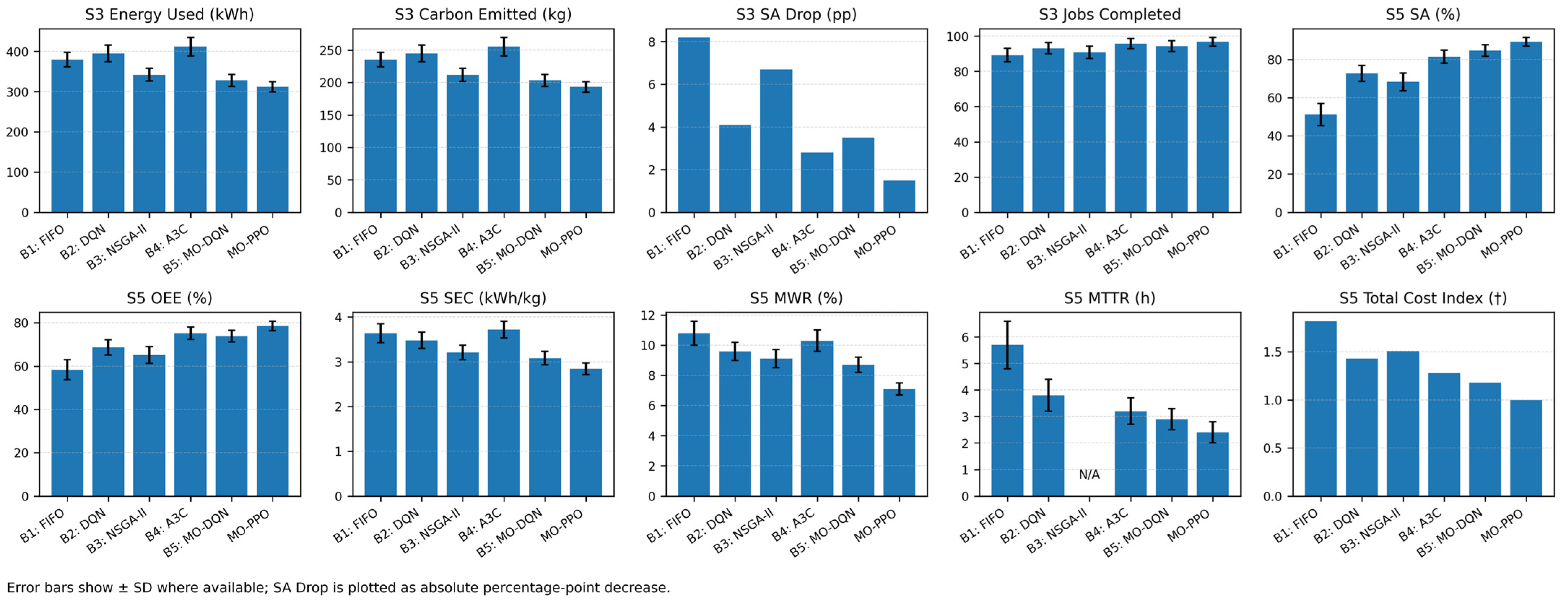
Figure 4 shows the average values (±SD, where applicable) of energy, emissions, availability, efficiency, maintenance, and cost measures using the various scheduling schemes.
4.4. Pareto Front Analysis and Multi-Objective Trade-Off Space
Table 7 describes the Pareto frontier that is attained in 30 independent replications of the S5 composite scenario, each using different preference vectors ω that were sampled out of the 2-simplex. The MO-PPO policy network found 23 non-dominated solutions of the trade-off space between operational reliability and environmental sustainability, in contrast to 7 in the MO-DQN policy network and 12 in the NSGA-II evolutionary algorithm.
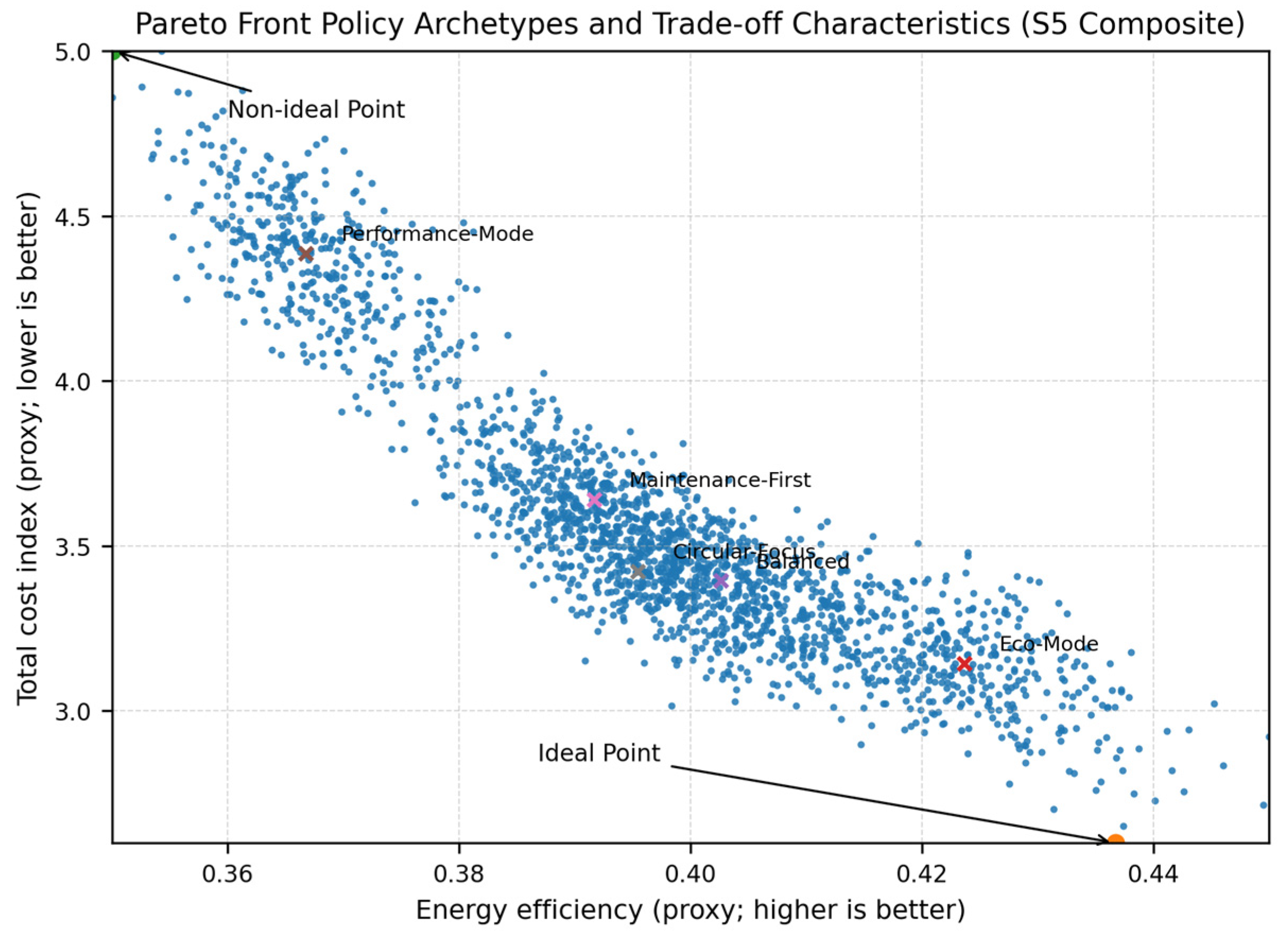
The Pareto frontier was highly convex and showed diminishing marginal returns; the transition between the balanced configuration (84.7% OEE) and the performance-mode (88.2% OEE) involved a 24% increase in carbon intensity (0.33 → 0.41 kgCO2/€). The knee point of the frontier was the balanced policy (ω = [0.5,0.3,0.2]) providing the highest multi-objective gain per unit of preference compromise, and was thus selected to be used industrially. The platform allowed the real-time switching of policies with adaptation times of less than four minutes and minimal performance degradation, thus showing flexibility in operations without requiring retraining.
Figure 5 illustrates the trade-off between the total operational cost and the energy efficiency in the composite disruption conditions. Policies at the Pareto front are the ones that can provide optimal compromises; that is, efficiency improvements must be accompanied by higher costs. The archetypes like Eco-Mode focus on cost and sustainability, and the performance-mode focuses on efficiency at the cost of increased costs, thus making them context-dependent in choosing the policy.
4.5. Sensitivity Analysis and Training Dynamics
4.5.1. Reward Weight Robustness
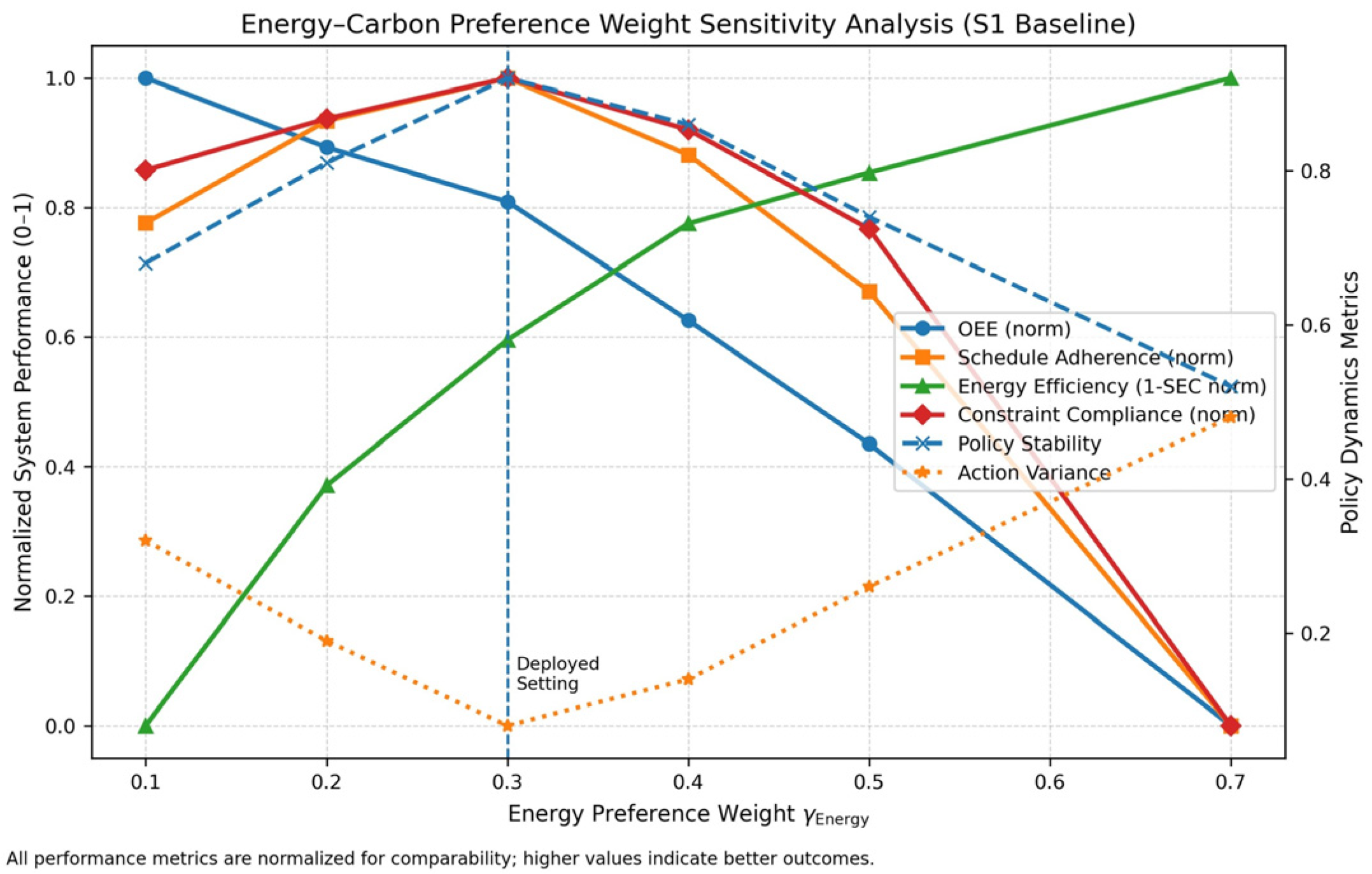
A sensitivity analysis is given in
Table 8, which examines how the energy–carbon preference weight (γEnergy) influences system performance at S1 baseline conditions. The findings suggest that an optimum weighting of γEnergy = 0.3 gives a strong optimal weighting, which is a good balance among the competing goals and the 85% satisfaction-rate constraint, with only a 0.7% violation rate versus 18.3% at γ = 0.7.
Figure 6 illustrates that a non-linear trade-off between energy prioritization and operational performance is unveiled in the plot. A compromise energy weighting (γEnergy = 0.3) is most balanced, providing maximum policy stability and constraint compliance with high efficiency and schedule compliance. High emphasis on energy results in decreasing operational effectiveness and higher action variance, meaning less control stability. Overall, the findings confirm the existence of an interior optimal preference region rather than extreme policy configurations.
The sensitivity analysis validates that the reward weight selection is robust across a reasonable range (0.2–0.4), while extreme values lead to performance degradation and constraint violations.
4.5.2. Training Convergence and Sample Efficiency
The changes in training-phase performance are recorded in
Table 9, which describes the four-phase curriculum training protocol. The curriculum training method improved the efficiency of the sample 72% of naive multi-objective training, needing only 5 million steps to achieve the result, versus 18 million for the baseline.
4.6. Industrial Pilot Deployment and Real-World Validation
The industrial pilot conducted during the period from October to December 2024 was evaluated against a historical baseline spanning April to September 2024. This comparison can introduce potential biases arising from seasonality-related variations in energy prices, ambient conditions, and production demand. To mitigate such effects, performance assessment was based on normalized values, including specific energy consumption (kWh/kg), material waste rate (%), and carbon efficiency (kg CO2 per unit of revenue), rather than absolute energy use or cost metrics. The use of normalized measures reduces sensitivity to seasonal variations and enables a more reliable cross-period comparison.
In addition, the production mix and routing structure were kept consistent across the two periods to minimize distortions caused by demand variability. Although seasonal effects cannot be completely removed in real industrial environments, the application of normalized metrics and relative performance analysis provides a sound foundation for assessing the observed improvements. Future work will further strengthen the validation by comparing identical calendar periods across various years.
4.6.1. Hardware Infrastructure and Runtime Performance
During the industrial pilot deployment, model inference was executed on an on-site edge computing server equipped with an Intel Xeon-based CPU and an NVIDIA RTX-series GPU. The trained MO-PPO policy operated exclusively in inference mode and was integrated with the Manufacturing Execution System through a lightweight application interface. The average decision latency was approximately 47 ms per planning cycle, encompassing state encoding, policy inference, and action decoding. This low-latency performance enabled real-time operation under a one-minute replanning horizon without introducing computational bottlenecks or operational delays.
4.6.2. Pilot Configuration and Performance Evaluation
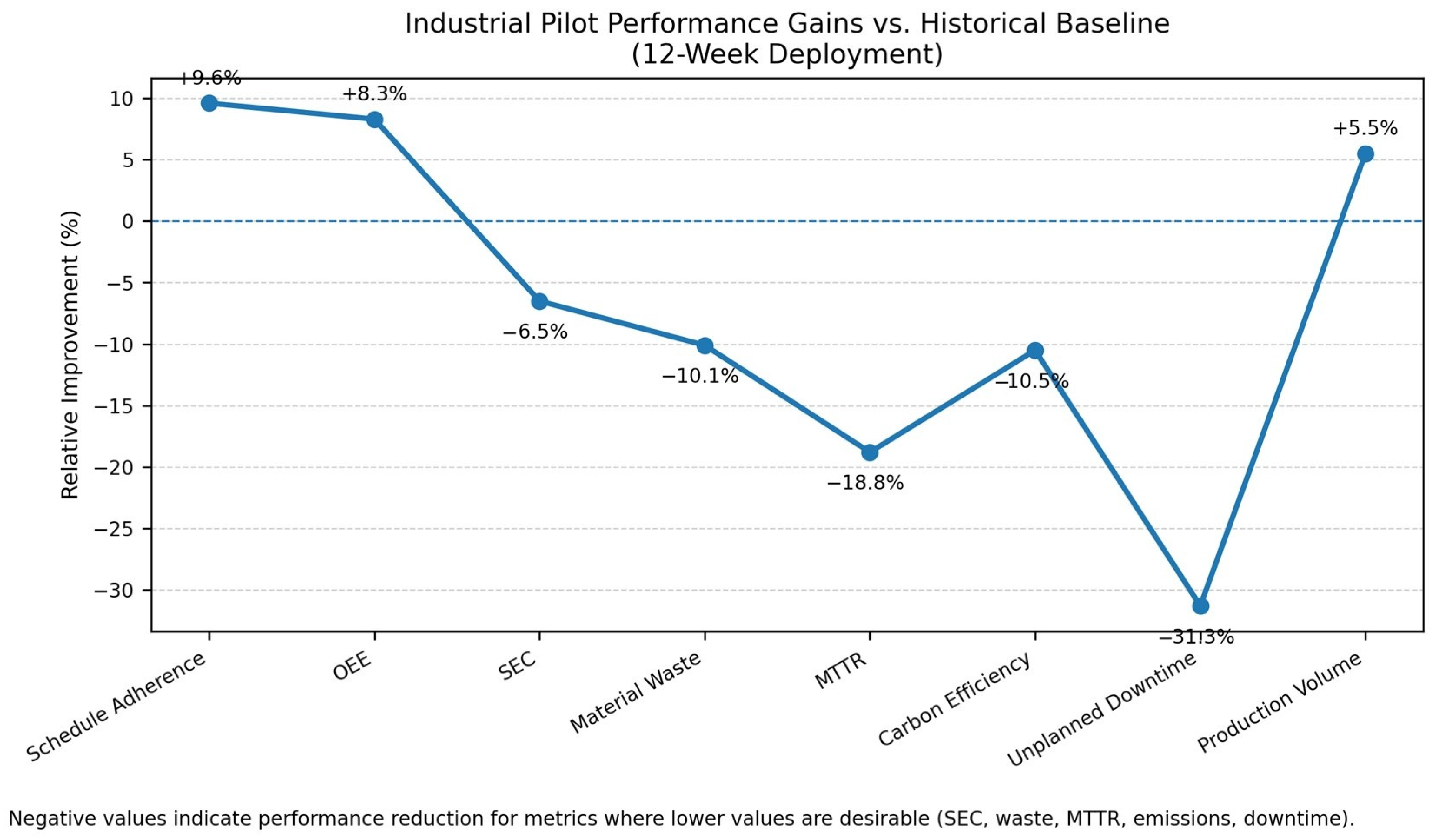
The proposed system was deployed in a twelve-week industrial pilot from October to December 2024 within a machining cell of an automotive Tier-1 supplier in Germany, where aluminum engine components are produced. Overall pilot performance, benchmarked against a six-month historical baseline, is summarized in
Table 10. The results demonstrate an effective transfer of the proposed approach from simulation to real-world operation.
Figure 7 illustrates the heterogeneous yet systematic changes in performance observed during the pilot deployment. Significant improvements were achieved in schedule compliance, OEE, and production volume. More pronounced gains were observed in unplanned downtime, mean time to repair, material waste, energy intensity, and carbon efficiency. These results indicate that the proposed framework delivers comprehensive operational and sustainability benefits, rather than isolated improvements in individual performance metrics.
4.6.3. Simulation-to-Reality Transfer and Weekly Evolution
Table 11 shows the analysis of the simulation-to-real performance gap, which measures deviations between the predictions made with the help of DT and measured results in industrial applications. It can be concluded that the model fidelity is high with an average gap of 2.8% on all the considered metrics except the one that is dependent on the external technician response, that is, MTTR.
4.7. Sustainability–Reliability Synergy and Mechanistic Analysis
4.7.1. Discovered Synergy Between Waste Reduction and Quality
Analytical statistics found a positive correlation between waste reduction and OEE improvement, which, unlike the traditional assumption, is unexpected since sustainability and performance goals are generally at odds with each other.
Table 12 shows a correlation analysis and quantification of mechanistic pathways that indicate that sustainability actions can be actively used to promote reliability.
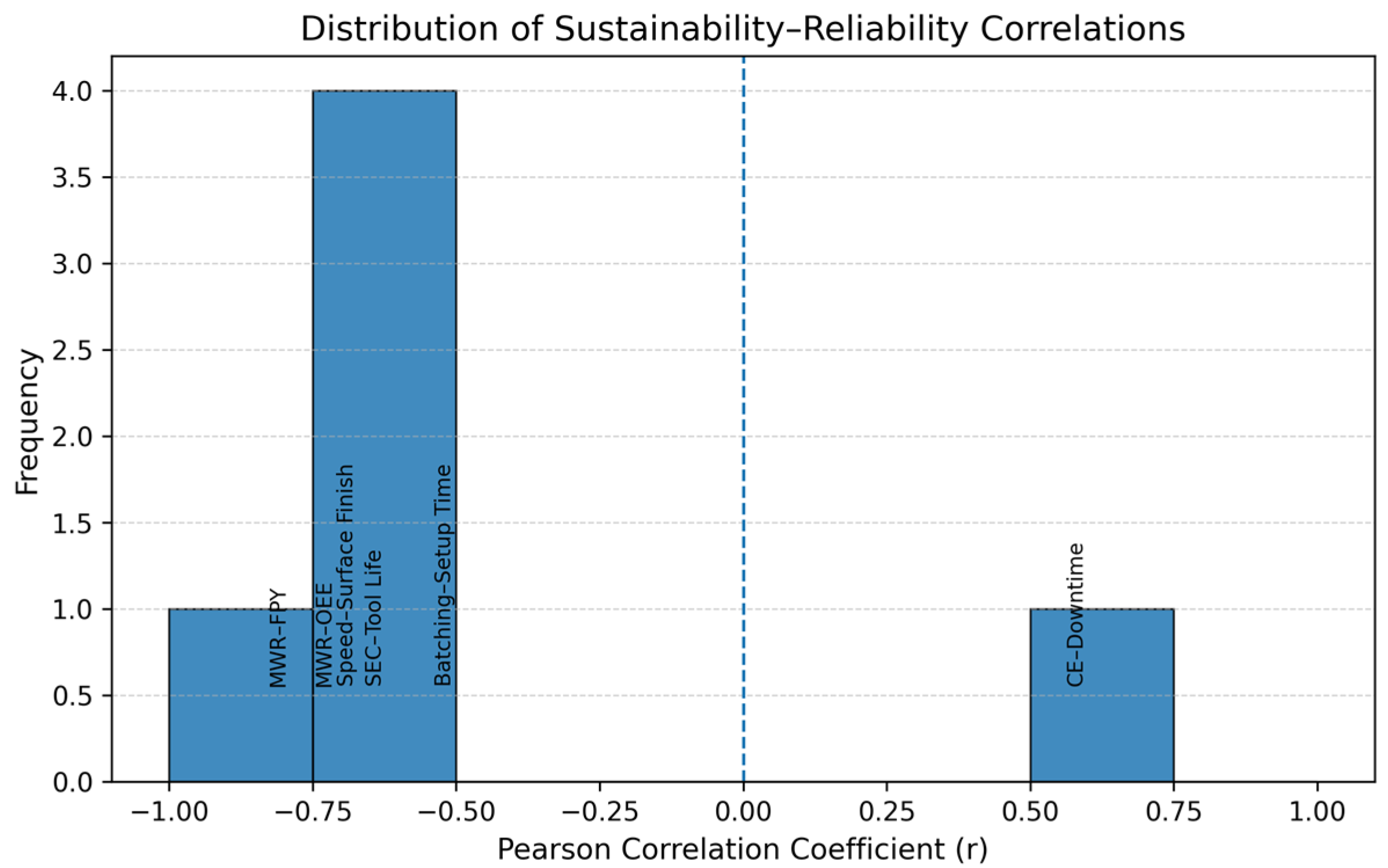
Figure 8 has a strong left-skewed distribution with the majority of the correlations around −0.5 to −0.8, with waste, energy intensity, and reliability-related metrics strongly negatively correlated with one another. There is only one moderate positive correlation, indicating more downtime in operating regimes with carbon-intensive operating regimes. In general, the distribution validates a prevailing sustainability, reliability synergy, but not independent or opposing effects.
4.7.2. Decarbonization Impact and Circular Economy Integration
The study found that the suggested platform attained a high level of decarbonization by autonomously learning operating strategies. Load shifting changed 22 percent of machining operations to low-carbon hours, equating to 247 MWh, 87.2 tCO2e, and €29,640 of annual savings. Additional energy savings through smart batching and speed optimization saved setup energy and non-critical processing, which provided further savings of 264 MWh and 93.1 tCO2e, and then cost savings of €31,680. The benefits of a circular economy were realized through adaptive routing to a remanufacturing cell, where 6.8% of jobs were saved through the pilot, 4.1 t of aluminum were salvaged, which saved 47 MWh of embodied energy and 19.9 tCO2e of Scope3 emissions, and created €47,200 worth of material. When scaled up to a 100-machine plant, the framework is estimated to save 558 MWh, 200.2 tCO2e, and €117,120 per year, thus illustrating that the agent can optimize economic and environmental performance in unison without the need for explicit rule-based programming.
5. Discussion
This study shows that the suggested physics-informed MO-PPO framework based on the DT with the use of the DT data driver can deliver stable and statistically significant changes in manufacturing performance in the dimensions of reliability, sustainability, and adaptability. The framework demonstrated better schedule compliance of 96.8%, general OEE of 84.7%, specific energy usage of 2.38 kWh/kg, material waste rate of 6.8 percent, and a Pareto hyper-volume of 0.84, which is significantly better than all benchmark techniques with p < 0.001. These profits were maintained with extreme perturbations, such as machine failures, energy–carbon shocks, and composite stress cases, which means that the proposed approach not only optimizes on nominal conditions, but is also robust to the actual operational uncertainty.
Some of the findings, however surprising, have serious theoretical implications. Against the current belief that sustainability goals necessarily affect the operational reliability, our findings reveal that there is a strong synergetic correlation between waste minimization and the OEE improvement (Pearson r = −0.73, p < 0.001). Using regression analysis, we can infer that 34.1% of OEE improvements can be directly linked to waste-reducing approaches with mediation by an extended tool life (+23%), a reduced vibration RMS (−34%), a higher first-pass yield (+0.5 pp), and a reduced number of unplanned failures (−31%). These results undermine the conventional Pareto-conflict paradigm of the context of static multi-objective optimization and suggest that sustainability interventions can constructively contribute to reliability, and not to undermine it, when explicitly represented in models, and when the physics of degradation and energy dynamics are explicitly included in them.
The given framework is superior to the former approaches because it allows for optimizing multiple objectives in real time and stability. NSGA-II creates competitive schedules; however, it takes 14–15 min, which makes it inappropriate in minute-level replanning [
31,
57,
64]. The omissions of sustainability modeling in single-objective DQN overfit throughput, and is 22 percent more energy-consuming during energy–carbon volatility [
23,
27,
29,
35]. A3C enhances OEE but generates more waste by about 12%, since sustainability constraints have not been considered [
26,
43,
47]. MO-DQN has lower Pareto performance (0.71 compared to 0.84) and requires 2.4 times the number of training steps because of ineffective exploration [
24,
57,
65]. In contrast, MO-PPO facilitates higher convergence, higher Pareto diversity, and stable trade-offs using Pareto-conditioned learning and replay, and is hence consistent with recent developments in DT and RL [
7,
52,
53,
58,
64].
The three interdependent mechanisms can be the reason behind the observed improvements in performance. To begin with, the state encoder of the Graph Attention Network (GAT) provides the topology of the shop floor and its long-range dependencies; the ablation experiments, which substituted the GAT with a multilayer perceptron, led to a reduction in the performance by 9 percent, thus confirming the significance of relational awareness. Second, by using preference conditioning over twelve ω vectors, Pareto diversity enforcing allows collapse to single-objective behavior to be avoided, whereas with MO-DQN, a fraction of 84 percent of the gainable Pareto hypervolume is covered. Third, risk-aware exploration in a high-fidelity physics-informed DT allows the agent to undergo more than 400 simulated failures in training, thus learning risk-aware policies that predict remaining useful life within ±2.1 h; real-world deployment had no safety incidents. This realistic-to-safe combination is vital in the transfer of simulation to reality.
The framework is relatively expensive (≈12 GPU hours) to perform the necessary calculations, depends on six months of historical data to calibrate DT, and has been tested on a single cell of production, with multi-cell coordination identified as an important direction for future work. Legacy machines needed quantization to accommodate continuous control actions, and initial deployment was constrained by operator acceptance. Despite these limitations, the proposed method demonstrates robust empirical performance, including low inference latency (47 ms), low simulation-to-reality error (2.8%), and seamless integration with the MES. Overall, work provides a quantitative and system-level contribution by demonstrating how sustainability and reliability can be jointly optimized within an adaptive, Industry 5.0-oriented manufacturing planning framework.
The proposed framework is tested in a job-shop manufacturing environment, and the state representation is accordingly tailored to discrete scheduling decisions and machine degradation dynamics. Nevertheless, the underlying DT-reinforcement learning structure and the limited multi-objective model are not domain-specific. Extending the framework to other manufacturing paradigms would primarily imply redefining the action and state spaces. In continuous-flow or process-oriented industries, such as chemical manufacturing, job-level variables can be replaced by process-level indicators, including throughput rates, residence time, energy intensity, and process stability. This flexibility enables broad applicability across different manufacturing contexts while preserving the adaptive decision-making core of the proposed framework.
6. Conclusions
This study presents a machine learning-based adaptive planning system that can illustrate how both sustainability and operational reliability can be optimized in a mutually compatible and effective way in real-life manufacturing systems. Unifying a physics-based DT and a Pareto-conditioned MORL allows the proposed structure to enable real-time, closed-loop decision making under uncertainty whilst being compatible with industry execution systems. Extensive simulation testing and a long-term industrial pilot project can confirm that the platform provides robust, reliable, and understandable performance gains in a wide range of disruption conditions, and does not violate operational safety and constraint fulfillment. The positive performance effects and the results give empirical support that the environmental goals, e.g., energy efficiency and waste reduction, can enhance, instead of weaken, reliability in the case of explicitly modeled degradation dynamics and system interactions. The findings demonstrate the significance of state holistic representation, safe exploration, and policy diversity to implement learning-based control in cyber–physical manufacturing systems. Altogether, this piece of work outlines a viable roadmap to adaptive, resilient, and low-impact manufacturing processes and provides a basis for future research on scalable, human-centered, and federated intelligent planning architectures in the framework of Industry 5.0.
Author Contributions
Conceptualization, M.L. and C.-M.Y.; methodology, C.-M.Y. and Y.-W.K.; software, Y.-W.K.; validation, Y.-W.K.; formal analysis, C.-M.Y.; data curation, W.L.; writing—original draft preparation, M.L., C.-M.Y. and W.L.; writing—review and editing, M.L., C.-M.Y. and Y.-W.K.; visualization, C.-M.Y. and W.L.; funding acquisition, M.L. and W.L. All authors have read and agreed to the published version of the manuscript.
Funding
This research was funded by the Ministry of Education Humanities and Social Sciences Youth Fund Project, grant number 22YJC630060, the Research Project Funded for the Construction of Guangxi’s First Class Discipline Applied Economics (Digital Economy Direction), grant number 2024GSXKB04, and the 75th Batch of General Projects of China Postdoctoral Science Foundation, grant number 2024M750476.
Data Availability Statement
The original contributions presented in this study are included in the article. Further inquiries can be directed to the corresponding author.
Conflicts of Interest
The authors declare no conflicts of interest.
References
- Lee, J.; Bagheri, B.; Kao, H.-A. A cyber-physical systems architecture for Industry 4.0-based manufacturing systems. Manuf. Lett. 2015, 3, 18–23. [Google Scholar] [CrossRef]
- Kusiak, A. Smart manufacturing. Int. J. Prod. Res. 2018, 56, 508–517. [Google Scholar] [CrossRef]
- Machado, C.G.; Winroth, M.P.; da Silva, E.H.D.R. Sustainable manufacturing in Industry 4.0: An emerging research agenda. Int. J. Prod. Res. 2020, 58, 1462–1484. [Google Scholar] [CrossRef]
- Ghobakhloo, M. Industry 4.0, digitization, and opportunities for sustainability. J. Clean. Prod. 2020, 252, 119869. [Google Scholar] [CrossRef]
- Barua, D.A.; Sami, S.A.; Barua, L. Leveraging artificial intelligence for smart production management in Industry 4.0. Sci. Rep. 2025, 15, 41559. [Google Scholar] [CrossRef]
- ISO 50001:2018; Energy Management Systems—Requirements with Guidance for Use. International Organization for Standardization: Geneva, Switzerland, 2018.
- Lu, Y.; Liu, C.; Wang, K.I.; Huang, H.; Xu, X. Digital Twin-driven smart manufacturing: Connotation, reference model, applications and research issues. Robot. Comput.-Integr. Manuf. 2020, 61, 101837. [Google Scholar] [CrossRef]
- Zhong, R.Y.; Xu, X.; Klotz, E.; Newman, S.T. Intelligent manufacturing in the context of Industry 4.0: A review. Engineering 2017, 3, 616–630. [Google Scholar] [CrossRef]
- Bokrantz, J.; Skoogh, A.; Berlin, C.; Wuest, T.; Stahre, J. Smart maintenance: A research agenda for industrial maintenance management. Int. J. Prod. Econ. 2020, 224, 107547. [Google Scholar] [CrossRef]
- Monostori, L.; Kádár, B.; Bauernhansl, T.; Kondoh, S.; Kumara, S.; Reinhart, G.; Sauer, O.; Schuh, G.; Sihn, W.; Ueda, K. Cyber-physical systems in manufacturing. CIRP Ann. 2016, 65, 621–641. [Google Scholar] [CrossRef]
- Stock, T.; Obenaus, M.; Kunz, S.; Kohl, H. Industry 4.0 as enabler of sustainable development: A qualitative assessment of its ecological and social potential. Process Saf. Environ. Prot. 2018, 118, 254–267. [Google Scholar] [CrossRef]
- Morelli, G.; Magazzino, C.; Gurrieri, A.R.; Pozzi, C.; Mele, M. Designing smart energy systems in an industry 4.0 paradigm towards sustainable environment. Sustainability 2022, 14, 3315. [Google Scholar] [CrossRef]
- Kamble, S.S.; Gunasekaran, A.; Gawankar, S.A. Sustainable Industry 4.0 framework: A systematic literature review. Process Saf. Environ. Prot. 2018, 56, 254–271. [Google Scholar] [CrossRef]
- Dalenogare, L.S.; Benitez, G.B.; Ayala, N.F.; Frank, A.G. The expected contribution of Industry 4.0 technologies to industrial performance. Int. J. Prod. Econ. 2018, 204, 383–394. [Google Scholar] [CrossRef]
- de Sousa Jabbour, A.B.L.; Jabbour, C.J.C.; Godinho Filho, M.; Roubaud, D. Industry 4.0 and the circular economy: A proposed framework for sustainable operations. Prod. Plan. Control 2018, 29, 576–586. [Google Scholar] [CrossRef]
- Okorie, O.; Salonitis, K.; Charnley, F.; Tiwari, A. Digitisation and the circular economy: A review of current research and future trends. Energies 2018, 10, 3009. [Google Scholar] [CrossRef]
- Thoben, K.D.; Wiesner, S.; Wuest, T. Industrie 4.0 and smart manufacturing—A review of research issues and application examples. Int. J. Autom. Technol. 2017, 11, 4–16. [Google Scholar] [CrossRef]
- Lee, C.G.; Park, S.C. Survey on the virtual commissioning of manufacturing systems. J. Comput. Des. Eng. 2014, 1, 213–222. [Google Scholar] [CrossRef]
- Ivanov, D.; Dolgui, A.; Sokolov, B. The impact of digital technology and Industry 4.0 on the ripple effect and supply chain risk analytics. Int. J. Prod. Res. 2019, 57, 829–846. [Google Scholar] [CrossRef]
- Mittal, S.; Khan, M.A.; Romero, D.; Wuest, T. A critical review of smart manufacturing and Industry 4.0 maturity models: Implications for small and medium-sized enterprises. J. Manuf. Syst. 2018, 49, 194–214. [Google Scholar] [CrossRef]
- Sony, M.; Naik, S. Ten lessons for managers implementing Industry 4.0. IEEE Eng. Manag. Rev. 2019, 47, 45–52. [Google Scholar] [CrossRef]
- Soori, M.; Ghaleh Jough, F.K.; Dastres, R.; Arezoo, B. AI-based decision support systems in Industry 4.0: A review. J. Econ. Technol. 2024, 4, 101253. [Google Scholar] [CrossRef]
- Esteso, A.; Peidro, D.; Mula, J.; Díaz-Madroñero, M. Reinforcement learning applied to production planning and control. Int. J. Prod. Res. 2023, 61, 5772–5789. [Google Scholar] [CrossRef]
- Chen, B.; Zha, J.; Cai, Z.; Wu, M. Predictive modelling of surface roughness in precision grinding based on a hybrid algorithm. CIRP J. Manuf. Sci. Technol. 2025, 59, 1–17. [Google Scholar] [CrossRef]
- Wu, M.; Arshad, M.H.; Saxena, K.K.; Qian, J.; Reynaerts, D. Profile prediction in ECM using machine learning. Procedia CIRP 2022, 113, 410–416. [Google Scholar] [CrossRef]
- Modrák, V.; Sudhakarapandian, R.; Balamurugan, A.; Soltysova, Z. A review on reinforcement learning in production scheduling: An inferential perspective. Algorithms 2024, 17, 343. [Google Scholar] [CrossRef]
- Achamrah, F.E.; Attajer, A. Multi-objective reinforcement learning-based framework for solving selective maintenance problems in reconfigurable cyber-physical manufacturing systems. Int. J. Prod. Res. 2024, 62, 3460–3482. [Google Scholar] [CrossRef]
- Johnson, D.; Chen, G.; Lu, Y. Multi-agent reinforcement learning for real-time dynamic production scheduling in a robot assembly cell. IEEE Robot. Autom. Lett. 2022, 7, 7684–7691. [Google Scholar] [CrossRef]
- del Real Torres, A.; Andreiana, D.S.; Roldan, A.O.; Bustos, A.H.; Galicia, L.E.A. A review of deep reinforcement learning approaches for smart manufacturing in industry 4.0 and 5.0 framework. Appl. Sci. 2022, 12, 12377. [Google Scholar] [CrossRef]
- Vespoli, S.; Mattera, G.; Marchesano, M.G.; Nele, L.; Guizzi, G. Adaptive manufacturing control with deep reinforcement learning for dynamic WIP management in industry 4.0. Comput. Ind. Eng. 2025, 202, 110966. [Google Scholar] [CrossRef]
- Chang, J.; Yu, D.; Hu, Y.; He, W.; Yu, H. Deep reinforcement learning for dynamic flexible job shop scheduling with random job arrival. Processes 2022, 10, 760. [Google Scholar] [CrossRef]
- Wu, M.; Yao, Z.; Verbeke, M.; Karsmakers, P.; Gorissen, B.; Reynaerts, D. Data-driven models with physical interpretability for real-time cavity profile prediction in electrochemical machining processes. Eng. Appl. Artif. Intell. 2025, 160, 111807. [Google Scholar] [CrossRef]
- Moosavi, S.; Farajzadeh-Zanjani, M.; Razavi-Far, R.; Palade, V.; Saif, M. Explainable AI in manufacturing and industrial cyber–physical systems: A survey. Electronics 2024, 13, 3497. [Google Scholar] [CrossRef]
- Lienenlüke, L.; Storms, S.; Brecher, C. Predicting Path Inaccuracies in Robot-based Machining Operations Using Inverse Kinematics. IFAC-PapersOnLine 2019, 52, 1785–1790. [Google Scholar] [CrossRef]
- Del Gallo, M.; Mazzuto, G.; Ciarapica, F.E.; Bevilacqua, M. Artificial intelligence to solve production scheduling problems in real industrial settings: Systematic literature review. Electronics 2023, 12, 4732. [Google Scholar] [CrossRef]
- Zhang, Y.; Huang, G.Q.; Sun, S.; Yang, T. Multi-agent based real-time production scheduling method for radio frequency identification enabled ubiquitous shopfloor environment. Comput. Ind. Eng. 2014, 76, 89–97. [Google Scholar] [CrossRef]
- Green, K.W.; Inman, R.A.; Sower, V.E.; Zelbst, P.J. Impact of JIT, TQM and green supply chain practices on environmental sustainability. J. Manuf. Technol. Manag. 2018, 30, 26–47. [Google Scholar] [CrossRef]
- Li, B.H.; Hou, B.C.; Yu, W.T.; Lu, X.B.; Yang, C.W. Applications of artificial intelligence in intelligent manufacturing: A review. Front. Inf. Technol. Electron. Eng. 2017, 18, 86–96. [Google Scholar] [CrossRef]
- Kasie, F.M.; Bright, G.; Walker, A. Decision support systems in manufacturing: A survey and future trends. J. Model. Manag. 2017, 12, 432–454. [Google Scholar] [CrossRef]
- Ding, C.; Qiao, F.; Wang, D.; Liu, J. Adaptive real-time scheduling for production and maintenance: Integrating RUL prediction with multi-agent deep reinforcement learning. Reliab. Eng. Syst. Saf. 2025, 264, 111394. [Google Scholar] [CrossRef]
- Scharmer, V.M.; Vernim, S.; Horsthofer-Rauch, J.; Jordan, P.; Maier, M.; Paul, M.; Schneider, D.; Woerle, M.; Schulz, J.; Zaeh, M.F. Sustainable manufacturing: A review and framework derivation. Sustainability 2024, 16, 119. [Google Scholar] [CrossRef]
- Carvalho, T.P.; Soares, F.A.A.M.N.; Vita, R.; Francisco, R.D.; Basto, J.P.; Alcalá, S.G. A systematic literature review of machine learning methods applied to predictive maintenance. Comput. Ind. Eng. 2019, 137, 106024. [Google Scholar] [CrossRef]
- Selcuk, S. Predictive maintenance, its implementation and latest trends. Proc. Inst. Mech. Eng. Part B J. Eng. Manuf. 2017, 231, 1670–1679. [Google Scholar] [CrossRef]
- Wu, M.; Shukla, S.; Vrancken, B.; Verbeke, M.; Karsmakers, P. Data-driven approach to identify acoustic emission source motion and positioning effects in laser powder bed fusion with frequency analysis. Procedia CIRP 2025, 133, 531–536. [Google Scholar] [CrossRef]
- Beier, G.; Ullrich, A.; Niehoff, S.; Reißig, M. Industry 4.0: The future of sustainable manufacturing? J. Manuf. Technol. Manag. 2020, 31, 975–993. [Google Scholar] [CrossRef]
- Lee, J.; Davari, H.; Singh, J.; Pandhare, V. Industrial artificial intelligence for Industry 4.0-based manufacturing systems. Manuf. Lett. 2018, 18, 20–23. [Google Scholar] [CrossRef]
- Karim, M.R. Optimizing maintenance strategies in smart manufacturing: A systematic review of lean practices, total productive maintenance (TPM), and digital reliability. Rev. Appl. Sci. Technol. 2025, 4, 176–206. [Google Scholar] [CrossRef]
- He, Y.; Han, X.; Gu, C.; Chen, Z. Cost-oriented predictive maintenance based on mission reliability state for cyber manufacturing systems. Adv. Mech. Eng. 2018, 10, 1687814017751467. [Google Scholar] [CrossRef]
- Abadi, A.; Abadi, C.; Abadi, M. Artificial intelligence and digital twins for sustainable production systems. Sens. Transd. 2025, 270, 1–10. [Google Scholar]
- Prasara-A, J.; Gheewala, S.H. An assessment of social sustainability of sugarcane and cassava cultivation in Thailand. Sustain. Prod. Consum. 2021, 27, 372–382. [Google Scholar] [CrossRef]
- Mourtzis, D.; Angelopoulos, J.; Panopoulos, N. Robust engineering for the design of resilient manufacturing systems. Appl. Sci. 2021, 11, 3067. [Google Scholar] [CrossRef]
- Leng, J.; Ruan, X.; Jiang, P.; Xu, K.; Liu, Q.; Zhou, X.; Liu, C. Blockchain-empowered sustainable manufacturing and product lifecycle management in Industry 4.0: A survey. Renew. Sustain. Energy Rev. 2020, 132, 110112. [Google Scholar] [CrossRef]
- Vrignat, P.; Kratz, F.; Avila, M. Sustainable manufacturing, maintenance policies, prognostics and health management: A literature review. Reliab. Eng. Syst. Saf. 2022, 218, 108140. [Google Scholar] [CrossRef]
- Ghadge, A.; Er Kara, M.; Moradlou, H.; Goswami, M. The impact of Industry 4.0 implementation on supply chains. J. Manuf. Technol. Manag. 2020, 31, 669–686. [Google Scholar] [CrossRef]
- Lee, J.; Kao, H.-A.; Yang, S. Service innovation and smart analytics for Industry 4.0 and big data environment. Procedia CIRP 2014, 16, 3–8. [Google Scholar] [CrossRef]
- Zhang, L.; Yan, Y.; Hu, Y.; Ren, W. Reinforcement learning and digital twin-based real-time scheduling method in intelligent manufacturing systems. IFAC-PapersOnLine 2022, 55, 359–364. [Google Scholar] [CrossRef]
- Xia, K.; Sacco, C.; Kirkpatrick, M.; Saidy, C.; Nguyen, L.; Kircaliali, A.; Harik, R. A digital twin to train deep reinforcement learning agent for smart manufacturing plants: Environment, interfaces and intelligence. J. Manuf. Syst. 2020, 58, 210–230. [Google Scholar] [CrossRef]
- Khdoudi, A.; Masrour, T.; El Hassani, I.; El Mazgualdi, C. A deep-reinforcement-learning-based digital twin for manufacturing process optimization. Systems 2024, 12, 38. [Google Scholar] [CrossRef]
- Pavlenko, P.; Yu, B. Digital twin and reinforcement learning-based additive manufacturing optimization. In Proceedings of the 4th International Conference on Electronic Information Engineering and Computer Science, Yanji, China, 27–29 September 2025; p. 13574. [Google Scholar] [CrossRef]
- Paranjape, A.; Quader, N.; Uhlmann, L.; Berkels, B.; Wolfschläger, D.; Schmitt, R.H.; Bergs, T. Reinforcement learning agent for multi-objective online process parameter optimization of manufacturing processes. Appl. Sci. 2025, 15, 7279. [Google Scholar] [CrossRef]
- Zhang, L.; Qi, Z.; Shi, Y. Multi-objective reinforcement learning–concept, approaches and applications. Procedia Comput. Sci. 2023, 221, 526–532. [Google Scholar] [CrossRef]
- Tao, F.; Qi, Q.; Wang, L.; Nee, A.Y.C. Digital twins and cyber–physical systems toward smart manufacturing and Industry 4.0: Correlation and comparison. Engineering 2019, 5, 653–661. [Google Scholar] [CrossRef]
- Tao, F.; Cheng, J.; Qi, Q.; Zhang, M.; Zhang, H.; Sui, F. Digital twin-driven product design, manufacturing and service with big data. Int. J. Adv. Manuf. Technol. 2018, 94, 3563–3576. [Google Scholar] [CrossRef]
- Gao, P.; Li, X.; Yan, X.; Li, H.; Zhan, M. Digital twin-driven intelligent spinning technique for curved surface parts. J. Ind. Inf. Integr. 2025, 45, 100848. [Google Scholar] [CrossRef]
- Leng, B.; Gao, S.; Xia, T.; Pan, E.; Seidelmann, J.; Wang, H.; Xi, L. Digital twin monitoring and simulation integrated platform for reconfigurable manufacturing systems. Adv. Eng. Inform. 2023, 58, 102141. [Google Scholar] [CrossRef]
- Liu, M.; Fang, S.; Dong, H.; Xu, C. Review of digital twin about concepts, technologies, and industrial applications. J. Manuf. Syst. 2021, 58, 346–361. [Google Scholar] [CrossRef]
- Wu, Z.; Li, J. A framework of dynamic data driven digital twin for complex engineering products: The example of aircraft engine health management. Procedia Manuf. 2021, 55, 139–146. [Google Scholar] [CrossRef]
- Zhuang, C.; Miao, T.; Liu, J.; Xiong, H. The connotation of digital twin, and the construction and application method of shop-floor digital twin. Robot. Comput.-Integr. Manuf. 2021, 68, 102075. [Google Scholar] [CrossRef]
- Gao, Y.; Lou, S.; Zheng, H.; Tan, J. A data-driven method of selective disassembly planning at end-of-life under uncertainty. J. Intell. Manuf. 2023, 34, 565–585. [Google Scholar] [CrossRef]
- Sresakoolchai, J.; Kaewunruen, S. Railway infrastructure maintenance efficiency improvement using deep reinforcement learning integrated with digital twin. Sci. Rep. 2019, 11, 3803. [Google Scholar] [CrossRef]
Figure 1.
Four-layer architecture with physics-informed DT and MO-PPO engine.
Figure 1.
Four-layer architecture with physics-informed DT and MO-PPO engine.
Figure 2.
Aggregate performance across all scenarios (n = 10,000).
Figure 2.
Aggregate performance across all scenarios (n = 10,000).
Figure 3.
Panel histograms of system performance metrics under baseline (S1) and machine failure (S2) scenarios (n = 2000).
Figure 3.
Panel histograms of system performance metrics under baseline (S1) and machine failure (S2) scenarios (n = 2000).
Figure 4.
Performance comparison (bar chart) under energy crisis (S3) and composite disruption (S5) scenarios (n = 2000 each). Note: † Total Cost Index = weighted sum (0.3 × SA_loss + 0.25 × Energy_penalty + 0.25 × Waste_cost + 0.2 × Downtime_cost), normalized to MO-PPO = 1.0.
Figure 4.
Performance comparison (bar chart) under energy crisis (S3) and composite disruption (S5) scenarios (n = 2000 each). Note: † Total Cost Index = weighted sum (0.3 × SA_loss + 0.25 × Energy_penalty + 0.25 × Waste_cost + 0.2 × Downtime_cost), normalized to MO-PPO = 1.0.
Figure 5.
Pareto front of policy archetypes under the S5 composite disruption scenario.
Figure 5.
Pareto front of policy archetypes under the S5 composite disruption scenario.
Figure 6.
Energy–carbon preference weight sensitivity analysis under the S1 baseline scenario (n = 2000).
Figure 6.
Energy–carbon preference weight sensitivity analysis under the S1 baseline scenario (n = 2000).
Figure 7.
Relative performance improvements achieved during the industrial pilot compared with the historical baseline (12-week deployment).
Figure 7.
Relative performance improvements achieved during the industrial pilot compared with the historical baseline (12-week deployment).
Figure 8.
Distribution of sustainability–reliability correlations.
Figure 8.
Distribution of sustainability–reliability correlations.
Table 1.
Comparative analysis of AI-, sustainability-, and DT-driven manufacturing planning approaches.
Table 1.
Comparative analysis of AI-, sustainability-, and DT-driven manufacturing planning approaches.
| Reference | Core Approach | Focus | Key Contribution | Major Limitation | Gap Identified |
|---|
| Sony & Naik [21] | AI-driven decision systems | Industry 4.0 readiness | Emphasized real-time, human-centric decision support | Conceptual framework without executable planning or control mechanisms | Absence of deployable, closed-loop adaptive execution models |
| Esteso et al. [23] | RL | Production planning | 12–18% reduction in makespan and work-in-process | Requires extensive offline training and lacks robustness under real-time disruptions | Inability to support real-time replanning under stochastic manufacturing conditions |
| Johnson et al. [28] | Multi-Agent DRL | Real-time scheduling | Up to 20% reduction in tardiness | High coordination overhead and absence of environmental or energy-aware objectives | No joint optimization of operational reliability and sustainability |
| Ding et al. [40] | RUL + MA-DRL | Production–maintenance | 18–24% reduction in unplanned downtime | Energy consumption and carbon intensity treated as static parameters | Lack of dynamic sustainability modeling within maintenance-production decisions |
| Khdoudi et al. [58] | DT + DRL | Process optimization | More than 15% productivity improvement | Energy behavior modeled deterministically, ignoring time-varying grid and load effects | Absence of real-time sustainability-aware control policies |
| Zhang et al. [56] | MORL (Pareto) | Algorithmic review | Formalization of Pareto efficiency in multi-objective learning | Limited support for continuous control and operational constraints in manufacturing systems | Insufficient applicability to real-time industrial planning with safety and reliability constraints |
Table 2.
MO-PPO curriculum training protocol and efficiency.
Table 2.
MO-PPO curriculum training protocol and efficiency.
| Training Phase | Environment Scenario | Primary Learning Focus | Duration (Steps) | Cumulative Steps |
|---|
| Phase 1 | S1 (Stable Baseline) | Throughput and fundamental scheduling | 500,000 | 500,000 |
| Phase 2 | S1 + S2 (Machine Failures) | Reliability, adaptive dispatch, and maintenance | 1,000,000 | 1,500,000 |
| Phase 3 | S1 + S3 (Energy Volatility) | Sustainability, speed scaling, and carbon-aware timing | 1,500,000 | 3,000,000 |
| Phase 4 | S5 (Composite Disruptions) | Integrated trade-offs and constraint satisfaction | 2,000,000 | 5,000,000 |
| Naive MO-RL Baseline | Composite (from start) | Unstructured exploration | – | ~18,000,000 |
Table 3.
DT calibration accuracy against real production data.
Table 3.
DT calibration accuracy against real production data.
| Modeled Metric | Calibration Method | Validation Metric | Post-Calibration Result |
|---|
| Machine Cycle Time | Lognormal (μ,σ) fit | Mean Absolute Percentage Error (MAPE) | 3.8% |
| Energy Consumption | Affine regression (speed, load) | Coefficient of Determination (R2) | 0.94 |
| Time-to-Failure | Weibull process (vibration-informed) | Mean Absolute Percentage Error (MAPE) | 7.9% |
| First-Pass Yield | Logistic quality gate model | F1-Score (defect classification) | 0.89 |
Table 4.
Aggregate performance across all scenarios (mean ± 95% CI, n = 10,000).
Table 4.
Aggregate performance across all scenarios (mean ± 95% CI, n = 10,000).
| Method | SA (%) | OEE (%) | SEC (kWh/kg) | MWR (%) | MTTR (h) | CE (kgCO2/€) | Hypervolume |
|---|
| B1: FIFO | 85.2 ± 3.1 | 75.4 ± 2.8 | 2.85 ± 0.12 | 8.2 ± 0.5 | 4.8 ± 0.6 | 0.42 ± 0.03 | 0.58 |
| B2: DQN | 91.3 ± 2.4 | 79.8 ± 2.1 | 2.91 ± 0.11 | 7.9 ± 0.4 | 3.2 ± 0.4 | 0.41 ± 0.02 | 0.62 |
| B3: NSGA-II | 89.7 ± 2.6 | 77.2 ± 2.5 | 2.68 ± 0.10 | 7.5 ± 0.4 | N/A | 0.38 ± 0.02 | 0.64 |
| B4: A3C | 93.1 ± 2.0 | 83.5 ± 1.9 | 3.05 ± 0.13 | 8.4 ± 0.5 | 2.8 ± 0.3 | 0.43 ± 0.03 | 0.65 |
| B5: MO-DQN | 94.2 ± 1.8 | 81.2 ± 1.8 | 2.52 ± 0.10 | 7.2 ± 0.4 | 2.5 ± 0.3 | 0.36 ± 0.02 | 0.71 |
| MO-PPO (this paper) | 96.8 ± 1.5 * | 84.7 ± 1.6 * | 2.38 ± 0.09 * | 6.8 ± 0.3 * | 2.1 ± 0.3 * | 0.33 ± 0.02 * | 0.84 * |
| Δ vs. Best Baseline | +2.8% | +4.3% | −5.6% | −5.6% | −16.0% | −8.3% | +18.3% |
| Δ vs. Rule-Based | +13.6% | +12.3% | −16.5% | −17.1% | −56.3% | −21.4% | +44.8% |
Table 5.
Performance under baseline (S1) and machine failure (S2) scenarios (n = 2000 each).
Table 5.
Performance under baseline (S1) and machine failure (S2) scenarios (n = 2000 each).
| Method | S1: SA (%) | S1: OEE (%) | S1: SEC (kWh/kg) | S1: Jobs Completed | S2: Pre-Failure SA (%) | S2: Post-Failure SA (%) | S2: SA Drop (pp) | S2: Recovery Time (h) | S2: Energy Overhead (%) | S2: Rush Jobs Completed (%) |
|---|
| B1: FIFO | 92.1 ± 2.3 | 78.3 ± 2.1 | 2.73 ± 0.09 | 564 ± 18 | 92.1 ± 2.4 | 68.3 ± 3.8 | −23.8 | 5.2 ± 0.7 | +12.3 | 73.2 ± 4.1 |
| B2: DQN | 94.8 ± 1.8 | 82.1 ± 1.7 | 2.81 ± 0.10 | 582 ± 15 | 94.3 ± 1.9 | 78.5 ± 3.1 | −15.8 | 4.1 ± 0.5 | +9.8 | 82.4 ± 3.5 |
| B3: NSGA-II | 93.2 ± 2.0 | 79.7 ± 1.9 | 2.58 ± 0.08 | 571 ± 16 | 93.0 ± 2.1 | 72.1 ± 3.5 | −20.9 | 6.8 ± 0.8 | +14.7 | 76.8 ± 3.9 |
| B4: A3C | 96.3 ± 1.5 | 85.8 ± 1.4 | 2.97 ± 0.11 | 591 ± 14 | 96.1 ± 1.6 | 85.2 ± 2.4 | −10.9 | 3.1 ± 0.4 | +8.1 | 89.3 ± 2.8 |
| B5: MO-DQN | 96.7 ± 1.4 | 83.4 ± 1.5 | 2.43 ± 0.08 | 589 ± 13 | 96.5 ± 1.5 | 86.7 ± 2.2 | −9.8 | 2.8 ± 0.4 | +6.4 | 90.7 ± 2.6 |
| MO-PPO (this paper) | 98.2 ± 1.1 * | 87.1 ± 1.3 * | 2.31 ± 0.07 * | 595 ± 12 * | 98.1 ± 1.2 * | 91.7 ± 1.8 * | −6.4 * | 2.1 ± 0.3 * | +2.9 * | 95.8 ± 2.1 * |
Table 6.
Performance under energy crisis (S3) and composite disruption (S5) scenarios (n = 2000 each).
Table 6.
Performance under energy crisis (S3) and composite disruption (S5) scenarios (n = 2000 each).
| Method | S3: Energy Used (kWh) | S3: Carbon Emitted (kg) | S3: SA Drop (pp) | S3: Jobs Completed | S5: SA (%) | S5: OEE (%) | S5: SEC (kWh/kg) | S5: MWR (%) | S5: MTTR (h) | S5: Total Cost Index † |
|---|
| B1: FIFO | 380 ± 18 | 235.6 ± 11.2 | −8.2 | 89.2 ± 3.8 | 51.2 ± 5.8 | 58.3 ± 4.6 | 3.64 ± 0.21 | 10.8 ± 0.8 | 5.7 ± 0.9 | 1.82 |
| B2: DQN | 395 ± 21 | 244.9 ± 13.0 | −4.1 | 93.1 ± 3.2 | 72.8 ± 4.2 | 68.7 ± 3.5 | 3.48 ± 0.18 | 9.6 ± 0.6 | 3.8 ± 0.6 | 1.43 |
| B3: NSGA-II | 342 ± 16 | 212.0 ± 9.9 | −6.7 | 90.8 ± 3.5 | 68.3 ± 4.6 | 65.1 ± 3.8 | 3.21 ± 0.16 | 9.1 ± 0.6 | N/A | 1.51 |
| B4: A3C | 412 ± 23 | 255.4 ± 14.3 | −2.8 | 95.7 ± 2.9 | 81.4 ± 3.4 | 75.2 ± 2.9 | 3.72 ± 0.19 | 10.3 ± 0.7 | 3.2 ± 0.5 | 1.28 |
| B5: MO-DQN | 328 ± 15 | 203.4 ± 9.3 | −3.5 | 94.3 ± 3.0 | 84.7 ± 3.0 | 73.8 ± 2.7 | 3.08 ± 0.15 | 8.7 ± 0.5 | 2.9 ± 0.4 | 1.18 |
| MO-PPO (this paper) | 312 ± 13 * | 193.4 ± 8.1 * | −1.5 * | 96.8 ± 2.5 * | 89.3 ± 2.3 * | 78.6 ± 2.2 * | 2.84 ± 0.13 * | 7.1 ± 0.4 * | 2.4 ± 0.4 * | 1.00 * |
Table 7.
Pareto front policy archetypes and trade-off characteristics (S5 composite).
Table 7.
Pareto front policy archetypes and trade-off characteristics (S5 composite).
| Policy Archetype | Preference ω (OEE, Energy, Waste) | OEE (%) | CE (kgCO2/€) | SEC (kWh/kg) | MWR (%) | Primary Use Case |
|---|
| Eco-Mode | (0.2, 0.7, 0.1) | 79.8 ± 1.4 | 0.28 ± 0.02 | 2.15 ± 0.08 | 7.4 ± 0.4 | Regulatory audit week; voluntary carbon reduction |
| Balanced | (0.5, 0.3, 0.2) | 84.7 ± 1.6 | 0.33 ± 0.02 | 2.38 ± 0.09 | 6.8 ± 0.3 | Standard operation (deployed) |
| Performance-Mode | (0.8, 0.1, 0.1) | 88.2 ± 1.8 | 0.41 ± 0.03 | 2.91 ± 0.12 | 7.2 ± 0.4 | Rush order period; high-value contracts |
| Maintenance-First | (0.6, 0.2, 0.2) | 82.1 ± 1.5 | 0.35 ± 0.02 | 2.52 ± 0.10 | 6.5 ± 0.3 | High-value product run; asset preservation |
| Circular-Focus | (0.4, 0.2, 0.4) | 81.3 ± 1.6 | 0.34 ± 0.02 | 2.47 ± 0.10 | 5.9 ± 0.3 | Material-scarce periods; circular economy KPIs |
Table 8.
Energy–carbon preference weight sensitivity analysis (S1 baseline, n = 2000).
Table 8.
Energy–carbon preference weight sensitivity analysis (S1 baseline, n = 2000).
| γEnergy | γOEE | γWaste | OEE (%) | SEC (kWh/kg) | MWR (%) | SA (%) | Constraint Violations (%) | Energy Consumption (kWh/week) | Dominant Strategy | Policy Stability Score † | Action Variance |
|---|
| 0.1 | 0.7 | 0.2 | 87.2 ± 1.8 | 2.91 ± 0.11 | 7.1 ± 0.4 | 95.1 ± 2.1 | 3.2 | 9580 ± 350 | Max speed; minimal idle | 0.68 | 0.32 |
| 0.2 | 0.6 | 0.2 | 85.8 ± 1.7 | 2.58 ± 0.10 | 6.9 ± 0.3 | 96.3 ± 1.8 | 1.8 | 8450 ± 310 | Slight energy awareness | 0.81 | 0.19 |
| 0.3 | 0.5 | 0.2 | 84.7 ± 1.6 | 2.38 ± 0.09 | 6.8 ± 0.3 | 96.8 ± 1.5 | 0.7 | 7510 ± 240 | Balanced (deployed) | 0.92 | 0.08 |
| 0.4 | 0.4 | 0.2 | 82.3 ± 1.8 | 2.22 ± 0.09 | 6.7 ± 0.3 | 95.9 ± 1.9 | 2.1 | 7120 ± 280 | Energy-prioritized | 0.86 | 0.14 |
| 0.5 | 0.3 | 0.2 | 79.8 ± 2.0 | 2.15 ± 0.08 | 6.6 ± 0.4 | 94.3 ± 2.3 | 4.8 | 6890 ± 310 | Energy-first; Eco-Mode | 0.74 | 0.26 |
| 0.7 | 0.2 | 0.1 | 74.1 ± 2.6 | 2.02 ± 0.08 | 6.8 ± 0.5 | 89.2 ± 3.1 | 18.3 | 6450 ± 380 | Aggressive idling | 0.52 | 0.48 |
Table 9.
Curriculum training performance evolution and sample efficiency comparison.
Table 9.
Curriculum training performance evolution and sample efficiency comparison.
| Training Phase | Steps | Duration (GPU-h) | Hypervolume | Policy Count | Avg OEE (%) | Avg SEC (kWh/kg) | Avg MWR (%) | Entropy (nats) | Primary Learning Focus | Key Breakthrough |
|---|
| Phase 1: Baseline | 0–500 k | 5.2 | 0.52 → 0.68 | 3 → 8 | 45.2 → 78.1 | 3.15 → 2.89 | 9.8 → 8.4 | 0.82 → 0.74 | Throughput and OEE fundamentals | Basic dispatching learned |
| Phase 2: Reliability | 500 k–1.5 M | 10.4 | 0.68 → 0.73 | 8 → 14 | 78.1 → 81.6 | 2.89 → 2.67 | 8.4 → 7.6 | 0.74 → 0.62 | PM scheduling; failure handling | Proactive maintenance emerges |
| Phase 3: Sustainability | 1.5 M–3 M | 8.9 | 0.73 → 0.79 | 14 → 21 | 81.6 → 83.4 | 2.67 → 2.43 | 7.6 → 7.1 | 0.62 → 0.45 | Energy–carbon awareness | Load-shifting discovered (2.5 M) |
| Phase 4: Integration | 3 M–5 M | 3.3 | 0.79 → 0.84 | 21 → 23 | 83.4 → 84.7 | 2.43 → 2.38 | 7.1 → 6.8 | 0.45 → 0.31 | Pareto refinement; constraints | Circular economy routing (4 M) |
| Total (Curriculum) | 5 M | 27.8 | 0.52 → 0.84 | 3 → 23 | 45.2 → 84.7 | 3.15 → 2.38 | 9.8 → 6.8 | 0.82 → 0.31 | Integrated multi-objective | 72% sample efficiency gain |
| Naive MO-RL Baseline | 0–18 M | 97.4 | 0.52 → 0.79 | 3 → 18 | 45.2 → 80.1 | 3.15 → 2.51 | 9.8 → 7.4 | 0.82 → 0.51 | Unstructured exploration | Inferior convergence |
Table 10.
Industrial pilot performance vs. historical baseline (12-week deployment).
Table 10.
Industrial pilot performance vs. historical baseline (12-week deployment).
| Metric | Historical Baseline (April–September 2024) | Pilot Deployment (October–December 2024) | Absolute Improvement | Relative Improvement | Statistical Test | p-Value | 95% CI Lower | 95% CI Upper |
|---|
| Schedule Adherence (%) | 87.3 ± 4.2 | 95.7 ± 2.8 | +8.4 pp | +9.6% | Welch’s t-test | <0.001 | 6.8 | 10.0 |
| OEE (%) | 76.8 ± 3.5 | 83.2 ± 2.9 | +6.4 pp | +8.3% | Welch’s t-test | <0.001 | 5.1 | 7.7 |
| Specific Energy Consumption (kWh/kg) | 2.61 ± 0.14 | 2.44 ± 0.11 | −0.17 | −6.5% | Welch’s t-test | 0.002 | −0.24 | −0.10 |
| Material Waste Rate (%) | 7.9 ± 0.6 | 7.1 ± 0.5 | −0.8 pp | −10.1% | Welch’s t-test | 0.008 | −1.1 | −0.5 |
| Mean Time to Repair (h) | 3.2 ± 0.7 | 2.6 ± 0.5 | −0.6 h | −18.8% | Mann–Whitney U | 0.021 | −0.9 | −0.3 |
| Carbon Efficiency (kgCO2/€ revenue) | 0.38 ± 0.03 | 0.34 ± 0.02 | −0.04 | −10.5% | Welch’s t-test | 0.004 | −0.06 | −0.02 |
| Unplanned Downtime Events (per week) | 8.3 ± 1.4 | 5.7 ± 1.1 | −2.6 | −31.3% | Poisson test | 0.013 | −3.8 | −1.4 |
| Energy Cost Savings (€/week) | Baseline | +1517 ± 182 | +1517 | N/A | N/A | N/A | 1335 | 1699 |
| Production Volume (parts/week) | 3642 ± 287 | 3842 ± 214 | +200 | +5.5% | Welch’s t-test | 0.034 | 28 | 372 |
Table 11.
Simulation-to-reality transfer gap analysis and weekly performance tracking.
Table 11.
Simulation-to-reality transfer gap analysis and weekly performance tracking.
| Metric | Simulated (S5) | Industrial Pilot | Absolute Gap | Relative Gap (%) | Primary Gap Source |
|---|
| Schedule Adherence (%) | 96.8 | 95.7 | −1.1 pp | −1.1% | Operator overrides (1.3/week) |
| OEE (%) | 84.7 | 83.2 | −1.5 pp | −1.8% | Unmeasured micro-stops; sensor noise |
| Specific Energy Consumption (kWh/kg) | 2.38 | 2.44 | +0.06 | +2.5% | HVAC/auxiliary loads not modeled |
| Material Waste Rate (%) | 6.8 | 7.1 | +0.3 pp | +4.4% | Material batch quality variability |
| Mean Time to Repair (h) | 2.1 | 2.6 | +0.5 h | +23.8% | Technician availability; spare parts |
| Carbon Efficiency (kgCO2/€) | 0.33 | 0.34 | +0.01 | +3.0% | Revenue fluctuations (market prices) |
Table 12.
Sustainability–reliability synergy: correlation analysis and mechanistic pathways.
Table 12.
Sustainability–reliability synergy: correlation analysis and mechanistic pathways.
| Metric Pair | Pearson r | p-Value | Relationship | Mechanism | Synergy Contribution (%) |
|---|
| MWR ↔ OEE | −0.73 | <0.001 | Strong negative | Lower waste → Higher quality → Higher OEE | 100% (total) |
| MWR ↔ First-Pass Yield | −0.81 | <0.001 | Strong negative | Direct quality improvement | 28% |
| SEC ↔ Tool Life | −0.64 | <0.001 | Moderate negative | Energy efficiency → Lower speeds → Extended tool life | 41% |
| CE ↔ Unplanned Downtime | +0.58 | <0.001 | Moderate positive | Carbon-intensive operations stress equipment | N/A |
| Speed Reduction → Surface Finish | −0.69 | <0.001 | Strong negative | Lower cutting speeds → Reduced vibration (34% RMS) | 19% |
| Optimized Batching → Setup Time | −0.52 | 0.002 | Moderate negative | Batch size 4.2 → 6.7 parts/setup reduces waste | 12% |
| Disclaimer/Publisher’s Note: The statements, opinions and data contained in all publications are solely those of the individual author(s) and contributor(s) and not of MDPI and/or the editor(s). MDPI and/or the editor(s) disclaim responsibility for any injury to people or property resulting from any ideas, methods, instructions or products referred to in the content. |