Article

Adaptive Pneumatic Separation Based on LGDNet Visual Perception for a Representative Fibrous–Granular Mixture

1
School of Mechanical Engineering, Guangxi University, Nanning 530004, China
2
School of Artificial Intelligence, Guangxi Science & Technology Normal University, Laibin 546199, China
3
School of Advanced Manufacturing Engineering, Guangxi Science & Technology Normal University, Laibin 546199, China
*
Authors to whom correspondence should be addressed.
These authors contributed equally to this work.
Machines 2026, 14(1), 66; https://doi.org/10.3390/machines14010066
Submission received: 4 December 2025 / Revised: 30 December 2025 / Accepted: 1 January 2026 / Published: 5 January 2026
(This article belongs to the Section Automation and Control Systems)

Abstract

Pneumatic separation can exhibit unstable performance when the feed composition fluctuates while operating parameters remain fixed. This work investigates a perception-informed airflow regulation approach, demonstrated on a representative fibrous–granular mixture case study. We propose LGDNet, a lightweight visual ratio estimation network (0.08 M parameters) built with Ghost-based operations and learned grouped channel convolution (LGCC), to estimate mixture composition from dense images. A dedicated 21-class dataset (0–100% in 5% increments) containing approximately 21,000 augmented images was constructed for training and evaluation. LGDNet achieves a Top-1 accuracy of 66.86%, an interval accuracy of 74.10% within a ± 5 % tolerance, and an MAE of 4.85, with an average inference latency of 28.25 ms per image under the unified benchmark settings. To assess the regulation mechanism, a coupled CFD–DEM simulation model of a zigzag air classifier was built and used to compare a regime-dependent airflow policy with a fixed-velocity baseline under representative prescribed inlet ratios. Under high impurity loading ( r = 70 % ), the dynamic policy improves product purity by approximately 1.5 percentage points in simulation. Together, the real-image perception evaluation and the mechanism-level simulation study suggest the feasibility of using visual ratio estimation to inform airflow adjustment; broader generalization and further on-site validation on real equipment will be pursued in future work.

1. Introduction

Pneumatic separation is a fundamental unit operation in process engineering and is widely used in agriculture and food processing, waste recycling, and chemical manufacturing [1,2]. It exploits differences in density and morphology—and thus distinct aerodynamic responses—among constituents to achieve fractionation through controlled airflow. In zigzag air classifiers, repeated flow redirection and staged settling are leveraged to separate light fibrous fractions from heavier granular fractions under a suitable inlet airflow velocity [3,4].
Challenges arise in high-throughput production because heterogeneous feeds and stochastic fluctuations continuously shift the optimal separation boundary [5,6]. For example, grain-cleaning streams may contain grains, short stalks, and husks with partially overlapping terminal velocities; uneven feeding further aggravates misclassification and increases loss rates [7,8].
To bridge the mismatch between stationary control settings and non-stationary feeds, this study proposes a perception-informed regulation framework and demonstrates it on a representative fibrous–granular pneumatic separation case. A lightweight visual ratio estimation model, termed LGDNet (LGCC–Ghost–Dense Network), is developed to cope with dense overlap and high-throughput flow conditions. The design leverages learned grouped convolution and efficient feature generation operations to maintain a compact footprint suitable for edge deployment [9,10,11]. The estimated impurity ratio r (mass fraction of heavy impurities) is mapped to the inlet airflow velocity v as the final control variable used by the actuation module. The perception module is validated using real acquired images from an in-line conveyor belt acquisition platform, while the regulation mechanism is assessed in a coupled CFD–DEM simulation environment for controlled mechanism-level analysis [12,13].
The main contributions are summarized as follows:
  • A perception-informed regulation framework is proposed for pneumatic separation under non-stationary feeds, where the visually estimated composition ratio r is directly mapped to the inlet airflow velocity v as the final control variable.
  • A lightweight visual ratio estimation model (LGDNet) is developed for dense and highly overlapped mixture images, enabling robust in-line composition estimation under high-throughput conditions.
  • Extensive evaluations are conducted, including controlled benchmarking under a unified training/inference protocol and mechanism-level validation of regime-dependent airflow policies in a CFD–DEM simulation environment.
The primary objective of this study is to evaluate the feasibility of using visual ratio estimation to support stable separation under time-varying feed conditions and to quantify the potential benefit of regime-dependent airflow settings. The perception module is validated using real acquired images from an in-line conveyor belt acquisition platform, while the regulation policy is assessed in a coupled CFD–DEM simulation environment for controlled mechanism-level analysis. However, the present study does not yet demonstrate a full image-in-the-loop closed-loop experiment using real equipment. The perception module is validated using real conveyor images, whereas the control strategy is evaluated in CFD–DEM simulations with prescribed impurity ratios to enable controlled mechanism-level analysis; the scope and limitations are discussed in Section 5.3 and Section 6.
The remainder of this article is organized as follows: Section 2 reviews related work; Section 3 describes the system framework and data acquisition; Section 4 details the LGDNet-based perception model, the CFD–DEM simulation configuration, and the control strategy; Section 5 presents the experimental results; Section 6 discusses key findings, limitations, and engineering implications; and Section 7 concludes the study.

2. Related Work

2.1. Online Composition Sensing and Sensing Modalities

Online composition sensing for process streams is guided by the physical and chemical contrast between constituents as well as by industrial deployment constraints. When high-density foreign bodies are the primary concern, X-ray imaging is widely adopted for non-contact contaminant detection on production lines [14,15,16]. For chemically driven assessments, near-infrared spectroscopy and hyperspectral imaging are frequently used for rapid, non-destructive quality evaluation and adulteration detection in food and process engineering [17,18,19]. However, for fibrous–granular mixtures where constituents share similar chemical compositions, spectral cues may provide limited separability for inline ratio estimation, and the installation cost, calibration effort, and safety constraints of some physical modalities can further limit deployment. In practice, manual weighing and sampling are reliable but inherently offline or delayed, motivating low-cost inline sensing options that directly observe morphological mixing states.

2.2. Vision-Based Perception for Dense Mixture Streams

Computer vision captures rich morphological and textural information and has been increasingly used for industrial sorting and grading [20,21,22]. Many systems formulate perception as object detection or segmentation to localize and classify individual items [23,24]. While effective for sparse scenes, instance-level approaches may break down in dense mixture streams due to severe occlusion and boundary ambiguity, and their per-instance post-processing can limit scalability. Consequently, image-level modeling that estimates mixture composition directly from global visual cues has attracted attention for dense, high-throughput feeds, including classification-style approaches for material composition recognition [25]. Because mixture ratios are ordered by definition, ordinal modeling is a natural alternative to nominal classification, and ordinal formulations have demonstrated both accuracy and efficiency benefits in related vision tasks [26,27]. Moreover, explainability tools adapted to ordinal models can support debugging and validation of ratio estimation pipelines [28].

2.3. Lightweight CNNs for Industrial Edge Deployment

Industrial deployment on edge platforms requires balancing accuracy and computational footprint. Dense feature reuse can preserve subtle texture cues [29], whereas learned grouped convolution reduces redundancy in dense connectivity patterns [9,10]. Efficient building blocks such as channel shuffling and depthwise separable convolution improve throughput in resource-constrained settings [30,31]. Ghost modules further reduce computation by generating additional feature maps from inexpensive operations [11]. Beyond raw parameter count, practical efficiency is influenced by memory access and hardware utilization; recent lightweight inspection studies have highlighted that throughput stability and memory overhead can dominate latency in real deployments [32,33]. These considerations motivate compact networks tailored to cluttered industrial scenes, often integrating attention or large-kernel operators to strengthen global context under tight budgets [34,35,36].

2.4. CFD–DEM Studies and Adaptive Regulation in Pneumatic Separation

Mechanism-level analysis of pneumatic separators is commonly conducted using CFD–DEM coupling [12,37]. Prior work has studied zigzag classifiers and related pneumatic devices through experiments and simulations, often focusing on geometry, airflow regimes, or stationary inlet conditions [1,3,4,7,8,38,39]. CFD–DEM has also been used to validate material-specific aerodynamic behaviors and separation mechanisms under controlled conditions [6,40]. From a systems perspective, recent trends emphasize coupling perception with actuation logic (i.e., perception–motion co-design) to respond to disturbances in industrial environments [41,42]. Although industrial implementation may ultimately regulate flow rate or pressure difference, the airflow velocity is a practical control variable for separator tuning and is directly supported by simulation-based evaluation; related studies on pressure drop and gas–solid separator performance further inform this choice [43].

2.5. Summary and Positioning

Overall, existing studies provide foundations for sensing modalities, vision-based perception, lightweight architectures, and CFD–DEM analysis. However, robust online estimation of mixture composition under dense, high-throughput conditions and its explicit use in a regulation loop remain underexplored. To address these gaps, this work proposes an integrated perception-informed regulation framework centered on a representative fibrous–granular mixture. By using the estimated mixture ratio r as a bridging variable, the proposed approach couples real-image perception via LGDNet with CFD–DEM-validated regulation logic, providing a practical pathway toward adaptive pneumatic separation under non-stationary feed conditions.

3. System Framework and Data Acquisition

3.1. System Overview

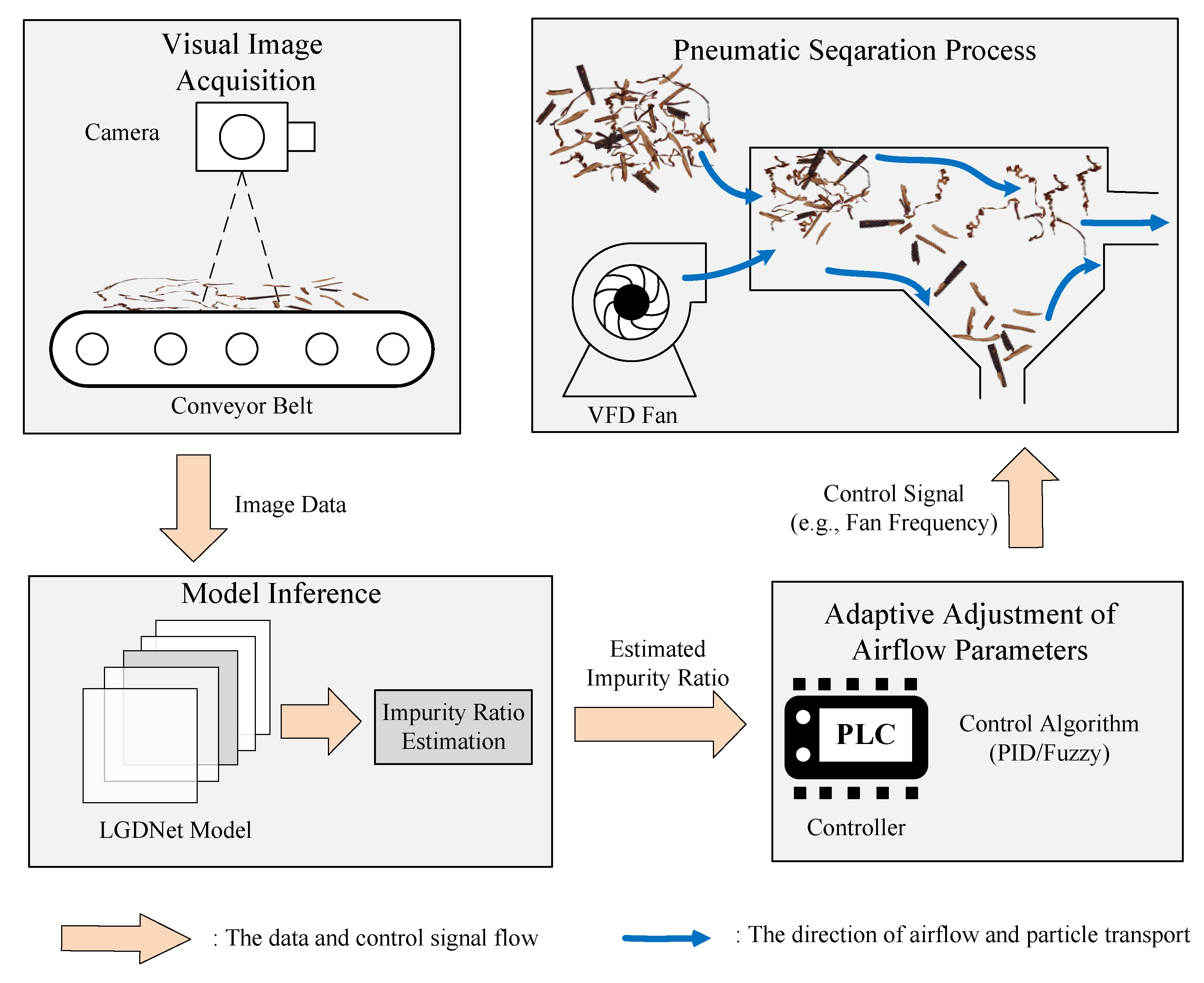
To address the challenges of stochastic fluctuations in feed composition, a perception-informed control architecture is proposed for pneumatic separation. The system architecture integrates three core subsystems: visual perception, adaptive decision-making, and pneumatic actuation (Figure 1). The operational workflow begins with a high-speed industrial camera capturing in-line images of the material stream. The visual perception module, powered by the proposed LGDNet, processes these images to estimate the current impurity ratio r (mass fraction of the heavy impurities). Subsequently, the adaptive controller compares this estimate against a pre-defined safety threshold and calculates the optimal airflow velocity using a discrete control law. Finally, the control signal can regulate the centrifugal fan to modulate the aerodynamic field within the zigzag classifier, aiming to maintain separation purity under non-stationary feed conditions.
To ensure applicability in real-world scenarios with limited computing resources, the system is designed for deployment on standard industrial edge devices. The visual perception algorithm is optimized to run on hardware with constrained computational power, such as standard industrial personal computers (IPCs) or embedded controllers, without relying on high-end workstations.
The central control logic is designed to be executed by a Siemens S7-1200 Programmable Logic Controller (Siemens, Munich, Germany). Communication relies on the Modbus TCP/IP protocol. For precise airflow regulation, the PLC can transmit a 4–20 mA control current to the Variable Frequency Drive (Siemens SINAMICS G120C; Siemens, Munich, Germany), which then adjusts the centrifugal fan speed with a resolution of 0.01 Hz.

3.2. Data Acquisition

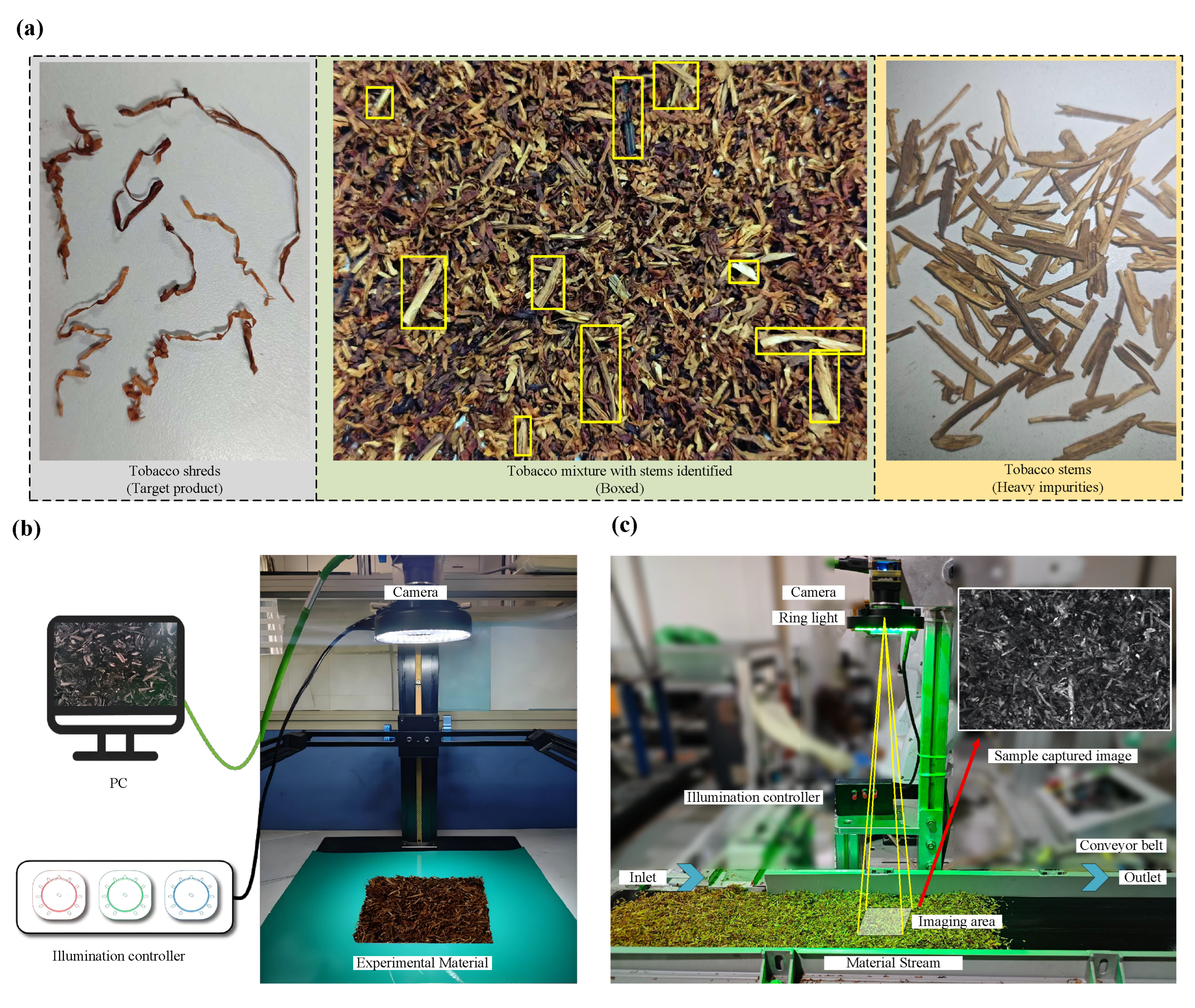
To train and validate the perception model, a rigorously calibrated dataset was constructed using a representative fibrous–granular mixture. In this study, tobacco shreds and stems are used as a representative industrial case study to instantiate the proposed fibrous–granular mixture scenario: shreds form the light fibrous fraction (target product), whereas stems act as heavier, stem-like rigid impurities with a rod-like morphology. As shown in Figure 2, the acquisition setup includes (a) visual examples of the constituent materials and (b,c) two imaging platforms. Before large-scale data collection, an orthogonal experiment was conducted on a laboratory testbed (Figure 2b) to optimize imaging parameters. Based on texture contrast and feature separability, the optimal configuration was determined as follows: the camera was positioned at a height of 35 cm relative to the imaging plane, a green ring light was used, and the illumination intensity was set to 600 lux (measured at the center of the imaging plane). Using these optimized parameters, an in-line acquisition platform was deployed on an industrial conveyor belt (Figure 2c). A global-shutter industrial camera (MV-CB060-10GM-C), configured with an exposure time of 120 ms, captured grayscale images of the material flow at a frame rate of 1 fps. The image capture was synchronized with the belt speed to avoid motion blur. The grayscale images were replicated to three channels and resized to 224 × 224 for network input.
The aerodynamic basis for pneumatic separation arises from the distinct physical properties of the two fractions. Representative particle mass and geometric dimensions were measured using a high-precision electronic balance and digital vernier calipers, respectively, and the quantified parameters are summarized in Table 1. For dataset construction, a total of 8400 raw images were captured and categorized into 21 distinct classes according to the impurity ratio, defined as the mass fraction of the heavy (stem-like) impurities in the mixture, ranging from 0% to 100% in 5% increments. For each ratio level, approximately 400 raw frames were acquired. To enhance model generalization and mitigate overfitting, standard data augmentation techniques (rotation, flipping, and brightness adjustment) were applied, expanding the dataset to approximately 21,000 images. The dataset was partitioned into training, validation, and test sets in a 7:2:1 ratio, as detailed in Table 2.
Note that Table 1 reports representative single-particle properties (mass, density, and characteristic dimensions) measured for each fraction and used for describing aerodynamic contrast and for CFD–DEM parameterization; the mixture condition is specified separately by the impurity ratio r (mass fraction of the heavy fraction) and is varied from 0% to 100% in 5% bins in both the dataset and the simulation scenarios. Regarding the reviewer’s hypothesis of a reduced inter-material contrast (e.g., the characteristic particle mass of the light fraction approaching that of the heavy fraction), the terminal velocity distributions of the two fractions may overlap more strongly, which can reduce separation selectivity and narrow the feasible operating window for simultaneously achieving high target recovery and low impurity carryover. This physical consideration is stated here as a boundary condition; quantitative validation for reduced-contrast material pairs is left for future work.

4. Methods

4.1. LGDNet Architecture

LGDNet is a compact dense convolutional neural network tailored for image classification in resource-constrained scenarios. The naming explicitly refers to its three core components: LGCC (Learned Grouped Channel Convolution), GhostDWConv (Ghost Depthwise Convolution), and dense connectivity. The design targets heterogeneous fibrous–granular mixtures, where light fibrous particles and heavy granular impurities exhibit complex and non-uniform textures. Instead of stacking multiple attention blocks, LGDNet relies on structured channel grouping, learnable channel gating, and depthwise convolutions, achieving a balanced trade-off between recognition accuracy and a parameter count of approximately 8.0 × 10 4 .
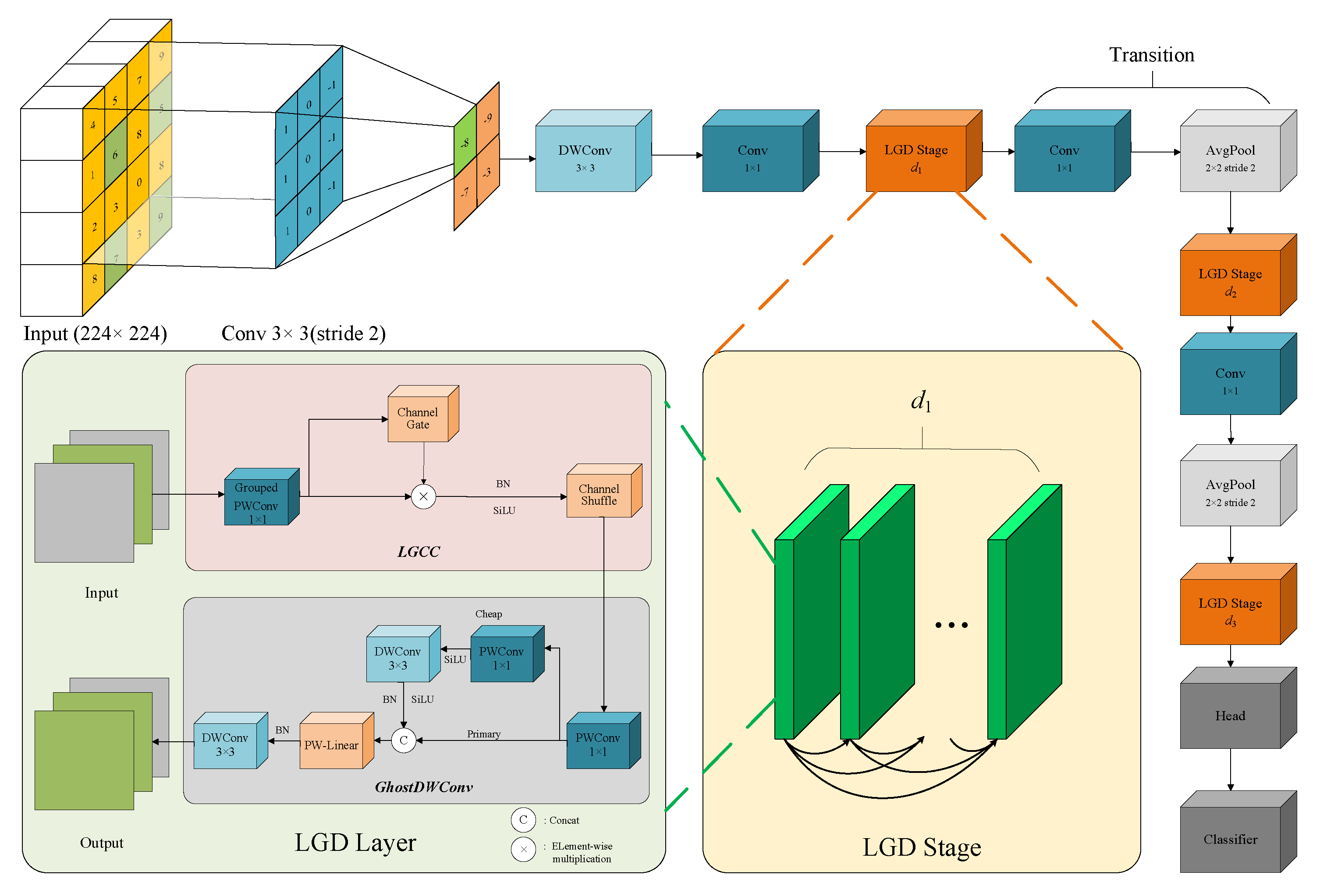
The overall architecture follows a DenseNet-style topology and is composed of a stem, three LGD stages, transition layers, and a classifier head (Figure 3). For an input image X R 3 × 224 × 224 , the stem applies a 3 × 3 convolution with stride 2, a depthwise 3 × 3 convolution (DWConv), and a 1 × 1 pointwise convolution (PWConv):
F 0 = ϕ 1 × 1 ϕ dw , 3 × 3 ϕ 3 × 3 ( X ) ,
where ϕ 3 × 3 denotes a standard convolution, and ϕ dw , 3 × 3 and ϕ 1 × 1 denote depthwise and pointwise convolutions, respectively. This sequence reduces the spatial resolution to 112 × 112 , outputs 32 channels, and prepares a compact feature tensor for the subsequent dense stages. Each LGD stage contains multiple LGD layers connected by dense feature concatenation. The input of the i-th LGD layer within a stage is formed by stacking all preceding feature maps in the same stage:
h i = [ x 0 , x 1 , , x i 1 ] ,
where x k denotes the output of the k-th layer and [ · ] denotes channel-wise concatenation. If the stage receives C in channels and uses a growth rate g, the number of channels entering the i-th LGD layer is
C i = C in + ( i 1 ) g .
This connectivity pattern enhances feature reuse and stabilizes gradient propagation, which is crucial for such a compact network. LGCC performs channel mixing with structured sparsity inside each LGD layer. The input feature map h i is partitioned into G channel groups:
h i = [ h i ( 1 ) , , h i ( G ) ] , C in = G · C g ,
where h i ( g ) denotes the g-th group, C in is the number of input channels, and C g is the number of channels per group. For each group, LGCC applies a grouped 1 × 1 convolution followed by a learnable binary gate:
u ( g ) = W g h i ( g ) , z ( g ) = m ( g ) u ( g ) ,
where W g is the grouped 1 × 1 kernel for the g-th group, m ( g ) { 0 , 1 } C out ( g ) is the gate vector, ⊙ denotes element-wise multiplication, and C out ( g ) is the number of output channels in that group. The gates are trained with a straight-through estimator and are clipped to [ 0 , 1 ] during optimization. During inference, channels associated with zero-valued gates are removed, reducing both parameters and floating-point operations. After gating, the outputs of all groups are concatenated and processed by batch normalization (BN), a SiLU (sigmoid linear unit) activation, and channel shuffle:
v = Shuffle σ BN ( [ z ( 1 ) , , z ( G ) ] ) ,
which promotes information exchange across groups. GhostDWConv is responsible for spatial feature extraction at low cost. For a target output width C out and ghost ratio γ , the module first computes the number of intrinsic channels C pri = C out / γ and ghost channels C gho = C out C pri . A primary pointwise convolution maps v to C pri channels,
p = ϕ 1 × 1 pri ( v ) ,
and a computationally efficient branch applies depthwise and pointwise convolutions to generate C gho ghost channels,
c = ϕ 1 × 1 cheap ϕ dw , 3 × 3 cheap ( p ) .
The intrinsic and ghost features are concatenated and linearly fused:
y ˜ = ϕ 1 × 1 lin ( [ p , c ] ) ,
followed by a depthwise 3 × 3 convolution, BN, and SiLU:
x i = σ BN ϕ dw , 3 × 3 out ( y ˜ ) .
This sequence approximates the effect of a dense 3 × 3 convolution while maintaining a small number of real convolutional kernels. The overall transformation inside an LGD layer can be summarized as
h i LGCC GhostDWConv x i .
The three LGD stages adopt different depths and growth rates to gradually increase the representational capacity. The first, second, and third stages contain 4, 6, and 8 LGD layers, respectively, with growth rates of 16, 20, and 24 channels per layer. If the input of a stage has C in channels and the stage contains L LGD layers with growth rate g, the output channel dimension satisfies
C out = C in + L · g ,
which provides a controlled linear increase instead of an explosive channel expansion. Between consecutive LGD stages, transition layers are inserted to manage spatial resolution and channel width. Each transition layer consists of a 1 × 1 PWConv followed by a 2 × 2 average pooling (AvgPool) with stride 2:
t = AvgPool 2 × 2 ϕ 1 × 1 ( x ) ,
so that the channel dimension is compressed and the spatial size is halved. After the third LGD stage, the feature maps are processed by the classifier head. This head contains BN, a SiLU activation, global average pooling (GAP), and a final 1 × 1 PWConv that maps the pooled feature vector to the required number of classes:
f = σ ( BN ( x out ) ) , g = GAP ( f ) , y = ϕ 1 × 1 ( g ) .
No fully connected layer is used, which simplifies deployment on embedded processors and industrial controllers. Overall, the stem, LGD layers, LGD stages, transition layers, and classifier head together form a compact LGCC–Ghost dense network that maintains competitive recognition accuracy under strict resource and latency constraints.

4.2. CFD–DEM Simulation Configuration

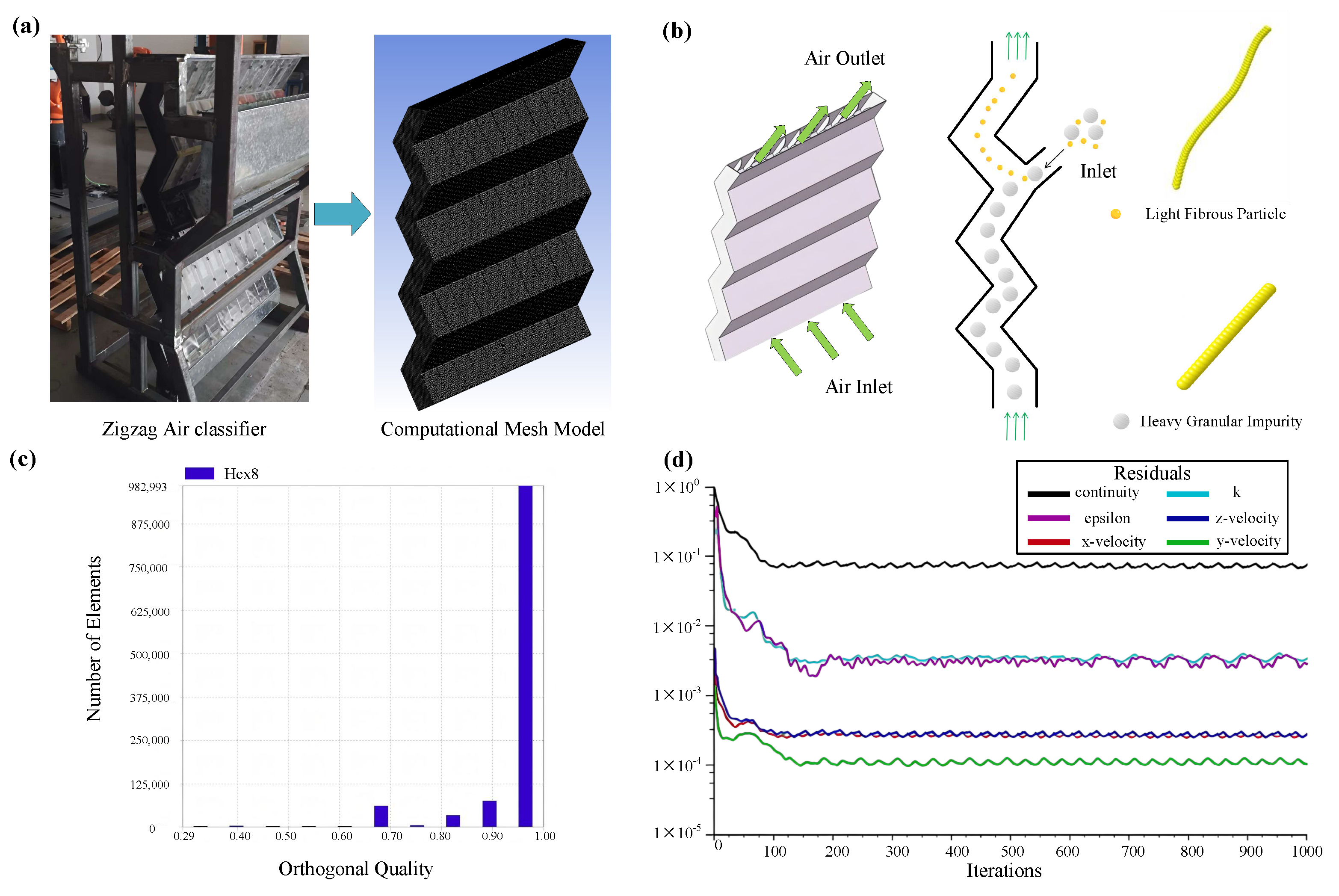
To validate the effectiveness of the control framework driven by LGDNet, a coupled Computational Fluid Dynamics–Discrete Element Method (CFD–DEM) simulation was established (Figure 4). The configuration was designed to capture the interaction between the fluid field and solid particles under realistic operating conditions. A perception–motion co-design strategy was adopted to align the simulation with the response characteristics of the control system [41], and time-delay compensation was considered to reflect the latency of signal transmission and actuation [42]. The airflow field within the zigzag classifier was resolved using ANSYS Fluent (version 2022 R1), whereas particle dynamics were tracked using EDEM. This coupled approach [12] has been widely validated for simulating granular flows in pneumatic separation and related processes [13].
A transient Euler–Euler coupling scheme was employed to represent the two-way momentum exchange between the fluid and solid phases. The fluid flow was solved with a pressure-based transient solver including gravitational acceleration g y = 9.81 m / s 2 . The CFD time step was set to 1.0 × 10 3 s for a total duration of 3 s to ensure stability of the flow field. To resolve particle collisions accurately, the DEM time step was set to 5.0 × 10 6 s . The computational domain was discretized using hexahedral elements, and more than 95 % of the mesh cells exhibited an orthogonal quality index above 0.95 . Convergence of the flow solution was monitored via scaled residuals, and the evolution of the residuals confirmed that a statistically steady state was reached before post-processing.

4.3. Adaptive Control Strategy

The adaptive strategy regulates the inlet air velocity to maintain separation performance under fluctuating feed compositions. The procedure consists of selecting a baseline operating point and defining a response logic for impurity disturbances. Baseline velocity determination was first carried out under nominal feed conditions with an impurity ratio r = 30 % . The inlet velocity v was varied from 9 to 14 m/s, and the corresponding target recovery and impurity carryover were evaluated (Table 3). Increasing v from 9 to 11 m/s markedly improved target recovery, which rose from 31.7 to 69.9 g, while impurity carryover increased only moderately from 4.24 to 8.82 g. Further increasing v beyond 11 m/s did not yield additional recovery but caused a sharp increase in impurity carryover, reaching 16.9 g at 12 m/s and almost 30 g at 14 m/s. Consequently, v = 11 m/s was selected as the nominal baseline velocity v nom that balances recovery and purity under nominal conditions.
The sharp increase of target recovery from 9 to 11 m/s indicates that, below this range, a substantial portion of the light fibrous fraction still settles or recirculates inside the classifier due to insufficient lift. Around 11 m/s, most recoverable fibrous fragments have already been conveyed to the target outlet, so recovery becomes supply- and geometry-limited and therefore saturates near 70 g. Further increasing the inlet velocity mainly strengthens entrainment of heavy impurities (as reflected by the rapid rise in impurity carryover) while contributing little to additional target recovery.
The necessity of adaptive control becomes evident when the inlet impurity ratio deviates from the nominal condition. Under the fixed baseline velocity v = 11 m/s, increasing r leads to pronounced deterioration of separation quality (Table 4). When the impurity ratio reaches 75 % , the impurity carryover mass increases to 44.5 g, indicating a substantial amount of heavy granular impurities entrained into the product stream due to intensified drag coupling. To mitigate this effect, a threshold-based purity protection strategy is implemented, in which the airflow velocity v ( t ) is adjusted according to the estimated impurity ratio r ( t ) :
v ( t ) = v nom , r ( t ) r th , v nom α r ( t ) r th , r ( t ) > r th ,
where r th denotes the impurity threshold and α is a tunable gain that controls the sensitivity of the response. In practice, the control law is implemented in discrete time within the programmable logic controller as
v k + 1 = v nom α r k r th + ,
where k indexes the sampling instant and ( · ) + denotes the positive part operator. When a high-impurity surge is detected, that is r k > r th , the controller reduces the airflow velocity to suppress impurity entrainment while maintaining as much target recovery as possible.

5. Experimental Results

5.1. Experimental Setup and Evaluation Metrics

All backbone architectures were implemented in PyTorch (version 2.3.0) and trained on a workstation equipped with an NVIDIA GeForce RTX 4070 Ti GPU. To ensure a fair comparison, all baseline models were trained using the same protocol: 150 epochs, batch size 128, input resolution 224, AdamW optimizer ( l r = 5 × 10 4 , w d = 0.05 ), per-step cosine annealing with 5 warm-up epochs, ImageNet normalization, and data augmentation (RandomResizedCrop with scale 0.08–1.0 and horizontal flip). Automatic mixed precision was enabled.
For all classification models (including LGDNet with the classification head), label-smoothing cross-entropy loss was adopted to reduce over-confidence and improve generalization across adjacent ratio classes. Given C classes and the ground-truth label y, the smoothed target distribution is defined as
q k = 1 ϵ , k = y , ϵ C 1 , k y ,
where ϵ = 0.1 in this work. Let p k be the predicted posterior probability for class k after softmax. The loss is
L c l s = k = 1 C q k log p k .
Note that this cross-entropy objective treats all misclassifications equally; exploring ordinal or metric-aware objectives that penalize larger ratio deviations more strongly is a promising direction for future work. For the regression-based variant (Model F), the classifier head was replaced by a single-neuron linear output and optimized using Smooth L1 (Huber) loss with β = 1.0 :
L r e g = 1 N i = 1 N ϕ r ^ i r i , ϕ ( d ) = d 2 2 β , | d | < β , | d | β 2 , otherwise .
Model performance was assessed using Top-k accuracy (Top-1 and Top-5), mean absolute error (MAE), and interval accuracy (IntervalAcc). Top-k accuracy is defined as
Acc @ k = 1 N i = 1 N I y i Top k ( p ^ i ) × 100 % ,
where p ^ i is the predicted class-probability vector for the i-th sample. To quantify numerical deviation in composition estimation, MAE is defined as
MAE = 1 N i = 1 N r ^ i r i ,
where r i { 0 , 5 , , 100 } is the ground-truth ratio value parsed from the class name and r ^ i is the predicted ratio value mapped from the predicted class. Considering the tolerance of industrial pneumatic separation, interval accuracy measures the proportion of predictions within ± 5 % :
Interval Acc . = 1 N i = 1 N I r ^ i r i 5 × 100 % .
Inference latency is reported as the average per-image time (ms/img) measured on the same hardware, enabling a direct comparison of real-time capability.

5.2. Performance Benchmark and Error Analysis

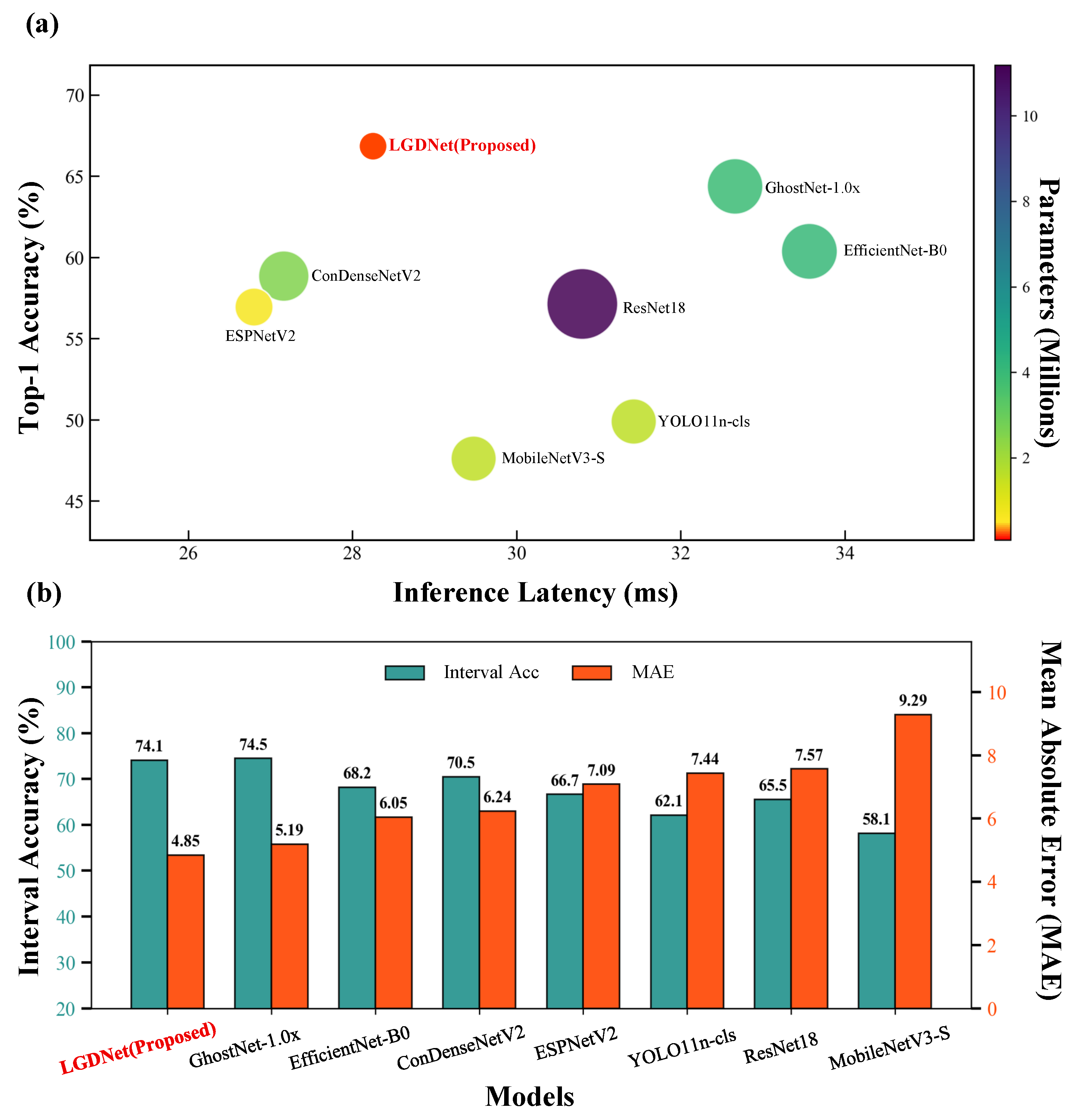
The 21-class composition estimation task considered in this work involves dense and visually complex backgrounds. To benchmark LGDNet under this setting, representative lightweight image classification architectures were selected, including CondenseNetV2 [10], ESPNetV2 [44], YOLO11n-cls [23], EfficientNet-B0 [45], GhostNet-1.0x [11], MobileNetV3-Small [31], and ResNet18 [46]. All models were trained with the unified configuration described in Section 5.1, so that performance differences primarily reflect architectural design rather than training protocol. Figure 5a visualizes the trade-off between inference latency and Top-1 accuracy. LGDNet achieves the highest Top-1 accuracy while maintaining competitive latency, demonstrating that the proposed Ghost-based operations and grouped channel mixing provide a favorable accuracy–efficiency balance. Figure 5b compares interval accuracy and MAE. LGDNet attains the lowest MAE and a high interval accuracy, indicating that its predictions are numerically closer to the target ratio and more reliable under an industrial tolerance band.
Numerical results are summarized in Table 5. LGDNet achieves a Top-1 accuracy of 66.86% and a Top-5 accuracy of 97.14% with 0.080 million parameters. Among the baselines, GhostNet-1.0x reaches a similar interval accuracy but requires a substantially larger model size, whereas EfficientNet-B0 and CondenseNetV2 provide moderate accuracy at higher parameter counts. For YOLO11n-cls and MobileNetV3-S, the increased MAE and reduced interval accuracy indicate less stable ratio estimation under dense mixture textures.
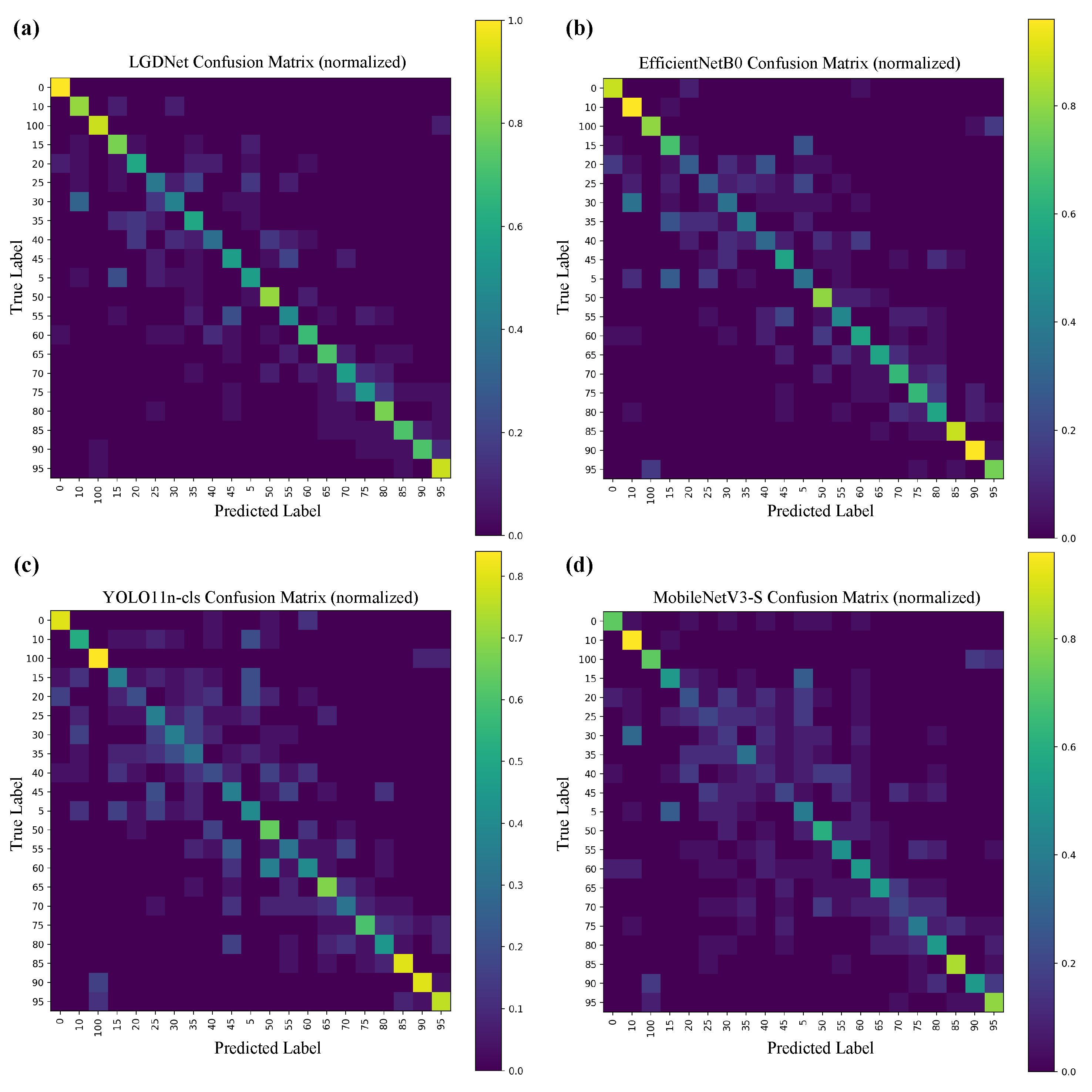
To further examine error characteristics, confusion matrices for four representative models are shown in Figure 6. LGDNet exhibits a concentrated diagonal pattern with most errors confined to neighboring ratio classes. EfficientNet-B0 shows a similar structure but with more pronounced off-diagonal responses. YOLO11n-cls and MobileNetV3-S present stronger scattering across distant classes, highlighting the difficulty of this task for generic backbones without dense connectivity and dedicated channel mixing.

5.3. Module Contribution and Architectural Variants

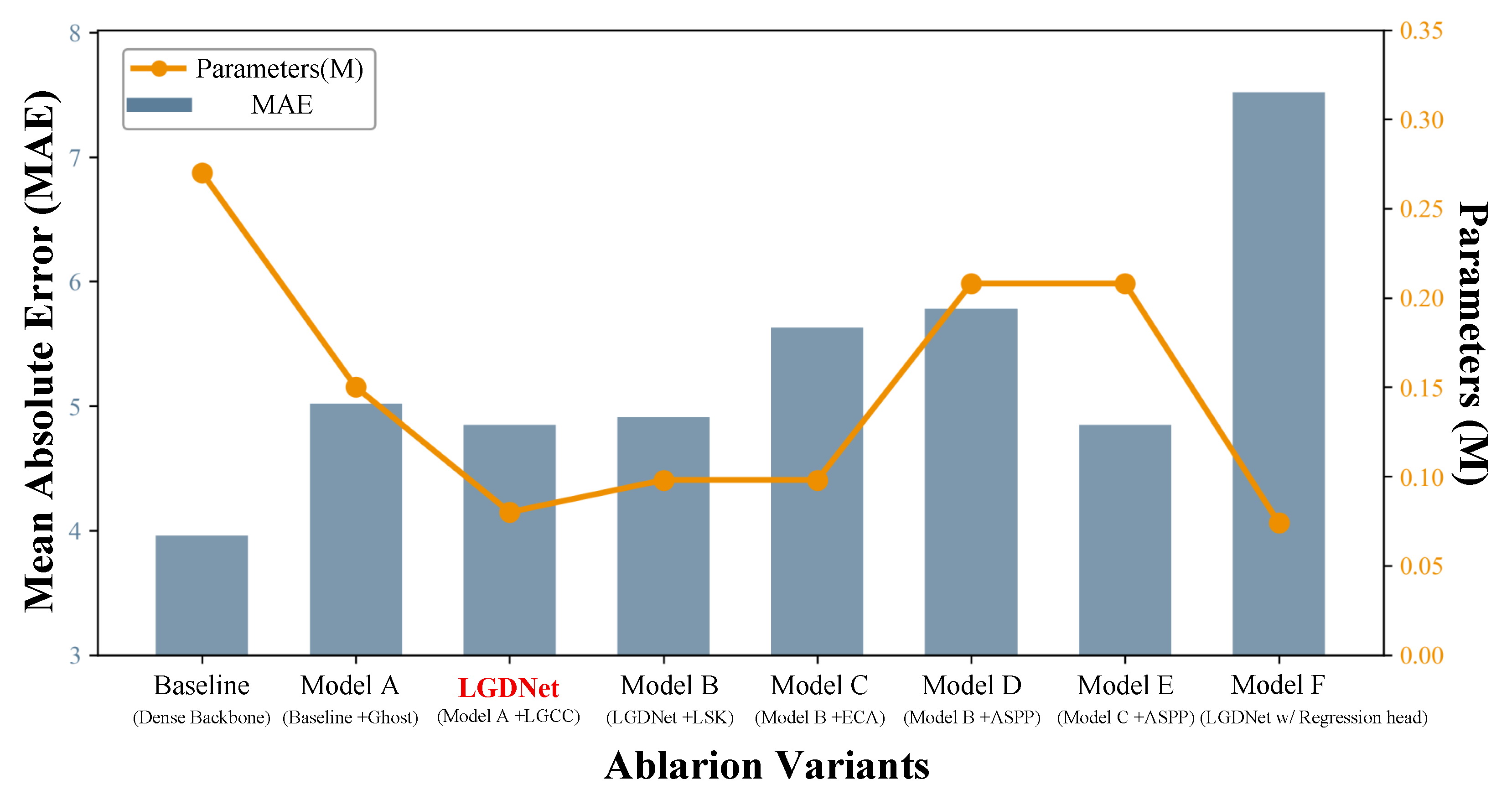
The dense 21-class ratio estimation task imposes stringent requirements on both representation capability and computational efficiency. To analyze how individual modules contribute to this trade-off, a progressive module-wise study was conducted starting from a dense baseline and then introducing lightweight components under the same training protocol as in Section 5.1. The first group of experiments replaces standard convolutions inside the DenseNet-style block with GhostDWConv and then introduces LGCC for learned grouped channel mixing. Quantitative results are listed in Table 6. The baseline DenseNet variant with standard convolutions uses 0.270 million parameters and attains a Top-1 accuracy of 72.95%, a Top-5 accuracy of 98.67%, an interval accuracy of 79.05%, and an MAE of 3.96. After replacing standard convolutions with GhostDWConv (Model A), the parameter count decreases to 0.150 million, while Top-1 accuracy and interval accuracy drop to 66.29% and 74.86%, and MAE increases to 5.02. When LGCC is further integrated on top of Model A (LGDNet), the parameter count is reduced to 0.080 million with a Top-1 accuracy of 66.86%, an interval accuracy of 74.10%, and an MAE of 4.85. These results indicate that the combination of GhostDWConv and LGCC yields a compact configuration that recovers part of the accuracy lost by the pure GhostDWConv replacement while keeping the model in the low-parameter regime.
Beyond the core architecture, we examined whether additional attention-style and multi-scale modules could further improve performance. Large selective kernel (LSK) [35], efficient channel attention (ECA) [34], and atrous spatial pyramid pooling (ASPP) [24] were attached in different combinations to construct Models B through E. The results in Table 7 indicate that these modules provide only marginal or inconsistent gains compared with the base LGDNet configuration. In many cases, the added parameters do not translate into proportional improvements, reinforcing the efficiency of the proposed synergy between Ghost-based operations and learned grouped channel mixing.
To further justify the discretization of impurity ratio estimation, a comparative study was conducted between the classification formulation and a regression-based variant (Model F). In Model F, the classification head was replaced by a single-neuron scalar output and optimized using Smooth L1 loss as described in Section 5.1. As shown in Figure 7 and Table 8, the regression formulation achieved lower scores the classification approach by a large margin: MAE increased to 7.52, while the ± 5 % interval accuracy dropped to 49.33%. This gap indicates that, under dense and highly cluttered mixture textures, direct scalar regression is less stable with the available supervision granularity. By contrast, the classification head models the ratio as a discrete probability distribution over 5% bins, which is more tolerant to near-neighbor ambiguity and better captures non-linear appearance variations. Moreover, the 5% discretization is consistent with the dataset annotation granularity and the practical resolution of industrial dosing, providing a stable feedback signal for downstream control.

5.4. Control Strategy Validation

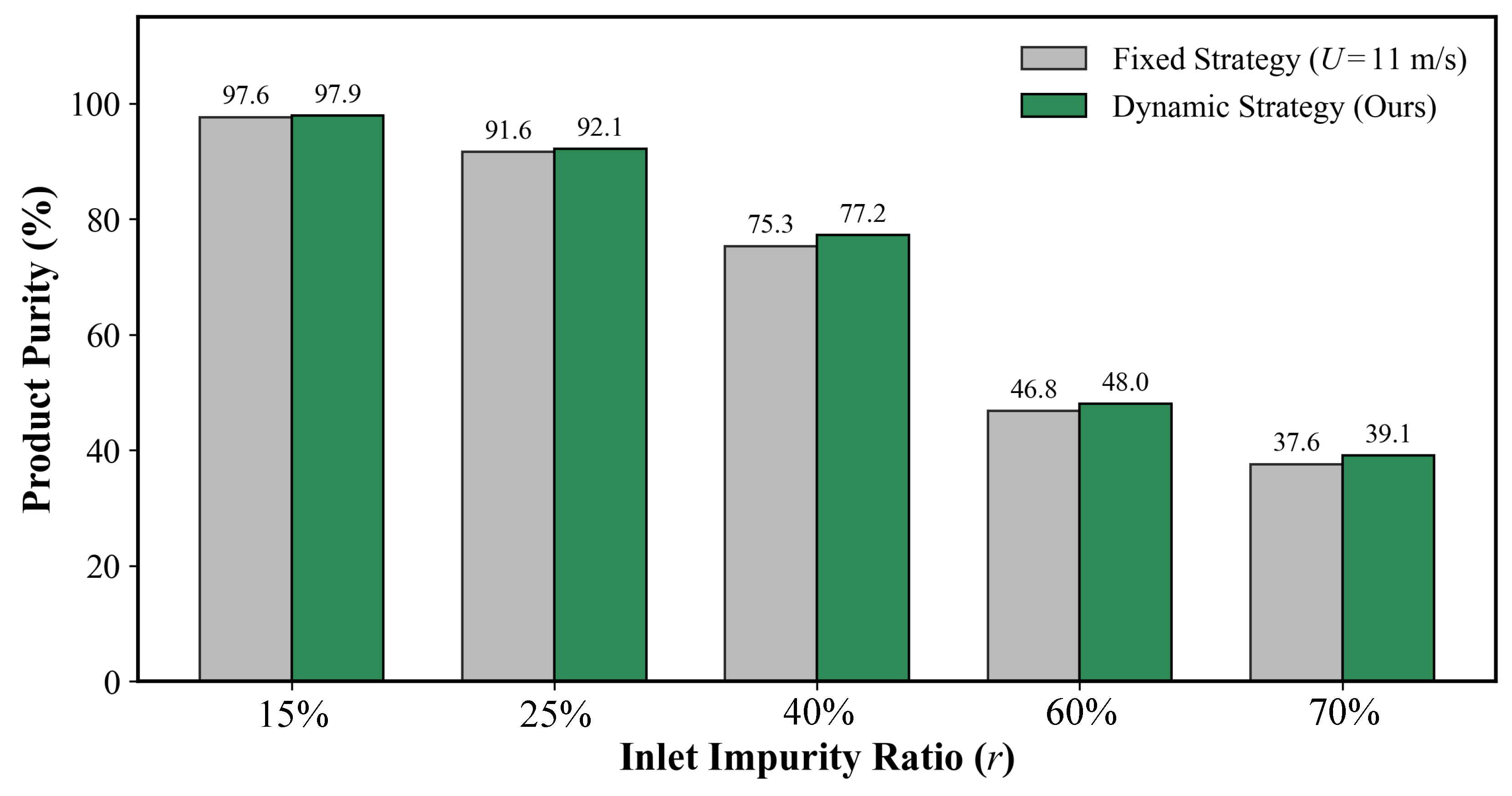
The adaptive airflow strategy was evaluated using the coupled CFD–DEM configuration described previously. Due to boundary condition constraints in the CFD solver, the inlet impurity ratio must be prescribed as a fixed value for each simulation case. Therefore, the simulations validate how the proposed control law responds to representative impurity loads rather than running a fully image-in-the-loop closed-loop simulation driven by a time sequence of r ^ inferred from real images. To distinguish this assessment from the baseline velocity sensitivity analysis, a new set of inlet impurity ratios r was considered, namely 15%, 25%, 40%, 60%, and 70%. For each case, the separation performance of a fixed-speed baseline with U = 11 m/s was compared with that of the dynamic strategy in which the inlet velocity is adjusted as a function of the impurity ratio. Figure 8 reports the resulting product purity for both strategies across the different impurity loads. For low to moderate impurity ratios ( r 25 % ), the two curves almost coincide because the control law keeps the airflow velocity close to the nominal setting and the separation task remains relatively easy. As the impurity ratio increases to 40% and beyond, the fixed-speed baseline exhibits a visible decline in product purity, reflecting intensified entrainment of heavy granular impurities under a constant high velocity. In contrast, the dynamic strategy gradually reduces the inlet velocity in response to higher impurity content and maintains a consistently higher purity level. At r = 70 % , the dynamic strategy achieves an improvement of approximately 1.5 percentage points in product purity compared with the fixed baseline, illustrating that the strategy can attenuate strong upstream disturbances and stabilize separation performance under severely loaded conditions. In the intended physical deployment, the impurity ratio r is provided in-line by the vision module (LGDNet), and the control loop is designed to operate with an industrial tolerance band of ± 5 % , as reflected by the IntervalAcc metric. This separation of perception validation (real-image tests) and control validation (CFD–DEM response to prescribed r) provides complementary evidence for the feasibility of the proposed perception-driven control framework.

6. Discussion

6.1. Challenges of Visual Perception in Dense Heterogeneous Mixtures

Benchmark results on the 21-class composition estimation task reveal that several mainstream lightweight backbones achieve only moderate accuracy on heterogeneous fibrous–granular mixtures, despite their strong performance on standard object recognition datasets. This gap reflects a fundamental mismatch between conventional object-centric feature extraction and the requirements of dense texture estimation. Many convolutional neural network architectures rely on aggressive spatial downsampling to extract semantic shape features. In heterogeneous material streams, however, the distinction between light fibrous particles and heavy granular impurities is encoded primarily in high-frequency textural patterns, local edge statistics, and small-scale occlusion cues rather than in global object outlines. When these high-frequency details are suppressed by pooling and stride operations, the resulting features become insufficiently sensitive to subtle composition changes, which manifests as larger estimation deviations in terms of mean absolute error.
The error distribution across ratio classes further indicates that the most challenging region corresponds to intermediate mixtures. Near the low and high impurity extremes, image appearances are dominated by one component, and class boundaries are relatively clear. In the mid-range, random stacking and interlocking of fibrous and granular particles generate severe occlusion, visual aliasing, and locally ambiguous patterns. Even when the model capacity is adequate, such configurations introduce intrinsic variability in the visual observations. This suggests that a portion of the residual error originates from aleatoric uncertainty associated with the scene itself rather than from insufficient model expressiveness alone. From a practical standpoint, this observation highlights the importance of designing both the imaging system and the model to reduce ambiguity, for example by controlling illumination, stabilizing the field of view, and emphasizing robust texture statistics rather than relying solely on higher model complexity.
From an application perspective, it is appropriate to distinguish clearly between the accuracy of classification (Top-1 accuracy) and the accuracy of mixture composition estimation (MAE, tolerance band). Top-1 accuracy measures the model’s ability to strictly identify the exact ratio class (e.g., exactly 30%), which is a stringent metric for discrete classification. However, for the feedback control of pneumatic separation, the composition estimation accuracy—quantified by MAE and Interval Accuracy—is of greater practical significance. A prediction that falls into a neighboring class (e.g., predicting 35% instead of 30%) may result in a “classification error” but still provides a valid control signal within the allowable tolerance band. The results in Section 5 indicate that while LGDNet achieves a balanced Top-1 accuracy, its high Interval Accuracy and low MAE ensure that the estimated impurity ratio r remains sufficiently reliable to drive the regime-dependent airflow regulation.

6.2. Architectural Efficiency, Redundancy, and Deployability

The primary object of the architectural design is a compact perception module that can be deployed close to the production line and estimate the composition of heterogeneous fibrous–granular mixtures in real time under limited hardware resources. In this context, LGDNet is constructed as a task-specific backbone rather than a general-purpose image classifier. The module-wise comparisons in Table 5, Table 6 and Table 7 show that LGDNet occupies a distinct operating point: the parameter count is kept in the order of 0.080 million, while the accuracy on the 21-class composition task remains comparable to or better than that of substantially larger alternatives. When the DenseNet-style baseline is taken as a reference, the object of compression is clear. The baseline demonstrates that higher accuracy can be obtained by increasing the number of channels and layers, but this comes with a growth in memory access and computational cost that is difficult to accommodate on low-power embedded devices. Replacing standard convolutions with GhostDWConv reduces the parameter count but also degrades performance, indicating that indiscriminate removal of redundancy is not sufficient for the target task. LGDNet is positioned between these two extremes: GhostDWConv is used to compress the convolutional blocks, and LGCC is introduced to restore feature transmission and channel interaction. The resulting network realizes the intended object of design, namely selective pruning of redundant connections while preserving the pathways that are essential for ratio estimation in dense mixtures. From a deployment perspective, LGDNet directly reflects the constraints of the intended hardware platform. The total number of parameters implies a weight storage requirement well below one megabyte in 32-bit floating-point representation and considerably less under 16-bit or 8-bit quantization. This footprint fits within the on-chip memory of many embedded graphics processors and system-on-chip platforms that are typically co-located with programmable logic controllers. The measured single-image latency in Table 5 indicates competitive inference time on the same hardware; although LGDNet is not the fastest backbone among all entries, it achieves the best estimation accuracy with the smallest parameter footprint and a comparable latency budget. Even after accounting for slower execution on an embedded central processing unit, the expected inference time per frame remains shorter than the image acquisition interval in the conveyor application. In other words, the perception module defined by LGDNet leaves a substantial safety margin in both memory usage and computational throughput relative to the requirements of the industrial system. The variants built on top of LGDNet further clarify how much complexity is actually necessary for the target object. Adding LSK, ECA, or ASPP produces only modest and sometimes inconsistent changes in accuracy while increasing the parameter count by 20–160%. For the deployment scenario considered here, such increases offer limited practical benefit: the additional accuracy is small, the memory footprint grows, and the implementation becomes more difficult to verify and maintain on site. LGDNet therefore represents a deliberate compromise that matches the needs of the application: sufficient representational capacity to handle dense heterogeneous mixtures, minimal redundancy to respect hardware limits, and a structure that remains straightforward to integrate into existing edge-computing and control hardware.

6.3. Mechanism of Aerodynamic Regulation

The control strategy analysis indicates that regulating airflow based on the estimated impurity ratio can substantially improve product purity under high-load conditions. The underlying mechanism is governed by the interaction between aerodynamic drag, particle inertia, and the geometry of the separation channel. Under a fixed high inlet velocity, dense clusters of heavy granular impurities experience enhanced entrainment due to collective drag effects. Particles aligned within the same flow structures tend to shield each other, enabling groups of impurities to be carried toward the product outlet even when their individual terminal velocities would otherwise promote settling. This group effect becomes more pronounced as the impurity ratio increases, which explains the purity degradation observed when the airflow remains unchanged across all loading conditions. By contrast, the threshold-based control logic reduces the inlet velocity when the estimated impurity ratio exceeds a specified level. Lowering the airflow in these regimes decreases the drag force acting on heavy impurities, bringing it below their effective terminal velocity while maintaining sufficient lift for the lighter fibrous particles. The zigzag geometry of the classifier then amplifies this difference: heavy impurities increasingly collide with the channel walls and lose momentum, whereas fibrous particles remain suspended and follow the main flow. The resulting separation improvement, including the observed purity gains on the order of one to two percentage points under severe disturbances, is consistent with this aerodynamic interpretation. Another important aspect of the control design is its computational simplicity. The threshold-based adjustment law requires only basic arithmetic operations and a small number of tunable parameters. This structure aligns well with the capabilities of programmable logic controllers and low-level industrial controllers, which typically favor deterministic and interpretable logic over complex optimization routines. More advanced strategies such as model predictive control or adaptive nonlinear control could, in principle, further optimize separation performance, but they would introduce additional implementation and maintenance costs. In contrast, the present logic exploits the sensitivity of the separation process to airflow while maintaining a control structure that is easy to integrate, understand, and tune on site, which is an important consideration for real-world deployment.

6.4. Limitations and Future Work

This study provides complementary evidence for perception-informed pneumatic separation, but several limitations should be stated explicitly. First, a complete physical closed-loop experiment (LGDNet → control policy → PLC/VFD actuation) has not yet been conducted on real separation equipment; the vision model is validated on real conveyor images, whereas the control strategy is evaluated in a coupled CFD–DEM environment. Second, the CFD–DEM validation is performed under prescribed impurity ratio scenarios to evaluate the control logic. This design choice is adopted because generating photorealistic dense particle-flow images from a CFD–DEM simulation and using them to drive the perception model is beyond the scope of the present work; such a tightly synchronized image-in-the-loop simulation will be explored in future studies.
Third, the current framework is demonstrated on a single representative fibrous–granular material pair with distinct morphological contrast. A brief note on transferability is warranted: for other types of fibrous–granular mixtures, particularly those with less contrast in density or particle shape (e.g., mixtures where components have similar terminal velocities or visual textures), the separability boundaries may narrow. Future work should investigate the applicability of the proposed visual estimation and regulation approach to these more challenging material systems to better define the scope of the solution.
Finally, although inlet airflow velocity is used as the regulated variable because it is directly supported by the simulation model and industrial fan control, future implementations may benefit from regulating flow rate or pressure difference and mapping them to velocity via calibrated process models.

7. Conclusions

This study proposes a perception-informed regulation architecture for pneumatic separation in which the impurity ratio r (mass fraction of heavy impurities) estimated from conveyor images is used to adjust the inlet airflow setting through a simple threshold-based policy. The proposed LGDNet backbone achieves reliable ratio recognition for dense mixture images with a compact footprint (0.080 M parameters), reaching 66.86% Top-1 accuracy, 74.10% interval accuracy within a ± 5 % tolerance, and an MAE of 4.85 on the 21-class dataset. Using a coupled CFD–DEM environment with prescribed impurity ratio scenarios, the regulation policy is further shown to mitigate purity degradation under heavily contaminated feeds, yielding an improvement of about 1.5 percentage points at r = 70 % compared with a fixed-velocity baseline. While the present validation combines real-image perception tests with simulation-based control assessment (and does not yet constitute a full hardware-in-the-loop or on-site closed-loop experiment), the results provide quantitative evidence that composition-aware airflow adaptation can improve robustness against non-stationary feed disturbances. Looking forward, future goals are threefold: (1) to conduct full-scale experimental verification of the image-in-the-loop closed control loop on real separation equipment to validate the dynamic regulation strategy in an operational environment; (2) to extend the dataset and validation to include material mixtures with lower density and morphological contrast; and (3) to explore metric-aware loss functions that further minimize estimation variance for high-precision industrial control.

Author Contributions

Conceptualization, S.J. and L.C.; methodology, S.J. and R.W.; software, R.W., S.Y. and X.G.; validation, L.L., H.S. and X.C.; formal analysis, S.J. and X.G.; investigation, S.Y. and L.L.; resources, L.C. and H.P.; data curation, H.S. and X.C.; writing—original draft preparation, S.J. and R.W.; writing—review and editing, L.C. and H.P.; visualization, S.J., R.W. and X.C.; supervision, L.C. and H.P.; project administration, L.C.; funding acquisition, R.W., L.C. and H.P. All authors have read and agreed to the published version of the manuscript.

Funding

This research was funded by the Guangxi Science and Technology Plan Project (Grant No. AD23026282), the Guangxi Science and Technology Major Program (Grant No. AA17204017), and the Innovation Project of Guangxi Graduate Education (Grant No. A3010022002).

Institutional Review Board Statement

Not applicable.

Informed Consent Statement

Not applicable.

Data Availability Statement

The data that support the findings of this study involve confidential industrial processes and therefore cannot be made publicly available. Data may be provided by the corresponding author upon reasonable request and with appropriate permissions.

Acknowledgments

The authors express their gratitude to the School of Mechanical Engineering at Guangxi University for providing the experimental facilities and high-performance computing resources necessary for the CFD–DEM simulations and data analysis. We also extend our appreciation to the laboratory technical staff for their assistance in setting up the pneumatic separation testbed and the hardware–software interface. Furthermore, we thank the anonymous reviewers for their constructive comments that significantly improved the quality of this manuscript.

Conflicts of Interest

The authors declare no conflict of interest.

Abbreviations

The following abbreviations are used in this manuscript:
LGDNetLGCC–Ghost–Dense Network
LGCCLearned Grouped Channel Convolution
GhostDWConvGhost Depthwise Convolution
CNNConvolutional Neural Network
CFDComputational Fluid Dynamics
DEMDiscrete Element Method
MAEMean Absolute Error
PLCProgrammable Logic Controller
VFDVariable Frequency Drive
IPCIndustrial Personal Computer
LSKLarge Selective Kernel
ECAEfficient Channel Attention
ASPPAtrous Spatial Pyramid Pooling

References

  1. Kaas, A.; Mütze, T.; Peuker, U.A. Review on zigzag air classifier. Processes 2022, 10, 764. [Google Scholar] [CrossRef]
  2. Eswaraiah, C.; Kavitha, T.; Vidyasagar, S.; Narayanan, S.S. Classification of metals and plastics from printed circuit boards (PCB) using air classifier. Chem. Eng. Process. 2008, 47, 565–576. [Google Scholar] [CrossRef]
  3. Lukas, E.; Roloff, C.; Mann, H.; Kerst, K.; Hagemeier, T.; van Wachem, B.; Thévenin, D.; Tomas, J. Experimental Study and Modelling of Particle Behaviour in a Multi-stage Zigzag Air Classifier. In Dynamic Flowsheet Simulation of Solids Processes; Springer: Berlin/Heidelberg, Germany, 2020; pp. 391–410. [Google Scholar]
  4. Stepanenko, S.; Kotov, B.; Kuzmych, A.; Kalinichenko, R.; Hryshchenko, V. Research of the process of air separation of grain material in a vertical zigzag channel. J. Cent. Eur. Agric. 2023, 24, 225–235. [Google Scholar] [CrossRef]
  5. Reguła, T.; Frączek, J.; Fitas, J. A Model of Transport of Particulate Biomass in a Stream of Fluid. Processes 2020, 9, 5. [Google Scholar] [CrossRef]
  6. Zhou, L.; Elemam, M.A.; Agarwal, R.K.; Shi, W. Aerodynamic Systems. In Discrete Element Method for Multiphase Flows with Biogenic Particles: Agriculture Applications; Springer: Berlin/Heidelberg, Germany, 2024; pp. 5–18. [Google Scholar]
  7. Kharchenko, S.; Borshch, Y.; Kovalyshyn, S.; Piven, M.; Abduev, M.; Miernik, A.; Popardowski, E.; Kiełbasa, P. Modeling of aerodynamic separation of preliminarily stratified grain mixture in vertical pneumatic separation duct. Appl. Sci. 2021, 11, 4383. [Google Scholar] [CrossRef]
  8. Choszcz, D.J.; Reszczyński, P.S.; Kolankowska, E.; Konopka, S.; Lipiński, A. The effect of selected factors on separation efficiency in a pneumatic conical separator. Sustainability 2020, 12, 3051. [Google Scholar] [CrossRef]
  9. Huang, G.; Liu, S.; Van der Maaten, L.; Weinberger, K.Q. CondenseNet: An efficient densenet using learned group convolutions. In Proceedings of the IEEE Conference on Computer Vision and Pattern Recognition, Salt Lake City, UT, USA, 18–23 June 2018; pp. 2752–2761. [Google Scholar]
  10. Yang, L.; Jiang, H.; Cai, R.; Wang, Y.; Song, S.; Huang, G.; Tian, Q. CondenseNetV2: Sparse feature reactivation for deep networks. In Proceedings of the IEEE/CVF Conference on Computer Vision and Pattern Recognition, Nashville, TN, USA, 20–25 June 2021; pp. 3569–3578. [Google Scholar]
  11. Han, K.; Wang, Y.; Tian, Q.; Guo, J.; Xu, C.; Xu, C. GhostNet: More features from cheap operations. In Proceedings of the IEEE/CVF Conference on Computer Vision and Pattern Recognition, Seattle, WA, USA, 13–19 June 2020; pp. 1580–1589. [Google Scholar]
  12. El-Emam, M.A.; Zhou, L.; Shi, W.; Han, C.; Bai, L.; Agarwal, R. Theories and applications of CFD–DEM coupling approach for granular flow: A review. Arch. Comput. Methods Eng. 2021, 28, 4979–5020. [Google Scholar] [CrossRef]
  13. Zhou, C.; Su, J.; Jiang, X.; Shi, Z. Numerical simulation and experimental verification for the sorting behaviors of mixed biomass particles in a novel Z-shaped fluidized bed. Chem. Eng. J. 2022, 441, 136109. [Google Scholar] [CrossRef]
  14. Mohd Khairi, M.T.; Ibrahim, S.; Md Yunus, M.A.; Faramarzi, M. Noninvasive techniques for detection of foreign bodies in food: A review. J. Food Process Eng. 2018, 41, e12808. [Google Scholar] [CrossRef]
  15. Lee, D.-H.; Kim, E.-S.; Cho, J.-S.; Ryu, J.-H.; Min, B.-S. A two-stage automatic labeling method for detecting abnormal food items in X-ray images. J. Food Meas. Charact. 2022, 16, 2999–3009. [Google Scholar] [CrossRef]
  16. Dianyu, E.; Liu, Y.; Xiao, Y.; Fan, Y.; Yin, M.; Liu, S.; Zou, R.; Wang, H. Numerical investigation of vertical pneumatic separation of heterogeneous particle swarms in lithium iron phosphate battery recycling. Sep. Purif. Technol. 2025, 354, 135329. [Google Scholar]
  17. Zhang, K.; Zhang, J.; Guo, J.; Yao, L. Application of near-infrared spectroscopy and hyperspectral imaging for non-destructive quality evaluation and detection of adulteration in food products: A review. Foods 2022, 11, 440. [Google Scholar]
  18. Sun, J.; Shen, X.; Sun, Q. Hyperspectral image few-shot classification network based on the earth mover’s distance. IEEE Trans. Geosci. Remote Sens. 2022, 60, 5534114. [Google Scholar] [CrossRef]
  19. Choi, J.; Lim, B.; Yoo, Y. Advancing plastic waste classification and recycling efficiency: Integrating image sensors and deep learning algorithms. Appl. Sci. 2023, 13, 10224. [Google Scholar] [CrossRef]
  20. Chakraborty, S.K.; Subeesh, A.; Dubey, K.; Jat, D.; Chandel, N.S.; Potdar, R.; Rao, N.G.; Kumar, D. Development of an optimally designed real-time automatic citrus fruit grading–sorting machine leveraging computer vision-based adaptive deep learning model. Eng. Appl. Artif. Intell. 2023, 120, 105826. [Google Scholar] [CrossRef]
  21. Ziouzios, D.; Baras, N.; Balafas, V.; Dasygenis, M.; Stimoniaris, A. Intelligent and real-time detection and classification algorithm for recycled materials using convolutional neural networks. Recycling 2022, 7, 9. [Google Scholar] [CrossRef]
  22. Karim, M.J.; Munir, S.; Khandakar, A.; Ahsan, M.; Haider, J. RTDRNet-lite: A lightweight real-time detection framework for robotic waste sorting. Waste Manag. 2025, 208, 115164. [Google Scholar] [CrossRef]
  23. Jiang, Z.; Zhao, L.; Li, S.; Jia, Y. Real-time object detection method based on improved YOLOv4-tiny. arXiv 2020, arXiv:2011.04244. [Google Scholar] [CrossRef]
  24. Chen, L.-C.; Papandreou, G.; Kokkinos, I.; Murphy, K.; Yuille, A.L. DeepLab: Semantic Image Segmentation with Deep Convolutional Nets, Atrous Convolution, and Fully Connected CRFs. IEEE Trans. Pattern Anal. Mach. Intell. 2017, 40, 834–848. [Google Scholar] [CrossRef]
  25. Özkan, K.; Ergin, S.; Işık, Ş.; Işıklı, İ. A new classification scheme of plastic wastes based upon recycling labels. Waste Manag. 2015, 35, 29–35. [Google Scholar] [CrossRef]
  26. Qin, Z.; Zhang, P.; Li, X. Ultra fast deep lane detection with hybrid anchor driven ordinal classification. IEEE Trans. Pattern Anal. Mach. Intell. 2022, 46, 2555–2568. [Google Scholar] [CrossRef] [PubMed]
  27. Nxumalo, T.L.; Rimiru, R.M.; Magagula, V.M. A deep learning ordinal classifier. Int. J. Adv. Comput. Sci. Appl. 2025, 16, 301–308. [Google Scholar] [CrossRef]
  28. Barbero-Gómez, J.; Cruz, R.P.M.; Cardoso, J.S.; Gutiérrez, P.A.; Hervás-Martínez, C. CNN explanation methods for ordinal regression tasks. Neurocomputing 2025, 615, 128878. [Google Scholar] [CrossRef]
  29. Huang, G.; Liu, S.; Van der Maaten, L.; Weinberger, K.Q. Densely connected convolutional networks. In Proceedings of the IEEE Conference on Computer Vision and Pattern Recognition, Honolulu, HI, USA, 21–26 July 2017; pp. 4700–4708. [Google Scholar]
  30. Ma, N.; Zhang, X.; Zheng, H.-T.; Sun, J. ShuffleNet V2: Practical Guidelines for Efficient CNN Architecture Design. In Proceedings of the European Conference on Computer Vision (ECCV), Munich, Germany, 8–14 September 2018; pp. 116–131. [Google Scholar]
  31. Howard, A.; Sandler, M.; Chu, G.; Chen, L.-C.; Chen, B.; Tan, M.; Wang, W.; Zhu, Y.; Pang, R.; Vasudevan, V.; et al. Searching for MobileNetV3. In Proceedings of the IEEE/CVF International Conference on Computer Vision, Seoul, Republic of Korea, 27 October–2 November 2019; pp. 1314–1324. [Google Scholar]
  32. Chang, S.; Zheng, B. A lightweight convolutional neural network for automated crack inspection. Constr. Build. Mater. 2024, 416, 135151. [Google Scholar] [CrossRef]
  33. Zhang, L.; Kuang, J.; Teng, Y.; Xiang, S.; Li, L.; Zhou, Y. A Lightweight Infrared and Visible Light Multimodal Fusion Method for Object Detection in Power Inspection. Processes 2025, 13, 2720. [Google Scholar] [CrossRef]
  34. Wang, Q.; Wu, B.; Zhu, P.; Li, P.; Zuo, W.; Hu, Q. ECA-Net: Efficient channel attention for deep convolutional neural networks. In Proceedings of the IEEE/CVF Conference on Computer Vision and Pattern Recognition, Seattle, WA, USA, 13–19 June 2020; pp. 11534–11542. [Google Scholar]
  35. Li, Y.; Hou, Q.; Zheng, Z.; Cheng, M.-M.; Yang, J.; Li, X. Large selective kernel network for remote sensing object detection. In Proceedings of the IEEE/CVF International Conference on Computer Vision, Paris, France, 2–6 October 2023; pp. 16794–16805. [Google Scholar]
  36. Liu, J.; Li, H.; Zuo, F.; Zhao, Z.; Lu, S. Kd-lightnet: A lightweight network based on knowledge distillation for industrial defect detection. IEEE Trans. Instrum. Meas. 2023, 72, 3525713. [Google Scholar] [CrossRef]
  37. Cui, K.F.E.; Zhou, G.G.D.; Lu, X.; Pasuto, A. Mechanisms of friction segregation in dense granular flows. Powder Technol. 2025, 434, 121292. [Google Scholar] [CrossRef]
  38. Adamchuk, V.; Bulgakov, V.; Ivanovs, S.; Holovach, I.; Ihnatiev, Y. Theoretical study of pneumatic separation of grain mixtures in vortex flow. Eng. Rural Dev. 2021, 20, 657–664. [Google Scholar]
  39. Wang, F.; Zhao, Z.; Peng, J.; Fang, Y. The influence of secondary air guide vanes on the flow field and performance of a turbine air classifier. Processes 2025, 13, 2268. [Google Scholar] [CrossRef]
  40. Chang, M.; Fan, Y.; Lu, C. Filtration of dust particulates with a granular bed filter in a novel coupled separator. Sep. Purif. Technol. 2024, 342, 126502. [Google Scholar] [CrossRef]
  41. Tang, H.; Li, Y.; Zhou, N.; Cheng, M.; Tao, S.; Xu, B. A real-time perception-motion codesign method for image-based visual servoing in embodied intelligence systems. J. Ind. Inf. Integr. 2025, 48, 100933. [Google Scholar] [CrossRef]
  42. Chen, H.; Li, Q.; Ye, Z.; Pang, S. Neural Network-Based Parameter Estimation and Compensation Control for Time-Delay Servo System of Aeroengine. Aerospace 2025, 12, 64. [Google Scholar] [CrossRef]
  43. Si, D.; Yan, Z.; Lu, C. Performance experiments and pressure drop prediction modelling of an energy-saving cyclone separator. Fuel 2024, 372, 132165. [Google Scholar] [CrossRef]
  44. Mehta, S.; Rastegari, M.; Shapiro, L.; Hajishirzi, H. ESPNetv2: A Light-Weight, Power Efficient, and General Purpose Convolutional Neural Network. In Proceedings of the IEEE/CVF Conference on Computer Vision and Pattern Recognition, Long Beach, CA, USA, 15–20 June 2019; pp. 9190–9200. [Google Scholar]
  45. Tan, M.; Le, Q. EfficientNet: Rethinking Model Scaling for Convolutional Neural Networks. In Proceedings of the International Conference on Machine Learning, Long Beach, CA, USA, 9–15 June 2019; pp. 6105–6114. [Google Scholar]
  46. He, K.; Zhang, X.; Ren, S.; Sun, J. Deep residual learning for image recognition. In Proceedings of the IEEE Conference on Computer Vision and Pattern Recognition, Las Vegas, NV, USA, 27–30 June 2016; pp. 770–778. [Google Scholar]
Figure 1. Overall framework of the intelligent control system for pneumatic separation. The system consists of four functional modules: visual image acquisition, model inference, adaptive adjustment, and the pneumatic separation process.
Machines 14 00066 g001
Figure 2. Experimental materials and acquisition system: (a) Optical characteristics of constituent materials including fibrous fragments as target product (left), mixture with stem-like impurities highlighted by colored bounding boxes (middle), and stem-like impurities as heavy fraction (right); (b) laboratory testbed for parameter optimization; (c) in-line acquisition platform on the conveyor belt.
Machines 14 00066 g002
Figure 3. Overall architecture of LGDNet including the stem, LGD layer, LGD stage, transitions, and classifier head. The ellipsis (…) indicates the repetition of stacked layers, and distinct functional modules are distinguished by different colors.
Machines 14 00066 g003
Figure 4. CFD–DEM configuration of the pneumatic classifier: (a) geometry and computational mesh; (b) particle models with green arrows indicating the airflow direction; (c) mesh quality distribution; and (d) residual convergence history.
Machines 14 00066 g004
Figure 5. Performance comparison of different models with latency versus Top-1 accuracy in a 21-class setting (a) and interval accuracy versus mean absolute error (b). The proposed model (LGDNet) is highlighted in red text to distinguish it from the baselines.
Machines 14 00066 g005
Figure 6. Confusion matrices for LGDNet (a), EfficientNet-B0 (b), YOLO11n-cls (c), and MobileNetV3-S (d).
Machines 14 00066 g006
Figure 7. Ablation trend of MAE (bars) and parameter count (line) across LGDNet variants, including the regression-head formulation. The proposed LGDNet configuration is highlighted in red text.
Machines 14 00066 g007
Figure 8. Comparison of product purity for fixed and dynamic airflow strategies at impurity ratios r = 15 % ,   25 % ,   40 % ,   60 % ,   70 % .
Machines 14 00066 g008
Table 1. Physical parameters of the experimental heterogeneous particles (representative samples).
Particle TypeMass (g)Density (g/cm3)Length (mm)Width (mm)Height (mm)
Light fibrous particle (shred)0.0020.592172.01.4
Heavy stem-like impurity (stem fragment)0.0200.908201.20.4
Table 2. Dataset composition and augmentation details.
Dataset AttributeValue/Description
Total Raw Images8400
Number of Classes21 (0% to 100% impurity ratio, step = 5%)
Images per Class (Raw)∼400
Augmentation TechniquesRotation ( ± 15 ), Horizontal Flip, Brightness ( ± 10 % )
Total Augmented Images∼21,000
Training Set (70%)14,700
Validation Set (20%)4200
Test Set (10%)2100
Table 3. Sensitivity of separation performance to air velocity under nominal feed conditions ( r = 30 % ).
Air Velocity v (m/s)Target Recovery (g)Impurity Carryover (g)
31.74.24
1051.67.61
1169.98.82
1269.916.9
1370.021.1
1470.029.8
Table 4. Impact of feed composition on separation performance under fixed airflow ( v = 11 m/s).
Impurity Ratio r (%)Target Recovery (g)Impurity Carryover (g)
1089.92.10
3069.98.82
5049.830.6
6733.437.9
7524.844.5
Table 5. Performance benchmark under a unified training framework (models sorted by MAE).
ModelParams (M)Latency (ms)Top-1 (%)Top-5 (%)Interval Acc. (%)MAE
LGDNet (Proposed)0.08028.2566.8697.1474.104.85
GhostNet-1.0x3.92832.6664.3895.2474.485.19
EfficientNet-B04.03433.5760.3890.2968.196.05
CondenseNetV22.53927.1658.8692.5770.486.24
ESPNetV20.66726.8056.9591.2466.677.09
YOLO11n-cls1.55831.4349.9191.0562.107.44
ResNet1811.18730.8057.1490.6765.527.57
MobileNetV3-S1.53929.4747.6287.2458.109.29
Table 6. Module-wise analysis of the DenseNet-style backbone with GhostDWConv and LGCC components.
Model VariantParams (M)Top-1 (%)Top-5 (%)Interval Acc. (%)MAE
Baseline (DenseNet var.)0.27072.9598.6779.053.96
Model A (+GhostDWConv)0.15066.2997.9074.865.02
LGDNet (+LGCC on A)0.08066.8697.1474.104.85
Table 7. Comparison of LGDNet variants with additional attention and multi-scale modules.
Model VariantParams (M)Top-1 (%)Top-5 (%)Interval Acc. (%)MAE
LGDNet (Proposed)0.08066.8697.1474.104.85
Model B (+LSK on LGDNet)0.09866.8697.9074.674.91
Model C (+ECA on B)0.09863.8196.9571.625.63
Model D (+ASPP on B)0.20864.0096.9572.765.78
Model E (+ASPP on C)0.20865.5296.9574.484.85
Table 8. Empirical comparison between classification and a regression-head variant using the same backbone under the specified protocol.
FormulationParams (M)MAEInterval Acc. (%)Latency (ms)
Classification (Proposed)0.0804.8574.1028.25
Regression (Model F)0.0747.5249.3328.49
Disclaimer/Publisher’s Note: The statements, opinions and data contained in all publications are solely those of the individual author(s) and contributor(s) and not of MDPI and/or the editor(s). MDPI and/or the editor(s) disclaim responsibility for any injury to people or property resulting from any ideas, methods, instructions or products referred to in the content.