Article

Modelling, Optimisation, and Construction of a High-Temperature Superconducting Maglev Demonstrator

Institute for Energy Systems, School of Engineering, University of Edinburgh, Edinburgh EH9 3FB, UK
*
Authors to whom correspondence should be addressed.
Machines 2026, 14(1), 108; https://doi.org/10.3390/machines14010108
Submission received: 11 December 2025 / Revised: 6 January 2026 / Accepted: 12 January 2026 / Published: 16 January 2026
(This article belongs to the Section Vehicle Engineering)

Abstract

To achieve global carbon-neutrality goals, magnetic levitation (maglev) technologies offer a promising pathway toward sustainable, energy-efficient transportation systems. In this study, a comprehensive methodology was developed to analyse and optimise the levitation performance of high-temperature superconducting (HTS) maglev systems. Several permanent magnet guideway (PMG) configurations were compared, and an optimised PMG Halbach array design was identified that enhances flux concentration and significantly improves levitation performance. To accurately model the electromagnetic interaction between the HTS bulk and the external magnetic field, finite element models based on the H-formulation were established in both two dimensions (2D) and three dimensions (3D). An HTS maglev demonstrator was built using YBCO bulks, and an experimental platform was constructed to measure levitation force. While the 2D model offers fast computation, it shows deviations from the measurements due to geometric simplifications, whereas the 3D model predicts levitation forces for the cylindrical bulk with much higher accuracy, with errors remaining below 10%. The strong agreement between experimental measurements and the 3D simulation across the entire force–height cycle confirms that the proposed model reliably reproduces the electromagnetic coupling and resulting levitation forces in HTS maglev systems. The paper provides a practical and systematic reference for the optimal design and experimental validation of HTS bulk-based maglev systems.

1. Introduction

Magnetic levitation (maglev) technology, as the latest innovation in global ground transportation, is leading a revolution in various areas. Among its many applications, maglev trains stand out as a significant development [1]. The maglev train offers various benefits over the traditional wheel-on-rail train due to contactless electromagnetic levitation, which reduces energy consumption, maintenance costs, and noise while enabling higher speeds [2]. Therefore, due to these benefits, the development prospects of maglev trains are exceedingly promising, making them a focal point for research and development among various countries [1].
Current maglev systems can be broadly classified into three types: electromagnetic suspension (EMS), electrodynamic suspension (EDS), and high-temperature superconducting (HTS) pinning maglev [3,4,5]. EMS requires active control and continuous power input to maintain stability, whereas EDS provides passive levitation but cannot levitate at low speeds. HTS pinning maglev train overcomes these limitations by utilising the strong flux pinning effect in superconductors, enabling self-stabilisation, excellent energy efficiency, and the potential for ultra-high-speed capability (thousands of kilometres per hour) [6]. These advantages have motivated extensive international research into HTS maglev technologies.
Over the past two decades, numerous countries have contributed to the development of maglev vehicles and test facilities. Early collaborative work between China and Germany produced a compact maglev prototype in 1997 [7], followed by the first manned HTS maglev vehicle, “Century”, demonstrated at Southwest Jiaotong University in 2000 [8]. Subsequent progress includes prototype systems developed in Russia [9] and Germany [10] in 2004, a 45 m circular test track constructed in China in 2013 [11], and additional demonstrators presented by research groups in Japan [12] and Italy [13]. These efforts highlight the global momentum toward advancing HTS maglev from laboratory exploration to engineering application.
As HTS maglev technology moves toward practical applications, accurate numerical simulation has become increasingly important for performance prediction and optimisation [14]. Several modelling approaches have been introduced, including the finite difference method (FDM) [15], combined sand-pile/Biot–Savart method [16], and finite element method (FEM) [17,18]. FEM has become the most widely adopted technique due to its flexibility in handling complex geometries and nonlinear superconducting behaviour. Within FEM-based simulations, Maxwell equation formulations such as the H formulation [19,20,21], AV formulation [22], TA formulation [18,23,24,25,26], and Hϕ formulation [27,28] have been used to model electromagnetic responses. Among these, the H formulation is widely adopted for modelling HTS electromagnetic behaviour, due to its simplicity of implementation in COMSOL Multiphysics 6.3. Its effectiveness has been demonstrated across a broad range of superconducting devices, from tapes and coils to large-scale magnet systems [29].
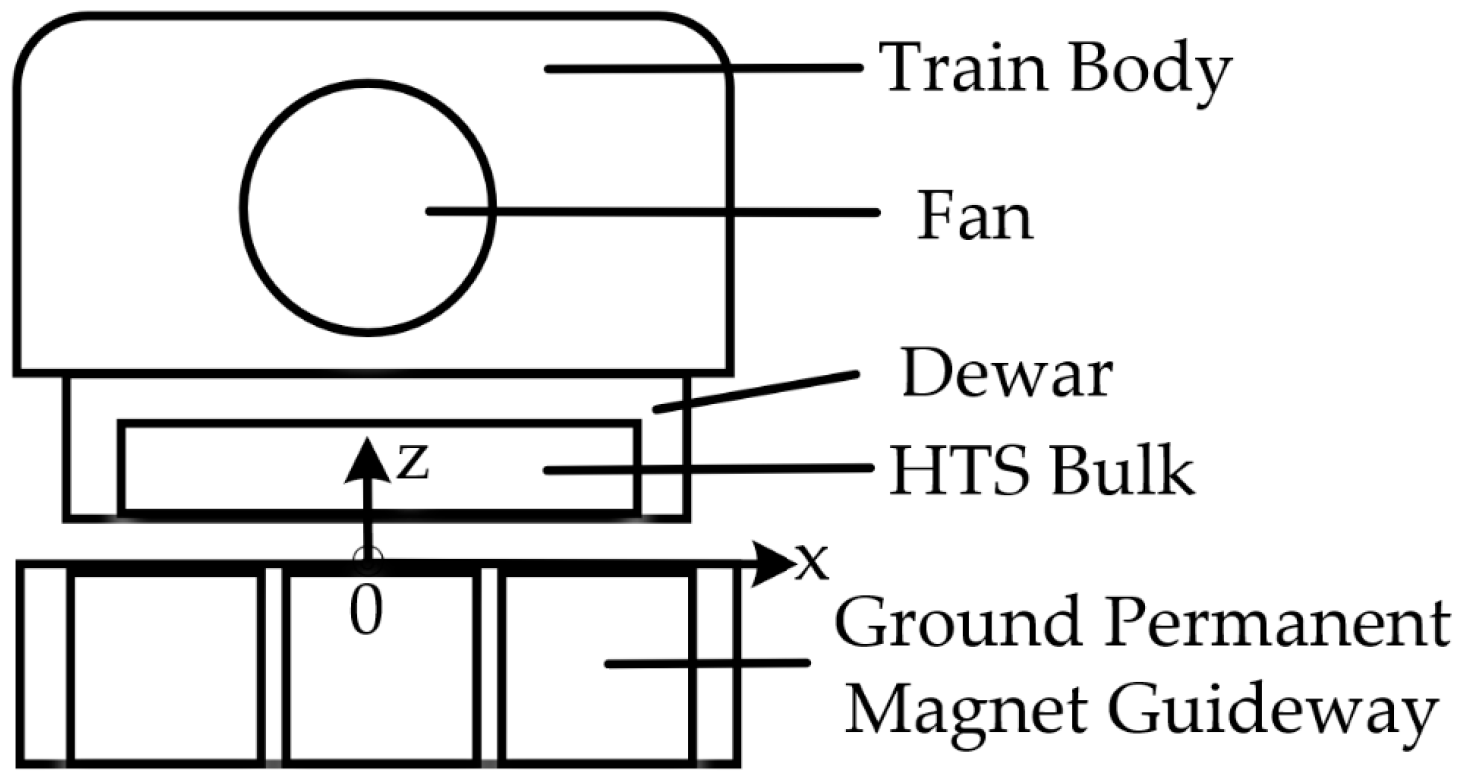
Effective use of these modelling techniques requires a clear understanding of the physical configuration of HTS maglev vehicles. A small-scale HTS pinning maglev demonstrator consists of several key components: vehicle-mounted HTS bulks, a cryogenic cooling dewar, a permanent magnet guideway (PMG), a propulsion system, and the vehicle body, as shown in Figure 1. Among these, the interaction between the HTS bulks and the PMG is the dominant factor determining levitation performance. Therefore, optimising PMG configuration is essential for achieving enhanced levitation force, stability, and system feasibility [30].
Despite extensive progress, several challenges remain in developing small-scale HTS maglev systems. First, existing PMG designs are relatively limited in diversity, and systematic comparative studies examining their influence on maximum levitation force are lacking. Second, many previous simulation studies rely on two-dimensional (2D) simplifications to reduce computational cost. However, for cylindrical HTS bulks, 2D models cannot accurately capture the magnetic flux behaviour of the HTS bulk, leading to errors between simulations and experiments [31]. Third, there remains a need for integrated studies that combine three-dimensional (3D) numerical modelling with experimental validation to support practical engineering design.
To address these limitations, this study develops an improved PMG design and optimisation framework for small-scale HTS maglev systems based on numerical modelling. A systematic simulation methodology is proposed to compare the magnetic field distributions of different PMG configurations and to identify the optimal guideway arrangement for maximising levitation performance. A full 3D FEM model of cylindrical HTS bulks is constructed to overcome the inherent limitations of traditional 2D approaches. Furthermore, an experimental platform is established to verify the accuracy of the simulation results and to assess the feasibility of the proposed design. Together, these contributions provide a validated and practical levitation-optimisation strategy that supports the future engineering development and large-scale implementation of HTS maglev technology.

2. Numerical Methodology

In this study, both 2D and 3D finite element methods are used to simulate YBCO bulk behaviour above different arrangements of permanent magnets, utilising the H formulation of Maxwell’s equations [21]. For a given HTS bulk, the distribution of induced currents within it depends on the external magnetic field. Therefore, accurate calculation of the magnetic field is crucial for computing the levitation characteristics of the bulk above PMGs [4].

2.1. Magnetic Field Calculation

To compute the magnetic flux density, the magnetic scalar potential formulation can be used in regions free of current. The magnetic flux density B is related to magnetic field intensity H through the constitutive relation:
B = μ   H + B rem
where μ = μ 0   μ r . μ 0 is the permeability of free space, μ r is the relative magnetic permeability of the studied materials. Brem represents the remanent flux density in permanent magnets, which is zero for non-PM regions.

2.2. Modelling HTS Bulks

As for modelling HTS bulks, the H formulation has been recognised as a highly versatile equation, effectively used in modelling numerous applications, including superconducting tapes and bulks [19,28,32,33]. It focuses on using the magnetic field components as state variables. Its key advantages include high accuracy, robust convergence, and reasonable computational efficiency.
According to Maxwell’s equations, we have:
× E + B t = × E + μ H t = 0
where E is the electric field, and H is the magnetic field intensity.
Due to the strong flux pinning property of the HTS materials, their electric field-current density relationship shows a highly nonlinear relationship, which has been expressed by three main analytical models. The discontinuous models are the flux flow model (FFM) and the flux flow and creep model (FFCM), while the continuous model is the power law model (PLM) [34]. Among these, PLM is widely used in superconducting applications because it provides a smooth and continuous transition between the superconducting state (JJc) and the resistive state (J > Jc). This is particularly advantageous for numerical simulations, as the differentiability of the power law ensures stable and efficient computation [35].
For the E-J power law model [36]:
E = ρ HTS J = E c J c J J c n 1 J
where Ec denotes the critical current criterion, with Ec = 1 × 10⁻⁴ V/m, and the power-law exponent n is set to 18. This model is flexible, with the exponent n allowing for the adjustment of the sharpness of the transition, making it adaptable to different types of superconducting materials and experimental conditions [37]. Furthermore, the most important property is its ability to sustain the maximum current density without resistance, known as the critical current density Jc [38].
Therefore, understanding this behaviour in detail enables precise predictions of the magnitude and spatial distribution of the trapped magnetic field, as well as the flux dynamics during the magnetisation process [17]. To accurately characterise the critical current density in high-temperature superconductors, the Kim model is frequently employed [39]. This model provides a more realistic representation of the field-dependent electromagnetic properties of type-II superconductors, capturing the nonlinear distribution of current density and offering improved accuracy in analysing flux pinning effects and energy loss characteristics [40].
The Kim model describes the dependence of the critical current density Jc on magnetic flux density B. This dependency of Jc reflects the strength of flux pinning in the superconductor, as follows:
J c B = J c   0 1 + B B 0
where Jc0 is the critical current density in the self-field at a given temperature and is set to 4 × 10⁷ A/m2 at 77 K, and B0 is a constant determined by the material properties.
Based on the above equations, the H based governing equation can be derived for modelling the HTS bulk [41]:
E 0 J c 0 n 1 + μ 0 μ r H B 0 n × H n 1 × × H + μ 0 μ r H t = 0
By solving for the magnetic field intensity H, the induced current density J and magnetic flux density within the HTS bulk can be further calculated, enabling the evaluation of AC losses and other electromagnetic characteristics.

2.3. Force Calculation

For non-ideal type-II high-temperature superconductors, magnetic flux can be trapped within the superconductor. When the external magnetic field changes, current density is induced within the superconductor, resulting in pinning forces acting on the trapped flux due to the Lorentz force:
F = V J × B   d V
where J is the current density induced in the bulk, B is the total magnetic flux density (including both the external magnetic field Bex and the magnetic field Bsc induced by the internal current in the bulk), and V is the volume region containing the superconductor current. For 2D models, the levitation force can be calculated as follows (the x, y, z axes are illustrated in Figure 1):
F lev = F z = S J y   B x   dS
where the integral region S on the right side represents the space occupied by the superconductor.
To account for the full spatial distribution of the electromagnetic field in a more realistic setting, the force components in 3D models are derived from the volume integral of the Lorentz force density. In this case, the contributions from all components of both the current density J = [Jx, Jy, Jz] and magnetic flux density B = [Bx, By, Bz] must be considered, leading to the following expressions for the levitation and guidance forces:
F lev = F z = V J x   B y J y   B x dV
With these calculation formulas, the next step is to apply them to the optimisation of the PMG configuration, evaluating different PMG arrangements in terms of levitation performance.

3. Maglev Optimisation Design

For maglev system simulation and optimisation, the calculation needs to be divided into two main parts [42]. First, the magnetic field distribution for different magnet arrangements should be calculated, selecting the appropriate magnet structure, dimensions, and gap. Then, the HTS bulk is coupled with the magnetic field produced by each guideway, and the induced current density J is calculated under the magnetic field density B. Using B and J at different positions, the levitation force Flev experienced by the bulk is calculated and subsequently used for optimisation analysis. All these simulations are carried out using the finite element software COMSOL Multiphysics, which enables accurate modelling of the electromagnetic interactions between the PMG and the HTS bulk.

3.1. Guideway Magnetic Field Analysis

To ensure strong and stable magnetic excitation, neodymium-iron-boron (NdFeB) permanent magnets of grade N52 were selected due to their high remanent flux density, high coercivity, and cost-effectiveness [43]. These properties make N52 particularly suitable for compact HTS maglev prototypes.
In the numerical model, each magnet was represented as a uniformly magnetised NdFeB cube. In COMSOL, the magnet material was specified primarily by the remanent flux density Br and a constant relative permeability μr, which provides an efficient and widely adopted description for hard magnetic materials. The coercivity-related parameters (Hcb and Hci) are included to characterise demagnetisation resistance. Because the guideway operates at room temperature and is not subjected to strong opposing fields in this study, the irreversible demagnetisation is neglected. The material properties used for the simulations are summarised in Table 1.
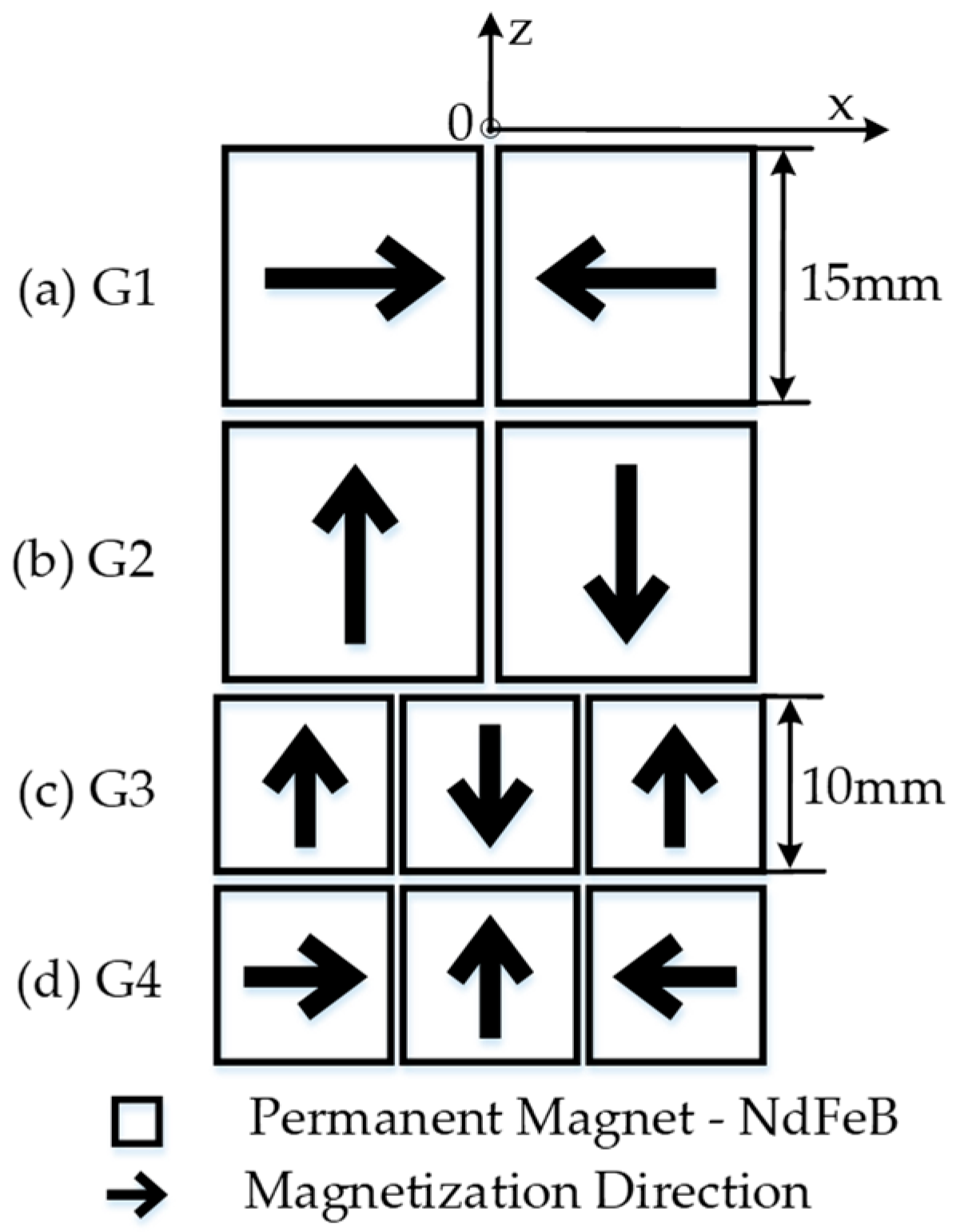
For the guideway layout design, each HTS bulk corresponds to either two or three permanent magnets, following the four guideway configurations shown in Figure 2.
The four guideway configurations were selected because they represent typical and fundamentally distinct magnetisation arrangements commonly used in PMG design. G1 adopts a basic lateral dipole pattern, which is not only simple in its magnetic field distribution but also widely employed as a conventional reference structure. G2 introduces a vertical dipole orientation that produces a single-peak magnetic field profile, enabling a direct comparison of how magnetisation direction influences field symmetry and levitation behaviour. G3, by contrast, employs alternating vertical magnetisations with reduced magnet size, resulting in a compact guideway structure that exhibits a double-peak field distribution. G4 integrates both horizontal and vertical magnetisation components, forming a hybrid pattern corresponding to a segment of the widely used Halbach array. However, a complete Halbach configuration is not optimal for the relatively small HTS bulk considered here, as it does not utilise the magnetic field efficiently.
In practical assembly, gaps between adjacent magnets are inevitable. Simulation results indicate that smaller gaps lead to a more concentrated magnetic field and thus improved performance. However, the specific gap size must be determined by balancing the simulation-based optimisation results with practical feasibility during prototype fabrication and assembly. The coordinate system was set according to the scheme shown in Figure 2, providing a consistent reference for positioning the bulk and PMG arrangement.
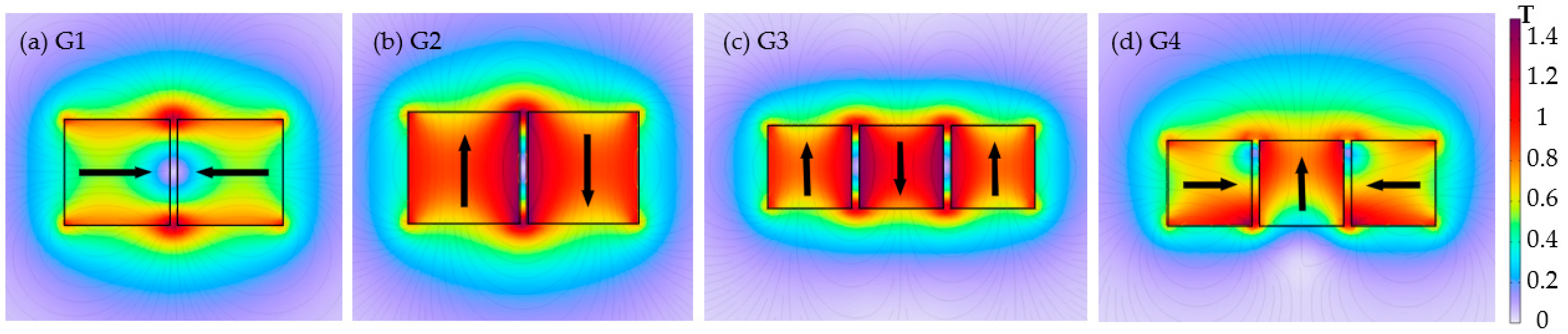
For a single small HTS bulk, all four guideway configurations are practical in terms of fabrication and assembly. Accordingly, these four corresponding PMG models were constructed in COMSOL, and the magnetic field distribution of each guideway was simulated and visualised. The resulting magnetic fields are shown in Figure 3, providing a clear comparison of the field characteristics for each configuration.
For these four PMG configurations, G1, G2, and G3 generate magnetic fields that are essentially top-bottom symmetric. In contrast, G4 exhibits an asymmetric magnetic field distribution, effectively concentrating the magnetic field in the upper space above the guideway. This configuration results in a more focused magnetic flux density near the HTS bulk position, which can strengthen the levitation force while maintaining relatively stable field gradients.
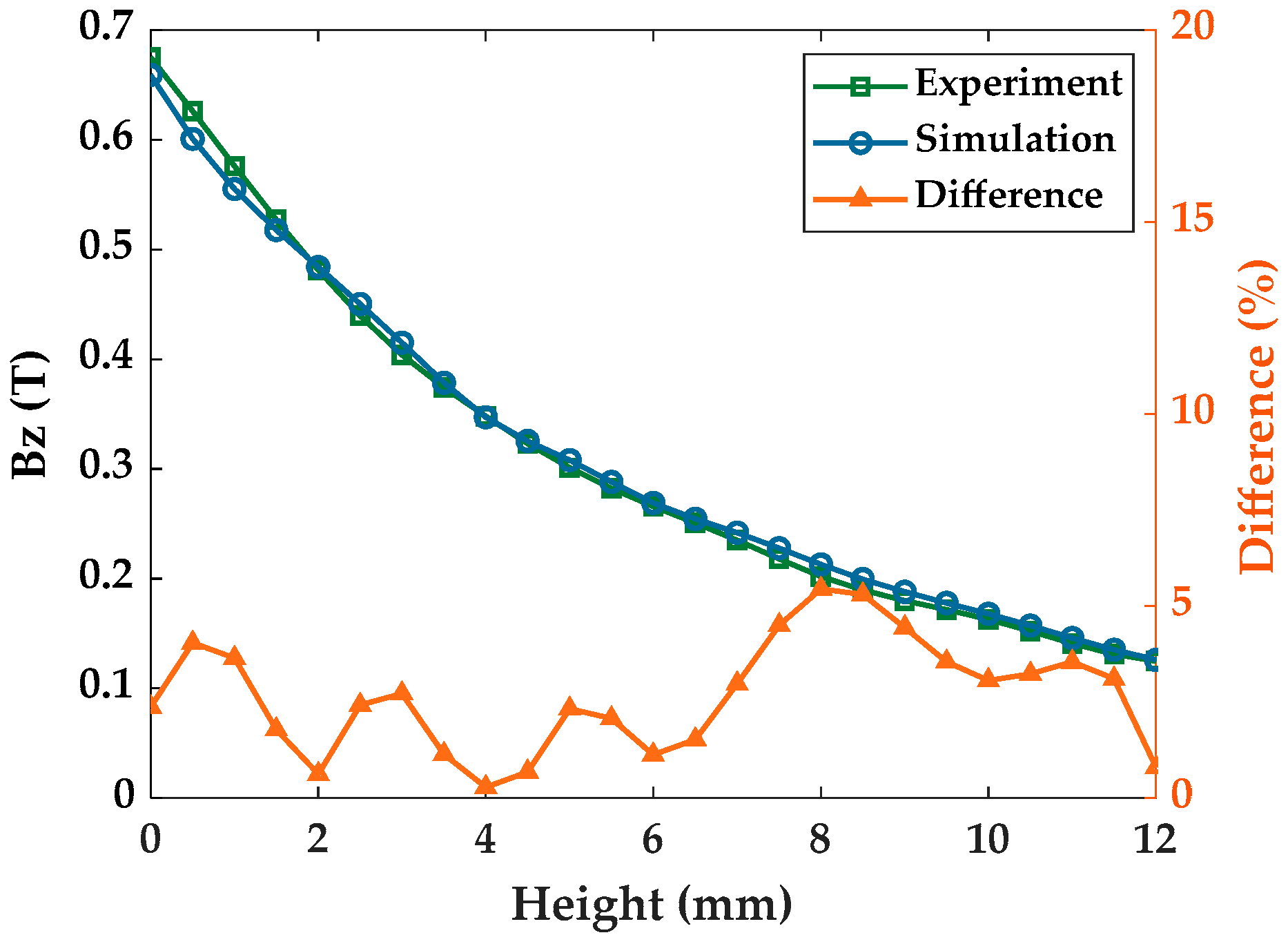
Furthermore, to verify the accuracy of the simulated magnetic field, the magnetic field distributions were measured experimentally using a Gauss meter. For the G4 configuration, the vertical variation in the magnetic flux density Bz was recorded above the guideway at the position corresponding to the centre of the HTS bulk and guideway. The probe of the Gauss meter was positioned at a series of different heights above the guideway top surface. At each height, the Bz component was measured after stabilisation. The simulated results, the corresponding measured values, and their differences are compared in Figure 4.
As shown in Figure 4, the simulated and measured magnetic fields match closely across the entire height range, with the difference consistently remaining below 5%. This good agreement demonstrates the high accuracy of the magnetic field modelling and confirms the reliability of the simulation for subsequent levitation-force analysis.

3.2. Levitation Force Analysis and Optimisation

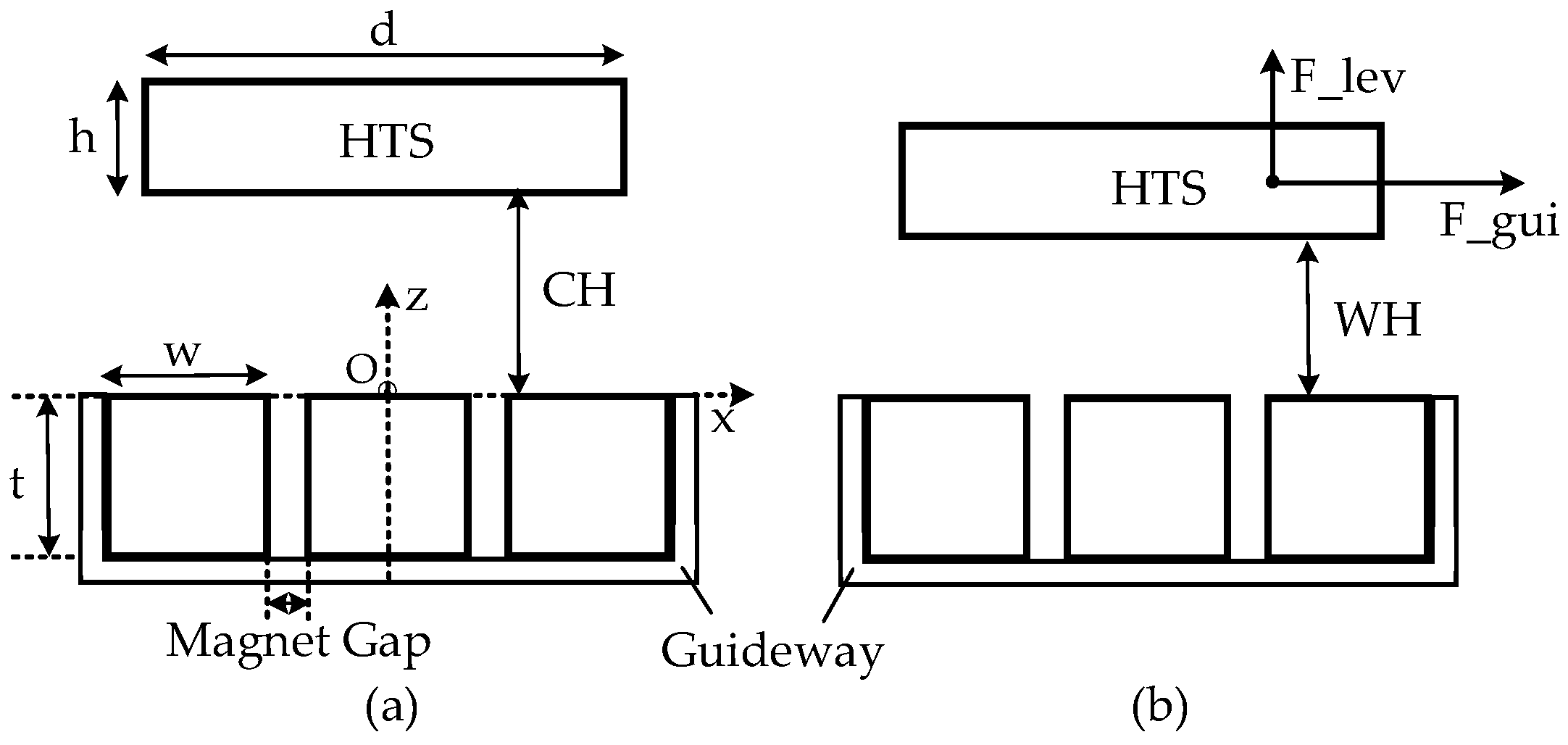
First, the levitation force is evaluated using a 2D model. The 2D model relies on the following assumptions: (1) the HTS bulk and the guideway are infinitely long along the axial direction; (2) the magnetic field generated by the permanent magnet guideway is uniform and devoid of any longitudinal component. These assumptions simplify the problem while preserving the dominant physics of the levitation interaction. The HTS bulk was positioned above the PMG, and the corresponding model is shown in Figure 5.
Figure 5a represents the cooling state, during which the bulk is cooled at a certain distance from the PMG, defined as the cooling height (CH). Figure 5b illustrates the operating stage, where the bulk descends to a lower position because of the weight; the corresponding distance is the working height (WH).
The levitation force arises from the interaction between the induced currents within the HTS bulk and the external magnetic field generated by the PMG. The levitation force is calculated by simulating a vertical motion cycle, in which the HTS bulk moves from an initial position above the guideway down to the minimum levitation gap at a predefined speed, and then returns to the cooling height. This complete up–down motion constitutes one vertical levitation cycle for force evaluation.
In this process, the initial cooling position plays a crucial role in determining the initial current and trapped-field state inside the bulk. Zero field cooling (ZFC) [44] and field cooling (FC) [30] establish fundamentally different initial current and trapped-field configurations in HTS bulks. In ZFC, the bulk is cooled in the absence of any magnetic field and only afterwards brought into the magnetic field [44]. In FC, the HTS bulk is placed in the magnetic field above the permanent magnet at a chosen height and then cooled down into the superconducting state [30].
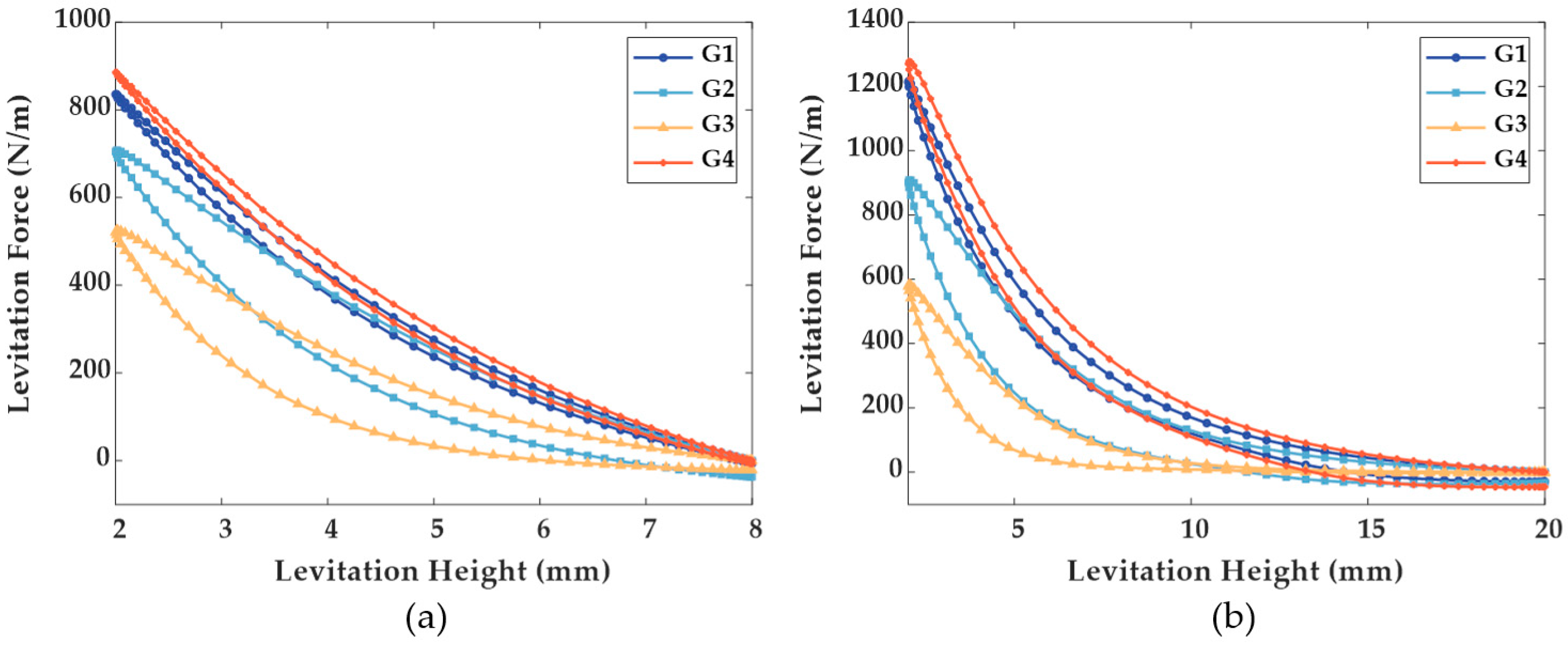
Under FC conditions, the levitation force was calculated as the HTS bulk moved at a speed of 1 mm/s between 8 mm and 2 mm above the guideway. Under ZFC conditions, the levitation force was calculated as the HTS bulk moved at the same speed between 20 mm and 2 mm above the guideway. The levitation height is defined as the distance between the bottom surface of the bulk and the top surface of the guideway. The resulting relationship between levitation force and levitation height is shown in Figure 6.
For the four guideways shown in Figure 6, before any relative motion occurs, no currents are generated inside the bulk at the initial cooling height, and thus no magnetic force acts on it. When the superconductor subsequently moves closer to the permanent magnet, screening currents are induced, producing a repulsive interaction between the bulk and the guideway. Both the magnitude of the levitation force and the hysteresis behaviour follow consistent trends. As the bulk descends from the field cooling height, the levitation force increases continuously with decreasing height, and this increase becomes steeper as the height decreases. During the return motion, as the height increases, the levitation force drops rapidly. At any identical position, the levitation force in the ascending stage is lower than that in the descending stage, resulting in a clear hysteresis loop in all curves [45,46]. G4 exhibits the highest levitation force over almost the entire investigated height range under both FC and ZFC conditions. Therefore, G4 is identified as the optimal guideway configuration, and all subsequent analyses in this study are conducted using the G4.
When comparing the FC and ZFC curves for the same guideway, the levitation forces at identical heights differ because the initial electromagnetic states of the superconductor are fundamentally different. Under ZFC conditions, the bulk is cooled in a negligible external field, so when it later enters the strong magnetic field of the guideway, large screening currents are induced to expel the flux. These strong screening currents generate a relatively large repulsive force at a given height. Under FC conditions, by contrast, the bulk is cooled in the presence of the guideway field, and a portion of the magnetic flux is trapped inside the superconductor. This trapped flux partially compensates the subsequently induced screening currents when the bulk moves, thereby reducing the levitation force at the same height. This explains why the levitation force obtained under ZFC is larger than that under FC for identical levitation heights.
ZFC typically produces a larger levitation force, but the resulting levitation state is less stable. In contrast, FC generates a more stable levitation condition due to the trapped magnetic flux inside the superconductor [47]. Moreover, FC is preferable for safe operation of HTS maglev systems during curve negotiation because of its larger guidance force, and the levitation force under FC can even exceed that of ZFC at large eccentric distances [48]. Therefore, FC is utilised as the primary cooling method in this study for subsequent simulations and experiments.
In this work, both 2D and 3D finite element models are constructed using identical parameters. The 2D model offers faster computation, but its simplifications limit its ability to capture the full behaviour of the cylindrical superconductor. By contrast, the 3D model provides a more accurate physical representation at the cost of higher computational demand. It captures the full spatial distribution of magnetic flux and induced currents within the cylindrical HTS bulk. It naturally accounts for edge effects, longitudinal field components, and asymmetric current pathways that cannot be represented in 2D.
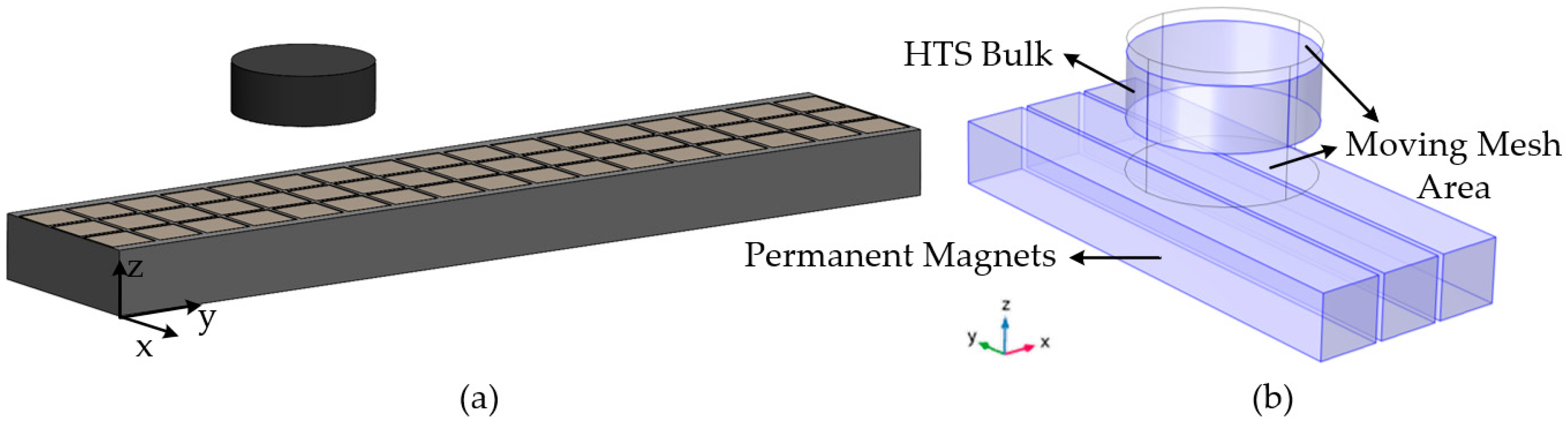
In both cases, FC conditions are applied, and the HTS bulk is simulated to move vertically between 8 mm and 2 mm above the guideway and back, matching the experimental procedure. The construction of the 3D model is shown in Figure 7, where the HTS bulk remains stably levitated above the permanent magnet guideway.
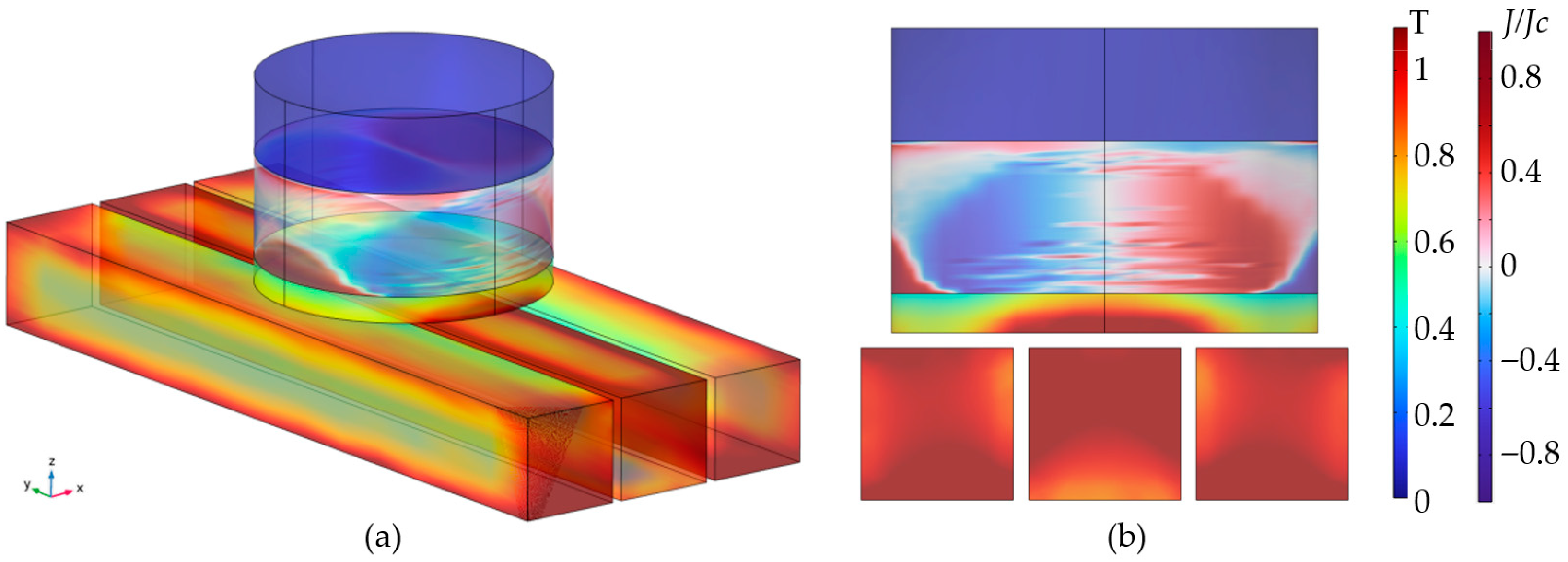
Building on the structural and modelling framework illustrated in Figure 7, the electromagnetic response of the HTS bulk within the 3D simulation can be further examined. To reveal how the bulk interacts with the magnetic field produced by the PMG, Figure 8 presents the resulting magnetic flux distribution and induced current within the bulk at the working height of 2.5 mm. This progression from geometric configuration to physical field analysis provides a complete depiction of the 3D levitation model and its underlying operating mechanism.
The current density first appears at the edges of the HTS bulk, where the magnetic flux from the PMG enters most easily. It then progressively penetrates toward the interior as the external field increases. Once the distributions of J and B inside the bulk are obtained, the levitation force can then be calculated. The simulation results were compared with experimental measurements, and the simulation approach was refined to balance computational efficiency with accuracy.

4. Experimental Validation

After comparison and selection, the CSYL-28SE YBCO levitation disk from CAN SUPERCONDUCTORS, S.R.O. (Říčany, Czech Republic) was chosen. This bulk superconductor has a diameter of 28 mm and a height of 10 mm. According to the datasheet, it exhibits a rated levitation force of up to 60 N, measured at 77 K under ZFC conditions, with the force value extrapolated to zero levitation gap [49]. Based on the bulk dimensions, permanent magnets were selected from the available products offered by Supreme Magnets (Singapore). To generate a sufficiently strong magnetic field, NdFeB permanent magnets of grade N52 were used, each with dimensions of 10 mm × 10 mm × 10 mm along the x, y, and z axes, respectively.
With the material specifications established, the next step involves detailing the experimental procedure for levitation-force measurement and the construction of the demonstrator used to validate the simulation and guideway design.

4.1. Experimental Procedure

This section presents the construction of the experimental demonstrator and the procedure used for levitation force measurements. Due to the strong mutual attraction between the N52 magnets, the guideway was first designed in SolidWorks 2024 and then fabricated using a 3D printer to ensure safe, repeatable and accurate assembly. The printed guideway adopts a modular grid structure composed of cubic cells, each intended to accommodate a single magnet at a fixed and well-defined position.
The choice of magnet gap and cell dimensions was determined through a combination of mechanical strength testing and magnetic assembly considerations. Guideway samples with different printed parameters were fabricated and evaluated to assess their structural integrity under the strong magnetic forces, as well as their compatibility with the required magnetic flux distribution. Experimental observations indicate that reducing the gap between adjacent magnets enhances both the levitation force acting on the HTS bulk and the stability of motion along the moving direction. However, when the inter-magnet spacing was smaller than 1 mm, the printed cell walls were prone to deformation due to the large attractive forces between neighbouring magnets, which compromised the mechanical robustness and positional accuracy of the guideway. Taking these factors into account, a magnet gap of 1 mm was selected as an optimal compromise between magnetic performance and structural reliability. In addition, a dimensional tolerance of 0.5 mm was incorporated into each cell to facilitate magnet insertion and to allow air to escape during assembly, thereby preventing misalignment and installation difficulties. As a result, the final cell dimensions were set to 10.5 mm × 10.5 mm × 10 mm for housing 10 mm × 10 mm × 10 mm N52 cubic magnets.
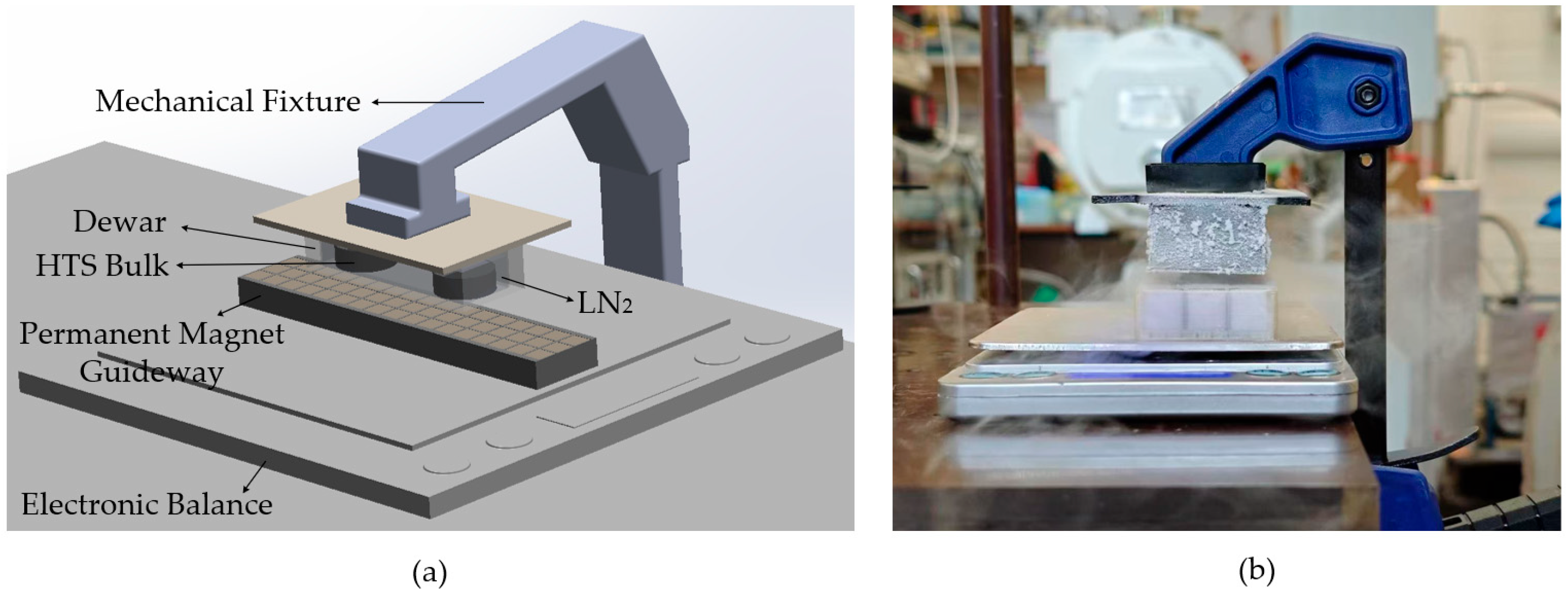
The HTS bulk was mounted above the guideway in a seed-down orientation, which has been shown to provide a higher levitation force for YBCO bulks [50]. The bulk was placed inside a dewar, and the dewar was fixed by a mechanical fixture that also defined the initial field cooling height. Because no suitable force sensor was available, a high-precision electronic balance was used to indirectly measure the levitation force. The balance has a resolution of 0.01 g, which provides sufficient precision to detect variation in levitation force, and its load capacity is adequate for the full force range expected in the experiment. The measurement setup is shown in Figure 9.
The PMG, height spacers, and the dewar containing the bulk were placed on the balance platform, while the upper mechanical fixture remained fixed to define the levitation height. At the initial field cooling height, liquid nitrogen (LN2) was poured into the dewar. Once the boil-off became minimal, it was assumed that the bulk had cooled to 77 K. The initial spacer was then removed, and the electronic balance was tared to zero so that subsequent readings directly reflected the levitation force at the corresponding height.
During the experimental measurements, it was observed that although the levitation force under ZFC was relatively large, the bulk exhibited poor levitation stability. Specifically, the bulk was highly sensitive to small external disturbances, including minor mechanical vibrations of the experimental setup and weak airflow in the surrounding environment. Such disturbances frequently caused noticeable lateral displacement of the bulk away from the guideway centreline, accompanied by tilting of the bulk with respect to the horizontal plane. In contrast, when operated under FC conditions, the levitation behaviour of the HTS bulk was more stable and robust. The bulk maintained a well-defined levitation position above the guideway, with significantly reduced lateral motion and negligible tilting, even in the presence of similar external disturbances. The levitation gap remained stable throughout the measurement process. Furthermore, the levitation state under FC conditions was highly repeatable across multiple experimental runs, providing consistent and reliable force measurements.
The levitation height was gradually decreased from 8 mm to 2 mm and then increased back to 8 mm, and the balance readings were continuously recorded to obtain a complete force–height hysteresis cycle. However, the force–height measurement cannot be regarded as instantaneous. Because each levitation height is maintained for a finite period and the complete force–height hysteresis cycle requires a measurement duration, the balance reading is inevitably influenced by time-dependent mass variations. On the one hand, continuous evaporation of LN2 leads to a gradual reduction in the measured mass. On the other hand, the low temperature of the dewar promotes condensation of moisture and frost formation on its external surface, resulting in an apparent increase in mass. These two effects would introduce a systematic drift in the balance output that is independent of the levitation force.
To quantify and eliminate this drift, a calibration procedure was conducted under laboratory conditions consistent with those used in the levitation experiments and over a comparable measurement duration. During calibration, the bulk and dewar were maintained at a fixed height, and the balance output was continuously recorded with time to capture the net mass variation resulting from LN2 evaporation and surface frosting. Based on this observation, a time-dependent correction model was established and applied to the raw balance data, so that the corrected levitation force was obtained by removing the estimated drift component.
For each height, five replicate measurements were taken, and the average value was used to construct the experimental levitation force–levitation height curve. The levitation force measured as the bulk moved between 8 mm and 2 mm is summarised in Table 2, which lists the five measurement cycles with their averaged results. All data correspond to the calibrated levitation forces after drift correction.
As shown in Table 2, the trend is consistent across all five experimental runs, indicating good repeatability of the measurement process. The maximum levitation force occurs at 2 mm, with an average value of approximately 15.67 N, reflecting the strong pinning interaction and enhanced magnetic flux density at small gaps. When the bulk moves upward during the return stage, the levitation force decreases more rapidly, resulting in lower force values at the same heights compared to the downward path. This difference between the descending and ascending sequences confirms the presence of a clear hysteresis effect, which is characteristic of flux pinning behaviour in the bulk. Moreover, the overall force–height trend agrees with the simulation results, further validating the accuracy of the numerical model.
The small negative force recorded at the 8 mm gap during the return path does not represent a physically negative levitation force. In the measurement procedure, the levitation force at the initial FC position of 8 mm was defined as the reference and explicitly zeroed; therefore, this position corresponds to 0 N, and all force values are expressed relative to this baseline. During the force–height cycle, partial relaxation of the pinned current distribution due to flux creep reduces the magnetic interaction force at a given gap when the system returns to its initial position. At large levitation gaps, where the true force is close to zero, this slight reduction appears as a negative value in the relative measurement. Despite this offset, the experimental force–height curve exhibits the same monotonic dependence and hysteretic behaviour as the numerical models, demonstrating good qualitative agreement between simulation and experiment.

4.2. Demonstrator Construction

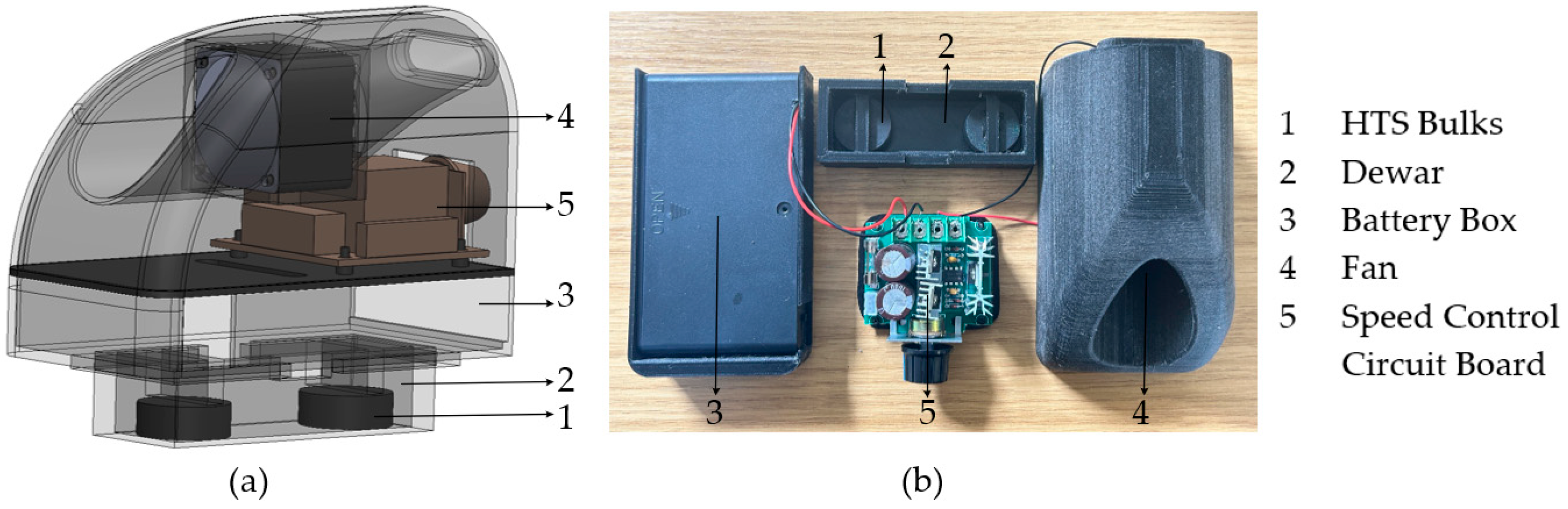
To experimentally validate the proposed guideway design and assess its applicability to a small-scale HTS maglev vehicle, a full demonstrator was constructed, as shown in Figure 10. A lightweight vehicle was designed to carry the HTS bulk, dewar, battery, fan, and the speed-control circuit board. The labels indicate the names of all components.
The prototype consists of four detachable modules, allowing convenient access for circuit connections and battery replacement. This modular design not only improves maintainability but also enables rapid adjustments and component substitution for different testing scenarios. Through repeated testing and refinement, the compatibility and durability of each module were verified. Particularly during battery replacement, it can be performed without disassembling the entire structure.
For the small-scale demonstrator, a fan-based propulsion system was selected instead of a linear motor. Linear motors typically require complex drive electronics, precise coil alignment, and high manufacturing accuracy, and their time-varying electromagnetic fields may introduce interference with the HTS levitation system [51]. By contrast, the fan provides a simple, low-cost, and easily controllable thrust source, enabling straightforward speed regulation while keeping the propulsion mechanism electromagnetically decoupled from the superconducting levitation system. It should be noted that the fan-based propulsion is not intended as a scalable solution for full-scale maglev systems; instead, it provides a mechanically simple and electromagnetically decoupled means of studying levitation and guidance behaviour in a laboratory demonstrator.
The fan speed is regulated by a compact onboard controller integrated into the vehicle. The control knob functions as a variable resistor that adjusts the duty cycle of a PWM signal generated by an NE555 timer. Varying the resistance in the timing network changes the charge and discharge durations of the capacitor, thereby modifying the high/low intervals of the output waveform. The resulting duty-cycle variation changes the average voltage delivered to the motor and hence provides smooth and efficient fan-speed control.
Using this propulsion system, the vehicle showed speed variations under different operating conditions. First, even at the same propulsion power setting, the measured speed changed with levitation height. This is mainly because the HTS–PMG guidance characteristics depend on height. When the levitation gap changes, the lateral restoring stiffness and the damping of small disturbances also change. Second, at a fixed levitation height, the vehicle speed also varied along different regions of the guideway under the same propulsion power. In particular, the speed on straight sections was consistently slightly higher than on curved sections. This is because the continual change in direction in curved segments demands additional lateral stabilising response, which reduces the fraction of thrust contributing to forward motion. The speed can also be influenced by the airflow and temperature. However, because the experiments were conducted indoors, the variation in speed induced by environmental changes can be neglected.
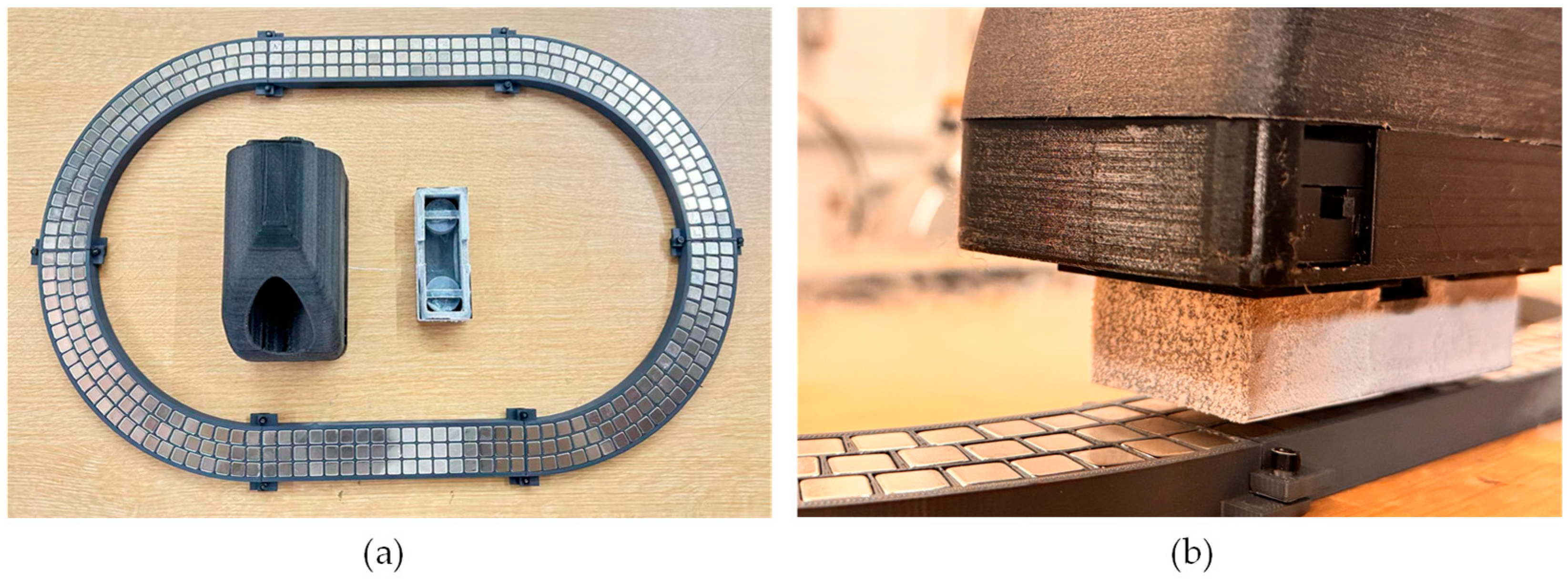
The complete HTS maglev demonstrator, comprising both the vehicle and the guideway, is shown in Figure 11. It presents the whole system, as well as the operating condition in which the train remains stably levitated above the guideway during motion.
The guideway was first modelled in SolidWorks according to the G4 configuration. Owing to the relatively large overall length of the guideway and the limited build volume of the 3D printer, the structure was divided into 6 modular segments. These segments were printed separately and subsequently aligned and bolted together to ensure geometric accuracy and structural rigidity.
The total mass of the vehicle, including the HTS bulk, dewar, battery, fan and control electronics, is approximately 931 g. The overall dimensions of the vehicle are 135 mm × 119 mm × 76 mm (length × width × height). The assembled guideway has an overall footprint of 456 mm × 337 mm. The mass distribution of the vehicle was carefully arranged to maintain a low centre of gravity, thereby enhancing levitation stability and suppressing pitching or rolling motions during operation. Under FC conditions, no visible lateral drift or noticeable tilting of the vehicle was observed during steady operation, indicating sufficient passive guidance stiffness for the scale of the demonstrator.
Overall, the modular architecture of both the guideway and the vehicle forms a practical and flexible experimental platform. The design meets the mechanical robustness and alignment requirements typically emphasised in vehicle-oriented engineering studies, while ensuring reliable and repeatable assembly. At the system level, the platform enables systematic investigation of HTS maglev performance under realistic operating conditions. Moreover, the inherent modularity allows straightforward reconfiguration and scaling, making the demonstrator well-suited for future studies on electromagnetic–mechanical coupling, guidance optimisation, and control-oriented experiments.

5. Results

Based on the validated numerical models and the experimental methodology described above, this section presents a detailed comparison of the simulation and measurement results. The corresponding levitation force–height characteristics are compared with the experimental data to assess the quantitative accuracy of the simulations.
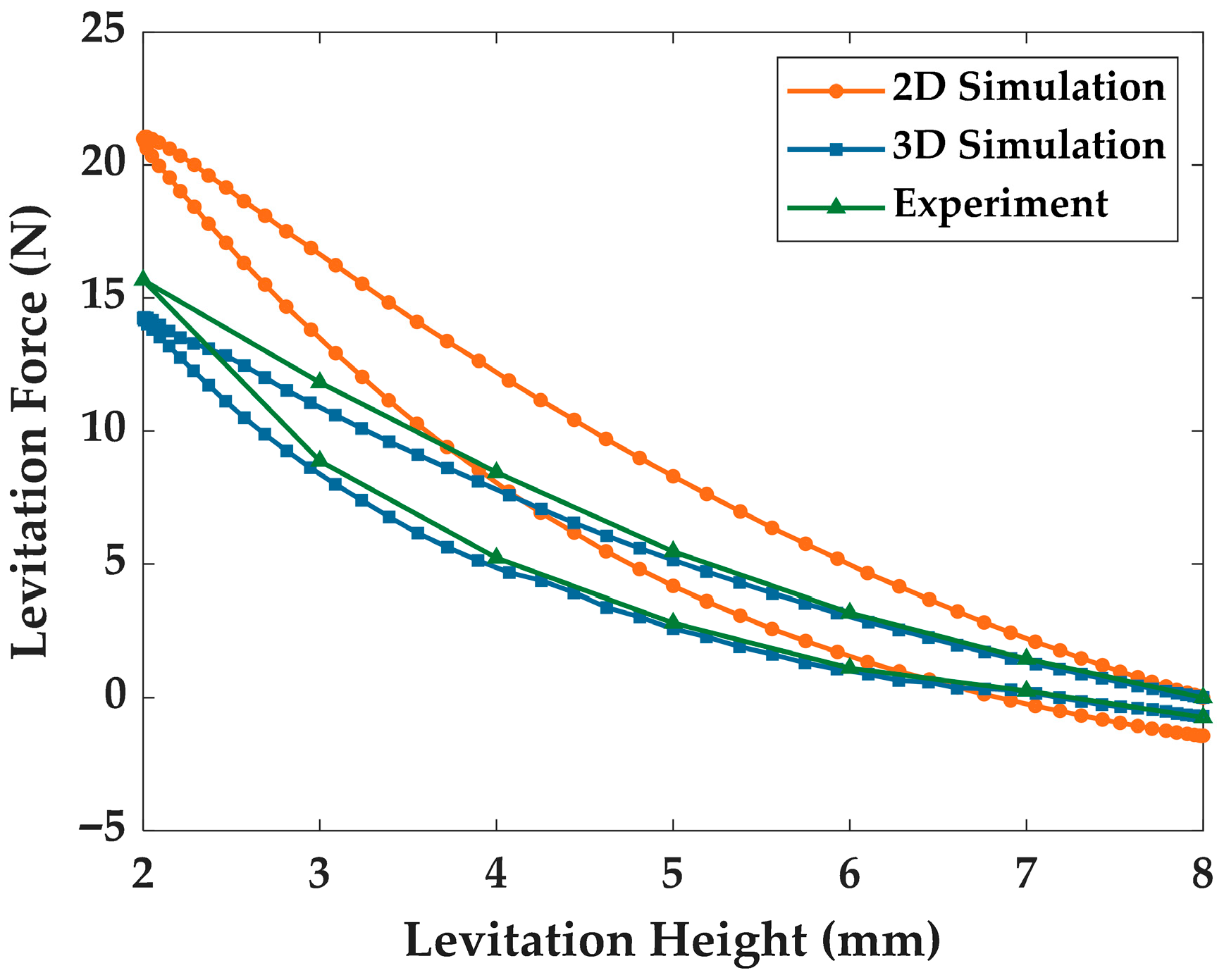
A comparative analysis of the levitation forces obtained from the 2D model, 3D model, and experiments is essential to assess the accuracy and reliability of the numerical simulations, using the experimentally measured data as the reference. As shown in Figure 12, all three cases follow the same procedure: the HTS bulk is field cooled at a levitation height of 8 mm, then moved downward to 2 mm at a controlled speed, and finally returned to 8 mm. The resulting levitation force–height curves provide a direct basis for evaluating the consistency between simulation and experiment.
As shown in Figure 12, the 3D simulation agrees much better with the experimental data than the 2D model, while the 2D results overestimate the levitation force, especially at small gaps. This discrepancy arises mainly from the geometric and physical simplifications inherent in the 2D formulation. In the 2D model, the HTS bulk is represented by a 28 mm × 28 mm × 10 mm rectangular cross-section that is assumed to be infinitely long, whereas the actual specimen is a cylindrical bulk with a 28 mm diameter and 10 mm height. The effective cross-sectional area and current-carrying volume in the 2D square approximation are therefore larger than those of the real cylinder, leading to an overestimation of the induced currents and the levitation force. In addition, the 2D model neglects longitudinal edge effects and flux leakage at the ends of the bulk, which are included in the 3D simulation and tend to reduce the net force. As a result, the 3D model provides a more realistic representation of the electromagnetic behaviour and levitation forces that closely match the experimental measurements. The error analysis of the simulation comparison experiment results is shown in Table 3.
A quantitative comparison of the simulation errors at different levitation heights demonstrates the clear advantage of the 3D model. As shown in Table 3, the 2D simulation shows large discrepancies from the experimental data, with an average error of 45.51%. By contrast, the error of the 3D model remains below 10% at all heights, well within the expected experimental uncertainty. This close agreement with the measurements indicates that the 3D model could calculate the levitation force accurately. The significantly lower error levels confirm that, despite the computational efficiency of the 2D model, it lacks the accuracy required for reliable force prediction. In comparison, the 3D model provides a robust and dependable representation of the levitation characteristics and is therefore more suitable for analysing and optimising HTS maglev systems.
Despite the good overall agreement achieved by the 3D model, the remaining discrepancies between simulation and experiment can be attributed to several identifiable error sources. First, geometric idealisation in the numerical model neglects small manufacturing tolerances of the permanent magnets and guideway assembly, such as slight misalignment and edge chamfering, which can lead to deviations in the local magnetic field distribution. Second, material parameter uncertainties contribute to modelling error: the superconducting properties of the HTS bulk are assumed to be spatially uniform, whereas in practice they may vary due to fabrication inhomogeneity. Third, simplifications in the electromagnetic formulation, including the neglect of minor effects such as the idealised boundary conditions, can introduce additional differences between simulated and measured forces. Finally, experimental measurement uncertainties, arising from force sensor resolution, positioning accuracy of the levitation height, and repeatability during cooling procedures, also contribute to the residual error. However, averaging results over multiple repeated measurements effectively reduces random measurement errors and improves the reliability of the experimental data. Therefore, these factors explain the remaining discrepancy and suggest that further improvements could be achieved through more accurate material characterisation and enhanced experimental calibration.

6. Discussion

The optimisation results demonstrate clear performance differences among the four guideway configurations. Overall, G4 exhibits the strongest levitation capability. This outcome is consistent with the expected influence of magnetisation orientation and field distribution on HTS flux-pinning behaviour. Specifically, the mixed-orientation pattern of G4 produces a locally concentrated magnetic flux and a steeper vertical field gradient, which collectively enhance the induced screening currents in the HTS bulk and lead to a higher levitation force. These findings align with previous studies reporting that asymmetric or Halbach-type arrangements can substantially increase the effective magnetic field above the guideway and therefore improve levitation performance.
The experimentally measured force–height curves show good agreement with the numerical predictions, validating the modelling framework and confirming that the 3D H-formulation accurately captures the nonlinear electromagnetic response of the cylindrical HTS bulk.
From an engineering perspective, the enhanced levitation performance of G4 combined with the operational stability of FC makes this guideway design particularly suitable for small-scale HTS maglev demonstrators. Moreover, the modularity of the G4 structure suggests practical scalability: multiple G4-type units can be arranged in series or expanded into multi-column guideway arrays to support large-format HTS bulks or increase the weight capacity of full-scale maglev vehicles. This offers a feasible and flexible pathway toward constructing higher-load, more efficient HTS maglev systems based on modular PMG building blocks.
Despite the promising results, several limitations should be acknowledged. The current optimisation does not account for geometric tolerances, mechanical vibration, or long-term degradation of magnetisation strength, all of which may influence practical performance. Moreover, this study focuses primarily on vertical levitation force, whereas lateral guidance force, dynamic stability, and damping characteristics are equally essential for the reliable operation of a full-scale maglev vehicle.
Future research will extend beyond the current single-specification bulk configuration by conducting systematic multi-parameter comparative experiments, supported by corresponding numerical simulations. Key variables—including HTS bulk dimensions, crystallographic orientation, and bulk arrangement—will be investigated to clarify their coupled impacts on both levitation force and stability. On this basis, correlation models linking bulk parameters to levitation performance will be established to provide more quantitative and practically useful design guidance for bulk selection and arrangement in engineering-oriented HTS maglev applications. Further work will also focus on improving force measurement accuracy, performing multi-objective optimisation of magnet arrangements, and extending the analysis to lateral guidance and dynamic forces under realistic operating conditions. Therefore, these efforts will support a more complete understanding of HTS maglev behaviour and facilitate the development of scalable, high-performance superconducting transportation systems.

7. Conclusions

This study has developed and validated a systematic methodology for the modelling, optimisation, and construction of high-temperature superconducting maglev systems. By integrating detailed numerical simulations with experimental measurements, an optimal PMG arrangement was identified that substantially enhances levitation performance while meeting key engineering constraints for practical implementation. In parallel, an experimental platform was constructed to measure the levitation forces under controlled conditions. The measured results showed strong agreement with the numerical predictions, thereby confirming the accuracy of the simulation models and the effectiveness of the proposed optimisation strategy. This consistency validates the modelling approach and demonstrates its suitability for real-world HTS maglev applications. Furthermore, the validated 3D H formulation model developed in this work provides an essential reference for future large-scale HTS maglev simulations. The accurate characterisation of the cylindrical bulk and fully 3D magnetic flux behaviour is essential for system-level design, optimisation, and performance prediction. Overall, this study establishes both a solid theoretical foundation and an experimentally supported design methodology, offering valuable guidance for the continued development of high-performance and scalable HTS maglev transportation.

Author Contributions

Conceptualization, C.Z., H.Z. and M.M.; methodology, C.Z., H.Z. and M.M.; software, C.Z. and H.Z.; validation, C.Z., Q.D., H.Z. and M.M.; formal analysis, C.Z.; investigation, C.Z.; resources, H.Z. and M.M.; data curation, C.Z., and H.Z.; writing—original draft preparation, C.Z.; writing—review and editing, C.Z., H.Z. and M.M.; visualization, C.Z. and Q.D.; supervision, H.Z. and M.M.; project administration, H.Z. and M.M.; funding acquisition, H.Z. and M.M. All authors have read and agreed to the published version of the manuscript.

Funding

This work was supported by a fully funded PhD Scholarship from the University of Edinburgh, UK. Markus Mueller acknowledges support from the Royal Academy of Engineering Chair in Emerging Technologies Programme.

Data Availability Statement

All data are contained within the article.

Conflicts of Interest

The authors declare no conflicts of interest.

Abbreviations

The following abbreviations are used in this manuscript:
HTSHigh-temperature superconducting
PMGPermanent magnet guideway
FEMFinite element method
FCField cooling
ZFCZero field cooling
LN2Liquid nitrogen
YBCOYttrium barium copper oxide
NdFeBNeodymium-iron-boron
FCHField cooling height
WHWorking height
LHLevitation height

References

  1. Espejo-Peña, D.A.; Pérez, A.; Eduardo, D.; Gutiérrez Durand, G.A.; Gonzales, S. Magnetic Levitation Technology in Trains: A systematic literature review from 2018 to 2023. In Proceedings of the 22nd LACCEI International Multi-Conference for Engineering, Education, and Technology, San Jose, Costa Rica, 17–19 July 2024. [Google Scholar]
  2. Kusagawa, S.; Baba, J.; Shutoh, K.; Masada, E. Multipurpose design optimization of EMS-type magnetically levitated vehicle based on genetic algorithm. IEEE Trans. Appl. Supercond. 2004, 14, 1922–1925. [Google Scholar] [CrossRef]
  3. Bernstein, P.; Noudem, J. Superconducting magnetic levitation: Principle, materials, physics and models. Supercond. Sci. Technol. 2020, 33, 033001. [Google Scholar] [CrossRef]
  4. Zhang, H.; Kails, K.; Machura, P.; Mueller, M. Conceptual design of electrodynamic wheels based on HTS Halbach array magnets. IEEE Trans. Appl. Supercond. 2021, 31, 3601306. [Google Scholar] [CrossRef]
  5. Ma, G.; Gong, T.; Wang, R.; Li, S.; Nie, X.; Zhou, P.; Li, J.; Li, C.; Ge, Z.; Cui, H. Design, fabrication and testing of a coated conductor magnet for electrodynamic suspension. Supercond. Sci. Technol. 2021, 35, 025013. [Google Scholar] [CrossRef]
  6. Werfel, F.N.; Floegel-Delor, U.; Riedel, T.; Goebel, B.; Rothfeld, R.; Schirrmeister, P.; Wippich, D. Large-scale HTS bulks for magnetic application. Phys. C Supercond. 2013, 484, 6–11. [Google Scholar] [CrossRef]
  7. Wang, S.; Wang, J.; Lian, J. Proceeding of Fifteenth International Conference on Magnet Technology; Science Press: Beijing, China, 1998. [Google Scholar]
  8. Wang, J.; Wang, S.; Zeng, Y.; Huang, H.; Luo, F.; Xu, Z.; Tang, Q.; Lin, G.; Zhang, C.; Ren, Z. The first man-loading high temperature superconducting Maglev test vehicle in the world. Phys. C Supercond. 2002, 378, 809–814. [Google Scholar] [CrossRef]
  9. Kovalev, K.; Koneev, S.; Poltavec, V.; Gawalek, W. Magnetically levitated high-speed carriages on the basis of bulk HTS elements. In Proceedings of the 8th International Symposium on Magnetic Suspension Technology (ISMST 2005), Dresden, Germany, 26–28 September 2005; pp. 45–49. [Google Scholar]
  10. Schultz, L.; de Haas, O.; Verges, P.; Beyer, C.; Rohlig, S.; Olsen, H.; Kuhn, L.; Berger, D.; Noteboom, U.; Funk, U. Superconductively levitated transport system-the SupraTrans project. IEEE Trans. Appl. Supercond. 2005, 15, 2301–2305. [Google Scholar] [CrossRef]
  11. Deng, Z.; Wang, J.; Zheng, J.; Zhang, Y.; Wang, S. An efficient and economical way to enhance the performance of present HTS Maglev systems by utilizing the anisotropy property of bulk superconductors. Supercond. Sci. Technol. 2012, 26, 025001. [Google Scholar] [CrossRef]
  12. Okano, M.; Iwamoto, T.; Furuse, M.; Fuchino, S.; Ishii, I. Running performance of a pinning-type superconducting magnetic levitation guide. In Proceedings of the 7th European Conference on Applied Superconductivity, Vienna, Austria, 11–15 September 2005; p. 999. [Google Scholar]
  13. D’ovidio, G.; Crisi, F.; Lanzara, G. A “V” shaped superconducting levitation module for lift and guidance of a magnetic transportation system. Phys. C Supercond. Appl. 2008, 468, 1036–1040. [Google Scholar] [CrossRef]
  14. Arsenault, A.; Sirois, F.; Grilli, F. Implementation of the H-φ Formulation in COMSOL Multiphysics for Simulating the Magnetization of Bulk Superconductors and Comparison with the H-Formulation. IEEE Trans. Appl. Supercond. 2021, 31, 11. [Google Scholar] [CrossRef]
  15. Chechurin, V.; Sarma, M. Computing models for the magnetic field calculation of superconducting electric machines with the help of scalar magnetic potential. IEEE Trans. Magn. 1976, 12, 1048–1049. [Google Scholar] [CrossRef]
  16. Aydıner, A.; Yanmaz, E. Numerical calculation of trapped magnetic field for single and multiple bulk superconductors. J. Supercond. Nov. Magn. 2010, 23, 457–463. [Google Scholar] [CrossRef]
  17. Ainslie, M.D.; Fujishiro, H. Modelling of bulk superconductor magnetization. Supercond. Sci. Technol. 2015, 28, 053002. [Google Scholar] [CrossRef]
  18. Pan, Y.; Yang, J.; Luo, X.; Xiao, H.; Ma, J. A method for calculating critical current of high temperature superconducting machine based on magnetic vector potential. IEEE Trans. Appl. Supercond. 2024, 34, 8000706. [Google Scholar] [CrossRef]
  19. Grilli, F.; Brambilla, R.; Sirois, F.; Stenvall, A.; Memiaghe, S. Development of a three-dimensional finite-element model for high-temperature superconductors based on the H-formulation. Cryogenics 2013, 53, 142–147. [Google Scholar] [CrossRef]
  20. Wei, J.; Wang, W.; Zhou, L.; Zhang, C.; Wang, X.; Yang, Z.; Xiong, C.; Yang, C.; Long, R.; Wu, C. Improving the central magnetic field of an HTS magnet using multiple flux pumps. IEEE Trans. Appl. Supercond. 2022, 32, 4602705. [Google Scholar] [CrossRef]
  21. Zhang, H.Y.; Mueller, M. Electromagnetic properties of curved HTS trapped field stacks under high-frequency cross fields for high-speed rotating machines. Supercond. Sci. Technol. 2021, 34, 045018. [Google Scholar] [CrossRef]
  22. Grilli, F.; Stavrev, S.; Le Floch, Y.; Costa-Bouzo, M.; Vinot, E.; Klutsch, I.; Meunier, G.; Tixador, P.; Dutoit, B. Finite-element method modeling of superconductors: From 2-D to 3-D. IEEE Trans. Appl. Supercond. 2005, 15, 17–25. [Google Scholar] [CrossRef]
  23. Sang, M.; Li, X.; Wang, S.; Zhu, X.; Wang, Y.; Hua, W. AC loss calculation of racetrack-shaped HTS-excitation magnet for electrical machine considering end part. IEEE Trans. Appl. Supercond. 2023, 34, 5901005. [Google Scholar] [CrossRef]
  24. Zhang, H.; Shen, B.; Chen, X.; Jiang, Z. Dynamic resistance and dynamic loss in a ReBCO superconductor. Supercond. Sci. Technol. 2022, 35, 113001. [Google Scholar] [CrossRef]
  25. Zhang, H.; Hao, C.; Xin, Y.; Mueller, M. Demarcation currents and corner field for dynamic resistance of HTS-coated conductors. IEEE Trans. Appl. Supercond. 2020, 30, 6601305. [Google Scholar] [CrossRef]
  26. Zhou, P.; Dos Santos, G.; Ghabeli, A.; Grilli, F.; Ma, G. Coupling electromagnetic numerical models of HTS coils to electrical circuits: Multi-scale and homogeneous methodologies using the TA formulation. Supercond. Sci. Technol. 2022, 35, 115005. [Google Scholar] [CrossRef]
  27. Zhang, H.Y.; Wen, Z.Z.; Grilli, F.; Gyftakis, K.; Mueller, M. Alternating Current Loss of Superconductors Applied to Superconducting Electrical Machines. Energies 2021, 14, 2234. [Google Scholar] [CrossRef]
  28. Arsenault, A.; Sirois, F.; Grilli, F. Efficient Modeling of High-Temperature Superconductors Surrounded by Magnetic Components Using a Reduced H–φ Formulation. IEEE Trans. Appl. Supercond. 2021, 31, 6800609. [Google Scholar] [CrossRef]
  29. Shen, B.Y.; Grilli, F.; Coombs, T. Overview of H-Formulation: A Versatile Tool for Modeling Electromagnetics in High-Temperature Superconductor Applications. IEEE Access 2020, 8, 100403–100414. [Google Scholar] [CrossRef]
  30. Wang, L.; Deng, Z.; Cheng, Y. A field cooling method to increase the suspension force of HTS pinning maglev system. Cryogenics 2022, 123, 103448. [Google Scholar] [CrossRef]
  31. Liao, H.; Zheng, J.; Huang, H.; Deng, Z. Simulation and experiment research on the dynamic levitation force of bulk superconductors under a varying external magnetic field. IEEE Trans. Appl. Supercond. 2018, 29, 3600805. [Google Scholar] [CrossRef]
  32. Grilli, F.; Morandi, A.; De Silvestri, F.; Brambilla, R. Dynamic modeling of levitation of a superconducting bulk by coupled H-magnetic field and arbitrary Lagrangian-Eulerian formulations. Supercond. Sci. Technol. 2018, 31, 10. [Google Scholar] [CrossRef]
  33. Shen, B.Y.; Grilli, F.; Coombs, T. Review of the AC loss computation for HTS using H formulation. Supercond. Sci. Technol. 2020, 33, 033002. [Google Scholar] [CrossRef]
  34. Hong, Y.; Zheng, J.; Huang, Z.; Zhang, J. Dynamic response simulation of the HTS bulk over an actual permanent magnet guideway using different EJ relationships. J. Supercond. Nov. Magn. 2022, 35, 1049–1058. [Google Scholar] [CrossRef]
  35. Yang, J.; Chi, M.; Wu, X.; Ji, Y.; Liang, S. A simulation on levitation force and guidance force of the HTSC bulk under the permanent magnetic guideway’s stochastic excitation. J. Supercond. Nov. Magn. 2021, 34, 3099–3114. [Google Scholar] [CrossRef]
  36. Huang, H.; Zheng, J.; Liao, H.; Hong, Y.; Li, H.; Deng, Z. Effect laws of different factors on levitation characteristics of high-Tc superconducting maglev system with numerical solutions. J. Supercond. Nov. Magn. 2019, 32, 2351–2358. [Google Scholar] [CrossRef]
  37. Ainslie, M.; Fujishiro, H. Numerical Modelling of Bulk Superconductor Magnetisation; IOP Publishing: Bristol, UK, 2019. [Google Scholar]
  38. Dew-Hughes, D. The critical current of superconductors: An historical review. Low Temp. Phys. 2001, 27, 713–722. [Google Scholar] [CrossRef]
  39. Kim, Y.; Hempstead, C.; Strnad, A. Critical persistent currents in hard superconductors. Phys. Rev. Lett. 1962, 9, 306. [Google Scholar] [CrossRef]
  40. Zhang, H. Electromagnetic characteristics of high temperature superconductor coated conductors applied to electric machines. Ph.D. Thesis, The University of Edinburgh, Edinburgh, UK, 2021. [Google Scholar]
  41. Zhang, H.Y.; Li, Q.; Ubani, O.; Mueller, M. High Temperature Superconducting Halbach Array Topology for Air-cored Electrical Machines. In Proceedings of the 14th European Conference on Applied Superconductivity (EUCAS), Glasgow, UK, 1–5 September 2019. [Google Scholar]
  42. Zhang, H.; Yang, T.; Li, W.; Xin, Y.; Li, C.; Iacchetti, M.F.; Smith, A.C.; Mueller, M. Origin of the anomalous electromechanical interaction between a moving magnetic dipole and a closed superconducting loop. Supercond. Sci. Technol. 2022, 35, 045009. [Google Scholar] [CrossRef]
  43. Lei, W.Y.; Qian, N.; Zheng, J.; Huang, H.; Zhang, Y.; Deng, Z.G. Magnetic superelevation design of Halbach permanent magnet guideway for high-temperature superconducting maglev. Phys. C 2017, 538, 1–5. [Google Scholar] [CrossRef]
  44. da Costa Branco, P.; Dente, J. Design and experiment of a new maglev design using zero-field-cooled YBCO superconductors. IEEE Trans. Ind. Electron. 2011, 59, 4120–4127. [Google Scholar] [CrossRef]
  45. Li, H.; Liu, D.; Hong, Y.; Yu, J.; Zheng, J.; Deng, Z. Modeling and identification of the hysteresis nonlinear levitation force in HTS maglev systems. Supercond. Sci. Technol. 2020, 33, 054001. [Google Scholar] [CrossRef]
  46. Ghabeli, A.; Fuchs, G.; Hänisch, J.; Zhou, P.; de Haas, O.; Morandi, A.; Grilli, F. 3D modeling and measurement of HTS tape stacks in linear superconducting magnetic bearings. Supercond. Sci. Technol. 2024, 37, 065003. [Google Scholar] [CrossRef]
  47. Deng, Z.; Zheng, J.; Lin, Q.; Li, J.; Zhang, Y.; Wang, S.; Wang, J. Improved Maglev performance of bulk high-temperature superconductors with a re-magnetization process after zero-field cooling. J. Low Temp. Phys. 2011, 162, 72–79. [Google Scholar] [CrossRef]
  48. Che, T.; Gou, Y.; Zheng, J.; Sun, R.; He, D.; Deng, Z. Enhanced maglev performance by field cooling for HTS maglev system in curve negotiation. J. Supercond. Nov. Magn. 2014, 27, 2211–2216. [Google Scholar] [CrossRef]
  49. REBCO Melt-Textured HTS Bulks Datasheet. Available online: https://www.can-superconductors.com/wp-content/uploads/2023/11/CAN_REBCO_Bulks.pdf (accessed on 30 December 2025).
  50. Cheng, Y.; Zheng, J.; Huang, H.; Bao, Y.; Chen, N.; Deng, Z. Levitation characteristics of high-temperature superconducting bulks of different orientations and arrays. IEEE Trans. Appl. Supercond. 2022, 32, 3601205. [Google Scholar] [CrossRef]
  51. Deng, Z.; Shi, H.; Chen, Y.; Ke, Z.; Liang, L.; Liu, X.; Li, K.; Zhang, W. A cost-effective linear propulsion system featuring PMEDW for HTS maglev vehicle: Design, implementation, and dynamic test. Measurement 2025, 240, 115618. [Google Scholar] [CrossRef]
Figure 1. Structure of the small-scale HTS pinning maglev train.
Machines 14 00108 g001
Figure 2. Sketch of the structures of PMG: (a) G1: horizontally opposed field; (b) G2: vertically opposed field; (c) G3: triple alternating field; and (d) G4: mixed orientation field.
Machines 14 00108 g002
Figure 3. Magnetic flux density distributions of the four PMG configurations. The arrows indicate the field vector.
Machines 14 00108 g003
Figure 4. Comparison of magnetic field distribution with height above the centre of G4.
Machines 14 00108 g004
Figure 5. Two-dimensional cross-sectional view of maglev model: (a) initial field cooling stage; (b) operating stage.
Machines 14 00108 g005
Figure 6. Comparison of levitation force–height for the four guideways (G1–G4): (a) FC; (b) ZFC.
Machines 14 00108 g006
Figure 7. Three-dimensional modelling of a superconducting bulk levitating above the PMG: (a) schematic diagram; (b) 3D COMSOL simulation modelling diagram.
Machines 14 00108 g007
Figure 8. Magnetic flux density and induced current distribution obtained from the 3D simulation at WH = 2.5 mm: (a) 3D panorama view; (b) xz plane cross-sectional view.
Machines 14 00108 g008
Figure 9. Levitation force and height measurement system: (a) schematic diagram; (b) experiment setup.
Machines 14 00108 g009
Figure 10. Maglev vehicle demonstrator: (a) SolidWorks design model; (b) actual model with the circuit connections.
Machines 14 00108 g010
Figure 11. Prototype of the whole maglev system: (a) top view of the whole guideway; (b) the train levitating and operating above the guideway.
Machines 14 00108 g011
Figure 12. Comparison of levitation force characteristics: 2D model, 3D model, and experiment.
Machines 14 00108 g012
Table 1. Material properties of N52 permanent magnets.
ParameterSymbolValue
Remanent flux densityBr1.43–1.48 T
Maximum energy product(BH)max398–422 kJ/m3
CoercivityHcb≥796 kA/m
Intrinsic CoercivityHci≥876 kA/m
Relative permeabilityμr1.05
Densityρ7.40 g/cm3
Table 2. Experimental levitation force measurements at different heights under FC conditions.
LHFexp1 (N)Fexp2 (N)Fexp3 (N)Fexp4 (N)Fexp5 (N)Fmean (N)
8 mm0.000.000.000.000.000.00
7 mm1.511.661.531.231.361.46
6 mm3.363.753.272.732.823.19
5 mm6.036.135.724.485.005.47
4 mm8.959.738.877.467.228.45
3 mm12.7813.4312.3510.1810.4011.83
2 mm16.2316.4216.3815.3813.9615.67
3 mm9.4710.069.647.657.568.88
4 mm5.596.085.544.524.425.23
5 mm2.953.262.902.542.382.81
6 mm1.161.231.220.980.971.11
7 mm0.280.290.260.230.230.26
8 mm−0.78−0.78−0.79−0.68−0.67−0.74
Table 3. Error summary of simulation results compared with experimental data.
ModelMean Error (%)Maximum Error (%)Minimum Error (%)
2D45.5153.9433.93
3D6.289.145.48
Disclaimer/Publisher’s Note: The statements, opinions and data contained in all publications are solely those of the individual author(s) and contributor(s) and not of MDPI and/or the editor(s). MDPI and/or the editor(s) disclaim responsibility for any injury to people or property resulting from any ideas, methods, instructions or products referred to in the content.