Review

Research on Control Strategy Technology of Upper Limb Exoskeleton Robots: Review

1
Shendong Coal Group Co., Ltd., CHN Energy Group, Yulin 017209, China
2
The Research Center for Mine Ventilation Safety and Occupational Health Protection of the State Energy Group, Yulin 017209, China
3
China Coal Research Institute, Beijing 100013, China
4
State Key Laboratory of Intelligent Coal Mining and Strata Control, Beijing 100013, China
*
Author to whom correspondence should be addressed.
Machines 2025, 13(3), 207; https://doi.org/10.3390/machines13030207

Submission received: 9 January 2025 / Revised: 16 February 2025 / Accepted: 27 February 2025 / Published: 3 March 2025
(This article belongs to the Special Issue Advances and Challenges in Wearable Robotics)

Abstract

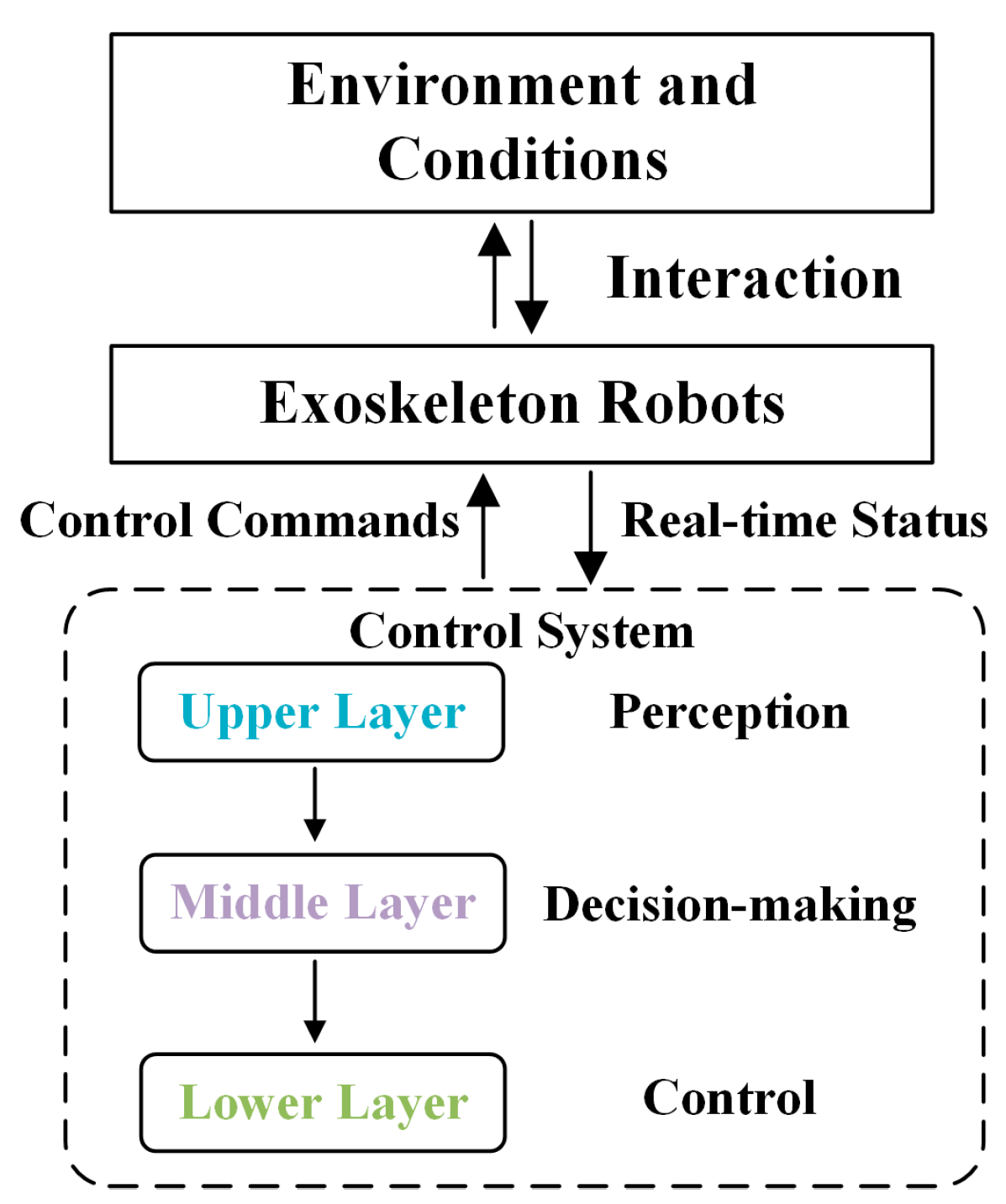
Upper limb exoskeleton robots, as highly integrated wearable devices with the human body structure, hold significant potential in rehabilitation medicine, human performance enhancement, and occupational safety and health. The rapid advancement of high-precision, low-noise acquisition devices and intelligent motion intention recognition algorithms has led to a growing demand for more rational and reliable control strategies. Consequently, the control systems and strategies of exoskeleton robots are becoming increasingly prominent. This paper innovatively takes the hierarchical control system of exoskeleton robots as the entry point and comprehensively compares the current control strategies and intelligent technologies for upper limb exoskeleton robots, analyzing their applicable scenarios and limitations. The current research still faces challenges such as the insufficient real-time performance of algorithms and limited individualized adaptation capabilities. It is recognized that no single traditional control algorithm can fully meet the intelligent interaction requirements between exoskeletons and the human body. The integration of many advanced artificial intelligence algorithms into intelligent control systems remains restricted. Meanwhile, the quality of control is closely related to the perception and decision-making system. Therefore, the combination of multi-source information fusion and cooperative control methods is expected to enhance efficient human–robot interaction and personalized rehabilitation. Transfer learning and edge computing technologies are expected to enable lightweight deployment, ultimately improving the work efficiency and quality of life of end-users.
Keywords: exoskeleton robots; human–robot; adaptive control; intelligent control; deep learning exoskeleton robots; human–robot; adaptive control; intelligent control; deep learning