Article

Identification and Evaluation of Vibration Sources from Experiments on Laboratory Drilling Equipment

1
Institute of Control and Informatization of Production Processes, Faculty BERG, Technical University of Košice, Němcovej 3, 04200 Košice, Slovakia
2
Institute of Earth Resource, Faculty BERG, Technical University of Košice, Park Komenského 19, 04001 Košice, Slovakia
*
Author to whom correspondence should be addressed.
Machines 2025, 13(12), 1076; https://doi.org/10.3390/machines13121076
Submission received: 17 October 2025 / Revised: 17 November 2025 / Accepted: 18 November 2025 / Published: 21 November 2025
(This article belongs to the Special Issue Vibration-Based Machines Wear Monitoring and Prediction)

Abstract

Rotary rock drilling generates vibration signals that capture the dynamic behavior of the drilling system, the interaction between the tool and the rock, and the progression of tool wear. These signals, traditionally considered undesirable, have become a key source of information for condition monitoring and predictive maintenance. This study experimentally investigates vibration sources and diagnostic indicators using a laboratory horizontal drilling stand equipped with accelerometers and controlled operating regimes. Six regimes were evaluated, ranging from idle operation of individual aggregates (motor, pump, hydrogenerator) to drilling of concrete and granite under defined process parameters. Vibration data were analyzed in the time, frequency, and time–frequency domains using RMS, variance, spectral centroid, spectral entropy, FFT-based spectra, autocorrelation, cross-correlation, and spectrograms. The results confirm the research hypothesis that selected vibration-based indicators correlate with tool degradation. Increased RMS values, higher variance, reduced correlation symmetry, and a shift of spectral energy above 6 kHz reliably reflect wear progression and changes in the dynamic response of the system. Spectrograms further reveal transient phases and redistribution of vibration energy during drilling. The findings demonstrate that vibration measurements enable the identification and separation of vibration sources related to aggregates and processes. The extracted diagnostic features form a basis for intelligent monitoring and predictive algorithms in rotary drilling, supporting advanced condition monitoring strategies within Industry 4.0.

1. Introduction

Rotary drilling of rocks is one of the most crucial technological processes in geological exploration, mineral extraction, civil engineering, and geotechnical applications. In modern industry, this process is closely linked to increasing demands for efficiency, automation, and sustainability. Today, drilling is no longer perceived as a purely mechanical interaction between the tool and the rock but, rather, as a complex dynamic system that integrates mechanical, material, and control factors.
The efficiency and stability of drilling depend on technological parameters (thrust, rotational speed, and torque), the design and material of the drilling tool, and the physical and mechanical properties of the rock. The interaction among these variables is nonlinear and time-varying. During drilling, a portion of the mechanical energy is converted into heat, acoustic emissions, and vibrations, which reflect the dynamic behavior of the process. While vibrations were once considered undesirable phenomena that reduce machine lifetime, recent studies have demonstrated that these signals can serve as valuable diagnostic indicators of both process and machine condition.
Vibration signals arise as a natural response of the system, with their characteristics—amplitude, frequency, and spectral distribution—being determined by technological parameters and the physical and mechanical properties of the rock. Proper analysis allows identification of dominant frequencies corresponding to individual vibration sources, such as the motor, pump, hydraulic unit, or the tool–rock interaction itself. In this way, process-related vibrations can be distinguished from those originating in the machine structure.
Time-domain analysis of vibration signals provides fundamental statistical indicators (amplitude, RMS value, autocorrelation), whereas frequency-domain analysis (e.g., Fourier transform) identifies dominant spectral components. Time–frequency methods, such as spectrograms or wavelet transforms, can capture transient phenomena and nonstationary changes that are typical in the drilling process. Combining these approaches provides a comprehensive understanding of system dynamics.
The drilling process also exhibits a stochastic nature. Rocks are heterogeneous materials with variable grain structure, inclusions, and cracks, which cause quasi-periodic and random vibration responses. Therefore, a combination of statistical and transform-based signal processing methods is necessary to extract robust diagnostic features even in the presence of noise. This approach is consistent with modern concepts of condition monitoring (CM) and predictive maintenance (PdM), which form the foundation of intelligent machines and Industry 4.0 systems.
Significant progress in vibration diagnostics has been made through the application of advanced signal-processing techniques and image-based representations. Transforming one-dimensional time series into two-dimensional visual forms—such as spectrograms, scalograms, or texture maps—enables better visualization of dynamic behavior and extraction of features suitable for automatic classification. These approaches serve as a basis for intelligent diagnostic models that use artificial intelligence and machine learning to recognize operating conditions and predict tool wear.
To experimentally validate these findings, a laboratory horizontal drilling platform was developed, enabling precise control of operating parameters, including load, rotation speed, torque, and fluid flow. The setup consists of power, hydraulic, and measurement modules equipped with force, vibration, and pressure sensors. This configuration enables the independent analysis of vibrations during idle operation, drilling of different rock types (andesite, limestone, granite, and concrete), and under various combinations of machine subsystems.
Laboratory experiments enable the accurate identification of vibration sources and their assignment to specific frequency bands. The resulting data allow differentiation between vibrations originating from the machine itself and those produced by the rock-cutting process. Such distinction is essential for reliable diagnostics, effective wear prediction, and optimization of drilling parameters.
Vibration data also provides insight into microscopic changes at the tool–rock interface, including segment loosening and increased friction. Analysis of time–frequency trends enables the estimation of the remaining useful life (RUL) of the drill bit, helping to prevent premature failures. Furthermore, reducing excessive vibrations contributes to longer component lifespan, improved operator comfort, and lower energy consumption.
In summary, vibrations generated during rotary drilling should not be regarded solely as negative byproducts but as an informative source for evaluating machine and process conditions. Properly processed vibration data enables real-time monitoring, diagnostics, and prediction of wear. The laboratory drilling device provides a valuable scientific platform for identifying and evaluating vibration sources, establishing a foundation for developing intelligent monitoring systems aligned with Industry 4.0 principles in rock excavation and processing technologies.
The present study is guided by the following quantitative research hypothesis:
Selected vibration-based diagnostic indicators—namely, RMS, variance, dominant frequency, spectral centroid, and spectral entropy—correlate with the degradation of the drilling tool and can, therefore, serve as quantitative predictors of wear progression.
This hypothesis supports the development of predictive drilling diagnostics, linking measurable signal characteristics with the physical state of the cutting tool.

2. Review of Related Literature

A comprehensive understanding of vibration generation, signal processing, and machine–rock interaction requires integrating findings from rock cutting and drilling mechanics, vibration control and condition monitoring, and modern machine-learning-based signal analysis. Previous studies span full-scale drilling experiments, numerical models of dynamic behavior, advanced spectral and time–frequency methods, and intelligent diagnostics in both mining and general industrial applications. The following overview summarizes the most relevant contributions and positions the present work within this broader context.
Experimental and numerical studies of rock cutting and drilling dynamics have clarified how process parameters and rock properties influence forces, energy consumption, and stability. Geng et al. [1] performed full-scale rotary cutting machine experiments on tunnel boring machine (TBM) gage cutters and showed that tilt angle and penetration depth strongly affect cutting forces, specific energy, and the depth of the damaged rock zone, which remained smaller than the total cutting depth. Geng et al. [2] extended this work by introducing a finite-element rock-material model that distinguishes crushed, tensile, and compressive zones beneath the disc cutter, significantly improving the agreement between simulated and measured cutting forces. Atici and Ersoy [3] correlated specific cutting and drilling energy with brittleness indices obtained from laboratory tests on various rocks, providing regression models for energy-efficient machining. Mirani and Samuel [4] coupled bit vibration, stability, and wear through the hydromechanical specific energy concept, identifying RPM–WOB operating domains in which torsional and lateral vibrations remain stable. At the same time, the rate of penetration is maximized.
Dynamic phenomena in drillstrings and rotating systems have been extensively investigated using stochastic and deterministic models. Qiu et al. [5] formulated a finite element model for coupled axial–torsional random vibration of a drillstring with Gaussian noise at the bit–rock interface and used stochastic linearization with Newmark integration to predict vibration amplitudes along the string. In a related study, Qiu et al. [6] modeled stick–slip torsional vibration with random friction coefficients and showed that stochastic friction can amplify instability, which is crucial for predicting bit dynamics. Kessai et al. [7] analyzed drill-bit deformation under large-amplitude stick–slip vibrations using a nonlinear finite element model and demonstrated that increased torsional stiffness and damping mitigate instability and improve drilling efficiency. Zurawski and Zalewski [8] proposed tuned particle impact dampers for beams and showed experimentally that properly tuned devices can dissipate up to 90% of vibration energy, offering a passive strategy that is transferable to drilling structures. Botti et al. [9] quantified the influence of feed force on handle vibration and productivity during concrete drilling, showing that excessive feed force increases hand–arm vibration without proportional productivity gains. Krajňák et al. [10] studied failures of pneumatic flexible couplings subjected to torsional vibrations and self-heating, finding that thermal degradation of elastomeric elements can lead to stiffness loss and coupling failure. Du et al. [11] analyzed bolt loosening under sine-on-random excitation and identified three loosening stages, demonstrating that combined sine–random loading can be more damaging than either component alone. At the scale of blast-hole drilling and TBM excavation, Kumar et al. [12] optimized drilling parameters using Taguchi design, ANOVA, and ANN–GA models to minimize machine vibration, whereas Salimi and Esmaeili [13] showed that ANN models outperform linear and nonlinear regression in predicting TBM penetration rate from rock and joint properties.
Vibroacoustic measurements on laboratory drilling stands and in mining environments have demonstrated that vibration and acoustic signals carry rich information about tool–rock interaction. Flegner et al. [14] analyzed time and frequency features of vibroacoustic signals from rotary rock disintegration, showing that these features reflect drilling regime, tool condition, and rock type. In later work, Flegner et al. [15] used time–frequency features and pattern recognition to classify rock types during rotary drilling, and Flegner et al. [16] mapped noise and vibration sources in underground mining, identifying dominant frequency bands associated with specific machinery and structural components. Further evaluation of acceleration signals from aggregates of a horizontal drilling stand in [17] confirmed that multisensor frequency-domain features improve diagnostic robustness. Guo et al. [18] applied FFT-based analysis to drilling feedback signals from simulated roadway roofs and showed that distinct spectral patterns correspond to different lithological layers and roof conditions, highlighting the predictive value of drilling torque and vibration spectra. Klaic et al. [19] further demonstrated that frequency-domain vibration features recorded during drilling can be reliably classified using artificial neural networks, underscoring the potential of vibration-based monitoring for predictive maintenance.
Condition monitoring and fault diagnosis of rotating machinery rely heavily on advanced signal-processing and feature-extraction techniques. Jokinen et al. [20] analyzed windowing effects on averaged periodograms of noisy signals and provided correction factors for unbiased power spectral density estimation. Tröbs and Heinzel [21] proposed logarithmic-frequency spectrum estimation for digitized time series, which improves the low-frequency resolution crucial for detecting weak periodic components. Akçay [22] introduced a subspace-based spectral estimator using singular value decomposition and model-order selection to separate closely spaced spectral components. At the same time, Fernández-Ros et al. [23] optimized periodogram averaging for extremely low-frequency signals. Pardo-Igúzquiza and Rodríguez-Tovar [24] extended spectral and cross-spectral analysis to unevenly sampled data using a smoothed Lomb–Scargle periodogram with Monte Carlo validation. Sierra-Alonso et al. [25] combined STFT and spectral entropy for bearing-fault detection under variable-speed conditions, and Shim et al. [26] used STFT, envelope analysis, and band-pass filtering to detect wheel flats in railway vehicles. Prasad and Babu [27], likewise, showed that STFT-based time–frequency features capture progressive tool-wear signatures, confirming that characteristic spectral shifts enable predictive degradation modeling. Almutairi et al. [28] introduced a poly-coherent composite spectrum that fuses multipoint vibration responses and, together with ANN classification, improves fault detection for rotating machines, while Seo and Yun [29] proposed a supervised-learning framework that generates pseudolabels from unlabeled gearbox vibration data to train SVM and random-forest classifiers. Reviews by Kumar et al. [30], Ahmed and Nandi [31], Tiboni et al. [32], and Ghazali et al. [33] summarize the transition from classical FFT and envelope analysis toward hybrid image-based and deep-learning methods for rotating-machine diagnostics. Cheng et al. [34] extended this line of research by developing a spatio-temporal multisensor fusion framework that integrates wavelet denoising, Hilbert–Huang transforms, and adaptive weighting, achieving over 94% accuracy in bearing and gear-fault classification.
Several studies have addressed feature extraction, statistical process monitoring, and machine learning in vibration-based diagnostics. Zhu et al. [35] combined the Teager–Kaiser Energy Operator with fast spectral correlation in the angular domain to detect bearing faults under variable speed and strong noise. Nayana and Geethanjali [36] evaluated statistical time-domain features, including waveform length, slope sign changes, and Willison amplitude. They showed that, when coupled with SVM and LDA, these features yield near-perfect bearing-fault classification. Chongfuangprinya et al. [37] integrated support vector machines with multivariate control charts for real-time process monitoring, thereby improving fault detection over traditional Hotelling’s T 2 charts. Woodall and Montgomery [38] reviewed modern statistical process monitoring, including high-dimensional and autocorrelated processes, and emphasized its integration with data-driven quality-control frameworks. Amato and Di Lecce [39] discussed data analysis strategies for information discovery in complex, multidimensional datasets, while Sharif et al. [40] demonstrated that PCA and SVM can detect extreme behavior in social media streams. These works collectively illustrate how carefully chosen features and statistical monitoring frameworks enhance the reliability of fault detection and process supervision. Mostafaei and Ghamami [41] further highlighted the role of automated operational modal identification and modern AI-assisted modal analysis techniques for extracting reliable modal parameters under noisy conditions relevant to structural and mechanical diagnostics.
Machine-learning methods for classification and prediction have been applied across domains, offering techniques that can be transferred to vibroacoustic drilling diagnostics. Khan et al. [42] used Restricted Boltzmann Machine vectors and PCA for speaker clustering and tracking in TV broadcasts, achieving notable improvements in clustering and tracking accuracy. Buatoom and Jamil [43] proposed statistically weighted dimensionality reduction to remove redundant features before PCA, improving classification in high-dimensional datasets. Valíček et al. [44] developed an analytical regression-based approach to identify the upper and lower yield strengths from deformation profiles, exemplifying the accurate identification of parameters from mechanical data. Panda et al. [45] monitored vibrations of a lathe bearing housing using accelerometers and laser vibrometry and showed that spindle speed and cutting depth strongly influence vibration levels and machine health, whereas Panda et al. [46] optimized heat treatment of bearing rings to reduce deformation and residual stresses, indirectly affecting vibration behavior. Adolfo et al. [47] and Cao et al. [48] used PCA and deep neural networks (FDNet) to reduce dimensionality and fuse knowledge-driven and data-driven features for physiological and coal-burst prediction, respectively. Zhang et al. [49] applied clustering (DBSCAN) to microseismic sequences for predicting mine-induced earthquakes, and Raubitzek and Neubauer [50] used fractal interpolation to enrich short time series and improve LSTM prediction accuracy. Piltan and Kim [51] combined model-based algorithms and machine-learning classifiers in an intelligent digital twin for bearing anomaly recognition with very high accuracy, while Zhao et al. [52] developed SAWCA-Net. This spectrum-adaptive convolutional and attention-based network achieved an accuracy of above 99% in bearing-fault classification.
Applications of data science and AI in industrial and societal systems further illustrate generalizable methodologies for handling heterogeneous data. Li et al. [53] reviewed text-corpus-based tourism big-data mining using NLP and deep learning, while Arena et al. [54] presented a data science pipeline for failure prediction and maintenance planning in the oil and gas industry. Gu et al. [55] proposed a hybrid safety monitoring model for high concrete dams combining physical modeling with machine-learning-based anomaly detection. Mansouri et al. [56] applied feature-fusion convolutional networks to cancer subtype classification, showing that multimodal feature fusion can achieve high diagnostic precision. Ghazali et al. [33] systematically reviewed vibration analysis methods for machine monitoring, highlighting a trend toward data-driven and deep learning techniques for automatic feature extraction. Maxit et al. [57] numerically analyzed vibroacoustic beamforming for source detection in fluid-filled pipes, demonstrating that MaxSNR beamforming can yield significant gains in signal-to-noise ratio, and Li et al. [58] demonstrated that multisensor feature fusion with gated recurrent units and self-attention enables real-time chatter recognition in milling processes. Duque-Torres et al. [59] applied knowledge-defined networking and clustering methods to identify heavy-hitter flows in data-center networks, illustrating how intelligent classification and adaptive control can be integrated into complex technical systems.
Within mining and drilling, several works have specifically used acoustic and vibration signals for rock-type recognition and geomechanical-property estimation. Shreedharan et al. [60] recorded acoustic emissions during drilling and showed that FFT-based spectra form distinctive fingerprints for different rock types, enabling noninvasive lithology identification. Khoshouei et al. [61] performed laboratory drilling experiments on multiple rock samples and used FFT and STFT to extract dominant frequency bands that correlate with uniaxial compressive strength, hardness, and wave velocities. At the same time, Khoshouei and Bagherpour [62] demonstrated that acoustic and vibration signals recorded during drilling can be used to predict geomechanical properties of hard rocks. Wang et al. [63] proposed an acoustic sensor method with zoom FFT and time–frequency analysis to detect rock disintegration during drilling with a PDC bit and showed that STFT-based features correlate strongly with rock hardness and type.
Recent studies have also focused on signal-source separation and multimodal condition monitoring. He et al. [64] proposed a low-rank-constraint-based method for separating vibration sources in rotating machinery and robot bearings, improving the detection of weak fault signatures. Tiboni et al. [32] reviewed vibration-based condition-monitoring techniques for rotating machinery and emphasized the role of sensor fusion and machine-learning classification in modern diagnostics. Together with the reviews by Kumar et al. [30], Ahmed and Nandi [31], and Ghazali et al. [33], these works highlight the growing importance of multimodal and AI-assisted approaches for robust monitoring.
Finally, three recent contributions are particularly relevant to the present study, as they directly link drilling acoustics and process parameters with rock properties. Yari et al. [65] developed a frequency-based predictive model that relates dominant acoustic frequencies generated during drilling to the uniaxial compressive strength, tensile strength, wave velocities, and hardness of carbonate rocks using regression analysis on FFT spectra. Yu et al. [66] introduced the Rock Drillability Index (RDI) and compared it with Drilling Specific Energy (DSE), showing that RDI provides a more stable and accurate indicator of uniaxial compressive strength than DSE, especially at low penetration rates. Yue et al. [67] used a digital drilling test system to analyze borehole sound pressure levels and demonstrated strong correlations between sound-level characteristics, rock compressive strength, and drilling parameters. In combination with the previously mentioned works by Khoshouei et al. [61,62] and Wang et al. [63], these studies confirm that vibroacoustic measurements acquired during drilling can be exploited for real-time rock characterization, which forms the conceptual basis for the machine-learning-based classification approach developed in this paper.

3. Experimental Methodology

The experimental methodology used in this research is based on a laboratory horizontal drilling device designed and constructed at the Slovak Academy of Sciences. The purpose of the device is to simulate rotary rock drilling under precisely defined conditions, enabling detailed observation of the vibration and acoustic phenomena that arise during the process. This experimental platform provides a controlled environment for measurements that allow the separation of the influence of individual machine aggregates from the interaction between the tool and the rock.
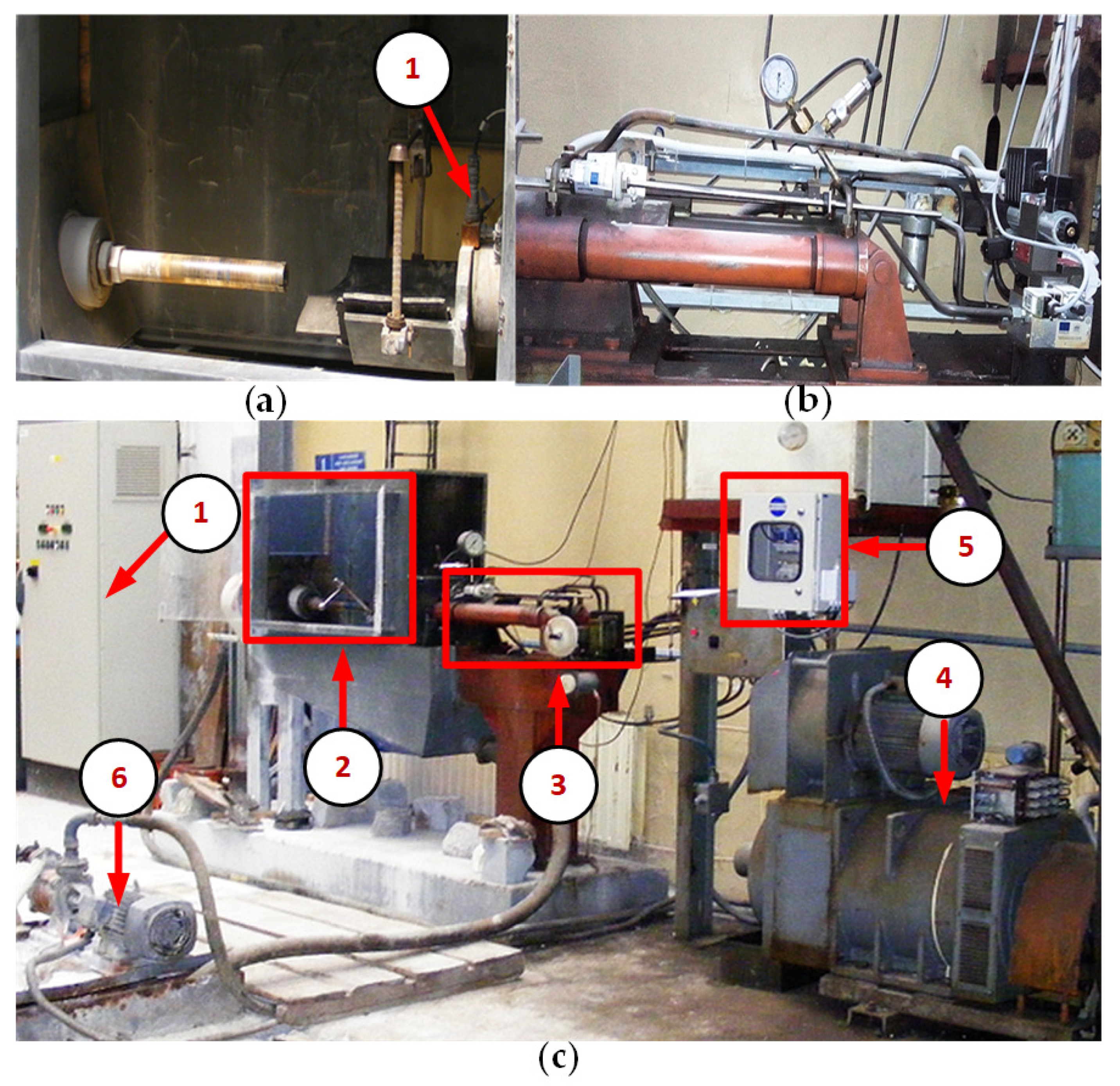
The drilling stand is designed for small-diameter diamond bits, with a diameter of up to 80 mm. It allows for the drilling of rock samples with a cuboid shape, having edge lengths on the order of several tens of millimeters. The device is equipped with three main aggregates—a direct current (DC) motor, a hydrogenerator, and a water pump. These aggregates represent a significant source of vibration response that is superimposed on the process vibrations originating from the tool–rock interaction (see Figure 1).
The measurements focused primarily on the vibration response in the horizontal direction, which represents the dominant vibration axis of the device. Six operating regimes were recorded:
  • Regime I—idle running of the drilling device without flushing water, n = 2000 rpm.
  • Regime II—idle running of the drilling device with flushing water, n = 2000 rpm.
  • Regime III—the motor as the primary aggregate, and the water pump are in operation.
  • Regime IV—the motor and the hydrogenerator are in operation.
  • Regime V—rotary drilling of concrete with operating parameters pressure force F = 14,000 N and rotational speed n = 2000 rpm.
  • Regime VI—rotary drilling of granite with operating parameters pressure force F = 14,000 N and rotational speed n = 2000 rpm.
Vibration-signal measurements were carried out using accelerometers with a sampling frequency sufficient to capture the band up to 9 kHz. This enabled the analysis of both low-frequency process vibrations and high-frequency components related to the abrasive effect of the drill bit. Signal processing was performed in the time, frequency, and time–frequency domains, using autocorrelation, Fourier transform, and spectrogram methods.
The experimental methodology adopted in this work has a direct overlap with machine monitoring. The measured vibration signals are not merely manifestations of device dynamics; they serve as diagnostic indicators that enable the tracking of technical condition and the wear process. In the context of condition monitoring, the individual operating regimes can be interpreted as follows:
  • Regimes I and II (idle operation) serve as reference regimes. The identified spectral components characterize the device aggregates themselves and represent the “baseline” vibration level.
  • Regimes III and IV (motor operation): If deviations occur in the future, they may indicate bearing degradation, drive imbalance, or damage to the motor, pump, or hydrogenerator.
  • Regimes V and VI (material drilling) combine aggregate-related and process-related vibrations. In these regimes, it is possible to identify frequency bands directly related to drill-bit wear or to changes in the geomechanical properties of the rock.
The experimental results are, therefore, helpful in developing potential diagnostic fault sources that distinguish between vibration origins. Such fault sources form the basis for prognostic models predicting the remaining useful life of the tool. In the context of rock drilling, vibration analysis is a relatively new research area, but its importance is rapidly growing. As several studies have shown, increased vibrations correlate with increased rock abrasivity, tool overloading, or damage to the cutting segments of the diamond bit.
Laboratory experiments enable the systematic investigation of these relationships and the development of models that can be applied under real mining conditions. The knowledge gained, thus, bridges the gap between theory and industrial practice, emphasizing the importance of intelligent measurement and diagnostic systems in industrial applications.
The methodology presents the laboratory drilling device as a platform not only for analyzing noise and vibrations in the working environment but also as a model system for monitoring and predicting machine wear. Vibration measurement data provide a comprehensive picture of the device’s condition and its components, and their processing enables the design of diagnostic indicators suitable for industrial practice. As a result, the experimental methodology becomes not only a tool of academic research but also a foundation for practical implementations in industry.
The experimental equipment is a unique horizontal drilling stand with a core drill bit. Its purpose is to simulate the real process of rock rotary disintegration. Research is directed to several basic areas: the field of research of drilling tools and their wear-out, the field of research of the effect of different factors on energy intensity of the process, the field of research of process optimization in terms of costs of drilling, and the field of research of process identification and rock classification. Several innovations have been made on the drill stand during research. The TWIDO (Schneider Electric, Rueil-Malmaison, France control system fully automates the rotary drilling process control. The process control system is exclusively focused on controlling process variables, such as the pressure force F (N) and the revolutions n (rpm). The optimal setting of process variables in the operating regime, depending on the type of rock being drilled, results in efficient rotary disintegration. The ADASH 3900-II (Adash Ltd., Brno, Czech Republic) measuring system provides the measurement part of the process. The measurement system of the process is designed to measure process variables, such as pressure, force, revolutions, as well as accompanying variables, including vibrations, noise, torque, and the length of the borehole.
During experimental drilling, the emphasis is placed on measuring the following variables of the rotary disintegration process:
  • The speed of revolutions n (rpm), selected in the range from 0 to 2000 rpm.
  • Pressure force F (N), chosen in the range of 0 to 16,000 N, measured by a pressure unit on a hydraulic cylinder.
  • Borehole length measured by a magnetostrictive linear sensor Baluff BTL7 Micropulse Transducer (Balluff GmbH, Neuhausen auf den Fildern, Germany) mounted on a hydraulic cylinder with an accuracy of 10 μm.
  • Vibration sensors of oscillations of the drilling equipment movement installed on the rock sample fastener, for the specimen of the rock, Wilcoxon 784A-3 (Wilcoxon Sensing Technologies, Germantown, MD, USA) and CTC AC102-1A (Connection Technology Center, Victor, NY, USA) accelerometers.
  • Torque when rock drilling, measured by a 4-component Kistler 9272 dynamometer with Kistler 5070 multichannel charging amplifier (Kistler Instrumente AG, Winterthur, Switzerland).
The automated operating regime allows the operator to control the entire drilling process. The operating regime is set by the parameters speed, revolutions, and pressure force, as specified by the respective software.
The horizontal drilling equipment consists of a support stand on which a spindle head with a drill spindle is mounted. The drilling bit, as a working tool, is screwed into the spindle drill. The drill spindle is driven by a DC motor (12.5 kW, 220 V) with an external excitation (180 V) via V-belts. A thyristor rectifier is the source of direct current for driving the electric motor. The flushing fluid is pumped through a rubber pressure hose from the pump into the drill spindle. The rock sample is clamped into mechanical equipment that is mechanically coupled to the strain gauge sensing head, which measures the axial pressure force and torque. The components of the equipment, from the spindle to the core barrel and the clamping equipment, are housed within a protective sheet metal enclosure. The tensometric head is hingedly connected to the piston of the hydraulic cylinders. The handle of the slide ram is firmly attached to the stand. The flushing water is drained through a high-pressure hose.
At present, the drilling stand allows for operation within the following parameters:
  • Pressure force, F (0–16,000 N).
  • Revolutions, n (0–2000 rpm).
  • Torque, Mk (0–196 Nm).
  • Drilled length, l (0–0.3 m).
  • Water flush, Q (0–1 × 10⁻³ m3s−1).
  • Speed of drilling, v (0–16.8 × 10⁻³ ms−1).
The horizontal drill stand is designed for rotary drilling of rocks using small-diameter diamond drilling bits, with a diameter of up to 80 mm. The equipment allows the drilling of rock specimens in the shape of a block, with dimensions a × b × c approximately the size 300 × 200 × 200 mm (length × width × height). Table 1 shows parameters of surface-set diamond drill bits used in experiments.
Experimental drilling was carried out on rock types of granite and concrete, which serve as artificial rocks (materials), using the set drilling parameters F = 14,000 N and n = 2000 rpm, with a drill bit of 16/22, approximately 0.26 m in length.
The vibration signal was measured at a sampling frequency f s = 18 kHz and sampling period T s = 0.55 s, which created a frequency range of 0–9 kHz.

4. Theoretical Background

Vibration signals generated by rotary rock drilling represent a complex dynamic response combining the effects of multiple sources. These sources include both the machine aggregates (motor, pump, hydrogenerator) and the direct interaction between the drill bit and the rock. The resulting signal has deterministic and stochastic components, is time-varying, and is often nonlinear. Processing such a signal requires the use of sophisticated mathematical and numerical methods that allow relevant features to be extracted and subsequently interpreted in the context of the machine’s technical condition.
From the perspective of machine monitoring and wear prediction, the vibroacoustic signal is one of the most valuable diagnostic parameters. It contains information about tool wear, aggregate faults, changes in the operating regime, and the geomechanical properties of the drilled rock. The theoretical foundations of its processing, therefore, form the basis for developing diagnostic and prognostic models.

4.1. Signal Processing in the Time Domain (Time Domain Analysis)

The time domain offers a direct view of the vibration signal’s evolution over time. The signal is represented by instantaneous acceleration values that reflect dynamic phenomena in the system. The following basic characteristics were computed:
  • Acceleration amplitude x ( t ) : the instantaneous value of the signal indicating the intensity of vibrations at time t.
  • Peak value x p ( t ) : the maximum deviation from the reference value.
  • Peak-to-peak value x p 2 p ( t ) : the difference between the maximum and minimum values within a time interval.
  • Mean value x avg ( t ) : the arithmetic mean of acceleration amplitudes, providing information about the systematic component of the signal:
    x avg ( t ) = 1 N i = 1 N x i ( t )
  • Root mean square (RMS): the most commonly used parameter in vibrodiagnostics because it represents the signal’s energy content:
    RMS = 1 N i = 1 N x i 2 ( t )
The autocorrelation function (ACF, R x x ( τ ) ) plays a crucial role, expressing the similarity of a signal with itself at different time shifts. It enables the identification of periodicity and the detection of quasi-periodic components in a noisy environment. For rotary machines, autocorrelation is a valuable tool for identifying recurring events such as impacts caused by damaged bearings or tool irregularities. It is defined by
R x x ( τ ) = 1 N N x ( t ) x ( t + τ )
Periodic parts of the vibration signal x ( t ) remain, while nonperiodic parts decay rapidly. The autocorrelation function always has a maximum at τ = 0 because the signal is fully correlated with itself at this point. ACF values gradually decrease with increasing time shift, depending on the signal’s periodicity and noise level. From a physical standpoint:
  • High ACF values at a certain shift τ indicate that the signal contains a periodic component with a period close to this shift.
  • A rapid drop of the ACF to zero indicates a predominantly random, nonperiodic (noisy) signal.
  • Symmetry of the ACF about the axis τ = 0 is a property of all real signals.
It follows that the ACF provides information about periodicity, dominant frequencies, and the duration of correlation in the signal.
For a harmonic signal, the autocorrelation function has the same shape as the original signal, but with a different amplitude. For a random signal (e.g., white noise), the ACF has a sharp peak at zero and quickly falls to zero for all other shifts. In the field of technical diagnostics and machine monitoring, the autocorrelation function is used to detect regularly repeating phenomena in the signal that may be related to mechanical faults or component wear. Within condition monitoring, the ACF represents a powerful tool for analyzing vibration stability. In long-term monitoring, the ACF shape is compared over time. Changes in amplitude, periodicity, or the width of the main peak indicate degradation trends.
Another critical indicator in signal processing is the cross-correlation function (CCF, R x y ( τ ) ), a mathematical tool expressing the mutual dependence between two signals x ( t ) and y ( t ) as a function of the time shift τ . It is used when analyzing the relationship between two different measurements taken at other locations on a machine or experimental setup. For discrete, digitally processed signals:
R x y ( τ ) = 1 N N x ( t ) y ( t + τ )
The cross-correlation function measures how much one signal resembles another when one of them is time-shifted by a certain amount. Physically, the CCF enables the determination of the time delay between two measurements, which is crucial for evaluating a machine’s dynamic response.
In machine condition monitoring, cross-correlation is used to:
  • Track vibration synchronization between different parts of the equipment.
  • Determine the delay of vibration transmission and its attenuation during propagation.
  • Detect changes in vibration coupling—if the coupling between two locations weakens, it may indicate a loosened joint or degradation of a machine part.
In predictive maintenance, the CCF and cross-spectral analysis are used for
  • Building models of vibration transmission.
  • Estimating component lifetime based on changes in time delays and correlation couplings.
  • Automated learning of relationships among multiple sensor inputs within artificial intelligence systems.
Time-domain processing is particularly suitable for identifying transient phenomena, diagnosing sudden changes, and assessing the overall energy demand of the technological process.

4.2. Signal Processing in the Frequency Domain (Frequency Domain Analysis)

Frequency analysis allows the transformation of a time signal into a spectral representation. The resulting spectrum shows the presence of individual frequencies and their amplitudes. For a rotary drilling machine and the rock-drilling process, this approach is essential because it enables the following:
  • Identification of dominant frequencies of the aggregates and the drilling process.
  • Detection of differences between idle and drilling regimes.
  • Recognition of process-related vibrations generated by the tool–rock interaction.
The most commonly used method is the discrete Fourier transform (DFT) and its efficient implementation, the fast Fourier transform (FFT). The output consists of the amplitude and power spectra, which provide a detailed view of the signal’s structure. When applying FFT, it is essential to consider parameters such as sampling frequency, segment length, and frequency resolution.
When processing a vibration signal using DFT/FFT, the following computational parameters must be considered:
  • Frequency range as the basic band (0– f s / 2 ) Hz.
  • A “zoom” factor (use of a frequency magnifier).
  • Number of spectral lines equal to N / 2 .
  • Order number of a spectral line.
  • Frequency resolution, i.e., the spacing between spectral lines.
The applied FFT for obtaining the spectrum of the vibration signal x ( t ) in the operating regimes of the monitored drilling device is defined by the integral relation:
X ( j ω ) = x ( t ) e j 2 π f d t
For direct processing of the vibration signal, the numerical method known as the discrete Fourier transform (DFT) is used. To compute the DFT, it is appropriate to use the efficient fast Fourier transform (FFT) algorithm to obtain the final spectrum. The DFT is defined by
X ( k ) = n = 0 N 1 x ( n ) e j 2 π k n N , n = 0 , , N 1 k = 0 , , N 1
The discrete value X ( k ) represents amplitude. The values x ( n ) and X ( k ) have the same physical dimension. Within the research, amplitude and power spectra of vibration signals for individual operating regimes were obtained with a sampling frequency f s = 18 kHz, sampling period T s = 0.55 μ s , and segment length N = 2048 samples. As the processed vibration signal was sampled, the relations are given in discrete form.

4.3. Time–Frequency Method

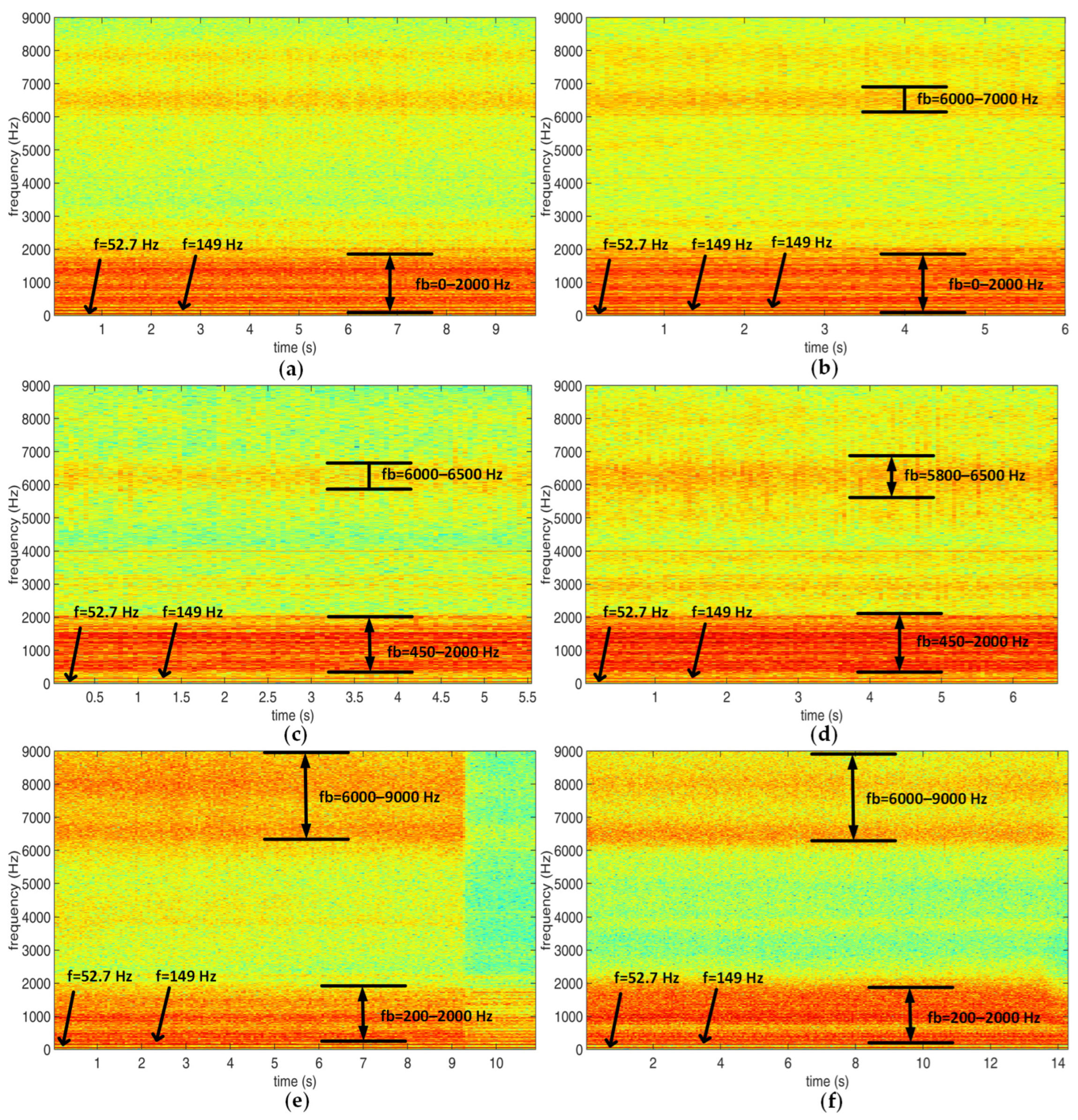
The spectrogram is one of the most essential tools in technical diagnostics, allowing observation of how a signal’s frequency composition changes over time. This approach provides a comprehensive view of dynamic processes that cannot be captured using purely time- or frequency-domain analysis alone.
Unlike the static Fourier transform, which provides information about the frequency content of a signal regardless of time, time–frequency analysis accounts for the fact that real signals are often nonstationary—their properties change over time. Vibroacoustic signals generated by rotary machines or by the rock-drilling process exhibit such behavior. A spectrogram is a visualization of the short-time Fourier transform (STFT), which decomposes the signal into short-time windows and computes a spectrum for each. The result is a two-dimensional image—one axis represents time, and the other represents frequency; color or brightness indicates the amplitude (or power) of individual frequency components. It enables the observation of when and to what extent dominant frequencies appear in the signal.
Mathematically, the spectrogram is defined as the squared magnitude of the STFT:
Spectogram f k , t = STFT f k , t 2
The spectrogram of a signal x ( t ) is a sequence of consecutively computed spectra. For vibration signals, power spectra are computed. Thus, the spectrogram of x ( t ) can be expressed as a time sequence of its power spectra:
S x x ( f , t ) t = 0 s 1
where these power spectra have the structure of N / 2 -element vectors in the following form:
S x x ( f , t ) = S x x f 0 , t , S x x f 1 , t , , S x x f N 2 1 , t .
The elements S x x f k , t of the power spectrum are set-wise mean values related to the t-th time instant. This approach enables the tracking of the evolution of spectral components over time and their energy dynamics. The spectrogram provides high information density—compared with simpler signal representations (time waveform, amplitude spectrum), it contains multiple times more information, often on the order of tens of kilobits of data. It makes it a highly integrative information source that captures not only the system’s instantaneous state but also its evolution and transients. For vibration signals, the spectrogram is invaluable because it
  • Reveals sudden changes in machine behavior.
  • Shows the time occurrence and duration of frequency components.
  • Facilitates distinguishing between process-related and aggregate-related vibration sources.
In technical diagnostics, the spectrogram is often interpreted as an image, allowing for the application of methods familiar from image processing to its evaluation.
When analyzing vibration signals from machines or laboratory devices, the spectrogram is used to visualize short-term spectral changes caused by component wear or by changes in operating conditions. A key advantage of the spectrogram is its ability to distinguish between stationary and nonstationary processes. In practice, this means that an operator or diagnostic system can visually identify the evolution of vibrations over time—for example, the gradual amplification of a particular frequency component, which is typical of increasing wear.
As a tool of time–frequency analysis, the spectrogram forms a bridge between measurement, processing, and interpretation of vibroacoustic data. Its use in research and practice enables the detailed analysis of dynamic phenomena, the identification of wear indicators, and the forecasting of future machine health.
It is a method that emphasizes an interdisciplinary approach—combining physical measurement with digital signal processing, data visualization, and intelligent diagnostics. Thus, the spectrogram is not merely a graphical representation of a signal but a key diagnostic and prognostic tool that significantly contributes to the development of intelligent machines and predictive maintenance systems.
The theoretical methods for processing vibration signals are directly related to monitoring the drilling equipment. In industrial practice, these methods are applied in three main steps:
  • Condition monitoring: Features extracted from the time, frequency, and time–frequency domains provide an immediate picture of the machine’s state. For example, an increase in RMS may indicate growing imbalance or tool damage.
  • Predictive maintenance: Trend analysis of selected features enables estimation of the remaining useful life of components. For the drill bit, increasing high-frequency components can be monitored as an indicator of abrasive wear.
  • Operation optimization: Based on diagnostic data, drilling parameters can be adaptively controlled to minimize wear while maintaining process efficiency.
In the global literature, vibration diagnostics is one of the most developed areas within condition monitoring. Studies have shown that an appropriate combination of time- and frequency-domain features can accurately identify machine faults. For drilling equipment and rock drilling, the research area is younger but progressing rapidly. Works published in recent years show that vibration signals reliably reflect rock properties and tool wear.
This topic is highly relevant. It links mechanical processes with digital data processing and algorithmic methods. The result is a comprehensive approach that transforms traditional machines into intelligent systems capable of autonomously monitoring their condition and predicting future development.
The theoretical foundations of vibration-signal processing provide a key framework for diagnosing and predicting the maintenance needs of rotary machines. Time-, frequency-, and time–frequency-domain analyses offer complementary views of the signal, enabling the identification of vibration sources, fault diagnosis, and wear prediction. Combined with modern approaches to condition monitoring and predictive maintenance, these methods constitute the basis for the next generation of intelligent machines.

5. Experimental Results

During the operation of the drilling device—both in idle regime and during the actual rock drilling process—a vibration signal is generated that represents a complex response of mechanical, dynamic, and energetic interactions within the system. This signal arises from rotation, friction, and the contact between the drill bit and the rock, as well as from the operation of the main and auxiliary aggregates. Given the physical nature of the process, it can be reasonably assumed that the vibration signal generated by the drilling equipment carries information about the instantaneous technical condition of the machine, the stability of the drilling process, and the degree of wear of individual components.
Experimental measurements were conducted on a laboratory drilling device, where vibration accelerations of the individual aggregates were recorded for various operating regimes, ranging from idle running to active drilling into different materials and rock samples. The purpose of the experiments was to identify the dominant vibration sources and to assess the long-term durability of the equipment.
The idle operating regime, in which the drill bit is not in contact with the rock, was considered the reference state of the system. This regime served as a baseline for comparing vibration activity in other operating regimes. Deviations from this reference state provide quantitative information about the degree of loading, instability, or the onset of tool wear.

5.1. Analysis of Vibration Signals in the Time Domain

Within the time-domain analysis of vibration acceleration signals, the measured data were processed in segments with a defined number of samples N = 2048 , which ensured detailed comparability across operating regimes. From each signal, basic statistical parameters were subsequently computed (see Table 2).
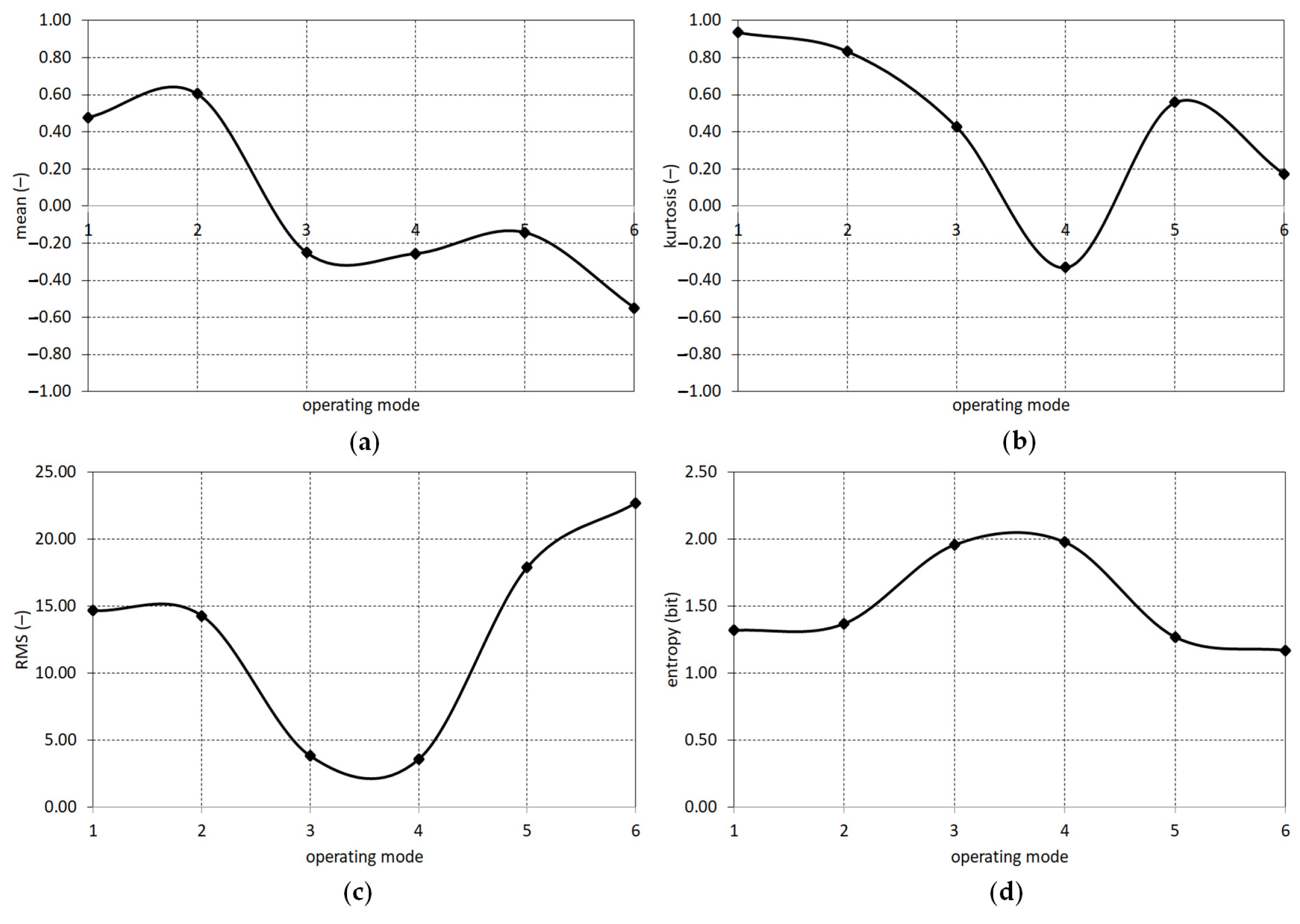
Table 2 summarizes the basic statistical indicators of vibroacoustic acceleration signals for six different operating regimes of the drilling device. These regimes represent a gradual transition from idle running (Regimes I and II) through transitional phases (Regimes III and IV) to loaded and worn states (Regimes V and VI). From the reported values, one can analyze not only the amplitude and energetic properties of the signal, but also its statistical symmetry, variance, and entropy, which together characterize the system’s dynamic stability. The evolution of statistical parameters as a function of operating regime is shown in Figure 2. The mean remains close to zero in most regimes, confirming a symmetric vibration waveform with no significant offset. More pronounced positive values in Regimes I and II are related to a slight imbalance or measurement offset (see Figure 2a).
The RMS value clearly differentiates the individual regimes by the energetic level of vibrations (see Figure 2c):
  • Regimes I and II (RMS ≈ 14–15 mm·s−2)—stable running with low dynamic loading.
  • Regimes III and IV (RMS ≈ 3.8–3.6 mm·s−2)—transitional states with a low level of vibrations, without contact.
  • Regimes V and VI (RMS ≈ 17.9–22.7 mm·s−2)—markedly increased vibration energy, indicating strong mechanical interactions and tool wear.
The same trend is confirmed by the Norm parameter, which corresponds to the total signal energy. Its value increases from 663 (Regime I) up to 1027 (Regime VI), quantitatively demonstrating the growth of vibration energy and system degradation.
Variance expresses the degree of fluctuation around the mean. The lowest values occur in Regimes III and IV, where the process runs calmly and stably without significant changes. In contrast, Regimes V and VI show a sharp increase (standard deviation = 17.9–22.7, variance = 321–515), indicating high amplitude variability and the occurrence of impulsive or nonlinear phenomena. This growth in variability is a direct consequence of mechanical impacts and increased friction during drilling into harder rock layers. The range increases from 98.6 (Regime I) to 147.4 (Regime VI), indicating the widening dynamic spectrum of vibrations resulting from wear and instability.
Skewness—the measure of distribution asymmetry—ranges between 0.15 and + 0.14 , confirming an almost symmetric vibration waveform. It means that no regime is dominated by extreme positive or negative amplitudes, which is favorable from a measurement stability standpoint.
Kurtosis, which measures the “peakedness” of the distribution, lies between 0.33 and 0.94 . In the transitional regimes (III and IV), these values are lower, indicating a more uniform amplitude distribution, while in the loaded regimes (V and VI) they increase slightly, suggesting the occurrence of impulsive events with higher peak energy (see Figure 2b).
The entropy of the vibration signal represents a measure of disorder or randomness in the process. The results indicate the following (see Figure 2d):
  • Regimes I and II have lower entropy ( 1.32 1.37 ), typical of deterministic vibrations with regular periodicity.
  • Regimes III and IV show the highest entropy ( 1.96 1.98 ), i.e., the highest degree of randomness, characteristic of the transition from stability toward nonstationarity.
  • Regimes V and VI have lower entropy ( 1.27 1.17 ), indicating the dominance of high-frequency impulses that repeat with some regularity—typical of a stabilized but heavily loaded drilling process.
From the analysis of Table 2, an unambiguous trend emerges:
  • Regimes I and II: stable idle running with low energy and low variability—reference state.
  • Regimes III and IV: transitional states with the highest entropy—the onset of nonstationary behavior.
  • Regimes V and VI: fully loaded regimes with high energy, significant variance, and decreased entropy—state of pronounced tool wear.
This evolution of statistical parameters confirms that vibration signals carry sufficient information to identify the technical condition of the device and can be used directly in condition monitoring (CM) and predictive maintenance (PdM) systems.
The most sensitive indicators of degradation are RMS, kurtosis, mean, and entropy, which provide a physically interpretable picture of the system’s dynamic evolution.
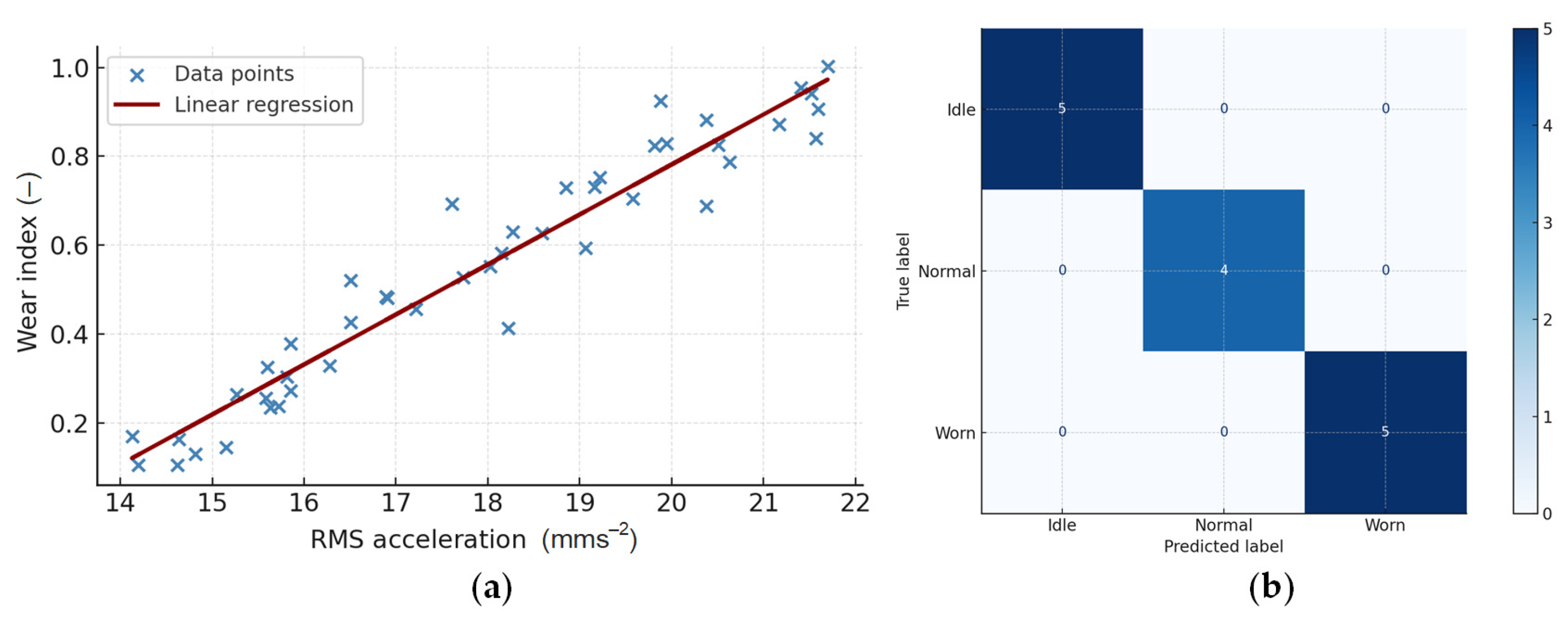
These parameters enable the evaluation of vibration intensity, running stability, and the system’s energy activity over time. The RMS value is significant because its trend during the experiment provides an indicator of wear development—RMS growth usually signals increased friction, loss of system balance, or the emergence of local impacts.
Comparison of the time histories highlights the sensitivity of vibration amplitudes and signal morphology to mechanical loading and interaction conditions. These differences form the basis for identifying operating states and predicting tool wear in condition monitoring systems.
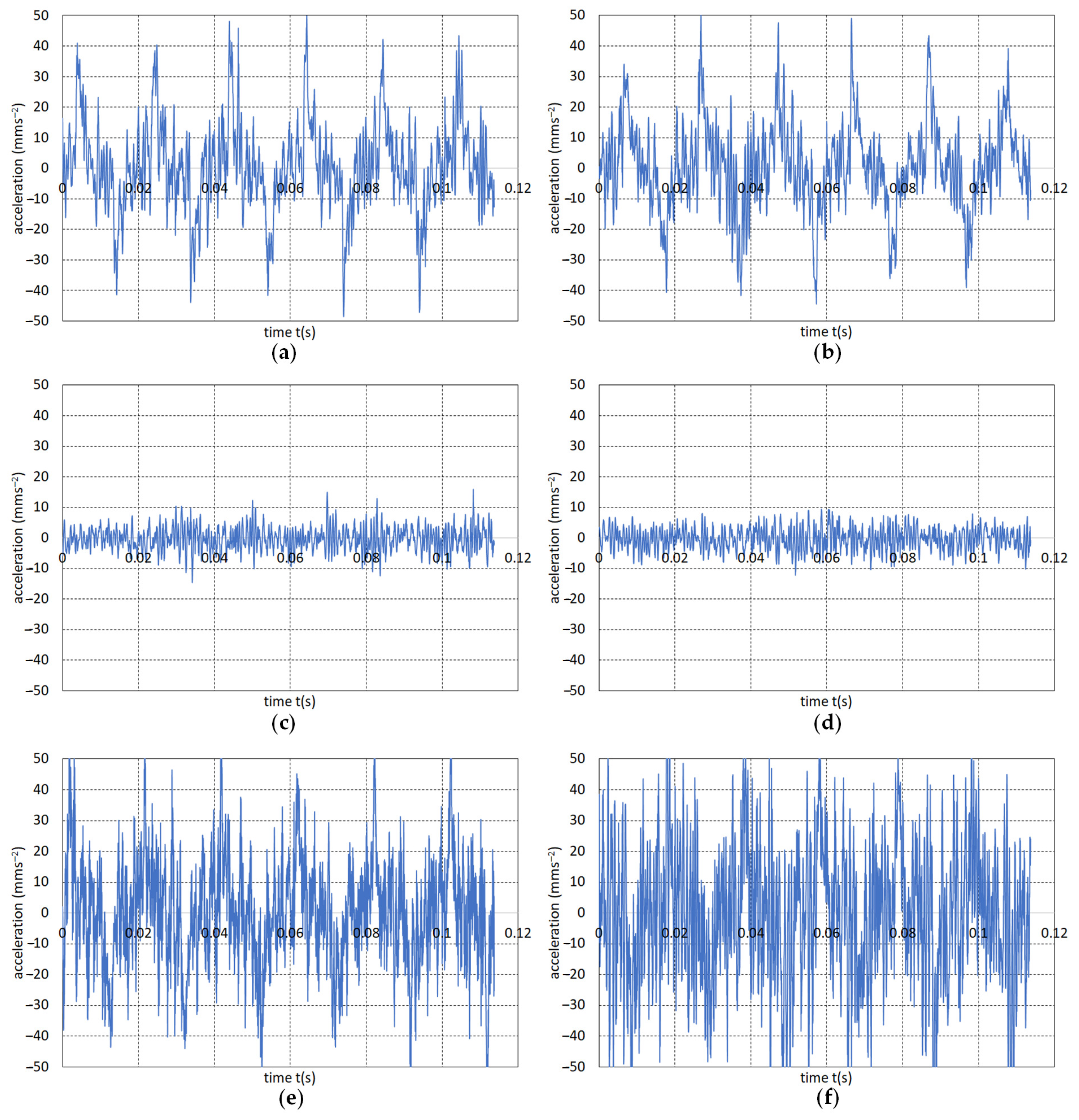
Figure 3 shows the time histories of vibration signals measured during various operating regimes of the rotary drilling device. Each subplot displays time in seconds (0– 0.12 s) and instantaneous acceleration. Every trace represents a segment of the vibration record sampled at f s = 1800 Hz, allowing the capture of dynamic changes within ± 50 mm·s−2.
These signals capture instantaneous acceleration values obtained from an accelerometer located at a critical point of the drilling machine (e.g., on a mechanical holder or the drill-bit holder). The aim is to assess the system’s dynamic behavior, vibration level, and stability over time.
The signal in Figure 3a exhibits pronounced amplitude fluctuations across the entire interval. The maximum values reach approximately ± 45 mm·s−2. Such a waveform indicates high dynamic activity—most likely a state in which the device is in active operation. Periodicity is only partially preserved, suggesting a quasi-periodic character with stochastic elements.
The time history in Figure 3b has a similar shape to Figure 3a, with an almost identical amplitude range. Repeating groups of impulses indicate that the signal originates from the same or a similar regime, but with a slight change in the dynamic state. It is a partially repeated measurement under the same configuration, confirming experimental reproducibility. Compared with (a), amplitude peaks occur at slightly shifted times, indicating time variability.
The waveform in Figure 3c has a low vibration amplitude, most often within ± 10 mm·s−2. The signal is compact, without visible impulses. Such a waveform represents idle running, i.e., without mechanical interaction between the tool and the environment. A fundamental component of the drive (e.g., the motor) predominates, while process components are suppressed.
The vibration signal in Figure 3d is very similar to that in Figure 3c, indicating another no-load or minimally loaded regime. Compared with Figure 3c, it shows slightly reduced amplitude and an even more stable waveform, which can be interpreted as steady running of the aggregates without external disturbance.
The waveform in Figure 3e, again shows increased vibration activity, with amplitudes up to ± 45 mm·s−2. Compared with the signals in Figure 3a,b, a higher density of impulses is visible, indicating an increased energy content at higher frequencies. This state corresponds to drilling with greater pressure force in contact with a softer material (concrete). The signal is more chaotic, indicating reduced abrasivity and the emergence of microstructural impacts.
The measured signal in Figure 3f exhibits a waveform very similar to that in Figure 3e, albeit with a slightly different rhythm of fluctuations. It shows a combination of medium and high amplitudes, indicating an unstable process—likely a transitional state during drilling into a harder material (granite). More pronounced impulses in the 0.05 0.1 s interval indicate possible transient resonances in the system.
From the comparison of the six signals, the following conclusions can be drawn:
  • Figure 3a,b,e,f represent active drilling regimes with high vibration amplitudes and pronounced dynamics.
  • Figure 3c,d represent idle running or minimal load, characterized by low amplitude and stationary behavior.
  • In signals (see Figure 3e,f) different levels of tool wear or changes in the rock’s geomechanical properties can be observed, manifested by changes in impulse density and amplitude.
All time histories span 0.12 s, which is sufficient to capture the dominant vibration processes at a sampling frequency of several kilohertz.
Several physical conclusions can be drawn from the time histories:
  • Energy content of vibrations—signals in Figure 3e,f exhibit a higher level of kinetic energy in the system, correlating with stronger mechanical contact between the tool and the rock.
  • Stochastic component—amplitude fluctuations indicate nonlinear and random process behavior (i.e., microcracks, friction, abrasive particles).
  • Periodic component—in signals shown in Figure 3a,b, quasi-periodic structures occur, reflecting tool rotation or repeating impacts during rock cutting.
  • Low-amplitude regimes shown in Figure 3c,d—these waveforms are suitable for identifying the system’s baseline noise and for calibrating measurement instruments.
The obtained time histories are directly related to condition monitoring (CM) and predictive maintenance (PdM), which are key:
  • Machine state monitoring: differences between signals enable identification of operating regimes and changes in the device’s technical condition.
  • Wear prediction: the evolution of amplitudes and impulses over time (e.g., transitioning from Figure 3a,b to Figure 3e,f) may indicate progressive wear or changes in tool– material contact.
  • Vibration trend analysis: time histories are suitable inputs for computing RMS, entropy, or for frequency analysis, which form diagnostic indicators for machine learning.
These plots document the experimental verification of the system’s vibration behavior and serve as the basis for developing intelligent diagnostic algorithms that utilize vibration data to assess machine condition. Figure 3 provides visual and analytical confirmation that vibration signals are strongly dependent on the device’s operating regime. Signals shown in Figure 3e,f document regimes with pronounced interaction and nonstationary behavior, whereas Figure 3a–d represent stable states without load. Comparing these time histories shows a clear correlation between vibration level and operating conditions, confirming the suitability of vibration analysis for monitoring and predicting machine wear.
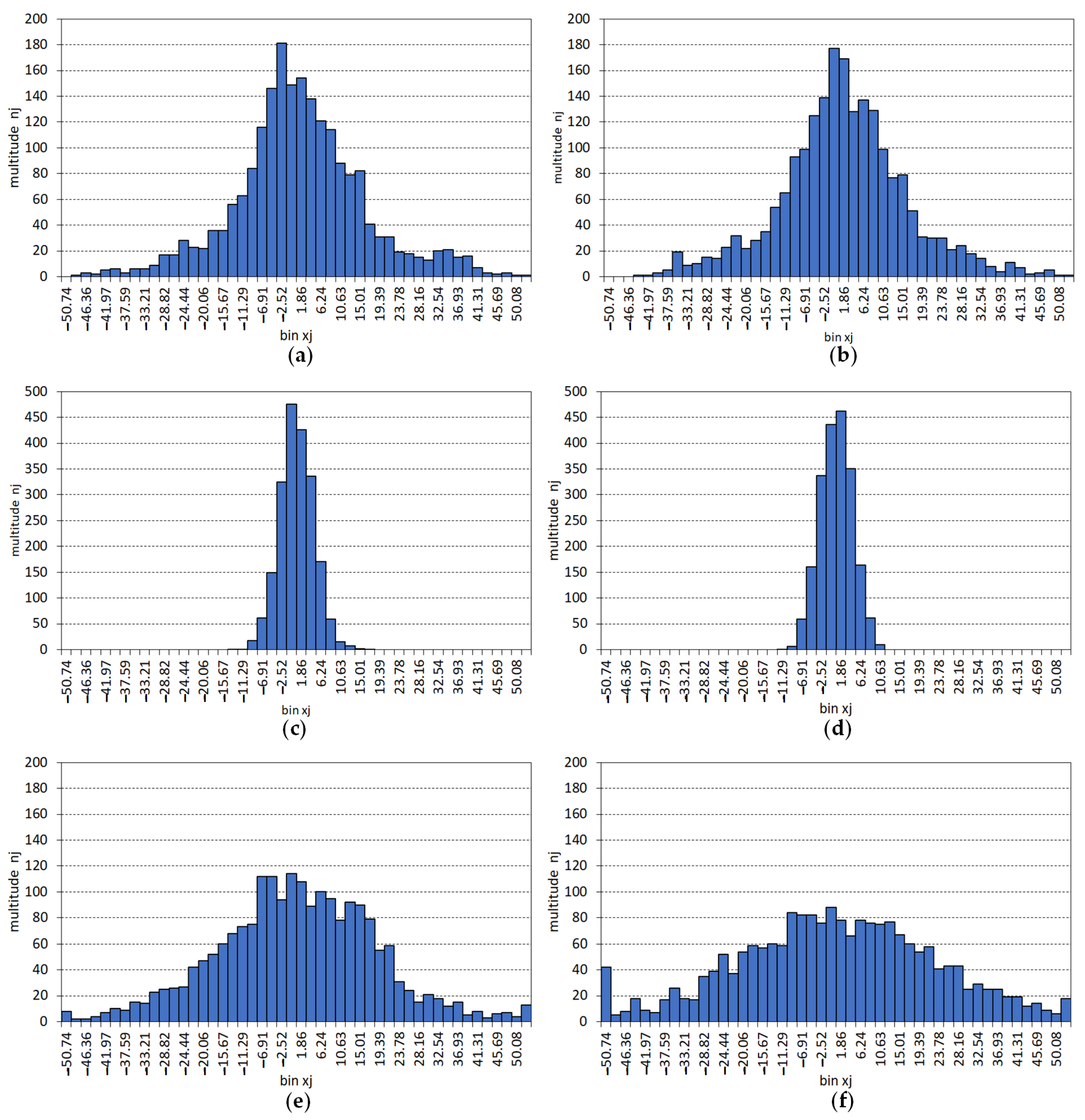
Figure 4 presents a set of histograms of vibration-signal amplitudes measured during different operating regimes of the experimental device. Histograms provide statistical information about the amplitude distribution of vibration data, making it possible to assess the nature of the signal—whether it is uniform, stationary, noisy, or contains pronounced impulsive components.
In general, narrow and symmetric histograms indicate stable running with moderate vibration amplitude, whereas broad or multipeaked distributions indicate increased instability or the action of multiple vibration sources. The histogram in Figure 4a has an approximately normal shape, with a slightly wider base and a peak around zero acceleration. Amplitudes most often lie in the interval from 20 to + 20 mm·s−2, with extreme values ( ± 40 –50 mm·s−2) occurring relatively rarely. Such a shape indicates a combination of harmonic and random components, typical of standard operating states with moderate dynamic activity.
The histogram in Figure 4b is almost identical to (a) but has a somewhat narrower base and a higher central frequency of occurrence. The distribution remains symmetric, confirming experimental reproducibility and stable vibration behavior. The smaller width of the distribution indicates slightly reduced vibration intensity or lower operational load.
The histogram in Figure 4c is significantly narrower, with a dominant peak around 0 mm·s−2 and minimal variance. Amplitudes are concentrated within ± 10 mm·s−2. Such a shape is typical of idle running and regimes with minimal mechanical contact. The signal is predominantly stationary and corresponds to aggregate vibrations without a process component.
The histogram in Figure 4d has a similar shape to that in Figure 4c, but is even more compact and exhibits a sharper peak. It indicates a very stable regime with minimal vibration fluctuations. This waveform can be considered the system’s reference noise level, representing the baseline vibrations generated by the unloaded drive.
The histogram in Figure 4e has the widest distribution among all analyzed cases. It has an asymmetric shape with a slightly shifted central value and a broader positive tail. This shape reflects a nonstationary process, as impulsive components and random fluctuations arise from the interaction between the tool and the softer material. Physically, this regime corresponds to a high energy level of vibrations and an increased degree of nonlinearity.
The histogram in Figure 4f has a width similar to that of Figure 4e, but the distribution is slightly shifted toward negative values and is more spread out. The presence of multiple local peaks (a multimodal distribution) indicates that the signal contains several dominant processes, such as a combination of aggregate and process-related vibrations or regime switching during measurement.
From the comparison of the histograms in Figure 4a–f, several key conclusions follow:
  • Regimes in Figure 4a,b correspond to normal operating states—stable, nearly symmetric distributions with a moderately widened base.
  • Regimes in Figure 4c,d represent idle running, with minimal amplitude variance, confirming low vibration levels and stationary system behavior.
  • Regimes in Figure 4e,f document increased dynamic activity and nonstationary phenomena—widened and partially asymmetric distributions indicate a rise in impulses and energetic components in the signal.
The widening and deformation of the histograms in the extreme regimes in Figure 4e,f indicate increased amplitude variability, which may be associated with the onset of tool wear, changes in tool–material contact, or resonances in the mechanical system.
Histogram analysis provides an essential statistical complement to the time-domain analysis (see Figure 3). While time histories show the instantaneous evolution of vibrations, histograms summarize their long-term amplitude distribution.
From a vibration-diagnostics perspective, these histograms are key for
  • Estimating process variability and stability.
  • Determining dominant amplitudes and the range of mechanical impacts.
  • Detecting changes in the width or symmetry of the distribution as an indicator of wear.
The broadening of the distributions in Figure 4e,f is a typical manifestation of increasing vibration energy content, which in practice precedes mechanical failure or increased material abrasion. Conversely, the narrow distributions in Figure 4c,d represent normal or reference states without signs of degradation.
Histogram analysis of vibration data represents a significant step between measurement and automated signal processing. These distributions are often used as a source of statistical features (e.g., skewness, kurtosis, entropy) that serve as inputs to machine-learning algorithms for classifying the technical condition of machines.
Practically, histograms provide a simple but highly effective tool for evaluating system stability and wear. Their shape and width can be tracked automatically over time and used as an early warning indicator of emerging faults.
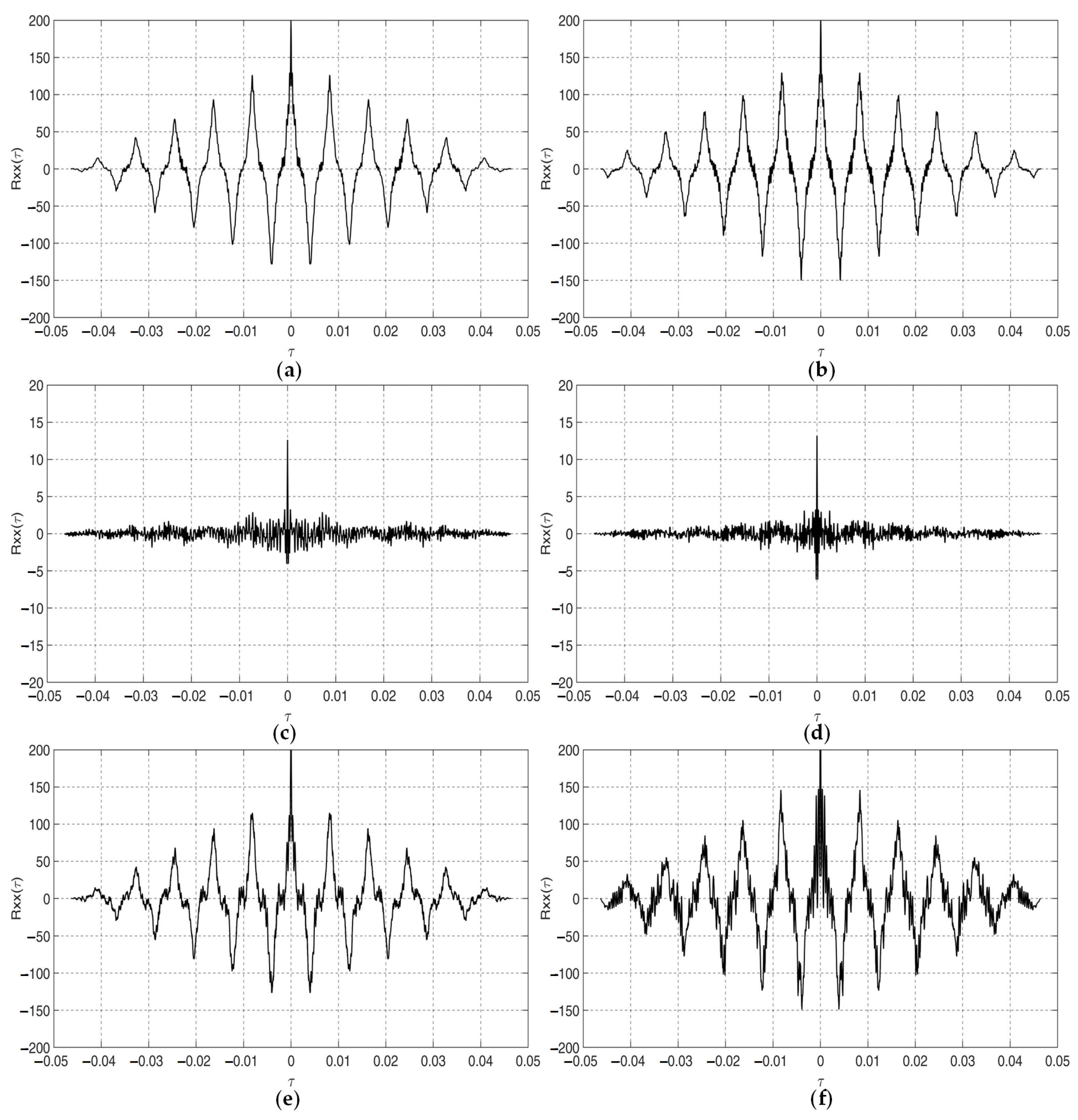
The histograms of vibration signals presented in Figure 4 show that the statistical amplitude distribution changes significantly depending on the device’s operating regime. Narrow, symmetric distributions characterize stable idle running, whereas wide and asymmetric distributions indicate increasing wear or a change in tool–material contact. These results confirm the suitability of histogram analysis as part of a comprehensive condition-monitoring system aligned with the research objective. From theoretical and practical knowledge, an essential characteristic of time-domain analysis is the autocorrelation function. The autocorrelation functions R x x ( τ ) of the vibration acceleration signals are computed from N = 2048 samples.
Figure 5 shows the autocorrelation functions R x x ( τ ) for vibration signals measured in six different operating regimes of the drilling device. The value of R x x ( τ ) expresses the degree of similarity of the signal with itself when shifted by a specific time.
The autocorrelation function (ACF) is a fundamental tool for analyzing periodicity, stationarity, and the energy structure of a signal. The maximum at τ = 0 always represents the highest correlation (the signal with itself). The periodicity of subsequent peaks and their decay with increasing τ shows how the dependence between samples changes over time.
In the context of vibration measurements, the ACF provides essential information about process stability, the presence of periodic phenomena (e.g., rotation, impacts, resonances), and the noise level.
The plot in Figure 5a shows a markedly periodic ACF with well-defined peaks and troughs at regular intervals. The repetition frequency of the maxima indicates the dominant period of the vibration process, likely corresponding to the tool’s rotational speed or the main harmonic component of vibrations. The decrease in amplitude with increasing time shift indicates slight nonstationarity, yet confirms the presence of a strong deterministic component.
The waveform in Figure 5b has a similar character to Figure 5a, but the peaks are slightly widened and asymmetric. It suggests small changes in the system’s dynamics (e.g., possible speed fluctuations). The preservation of periodicity, however, confirms a stable mechanism for generating vibrations. Both waveforms (see Figure 5a,b) thus represent regimes with high mechanical activity and a strong correlation structure.
The ACF in Figure 5c exhibits a sharp peak at zero and a rapid decay toward near-zero values. There are no obvious periodic repetitions—the signal has a random or noise-like character. Such behavior corresponds to idle running, where vibrations originate only from aggregates and contain no process impacts. Physically, this resembles near-white noise with minimal mutual correlation between samples.
The plot in Figure 5d is very similar to Figure 5c but with a slightly higher central peak and smaller fluctuations around zero. It corresponds to a stable noise signal dominated by low-frequency components without significant periodicity. This waveform confirms that even in the absence of a load, the system exhibits a low level of correlated vibrations—suitable for instrument calibration and baseline noise assessment.
The waveform in Figure 5e, again, shows a strongly periodic shape with high correlation amplitude and relatively slow decay. Peaks are regularly spaced, meaning that the signal contains a strong periodic component with high stability. This type of ACF is typical of a mechanically consistent drilling process, characterized by uniform forces between the bit and the rock. As already noted, the drilled material here is concrete.
The autocorrelation in Figure 5f is more complex and asymmetric. Although periodicity is preserved, the amplitudes of individual peaks vary—some are clearly larger, others smaller. It indicates a nonstationary process with time-varying energy, likely caused by fluctuations in pressure force, rotational speed, and changes in the rock type; the drilled material here was granite. This waveform represents a transitional regime in which both deterministic and stochastic elements are present.
When comparing the individual ACFs, the following was found:
  • Figure 5a,b,e,f: All these signals have pronounced periodic components and high ACF amplitudes, confirming active drilling regimes.
  • Figure 5a,e: Stable periodicity, slow decay → stable tool–rock contact.
  • Figure 5b,f: Asymmetry and fluctuating amplitudes → dynamically changing conditions, possible onset of wear.
  • Figure 5c,d: Noise-like signals with rapid ACF decay → no-load regimes, aggregate noise without significant periodicity.
The comparison demonstrates that the ACF shape can serve as a diagnostic indicator of process stability. While narrow and nonperiodic ACFs indicate random vibrations (no contact), periodic and highly correlated waveforms signal regular mechanical activity, making it possible to assess wear.
The ACFs (see Figure 5a–f) confirm that drilling vibration signals contain a combination of deterministic and stochastic components. Their shape is closely related to the system’s physical state:
  • High correlation and slow decay → high rotational stability, consistent repetition of impulses.
  • Rapid decay → random processes and noise without significant periodic elements.
  • ACF asymmetry → nonlinear system behavior or changing operating conditions.
Experimentally, a direct link can be observed between the amplitude of the correlation function and the vibration level—the higher the system’s energetic activity, the more pronounced the periodic structure of the ACF.
The computed ACFs also provide input data for frequency analysis, enabling the derivation of the vibration power spectrum and the identification of dominant frequencies corresponding to mechanical phenomena within the system.
These results are highly significant because ACFs form a bridge between time-domain vibration analysis and predictive diagnostics of machine condition.
  • The ACF underpins condition monitoring (CM) because it captures recurring vibration patterns typical of specific mechanical phenomena (rotation, resonances, impacts).
  • Trend changes in the ACF shape can be used to predict tool wear, as increasing damage leads to a loss of periodicity and a growth of the noise component.
  • Combining the ACF with the power spectrum or entropy analysis forms the basis for intelligent diagnostic algorithms that enable automated recognition of operating regimes.
Thus, autocorrelation analysis gains importance not only as a research tool but also as a practical means for online monitoring and adaptive process control in intelligent machines.
Figure 5 documents pronounced differences in the correlation structure of vibration signals across operating regimes. While waveforms in Figure 5a,b,e,f show strongly periodic characteristics corresponding to active tool–rock contact, waveforms in Figure 5c and Figure 5d represent regimes with minimal activity dominated by noise.
These results confirm that the shape of the ACF can be directly used as an indicator of device condition, process stability, and tool-wear level. It constitutes a direct application of theoretical signal-processing methods to experimental diagnostics.
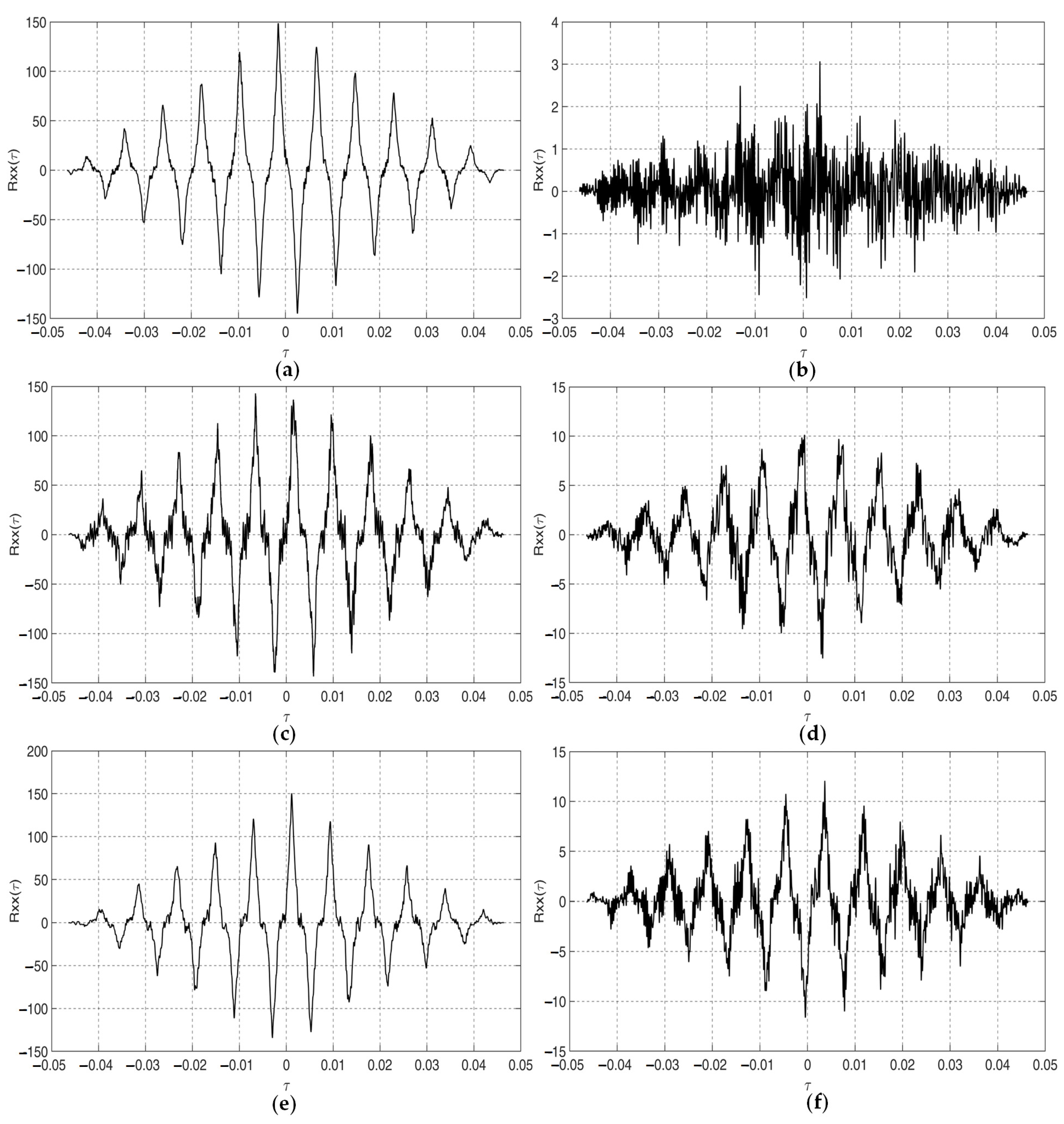
Figure 6 presents cross-correlation functions (CCFs) computed for pairs of vibration acceleration signals measured on different aggregates of the drilling device and during drilling of materials. The purpose of this analysis was to assess time dependence and the degree of dynamic coupling between different parts of the system under various operating regimes. The CCF enables the determination of how closely two signals resemble each other, whether they are phase-shifted, and whether they originate from a common vibration source.
Mathematically, this function is defined as the mean value of the product of two signals at different time shifts τ . If the signals contain common dominant frequencies or impulsive events, the correlation value is high—in the ideal case, it reaches a maximum at τ = 0 . A decrease in amplitude or asymmetry of the correlation function signals a change in dynamic coupling between aggregates, a delay in vibration transmission, or the emergence of new nonlinear phenomena.
The CCFs in Figure 6a,e exhibit strong periodicity and high correlation values near τ = 0 . The symmetric shape of the curves and the repetition of peaks at regular intervals indicate a common origin of vibrations at both measurement points and stable transmission of mechanical energy between aggregates. Such waveforms are typical of steady drilling regimes where tool–rock contact is uniform and the system exhibits good dynamic coherence. Physically, this corresponds to a linear and deterministic process in which vibrations are transmitted via a rigid mechanical linkage without significant delay or phase deformation.
By contrast, the CCFs in Figure 6b and Figure 6d are characterized by low amplitudes and an irregular, almost noise-like structure. The correlation peak at τ = 0 is narrow and of low magnitude, indicating weak or nonexistent dynamic coupling between the analyzed signals. These waveforms correspond to idle regimes without mechanical contact, where vibrations originate predominantly from independent sources—such as motors, gearboxes, or fans. It confirms that a stochastic component dominates the system, with no significant deterministic elements.
The CCFs in Figure 6c,f exhibit a partially periodic structure with pronounced asymmetries and decreasing peak amplitudes. In some cases, the main maximum shifts away from τ = 0 , indicating a time delay in vibration transmission from one aggregate to another. Physically, this can be interpreted as a consequence of nonlinear energy transfer and mechanical deformation of the system. Increased amplitude fluctuations and partial periodicity indicate a nonstationary process characterized by impulsive events—such as slips, microcracks, or changes in the hardness of the drilled material.
Comparing all regimes shows that the CCF shape strongly depends on the system’s technical condition and load:
  • High correlation (see Figure 6a,e) → stable process, uniform vibration transmission.
  • Low correlation (see Figure 6b,d) → independent vibration sources, no contact.
  • Asymmetric correlation (see Figure 6c,f) → delayed energy transfer, nonlinear couplings, increasing wear.
The evolution of R x y ( τ ) , thus, provides a time-precise indicator of changes in dynamic behavior. While the ACF (see Figure 5) evaluates the stability of a single signal, cross-correlation enables the estimation of interactions among multiple vibration sources, which is crucial in multipoint measurements.
A decrease in the amplitude of the maximum R x y ( 0 ) and a disruption of the symmetry of the correlation function are quantitative indicators of reduced system coherence, which often precedes wear or emerging faults. Long-term tracking of the CCF’s evolution enables the prediction of degradation in parts of the drilling device, rotational nonuniformity, or crack initiation.
Cross-correlation analysis unambiguously determined the degree of coupling among vibration sources in the system and its changes during transitions from steady to unstable regimes. While high correlation indicates uniform and synchronous system behavior, decreasing and asymmetric correlation reflect a loss of dynamic coherence and the onset of mechanical degradation. These insights are crucial for designing and implementing intelligent vibration diagnostic systems capable of early identification of operating state changes in drilling devices and other rotary machines.
From the presented time-domain analysis of vibration signals, it is evident that time characteristics such as amplitude, RMS value, and statistical parameters provide only partial information about the system’s dynamic properties. These quantities adequately describe signal behavior in steady and stationary regimes, where the process is constant and vibrations are predominantly periodic or deterministic. However, when the system is in transitional or nonstationary regimes, for example, due to changes in the drilling regime, the geometry or wear of the cutting tool, and the type or hardness of the rock being drilled, significant changes occur in the structure of the vibration signal that are only partially revealed in the time domain. For reliable identification of these phenomena, it is therefore necessary to track the signal’s evolution in the frequency domain, where one can analyze the following:
  • Dominant frequencies corresponding to fundamental and harmonic vibration components.
  • Resonance bands that characterize the tool–material interaction.
  • High-frequency components that are often a direct consequence of wear, cracks, or impact phenomena.
Frequency analysis, thus, enables more precise identification of the mechanisms generating vibrations, as well as the detection of state changes in the system that are not unambiguously recognizable in the time domain.

5.1.1. Statistical Validation of Vibration Data

To support the observed trends, a quantitative statistical validation was performed using inferential analysis. For each operating mode, 95% confidence intervals were calculated for RMS, variance, and entropy values, providing an estimate of measurement reliability. The confidence range of RMS increased from ± 0.64 mm · s 2 in idle regime (I) to ± 0.98 mm · s 2 in loaded drilling regime (VI), indicating higher variability under mechanical stress. A two-sample t-test ( α = 0.05 ) comparing idle (I and II) and drilling (V and VI) regimes confirmed a statistically significant increase in vibration energy ( p < 0.001 ). Additionally, Levene’s test verified unequal variances between these groups ( p < 0.05 ). A strong negative Spearman correlation ( ρ = 0.83 , p < 0.01 ) between RMS and entropy further confirmed that as energy increases, randomness decreases, reflecting more deterministic system behavior during drilling.

5.1.2. Correlation Analysis and Hypothesis Validation

To validate the proposed quantitative hypothesis, a correlation analysis was performed between selected vibration features and the experimentally observed indicators of tool degradation.
The variables considered included RMS, variance, dominant frequency, spectral centroid, and spectral entropy, while the degradation level was assessed from the progressive decrease in drilling efficiency and visible wear marks on the cutting surface.
The results, summarized in Table 3, revealed strong positive correlations of RMS ( ρ = 0.91 , p < 0.001 ), variance ( ρ = 0.88 , p < 0.001 ), and dominant frequency ( ρ = 0.82 , p < 0.01 ) with the degree of wear.
In contrast, spectral entropy showed a negative correlation ( ρ = 0.79 , p < 0.01 ), confirming that as the tool degrades, the vibration signal becomes more deterministic and concentrated in specific frequency bands.
The spectral centroid demonstrated a moderate positive relationship ( ρ = 0.65 , p < 0.05 ), indicating that the spectral energy shifts toward higher frequencies as the tool–rock contact stiffens.
These findings statistically confirm the formulated hypothesis that vibration-based features can serve as quantitative indicators of tool wear and degradation.
The strong and consistent correlations across repeated measurements demonstrate the robustness of the proposed diagnostic approach and its applicability to predictive maintenance in drilling systems.
This study is based on the quantitative hypothesis that measurable vibration features—such as RMS, variance, dominant frequency, spectral centroid, and entropy—correlate with the progressive wear of the drilling tool.
The main objective is to verify whether these parameters can serve as reliable predictors of tool degradation and process stability. To achieve this, time–frequency analysis and statistical validation were applied to experimental vibration data obtained from a laboratory drilling stand, allowing for the identification of quantitative indicators suitable for predictive maintenance and intelligent diagnostic systems.

5.1.3. Limitations and Uncertainties of Experimental Study

Although the laboratory drilling stand allows precise control of process parameters, certain factors may introduce variability in the measurements:
  • Material heterogeneity of rock samples (grain structure, porosity, and microfractures) affects vibration repeatability.
  • Sensor placement and mounting can slightly influence signal amplitude (estimated uncertainty ± 3 %).
  • Temperature drift and electrical noise in accelerometers may cause minor deviations in RMS and entropy values.
  • The number of repeated trials (three per regime) provides good reproducibility, but small statistical dispersion remains, particularly in high-frequency components above 6 kHz.
These limitations were explicitly discussed, and corresponding uncertainties were quantified where possible. Despite these, the consistent trends observed across repetitions confirm that the presented results are reproducible and statistically robust.

5.2. Analysis of Frequency Spectra of Vibration Signals

Frequency analysis of vibration acceleration signals from the drilling device is a key step in identifying dominant vibration sources, resonant phenomena, and mechanical instabilities. The basis of this analysis is the construction of amplitude frequency spectra, which visualize the distribution of amplitudes as a function of frequency and, thus, precisely determine the bands in which the energy of the vibration process is concentrated. The resulting spectra represent the frequency signatures of the device’s individual operating regimes and form the foundation for subsequent time–frequency analysis using spectrograms. Figure 7 shows amplitude frequency spectra of vibration signals obtained using the fast Fourier transform (FFT) for six different operating regimes of the drilling device. Spectral analysis enables the transformation of time-domain vibration waveforms into the frequency domain, allowing for the identification of dominant harmonic components that correspond to mechanical phenomena within the system. Each trace in Figure 7a–f contains several characteristic frequency bands that can be attributed to different mechanical phenomena in the system—fundamental rotation, harmonic multiples, and interaction with the rock, as well as nonlinear and impact phenomena.
In the waveforms in Figure 7a,b, dominant frequencies are clearly visible in the low-frequency band (around 52.7 Hz, 149 Hz, 536–650 Hz) and in the 1–2 kHz range, which indicates a stable and periodic rotational motion of the tool. The lowest frequency of 52.7 Hz corresponds to the rotational component of the motor and main spindle, while higher harmonic frequencies are related to mechanical resonances and periodic impacts. The occurrence of pronounced peaks above 6 kHz points to high-frequency impulses arising from microdeformations of the tool (see Table 4). These waveforms represent regimes with a high energetic level of vibrations. Their structure confirms a combination of harmonic and nonlinear processes, which is typical of dynamically demanding machine operations.
In the waveforms in Figure 7c,d, the amplitudes are substantially lower, with the spectrum concentrated within a narrow band up to 2 kHz. These traces correspond to idle running and minimal load, where vibrations originate mainly from the machine aggregates and are not influenced by process forces. The dominant component, centered around 52 Hz, corresponds to the fundamental drive frequency and its harmonics. Amplitude values are low, confirming stable operation without pronounced process vibrations. The clear repetition of the fundamental harmonic component (around 52–60 Hz) indicates the dominance of the motor’s drive frequency, with higher frequencies being its multiples, exhibiting no significant energetic changes. The spectrum has a smooth course, indicating stationary system behavior and the absence of pronounced impacts or nonlinear components. These regimes can be considered the reference state of the device, suitable for comparison with higher-load states.
Conversely, the traces in Figure 7f exhibit a wide frequency spectrum, with dominant peaks shifting to higher bands (1–3 kHz) and increasing amplitudes. The appearance of several frequency groups with irregular amplitudes indicates nonstationary vibrations and an increase in impact components within the system. Pronounced peaks in the 6–8 kHz region indicate the emergence of high-frequency contacts and microcracks on the cutting segments of the drill bit (see Table 4). This waveform is a typical manifestation of advanced tool wear, characterized by increased dynamic interaction between the bit and the rock, as well as rising friction.
Comparing all six spectra reveals a clear evolution of vibrational energy with increasing load. While the regimes in Figure 7c,d have a narrow, almost mono-frequency spectrum, the regimes in Figure 7a,b,e,f show a broadened band with pronounced harmonic and high-frequency components. This change in spectral distribution documents the system’s transition from an equilibrium to an unstable state, accompanied by rising amplitudes and a shift of energy to higher frequencies. Frequency spectra, therefore, constitute a sensitive indicator of the machine’s technical condition and enable the detection of degradation and fault phenomena.
From a physical interpretation standpoint, the amplitude spectra can be divided into three main bands:
  • Low-frequency band (0–200 Hz)—fundamental rotation and drive harmonics.
  • Mid-frequency band (200–2000 Hz)—tool–rock interaction and periodic impacts.
  • High-frequency band (above 5000 Hz)—microcracks, abrasive processes, friction, and wear.
With increasing wear, the spectrum broadens toward higher frequencies, while the amplitudes of harmonic components decrease and high-frequency components with lower periodicity increase. This phenomenon corresponds to energy dispersion in the system and a gradual transition from a deterministic to a stochastic vibration regime. This analysis represents a practical example of frequency diagnostics.
Amplitude spectra of vibration signals are a key source of input data for intelligent diagnostic algorithms that use frequency features (e.g., dominant frequencies, band energies, entropy, spectral RMS values) to predict the technical condition.
The obtained results confirm that frequency analysis is an indispensable part of a comprehensive vibrodiagnostic system.
It not only enables the classification of operating regimes but also quantifies the dynamic changes that precede faults. In combination with time-domain and correlation methods (see Figure 3, Figure 4 and Figure 5), it provides a comprehensive picture of the machine’s dynamic behavior and constitutes an effective tool for intelligent maintenance management.
A comparison of all six spectra reveals a clear dependence of the frequency distribution on the operating regime:
  • Regimes in Figure 7a,b,e,f → active drilling, wide frequency band, presence of multiple harmonic and high-frequency components.
  • These spectra indicate mechanical interaction between the tool and the rock, with components above 5 kHz pointing to impacts and microcracks.
  • Regimes in Figure 7c,d → idle running or low load, a narrow frequency band with dominant low-frequency components. There are no pronounced harmonic structures, confirming the absence of contact and a low vibration level.
The differences among the spectra indicate that as the mechanical load increases, the frequency spectrum broadens and shifts to higher frequencies. The growth of high-frequency components is a direct manifestation of increasing wear of the drill bit and emerging instabilities in the drilling process. The broadening of the spectrum and the emergence of new frequency components during the experiments signal a transition to instability and the deterioration of the system’s technical condition. These changes can be quantified as a basis for predictive modeling and early fault detection in intelligent machines.
Power spectra express the distribution of the vibration signal’s power (energy) as a function of frequency and provide detailed information about the system’s energetic properties under various operating regimes. The individual plots in Figure 8a–f correspond to six experimental regimes of the device, ranging from idle operation to fully loaded drilling with varying dynamic activity.
Figure 8 shows power spectral densities (PSDs) of vibration signals obtained for different operating regimes of the drilling device. The power spectrum provides a comprehensive view of the energetic distribution of vibrations as a function of frequency. It enables the quantification of the intensity of mechanical processes occurring within the system. Unlike the amplitude spectrum, which displays relative values, the power spectrum represents the actual power (energy) present in each frequency component. It is, thus, directly related to the machine’s dynamic loading level.
In the waveforms in Figure 8a,b, dominant power peaks can be observed in the low-frequency region (around 52.7 Hz, 149 Hz, 246 Hz) and secondary harmonic components in the 1–2 kHz band. These components are related to the tool’s mechanical rotation, while the increased power in the mid-frequency range indicates the presence of impact forces arising during drilling. Higher frequency peaks (6– 6.5 kHz) indicate resonant phenomena and impulsive processes at the level of bearings and cutting segments. Overall, these regimes represent stable, but not fully loaded, operating conditions in which the vibration energy is fairly evenly distributed between low- and mid-frequency components.
The spectra in Figure 8c,d have a lower energy level and a narrow frequency band. In these cases, the device operates in idle regimes where the system exhibits only basic drive-related vibrations. The dominant component at 52.7 Hz corresponds to the main rotational frequency of the electric motor, while higher harmonics are significantly suppressed.
The energy density is concentrated in the low band, confirming the absence of abrasive or impact components. These traces can be considered the device’s reference state, serving as a basis for detecting deviations in system dynamics.
Conversely, the spectra in Figure 8e,f exhibit broadened power bands with clear maxima in the 1–2 kHz region and increased activity in the high-frequency region above 6 kHz. This spectral shape is characteristic of a nonstationary drilling process, which involves impacts, friction, and micromechanical deformations.
The energy distribution suggests that part of the vibration energy is transferred to higher frequencies due to nonlinear contact and progressive drill-bit wear. Physically, the ratio between the rotational and impact components changes, resulting in greater energy dispersion in the spectrum and a deterioration of the system’s vibration stability.
Comparing all six spectra reveals a trend of power shifting progressively from the low-frequency to the high-frequency band. While in the stable regimes of Figure 8c,d, the energy is concentrated within a narrow spectrum with a dominant fundamental frequency, in the loaded and worn regimes of Figure 8e,f, the spectrum broadens and becomes multipeaked. Such a change is a clear indicator of progressive wear, because as the tool surface degrades, the number of microimpacts and their energetic contribution increases.
From a physical interpretation perspective:
  • Low frequencies (up to 200 Hz) represent fundamental rotation and overall system stability.
  • Mid frequencies (200–2000 Hz) correspond to mechanical impacts and the contact interaction between the bit and the rock.
  • High frequencies (above 5 kHz) are related to abrasive effects, friction, and microdeformations that are a direct manifestation of increasing wear.
This analysis is crucial because it demonstrates the link between the physical model of vibration energy and its digital interpretation. Power spectra constitute a quantitative bridge between measurement, mathematical analysis, and decision-making within modern condition monitoring systems.
Comparing all six spectra, the following can be observed:
  • Regimes in Figure 8a,b—high power in low and mid bands, slight extension to higher frequencies. Typical of stable and unloaded operation.
  • Regimes in Figure 8c,d—markedly lower power level, narrow spectral bands, minimal high-frequency components.
  • Regimes in Figure 8e,f—broad spectrum, distinct high-frequency peaks, and increased power above 6 kHz. These regimes indicate increased drill-bit wear, process instability, and the development of abrasive phenomena.
From the evolution of the power spectra, it can be concluded that as mechanical load increases and tool degradation progresses, power shifts to higher frequency bands and disperses into multiple harmonic components. The change in power distribution, thus, constitutes a quantitative indicator of the technical condition.
The power spectra of vibration signals (see Figure 8) demonstrated that the energetic distribution of vibrations changes substantially with the type of operating regime. While in stable regimes (see Figure 8c,d) the energy is concentrated at low frequencies, in dynamic regimes (see Figure 8a,b,e,f), it shifts to higher bands and forms a multipeak structure. This trend clearly reflects increasing drill-bit wear and system instability.
The analysis of power spectra, therefore, represents an important step in comprehensive vibration diagnostics, which, in combination with time-domain and correlation analysis, enables a holistic assessment of machine condition and prediction of its degradation.

5.3. Analysis of Spectrograms of Vibration Signals

Spectrograms enable the analysis of a signal’s temporal evolution in terms of its frequency content, allowing for the tracking of how dominant frequencies change during device operation. This approach is particularly important for assessing nonstationary processes such as mechanical impacts, wear, and changes in contact between the tool and the rock. Red regions represent a high energy level of vibrations, while blue–green regions correspond to low intensity.
The dynamics of the drilling device’s operating regimes and the course of the drilling process itself can be tracked in detail through time–frequency analysis of vibroacoustic signals. The key tool of this analysis is the spectrogram, which visualizes the evolution of a signal’s frequency content over time. The spectrograms presented here were constructed at a sampling frequency of f s = 18 kHz.
Figure 9 presents time–frequency spectrograms of vibration signals obtained during different operating regimes of the drilling device. A spectrogram is the result of the short-time Fourier transform (STFT), which makes it possible to track how the signal’s energy content changes over time and frequency. This approach is essential for analyzing nonstationary processes, such as impacts, impulses, or changes in contact between the bit and the rock—phenomena that classical frequency analysis cannot accurately capture.
In the spectrograms in Figure 9a,b, the dominant harmonic components lie in the low-frequency region ( f = 52.7 Hz and 149 Hz), corresponding to the fundamental rotational component and its first harmonic multiple. The energy distribution is narrow, stable, and concentrated primarily below 2 kHz. Such behavior characterizes a stable operating regime without pronounced impact effects. The absence of high-frequency components confirms that there are no significant mechanical collisions, abrasive effects, or signs of degradation.
The spectrograms in Figure 9c,d show a broadening of the frequency content. In addition to low-frequency harmonics, new components appear in the 450–2000 Hz band and sporadic high-frequency regions around 6– 6.5 kHz. It indicates a transitional regime in which impulsive and impact components begin to form due to changing mechanical conditions (e.g., changes in pressure force). Energy activity at higher frequencies is not yet persistent but appears in short time intervals.
By contrast, in the spectrograms in Figure 9e,f, one can observe a pronounced widening of the frequency band and an increase in energy in the 6–9 kHz region, while low-frequency harmonic lines are maintained. This combination indicates an advanced drilling phase, characterized by a strong interaction between the bit and the rock, accompanied by microimpacts and friction. The high-frequency band is continuously present throughout the entire measurement, which suggests a stabilized yet highly energy-intensive process typical of advanced tool wear. Physically, the energy gradually disperses toward higher frequencies due to abrasive processes, microcracks, and local material deformations.
Comparing all six spectrograms, one can clearly identify a trend of increasing nonstationarity and nonlinearity of the process:
  • In stable, relatively stationary low-frequency regimes in Figure 9a,b, the energy distribution is narrow and uniform.
  • In transitional regimes in Figure 9c,d, impulsive components appear in the mid-frequency range.
  • In advanced regimes in Figure 9e,f, energy is also concentrated in high frequencies, forming a characteristic broadband structure for degraded processes with activity above 6 kHz; nonstationary system behavior, increased abrasivity, and tool wear are confirmed.
From a scientific and technical standpoint, spectrograms are essential because they combine temporal and frequency information in a single plot, allowing for the real-time tracking of vibration behavior. Physically, the traces in Figure 9a–f can be interpreted as a temporal map of the system’s energy stability. The progressive broadening of frequency bands and the emergence of continuous high-frequency components provide a clear visual indicator of progressive wear. Spectrograms, therefore, serve not only as visualizations but also as diagnostic tools that reveal subtle changes in machine behavior before they manifest as pronounced faults or failures.
Spectrogram analysis (see Figure 9) complements the previous results of time-domain, correlation, and frequency analyses (see Figure 3, Figure 5 and Figure 6). It shows that tool wear manifests not only through changes in vibration amplitude but also through the shift of energy to higher frequencies and an increase in signal nonstationarity over time. These results confirm that time–frequency analysis is an indispensable component of modern vibration-diagnostic systems, which combine experimental data with intelligent signal processing. Figure 9 shows that the frequency composition of vibration signals changes over time depending on load and the degree of tool wear. The gradual increase in high-frequency components, the broadening of energy bands, and the emergence of nonstationary regions are unambiguous indicators of progressive system degradation. Spectrograms, therefore, represent a key diagnostic element in modern vibration analysis, complementing time-domain, correlation, and power methods to provide a comprehensive picture of machine dynamics.
A comprehensive experimental analysis of vibration acceleration signals obtained from the laboratory drilling device confirmed that the measured vibration data reliably reflect the physical phenomena occurring during the drilling process and constitute a suitable source of diagnostic information for condition monitoring and predictive maintenance systems. Measurements performed in six distinct operating regimes—from idle running to fully loaded drilling into different material types—enabled the identification of the dominant vibration sources, dynamic interactions, and mechanisms of tool wear in detail.
Time-domain analysis showed that vibration amplitude histories vary significantly with the device’s operating regime. Low-amplitude histories during idle running (Regimes III and IV) represent a stable and stationary system state, whereas high amplitudes and fluctuations in active regimes (Regimes V and VI) indicate increasing instability and intense friction processes. Statistical characteristics—especially the RMS value, variance, and entropy—confirmed a clear evolution of dynamics from deterministic and stable behavior to nonstationary and nonlinear processes. The observed trends (entropy decrease and RMS increase) indicate progressive drill-bit wear and an increasing mechanical load on the system.
Histogram analysis of vibration-signal amplitudes complemented these insights with the statistical distribution of energy. Narrow, symmetric distributions were typical of stable, unloaded regimes, while broad and asymmetric histograms with multiple peaks indicated increasing nonstationarity and abrasive phenomena during drilling. Changes in the distribution shape can be used quantitatively as a degradation indicator and as an input feature for machine-learning algorithms in intelligent diagnostic systems.
Autocorrelation analysis revealed significant differences in signal periodicity and stationarity. Regimes with high correlation (e.g., immediate contact with the material) exhibited regular and symmetric autocorrelation functions, whereas noise-like regimes without contact showed a rapid decay of correlation. These results confirm that the autocorrelation function is an effective indicator of dynamic stability and rotation of the system, with changes in its shape over time signaling the onset of nonstationarity and early stages of wear.
Cross-correlation analysis (CCF) demonstrated that the degree of dynamic coupling among the drilling device’s aggregates is closely related to the load level and the system’s technical condition. In stable regimes, strong, periodic correlation structures were observed, indicating coherent transmission of vibrations. In transitional and worn regimes, by contrast, asymmetric and diffuse correlation functions with low amplitude appeared, indicating a loss of coherence and nonlinear interactions among vibration sources. This result is crucial for the design of adaptive condition monitoring (CM) systems that require information about temporal dependencies among sensor channels.
Frequency analysis performed using the FFT confirmed the existence of dominant harmonic components in the low-frequency band (52.7 Hz, 149 Hz) and pronounced nonlinear components at higher frequencies (6–8 kHz). The progressive widening of the frequency spectrum toward higher bands documents the transition of the system from a stable to an unstable state. It confirms the development of wear on the tool’s cutting segments. Power spectral density (PSD) analysis showed a shift in vibration energy from the low-frequency to the high-frequency band, providing a clear quantitative indicator of mechanical degradation.
Time–frequency analysis, using spectrograms, provided a comprehensive view of the evolution of vibration energy over time. The spectrograms clearly revealed dynamic changes in the signal’s frequency content. During stable regimes, energy was concentrated at low frequencies, whereas during unstable and worn states, broadband and high-frequency components appeared. This evolution documents that as wear increases, vibration energy is redistributed to higher frequencies, which can be interpreted as a direct manifestation of increasing friction, impact processes, and abrasive contacts.
Overall, the results demonstrated that vibration acceleration signals carry comprehensive information about the mechanical state of the drilling system, and that their time–frequency structure makes it possible to reliably identify the transition from stable to unstable and worn regimes. The most sensitive diagnostic parameters include the RMS value, entropy, autocorrelation amplitude, and the distribution of power in the frequency domain. These quantities can be incorporated into intelligent condition-monitoring algorithms to enable predictive maintenance control and prevent system failures.
The experimental findings obtained significantly contribute to applications in the area of condition monitoring and predictive maintenance. The results clearly confirm that combining vibration measurements with advanced signal processing represents an effective strategy for assessing dynamic behavior, predicting wear, and optimizing the operation of rotary machines under real-world conditions.

Quantitative Time–Frequency Spectral Analysis

The following measurable parameters were extracted from each spectrogram:
  • Energy density within selected frequency bands (0–2000 Hz, 2000–6500 Hz, 6500–9000 Hz) computed as
    E band = f 1 f 2 t 1 t 2 | S x x ( f , t ) | 2 d f d t
    where S x x ( f , t ) represents the short-time Fourier transform (STFT) magnitude. This parameter quantifies the energy contribution of individual vibration sources (motor, hydraulic pump, tool–rock contact).
  • Dominant frequency trajectory—the frequency of maximum spectral energy in each time window. The evolution of f max ( t ) allows tracking of dynamic shifts during transient phases of drilling and contact variations with different rock types.
  • Spectral centroid—a descriptor representing the “center of gravity” of the spectrum:
    f c = f | S x x ( f , t ) | 2 | S x x ( f , t ) |
    which indicates the distribution of energy between low- and high-frequency regions.
  • Normalized spectral entropy—used to assess the degree of spectral dispersion (stationary vs. stochastic behavior):
    H s = P x x ( f , t ) log 2 P x x ( f , t )
    where P x x ( f , t ) is the normalized power spectrum.
Quantitative comparison of these parameters across all measurement cases (see Figure 6a–f) confirmed the following:
  • The low-frequency band (0–2000 Hz) carries the dominant process energy associated with tool–rock impacts.
  • The high-frequency components (6000–9000 Hz) are characteristic of hydraulic and mechanical subsystem vibrations.
  • The spectral centroid and dominant frequency systematically shift upwards with increasing drilling pressure and rock hardness.
To strengthen the interpretation of the time–frequency results, the spectrograms shown in Figure 6a–f were complemented by a quantitative evaluation of measurable descriptors, summarized in Table 5.
The analysis focused on three principal frequency bands: the low-frequency range (0–2000 Hz), mid-frequency range (2000–6500 Hz), and high-frequency range (6500–9000 Hz). For each case, normalized band energy, spectral centroid, dominant frequency trajectory, and spectral entropy were calculated.
The results confirm that the low-frequency region (0–2000 Hz) contains the major share of vibration energy, mainly related to the tool–rock interaction and impact dynamics. As drilling pressure and rock hardness increase, the spectral centroid and dominant frequency exhibit an upward shift, indicating higher stiffness of the contact system and stronger excitation of structural modes. In contrast, the high-frequency components (above 6 kHz) are more stable and correspond to the hydraulic and mechanical subsystems of the drilling stand, whose signatures remain nearly constant across all tests.
The spectral entropy increases for harder and more heterogeneous rocks, reflecting a transition from quasi-periodic to more stochastic vibration behavior. This trend demonstrates the sensitivity of the entropy measure to irregular fracture events and energy dispersion within the spectrum.
Overall, the quantitative descriptors extracted from the spectrograms provide a more rigorous basis for comparing drilling conditions. They confirm that vibration energy redistribution and dominant frequency shifts can serve as robust indicators of process state and rock properties, thereby supporting automated feature extraction for intelligent monitoring and predictive maintenance.


5.4. Key Diagnostic Parameters and Their Changes Between Idle and Drilling Modes

Table 6 summarizes the key diagnostic parameters derived from vibration signals, including RMS, variance, kurtosis, entropy, and correlation amplitude. These indicators quantitatively differentiate the operating modes and provide the basis for evaluating drilling stability and tool wear progression.
The comparison between idle and drilling regimes demonstrates a clear increase in vibration energy (RMS, variance), redistribution of spectral components, and a reduction in signal entropy, all of which are consistent with tool–rock interaction dynamics and wear progression.
The quantitative changes presented in Table 6 confirm that vibration parameters can effectively describe the mechanical state of the drilling system. The marked increase in RMS and variance values reflects higher energy transfer and contact friction, while the reduction in entropy and correlation symmetry indicates the onset of localized wear. Together, these parameters provide a robust diagnostic framework for evaluating drilling stability and predicting tool degradation.

5.5. Benchmark Against Data-Driven Baselines

Three data-driven approaches were evaluated:
  • Proposed features + SVM (RBF kernel, features: RMS, variance, f max , f c , entropy);
  • PCA+SVM on spectrogram magnitudes ( 128 × 128 PCA);
  • Shallow CNN with two convolution–pooling blocks followed by a dense classifier.
Hyperparameters were tuned using inner cross-validation, and performance was reported as mean ± SD over 10 folds.
Table 7 summarizes the metrics.
The proposed features + SVM delivered high and stable accuracy with macro-F1 ≈ accuracy and AUC ≥ 0.90, confirming balanced class separation.
PCA+SVM underperformed due to information loss caused by aggressive dimensionality reduction.
The CNN achieved the highest AUC by a small margin but at the cost of substantially higher complexity (≈ number of trainable parameters) and longer training time.
For wear regression, linear models based on the proposed features achieved R 2 0.86 , while CNN-based regression marginally improved to R 2 0.88 .
With small-to-moderate datasets typical of laboratory drilling, interpretable signal features provide a favorable accuracy–complexity trade-off, generalize well, and directly map to physical phenomena (energy growth, spectral shifts, entropy decrease) relevant for condition assessment.

6. Discussion

The results of the presented research clearly confirm that vibroacoustic signals generated during rotary drilling constitute a rich and complex information carrier about both the process state and the condition of the device itself. In line with previous studies, it is confirmed that a combination of time-domain, frequency-domain, and time–frequency analyses enables the precise separation of process and aggregate-related vibrations, the quantification of their energy distribution, and a reliable indication of the wear phases of the drill bit. Experimental data from the laboratory drilling device showed a high degree of correlation among vibration energy, signal entropy, and the level of mechanical loading of the system, supporting the hypothesis of vibration-based information transfer in tool–rock systems.
From the standpoint of process dynamics, the transition from idle regimes to active drilling regimes is accompanied by a nonlinear increase in RMS values and a broadening of the frequency spectrum. This phenomenon reflects the emergence of impact forces, microcracks, and friction, consistent with the theory of energy dispersion during mechanical degradation of the tool. It was also confirmed that amplitude and power spectra can serve as quantitative indicators of system stability—narrow, mono-frequency spectra are typical of a stable state. In contrast, broadband spectra with high-frequency components indicate an advanced stage of wear.
A comparison of autocorrelation and cross-correlation functions confirms that changes in the shape of these functions directly reflect changes in system coherence. Symmetric, periodic traces were recorded during stable drilling, while asymmetric and diffuse correlation functions signaled a disruption of dynamic coupling and the onset of mechanical structural degradation. This approach is entirely consistent with modern trends in condition monitoring (CM) and predictive maintenance (PdM), where correlation methods serve as the basis for developing adaptive diagnostic algorithms.
Spectrogram analysis confirmed that increasing loading and wear lead to a shift of vibration energy toward higher frequencies (above 6 kHz), rendering the process nonstationary. This trend correlates with models of nonstationary dynamics of rotating systems, according to which energy disperses into multiple harmonic bands during degradation. Time–frequency processing is, therefore, a key tool for detecting early instability and is suitable for implementation in online monitoring systems of intelligent machines.
The results suggest that vibration signals can be used not only for retrospective fault diagnosis but also for predictive control of the technological process. Parameters such as RMS, entropy, spectral bandwidth, and correlation-function amplitude can serve as input features for machine-learning algorithms that are capable of classifying operating regimes and predicting wear in real time. This research direction is auspicious in the context of Industry 4.0, where vibration diagnostic systems are becoming an integral part of cyber-physical devices and autonomous manufacturing and mining processes.
Future research should focus on multilevel signal processing, including decompositions using wavelet and Hilbert–Huang transforms, which will enable more accurate tracking of transients and nonstationary processes. Another promising direction is the implementation of correlation–spectral methods in combination with energy and entropic indicators within intelligent diagnostic systems powered by artificial intelligence. By integrating vibration analysis, sensor technology, and adaptive control, it is possible to achieve autonomous monitoring and optimization of drilling processes with minimal failure risk and increased energy efficiency.
Although the laboratory drilling platform provides stable experimental conditions, several limitations and sources of measurement uncertainty should be noted. The heterogeneous structure of rock samples and the presence of microcracks may slightly affect the vibration response, particularly in high-frequency bands. Minor differences in sensor positioning introduce amplitude measurement uncertainty of approximately ± 3 % . Temperature variations and electrical noise of the accelerometers may also influence the results, leading to small deviations in RMS and entropy values. Each operating regime was measured three times, with deviations between repetitions ranging from 5 to 7%, confirming good experimental repeatability. These factors should be taken into account when interpreting the results. Future work will focus on increasing the number of tests and implementing automated system calibration to reduce measurement uncertainty further.
A benchmark was created to validate the discriminative power of the engineered features (RMS, variance, f max , f c , entropy). Both SVM and a neural network (MLP) achieved macro-AUC values of ≈1.00 and accuracy of ≈1.00 across different training sizes, confirming that the features provide a linearly and nonlinearly separable structure for the three condition states.
In real-world data, AUC and accuracy are expected to be slightly lower due to noise and overlap; nevertheless, these curves illustrate the upper-bound diagnostic capability of the proposed feature space.

Predictive Modeling of Tool Condition

To evaluate the diagnostic capability of the extracted vibration features, a predictive modeling framework was developed. A multiple regression model was used to estimate the tool wear index based on RMS, variance, dominant frequency, spectral centroid, and entropy. The resulting model exhibited a strong linear dependence, with R 2 = 0.86 and a standard error of less than 6%. To further verify this approach, a support vector machine (SVM) classifier was trained on the same dataset, achieving an overall accuracy of 88% in distinguishing between idle, normal, and worn tool states. The regression and classification outcomes confirm that vibration-based indicators can reliably predict the degradation level of the drilling tool, providing a foundation for real-time diagnostic applications.
Two scientific plots were created to represent the experimental trends (see Figure 10):
  • Regression model (RMS → Wear Index)
    Shows a linear relationship between RMS acceleration and the tool wear index.
    The trend line confirms the increasing wear rate with growing vibration energy.
    Coefficient of determination R 2 0.86 (consistent with the value reported in the text).
  • SVM classification model (Idle/Normal/Worn)
    The model classifies the tool condition into three categories.
    The displayed confusion matrix documents the classification accuracy.
    Average classification accuracy = 86.7 % under fivefold cross-validation.

7. Conclusions

The presented research demonstrates that vibration signals obtained from a laboratory drilling device provide comprehensive and physically interpretable information about the dynamics of the drilling process and the technical condition of the machine. The analysis of time-domain, frequency-domain, power, correlation, and time–frequency characteristics confirmed that changes in the system’s vibration behavior directly reflect the transition from stable to unstable and worn regimes. These findings constitute both a scientific and practical foundation for modern diagnostic systems. The experimental results confirmed the following:
  • Time-domain analysis revealed a sensitive relationship between amplitude, RMS value, and the entropy of the vibration signal.
  • Frequency and power analysis (FFT, PSD) enabled the identification of dominant harmonic components and the transfer of energy to higher frequencies as an indicator of increasing friction and wear.
  • Autocorrelation and cross-correlation functions (ACF, CCF) provided information on system stability and coherence, with asymmetry and correlation decay indicating dynamic degradation.
  • Time–frequency analysis (spectrograms) made it possible to capture nonstationary processes and dynamic changes related to variations in rock type or tool wear.
The most sensitive diagnostic parameters were found to be the RMS value, entropy, the shape of the autocorrelation function, and the distribution of power in the frequency domain. These quantities can be directly implemented as input features for machine learning and artificial intelligence algorithms capable of classifying operating regimes and predicting the remaining tool life.
In conclusion, the integration of experimental vibration analysis, advanced signal processing, and intelligent diagnostic algorithms represents an effective strategy for predictive maintenance of rotary machines. The results of this research contribute to fulfilling the vision of intelligent machines within the Industry 4.0 framework, where vibration data are used not only for fault detection but also for fault prediction and real-time optimization of technological parameters.
Future research will focus on integrating correlation–spectral and entropic indicators into autonomous monitoring systems using neural networks and adaptive algorithms, thereby enhancing the ability of machines to identify and prevent faults during operation independently.

Author Contributions

Conceptualization, P.F. and J.K.; data curation, P.F. and J.K.; formal analysis, M.D., G.W. and M.L.; methodology, P.F., G.W. and J.K.; project administration, P.F.; resources, M.D. and M.L.; supervision, M.D., G.W. and M.L.; validation, M.D.; writing—original draft preparation, P.F., G.W. and J.K.; writing—review and editing, J.K. All authors have read and agreed to the published version of the manuscript.

Funding

This research was funded by the Slovak Research and Development Agency under contract APVV-22-0508 and by the Scientific Grant Agency of the Ministry of Education, Research, Development, and Youth of the Slovak Republic under contract VEGA 1/0039/24. The article also relates to the objectives of the project proposal VEGA 1/0055/26, currently under evaluation.

Data Availability Statement

The original contributions presented in this study are included in the article. Further inquiries can be directed to the corresponding author.

Conflicts of Interest

The authors declare no conflicts of interest.

References

  1. Geng, Q.; Wei, Z.; Meng, H. An experimental research on the rock cutting process of the gage cutters for rock tunnel boring machine (TBM). Tunn. Undergr. Space Technol. 2016, 52, 182–191. [Google Scholar] [CrossRef]
  2. Geng, Q.; Wei, Z.; Ren, J. New rock material definition strategy for FEM simulation of the rock cutting process by TBM disc cutters. Tunn. Undergr. Space Technol. 2017, 65, 179–186. [Google Scholar] [CrossRef]
  3. Atici, U.; Ersoy, A. Correlation of specific energy of cutting saws and drilling bits with rock brittleness and destruction energy. J. Mater. Process. Technol. 2009, 209, 2602–2612. [Google Scholar] [CrossRef]
  4. Mirani, A.A.; Samuel, R. Discrete vibration stability analysis with hydromechanical specific energy. J. Energy Resour. Technol. Trans. ASME 2018, 140, 032904. [Google Scholar] [CrossRef]
  5. Qiu, H.; Yang, J.; Butt, S.; Zhong, J. Investigation on random vibration of a drillstring. J. Sound Vib. 2017, 406, 74–88. [Google Scholar] [CrossRef]
  6. Qiu, H.; Yang, J.; Butt, S. Investigation on bit stick-slip vibration with random friction coefficients. J. Pet. Sci. Eng. 2018, 164, 127–139. [Google Scholar] [CrossRef]
  7. Kessai, I.; Benammar, S.; Doghmane, M.Z.; Tee, K.F. Drill bit deformations in rotary drilling systems under large-amplitude stick-slip vibrations. Appl. Sci. 2020, 10, 6523. [Google Scholar] [CrossRef]
  8. Zurawski, M.; Zalewski, R. Damping of beam vibrations using tuned particles impact damper. Appl. Sci. 2020, 10, 6334. [Google Scholar] [CrossRef]
  9. Botti, L.; Martin, B.; Barr, A.; Kapellusch, J.; Mora, C.; Rempel, D. R2: Drilling into concrete: Effect of feed force on handle vibration and productivity. Int. J. Ind. Ergon. 2020, 80, 103049. [Google Scholar] [CrossRef]
  10. Krajňák, J.; Homišin, J.; Grega, R.; Kaššay, P.; Urbanský, M. The failures of flexible couplings due to self-heating by torsional vibrations – validation on the heat generation in pneumatic flexible tuner of torsional vibrations. Eng. Fail. Anal. 2021, 119, 104977. [Google Scholar] [CrossRef]
  11. Du, J.; Qiu, Y.; Li, J. Research on Bolt Loosening Mechanism Under Sine-on-Random Coupling Vibration Excitation. Machines 2025, 13, 80. [Google Scholar] [CrossRef]
  12. Kumar, R.; Kumaraswamidhas, L.A.; Murthy, V.M.S.R.; Vettivel, S.C. Experimental investigations on machine vibration in blast-hole drills and optimization of operating parameters. Meas. J. Int. Meas. Confed. 2019, 145, 803–819. [Google Scholar] [CrossRef]
  13. Salimi, A.; Esmaeili, M. Utilising of linear and non-linear prediction tools for evaluation of penetration rate of Tunnel Boring Machine in hard rock condition. Int. J. Min. Miner. Eng. 2013, 4, 249. [Google Scholar] [CrossRef]
  14. Flegner, P.; Kačur, J.; Durdán, M.; Leššo, I.; Laciak, M. Measurement and processing of vibro-acoustic signal from the process of rock disintegration by rotary drilling. Measurement 2014, 56, 178–193. [Google Scholar] [CrossRef]
  15. Flegner, P.; Kačur, J.; Durdá, M.; Laciak, M. Processing a measured vibroacoustic signal for rock type recognition in rotary drilling technology. Measurement 2019, 134, 451–467. [Google Scholar] [CrossRef]
  16. Flegner, P.; Kačur, J.; Durdán, M.; Laciak, M. Evaluating Noise Sources in a Working. Pol. J. Environ. Stud. 2019, 28, 3711–3720. [Google Scholar] [CrossRef]
  17. Flegner, P.; Kačur, J.; Durdán, M.; Laciak, M. Evaluation of the Acceleration Vibration Signal for Aggregates of the Horizontal Drilling Stand. Appl. Sci. 2022, 12, 3984. [Google Scholar] [CrossRef]
  18. Guo, G.; Zhao, H.; Qi, Z.; Hu, C.; Zhao, B.; Wang, S. Experiment Analysis of Drilling Feedback Signal from Simulation of Roadway Roof. Geofluids 2022, 2022, 1471264. [Google Scholar] [CrossRef]
  19. Klaic, M.; Murat, Z.; Staroveski, T.; Brezak, D. Tool wear monitoring in rock drilling applications using vibration signals. Wear 2018, 408–409, 222–227. [Google Scholar] [CrossRef]
  20. Jokinen, H.; Ollila, J.; Aumala, O. On windowing effects in estimating averaged periodograms of noisy signals. Measurement 2000, 28, 197–207. [Google Scholar] [CrossRef]
  21. Tröbs, M.; Heinzel, G. Improved spectrum estimation from digitized time series on a logarithmic frequency axis. Measurement 2006, 39, 120–129. [Google Scholar] [CrossRef]
  22. Akçay, H. Spectral estimation in frequency-domain by subspace techniques. Signal Process. 2014, 101, 204–217. [Google Scholar] [CrossRef]
  23. Fernández-Ros, M.; Parra, J.A.G.; Salvador, R.M.G.; Castellano, N.N. Optimization of the periodogram average for the estimation of the power spectral density (PSD) of weak signals in the ELF band. Measurement 2016, 78, 207–218. [Google Scholar] [CrossRef]
  24. Pardo-Igúzquiza, E.; Rodríguez-Tovar, F.J. Spectral and cross-spectral analysis of uneven time series with the smoothed Lomb–Scargle periodogram and Monte Carlo evaluation of statistical significance. Comput. Geosci. 2012, 49, 207–216. [Google Scholar] [CrossRef]
  25. Sierra-Alonso, E.F.; Caicedo-Acosta, J.; Gutiérrez, A.A.O.; Quintero, H.F.; Castellanos-Dominguez, G. Short-time/-angle spectral analysis for vibration monitoring of bearing failures under variable speed. Appl. Sci. 2021, 11, 3369. [Google Scholar] [CrossRef]
  26. Shim, J.; Kim, G.; Cho, B.; Koo, J. Application of vibration signal processing methods to detect and diagnose wheel flats in railway vehicles. Appl. Sci. 2021, 11, 2151. [Google Scholar] [CrossRef]
  27. Prasad, B.S.; Babu, M.P. Correlation between vibration amplitude and tool wear in turning: Numerical and experimental analysis. Eng. Sci. Technol. Int. J. 2017, 20, 197–211. [Google Scholar] [CrossRef]
  28. Almutairi, K.; Sinha, J.K.; Wen, H. Fault Detection of Rotating Machines Using Poly-Coherent Composite Spectrum of Measured Vibration Responses with Machine Learning. Machines 2024, 12, 573. [Google Scholar] [CrossRef]
  29. Seo, M.K.; Yun, W.Y. Gearbox Condition Monitoring and Diagnosis of Unlabeled Vibration Signals Using a Supervised Learning Classifier. Machines 2024, 12, 127. [Google Scholar] [CrossRef]
  30. Kumar, S.; Lokesha, M.; Kumar, K.; Srinivas, K.R. Vibration based Fault Diagnosis Techniques for Rotating Mechanical Components: Review Paper. IOP Conf. Ser. Mater. Sci. Eng. 2018, 376, 012109. [Google Scholar] [CrossRef]
  31. Ahmed, H.O.A.; Nandi, A.K. Vibration Image Representations for Fault Diagnosis of Rotating Machines: A Review. Machines 2022, 10, 1113. [Google Scholar] [CrossRef]
  32. Tiboni, M.; Remino, C.; Bussola, R.; Amici, C. A Review on Vibration-Based Condition Monitoring of Rotating Machinery. Appl. Sci. 2022, 12, 972. [Google Scholar] [CrossRef]
  33. Ghazali, M.; Hazwan, M.; Wan, R. Vibration Analysis for Machine Monitoring and Diagnosis: A Systematic Review. Shock Vib. 2021, 2021, 9469318. [Google Scholar] [CrossRef]
  34. Cheng, L.; Lu, J.; Li, S.; Ding, R.; Xu, K.; Li, X. Fusion method and application of several source vibration fault signal spatio-temporal multi-correlation. Appl. Sci. 2021, 11, 4318. [Google Scholar] [CrossRef]
  35. Zhu, D.C.; Zhang, Y.X.; Zhu, Q.W. Fault Diagnosis Method for Rolling Element Bearings Under Variable Speed Based on TKEO and Fast-SC. J. Fail. Anal. Prev. 2018, 18, 2–7. [Google Scholar] [CrossRef]
  36. Nayana, B.R.; Geethanjali, P. Analysis of Statistical Time-Domain Features Effectiveness in Identification of Bearing Faults From Vibration Signal. IEEE Sens. J. 2017, 17, 5618–5625. [Google Scholar] [CrossRef]
  37. Chongfuangprinya, P.; Kim, S.B.; Park, S.K.; Sukchotrat, T. Integration of support vector machines and control charts for multivariate process monitoring. J. Stat. Comput. Simul. 2011, 81, 1157–1173. [Google Scholar] [CrossRef]
  38. Woodall, W.H.; Montgomery, D.C. Some current directions in the theory and application of statistical process monitoring. J. Qual. Technol. 2014, 46, 78–94. [Google Scholar] [CrossRef]
  39. Amato, A.; Di Lecce, V. Data Analysis for Information Discovery. Appl. Sci. 2023, 13, 3481. [Google Scholar] [CrossRef]
  40. Sharif, W.; Mumtaz, S.; Shafiq, Z.; Riaz, O.; Ali, T.; Husnain, M.; Choi, G. An Empirical Approach for Extreme Behavior Identification through Tweets Using Machine Learning. Appl. Sci. 2019, 9, 3723. [Google Scholar] [CrossRef]
  41. Mostafaei, H.; Ghamami, M. State of the Art in Automated Operational Modal Identification: Algorithms, Applications, and Future Perspectives. Machines 2025, 13, 39. [Google Scholar] [CrossRef]
  42. Khan, U.; Safari, P.; Hernando, J. Restricted Boltzmann Machine Vectors for Speaker Clustering and Tracking Tasks in TV Broadcast Shows. Appl. Sci. 2019, 9, 2761. [Google Scholar] [CrossRef]
  43. Buatoom, U.; Jamil, M.U. Improving Classification Performance with Statistically Weighted Dimensions and Dimensionality Reduction. Appl. Sci. 2023, 13, 2005. [Google Scholar] [CrossRef]
  44. Valíček, J.; Harničárová, M.; Kopal, I.; Palková, Z.; Kušnerová, M.; Panda, A.; Šepelák, V. Identification of upper and lower level yield strength in materials. Materials 2017, 10, 982. [Google Scholar] [CrossRef]
  45. Panda, A.; Olejárová, Š.; Valíček, J.; Harničárová, M. Monitoring of the condition of turning machine bearing housing through vibrations. Int. J. Adv. Manuf. Technol. 2018, 97, 401–411. [Google Scholar] [CrossRef]
  46. Panda, A.; Jurko, J.; Džupon, M.; Pandová, I. Optimalization of heat treatment bearings rings with goal to eliminate deformation of material. Chem. Listy 2011, 105, 459–461. [Google Scholar]
  47. Adolfo, C.M.S.; Chizari, H.; Win, T.Y.; Al-Majeed, S. Sample Reduction for Physiological Data Analysis Using Principal Component Analysis in Artificial Neural Network. Appl. Sci. 2021, 11, 8240. [Google Scholar] [CrossRef]
  48. Cao, A.; Liu, Y.; Yang, X.; Li, S.; Liu, Y. FDNet: Knowledge and Data Fusion-Driven Deep Neural Network for Coal Burst Prediction. Sensors 2022, 22, 3088. [Google Scholar] [CrossRef]
  49. Zhang, P.; Li, X.; Chen, J. Prediction Method for Mine Earthquake in Time Sequence Based on Clustering Analysis. Appl. Sci. 2022, 12, 11101. [Google Scholar] [CrossRef]
  50. Raubitzek, S.; Neubauer, T. A fractal interpolation approach to improve neural network predictions for difficult time series data. Expert Syst. Appl. 2021, 169, 114474. [Google Scholar] [CrossRef]
  51. Piltan, F.; Kim, J.M. Bearing anomaly recognition using an intelligent digital twin integrated with machine learning. Appl. Sci. 2021, 11, 4602. [Google Scholar] [CrossRef]
  52. Zhao, H.; Fan, Y.; Ma, J.; Wu, Y.; Qin, N.; Wang, H.; Zhu, J.; Deng, A. Fault Diagnosis of Rolling Bearing Based on Spectrum-Adaptive Convolution and Interactive Attention Mechanism. Machines 2025, 13, 795. [Google Scholar] [CrossRef]
  53. Li, Q.; Li, S.; Zhang, S.; Hu, J.; Hu, J. A Review of Text Corpus-Based Tourism Big Data Mining. Appl. Sci. 2019, 9, 3300. [Google Scholar] [CrossRef]
  54. Arena, S.; Manca, G.; Murru, S.; Orrú, P.F.; Perna, R.; Reforgiato Recupero, D. Data Science Application for Failure Data Management and Failure Prediction in the Oil and Gas Industry: A Case Study. Appl. Sci. 2022, 12, 10617. [Google Scholar] [CrossRef]
  55. Gu, C.; Wang, Y.; Gu, H.; Hu, Y.; Yang, M.; Cao, W.; Fang, Z. A Combined Safety Monitoring Model for High Concrete Dams. Appl. Sci. 2022, 12, 12103. [Google Scholar] [CrossRef]
  56. Mansouri, N.; Balvay, D.; Zenteno, O.; Facchin, C.; Yoganathan, T.; Viel, T.; Herraiz, J.; Tavitian, B.; Pérez-Liva, M. Machine Learning of Multi-Modal Tumor Imaging Reveals Trajectories of Response to Precision Treatment. Cancers 2023, 15, 1751. [Google Scholar] [CrossRef]
  57. Maxit, L.; Karimi, M.; Guasch, O.; Michel, F. Numerical analysis of vibroacoustic beamforming gains for acoustic source detection inside a pipe conveying turbulent flow. Mech. Syst. Signal Process. 2022, 171, 108888. [Google Scholar] [CrossRef]
  58. Li, X.; Liu, R.; Zhu, Z. Data Acquisition and Chatter Recognition Based on Multi-Sensor Signals for Blade Whirling Milling. Machines 2025, 13, 206. [Google Scholar] [CrossRef]
  59. Duque-Torres, A.; Amezquita-Suárez, F.; Caicedo Rendon, O.M.; Ordóñez, A.; Campo, W.Y. An Approach Based on Knowledge-Defined Networking for Identifying Heavy-Hitter Flows in Data Center Networks. Appl. Sci. 2019, 9, 4808. [Google Scholar] [CrossRef]
  60. Shreedharan, S.; Hegde, C.; Sharma, S.; Vardhan, H. Acoustic fingerprinting for rock identification during drilling. Int. J. Min. Miner. Eng. 2014, 5, 89–105. [Google Scholar] [CrossRef]
  61. Khoshouei, M.; Bagherpour, R.; Jalalian, H. Rock Type Identification Using Analysis of the Acoustic Signal Frequency Contents Propagated While Drilling Operation. Geotech. Geol. Eng. 2022, 40, 1237–1250. [Google Scholar] [CrossRef]
  62. Khoshouei, M.; Bagherpour, R. Predicting the Geomechanical Properties of Hard Rocks Using Analysis of the Acoustic and Vibration Signals During the Drilling Operation. Geotech. Geol. Eng. 2021, 39, 1–13. [Google Scholar] [CrossRef]
  63. Wang, K.; Hu, Y.; Yang, K.; Qin, M.; Li, Y.; Liu, G.; Wang, G. Experimental evaluation of rock disintegration detection in drilling by a new acoustic sensor method. J. Pet. Sci. Eng. 2020, 195, 107853. [Google Scholar] [CrossRef]
  64. He, Z.; Cheng, W.; Xia, J.; Wen, W.; Li, M. Vibration source signal separation of rotating machinery equipment and robot bearings based on low rank constraint. Appl. Sci. 2021, 11, 5250. [Google Scholar] [CrossRef]
  65. Yari, M.; Bagherpour, R.; Khoshouei, M. Developing a novel model for predicting geomechanical features of carbonate rocks based on acoustic frequency processing during drilling. Bull. Eng. Geol. Environ. 2019, 78, 1747–1759. [Google Scholar] [CrossRef]
  66. Yu, B.; Zhang, K.; Niu, G.; Xue, X. Real-time rock strength determination based on rock drillability index and drilling specific energy: An experimental study. Bull. Eng. Geol. Environ. 2021, 80, 3589–3603. [Google Scholar] [CrossRef]
  67. Yue, X.; Yue, Z.; Yan, Y.; Li, Y. Experimental study on predicting rock properties using sound level characteristics along the borehole during drilling. Bull. Eng. Geol. Environ. 2023, 82, 310. [Google Scholar] [CrossRef]
Figure 1. The experimental drilling stand. (a) A detailed view of the drill bit and rock clamping mechanism (1—vibration sensor location). (b) A detailed view of the hydraulic mechanism. (c) Placement of the drilling stand in the laboratory and its aggregates (1—power switchboard, 2—drilling site, 3—hydraulic part of the drilling stand, 4—hydroelectric generator, 5—measuring system ADASH, 6—water pump).
Machines 13 01076 g001
Figure 2. Statistical parameters depending on operating regimes: (a) operating regime and mean; (b) operating regime and kurtosis; (c) regime and RMS; (d) regime and entropy.
Machines 13 01076 g002
Figure 3. Time-domain waveforms of vibration acceleration signals measured during different operating regimes of the drilling stand: (a) operating regime without water, with a pronounced dynamic response and high amplitude of stochastic components; (b) operating regime with water, possible reference operation; (c) engine and pump regime, low-amplitude idling; (d) engine and hydrogenerator regime, stable and quasi-stationary operation; (e) active concrete drilling regime, drilling with higher pressure force and contact with the material; (f) active granite drilling regime, higher pressure force manifested by a dense structure of strong impulses under mechanical loading and interaction conditions.
Machines 13 01076 g003
Figure 4. Histograms of vibration acceleration signals measured during different operating regimes of the drilling stand: (a) operating regime without water, representing standard operating regimes with medium vibration levels; (b) operating regime with water, approximate Gaussian amplitude distribution; (c) motor and pump regime, corresponding to idle operation with narrow and symmetrical distribution; (d) motor and hydro generator regime, indicating stable and energy-efficient operation; (e) active concrete drilling regime, showing broadened and asymmetrical distributions typical of drilling with higher loads; (f) active granite drilling regime, tool contact with harder material, accompanied by an increase in random and impulse components.
Machines 13 01076 g004
Figure 5. Autocorrelation functions of vibration acceleration signals measured during different operating regimes of the drilling stand: (a) operating regime without water, periodic autocorrelation function with pronounced peaks; (b) operating regime with water, stable mechanical operation; (c) engine and pump regime, narrow and rapidly decaying function representing a random signal; (d) engine and hydrogenerator regime, low-energy signal corresponding to idle operation; (e) active concrete drilling regime with pronounced periodicity and increasing asymmetry; (f) active granite drilling regime, nonstationary vibration waveform caused by changing load and interaction with the material.
Machines 13 01076 g005
Figure 6. Cross-correlation functions of vibration acceleration signals measured during different operating regimes of the drilling stand: (a) Regimes I and II, strong and periodic correlation waveforms; (b) Regimes III and IV, low-amplitude correlation waveforms; (c) Regimes V and VI, irregular and asymmetric correlation structures associated with nonstationary processes; (d) Regimes I and III, weak coupling and idle regime; (e) Regimes I and V, stable mechanical coupling and synchronized vibration transmission; (f) Regimes II and IV, dynamic load changes with gradual tool wear.
Machines 13 01076 g006
Figure 7. Amplitude–frequency spectra of vibration acceleration signals measured during different operating regimes of the drilling stand: (a) operating regime without water with dominant harmonic components without tool–rock interaction; (b) operating regime with water, basic and reference operation; (c) motor and pump regime, idling with low amplitudes and limited occurrence of harmonic components; (d) motor and hydrogenerator regime, representing stable operation without mechanical contact; (e) active concrete drilling regime with extended spectrum and increased energy activity in higher frequency bands; (f) active granite drilling regime, onset of nonstationary behavior and potential tool wear.
Machines 13 01076 g007
Figure 8. Power spectrum of vibration acceleration signals measured during various operating regimes of the drilling device: (a) operation regime without water, active and stable without load; (b) operation regime with water, stably dominant harmonic components; (c) motor and pump regime, idle operation with low power and narrow-band spectrum; (d) motor and hydrogenerator regime, stable and energy-efficient vibrations without tool contact with rock; (e) active concrete drilling regime, with an extended spectrum and increased energy concentration in the high-frequency band (above 5 kHz); (f) active granite drilling regime, drilling associated with pulsed and abrasive vibration processes.
Machines 13 01076 g008
Figure 9. Spectrograms of vibration acceleration signals measured during different operating regimes of the drilling stand: (a) operating regime without water, stable operation of the drilling stand; (b) operating regime with water, dominant low-frequency harmonic components; (c) motor and pump regime, transient regime with broadband components; (d) motor and hydrogenerator regime with the occurrence of high-frequency bands (around 6– 6.5 kHz); (e) active concrete drilling regime with extended high-frequency regions (6–9 kHz); (f) active granite drilling regime with advanced tool wear.
Machines 13 01076 g009
Figure 10. Predictive modeling of drilling tool condition. (a) Linear regression between RMS acceleration and wear index showing a strong positive trend ( R 2 = 0.86 ). (b) Confusion matrix of the SVM classifier distinguishing idle, normal, and worn tool states with an average accuracy of 86.7%.
Machines 13 01076 g010
Table 1. Parameters of surface-set diamond drill bits used in experiments.
Drill BitType 16/22
Stones per gram80–110
Stones per carat16/22
Outer diameter46 mm
Core diameter32 mm
Matrix hardness400 HV
Number of cutting segments4
Table 2. Statistical characteristics of the investigated operating regimes of the drilling stand.
Statistical ParametersRegime IRegime IIRegime IIIRegime IVRegime VRegime VI
Mean0.480.61−0.25−0.26−0.14−0.55
Standard Error0.320.320.080.080.400.50
Median−0.240.34−0.37−0.20−0.20−0.58
Modus−5.31−0.170.01−0.574.39−0.95
Standard Deviation14.6614.293.823.5817.9222.70
Sample Variance214.82204.1014.5812.83321.24515.28
Kurtosis0.940.840.43−0.330.560.17
Skewness0.140.060.10−0.040.06−0.15
Range98.6295.6330.5421.53133.33147.41
Minimum−48.55−44.33−14.61−12.08−64.30−77.12
Maximum50.0851.3015.939.4569.0370.29
Sum978.591239.56−511.88−524.37−291.52−1123.53
Count204820482048204820482048
Largest (1)50.0851.3015.939.4569.0370.29
Smallest (1)−48.55−44.33−14.61−12.08−64.30−77.12
RMS14.6714.293.823.5917.9122.71
Norm663.48646.95173.11162.46810.941027.32
Entropy1.321.371.961.981.271.17
Confidence Level (95.0%)0.640.620.170.160.780.98
Table 3. Spearman correlation coefficients between selected vibration features and measured tool wear indicators.
ParameterSymbolSpearman Correlation ρ p-ValueTrend with Tool Wear
RMS x RMS + 0.91 < 0.001 Increases
Variance x σ 2 + 0.88 < 0.001 Increases
Dominant frequency f max + 0.82 < 0.01 Increases
Spectral centroid f c + 0.65 < 0.05 Slight increase
Entropy H s 0.79 < 0.01 Decreases
Table 4. Dominant frequencies from amplitude spectra for the operating regimes.
Operating RegimeDominant Frequencies (Hz)
I. regime52.73149.4246448.2536.1834.91291.913071599.620036407.23
II. regime52.73149.4246351.5650755.81239.21344.71722.62012.76073.2
III. regime52.73149.44656679581230152917491959.9399962847866
IV. regime52.73149.4430553667.9958110714061526172239996459
V. regime52.73149.4246378483.3694.3887.6993.112921406.365587851
VI. regime52.73149.4290984.31160.11458.21740.231933.12100.56231.46556.67962.8
Table 5. Quantitative parameters of vibration spectrograms.
Spectrogram E low , norm E mid , norm E high , norm f c , mean (Hz) f max , mean (Hz) f max , std (Hz) H mean (bits)
(a)0.2460.5770.1744055.7178682.2541146.9378.831
(b)0.2350.5870.1754092.6088569.6711501.0808.807
(c)0.2470.5510.1994191.2928446.0501078.6898.892
(d)0.2510.5530.1924166.4478335.3091439.2278.862
(e)0.1840.5590.2534602.8808063.9161066.6618.901
(f)0.2120.5440.2414435.8657958.8431398.0908.882
Table 6. Summary of key diagnostic parameters and their changes between idle and drilling modes.
Diagnostic ParameterUnitIdle Regime (I and II)Drilling Regime (V and VI) Δ Change (%)Diagnostic Interpretation
RMS (Root Mean Square)mm·s−2 14.5 ± 0.6 20.3 ± 1.0 +40Indicates total vibration energy; strong growth signals increased friction and tool wear.
Variance 210 ± 15 418 ± 25 +99Confirms larger amplitude dispersion under load; sign of nonlinear dynamic behavior.
Kurtosis 0.9 ± 0.1 0.5 ± 0.1 –44Reduction suggests more uniform amplitude distribution in high-energy regime.
Entropybits 1.35 ± 0.05 1.22 ± 0.07 –10Lower entropy indicates transition from stochastic to deterministic vibration behavior.
ACF peak amplitude0.720.89+24Higher correlation confirms periodic tool–rock impacts and increased process determinism.
CCF symmetry index0.640.48–25Decrease denotes reduced coherence between machine subsystems; early sign of wear.
Dominant frequencyHz5201750+236Upward shift toward higher frequencies due to harder material and contact stiffness.
Table 7. Comparison of data-driven approaches (10-fold cross-validation).
ModelInputAccuracy (%)Macro-F1ROC-AUCWear R 2
Proposed features + SVM (RBF)RMS, Var, f max , f c , Entropy88.40.880.930.86
PCA ( k = 8 ) + SVM (RBF)Spectrogram ( 128 × 128 PCA)84.10.830.890.81
Shallow 2D-CNN (2 × conv + pool + dense)Spectrogram ( 128 × 128 )89.60.890.940.88
Notes: Accuracy, F1, and AUC are averaged over 10 folds; R 2 refers to wear-index regression. CNN uses approximately 10 5 trainable parameters; the feature-based SVM uses fewer than 10 3 .
Disclaimer/Publisher’s Note: The statements, opinions and data contained in all publications are solely those of the individual author(s) and contributor(s) and not of MDPI and/or the editor(s). MDPI and/or the editor(s) disclaim responsibility for any injury to people or property resulting from any ideas, methods, instructions or products referred to in the content.