


Abstract
Digital twin, as a new generation of industrial intelligent technology, has become a key technology for achieving virtual-physical interaction and real-time optimization in intelligent manufacturing systems due to its capability for high-fidelity virtual mapping of physical systems. Production scheduling, as the core link in the operation of intelligent workshops, faces challenges such as frequent dynamic disturbances, rendering traditional static scheduling approaches inadequate to meet the real-time and flexibility requirements of backdrop operations. In this context, the significant potential of the deep integration of digital twin technology and workshop scheduling in enhancing scheduling real-time performance, agility, and robustness has increasingly been highlighted. This paper reviews the research progress in workshop digital twin scheduling technology over the past five years, focusing on the development paths and technical characteristics of typical workshop digital twin modeling techniques, intelligent scheduling algorithms, and system frameworks. Based on this, the paper proposes a conceptual framework for digital twin scheduling in complex manufacturing scenarios, providing theoretical references for developing highly real-time and robust intelligent manufacturing scheduling systems, and highlights future research directions and developmental trends.
1. Introduction
As the core pillar of the national economy, the manufacturing industry drives technological progress and enhances national competitiveness, promoting the development of related industries. The scale of manufacturing is increasing, and the complexity is gradually rising. With the entry of “intelligence” into manufacturing systems and the development and popularization of the next generation of information technology, the manufacturing industry is gradually moving towards digitization and intelligent development [1]. In this context, Germany proposed the “Vision 2030”, pointing out that autonomous, interoperable, and sustainable intelligent production and smart factories are the characteristics of future manufacturing. Meanwhile, the European Union emphasized a human-centered, sustainable, and resilient supply chain in “Industry 5.0” to ensure its global leading position in the manufacturing field [2]. In this ongoing “industrial revolution”, digital twin technology, which can dynamically interact with objects in the physical world and self-optimize and adjust through real-time data acquisition, has become a cutting-edge digital technology in manufacturing [3]. The most accepted concept of digital twin is the term “Digital Twin” proposed by NASA in 2010, defined as an integrated simulation process of multiple physical quantities, multiple scales, and multiple probabilities, completing the mapping of physical entities in virtual space and reflecting their entire life cycle process [4]. This technology allows for seamless bidirectional data flow between the virtual and physical worlds, adjusting and adapting according to changes in physical objects, and is widely applied in product design and development, fault detection, performance prediction, production scheduling, and other manufacturing scenarios. Thus, traditional modeling and simulation are comparatively inferior to the digitally interactive digital twin technology [5].
In the context of an increasingly intelligent industry, production scheduling models are gradually evolving from static to dynamic, requiring scheduling models to adjust production plans under continuously changing conditions and uncertain processing environments in a timely manner, thereby ensuring that the developed scheduling schemes can meet current workshop operations [6]. From the perspective of production scheduling, digital twins, as digital equivalents of the physical manufacturing environment, provide various decision-making supports, significantly enhancing the flexibility, adaptability, and efficiency of the manufacturing industry, while minimizing processing time, costs, and waste [7]. As this review illustrates, a digital twin can drive the transition of production scheduling towards dynamic optimization, thereby reducing and mitigating the chain reactions caused by interruptions and deviations from production goals [8].
This review aims to explore the latest developments and applications of digital twins in intelligent workshop scheduling and propose potential future research directions. By delving into the technologies and application cases of digital twins, this literature review systematically reflects the current status and future trends of digital twins, hoping to provide valuable references and insights for scholars and practitioners in related fields. Specifically, this review will address the following research questions:
RQ1: Which methods (such as algorithms and application programs) are referred to as digital twins in workshop dynamic scheduling?
RQ2: What modeling methods for digital twins are employed for workshop dynamic scheduling?
RQ3: What scheduling strategies based on digital twins are employed for workshop dynamic scheduling?
RQ4: What system technologies based on digital twins are employed for dynamic workshop scheduling in workshops?
RQ5: Which studies have focused on the architecture of digital twin technology in intelligent workshops within the context of dynamic scheduling?
RQ6: What are the requirements for applying digital twins in dynamic intelligent workshop scheduling, and what are their future developmental trends?
The structure of this paper is as follows: Section 2 provides an overview of the basic concepts of digital twins and production scheduling. Section 3 describes the methods and standards used for literature selection and the research strategy. In Section 4, a statistical analysis of the selected literature is conducted. Section 5 categorizes the included literature and provides a literature review. Section 6 introduces a description of the digital twin application framework found in the literature and proposes a conceptual overall framework for digital twins in intelligent workshops. This includes many manufacturing technologies that complement digital twins, thereby constructing a digital twin of the workshop to achieve dynamic scheduling and control. Section 7 summarizes the included literature and discusses future developmental trends and research gaps in the field of digital twins. Finally, Section 8 outlines the conclusions drawn from this review paper.
2. Background
To better apply digital twins in the dynamic production scheduling process, it is essential to thoroughly summarize and apply relevant knowledge about digital twins and production scheduling, maximizing their performance and multifunctionality in production scheduling [9]. This section briefly introduces the development and characteristics of digital twins and the methods and strategies for dynamic workshop scheduling.
2.1. Digital Twin
As the difficulty of workpiece processing gradually increases, it is necessary to carry out prediction and simulation during processing to ensure that the workpiece meets production requirements. Digital twins are one of the technologies that can meet these needs. With the rapid development of information technologies such as the Internet of Things and big data, digital twins have transitioned from theory to practice [10]. The essence of digital twin technology is to create high-precision models of physical entities through the “virtual-real integration” characteristic, reflecting and optimizing the operation of the physical world by collecting real-time data and performing intelligent analysis and predictions [11]. The term “digital twin” first appeared in David Gelernter’s book, The Mirror World, published in 1991. In its early application cases, NASA (National Aeronautics and Space Administration) constructed two identical spacecraft models for the Apollo Program, one for space missions and the other on Earth, simulating the behavior of the space model to predict its development. Since then, digital twins have gradually entered the public eye and have been increasingly applied in manufacturing [12]. The definition of digital twin has evolved from “a digital mirror of the entire product lifecycle” to “a real-time data-driven adaptive virtual-real symbiotic entity”. The early definition was proposed under NASA’s “twin machine mirror” concept and Grieves’ conceptual model of product lifecycle management, emphasizing high-fidelity digital models of physical entities and a full lifecycle perspective. Subsequently, driven by CPS/IoT, real-time data and continuous synchronization were gradually integrated into the core. In 2017, Tao, F first proposed the “Digital Twin Workshop (DTS)”, systematically elaborating on the four elements of physical workshop (PS), virtual workshop (VS), service system, and twin data, along with the dual-space interaction mechanism of sensors, data, and models, directly reflecting the idea of DT as the digital side of CPS, updated in real-time [13]. By 2018, Werner Kritzinger and others clarified “simulation ≠ DT” using the DM/DS/DT triad, defining the essence of DT as automatic decision-making based on current states and evolutionary predictions [14]. In 2021, Semeraro provided a consensus statement that DT is a collection of models driven by real-time data, adaptively updated throughout the entire lifecycle for simulation, prediction, and prescriptive decision-making, achieving bidirectional synchronization and closed-loop optimization [15]. To date, the definitions of DT have converged and formed a relatively stable theoretical consensus. Overall, a digital twin fuses physics-based modeling with data-driven methods to create a high-fidelity virtual counterpart that co-evolves in real-time with its physical asset and enables bidirectional interaction.
In the manufacturing sector, the main applications of digital twins are as follows: the first is to construct physical models during the design phase using digital twins, employing simulation analysis to evaluate different product design and development techniques, ensuring the accuracy of system models; real-time reflection of the operation status of the production line through digital twins, and formulating optimal process routes and production plans [16]. The second is to promptly identify issues during operation, record key production data, and complete rapid diagnostics, taking corrective actions in a timely manner to promote process optimization and closed-loop supervision. The third is that a digital twin utilizes its “forward-looking” mechanism to analyze historical and current data, predicting future evolutionary trends of the production system and identifying potential deviations in advance, thereby taking preventive measures before problems occur. Compared to post-event corrections, it aims to minimize lead time and costs, implementing optimal interventions before risks materialize, thereby enhancing stability, availability, and energy efficiency [17].
2.2. Dynamic Production Scheduling
Production scheduling is the process of managing, analyzing, and making decisions about production, designed to address the challenges posed by uncertainties and changes in the manufacturing environment in the workshop [18]. The goal is to optimize task allocation in the production process to ensure that the workshop can continue to operate efficiently in the face of unexpected situations. Under the demands of the Industry 4.0 era, manufacturing systems must gradually move towards “intelligence”, as traditional static scheduling has poor adaptability and struggles to respond promptly to the frequent dynamic events occurring in the workshop [19]. Compared to static scheduling, dynamic scheduling offers greater flexibility and adaptability. It can adjust production plans based on the actual conditions of the workshop and unforeseen processing demands, mitigating interruptions caused by uncertain events and making scheduling strategies more suited to the current workshop environment [20].
Dynamic scheduling can be categorized into three major types based on the different ways of responding to and processing data. These include real-time scheduling, which adjusts scheduling plans in a timely manner according to real-time events; pre-reactive scheduling, which combines pre-planning and post-response to address uncertainties in the production process and is the most widely used dynamic scheduling approach in actual production applications; and robust scheduling, which fully considers future uncertainties when formulating scheduling plans and takes preventive measures to ensure smooth production process [21]. In real-time scheduling, no initial plan is generated in advance; instead, scheduling decisions are made based on the real-time production status of the workshop. Although this scheduling strategy can sense disturbances and respond, its scheduling response efficiency is relatively slow and its stability is weaker, making it prone to becoming stuck in local optima [22]. Robust scheduling predicts potential issues that may occur in future production processes, ensuring the stability of workshop operations. However, the scheduling strategy is overly conservative and cannot fully leverage the performance of workshop machines [23]. Pre-reaction scheduling combines real-time scheduling and robust scheduling, possessing the ability to predict anomalies in advance while also being able to adjust scheduling strategies in response to occurring anomalies [24]. To solve these three scheduling schemes, heuristic methods have been proposed. F. Zhao introduced a mixed-integer linear programming model and designed a population-based iterated greedy algorithm (PBIGA) to address workshop problems. To improve algorithm efficiency, an accelerated NR3 algorithm was proposed and high-quality initial populations were generated through heuristic algorithms. Meanwhile, local search and destruction construction mechanisms were designed for product and job sequences [25]. In meta-heuristics, Amir M proposed an online mixed-integer programming model to reduce workshop manufacturing time and limit energy consumption, employing two scheduling strategies; namely, prediction-reactive and proactive-reactive scheduling. The complexity of the model was managed using methods such as Lagrange relaxation and Benders decomposition, and large-scale instances were solved using simulated annealing and tabu search [26]. In hyper-heuristics, Emilio Singh et al. proposed an ant-based constructive hyper-heuristic method, applying it directly to the heuristic space while analyzing the impact of different pheromone maps (2D and 3D) on algorithm performance, automatically adjusting the usage strategies of various heuristics to enhance solving performance through intelligent selection or combination of heuristic algorithms [27].
3. Research Methodology
3.1. Document Search Strategies
The specific document retrieval strategies include keyword retrieval, database searching, and other measures. To ensure the high relevance and scientific rigor of the retrieved documents and content [28], this study develops a literature search strategy at the intersection of Digital Twin, Workshop/Dynamic Scheduling, and Intelligent Manufacturing. We first identify core search terms—“Digital Twin,” “Workshop Scheduling,” “Dynamic Scheduling,” “Intelligent Manufacturing,” “Digital Twin Modeling,” and “Intelligent Twin Framework”—and then refine the search queries using Boolean logic to balance relevance and coverage. For example, using AND restricts results to the intersection of topics (e.g., “Digital Twin AND Dynamic Scheduling”), thereby focusing on studies that address both; employing OR broadens the scope (e.g., “Workshop Scheduling OR Digital Twin”) to avoid missing potentially relevant work; and, when necessary, NOT excludes unrelated areas (e.g., “Digital Twin NOT Warehouse Scheduling”). The number of papers and research activities in this research direction have risen since 2015, and special attention was paid to relevant documents published in the past five years [29].
To balance rigor and coverage—and given the study’s interdisciplinary and international scope—we conducted parallel searches across multiple bibliographic databases. We used Web of Science to target high-quality journals and to conduct citation-network analyses, thereby identifying seminal works and research trajectories; its advanced search functions (e.g., keywords, authors, institutions) further enhanced retrieval precision. IEEE Xplore, with its emphasis on engineering and industrial applications, enabled the identification of technical pathways and case studies of digital-twin implementations in manufacturing and scheduling. ScienceDirect, with broad cross-disciplinary coverage, facilitated the capture of recent advances in intelligent manufacturing and the methodological evolution of dynamic scheduling [30]. CNKI complemented these sources by documenting developments in the Chinese context and reflecting domestic scholarly trends. Beyond these mainstream databases, we leveraged Google Scholar for natural-language queries and forward- and backward-citation chasing to surface influential works and gray literature (e.g., theses, conference papers). We also consulted proceedings from relevant international conferences (e.g., IEEE CASE, IEEM) to incorporate frontier and exploratory findings in a timely manner. Collectively, these sources provide authoritative and comprehensive coverage, effectively representing the current state of fundamental theory and applied technologies in the DT domain [31].
3.2. Document Screening and Evaluation Standards
In research on digital-twin-enabled dynamic workshop scheduling, the quality of the literature directly constrains the depth and breadth of inquiry; therefore, rigorous screening of the retrieved records is essential. We assess the literature along three dimensions—relevance, scholarly quality, and timeliness. First, for relevance, we verify whether the topic directly aligns with digital twins and dynamic scheduling in intelligent workshops, decisively excluding studies that deviate from manufacturing/scheduling scenarios. Second, for scholarly quality—treated as a key indicator of value—we prioritize publications indexed in authoritative journals, authored by recognized scholars, and subjected to rigorous peer review; we also consider quantitative indicators such as journal impact factors, citation counts, and position within citation networks, giving precedence to highly cited articles and those published in high-impact journals. Third, for timeliness, we focus on developments from the past five years while retaining a limited number of foundational early studies to establish the historical trajectory of theories and methods. Following this screening and quality assessment, the included literature is not only tightly coupled to the “digital twin–scheduling–intelligent manufacturing” theme but also meets requirements for academic rigor and timeliness, thereby laying a solid foundation for subsequent research.
The screening workflow follows a closed-loop principle of initial screening → relevance assessment → scholarly quality assessment → timeliness assessment. In the initial screening, titles, abstracts, and keywords are reviewed to remove records whose topics do not align or whose scenarios are misaligned. During the relevance assessment, full texts are examined to determine whether their research questions, methods, and conclusions closely correspond to digital-twin-driven dynamic scheduling; studies that touch only peripheral themes or adopt an overly broad scope are excluded. In the scholarly quality assessment, we prioritize publications in high-impact, peer-reviewed journals and major conferences, incorporating journal impact factors, citation counts, and citation network relationships into the evaluation. In the timeliness assessment, emphasis is placed on works from the last five years, while judiciously retaining a small number of milestone studies to ensure conceptual completeness. In addition, our quality appraisal considers the transparency and reproducibility of research design and methods, giving preference to studies that report adequately on data sources, model specifications, experimental/simulation design, and statistical analysis; where appropriate for the study type, we also draw on risk-of-bias assessment frameworks to identify and document factors that may affect the robustness of conclusions. On this basis, the retained literature supports the construction of the theoretical foundation, the development of technical roadmaps, and the formulation of subsequent methodological plans [32].
4. Bibliometric Analysis of Documents
Research on digital twin-based workshop scheduling attracts attention in a wide scope. Consequently, multiple representative databases were selected for retrieval, including Web of Science, IEEE Xplore, ScienceDirect, CNKI, etc. These databases cover a large number of documents within an extensive scope, ranging from fundamental theories to application technology, and comprehensively reflect the current research status. In this section, 136 documents are summarized, with a statistical overview provided in terms of publication types and periodical publishing houses. This study begins with the dimensions of Year, Authors, and Publication Title to further delineate the Research Subject. Building on this basis, it synthesizes the Algorithms and Techniques for Digital Twins, the Problems Addressed, the Methods Applied, and the Outcomes Achieved, while also compiling information on the Journal and on Databases and Publishers. Detailed data are provided in Appendix A. Analyzing these data can help extract key information, and based on the statistical results, researchers and journals with a significant influence on the study of digital twin-driven dynamic production scheduling can be identified, thus further deepening the research direction for scholars and students in the field [33]. Figure 1 illustrates the distribution of years of the publications selected, which reveals that the field attracts more attention in recent years. Over the past four years, journal articles have dominated among various types of published documents. Given that the current period is the beginning of 2025, with relatively limited research achievements that have been formally published and plenty of manuscripts still being reviewed, the number of articles is relatively small. Figure 2 primarily describes the types of publications selected, and Figure 3 presents the top eight periodical publishers. Figure 4 lists the top nine authors of publications. Figure 5 illustrates the major research orientations of the publications selected, and Figure 6 shows the research fields involved by the top seven publications. Figure 7 contains the types of workshops primarily studied in publications, and Figure 8 shows the word clouds generated from the keywords of the selected documents.
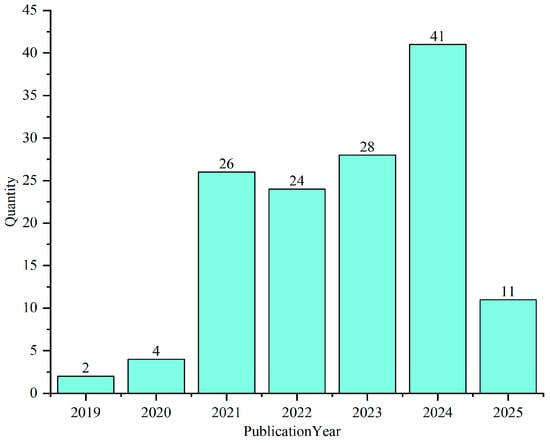
Figure 1.
Publication Distribution by Year.
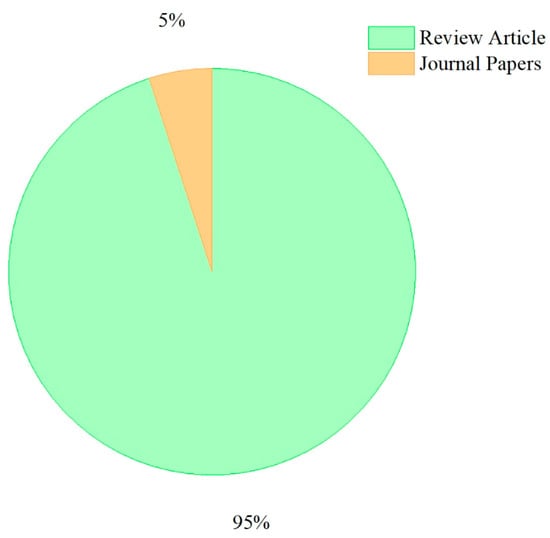
Figure 2.
Types of Publications.
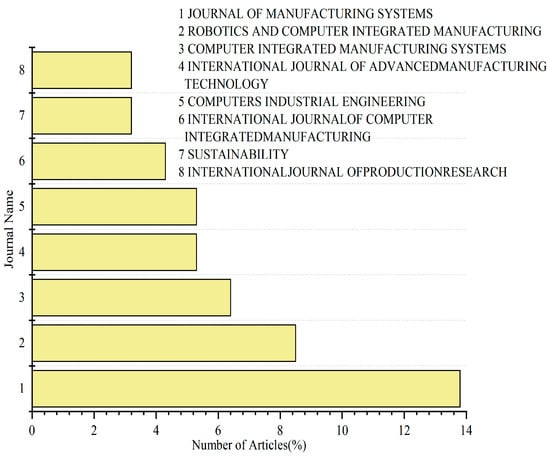
Figure 3.
Top Eight Periodical Publishers.
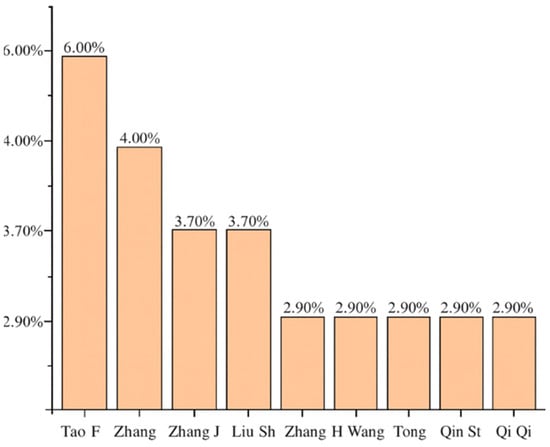
Figure 4.
Top Nine Authors of the Selected Publications.
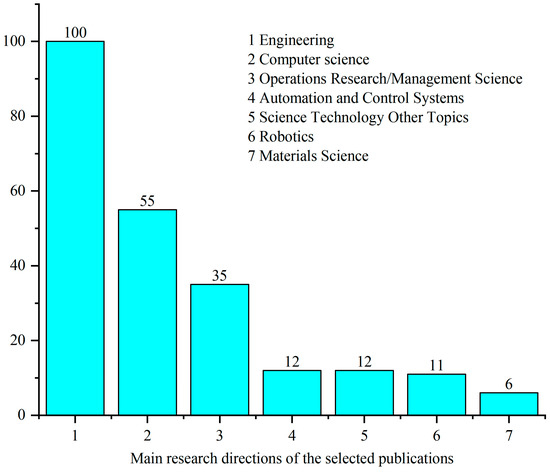
Figure 5.
Main Research Orientations of the Selected Publications.
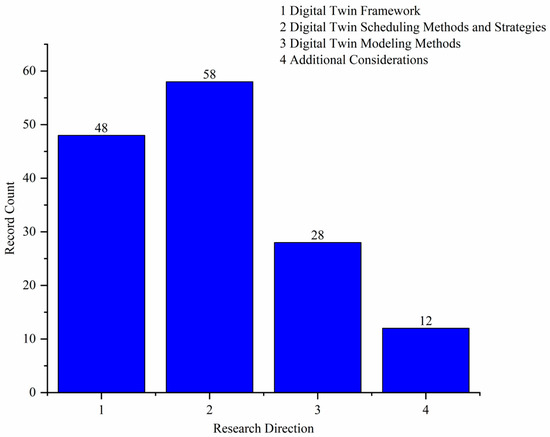
Figure 6.
Research Fields Involved by Top Seven Selected Publications.
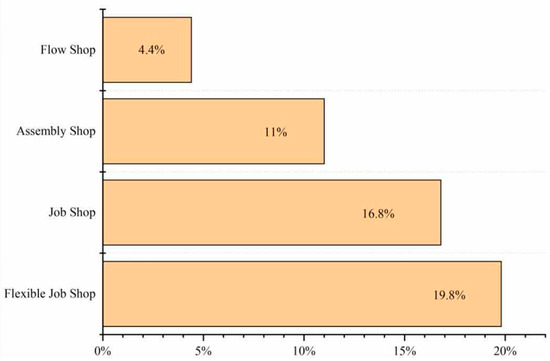
Figure 7.
Types of Workshops Primarily Researched in the Selected Publications.
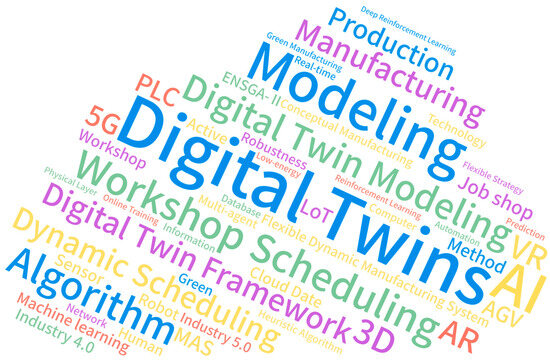
Figure 8.
Word Cloud Generated from Keywords of the Selected Publications.
5. Literature Review
In smart workshops, digital twins abstract multi-entity systems such as equipment, workstations, and logistics into computable and predictable digital replicas through the integration of mechanisms, data, and simulation. Based on this, decision spaces that are assessable, comparable, and optimizable are constructed within the twin, generating executable scheduling plans around objectives such as delivery time, production capacity, and cost, using mathematical analysis, simulation collaboration, and intelligent algorithms. To support the feasibility and controllability of the twin model and scheduling strategy, data must be systematically collected in real-time, arranged in a hierarchical architecture from the data layer to the model layer, then to the decision layer, followed by the execution layer, and finally to the feedback layer [34]. Among them, modeling methods provide credible scenarios and predictions, scheduling strategies search and evaluate on the twin model, and system technologies close the loop of data-model-execution. The system architecture specifies interfaces, governance, and evolution paths, thus achieving maintainable, auditable, and scalable closed-loop optimization.
The analysis presented in the section and the literature selected herein are primarily aimed at addressing the following research questions:
RQ1: What approaches in dynamic workshop scheduling (such as algorithms and application programs) can be categorized as a Digital Twin?
RQ2: What modeling methods for digital twins are employed for workshop dynamic scheduling?
RQ3: What digital twin-based scheduling strategies are employed for dynamic workshop scheduling?
5.1. Digital Twin-Based Methods in Dynamic Workshop Production Scheduling
Digital twins serve as a new technical measure for dynamic scheduling in workshops. Through real-time data collection, simulation, and optimized decision-making, digital twins effectively enhance production efficiency and scheduling flexibility. Technical measures referred to as “digital twins” in workshop dynamic scheduling mainly include the following categories: model-based scheduling algorithms, which utilize digital modeling to simulate and optimize decisions for equipment, systems, production lines, or supply chains, with the most commonly used method being discrete event simulation (DES), which optimizes scheduling by simulating the sequence of events in the system (such as tasks, resource allocation, and equipment state changes) [35]; adaptive optimization scheduling algorithms, which combine digital twin models with optimization algorithms, such as genetic algorithms, particle swarm optimization (PSO), and simulated annealing, to dynamically optimize scheduling based on production objectives (such as minimizing total time and maximizing resource utilization) [36]; and data-driven dynamic scheduling methods, which utilize real-time data from IoT devices, sensors, and ERP/MES to perceive production status and dynamically adjust scheduling strategies. Virtual simulation and decision support system (DSS) use virtual simulation to model different scheduling schemes and optimize scheduling decisions; predictive scheduling and maintenance combines digital twins with predictive maintenance to anticipate equipment failures or production bottlenecks in advance and perform scheduling adjustments to reduce the impact of unexpected events [37].
These methods and algorithms are closely integrated in the application of digital twins, enabling real-time monitoring of production status, optimizing scheduling strategies, and enhancing decision-making efficiency, thereby ensuring the efficient operation of intelligent workshops [38].
5.2. Exploratory Research on Digital Twin Modeling Methods for Dynamic Scheduling
A digital twin constructs a virtual model of physical entities through digital means, promoting the deep integration and interaction between the physical world and information world, serving as an important bridge for industrial information integration [39]. The model is the core of digital twin realization, which can be categorized based on different applications: product-level models targeting individual devices or components (such as aircraft engines) for design optimization, fault detection, and personalized customization; process-level models for manufacturing or business processes (like automobile production lines) to enhance production efficiency and quality management, as well as flexibly adjusting production efficiency, quality management, and production plans and resource allocation; and system-level models covering multiple interacting products or subsystems (such as wind power stations) for collaborative work, resource optimization, and risk assessment. From product-level to process-level and then to system-level, digital twin modeling continuously expands, driving production from a single product to multi-product collaboration, enhancing overall performance and efficiency [40]. Based on the surveyed literature, representative studies were extracted and synthesized to summarize and categorize method classes, principal characteristics, experimental data, baselines, and performance outcomes, as shown in Table 1. The analysis indicates that modeling approaches for digital-twin manufacturing workshops can be broadly classified into three categories: classical simulation/graph-theoretic modeling methods, distributed intelligent modeling methods, and data- and knowledge-driven modeling methods. Each category exhibits distinct advantages, limitations, and application contexts. The following sections provide a detailed summary of these three classes of methods, outlining their respective strengths and weaknesses and highlighting typical application scenarios.

Table 1.
Normalized Quantitative Evaluation of Modeling Approaches.
5.2.1. Classical Simulation and Graph Theory Modeling Methods
Research on modeling methods for digital twins has been continuously advancing across various manufacturing workshops, from semiconductor wafer workshops and aerospace assembly workshops to chemical fiber workshops, gene therapy cryogenic storage, and digitized intelligent factories [41]. Discrete event simulation (DES) and graph theory models are the most widely used classic foundational methods. DES formalizes discrete event-based modeling of systems, enabling the construction of virtual models of manufacturing systems and their connection to physical systems, thus achieving the simulation and optimization of production processes.
In the recent literature, Jiang Haifan et al. focus on complex discrete manufacturing workshops, proposing a digital twin modeling method based on DES theory and a virtual-physical interconnection mechanism to achieve the construction and application of digital twins throughout the lifecycle of manufacturing systems [42]. Wang, Yankai, and Wang Shilong, targeting hybrid flow digital workshops, proposed a green scheduling model that integrates a dynamic digital twin with Adaptive Multi-Objective Dynamic Harris Hawks Optimizer (AMODHHO), achieving dual optimization of total completion time and energy consumption [46]. In the application of graph theory models, Zhou Sujing proposed a big data-driven modeling approach that integrates digital twin with graph theoretic combinatorial optimization for discrete manufacturing workshops, constructing a real-time monitoring and scheduling system based on AP clustering and priority rules, addressing issues of data asynchrony, incompleteness, and scheduling uncertainty, significantly enhancing workshop flexibility and production efficiency [11]. Although graph theory models like discriminative graphs ensure rigorous understanding, their practicality may be insufficient as complexity increases and real-time requirements grow.
The core of this type of modeling lies in mathematical models and simulations, which deduce system behavior; its advantages include theoretical rigor, verifiability, and interpretability. DES supports the visualization, monitoring, and control of manufacturing systems, while graph theory models can formally verify complex structures to ensure correctness, making them easier to adopt in stable scenarios such as mass production and assembly lines. However, their limitations arise when systems are complex and require real-time responses, as the computational and modeling maintenance costs are high, and virtual-physical synchronization may lag; graph theory models lack flexibility under dynamic, uncertain events, making it difficult to meet real-time requirements. Such modeling methods are often used in large-scale discrete manufacturing, assembly lines, and large assembly lines where processes are relatively fixed and events are discrete; DES is commonly used as the main framework for scheduling and logistics simulation, combined with data analysis to assess bottlenecks and utilization; when processes and constraints are clear, graph theory models can also be used for combinatorial optimization of process paths and equipment layouts to enhance efficiency [52].
5.2.2. Distributed Intelligent Modeling Methods
To overcome the limitations of centralized models in complex dynamic environments, distributed and intelligent modeling approaches have emerged. These methods abstract machines, workpieces, and people in manufacturing systems as intelligent agents, achieving autonomous control and optimized scheduling of workshops through the collaboration and game theory of agents [53]. Latsou, Christina proposed a new method integrating digital twin with multi-agent CPS for low-temperature workshops in the cell and gene therapy industry, introducing “monitoring agents” to achieve micro-level anomaly detection and bottleneck identification, enhancing the utilization of human resources and decision-making capabilities in complex manufacturing systems [43]. In flexible job shop scenarios, the decentralized GMAS scheduling model utilizes multi-agent centralized learning and local execution to achieve real-time bottleneck detection and global performance improvement. Pu Yu, Fang Li et al. addressed modeling problems in flexible job shops for personalized manufacturing, proposing a centralized learning decentralized execution multi-agent scheduling method (GMAS) based on graph convolution network, constructing a directed acyclic graph probabilistic model and global action modeling to address the complexity and dynamics of Flexible Job Shop Scheduling (FJSP), achieving intelligent optimization of scheduling strategies [54].
Multi-agent modeling has the advantages of distributed autonomy and real-time responsiveness. Agents can perceive local states, make decisions in real-time, and collaborate to achieve global objectives, thus being able to timely detect and alleviate bottlenecks and adapt to dynamic changes in production, suitable for dynamic changes such as interleaving and system failures; for instance, “monitoring agents” can automatically detect anomalies and self-optimize human resource reallocation, while GMAS combines reinforcement learning to enable agents to autonomously learn scheduling strategies, making them more agile and robust in high-variability scenarios [55]. The trade-off is an increase in modeling and coordination complexity, with larger scales prone to instability and convergence issues; improper collaboration mechanisms can lead to process conflicts. Additionally, there is a strong reliance on data, with significant cold start as well as training costs, and safety and interpretability must also be considered in industrial real-time applications. Therefore, Multi-Agent Systems (MAS) are more suitable for flexible, customized manufacturing scenarios including complex workshops with heterogeneous coupling, such as flexible assembly lines, FJSP, and cell gene therapy; as well as scenarios requiring real-time bottleneck detection and autonomous correction in intelligent warehousing/AGV scheduling. When systems are highly dynamic and centralized control is inadequate, distributed intelligent agent modeling is particularly effective [56].
5.2.3. Data-Driven and Knowledge-Driven Modeling Methods
With the acceleration of workshop digitalization and data accumulation, machine learning (ML) and data-driven technologies are becoming mainstream solutions for digital twin modeling. These methods utilize big data and intelligent algorithms from the workshop to train models, predict performance, and optimize decisions, thereby partially replacing and enhancing mechanism-based models. Firstly, agent models represented by MARS can quickly approximate the workshop response surface using real-time data and provide lightweight decision support for scheduling [57]. Chua, Ping Chong, et al. proposed a proxy modeling method based on Multivariate Adaptive Regression Splines (MARS), integrating system load, equipment parameters, and product parameters to efficiently predict key production performance indicators and provide lightweight decision support for scheduling optimization [44]. Secondly, in relational structure learning, Graph Neural Networks (GNN) excel at capturing the complex relationships within manufacturing systems, representing equipment, tasks, etc., as graph nodes to predict bottlenecks [58]. Liu Tingyu, Hong Qing, and Sun Yifeng proposed a production action recognition method based on Attention Graph Convolutional Networks (GCN), utilizing topological graph structures to extract digital twin features, effectively supporting standardized process construction and digital twin model building [59]. Jwo, Jung-Sing addressed the challenges of complex manufacturing processes and virtual modeling in workshops by simplifying digital twin modeling with machine learning methods and designing Data Twin Service (DTS) and Cyber-Physical Factory (CPF), achieving collaborative integration of real and simulated data through physical and network operations [60]. Ladj, Asma integrated unsupervised learning and knowledge reasoning into digital shadows and digital twin models aimed at bottleneck identification to achieve micro-behavior-driven system modeling and intelligent decision optimization [61].
In the knowledge-driven direction, modeling utilizes structured semantics (such as knowledge graphs) to integrate heterogeneous data and support model interoperability and reconfigurability. Li, Xixing, Lei Wang, and Chuanjun constructed an ontology-based semantic modeling and indexing mechanism to achieve efficient matching and recommendation of production resources, enhancing the accuracy and timeliness of scheduling optimization in DTS [45]. Liu, Xiaojun, and Chongxin Wang proposed a structured data modeling and multi-level fusion framework, achieving deep integration of real-time production data and multi-dimensional digital twin models through a full-factor semantic mechanism, addressing the issue of insufficient multi-scale feature modeling [62]. Wang, Yunrui, and Yaodong Wang proposed a knowledge-driven XBOM reconstruction modeling method based on knowledge bases and the BiLSTM-CRF algorithm for maintenance scenarios of complex products like EMU bogies in digital twin workshops, effectively improving the efficiency and quality of multi-view bill of materials reconstruction [63]. Xie, Jiaxiang, and Haifan Jiang proposed an improved material node-oriented SevenElements (MNOSE) description model for discrete manufacturing workshops, enhancing the expressiveness of relationships between equipment and equipment-material, achieving efficient construction and rapid reconfiguration of workshop digital twins [47].
To simultaneously meet high fidelity and real-time synchronization [64], modeling methods such as point cloud + OPC UA + multi-source integration [48], multi-dimensional modeling methods combined with anomaly handling services [65], dynamic fidelity reconstruction [66], and assembly feature construction based on equipment grid models [49] have emerged. In high-precision, strongly constrained workshop modeling—for example, in semiconductor photolithography workshops—Machine Learning-Based Simulation Models (MLBSM) combine data vectorization and multi-output adaptive regressors with risk assessment to replace traditional simulation bottlenecks, achieving rapid prediction and scheduling support for high-risk operations [50]. Additionally, large language models (LLMs) automatically generate hierarchical object structures through intent parsing and domain knowledge extraction, shortening modeling cycles and enhancing the semantic expression and intelligence level of models.
Data-driven and knowledge-driven modeling centers around real-time data. The former learns input-output mappings from a large amount of historical data through proxy models, predicting complex workshop behaviors in milliseconds and presenting them with far lower computational costs than fine simulations; machine learning excels at mining high-dimensional non-linear patterns, and graph learning models like GNN can eliminate information silos. The latter ensures semantic consistency and reconfigurability through ontologies and knowledge graphs, spanning design, processes, and operations while enhancing decision reusability and interpretability [67]. However, challenges are also prominent: data-driven approaches depend on data quality and coverage, easily leading to underfitting due to insufficient historical data; the cost of deploying computational power raises the threshold for implementation; on the knowledge side, there are human resource costs and update lags in constructing and maintaining ontologies and knowledge bases; at the same time, there are weaknesses in generalization ability, the need for online adaptation, and security risks such as data poisoning, so caution should be exercised in data-scarce and security-sensitive scenarios [68]. Particular benefits can be achieved in the context of highly digitalized factories and data-intensive decision-making; for instance, in semiconductor manufacturing, machine learning replaces part of the simulation to achieve rapid prediction and scheduling of high-risk processes, customized production supports rolling plans with real-time proxies to reduce delay rates, and complex assembly and maintenance workshops leverage knowledge graphs to integrate cross-link information to support collaborative decision-making, while three-dimensional visual monitoring integrates point clouds, sensors, and OPC UA to achieve high-fidelity virtual-real synchronization [51]. Overall, when data is abundant and rapid iteration is needed, data-driven approaches are prioritized to gain real-time and intelligent dividends; when systems are heterogeneous and cross-domain complexity arises, knowledge-driven approaches are introduced to bridge semantics and hierarchies, constructing a scalable and reconfigurable digital twin system.
5.3. Strategies and Methods Implemented Based on Workshop Scheduling in Digital Twin Models
Section 2.2 outlines three strategies for production scheduling: real-time, robustness, and proactive-reactive scheduling. In the field of intelligent scheduling workshops oriented towards digital twins, intelligent scheduling methods have been validated and applied in various types of digital twin manufacturing workshops. Flexible job shops need to cope with flexible scheduling across multiple processes and devices, assembly workshops emphasize process coordination and timely response, semiconductor workshops involve reentrant processes and AGV logistics scheduling, while wood furniture workshops require efficiency in customized production [69]. In response to the uncertainties arising in workshop scheduling, research focus has expanded from static scheduling to dynamic rescheduling, robust optimization, and production maintenance collaboration, and production maintenance collaboration. Researchers have deeply integrated digital twins with real-time feedback, event-driven rolling rescheduling, logistics path planning, and predictive maintenance, constructing robust optimization frameworks to collaboratively schedule processing equipment, AGVs, and maintenance resources, significantly enhancing the adaptability and overall reliability of workshop production systems to random disturbances [70]. Based on the literature search, representative studies were selected and systematically synthesized across the dimensions of method category, key characteristics, experimental datasets, comparative baselines, and performance metrics; the findings are presented in Table 2. Building on this synthesis—and focusing on strategies and methods for digital-twin-driven shop-floor scheduling—we further distill five categories of technical strategies and propose two deep-integration pathways.
Table 2.
Normalized Quantitative Evaluation of Scheduling Algorithms.
5.3.1. Five Technical Strategies for Digital Twin-Driven Workshop Scheduling
In the strategy of deepening the combination of classical algorithms, mature classical optimization algorithms (such as Particle Swarm Optimization (PSO), Genetic Algorithms (GA), etc.) are deeply integrated with digital twin technology, driving algorithmic iteration through real-time simulation and feedback from DT, thereby improving scheduling efficiency and adaptability to dynamic changes. Weng et al. deeply coupled DT with competitive PSO and introduced a twin network for perception of production disturbances, achieving rapid convergence and strong anti-interference capability [85]. Javaid et al. constructed a simulation-optimization model (SBOM) based on Simio, integrating digital twin real-time data with hybrid PSO to compensate for the shortcomings of traditional PPS in uncertainty and system integration [86]. Chen et al. embedded hybrid PSO (H-PSO) into DT to solve fuzzy multi-objective scheduling, maintaining population diversity through learning factor adaptation and fuzzy membership-driven crowding distance, suppressing premature convergence [87]. Liu et al. constructed a workshop digital twin and event-driven rolling window rescheduling mechanism for island layout flexible assembly workshops, achieving dynamic optimization in conjunction with GA [88]. Gao et al. nested improved NSGA-II and integer programming within the joint simulation framework, DT-Simio, hierarchically solving rescheduling trigger thresholds and dual-objective trade-offs [71]. Zhou et al. proposed a two-stage GA decentralized scheduling for multi-agent discrete manufacturing, expanding the search space through agent crossover and block insertion, and generating high social welfare consensus schedules through non-dominating sorting and grey relational analysis, enhancing efficiency in large-scale multi-agent scenarios [89]. Within the strategies of integration and expansion of swarm intelligence and bionic algorithms, the in-depth coupling of bionic swarm intelligence with digital twins opens new pathways for enhancing optimization performance. Huang et al. mapped the “leader-cooperation-wandering” phase of LOA to three layers of search subspaces for process selection, equipment allocation, and fault recovery, dynamically adjusting the wandering radius based on the equipment health returned by the digital twin [72]. Huo et al. introduced attraction-repulsion potential field functions in the bacterial foraging algorithm (IBFOA), achieving adaptive trade-offs between machine load and completion time [90].
In the optimization scheduling strategy of bionic swarm intelligence in digital twins, relying on the characteristics of bionic algorithms with few parameters and easy parallelization, online evolution in the real-time simulation evaluation closed loop of digital twins significantly accelerates algorithm convergence, while integrating real-time data feedback and the advantages of algorithm heterogeneity, effectively providing a more efficient and robust solution for complex workshop scheduling problems. Liu, A. Y. proposed a multi-agent scheduling method that integrates attention mechanisms, constructing an optimized simulation model considering factors such as failure rates, route selection, and layout, enhancing the efficiency and robustness of scheduling in complex systems under intelligent manufacturing environments [91].
In terms of scheduling approaches integrating machine learning and digital twins, Zhang abstracts parallel production lines as “production communities”, constructs a digital twin community model, and dynamically balances loads using hierarchical reinforcement learning, verifying its high adaptability to demand fluctuations and line adjustments [73]; Wang proposes an end-to-end solution DRL plus DT solution for multi-product multi-stage batch processing plants, allowing for quick reordering under events such as equipment failures and maintenance insertions without extensive retraining, demonstrating robustness and efficiency superior to traditional algorithms [74]; Xia introduces data-driven digital twin, mapping manufacturing units to a virtual environment for pre-training before validating DRL, and then deploying to achieve autonomous and robust control [75]; Yuan builds an event-driven DT environment, transforming FJSP into MDP, proposing a multi-agent double DQN where job agents and machine agents collaborate, balancing real-time performance and robustness, suitable for large-scale scenarios [76]; Serrano-Ruiz implements flexible autonomous scheduling in a real workshop DT using PPO combined with multi-feature observation and multi-objective rewards [92]; Park first introduces RL for reentrant job workshops before constructing DT to improve control and learning effects [93]. He Junjie and Zhang Jie achieve fully reactive global optimization for dynamically arriving orders using MA-RPPO + LSTM [77]. Fang integrates distributed RL into DT, triggering feedback based on real-time perception of disturbance deviations, automatically correcting and self-learning for optimization [78]. Heik quickly balances energy consumption, project duration, and resource utilization on an IIoT testing platform using PPO [94]. Gu designs a two-stage adaptive dynamic scheduling strategy with PPO and achieves good results [95]. Overall, DRL plus DT, through event-driven and hierarchical systems combined with high-frequency closed-loop evaluations of DT, enables rapid re-tuning in highly uncertain environments, cross-objective trade-offs, and deployable real-time decision-making.
In the research on hybrid improved strategy optimization, Gan, XueMei proposed an adaptive scheduling method called Explicit Exploration and Asynchronous Update Proximal Policy Optimization Algorithm (E2APPO), achieving self-regulation and self-learning under dynamic interaction between virtual and physical workshops [96]; Li, Yuxin and Xinyu Li proposed a dynamic reconfigurable workshop scheduling method based on multi-agent deep reinforcement learning, effectively optimizing tardiness costs and enhancing the scheduling robustness and intelligence of complex workshops in dynamic environments [97]. Lv Lingling proposed a type-aware multi-agent deep reinforcement learning (MADRL) method, addressing the frequent machine failures in flexible job shop environments, realizing real-time schedule recovery through heterogeneous graph modeling and meta-path-type-aware mechanisms [98]. Hu Liang and Liu Zhenyu adopted the method of the deep Q network (DQN) to handle scenarios with shared resources, flexible paths, and random arrivals, approximating the state-action value function with a GCN-based Petri-net Convolution (PNC) layer, leveraging input/output matrix propagation features and parameter reduction for stability, outperforming traditional algorithms [99].
Classic algorithms are deepened and combined based on instant evaluation, featuring low cost, controllable parameters and processes, and fast convergence, making them suitable for scenarios with clear rules, moderate dynamics, and few insertions. However, they are parameter-sensitive, prone to premature convergence, and heavily reliant on high-precision digital twins (DT), facing global and response insufficiencies in highly dynamic situations. Bionic swarm intelligence enables parallel exploration and online adaptation, capable of handling frequent insertions and vast solution spaces, but essentially optimizes heuristic algorithms, lacking global optimality and relying on high-fidelity low-latency DT. Swarm intelligence optimization achieves rapid trial-and-error and multi-objective collaboration through high-frequency feedback from DT, being more robust to disturbances, but requires complex reward mechanisms and stability governance, with high demands on DT concurrency and real-time performance, and still lacks optimal guarantees [100]. Reinforcement Learning (RL) combined with DT models scheduling as a Markov Decision Process (MDP), enabling millisecond-level decision-making, handling high-dimensional non-linear and multi-objective (reward shaping), significantly reducing reliance on expert rules, but incurs high training/simulation costs, weak interpretability, and generalization, and faces challenges in interdisciplinary modeling. DT combined with hybrid improved algorithms achieves global-to-local coupling, such as EGA→PSO, embedding integer programming in swarm intelligence and improving NSGA-II for more robust multi-objective trade-offs, customizable for dynamic reconfigurable and frequently failing scenarios, but with complex integration, heavy parameter tuning, high computational overhead, and high team capability requirements [101]. In practical applications, stable process lines and processing workshops prioritize the application of DT and classic or swarm intelligence; in highly dynamic and uncertain scenarios (such as semiconductors and custom assembly), RL combined with DT or multi-agent swarm intelligence is preferred; extreme performance or system-level collaboration is best achieved through hybrid improved strategies, with DT leading simulation verification and gradual implementation to control risks.
5.3.2. Two Deep Integration Paths for Digital Twin-Driven Workshop Scheduling
In the research on the cloud-edge-end collaborative integration path, Xu Li-Zhang proposed a dynamic scheduling method for digital twin job workshops (DTJ) based on edge computing to address the shortcomings of traditional scheduling models in real-time interaction between information and physical spaces. A DT architecture is constructed at the management execution layer, building a scheduling model through data mining, integrating data collection and multi-scheduling knowledge to achieve dynamic scheduling optimization and remote monitoring and management of the manufacturing process [79]. Li Juan and Tian Xianghong proposed a dynamic data scheduling method that integrates digital twin and a cloud genetic algorithm (CGA) to address the premature convergence and yield decline issues in flexible industrial workshop scheduling, achieving efficient collaborative scheduling and stable output among multiple production lines through the construction of a comprehensive information integration model and the introduction of a chaotic particle swarm optimization algorithm [102]. Wang Jin and Liu Yang proposed a real-time digital twin flexible job shop scheduling method (R-DTFJSS) based on edge computing to address the limitations of traditional dynamic scheduling methods (TDSM) in coping with frequent abnormal disturbances. By achieving real-time interaction between the physical and virtual workshops, efficient job allocation is realized, and an improved Hungarian algorithm is introduced to optimize scheduling results, enhancing accuracy and robustness [103]. Liu Zhifeng constructed a hyper-network model of feature-process-machine through the integration of digital twin and hyper-network technology, achieving the association and clustering of multi-source data, making intelligent scheduling more efficient [104]. Ma Yumin and Li Luyao integrated the data of physical workshops and digital workshops, combined them with the sample expansion mechanism of the generative adversarial network and the multi-layer forward neural network to perform high-quality training of the scheduling model, and effectively enhanced the scheduling efficiency and precision [80]. Yue Pengjun proposed a scheduling mechanism disturbance evaluation method based on DT technology to address the continuous rescheduling issues caused by frequent disturbances. By evaluating the disturbance impact degree through causal factor graphs (CFC) and convolutional neural networks (CNN), combined with the full-process data and model support offered by DT, targeted scheduling response strategies are formulated [81].
In the integrated technological fusion path for multi-task multi-objective optimization, relying on explicit exploration entropy, parallel evolution pruning, and online transfer learning, combined with graph theory models, hyper-network structures, and data augmentation, collaborative optimization of production scheduling, logistics path planning, and equipment maintenance is achieved [105]. Serrano-Ruiz Julio C. proposed a job shop intelligent manufacturing scheduling method (JSSMS) based on the Markov decision process (MDP) and deep reinforcement learning (DRL), effectively enhancing the flexibility and autonomy of the scheduling system in complex and uncertain environments by constructing a digital twin model, designing a multi-feature observation space and multi-objective reward mechanism, and optimizing scheduling strategies with the PPO algorithm [92]. Yan Qi and Wang Hongfeng proposed a dynamic scheduling method that integrates Digital Twin (DT) and double-layer Q-learning (DLQL) to address uncertainties in the production process, using DT for real-time monitoring of virtual-physical differences and triggering rescheduling, while DLQL synchronously learns job and equipment-related decision-making strategies, thus improving the efficiency of scheduling responses [106]. Liu Zhifeng integrated digital twin and super-network technology to construct a feature-process-machine tool super-network technology to realize efficient association and clustering of multi-source heterogeneous data [107]. Yan Jun and Liu Zhifeng proposed an enhanced genetic algorithm that introduces redundant three-layer encoding and correction decoding mechanisms to address the often-overlooked transportation constraints in flexible job shop scheduling problems (FJSP), effectively enhancing the feasibility of scheduling results and the docking capability with digital twin (DT) systems [108]. Meanwhile, the multi-algorithm coupling strategy also demonstrates outstanding performance. For instance, Chen ZM, et al. applied an enhanced genetic algorithm (EGA) and particle swarm optimization (PSO) in series, obtained a near-optimal solution through the rapid convergence of EGA, and then conducted local and fine retrieval based on PSO, which significantly shortened the maximum completion time in flexible workshops [82]. For green manufacturing goals, most studies have expanded on traditional multi-objective evolutionary algorithms, focusing on optimizing control of factors such as carbon emission and energy consumption [83]. For example, by integrating reliability maintenance duration (RMD) and reliability processing coefficients (RPC) into workshop monitoring systems, a multi-objective scheduling model reflecting dynamic equipment reliability is constructed [109]. Wu Jiawei expanded the flexible manufacturing scheduling model, proposing a multi-objective dynamic partial reentrant mixed flow green workshop scheduling problem (MDPR-HFSP), and introduced a multi-agent proximal policy optimization algorithm (MMAPPO) to achieve dynamic resource and job scheduling through routing agents and sorting agents, integrating multiple scheduling rules and the Wasserstein distance restriction mechanism to enhance the stability of policy optimization and multi-objective adaptability [110]. Li Zhi proposed a flexible job shop scheduling strategy that integrates workers’ multi-memory behaviors (learning and forgetting) and digital twin technology, optimizing manufacturing span, carbon emissions, costs, and quality in dynamic situations such as machine failures, achieving green and efficient scheduling [111]. Zhou Zhuo and Xu Liyun proposed a scheduling strategy based on digital twin to address issues such as information opacity, response lag, and insufficient optimization capabilities in traditional scheduling, relying on a cloud-edge collaborative architecture to comprehensively optimize energy consumption, completion time, and delay metrics, and improving NSGA-II through multi-mode crossover and variable ratio elite retention mechanisms, validating the effectiveness and practicality of the method in standard datasets and actual workshop environments [84].
In the cloud-edge-end collaborative path, the cloud is responsible for global optimization and deep learning training, thus processing massive data, while the edge is close to the site and achieves millisecond-level control with low-latency autonomy. DT runs through the cloud and edge to ensure virtual-physical synchronization and closed-loop decision-making, thus combining high scalability with rapid response. The main challenges in this context include the high demands for network and computing infrastructure, latency, data consistency governance, and security protection. Applicable scenarios include smart factories with multiple production lines and equipment density requiring real-time optimization, achieving adaptive operation through “cloud computing and edge control”. The complementary multi-task multi-objective integrated path interacts within the same DT framework to link production, logistics, maintenance, energy/carbon emissions, and quality, achieving cross-functional consistency and real constraint integration; its difficulties arise from the solving and modeling challenges posed by problem scale and coupling complexity, as well as engineering implementation costs. This path is suitable for complex manufacturing (such as aerospace and lighthouse factories) that pursues system-level optimality and sustainability, achieving global trade-offs under multiple KPIs (efficiency, energy, delays, quality). Overall, the former addresses the issue of concentrated computing power combined with edge-side execution in seconds, while the latter resolves the problem of “multi-objective multi-link collaboration” [112]. In the actual production process, each algorithm has its unique advantages and applicable scenarios, and the most suitable algorithm should be chosen according to actual needs and system complexity.
6. Technology Adopted and Application Framework
This section reports on the selected literature primarily to address the following research questions:
RQ4: What system technologies based on digital twins are employed for dynamic workshop scheduling in workshops?
RQ5: What content is studied in research on the architecture of digital twin technology in intelligent plants?
6.1. What System Techniques Are Applied to Digital Twin?
In the digital twin system of a workshop, manufacturing perception technology is responsible for the real-time collection, transmission, and analysis of information such as manufacturing processes, equipment status, and environmental conditions in the physical world [113]. Sensor technology is the core of manufacturing perception, including environmental sensors, position and motion sensors, equipment status sensors, and image and video sensors. Through manufacturing perception technology, the digital twin system can perceive changes in the physical world in real-time [114]. IoT technology serves as a bridge for real-time data transmission, connecting sensors, devices, production systems, and information platforms to the network for intelligent data collection and transmission. Through IoT technology, operational data from factory equipment can be transmitted in real-time to the digital twin model, ensuring dynamic optimization of production scheduling [115]. Artificial intelligence (AI) technology and machine learning (ML) technology possess strong adaptive capabilities, allowing them to learn from historical data and optimize production scheduling, reducing manual intervention. AI can predict while analyzing potential production issues, assisting in scheduling decisions and enabling dynamic adjustment to optimize production efficiency [116]. Edge computing technology brings data processing capabilities closer to the device side, reducing cloud computing latency to improve response speed. Cloud computing and big data analysis technologies have powerful computing and storage capabilities, allowing for the simultaneous processing of massive amounts of data, enabling large-scale production optimization. For instance, the cloud can integrate digital twin models from multiple factories for global production scheduling and analysis. Virtual reality (VR) and augmented reality (AR) technologies provide intuitive visualization capabilities, helping managers and operators to view the production line status in real-time [117]. Programmable Logic Controllers (PLC) and Supervisory Control and Data Acquisition (SCADA) systems achieve automated management and scheduling of production line equipment [118]. Wireless communication technology ensures smooth data transmission, especially with 5G technology which, due to its high bandwidth and low latency characteristics, can support efficient data synchronization of large-scale devices and sensors, thus improving the flexibility and precision of production scheduling [119].
6.2. Digital Twin Technology Architecture
The core architecture of digital twin technology in smart factories connects physical devices with virtual models, collecting and processing data in real-time through sensor technology to construct virtual factory models and simulate production processes, equipment behavior, and data flows [120]. This architecture integrates multiple technology modules (such as IoT, cloud computing, big data, AI, automatic control, etc.) for unified management systems, thereby possessing cross-system and cross-platform data integration capabilities, providing intelligent decision support for production scheduling in digital twin workshops [121].
6.2.1. Research and Application Methods of Digital Twin Technology Architecture
Summarizing the recent research and literature, this paper categorizes digital twin architectures into two main types: the digital twin-driven dynamic scheduling workshop optimization framework and the digital twin-integrated intelligent manufacturing ecosystem framework.
In the digital twin-driven dynamic scheduling workshop optimization framework, this type of architecture focuses on achieving real-time scheduling optimization and operational collaboration in complex workshop environments. Liu Weiran, Zou Xiaofu et al. have constructed a DTPLSS framework for multi-level production logistics synchronization satellite large-scale assembly workshops using digital twins, integrating resource workstation workshop-level twin bodies with distributed control strategies to realize real-time coupling of assembly rhythm and material delivery, as well as disturbance self-adaptation [122]. For aircraft overhaul workshops, Liu Mengnan, et al. have integrated real-time work hour data with improved KDE methods to dynamically evaluate workshop capacity, providing a decision framework for maintenance planning and resource allocation [123]. At the scheduling level, Villalonga Alberto, et al. proposed a distributed decision framework that integrates local and global digital twins combined with fuzzy reasoning, in order to perceive and optimize equipment status and system capacity in response to the challenges of dynamic scheduling in cyber-physical production systems [124]. Pan, Jianguo proposed a digital twin-based hanging workshop management framework, combining graph neural networks and deep reinforcement learning (PPO) to effectively enhance scheduling decision-making capabilities and workshop operational performance [113]. Gu Wenbin and Duan Lianshui proposed a three-layer real-time scheduling framework based on digital twins combined with deep reinforcement learning (PPO) to realize adaptive dynamic scheduling optimization in mixed-flow workshops, enhancing decision autonomy [125]. Li, Yibing developed an anomaly detection and dynamic scheduling framework based on digital twins, integrating multi-level monitoring models and improved gray wolf optimization algorithms to achieve real-time optimization and deviation correction of scheduling plans [126]. Pandhare and others incorporated predictive health management (PHM) into twin scheduling, optimizing plans with genetic algorithms to maintain robust production rhythms even in equipment degradation scenarios [127]. The digital twin-driven dynamic scheduling workshop optimization framework is suitable for highly complex, frequently changing tasks and variable processes that need to respond in real-time to unexpected events in discrete manufacturing and assembly workshops, such as satellite batch assembly lines, aircraft overhaul workshops, or high-end equipment manufacturing production lines. Meanwhile, the implementation of this method is also challenging, requiring a complete perception network and high-precision digital model support, with algorithms such as multi-agent or deep reinforcement learning increasing system complexity and demanding high data quality and computing power [128]. In other words, deploying such frameworks in small factories with many customized devices and low data standardization may face integration difficulties; however, in complex workshops requiring flexible scheduling, real-time capacity assessment, and logistics synchronization, it can significantly enhance resource utilization and production resilience [129].
The digital twin-integrated intelligent manufacturing ecosystem framework aims to construct a unified digital twin ecosystem across processes and systems to achieve global optimization and lifecycle management, focusing on building a unified digital twin ecosystem [115]. Nie, Qingwei, and Dunbing Tang deployed a multi-agent cloud-edge collaborative digital twin framework at the virtual layer, allowing resource agents to coordinate in the cloud and respond quickly at the edge, achieving distributed production control [130]. Guo, Daqiang proposed the GiMS framework based on IIoT and digital twins, achieving synchronization of manufacturing and logistics at the information, decision, and execution levels through mixed-integer programming, effectively enhancing workshop operational coordination and decision-making efficiency [131]. In intelligent manufacturing workshops, targeting general intelligent manufacturing workshops across processes and lifecycles, Sun, Mengke proposed the digital twin intelligent manufacturing system (DT-IMS) framework based on multi-layer information system integration, constructing high-fidelity multi-dimensional twin models to achieve real-time collaboration of Intelligent Workshop processes, planning, and scheduling, effectively enhancing management efficiency and reducing workshop complexity, achieving a digitized closed loop of all elements including people, machines, materials, approaches, and environments [132]. Xia Luyao proposed the concept of a digital twin manufacturing ecosystem (DTME), establishing a cross-domain, multi-model intelligent factory DTS architecture, and validating its intelligent improvements in inventory reduction and delivery acceleration in hydraulic cylinder workshops [133]. At the same time, some reference models, such as the HexaSFDT six-dimensional workshop twin model and the hierarchical SDT model, provide standardized methods for constructing workshop twin frameworks from dimensional and hierarchical perspectives, emphasizing key elements such as information model standardization, high-performance data processing, and system interoperability [34]. Such system frameworks are suitable for large intelligent manufacturing enterprises or scenarios requiring cross-departmental collaboration, such as those needing to connect data across design, production, and operation phases or implement collaborative manufacturing across multiple factories and business units. In these environments [134], the digital twin ecosystem can serve as a key enabler, providing comprehensive perception and predictive analysis to ensure consistency in planning and execution under uncertain disturbances. Its disadvantages include complex implementation and high investment, requiring a complete industrial IoT and IT architecture support, the need to connect data standards from different source systems, and considerations for network security and data privacy issues [135]. Additionally, establishing high-precision all-element twin models is itself time-consuming and challenging, making it difficult for small- and medium-sized enterprises with weak information foundations to reap immediate benefits. However, overall, in smart factory scenarios pursuing global optimization and lifecycle digitization, such digital twin architectures can significantly enhance decision-making efficiency, resource allocation optimization levels, and rapid response capabilities to environmental changes [136].
6.2.2. Ideal Framework for Digital Twin Workshop Scheduling Based on Reinforcement Learning
Building upon prior research and incorporating the experimentally validated integration of dynamic scheduling and multi-agent reinforcement learning reported in “Multi-agent reinforcement learning based textile dyeing workshop dynamic scheduling method [77],” this paper proposes and develops a reinforcement-learning-based digital-twin shop-floor scheduling framework, as illustrated in Figure 9, which systematically displays its structure and functional relationships [137]. This digital twin ideal framework is an intelligent manufacturing architecture that integrates digital twin technology with reinforcement learning algorithms, presenting a dynamic collaboration mechanism from production instruction input to physical execution feedback and then to policy optimization in a closed loop [138]. The system first receives production orders, objective restrictions, and task resource allocation information from the manufacturing execution system (MES) or advanced planning and scheduling system (APS). The underlying physical layer is equipped with various industrial devices and sensors (such as PLCs, RFID, industrial cameras, visual recognition, and environmental monitoring sensors), achieving real-time data collection and feedback from the production site through communication modes, including 5G, Wi-Fi, Bluetooth, and industrial buses, covering multi-dimensional information such as equipment status, workpiece location, energy consumption information, and operator behavior [139]. The collected data undergoes preliminary pre-processing (data cleaning, noise reduction, format conversion, etc.) before being transmitted to the virtual-physical interaction layer, where the overall simulation and optimization module, based on the virtual factory, conducts manufacturing system modeling, production simulation, and scheduling optimization calculations [130]; meanwhile, the visualization module constructs a digital workshop view through 3D modeling and real-time rendering technology, achieving visual display of equipment operation, material circulation, and task execution processes, assisting decision-making and management intervention [140]. The core of the system is the digital twin and reinforcement learning integration layer. This layer constructs a multi-agent digital twin environment simulator, where multiple agents (such as scheduling agents, path planning agents, resource allocation agents, etc.) perceive, interact, and select strategies based on the current system state [141]. The system employs deep reinforcement learning algorithms for training and iterative updates of scheduling strategies and resource optimization strategies to maximize production efficiency, resource utilization, and response robustness [142]. During training, the system corrects the reward function and optimizes strategies based on actual feedback while continuously updating the precision of the twin model, achieving “perception, decision-making, execution, and feedback” closed-loop control [143]. Finally, the scheduling strategies generated by reinforcement learning are dispatched to the physical execution layer through the virtual-physical interaction layer, where controllers and devices complete manufacturing tasks, and the execution results are used as feedback for further training of the model and updating of the system state [144]. The system integrates multiple key techniques, including Industrial Internet of Things (IIoT), Edge Computing, 3D visualization, Digital Twin modeling, deep reinforcement learning, multi-agent collaboration, and adaptive strategy optimization, effectively addressing the challenges of task complexity, resource variability, and environmental uncertainty in discrete manufacturing processes, contributing to the development of an efficient, intelligent, and flexible dynamic manufacturing system [145].
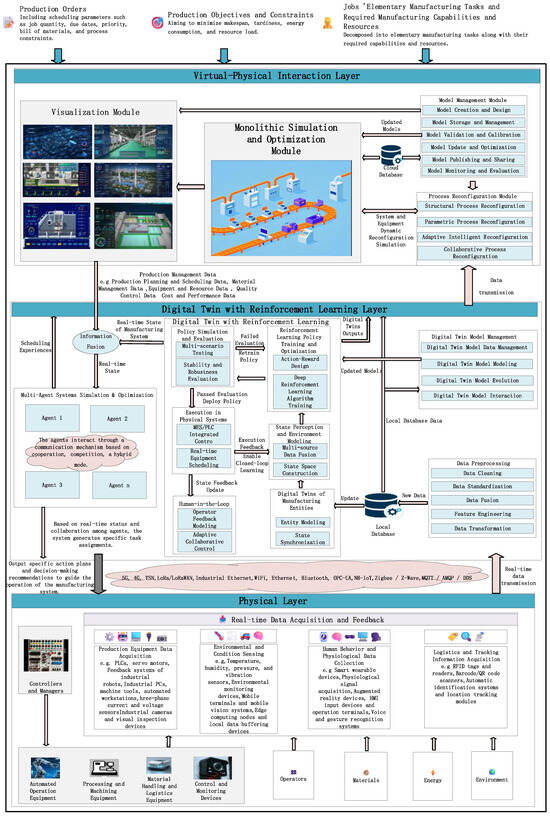
Figure 9.
The Intelligent Manufacturing Architecture Integrating Digital Twin Technology and A Reinforcement Learning Algorithm.
7. Discussion
This section reports on the selected literature primarily to address the following research questions:
RQ6: What are the requirements for applying digital twins in dynamic intelligent workshop scheduling, and what are their future developmental trends?
7.1. The Role of Humans in the Digital Twin System
Humans play a crucial role in digital twin systems. Although digital twins possess high levels of automation and data-driven decision-making capabilities, human involvement is indispensable [146].
In the production process, human decision-making and planning involve decision-makers utilizing digital twin systems to obtain data and analyze results, thereby formulating long-term strategies [147]; for instance, predicting market development trends, optimizing resource allocation, and adjusting business objectives through digital twin models. In production planning and scheduling, humans manage production plans and adjust production line configurations through the digital twin interface to respond to unexpected situations or changes in demand [148]. Meanwhile, with the predictive maintenance capabilities of digital twins, personnel can recognize potential faults in advance and utilize real-time data for remote diagnostics and repairs [149]. Remote experts can also assist on-site operators in diagnosing and repairing complex equipment through augmented reality (AR) or virtual reality (VR) features of the digital twin platform. In production monitoring, humans interact in real-time through graphical interfaces, touch screens, and AR glasses to monitor production processes, view alerts, and data streams, ensuring stability in the production process. In quality control, personnel can analyze data streams using the digital twin system to identify process defects and propose optimization suggestions, thereby enhancing production quality [150]. Furthermore, the integrated platform of the digital twin system promotes cross-department collaboration, enabling data and information sharing, and facilitating coordinated work among production, maintenance, research and development, and supply chain departments [151]. In terms of engineering ethics, humans can ensure that factory operations comply with safety, environmental, and labor regulations through the digital twin platform and utilize simulations to ensure operational compliance. As digital twin systems become increasingly intelligent and automated, balancing technical development with ethical issues (such as privacy protection and accountability in artificial intelligence) will become an important task. In production safety, personnel also assume the role of risk management [152].
In digital twin systems, humans are not only operators and supervisors but also the “decision-makers” and “feedback providers” of the system [153]. Human intuition, judgment, and creativity are vital for the smooth operation of digital twin systems [154]. By collaborating with the digital twin platform, personnel can achieve refined management, optimize production processes, and improve work efficiency while ensuring safety and ethical compliance, thus enabling rapid responses to changes in complex and dynamic production environments [155].
7.2. Prospect of Future Development
The role of digital twins in the dynamic scheduling of smart factories is gradually shifting from a “simulation tool” to a “decision-making hub”. The modeling of manufacturing workshops is accelerating towards hybridization and intelligence, deeply coupling with specific workshop forms and problem scenarios. In the future, flexible assembly lines and operational workshops will be more suitable for multi-agent systems (MAS) and reinforcement learning; for knowledge-intensive tasks, data-driven strategies such as semantic models, GNN, and ML will help break down information silos and achieve cross-domain integration [156]; large-scale discrete manufacturing will still primarily rely on discrete event simulation (DES) supplemented by data analysis [157]. In scenarios with high system heterogeneity and modeling complexity, new methods such as dynamic fidelity reconstruction, low-carbon footprint assessment, green scheduling optimization [158], multi-scale micro-assembly modeling [159], mixed reality visualization scheduling [143], multi-layer aggregation models trained with truncated normal distribution [160], visual-ultrasound-3D collaborative twins [161], heterogeneous AAS three-dimensional fusion [162], and edge-fog-cloud three-tier twins [163] will significantly enhance the real-time performance and interpretability of models, promoting the transition of manufacturing modeling from isolated, static simulation to an integrated, intelligent, and highly adaptive digital twin system [164].
In terms of strategy and method selection, future emphasis should be placed on the matching of “scenarios and methods”. In scheduling with stable processes and clear constraints, classical optimization or heuristic algorithms should be prioritized for offline and rolling production scheduling to obtain optimal solutions; whereas, in highly dynamic scenarios, strategies with adaptive and online rescheduling capabilities should be adopted due to the ineffectiveness of static plans [60]. When traditional rules and deterministic algorithms struggle to address issues such as random arrivals and equipment failures, it is advisable to introduce swarm intelligence optimization and MAS to achieve decentralized collaboration and rapid response, combined with deep reinforcement learning (DRL) to enhance robustness and flexibility. In terms of integration paths, the combination of digital twins (DT) and DRL will significantly enhance the dynamic optimization capabilities of flexible workshops through virtual workshop training and real-time decision-making in actual factories, in conjunction with GNN/PPO; the combination of DT and MAS will rely on twins to conduct global assessments and visual interventions to improve yield and identify and alleviate bottlenecks early [151].
At the technical and architectural levels of DT systems, “cloud-edge-end” collaboration is leading the future direction, with the front end connecting through industrial IoT sensors/PLCs and IIoT gateways, combined with high-precision timing and streaming acquisition using OPC UA/Modbus and PTP/TSN, establishing a continuous, reliable, and traceable data foundation to support millisecond-level scheduling [165]; the cloud side aggregates data from multiple workshops and factories for global optimization and resource orchestration, with microservices + containerization + event bus achieving low-latency, scalable computing scheduling; under the support of 5G/industrial wireless, high concurrency and low-latency data backhaul and remote operation and maintenance are realized, supporting real-time collaboration across production lines and factories; simultaneously, in human–computer interaction, AR is used for on-the-job decision-making and visual guidance, while VR is used for panoramic simulation, production scheduling simulation, and training, with 3D visualization and interpretable analysis enhancing transparency and collaboration efficiency [166].
Looking ahead, the key focus of digital twin workshop scheduling should be on compressing decision-making delays, explainable reinforcement learning (RL), and strategy visualization, while incorporating energy consumption and carbon emissions into normalized optimization. This should be supported by high-fidelity digital twin models and strict data collection to ensure generalization and scalable implementation. At the same time, digital twin (DT) technology will continue to serve as a central platform integrating RL, deep reinforcement learning (DRL), multi-agent systems (MAS), bionic swarm intelligence, and cloud-edge collaboration, supporting more real-time, efficient, transparent, and green workshop operations [167].
8. Conclusions
This study provides a systematic review of scientific publications, focusing on the relationship between Industry 4.0, workshop production scheduling, and digital twins, particularly in relation to intelligent workshop scheduling models.
The findings of this review indicate a significant increase in academic research on dynamic production scheduling driven by digital twins. The number of related publications from 2019 to 2024 has risen year by year, with particular attention to digital twin-based job shop scheduling and green scheduling. The study also reveals that most of the relevant literature employs case studies to verify the proposed frameworks, with cross-sector studies being particularly common. Nevertheless, most studies lack validation in real industrial environments and assume that the implementation and real-time synchronization capabilities of digital twins are guaranteed.
Another notable finding is the variation in the definition of digital twins in the literature: some studies view digital twins as models covering the entire scheduling system, while others define them as independent real-time monitoring platforms. This discrepancy has led to a lack of unified understanding of the concept of digital twins.
This study further clarifies the various applications of digital twins in production scheduling, providing effective references for subsequent theoretical research and proposing several future research directions. Specific contributions include: (1) analyzing the application algorithms, modeling approaches, and application frameworks of digital twins in dynamic production scheduling; (2) conducting a systematic review of recent literature on digital twins, summarizing their innovations; (3) providing a research road map for dynamic production scheduling driven by digital twins for academia and practitioners; (4) discussing relevant manufacturing technologies that can collaboratively build workshop digital twins; (5) underscoring more innovative applications of digital twins in dynamic scheduling within intelligent factories, aiming to promote understanding and profound studies on digital twins and dynamic scheduling.
Despite achieving significant results, this study still has certain limitations: (1) the research scope focuses solely on production scheduling and does not address other planning issues in manufacturing; (2) the research materials are limited to articles published in indexed journals, papers, and conference proceedings; (3) research on scheduling technology that has real-time capabilities but is not explicitly identified as a digital twin is not included; (4) only literature from a specific time period was reviewed, and subsequent new research was not covered.
Despite the aforementioned limitations, this study followed a clear methodology and successfully achieved its intended goals.
Author Contributions
Conceptualization, A.S. and Y.C.; methodology, A.S.; investigation, Y.C. and Y.Y.; resources, A.S.; writing—original draft preparation, A.S. and Y.C.; writing—review and editing, A.W., J.M. and P.M.; visualization, P.M. and Y.C.; supervision, J.M. and P.M.; project administration, Y.Y.; funding acquisition, A.S. and Y.Y. All authors have read and agreed to the published version of the manuscript.
Funding
This research was funded by the Xinjiang Uygur Autonomous Region Natural Science Foundation—Young Scientists Fund (no. 2023D01C177), the Innovation-driven Development Pilot Zone of the Silk Road Economic Belt, and the Science and Technology Development Plan of the Urumqi-Changji-Shihezi National Independent Innovation Demonstration Zone (no. 2024LQ01002), the Xinjiang Uygur Autonomous Region Natural Science Foundation (no. 2023D01C30), and Xinjiang Uygur Autonomous Region Leading Talent in Science and Technology Innovation (no. 2024TSYCLJ0010), and Xinjiang Uygur Autonomous Region Key R&D Special Program—Department-Local Joint Initiative; Grant No.: 2024B04003-1.
Conflicts of Interest
The authors declare no conflict of interest.
Appendix A
| Year | Authors | Publication Title | Research Subject | Algorithms and Techniques for Digital Twins | Problems Addressed | Methods Applied | Outcomes Achieved | Journal | Databases and Publishers | |
| 1 | 2019 | Liu Zhifeng, et al. [107] | Intelligent Manufacturing Workshop Dispatching Cloud Platform Based on Digital Twins. | Intelligent manufacturing workshop | DT. Data fusion. Data-driven full life cycle monitoring system | Unknown working paths, time uncertainty, and isolated production information that reduce scheduling efficiency in parts manufacturing workshops. | A digital twin-based scheduling cloud platform and full lifecycle monitoring system were developed. By integrating big data analytics, the system predicts and diagnoses multi-source dynamic disturbances and generates adaptive scheduling strategies. | The approach significantly improves real-time responsiveness and flexibility of workshop scheduling, enables information interconnection and resource collaboration, and enhances production efficiency and intelligence. | Computer Integrated Manufacturing Systems | Clarivate |
| 2 | 2019 | Zhang, Haijun, et al. [3] | Digital Twin-Driven Cyber-Physical Production System towards intelligent Shop-Floor. | Job shop | DT. Cyber-physical system | The study addresses the lack of intelligent interconnection and interaction between physical and virtual shop-floors, which hinders the integration and scalability of smart manufacturing. | A cyber-physical production system (CPPS) architecture based on Digital Twin (DT) technology is proposed. The Product Manufacturing Digital Twin (PMDT) model is developed, consisting of five sub-models: Product Definition, Geometric and Shape, Manufacturing Attribute, Behavior and Rule, and Data Fusion models. | The approach enables deep integration of physical and virtual shop-floors, supports job scheduling and operational optimization, and advances large-scale intelligent manufacturing development. | JOURNAL OF AMBIENT INTELLIGENCE AND HUMANIZED COMPUTING | SPRINGER HEIDELBERG |
| 3 | 2020 | Hu, Liang, et al. [99] | Petri-Net-Based Dynamic Scheduling of Flexible Manufacturing System via Deep Reinforcement Learning with Graph Constitutional Network. | Flexible Manufacturing System | DT. DRL. DQN, PNC | This study tackles the dynamic scheduling challenges in flexible manufacturing systems with shared resources, route flexibility, and stochastic product arrivals, while avoiding deadlocks. | A deep reinforcement learning approach using a deep Q-network (DQN) is developed, modeling the system as a Markov decision process (MDP) based on the timed (SPR)-P-3 Petri net. A graph convolutional network (GCN) with a novel Petri-net convolution (PNC) layer is proposed to approximate state-action values efficiently through structured feature propagation. | Experiments demonstrate that the proposed DQN with PNC significantly outperforms heuristic approaches and traditional DQN models in manufacturing performance, computational efficiency, and adaptability, enabling intelligent dynamic scheduling optimization. | JOURNAL OF MANUFACTURING SYSTEMS | ELSEVIER SCI LTD |
| 4 | 2020 | Negri, Elisa, et al. [168] | Field-Synchronized Digital Twin Framework for Production Scheduling with Uncertainty. | Flow Shop | DT. EPHM | Traditional scheduling methods struggle to manage uncertainty and dynamic equipment conditions, limiting real-time adaptability and robustness in manufacturing systems. | A Digital Twin (DT)-based simheuristics framework for robust scheduling is proposed, integrating genetic algorithms for optimization and discrete event simulation for analysis. An embedded Equipment Prognostics and Health Management (EPHM) module uses real-time sensor data to estimate equipment failure probabilities. | The framework’s feasibility is validated in a flow shop laboratory setting, enabling real-time scheduling adjustments based on equipment health and improving overall robustness and reliability of production scheduling. | JOURNAL OF INTELLIGENT MANUFACTURING | SPRINGER |
| 5 | 2020 | Park, Yangho, et al. [115] | A Cloud-based Digital Twin Manufacturing System based on an Interoperable Data Schema for intelligent Manufacturing. | Cyber-physical production systems | SMS. IoT | The manufacturing industry faces challenges such as diverse demands, rising costs, and environmental concerns. SMEs struggle to adopt digital manufacturing (DM) due to the lack of standardized data interfaces and schemas. | A data schema and cloud-based digital manufacturing system were developed based on the NIST reference activity model, enabling seamless data integration among systems like CAD, PLM, MES, and SCM. | The proposed approach enhances cyber-physical production systems (CPPS) by improving factory design and performance optimization, demonstrating practical feasibility and value for intelligent manufacturing and SME digital transformation. | INTERNATIONAL JOURNAL OF COMPUTER INTEGRATED MANUFACTURING | TAYLOR & FRANCIS LTD |
| 6 | 2020 | Wang, Yunrui, et al. [142] | Model Construction of Planning and Scheduling System Based on Digital Twin. | Job shop | DT. Management and control mechanism | Uncertainty factors in production significantly affect workshop scheduling accuracy, and traditional methods struggle to handle real-time changes effectively. | A digital twin-based planning and scheduling system is developed, integrating management and control mechanisms with digital twin modeling. Key technologies include real-time perception and data acquisition of production factors and scheduling prediction. | The system was designed and implemented in an enterprise workshop, verifying its effectiveness in dynamically managing uncertainties and improving scheduling accuracy and responsiveness. | INTERNATIONAL JOURNAL OF ADVANCED MANUFACTURING TECHNOLOGY | SPRINGER LONDON LTD |
| 7 | 2021 | Chang Xiao, Jia Xiaoliang et al. [121] | Knowledge-Driven Proactive Management and Control Method for Digital Twin Enabled Aircraft Overhaul Shop-Floor. | The problems of weak perception | DT. Proactive control and management | Traditional management in aircraft overhaul shop-floors suffers from weak perception, poor real-time decision-making, and limited dynamic response capability. | A digital twin-enabled proactive management and control framework is proposed, integrating key technologies such as intelligent resource allocation, virtual shop-floor modeling and simulation, knowledge base construction, and knowledge-driven proactive control strategies. | Applied in an aircraft parts workshop, the method achieves balanced resource utilization, shorter overhaul cycles, and lower maintenance costs, effectively improving shop-floor operational efficiency. | Computer Integrated Manufacturing Systems | Clarivate |
| 8 | 2021 | Chuang, Wang, et al. [156] | Smart cyber-physical production system enabled workpiece production in digital twin job shop | Job shop | DT. IOT. CPSS | Traditional job shops lack intelligent, self-driven production where workpieces can perceive, decide, and interact with manufacturing systems autonomously. | By integrating Digital Twin (DT), Internet of Things (IoT), and Cyber-Physical Production Systems (CPPS), a workpiece-driven process-level production model is proposed. The system includes process, operation, and IoT/sensor levels, enabling dynamic interaction through RFID-based communication between workpieces and machines. | The approach realizes intelligent, self-organized production of workpieces and demonstrates the feasibility of autonomous manufacturing in a digital twin job shop, providing a practical implementation path toward Industry 4.0. | ADVANCES IN MECHANICAL ENGINEERING | SAGE PUBLICATIONS LTD |
| 9 | 2021 | Corallo, Angelo, et al. [34] | Shop Floor Digital Twin in intelligent Manufacturing: A Systematic Literature Review | Job shop | DT. HexaSFDT | Existing research on shop floor digital twins is fragmented and lacks a holistic, integrated framework, making it difficult for manufacturers to align physical and digital systems effectively. | Through a systematic literature review, this study proposes the Hexadimensional Shop Floor Digital Twin (HexaSFDT) framework, integrating key components and their relationships across both physical and digital domains. | The framework provides manufacturers with a comprehensive methodological and technological reference for developing shop floor digital twins, strengthens the theoretical foundation, and supports progress in smart manufacturing. | SUSTAINABILITY | MDPI |
| 10 | 2021 | Hu Xing, et al. [169] | Digital Twin-Based Management Method and Application for the Complex Products Assembly Process. | Digital twin shop-floor | Grey Markov predictive model, T-K statistical control chart and association rule algorithm | The assembly process of complex products lacks real-time visualization, status prediction, and quality control capabilities. | A digital twin-based assembly process management and control method is proposed. A digital twin model is built, enabling real-time data collection and synchronization through workflow technology. The approach combines grey Markov prediction, T-K control charts, and association rule algorithms for small-sample quality prediction and analysis. | Implemented and validated in a satellite assembly workshop, the system enables real-time monitoring and predictive analysis, significantly improving assembly quality and control efficiency. | Computer Integrated Manufacturing Systems | Clarivate |
| 11 | 2021 | Huang Cheng, et al. [72] | Optimization of Digital Twin Job Scheduling Problem Based on Lion Swarm Algorithm. | Flexible job shop | DT. Lion swarm algorithm | In discrete manufacturing, flexible job shop scheduling often suffers from low equipment utilization and production delays caused by dynamic factors such as machine failures. | A digital twin-based job shop scheduling method using the Lion Swarm Optimization (LSO) algorithm is proposed. The method generates an initial schedule, builds a real–virtual interactive digital twin model, and dynamically optimizes the schedule in the virtual shop floor according to equipment utilization to handle real-time disturbances. | Experimental results show that the proposed method has strong search capability and fast convergence, finds better solutions across problem scales, and effectively mitigates production delays while improving overall system performance. | Journal of Shandong University. Engineering Science | Clarivate |
| 12 | 2021 | Jiang, Haifan, et al. [42] | How to Model and Implement Connections between Physical and Virtual Models for Digital Twin Application. | Smart factory and manufacturing | DT. Cyber-physical system. DES | It is challenging to efficiently create a digital twin (DT) model for complex discrete manufacturing systems that remains effective throughout the system lifecycle and ensures strong physical–virtual interaction. | Using Discrete Event System (DES) modeling theory, a 3D digital twin modeling method is proposed. Seven basic elements—controller, executor, processor, buffer, flowing entity, virtual service node, and logistics path—are defined, along with the concepts of logistics path network and service cell for unified system description. A virtual–physical interconnection and data interaction mechanism is also designed for through-life applications. | Applied to a real workshop, the proposed method effectively realizes the connection and synchronization between physical and virtual systems, demonstrating practicality and scalability for digital twin development in smart manufacturing. | JOURNAL OF MANUFACTURING SYSTEMS | ELSEVIER SCI LTD |
| 13 | 2021 | Kwak, Kwang-Jin, et al. [116] | A Study on Semantic-Based Autonomous Computing Technology for Highly Reliable intelligent Factory in Industry 4.0. | Highly Reliable Smart Factory | DT. Autonomous control | Although smart factories have advanced through ICT technologies such as IoT, big data, and AI, they still lack sufficient intelligence and autonomy in operation. | A smart factory design method integrating monitoring, autonomous control, and Semantic Web technologies is proposed. Based on this convergence, a digital twin-based autonomous control methodology for smart factories is developed. | The proposed approach enables knowledge-driven and autonomous decision-making, promoting the transformation of smart factories from automation to true intelligence. | APPLIED SCIENCES-BASEL | MDPI |
| 14 | 2021 | Ladj, Asma, et al. [61] | A Knowledge-Based Digital Shadow for Machining Industry in a Digital Twin Perspective | Data and knowledge management | DT. DS | Traditional data management and analytics methods for decision-aid often fail to effectively capture the real-time behavior of physical systems and optimize performance in real-time. | The concept of Digital Shadow (DS) is proposed as a core component of future Digital Twins. It integrates business rules generated by experts and AI, using unsupervised learning for data analytics and a knowledge inference engine to continuously refine the digital twin and characterize the system’s real behavior. | An example from the aeronautic machining industry demonstrates the feasibility of the approach and highlights its potential to enhance shop floor performance. | JOURNAL OF MANUFACTURING SYSTEMS | ELSEVIER SCI LTD |
| 15 | 2021 | Lee, Hyun. et al. [117] | Development of intelligent Factory-Based Technology Education Platform Linking CPPS and VR. | Smart factory | DT. CAPP, VR. BOP. OPC-UA. MES. SCADA | Existing smart factory education platforms lack effective integration and practical application, making it difficult to deeply combine digital twins with manufacturing processes in education. | A smart factory integrated education platform is proposed, utilizing CPPS and VR technologies. The platform links mechanical systems, digital twins, and VR through an OPC-UA server, and integrates BOP-based digital twin simulation, MES, SCADA systems, and VR interworking. | The platform enables integrated education in smart factories, facilitating the learning and practical application of digital twins and manufacturing processes, advancing the systematization and practice of smart factory education. | Journal of Practical Engineering Education | Clarivate |
| 16 | 2021 | Li, Xixing, et al. [45] | Framework for manufacturing-tasks semantic modelling and manufacturing-resource recommendation for digital twin shop-floor. | Shop-floor | DTS. MR. MT | Existing scheduling models and algorithms fail to meet the accuracy and timeliness requirements for simulation and optimization in the Digital Twin Shop-floor (DTS), making manufacturing resource recommendations inefficient and inadequate for production decision-making. | A Manufacturing Task (MT) semantic modeling and Manufacturing Resource dynamic recommendation (MT&MR) framework is proposed, utilizing ontology, semantic indexing and retrieval, and MR recommendations to effectively describe and recommend manufacturing tasks and resources for DTS. | A case analysis demonstrated the effectiveness and feasibility of the method, enhancing decision support for production services by improving manufacturing task and resource recommendations. | JOURNAL OF MANUFACTURING SYSTEMS | ELSEVIER SCI LTD |
| 17 | 2021 | Liu, Juan, et al. [134] | Construction Method of Shop-Floor Digital Twin Based on MBSE. | Job shop | DT. System modeling language. MagicGrid | Most existing Digital Twin Shop-floor (SDT) case studies lack a hierarchical, structured, and modular implementation framework, leading to low system block reuse, limited scalability, and high upgrade and maintenance costs. | A model-based systems engineering approach is proposed for constructing the Digital Twin for the shop floor. Using system modeling language, the MagicGrid modeling method, and the V-model of systems engineering, a comprehensive DT model is developed for the shop floor, covering four dimensions (requirements, structure, behavior, parameters) and linking the nine steps of the V-model. | An example of an NC machining shop floor was used to verify the functions of integrated subsystems, including visualization, synchronization, and simulation systems. The system successfully demonstrated real-time synchronization of man, machine, material, and method and transient simulation, improving the model completeness and synchronization timeliness. | JOURNAL OF MANUFACTURING SYSTEMS | ELSEVIER SCI LTD |
| 18 | 2021 | Liu Juan, et al. [64] | Online Prediction Technology of Workshop Operating Status Based on Digital Twin. | Job shop | DT. Online prediction. Continuous transient simulation | Existing methods struggle to achieve accurate and dynamic online predictions for the digital twin workshop based on real-time data. | A method for online prediction of digital twin workshop operations based on real-time data is proposed. The workshop’s digital twin connotation and operating mechanism are analyzed, a simulation prediction framework based on event scheduling is constructed, and input characteristics, sample generation, and event processing logic are established, enabling real-time data fusion and online prediction through continuous transient simulation. | An online simulation system for the operating status of the digital twin workshop was designed and developed. The feasibility and effectiveness of the method were validated through a case study. | Computer Integrated Manufacturing Systems | Clarivate |
| 19 | 2021 | Liu Tingyu, et al. [59] | Approach for Recognizing Production Action in Digital Twin Shop-Floor Based on Graph Convolution Network. | Job shop | DT. Graph convolution network. Attention mechanism | Intelligent recognition of production actions is the first step in standardizing production processes and rapidly constructing a digital twin workshop, yet existing methods struggle to efficiently recognize and model production actions. | An approach based on Graph Convolutional Networks (GCN) is proposed, where digital twin features are input into an attention GCN model using topological graph structures to achieve production action recognition. | The attention GCN model achieved better accuracy on the NJUST-3D dataset, providing an effective solution for building a digital twin model for production actions. | Computer Integrated Manufacturing Systems | Clarivate |
| 20 | 2021 | Liu, Zhifeng, et al. [104] | Intelligent Scheduling of a Feature-Process-Machine Tool Supernetwork Based on Digital Twin Workshop | Aeroengine gear production workshop. | DT. Information mapping | Modern manufacturing enterprises are shifting toward multi-variety, small-batch production, and optimizing scheduling to shorten transit and waiting times within production processes is crucial. | An intelligent scheduling method combining digital twin and supernetwork is proposed. A feature-process-machine tool supernetwork model is established to centrally manage multiple data types. A feature similarity matrix is used to cluster similar attribute data in the feature layer subnet, enabling rapid correspondence of multi-source association information. Through similarity calculations and supernetwork mapping relationships, production scheduling schemes can be efficiently formulated. | The efficiency of the proposed strategy is validated using a case study of an aeroengine gear production workshop, demonstrating its ability to rapidly and efficiently generate and optimize scheduling plans. | JOURNAL OF MANUFACTURING SYSTEMS | ELSEVIER SCI LTD |
| 21 | 2021 | Villalonga, Alberto, et al. [124] | A Decision-Making Framework for Dynamic Scheduling of Cyber-Physical Production Systems Based on Digital Twins. | Review | DT. Decision-making. Cyber-physical systems | Traditional scheduling methods in cyber-physical production systems fail to effectively address schedule infeasibility or inefficiency due to changes in manufacturing equipment condition, lacking automated decision-making and responsiveness to maintain productivity and reduce operational costs. | A new framework is proposed that aggregates multiple digital twins representing different physical assets, along with a global digital twin, to optimize production scheduling when needed. Decision-making is supported by a fuzzy inference system, using asset conditions from local digital twins and production rates from the global digital twin. | The proposed framework was validated in an Industry 4.0 assembly process pilot line, demonstrating its ability to detect changes in the manufacturing process and make appropriate decisions for re-scheduling, improving productivity and reducing operational costs. | ANNUAL REVIEWS IN CONTROL | PERGAMON-ELSEVIER SCIENCE LTD |
| 22 | 2021 | Wang, Chuang, et al. [141] | Service-Oriented Real-Time intelligent Job Shop Symmetric CPS Based on Edge Computing. | CPS | DT. Real-time | In a smart job shop, service response delays at production nodes affect the symmetry and real-time data responsiveness in the cyber-physical system (CPS). | A CPS based on mobile edge computing (MEC) middleware is proposed to address service response delays. The CPS architecture for a smart job shop is established based on MEC middleware. Functional modules such as data cache management, redundant data filtering, and data preprocessing are embedded, improving data processing by shifting capabilities from the data center to the data source, enhancing network performance | An experiment platform for the smart job shop was used to verify the improvements in network performance, such as bandwidth, packet loss rate, and response delay, under different data processing modes, demonstrating the effectiveness of the proposed approach. | SYMMETRY-BASEL | MDPI |
| 23 | 2021 | Wang, Yunrui, et al. [39] | Digital Twin-Based Research on the Prediction Method for the Complex Product Assembly Abnormal Events. | Assembly floor | DT. Grey-Markov | Abnormal events (e.g., personnel abnormalities, equipment failures) on the assembly floor of complex products can significantly disrupt normal assembly progress. Existing methods often suffer from poor timeliness and lack of predictability in controlling such events. | A method for predicting abnormal events on the assembly floor based on digital twin technology is proposed. The model integrates the physical and virtual assembly workshops, digital twin data platform, and abnormal event prediction service system. Grey-Markov method is used to predict abnormal events and provide real-time information to the planning and scheduling system. | The method was applied to the electrical multiple units bogie assembly workshop, predicting the number of equipment failures at the bottleneck station. The prediction accuracy significantly outperformed the GM(1,1) model, demonstrating its feasibility for practical production use. | INTERNATIONAL JOURNAL OF COMPUTER INTEGRATED MANUFACTURING | TAYLOR & FRANCIS LTD |
| 24 | 2021 | Woo, Woo-Jae, et al. [118] | A Study on the PLC-Based Pre-Validation Simulation Design Method for Intelligent Factory. | Smart factories | DT. PLC | In Cyber-Physical Systems (CPS), it is critical to monitor operational processes to detect abnormalities and respond through real-time comparisons between real-world and virtual models of the factory. | The study demonstrates modeling of key components such as process equipment and production results, placing virtualized equipment in virtual factories, and synchronizing data between actual and virtual facilities to design digital twins corresponding to physical assets. | The method successfully verified the effectiveness of virtualized equipment and data synchronization, enabling the detection of abnormalities in real factories and quick responses through simulation models. | Journal of Industrial Technology Research | Korea Industrial Technology Convergence Society |
| 25 | 2021 | Xia, Kaishu, et al. [75] | A Digital Twin to Train Deep Reinforcement Learning Agent for Intelligent Manufacturing Plants: Environment, Interfaces and Intelligence | Intelligent Manufacturing Plants | DT DEL QL | Filling the gap between virtual and physical systems in smart manufacturing to enable automation, enhance system intelligence, and adaptively control manufacturing processes. | A data-driven approach for digital transformation is proposed, using digital twins to represent manufacturing cells, simulate system behaviors, predict faults, and adaptively control variables. A network of interfaces is designed to enable communication between the digital world and the physical plant, achieving near-synchronous controls. Deep Reinforcement Learning (DRL), specifically Deep Q Learning, is used for intelligent industrial control. | The proposed Digital Engine control methodology acquires process knowledge, schedules tasks, identifies optimal actions, and demonstrates control robustness. Integrating a smart agent into industrial platforms expands the use of the system-level digital twin and enhances automated control, providing a novel integration of data science and manufacturing. | JOURNAL OF MANUFACTURING SYSTEMS | ELSEVIER SCI LTD |
| 26 | 2021 | Xu, Li-Zhang, et al. [79] | Dynamic Production Scheduling of Digital Twin Job-Shop Based on Edge Computing. | Job shop | DT. Edge computing. Data mining | Existing production scheduling models fail to enable real-time interaction between the information space and physical space, resulting in insufficient scheduling efficiency and dynamic responsiveness. | A dynamic scheduling method for Digital Twin Job-shop (DTJ) based on edge computing is proposed. The DTJ architecture is established by integrating a digital twin between the business management layer and the operation execution layer of the traditional job-shop. The DTJ is fully modeled, and the manufacturing process is monitored, analyzed, and managed remotely through edge computing. A DTJ scheduling model is created through data mining, consisting of a data collection model and a multi-scheduling knowledge model. | The proposed DTJ scheduling model was verified through simulation in a real job-shop, demonstrating its feasibility and providing new insights for optimizing manufacturing processes in various types of job-shops. | JOURNAL OF INFORMATION SCIENCE AND ENGINEERING | INST INFORMATION SCIENCE |
| 27 | 2021 | Yan, Jun, et al. [108] | Research on Flexible Job Shop Scheduling under Finite Transportation Conditions for Digital Twin Workshop. | Flexible Job Shop | DT. Genetic algorithm | Existing solutions to Flexible Job Shop Scheduling Problem (FJSP) overlook the limitations imposed by actual transportation conditions, which limits their application in real production environments. | A new scheduling method addressing the influence of finite transportation conditions is proposed. The coupling relationship between transportation and processing stages is analyzed, and a finite transportation conditions model is established. A three-layer encoding with redundancy and decoding with correction is designed to improve the genetic algorithm for solving the FJSP model. Additionally, an entity JavaScript Object Notation (JSON) method is proposed for data transmission between scheduling services and Digital Twin (DT) virtual equipment, applying the scheduling results to the DT system. | The results confirm that finite transportation conditions significantly impact scheduling under different scales of scheduling problems and transportation times, demonstrating the effectiveness of the proposed approach. | ROBOTICS AND COMPUTER-INTEGRATED MANUFACTURING | PERGAMON-ELSEVIER SCIENCE LTD |
| 28 | 2021 | Yi Yang, et al. [170] | Model Expression and Accuracy Prediction Method of Digital Twin-Based Assembly for Complex Products. | Complex products shop | Digital twin-based assembly | Practical engineering problems in the assembly of complex products include disconnection between assembly models, data, and information, inaccurate accuracy prediction, and lack of effective guidance for field assembly. | A digital twin-based assembly model for complex products is proposed, with a focus on model expression and accuracy prediction. The assembly model is divided into a digital twin-based assembly object model and a digital twin-based assembly process model, with a clarified mechanism for accurate modeling. The model uses an update and iteration mechanism based on measurement data to transfer assembly deviations and achieve multi-dimensional error source integration for assembly error analysis and accuracy prediction. | The feasibility of the method was verified through a case study of a satellite structure assembly, where a digital twin assembly system platform (including both software and hardware) was built, providing a new approach for assembly accuracy prediction and assurance in complex products. | Computer Integrated Manufacturing Systems | Clarivate |
| 29 | 2021 | Yu, Haifei, et al. [171] | Job Shop Scheduling Based on Digital Twin Technology: A Survey and an Intelligent Platform. | Job shop | DT, scheduling cloud platform | Job shop scheduling has long been a key research area in the discrete manufacturing industry. Existing methods struggle to efficiently address multi-source dynamic disturbances in shop floor scheduling, and the demand for intelligent development remains unmet. | A new intelligent scheduling platform based on digital twin technology is proposed, which integrates big data analysis to predict and diagnose multi-source dynamic disturbances in the workshop production process. The scheduling cloud platform proactively formulates corresponding disturbance strategies. | Simulation experiments of the intelligent dispatching cloud platform were conducted, and case studies from intelligent manufacturing workshops demonstrated the superiority of the proposed platform, offering new directions for future research in intelligent manufacturing based on digital twin technology. | COMPLEXITY | WILEY |
| 30 | 2021 | Zhang, Jian, et al. [5] | Bi-Level Dynamic Scheduling Architecture Based on Service Unit Digital Twin Agents. | Job shop | DT. PARTICLE SWARM OPTIMIZATION | Traditional dynamic scheduling methods are inadequate in addressing complex dynamic disturbances, especially in real-time scheduling and system coordination. | A new bi-level distributed dynamic workshop scheduling architecture is proposed, based on workshop digital twin scheduling agents and multiple service unit digital twin scheduling agents. The scheduling task is divided into two levels: the first level handles the overall workshop scheduling through a virtual workshop coordination agent, and the second level manages service unit scheduling through the corresponding service unit scheduling agents. | The architecture offers flexibility and robustness in local and coordinated scheduling. It effectively addresses dynamic scheduling requirements involving multiple service units, and the proposed method was tested and validated for feasibility and practicality. | JOURNAL OF MANUFACTURING SYSTEMS | ELSEVIER SCI LTD |
| 31 | 2021 | Zhang, Meng, et al. [35] | Digital Twin Enhanced Dynamic Job-Shop Scheduling. | Job shop | DT. Five-dimension DT | Dynamic scheduling in job-shops often faces bottlenecks in machine availability prediction, disturbance detection, and performance evaluation. Previous research mainly focuses on physical shop-floor data, with little integration with virtual models and simulated data. | By introducing Digital Twin (DT) technology, a deeper convergence between physical and virtual spaces is achieved. DT integrates real and simulated data to enhance machine availability prediction, detects disturbances by comparing the physical machine with its continuously updated digital counterpart, and triggers timely rescheduling when necessary. It also enables comprehensive performance evaluation using multi-dimensional models, describing machine geometry, physics, and behaviors. | The proposed DT-enhanced dynamic scheduling methodology was demonstrated in a machining job-shop for hydraulic valve production. The case study highlights the effectiveness and advantages of the method in machine availability prediction, disturbance detection, and performance evaluation. | JOURNAL OF MANUFACTURING SYSTEMS | ELSEVIER SCI LTD |
| 32 | 2021 | Zhuang, Cunbo, et al. [135] | The Connotation of Digital Twin, and the Construction and Application Method of Shop-Floor Digital Twin. | Job shop | DT. CPS, DT-VMPS | While Digital Twin (DT) technology is applied throughout the product lifecycle, its application in the production stage is still limited. The challenge remains in how to effectively build and apply the Shop-floor Digital Twin (SDT) model for production. | This study proposes an implementation framework for Shop-floor Digital Twin (SDT), detailing three key techniques: five-dimensional modeling of SDT, 3D visual and real-time monitoring of shop-floor operating status based on DT, and prediction of shop-floor operating status using Markov chains. A DT-based Visual Monitoring and Prediction System (DT-VMPS) for shop-floor operations is developed. | The feasibility and effectiveness of the proposed method were demonstrated through an engineering case study, providing a clear path for applying DT in the production stage of smart manufacturing and cyber-physical systems, and future research directions are discussed. | ROBOTICS AND COMPUTER-INTEGRATED MANUFACTURING | PERGAMON-ELSEVIER SCIENCE LTD |
| 33 | 2022 | Chen, Zhaoming, et al. [87] | Digital Twin Oriented Multi-Objective Flexible Job Shop Scheduling Model and Its Hybrid Particle Swarm Optimization. | Flexible job shop | DT. Hybrid PSO Algorithm | Low efficiency and insufficient dynamic response in job shop scheduling hinder production process optimization. | A multi-objective flexible job shop scheduling model based on digital twin is proposed, integrating physical entities, virtual models, and production plans. A hybrid particle swarm optimization method is designed, and grey relational analysis is used to analyze the Pareto optimal solution and match it with actual production. | A three-dimensional model mapped with real job shop scheduling is built using Plant Simulation software, combined with production data for simulation optimization, verifying the method’s feasibility and applicability, and providing effective guidance for production practices. | PROCEEDINGS OF THE INSTITUTION OF MECHANICAL ENGINEERS PART B-JOURNAL OF ENGINEERING MANUFACTURE | SAGE PUBLICATIONS LTD |
| 34 | 2022 | Chua, Ping Chong, et al. [144] | A Surrogate Model to Predict Production Performance in Digital Twin-Based Intelligent Manufacturing. | A surrogate model shop | DT. MARS. Agent | The challenge lies in how to predict and evaluate production performance accurately, ensuring coordination between production planning and scheduling in the face of dynamic order arrivals and unforeseen shop-floor changes. | A surrogate model approach based on digital twin technology is proposed to predict production performance using input parameters from a production plan. Multivariate Adaptive Regression Spline (MARS) is applied to construct the model based on three categories of input parameters: current production system load, machine-based parameters, and product-based parameters. | An industrial case study involving wafer fabrication production demonstrates the feasibility of the MARS model, showing a high correlation coefficient and significant reduction in the number of input parameters for flowtime, tardiness, and machine utilization. | JOURNAL OF COMPUTING AND INFORMATION SCIENCE IN ENGINEERING | ASME |
| 35 | 2022 | Ding, Kai, et al. [120] | AML-Based Web-Twin Visualization Integration Framework for DT-Enabled and IIoT-Driven Manufacturing System under I4.0 Workshop. | Job shop | DT. Automation ML | Technical bottlenecks exist in realizing digital twin workshops based on Web3D with IIoT integration. | A new AML-based Web-Twin visualization integration framework is proposed, combining IIoT-driven Asset Administration Shell, Automation ML-based Web-Twin kernel, and Web-Twin visualization. A reference technology route based on cloud-edge-browser and lightweight models is also introduced | The framework’s feasibility is validated through multiple I4.0 scenarios, providing theoretical and technical support for constructing digital twin workshops. | JOURNAL OF MANUFACTURING SYSTEMS | ELSEVIER SCI LTD |
| 36 | 2022 | Han Yifan. et al. [137] | Edge-Cloud Collaborative Intelligent Production Scheduling Based on Digital Twin. | Job shop | DT. ECC. DTECCS | The application of information technologies in smart manufacturing increases demands for the real-time and robustness of production scheduling, especially in large-scale manufacturing environments where DT requires high data processing capabilities at the terminals. | A DT-based edge-cloud collaborative intelligent production scheduling (DTECCS) system is proposed. This system uses edge-cloud collaboration (ECC) to predict workshop production capacity, reassemble customer orders, optimize global manufacturing resources, and perform distributed scheduling at the edge to improve scheduling and task processing efficiency. | The DTECCS system adjusts scheduling strategies in real-time to respond to production condition changes and order fluctuations. Simulation results demonstrate the effectiveness of the system. | The Journal of China Universities of Posts and Telecommunications | Clarivate |
| 37 | 2022 | Huo, L., et al. [90] | FLEXIBLE JOB SHOP SCHEDULING BASED ON DIGITAL TWIN AND enhanced BACTERIAL FORAGING. | Flexible job shop | DT. Improved Bacteria Foraging Optimization Algorithm | Dynamic scheduling in complex workpiece job shops faces challenges in minimizing maximum completion time and machine load, with traditional methods struggling to address disruptions caused by workshop emergencies. | A hybrid dynamic scheduling method combining Digital Twin and the Improved Bacterial Foraging Algorithm (IBFOA) is proposed for the Flexible Job Shop Scheduling Problem (FJSP). The method divides the scheduling problem into machine assignment and process sequencing, using IBFOA to generate the initial scheduling scheme and Digital Twin to address the impact of workshop emergencies. | Through experiments using typical benchmark cases and real data from a mould shop, the scheduling scheme with IBFOA and Digital Twin effectively optimizes system performance and addresses production time extensions caused by disruptions. The algorithm’s effectiveness in solving multi-objective FJSP is verified. | INTERNATIONAL JOURNAL OF SIMULATION MODELLING | DAAAM INTERNATIONAL VIENNA |
| 38 | 2022 | Jwo, Jung-Sing, et al. [60] | Data Twin-Driven Cyber-Physical Factory for intelligent Manufacturing. | Cyber-Physical Factory | DT. ML | The complex production processes and technology-intensive operations in the aerospace and defense industry make the creation of high-fidelity virtual models difficult, posing challenges for digital manufacturing in aircraft composite materials. | The concept of Data Twin is proposed, using machine learning approaches to simplify high-fidelity virtual models in Digital Twin. A Data Twin Service (DTS) is deployed, along with a microservice software architecture called Cyber-Physical Factory (CPF) to simulate the shop floor environment. The CPF includes two “war rooms”: the Physical War Room for integrating real data and the Cyber War Room for handling simulation data and results. | The DTS and CPF architecture enable the simulation of aerospace composite material manufacturing, simplifying the implementation of digital manufacturing and advancing the application of Digital Twin technology in the field. | SENSORS | MDPI |
| 39 | 2022 | Ko, Tae Hwan et al. [105] | Implementation of Digital Twin Framework for Functional Ingredients Analysis in Plant Factory. | Plant Factory | DT. Framework. Model | The study addresses the challenge of implementing a digital twin-based system to optimize the environment for growing functional ingredients and leaf vegetables in plant factories. | A universal digital twin framework for plant factories was designed, divided into four layers: (1) Physical World Layer, (2) Cyber-Physical Interaction Layer, (3) Digital Twin System Layer, and (4) Application Layer. | The designed framework was implemented in a testbed within a plant factory, demonstrating its feasibility and successful application of the digital twin system. | The Journal of Korean Institute of Communications and Information Sciences | Clarivate |
| 40 | 2022 | Leng Bohan, et al. [129] | Digital Twin Mapping Modeling and Method of Monitoring and Simulation for Reconfigurable Manufacturing System | Digital twin and manufacturing simulation shop | DT. DTMSIP. UE4 | The application of digital twin technology to Reconfigurable Manufacturing Systems (RMS) faces challenges in dynamic reconfiguration and simulation analysis. | A Digital Twin and Manufacturing Simulation Integrated Platform (DTMSIP) architecture for RMS is proposed, which is highly adaptable to RMS’s dynamic reconfiguration and used for simulation analysis in configuration design. Digital twin mapping for RMS is modeled, and Twinning Entities (TE) are defined to integrate heterogeneous multi-source data on the RMS shop-floor, establishing digital twin mappings for machine tools and configurations. | The DTMSIP software was implemented using Unreal Engine 4 (UE4) for a modular RMS, with current and four planned configurations input for simulation. Quantitative analysis considering reconfiguration costs, cycle time, and line balance was performed, contributing to accelerating the RMS reconfiguration design process. | Journal of Zhejiang University. Engineering Science | Clarivate |
| 41 | 2022 | Li, Juan, et al. [102] | Dynamic Data Scheduling of a Flexible Industrial Job Shop Based on Digital Twin Technology. | Flexible industrial job shop | DT. CGA | Existing workshop dynamic data scheduling methods suffer from premature convergence and declining product output, failing to effectively coordinate multiple production lines. | A flexible industrial job shop dynamic data scheduling method based on digital twin technology is proposed. The method uses digital twin technology to create an all-factor digital information fusion model for the workshop, enabling comprehensive control of workshop data. A CGA is introduced with a cloud model, and a chaotic particle swarm optimization algorithm is used to maintain particle diversity and complete dynamic data scheduling. | Experimental results show that the proposed method can coordinate scheduling across multiple production lines in the shortest time, improving scheduling efficiency and product output. | DISCRETE DYNAMICS IN NATURE AND SOCIETY | WILEY |
| 42 | 2022 | Nie, Qingwei, et al. [58] | A Multi-Agent and Internet of Things Framework of Digital Twin for Optimized Manufacturing Control. | Job shop | DT. MAS | Rising customization stresses traditional manufacturing: poor data analytics/feedback, suboptimal resource allocation, and weak disturbance resilience. | An intelligent Digital Twin shop-floor framework (physical shop-floor, virtual shop-floor, DT service system) is proposed. It builds a DT model, a physical self-organizing model, and a virtual adaptive model; uses Contract Net Protocol and multi-agent cooperation to boost reconfigurability and responsiveness. | A design case shows effective resource configuration and disturbance handling, improving dynamic reconfiguration and rapid response on the shop floor. | INTERNATIONAL JOURNAL OF COMPUTER INTEGRATED MANUFACTURING | TAYLOR & FRANCIS LTD |
| 43 | 2022 | Park, Kyu Tae, et al. [93] | Digital Twin Application with Horizontal Coordination for Reinforcement-Learning-Based Production Control in a Re-Entrant Job Shop. | Re-entrant job shop | DT. RL | In re-entrant job shops (RJS), repeated resource visits make scheduling NP-hard with stochastic arrivals; heuristic control lacks robustness. | A DT + RL horizontally coordinated production control model is proposed: define RJS dispatching requirements and DT–RL coordination, design architecture, service composition, and a logic library to leverage DT; import RL policy networks during creation procedures instead of synchronizing them post hoc to the DT. | As an early DT–RL coordination case, the study shows improved robustness and coordination for RJS dispatching and offers a useful reference for horizontally coordinated RL-based production control. | INTERNATIONAL JOURNAL OF PRODUCTION RESEARCH | TAYLOR & FRANCIS LTD |
| 44 | 2022 | Seeger, Paola Martins, et al. [172] | Literature Review on Using Data Mining in Production Planning and Scheduling within the Context of Cyber Physical Systems. | Review | Cyber physical system. Big data | Industry 4.0 shop floors must link physical assets with decision-making, yet there is a gap in organized guidance on data mining for production planning and scheduling amid massive data. | A systematic literature review classifies studies by research methodology, CPS implementation level, and technological/optimization techniques, mapping data analytics methods used for planning and scheduling. | A classification framework of data-mining approaches for planning and scheduling is established, clarifying CPS implementation pathways and technology choices, and outlining future research directions and practical insights for Shop Floor 4.0. | JOURNAL OF INDUSTRIAL INFORMATION INTEGRATION | ELSEVIER |
| 45 | 2022 | Serrano-Ruiz, Julio C., et al. [173] | Development of a Multidimensional Conceptual Model for Job Shop Intelligent Manufacturing Scheduling from the Industry 4.0 Perspective. | Job shop | DT. DRL. Zero-defect manufacturing | Job shop scheduling lacks a unified, structured conceptual model under Smart Manufacturing Scheduling (SMS) to boost efficiency and autonomy. | A systematic literature review leads to a three-axis framework: (1) semantic ontology context for unified knowledge/data semantics; (2) hierarchical agent structure for organized, collaborative decision-making; and (3) deep reinforcement learning (DRL) for adaptive, learning-based scheduling. Criteria are defined to assess benefits/limits and aggregate synergistic attributes. | The model enables greater flexibility and rescheduling capability toward autonomous operation, fills a gap by synergizing key Industry 4.0 principles for SMS, and provides guidance for practitioners and researchers advancing job-shop digital transformation. | JOURNAL OF MANUFACTURING SYSTEMS | ELSEVIER SCI LTD |
| 46 | 2022 | Son, Yoo Ho, et al. [174] | Past, Present, and Future Research of Digital Twin for intelligent Manufacturing. | Review | DT. Product lifecycle management | DT studies in manufacturing are fragmented, with unclear mapping of where DT is applied and what functions it serves. | A literature review classifies works along three axes—PLM phases, application fields, and RAMI 4.0 hierarchy—to track trends and distill five DT functions: prototyping, pilot testing, monitoring, improvement, and control. A gap analysis then informs a DT system architecture and future research agenda. | The study clarifies DT roles across lifecycle stages and layers, identifies research gaps, and proposes a comprehensive DT architecture covering all five functions, guiding progress toward end-to-end smart factories. | JOURNAL OF COMPUTATIONAL DESIGN AND ENGINEERING | OXFORD UNIV PRESS |
| 47 | 2022 | Sun Yucheng, et al. [48] | Modeling and Application of Digital Twin for Production Process in Intelligent Workshop. | Job shop | DT. OPC UA | Insufficient production transparency and lack of real-time, data-driven visual control on the shop floor. | A process-oriented DT modeling method for intelligent factories: build the DT framework; use point-cloud-based 3D geometry modeling, OPC UA information modeling for data interaction; perform multi-source data integration and fast virtual–real mapping. | A DT system was implemented in an engine manufacturing workshop, demonstrating accuracy and effectiveness and enhancing visualized, real-time production control. | Journal of Nanjing University of Aeronautics and Astronautics | Clarivate |
| 48 | 2022 | Wang, Yajun, et al. [175] | A Method for Dynamic Insertion Order Scheduling in Flexible Job Shops Based on Digital Twins. | Flexible job shop | DT | Flexible job shops suffer from dynamic disturbances (e.g., rush orders) that prolong completion time and reduce efficiency. | A DT-based dynamic scheduling framework is proposed: real-time shop-floor data uploading/fusion to cooperate with upper applications; for rush-order insertion, formulate a makespan minimization model solved by a Genetic Algorithm (GA). | A practical case shows ~35% reduction in completion time, demonstrating improved efficiency and robust disturbance handling. | APPLIED SCIENCES-BASEL | MDPI |
| 49 | 2022 | Wu Dinghui, et al. [52] | Job Shop Rescheduling Under Recessive Disturbance Based on Digital Twin. | Job Shop | DT. Dispatching rule mining | Cumulative disturbances cause frequent, inefficient rescheduling; scheduling parameters are inaccurate, triggers are mistimed, and scheduling knowledge is hard to reuse. | A DT-driven rescheduling model updates parameters via random probability distributions, uses a Siamese network with real-time data for implicit disturbance detection to decide rescheduling start time, and employs a Pseudo-Siamese CNN to learn process–machine state mappings from historical scenarios for online rescheduling. | Simulations show accurate rescheduling triggers, higher parameter fidelity, and faster online response, demonstrating the model’s feasibility and effectiveness. | Journal of System Simulation | Clarivate |
| 50 | 2022 | Xia, Luyao, et al. [133] | Construction and Application of Intelligent Factory Digital Twin System Based on DTME. | Manufacturing Plants | DT. SFDTS | Conventional DT systems are single-domain, short-cycled, and service-limited, failing to capture the deep physical–information integration required by smart manufacturing. | A Digital Twin Manufacturing Ecosystem (DTME) is proposed across the product lifecycle, integrating Factory DTS (FDTS), Product DTS (PDTS), and Supply Chain DTS (SCDTS) into a cross-domain, multi-model Smart Factory DTS (SFDTS) architecture. | Deployment in a hydraulic cylinder factory shows improved intelligence, reduced WIP inventory, and earlier delivery, demonstrating the feasibility and effectiveness of SFDTS. | INTERNATIONAL JOURNAL OF ADVANCED MANUFACTURING TECHNOLOGY | SPRINGER LONDON LTD |
| 51 | 2022 | Yan, Qi, et al. [106] | Digital Twin-Enabled Dynamic Scheduling with Preventive Maintenance Using a Double-Layer Q-Learning Algorithm. | Double-resource flexible job shop | DT. Q-Learning | Uncertain events (rush orders, cancelations, absences, breakdowns) cause large gaps between pre- and actual schedules and poor production–maintenance coordination. | A DT-enabled integrated optimization of flexible job-shop scheduling + preventive maintenance is proposed, with a double-layer Q-learning (DLQL) learning both machine selection and operation sequencing for real-time scheduling; DT continuously compares physical and virtual spaces to trigger rescheduling. | Across benchmarks, DLQL outperforms two metaheuristics and single-layer Q-learning; under various disturbances it achieves efficient collaborative scheduling, improving real-time decision-making under uncertainty. | COMPUTERS & OPERATIONS RESEARCH | PERGAMON-ELSEVIER SCIENCE LTD |
| 52 | 2022 | Yu, Wei, et al. [176] | Energy Digital Twin Technology for Industrial Energy Management: Classification, Challenges and Future. | Energy engineering | DT, Renewable energy | Understanding and deploying energy digital twins is fragmented; industry lacks a unified framework for classification, lifecycle applications, and carbon-reduction deployment. | A systematic, critical review proposes an original multi-dimensional classification, summarizes site lifecycle applications, and outlines a practical deployment framework for industrial sites and local areas to cut carbon and environmental footprints. | The review clarifies the value landscape and implementation steps, identifies adoption challenges, and provides an actionable framework to improve energy management/optimization, O&M, efficient design, and renewable integration. | RENEWABLE & SUSTAINABLE ENERGY REVIEWS | PERGAMON-ELSEVIER SCIENCE LTD |
| 53 | 2022 | Zhang, Fuqiang, et al. [145] | Digital twin data-driven proactive job-shop scheduling strategy towards asymmetric manufacturing execution decision | Proactive job-shop | A framework for implementing the proactive job-shop scheduling strategy | Data latency and stochastic shop-floor events create information asymmetry, causing mismatches between execution and prior resource plans and increasing makespan. | Using digital twin data, a proactive job-shop scheduling strategy is proposed: derive the impact mechanism of local delays on makespan; design an implementation framework; use coordination points to set adjustment intervals and a right-shift rule with delay constraints to resequence unprocessed operations on machines. | Validated on 6 × 6 and 20 × 40 cases, the method proves effective and scalable, enabling online decisions for efficient, smooth execution in DT-driven workshops. | SCIENTIFIC REPORTS | NATURE PORTFOLIO |
| 54 | 2022 | Zhang, He, et al. [164] | A Multi-Scale Modeling Method for Digital Twin Shop-Floor. | Job shop | DT. Model assembly. Model update | Existing DT shop-floor modeling overlooks multi-scale (time and space) features, limiting practical effectiveness. | A multi-layer framework from unit → system → system-of-systems is proposed, incorporating time-evolution mechanisms and detailed procedures for model assembly, fusion, and update for machines and shop floors. | A satellite AIT shop-floor case validates the framework’s correctness and feasibility, enhancing multi-scale DT modeling and application. | JOURNAL OF MANUFACTURING SYSTEMS | ELSEVIER SCI LTD |
| 55 | 2022 | Zhang, Yi, et al. [128] | Dynamic job shop scheduling based on deep reinforcement learning for multi-agent manufacturing systems. | Flexible job shop | DT. AI. DRL. PPO | Personalized orders and stochastic disturbances (rush jobs, failures) degrade the responsiveness and self-adjustment of workshops; traditional rules/heuristics struggle in such dynamic environments. | A DRL-based multi-agent manufacturing system is proposed: edge-enabled equipment agents coordinated via an improved Contract Net Protocol (CNP); each agent embeds an AI scheduler (MLP) that derives task-allocation policies from shop-floor states and is periodically trained/updated with PPO using collected scheduling trajectories. | On a testbed with job insertions and machine failures, the approach yields schedules meeting multiple performance criteria and handles resource/task disturbances efficiently and autonomously. | ROBOTICS AND COMPUTER-INTEGRATED MANUFACTURING | PERGAMON-ELSEVIER SCIENCE LTD |
| 56 | 2022 | Zhou, Sujing et al. [11] | Numerical Analysis of Digital Twin System Modeling Methods Aided by Graph-Theoretic Combinatorial Optimization. | Digital Twin Framework | DT. AP. Graph theory | Gaps between DT modeling and optimization, asynchronous/incomplete real-time data, and poor coordination of capacity and scheduling in smart manufacturing. | A big-data-based DT modeling approach using Affinity Propagation (AP) + graph theory for preprocessing and feature aggregation; a web DT system covering user, asset health, quality, and 3D shop navigation; a rapid-response manufacturing system and a capacity simulation-driven scheduling framework (batching optimization, outsourcing decisions, rolling scheduling via priority-rule batching). | Enabled robust cyber–physical data interaction, improved numerical analysis and visualization, and optimized equipment utilization and capacity—demonstrating stable, economical online monitoring, analysis, and management. | DISCRETE DYNAMICS IN NATURE AND SOCIETY | WILEY |
| 57 | 2023 | Guo, Daqiang, et al. [131] | Synchronization of Shop-Floor Logistics and Manufacturing Under IIoT and Digital Twin-Enabled Graduation Intelligent Manufacturing System. | Shop-floor | DT. GIMS, IIOT. MPC | Manufacturing–logistics synchronization across the production process is hindered by gaps in information sharing, decision-making, and execution, hurting responsiveness and performance. | Define four principles of shop-floor logistics–manufacturing synchronization (system, information, decisions, operations) and develop an IIoT + Digital Twin-enabled GiMS framework; propose a Mixed-Integer Programming synchronization mechanism and an equivalent Constraint Programming model for fast, real-life decisions. | A case study shows best-in-class KPIs with the proposed concept and approach, improving manufacturing–logistics coordination and efficiency, and guiding redesign of planning/control strategies in IIoT/DT environments. | IEEE TRANSACTIONS ON CYBERNETICS | IEEE-INST ELECTRICAL ELECTRONICS ENGINEERS INC |
| 58 | 2023 | Chang, Xiao et al. [177] | Digital twin and deep reinforcement learning enabled real-time scheduling for complex product flexible shop-floor. | Complex product flexible shop-floor | DT. Markov decision process. DRL | Dynamic events (rush jobs, breakdowns, rework) in complex-product flexible shops make conventional models/algorithms insufficiently adaptive and timely in DT-enabled environments, causing large pre- vs. actual schedule gaps. | An overall DT-enabled real-time scheduling (DTE-RS) framework is proposed; the CPFJSP is formulated as an MDP (including breakdowns and insertions), and a DQN policy dispatches tasks based on real-time shop states. | In an aircraft overhaul case study, the approach responds swiftly to disturbances and reduces makespan, outperforming benchmark dynamic scheduling methods. | PROCEEDINGS OF THE INSTITUTION OF MECHANICAL ENGINEERS PART B-JOURNAL OF ENGINEERING MANUFACTURE | SAGE PUBLICATIONS LTD |
| 59 | 2023 | Chen, Haotian, et al. [53] | A Digital Twin-Based Heuristic Multi-Cooperation Scheduling Framework for intelligent Manufacturing in IIoT Environment. | Smart factory | DT. IIoT. PDQN DRL | Heterogeneous IIoT requires secure, efficient multi-party collaboration; conventional methods over-transmit sensitive data and incur high authentication overhead, undermining real-time smart manufacturing. | An automated DT + Blockchain framework: blockchain authenticates and clusters data for DT; only DT results are uploaded for cloud access/visualization to avoid frequent sensitive-data transfer; a PDQN DRL model is deployed to improve intelligent scheduling/control. | Simulations show the proposed authentication is faster than standard protocols; the DT framework with PDQN achieves higher accuracy, stability, and reliability, enabling secure and efficient IIoT collaboration. | APPLIED SCIENCES-BASEL | MDPI |
| 60 | 2023 | Chen, Zhaoming, et al. [178] | Digital Twin-Oriented Collaborative Optimization of Fuzzy Flexible Job Shop Scheduling under Multiple Uncertainties. | Fuzzy flexible job shop | DT. Hybrid algorithms | Multiple uncertainties—processing time, due date, and maintenance cycle—make fuzzy flexible job-shop scheduling hard to balance efficiency, cost, carbon emissions, and customer satisfaction. | A general uncertainty + DT-based scheduling framework is built: processing time and due date modeled by fuzzy functions, maintenance cycle by interval numbers; a multi-objective model (min fuzzy makespan/cost/carbon; max satisfaction) is solved via hybrid PSO with Variable Neighborhood Search, using process-first encoding, multi-strategy initialization, GA crossover/mutation to reconstruct particle states, three neighborhood structures to obtain the Pareto set, and grey relational analysis to choose a satisfactory solution. | An industrial case confirms feasibility and effectiveness, producing robust schedules under uncertainties while balancing productivity, cost, carbon footprint, and service quality. | SADHANA-ACADEMY PROCEEDINGS IN ENGINEERING SCIENCES | SPRINGER INDIA |
| 61 | 2023 | Fang, Weiguang, et al. [78] | An Adaptive Job Shop Scheduling Mechanism for Disturbances by Running Reinforcement Learning in Digital Twin Environment. | An Adaptive Job Shop | DT. DRL | Manufacturing operates in highly dynamic, uncertain settings where stochastic disturbances disrupt plans; prior dynamic scheduling lacks adaptive and self-learning capabilities beyond machine unavailability prediction. | A DT-driven scheduling with dynamic feedback is proposed: disturbances are detected in the virtual layer synchronized with the shop floor, progress deviations trigger rescheduling in real-time, and a distributed RL (DRL)-based adaptive scheduler perceives the virtual state and applies corrective strategies. | Validated on a practical job-shop with a deployed DT system, the approach quickly detects disturbances, triggers rescheduling accurately, and improves robustness and efficiency, outperforming conventional methods. | JOURNAL OF COMPUTING AND INFORMATION SCIENCE IN ENGINEERING | ASME |
| 62 | 2023 | Gan, XueMei. et al. [96] | Digital Twin-Enabled Adaptive Scheduling Strategy Based on Deep Reinforcement Learning | Job shop | DT. RL. E2APPO | Rigid traditional schedulers lack self-learning and self-regulation, falling short for complex, smart manufacturing. | A DT-enabled adaptive scheduling approach using an improved PPO RL algorithm—E2APPO (Explicit Exploration and Asynchronous Update)—is proposed: a virtual–physical interactive framework boosts self-regulation; novel action selection and asynchronous updates enhance self-learning. | Across comparisons with heuristic/metaheuristic (e.g., GA) and other RL-based methods, the model shows superior effectiveness and advancement, delivering more robust real-time scheduling optimization. | SCIENCE CHINA-TECHNOLOGICAL SCIENCES | SCIENCE PRESS |
| 63 | 2023 | Guo, Mingyi, et al. [83] | Joint Multi-Objective Dynamic Scheduling of Machine Tools and Vehicles in a Workshop Based on Digital Twin. | Dynamic job-shop | DT. Machine fault prediction | Job-shop scheduling suffers from delayed rescheduling, limited factors, and decoupled machines vs. vehicles, hindering efficiency and energy reduction. | A multi-factor scheduling service is built with machine failure, tool wear, and product quality; under rising energy prices, it targets minimum makespan and flexible energy control. A Digital Twin integrates fault/wear prediction and quality monitoring to enable timely, predictive, and joint machine–vehicle scheduling. | Validated on critical parts in a marine diesel engine shop, the method improves timeliness, predictability, and overall performance, reducing energy consumption and makespan. | JOURNAL OF MANUFACTURING SYSTEMS | ELSEVIER SCI LTD |
| 64 | 2023 | He Junjie, et al. [77] | Multi-Agent Reinforcement Learning Based Textile Dyeing Workshop Dynamic Scheduling Method. | Textile dyeing workshop | DT. DRL. MA-RPPO. LSTM. Agent | In dyeing workshops with dynamically released orders, coupled batching and vat scheduling, strong dynamics, and high total tardiness challenge real-time adaptive optimization beyond heuristics. | A fully reactive Multi-Agent Recurrent PPO (MA-RPPO) is proposed: a batching agent and a scheduling agent coordinate batching and vat assignment; LSTM captures shop-floor dynamics to improve adaptability; an inter-agent interaction mechanism plus constraint/goal features and a tailored reward function drive online learning of optimal policies. | Industrial case studies show the method outperforms strong heuristic rules across scales, reducing total tardiness and improving on-time delivery through better global optimization. | Computer Integrated Manufacturing Systems | Clarivate |
| 65 | 2023 | Latsou, Christina, et al. [43] | Digital Twin-Enabled Automated Anomaly Detection and Bottleneck Identification in Complex Manufacturing Systems Using a Multi-Agent Approach. | Cryogenic warehouse Shop-floor | DT. CPS. | Top-down bottleneck analysis overlooks emergent micro-level behaviors (e.g., inventory, workforce), limiting timely anomaly/bottleneck mitigation in complex manufacturing. | A DT-integrated multi-agent CPS is developed on an extended 5C architecture, using agent-based simulation; a new exo-level monitoring agent communicates across levels to automatically detect anomalies and identify bottlenecks from sensor data and feeds corrective actions back to the physical shop floor. | Validated in a cryogenic warehouse (cell and gene therapy), the DT–CPS enables real-time supervision and control, improving human resource utilization by ~30% and strengthening decision-making in complex manufacturing systems. | JOURNAL OF MANUFACTURING SYSTEMS | ELSEVIER SCI LTD |
| 66 | 2023 | Li, Yibing. et al. [126] | Digital Twin-Based Job Shop Anomaly Detection and Dynamic Scheduling. | Flexible job shop | DT. Grey wolf optimization algorithm | Anomalies in production cause deviations between plan and execution; conventional job-shop scheduling lacks real-time accuracy, especially in flexible job shops. | A DT-based anomaly detection and dynamic scheduling framework: multi-level process monitoring for anomaly detection; rolling-window real-time schedule optimization; improved Grey Wolf Optimizer (GWO) to solve the schedule. | Enables real-time monitoring and reduction in plan–actual deviations; a case in an equipment manufacturing shop demonstrates superior timeliness, accuracy, and scheduling performance. | ROBOTICS AND COMPUTER-INTEGRATED MANUFACTURING | PERGAMON-ELSEVIER SCIENCE LTD |
| 67 | 2023 | Li, Zhi, et al. [111] | Dynamic Scheduling of Multi-Memory Process Flexible Job Shop Problem Based on Digital Twin. | Flexible job shop | DT. Multi -memory process | Conventional FJSP overlooks workers’ learning–forgetting effects and struggles to co-optimize makespan, carbon emissions, cost, and quality stability under machine breakdowns in human–system–process collaboration. | A DT-driven dynamic scheduling approach for MPFJSP is proposed: explicitly modeling workers’ multi-memory process, enabling real-time rescheduling under breakdowns, and optimizing the four objectives; a virtual workshop simulates and refines schedules to realize intelligent shop-floor coordination. | Computational experiments show improved adaptability and robustness under disturbances, with reductions in makespan, emissions, and cost, and enhanced product quality stability and execution performance. | COMPUTERS & INDUSTRIAL ENGINEERING | PERGAMON-ELSEVIER SCIENCE LTD |
| 68 | 2023 | Liu Jinfei, et al. [109] | Multi-Objective Intelligent Sorting Strategy Considering Reliability in Digital Twin Environment. | Military equipment manufacturing shop | DT. NSGA-Ⅱ | In high-complexity, high-mix/low-volume settings, frequent tooling and gauge switches cause dynamic equipment reliability issues that degrade shop scheduling and execution. | A reliability digital-twin-based workshop monitoring system is developed for sensing–analysis–mitigation and pre-maintenance of component reliabilities; two metrics—Reliability Maintenance Duration (RMD) and Reliability Processing Coefficient (RPC)—are proposed with RMD process planning; a multi-objective scheduling model incorporating RPC is solved efficiently via NSGA-II. | Validated in a military equipment shop, the approach jointly ensures equipment reliability and scheduling performance, demonstrating feasibility and effectiveness. | Modern Manufacturing Engineering | Clarivate |
| 69 | 2023 | Liu, Weiran, et al. [179] | A 5M Synchronization Mechanism for Digital Twin Shop-Floor. | Satellite assembly shop-floor | DT. A 5M Synchronization Mechanism | Lack of a common definition and a systematic mechanism for DTS synchronization, making it hard to achieve and sustain real-time physical–virtual and operational alignment. | A bottom-up 5M synchronization mechanism is proposed—multi-system data, multi-fidelity models, multi-resource states, multi-level states, and multi-stage operations—along with implementation methods. | The mechanism enables and sustains physical–virtual state and operation synchronization; validation in a digital-twin satellite assembly shop-floor demonstrates its effectiveness and feasibility. | CHINESE JOURNAL OF MECHANICAL ENGINEERING | SPRINGER |
| 70 | 2023 | Liu, Xiaojun, et al. [159] | A Digital Twin Modeling Method for Production Resources of Shop Floor | The smart shop floor | DT. Modeling | The complex connections and interactions among devices, materials, and information make smart shop-floor design and simulation difficult, hindering construction of multi-scale DT resource models that accurately guide production. | Proposes a multi-scale, multi-level DT modeling method for production resources: formalizes resource DTs into four parts—geometric, physical, behavioral, and rule models—introduces a connection/interaction mechanism across resources, and develops a prototype system. | Validated on a micro-assembly shop-floor, yielding reusable and reliable DT modeling guidance for production resources, enabling accurate simulation and supporting real operations. | INTERNATIONAL JOURNAL OF ADVANCED MANUFACTURING TECHNOLOGY | SPRINGER LONDON LTD |
| 71 | 2023 | Nie, Qingwei, et al. [130] | A Multi-Agent and Cloud-Edge Orchestration Framework of Digital Twin for Distributed Production Control. | Job shop | DT. Heterogeneous multi-agent system | Rising mass customization and networked collaboration make it hard to efficiently organize idle distributed resources; existing control struggles with real-time awareness, global optimization, and exception handling in distributed settings. | Proposes a multi-agent cloud–edge orchestration framework: agents at cloud and edge; DT + IIoT for real-time data; a cloud digital-twin production-line model with systematic evaluation for optimal allocation; a CNN + BiLSTM + attention rescheduling predictor plus a self-adaptive strategy that surfaces edge exceptions to the cloud for holistic rescheduling. | Improves applicability and efficiency in distributed manufacturing, enabling optimal idle-resource allocation and intelligent exception response; feasibility and effectiveness are validated via a design case. | ROBOTICS AND COMPUTER-INTEGRATED MANUFACTURING | PERGAMON-ELSEVIER SCIENCE LTD |
| 72 | 2023 | Peng Shaoming, et al. [17] | Parallel Workshop Scheduling Model and System Design. | Parallel Workshop | DT. Parallel system | Highly dynamic, tightly coupled workshops make “train-once, use-forever” scheduling infeasible; algorithms must evolve with changing states. | Proposes a parallel workshop scheduling model: MAS-based artificial scheduling system, computational experiments for tasks, and virtual–real parallel scheduling to enable closed-loop control and iterative optimization. | Designed the system architecture and core functions under the model, delivering continuously improving scheduling suited to dynamic workshop conditions. | Chinese Journal of Intelligent Science and Technology | Clarivate |
| 73 | 2023 | Suo Hansheng, et al. [136] | Digital twin-driving force for petrochemical intelligent factory | Smart plant | DT | Petrochemical plants have complex processes and large asset bases, making end-to-end lifecycle management and intelligent operations hard; despite policy emphasis, DT adoption is fragmented and lacks a systematic platform and rollout path. | Proposes a full-lifecycle DT platform for petrochemical smart factories: built on industrial internet to enable digital delivery, intelligent construction, operations simulation, and smart maintenance; plans three scenarios—DT-based visual scheduling, AR equipment inspection, and VR training/safety drills; plus challenge analysis and implementation guidance. | Delivers an integrated lifecycle roadmap and scenario portfolio that improves scheduling visibility/decisions, inspection efficiency, and safety training effectiveness; offers practical guidance and methodology for scaling DT in petrochemicals, accelerating smart-factory deployment. | Chemical Industry and Engineering Progress | Clarivate |
| 74 | 2023 | Ren, Jie, et al. [163] | An Edge-Fog-Cloud Computing-Based Digital Twin Model for Prognostics Health Management of Process Manufacturing Systems. | Process manufacturing systems | DT. PHM | PMSs face diverse dynamic disturbances, making sustained healthy operation hard; conventional PHM lacks a systematic, layered, and coordinated digital backbone. | A three-level DT PHM with a data-driven framework: unit-level (edge) real-time monitoring/analysis; station-level (fog) process-parameter optimization and execution; shop-level (private cloud) maintenance and production planning; closed loop via indicator prediction, influence evaluation, and decision-making. | Validated on a real chemical-fiber PMS: timely disturbance handling and coordinated optimization improve equipment health and production continuity, confirming the effectiveness of the edge–fog–cloud three-level DT-PHM. | CMES-COMPUTER MODELING IN ENGINEERING & SCIENCES | TECH SCIENCE PRESS |
| 75 | 2023 | Tliba, Khalil, et al. [112] | Digital Twin-Driven Dynamic Scheduling of a Hybrid Flow Shop. | Hybrid Flow Shop. | MILP DT | Frequent real-time disturbances (personalized demand, uncertainty, system/environment changes) require dynamic rescheduling for a perfume Hybrid Flow Shop (HFS) to keep plans viable. | A DT-driven dynamic scheduling approach combining optimization and simulation: a case-specific MILP model for scheduling plus a 3D shop-floor simulation capturing stochastic/complex constraints; both linked with the real shop floor to enable rescheduling. | The DT enables event-driven rescheduling, improving disturbance response and plan feasibility; validation scenarios in a perfume case study demonstrate feasibility and effectiveness. | JOURNAL OF INTELLIGENT MANUFACTURING | SPRINGER |
| 76 | 2023 | Wang, Jin, et al. [103] | Edge Computing-Based Real-Time Scheduling for Digital Twin Flexible Job Shop with Variable Time Window. | Flexible job shop | Edge computing. DT. RS. IHA | Frequent shop-floor disturbances cause schedule deviations and unreliable execution; traditional dynamic scheduling struggles to handle real-time changes in flexible job shops. | Introduce an edge-enabled real-time DT for FJSS (R-DTFJSS): a PW–VW interactive framework and process for real-time operation assignment, using an Improved Hungarian Algorithm (IHA) to optimize the real-time schedule. | Industrial case simulations show superior handling of unexpected/high-frequency disturbances versus TDSMs, improving real-time responsiveness, accuracy, and execution reliability. | ROBOTICS AND COMPUTER-INTEGRATED MANUFACTURING | PERGAMON-ELSEVIER SCIENCE LTD |
| 77 | 2023 | Wang, Yankai, et al. [46] | A Digital-Twin-Based Adaptive Multi-Objective Harris Hawks Optimizer for Dynamic Hybrid Flow Green Scheduling Problem with Dynamic Events. | Hybrid flow shop | DT. DES. HHO | Conventional hybrid flow-shop models overlook dynamic events (DEs), diverging from reality; emerging digital workshops urgently need green scheduling balancing makespan and energy. | Proposes a DT-based multi-objective HFS green scheduling model (MOHFGSM-DEs) with dual goals—minimizing makespan and total energy—explicitly modeling controllable processing time, dynamic machine reconfiguration, and rework; introduces AMODHHO, which uses DT-sensed DEs for real-time adaptive rescheduling, blends non-linear exploration–exploitation with GA crossover, and employs DT-driven dynamic encoding plus problem-specific strategies. | Numerical and case studies show AMODHHO outperforms SPEA2 and NSGA-II, adaptively handling real DEs and achieving makespan–energy trade-off optimization, enhancing green and resilient scheduling in digital workshops. | APPLIED SOFT COMPUTING | ELSEVIER |
| 78 | 2023 | Xiao, Bin, et al. [65] | Multi-Dimensional Modeling and Abnormality Handling of Digital Twin Shop Floor. | Manufacturing Plants | DT. Model reuse | DTS must deliver high-fidelity mapping and intelligent services for shop floors, yet lacks a systematic multi-dimensional modeling and abnormal-handling workflow. | Reuse-based geometric modeling; behavior modeling for equipment operations and production processes; derivation of an abnormality-handling service; validated on an aerospace product assembly shop floor. | Achieves high-fidelity digital mapping and practical abnormal-handling, enabling DTS intelligent services; case study confirms feasibility and effectiveness. | JOURNAL OF INDUSTRIAL INFORMATION INTEGRATION | ELSEVIER |
| 79 | 2023 | Yan Jihong, et al. [144] | A Big Data-driven Digital Twin Model Method for Building a Shop Floor. | Job shop | DT. A Big Data-driven model | Workshops face data interaction delays and dynamic perturbations, hindering lifecycle monitoring, autonomous decisions, and reliable forecasting; rework and insertion orders degrade scheduling accuracy. | Propose a five-aspect DT architecture (physical fusion, data interaction, virtual entity, autonomous model updates, decision and prediction) and a state-transfer-based twin model; develop adaptive model updating and self-decision scheduling (accounting for priority, rework, insertion orders); fuse stage-wise process data with historical big data to update DT structures/rules, synchronize shop status, and produce rescheduling plans. | Enables state synchronization, effective rescheduling, and credible forecasting; an aerospace non-standard part case updates the model with state-interval data and validates rework rescheduling, demonstrating effectiveness. | Journal of Mechanical Engineering | Clarivate |
| 80 | 2023 | Yang, Yanfang, et al. [57] | A Novel Digital Twin-Assisted Prediction Approach for Optimum Rescheduling in High-Efficient Flexible Production Workshops. | Flexible job-shop | DT. Rescheduling prediction | Flexible workshops need optimal rescheduling, yet post–order-arrival rescheduling is time-consuming and slow, hurting line efficiency and machining performance. | A DT-assisted predictive rescheduling approach: under an order-arrival hypothesis, plans are computed in advance; a model with dynamic and static parameters solved via distributed computation + backtracking search optimization, integrated with the DT workshop. | Case results show near/optimal schedules before orders arrive, markedly reducing reaction time and improving real-time performance and operational efficiency. | COMPUTERS & INDUSTRIAL ENGINEERING | PERGAMON-ELSEVIER SCIENCE LTD |
| 81 | 2023 | Yuan, Minghai, et al. [76] | A Multi-Agent Double Deep-Q-Network Based on State Machine and Event Stream for Flexible Job Shop Scheduling Problem | Flexible job shop | A multi-agent double Deep-Q-network | Under large-scale personalization, FJSP is complex with strict real-time needs; classical combinatorial/heuristic methods struggle on large instances and online decisions, often falling into local optima. | Reformulate FJSP from combinatorial optimization to a multi-stage sequential decision: build an event-driven shop model (state machine + event stream), cast as an MDP decoupling environment and policy; propose MADDQN with job/machine agents using Boltzmann exploration/exploitation and rule-guided actions to maximize cumulative reward and avoid local optima. | Numerical experiments show superiority on large-scale instances, with real-time scheduling and strong generalization. | ADVANCED ENGINEERING INFORMATICS | ELSEVIER SCI LTD |
| 82 | 2023 | Zhang, He, et al. [52] | A Consistency Evaluation Method for Digital Twin Models. | Job shop | DTS. AHP | Despite mature DT modeling and IIoT sync, there is no comprehensive consistency evaluation between DTS models and physical objects, undermining service accuracy/effectiveness. | A two-phase DTS consistency evaluation framework: before and after model assembly/fusion; pre-phase assesses geometric, physical, behavioral, rule models; post-phase evaluates overall performance of assembled/fused models; uses AHP to synthesize a comprehensive score with an application procedure. | Delivers actionable metrics and decision support, improving model–physical sync quality and service reliability; feasibility illustrated in a complex AIT shop-floor case. | JOURNAL OF MANUFACTURING SYSTEMS | ELSEVIER SCI LTD |
| 83 | 2023 | Zhang, Litong, et al. [160] | Modelling and online training method for digital twin workshop. | Job shop | DT. Online training | Digital twin workshops face challenges in modeling, simulation, and verification, such as high complexity, difficulty in model updating, and insufficient accuracy validation | Proposes a multi-level digital-twin aggregate modeling and online training approach: hierarchical modeling with state, static, and fluctuation attributes; constructs a digital twin graph (DTG) organization; builds a spatio-temporal data model; applies truncated-normal-distribution-based training; and introduces a real–virtual error–based verification method. | Enables real-time monitoring, online training, and production simulation for workshops; a case study confirms the method’s effectiveness and feasibility in dynamic environments. | INTERNATIONAL JOURNAL OF PRODUCTION RESEARCH | TAYLOR & FRANCIS LTD |
| 84 | 2023 | Zhang, Rong, et al. [73] | A digital twin-driven flexible scheduling method in a human–machine collaborative workshop based on hierarchical reinforcement learning. | Production lines | DT. RL | COVID-19 spikes demand for medical gear while lines lack flexibility/efficiency; human–machine collaboration is feasible but lacks community-level modeling and scheduling for system-wide efficiency and load balance. | Build parallel production communities and an intelligent workshop DT community model for cross-community fusion/interaction; introduce a hierarchical RL-based intra-community process optimizer to adaptively tune human/machine involvement under dynamic robot–operator assignments. | Ventilator-assembly case shows stronger adaptability to demand and line changes, improving overall efficiency and load balance, validating the proposed intelligent scheduling strategy. | FLEXIBLE SERVICES AND MANUFACTURING JOURNAL | SPRINGER |
| 85 | 2024 | Alsakka, Fatima, et al. [161] | Digital Twin for Production Estimation, Scheduling and Real-Time Monitoring in Offsite Construction. | Job shop | DT. ML. 3D simulation | High variability in offsite factories makes average-rate time estimates and schedules diverge markedly from reality. | Build a digital twin for estimation, scheduling, and real-time monitoring: integrate computer vision, ultrasonic sensors, ML predictors, and 3D simulation to stream time data, estimate cycle times, simulate ops, generate schedules, and update them with live progress. | In a wall-framing case, the shift-level schedule’s deviation from actual production drops by 81% versus the fixed-rate baseline, markedly improving planning accuracy and execution fidelity. | COMPUTERS & INDUSTRIAL ENGINEERING | PERGAMON-ELSEVIER SCIENCE LTD |
| 86 | 2024 | Chen, Zhaoming. et al. [82] | Digital Twin- Oriented Collaborative Optimization of Process Planning and Scheduling In a flexible Job Shop. | Job shop | DT. Optimization. Hybrid PSO Algorithm | Poor information interaction/sharing between process planning and scheduling in discrete FMS makes it hard to optimize makespan under shop-floor fluctuations. | A DT-oriented co-optimization: planning uses an enhanced GA to produce multiple near-optimal routes (four-level encoding for efficiency); scheduling applies a hybrid PSO aware of multi-route characteristics and resource states, with diverse neighborhoods for stronger local search. | Compared with GA/PSO baselines, it shows faster convergence, shorter runtime, and higher precision, enabling practical planning–scheduling co-optimization with improved makespan. | INTERNATIONAL JOURNAL OF INDUSTRIAL ENGINEERING-THEORY APPLICATIONS AND PRACTICE | UNIV CINCINNATI INDUSTRIAL ENGINEERING |
| 87 | 2024 | Gao, Qinglin, et al. [71] | Digital Twin-Driven Dynamic Scheduling for the Assembly Workshop of Complex Products with Workers Allocation. | Assembly workshop | IMOEA. NSGA-II | Manual-heavy complex assembly faces frequent disruptions (new/canceled orders, task changes, absences, rotations); rescheduling must consider event triggers/timings and allocate multi-skilled, multi-level workers while balancing efficiency and stability. | Develop a DT-based dynamic scheduling strategy: real-time event monitoring, on-demand rescheduling, and adjustments to task sequences and team composition; formulate an integer programming model; propose an NSGA-II-based Improved MOEA (IMOEA) using makespan for efficiency and time deviation pre/post reschedule for stability, with three new population initialization rules and tuned parameters. | Validated via a workshop DT system: enables real-time rescheduling under disruptions, optimizes worker allocation and task ordering, improving efficiency while limiting schedule volatility. | ROBOTICS AND COMPUTER-INTEGRATED MANUFACTURING | PERGAMON-ELSEVIER SCIENCE LTD |
| 88 | 2024 | Gu, Wenbin, et al. [125] | A real-time adaptive dynamic scheduling method for manufacturing workshops based on digital twin. | Hybrid flow shop | DT. DRL | Under Industry 4.0, workshops face volatile demands and complex resource optimization; traditional scheduling lacks the real-time adaptability to dynamic emergencies. | Proposes a three-layer DT-based real-time scheduling framework (DTRSF-HFS)—physical, DT, and service layers—for monitoring, visualization, and adaptive scheduling. Focusing on HFSP-SDSTB, it designs a DRL-based adaptive scheduling with two stages (learning and online application), defining scheduling points, state/action spaces, reward, and a PPO-based training algorithm. | Experiments demonstrate superior scheduling performance and real-time adaptability over other methods, enhancing responsiveness and intelligence in hybrid flow-shop operations. | FLEXIBLE SERVICES AND MANUFACTURING JOURNAL | SPRINGER |
| 89 | 2024 | Gu, Wenbin, Siqi Liu, et al. [95] | Dynamic Scheduling Mechanism for Intelligent Workshop with Deep Reinforcement Learning Method Based on Multi-Agent System Architecture. | Intelligent workshop | DB-VPA. DRL. MDP | Conventional workshops struggle with small-batch, high-mix environments and real-time FJSP under dynamic events. | Build an IoT-based multi-agent system with data-driven virtual–physical agents (DB-VPA) (info/software/physical layers); model production as an MDP, design DB-VPA communications; propose IGP-PPO (improved genetic programming + PPO) DRL scheduling. | Prototype experiments show superior, generalizable performance under dynamic events, enabling adaptive dynamic scheduling in intelligent workshops. | COMPUTERS & INDUSTRIAL ENGINEERING | PERGAMON-ELSEVIER SCIENCE LTD |
| 90 | 2024 | Heik, David, et al. [94] | Study on the Application of Single-Agent and Multi-Agent Reinforcement Learning to Dynamic Scheduling in Manufacturing Environments with Growing Complexity: Case Study on the Synthesis of an Industrial IoT Test Bed. | Flexible job-shop | PPO. MARL. RL. DRL | Under Industry 4.0, even highly interconnected systems still struggle to optimize resource use, minimize makespan, and maintain resilience; traditional scheduling methods underperform in complex, uncertain, and dynamic shop-floor contexts. | Conducted on HTW Dresden’s Industrial IoT Test Bed, fully integrating physical production and IT systems for real-time data exchange and adaptive control. Focused on FJSP, the study evaluated heuristic, metaheuristic, RL, and MARL methods, exploring state/action representations and reward function design. Implemented both single-agent and multi-agent PPO-based RL within a full digital-twin IoT system. | Results show that with per-operation agents, multi-agent PPO significantly improves resource management and manufacturing efficiency, delivering enhanced adaptability and real-time scheduling performance. | JOURNAL OF MANUFACTURING SYSTEMS | ELSEVIER SCI LTD |
| 91 | 2024 | Li, Yuxin, et al. [97] | Multi-Agent Deep Reinforcement Learning for Dynamic Reconfigurable Shop Scheduling Considering Batch Processing and Worker Cooperation. | Reconfigurable workshop | Multi-agent DRL. | Reconfigurable manufacturing systems (RMS) face coupled scheduling challenges—resource allocation, batch processing, and worker cooperation—under limited equipment and complex processes. Dynamic events (new orders, breakdowns, reworks) further heighten uncertainty, making traditional scheduling too slow and suboptimal. | Proposes a multi-agent DRL-based dynamic reconfigurable shop scheduling method to minimize total tardiness cost: a dual-agent DRL framework, a multi-agent training algorithm, rule-adjusted action spaces, tardiness-cost-based reward, heuristic multi-resource allocation, batch-processing rules, and dynamic handling for new orders, breakdowns, and reworks. | Across 140 instances, the approach outperforms heuristic rules, GP, and two DRL baselines, effectively handling disturbances; a real assembly/debugging workshop confirms its effectiveness and practical applicability in complex RMS scenarios. | ROBOTICS AND COMPUTER-INTEGRATED MANUFACTURING | PERGAMON-ELSEVIER SCIENCE LTD |
| 92 | 2024 | Lim, Kendrik Yan Hong, et al. [138] | Incorporating Supply and Production Digital Twins to Mitigate Demand Disruptions in Multi-Echelon Networks. | Shop floor scheduling | DT. Multi -echelon networks. Supply chain | Multi-echelon SCs and manufacturing pivot to e-commerce and product families for variety, convenience, cost, but this reduces resilience and exposes them to disruptions; existing DT solutions are siloed and context-insensitive, yielding illogical decisions. | Introduce an integrated Supply and Production (S&P) DT with a four-tier stack, combining resilience evaluation, SC replanning, and shop-floor rescheduling; a DT-enabled disruption-mitigation mechanism unifies sensing and decision-making, validated on an F&B demand-spike case. | Improves demand-fulfillment rate and reduces production makespan, strengthening operational continuity and resilience—demonstrating the hybrid S&P DT system’s effectiveness for disruption management in multi-echelon networks. | INTERNATIONAL JOURNAL OF PRODUCTION ECONOMICS | ELSEVIER |
| 93 | 2024 | Liu, A. Y. et al. [91] | DEEP LEARNING FOR INTELLIGENT PRODUCTION SCHEDULING OPTIMIZATION | Job shop | DL. Multi-Agent System. RL | Conventional scheduling struggles with complexity and uncertainty in intelligent manufacturing (failure rates, path choices, layout, utilization), limiting efficiency and economic returns. | Develops an optimized simulation model (failure rates, routing, layout, utilization) and a multi-agent DRL scheduler using an attention-augmented A2C framework with a global reward to improve decision quality. | Delivers a new scheduling approach and practical simulator, boosting scheduling performance and intelligence, supporting manufacturing’s digital transformation. (Received October 2023; accepted February 2024) | INTERNATIONAL JOURNAL OF SIMULATION MODELLING | DAAAM INTERNATIONAL VIENNA |
| 94 | 2024 | Liu, Junli, et al. [88] | Construction of a Digital Twin System and Dynamic Scheduling Simulation Analysis of a Flexible Assembly Workshops with Island Layout. | Flexible Assembly Workshops | DT. GA | AWIL faces complex scheduling, underused resources, and frequent disturbances, hindering efficient, low-waste, and sustainable production. | Build a DT workshop model and monitoring; use event-driven rolling-window rescheduling to split problems into static intervals, optimizing each in real-time with a genetic algorithm, forming a dynamic scheduling service. | Enables fast disturbance handling and accurate real-time decisions, boosting flexibility and resource use while reducing waste; advances toward real-time, unmanned scheduling and more sustainable operations. | SUSTAINABILITY | MDPI |
| 95 | 2024 | Liu Liang, et al. [139] | Optimization Study of Joint Scheduling for Semiconductor Reentrant Hybrid Flow Shop Based on Digital Twin Simulation. | Semiconductor reentrant hybrid flow shop | ENSGA-II. DT AnyLogic | In semiconductor reentrant hybrid flow shops, dynamic order arrivals and low production transparency hinder scheduling that balances makespan, carbon emissions, and AGV utilization, with no real-time closed-loop optimization. | Design an AnyLogic-based DT simulation architecture with a high-fidelity, multi-dimensional/multi-scale model for virtual–physical interaction over heterogeneous data; formulate a DT-driven joint scheduling model (tri-objective: makespan/carbon/AGV use) and embed ENSGA-II into the twin for real-time scheduling. | Validated across varied scenarios and tasks: enables online response to dynamics, improving schedule–carbon–intralogistics performance and AGV utilization. | Journal of Machine Design | Clarivate |
| 96 | 2024 | Liu, Mengnan, et al. [123] | Dynamic Production Capacity Assessment of Aircraft Overhaul Shop Based on Digital Twin. | Aircraft overhaul shop | DT. KDE | Aircraft overhaul is manual and stochastic; variable task execution times (TET) make shop capacity assessment—and thus cycle time and throughput—hard to gauge. | Build a digital twin of the overhaul shop with a fusion mechanism; analyze process and dynamic capacity; propose improved KDE and QHDP to model stochastic TET for capacity assessment and bottleneck analysis. | In an avionics repair-shop twin, four assessment results match real observations, proving feasibility and advantage; delivers capacity assessment and bottleneck insights to improve cycle time and throughput. | COMPUTERS & INDUSTRIAL ENGINEERING | PERGAMON-ELSEVIER SCIENCE LTD |
| 97 | 2024 | Liu, Weiran, et al. [122] | Digital Twin-Based Production-Logistics Synchronization System for Satellite Mass Assembly Shop-Floor. | Satellite mass assembly shop-floor | DT-PLSS. Production-logistics synchronization | SMAS lacks a modular, flexible manufacturing system and effective disturbance detection and production–logistics synchronization, hindering moving assembly and mass production. | Proposes a DT-based Production–Logistics Synchronization System (DT-PLSS) enabling modular build-out and distributed control; builds resource-, workstation-, and shop-floor-level twins; develops DT-driven disturbance detection/prediction and impact analysis; and designs a DT-enhanced synchronization mechanism for dynamic shop floors. | In a real SMAS case, achieves robust disturbance handling and dynamic logistics with synchronized production, improving assembly flexibility and throughput and validating feasibility and effectiveness. | CHINESE JOURNAL OF MECHANICAL ENGINEERING | SPRINGER |
| 98 | 2024 | Liu, Xiaojun, et al. [62] | Fusion Method for Digital Twin Model of a Production Line. | Micro-assembly based production shop | DT. Data fusion. Data driven | Current work underplays shop-floor multi-scale features, lacking a general method to fuse multi-level, multi-dimensional DT models with real-time process data, limiting DTS application. | Proposes a structured data modeling framework to organize real-time process data; develops a unit-to-system multi-level fusion framework that, via full-factor semanticization, fuses parsed data streams with full-factor twin models across dimensions and layers—realizing a “data-as-blood, model-as-skeleton” real-time fusion. | Validated in a micro-assembly shop, achieving multi-level real-time model–data fusion and improving DTS representation, synchronization, and practical effectiveness. | INTERNATIONAL JOURNAL OF ADVANCED MANUFACTURING TECHNOLOGY | SPRINGER LONDON LTD |
| 99 | 2024 | Luo, Ruiping, et al. [49] | Assembly Feature Construction Method of Equipment Mesh Model for Digital Twin Workshops. | Arc welding workshop | DT. 3D assembly information model | Workshop-level DT modeling is hindered by missing/low-reusability equipment mesh assembly features: equipment DTs are polygon meshes with only intra-part assembly info, lacking inter-equipment assembly relations, which slows workshop-level geometric assembly. | Proposes an assembly feature construction method for equipment meshes: builds a 3D assembly information model (geometry + features); performs coarse-to-precise localization to accurately map info-model features onto mesh models and construct assembly features efficiently. | Validated in arc welding and storage workshops: markedly improves workshop-level DT geometric assembly efficiency and boosts reusability/applicability of original 3D assembly data. | PROCEEDINGS OF THE INSTITUTION OF MECHANICAL ENGINEERS PART B-JOURNAL OF ENGINEERING MANUFACTURE | SAGE PUBLICATIONS LTD |
| 100 | 2024 | Lv, Lingling, et al. [98] | A Multi-Agent Reinforcement Learning Based Scheduling Strategy for Flexible Job Shops under Machine Breakdowns. | Flexible job shop | DT. Multi-agent DRL | Frequent machine breakdowns in FJSP require real-time schedule repair; heuristics and generic MADRL struggle to balance stability and makespan. | Model as a multi-agent MDP; build a heterogeneous graph per decision point, derive machine embeddings via MPTA RNN, aggregate with heterogeneous graph attention for operation embeddings; use a hypernetwork for type/location parameter adaptation, and cross-attention to select machine–operation actions. | Versus heuristics and prior MADRL, it achieves lower stability objective and reduced makespan under breakdowns, improving real-time repair scheduling. | ROBOTICS AND COMPUTER-INTEGRATED MANUFACTURING | PERGAMON-ELSEVIER SCIENCE LTD |
| 101 | 2024 | Ma, Yumin, et al. [80] | A New Data-Driven Production Scheduling Method Based on Digital Twin for Intelligent Shop Floors. | Semiconductor production shop floor | DT. Data fusion | Most data-driven schedulers rely on scarce/low-quality physical-floor data, causing long training times and weak scheduling performance. | Introduce a DT-based data-fusion scheduling method: model-level fusion of physical and twin-floor data, plus an MLP with GAN-based sample augmentation to generate schedules efficiently. | Experiments on a semiconductor shop floor show faster training and more accurate schedules, confirming effectiveness and practicality. | EXPERT SYSTEMS WITH APPLICATIONS | PERGAMON-ELSEVIER SCIENCE LTD |
| 102 | 2024 | Nejati, Erfan, et al. [50] | A machine learning-based simulation metamodeling method for dynamic scheduling in intelligent manufacturing systems. | Complex Stochastic Flexible Job Shop | DT. Machine learning | Conventional DTs need heavy simulations, limiting real-time decisions in stochastic FJSS; despite rich MES data, there is no fast simulation surrogate for schedule evaluation. | Proposes ML-based Simulation Metamodeling (MLBSM) with: SPBM vectorization of logs via queue-position penalties; multi-output ABR to predict mean job completion times across scenarios; and a statistical risk module estimating variance and delay probabilities. | On synthetic MES data for a semiconductor photolithography station: >80% recall for high-risk jobs, ≥70× faster than conventional simulations, with robust performance across workstation conditions. | COMPUTERS & INDUSTRIAL ENGINEERING | PERGAMON-ELSEVIER SCIENCE LTD |
| 103 | 2024 | Nguyen, Quang-Duy, et al. [62] | Manufacturing 4.0: Checking the Feasibility of a Work Cell Using Asset Administration Shell and Physics-Based 3D Digital Twins. | Job shop | DT. NEON-TSN | Mass personalization demands rapid cell reconfiguration; practical know-how for feasibility checking is lacking, limiting pre-execution prediction of issues, accident prevention, and shop-floor labor savings. | A methodology to engineer a digital environment/context for cells using AAS digital twins and physics-based 3D twins (a specific case of N-DTs), enabling feasibility checks of resource–process configurations in a virtual setting. | Validated on a product assembly line: pre-execution, multi-context testing improves safety/efficiency and supports rapid reconfiguration; the two methodologies plus case offer reusable references for deploying feasibility checking and handling heterogeneous digital twins. | MACHINES | MDPI |
| 104 | 2024 | Pandhare, Vibhor, et al. [127] | Digital Twin-Enabled Robust Production Scheduling for Equipment in Degraded State. | Flow shop | DT. Simheuristics | In complex manufacturing, uncertainties—especially equipment degradation/failures—undermine schedule validity; there is no DT framework that embeds PHM-based health states into flow shop scheduling. | Propose a PHM-enabled DT scheduling framework: integrates GA optimization, PCA and other data-driven models with DES; performs multi-component degradation/fault D&F, learns distributions of processing-time shifts from field data, and syncs them into scheduling. | Lab validation shows that under degradation, a PHM-synchronized DT yields more realistic makespan estimates and better schedules than DT without PHM, improving sensitivity to degraded states and overall optimization. | JOURNAL OF MANUFACTURING SYSTEMS | ELSEVIER SCI LTD |
| 105 | 2024 | Ouahabi, Nada, et al. [180] | Leveraging Digital Twin in Dynamic Production Scheduling: A Review. | Review | DT. Human -centric manufacturing | There is limited, fragmented work on DT for production scheduling, lacking a systematic review and framework to guide improvements in real-time capability, performance, and robustness, and deployments in sustainable, zero-defect, and human-centric manufacturing. | Conducts a systematic review of DT-driven dynamic scheduling; analyzes how DT boosts scheduling (real-time sensing/feedback, online optimization, closed-loop control); surveys enabling technologies for asset-and-human shop-floor twins; and proposes a conceptual DT framework and research agenda. | Delivers a panoramic view and roadmap for integrating DT with dynamic scheduling, clarifies key challenges/opportunities, and provides a reusable conceptual framework to guide higher real-time performance and robustness in smart manufacturing. | ROBOTICS AND COMPUTER-INTEGRATED MANUFACTURING | PERGAMON-ELSEVIER SCIENCE LTD |
| 106 | 2024 | Ojstersek, R., et al. [181] | Optimizing intelligent manufacturing systems using Digital Twin. | Job shop | DT. Simulation modelling. Simio. Case study | Build a data-driven DT in Simio from real system data; run it in real-time with graphical display to analyze throughput, average flow time, workstation utilization, and quality, then compare DT vs. shop-floor results and trace discrepancy causes. | Build a data-driven DT in Simio from real system data; run it in real-time with graphical display to analyze throughput, average flow time, workstation utilization, and quality, then compare DT vs. shop-floor results and trace discrepancy causes. | Despite limitations, the study justifies DTs’ predictive and financial value: real-time operation enables continuous evaluation/tracking, stresses careful input selection to avoid large errors from small deviations, and sets an optimization baseline for broader use from job shops to mass production. | ADVANCES IN PRODUCTION ENGINEERING & MANAGEMENT | UNIV MARIBOR |
| 107 | 2024 | Pu, Yu, et al. [54] | Multi-Agent Reinforcement Learning for Job Shop Scheduling in Dynamic Environments | Job shop | DT. Multi-agent proximal policy | Existing DRL struggles with dynamic adaptability, real-time interactivity, and dynamic optimization for complex job-shop scheduling, limiting stability and scalability. | Propose a distributed multi-agent scheduling architecture (DMASA), modeling scheduling as graph-based sequential decisions; use GE-HetGNN to embed heterogeneous states and derive policies (machine matching, operation selection); train with multi-agent PPO (actor–critic) to optimize for global reward. | Outperforms heuristic and RL baselines on benchmarks, shows greater stability than single-agent setups, scales to larger instances; enables formal mapping to real workshops, aligning with green scheduling and easing real-world integration. | SUSTAINABILITY | MDPI |
| 108 | 2024 | Santos, Romao, et al. [140] | Transitioning Trends into Action: A Simulation-Based Digital Twin Architecture for Enhanced Strategic and Operational Decision-Making. | Job shop | DT. MaaS | Conventional scheduling/decision-making struggles with modern manufacturing’s dynamism and complexity; there is no unified Simulation-based DT architecture with AI, AM, cobots, AGVs, and connectivity for both strategic and operational decisions. | Propose a system architecture combining Simulation-based DT with emerging tech, detailing protocols/technologies per component; the DT models, monitors, and optimizes in real-time, integrating AI, additive manufacturing, cobots, autonomous vehicles, and connectivity to enable MaaS and optimize dynamic job-shop configurations. | Validated in an industrial lab (MaaS supplier): improved operational efficiency and resource utilization, with strong potential to scale to more complex systems, especially incorporating sustainability and remanufacturing. | COMPUTERS & INDUSTRIAL ENGINEERING | PERGAMON-ELSEVIER SCIENCE LTD |
| 109 | 2024 | Serrano-Ruiz, Julio C. et al. [92] | Job shop intelligent manufacturing scheduling by deep reinforcement learning. | Job shop | DT. DRL | Real job shops are uncertain/complex; classic priority heuristics are biased and struggle to deliver balanced, real-time, multi-objective scheduling. | Build a DT with MDP + DRL (JSSMS): OpenAI Gym environment; 18 job features as observations; action space of three priority rules; single multi-objective reward; train/act with PPO (Stable Baselines3). | Validation shows more balanced performance and often outperforms well-known heuristics, indicating feasibility for smart manufacturing scheduling; future work targets dynamic and stochastic settings. | JOURNAL OF INDUSTRIAL INFORMATION INTEGRATION | ELSEVIER |
| 110 | 2024 | Song, Jiaye. et al. [182] | Designing and modeling of self-organizing manufacturing system in a Digital Twin shop floor. | Job shop | DT. Adaptive optimization control | Rising personalization reshapes manufacturing, yet traditional systems lack analysis/feedback on production data and suffer poor interoperability between physical and digital realms, limiting reconfiguration and agile disturbance response. | Introduce a DT-based Self-Organizing Manufacturing System (DT-SOMS): decentralized twins interconnect smart workpieces and resources to form a self-organizing network for intelligent task–resource collaboration; devise job–machine optimal assignment and adaptive optimization control to boost reconfigurability and responsiveness. | An implementation case shows DT-SOMS delivers synchronized online intelligence for resource configuration and disturbance handling, improving collaborative, reconfigurable, and real-time decision capabilities on the shop floor. | INTERNATIONAL JOURNAL OF ADVANCED MANUFACTURING TECHNOLOGY | SPRINGER LONDON LTD |
| 111 | 2024 | Sun, Mengke, et al. [132] | Design of Intelligent Manufacturing System Based on Digital Twin for intelligent Shop Floors. | Digital twin-based self-organizing manufacturing system | DT. Information systems | Smart shop floors rely on many siloed systems, causing poor data interoperability and weak real-time performance in process design, planning/scheduling, and monitoring/control. | Propose a DT-based IMS (DT-IMS) spanning twin, process (CAD/CAPP), management (PLM), planning/scheduling (ERP/MES), perception (SCADA), control (PLC/DCS), and equipment layers; build a high-fidelity DT (geometry, physics, kinematics, behavior, rules, constraints, communication) driven by IIoT real-time and historical data for simulation and coordinated decisions. | Industrial deployment reduces shop-floor complexity/uncertainty, enhances real-time integration and visualization across design, planning/scheduling, and monitoring/control, improving operational efficiency and decision quality. | INTERNATIONAL JOURNAL OF COMPUTER INTEGRATED MANUFACTURING | TAYLOR & FRANCIS LTD |
| 112 | 2024 | Wang, Yunrui, et al. [63] | Knowledge Driven Multiview Bill of Material Reconfiguration for Complex Products in Digital Twin Workshop. | Job shop | XBOM. DT | XBOM reconstruction for complex products in DT workshops is time-consuming and labor-intensive, limiting modeling efficiency, quality, and practical deployment. | Build an XBOM-oriented knowledge base; use EMU bogie maintenance data with a BiLSTM-CRF to recognize WBOM entities and extract parts; develop an interactive knowledge system to drive XBOM reconstruction and support simulation/analysis. | Validated on an enterprise bogie case: markedly shorter reconstruction cycles and improved modeling efficiency/quality, providing reusable knowledge support for XBOM reconstruction and DT applications. | INTERNATIONAL JOURNAL OF ADVANCED MANUFACTURING TECHNOLOGY | SPRINGER LONDON LTD |
| 113 | 2024 | Wang, Yunrui, et al. [16] | Research on Dynamic Scheduling and Perception Method of Assembly Resources Based on Digital Twin. | Assembly plant | Petri-net. Digital twin assembly. Resources. Dynamic perception | Uncertainty and dynamics in assembly resources cause incomplete control, lagging monitoring, and low scheduling intelligence, disrupting stable plant operations. | Build a DT-based dynamic scheduling model for assembly resources with detailed mechanisms; adopt Petri nets for dynamic perception, modeling four resource types—workpieces, handling equipment, assembly centers, storage areas—and simulate with CPN Tools. | In an enterprise frame-factory case, acquire real-time and simulated data (e.g., resource status, workstation times), supplying a scientific basis for reliable plan execution and dynamic rescheduling of assembly resources. | INTERNATIONAL JOURNAL OF COMPUTER INTEGRATED MANUFACTURING | TAYLOR & FRANCIS LTD |
| 114 | 2024 | Weng, L. L, et al. [85] | Dynamic scheduling for manufacturing workshops using Digital Twins, Competitive Particle Swarm Optimization, and Siamese Neural Networks. | Flexible manufacturing workshops | DT. Competitive Particle Swarm Optimization. Siamese Neural Network | Flexible workshops face hard-to-solve scheduling due to complex processes and are vulnerable to disturbances that degrade performance. | Develop a discrete shop scheduling model, integrate Digital Twin + Competitive PSO for optimization, and add a Siamese Neural Network to enable dynamic, disturbance-aware rescheduling. | The model converges quickly on Sphere/Griewank; achieves a best 244.8 min makespan in tests; and under disturbances reduces makespan from 58.5 min to 54.2 min, demonstrating efficiency and robustness. | ADVANCES IN PRODUCTION ENGINEERING & MANAGEMENT | UNIV MARIBOR |
| 115 | 2024 | Wu, Jiawei, et al. [110] | A Modified Multi-Agent Proximal Policy Optimization Algorithm for Multi-Objective Dynamic Partial-Re-Entrant Hybrid Flow Shop Scheduling Problem. | Partial-re-entrant hybrid flow shop | DT. DRL. Multi-agent | In MDPR-HFSP, scheduling must handle partial re-entrance, dynamic disturbances, green objectives, and machine workload; existing DRL struggles to learn robust policies under multi-objective and re-entrancy constraints. | Propose MMAPPO with a Routing Agent (RA) for machine assignment and a Sequencing Agent (SA) for job selection, each integrating four rules to choose actions at rescheduling points; build multi-objective returns via objective-weight × reward vectors and store parameters per weight for flexible trade-offs; add Wasserstein-based adaptive trust-region clipping to better constrain policy updates. | Experiments show MMAPPO converges faster and yields more diverse Pareto solutions than nine composite rules and baseline MAPPO; a semiconductor wafer case meets responsiveness requirements, confirming effectiveness and practicality. | ENGINEERING APPLICATIONS OF ARTIFICIAL INTELLIGENCE | PERGAMON-ELSEVIER SCIENCE LTD |
| 116 | 2024 | Wu Xiaochao, et al. [143] | Design and Implementation of an Intelligent Management System for Digital Twin Workshop Scheduling Based on Mixed Reality. | Job shop | DT. Mixed reality | interactivity scheduling, limiting intelligent management due to weak visualization, lack of unified data, and inefficient information capture. | Twin six-dimensional model and framework are proposed; MR-based scheduling visualization with a full-element information model provides a unified data foundation; a multimodal interactive acquisition strategy enables efficient, real-time human–machine interaction. | Validated across three typical scheduling scenarios, the system markedly improves scheduling efficiency and user experience, delivering intuitive visualization and an efficient sense–decide loop. | Modern Manufacturing Engineering | Clarivate |
| 117 | 2024 | Xie, Jiaxiang, et al. [47] | A New Description Model for Enabling More General Manufacturing Systems Representation in Digital Twin. | Flexible SHOP | DT. MNOSE | In discrete manufacturing, increasingly complex, configurable organizations demand rapid (re)construction of shop-floor digital twins; existing models lag physical reconfiguration and hinder integration and coordination across DT services. | Propose Material Nodes-oriented SevenElements (MNOSE) built on the classic seven-element model: capture both inter-device links and intra-device (device–material) relations, material-node–centric representation to swiftly express and rebuild the digital shadow, unifying DT services and easing IS integration. | Case studies and modeling of typical organizations show MNOSE enables easier, faster DT updates aligned with physical reconfiguration, improving DT-service coordination and system integration for rapid deployment across production setups. | JOURNAL OF MANUFACTURING SYSTEMS | ELSEVIER SCI LTD |
| 118 | 2024 | Yan, Jihong et al. [183] | Design and Implementation of Workshop Virtual Simulation Experiment Platform Based on Digital Twin. | Experiment platform | DT. Virtual simulation | Conventional lab teaching is constrained by sites and equipment, making it hard for a “Production Planning & Control” course to offer an open, collaborative, unconstrained environment; students’ mastery of assembly line scheduling theory and hands-on innovation is limited. | A digital-twin-based virtual simulation teaching platform is built to fuse virtual and physical realms: real-time interactive mapping, hands-on assembly line scheduling scenarios, data-driven visualization, and interactive decision training. | As a model practice for workshop scheduling education, the platform deepens theoretical understanding, boosts practical innovation, and enhances talent cultivation—overcoming resource and time-space limits of traditional instruction. | SYSTEMS | MDPI |
| 119 | 2024 | Yang, Jingzhe, et al. [69] | Towards Sustainable Production: An Adaptive Intelligent Optimization Genetic Algorithm for Solid Wood Panel Manufacturing. | Flexible job-shop | DT. Improved genetic algorithm | Solid wood panel lines suffer high material/energy use and inefficient scheduling/utilization, undermining sustainability and operational efficiency. | Develop a full simulation system (with a user-friendly interface) and propose an Adaptive Intelligent Optimization Genetic Algorithm (AIOGA) for FJSP, enhancing encoding, initialization, objective design, and selection/crossover/mutation to optimize schedules and balance workloads. | In the test FJSP, AIOGA cut makespan to 90 min, a 39.60% improvement over standard GA, with markedly better workload balance—showcasing a scalable path that fuses efficiency and sustainability. | SUSTAINABILITY | MDPI |
| 120 | 2024 | Yue, Pengjun, et al. [81] | A Disturbance Evaluation Method for Scheduling Mechanisms in Digital Twin-Based Workshops. | Job shop | DT. CNN, CFC | Frequent disturbances trigger constant rescheduling, hurting resource utilization, peak efficiency, and cost minimization; there is no robust way to decide when rescheduling is truly needed. | Use a Digital Twin (DT) for end-to-end data/model support; combine a Causal Factor Chart (CFC) with a CNN to quantify disturbance impact and select an appropriate scheduling mechanism, avoiding unnecessary rescheduling. | Experiments accurately assessed disturbances, avoided two unnecessary reschedules, and cut disturbance-handling time by 66.3%, improving adaptability and agility of scheduling. | INTERNATIONAL JOURNAL OF ADVANCED MANUFACTURING TECHNOLOGY | SPRINGER LONDON LTD |
| 121 | 2024 | Zhang, Jiapeng, et al. [6] | A Data-Driven Intelligent Management and Control Framework for a Digital Twin Shop Floor with Multi-Variety Multi-Batch Production. | Job shop | DT. Data-driven | Discrete shop floors with varied, variable-volume products face high uncertainty, dynamics, and complexity, making timely sensing, prediction, and decision-making hard for conventional management/control. | A data-driven DTS smart management and control framework is introduced with five tasks: (1) multi-dimensional/multi-scale DT modeling; (2) data acquisition/management; (3) real-time data-driven status synchronization; (4) model- and data-driven online prediction; and (5) multi-agent operational decision-making, plus the DT-VPPC system for complex assembly. | Validated on an assembly shop floor, the framework and DT-VPPC enable synchronized sensing, online prediction, and intelligent decisions, improving operational efficiency and resilience in complex assembly settings. | INTERNATIONAL JOURNAL OF ADVANCED MANUFACTURING TECHNOLOGY | SPRINGER LONDON LTD |
| 122 | 2024 | Zhang, Lei, et al. [158] | Construction and Application of Energy Footprint Model for Digital Twin Workshop Oriented to Low-Carbon Operation. | Low-carbon workshops | DT. Energy consumption model | In low-carbon workshops, equipment energy use shows hard-to-model fluctuations and cross-equipment correlations, hindering accurate characterization of shop-wide dynamic energy evolution and optimization. | Propose a low-carbon Energy Footprint Model (EFM) for DT workshops, explicitly modeling cross-equipment energy correlations at the process level (CBMEatWPPL); build unit-level EFMs for visualization; formulate an energy objective and combine it with tool life, robot motion stability, and production time into a multi-objective problem solved via a bee colony algorithm to co-optimize cross-equipment process parameters. | Case results visualize equipment fluctuations and overall energy evolution, and reduce energy consumption via multi-objective co-optimization, validating the method and EFM for low-carbon operation. | SENSORS | MDPI |
| 123 | 2024 | Zhang Yongping, et al. [7] | Digital Twin Shop-Floor Manufacturing Operations Management Platform. | Job shop | DT. Digital-model integration | In the digital economy, shop-floor operations must be lean, flexible, and intelligent, yet suffer from weak trusted data–model fusion and poor alignment of capabilities, modes, and strategies with physical needs, states, and scenarios. | Propose a DT shop-floor operations platform detailing architecture, traits, and key technologies; use trusted data–model fusion for decisions, and introduce a cross-organization/enterprise strategy—Organization–Management–Standardization–Insight–Decision–Improvement—to coordinate physical and virtual resources. | Provides a coherent theoretical and methodological reference for intra-shop, intra-enterprise, and cross-enterprise operations, improving multi-scenario adaptation and intelligent collaborative control to advance lean, flexible, and intelligent manufacturing. | Computer Integrated Manufacturing Systems | Clarivate |
| 124 | 2024 | Zhou, Xinmin, et al. [89] | A Decentralized Optimization Algorithm for Multi-Agent Job Shop Scheduling with Private Information. | Job shop | Multi-agent scheduling. Genetic algorithm | In demand-driven personalized production, job shops must balance diverse customer needs with limited resources; multiple self-interested agents with private information (many consumer agents and one shop agent) make centralized scheduling struggle to satisfy individuals and system-wide efficiency. | A two-stage decentralized GA is developed: agents evolve independently/concurrently to meet their own needs; inter-agent crossover and agent-based block insertion enlarge the search to avoid local optima; non-dominated sorting and grey relational analysis select a consensus solution with high social welfare. | Across 734 instances, the method yields stronger convergence and uniformity of non-dominated solutions than centralized and two state-of-the-art decentralized baselines; final schedules outperform competitors, with even greater gains on larger-scale, multi-agent problems. | MATHEMATICS | MDPI |
| 125 | 2024 | Zhou, Zhuo et al. [84] | Digital-Twin-Based Job Shop Multi-Objective Scheduling Model and Strategy. | Job shop | DT. Improved NSGA-II | Conventional job-shop scheduling suffers from low transparency, slow response, poor accuracy, and weak optimization, making it hard to jointly minimize makespan, tardiness, and energy. | Introduce a DT-based cloud–edge scheduling framework with a tri-objective model: an overall scheduling mechanism; time/space compression simulation for accurate processing-time estimation; data comparison and anomaly detection for reliability; and an improved NSGA-II (multi-mode crossover, random mutation, variable-ratio elite retention) for optimization. | Validated on benchmark datasets and a real case: compared with baselines, the method significantly improves scheduling, reducing makespan, tardiness, and energy simultaneously, while boosting transparency, real-time responsiveness, and decision accuracy. | INTERNATIONAL JOURNAL OF COMPUTER INTEGRATED MANUFACTURING | TAYLOR & FRANCIS LTD |
| 126 | 2025 | Javaid, Waqas, et al. [86] | Data Driven Simulation Based Optimization Model for Job-Shop Production Planning and Scheduling: An Application in a Digital Twin Shop Floor. | Complex job shops | DT. HPSO. SBOM | In job-shop-like complex settings, PPS is NP-hard with frequent disruptions and poor real-time visibility; traditional methods yield infeasible plans and rarely achieve planning–scheduling integration. | Propose a Simulation-Based Optimization Model (SBOM): ingest real-time data via Simio, combine Hybrid PSO with a Digital Twin, and use a simulation loop to evaluate/adjust schedules on the fly against disruptions. | In Industry 4.0-integrated and on-floor tests, the model outperforms traditional approaches, producing feasible real-time schedules, boosting throughput and efficiency, and robustly handling dynamics. | JOURNAL OF SIMULATION | TAYLOR & FRANCIS LTD |
| 127 | 2025 | Li, Guangzhen, et al. [70] | Discrete Event Simulation-Driven Method Solving Permutation Flowshop Scheduling Problem in Digital Twins. | Flow shop | DT. Computer numerical control | Conventional DT simulations often remain pure replicas, underusing analytical/decision power; this work introduces Sequence-Dependent Recovery Time (SDRT) into the Permutation Flowshop (PFSP) to model post-sequence recovery losses and examine their impact on optimal scheduling | Develop a DES-based DT optimization approach to solve PFSP with SDRT and four subproblems; use a simulation–optimization loop to find optimal job sequences and benchmark against the common practice of folding recovery time into processing time. | On benchmarks, explicitly modeling SDRT improves average performance by ≈14% over integrating recovery into processing time; in a real case, makespan drops 0.95% vs. a conventional mathematical approach, validating DES-based DT for PFSP with SDRT. | IEEE ACCESS | IEEE-INST ELECTRICAL ELECTRONICS ENGINEERS INC |
| 128 | 2025 | Liu, Mingyuan, et al. [157] | A Novel Production Execution Logic Model with Directed Service Node Pairs and Encapsulated Service Cells for Efficient Scheduling and Simulation in Discrete Manufacturing Shops. | Discrete manufacturing shops | DT. PELM-DaE | Dynamic uncertainties in discrete shops force frequent scheduling/simulation; existing execution-logic models do not integrate Flows of Information, Control, and Material (FICM), limiting dynamic logic description and efficiency. | Build PELM-DaE (directed service-node pairs + encapsulated service cells) extending SE/MNOSE to unify FICM; propose connectivity-map construction to encode job relations/constraints and precompute FICM; use dynamic, continuously applied maps in a framework for efficient scheduling/simulation, with a supporting software platform. | Validated on a real shop floor: the model/platform accurately capture execution logic and significantly speed up scheduling and simulation, demonstrating the practicality and advantages of the connectivity-map-driven PELM-DaE approach. | ROBOTICS AND COMPUTER-INTEGRATED MANUFACTURING | PERGAMON-ELSEVIER SCIENCE LTD |
| 129 | 2025 | Ngwu, Chinyere, et al. [184] | Reinforcement learning in dynamic job shop scheduling: a comprehensive review of AI-driven approaches in modern manufacturing. | Job shop | DL. RL. ML | DJSS requires real-time adaptability to new jobs, breakdowns, and demand swings; classical methods struggle with rapid change and computational burden; even with AI, scalability, interpretability, data availability, and standardized metrics remain gaps. | A systematic review of evolutionary heuristics, ML, and RL for scheduling, highlighting RL’s strength in large state spaces, continuous/discrete control, and hybridizing domain heuristics for robust real-time decisions; it also explores digital twins, quantum computing, hybrids, and explainable RL as future paths. | By mapping advances and gaps, the review outlines actionable steps toward industrial adoption: RL-centered, DT-augmented, and explainable approaches for more resilient, transparent, and scalable DJSS; it guides metric standardization and data curation to accelerate deployment. | JOURNAL OF INTELLIGENT MANUFACTURING | SPRINGER |
| 130 | 2025 | Pan, Jianguo, et al. [113] | Intelligent Scheduling of Hanging Workshop via Digital Twin and Deep Reinforcement Learning | Flexible job-shop | DT. RL | Flexible job-shop scheduling in hanging workshops is highly dynamic with many jobs, machines, constraints, and objectives; traditional methods struggle to adapt in real-time, limiting performance and efficiency. | A DT-based management framework integrates real-time/condition monitoring with smart scheduling; the workshop is modeled as an MDP, operations–machines are encoded via graph embeddings/GNN, and PPO-based DRL trains the scheduling policy. | Extensive experiments show improved scheduling performance and operational efficiency, delivering stronger adaptability and real-time decision-making in dynamic, uncertain environments. | FLEXIBLE SERVICES AND MANUFACTURING JOURNAL | SPRINGER |
| 131 | 2025 | Tong, Haonan, et al. [119] | Continual Reinforcement Learning for Digital Twin Synchronization Optimization | Job shop | DT. RL | Maintaining DT sync over dynamic wireless links requires continuous uploads, causing heavy spectrum use and state mismatch; the challenge is to adaptively pick reporting devices and allocate RBs under resource limits. | Formulate joint device selection and RB allocation as a CMDP, convert to a dual problem to expose RB constraints on scheduling; propose a Continual RL (CRL) algorithm that leverages past experience to learn stable policies and rapidly adapt to changing plant states and network capacity. | Simulations show CRL swiftly adapts to capacity shifts and cuts NRMSE by up to 55.2% with the same RB budget, markedly improving DT synchronization and spectrum efficiency. | arXiv | CORNELL UNIV |
| 132 | 2025 | Wang, Jinglin, et al. [74] | An End-to-End Scheduling Digital Twin for Multistage Batch Plants Considering Safety. | Modern multistage batch plants | DT. DRL | Modern multiproduct multistage batch plants must co-optimize schedules while handling inserted events (breakdowns, maintenance) in volatile markets; mathematical and metaheuristic methods are slow at scale, and hybrid/ML approaches often lack robustness to real-world disruptions. | An end-to-end DT + deep RL approach: a reusable DRL model that avoids extensive retraining, seamlessly incorporates dynamics, and unifies scheduling across process sizes with rapid DT-driven interaction. | Tests show superior processing speed and solution quality with rapid response and robust performance, improving efficiency, flexibility, and safety. | PROCESS SAFETY AND ENVIRONMENTAL PROTECTION | ELSEVIER |
| 133 | 2025 | Wu, Yanting, et al. [51] | A Generative Modeling Method for Digital Twin Shop Floor | Job shop | DT LLMs | Shop floors span many dimensions/scales/disciplines, making DT modeling complex, costly, and semantically inconsistent with poor reusability. | Propose ontology-based information models + LLM-driven generative modeling: LLMs parse intents to derive hierarchical DT objects; retrieval-augmented domain knowledge and dynamic prompts guide object creation/fusion to build structured, semantically rich DT models. | Validated on shop-floor resource scheduling: delivers more efficient, unified modeling with semantic alignment, improving DT model reusability and practical deployment. | IEEE INTERNET COMPUTING | IEEE |
| 134 | 2025 | Zhang, Chenyuan, et al. [66] | Digital Twin-Based Shop-Floor Reconfiguration Design for Uncertainty Management. | Job shop | DT. Virtual design | Most reconfiguration work optimizes layout/config via simplified models, underrepresenting real uncertainty and complexity, which limits effectiveness and fast adaptability on the shop floor. | Introduce a DT-based reconfiguration design: build dynamic-fidelity twins to reflect true complexity; add performance fluctuation identification, uncertain event extraction, and reconfiguration operation-domain partitioning to assess uncertainty impacts and steer design. | Validated on a chemical-fiber cake packing shop floor: effectively captures uncertainty-driven performance shifts and yields more realistic reconfiguration plans, improving adaptability and reconfiguration effectiveness. | INTERNATIONAL JOURNAL OF PRODUCTION RESEARCH | TAYLOR & FRANCIS LTD |
| 135 | 2025 | Zhu, Xing, et al. [12] | Towards Industry 5.0: Digital Twin-Enhanced Approach for Dynamic Supply Chain Rescheduling with Real-Time Order Arrival and Acceptance. | Physical factory | DT. DRL. Genetic algorithm | Under Industry 5.0, supply chains must reschedule amid dynamic order arrivals and acceptance, demanding resilience and human-centric sustainability; classic static/single-objective methods struggle to balance tardiness, disruption costs, and rejection penalties. | Propose a DT-based dynamic scheduling framework: a static model minimizes weighted tardiness of existing orders; a dynamic model balances disruption costs with rejection penalties; integrate DRL + GA within the DT, using an Actor–Critic to adaptively choose genetic operators for online policy optimization. | Extensive experiments show substantial resilience gains, achieving better tardiness–cost trade-offs under volatile demand and delivering a human-centric, sustainable scheduling solution aligned with Industry 5.0. | INTERNATIONAL JOURNAL OF PRODUCTION RESEARCH | TAYLOR & FRANCIS LTD |
| 136 | 2025 | Zhuang, Cunbo, Lei Zhang, et al. [8] | Digital twin-based intelligent shop-floor management and control: A review. | REVIEW | DT. Intelligent manufacturing | Applications of DT to smart shop-floor management and control (SSMC) are fragmented and lack a structured methodology; across DT modeling, DT-enabled monitoring/forecasting, DT-assisted scheduling, and DT-driven process control, efforts advance in silos without a unifying framework, clear challenges, or coherent roadmap. | The review proposes a DT-based SSMC framework and uses it to organize literature across four themes—modeling, monitoring/forecasting, scheduling, and process control—synthesizing advances, gaps, and key issues, then distilling future research directions and trends. | Delivers a panoramic view and agenda for DT-enabled SSMC: a common reference for academia and industry, clarifying challenges (e.g., data–model fusion, standardization, scalability, deployability) and highlighting promising directions to advance DT integration and application. | ADVANCED ENGINEERING INFORMATICS | ELSEVIER SCI LTD |
References
- Wu, Y.; Zhang, K.; Zhang, Y. Digital Twin Networks: A Survey. IEEE Internet Things J. 2021, 8, 13789–13804. [Google Scholar] [CrossRef]
- Ghobakhloo, M.; Iranmanesh, M.; Mubarak, M.F.; Mubarik, M.; Rejeb, A.; Nilashi, M. Identifying Industry 5.0 Contributions to Sustainable Development: A Strategy Roadmap for Delivering Sustainability Values. Sustain. Prod. Consum. 2022, 33, 716–737. [Google Scholar] [CrossRef]
- Zhang, H.; Zhang, G.; Yan, Q. Digital Twin-driven Cyber-physical Production System towards intelligent Shop-floor. J. Ambient. Intell. Humaniz. Comput. 2019, 10, 4439–4453. [Google Scholar] [CrossRef]
- Zhang, H.; Qi, Q.; Tao, F. A Consistency Evaluation Method for Digital Twin Models. J. Manuf. Syst. 2022, 65, 158–168. [Google Scholar] [CrossRef]
- Zhang, J.; Deng, T.; Jiang, H.; Chen, H.; Qin, S.; Ding, G. Bi-level Dynamic Scheduling Architecture Based on Service Unit Digital Twin Agents. J. Manuf. Syst. 2021, 60, 59–79. [Google Scholar] [CrossRef]
- Zhang, J.; Liu, J.; Zhuang, C.; Guo, H.; Ma, H. A Data-driven intelligent Management and Control Framework for a Digital Twin Shop Floor with Multi-variety Multi-batch Production. Int. J. Adv. Manuf. Technol. 2024, 131, 5553–5569. [Google Scholar] [CrossRef]
- Zhang, Y.; Zuo, Y.; Liu, B.; Hu, T.; Liu, T.; Liu, X.; Lyu, H.; Zhu, Y.; Shi, Y.; Wu, H.; et al. Digital Twin Shop-floor Manufacturing Operations Management Platform. Comput. Integr. Manuf. Syst. 2024, 30, 1–13. [Google Scholar]
- Zhuang, C.; Zhang, L.; Liu, S.; Leng, J.; Liu, J.; Pei, F. Digital Twin-based intelligent Shop-floor Management and Control: A Review. Adv. Eng. Inform. 2025, 65, 103102. [Google Scholar] [CrossRef]
- Yang, J.; Lin, F.; Chakraborty, C.; Yu, K.; Guo, Z.; Nguyen, A.-T.; Rodrigues, J.J.P.C. A Parallel Intelligence-Driven Resource Scheduling Scheme for Digital Twins-Based Intelligent Vehicular Systems. IEEE Trans. Intell. Veh. 2023, 8, 2770–2785. [Google Scholar] [CrossRef]
- Dai, S.; Zhao, G.; Yu, Y.; Wang, W. Trend of Digital Product Definition: From Mock-up to Twin. J. Comput.-Aided Des. Comput. Graph. 2018, 30, 1554–1562. [Google Scholar]
- Zhou, S. Numerical Analysis of Digital Twin System Modeling Methods Aided by Graph-Theoretic Combinatorial Optimization. Discret. Dyn. Nat. Soc. 2022, 2022, 8598041. [Google Scholar] [CrossRef]
- Zhu, X.; Liao, B.; Shen, Y.; Kong, M. Towards Industry 5.0: Digital Twin-enhanced Approach for Dynamic Supply Chain Rescheduling with Real-time Order Arrival and Acceptance. Int. J. Prod. Res. 2025, 1–23. [Google Scholar] [CrossRef]
- Tao, F.; Zhang, M. Digital Twin Shop-Floor: A New Shop-Floor Paradigm Towards Smart Manufacturing. IEEE Access 2017, 5, 1. [Google Scholar] [CrossRef]
- Kritzinger, W.; Karner, M.; Traar, G.; Henjes, J.; Sihn, W. Digital Twin in manufacturing: A categorical literature review and classification. IFAC-PapersOnLine 2018, 51, 1016–1022. [Google Scholar] [CrossRef]
- Semeraro, C.; Lezoche, M.; Panetto, H.; Dassisti, M. Digital twin paradigm: A systematic literature review. Comput. Ind. 2021, 130, 103469. [Google Scholar] [CrossRef]
- Wang, Y.; Wang, Y.; Ren, W.; Wu, Z.; Li, J. Research on Dynamic Scheduling and Perception Method of Assembly Resources Based on Digital Twin. Int. J. Comput. Integr. Manuf. 2023, 37, 149–164. [Google Scholar] [CrossRef]
- Peng, S.; Xiong, G.; Shen, Z.; Dong, X.; Qu, Z.; Fu, L.; Tao, Z.; Han, Y. Parallel Workshop Scheduling Model and System Design. Chin. J. Intell. Sci. Technol. 2023, 5, 254–266. [Google Scholar]
- Chen, Q.; Lee, S.J. Research Status and Trend of Digital Twin: Visual Knowledge Mapping Analysis. Int. J. Adv. Intell. Converg. 2021, 10, 84–97. [Google Scholar] [CrossRef]
- Leng, J.; Wang, D.; Shen, W.; Li, X.; Liu, Q.; Chen, X. Digital Twins-based intelligent Manufacturing System Design in Industry 4.0: A Review. J. Manuf. Syst. 2021, 60, 119–137. [Google Scholar] [CrossRef]
- Ju, Q.; Zhu, J.; Yuan, K. Study on Integrated System of Process Planning and Dynamic Job Shop Scheduling. China Mech. Eng. 2007, 18, 2705–2710. [Google Scholar]
- Allahverdi, A. The Third Comprehensive Survey on Scheduling Problems with Setup Times/Costs. Eur. J. Oper. Res. 2015, 246, 345–378. [Google Scholar] [CrossRef]
- Branke, J.; Nguyen, S.; Pickardt, C.W.; Zhang, M. Automated Design of Production Scheduling Heuristics: A Review. IEEE Trans. Evol. Comput. 2016, 20, 110–124. [Google Scholar] [CrossRef]
- Gao, K.; Cao, Z.; Zhang, L.; Chen, Z.; Han, Y.; Pan, Q. A Review on Swarm Intelligence and Evolutionary Algorithms for Solving Flexible Job Shop Scheduling Problems. IEEE/CAA J. Autom. Sin. 2019, 6, 904–916. [Google Scholar] [CrossRef]
- Zhang, J.; Ding, G.; Zou, Y.; Qin, S.; Fu, J. Review of Job Shop Scheduling Research and its New Perspectives under Industry 4.0. J. Intell. Manuf. 2019, 30, 1809–1830. [Google Scholar] [CrossRef]
- Zhao, F.; Xu, Z.; Wang, L.; Zhu, N.; Xu, T.; Jonrinaldi, J. A Population-Based Iterated Greedy Algorithm for Distributed Assembly No-Wait Flow-Shop Scheduling Problem. IEEE Trans. Ind. Inform. 2023, 19, 6692–6705. [Google Scholar] [CrossRef]
- Fathollahi-Fard, A.M.; Woodward, L.; Akhrif, O. A Distributed Permutation Flow-shop Considering Sustainability Criteria and Real-time Scheduling. J. Ind. Inf. Integr. 2024, 39, 100598. [Google Scholar] [CrossRef]
- Singh, E.; Pillay, N. A Study of Ant-based Pheromone Spaces for Generation Constructive Hyper-heuristics. Swarm Evol. Comput. 2022, 72, 101095. [Google Scholar] [CrossRef]
- Thomé, A.M.T.; Scavarda, L.F.; Scavarda, A.J. Conducting Systematic Literature Review in Operations Management. Prod. Plan. Control 2016, 27, 408–420. [Google Scholar] [CrossRef]
- Lam, W.S.; Lam, W.H.; Lee, P.F. A Bibliometric Analysis of Digital Twin in the Supply Chain. Mathematics 2023, 11, 3350. [Google Scholar] [CrossRef]
- AlRyalat, S.A.S.; Malkawi, L.W.; Momani, S.M. Comparing Bibliometric Analysis Using PubMed, Scopus, and Web of Science Databases. J. Vis. Exp. 2019, 152, e58494. [Google Scholar] [CrossRef]
- Zhu, J.; Liu, W. A Tale of Two Databases: The utilization of Web of Science and Scopus in Academic Papers. Scientometrics 2020, 123, 321–335. [Google Scholar] [CrossRef]
- Vera-Baceta, M.-A.; Thelwall, M.; Kousha, K. Web of Science and Scopus Language Coverage. Scientometrics 2019, 121, 1803–1813. [Google Scholar] [CrossRef]
- Wang, Q.; Waltman, L. Large-scale Analysis of the Accuracy of the Journal Classification Systems of Web of Science and Scopus. J. Inf. 2016, 10, 347–364. [Google Scholar] [CrossRef]
- Corallo, A.; Del Vecchio, V.; Lezzi, M.; Morciano, P. Shop Floor Digital Twin in intelligent Manufacturing: A Systematic Literature Review. Sustainability 2021, 13, 12987. [Google Scholar] [CrossRef]
- Zhang, M.; Tao, F.; Nee, A. Digital Twin Enhanced Dynamic Job-Shop Scheduling. J. Manuf. Syst. 2021, 58, 146–156. [Google Scholar] [CrossRef]
- Barbie, A.; Hasselbring, W. From Digital Twins to Digital Twin Prototypes: Concepts, Formalization, and Applications. IEEE Access 2024, 12, 75337–75365. [Google Scholar] [CrossRef]
- Onaji, I.; Tiwari, D.; Soulatiantork, P.; Song, B.; Tiwari, A. Digital Twin in Manufacturing: Conceptual Framework and Case Studies. Int. J. Comput. Integr. Manuf. 2022, 35, 831–858. [Google Scholar] [CrossRef]
- Wang, J.; Ye, L.; Gao, R.X.; Li, C.; Zhang, L. Digital Twin for Rotating Machinery Fault Diagnosis in intelligent Manufacturing. Int. J. Prod. Res. 2019, 57, 3920–3934. [Google Scholar] [CrossRef]
- Wang, Y.; Li, Y.; Ren, W. Digital Twin-based Research on the Prediction Method for the Complex Product Assembly Abnormal Events. Int. J. Comput. Integr. Manuf. 2021, 34, 1382–1393. [Google Scholar] [CrossRef]
- Tao, F.; Qi, Q.; Wang, L.; Nee, A.Y.C. Digital twins and Cyber-physical Systems toward intelligent Manufacturing and Industry 4. 0: Correlation and Comparison. Engineering 2019, 5, 653–661. [Google Scholar] [CrossRef]
- Liu, J.; Zhao, Y.; Zhang, X.; Miao, F.; Shi, K. Intelligent Factory Construction Based on Digital Twins. Mod. Manuf. Eng. 2019, 68–75. [Google Scholar]
- Jiang, H.; Qin, S.; Fu, J.; Zhang, J.; Ding, G. How to Model and Implement Connections between Physical and Virtual Models for Digital Twin Application. J. Manuf. Syst. 2021, 58, 36–51. [Google Scholar] [CrossRef]
- Latsou, C.; Farsi, M.; Erkoyuncu, J.A. Digital Twin-enabled Automated Anomaly Detection and Bottleneck Identification in Complex Manufacturing Systems Using a Multi-agent Approach. J. Manuf. Syst. 2023, 67, 242–264. [Google Scholar] [CrossRef]
- Chua, P.C.; Moon, S.K.; Ng, Y.T.; Ng, H.Y. A Surrogate Model to Predict Production Performance in Digital Twin-Based Smart Manufacturing. J. Comput. Inf. Sci. Eng. 2022, 22, 031007. [Google Scholar] [CrossRef]
- Li, X.; Wang, L.; Zhu, C.; Liu, Z. Framework for Manufacturing-tasks Semantic Modelling and Manufacturing-resource Recommendation for Digital Twin Shop-floor. J. Manuf. Syst. 2021, 58, 281–292. [Google Scholar] [CrossRef]
- Wang, Y.; Wang, S.; Yang, W.; Shen, C.; Li, J. A Digital-twin-based Adaptive Multi-objective Harris Hawks Optimizer for Dynamic Hybrid Flow Green Scheduling Problem with Dynamic Events. Appl. Soft Comput. 2023, 143, 110274. [Google Scholar] [CrossRef]
- Xie, J.; Jiang, H.; Qin, S.; Zhang, J.; Ding, G. A New Description Model for Enabling More General Manufacturing Systems Representation in Digital Twin. J. Manuf. Syst. 2024, 72, 475–491. [Google Scholar] [CrossRef]
- Sun, Y.; Song, J.; Wang, J.; Zheng, K.; Wang, Q.; Chen, W.; Wang, J.; Tang, D. Modeling and Application of Digital Twin for Production Process in Intelligent Workshop. J. Nanjing Univ. Aeronaut. Astronaut. 2022, 54, 481–488. [Google Scholar]
- Luo, R.; Sheng, B.; Song, K.; Jian, Y.; Fu, G.; Zhao, F. Assembly Feature Construction Method of Equipment Mesh Model for Digital Twin Workshops. Proc. Inst. Mech. Eng. Part B J. Eng. Manuf. 2024, 238, 1940–1951. [Google Scholar] [CrossRef]
- Nejati, E.; Ghaedy-Heidary, E.; Ghasemi, A.; Torabi, S.A. A Machine Learning-based Simulation Metamodeling Method for Dynamic Scheduling in Intelligent Manufacturing Systems. Comput. Ind. Eng. 2024, 196, 110507. [Google Scholar] [CrossRef]
- Wu, Y.; Sun, Y.; Wen, X.; Liu, X.; Bao, J.; Wang, S. A Generative Modeling Method for Digital Twin Shop Floor. IEEE Internet Comput. 2025, 29, 24–31. [Google Scholar] [CrossRef]
- Wu, D.; Zhang, T.; Zhang, X. Job Shop Rescheduling Under Recessive Disturbance Based on Digital Twin. J. Syst. Simul. 2022, 34, 573–583. [Google Scholar]
- Chen, H.; Jeremiah, S.R.; Lee, C.; Park, J.H. A Digital Twin-Based Heuristic Multi-Cooperation Scheduling Framework for Smart Manufacturing in IIoT Environment. Appl. Sci. 2023, 13, 1440. [Google Scholar] [CrossRef]
- Pu, Y.; Li, F.; Rahimifard, S. Multi-Agent Reinforcement Learning for Job Shop Scheduling in Dynamic Environments. Sustainability 2024, 16, 3234. [Google Scholar] [CrossRef]
- Palmarini, R.; Erkoyuncu, J.A.; Roy, R.; Torabmostaedi, H. A Systematic Review of Augmented Reality Applications in Maintenance. Robot. Comput. Manuf. 2018, 49, 215–228. [Google Scholar] [CrossRef]
- Zhao, F.; He, X.; Wang, L. A Two-Stage Cooperative Evolutionary Algorithm With Problem-Specific Knowledge for Energy-Efficient Scheduling of No-Wait Flow-Shop Problem. IEEE Trans. Cybern. 2021, 51, 5291–5303. [Google Scholar] [CrossRef] [PubMed]
- Yang, Y.; Yang, M.; Anwer, N.; Eynard, B.; Shu, L.; Xiao, J. A Novel Digital Twin-assisted Prediction Approach for Optimum Rescheduling in High-efficient Flexible Production Workshops. Comput. Ind. Eng. 2023, 182, 109398. [Google Scholar] [CrossRef]
- Nie, Q.; Tang, D.; Zhu, H.; Sun, H. A Multi-agent and Internet of Things Framework of Digital Twin for Optimized Manufacturing Control. Int. J. Comput. Integr. Manuf. 2022, 35, 1205–1226. [Google Scholar] [CrossRef]
- Liu, T.; Hong, Q.; Sun, Y.; Liu, Y.; Du, X.; Liu, X.; Song, H. Approach for Recognizing Production Action in Digital Twin Shop-floor Based on Graph Convolution Network. Comput. Integr. Manuf. Syst. 2021, 27, 501–509. [Google Scholar]
- Jwo, J.-S.; Lee, C.-H.; Lin, C.-S. Data Twin-Driven Cyber-Physical Factory for Smart Manufacturing. Sensors 2022, 22, 2821. [Google Scholar] [CrossRef]
- Ladj, A.; Wang, Z.; Meski, O.; Belkadi, F.; Ritou, M.; Da Cunha, C. A Knowledge-based Digital Shadow for Machining Industry in a Digital Twin Perspective. J. Manuf. Syst. 2021, 58, 168–179. [Google Scholar] [CrossRef]
- Liu, X.; Wang, C.; Huang, J.; Ni, Z.; Salam, M.; Yan, Y.; Feng, J. Fusion Method for Digital Twin Model of a Production Line. Int. J. Adv. Manuf. Technol. 2024, 132, 6145–6167. [Google Scholar] [CrossRef]
- Wang, Y.; Wang, Y.; Ren, W.; Jiang, Z. Knowledge Driven Multiview Bill of Material Reconfiguration for Complex Products in digital twin Workshop. Int. J. Adv. Manuf. Technol. 2024, 130, 3469–3480. [Google Scholar] [CrossRef]
- Liu, J.; Zhuang, C.; Liu, J.; Miao, T.; Wang, J. Online Prediction Technology of Workshop Operating Status Based on Digital Twin. Comput. Integr. Manuf. Syst. 2021, 27, 467–477. [Google Scholar]
- Xiao, B.; Qi, Q.; Tao, F. Multi-dimensional Modeling and Abnormality Handling of Digital Twin Shop Floor. J. Ind. Inf. Integr. 2023, 35, 100492. [Google Scholar] [CrossRef]
- Zhang, C.; Tao, F.; Qi, Q.; Cheng, Y.; Cheng, J.; Wang, B.; Nee, A.Y.C. Digital Twin-based Shop-floor Reconfiguration Design for Uncertainty Management. Int. J. Prod. Res. 2025, 1–25. [Google Scholar] [CrossRef]
- Huang, M.-H.; Rust, R.T. A Strategic Framework for Artificial Intelligence in Marketing. J. Acad. Mark. Sci. 2021, 49, 30–50. [Google Scholar] [CrossRef]
- Wang, Q.; Zhang, F.; Li, R. Artificial Intelligence and Sustainable Development during Urbanization: Perspectives on AI R&D Innovation, AI Infrastructure, and AI Market Advantage. Sustain. Dev. 2025, 33, 1136–1156. [Google Scholar] [CrossRef]
- Yang, J.; Zheng, Y.; Wu, J. Towards Sustainable Production: An Adaptive Intelligent Optimization Genetic Algorithm for Solid Wood Panel Manufacturing. Sustainability 2024, 16, 3785. [Google Scholar] [CrossRef]
- Li, G.; Zhang, L.; Zhao, X. Discrete Event Simulation-Driven Method Solving Permutation Flowshop Scheduling Problem in Digital Twins. IEEE Access 2025, 13, 32225–32236. [Google Scholar] [CrossRef]
- Gao, Q.; Liu, J.; Li, H.; Zhuang, C.; Liu, Z. Digital Twin-driven Dynamic Scheduling for the Assembly Workshop of Complex Products with Workers Allocation. Robot. Comput. Manuf. 2024, 89, 102786. [Google Scholar] [CrossRef]
- Huang, C.; Yuan, D.; Zhang, H. Optimization of Digital Twin Job Scheduling Problem Based on Lion Swarm Algorithm. J. Shandong Univ. Eng. Sci. 2021, 51, 17–23. [Google Scholar]
- Zhang, R.; Lv, J.; Bao, J.; Zheng, Y. A Digital Twin-driven Flexible Scheduling Method in a Human-machine Collaborative Workshop Based on Hierarchical Reinforcement Learning. Flex. Serv. Manuf. J. 2023, 35, 1116–1138. [Google Scholar] [CrossRef] [PubMed]
- Wang, J.; Zhao, J. An End-to-end Scheduling Digital Twin for Multistage Batch Plants Considering Safety. Process. Saf. Environ. Prot. 2025, 193, 1261–1278. [Google Scholar] [CrossRef]
- Xia, K.; Sacco, C.; Kirkpatrick, M.; Saidy, C.; Nguyen, L.; Kircaliali, A.; Harik, R. A Digital Twin to Train Deep Reinforcement Learning Agent for intelligent Manufacturing Plants: Environment, Interfaces and Intelligence. J. Manuf. Syst. 2021, 58, 210–230. [Google Scholar] [CrossRef]
- Yuan, M.; Huang, H.; Li, Z.; Zhang, C.; Pei, F.; Gu, W. A Multi-agent Double Deep-Q-network Based on State Machine and Event Stream for Flexible Job Shop Scheduling Problem. Adv. Eng. Inform. 2023, 58, 102230. [Google Scholar] [CrossRef]
- He, J.; Zhang, J.; Zhang, P.; Zheng, P.; Wang, M. Multi-agent Reinforcement Learning Based Textile Dyeing Workshop Dynamic Scheduling Method. Comput. Integr. Manuf. Syst. 2023, 29, 61–74. [Google Scholar]
- Fang, W.; Zhang, H.; Qian, W.; Guo, Y.; Li, S.; Liu, Z.; Liu, C.; Hong, D. An Adaptive Job Shop Scheduling Mechanism for Disturbances by Running Reinforcement Learning in Digital Twin Environment. J. Comput. Inf. Sci. Eng. 2023, 23, 051013. [Google Scholar] [CrossRef]
- Xu, L.-Z.; Xie, Q.-S. Dynamic Production Scheduling of Digital Twin Job-Shop Based on Edge Computing. J. Inf. Sci. Eng. 2021, 37, 93–105. [Google Scholar] [CrossRef]
- Ma, Y.; Li, L.; Shi, J.; Liu, J.; Qiao, F.; Wang, J. A New Data-driven Production Scheduling Method Based on Digital Twin for Intelligent Shop Floors. Expert Syst. Appl. 2025, 264, 125869. [Google Scholar] [CrossRef]
- Yue, P.; Hu, T.; Wei, Y.; Dong, L.; Meng, Q.; Ma, S. A Disturbance Evaluation Method for Scheduling Mechanisms in Digital Twin-based Workshops. Int. J. Adv. Manuf. Technol. 2024, 131, 4071–4088. [Google Scholar] [CrossRef]
- Chen, Z.M.; Zou, J.S.; Wang, W. Digital Twin-oriented Collaborative Optimization of Process Planning and Scheduling in a Flexible Job Shop. Int. J. Ind. Eng.-Theory Appl. Pract. 2024, 31, 483–505. [Google Scholar] [CrossRef]
- Guo, M.; Fang, X.; Wu, Q.; Zhang, S.; Li, Q. Joint Multi-objective Dynamic Scheduling of Machine Tools and Vehicles in a Workshop Based on Digital Twin. J. Manuf. Syst. 2023, 70, 345–358. [Google Scholar] [CrossRef]
- Zhou, Z.; Xu, L.; Ling, X.; Zhang, B. Digital-twin-based Job Shop Multi-objective Scheduling Model and Strategy. Int. J. Comput. Integr. Manuf. 2024, 37, 87–107. [Google Scholar] [CrossRef]
- Weng, L. Dynamic Scheduling for Manufacturing Workshops Using Digital Twins, Competitive Particle Swarm Optimization, and Siamese Neural Networks. Adv. Prod. Eng. Manag. 2024, 19, 301–314. [Google Scholar] [CrossRef]
- Javaid, W.; Ullah, S. Data-driven Simulation Based Optimization Model for Job-shop Production Planning and Scheduling: An Application in a Digital Twin Shop Floor. J. Simul. 2025, 1–15. [Google Scholar] [CrossRef]
- Chen, Z.; Zou, J.; Wang, W. Digital Twin Oriented Multi-objective Flexible Job Shop Scheduling Model and its Hybrid Particle Swarm Optimization. Proc. Inst. Mech. Eng. Part B J. Eng. Manuf. 2023, 237, 1269–1282. [Google Scholar] [CrossRef]
- Liu, J.; Zhang, D.; Liu, Z.; Guo, T.; Yan, Y. Construction of a Digital Twin System and Dynamic Scheduling Simulation Analysis of a Flexible Assembly Workshops with Island Layout. Sustainability 2024, 16, 8851. [Google Scholar] [CrossRef]
- Zhou, X.; Rao, W.; Liu, Y.; Sun, S. A Decentralized Optimization Algorithm for Multi-Agent Job Shop Scheduling with Private Information. Mathematics 2024, 12, 971. [Google Scholar] [CrossRef]
- Huo, L.; Wang, J.Y. Flexible Job Shop Scheduling Based on Digital Twin and enhanced Bacterial Foraging. Int. J. Simul. Model. 2022, 21, 525–536. [Google Scholar] [CrossRef]
- Liu, A.Y.; Yue, D.Z.; Chen, J.L.; Chen, H. Deep Learning for Intelligent Production Scheduling Optimization. Int. J. Simul. Model. 2024, 23, 172–183. [Google Scholar] [CrossRef]
- Serrano-Ruiz, J.C.; Mula, J.; Poler, R. Job Shop intelligent Manufacturing Scheduling by Deep Reinforcement Learning. J. Ind. Inf. Integr. 2024, 38, 100582. [Google Scholar] [CrossRef]
- Park, K.T.; Jeon, S.-W.; Noh, S.D. Digital Twin Application with Horizontal Coordination for Reinforcement-learning-based Production Control in a Re-entrant Job Shop. Int. J. Prod. Res. 2022, 60, 2151–2167. [Google Scholar] [CrossRef]
- Heik, D.; Bahrpeyma, F.; Reichelt, D. Study on the Application of Single-agent and Multi-agent Reinforcement Learning to Dynamic Scheduling in Manufacturing Environments with Growing Complexity: Case Study on the Synthesis of an Industrial IoT Test Bed. J. Manuf. Syst. 2024, 77, 525–557. [Google Scholar] [CrossRef]
- Gu, W.; Liu, S.; Guo, Z.; Yuan, M.; Pei, F. Dynamic Scheduling Mechanism for Intelligent Workshop with Deep Reinforcement Learning Method Based on Multi-agent System Architecture. Comput. Ind. Eng. 2024, 191, 110155. [Google Scholar] [CrossRef]
- Gan, X.; Zuo, Y.; Zhang, A.; Li, S.; Tao, F. Digital Twin-enabled Adaptive Scheduling Strategy Based on Deep Reinforcement Learning. Sci. China Technol. Sci. 2023, 66, 1937–1951. [Google Scholar] [CrossRef]
- Li, Y.; Li, X.; Gao, L.; Lu, Z. Multi-agent Deep Reinforcement Learning for Dynamic Reconfigurable Shop Scheduling Considering Batch Processing and Worker Cooperation. Robot. Comput. Manuf. 2025, 91, 102834. [Google Scholar] [CrossRef]
- Lv, L.; Fan, J.; Zhang, C.; Shen, W. A Multi-agent Reinforcement Learning Based Scheduling Strategy for Flexible Job Shops under Machine Breakdowns. Robot. Comput. Manuf. 2025, 93, 102923. [Google Scholar] [CrossRef]
- Hu, L.; Liu, Z.; Hu, W.; Wang, Y.; Tan, J.; Wu, F. Petri-net-based Dynamic Scheduling of Flexible Manufacturing System via Deep Reinforcement Learning with Graph Convolutional Network. J. Manuf. Syst. 2020, 55, 1–14. [Google Scholar] [CrossRef]
- Destouet, C.; Tlahig, H.; Bettayeb, B.; Mazari, B. Flexible Job Shop Scheduling Problem under Industry 5.0: A Survey on Human Reintegration, Environmental Consideration and Resilience Improvement. J. Manuf. Syst. 2023, 67, 155–173. [Google Scholar] [CrossRef]
- Navarro-Ortiz, J.; Romero-Diaz, P.; Sendra, S.; Ameigeiras, P.; Ramos-Munoz, J.J.; Lopez-Soler, J.M. A Survey on 5G Usage Scenarios and Traffic Models. IEEE Commun. Surv. Tutor. 2020, 22, 905–929. [Google Scholar] [CrossRef]
- Li, J.; Tian, X.; Liu, J. Dynamic Data Scheduling of a Flexible Industrial Job Shop Based on Digital Twin Technology. Discret. Dyn. Nat. Soc. 2022, 2022, 1009507. [Google Scholar] [CrossRef]
- Wang, J.; Liu, Y.; Ren, S.; Wang, C.; Ma, S. Edge Computing-based Real-time Scheduling for Digital Twin Flexible Job Shop with Variable Time Window. Robot. Comput. Manuf. 2023, 79, 102435. [Google Scholar] [CrossRef]
- Liu, Z.; Chen, W.; Zhang, C.; Yang, C.; Cheng, Q. Intelligent Scheduling of a Feature-process-machine Tool Supernetwork Based on Digital Twin Workshop. J. Manuf. Syst. 2021, 58, 157–167. [Google Scholar] [CrossRef]
- Ko, T.-H.; Lee, H.-M.; Noh, D.-H. Implementation of Digital Twin Framework for Functional Ingredients Analysis in Plant Factory. J. Korean Inst. Commun. Inf. Sci. 2022, 47, 1950–1956. [Google Scholar] [CrossRef]
- Yan, Q.; Wang, H.; Wu, F. Digital Twin-enabled Dynamic Scheduling with Preventive Maintenance Using a Double-layer Q-learning Algorithm. Comput. Oper. Res. 2022, 144, 105823. [Google Scholar] [CrossRef]
- Liu, Z.; Chen, W.; Yang, C.; Cheng, Q.; Zhao, Y. Intelligent Manufacturing Workshop Dispatching Cloud Platform Based on Digital Twins. Comput. Integr. Manuf. Syst. 2019, 25, 1444–1453. [Google Scholar]
- Yan, J.; Liu, Z.; Zhang, C.; Zhang, T.; Zhang, Y.; Yang, C. Research on Flexible Job Shop Scheduling under Finite Transportation Conditions for Digital Twin Workshop. Robot. Comput. Manuf. 2021, 72, 102198. [Google Scholar] [CrossRef]
- Liu, J.; Cheng, C.; Li, J.; Huang, H.; Ma, X. Multi-objective Intelligent Sorting Strategy Considering Re-liability in Digital Twin Environment. Mod. Manuf. Eng. 2023, 28–35. [Google Scholar]
- Wu, J.; Liu, Y. A Modified Multi-agent Proximal Policy Optimization Algorithm for Multi-objective Dynamic Partial-re-entrant Hybrid Flow Shop Scheduling Problem. Eng. Appl. Artif. Intell. 2025, 140, 109688. [Google Scholar] [CrossRef]
- Li, Z.; Chen, Y. Dynamic Scheduling of Multi-memory Process Flexible Job Shop Problem Based on Digital Twin. Comput. Ind. Eng. 2023, 183, 109498. [Google Scholar] [CrossRef]
- Tliba, K.; Diallo, T.M.L.; Penas, O.; Ben Khalifa, R.; Ben Yahia, N.; Choley, J.-Y. Digital Twin-driven Dynamic Scheduling of a Hybrid Flow Shop. J. Intell. Manuf. 2023, 34, 2281–2306. [Google Scholar] [CrossRef]
- Pan, J.; Zhong, R.; Hu, B.; Feng, Y.; Zhang, Z.; Tan, J. Intelligent Scheduling of Hanging Workshop via Digital Twin and Deep Reinforcement Learning. Flex. Serv. Manuf. J. 2025, 37, 157–178. [Google Scholar] [CrossRef]
- Niccolucci, F.; Felicetti, A. Digital Twin Sensors in Cultural Heritage Ontology Applications. Sensors 2024, 24, 3978. [Google Scholar] [CrossRef]
- Park, Y.; Woo, J.; Choi, S. A Cloud-based Digital Twin Manufacturing System based on an Interoperable Data Schema for intelligent Manufacturing. Int. J. Comput. Integr. Manuf. 2020, 33, 1259–1276. [Google Scholar] [CrossRef]
- Kwak, K.-J.; Park, J.-M. A Study on Semantic-Based Autonomous Computing Technology for Highly Reliable Smart Factory in Industry 4.0. Appl. Sci. 2021, 11, 10121. [Google Scholar] [CrossRef]
- Lee, H. Development of intelligent Factory-Based Technology Education Platform Linking CPPS and VR. J. Pract. Eng. Educ. 2021, 13, 483–490. [Google Scholar]
- Woo, W.-J.; Lee, J.-H. A Study on the PLC-Based Pre-Validation Simulation Design Method for Smart Factory. J. Ind. Technol. Res. 2021, 26, 63–68. [Google Scholar] [CrossRef]
- Tong, H.; Chen, M.; Zhao, J.; Hu, Y.; Yang, Z.; Liu, Y.; Yin, C. Continual Reinforcement Learning for Digital Twin Synchronization Optimization. arXiv 2025, arXiv:2501.08045. [Google Scholar] [CrossRef]
- Ding, K.; Fan, L.-Q. AML-based web-twin Visualization Integration Framework for DT-enabled and IIoT-driven Manufacturing System under I4.0 Workshop. J. Manuf. Syst. 2022, 64, 479–496. [Google Scholar] [CrossRef]
- Chang, X.; Jia, X. Knowledge-driven Proactive Management and Control Method for Digital Twin Enabled Aircraft Overhaul Shop-floor. Comput. Integr. Manuf. Syst. 2021, 27, 390–402. [Google Scholar]
- Liu, W.; Zou, X.; Wen, Z.; Cheng, J.; Zuo, Y.; Zhang, C.; Liu, H.; Tao, F. Digital Twin-Based Production-Logistics Synchronization System for Satellite Mass Assembly Shop-Floor. Chin. J. Mech. Eng. 2024, 37, 163. [Google Scholar] [CrossRef]
- Liu, M.; Fang, S.; Shu, Y.; Ye, Y.; Xie, J.; Dong, H. Dynamic Production Capacity Assessment of Aircraft Overhaul Shop Based on Digital Twin. Comput. Ind. Eng. 2024, 194, 110360. [Google Scholar] [CrossRef]
- Villalonga, A.; Negri, E.; Biscardo, G.; Castano, F.; Haber, R.E.; Fumagalli, L.; Macchi, M. A Decision-making Framework for Dynamic Scheduling of Cyber-physical Production Systems Based on Digital Twins. Annu. Rev. Control 2021, 51, 357–373. [Google Scholar] [CrossRef]
- Gu, W.; Duan, L.; Liu, S.; Guo, Z. A Real-time Adaptive Dynamic Scheduling Method for Manufacturing Workshops Based on Digital Twin. Flex. Serv. Manuf. J. 2024, 1–33. [Google Scholar] [CrossRef]
- Li, Y.; Tao, Z.; Wang, L.; Du, B.; Guo, J.; Pang, S. Digital Twin-based Job Shop Anomaly Detection and Dynamic Scheduling. Robot. Comput. Manuf. 2023, 79, 102443. [Google Scholar] [CrossRef]
- Pandhare, V.; Negri, E.; Ragazzini, L.; Cattaneo, L.; Macchi, M.; Lee, J. Digital Twin-enabled Robust Production Scheduling for Equipment in Degraded State. J. Manuf. Syst. 2024, 74, 841–857. [Google Scholar] [CrossRef]
- Zhang, Y.; Zhu, H.; Tang, D.; Zhou, T.; Gui, Y. Dynamic Job Shop Scheduling Based on Deep Reinforcement Learning for Multi-agent Manufacturing Systems. Robot. Comput. Manuf. 2022, 78, 102412. [Google Scholar] [CrossRef]
- Leng, B.; Xia, T.; Sun, H.; Wang, H.; Xi, L. Digital Twin Mapping Modeling and Method of Monitoring and Simulation for Reconfigurable Manufacturing System. J. Zhejiang Univ. Eng. Sci. 2022, 56, 843–855. [Google Scholar]
- Nie, Q.; Tang, D.; Liu, C.; Wang, L.; Song, J. A Multi-agent and Cloud-edge Orchestration Framework of Digital Twin for Distributed Production Control. Robot. Comput. Manuf. 2023, 82, 102543. [Google Scholar] [CrossRef]
- Guo, D.; Zhong, R.Y.; Rong, Y.; Huang, G.G.Q. Synchronization of Shop-Floor Logistics and Manufacturing Under IIoT and Digital Twin-Enabled Graduation Intelligent Manufacturing System. IEEE Trans. Cybern. 2023, 53, 2005–2016. [Google Scholar] [CrossRef]
- Sun, M.; Cai, Z.; Zhao, N. Design of Intelligent Manufacturing System Based on Digital Twin for intelligent Shop Floors. Int. J. Comput. Integr. Manuf. 2023, 36, 542–566. [Google Scholar] [CrossRef]
- Xia, L.; Lu, J.; Zhang, H.; Xu, M.; Li, Z. Construction and Application of intelligent Factory Digital Twin System Based on DTME. Int. J. Adv. Manuf. Technol. 2022, 120, 4159–4178. [Google Scholar] [CrossRef]
- Liu, J.; Liu, J.; Zhuang, C.; Liu, Z.; Miao, T. Construction Method of Shop-floor Digital Twin Based on MBSE. J. Manuf. Syst. 2021, 60, 93–118. [Google Scholar] [CrossRef]
- Zhuang, C.; Miao, T.; Liu, J.; Xiong, H. The Connotation of Digital Twin, and the Construction and Application Method of Shop-floor Digital Twin. Robot. Comput. Manuf. 2021, 68, 102075. [Google Scholar] [CrossRef]
- Suo, H.; Jia, M.; Song, G.; Liu, D. Digital Twin-driving Force for Petrochemical intelligent Factory. Chem. Ind. Eng. Prog. 2023, 42, 3365–3373. [Google Scholar]
- Han, Y.; Feng, T.; Liu, X.; Xu, F.; Zhao, C. Edge-cloud Collaborative Intelligent Production Scheduling Based on Digital Twin. J. China Univ. Posts Telecommun. 2022, 29, 108–120. [Google Scholar]
- Lim, K.Y.H.; Van Dang, L.; Chen, C.-H. Incorporating Supply and Production Digital Twins to Mitigate Demand Disruptions in Multi-echelon Networks. Int. J. Prod. Econ. 2024, 273, 109258. [Google Scholar] [CrossRef]
- Liu, L.; He, Y.; Yao, C.; Huo, Y. Optimization Study of Joint Scheduling for Semiconductor Reentrant Hybrid Flow Shop Based on Digital Twin Simulation. J. Mach. Des. 2024, 41, 102–113. [Google Scholar]
- Santos, R.; Piqueiro, H.; Dias, R.; Rocha, C.D. Transitioning Trends into Action: A Simulation-based Digital Twin Architecture for Enhanced Strategic and Operational Decision-making. Comput. Ind. Eng. 2024, 198, 110616. [Google Scholar] [CrossRef]
- Wang, C.; Lv, Y.; Wang, Q.; Yang, D.; Zhou, G. Service-oriented Real-Time intelligent Job Shop Symmetric CPS Based on Edge Computing. Symmetry 2021, 13, 1839. [Google Scholar] [CrossRef]
- Wang, Y.; Wu, Z. Model Construction of Planning and Scheduling System Based on Digital Twin. Int. J. Adv. Manuf. Technol. 2020, 109, 2189–2203. [Google Scholar] [CrossRef]
- Wu, X.; Wang, W.; Li, J.; Wang, N.; Wan, N. Design and Implementation of an Intelligent Management System for Digital Twin Workshop Scheduling Based on Mixed Reality. Mod. Manuf. Eng. 2024, 36–48. [Google Scholar]
- Yan, J.; Ji, S. A Big Data-driven Digital Twin Model Method for Building a Shop Floor. J. Mech. Eng. 2023, 59, 62–77. [Google Scholar]
- Zhang, F.; Bai, J.; Yang, D.; Wang, Q. Digital Twin data-driven Proactive Job-shop Scheduling Strategy towards Asymmetric Manufacturing Execution Decision. Sci. Rep. 2022, 12, 1546. [Google Scholar] [CrossRef]
- Freeman, R.E.; Phillips, R.; Sisodia, R. Tensions in Stakeholder Theory. Bus. Soc. 2020, 59, 213–231. [Google Scholar] [CrossRef]
- Hagendorff, T. The Ethics of AI Ethics: An Evaluation of Guidelines. Minds Mach. 2020, 30, 99–120. [Google Scholar] [CrossRef]
- Alcaraz, C.; Lopez, J. Digital Twin: A Comprehensive Survey of Security Threats. IEEE Commun. Surv. Tutor. 2022, 24, 1475–1503. [Google Scholar] [CrossRef]
- van Dinter, R.; Tekinerdogan, B.; Catal, C. Predictive Maintenance Using Digital Twins: A Systematic Literature Review. Inf. Softw. Technol. 2022, 151, 107008. [Google Scholar] [CrossRef]
- Soliman, M.M.; Ahmed, E.; Darwish, A.; Hassanien, A.E. Artificial Intelligence Powered Metaverse: Analysis, Challenges and Future Perspectives. Artif. Intell. Rev. 2024, 57, 36. [Google Scholar] [CrossRef]
- Madni, A.M.; Madni, C.C.; Lucero, S.D. Leveraging Digital Twin Technology in Model-Based Systems Engineering. Systems 2019, 7, 7. [Google Scholar] [CrossRef]
- Longo, F.; Padovano, A.; Umbrello, S. Value-Oriented and Ethical Technology Engineering in Industry 5.0: A Human-Centric Perspective for the Design of the Factory of the Future. Appl. Sci. 2020, 10, 4182. [Google Scholar] [CrossRef]
- Hanna, M.G.; Pantanowitz, L.; Jackson, B.; Palmer, O.; Visweswaran, S.; Pantanowitz, J.; Deebajah, M.; Rashidi, H.H. Ethical and Bias Considerations in Artificial Intelligence/Machine Learning. Mod. Pathol. 2025, 38, 100686. [Google Scholar] [CrossRef] [PubMed]
- Morley, J.; Floridi, L.; Kinsey, L.; Elhalal, A. From What to How: An Initial Review of Publicly Available AI Ethics Tools, Methods and Research to Translate Principles into Practices. Sci. Eng. Ethics 2020, 26, 2141–2168. [Google Scholar] [CrossRef] [PubMed]
- Uhlmann, E.L.; Pizarro, D.A.; Diermeier, D. A Person-Centered Approach to Moral Judgment. Perspect. Psychol. Sci. 2015, 10, 72–81. [Google Scholar] [CrossRef] [PubMed]
- Wang, C.; Zhou, G.; Wu, J. Intelligent Cyber-physical Production System Enabled Workpiece Production in Digital Twin Job Shop. Adv. Mech. Eng. 2021, 13, 168781402110408. [Google Scholar] [CrossRef]
- Liu, M.; Xie, J.; Zhang, J.; Qin, S.; Ding, G.; Chen, H. A Novel Production Execution Logic Model with Directed Service Node Pairs and Encapsulated Service Cells for Efficient Scheduling and Simulation in Discrete Manufacturing Shops. Robot. Comput. Manuf. 2025, 95, 103017. [Google Scholar] [CrossRef]
- Zhang, L.; Zhuang, C.; Tian, Y.; Yao, M. Construction and Application of Energy Footprint Model for Digital Twin Workshop Oriented to Low-Carbon Operation. Sensors 2024, 24, 3670. [Google Scholar] [CrossRef]
- Liu, X.; Qiu, C.; Shi, J.; Huang, J.; Zhu, C.; Ni, Z.; Zhu, M.; Liu, T. A Digital Twin Modeling Method for Production Resources of Shop Floor. Int. J. Adv. Manuf. Technol. 2023, 128, 743–761. [Google Scholar] [CrossRef]
- Zhang, L.; Guo, Y.; Qian, W.; Wang, W.; Liu, D.; Liu, S. Modelling and Online Training Method for Digital Twin Workshop. Int. J. Prod. Res. 2023, 61, 3943–3962. [Google Scholar] [CrossRef]
- Alsakka, F.; Yu, H.; El-Chami, I.; Hamzeh, F.; Al-Hussein, M. Digital Twin for Production Estimation, Scheduling and Real-time Monitoring in Offsite Construction. Comput. Ind. Eng. 2024, 191, 110173. [Google Scholar] [CrossRef]
- Nguyen, Q.-D.; Huang, Y.; Keith, F.; Leroy, C.; Thi, M.-T.; Dhouib, S. Manufacturing 4.0: Checking the Feasibility of a Work Cell Using Asset Administration Shell and Physics-Based Three-Dimensional Digital Twins. Machines 2024, 12, 95. [Google Scholar] [CrossRef]
- Ren, J.; Xu, C.; Wang, J.; Zhang, J.; Mao, X.; Shen, W. An Edge-Fog-Cloud Computing-Based Digital Twin Model for Prognostics Health Management of Process Manufacturing Systems. Comput. Model. Eng. Sci. 2023, 135, 599–618. [Google Scholar] [CrossRef]
- Zhang, H.; Qi, Q.; Tao, F. A Multi-scale Modeling Method for Digital Twin Shop-floor. J. Manuf. Syst. 2022, 62, 417–428. [Google Scholar] [CrossRef]
- He, P.; He, Y.; Tang, X.; Ma, S.; Xu, H. Channel Encroachment and Logistics Integration Strategies in an E-commerce Platform Service Supply Chain. Int. J. Prod. Econ. 2022, 244, 108368. [Google Scholar] [CrossRef]
- Deng, R.; Lu, R.; Lai, C.; Luan, T.H.; Liang, H. Optimal Workload Allocation in Fog-Cloud Computing Toward Balanced Delay and Power Consumption. IEEE Internet Things J. 2016, 3, 1171–1181. [Google Scholar] [CrossRef]
- Varghese, B.; Buyya, R. Next Generation Cloud Computing: New Trends and Research Directions. Future Gener. Comput. Syst. 2018, 79, 849–861. [Google Scholar] [CrossRef]
- Negri, E.; Pandhare, V.; Cattaneo, L.; Singh, J.; Macchi, M.; Lee, J. Field-Synchronized Digital Twin Framework for Production Scheduling with Uncertainty. J. Intell. Manuf. 2021, 32, 1207–1228. [Google Scholar] [CrossRef]
- Hu, X.; Liu, J.; Zhuang, C.; Wu, Y.; Zhang, L.; Xiong, H. Digital Twin-Based Management Method and Application for the Complex Products Assembly Process. Comput. Integr. Manuf. Syst. 2021, 27, 642–653. [Google Scholar]
- Yi, Y.; Feng, J.; Liu, J.; Chen, C.; Liu, X.; Ni, Z. Model Expression and Accuracy Prediction Method of Digital Twin-Based Assembly for Complex Products. Comput. Integr. Manuf. Syst. 2021, 27, 617–630. [Google Scholar]
- Yu, H.F.; Han, S.J.; Yang, D.S.; Wang, Z.Y.; Feng, W. Job Shop Scheduling Based on Digital Twin Technology: A Survey and an Intelligent Platform. Complexity 2021. [Google Scholar] [CrossRef]
- Seeger, P.M.; Yahouni, Z.; Alpan, G. Literature Review on Using Data Mining in Production Planning and Scheduling within the Context of Cyber Physical Systems. J. Ind. Inf. Integr. 2022, 28, 100371. [Google Scholar] [CrossRef]
- Serrano-Ruiz, J.C.; Mula, J.; Poler, R. Development of a Multidimensional Conceptual Model for Job Shop Smart Manufacturing Scheduling from the Industry 4.0 Perspective. J. Manuf. Syst. 2022, 63, 185–202. [Google Scholar] [CrossRef]
- Son, Y.H.; Kim, G.-Y.; Kim, H.C.; Jun, C.; Noh, S.D. Past, Present, and Future Research of Digital Twin for Smart Manufacturing. J. Comput. Des. Eng. 2022, 9, 1–23. [Google Scholar] [CrossRef]
- Wang, Y.J.; Leng, J.Y.; Liu, X.Q.; Wang, J.J.; Meng, Q.A. A Method for Dynamic Insertion Order Scheduling in Flexible Job Shops Based on Digital Twins. Appl. Sci. 2022, 12, 12430. [Google Scholar] [CrossRef]
- Yu, W.; Patros, P.; Young, B.; Klinac, E.; Walmsley, T.G. Energy Digital Twin Technology for Industrial Energy Management: Classification, Challenges and Future. Renew. Sustain. Energy Rev. 2022, 161, 112407. [Google Scholar] [CrossRef]
- Chang, X.; Jia, X.L.; Fu, S.F.; Hu, H.; Liu, K. Digital Twin and Deep Reinforcement Learning Enabled Real-Time Scheduling for Complex Product Flexible Shop-Floor. Proc. Inst. Mech. Eng. Part B-J. Eng. Manuf. 2023, 237, 1254–1268. [Google Scholar] [CrossRef]
- Chen, Z.; Zou, J.; Wang, W. Digital Twin-Oriented Collaborative Optimization of Fuzzy Flexible Job Shop Scheduling under Multiple Uncertainties. Sadhana-Acad. Proc. Eng. Sci. 2023, 48. [Google Scholar] [CrossRef]
- Liu, W.; Cheng, J.; Wen, Z.; Zou, X.; Wang, Z.; Liu, H.; Tao, F. A 5M Synchronization Mechanism for Digital Twin Shop-Floor. Chin. J. Mech. Eng. 2023, 36. [Google Scholar] [CrossRef]
- Ouahabi, N.; Chebak, A.; Kamach, O.; Laayati, O.; Zegrari, M. Leveraging Digital Twin into Dynamic Production Scheduling: A Review. Robot. Comput.-Integr. Manuf. 2024, 89, 102778. [Google Scholar] [CrossRef]
- Ojstersek, R.; Javernik, A.; Buchmeister, B. Optimizing Smart Manufacturing Systems Using Digital Twin. Adv. Prod. Eng. Manag. 2023, 18, 475–485. [Google Scholar] [CrossRef]
- Song, J.Y.; Zhang, Z.Q.; Tang, D.B.; Zhu, H.H.; Wang, L.P.; Nie, Q.W. Designing and Modeling of Self-Organizing Manufacturing System in a Digital Twin Shop Floor. Int. J. Adv. Manuf. Technol. 2024, 131, 5589–5605. [Google Scholar] [CrossRef]
- Yan, J.; Li, X.; Ji, S. Design and Implementation of Workshop Virtual Simulation Experiment Platform Based on Digital Twin. Systems 2024, 12, 66. [Google Scholar] [CrossRef]
- Ngwu, C. Liu, Y.; Wu, R. Reinforcement Learning in Dynamic Job Shop Scheduling: A Comprehensive Review of AI-Driven Approaches in Modern Manufacturing. J. Intell. Manuf. 2025. [Google Scholar] [CrossRef]
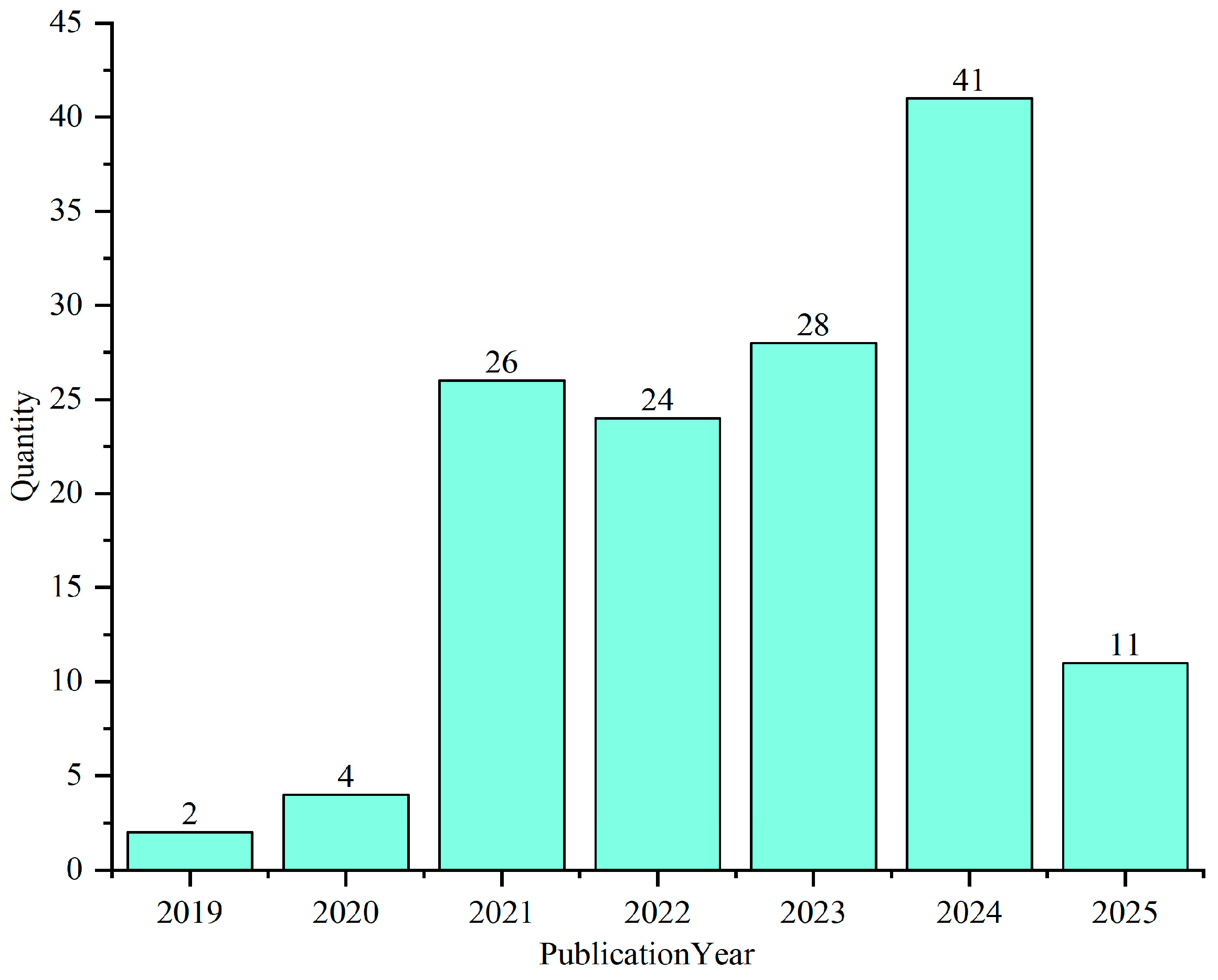
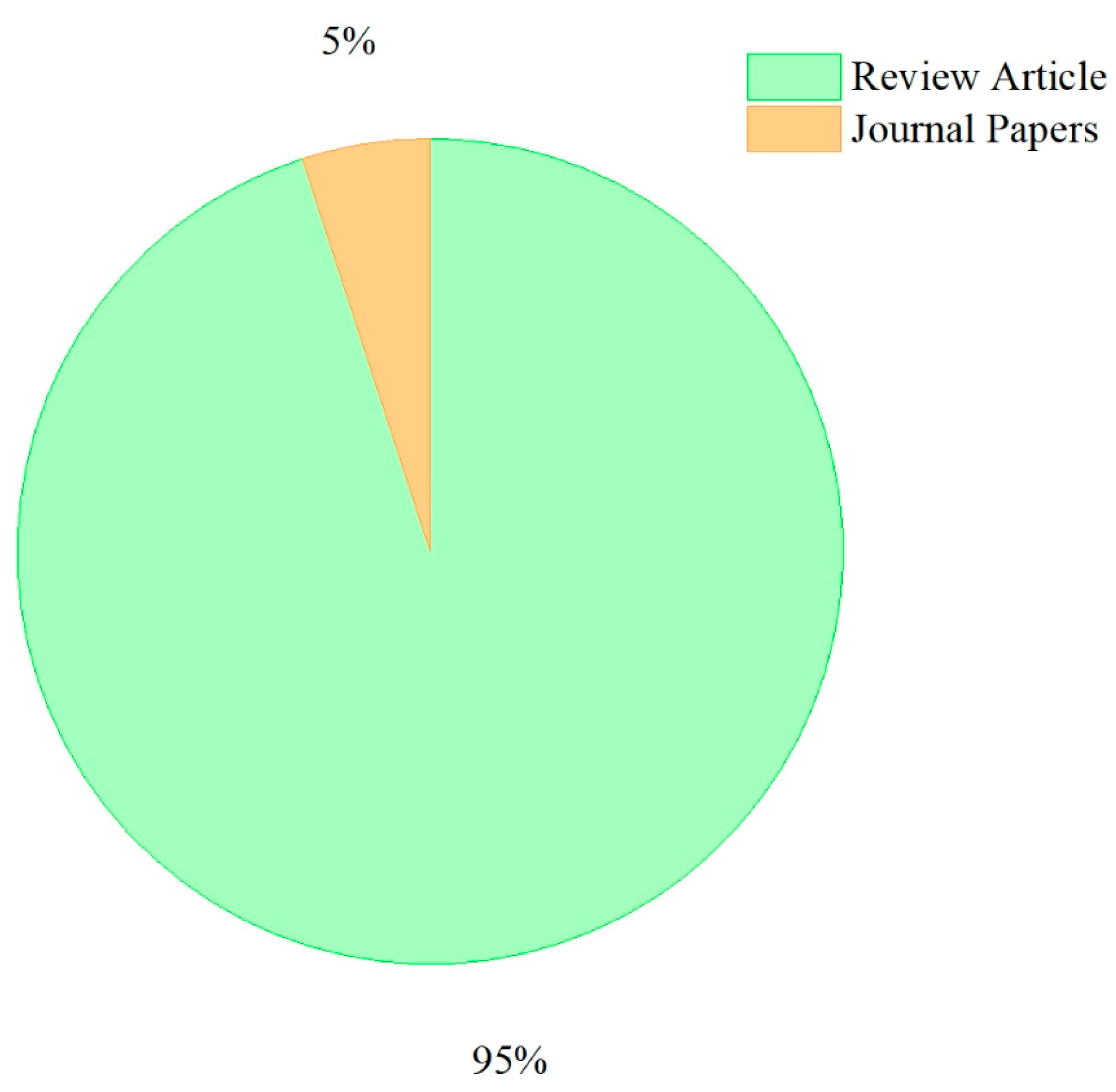
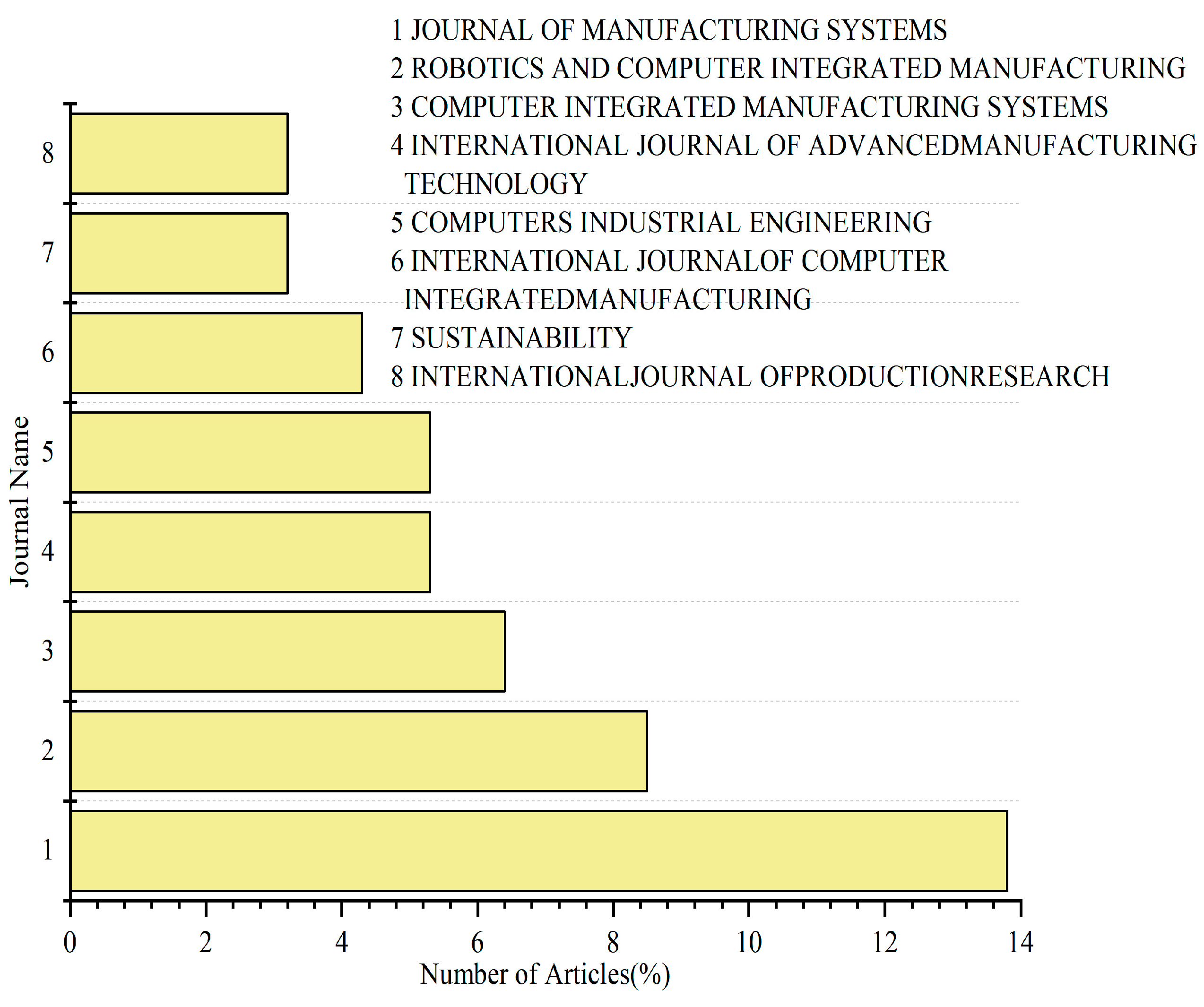
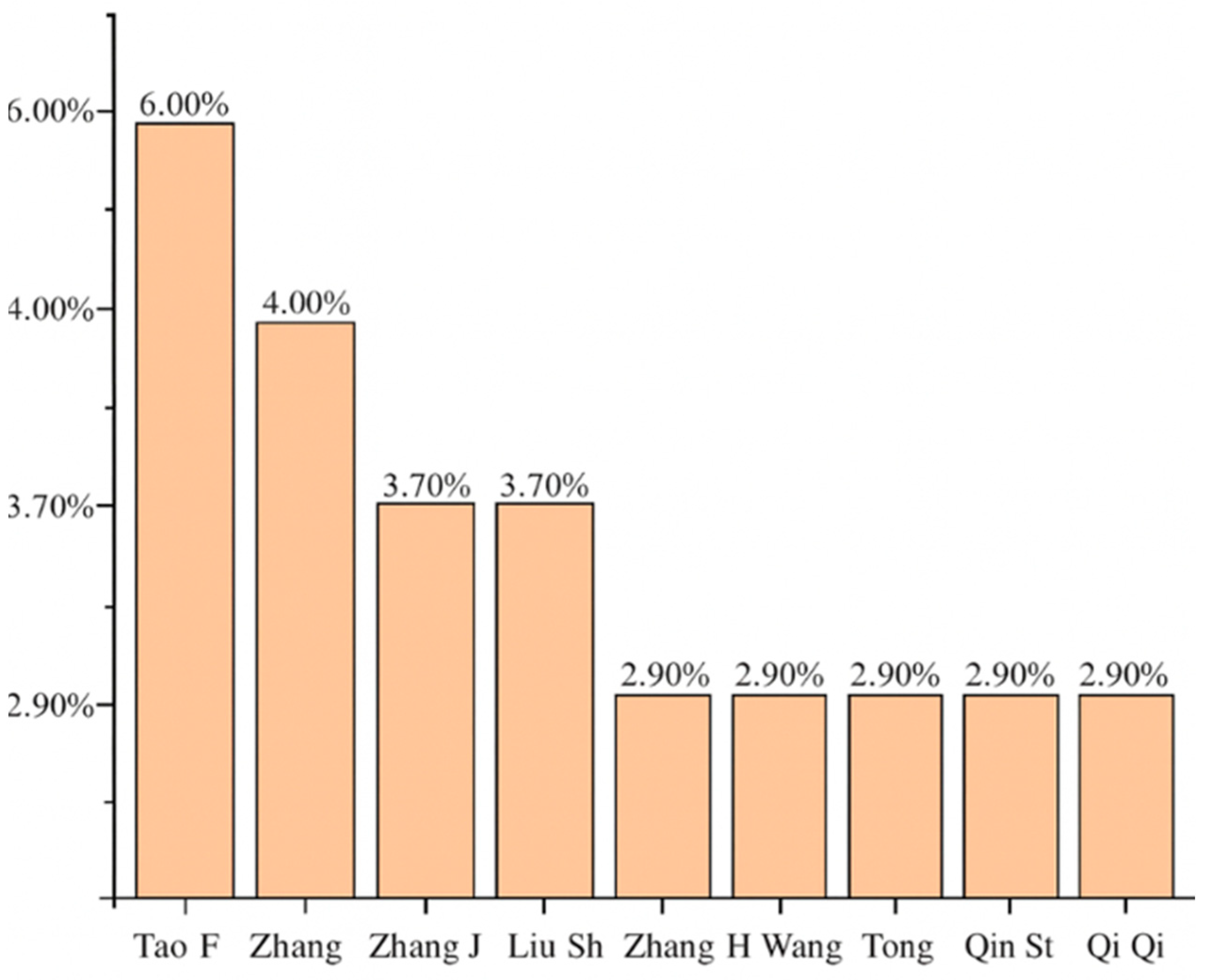
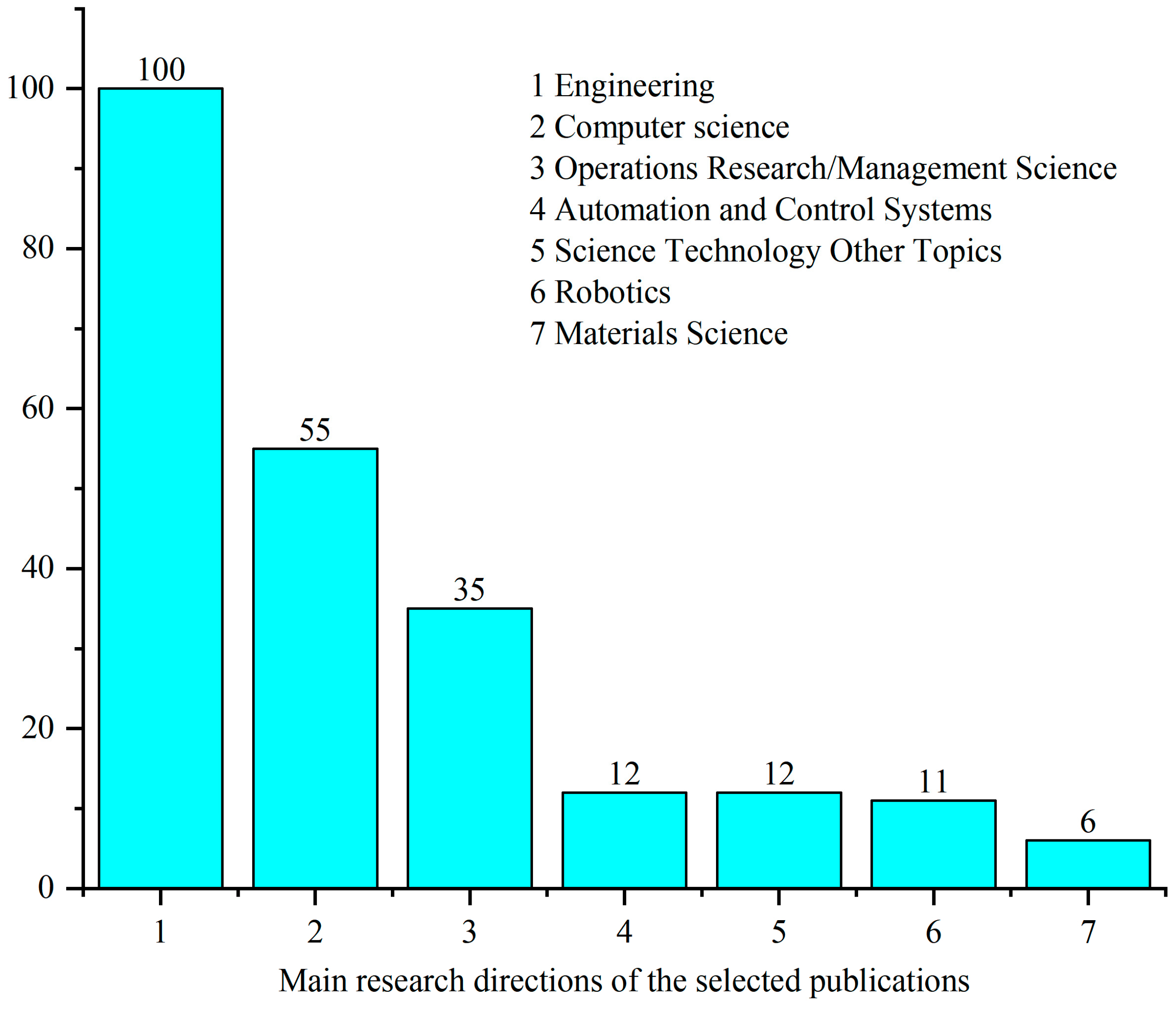
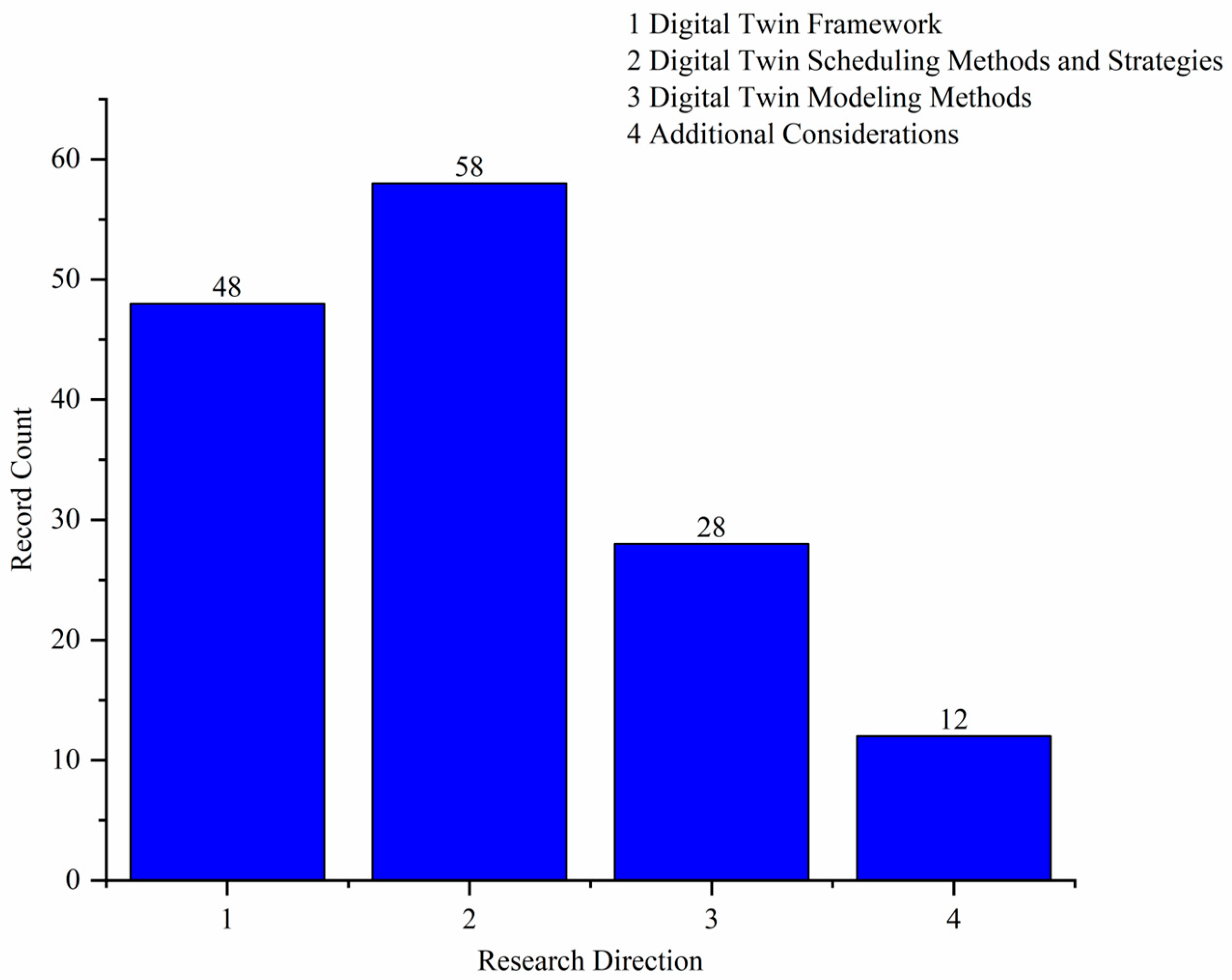
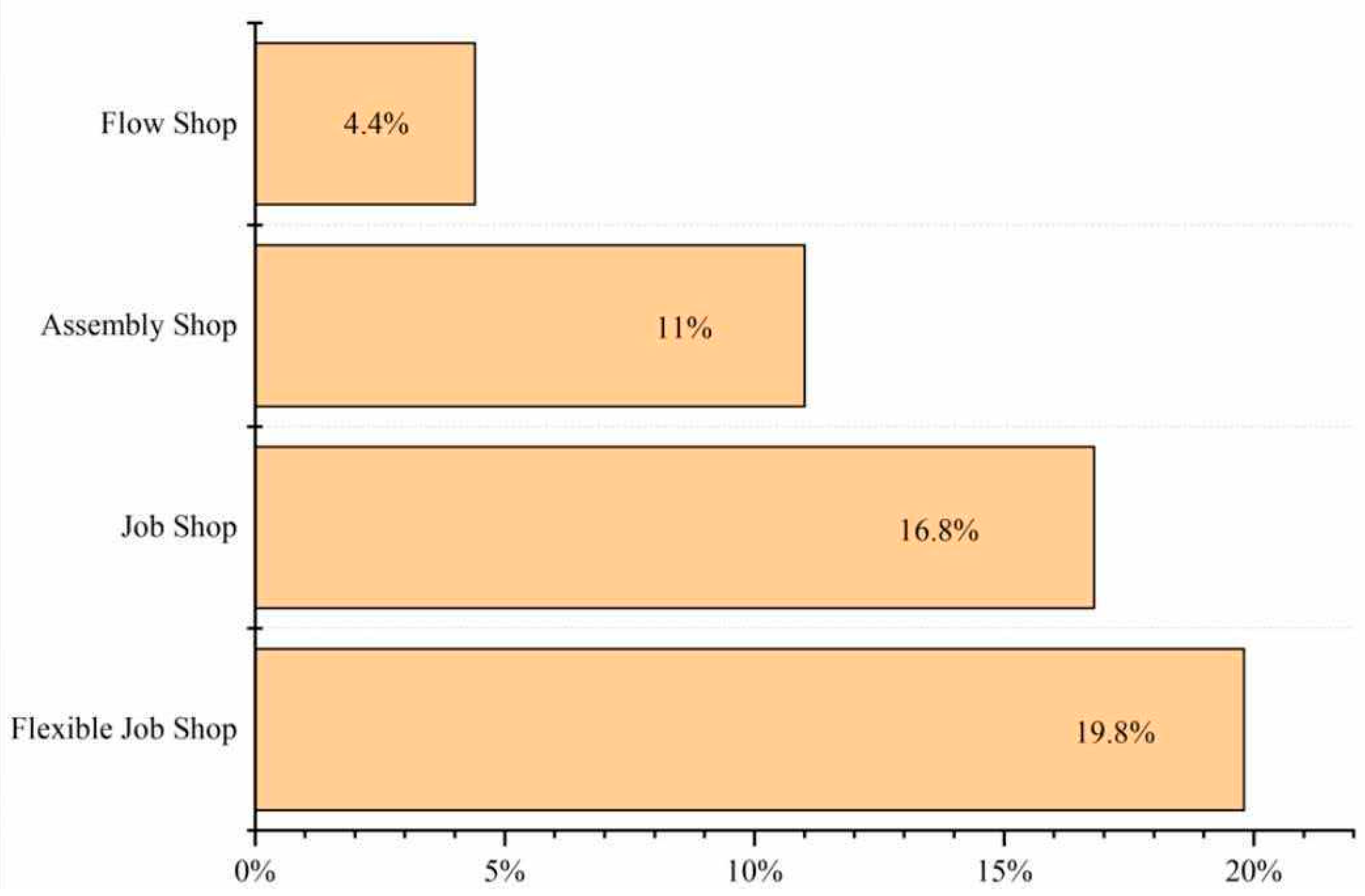
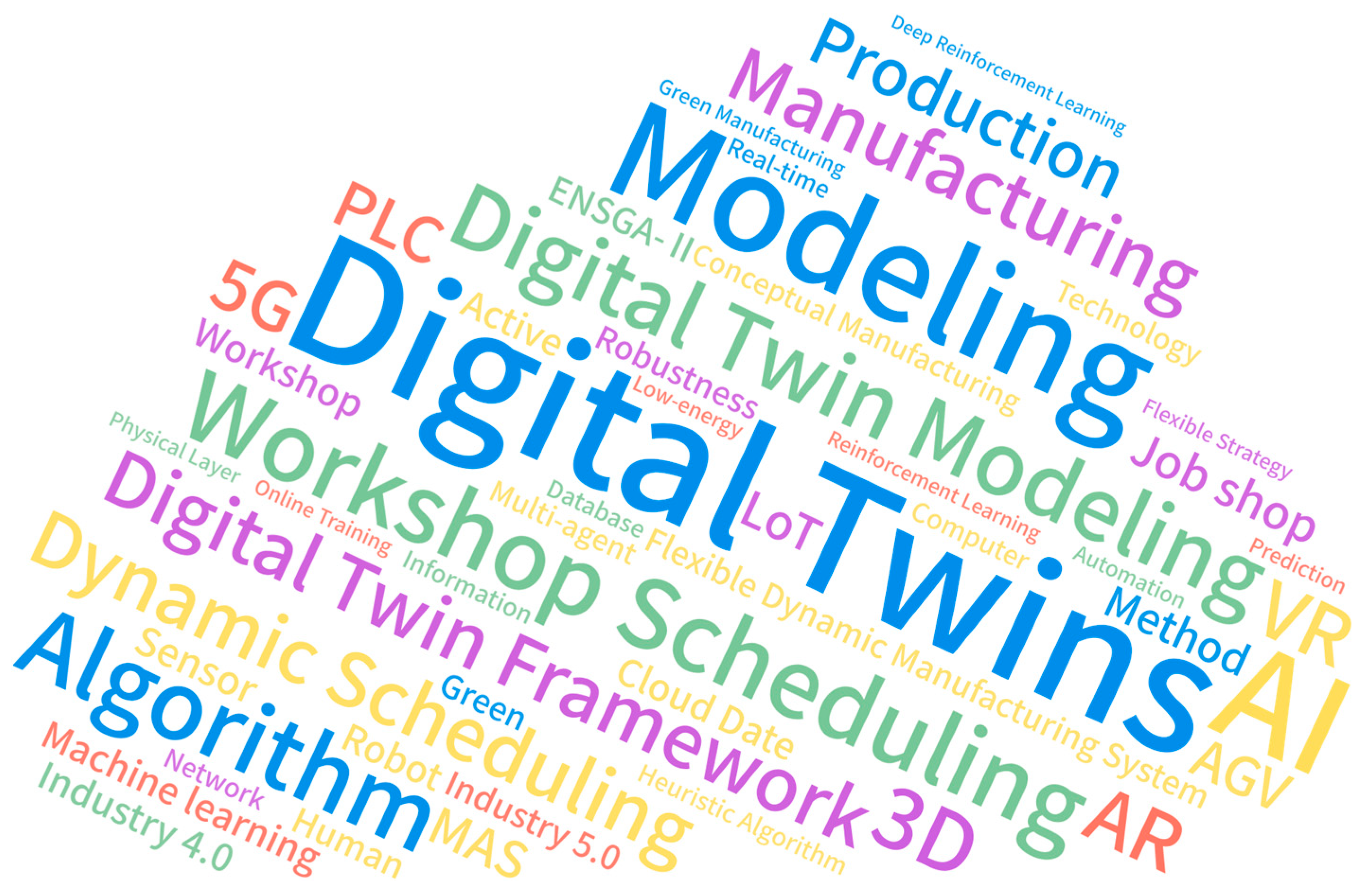
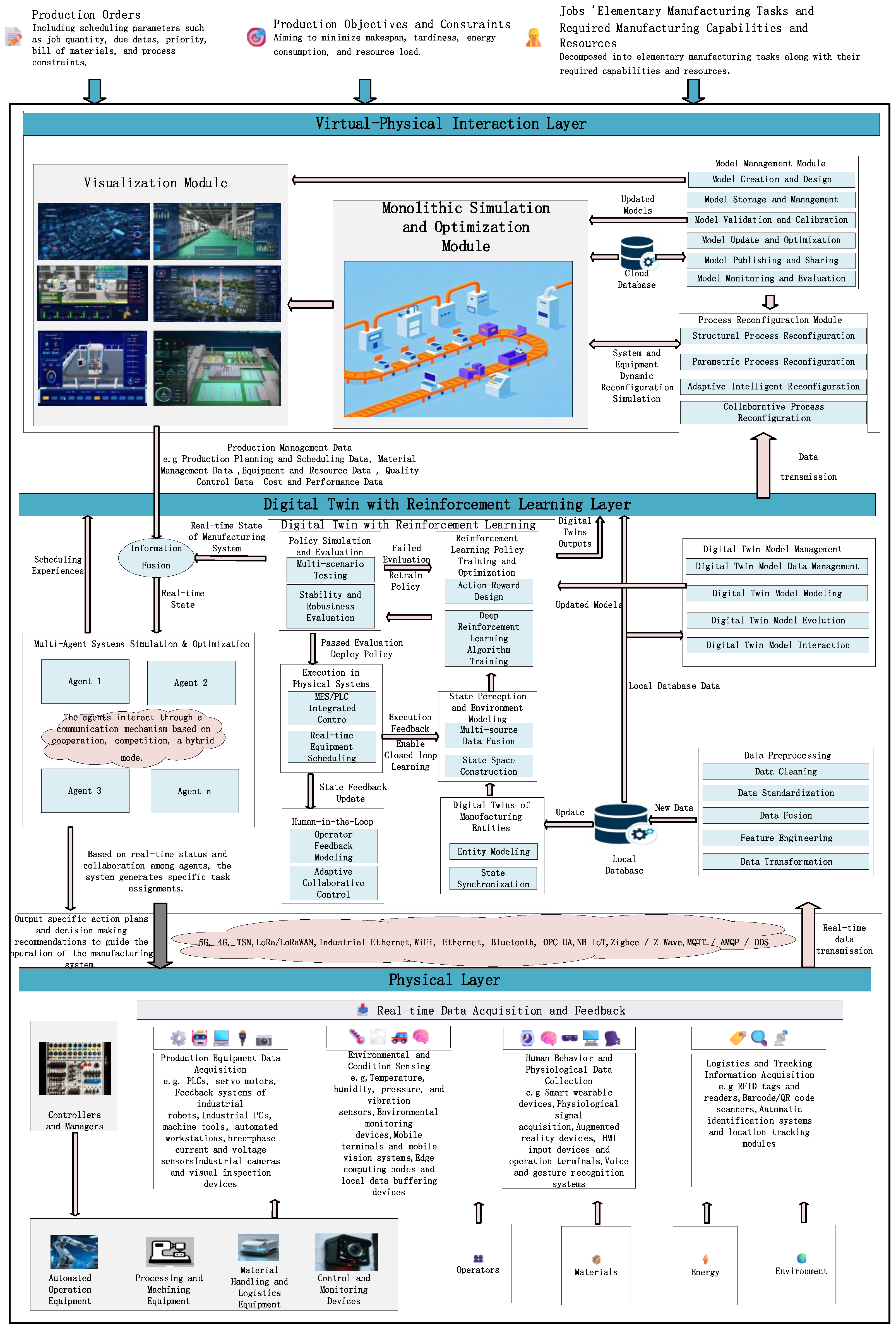
Disclaimer/Publisher’s Note: The statements, opinions and data contained in all publications are solely those of the individual author(s) and contributor(s) and not of MDPI and/or the editor(s). MDPI and/or the editor(s) disclaim responsibility for any injury to people or property resulting from any ideas, methods, instructions or products referred to in the content. |
© 2025 by the authors. Licensee MDPI, Basel, Switzerland. This article is an open access article distributed under the terms and conditions of the Creative Commons Attribution (CC BY) license (https://creativecommons.org/licenses/by/4.0/).