Communication

Theoretical Assessment of the Role of Bond Material during Grinding of Superhard Materials with Diamond Wheels
by
János Kundrák
1,
Vladimir Fedorovich
2,
Angelos P. Markopoulos
3,*,
Ivan Pyzhov
2 and
Yevgeniy Ostroverkh
2
1
Institute of Manufacturing Science, University of Miskolc, 3515 Miskolc, Hungary
2
Department “Integrated Technologies of Mechanical Engineering Named after MF Semko”, Educational and Scientific Institute of Mechanical Engineering and Transport, Kharkiv Polytechnic Institute, National Technical University, Kirpichova Str., 2, 61002 Kharkiv, Ukraine
3
Section of Manufacturing Technology, School of Mechanical Engineering, National Technical University of Athens, 15780 Athens, Greece
*
Author to whom correspondence should be addressed.
Machines 2022, 10(7), 543; https://doi.org/10.3390/machines10070543

Submission received: 18 May 2022 / Revised: 17 June 2022 / Accepted: 23 June 2022 / Published: 5 July 2022

Abstract

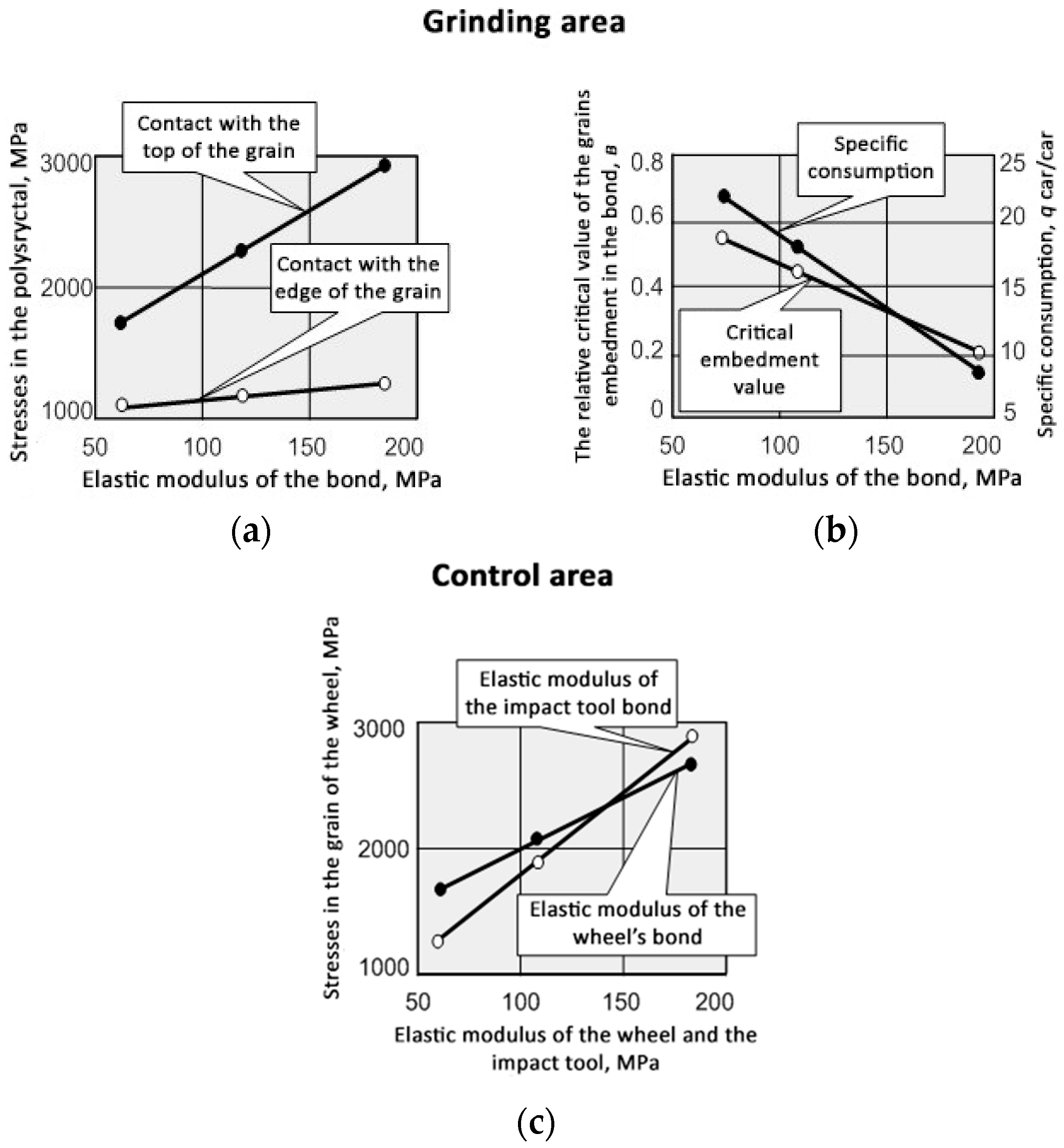
The grinding of superhard materials poses an important challenge to manufacturing industry, due to the increased wear and the high possibility of fracture of both the wheel and workpiece material. Various strategies have been proposed for effective grinding of these materials, but further research is still required, especially in cases in which the hardness of the wheel and the workpiece are almost equal. In this study, the role of the bond of a diamond grinding wheel during the processing of superhard materials, such as synthetic diamond, is investigated using theoretical models and FE simulation. Six different types of bonds are studied and the effect of their properties on the stress distribution of workpiece material is determined. Results indicate that even a slight increase in elastic modulus can affect considerably the stress state of the workpiece, directly affecting the critical embedding value of grains into the bond, something that can alter considerably the efficiency of grinding superhard materials. Thus, grinding wheels with bonds of high elastic modulus should be selected in order to increase grain retention, increase processing efficiency, and reduce specific consumption even at higher cross feeds and wheel speeds.
Keywords: diamond grinding wheel; superhard material; grinding wheel bond; elastic modulus; synthetic diamond; critical grain embedding value diamond grinding wheel; superhard material; grinding wheel bond; elastic modulus; synthetic diamond; critical grain embedding value