Abstract
In this paper, we propose Kripke-style models for the logics of evidence and truth and . These logics extend, respectively, Nelson’s logic and the logic of first-degree entailment () with a classicality operator ∘ that recovers classical logic for formulas in its scope. According to the intended interpretation here proposed, these models represent a database that receives information as time passes, and such information can be positive, negative, non-reliable, or reliable, while a formula means that the information about A, either positive or negative, is reliable. This proposal is in line with the interpretation of and as information-based logics, but adds to the four scenarios expressed by them two new scenarios: reliable (or conclusive) information (i) for the truth and (ii) for the falsity of a given proposition.
1. Introduction
The aim of this paper is to present Kripke-style models for the logics of evidence and truth and , introduced in [1,2]. Both are paraconsistent and paracomplete logics that extend respectively Nelson’s logic and the logic of first-degree entailment () with a classicality operator ∘ that recovers classical logic for formulas in its scope. The motivation for the logics of evidence and truth is to model contexts of reasoning where one deals with positive and negative evidence, which can be conclusive or non-conclusive. (On the notion of evidence, and and as evidence-preserving logics, see [1] Section 2, [3] Section 3 and [2] Section 2.2.1.) Conclusive evidence is subjected to classical logic, and non-conclusive to a paraconsistent and paracomplete logic that is in the case of and in the case of . According to the interpretation in terms of evidence and truth, a pair of contradictory formulas A and expresses conflicting non-conclusive evidence for A and , and means that there is conclusive evidence for the truth or the falsity of A. Conclusive evidence is subjected to classical logic, and so when holds, A is treated as true or false by the formal systems. Thus, while , in these logics it holds that , which means that conflicting evidence cannot be conclusive on pain of triviality. Both and are logics of formal inconsistency and undeterminedness [4,5,6]. Sound and complete valuation semantics were presented for and in [1] and [2], respectively.
It is well known that the logics and can be interpreted in terms of preservation of information, the latter in the sense of [7,8]. In terms of information, a formula can be read as meaning that the information about A is reliable, and and can be interpreted in terms of positive and negative information, which can be either reliable or unreliable. This idea fits Belnap and Dunn’s proposal of interpreting as a logic to be used by a computer that receives information from different sources [9,10,11]. The semantic values , , and , of what became known as Belnap–Dunn 4-valued logic, express the circumstances in which the computer receives, respectively, only positive, only negative, conflicting and no information at all, about a proposition A. In addition to these four scenarios, and are capable of representing two additional scenarios: when does not hold, we have the four scenarios above, but when holds, exactly one among A and holds, which means that the information about A, positive or negative, is reliable and subjected to classical logic.
The Kripke-style models to be presented here are intended to represent a database that, as time passes, receives information from different sources that may be either reliable or unreliable. Each stage w represents one of the following six scenarios:
- When :
- , : at w the database has only the information that A is true;
- , : at w the database has only the information that A is false;
- , : at w the database has conflicting information about A;
- , : at w the database has no information about A.
- When :
- 5.
- : at w the database has reliable information that A is true;
- 6.
- : at w the database has reliable information that A is false.
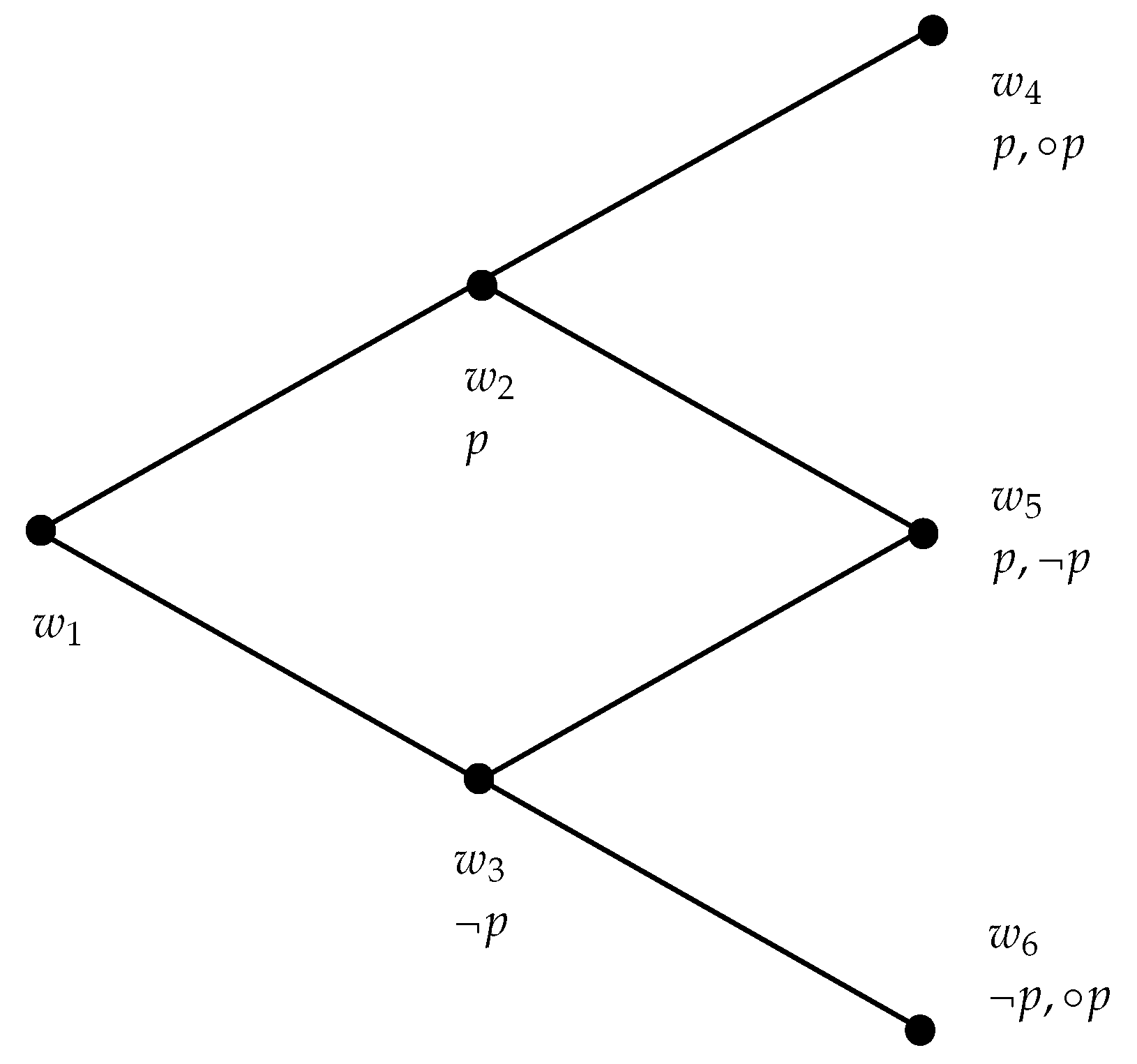
These six scenarios can be illustrated by the diagram below:


In stage , the database is empty and therefore has no information about p. In it receives only the information p, which in is not taken as reliable. From , there are two possibilities: in the database receives the information that the information about p is reliable, which is expressed by ; alternatively, in the information is obtained, and so the information about p remains unreliable. Analogous reasoning applies to , which may bifurcate into or .
In the example above, nothing has been removed from the database. As we will see, requires persistence for every formula, which means that once some information is inserted in the database it cannot be removed. On the other hand, in the case of , different persistence clauses may be adopted to express different criteria for revising information.
The remainder of this paper is structured as follows. Section 2 presents the models for and proves soundness and completeness, and Section 3 does the same regarding . Section 4 discusses the persistence clauses that can be added to for revisability of information and gives a proof that the addition of these clauses to the semantics of does not affect soundness, nor completeness. Section 5 discusses some results related to how the classical behavior propagates across stages in and -models, and finally, Section 6, points out some possible further developments.
2. The Logic
The logic [1] is an extension of Nelson’s paraconsistent logic . An interpretation of in terms of positive and negative information can be found in [12]. In [8], a view according to which paraconsistent logics should be interpreted without any ontological or epistemological ingredients in terms of Dunn’s notion of information [7] is presented and defended. is plus a semi-intuitionistic implication: Peirce’s law does not hold, but the equivalence between and holds. A Kripke semantics for can be found in [13], p. 164, and it is essentially the local conditions for ¬, ∨, ∧ that mimic the conditions of , the local conditions for and the intuitionistic global clause for →.
The language of is composed of denumerably many sentential letters , the unary connectives ∘ and ¬, the binary connectives ∧, ∨ and → and parentheses. The set of formulas of , which we will also denote by , is inductively defined in the usual way. Henceforth, Roman capitals will be used as metavariables for the formulas of , while Greek capitals will be used as metavariables for sets of formulas.
Definition 1.
The logic is defined over by the following natural deduction rules:
As is customary, enclosing a formula A in square brackets indicates that A is a discharged hypothesis. The notion of a derivation in can be inductively defined along the lines of the definition presented in [14] (pp. 35–36). It suffices to say here that a derivation is a tree of labeled formulas whose nodes are either a hypothesis or the conclusion of applying one of the rules above to formulas that occur previously in the tree. Given , the notation will be used to express that there is a derivation in such that A is the last formula that occurs in (its conclusion) and all of ’s undischarged hypotheses belong to . will be treated as a shorthand for . When there is no risk of confusion, we shall write ⊢ instead of .
Definition 2.
A Kripke model for is a structure such that W is a non-empty set of stages, the accessibility relation ≤ is a partial order on W, and is a valuation function satisfying the following conditions, for every :
- 1.
- iff and ;
- 2.
- iff or ;
- 3.
- iff ;
- 4.
- iff or ;
- 5.
- iff and ;
- 6.
- only if exactly one of the following conditions obtains:For every , and ;For every , and ;
- 7.
- iff for every , if , then ;
- 8.
- iff and ;
- P1.
- If , then for every , , for every .
Given a Kripke model and a stage , we say that a formula A holds in w () if, and only if, .
Definition 3.
Let . We say that A is a semantic consequence of Γ () if, and only if, for every model and every , if , for every , then . A is said to be logically valid if for every model and stage , . As in the case of , we shall sometimes write ⊩ and ⊧ instead of and , respectively.
Note that Clause 6 of Definition 2 gives only a necessary condition for . This mimics the clause for of the non-deterministic valuation semantics proposed in [1] (p. 3805) and will be important for the results presented later, specially in Section 4. We will now prove that is sound and complete with respect to .
Soudness and Completeness
Theorem 1.
(Soundness Theorem) Let . If , then .
Proof.
Suppose that . We shall prove that by induction on the number n of nodes in a derivation of A from Γ in . If , then A is the only formula that occurs in and . Since ⊧ is reflexive, it follows that . Suppose now that and that the result holds for every derivation with fewer nodes than . It is straightforward to check that for each rule of , if the premises of hold in , then so does its conclusion. Let us consider rule and leave the remaining cases to the reader: suppose that there is a derivation of B from in , and let be the derivation (of from Γ) obtained from by applying rule . Since has fewer nodes than , it follows that (by the induction hypothesis). Let and be such that , for every , and let be such that . Since by (P1) the values of the elements of Γ in w remain the same in , it follows that , for every . Hence, (since and . Therefore, for every , only if , i.e., . □
Definition 4.
(Regular set) Let . Δ is a regular set if it satisfies the following three conditions (A regular set, as defined here, corresponds to what is usually called a nontrivial prime theory. For the sake of convenience, we shall adopt the former terminology throughout this paper.):
- 1.
- Δ is nontrivial: , for some ;
- 2.
- Δ is closed: if , then , for every ;
- 3.
- Δ is disjunctive (or prime): if , then or , for every .
Definition 5.
Let . Δ is said to be maximal with respect to A if, and only if, (i) and (ii) , for every .
Lemma 1.
If Δ is maximal w.r.t. A, then Δ is a regular set.
Proof.
In order to prove that Δ is a theory, suppose that and that . Thus, . By the transitivity of ⊢, it follows that , which contradicts the initial hypothesis. To prove that Δ is a disjunctive set, suppose that and that and , that is, and . Hence, and . Since , it then follows by rule that , which also contradicts the initial hypothesis. □
Proposition 1.
Let . If , then there is a set that is maximal w.r.t. A.
Proof.
Let be a fixed enumeration of and let the sequence be defined by:
It can then be proven by a straightforward induction on n that , for every . Let . To prove that , it suffices to notice that if A were derivable from Δ, then, by the compactness of ⊢, it would also be derivable from , for some . Now, suppose that and let n be such that . Since (for ), it follows by construction that . Therefore, . □
Lemma 2.
Let be a regular set and . Then:
- 1.
- iff and ;
- 2.
- iff or ;
- 3.
- iff ;
- 4.
- iff or ;
- 5.
- iff and ;
- 6.
- If , then one of the following conditions obtains:For every regular set , and ;For every regular set , and ;
- 7.
- iff for every regular set , if , then ;
- 8.
- iff and .
Proof.
Items (1)–(5) and (8) follow immediately from the definition of a regular set together with the rules of . As for (6), suppose that . By , it follows that , and so either or . Let Σ be a regular set such that and suppose that . Since , it then follows that both and B belong to Σ. Hence, , for otherwise Σ would be trivial (in virtue of rule and the fact that Σ is a regular set). A similar reasoning suffices to show that if , then and , for every regular set . Finally, to prove the left-to-right direction of (7), suppose that and let be a regular set such that . Since , it follows that and so, (by rule ). As for the right-to-left direction, suppose that . By rule , it follows that . By Proposition 1 and Lemma 1, there is a regular set such that . Since , . Therefore, there is a regular set such that and . □
Proposition 2.
If Δ is a regular set, then there is a model and a stage such that:
Proof.
Let be such that:
- ;
- ;
- is defined by: iff , for every .
Since Δ is a regular set, . It follows from the definition of v that if, and only if, . However, in order to complete the proof we are still required to show that v is a valuation, i.e., that it satisfies all clauses of Definition 2. That satisfies clauses (1)–(8) is an immediate consequence of Lemma 2 above. Note, moreover, that since ≤ has been defined as the set inclusion relation over W, also satisfies (P1). □
Theorem 2.
(Completeness Theorem)
Proof.
Suppose that . By Proposition 1 and Lemma 1, there is a regular set such that . By Proposition 2, there is a model and a stage such that for every , if, and only if, . Therefore, , for every (since ), and (for ). □
3. From to
The logic was introduced in [2] as an extension of equipped with both a classicality operator ∘ and a non-classicality operator •, dual to ∘—cf. [2] Section 3.1. (Hilbert and Gentzen-style systems for can be found in [15] Section 2.2.) can also be obtained from by dropping the implication and adding •, with the respective rules, which say essentially that holds if, and only if, does not hold. As far as we know, classical negation cannot be defined in , so • had to be introduced as a primitive symbol. In the intended interpretation of the Kripke models presented here, means that in the database there is no reliable information about A.
Definition 6.
Let be the language obtained from by replacing → by the unary connective •. The logic results from adding the following rules to the set of ’s →-free rules:
We shall use to denote the derivability relation generated by and abbreviate it to ⊢ whenever appropriate.
Definition 7.
A Kripke model for is a structure as in Definition 2, except that (7), (8) and (P1) are replaced by:
- 7′.
- iff
As in the case of , we say that A holds in w () if, and only if, . The definition of ’s semantic consequence relation, to be denoted by , is like the one for (Definition 3), with the obvious adjustments. When there is no risk of ambiguity, we write simply ⊩ and ⊧ instead of and .
Theorem 3.
(Soundness Theorem) Let . If , then .
Proof.
Suppose that . We shall prove that by induction on the number n of nodes in a derivation of A from Γ in . If , then contains only one formula and so either or it is the result of applying rule . If , then , by the reflexivity of ⊧. As for the latter case, suppose that A is the formula and let and be arbitrary. By Definition 7(7), or . It then follows from clause (2) of Definition 7 that . Therefore, , and since and w were arbitrary, we may conclude that . Suppose now that and that the result holds for every derivation with fewer nodes than . It is straightforward to check that for each rule of (other than ), if the premises of hold in , then so does its conclusion. □
The proof of the completeness of with respect to the class of models characterized in Definition 7 is also similar to the one for , except for some minor differences. In particular, the definitions of regular and maximal sets (Definitions 4 and 5), and the proofs of Lemma 1 and Proposition 1 will carry over to the case . Hence, we shall assume those results to hold without presenting their proofs.
Lemma 3.
Let be a regular set and . Then:
- 1.
- iff and ;
- 2.
- iff or ;
- 3.
- iff ;
- 4.
- iff or ;
- 5.
- iff and ;
- 6.
- If , then one of the following conditions obtains:For every regular set , and ;For every regular set , and ;
- 7′.
- iff .
Proof.
Items (1)–(5) follow immediately from the definition of a regular set together with the rules of . As for (6), it can be proven exactly as in the proof of Lemma 2. Finally, to prove (7) it suffices to notice that if , then Δ would be trivial, and that either or (by rule and the assumption that Δ is regular). □
Proposition 3.
If Δ is a regular set, then there is a model and a stage such that:
Proof.
Let be such that:
- ;
- ;
- is defined by: iff , for every .
Since Δ is a regular set, . It then follows from the definition of v that if, and only if, , for every . By Lemma 3 above, Δ satisfies all clauses of Definition 7, and we are done. □
Theorem 4.
(Completeness Theorem)
Proof.
Suppose that . By (the -analogues of) Proposition 1 and Lemma 1, there is a regular set such that (and so ). By applying Proposition 3, it then follows that there is a model and a stage such that for every , if, and only if, . Therefore, , for every , but , that is, . □
Although the persistence clause (P1) of Definition 2 is necessary for proving the soundness of , it can be completely dispensed with in . As we shall see in the next section, there are some reasons why supplementing the semantics of with some weaker versions of (P1) may be desirable. Before we do so, it is worth noting that even in the absence of (P1), for formulas , already requires the values of A or to be preserved across stages.
Proposition 4.
Let and . For every , it holds that:
- 1.
- If , then , for every ;
- 2.
- If , then , for every .
Proof.
This is an immediate consequence of clause (6) of Definition 7. □
Thus, in , whenever holds in a certain stage w, both A and will retain their values in every stage accessible from w; and since exactly one of A or holds in w whenever does, this entails that exactly one of A or will hold in every such .
4. Persistence Clauses and Information Revision
In this section we explore different persistence relations that may hold in a Kripke model for and indicate how each of those relations may be useful for representing different criteria for revising information.
Recall that, given a model and a stage , expresses that positive information A is available at w, while expresses that there is no such information in w. Likewise, indicates the presence at w of negative information , whereas is to be interpreted as the lack of such information. When the information about A is reliable at w, we have . For the sake of convenience, we may express the same thing more succinctly by saying that the information conveyed by A (which may assume the form or ) is available at w whenever , and that no such information is available at w whenever .
Now, how are we to understand the fact that A may assume different values in two ≤-related stages? The following definitions may be of some help: given stages such that , we shall say that in we have acquired the information conveyed by A whenever and ; and that we have revised that same information whenever and . Using this new terminology, we can then describe the following four scenarios:
- and : the information conveyed by A was available at w and it has not been revised in the process of moving from w to (i.e., it remained available);
- and : the information conveyed by A was available at w but it has been revised in the process of moving from w to ;
- and : the information conveyed by A was unavailable at w, nor was it acquired in the process of moving from w to (i.e., it remained unavailable);
- and : the information conveyed by A was unavailable at w but it has been acquired in the process of moving from w to .
4.1. Persistence Conditions
Having the notions characterized in (1)–(4) at our disposal, we can now categorize the models of according to the different revisability relations that may or may not hold between formulas and stages. In other words, we can distinguish classes of models in terms of the kinds of information that are allowed to be revised.
Let a literal be a propositional letter or the negation of a propositional letter, and let basic information be the (positive and negative) information conveyed by literals. The models of can be classified according to whether or not they satisfy one of the following persistence conditions:
- P1.
- Total non-revisabilityFor every , if , then .
- P2.
- Non-revisability of reliable informationFor every , if , then .
- P3.
- Non-revisability of reliable information and basic informationFor every , if , then ;For every , if , then ;For every , if , then .

Condition (P1), which was already present in , amounts to the constraint of total non-revisability: it states that no information whatsoever is allowed to be revised at any stage. In other words, every new piece of information acquired at a certain stage is always passed on to the subsequent stages, leaving no room for data to be removed in the light of new information.
It is to be noted, however, that (P1) does not quite fit in the intended interpretation of . This is because if were to always persist across stages, we would be prevented from acquiring reliable information about A whenever that information had been previously deemed unreliable. On the other hand, in the semantics for , total non-revisability was required because of the intuitionistic clause for implication. Since • is absent from , this does not represent a problem there, although the presence of (P1) does prevent revising information in -models.
(P2) corresponds to the constraint that information already marked as reliable cannot be revised. Thus, once holds in a stage w, it cannot be removed at any stage . Recall that in Proposition 4 we have proved, even in the absence of (P2), that the fact that holds in a certain stage w is already sufficient for the non-revisability of either A or (which depends on which of A and actually holds in w). However, this did not prevent the revisability of itself; that is, it did not rule out such models as:
.
.Requiring models to satisfy (P2) will, however, prevent situations in which A () is non-revisable in virtue of holding in a certain stage, even though itself is allowed to be revised at any further stage.
Another important aspect of (P2) is that it entails (actually, is equivalent to):
- P2′.
- If , then for every , .
(P2) says that if some information is unreliable at a stage , it must have been unreliable in every stage w that precedes (To prove that (P2) entails (P2), suppose that and let . Suppose further that . By (P2), it then follows that , which contradicts clause (7) of Definition 7. Therefore, . Suppose now that satisfies (P2) and let be such that . For any arbitrary , or . If , then (by (P2)). This result contradicts clause (7) of Definition 7. Therefore, .).
Finally, (P3) adds to (P2) the requirement of non-revisability of basic information. This makes sense if we think of a database in which only literals and formulas of the form can be inserted. Given a model that satisfies (P3), it can be easily proved that any formula A in which neither ∘ nor • occur will be preserved across ≤-related stages.
Proposition 5.
Let and . Let be such that neither ∘ nor • occur in A. If satisfies (P3) and , then for every , .
Proof.
The result can be proved by a straightforward induction on the complexity of A; this proof is left to the reader. □
Concerning the result above, it is to be noted that the condition (P3) added to does not collapse into (P1) because (P3) does not apply to formulas like , nor to formulas in which ∘ and • appear in the scope of ¬.
The conditions (P1), (P2) and (P3) are not exhaustive. The idea of these models as representations of information revision can be developed in different ways, even allowing revisability of reliable information. We can think of different revisability conditions as different levels of access to the database. Total non-revisability (P1) would be a level of access that can insert information but cannot remove anything from the database. Non-revisability of reliable information (P2) fits the idea of two different levels of access: a level-1 access that can only insert basic information but cannot remove nor mark anything as reliable (i.e., cannot insert ), and a level-2 access that can remove any information not marked as reliable and mark information as reliable (i.e., can insert and remove literals and insert ), but still cannot remove or change reliable information, which is marked with ∘. This does not mean, however, that in both cases reliable information cannot be revised once and for all, but only that the model is not able to represent, so to speak, a sort of higher level access to the database.
4.2. Adding Persistence to
The reader may ask at this point what would be the result of adding the persistence clauses above to the semantics of . After all, it seems that modifying Definition 7 would restrict the class of models originally characterized in the previous section and, as a result, we should expect to retain soundness but not completeness with respect to the new, more restricted, classes of models. As we shall now see, though, this is not really the case, for no matter which persistence clause we choose to supplement Definition 7 with, will continue to be sound and complete with respect to the new class of models. Let us first prove this fact and then explain why none of the persistence clauses (P1)–(P3) interfere with the completeness of .
Soundness and Completeness with Persistence
To prove that soundness and completeness will continue to hold with respect to the classes of models corresponding to each of the persistence clauses (P1)–(P3), it will suffice to consider the class generated by the most restrictive condition, (P1). In order to establish this result it will be convenient to first introduce some preliminary notation. We shall use the symbol to denote the class of models originally characterized in Definition 7—i.e., models with no persistence constraints, except for those stated in Proposition 4—and () to denote the class that results from adding (Pi) to that definition. Note that, for every i, is properly included in , is properly included in both and , and in , since every model that satisfies (P1) also satisfies (P2) and (P3), and every model that satisfies (P3) satisfies (P2). Finally, denotes the semantic consequence relation generated by the models in (We shall continue to use ⊢ and ⊧ as abbreviations for respectively and throughout this section.). We can then prove that:
Lemma 4.
Let be a member of and let . Then there is a model in and a stage such that if, and only if, , for every .
Proof.
Let be defined by:
- ;
- ; and
- is a total function such that for every :
Given that has only one stage, (vacuously) satisfies (P1). Hence, all we need to do in order to complete the proof is to show that satisfies all clauses of Definition 7. Since clauses (1)–(5) and (7) are all locally formulated, they follow immediately from the definition of . Concerning clause (6), which is the only global clause among (1)-(7’), we may proceed as follows. Suppose that . Hence, , and so exactly one of (I) and (II) below obtains:
- (I)
- For every such that , and ;
- (II)
- For every such that , and .
Suppose that (I) holds. Thus, and , and, so, and . Since w is the only element of , we may conclude that for every such that , and (and similarly in the case of (II)). When , it follows that , and there is nothing to be proved since clause 6 has just one direction and is vacuous on this condition. □
Theorem 5.
Let . Then if, and only if, .
Proof.
Since every model that belongs to also belongs to , it follows immediately that if , then . As for the other direction, suppose that . Hence, there is a model in and a stage such that , for every , and . By Lemma 4 above, there is a model in and such that , for every , and . Therefore, . □
Lemma 4 states that no matter how many stages a given model has, for each stage w of , we can always find a corresponding model with exactly one stage such that the same formulas hold in both w and . Notice that because contains only one stage, (vacuously) satifies each of the persistence clauses (P1)–(P3). This means that Lemma 4 and Theorem 5 would still be provable in exactly the same way if (and the corresponding consequence relation ) were replaced by either or . As a result, all of ⊧, , and turn out to have the same extension which, together with the soundness and completeness of , yields:
Corrolary 1.
Let . Then:
- 1.
- iff;
- 2.
- iff;
- 3.
- iff.
How can be sound and complete with respect to all of ⊧, , and , in spite of those relations being characterized in terms of different classes of models? As we shall see, the reason has to do with the fact that in the semantics for there is no clause that states a sufficient condition for to hold in a given stage. Before we get to that, however, we first need to take a look at the soundness and completeness proofs of presented in the previous section, in order to make sure that they would still work had we adopted any of those alternative notions of consequence relation.
That the soundness theorem would continue to hold follows immediately from the fact each is included in , which, in turn, implies that if ⊢ is sound with respect to the models in , then it is also sound with respect to models in the more restricted class (given that implies ). Notice, moreover, that since nowhere in the proof of Theorem 3 was any of (P1)–(P3) appealed to, the proof would work equally well had we adopted any of , , instead of ⊧.
Concerning the completeness theorem, we need to consider the modifications (if any) that would be necessary if the proof were being formulated with respect to models satisfying one of (P1)–(P3). As it turns out, there is precisely one place in the whole proof that requires more attention, viz., Proposition 3.
Recall that it was established in Proposition 3 that for any regular set Δ of formulas of , one can find a model and a stage w of such that a formula holds in w if, and only if, it belongs to Δ. While proving this result, the model was defined in such a way that its stages were all the regular sets of , its accessibility relation ≤ was taken to be the inclusion relation ⊆ over W, and its valuation function was defined in terms of the characteristic function of each . Now, had we proved this result with respect to models that satisfy one of (P1)-(P3), we would have to make sure that did indeed satisfy the corresponding clause. In the case of (P1), for example, this would require showing that for every regular sets Σ and such that , the fact that formula A belongs to Σ implies that it also belongs to (and similarly for the other clauses). At this point, it becomes clear, however, that this requirement, as well as the ones corresponding to the other clauses, was already satisfied in the original proof of Proposition 3, given the way ≤ was defined (i.e., in terms of ⊆). Hence, as in the case of the proof of the soundness of , the proof of its completeness would also remain unaltered.
Why does the adoption of any of the persistence clauses above bring no changes whatsoever upon the corresponding deductive system? We can reach a better understanding of this fact by taking a closer look at the proof of Lemma 4, for it is precisely because of that result that we are able to prove the equivalence between ⊧, , and .
The proof tells us that given any model belonging to and a stage w in this model, one can always extract a model out of such that w is the only stage of and the same formulas hold in w with respect to either model. That the semantic values of formulas containing no occurrences of either ∘ or • are carried over to the new model is a consequence of the fact that the semantic conditions of formulas formed with are all local, and so they do not depend on the values their subformulas have at stages other than w.
There is no need to take formulas into account here because their semantic conditions are stated directly in terms of those for . So let us consider what happens with formulas of the form . Assuming that , the only reason why could fail to hold in w (w.r.t. ) is if there were some in such that . However, since w is the only stage in and since A and inherit in the values they had in , this cannot happen. What if did not hold in the original ? Could the elimination of all stages in except for w also eliminate all the counterexamples to in ? The answer is ‘no’, and the reason for this is that the definition of a Kripke model for (with or without any of (P1)–(P3)) does not state any sufficient condition for to hold in a stage. If this were the case, then while moving from to we would have no guarantee that the (sufficient) condition for to hold in would not become satisfied in virtue of there being fewer stages in than in —and so would hold in , even though it failed to hold in . This situation is thus very different from what takes place in intuitionistic logic. For imagine what would happen if we attempted to prove an analogue of Lemma 4 for intuitionistic logic. Although every formula that holds in w in the original model would continue to hold in w in the new model , it could well happen that a formula that did not hold in w (w.r.t. ) would nonetheless hold in w w.r.t. . This is because all the counter-examples to could end up being eliminated in . Notice that this phenomenon depends essentially on the fact that in order for to hold in a stage w in a Kripke model for intuitionistic logic, there can be no stage such that A holds in and B does not hold in , which amounts to a sufficient condition for to hold in w. And it is precisely one such condition that is missing in the case of ’s ∘ operator.
It is worth noting that, as a matter of fact, a semantics for does not need a global clause for ∘, which means that from the strictly technical point of view, Kripke-style models for collapse into standard models. Nevertheless, the conceptual idea of Kripke models for intuitionistic logic, in which propositions are proved as time passes, has an analogy with the idea of a database that receives information as time passes. Moreover, if we change the ‘only if’ of the semantic clause for ∘ (Definition 2 item 6) to an ‘if and only if’, we obtain an appealing sufficient condition for : if at a stage w we ‘look to the future’ and either across all stages A holds or across all stages holds, then holds in w (we return to this point in Section 6 below). Therefore, although strictly speaking we have here ‘Kripke-style’ models rather than Kripke models, from the conceptual point of view our proposal here seems to be quite justified.
Remark 1.
In Omori and Sano [16], p. 162 we find Kripke models for the logic cBS4, which is an extension of with the following axioms:
- A3.
- ,
- A8.
- .
The semantics is given by Kripke models for plus clauses tantamount to the following:
- i.
- ;
- ii.
- .
Omori and Sano adopt a Dunn-style relational semantics, with two relations and , but the result is the same, since is equivalent to . The logics cBS4, BD∘ and BS4 discussed in [16] are indeed related, respectively, to the logics of evidence and truth , , and LET (the latter is plus Peirce Law, see [17], pp. 82–83). A more detailed analysis of the similarities and differences between these logics will be done elsewhere.
Although the ‘only if’ direction of the semantic clause (i) is equivalent to the clause for ∘ in (and in if persistence for holds, see Section 4.2), the behavior of the classicality operator ∘ in cBS4 is quite different from its behavior in and . A formula in cBS4 has some analogy to a formula in , since in the former and hold. However, whether or not holds in and is left undetermined even in those circumstances in which exactly one between A and holds. The rationale for this is that the information that only A (or ) holds may be reliable, and in this case holds, or unreliable, and so does not hold. In this can be expressed by the formulas and . This feature of and is essential for the intended interpretation in terms of positive and negative, reliable or unreliable, information.
Modal interpretations for variants of the consistency operator have been proposed before. The first one appears in [18] where is defined as , obtaining a conceptualization of ∘ that preserves all the essential properties of a consistency connective (under a specific negation). In view of its definition, the semantic interpretation of ∘ depends naturally on a modal reading. This does not exactly signify assigning a possible-world interpretation to ∘, but rather defining a modal formula that behaves like ∘. Later on, a modal approach for consistency combined with modal negations was proposed in [19].
5. Some Properties of and
The following properties clarify some aspects of and that bear directly on their intended interpretations:
Proposition 6.
In and the following inferences do not hold:
- 1.
- ;
- 2.
- ();
- 3.
- (in only);
- 4.
- (, in only).
Proof.
Left to the reader. □
It is easy to find counterexamples for all the inferences above. The semantic values of the conclusions are left undetermined by the premises because there is no sufficient condition for . As a consequence, in both and propagation rules over do not hold. On the other hand, let us say that a formula A behaves classically in or if and hold; so in both and , although they do not have propagation rules, the classical behavior propagates over . More precisely:
Proposition 7.
Suppose hold for (where , , represents occurrences of negations before the formula ).
Then:
- 1.
- Any -formula formed with over behaves classically;
- 2.
- Any -formula formed with over behaves classically.
Proof.
Item (1) has been proved in [2], Fact 31. To prove (2), given that for any , and , it remains to be proved that: (i) and (ii) . The proofs of (i) and (ii) are left to the reader. □
This result establishes that even though, say, and do not entail , , etc., they do entail that every formula formed with p and q over has a classical behavior. Hence, if formulas of the form are required to persist across stages in (i.e., if models are required to satisfy (P2)), this behavior is also transmitted across ≤-related stages:
Proposition 8.
- 1.
- In , if , then for any formula B formed with over , and for any , B behaves classically in ;
- 2.
- In , assuming persistence for formulas , if , then for any formula B formed with over , and for any , B behaves classically in .
Proof.
Item (1) follows from Proposition 7 item 2 above and the fact that persistence holds for every formula in . Item (2) follows from Proposition 7 item 1 above and the persistence of every formula . □
6. Final Remarks and Further Research
In this paper we proposed Kripke-style models for the logics and introduced respectively in [1] and [2]. The intended interpretation of these models is in terms of a database that receives positive and negative information, that can be either unreliable or reliable, the reliable information being subjected to classical logic. We claim that the semantics is sound with respect to this intended interpretation.
A remarkable feature of these models is that there is no sufficient condition for . This mimics the fact that in the valuation semantics for and different values for A and do not imply , and there is a rationale for this. The information that exactly one of either A or holds is not enough, for we still need the information that such information is reliable. Note that this is what distinguishes the scenarios 1 and 2 respectively from 5 and 6 mentioned in the Introduction.
There are no introduction rules for ∘ in and . The idea that the reliability of a formula comes from outside the formal system is appealing, but it could be made more precise. The reliability and conclusiveness of p and are expressed by logics of evidence and truth as the classicality of p. Although it is reasonable that no rule concludes , and propositions 7 and 8 show that classical behavior propagates over the standard propositional connectives, it could be an advantage to have propagation rules for ∘. This can be obtained simply by changing item 6 of Definition 2, and the corresponding definition for , putting an ‘if and only if’ in the place of ‘only if’. More precisely, if we make the necessary condition for also a sufficient condition, the consequent of the result expressed by Proposition 8 becomes stronger: for any formula B formed with over , and for any , . Investigating the consequences of such a change in the semantics presented here, however, will be done elsewhere.
An algebraic semantics for was proposed in [20] by means of the -lattices. In a similar vein, it was proved in [21] Section 9.3 that the logic is sound and complete with respect to Fidel-structures. As can be defined from by dropping the implication and adding the operator • and the rules Cons and Comp, a natural conjecture is that both and would be algebraizable (or at least count with an algebraic semantics) by way of the non-deterministic algebraization methods of [22]. This of course has still to be proved.
Author Contributions
Conceptualization: A.R., A.K., and W.C.; formal analysis: H.A. and A.R.; investigation: A.R., A.K., W.C., and H.A.: writing—review and editing, H.A. and A.R. All authors have read and agreed to the published version of the manuscript.
Funding
This research received no external funding.
Conflicts of Interest
The authors declare no conflict of interest.
References
- Carnielli, W.; Rodrigues, A. An epistemic approach to paraconsistency: A logic of evidence and truth. Synthese 2017, 196, 3789–3813. [Google Scholar] [CrossRef]
- Rodrigues, A.; Bueno-Soler, J.; Carnielli, W. Measuring evidence: A probabilistic approach to an extension of Belnap-Dunn Logic. Synthese 2020. [Google Scholar] [CrossRef]
- Carnielli, W.; Rodrigues, A. On epistemic and ontological interpretations of intuitionistic and paraconsistent paradigms. Log. J. IGPL 2020. [Google Scholar] [CrossRef]
- Carnielli, W.; Coniglio, M.E. Paraconsistent Logic: Consistency, Contradiction and Negation; Springer: Berlin, Germany, 2016. [Google Scholar]
- Carnielli, W.; Coniglio, M.E.; Marcos, J. Logics of Formal Inconsistency. In Handbook of Philosophical Logic; Gabbay, D.M., Guenthner, F., Eds.; Springer: Berlin, Germany, 2007; Volume 14. [Google Scholar]
- Carnielli, W.; Coniglio, M.E.; Rodrigues, A. Recovery operators, paraconsistency and duality. Log. J. IGPL 2019. [Google Scholar] [CrossRef]
- Dunn, J.M. Information in computer science. In Philosophy of Information; Volume 8 of Handbook of the Philosophy of Science; Adriaans, P., van Benthem, J., Eds.; Elsevier: Amsterdam, The Netherlands, 2008; pp. 581–608. [Google Scholar]
- Odintsov, S.; Wansing, H. On the Methodology of Paraconsistent Logic. In Logical Studies of Paraconsistent Reasoning in Science and Mathematics; Andreas, H., Verdée, P., Eds.; Springer: Berlin, Germany, 2016. [Google Scholar]
- Belnap, N.D. How a computer should think. In Contemporary Aspects of Philosophy; Ryle, G., Ed.; Oriel Press: Charleville, UK, 1977. [Google Scholar]
- Belnap, N.D. A useful four-valued logic. In Modern Uses of Multiple Valued Logics; Epstein, G., Dunn, J.M., Eds.; D. Reidel: Dordrecht, The Netherlands, 1977. [Google Scholar]
- Dunn, J.M. Intuitive semantics for first-degree entailments and ‘coupled trees’. Philos. Stud. 1976, 29, 149–168. [Google Scholar] [CrossRef]
- Wansing, H. The Logic of Information Structures; Springer: Berlin, Germany, 1993. [Google Scholar]
- Kapsner, A. Logics and Falsifications; Springer: Berlin, Germany, 2014. [Google Scholar]
- Van Dalen, D. Logic and Structure, 4th ed.; Springer: Berlin, Germany, 2008. [Google Scholar]
- Omori, H.; Wansing, H. 40 years of FDE: An Introductory Overview. In Studia Logica; Springer: Berlin, Germany, 2017; pp. 1021–1049. [Google Scholar]
- Omori, H.; Sano, K. da Costa Meets Belnap and Nelson. In Recent Trends in Philosophical Logic; Ciuni, R., Wansing, H., Willkommen, C., Eds.; Springer: Berlin, Germany, 2014. [Google Scholar]
- Carnielli, W.; Rodrigues, A. On the philosophy and mathematics of the Logics of Formal Inconsistency. In New Directions in Paraconsistent Logic; Springer: Berlin, Germany, 2016. [Google Scholar]
- Marcos, J. Nearly every normal modal logic is paranormal. Log. Anal. 2005, 48, 279–300. [Google Scholar]
- Dodó, A.; Marcos, J. Negative modalities, consistency and determinedness. Electron. Notes Theor. Comput. Sci. 2014, 300, 21–45. [Google Scholar] [CrossRef][Green Version]
- Odintsov, S. Algebraic semantics for paraconsistent Nelson’s logic. J. Log. Comput. 2003, 4, 453–468. [Google Scholar] [CrossRef]
- Carnielli, W.; Coniglio, M.E.; Rodrigues, A. On formal aspects of the epistemic approach to paraconsistency. In Logic and Philosophy of Logic: Recent Trends in Latin America and Spain; Freund, M., de Castro, M., Ruffino, M., Eds.; College Publications: London, UK, 2018. [Google Scholar]
- Coniglio, M.E.; Figallo-Orellano, A.; Golzio, A.C. Non-deterministic algebraization of logics by swap structures. Log. J. IGPL. forthcoming.
© 2020 by the authors. Licensee MDPI, Basel, Switzerland. This article is an open access article distributed under the terms and conditions of the Creative Commons Attribution (CC BY) license (http://creativecommons.org/licenses/by/4.0/).