1. Introduction
Let and denote the sets of complex and real numbers, respectively, and let and denote the corresponding n-dimensional complex and real vector spaces, respectively. We write . An mth-order n-dimensional tensor is an array of real entries , where for . If for every permutation p of , then is called a symmetric tensor. If all entries are nonnegative (positive), then is called a nonnegative (positive) tensor.
A tensor is a higher-order extension of a matrix, which plays an important role in multilinear PageRank [
1], higher-order Markov chains [
2] and medical imaging [
3,
4]. Just as matrices serve as a fundamental tool for unveiling graph properties [
5], tensors offer an indispensable framework for exploring the structural characteristics of hypergraphs [
6,
7]. To capture the properties of different undirected hypergraphs, signless Laplacian tensors and adjacency tensors have been established [
6,
8,
9,
10,
11,
12,
13].
Unlike undirected hypergraphs, the edges (called arcs) in directed hypergraphs have directionality, capturing unidirectional relationships among nodes. As a generalization of directed graphs, directed hypergraphs find wide application in image processing [
14,
15] and social network analysis [
16,
17,
18,
19,
20]. For example, hypergraph-based representations have been successfully used for feature extraction and segmentation in image processing. Formally, a
k-uniform directed hypergraph
consists of a vertex set
and an arc set
. Each arc
has the form
, where
is the tail (out-vertex) and
are the heads (in-vertices). Accordingly, the associated adjacency or signless Laplacian tensor is assumed to be symmetric with respect to the last
indices (or fully symmetric) to ensure a well-defined tensorial representation. The outdegree and indegree of a vertex
i are defined as follows:
where
and
.
The pioneering work in [
21] showed that
k-uniform directed hypergraphs correspond bijectively to their adjacency tensors. Specifically, for a directed hypergraph
, the adjacency tensor
is a
kth-order
n-dimensional nonnegative tensor, whose
-entry is defined by
The tensor is understood to be symmetric with respect to the last indices, and thus the ordering of the heads does not affect the representation.
However, the adjacency tensor reflects only the bare incidence pattern of arcs and ignores the outdegree of each vertex. In many contexts, the outdegree distribution is known to influence invariants such as expansion, the isoperimetric number and connectivity [
22]. This shortcoming naturally motivates the introduction of the signless Laplacian tensor:
where
is the diagonal tensor of vertex outdegrees [
23].
There is an extensive research on the
H-spectral radius analysis of adjacency tensors for hypergraphs [
8,
9,
23,
24,
25,
26]. In contrast to the adjacency tensor, the signless Laplacian
H-spectral radius encodes both the underlying connection structure and the weighted contribution of outdegrees [
27], thus providing a more informative spectral measure. Its importance is reinforced by well-known relations to several hypergraph properties, including connectivity and the maximum cut and independence number [
28,
29]. These observations suggest that the signless Laplacian
H-spectral radius is not merely of theoretical interest but also serves as an effective tool for investigating network integrity and extremal properties. From a theoretical perspective, the pursuit of tighter bounds is central to the characterization of extremal hypergraphs [
20]. From a practical perspective, directed hypergraphs naturally model complex systems such as citation networks, social networks and biological networks, where spectral bounds are instrumental in assessing robustness and understanding propagation dynamics [
19].
To rigorously study the
H-spectral radius of tensors, we adopt the framework of
H-eigenvalues introduced in [
7,
30]. A real pair
is an
H-eigenpair of an
mth-order
n-dimensional tensor
if
where
and
.
The nonnegativity of
guarantees that its
H-spectral radius is the largest
H eigenvalue from the Perron–Frobenius theorem [
31]. Owing to the inherent asymmetry of the signless Laplacian tensor, standard optimization methods are inapplicable to the direct computation of its
H-spectral radius [
32]. Compounding this difficulty, determining the
H-spectral radius for such structures is known to be NP-hard [
7]. These obstacles have prompted a shift in research focus toward deriving upper and lower bounds on the
H-spectral radius [
21,
23,
25]. In this vein, Xie et al. [
23] proposed an estimate for the signless Laplacian
H-spectral radius associated with the directed hypergraph
as follows:
where
is the signless Laplacian
H-spectral radius and
is the maximum outdegree.
Bounding the signless Laplacian
H-spectral radius solely by the maximum outdegree often yields crude estimates. To circumvent this limitation, we present a refined strategy that jointly employs multiple outdegree statistics. This strategy captures local structural correlations beyond the mere global maximum degree, thus leading to sharp bounds on the signless Laplacian
H-spectral radius. In directed hypergraphs, multiple arcs with the same tail
i may share the same head
j, which is a distinctive property absent in ordinary graphs. Accordingly, we define
as the number of such arcs and utilize this multiplicity to refine the characterization of the signless Laplacian
H-spectral radius, leading to improved bounds. Finally, similarity transformation can preserve tensor eigenvalues and enable a more precise characterization of the eigenvalues [
31]. Hence, we employ similarity transformations to introduce the average two-outdegree as an extra structural parameter, which yields sharper bounds. Based on these observations, we establish new bounds of the signless Laplacian
H-spectral radius with
complexity and improve the existing results, where
. Our main contributions are summarized as follows:
(1) We establish improved bounds for the signless Laplacian H-spectral radius in terms of the outdegree sums of two or more vertices and yield equality conditions that precisely characterize extremal directed hypergraphs.
(2) By exploiting parameters unique to directed hypergraphs, we construct new bounds that outperform the previous ones by capturing higher-order structural correlations beyond conventional degree-based approaches.
(3) By applying similarity transformations, we introduce the average two-outdegree as an additional parameter, leading to bounds of a different functional form.
(4) Numerical examples confirm the effectiveness and applicability of our theoretical results.
This paper proceeds as follows. In
Section 2, we recall the notation and necessary preliminaries. We present the signless Laplacian
H-spectral radius bounds based on double and multiple outdegrees in
Section 3.
Section 4 derives the new signless Laplacian
H-spectral radius bounds via similarity transformations and average two-outdegree information.
Section 5 concludes the paper.
2. Notation and Preliminaries
In this section, we review the fundamental definitions and properties concerning tensor eigenvalues and directed hypergraphs. Following [
14,
23], we define a directed hypergraph as one in which every arc has a single tail.
Definition 1. For a k-uniform directed hypergraph , we define the following concepts:
(1) Each arc has cardinality k.
(2) Two distinct vertices and are weakly connected if there exists a sequence of arcs such that belongs to , belongs to and for every . The directed hypergraph is called weakly connected if every pair of distinct vertices in is weakly connected.
(3) For two distinct vertices and , we write if there exists a sequence of arcs such that is the tail of , is one of the heads of and for each , some head of is the tail of . The directed hypergraph is called strongly connected if for every pair of distinct vertices , we have both and .
(4) For two distinct vertices and , we say if there exists an arc with a tail and a head . The out-neighborhood of is defined as , i.e., the set of all out-neighbors of .
(5) For a subset , the directed subhypergraph of induced by S, denoted by , is the directed hypergraph with a vertex set S and arc set
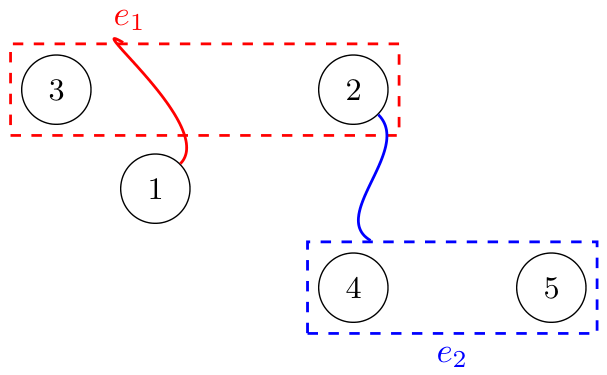
Note that the outgoing arc set denotes the set of all arcs with tail a (each of which may contain multiple heads). Hence, is a collection of arcs, while is a set of vertices. From the above definitions, it follows that every strongly connected directed hypergraph is also weakly connected. The example below shows that a weakly connected directed hypergraph need not be strongly connected.
Let be a three-uniform directed hypergraph with a vertex set and an arc set , where
Then,
is weakly connected. For any pair of distinct vertices, one can find a sequence of arcs with nonempty intersections between consecutive arcs (e.g.,
and
share vertex 2). However,
is not strongly connected. To see this, we compute the out-neighborhoods:
Indeed, vertex 1 is the tail of
only, and thus its out-neighbors are two and three; vertex 2 is the tail of
only, so its out-neighbors are four and five; vertices
are not tails of any arc; hence, their out-neighborhoods are empty. Because vertices
have no outgoing arcs, they cannot initiate any directed path. In particular, there is no directed path from five (or four or three) to one, and thus the condition
fails for some ordered pairs. Therefore,
is not strongly connected.
Figure 1 provides a visualization.
The following defines (generalized) regular directed hypergraphs [
23,
25].
Definition 2. For a k-uniform directed hypergraph , we introduce the following terminology:
(1) is called outdegree-regular (in-degree regular) if all () are equal to a common constant w.
(2) is called outdegree-semiregular if with , the outdegree of every vertex in U is , that of every vertex in W is and the subhypergraphs induced by U and W are both empty (i.e., contain no arcs).
Outdegree regularity is clearly a special case of outdegree semiregularity. To facilitate the subsequent analysis, we recall that the signless Laplacian tensor
is nonnegative and closely related to the hypergraph structure. We therefore summarize below several key properties of nonnegative tensors [
10,
33] that will be used later. Among these, two facts are particularly relevant. First,
is weakly irreducible if and only if
is strongly connected. Second, the weak irreducibility of
is equivalent to that of
.
Lemma 1. Let be a nonnegative tensor. Then, is an eigenvalue of with a nonnegative eigenvector. Moreover, if is weakly irreducible, then it admits a unique positive eigenvector x associated with up to a positive scalar multiple.
In the following, we introduce similarity transformations and some important properties of tensors. Let
be an
mth-order
n-dimensional tensor and
be a positive diagonal matrix. We define
as the tensor obtained from
by multiplying each entry by
; that is, we have
Lemma 2 (Theorem 2.8 of [
31])
. For two mth-order n-dimensional tensors and , if there exists a nonsingular diagonal matrix D such thatthen and have identical eigenvalues. 3. Bounds for the Signless Laplacian -Spectral Radius via Multiple (Two) Outdegrees
This section is devoted to deriving improved bounds for the signless Laplacian H-spectral radius by leveraging two or multiple outdegrees of a directed hypergraph. The proof framework for the subsequent theorems consists of three main steps: (1) selection of eigenvector components and characterization of their properties; (2) derivation of upper and lower bounds based on the chosen components and outdegree data and (3) investigation of the conditions under which equality is attained.
Theorem 1. Let be a k-uniform directed hypergraph on n vertices. Then, we have the following:
- (i)
If is strongly connected, then - (ii)
Moreover, if is strongly connected, then equality holds in both Equations (1) and (2) if and only if is outdegree-semiregular. Proof. (i) We establish the upper bound. Under Lemma 1, let
be a nonnegative eigenvector of
corresponding to
Choose an index
t such that
, and let
s be an index satisfying
From the
tth equation of
, we obtain
It follows from
and
that
Similarly, from the
sth equation, we have
which, after division by
(the case
is trivial; from the
tth equation, we have
), yields
In Theorem 5.1 of [
23], it was shown that
which implies
Taking the product of Equations (
4) and (
5) yields
By solving the inequality above, we obtain
which implies
(ii) We establish the lower bound. According to Lemma 1, strong connectivity of
implies that
is weakly irreducible, which guarantees a positive eigenvector
associated with the signless Laplacian
H-spectral radius
. Choose
t such that
, and choose
such that
. Applying the same arguments as in the proofs of Equations (
4) and (
5) yields
Taking the product of Equations (
6) and (
7) gives
By solving the inequality above, one has
and therefore
(iii) It remains to characterize equality. Suppose equality holds in Equation (
1). From the derivation of Equation (
4), equality forces
for every
; similarly, equality in Equation (
5) forces
for every
. We distinguish two cases.
Case I:
Let
. If
, then strong connectivity implies the existence of vertices
and
with
and
. Therefore, for the tail vertices
, we obtain
Substituting these relations into the eigenvalue equations gives a strict inequality
, contradicting the equality in Equation (
1). Thus,
, and so all outdegrees are equal, and
is outdegree-semiregular.
Case II:
Then,
for every
, and
for every
. Define
Clearly,
and
. For any
, choose
with
. Then, using
in the
H-eigenvalue equations, we obtain
and
Equivalently, we have
which imply
. Suppose that
For any
, it holds that
Consequently,
Therefore, the following equations hold simultaneously:
Since
from
, we obtain
We employ a proof by contradiction to establish that
Otherwise,
and one has
This, together with
, yields
which contradicts
Thus,
and
Arguing analogously for the case
yields
. By iterating this procedure and using the strong connectivity of
, we conclude that
, with the subhypergraphs induced by
U and
W being arc-free. Moreover, the outdegree is constant on each of the two parts, which implies that
is outdegree-semiregular.
Conversely, under the assumption of strong connectivity, the two-sided inequality in Equations (
1) and (
2) is satisfied:
Now, assume further that is outdegree-semiregular with bipartition . In this case, every arc must have its tail in one part and all its heads in the other so that is constant over all admissible pairs with . Consequently, both bounds coincide with , and equality holds. □
Remark 1. For a k-uniform directed hypergraph, with denoting the maximum outdegree, it holds that This directly implies that the bounds in Theorem 1 are sharper than those of Theorem 5.1 in [23]. Example 1. Let be a three-uniform directed hypergraph on five vertices with the following outgoing arcs: We verify that
is strongly connected and
which implies
,
and
Furthermore, the subhypergraphs induced by
U and
W are empty, which shows that
is outdegree-semiregular. Since the outdegrees
are not all equal to a common constant,
is not outdegree-regular. Using Theorem 1, we obtain
Compared with the precise bounds of Theorem 1, the estimation for
provided by Theorem 5.1 of [
23] is as follows:
This example illustrates the sharpness of our bounds when the structural assumptions (outdegree semiregularity) are met.
Unlike directed graphs, where each pair appears in at most one arc, a directed hypergraph can have multiple arcs with the same tail i containing the same head j. To account for this multiplicity, we define as the number of arcs with a tail i that contain j as a head. Selecting the second largest component of the eigenvector is also time-consuming, and thus we choose an arbitrary component of the eigenvector x to estimate the signless Laplacian H-spectral radius. To state the theorem more clearly, we introduce the following definition.
For every arc
and every vertex
, define
Let
be the largest real root in
of the equation
Equivalently,
can be written as
Theorem 2. Let be a k-uniform directed hypergraph on n vertices. Then, we have
- (i)
If is strongly connected, then - (ii)
Moreover, if is outdegree-regular with a common outdegree w, then .
Proof. (i) We establish the upper bound. According to Lemma 1, let
be a nonnegative eigenvector of
corresponding to
Define an index
t such that
and an arbitrary vertex
. From the
tth equation of
, one has
which shows that
We proceed by considering two cases:
Case I:
. Then, Equation (10) reduces to
By the definition of
, we have
, and hence
Case II:
. From Equation (10), if
, then
and the desired inequality for this
s follows. Otherwise, the factor is positive, and raising both sides of Equation (10) to the
th power yields
Under the
sth equation of
, it holds that
Multiplying Equations (11) and (12) gives
Then,
f is continuous and strictly increasing on
. If
, then again,
because
. If
. Then, from Equation (13), we have
Since
is the largest real number satisfying
and
f is increasing on
, it follows that
Thus, in all cases, we obtain
for the chosen
s. Since
s was arbitrary in
, we get
Taking the maximum over all arcs
yields
(ii) We establish the lower bound. Under Lemma 1, strong connectivity of
implies that
is weakly irreducible, which guarantees a positive eigenvector
associated with the signless Laplacian
H-spectral radius
. Define an index
t such that
and an arbitrary vertex
. From the same reasoning that led to Equations (10) and (12), we obtain
and
Since
and
, the factors
and
are nonnegative. Therefore,
Taking the
th power preserves the inequality direction and yields
The positivity of
and
, together with
, allows us to multiply Equations (14) and (15), yielding
We verify that
f is increasing on the interval
, and Equation (16) is exactly
By the definition of
as the largest real number satisfying
the monotonicity of
f on
implies
Since
s was chosen arbitrarily from
, the above inequality holds for every
. Therefore, we have
Taking the minimum over all arcs yields
(iii) It remains to verify that
. If
is outdegree-regular with
, then we confirm that the equation
has a positive real root, namely
, for any integer
. A direct substitution gives
which shows that
is indeed a root of the equation. Thus,
Under the assumption that
is outdegree-regular with a common outdegree
w, we have
, and hence
. Thus, the upper bound is exactly
. □
Remark 2. (i) In contrast to directed graphs, where , a directed hypergraph has , which can be advantageous for bounding the spectral radius.
(ii) A distinctive feature of our approach is that the proof of Theorem 2 does not require to be the second largest component of the eigenvector; the inequality holds for any chosen component . This is achieved by splitting the arcs with tail i into two classes according to whether they contain s or not, which yields the inequality This is valid for an arbitrary choice of s. Consequently, no optimality or ordering condition on is needed. This flexibility is a direct mathematical consequence of the classification argument rather than an additional assumption. In contrast to existing approaches that require identifying the second largest eigencomponent (e.g., the proof of Theorem 5.1 in [23]), our method avoids this step entirely, thereby reducing the computational cost while maintaining the validity of the bounds. (iii) For a k-uniform directed hypergraph, from Equation (8), there exists such that If , then the inequality yields either If , then we obtain Otherwise, when and , the inequality is equivalent to at least one of the following two conditions holding: If the first one holds, then . If the second one holds, then . Consequently, the proposed upper bound is no worse than the bound given in Theorem 5.1 of [23]. Moreover, as demonstrated in Examples 2 and 5, it can be strictly tighter in a number of cases. Example 2. Let be a three-uniform directed hypergraph on six vertices with the following outgoing arcs: It is easy to see that
Among the directed arcs with a tail at vertex 1, there is one arc with vertex 2 as a head, two arcs with vertex 3 as a head, and one arc with vertex 4 as a head; all other counts are zero. These values form the first row of the vector
. Similarly, we obtain
. Furthermore, the
matrix is given as follows:
Using Theorem 1, we obtain
From Theorem 2, we compute
The improvement in the upper bound from to demonstrates the advantage of incorporating the multiplicity parameter . This is particularly significant in applications where a tighter upper bound is required for spectral analysis.
While the previous theorem relies on the outdegree data of two vertices to bound the spectral radius, the following theorem makes use of the outdegree information of multiple vertices on the same edge, thereby achieving significantly better performance.
For each arc
, define
and let
be the largest real root in
of the equation
Theorem 3. Let be a k-uniform directed hypergraph on n vertices. For each arc the following apply:
and if is strongly connected, then
Moreover, if is strongly connected and outdegree-regular, then equality holds in both Equations (17) and (18).
Proof. (i) We establish the upper bound. Under Lemma 1, let
be a nonnegative eigenvector of
corresponding to
From the
th equation of
, we obtain
and
Define
as the maximum of the products
over all arcs. Then, for every
, the following inequality holds:
We now distinguish two cases.
Case I:
Since
x is nonzero, there exists
such that
. Applying Equation (20) gives
which shows that
Hence, the desired bound holds trivially.
Case II: Suppose that for some edge .
If
for some
, then Equation (20) yields
Since , we have , and consequently , confirming the validity of the result.
Now, assume that
for all vertices in the chosen edge. By definition, there exists an edge
such that
For each vertex
in this edge, we obtain
Multiplying the
k inequalities (Equation (21)) together yields
Since
we obtain
Then,
g is continuous and strictly increasing on
. Since
is the largest real number satisfying
and
g is increasing on
, it follows that
This implies that
. Taking the maximum over all arcs
yields
(ii) We establish the lower bound. From Lemma 1, strong connectivity of
implies that
is weakly irreducible, which guarantees a positive eigenvector
associated with the signless Laplacian
H-spectral radius
. Define
as the minimum of the products
over all arcs
. Then, for every
, the following inequality holds:
Set
Then, we have
When multiplying the multiple inequalities above, we have
Then,
g is continuous and strictly increasing on
. Since
is the largest real number satisfying
and
g is increasing on
, it follows that
This implies that
. Taking the minimum over all arcs
yields
(iii) If is outdegree-regular with a common outdegree w, then for every arc , we have for all t. Thus, is the largest root of , i.e., . Hence, both and equal . Since the all-ones vector gives , equality holds in both bounds. □
Example 3. Let be a four-uniform strongly connected directed hypergraph on six vertices with the following outgoing arcs: We can verify that
is neither outdegree-semiregular nor outdegree-regular. The estimation for
provided by Theorem 5.1 of [
23] is as follows:
For every arc
(
), Theorem 3 gives the same inequality:
Solving equality for
numerically (using Newton’s method) yields the unique root
As stated above, Theorem 3 provides a sufficient condition for equality to hold in both bounds.
4. Bounds for the Signless Laplacian -Spectral Radius via Similarity Transformation
We establish bounds for by means of similarity transformations. By averaging the outdegree information of adjacent vertices, the similarity transformation allows us to derive more refined bounds without losing spectral information. This method may provide tighter results than the degree-based approach.
Let
be a
k-uniform directed hypergraph, and let
for
Moreover, for each vertex
i, define
which we refer to as the average two-outdegree of
i.
Definition 3. Let be a k-uniform directed hypergraph, and let and denote the average two-outdegree and average two-in-degree of vertex , respectively.
(i) For some constant w, is said to be average two-outdegree-regular if for all . Analogously, it is average two-in-degree-regular if .
(ii) is called average two-outdegree-semiregular if with , the average two-outdegree of every vertex in U is , the average two-outdegree of every vertex in W is , and the subhypergraphs induced by U and W are both empty (i.e., contain no arcs).
Note that the strong connectivity of the directed hypergraph is preserved under the similarity transformation. Through the similarity transformation, we obtain the average two-outdegree information. The subsequent theorems utilize both outdegree and average two-outdegree data to characterize the signless Laplacian H-spectral radius.
Theorem 4. Let be a k-uniform directed hypergraph on n vertices with outdegrees for . Then, we have
- (i)
If is strongly connected, then - (ii)
In the strongly connected and average two-outdegree-regular case, equality in Equations (23) and (24) is attained if and only if is outdegree-regular.
Proof. (i) We establish the upper bound. Let
, and define
by
Lemma 2 yields
, while Lemma 1 guarantees a nonnegative eigenvector
associated with the signless Laplacian
H-spectral radius
. Define
such that
for
. From the
tth equation of
and
, we obtain
Using
and
, we obtain
which implies
(ii) We establish the lower bound. Let
, and define
by
Lemma 2 yields
. Strong connectivity of
implies that
is weakly irreducible, which guarantees a positive eigenvector
associated with the signless Laplacian
H-spectral radius
from Lemma 1. Define
and
for
. An argument parallel to that for Equation (25) gives
(iii) It remains to characterize equality. Assume equality holds in Equation (23). Then, Equation (25) implies
for every
. Define
. If
, since
is strongly connected, then there exists an arc from
to
. Choose
and
with
, and choose
with
. The
H-eigenvalue equations together with Lemma 2 yield
and thus
, which contradicts the equality condition in Equation (23). Hence,
, and
Since is average two-outdegree-regular, there exists a constant c such that for all . It follows that is independent of i. Thus, is outdegree-regular.
Conversely, if is strongly connected and outdegree-regular, then equality in Equations (23) and (24) is attained. □
Remark 3. (i) Outdegree regularity implies average two-outdegree regularity but not conversely (see Example 4).
(ii) For a directed hypergraph, average two-outdegree regularity suffices to precisely determine its H-spectral radius [25], whereas an exact characterization of the signless Laplacian H-spectral radius requires outdegree regularity. Example 4. Let be a three-uniform directed hypergraph on 12 vertices with the following outgoing arcs: Furthermore, we compute
which implies that
is average two-outdegree-regular. From Theorem 4, we obtain
Compared with the bounds of Theorem 1, the estimation for
provided by Theorem 5.1 of [
23] is as follows:
As stated above, similarity transformations can sometimes balance the discrepancies among outdegrees, thereby yielding better estimates for the signless Laplacian H-spectral radius.
Theorem 4 demonstrates that bounds based on a single outdegree and a single average two-outdegree are already effective in certain settings. A natural extension is to consider two outdegrees and two average two-outdegrees, with the expectation of obtaining tighter bounds for the signless Laplacian spectral radius.
Theorem 5. Let be a k-uniform directed hypergraph on n vertices with outdegrees for . Then, we have
- (i)
If is strongly connected, then - (ii)
Moreover, if is strongly connected and outdegree-semiregular, then equality holds in both Equations (26) and (27).
Proof. (i) We establish the upper bound. Let
, and define
by
Lemma 2 yields
, while Lemma 1 guarantees a nonnegative eigenvector
associated with the signless Laplacian
H-spectral radius
. Choose an index
t such that
, and let
s be an index satisfying
From the
tth equation of
and
, we obtain
It follows from
and
that
Similarly, from the
sth equation, we find that
which, after division by
(the case
is trivial; from the
tth equation, we have
), yields
Taking the product of Equations (29) and (31) yields
By solving the inequality above, one has
which shows that
(ii) We establish the lower bound. Let
, and define
by
Lemma 2 yields
. Strong connectivity of
implies that
is weakly irreducible, which guarantees a positive eigenvector
associated with the signless Laplacian
H-spectral radius
from Lemma 1. Choose
t such that
, and choose
such that
. Arguing analogously to Equations (29) and (31), we have
Multiplying Equations (33) and (34) yields
and
(iii) It remains to characterize equality. Under the assumption of strong connectivity, the two-sided inequality in Equations (26) and (27) is satisfied:
Now, assume further that is outdegree-semiregular with bipartition . In this case, every arc must have its tail in one part and all its heads in the other, which implies that and are constant over all admissible pairs with . Consequently, both bounds coincide with , and equality holds. □
Remark 4. (i) Outdegree semiregularity implies average two-outdegree semiregularity, but the converse need not hold. Example 4 serves as a counterexample to the reverse implication.
(ii) For an adjacency hypergraph, average two-outdegree semiregularity suffices to precisely determine its H-spectral radius [25], whereas an exact characterization of the signless Laplacian H-spectral radius requires outdegree semiregularity. Example 5. Let be a three-uniform directed hypergraph with vertex set , where and , with the arc set Furthermore,
and
and the induced subhypergraphs on
U and
W are empty. Thus,
is outdegree-semiregular but not outdegree-regular. Moreover, we have
Therefore, and and the induced subhypergraphs on U and W are empty. Hence, is average two-outdegree-semiregular but not average two-outdegree-regular.
According to
Table 1, Theorems 1 and 5 give the exact spectral radius
. This is because
is strongly connected and outdegree-semiregular, which are precisely the equality conditions stated in these theorems. Theorem 2 provides the tighter estimate, with a width of
, while Theorem 5.1 of [
23] and Theorem 4 give the wider intervals. This demonstrates that the multiplicity parameter
can significantly improve the crude bounds.
We now proceed to establish refined estimates for the signless Laplacian H-spectral radius by incorporating the average two-outdegree information associated with each arc.
For each arc
, define
and let
be the largest real root in
of the equation
Theorem 6. Let be a k-uniform directed hypergraph on n vertices. For each arc we have
and if is strongly connected, then
Moreover, if is strongly connected and outdegree-regular, then equality holds in both Equations (36) and (37).
Proof. (i) We establish the upper bound. Let
, and define
by
Lemma 2 yields
, while Lemma 1 guarantees a nonnegative eigenvector
associated with the signless Laplacian
H-spectral radius
. Define
as the maximum of the products
over all arcs
. For every
, using the
th equation of
and
, one has
We now distinguish two cases.
Case I:
Since
x is nonzero, there exists
such that
. Applying Equation (38) gives
which shows that
Hence, the desired bound holds trivially.
Case II: Suppose that for some edge .
If
for some
, then Equation (38) yields
Since , we have , and consequently , confirming the validity of the result.
Now, assume that
for all vertices in the chosen edge. By definition, there exists an edge
such that
For each vertex
in this edge, we obtain
Multiplying the
k inequalities (Equation (39)) together yields
Since
we obtain
Then,
g is continuous and strictly increasing on
. Since
is the largest real number satisfying
and
g is increasing on
, it follows that
This implies that
. Taking the maximum over all arcs
yields
(ii) We establish the lower bound. Let
, and define
by
Lemma 2 yields
. Strong connectivity of
implies that
is weakly irreducible, which guarantees a positive eigenvector
associated with the signless Laplacian
H-spectral radius
from Lemma 1. Define
as the minimum of the products
over all arcs
. Then, for every
, the following inequality holds:
Let
be an arc such that
. Then, from applying Equation (40) to each
, we have
By multiplying the multiple inequalities above, we have
Let
. On the interval
, each factor
is nonnegative and strictly increasing, and thus
g is continuous and strictly increasing. Let
be the unique real number in
satisfying
Under the monotonicity of
g, we have
Taking the minimum over all arcs
yields
(iii) It remains to characterize equality. Under the assumptions of strong connectivity and outdegree regularity, it follows that and for every . Hence, is constant, which immediately yields the equalities. □
Example 6. Let be a four-uniform directed hypergraph with a vertex set , where and , with the arc set Thus,
and
. Although the vertex set admits a partition
such that the outdegrees are constant on each part, the induced subhypergraphs on
U and
W are not empty. Therefore,
is not outdegree-semiregular. Moreover, we have
Thus, and Since the induced subhypergraphs on U and W are not empty, is not average two-outdegree-semiregular.
As illustrated by this example, the failure of outdegree semiregularity prevents Theorems 1 and 5 from attaining the exact spectral radius. However,
Table 2 reveals that even in the absence of regularity or even semiregularity, the product-type bounds established in Theorems 3 and 6 may still capture the precise value of the spectral radius. This underscores the complementary nature and versatility of the proposed approaches.
As illustrated by this example, the failure of outdegree semiregularity prevents Theorems 1 and 5 from attaining the exact spectral radius. However, the same example reveals that even in the absence of regularity or even semiregularity, the product-type bounds established in Theorems 3 and 6 may still capture the precise value of the spectral radius. This underscores the complementary nature and versatility of the proposed approaches.